TOEFL IBT
The Internet-based Test of English as a
Foreign Language
(International TOEFL)
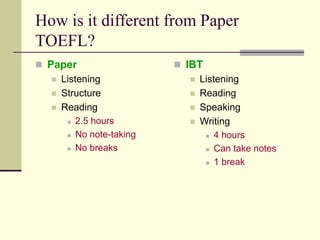
How is it different from Paper
TOEFL?
 Paper
 Listening
 Structure
 Reading
 2.5 hours
 No note-taking
 No breaks
 IBT
 Listening
 Reading
 Speaking
 Writing
 4 hours
 Can take notes
 1 break
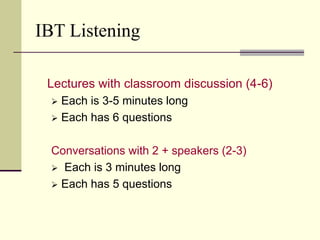
IBT Listening
Lectures with classroom discussion (4-6)
 Each is 3-5 minutes long
 Each has 6 questions
Conversations with 2 + speakers (2-3)
 Each is 3 minutes long
 Each has 5 questions
What’s new in listening?
 One speaker is always a student on campus.
 A variety of accents (one is always British)
 Time 60-90 minutes
 Score: 0 – 30
 Questions about pragmatic understanding
and connections between ideas
What is pragmatic understanding?
 Recognize speakers’ purpose (apologizing,
complaining, suggesting, etc.)
 Recognize speaker’s attitude or feelings
 Decide how certain or sure the speaker is
 How is the speaker using stress for meaning?
Connections between ideas
 Organization of information
 Relationships between ideas (cause/effect,
compare/contrast, etc.)
 Recognizing topic changes
 Making inferences
 Knowing about “asides” (when people
mention unrelated information in a
conversation)
Speaking Section
 2 independent tasks – Speak about personal
or familiar experiences
 4 integrated tasks
 2 Reading/Listening/Speaking tasks (Talk
about what you read and heard.)
 2 Listening/Speaking tasks (Talk about what
you heard and your opinion.)
Independent speaking
 Task 1 – Talk about a personal preference
and defend it.
 Task 2 – Choose between 2 possible actions
or behaviors and explain your choice.
 For each choice: 15 seconds to prepare; 45
seconds to answer.
Integrated speaking
 Read some information.
 Listen to other information
 Use the information in both of them to answer
a question.
 For example: 1) Read about how we know if
animals are “domesticated.” 2) Then listen to
a lecture on antelope behavior. 3) Question:
Are antelopes domesticated animals?
 30 seconds to prepare; 60 seconds to answer
Integrated speaking with listening
 Listen to 2 solutions for a problem.
 Talk about the two ideas, which one you
prefer, and why.
 Time: 20 seconds to prepare; 60 seconds to
speak
Tips for speaking
 You are scored from 0 to 4 on each task.
 If you say anything, you get a 1. Always say
SOMETHING.
 Self-correction is good. You are being graded
on ideas, grammar, and pronunciation. Make
sure you say it correctly.
 Keep an even flow of speech.
 Use stress, intonation, and pauses well.
 Overall score: 0-30
Reading Section
 Passages from textbooks (3-5)
 Each passage has 12-14 questions.
 You can look at the reading when answering
the questions.
 Time: 60-100 minutes
 Score: 0-30
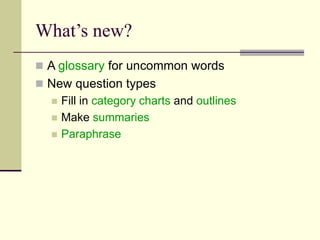
What’s new?
 A glossary for uncommon words
 New question types
 Fill in category charts and outlines
 Make summaries
 Paraphrase
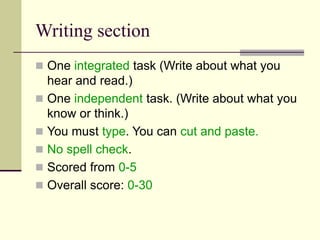
Writing section
 One integrated task (Write about what you
hear and read.)
 One independent task. (Write about what you
know or think.)
 You must type. You can cut and paste.
 No spell check.
 Scored from 0-5
 Overall score: 0-30
Integrated writing
 Read a short passage (230-300 words) in 3
minutes.
 Listen to a person discuss the topic for 2
minutes.
 Write an answer to a question in 20 minutes
(150-225 words).
 There is a word counter to help you.
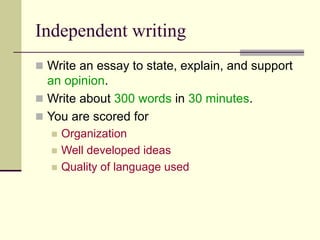
Independent writing
 Write an essay to state, explain, and support
an opinion.
 Write about 300 words in 30 minutes.
 You are scored for
 Organization
 Well developed ideas
 Quality of language used
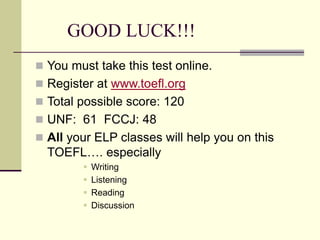
GOOD LUCK!!!
 You must take this test online.
 Register at www.toefl.org
 Total possible score: 120
 UNF: 61 FCCJ: 48
 All your ELP classes will help you on this
TOEFL…. especially
 Writing
 Listening
 Reading
 Discussion

TOEFL overview.ppt

  • 1.
    TOEFL IBT The Internet-basedTest of English as a Foreign Language (International TOEFL)
  • 2.
    How is itdifferent from Paper TOEFL?  Paper  Listening  Structure  Reading  2.5 hours  No note-taking  No breaks  IBT  Listening  Reading  Speaking  Writing  4 hours  Can take notes  1 break
  • 3.
    IBT Listening Lectures withclassroom discussion (4-6)  Each is 3-5 minutes long  Each has 6 questions Conversations with 2 + speakers (2-3)  Each is 3 minutes long  Each has 5 questions
  • 4.
    What’s new inlistening?  One speaker is always a student on campus.  A variety of accents (one is always British)  Time 60-90 minutes  Score: 0 – 30  Questions about pragmatic understanding and connections between ideas
  • 5.
    What is pragmaticunderstanding?  Recognize speakers’ purpose (apologizing, complaining, suggesting, etc.)  Recognize speaker’s attitude or feelings  Decide how certain or sure the speaker is  How is the speaker using stress for meaning?
  • 6.
    Connections between ideas Organization of information  Relationships between ideas (cause/effect, compare/contrast, etc.)  Recognizing topic changes  Making inferences  Knowing about “asides” (when people mention unrelated information in a conversation)
  • 7.
    Speaking Section  2independent tasks – Speak about personal or familiar experiences  4 integrated tasks  2 Reading/Listening/Speaking tasks (Talk about what you read and heard.)  2 Listening/Speaking tasks (Talk about what you heard and your opinion.)
  • 8.
    Independent speaking  Task1 – Talk about a personal preference and defend it.  Task 2 – Choose between 2 possible actions or behaviors and explain your choice.  For each choice: 15 seconds to prepare; 45 seconds to answer.
  • 9.
    Integrated speaking  Readsome information.  Listen to other information  Use the information in both of them to answer a question.  For example: 1) Read about how we know if animals are “domesticated.” 2) Then listen to a lecture on antelope behavior. 3) Question: Are antelopes domesticated animals?  30 seconds to prepare; 60 seconds to answer
  • 10.
    Integrated speaking withlistening  Listen to 2 solutions for a problem.  Talk about the two ideas, which one you prefer, and why.  Time: 20 seconds to prepare; 60 seconds to speak
  • 11.
    Tips for speaking You are scored from 0 to 4 on each task.  If you say anything, you get a 1. Always say SOMETHING.  Self-correction is good. You are being graded on ideas, grammar, and pronunciation. Make sure you say it correctly.  Keep an even flow of speech.  Use stress, intonation, and pauses well.  Overall score: 0-30
  • 12.
    Reading Section  Passagesfrom textbooks (3-5)  Each passage has 12-14 questions.  You can look at the reading when answering the questions.  Time: 60-100 minutes  Score: 0-30
  • 13.
    What’s new?  Aglossary for uncommon words  New question types  Fill in category charts and outlines  Make summaries  Paraphrase
  • 14.
    Writing section  Oneintegrated task (Write about what you hear and read.)  One independent task. (Write about what you know or think.)  You must type. You can cut and paste.  No spell check.  Scored from 0-5  Overall score: 0-30
  • 15.
    Integrated writing  Reada short passage (230-300 words) in 3 minutes.  Listen to a person discuss the topic for 2 minutes.  Write an answer to a question in 20 minutes (150-225 words).  There is a word counter to help you.
  • 16.
    Independent writing  Writean essay to state, explain, and support an opinion.  Write about 300 words in 30 minutes.  You are scored for  Organization  Well developed ideas  Quality of language used
  • 17.
    GOOD LUCK!!!  Youmust take this test online.  Register at www.toefl.org  Total possible score: 120  UNF: 61 FCCJ: 48  All your ELP classes will help you on this TOEFL…. especially  Writing  Listening  Reading  Discussion