Copyright and Fair Use Guidelines For Teachers:Printed Material By: Rebecca GantnierEDT 415 4/12/11
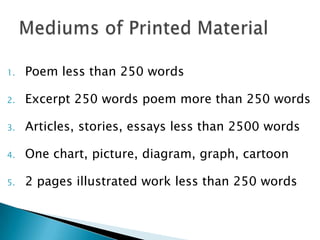
Poem less than 250 wordsExcerpt 250 words poem more than 250 wordsArticles, stories, essays less than 2500 wordsOne chart, picture, diagram, graph, cartoon 2 pages illustrated work less than 250 wordsMediums of Printed Material
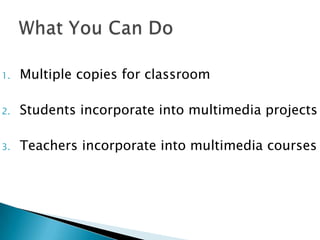
Multiple copies for classroom Students incorporate into multimedia projectsTeachers incorporate into multimedia coursesWhat You Can Do
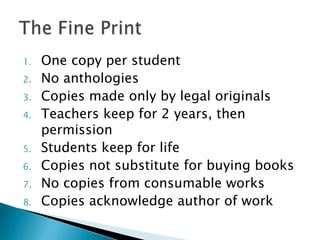
One copy per studentNo anthologiesCopies made only by legal originalsTeachers keep for 2 years, then permissionStudents keep for life Copies not substitute for buying booksNo copies from consumable works Copies acknowledge author of workThe Fine Print
Use works repeatedly Use for commercial or noneducational reasonsUse work in entirety, more than 2500 wordsWhen To Get Permission
Needs 4 copies of book-copies made of book in entiretyViolates law-copies not used as substitute for purchasing2. Teach sequencing-copy entire picture book, mix up pages, put in orderViolates law—only two pages allowed from picture bookExample of Violation of Law
"Copyright and Fair Use in the Classroom, on the Internet, and the World Wide Web ." University of Maryland University College . University of Maryland University College , 2010. Web. 11 Apr 2011. <http://www.umuc.edu/library/copy.shtml>. "Do’s and Don’ts of Copyright Issues for Educators." Copyright @ Schools – Print and Video Materials. Office of Educational Media and Technologies, n.d. Web. 11 Apr 2011. http://www.howard.k12.md.us/met/media/copyright/copyrightprintvideo.PDF"Classroom Copyright Chart ." Copyright and Fair Use Guidelines for Teachers. N.p., n.d. Web. 11 Apr 2011. <http://www.halldavidson.net/chartshort.html>. Bibliography

Copyright and fair use guidelines for teachers

  • 1.
    Copyright and FairUse Guidelines For Teachers:Printed Material By: Rebecca GantnierEDT 415 4/12/11
  • 2.
    Poem less than250 wordsExcerpt 250 words poem more than 250 wordsArticles, stories, essays less than 2500 wordsOne chart, picture, diagram, graph, cartoon 2 pages illustrated work less than 250 wordsMediums of Printed Material
  • 3.
    Multiple copies forclassroom Students incorporate into multimedia projectsTeachers incorporate into multimedia coursesWhat You Can Do
  • 4.
    One copy perstudentNo anthologiesCopies made only by legal originalsTeachers keep for 2 years, then permissionStudents keep for life Copies not substitute for buying booksNo copies from consumable works Copies acknowledge author of workThe Fine Print
  • 5.
    Use works repeatedlyUse for commercial or noneducational reasonsUse work in entirety, more than 2500 wordsWhen To Get Permission
  • 6.
    Needs 4 copiesof book-copies made of book in entiretyViolates law-copies not used as substitute for purchasing2. Teach sequencing-copy entire picture book, mix up pages, put in orderViolates law—only two pages allowed from picture bookExample of Violation of Law
  • 7.
    "Copyright and FairUse in the Classroom, on the Internet, and the World Wide Web ." University of Maryland University College . University of Maryland University College , 2010. Web. 11 Apr 2011. <http://www.umuc.edu/library/copy.shtml>. "Do’s and Don’ts of Copyright Issues for Educators." Copyright @ Schools – Print and Video Materials. Office of Educational Media and Technologies, n.d. Web. 11 Apr 2011. http://www.howard.k12.md.us/met/media/copyright/copyrightprintvideo.PDF"Classroom Copyright Chart ." Copyright and Fair Use Guidelines for Teachers. N.p., n.d. Web. 11 Apr 2011. <http://www.halldavidson.net/chartshort.html>. Bibliography

Editor's Notes

  • #5 7. Consumable works= workbooks 8. The copies should include a notice of copyright acknowledging the author of the work.
  • #7 A teacher needs four extra copies of a book for classroom use. Copies are made of thebook in its entirety.This violates the copyright law because employees may not copy as a substitute forpurchasing a book.A teacher wishes to teach the concept of sequencing. To help students visualize theprocess, the teacher copies a picture book for each student and mixes up the pages. Thestudents are then asked to put the pages in the correct sequence.This violates the limit on brevity. Only two pages may be copied from a picture book.