Standards & elements
• S6E2. Students will understand the
  effects of the relative positions of the
  earth, moon and sun.
• a. Demonstrate the phases of the moon
  by showing the alignment of the earth,
  moon, and sun.
• b. Explain the alignment of the earth,
  moon, and sun during solar and lunar
  eclipses.
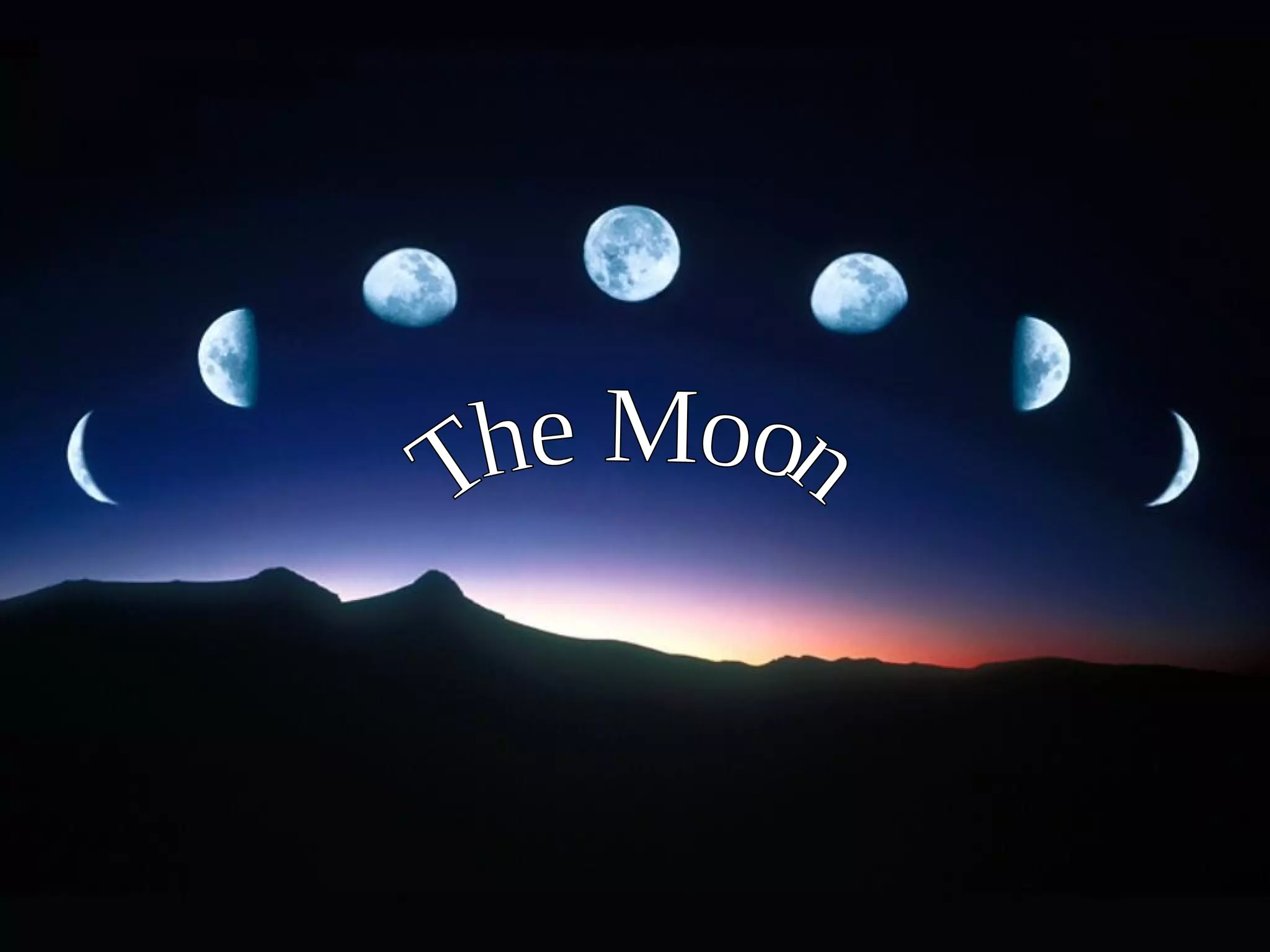
The Moon and You
•   Meet your moon.
•   What do we see?
•   What does it do to Earth?
•   What if you traveled to the moon?
•   Where did it come from?
• How is the moon’s motion around the
  Earth observed?
Check what you know:
   Does the Moon orbit the Earth?
The Earth takes a year to orbit around the Sun.
   What about the Moon? Does it orbit the Earth?
   Circle the answer you think best describes the
   motion of the Moon.
A. The Moon orbits the Earth about once a day.
B. The Moon orbits the Earth about once a week.
C. The Moon orbits the Earth about once a
   month.
D. The Moon orbits the Earth about once a year.
E. The Moon does not orbit the Earth.

            Uncovering Student Ideas in Astronomy pg 99
INTRODUCTION
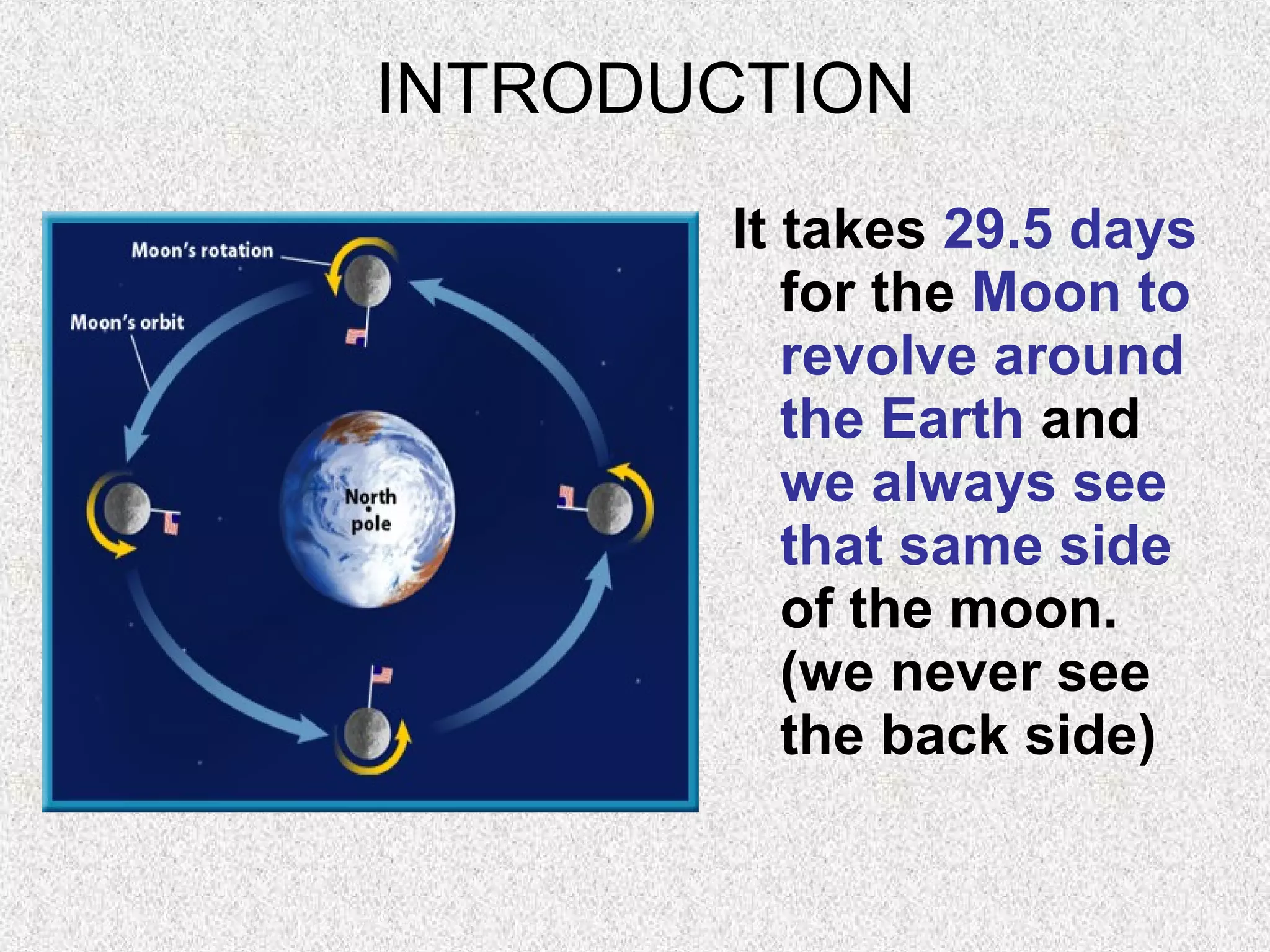
       It takes 29.5 days
          for the Moon to
          revolve around
          the Earth and
          we always see
          that same side
          of the moon.
          (we never see
          the back side)
Why do we have MOON PHASES?


Different amounts of sunlight
 light up the moon and, from
 Earth, makes the moon appear
 to have “different shapes” or
 phases.
How big is the Moon?
• Wall-e Learns about Proportions
Check what you know:
           Seeing the Moon
How often have you looked up into the sky and
  seen the Moon? Put an X next to all the times
  when you think you can go outside and see the
  Moon.
____ in the morning
____ at noon
____ in the middle of the afternoon
____ in the evening before sunset
____ in the evening after sunset
____ at midnight

            Uncovering Student Ideas in Astronomy pg 91
What do we see?
• The Phases of the Moon
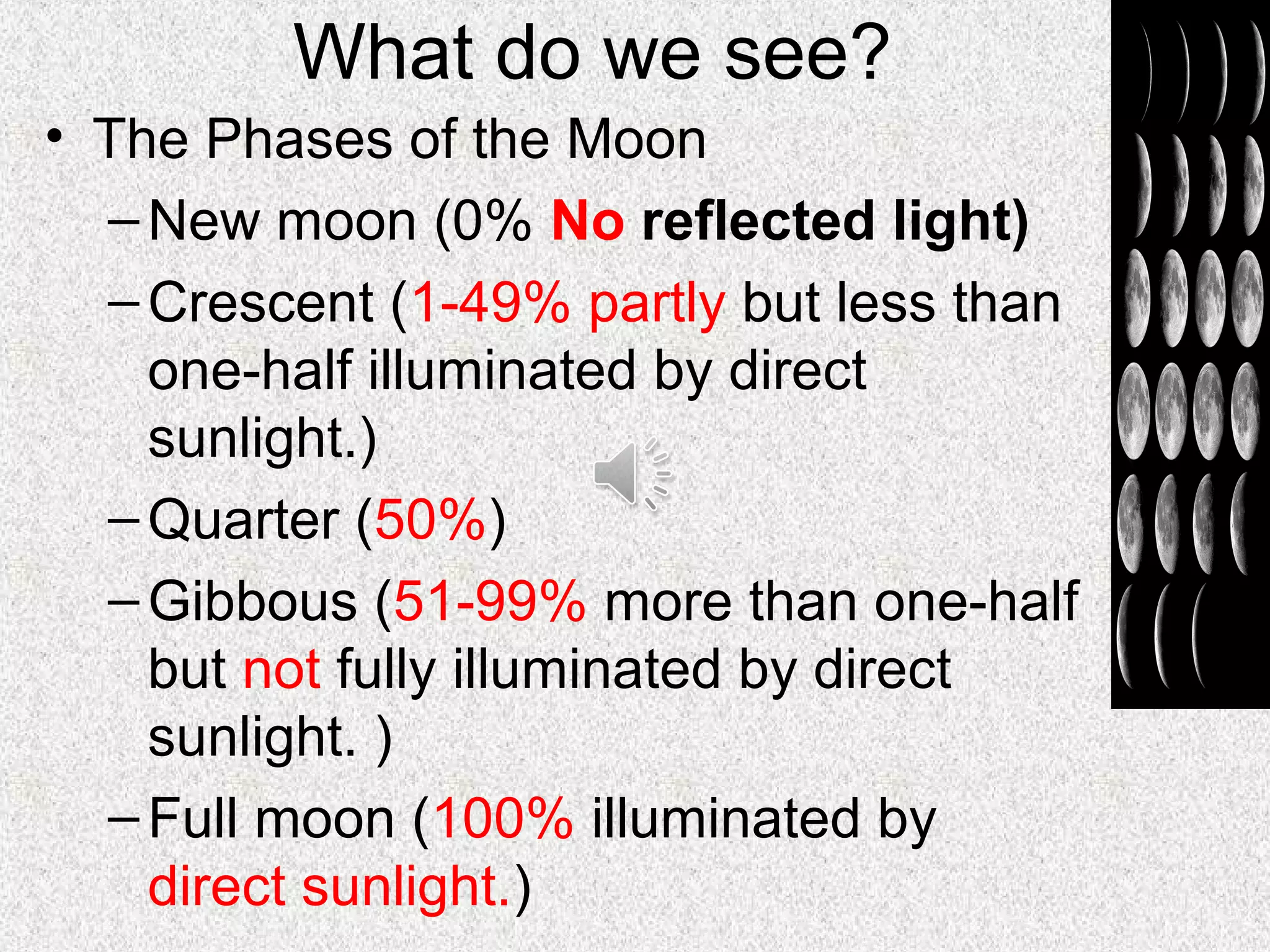
  – New moon (0% No reflected light)
  – Crescent (1-49% partly but less than
    one-half illuminated by direct
    sunlight.)
  – Quarter (50%)
  – Gibbous (51-99% more than one-half
    but not fully illuminated by direct
    sunlight. )
  – Full moon (100% illuminated by
    direct sunlight.)
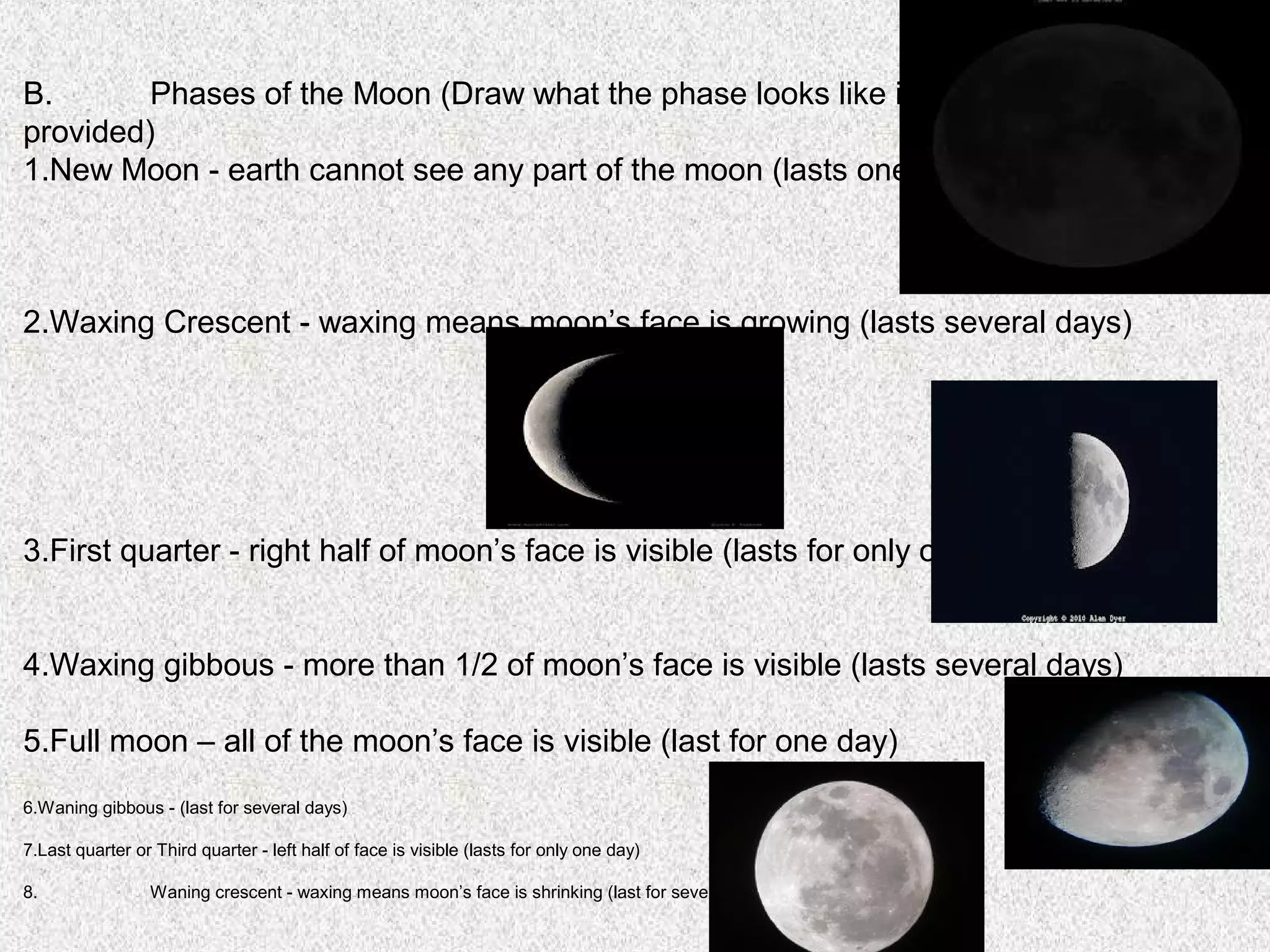
B.       Phases of the Moon (Draw what the phase looks like in the boxes
provided)
1.New Moon - earth cannot see any part of the moon (lasts one day)


2.Waxing Crescent - waxing means moon’s face is growing (lasts several days)


3.First quarter - right half of moon’s face is visible (lasts for only one day)


4.Waxing gibbous - more than 1/2 of moon’s face is visible (lasts several days)

5.Full moon – all of the moon’s face is visible (last for one day)
6.Waning gibbous - (last for several days)

7.Last quarter or Third quarter - left half of face is visible (lasts for only one day)

8.               Waning crescent - waxing means moon’s face is shrinking (last for several days)
W all the crazy words for the moon phases?
       hy
Most of these words are based in Latin or Greek (those dudes way back when that
  started doing science and observing space!)
CRESCENT- like the shape, curve.
GIBBOUS- think bulging for those two “b”s in
 the middle of the word. This shape is bigger
 than half, but less than full.
WAXING- Think “Wax On” from Karate Kid. It
 means getting bigger. Light is being
 “added” and the moon is looking bigger
 each day.
WANING- It means getting smaller. Since we
 say “Way-ning”…. I think of it as “going
 AWAY”. Moon appears to be “shrinking”
 each day.
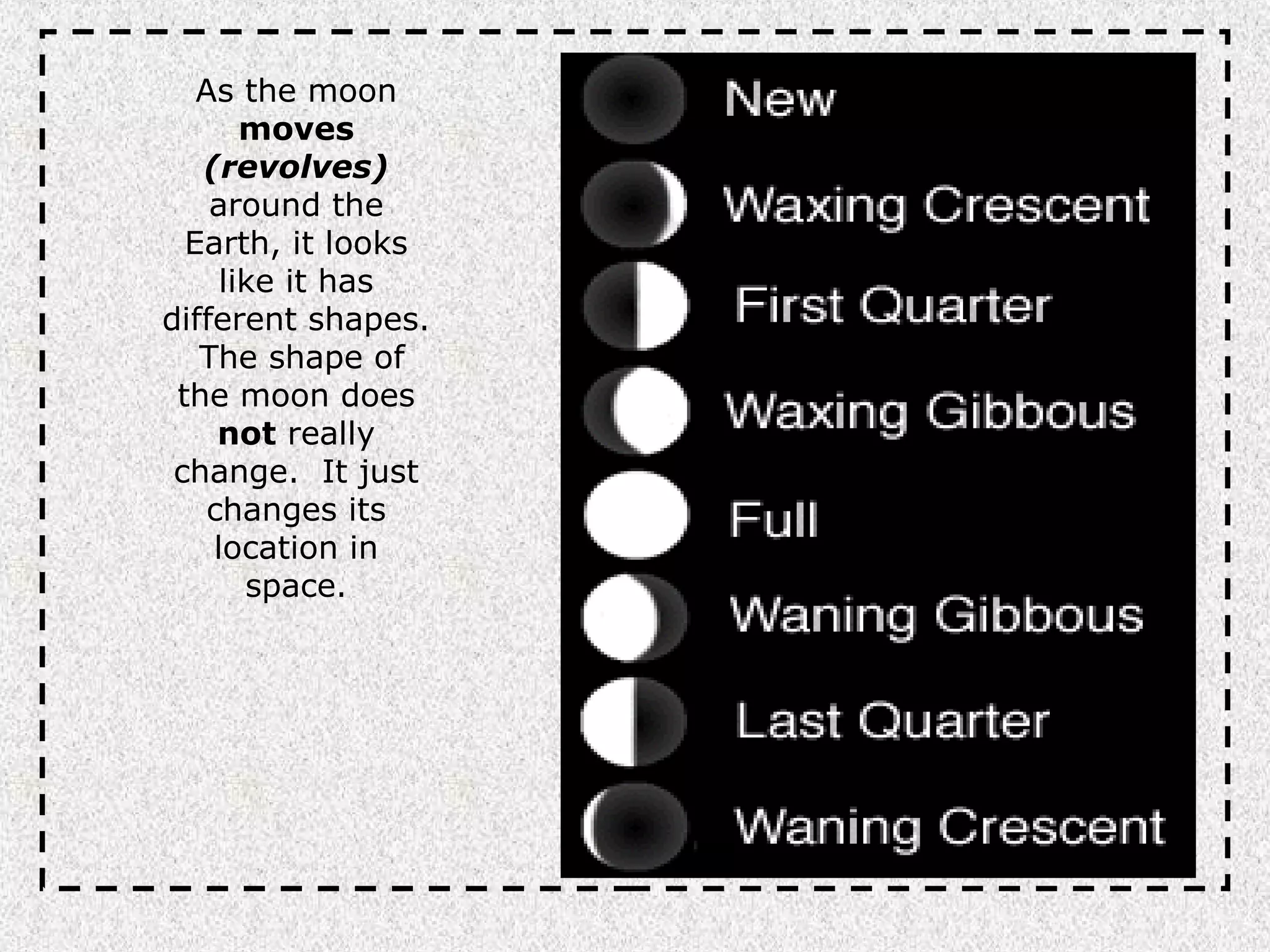
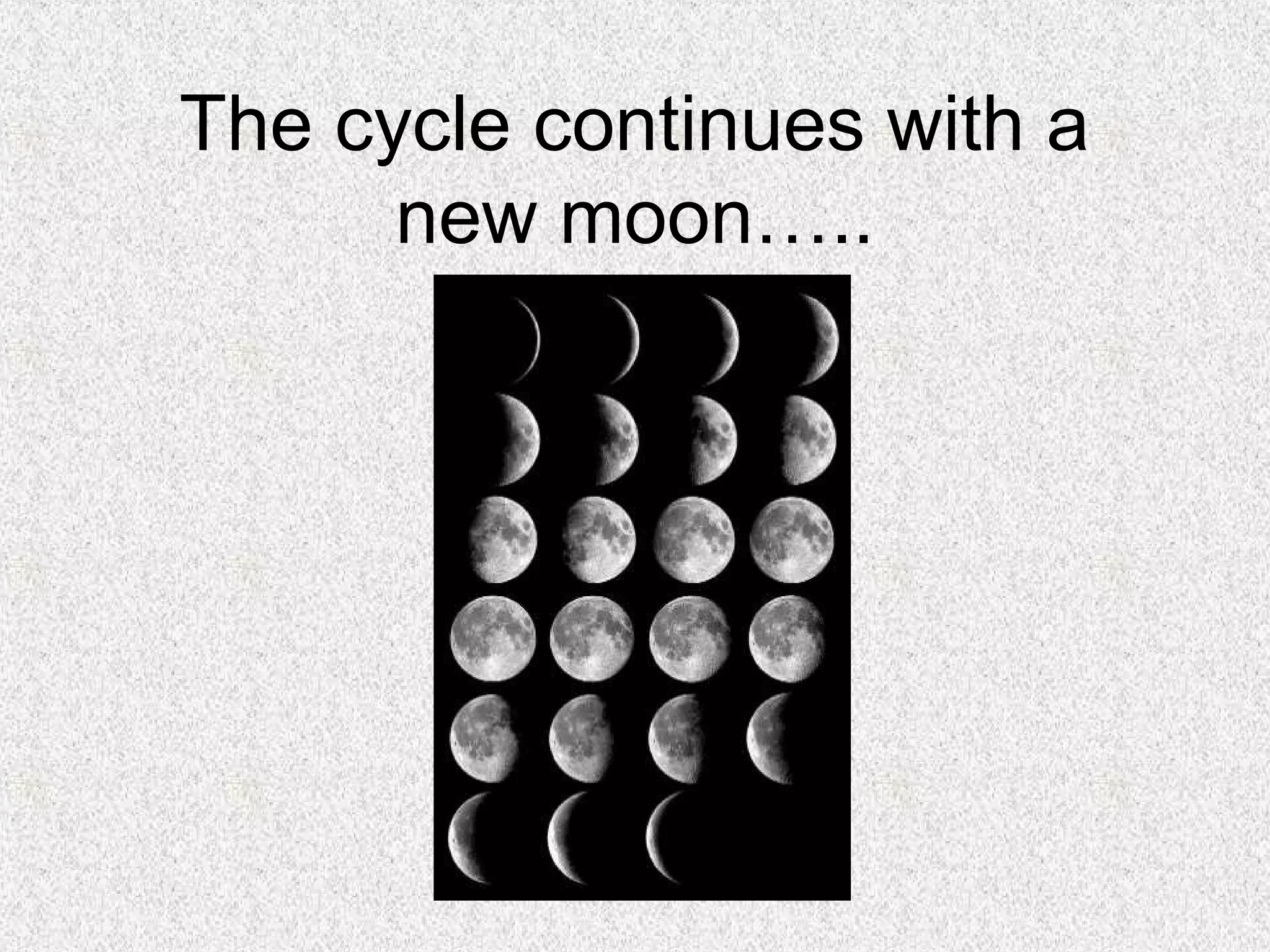
As the moon
       moves
   (revolves)
    around the
  Earth, it looks
     like it has
different shapes.
   The shape of
 the moon does
     not really
 change. It just
    changes its
    location in
       space.
The cycle continues with a
      new moon…..
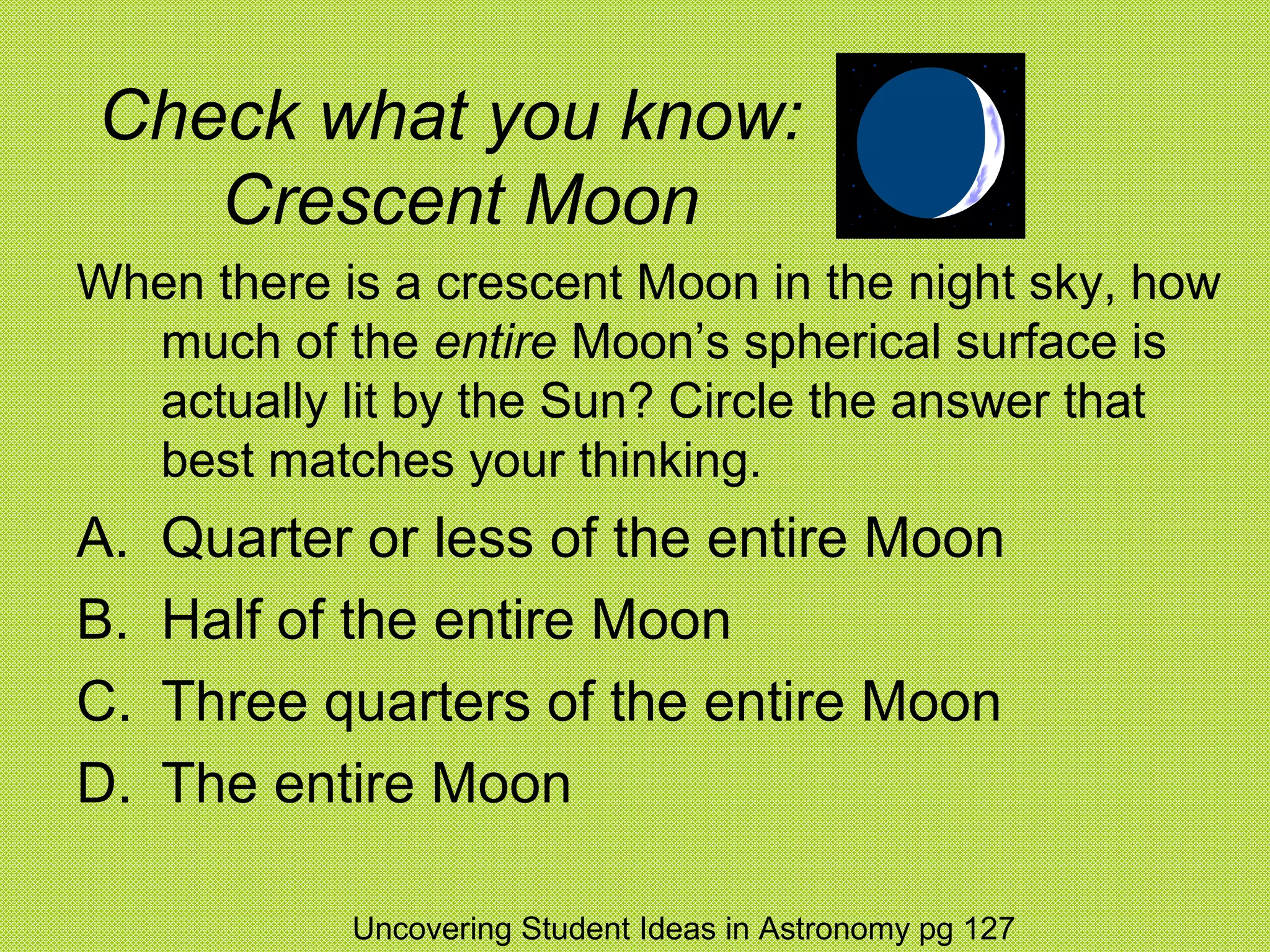
Check what you know:
   Crescent Moon
When there is a crescent Moon in the night sky, how
  much of the entire Moon’s spherical surface is
  actually lit by the Sun? Circle the answer that
  best matches your thinking.
A.   Quarter or less of the entire Moon
B.   Half of the entire Moon
C.   Three quarters of the entire Moon
D.   The entire Moon

            Uncovering Student Ideas in Astronomy pg 127
Why do we see “phases” of the moon?
•   NASA animation- Moon Phases in 2013
•   View from Above
•   Lunar Phase Simulator
•   Brainpop
Check what you know:
    Moon Phase and Solar Eclipse
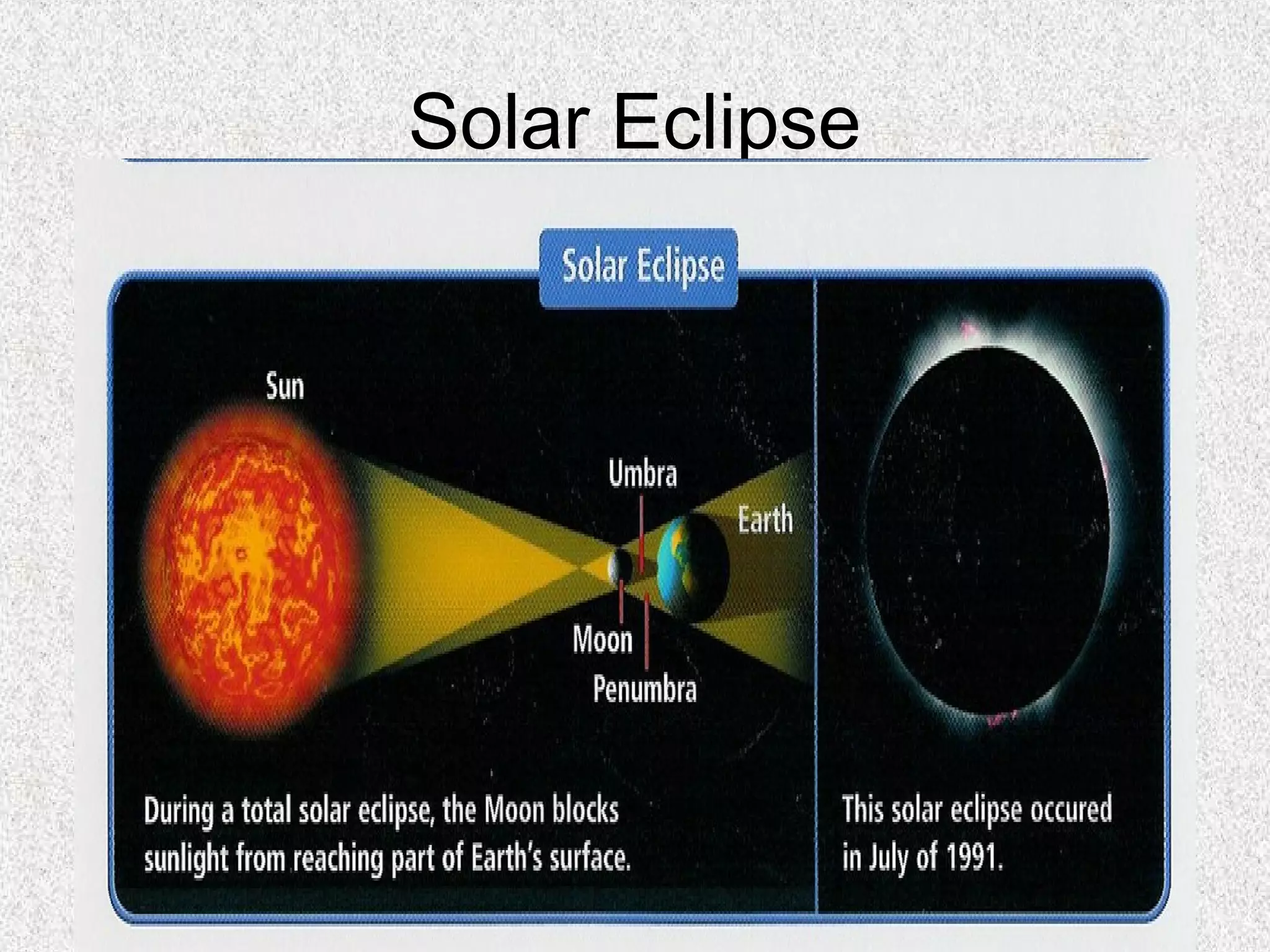
During a solar eclipse the Moon appears to completely
    cover the Sun. What phase is the Moon in just before
    and after a solar eclipse? Circle the answer that best
    matches your thinking.
A. Full Moon
B. New Moon
C. First quarter Moon
D. Last quarter Moon
E. It can be any phase.

Now, draw a diagram of where the Earth, Moon and Sun
   will be during a SOLAR eclipse.


              Uncovering Student Ideas in Astronomy pg 109
Solar Eclipse
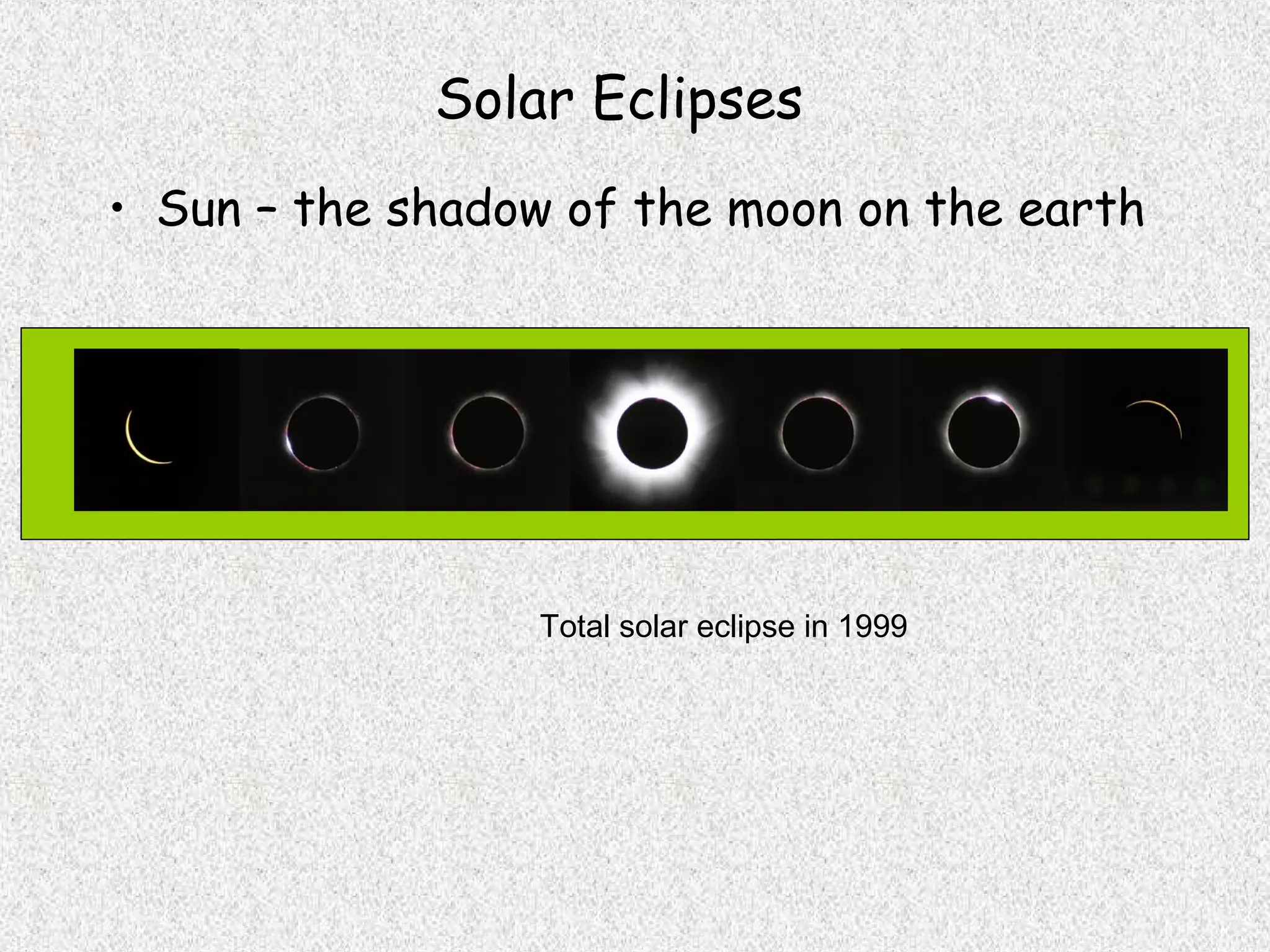
Solar Eclipses
• Sun – the shadow of the moon on the earth


                 Total solar eclipse in 1999
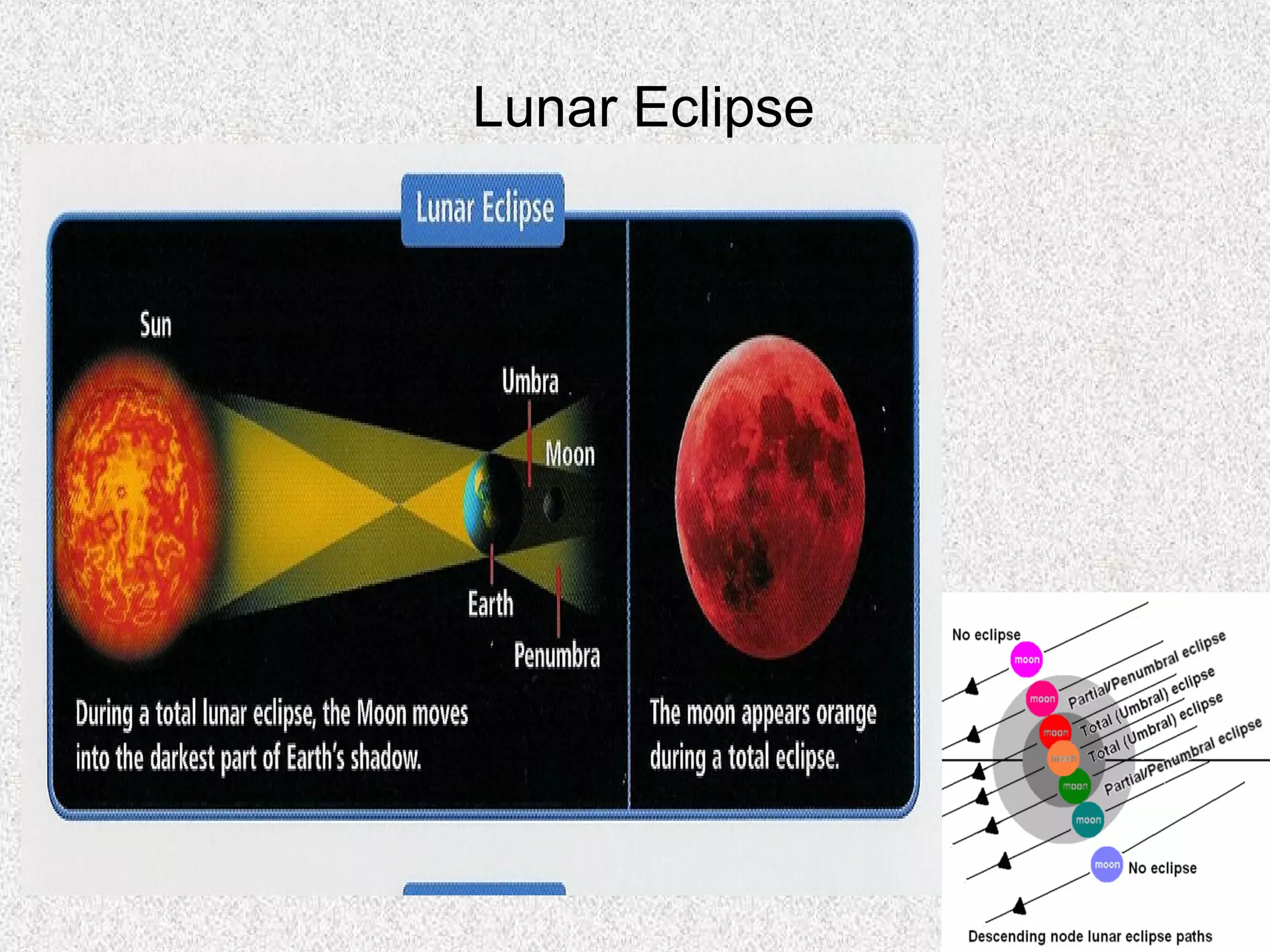
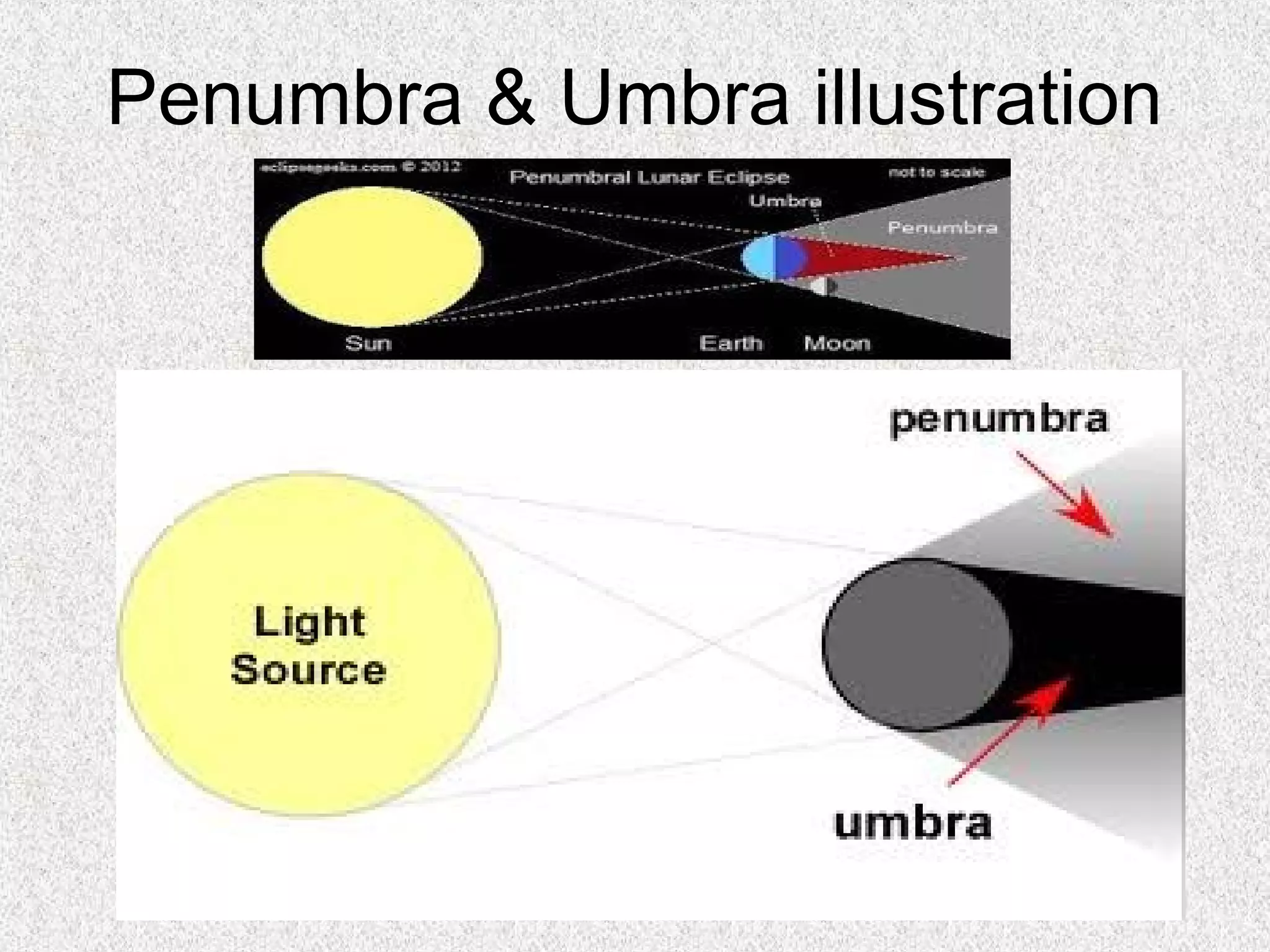
What is a lunar eclipse?
• Now imagine what happens when you have the
  sun, the Earth, and the moon all lined up in a
  row. The Earth will end up blocking the rays of
  the sun from reaching the moon. The Earth has
  two shadows, one inside the other. The inner
  shadow is called the umbra, and it's the darker
  shadow. The penumbra is a wider shadow,
  stretching out more to the sides, but it's not as
  dark as the umbra. When the moon is in the
  penumbra shadow of the Earth, we barely
  notice that the moon is darkened. When the
  moon is partly in the umbra shadow of the
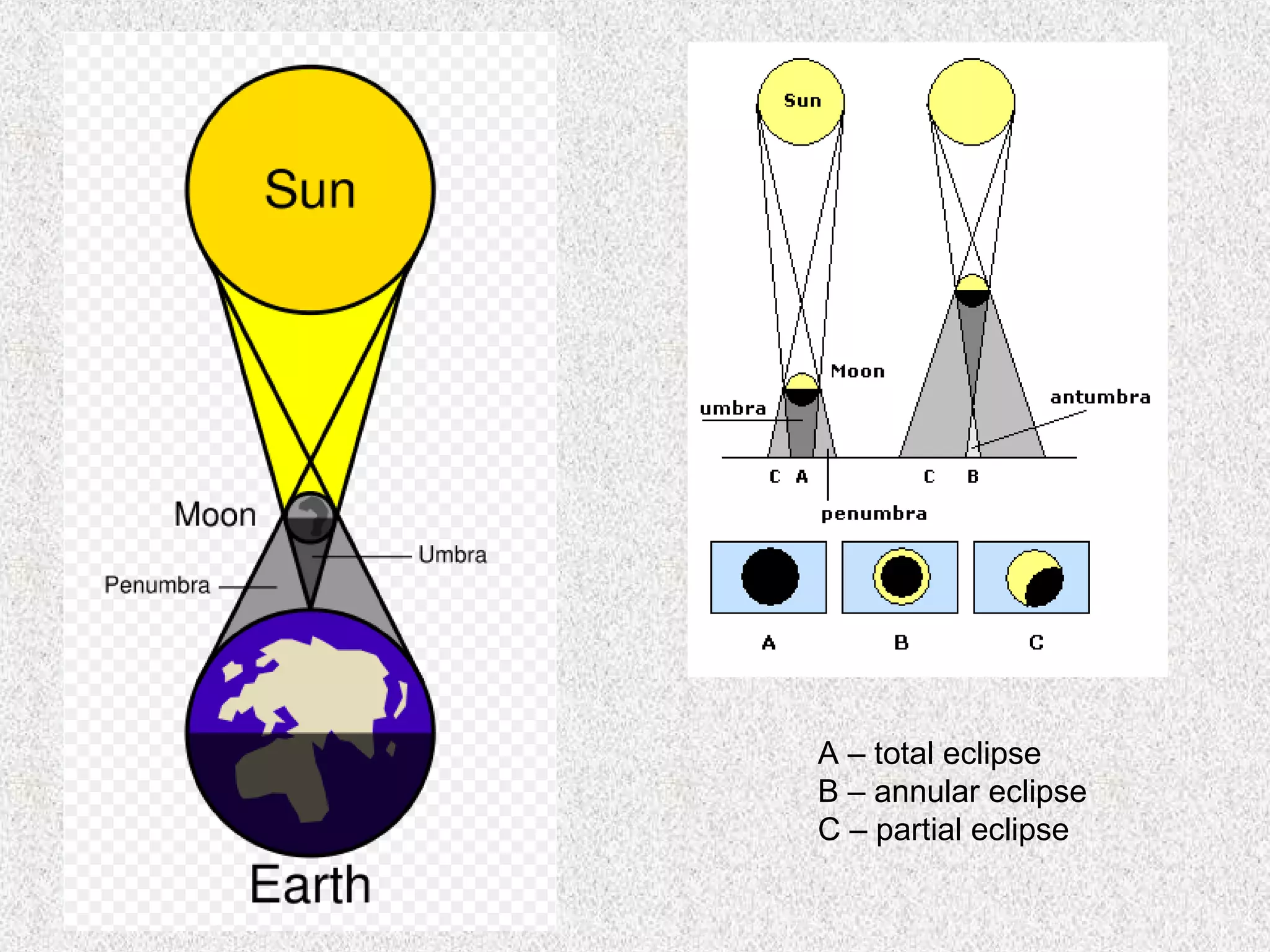
A – total eclipse
B – annular eclipse
C – partial eclipse
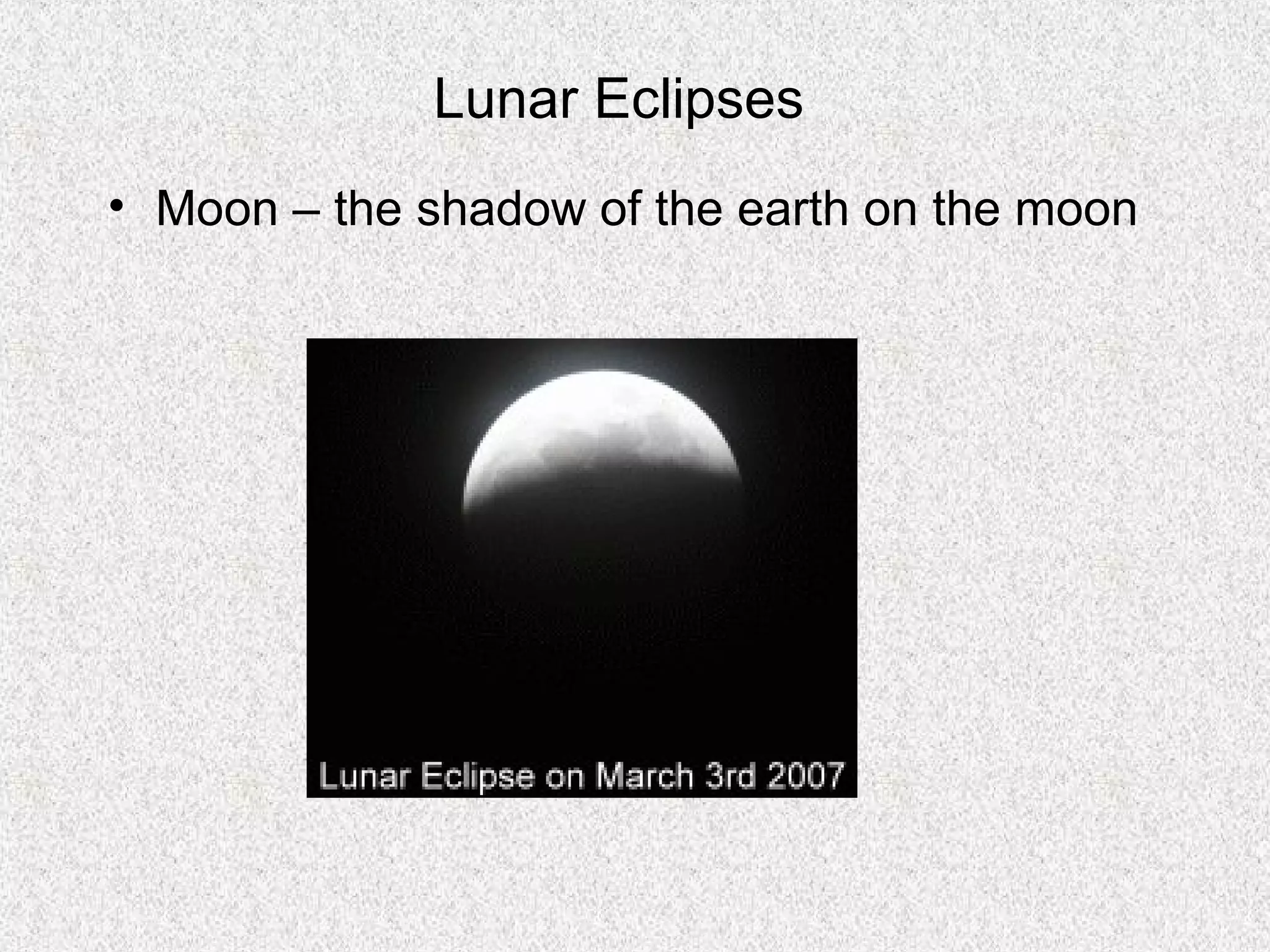
Lunar Eclipses
• Moon – the shadow of the earth on the moon
Lunar Eclipse
Eclipses
• Have you seen eclipses?
• What are eclipses in nature?
  – One celestial object casts its shadow on the other one
• Umbra: Inner core of total darkness the
  disc of the Sun is completely blocked.

• Penumbra: Outer, partial shadow Sun's
  disc is only partly blocked, with a bit
  peeking over the edge.
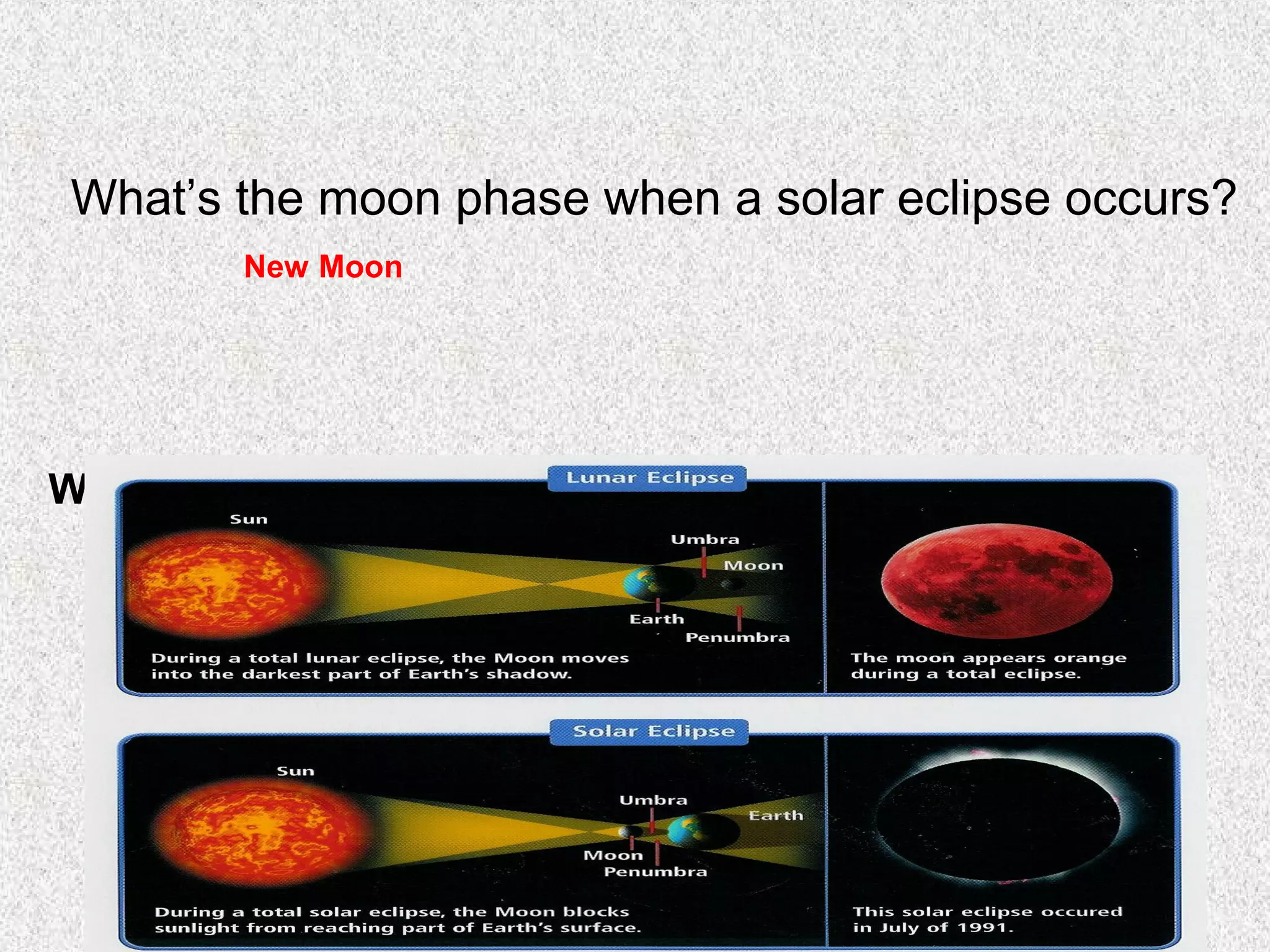
What’s the moon phase when a solar eclipse occurs?
         New Moon


What’s the moon phase when a lunar eclipse occurs?


         Full Moon
Penumbra & Umbra illustration
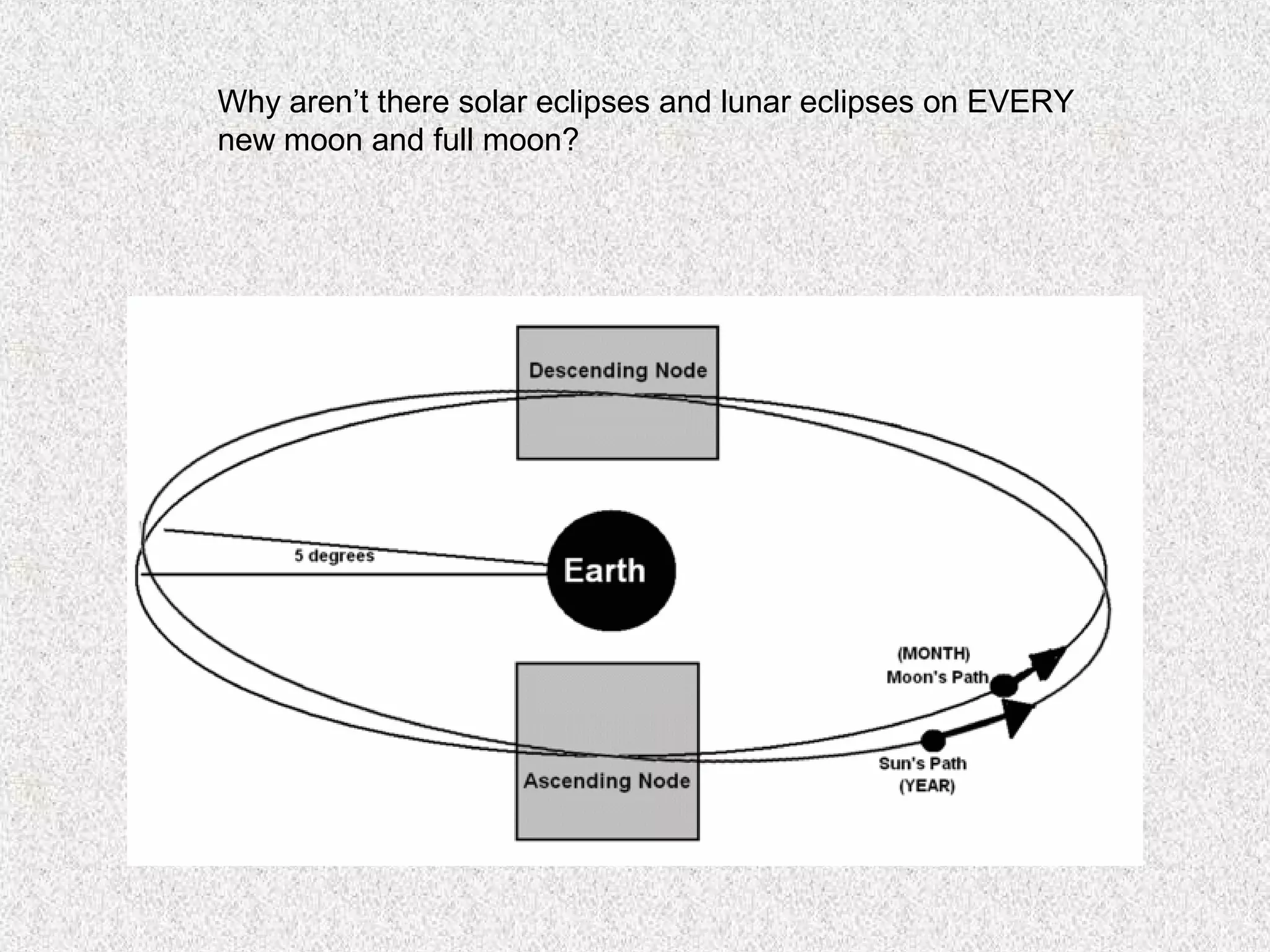
Why aren’t there solar eclipses and lunar eclipses on EVERY
new moon and full moon?
Two conditions must be satisfied for an eclipse
  to occur
  1. The nodes of the moon’s orbit must be
     nearly aligned with the Sun and the Earth
  2. The phase of the moon must be new or
     full
End Section One
Amazing video: Planets viewed from Earth
 as if they were at the distance of our moon
What does the Moon do to Earth?
Check What You Know:
                       Tides
Sally and Ben had only recently moved to the little community of
Windy Bay. They were eager to explore the nearby sandy beach, and
especially adventure to the small rocky island a short distance
offshore. They could scarcely wait until Saturday morning when they
could explore the tide pools and rocky crevices of the island to look
for neat critters. They arose early and walked to the sand bar that
jutted onto the rocky island. At first they walked along the lower
beach looking into glassy blue tidepools, then searched the high tide
line for beach pebbles, empty snail shells, and glass balls. After
about three hours, Ben and Sally decided to return home. Much to
their surprise the connecting sand bar to the mainland was now
covered with seawater to a depth well up to their waist. They were
stuck. They were afraid to swim the distance because of the
surprisingly strong current, and it was too far for their yells to be
heard. Will Sally and Ben have to spend the rest of the day and the
night on the island? How long will they have to stay? Why?

      https://sites.google.com/site/k12oceanliteracy/curricular-materials/5th-grade/tides-formative-assessment
What does the Moon do to Earth?
• Gives us light at night (depending on the phase.)
  Which phase gives us the most light?
• Controls TIDES.
  – Tides are different than WAVES. Tides are periodic.
    They repeat and move the water at coastlines in and
    out every few hours.
  – Waves are caused by wind (and occasionally,
    earthquakes, boats, etc.)
  – Tides are caused by the pull (Gravity) of the Moon
    and Sun on Earth’s fluids (water and atmosphere)
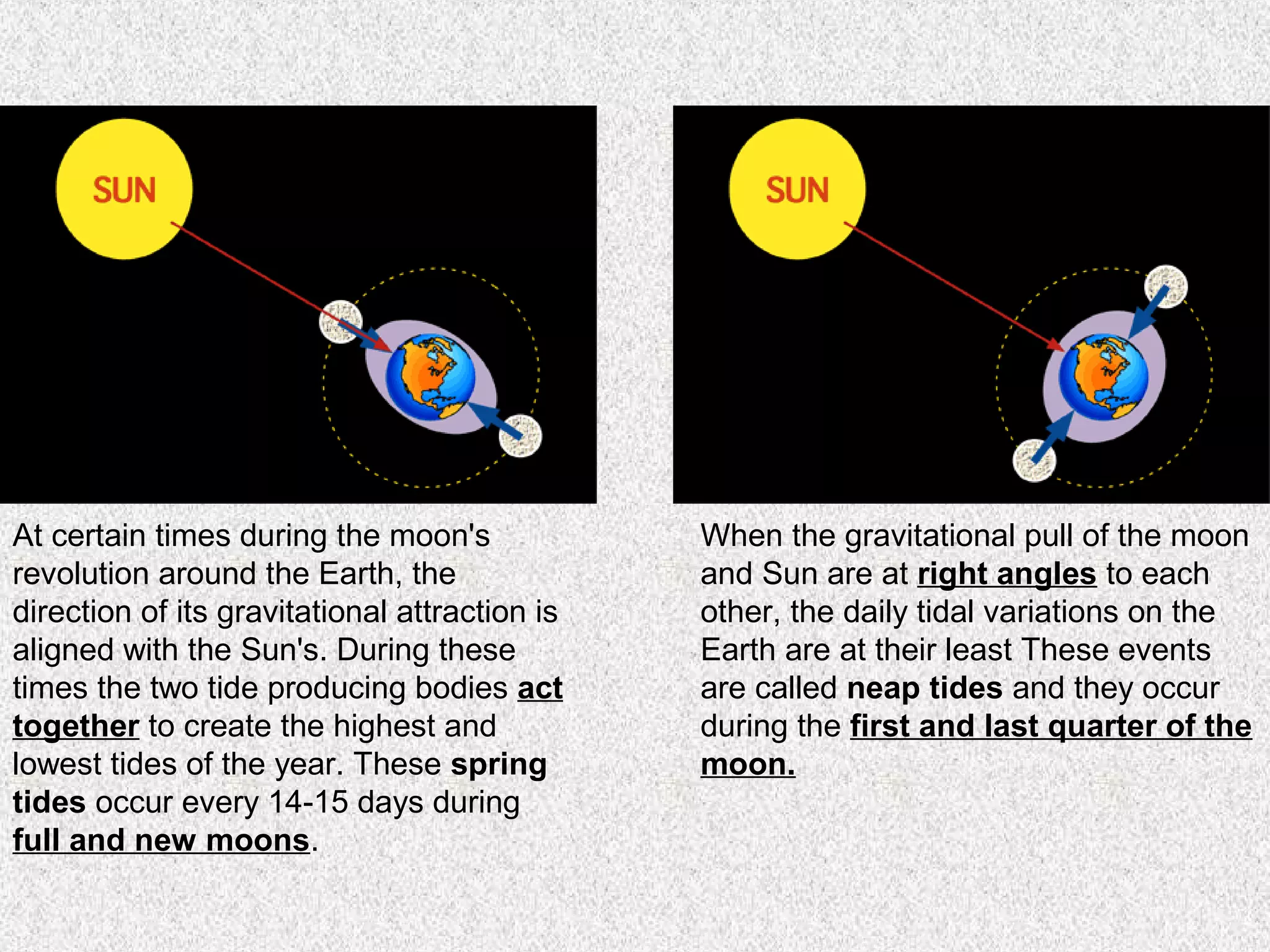
At certain times during the moon's             When the gravitational pull of the moon
revolution around the Earth, the               and Sun are at right angles to each
direction of its gravitational attraction is   other, the daily tidal variations on the
aligned with the Sun's. During these           Earth are at their least These events
times the two tide producing bodies act        are called neap tides and they occur
together to create the highest and             during the first and last quarter of the
lowest tides of the year. These spring         moon.
tides occur every 14-15 days during
full and new moons.
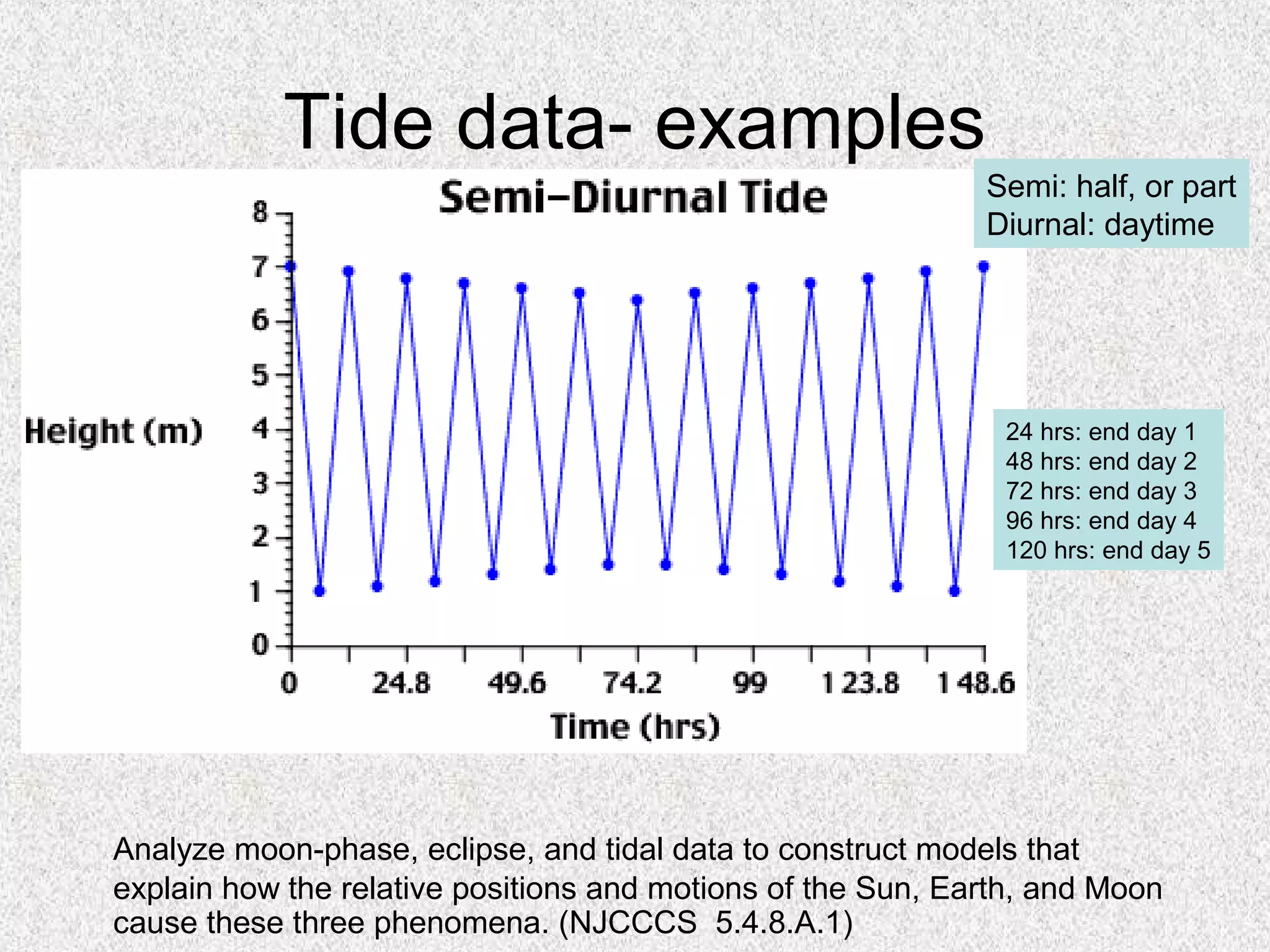
Tide data- examples
                                                             Semi: half, or part
                                                             Diurnal: daytime


                                                              24 hrs: end day 1
                                                              48 hrs: end day 2
                                                              72 hrs: end day 3
                                                              96 hrs: end day 4
                                                              120 hrs: end day 5


Analyze moon-phase, eclipse, and tidal data to construct models that
explain how the relative positions and motions of the Sun, Earth, and Moon
cause these three phenomena. (NJCCCS 5.4.8.A.1)
Use the Tide Data graph on your notes sheet to answer these questions:

1. How many high tides are completed in the first day?
    _____________________________________
2. What is the approximate height of high tide?
    _________ of low tide? ___________
3. What pattern do you see in the tides over the 6 days
    of this graph?
    __________________________________________
    ________________________________________
What if you traveled to the moon?
• Gravity
• What it looks like up there
Your Weight on the Moon
Calculate your weight in Space
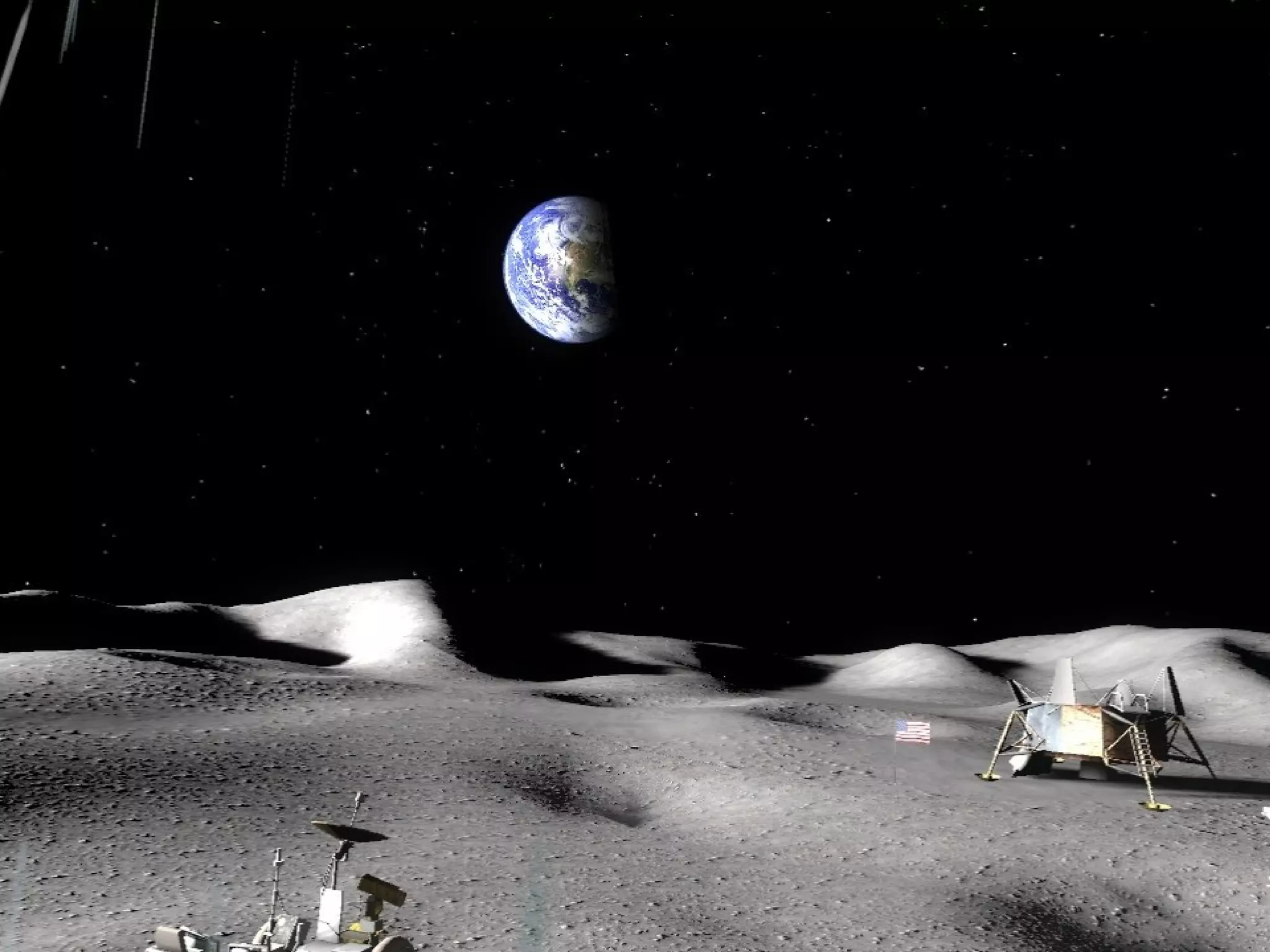
Earthrise and Earthset

 Earthrise... then and now.
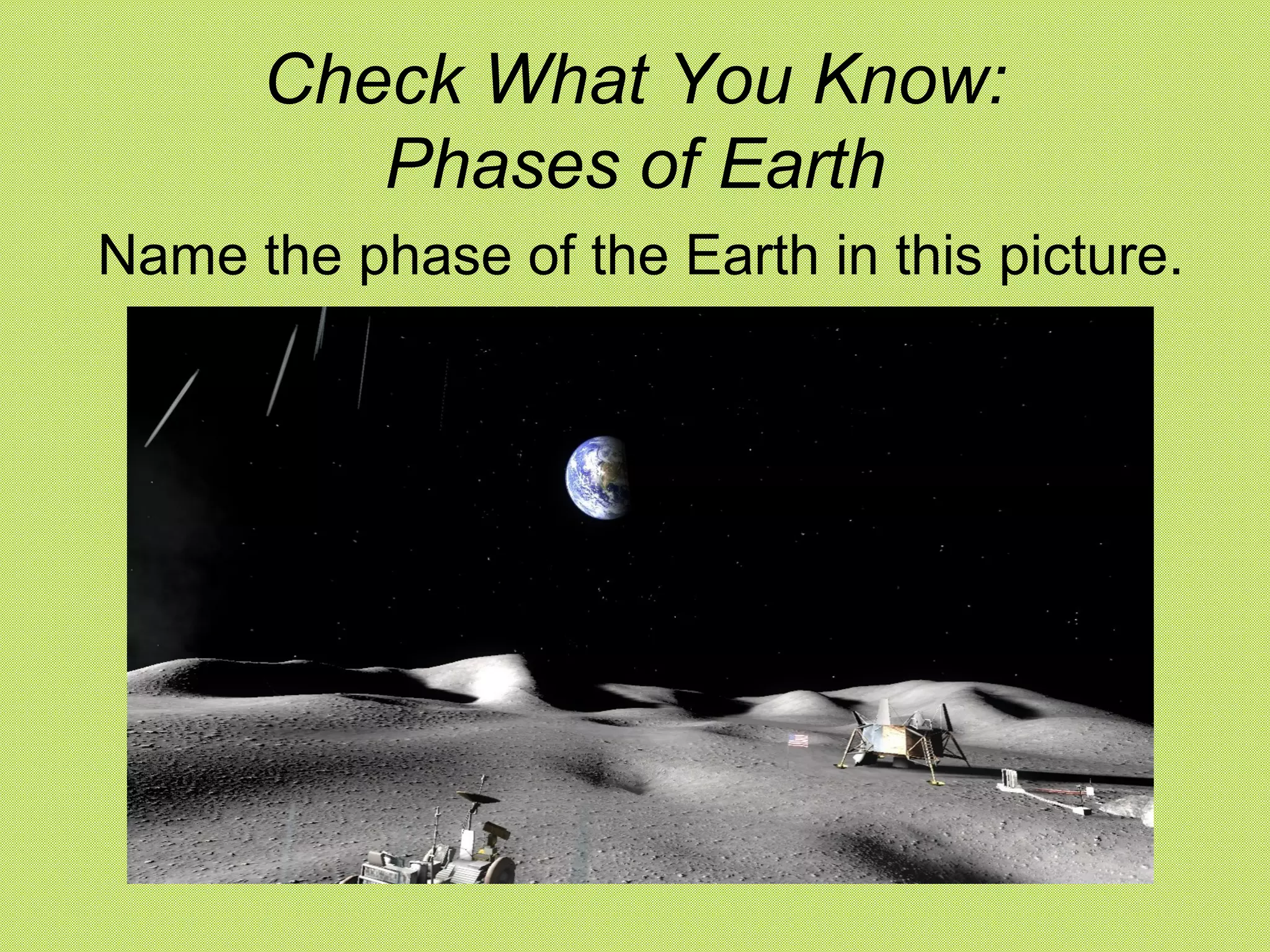
Check What You Know:
         Phases of Earth
Name the phase of the Earth in this picture.
Where did the Moon come from?
              How the Moon was born.
Billions of years ago, there were about 20 planets in our
solar system.

A Mars-sized planet named Thea crashed into Earth.

The debris from the crash was flung out into space and
formed a ring around Earth, held by Earth’s gravity.

The debris eventually collected into one ball as it orbited Earth,
and we now call it the Moon.
3 28 moon ntes student ppt

  • 2.
    Standards & elements •S6E2. Students will understand the effects of the relative positions of the earth, moon and sun. • a. Demonstrate the phases of the moon by showing the alignment of the earth, moon, and sun. • b. Explain the alignment of the earth, moon, and sun during solar and lunar eclipses.
  • 3.
    The Moon andYou • Meet your moon. • What do we see? • What does it do to Earth? • What if you traveled to the moon? • Where did it come from?
  • 4.
    • How isthe moon’s motion around the Earth observed?
  • 5.
    Check what youknow: Does the Moon orbit the Earth? The Earth takes a year to orbit around the Sun. What about the Moon? Does it orbit the Earth? Circle the answer you think best describes the motion of the Moon. A. The Moon orbits the Earth about once a day. B. The Moon orbits the Earth about once a week. C. The Moon orbits the Earth about once a month. D. The Moon orbits the Earth about once a year. E. The Moon does not orbit the Earth. Uncovering Student Ideas in Astronomy pg 99
  • 6.
    INTRODUCTION It takes 29.5 days for the Moon to revolve around the Earth and we always see that same side of the moon. (we never see the back side)
  • 7.
    Why do wehave MOON PHASES? Different amounts of sunlight light up the moon and, from Earth, makes the moon appear to have “different shapes” or phases.
  • 8.
    How big isthe Moon? • Wall-e Learns about Proportions
  • 9.
    Check what youknow: Seeing the Moon How often have you looked up into the sky and seen the Moon? Put an X next to all the times when you think you can go outside and see the Moon. ____ in the morning ____ at noon ____ in the middle of the afternoon ____ in the evening before sunset ____ in the evening after sunset ____ at midnight Uncovering Student Ideas in Astronomy pg 91
  • 10.
    What do wesee? • The Phases of the Moon – New moon (0% No reflected light) – Crescent (1-49% partly but less than one-half illuminated by direct sunlight.) – Quarter (50%) – Gibbous (51-99% more than one-half but not fully illuminated by direct sunlight. ) – Full moon (100% illuminated by direct sunlight.)
  • 11.
    B. Phases of the Moon (Draw what the phase looks like in the boxes provided) 1.New Moon - earth cannot see any part of the moon (lasts one day) 2.Waxing Crescent - waxing means moon’s face is growing (lasts several days) 3.First quarter - right half of moon’s face is visible (lasts for only one day) 4.Waxing gibbous - more than 1/2 of moon’s face is visible (lasts several days) 5.Full moon – all of the moon’s face is visible (last for one day) 6.Waning gibbous - (last for several days) 7.Last quarter or Third quarter - left half of face is visible (lasts for only one day) 8. Waning crescent - waxing means moon’s face is shrinking (last for several days)
  • 12.
    W all thecrazy words for the moon phases? hy Most of these words are based in Latin or Greek (those dudes way back when that started doing science and observing space!) CRESCENT- like the shape, curve. GIBBOUS- think bulging for those two “b”s in the middle of the word. This shape is bigger than half, but less than full. WAXING- Think “Wax On” from Karate Kid. It means getting bigger. Light is being “added” and the moon is looking bigger each day. WANING- It means getting smaller. Since we say “Way-ning”…. I think of it as “going AWAY”. Moon appears to be “shrinking” each day.
  • 13.
    As the moon moves (revolves) around the Earth, it looks like it has different shapes. The shape of the moon does not really change. It just changes its location in space.
  • 14.
    The cycle continueswith a new moon…..
  • 15.
    Check what youknow: Crescent Moon When there is a crescent Moon in the night sky, how much of the entire Moon’s spherical surface is actually lit by the Sun? Circle the answer that best matches your thinking. A. Quarter or less of the entire Moon B. Half of the entire Moon C. Three quarters of the entire Moon D. The entire Moon Uncovering Student Ideas in Astronomy pg 127
  • 16.
    Why do wesee “phases” of the moon? • NASA animation- Moon Phases in 2013 • View from Above • Lunar Phase Simulator • Brainpop
  • 17.
    Check what youknow: Moon Phase and Solar Eclipse During a solar eclipse the Moon appears to completely cover the Sun. What phase is the Moon in just before and after a solar eclipse? Circle the answer that best matches your thinking. A. Full Moon B. New Moon C. First quarter Moon D. Last quarter Moon E. It can be any phase. Now, draw a diagram of where the Earth, Moon and Sun will be during a SOLAR eclipse. Uncovering Student Ideas in Astronomy pg 109
  • 18.
  • 19.
    Solar Eclipses • Sun– the shadow of the moon on the earth Total solar eclipse in 1999
  • 20.
    What is alunar eclipse? • Now imagine what happens when you have the sun, the Earth, and the moon all lined up in a row. The Earth will end up blocking the rays of the sun from reaching the moon. The Earth has two shadows, one inside the other. The inner shadow is called the umbra, and it's the darker shadow. The penumbra is a wider shadow, stretching out more to the sides, but it's not as dark as the umbra. When the moon is in the penumbra shadow of the Earth, we barely notice that the moon is darkened. When the moon is partly in the umbra shadow of the
  • 21.
    A – totaleclipse B – annular eclipse C – partial eclipse
  • 22.
    Lunar Eclipses • Moon– the shadow of the earth on the moon
  • 23.
  • 24.
    Eclipses • Have youseen eclipses? • What are eclipses in nature? – One celestial object casts its shadow on the other one • Umbra: Inner core of total darkness the disc of the Sun is completely blocked. • Penumbra: Outer, partial shadow Sun's disc is only partly blocked, with a bit peeking over the edge.
  • 25.
    What’s the moonphase when a solar eclipse occurs? New Moon What’s the moon phase when a lunar eclipse occurs? Full Moon
  • 26.
    Penumbra & Umbraillustration
  • 27.
    Why aren’t theresolar eclipses and lunar eclipses on EVERY new moon and full moon?
  • 28.
    Two conditions mustbe satisfied for an eclipse to occur 1. The nodes of the moon’s orbit must be nearly aligned with the Sun and the Earth 2. The phase of the moon must be new or full
  • 29.
  • 30.
    Amazing video: Planetsviewed from Earth as if they were at the distance of our moon
  • 31.
    What does theMoon do to Earth?
  • 32.
    Check What YouKnow: Tides Sally and Ben had only recently moved to the little community of Windy Bay. They were eager to explore the nearby sandy beach, and especially adventure to the small rocky island a short distance offshore. They could scarcely wait until Saturday morning when they could explore the tide pools and rocky crevices of the island to look for neat critters. They arose early and walked to the sand bar that jutted onto the rocky island. At first they walked along the lower beach looking into glassy blue tidepools, then searched the high tide line for beach pebbles, empty snail shells, and glass balls. After about three hours, Ben and Sally decided to return home. Much to their surprise the connecting sand bar to the mainland was now covered with seawater to a depth well up to their waist. They were stuck. They were afraid to swim the distance because of the surprisingly strong current, and it was too far for their yells to be heard. Will Sally and Ben have to spend the rest of the day and the night on the island? How long will they have to stay? Why? https://sites.google.com/site/k12oceanliteracy/curricular-materials/5th-grade/tides-formative-assessment
  • 33.
    What does theMoon do to Earth? • Gives us light at night (depending on the phase.) Which phase gives us the most light? • Controls TIDES. – Tides are different than WAVES. Tides are periodic. They repeat and move the water at coastlines in and out every few hours. – Waves are caused by wind (and occasionally, earthquakes, boats, etc.) – Tides are caused by the pull (Gravity) of the Moon and Sun on Earth’s fluids (water and atmosphere)
  • 34.
    At certain timesduring the moon's When the gravitational pull of the moon revolution around the Earth, the and Sun are at right angles to each direction of its gravitational attraction is other, the daily tidal variations on the aligned with the Sun's. During these Earth are at their least These events times the two tide producing bodies act are called neap tides and they occur together to create the highest and during the first and last quarter of the lowest tides of the year. These spring moon. tides occur every 14-15 days during full and new moons.
  • 35.
    Tide data- examples Semi: half, or part Diurnal: daytime 24 hrs: end day 1 48 hrs: end day 2 72 hrs: end day 3 96 hrs: end day 4 120 hrs: end day 5 Analyze moon-phase, eclipse, and tidal data to construct models that explain how the relative positions and motions of the Sun, Earth, and Moon cause these three phenomena. (NJCCCS 5.4.8.A.1)
  • 36.
    Use the TideData graph on your notes sheet to answer these questions: 1. How many high tides are completed in the first day? _____________________________________ 2. What is the approximate height of high tide? _________ of low tide? ___________ 3. What pattern do you see in the tides over the 6 days of this graph? __________________________________________ ________________________________________
  • 37.
    What if youtraveled to the moon? • Gravity • What it looks like up there
  • 38.
    Your Weight onthe Moon Calculate your weight in Space
  • 39.
    Earthrise and Earthset Earthrise... then and now.
  • 41.
    Check What YouKnow: Phases of Earth Name the phase of the Earth in this picture.
  • 42.
    Where did theMoon come from? How the Moon was born. Billions of years ago, there were about 20 planets in our solar system. A Mars-sized planet named Thea crashed into Earth. The debris from the crash was flung out into space and formed a ring around Earth, held by Earth’s gravity. The debris eventually collected into one ball as it orbited Earth, and we now call it the Moon.