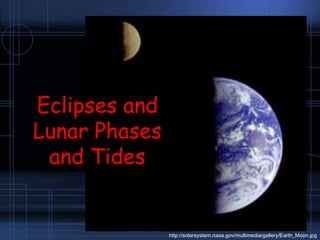
Eclipses and Lunar Phases and Tideshttp://solarsystem.nasa.gov/multimedia/gallery/Earth_Moon.jpg
What does “Phases of the Moon” mean?The positions of the moon, Earth, and the sun cause the phases of the moon, eclipses, and tides.The phase of the moon you see depends on how much of the sunlit side of the moon faces Earth.The moon does not have it’s own light, it reflects light from the sun. This determines its phase.
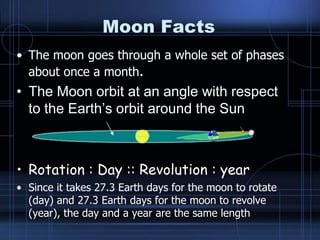
Moon FactsThe moon goes through a whole set of phases about once a month.The Moon orbit at an angle with respect         to the Earth’s orbit around the SunRotation : Day :: Revolution : yearSince it takes 27.3 Earth days for the moon to rotate (day) and 27.3 Earth days for the moon to revolve (year), the day and a year are the same length
Phases:Observing and IdentifyingNew (couple days)Waxing Crescent (several days)1st QuarterWaxing Gibbous (several days) FullWaning Gibbous (several days)3rd QuarterWaning Crescent (several days)New
starchild.gsfc.nasa.gov/docs/StarChild/questions/phases.html
Phases--CausesThe Sun shines on the Moon.  When the sunlight reflects off the Moon’s far side, we call it a New MoonWhen the sunlight reflects off on the Moon’s near side, we call it a Full MoonBetween New and Full, we see parts of the daytime side of the Moon.Golfball and Blacklight Activity
EclipsesThe Sun and Moon occasionally line up so that we have an eclipse.  These eclipses happen every yearTo see a solar eclipse, you need to be on a particular part of the Earth
When the Earth’s shadow covers the Moon, we have a lunar eclipse
Three types of Lunar EclipsesPenumbral lunar eclipse—the Moon only passes through the penumbra of Earth’s shadowPartial lunar eclipse—part of the Moon passes through the umbra of Earth’s shadowTotal lunar eclipse—the entire Moon passes through the umbra of Earth’s shadowAnyone who can see the Moon (anyone who is on the nighttime side of the Earth during the eclipse)
Images from Fred Espenakhttp://www.mreclipse.com/LEphoto/LEgallery1/LEgallery1.html
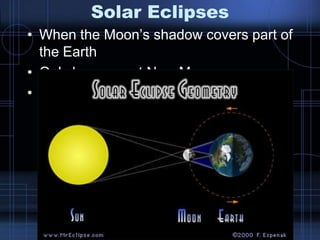
Solar EclipsesWhen the Moon’s shadow covers part of the EarthOnly happens at New MoonThree types: Annular, Partial, and Total
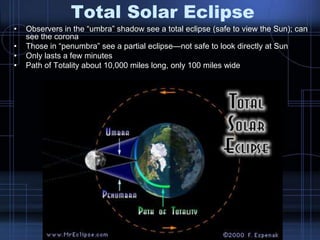
Total Solar EclipseObservers in the “umbra” shadow see a total eclipse (safe to view the Sun); can see the coronaThose in “penumbra” see a partial eclipse—not safe to look directly at SunOnly lasts a few minutesPath of Totality about 10,000 miles long, only 100 miles wide
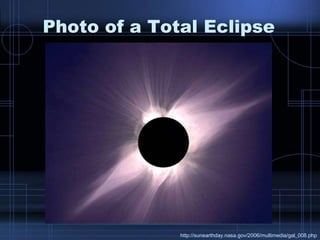
Photo of a Total Eclipsehttp://sunearthday.nasa.gov/2006/multimedia/gal_008.php
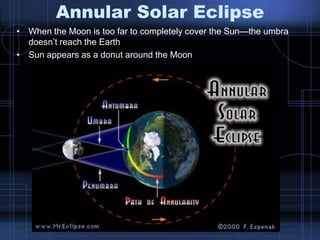
Annular Solar EclipseWhen the Moon is too far to completely cover the Sun—the umbra doesn’t reach the EarthSun appears as a donut around the Moon
Photos of an Annular Eclipsehttp://sunearthday.nasa.gov/2006/multimedia/gal_010.php; photos taken by Fred Espenak
Solar and Lunar EclipsesSolar EclipseA solar eclipse occurs when the moon passes between the Earth and the sun, blocking the sunlight from reaching the Earth.Lunar EclipseA lunar eclipse occurs at a full moon when Earth is directly between the moon and the sun.Next Total Solar Eclipse in USA—August 21, 2017
What is a tide?A tide is the rise and fall of water every 12.5 hours.The water rises for about 6 hours and then falls for about 6 hours.
What causes the tides?The force of the gravity pulls the moon Earth (especially the water on Earth’s surface) toward each other.  Tides occur mainly because of differences in how much the moon pulls on different parts of the Earth.
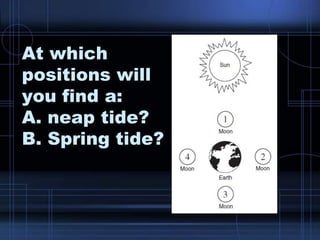
Spring and Neap TidesSpring TidesOnce a month, at a new moon, the sun, Earth, and moon are nearly in a line.The gravity of the sun and moon pull in the same direction causing a tide with the greatest difference between low and high tide.	Neap TidesTwice a month when the Earth and sun are at right angles to line between the Earth and moon.The sun and moon pulling in these directions causes a tide with the least difference between low and high tide.
At which positions will you find a:A. neap tide?B. Spring tide?
Class ReviewWhy does the moon change its phases as the month progresses?Why are a day and a year on the moon the same length?

Astronomy lunar phases eclipses and tides

  • 1.
    Eclipses and LunarPhases and Tideshttp://solarsystem.nasa.gov/multimedia/gallery/Earth_Moon.jpg
  • 2.
    What does “Phasesof the Moon” mean?The positions of the moon, Earth, and the sun cause the phases of the moon, eclipses, and tides.The phase of the moon you see depends on how much of the sunlit side of the moon faces Earth.The moon does not have it’s own light, it reflects light from the sun. This determines its phase.
  • 3.
    Moon FactsThe moongoes through a whole set of phases about once a month.The Moon orbit at an angle with respect to the Earth’s orbit around the SunRotation : Day :: Revolution : yearSince it takes 27.3 Earth days for the moon to rotate (day) and 27.3 Earth days for the moon to revolve (year), the day and a year are the same length
  • 4.
    Phases:Observing and IdentifyingNew(couple days)Waxing Crescent (several days)1st QuarterWaxing Gibbous (several days) FullWaning Gibbous (several days)3rd QuarterWaning Crescent (several days)New
  • 5.
  • 6.
    Phases--CausesThe Sun shineson the Moon. When the sunlight reflects off the Moon’s far side, we call it a New MoonWhen the sunlight reflects off on the Moon’s near side, we call it a Full MoonBetween New and Full, we see parts of the daytime side of the Moon.Golfball and Blacklight Activity
  • 7.
    EclipsesThe Sun andMoon occasionally line up so that we have an eclipse. These eclipses happen every yearTo see a solar eclipse, you need to be on a particular part of the Earth
  • 8.
    When the Earth’sshadow covers the Moon, we have a lunar eclipse
  • 9.
    Three types ofLunar EclipsesPenumbral lunar eclipse—the Moon only passes through the penumbra of Earth’s shadowPartial lunar eclipse—part of the Moon passes through the umbra of Earth’s shadowTotal lunar eclipse—the entire Moon passes through the umbra of Earth’s shadowAnyone who can see the Moon (anyone who is on the nighttime side of the Earth during the eclipse)
  • 10.
    Images from FredEspenakhttp://www.mreclipse.com/LEphoto/LEgallery1/LEgallery1.html
  • 11.
    Solar EclipsesWhen theMoon’s shadow covers part of the EarthOnly happens at New MoonThree types: Annular, Partial, and Total
  • 12.
    Total Solar EclipseObserversin the “umbra” shadow see a total eclipse (safe to view the Sun); can see the coronaThose in “penumbra” see a partial eclipse—not safe to look directly at SunOnly lasts a few minutesPath of Totality about 10,000 miles long, only 100 miles wide
  • 13.
    Photo of aTotal Eclipsehttp://sunearthday.nasa.gov/2006/multimedia/gal_008.php
  • 14.
    Annular Solar EclipseWhenthe Moon is too far to completely cover the Sun—the umbra doesn’t reach the EarthSun appears as a donut around the Moon
  • 15.
    Photos of anAnnular Eclipsehttp://sunearthday.nasa.gov/2006/multimedia/gal_010.php; photos taken by Fred Espenak
  • 16.
    Solar and LunarEclipsesSolar EclipseA solar eclipse occurs when the moon passes between the Earth and the sun, blocking the sunlight from reaching the Earth.Lunar EclipseA lunar eclipse occurs at a full moon when Earth is directly between the moon and the sun.Next Total Solar Eclipse in USA—August 21, 2017
  • 17.
    What is atide?A tide is the rise and fall of water every 12.5 hours.The water rises for about 6 hours and then falls for about 6 hours.
  • 18.
    What causes thetides?The force of the gravity pulls the moon Earth (especially the water on Earth’s surface) toward each other. Tides occur mainly because of differences in how much the moon pulls on different parts of the Earth.
  • 19.
    Spring and NeapTidesSpring TidesOnce a month, at a new moon, the sun, Earth, and moon are nearly in a line.The gravity of the sun and moon pull in the same direction causing a tide with the greatest difference between low and high tide. Neap TidesTwice a month when the Earth and sun are at right angles to line between the Earth and moon.The sun and moon pulling in these directions causes a tide with the least difference between low and high tide.
  • 20.
    At which positionswill you find a:A. neap tide?B. Spring tide?
  • 21.
    Class ReviewWhy doesthe moon change its phases as the month progresses?Why are a day and a year on the moon the same length?

Editor's Notes

  • #17 Information at http://sunearth.gsfc.nasa.gov/eclipse/solar.html
  • #20 It's not a question of mass, but of energy! The tidal force exerted by the Moon on the Earth causes the oceans to bulge. The Earth rotates about its axis faster than the Moon revolves around the Earth, and this rapid rotation carries the tidal bulge of the oceans forward of the Moon in its orbit. So the tidal bulge on the Earth is always slightly ahead of the Moon's own position. This bulge is continuously tugging the Moon forward, increasing the Moon's total energy. Imagine a cowboy's lasso. As the cowboy spins the lasso faster and faster (increasing its total energy), the loop gets wider. The same thing essentially happens to the Moon. The tugging of the Earth's bulge lifts it into a wider orbit around the Earth.
  • #21 1 AND 3 ARE SPRING TIDES2 AND 4 ARE NEAP TIDES