The document outlines the seminar on hyperloop technology, a proposed high-speed transportation system designed by Elon Musk, which operates using magnetic levitation within low-pressure tubes. It reviews the historical development, working principles, construction features, advantages, and disadvantages of hyperloop, emphasizing its potential to enhance travel speed and reduce environmental impact. Current and future projects are discussed, highlighting the projected routes and ongoing interest in expanding hyperloop technology for efficient transport solutions.
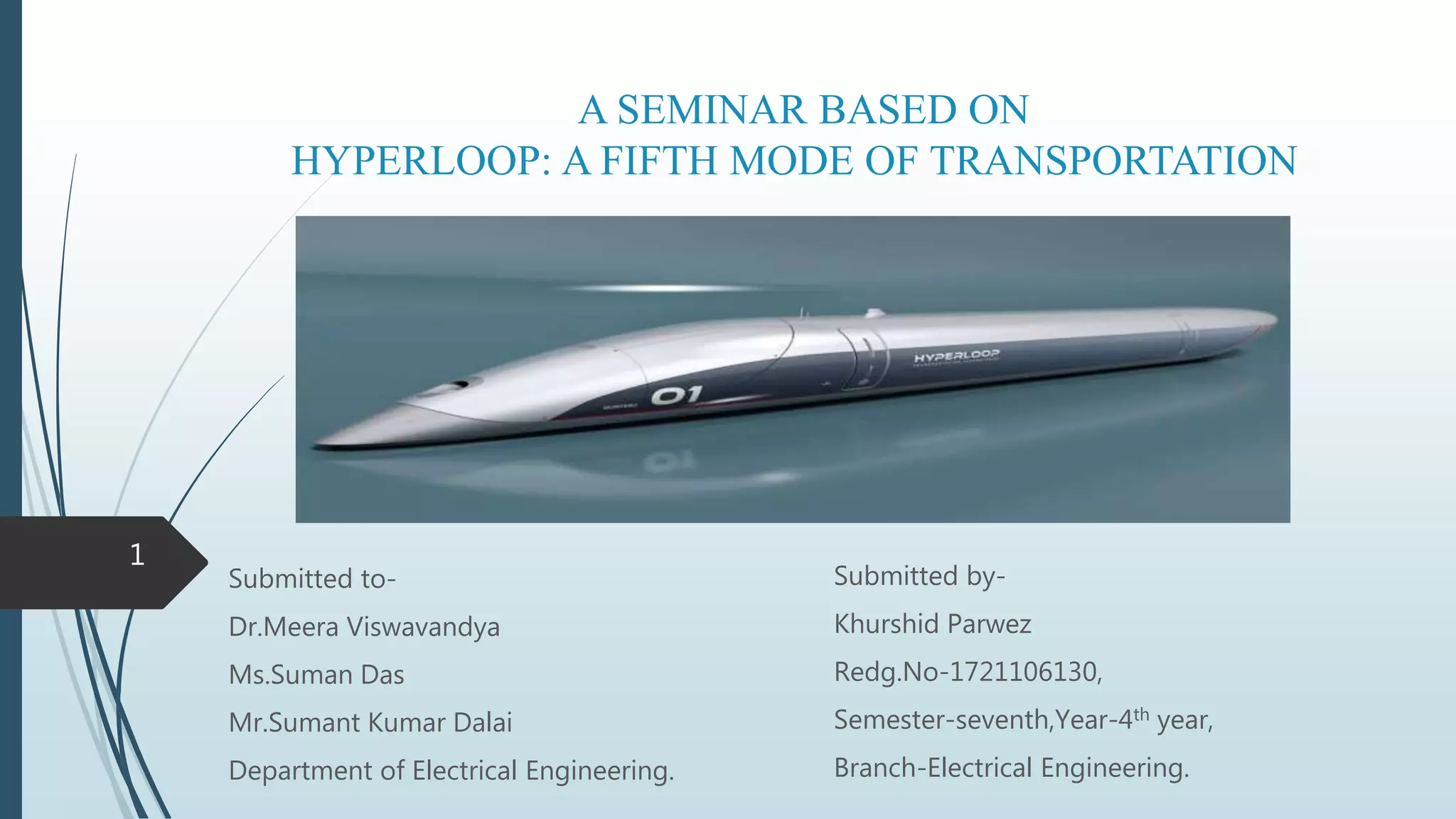
A SEMINAR BASEDON
HYPERLOOP: A FIFTH MODE OF TRANSPORTATION
Submitted to-
Dr.Meera Viswavandya
Ms.Suman Das
Mr.Sumant Kumar Dalai
Department of Electrical Engineering.
1
Submitted by-
Khurshid Parwez
Redg.No-1721106130,
Semester-seventh,Year-4th year,
Branch-Electrical Engineering.
2.
INTRODUCTION
HISTORICALREVIEW
WORKING PRINCIPLE OF HYPERLOOP
CONSTRUCTION FEATURES OF HYPERLOOP
SYSTEM & RELIABILITY
ADVANTAGES
DISADVANTAGES
PRESENT AND FUTURE WORK
CONCLUSION
REFERENCES
2
3.
CONVENTIONAL MODES OFTRANSPORTATION:
Roadways (Cheap, Time Consuming, Not so eco-friendly)
Railways (not cheap, time consuming, relatively much more eco-friendly than
others)
Airways (not Cheap, time saving, not eco-friendly)
3
4.
INTRODUCTION:
Hyperloop is acompletely new mode of fastest transportation. Hyperloop is firstly proposed by Elon
musk and a team of engineer from Tesla Motors and the Space Exploration Technologies Corporation
in August 2013. The concept of hyperloop includes travelling people from one place to another place
in a capsule which is propelling at a very high speed. We can also called hyperloop as a solar
powered transportation system and it is an alternative of high speed train. Basically hyperloop is
magnetically levitated train which runs inside a long tube or pipe. It consists of low pressure tube
with capsule that is transported at both low and high speeds. It is driven by linear induction motor and
compressor. It includes 28 passenger pods. For propulsion, magnetic accelerators will be planted
along the length of the tube, propelling the pods forward. The tubes would house a low pressure
environment, surrounding the pod with a cushion of air that permits the pod to move safely at such
high speeds, like a puck gliding over an air hockey table. Given the tight quarters in the tube, pressure
buildup in front of the pod could be a problem. The tube needs a system to keep air from building up
in this way. Musk’s design recommends an air compressor on the front of the pod that will move air
from the front to the tail, keeping it aloft and preventing pressure building up due to air displacement.
A one way trip on the Hyperloop is projected to take about 35 minutes (for comparison, traveling the
same distance by car takes roughly six hours.) Passengers may enter and exit Hyperloop at stations
located either at the ends of the tube, or branches along the tube length.
4
5.
HISTORICAL REVIEW:
Hyperloopconcept was invented and designed in 1812 by the British Mechanical Engineer George
Wenger and later on polished by various people like George Medhurs in 1827 and Alferd ely beach
in 1869.
Concepts for high-speed trains in vacuum or evacuated tubes can be traced back as far as 1909,
when rocket pioneer Robert H. Goddard proposed high-speed passenger-carrying pods traveling
through evacuated tubes.
Bachelet introduced the core idea behind magnetically levitating trains as early as 1910. Over the
years these ideas have been further renamed, for instance by the Rand Corporation in 1972 with
their “Very High Speed Transport System”.
The concept of Hyperloop is now developed and redesigned by the billionaire Elon Musk in 2012.
Hyperloop is in some countries a registered trademark of the Space Exploration Technologies
Corporation (SpaceX) for the high speed transportation of passengers and goods in partially
evacuated tubes. Earlier, in all types of transportation mode, we have encountered many accidents,
cost issues, comfort issues, affordability, conservation issues and environmental issues. Hyperloop
confront all the above point issues to provide better way to future with help of modern science and
engineering solutions.
5
6.
WORKING PRINCIPLE OFHYPERLOOP:
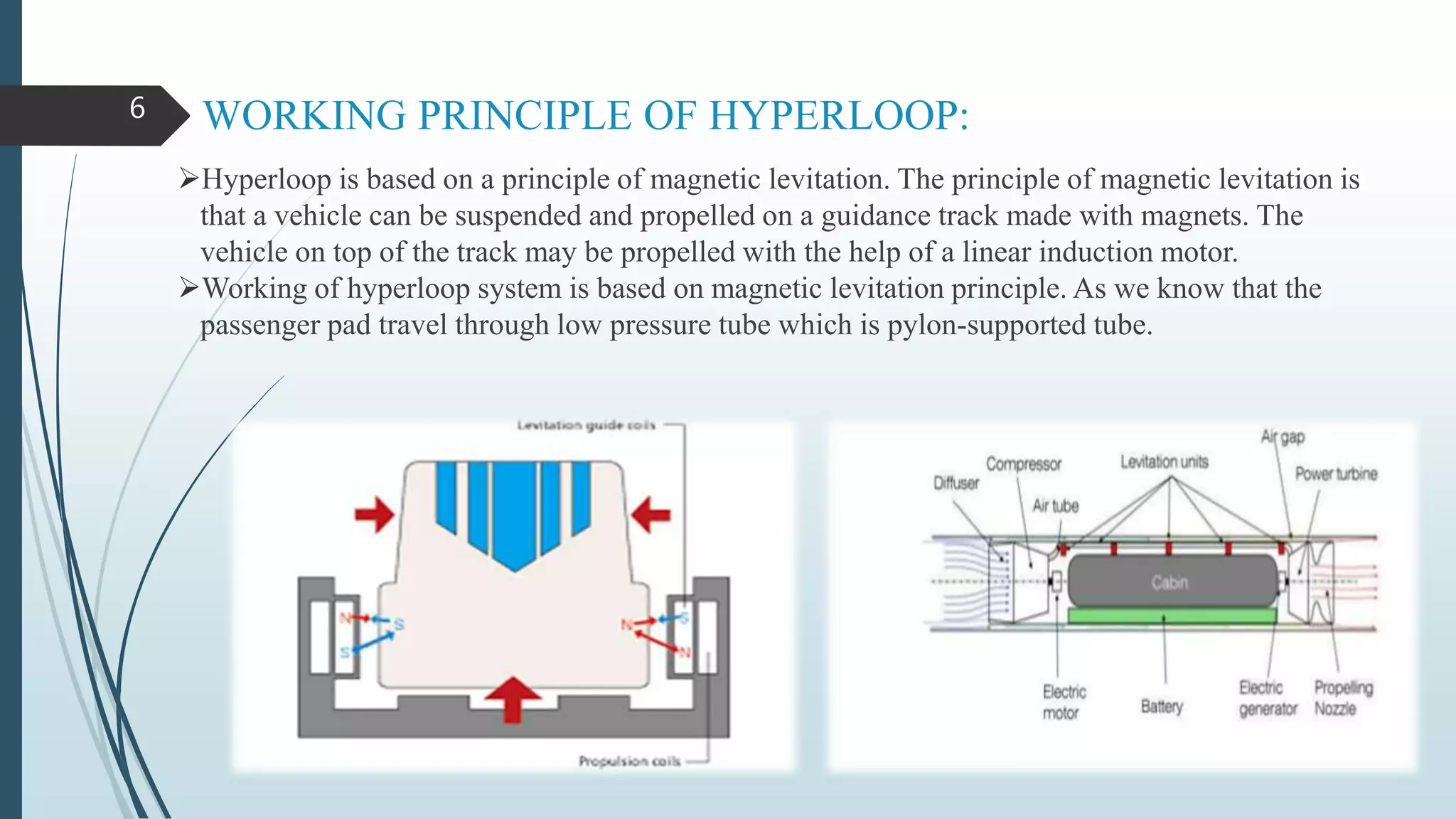
Hyperloop is based on a principle of magnetic levitation. The principle of magnetic levitation is
that a vehicle can be suspended and propelled on a guidance track made with magnets. The
vehicle on top of the track may be propelled with the help of a linear induction motor.
Working of hyperloop system is based on magnetic levitation principle. As we know that the
passenger pad travel through low pressure tube which is pylon-supported tube.
6
7.
7
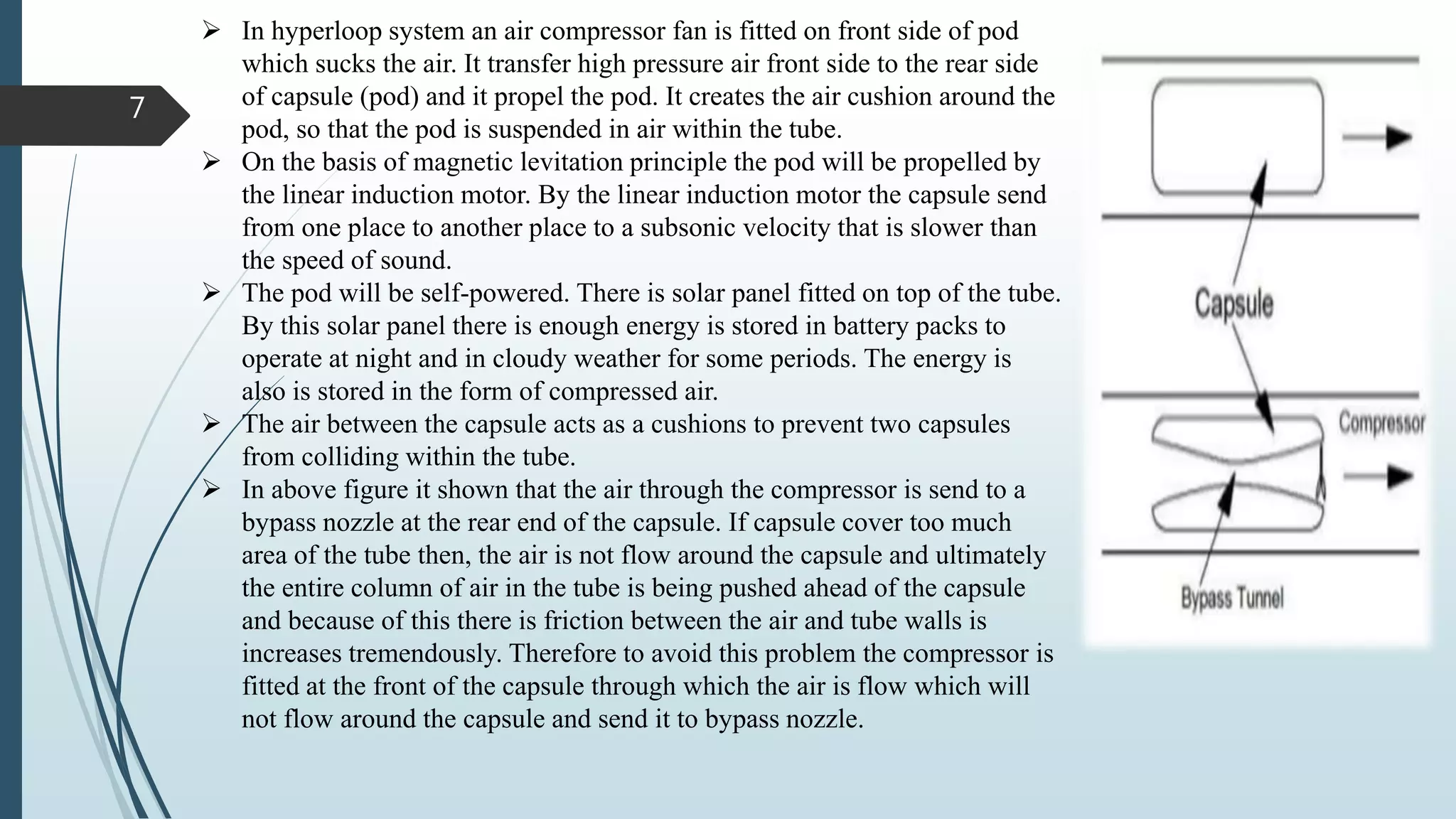
In hyperloopsystem an air compressor fan is fitted on front side of pod
which sucks the air. It transfer high pressure air front side to the rear side
of capsule (pod) and it propel the pod. It creates the air cushion around the
pod, so that the pod is suspended in air within the tube.
On the basis of magnetic levitation principle the pod will be propelled by
the linear induction motor. By the linear induction motor the capsule send
from one place to another place to a subsonic velocity that is slower than
the speed of sound.
The pod will be self-powered. There is solar panel fitted on top of the tube.
By this solar panel there is enough energy is stored in battery packs to
operate at night and in cloudy weather for some periods. The energy is
also is stored in the form of compressed air.
The air between the capsule acts as a cushions to prevent two capsules
from colliding within the tube.
In above figure it shown that the air through the compressor is send to a
bypass nozzle at the rear end of the capsule. If capsule cover too much
area of the tube then, the air is not flow around the capsule and ultimately
the entire column of air in the tube is being pushed ahead of the capsule
and because of this there is friction between the air and tube walls is
increases tremendously. Therefore to avoid this problem the compressor is
fitted at the front of the capsule through which the air is flow which will
not flow around the capsule and send it to bypass nozzle.
8.
CONSTRUCTION FEATURES OFHYPERLOOP:
TUBE
CAPSULE
COMPRESSOR FAN
AIR BEARINGS
PROPULSION
SUSPENSION
POWER SOURCE
8
9.
TUBE:
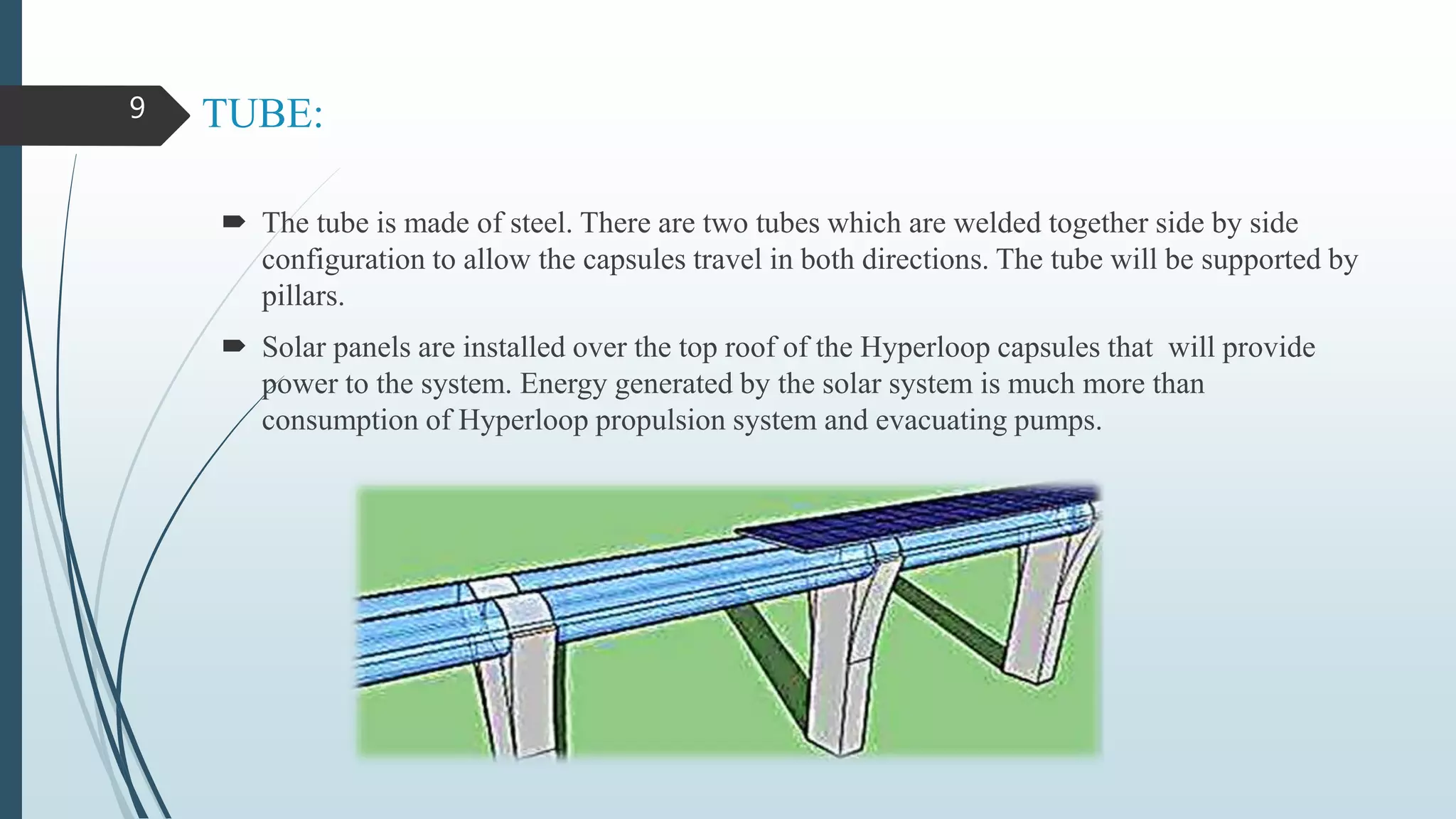
The tubeis made of steel. There are two tubes which are welded together side by side
configuration to allow the capsules travel in both directions. The tube will be supported by
pillars.
Solar panels are installed over the top roof of the Hyperloop capsules that will provide
power to the system. Energy generated by the solar system is much more than
consumption of Hyperloop propulsion system and evacuating pumps.
9
10.
CAPSULE:
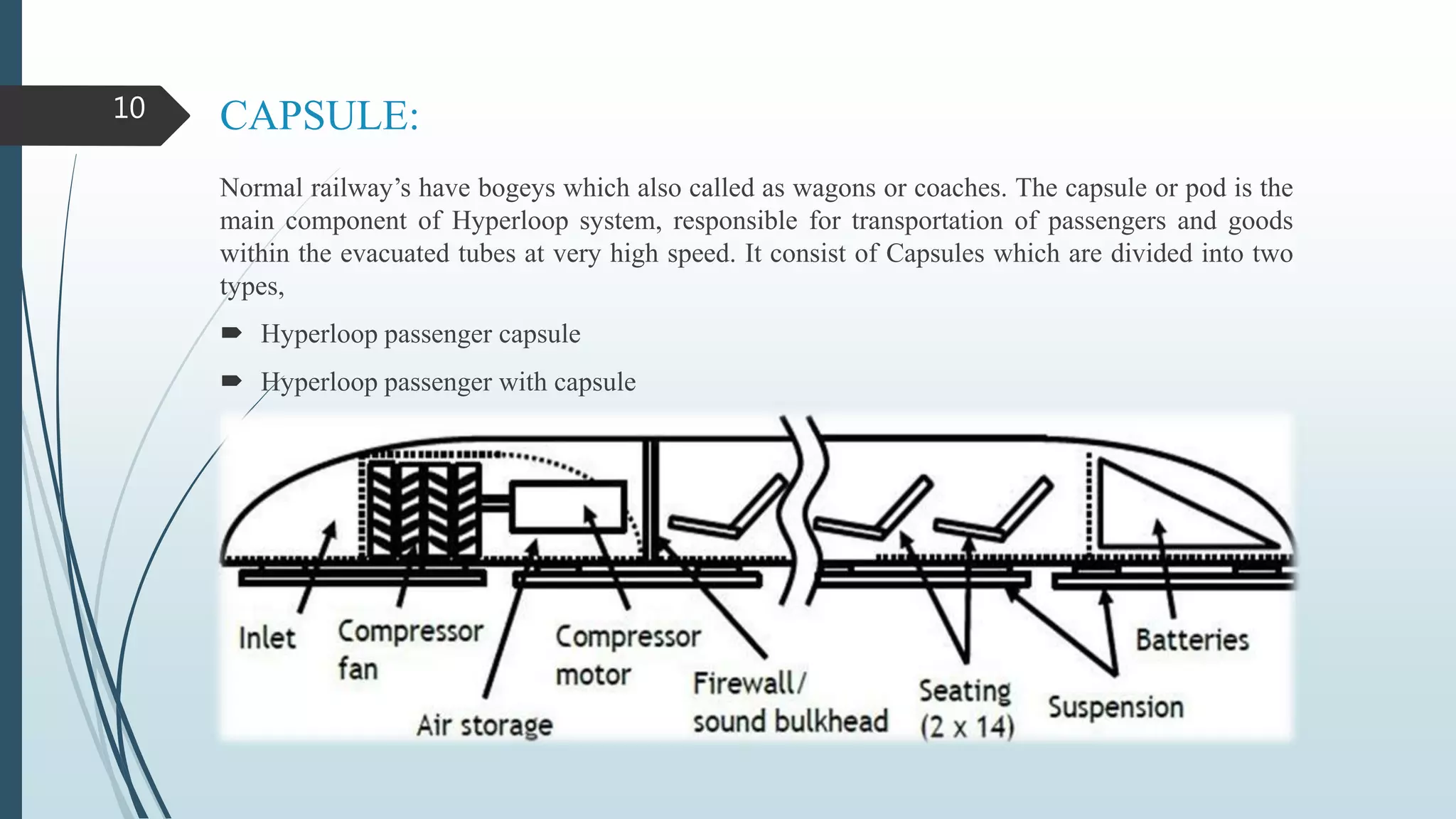
Normal railway’s havebogeys which also called as wagons or coaches. The capsule or pod is the
main component of Hyperloop system, responsible for transportation of passengers and goods
within the evacuated tubes at very high speed. It consist of Capsules which are divided into two
types,
Hyperloop passenger capsule
Hyperloop passenger with capsule
10
11.
COMPRESSOR FAN:
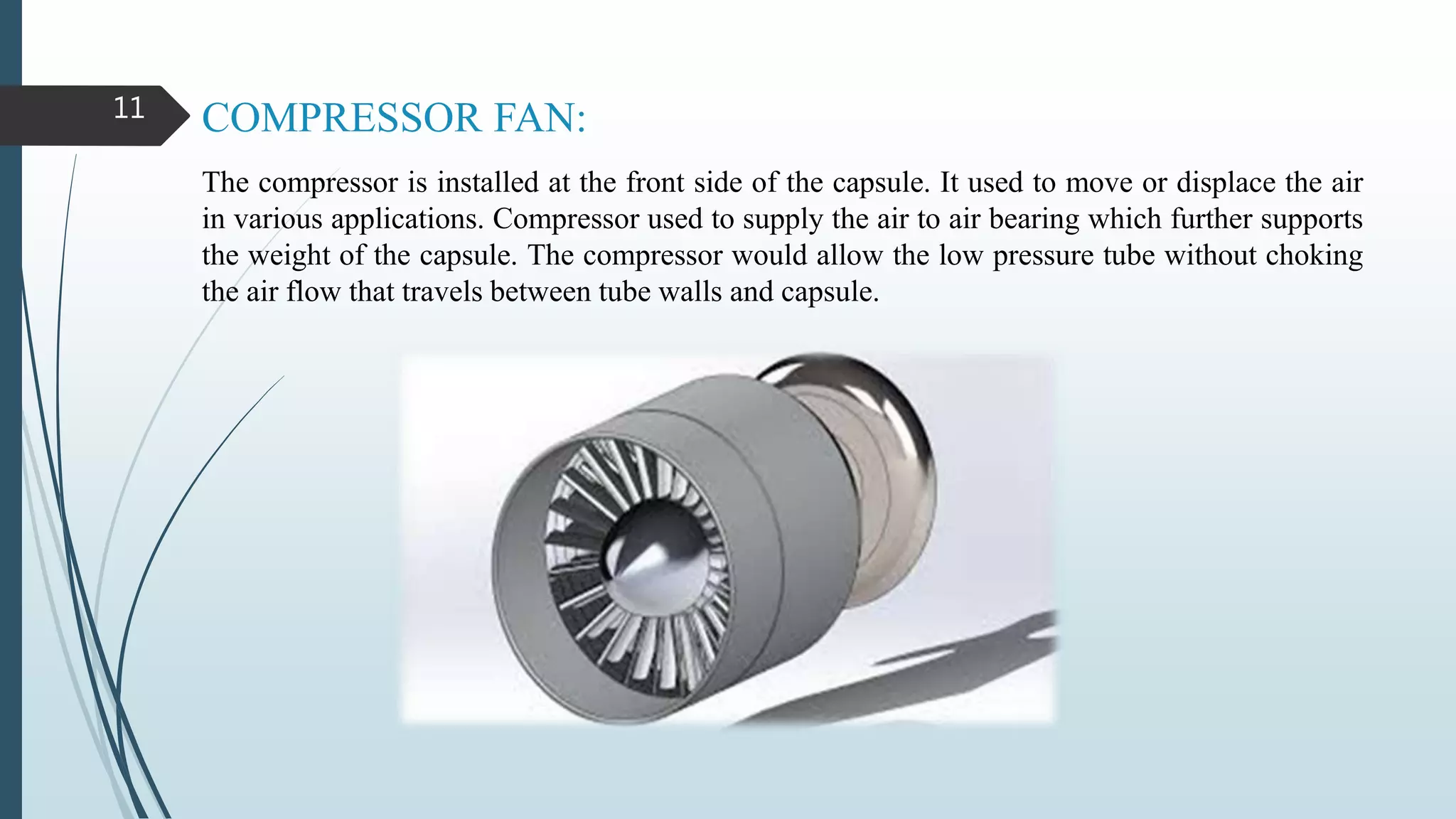
The compressoris installed at the front side of the capsule. It used to move or displace the air
in various applications. Compressor used to supply the air to air bearing which further supports
the weight of the capsule. The compressor would allow the low pressure tube without choking
the air flow that travels between tube walls and capsule.
11
12.
AIR BEARINGS:
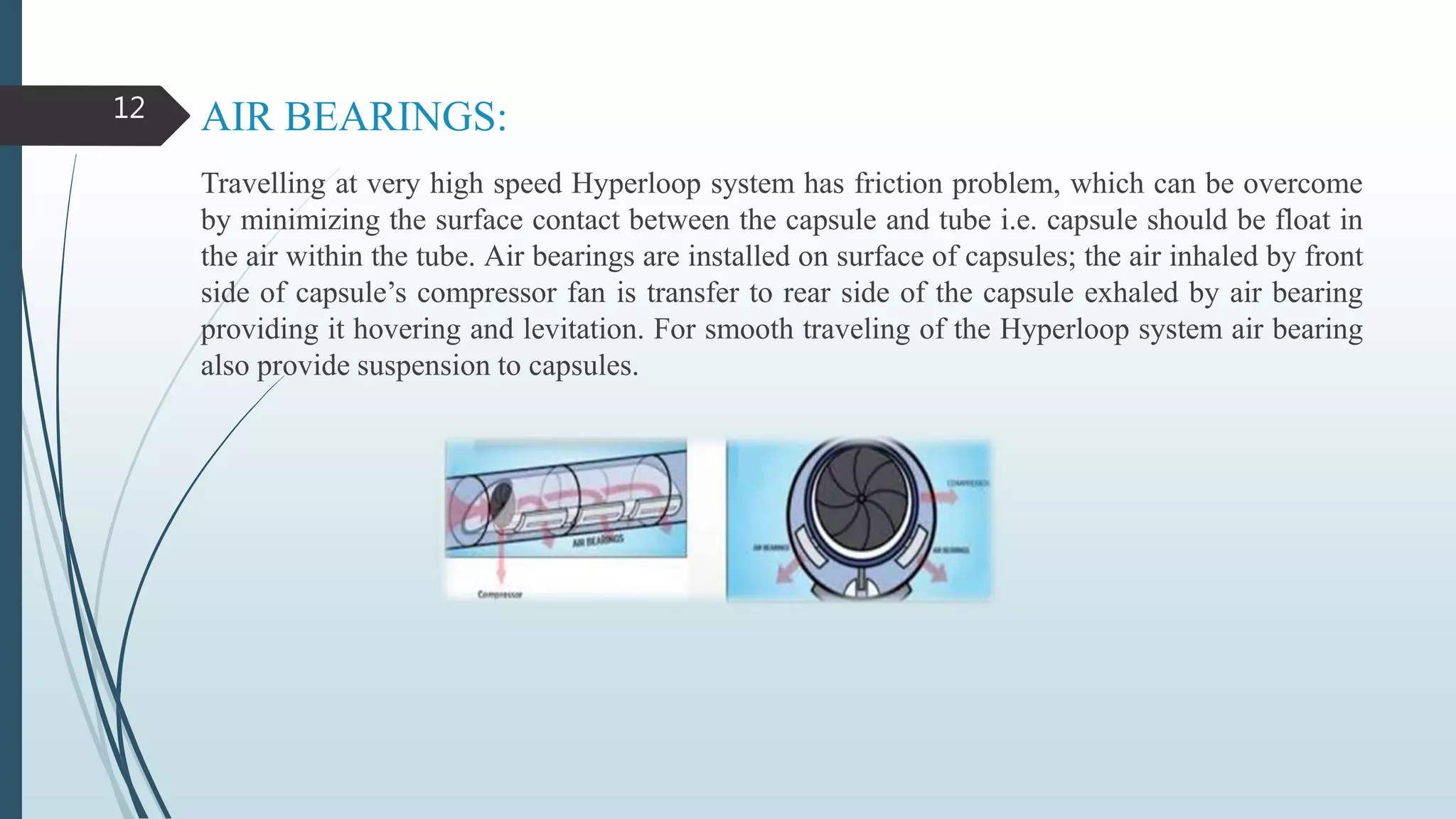
Travelling atvery high speed Hyperloop system has friction problem, which can be overcome
by minimizing the surface contact between the capsule and tube i.e. capsule should be float in
the air within the tube. Air bearings are installed on surface of capsules; the air inhaled by front
side of capsule’s compressor fan is transfer to rear side of the capsule exhaled by air bearing
providing it hovering and levitation. For smooth traveling of the Hyperloop system air bearing
also provide suspension to capsules.
12
13.
PROPULSION:
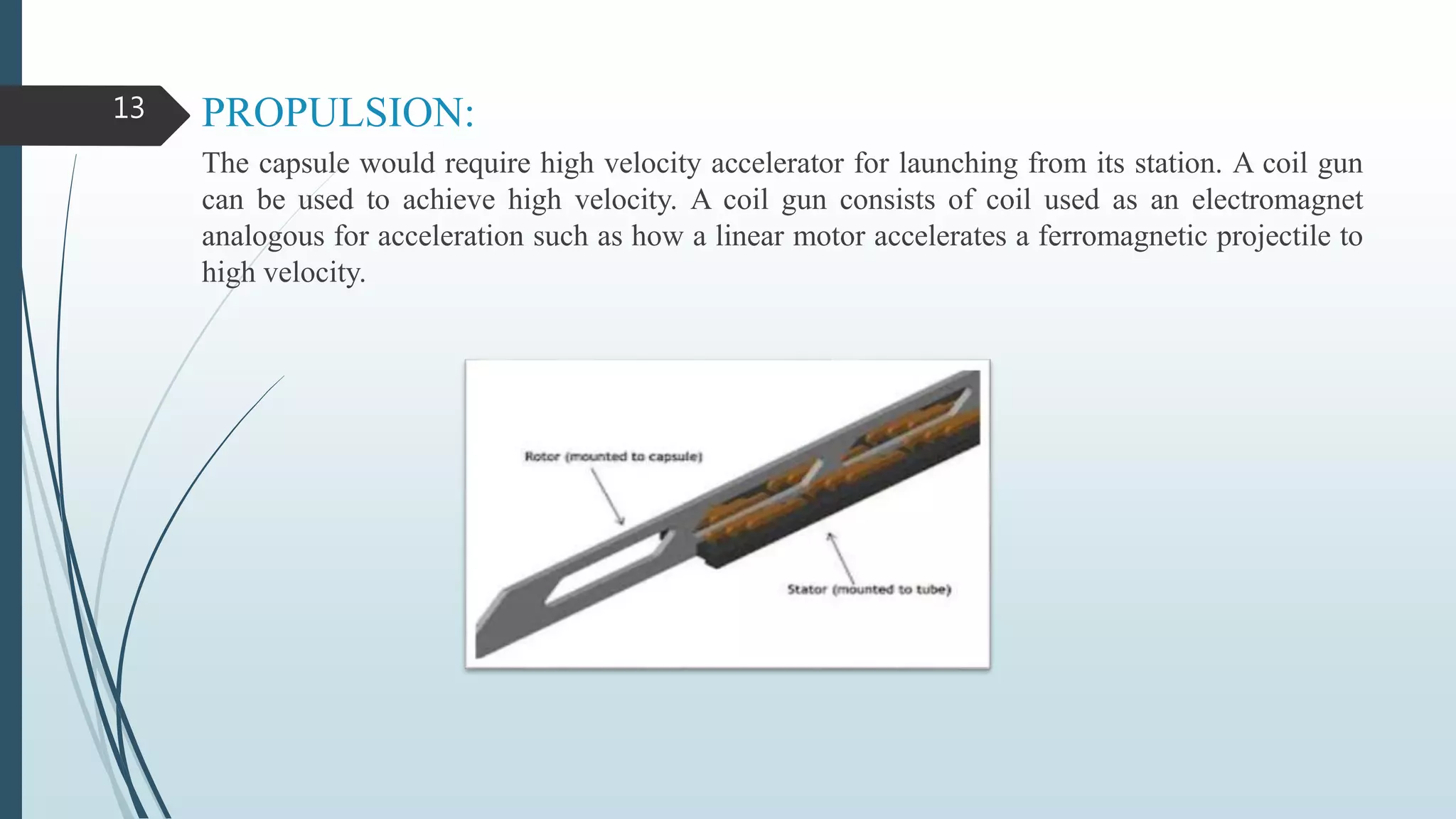
The capsule wouldrequire high velocity accelerator for launching from its station. A coil gun
can be used to achieve high velocity. A coil gun consists of coil used as an electromagnet
analogous for acceleration such as how a linear motor accelerates a ferromagnetic projectile to
high velocity.
13
14.
SUSPENSION:
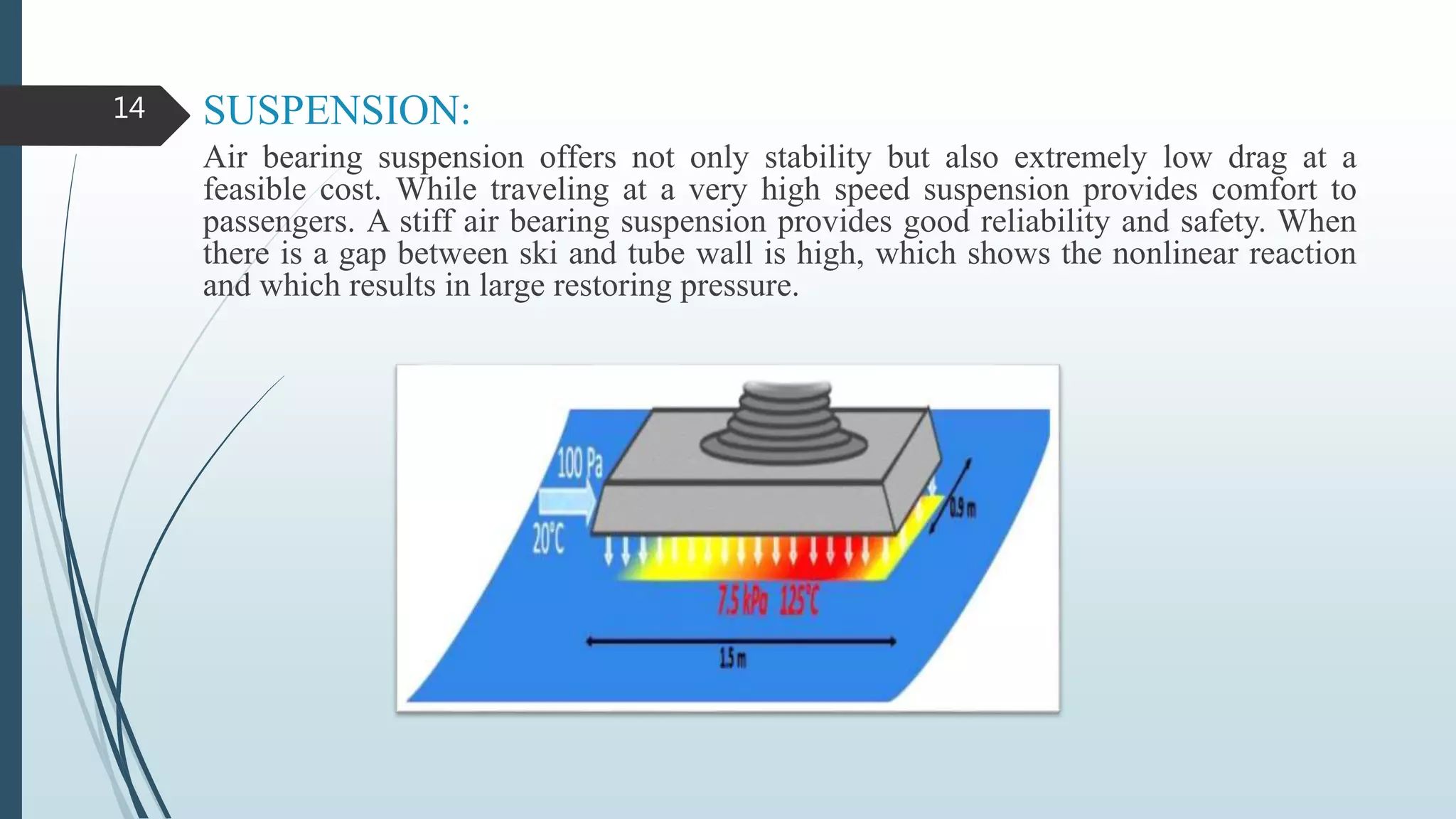
Air bearing suspensionoffers not only stability but also extremely low drag at a
feasible cost. While traveling at a very high speed suspension provides comfort to
passengers. A stiff air bearing suspension provides good reliability and safety. When
there is a gap between ski and tube wall is high, which shows the nonlinear reaction
and which results in large restoring pressure.
14
15.
POWER SOURCE:
Hyperloop systemwould require abundant power. Increasing demand of fuel due to
globalization, limited energy sources and sky high fuel prices was the main problem for
Hyperloop system. However this problem is overcome by the conventional solar energy.
Throughout the length of the tube’s roof covered with solar panel, which produces more
energy than needed by whole Hyperloop setup without consuming drop of petrol, diesel or
kerosene. Extra amount of energy stored in large batteries, which can be used in cloudy days
when sun not shines. It is self-sufficient environment friendly and modern technology.
15
16.
HYPERLOOP TRAVEL TIME:
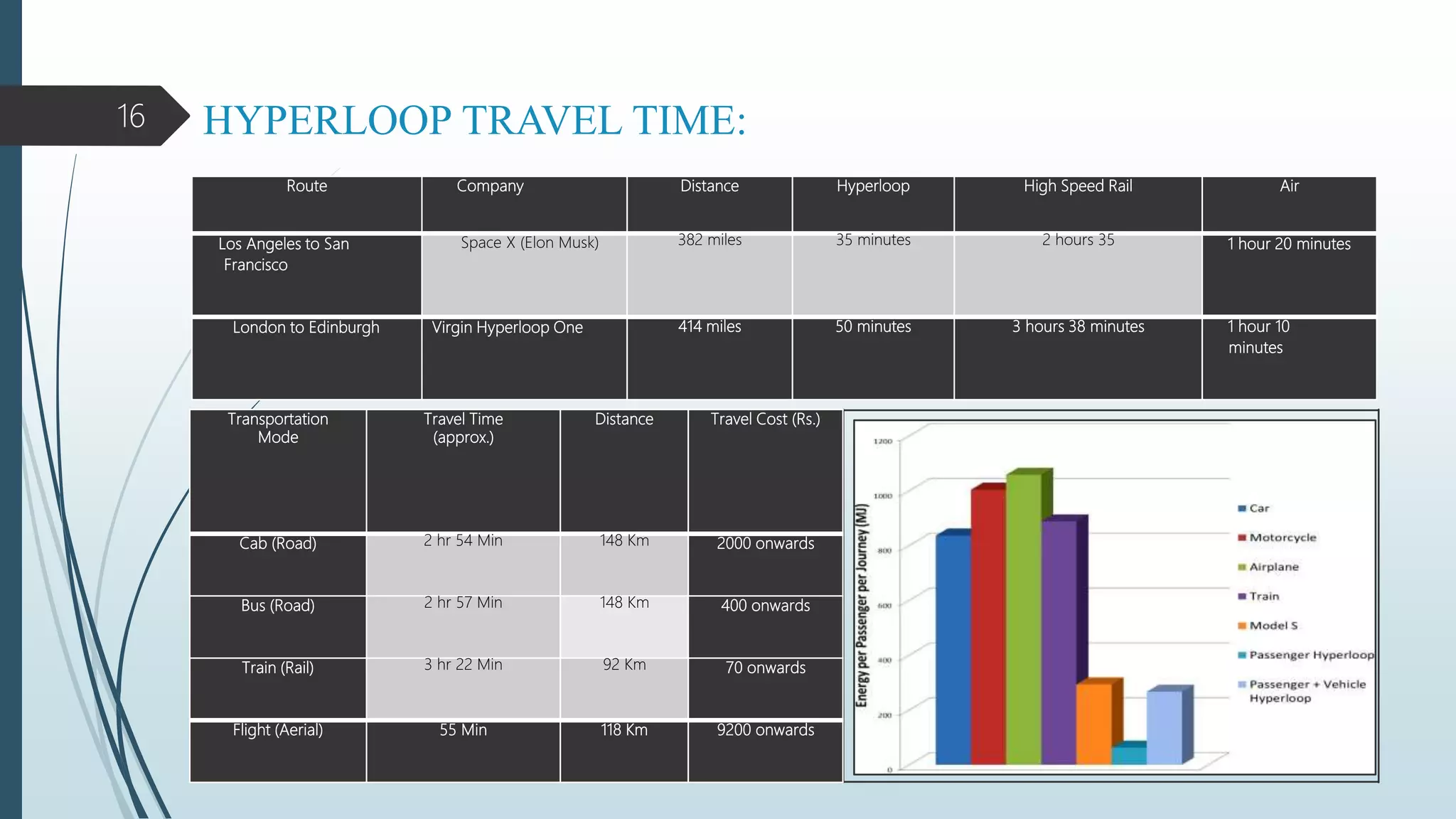
RouteCompany Distance Hyperloop High Speed Rail Air
Los Angeles to San
Francisco
Space X (Elon Musk) 382 miles 35 minutes 2 hours 35 1 hour 20 minutes
London to Edinburgh Virgin Hyperloop One 414 miles 50 minutes 3 hours 38 minutes 1 hour 10
minutes
16
Transportation
Mode
Travel Time
(approx.)
Distance Travel Cost (Rs.)
Cab (Road) 2 hr 54 Min 148 Km 2000 onwards
Bus (Road) 2 hr 57 Min 148 Km 400 onwards
Train (Rail) 3 hr 22 Min 92 Km 70 onwards
Flight (Aerial) 55 Min 118 Km 9200 onwards
17.
SYSTEM & RELIABILITY:
Onboard Passenger Emergency
Power Outage
Capsule Depressurization
Structural Integrity of the Tube in Jeopardy
Earthquakes
Human Related Incidents
Reliability
17
18.
ADVANTAGES:
Fast, inexpensiveand advance mode of transportation.
Environmentally friendly and pollution free as it powered by regenerative energy source
solar.
Time consuming and best solution on traffic congestion problems.
Resistance to earthquakes. It can travel in any kind of weather.
At very high speed system provides better comfort to passengers at low travel cost.
More convenient and ready to travel when passengers are ready.
18
19.
DISADVANTAGES:
Construction costof Hyperloop tubes and capsule is very high.
As Hyperloop tube are longer in length so sharp turning is critical.
Capsules are compact in size so that less moveable space for passengers.
Punctured tunnel could cause shockwaves.
System is high profile asset so continuous screening and monitoring is required to manage
safety risks & terrorist activities.
High speed might cause dizziness in some passenger.
19
20.
PRESENT AND FUTUREWORK :
PRESENT WORK:-
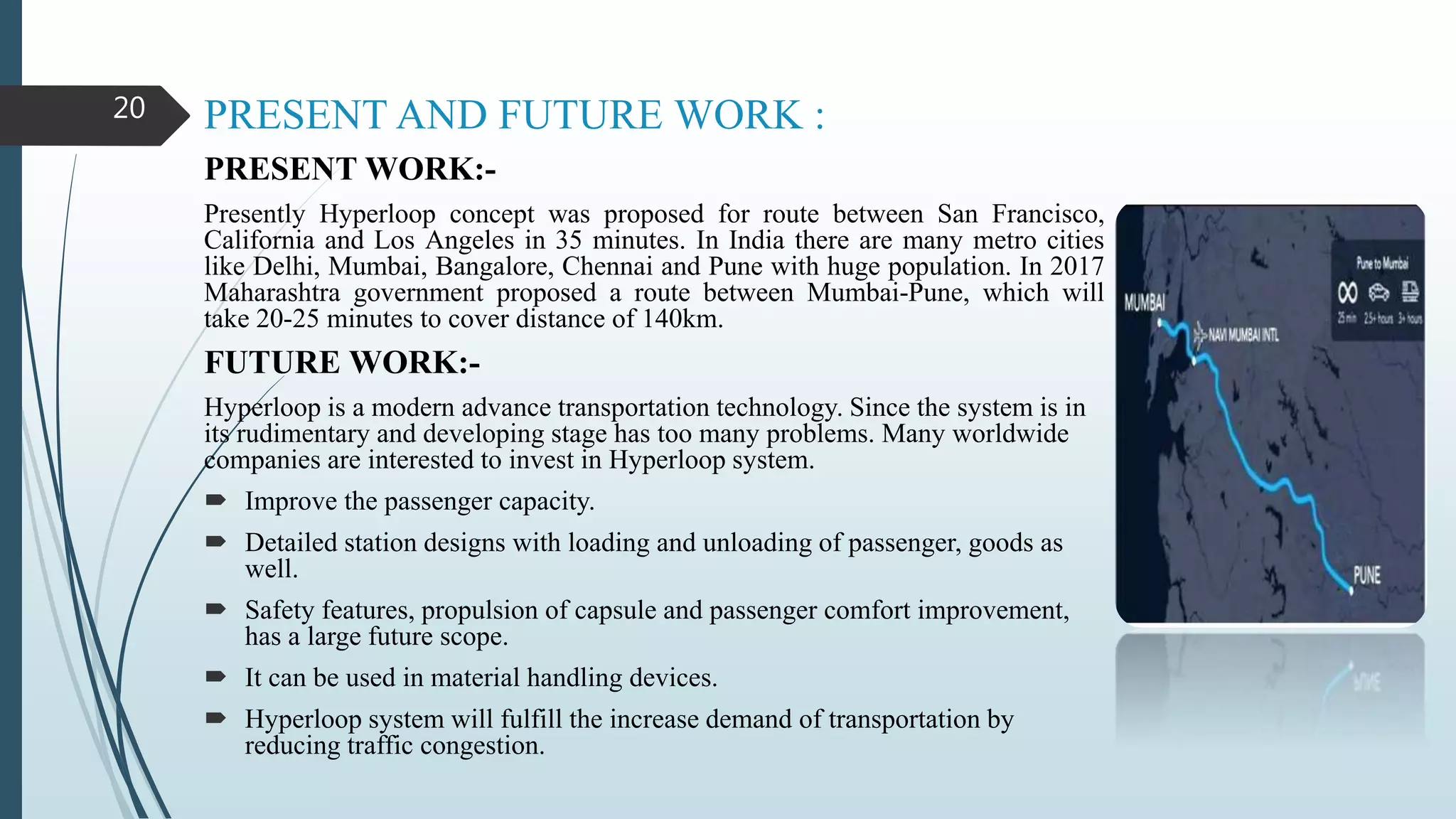
Presently Hyperloop concept was proposed for route between San Francisco,
California and Los Angeles in 35 minutes. In India there are many metro cities
like Delhi, Mumbai, Bangalore, Chennai and Pune with huge population. In 2017
Maharashtra government proposed a route between Mumbai-Pune, which will
take 20-25 minutes to cover distance of 140km.
FUTURE WORK:-
Hyperloop is a modern advance transportation technology. Since the system is in
its rudimentary and developing stage has too many problems. Many worldwide
companies are interested to invest in Hyperloop system.
Improve the passenger capacity.
Detailed station designs with loading and unloading of passenger, goods as
well.
Safety features, propulsion of capsule and passenger comfort improvement,
has a large future scope.
It can be used in material handling devices.
Hyperloop system will fulfill the increase demand of transportation by
reducing traffic congestion.
20
21.
CONCLUSION:
A highspeed transportation system known as Hyperloop has been developed in this
Seminar.
Hyperloop transportation system can be used over the conventional modes of
transportation that are rail, road, water and air.
At very high speed it provides better comfort and cost is also low.
By reducing the pressure of the air in the tube which reduces simple air drag and enables
the capsule to move faster than through a tube at atmospheric pressure.
21
22.
REFERENCES:
Ahmed HodaibSamar, International Journal of mechanical, aerospace, industrial,
mechatronics and manufacturing engineering Vol:10 No:5, (May 2016).
Paper by Mark Sakowski,” The Next Contender in High Speed Transport Elon Musks
Hyperloop”, 2016.
N. Kayela, editor of scientific and technical department,” Hyperloop: A Fifth Mode of
Transportation”, 2014.
Mohammed Imran, International Journal of Engineering Research, 2016.
Elon Musk (August 12, 2013).” Hyperloop Alpha” (PDF). SpaceX Retrieved August 13, 2013.
“Hyperloop Transportation System”, International Research Journal of Engineering and
Technology (IRJET), From the WWW.IRJET.NET Sites.
22