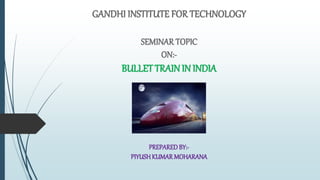
BULLET TRAININ INDIA
PREPAREDBY:-
PIYUSHKUMARMOHARANA
• INTRODUCTION
• BULLET TRAIN TRACK
• BULLET TRAIN TECHNOLOGY
• PROPULSION SYSTEM
• SEATING CAPACITY AND CLASSES
• BULLET TRAIN VS CONVENTIONAL TRAIN
• APPLICATION INFORMATION
• ENVIRONMENT FRIENDLY
• CONCLUSSION
• REFERENCE
INTRODUCTION
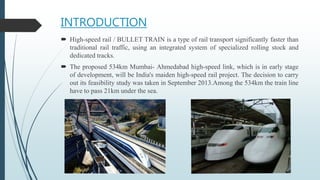
 High-speed rail / BULLET TRAIN is a type of rail transport significantly faster than
traditional rail traffic, using an integrated system of specialized rolling stock and
dedicated tracks.
 The proposed 534km Mumbai- Ahmedabad high-speed link, which is in early stage
of development, will be India's maiden high-speed rail project. The decision to carry
out its feasibility study was taken in September 2013.Among the 534km the train line
have to pass 21km under the sea.
THE BULLET TRAIN TRACK
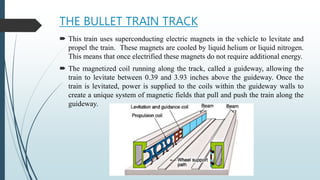
 This train uses superconducting electric magnets in the vehicle to levitate and
propel the train. These magnets are cooled by liquid helium or liquid nitrogen.
This means that once electrified these magnets do not require additional energy.
 The magnetized coil running along the track, called a guideway, allowing the
train to levitate between 0.39 and 3.93 inches above the guideway. Once the
train is levitated, power is supplied to the coils within the guideway walls to
create a unique system of magnetic fields that pull and push the train along the
guideway.
BULLET TRAIN TECHNOLOGY
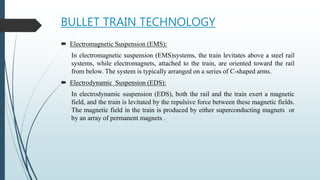
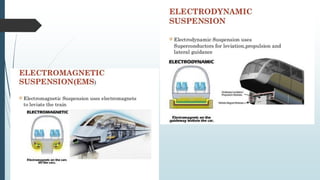
 Electromagnetic Suspension (EMS):
In electromagnetic suspension (EMS)systems, the train levitates above a steel rail
systems, while electromagnets, attached to the train, are oriented toward the rail
from below. The system is typically arranged on a series of C-shaped arms.
 Electrodynamic Suspension (EDS):
In electrodynamic suspension (EDS), both the rail and the train exert a magnetic
field, and the train is levitated by the repulsive force between these magnetic fields.
The magnetic field in the train is produced by either superconducting magnets or
by an array of permanent magnets .
PROPULSION SYSTEM
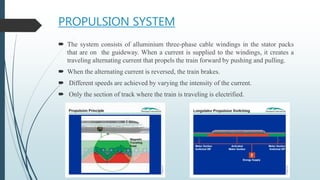
 The system consists of alluminium three-phase cable windings in the stator packs
that are on the guideway. When a current is supplied to the windings, it creates a
traveling alternating current that propels the train forward by pushing and pulling.
 When the alternating current is reversed, the train brakes.
 Different speeds are achieved by varying the intensity of the current.
 Only the section of track where the train is traveling is electrified.
SEATING CAPACITY AND CLASSES
 The train has three separate classes namely business class, green class, ordinary class.
 E 5 Series shinkansen train configured with ten cars and has a capacity to carry 731
passenger.
 658 seats of ordinary class, 55 seats are of green class and 18 seats are in buisness class.
BULLET TRAIN VS CONVNTIONAL TRAIN
APPLICATION INFORMATION
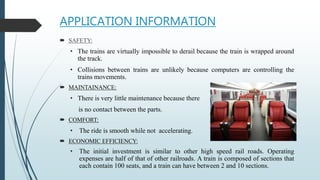
 SAFETY:
• The trains are virtually impossible to derail because the train is wrapped around
the track.
• Collisions between trains are unlikely because computers are controlling the
trains movements.
 MAINTAINANCE:
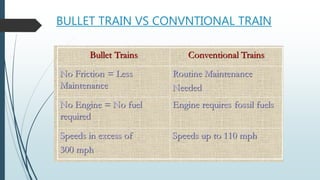
• There is very little maintenance because there
is no contact between the parts.
 COMFORT:
• The ride is smooth while not accelerating.
 ECONOMIC EFFICIENCY:
• The initial investment is similar to other high speed rail roads. Operating
expenses are half of that of other railroads. A train is composed of sections that
each contain 100 seats, and a train can have between 2 and 10 sections.
ENVIRONMENT FRIENDLY
 Less energy consumption because no rail-track friction.
 Requires no fossil fuel which can harm the environment.
 Less noise pollution since the train never hits the track.
 Trains take up less space than conventional trains.
MUMBAI–AHMEDABAD HIGH-SPEED RAIL
CORRIDOR
 The Mumbai-Ahmedabad high-speed rail corridor is a proposed high-speed rail line
connecting the cities of Mumbai, Maharashtra and Ahmedabad, Gujarat in Western
India. It will be India's first high-speed rail line.
 Construction of the corridor will begin in 2018 and is expected to be completed by
2023.
 Consultancy work on the high-speed rail corridor began in December 2016. Most of
the corridor will be elevated, except for a 21 km undersea tunnel between Thane and
Virar. It is estimated that land acquisition be completed by 2017.
 Survey work on the route began in January 2017. The geo-technical surveys have
started along the entire route between Mumbai and Ahmedabad and is expected to
take two to three months.
CONCLUSION
 Bullet trains use magnets to levitate and propel the trains forward.
 Since there is no friction these trains can reach high speeds.
 It is a safe and efficient way to travel.
 This project will revolutionise rail Travel experience in INDIA and will write a new
chapter in History of India .
 It will provide world class facilities and experience to Indian customers at a price of
A/C first class but reducing travel time by more than half.
 This venture will be profitable to both the Developers/ Investors and Consumers and
it will be a win- win situation for all including government.
COST ESTIMATED
 The project is estimated to cost ₹97,636 crore . JICA agreed to fund 81% of the
total project cost ₹79,087 crore, through a 50-year loan at an interest rate of 0.1%
and a moratorium on repayments up to 15 years. Indian Railways will invest
₹9,800 crore in the high-speed rail project, and the remaining cost will be borne
by the state governments of Maharashtra and Gujarat. 20% of the components
used on the corridor will be supplied by Japan, and manufactured in India.
 It has been proposed to construct the line on an elevated corridor to avoid land
acquisitions and the need to build underpasses. If this proposal is accepted, it
would raise the cost for the project by an additional ₹10,000 crore.
 Infrastructure and operations
Trains are proposed to have length of between 10 and 16 coaches. Each train will
have a passenger capacity of 1,300 and 1,600 passengers. The system will be
designed to operate trains at a maximum speed of 350 kilometres per hour
(220 mph), while operational speed would be 320 kilometres per hour (200 mph).
When traveling at 350 kilometres per hour (220 mph) a train will be able to travel
end-to-end on the 508 kilometres (316 mi) line in 2 hours and 7 minutes. Currently, a
train journey from Mumbai to Ahmedabad takes 7 hours.
 Signaling and power
Signaling equipment and power systems for the corridor will be imported from
Japan, per the terms of the loan agreement with JICA.
 Operator
In February 2016, the National High Speed Rail Corporation (NHSRC) was
registered under the Companies Act, 1956. The NHSRC is a special purpose
vehicle responsible for the implementation of the Mumbai–Ahmedabad high-speed
rail project. In October 2016, the Indian Railways invited applications to fill key
positions in the NHSRC. These positions include managing director, director
(project), director (electrical and systems) and director (finance). The managing
director is required to sign a bond guaranteeing to serve in the position for a
minimum of 5 years.
 Fares
Fares are proposed to be 1.5 times that of a First-Class AC ticket on the Mumbai-
Ahmedabad Duronto Express. As of January 2017, a First-Class AC ticket from
Mumbai to Ahmedabad costs ₹2,000, which would make the cost of a high-speed
rail ticket ₹3,000.
REFERANCE
 www.wikipedia.com
 www.pib.nic.in
 www.google.co.in
 www.railway-technology.com
Piyush

Piyush

  • 1.
  • 2.
    • INTRODUCTION • BULLETTRAIN TRACK • BULLET TRAIN TECHNOLOGY • PROPULSION SYSTEM • SEATING CAPACITY AND CLASSES • BULLET TRAIN VS CONVENTIONAL TRAIN • APPLICATION INFORMATION • ENVIRONMENT FRIENDLY • CONCLUSSION • REFERENCE
  • 3.
    INTRODUCTION  High-speed rail/ BULLET TRAIN is a type of rail transport significantly faster than traditional rail traffic, using an integrated system of specialized rolling stock and dedicated tracks.  The proposed 534km Mumbai- Ahmedabad high-speed link, which is in early stage of development, will be India's maiden high-speed rail project. The decision to carry out its feasibility study was taken in September 2013.Among the 534km the train line have to pass 21km under the sea.
  • 4.
    THE BULLET TRAINTRACK  This train uses superconducting electric magnets in the vehicle to levitate and propel the train. These magnets are cooled by liquid helium or liquid nitrogen. This means that once electrified these magnets do not require additional energy.  The magnetized coil running along the track, called a guideway, allowing the train to levitate between 0.39 and 3.93 inches above the guideway. Once the train is levitated, power is supplied to the coils within the guideway walls to create a unique system of magnetic fields that pull and push the train along the guideway.
  • 5.
    BULLET TRAIN TECHNOLOGY Electromagnetic Suspension (EMS): In electromagnetic suspension (EMS)systems, the train levitates above a steel rail systems, while electromagnets, attached to the train, are oriented toward the rail from below. The system is typically arranged on a series of C-shaped arms.  Electrodynamic Suspension (EDS): In electrodynamic suspension (EDS), both the rail and the train exert a magnetic field, and the train is levitated by the repulsive force between these magnetic fields. The magnetic field in the train is produced by either superconducting magnets or by an array of permanent magnets .
  • 7.
    PROPULSION SYSTEM  Thesystem consists of alluminium three-phase cable windings in the stator packs that are on the guideway. When a current is supplied to the windings, it creates a traveling alternating current that propels the train forward by pushing and pulling.  When the alternating current is reversed, the train brakes.  Different speeds are achieved by varying the intensity of the current.  Only the section of track where the train is traveling is electrified.
  • 8.
    SEATING CAPACITY ANDCLASSES  The train has three separate classes namely business class, green class, ordinary class.  E 5 Series shinkansen train configured with ten cars and has a capacity to carry 731 passenger.  658 seats of ordinary class, 55 seats are of green class and 18 seats are in buisness class.
  • 9.
    BULLET TRAIN VSCONVNTIONAL TRAIN
  • 10.
    APPLICATION INFORMATION  SAFETY: •The trains are virtually impossible to derail because the train is wrapped around the track. • Collisions between trains are unlikely because computers are controlling the trains movements.  MAINTAINANCE: • There is very little maintenance because there is no contact between the parts.  COMFORT: • The ride is smooth while not accelerating.  ECONOMIC EFFICIENCY: • The initial investment is similar to other high speed rail roads. Operating expenses are half of that of other railroads. A train is composed of sections that each contain 100 seats, and a train can have between 2 and 10 sections.
  • 11.
    ENVIRONMENT FRIENDLY  Lessenergy consumption because no rail-track friction.  Requires no fossil fuel which can harm the environment.  Less noise pollution since the train never hits the track.  Trains take up less space than conventional trains.
  • 12.
    MUMBAI–AHMEDABAD HIGH-SPEED RAIL CORRIDOR The Mumbai-Ahmedabad high-speed rail corridor is a proposed high-speed rail line connecting the cities of Mumbai, Maharashtra and Ahmedabad, Gujarat in Western India. It will be India's first high-speed rail line.  Construction of the corridor will begin in 2018 and is expected to be completed by 2023.  Consultancy work on the high-speed rail corridor began in December 2016. Most of the corridor will be elevated, except for a 21 km undersea tunnel between Thane and Virar. It is estimated that land acquisition be completed by 2017.  Survey work on the route began in January 2017. The geo-technical surveys have started along the entire route between Mumbai and Ahmedabad and is expected to take two to three months.
  • 13.
    CONCLUSION  Bullet trainsuse magnets to levitate and propel the trains forward.  Since there is no friction these trains can reach high speeds.  It is a safe and efficient way to travel.  This project will revolutionise rail Travel experience in INDIA and will write a new chapter in History of India .  It will provide world class facilities and experience to Indian customers at a price of A/C first class but reducing travel time by more than half.  This venture will be profitable to both the Developers/ Investors and Consumers and it will be a win- win situation for all including government.
  • 14.
    COST ESTIMATED  Theproject is estimated to cost ₹97,636 crore . JICA agreed to fund 81% of the total project cost ₹79,087 crore, through a 50-year loan at an interest rate of 0.1% and a moratorium on repayments up to 15 years. Indian Railways will invest ₹9,800 crore in the high-speed rail project, and the remaining cost will be borne by the state governments of Maharashtra and Gujarat. 20% of the components used on the corridor will be supplied by Japan, and manufactured in India.  It has been proposed to construct the line on an elevated corridor to avoid land acquisitions and the need to build underpasses. If this proposal is accepted, it would raise the cost for the project by an additional ₹10,000 crore.
  • 15.
     Infrastructure andoperations Trains are proposed to have length of between 10 and 16 coaches. Each train will have a passenger capacity of 1,300 and 1,600 passengers. The system will be designed to operate trains at a maximum speed of 350 kilometres per hour (220 mph), while operational speed would be 320 kilometres per hour (200 mph). When traveling at 350 kilometres per hour (220 mph) a train will be able to travel end-to-end on the 508 kilometres (316 mi) line in 2 hours and 7 minutes. Currently, a train journey from Mumbai to Ahmedabad takes 7 hours.  Signaling and power Signaling equipment and power systems for the corridor will be imported from Japan, per the terms of the loan agreement with JICA.
  • 16.
     Operator In February2016, the National High Speed Rail Corporation (NHSRC) was registered under the Companies Act, 1956. The NHSRC is a special purpose vehicle responsible for the implementation of the Mumbai–Ahmedabad high-speed rail project. In October 2016, the Indian Railways invited applications to fill key positions in the NHSRC. These positions include managing director, director (project), director (electrical and systems) and director (finance). The managing director is required to sign a bond guaranteeing to serve in the position for a minimum of 5 years.  Fares Fares are proposed to be 1.5 times that of a First-Class AC ticket on the Mumbai- Ahmedabad Duronto Express. As of January 2017, a First-Class AC ticket from Mumbai to Ahmedabad costs ₹2,000, which would make the cost of a high-speed rail ticket ₹3,000.
  • 17.
    REFERANCE  www.wikipedia.com  www.pib.nic.in www.google.co.in  www.railway-technology.com