Introduction to the graphics
pipeline of the PS3
Introduction to the graphics
pipeline of the PS3
: : Cedric Perthuis: : Cedric Perthuis
IntroductionIntroduction
An overview of the hardware architecture with a
focus on the graphics pipeline, and an
introduction to the related software APIs
Aimed to be a high level overview for academics
and game developers
No announcement and no sneak previews of
PS3 games in this presentation
An overview of the hardware architecture with a
focus on the graphics pipeline, and an
introduction to the related software APIs
Aimed to be a high level overview for academics
and game developers
No announcement and no sneak previews of
PS3 games in this presentation
OutlineOutline
Platform Overview
Graphics Pipeline
APIs and tools
Cell Computing example
Conclusion
Platform Overview
Graphics Pipeline
APIs and tools
Cell Computing example
Conclusion
Platform overviewPlatform overview
Processing
3.2Ghz Cell: PPU and 7 SPUs
PPU: PowerPC based, 2 hardware threads
SPUs: dedicated vector processing units
RSX®: high end GPU
Data flow
IO: BluRay, HDD, USB, Memory Cards, GigaBit
ethernet
Memory: main 256 MB, video 256 MB
SPUs, PPU and RSX® access main via shared bus
RSX® pulls from main to video
Processing
3.2Ghz Cell: PPU and 7 SPUs
PPU: PowerPC based, 2 hardware threads
SPUs: dedicated vector processing units
RSX®: high end GPU
Data flow
IO: BluRay, HDD, USB, Memory Cards, GigaBit
ethernet
Memory: main 256 MB, video 256 MB
SPUs, PPU and RSX® access main via shared bus
RSX® pulls from main to video
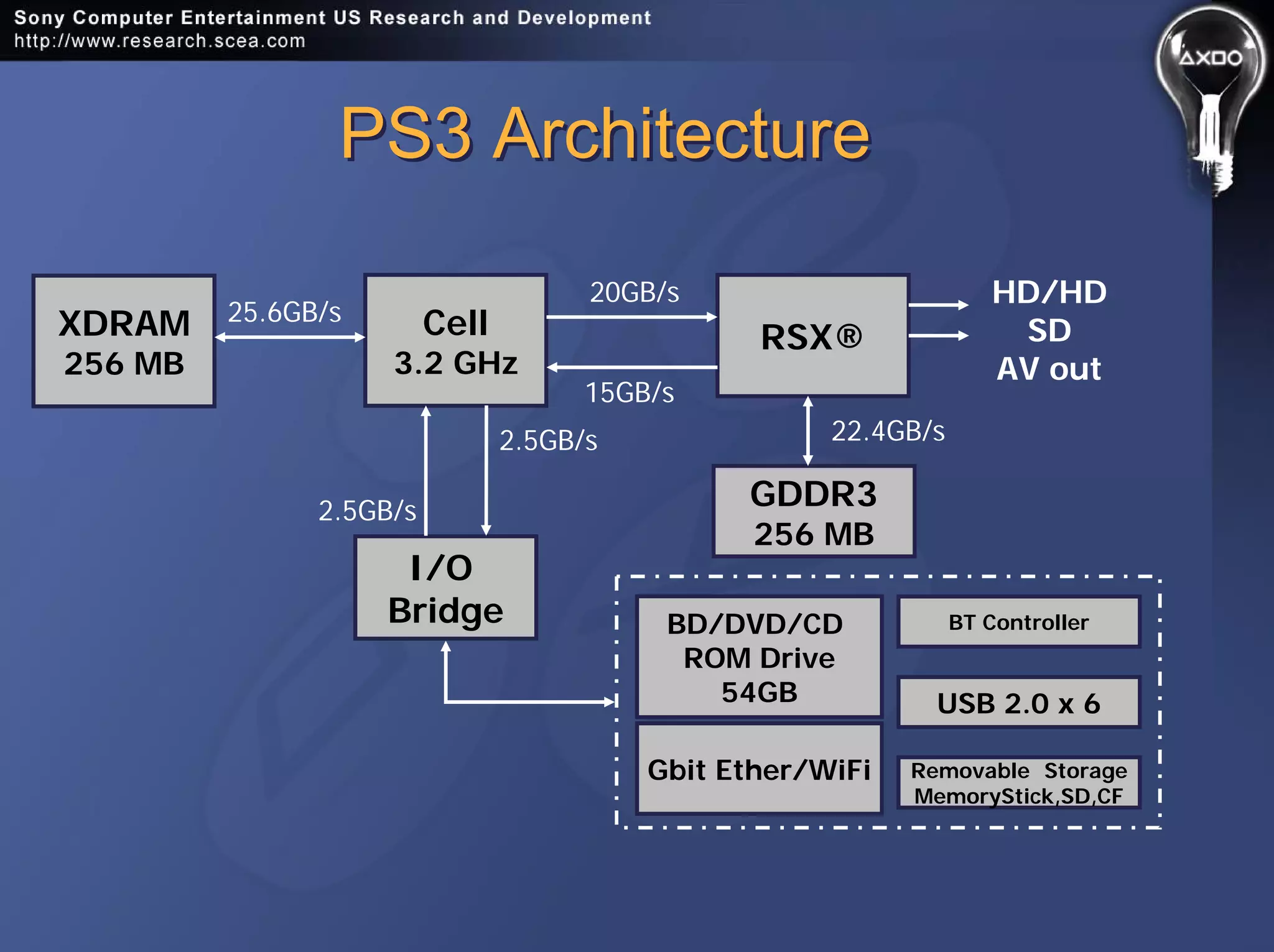
PS3 ArchitecturePS3 Architecture
Cell
3.2 GHz
RSX®XDRAM
256 MB
I/O
Bridge
HD/HD
SD
AV out
20GB/s
25.6GB/s
15GB/s
2.5GB/s
2.5GB/s
BD/DVD/CD
ROM Drive
54GB USB 2.0 x 6
Gbit Ether/WiFi Removable Storage
MemoryStick,SD,CF
BT Controller
GDDR3
256 MB
22.4GB/s
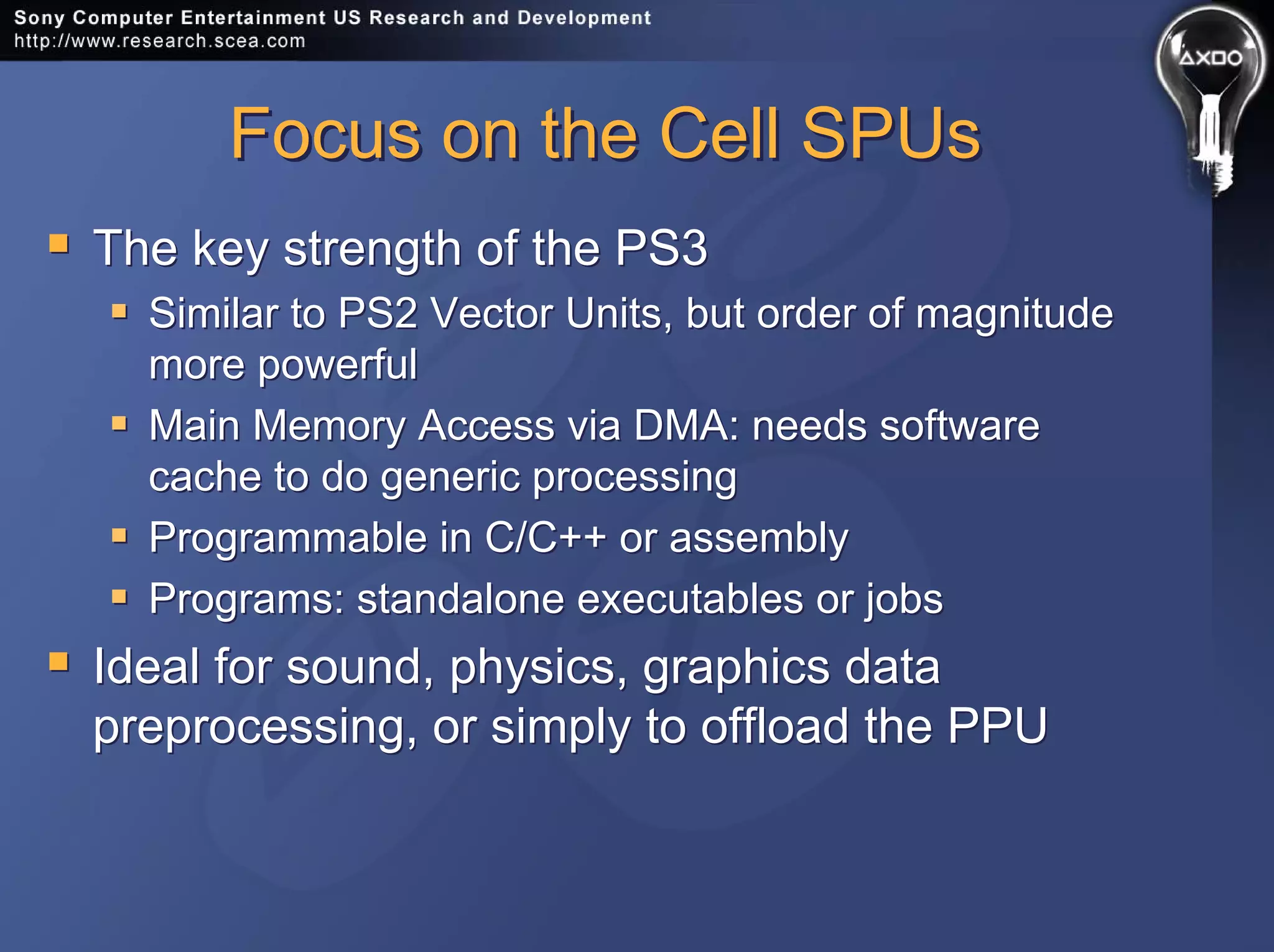
Focus on the Cell SPUsFocus on the Cell SPUs
The key strength of the PS3
Similar to PS2 Vector Units, but order of magnitude
more powerful
Main Memory Access via DMA: needs software
cache to do generic processing
Programmable in C/C++ or assembly
Programs: standalone executables or jobs
Ideal for sound, physics, graphics data
preprocessing, or simply to offload the PPU
The key strength of the PS3
Similar to PS2 Vector Units, but order of magnitude
more powerful
Main Memory Access via DMA: needs software
cache to do generic processing
Programmable in C/C++ or assembly
Programs: standalone executables or jobs
Ideal for sound, physics, graphics data
preprocessing, or simply to offload the PPU
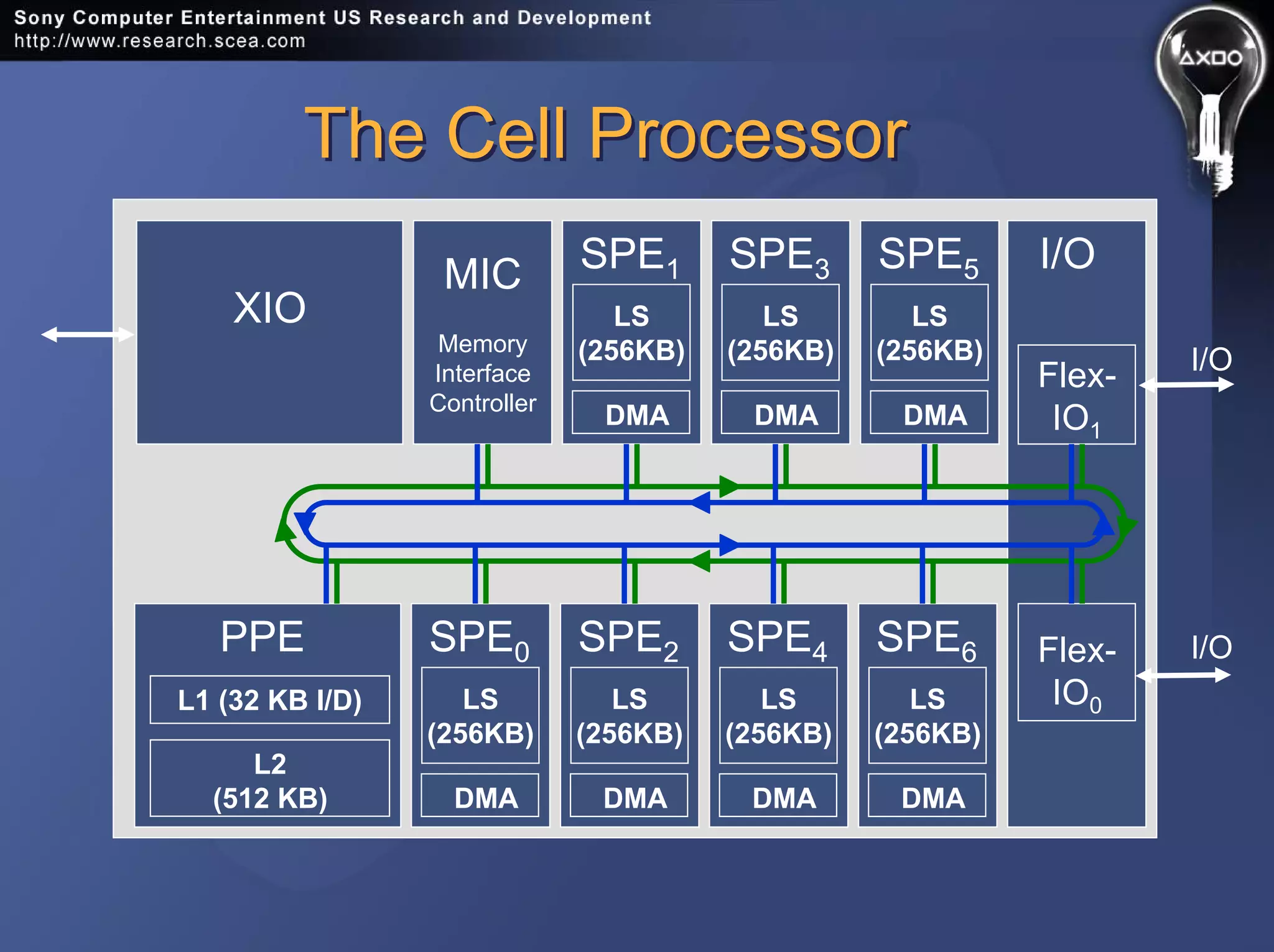
The Cell ProcessorThe Cell Processor
SPE0
LS
(256KB)
DMA
SPE1
LS
(256KB)
DMA
MIC
Memory
Interface
Controller
XIO
SPE2
LS
(256KB)
DMA
SPE3
LS
(256KB)
DMA
SPE4
LS
(256KB)
DMA
SPE5
LS
(256KB)
DMA
SPE6
LS
(256KB)
DMA
PPE
L1 (32 KB I/D)
L2
(512 KB)
Flex-
IO1
Flex-
IO0
I/O
I/O
I/O
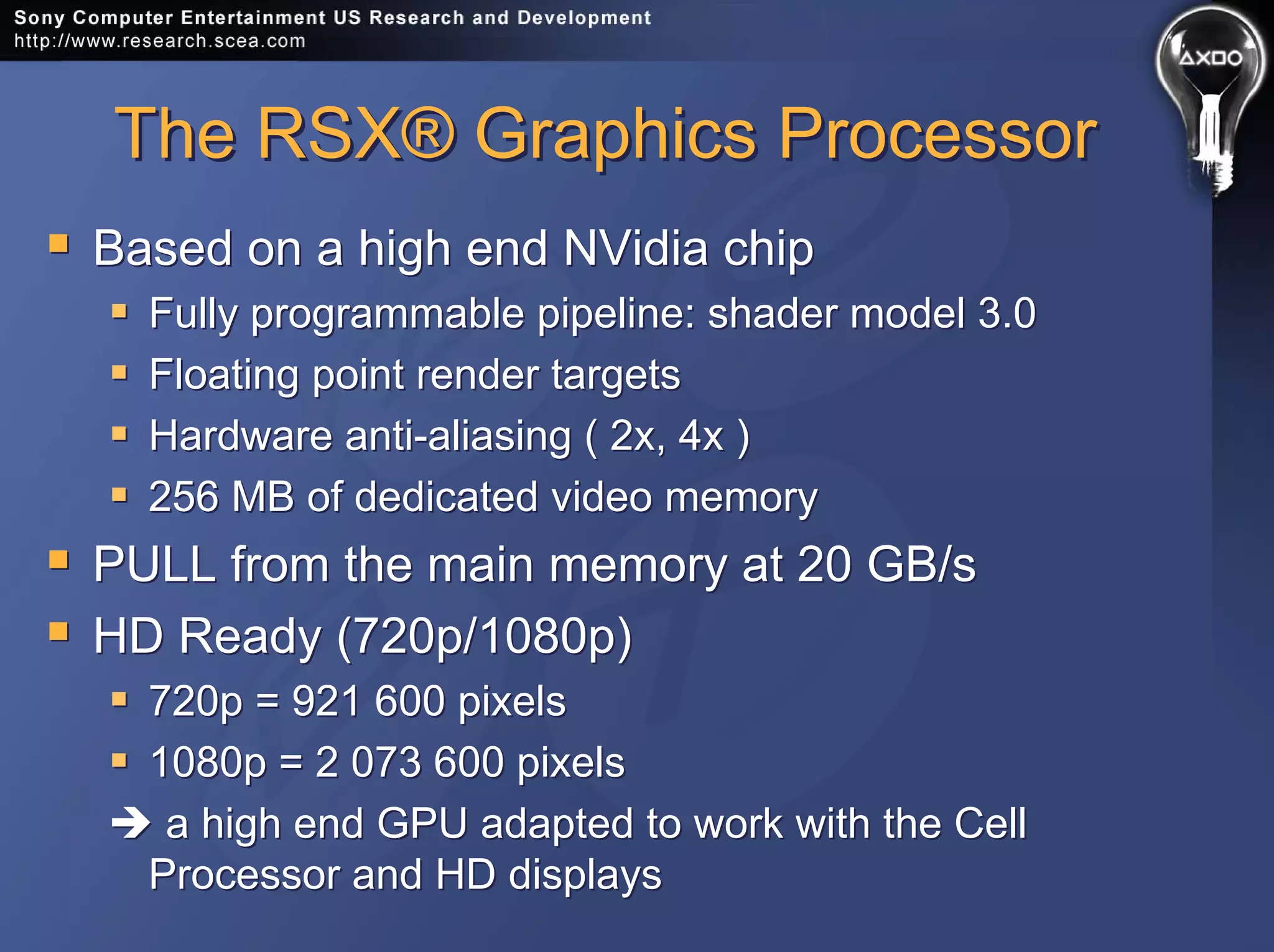
The RSX® Graphics ProcessorThe RSX® Graphics Processor
Based on a high end NVidia chip
Fully programmable pipeline: shader model 3.0
Floating point render targets
Hardware anti-aliasing ( 2x, 4x )
256 MB of dedicated video memory
PULL from the main memory at 20 GB/s
HD Ready (720p/1080p)
720p = 921 600 pixels
1080p = 2 073 600 pixels
a high end GPU adapted to work with the Cell
Processor and HD displays
Based on a high end NVidia chip
Fully programmable pipeline: shader model 3.0
Floating point render targets
Hardware anti-aliasing ( 2x, 4x )
256 MB of dedicated video memory
PULL from the main memory at 20 GB/s
HD Ready (720p/1080p)
720p = 921 600 pixels
1080p = 2 073 600 pixels
a high end GPU adapted to work with the Cell
Processor and HD displays
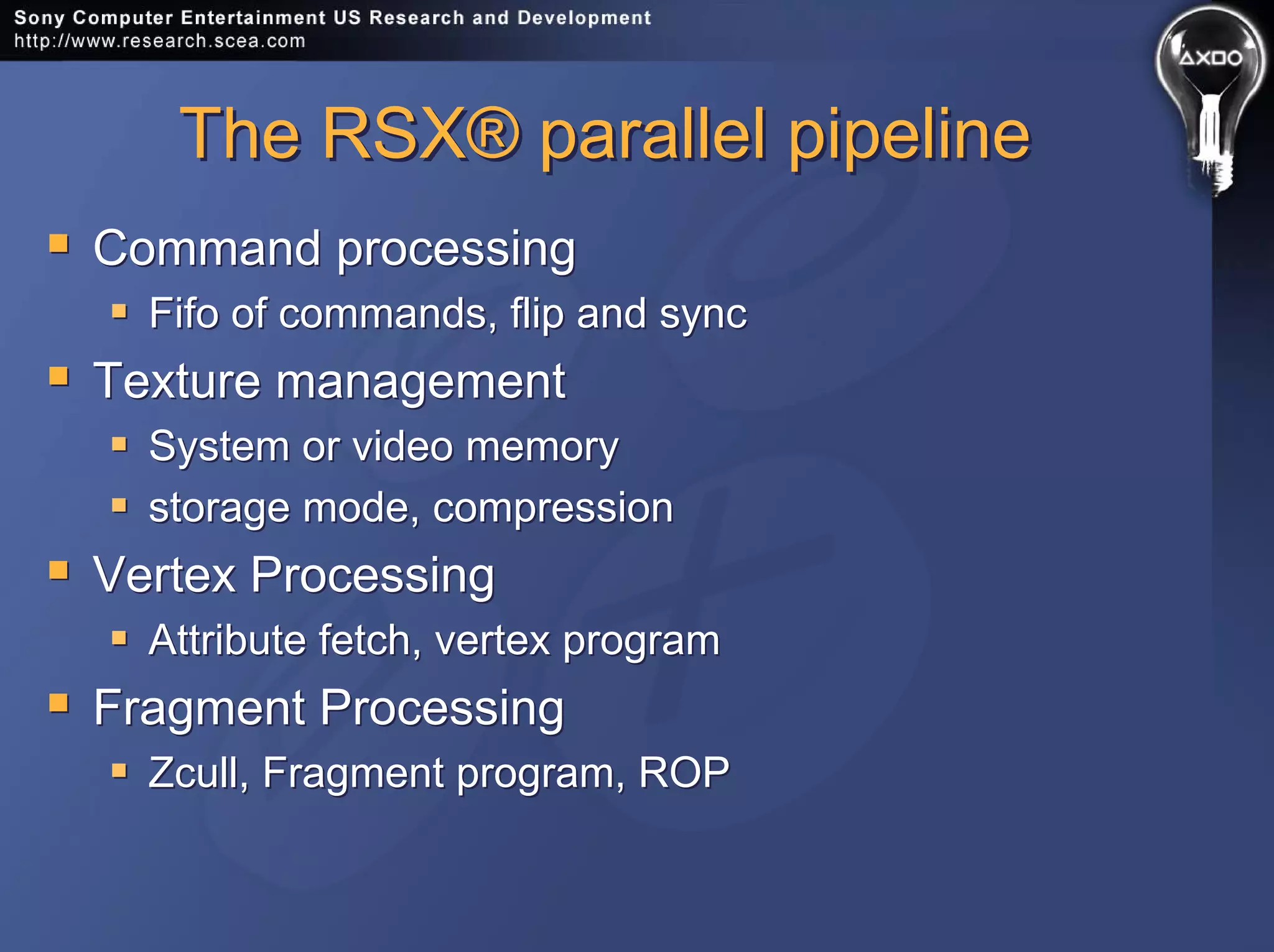
The RSX® parallel pipelineThe RSX® parallel pipeline
Command processing
Fifo of commands, flip and sync
Texture management
System or video memory
storage mode, compression
Vertex Processing
Attribute fetch, vertex program
Fragment Processing
Zcull, Fragment program, ROP
Command processing
Fifo of commands, flip and sync
Texture management
System or video memory
storage mode, compression
Vertex Processing
Attribute fetch, vertex program
Fragment Processing
Zcull, Fragment program, ROP
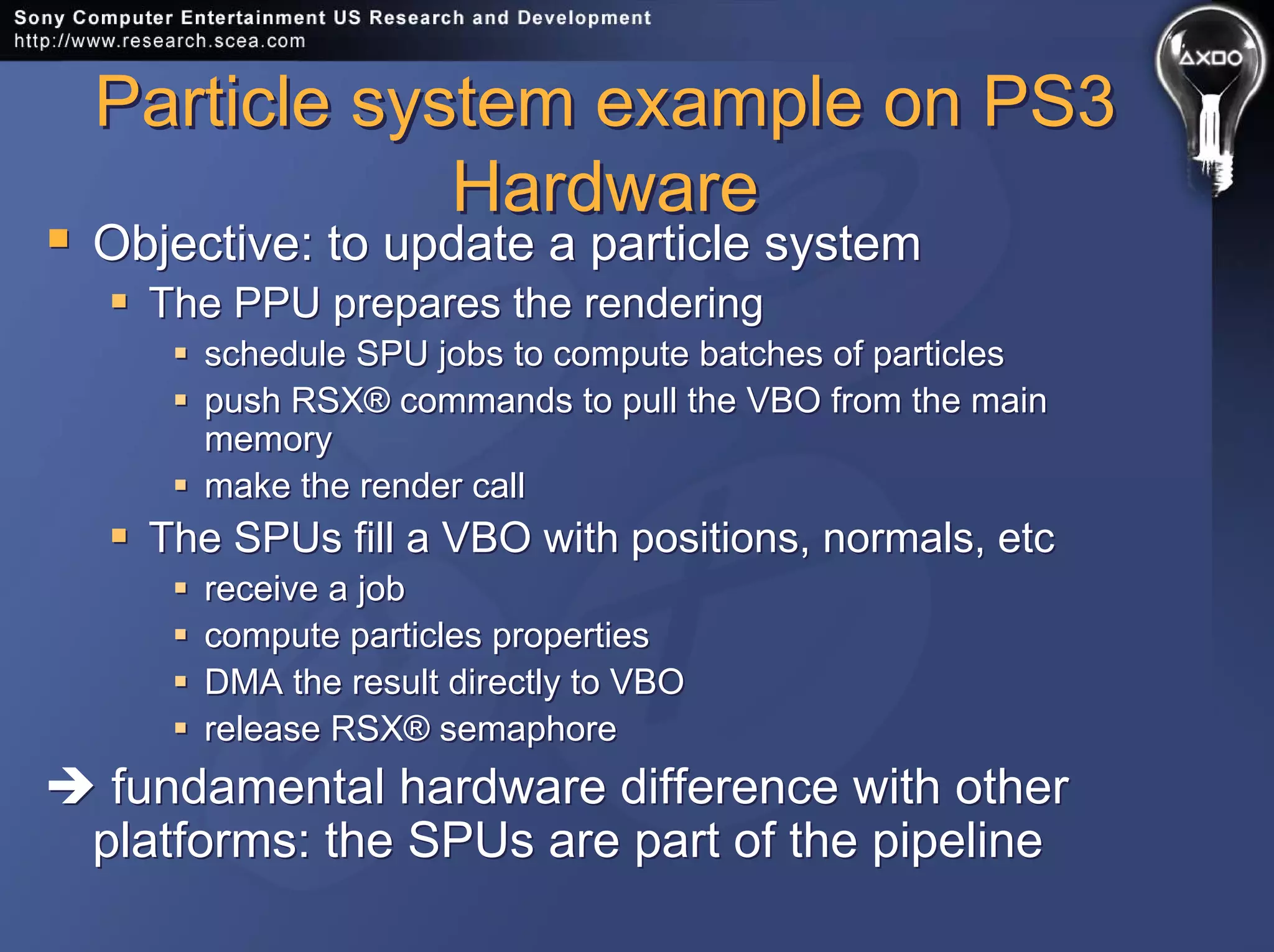
Particle system example on PS3
Hardware
Particle system example on PS3
Hardware
Objective: to update a particle system
The PPU prepares the rendering
schedule SPU jobs to compute batches of particles
push RSX® commands to pull the VBO from the main
memory
make the render call
The SPUs fill a VBO with positions, normals, etc
receive a job
compute particles properties
DMA the result directly to VBO
release RSX® semaphore
fundamental hardware difference with other
platforms: the SPUs are part of the pipeline
Objective: to update a particle system
The PPU prepares the rendering
schedule SPU jobs to compute batches of particles
push RSX® commands to pull the VBO from the main
memory
make the render call
The SPUs fill a VBO with positions, normals, etc
receive a job
compute particles properties
DMA the result directly to VBO
release RSX® semaphore
fundamental hardware difference with other
platforms: the SPUs are part of the pipeline
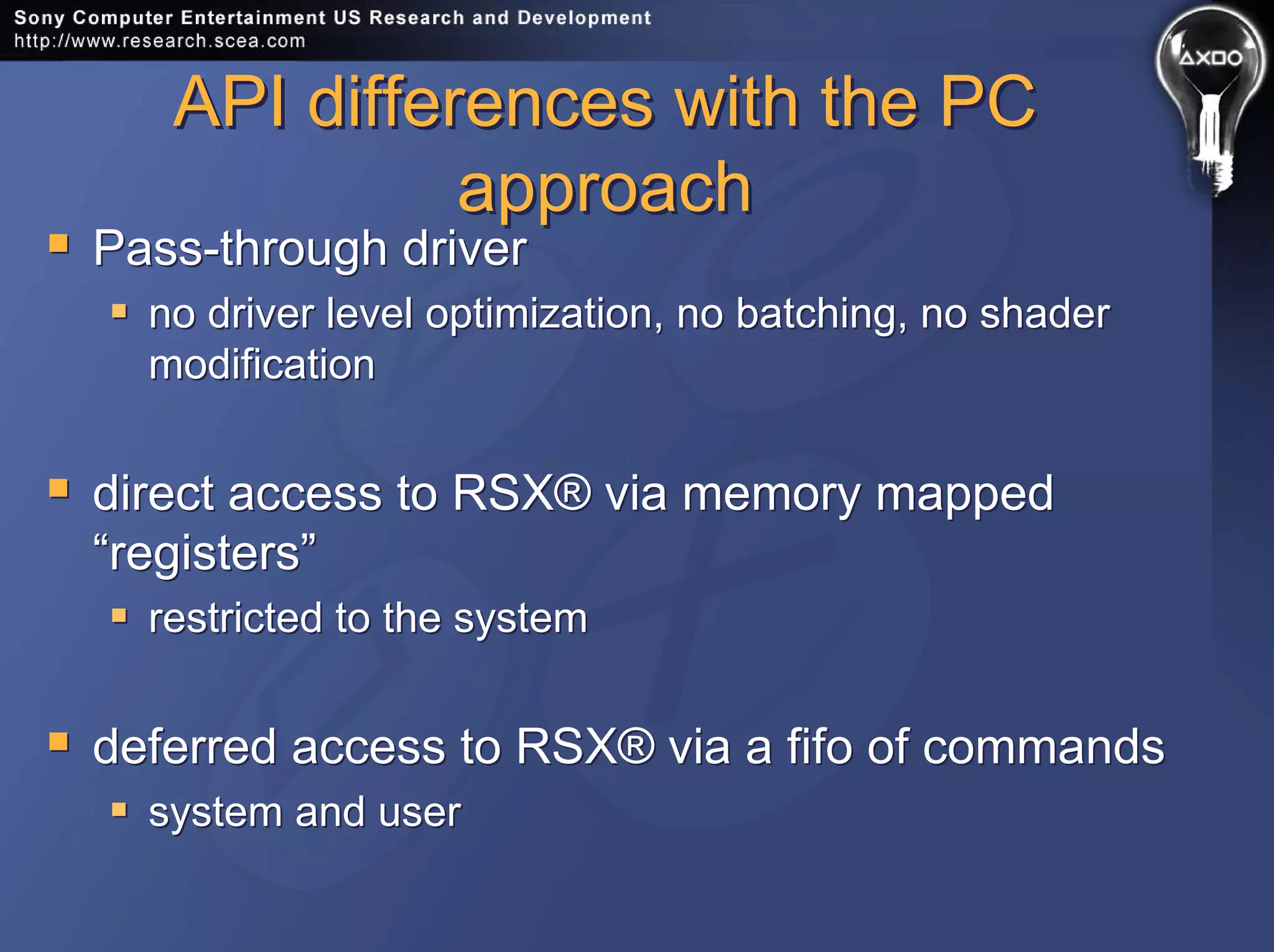
API differences with the PC
approach
API differences with the PC
approach
Pass-through driver
no driver level optimization, no batching, no shader
modification
direct access to RSX® via memory mapped
“registers”
restricted to the system
deferred access to RSX® via a fifo of commands
system and user
Pass-through driver
no driver level optimization, no batching, no shader
modification
direct access to RSX® via memory mapped
“registers”
restricted to the system
deferred access to RSX® via a fifo of commands
system and user
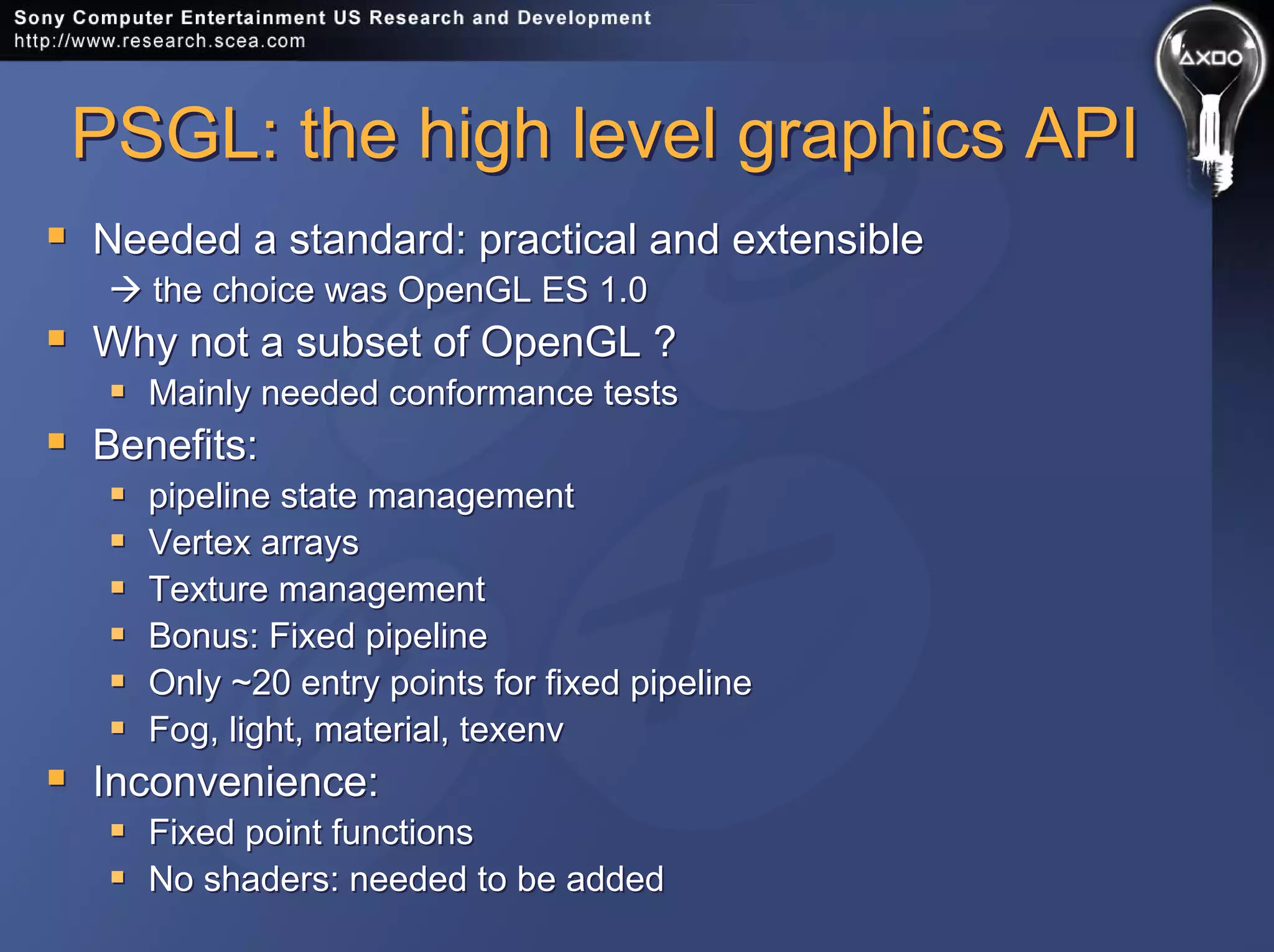
PSGL: the high level graphics APIPSGL: the high level graphics API
Needed a standard: practical and extensible
the choice was OpenGL ES 1.0
Why not a subset of OpenGL ?
Mainly needed conformance tests
Benefits:
pipeline state management
Vertex arrays
Texture management
Bonus: Fixed pipeline
Only ~20 entry points for fixed pipeline
Fog, light, material, texenv
Inconvenience:
Fixed point functions
No shaders: needed to be added
Needed a standard: practical and extensible
the choice was OpenGL ES 1.0
Why not a subset of OpenGL ?
Mainly needed conformance tests
Benefits:
pipeline state management
Vertex arrays
Texture management
Bonus: Fixed pipeline
Only ~20 entry points for fixed pipeline
Fog, light, material, texenv
Inconvenience:
Fixed point functions
No shaders: needed to be added
PSGL: modern GPU extensionsPSGL: modern GPU extensions
OpenGL ES 1.1OpenGL ES 1.1
VBOVBO
FBOFBO
PBOPBO
Cube Map,Cube Map, texgentexgen
Primitives:Primitives:
Quads, Quads_stripsQuads, Quads_strips
primitive restartprimitive restart
InstancingInstancing
Queries and ConditionalQueries and Conditional
RenderingRendering
More data typesMore data types
ex: half_floatex: half_float
Textures:Textures:
Floating point texturesFloating point textures
DXTDXT
3D3D
non power of 2non power of 2
Anisotropic filtering,Anisotropic filtering,
Min/Max LOD, LOD BiasMin/Max LOD, LOD Bias
Depth texturesDepth textures
Gamma correctionGamma correction
Vertex TextureVertex Texture
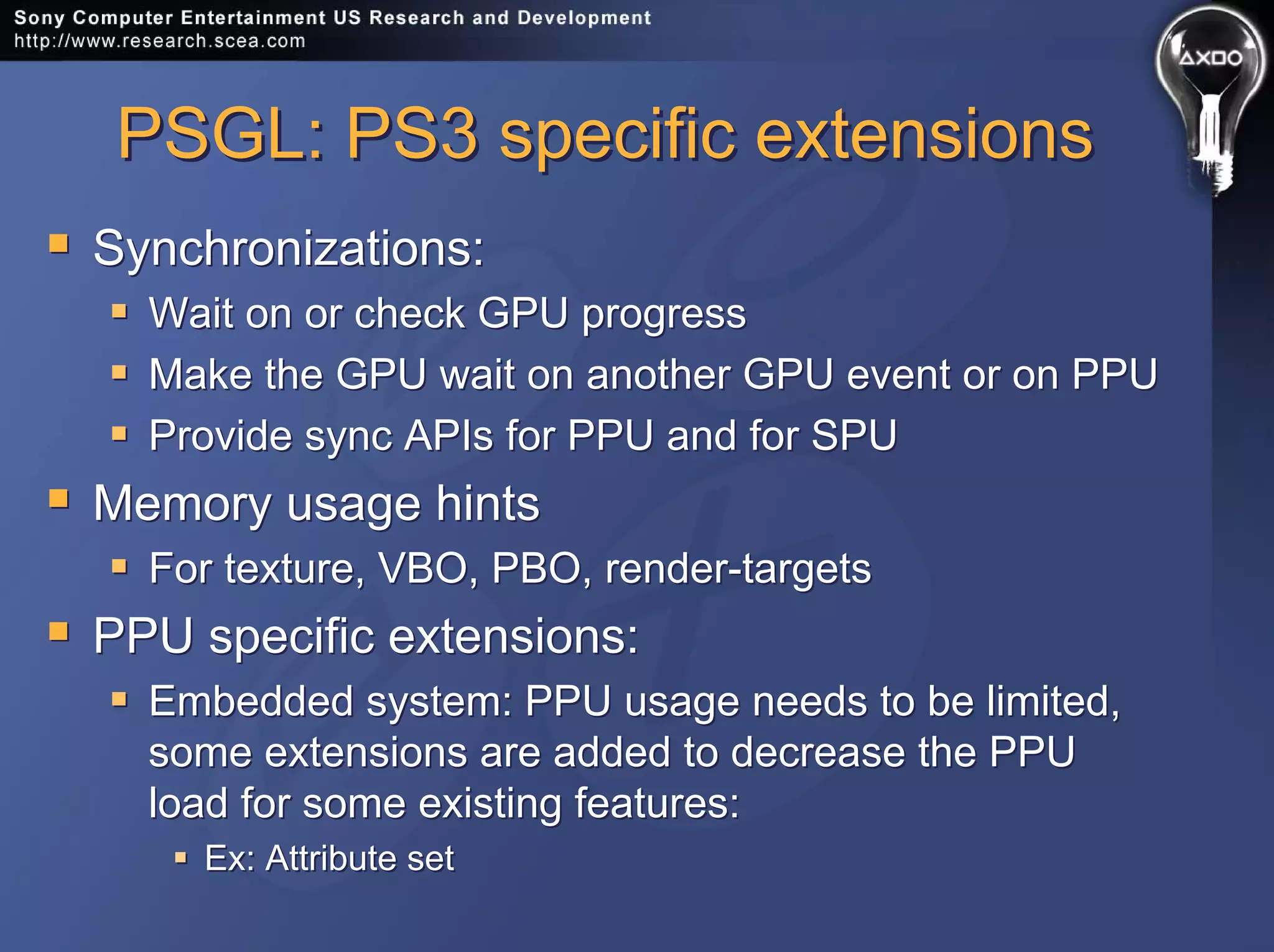
PSGL: PS3 specific extensionsPSGL: PS3 specific extensions
Synchronizations:
Wait on or check GPU progress
Make the GPU wait on another GPU event or on PPU
Provide sync APIs for PPU and for SPU
Memory usage hints
For texture, VBO, PBO, render-targets
PPU specific extensions:
Embedded system: PPU usage needs to be limited,
some extensions are added to decrease the PPU
load for some existing features:
Ex: Attribute set
Synchronizations:
Wait on or check GPU progress
Make the GPU wait on another GPU event or on PPU
Provide sync APIs for PPU and for SPU
Memory usage hints
For texture, VBO, PBO, render-targets
PPU specific extensions:
Embedded system: PPU usage needs to be limited,
some extensions are added to decrease the PPU
load for some existing features:
Ex: Attribute set
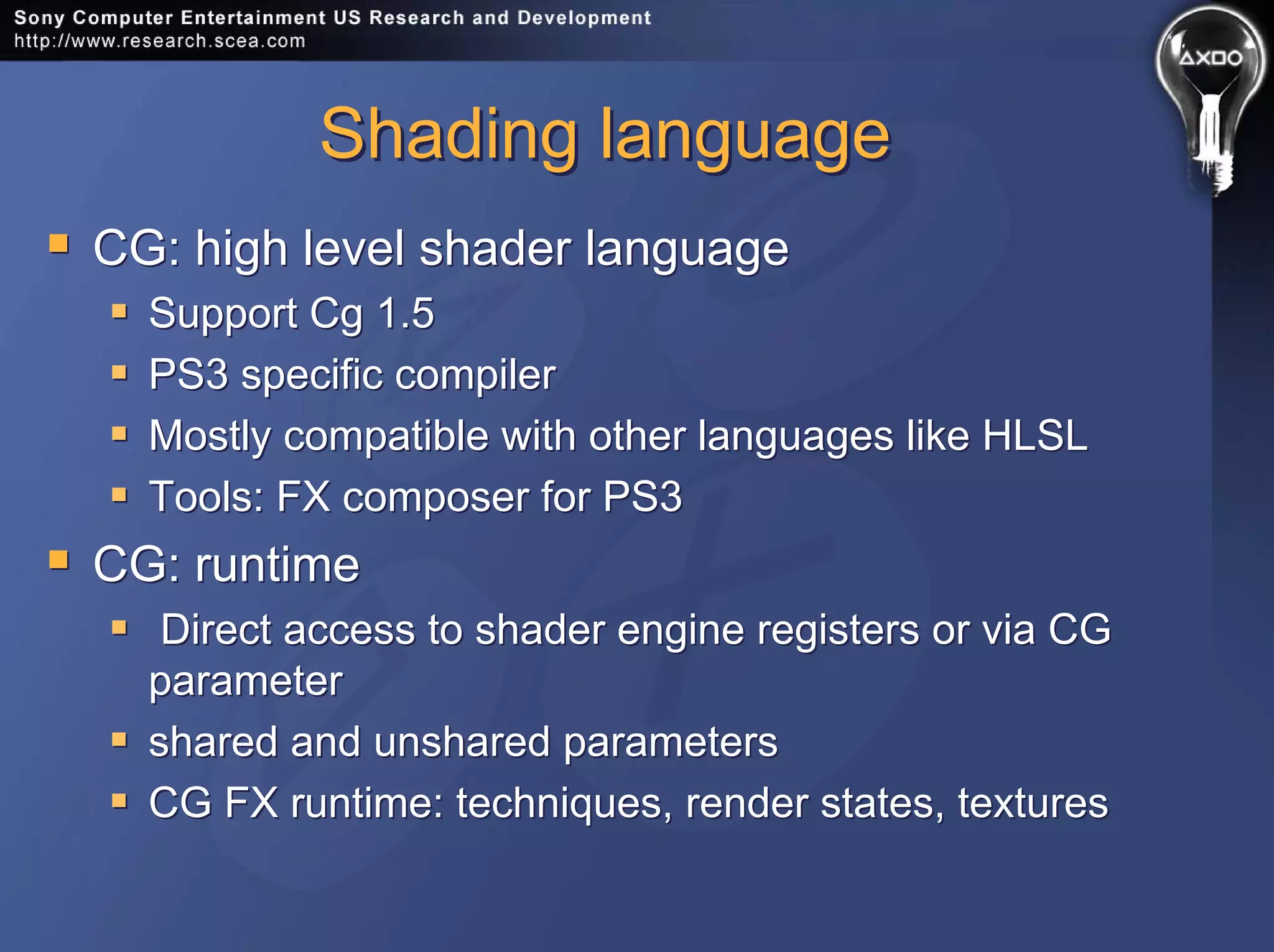
Shading languageShading language
CG: high level shader language
Support Cg 1.5
PS3 specific compiler
Mostly compatible with other languages like HLSL
Tools: FX composer for PS3
CG: runtime
Direct access to shader engine registers or via CG
parameter
shared and unshared parameters
CG FX runtime: techniques, render states, textures
CG: high level shader language
Support Cg 1.5
PS3 specific compiler
Mostly compatible with other languages like HLSL
Tools: FX composer for PS3
CG: runtime
Direct access to shader engine registers or via CG
parameter
shared and unshared parameters
CG FX runtime: techniques, render states, textures
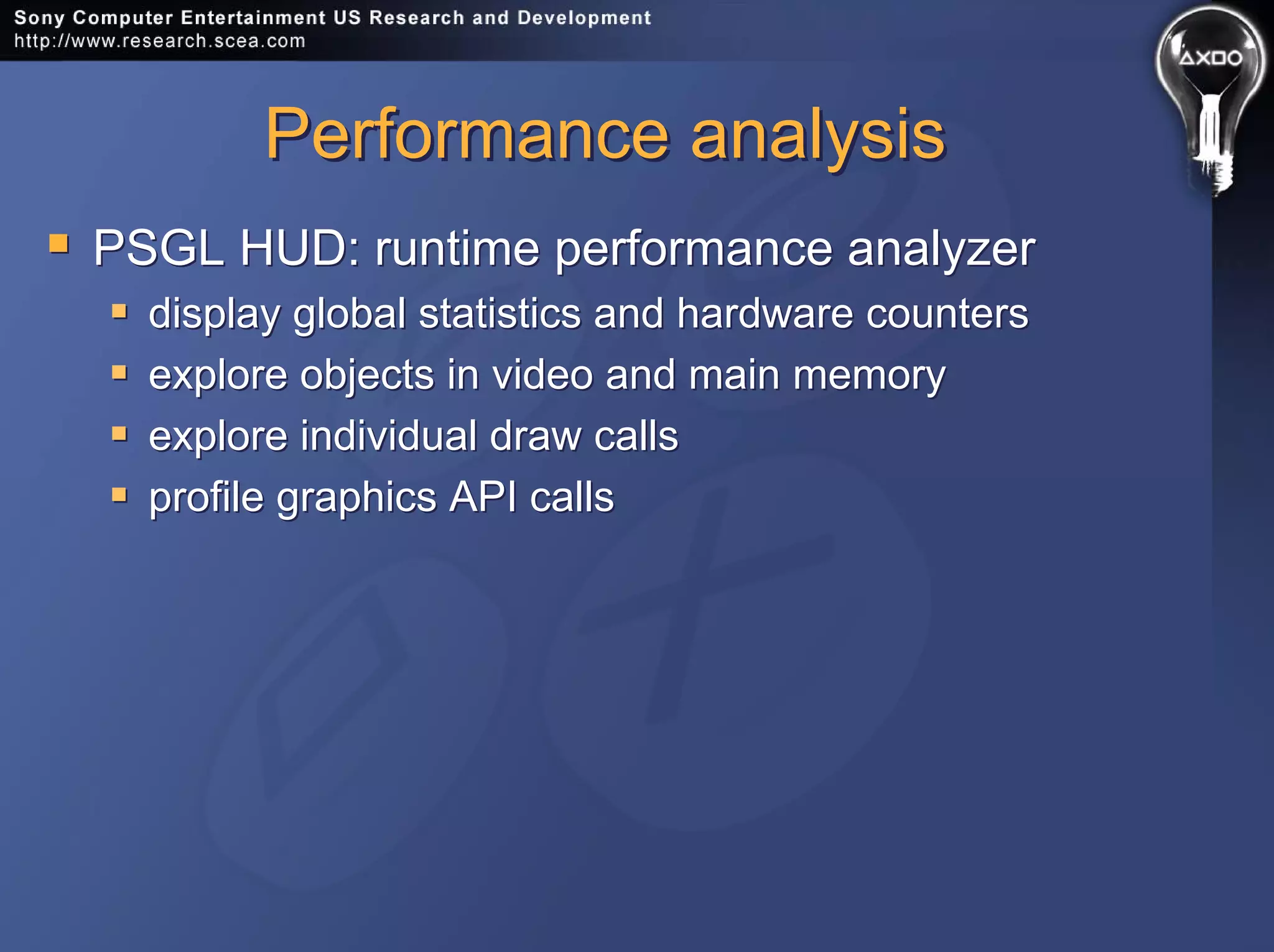
Performance analysisPerformance analysis
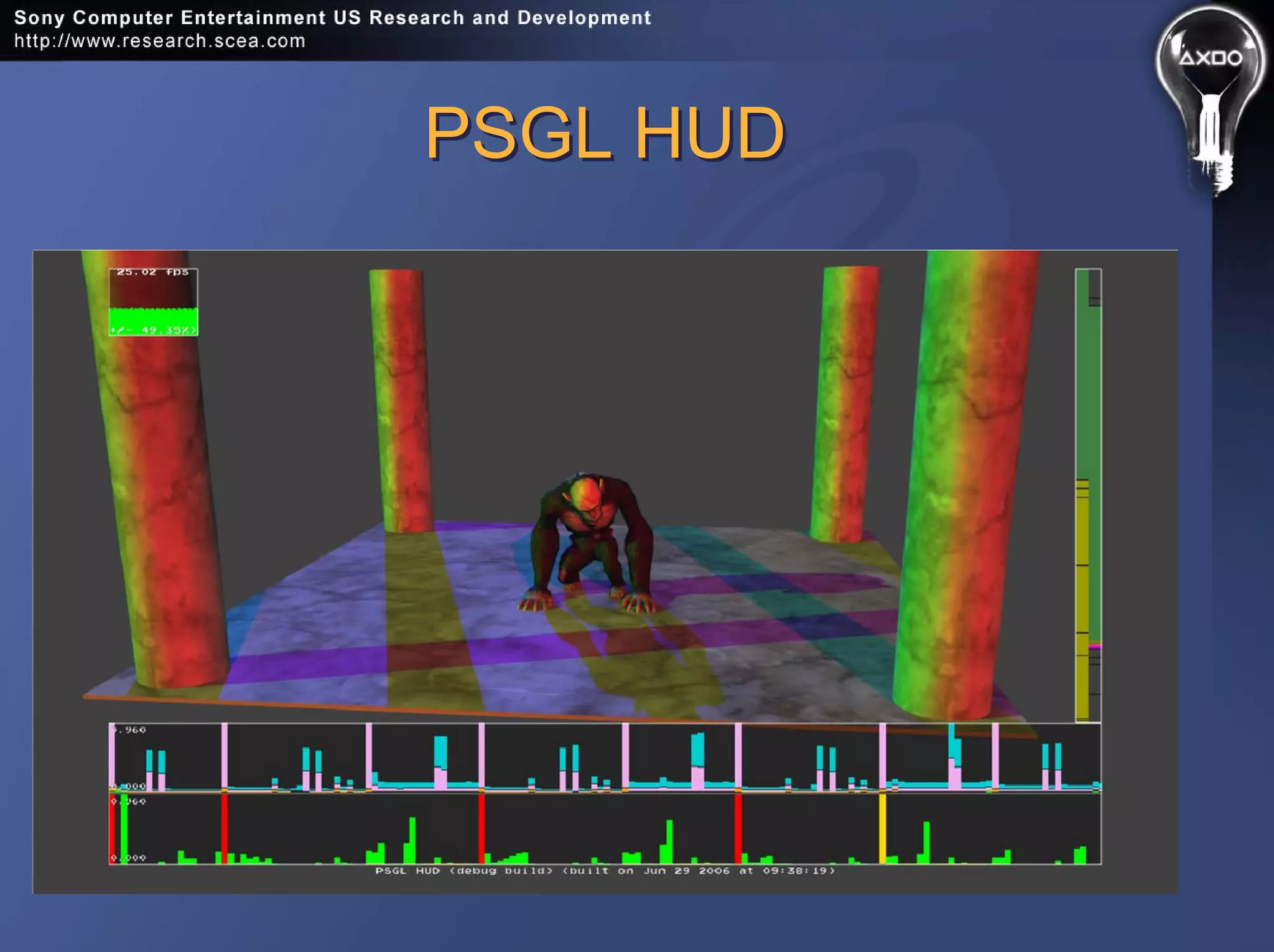
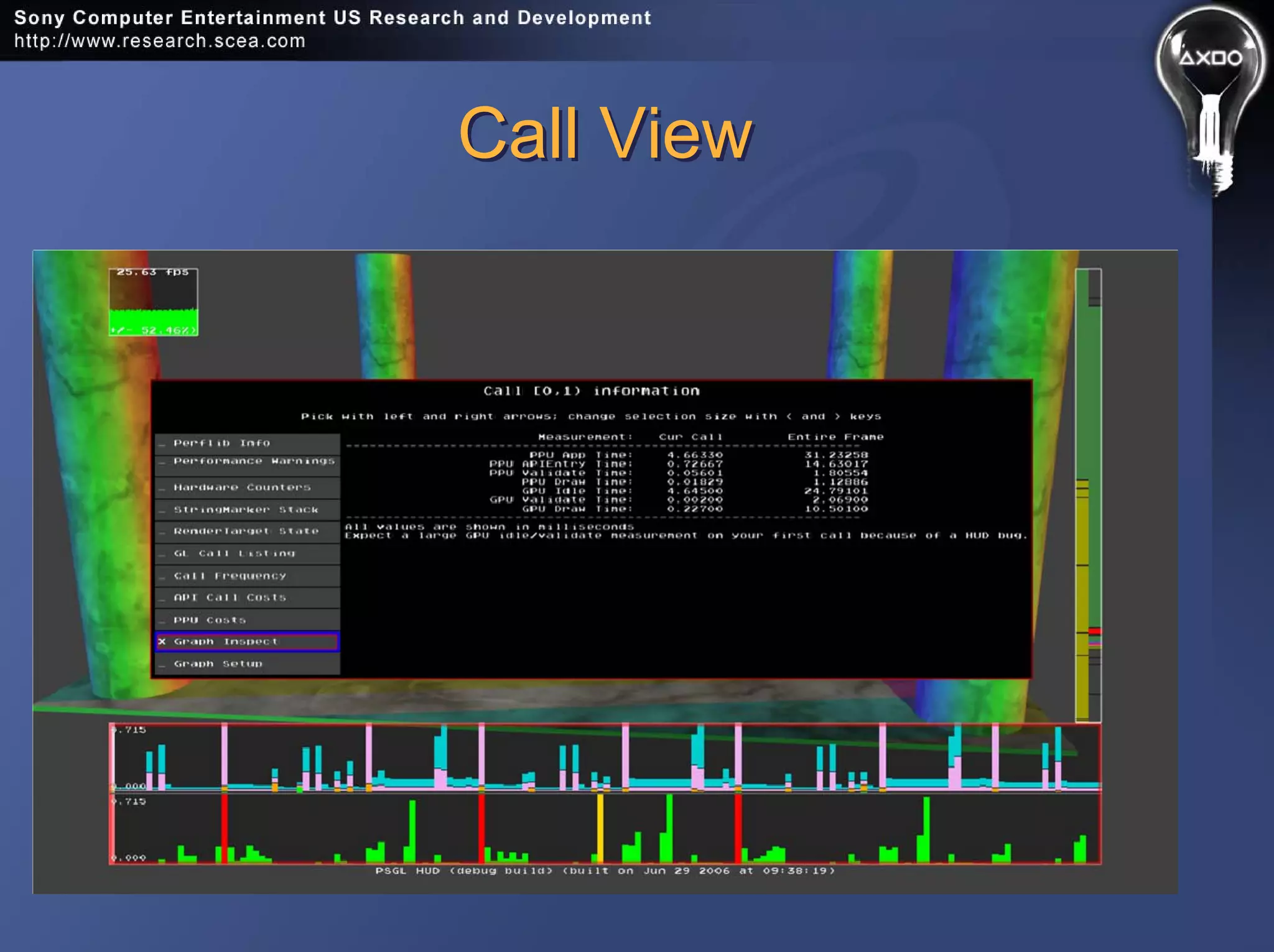
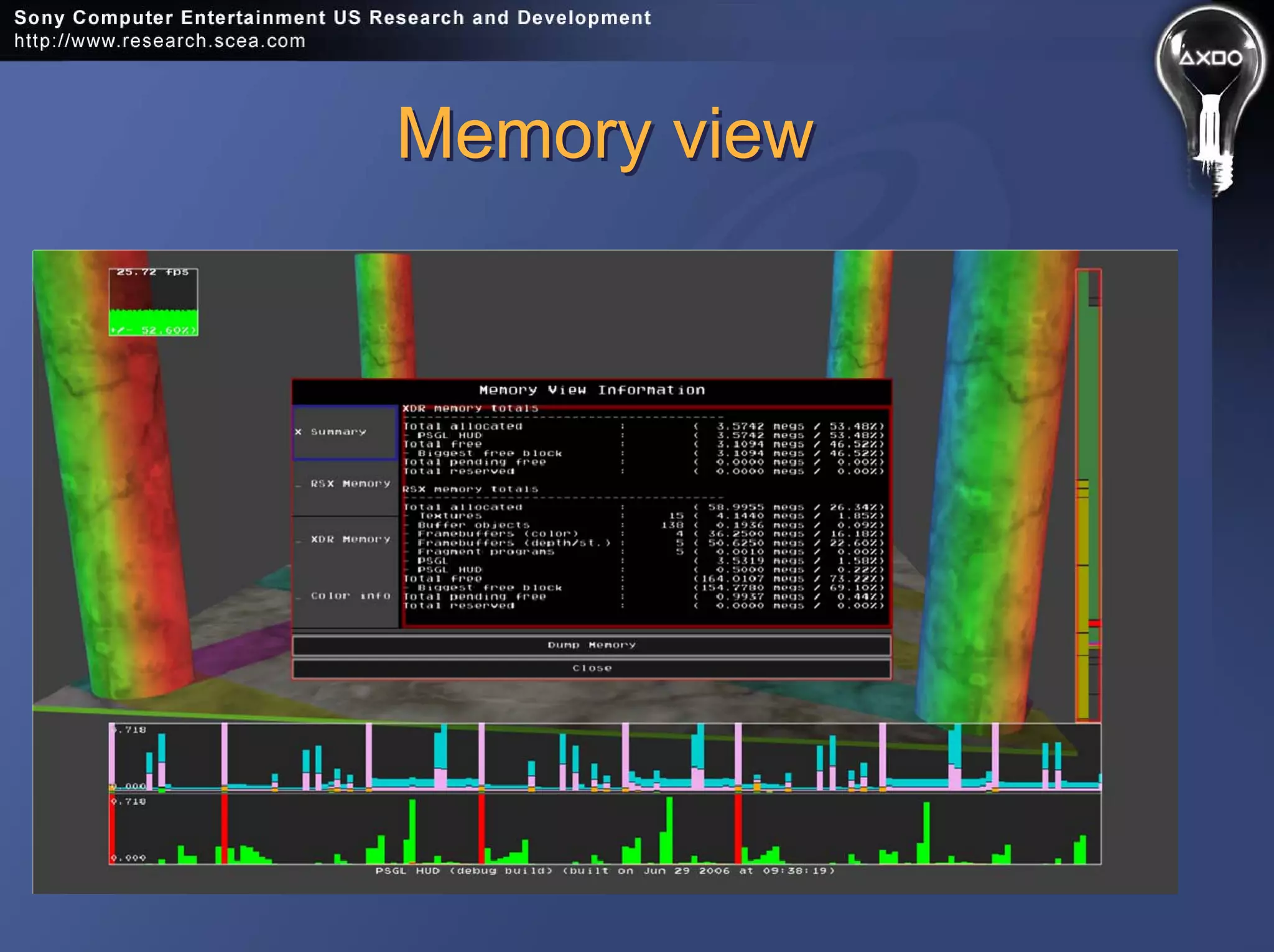
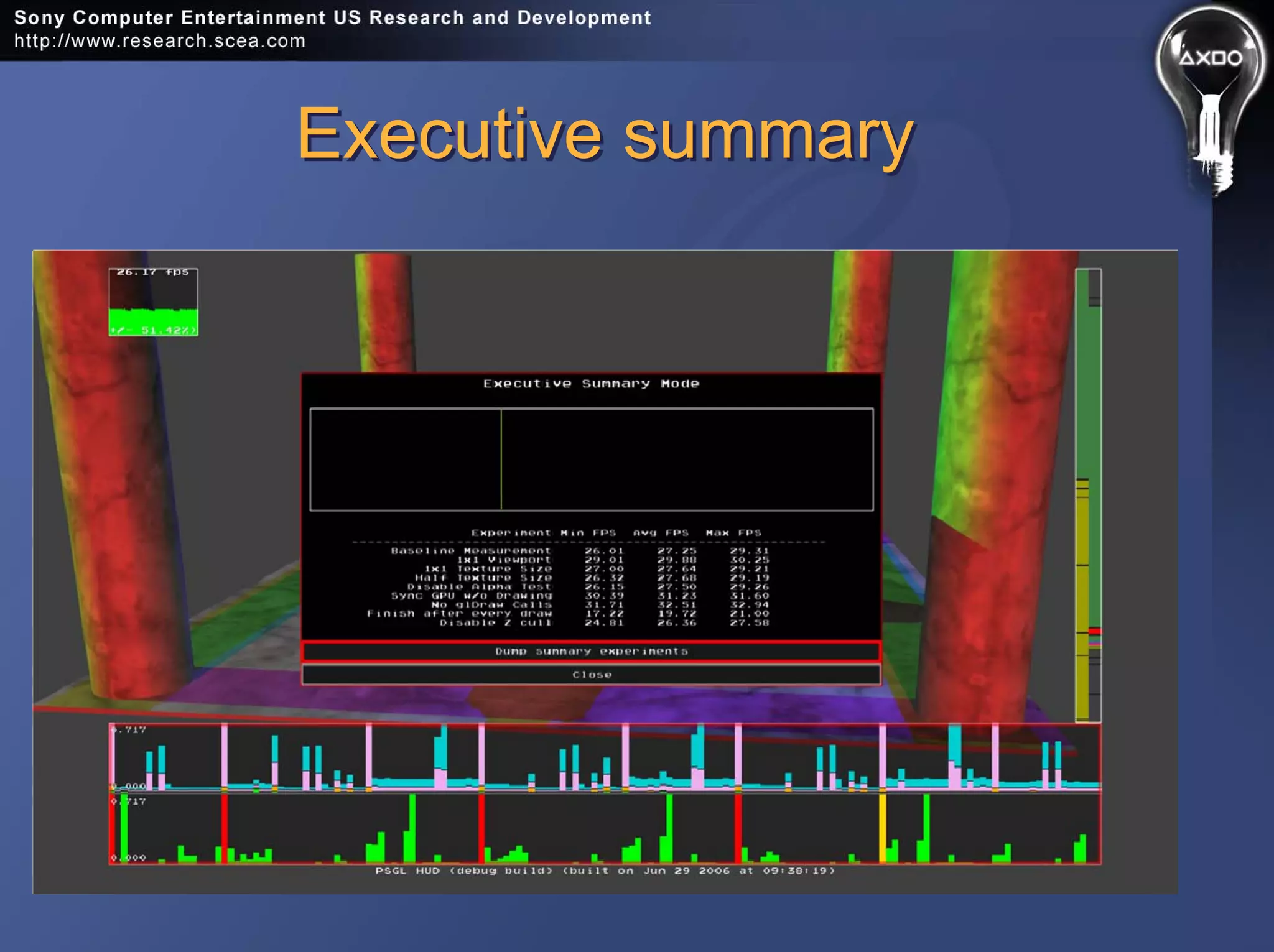
PSGL HUD: runtime performance analyzer
display global statistics and hardware counters
explore objects in video and main memory
explore individual draw calls
profile graphics API calls
PSGL HUD: runtime performance analyzer
display global statistics and hardware counters
explore objects in video and main memory
explore individual draw calls
profile graphics API calls
PSGL HUDPSGL HUD
Call ViewCall View
Memory viewMemory view
Executive summaryExecutive summary
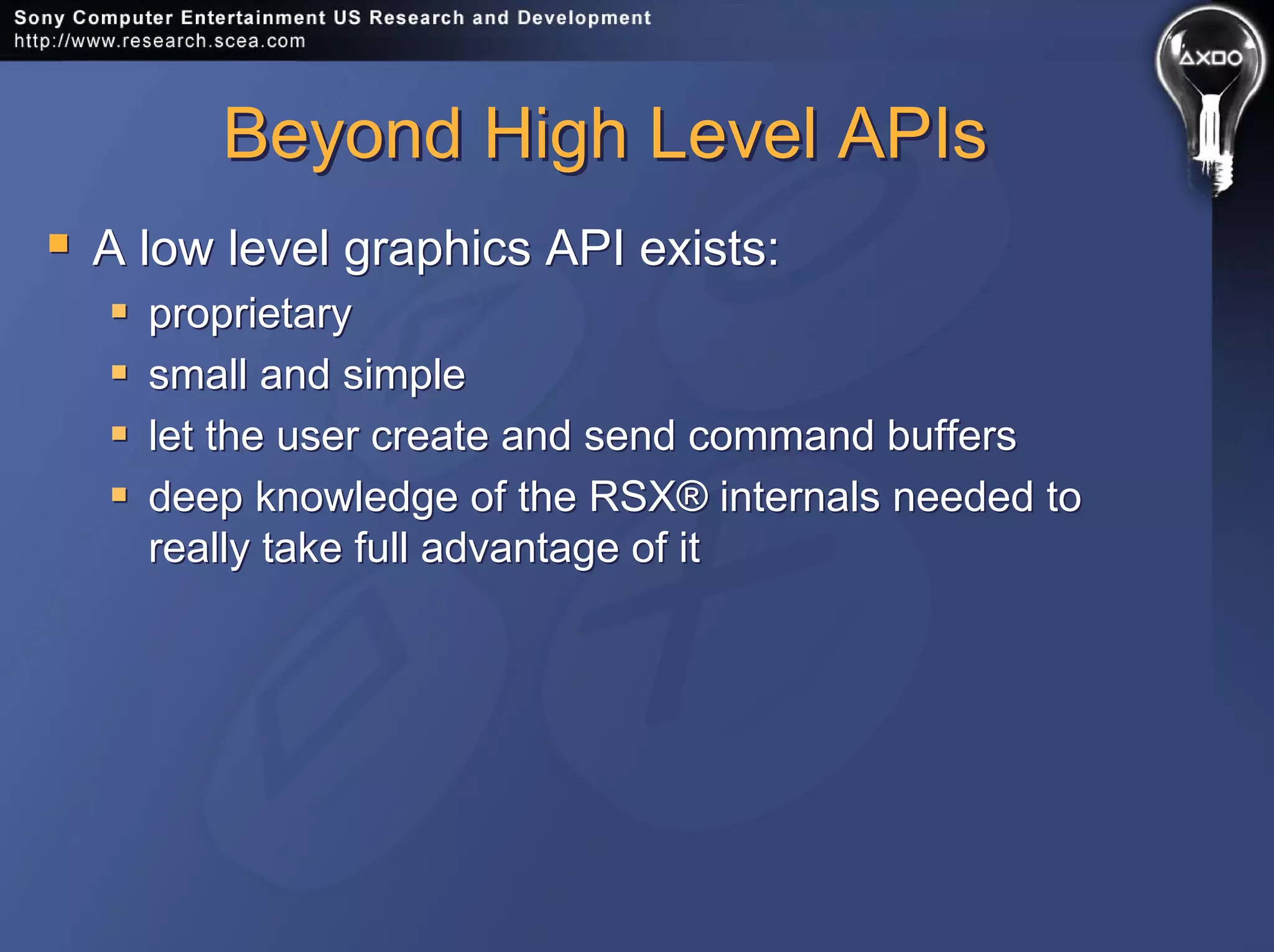
Beyond High Level APIsBeyond High Level APIs
A low level graphics API exists:
proprietary
small and simple
let the user create and send command buffers
deep knowledge of the RSX® internals needed to
really take full advantage of it
A low level graphics API exists:
proprietary
small and simple
let the user create and send command buffers
deep knowledge of the RSX® internals needed to
really take full advantage of it
A leap forward in graphicsA leap forward in graphics
Gamer expectations have changed:
Higher resolutions
Deeper colors
Larger and deeper environment
More environmental and lighting effects
Game console developer expectations have
changed too
Gamer expectations have changed:
Higher resolutions
Deeper colors
Larger and deeper environment
More environmental and lighting effects
Game console developer expectations have
changed too
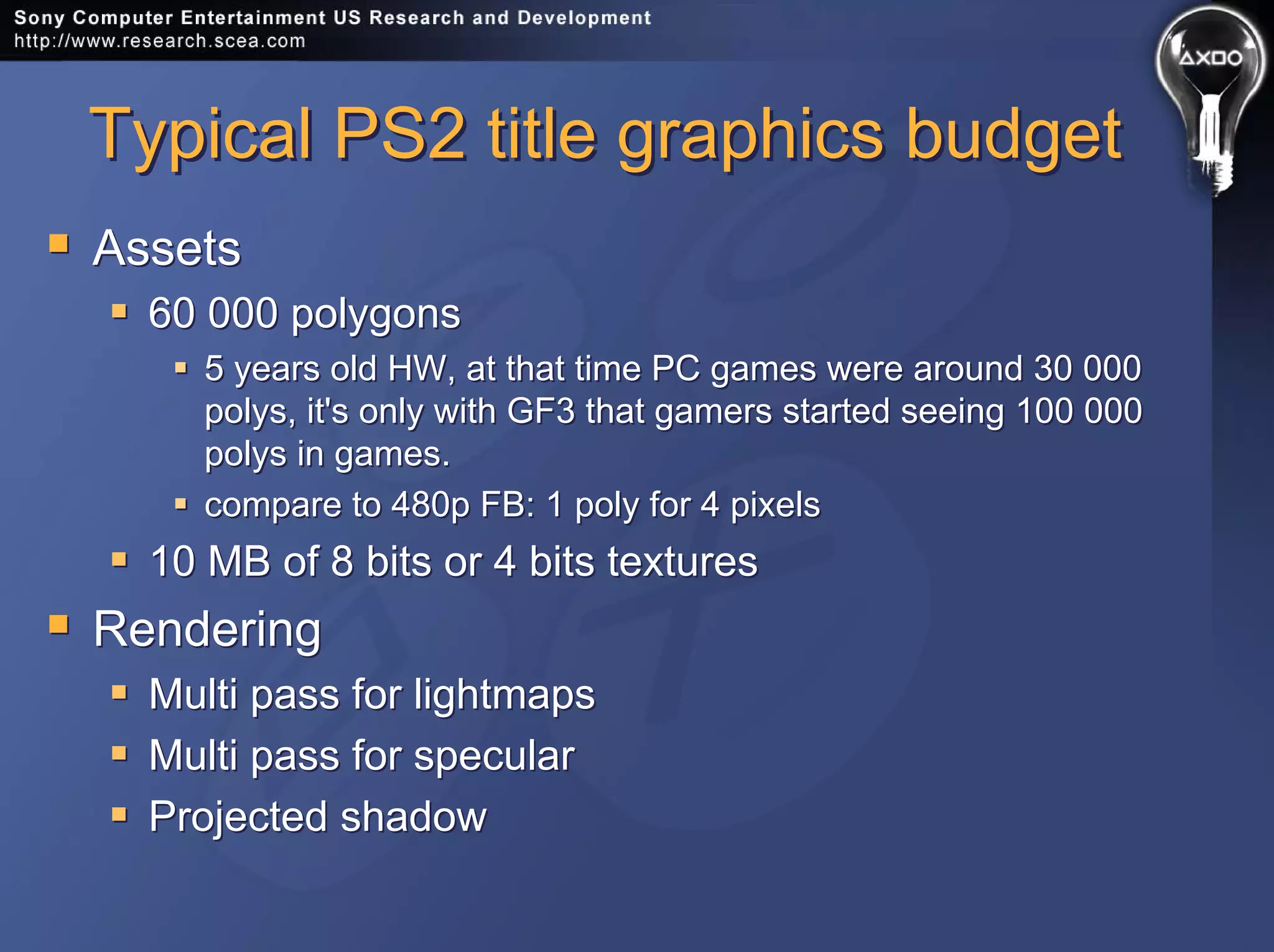
Typical PS2 title graphics budgetTypical PS2 title graphics budget
Assets
60 000 polygons
5 years old HW, at that time PC games were around 30 000
polys, it's only with GF3 that gamers started seeing 100 000
polys in games.
compare to 480p FB: 1 poly for 4 pixels
10 MB of 8 bits or 4 bits textures
Rendering
Multi pass for lightmaps
Multi pass for specular
Projected shadow
Assets
60 000 polygons
5 years old HW, at that time PC games were around 30 000
polys, it's only with GF3 that gamers started seeing 100 000
polys in games.
compare to 480p FB: 1 poly for 4 pixels
10 MB of 8 bits or 4 bits textures
Rendering
Multi pass for lightmaps
Multi pass for specular
Projected shadow
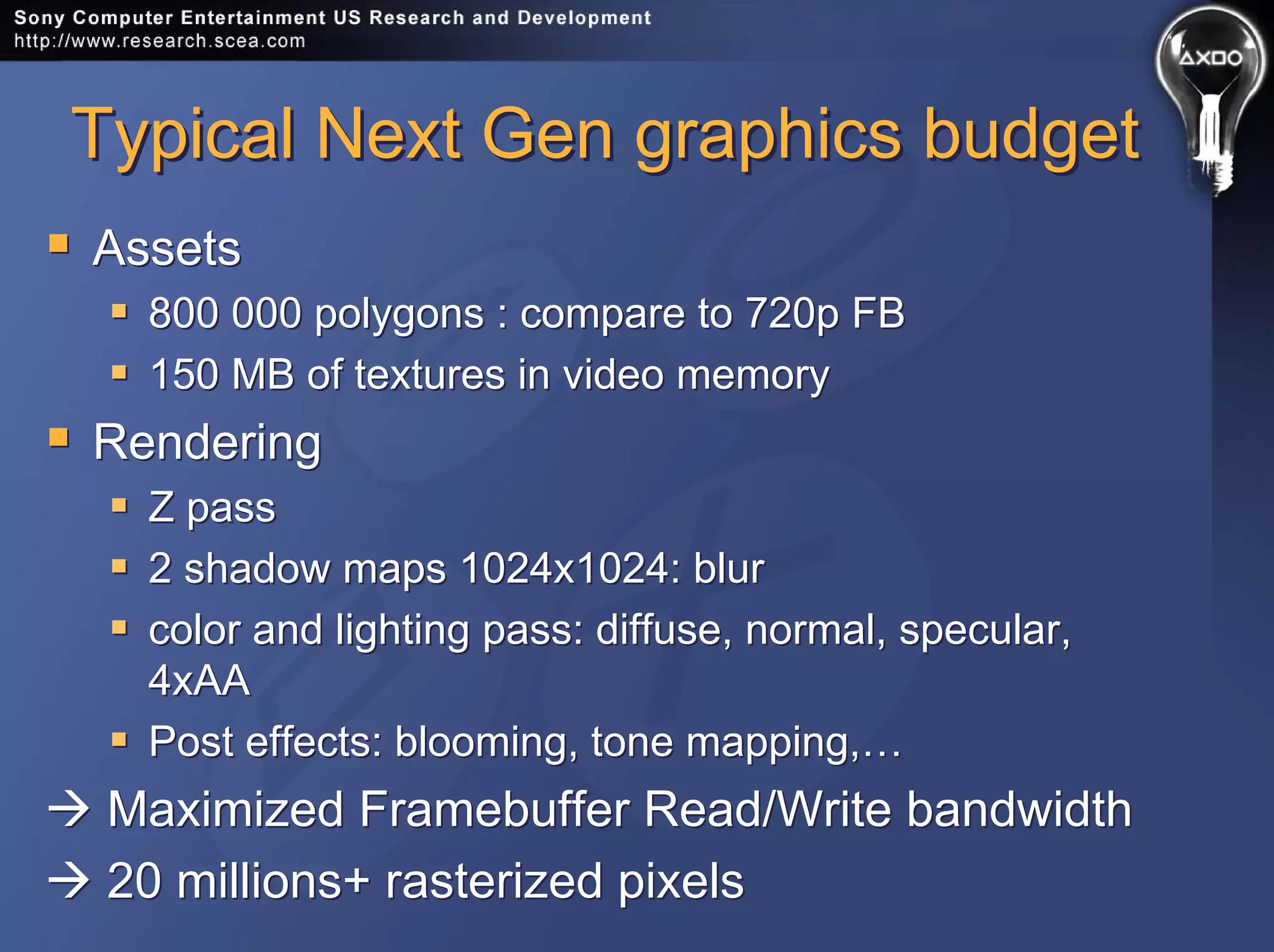
Typical Next Gen graphics budgetTypical Next Gen graphics budget
Assets
800 000 polygons : compare to 720p FB
150 MB of textures in video memory
Rendering
Z pass
2 shadow maps 1024x1024: blur
color and lighting pass: diffuse, normal, specular,
4xAA
Post effects: blooming, tone mapping,…
Maximized Framebuffer Read/Write bandwidth
20 millions+ rasterized pixels
Assets
800 000 polygons : compare to 720p FB
150 MB of textures in video memory
Rendering
Z pass
2 shadow maps 1024x1024: blur
color and lighting pass: diffuse, normal, specular,
4xAA
Post effects: blooming, tone mapping,…
Maximized Framebuffer Read/Write bandwidth
20 millions+ rasterized pixels
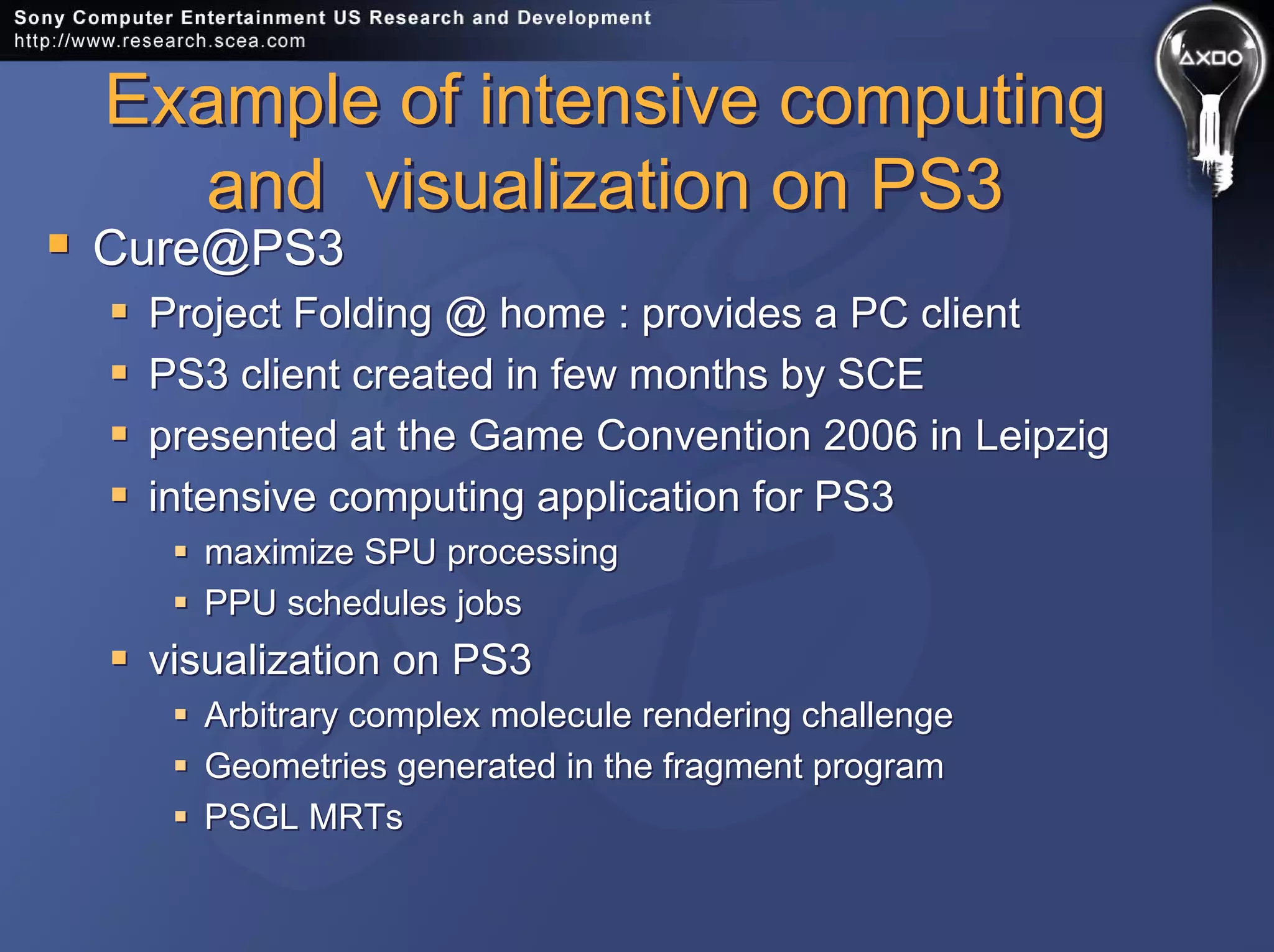
Example of intensive computing
and visualization on PS3
Example of intensive computing
and visualization on PS3
Cure@PS3
Project Folding @ home : provides a PC client
PS3 client created in few months by SCE
presented at the Game Convention 2006 in Leipzig
intensive computing application for PS3
maximize SPU processing
PPU schedules jobs
visualization on PS3
Arbitrary complex molecule rendering challenge
Geometries generated in the fragment program
PSGL MRTs
Cure@PS3
Project Folding @ home : provides a PC client
PS3 client created in few months by SCE
presented at the Game Convention 2006 in Leipzig
intensive computing application for PS3
maximize SPU processing
PPU schedules jobs
visualization on PS3
Arbitrary complex molecule rendering challenge
Geometries generated in the fragment program
PSGL MRTs
Cure@PS3: proteinCure@PS3: protein
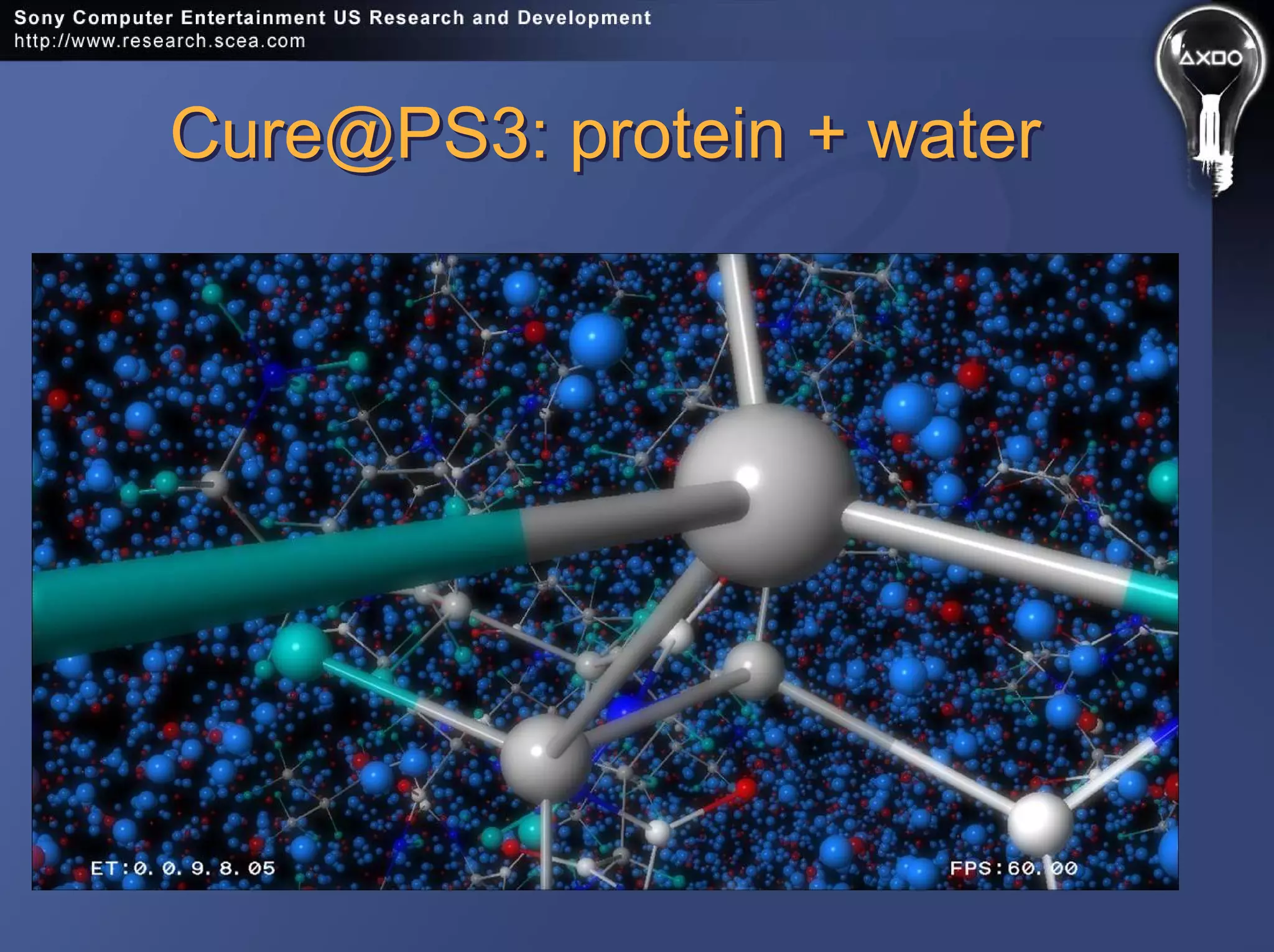
Cure@PS3: protein + waterCure@PS3: protein + water
Cure@PS3 : what if...Cure@PS3 : what if...
What if it became a PS3 screensaver ?
Running on 1% of the PS3 sold during the 1st
month
Estimation: x2 the current Folding @ home
computing power of 210 T flops
Up to 20 times faster than a PC
What if it became a PS3 screensaver ?
Running on 1% of the PS3 sold during the 1st
month
Estimation: x2 the current Folding @ home
computing power of 210 T flops
Up to 20 times faster than a PC
ConclusionConclusion
Thank you for attending
Questions ?
Cedric_Perthuis @ playstation.sony.com
Thank you for attending
Questions ?
Cedric_Perthuis @ playstation.sony.com

Introduction to the Graphics Pipeline of the PS3

  • 1.
    Introduction to thegraphics pipeline of the PS3 Introduction to the graphics pipeline of the PS3 : : Cedric Perthuis: : Cedric Perthuis
  • 2.
    IntroductionIntroduction An overview ofthe hardware architecture with a focus on the graphics pipeline, and an introduction to the related software APIs Aimed to be a high level overview for academics and game developers No announcement and no sneak previews of PS3 games in this presentation An overview of the hardware architecture with a focus on the graphics pipeline, and an introduction to the related software APIs Aimed to be a high level overview for academics and game developers No announcement and no sneak previews of PS3 games in this presentation
  • 3.
    OutlineOutline Platform Overview Graphics Pipeline APIsand tools Cell Computing example Conclusion Platform Overview Graphics Pipeline APIs and tools Cell Computing example Conclusion
  • 4.
    Platform overviewPlatform overview Processing 3.2GhzCell: PPU and 7 SPUs PPU: PowerPC based, 2 hardware threads SPUs: dedicated vector processing units RSX®: high end GPU Data flow IO: BluRay, HDD, USB, Memory Cards, GigaBit ethernet Memory: main 256 MB, video 256 MB SPUs, PPU and RSX® access main via shared bus RSX® pulls from main to video Processing 3.2Ghz Cell: PPU and 7 SPUs PPU: PowerPC based, 2 hardware threads SPUs: dedicated vector processing units RSX®: high end GPU Data flow IO: BluRay, HDD, USB, Memory Cards, GigaBit ethernet Memory: main 256 MB, video 256 MB SPUs, PPU and RSX® access main via shared bus RSX® pulls from main to video
  • 5.
    PS3 ArchitecturePS3 Architecture Cell 3.2GHz RSX®XDRAM 256 MB I/O Bridge HD/HD SD AV out 20GB/s 25.6GB/s 15GB/s 2.5GB/s 2.5GB/s BD/DVD/CD ROM Drive 54GB USB 2.0 x 6 Gbit Ether/WiFi Removable Storage MemoryStick,SD,CF BT Controller GDDR3 256 MB 22.4GB/s
  • 6.
    Focus on theCell SPUsFocus on the Cell SPUs The key strength of the PS3 Similar to PS2 Vector Units, but order of magnitude more powerful Main Memory Access via DMA: needs software cache to do generic processing Programmable in C/C++ or assembly Programs: standalone executables or jobs Ideal for sound, physics, graphics data preprocessing, or simply to offload the PPU The key strength of the PS3 Similar to PS2 Vector Units, but order of magnitude more powerful Main Memory Access via DMA: needs software cache to do generic processing Programmable in C/C++ or assembly Programs: standalone executables or jobs Ideal for sound, physics, graphics data preprocessing, or simply to offload the PPU
  • 7.
    The Cell ProcessorTheCell Processor SPE0 LS (256KB) DMA SPE1 LS (256KB) DMA MIC Memory Interface Controller XIO SPE2 LS (256KB) DMA SPE3 LS (256KB) DMA SPE4 LS (256KB) DMA SPE5 LS (256KB) DMA SPE6 LS (256KB) DMA PPE L1 (32 KB I/D) L2 (512 KB) Flex- IO1 Flex- IO0 I/O I/O I/O
  • 8.
    The RSX® GraphicsProcessorThe RSX® Graphics Processor Based on a high end NVidia chip Fully programmable pipeline: shader model 3.0 Floating point render targets Hardware anti-aliasing ( 2x, 4x ) 256 MB of dedicated video memory PULL from the main memory at 20 GB/s HD Ready (720p/1080p) 720p = 921 600 pixels 1080p = 2 073 600 pixels a high end GPU adapted to work with the Cell Processor and HD displays Based on a high end NVidia chip Fully programmable pipeline: shader model 3.0 Floating point render targets Hardware anti-aliasing ( 2x, 4x ) 256 MB of dedicated video memory PULL from the main memory at 20 GB/s HD Ready (720p/1080p) 720p = 921 600 pixels 1080p = 2 073 600 pixels a high end GPU adapted to work with the Cell Processor and HD displays
  • 9.
    The RSX® parallelpipelineThe RSX® parallel pipeline Command processing Fifo of commands, flip and sync Texture management System or video memory storage mode, compression Vertex Processing Attribute fetch, vertex program Fragment Processing Zcull, Fragment program, ROP Command processing Fifo of commands, flip and sync Texture management System or video memory storage mode, compression Vertex Processing Attribute fetch, vertex program Fragment Processing Zcull, Fragment program, ROP
  • 10.
    Particle system exampleon PS3 Hardware Particle system example on PS3 Hardware Objective: to update a particle system The PPU prepares the rendering schedule SPU jobs to compute batches of particles push RSX® commands to pull the VBO from the main memory make the render call The SPUs fill a VBO with positions, normals, etc receive a job compute particles properties DMA the result directly to VBO release RSX® semaphore fundamental hardware difference with other platforms: the SPUs are part of the pipeline Objective: to update a particle system The PPU prepares the rendering schedule SPU jobs to compute batches of particles push RSX® commands to pull the VBO from the main memory make the render call The SPUs fill a VBO with positions, normals, etc receive a job compute particles properties DMA the result directly to VBO release RSX® semaphore fundamental hardware difference with other platforms: the SPUs are part of the pipeline
  • 11.
    API differences withthe PC approach API differences with the PC approach Pass-through driver no driver level optimization, no batching, no shader modification direct access to RSX® via memory mapped “registers” restricted to the system deferred access to RSX® via a fifo of commands system and user Pass-through driver no driver level optimization, no batching, no shader modification direct access to RSX® via memory mapped “registers” restricted to the system deferred access to RSX® via a fifo of commands system and user
  • 12.
    PSGL: the highlevel graphics APIPSGL: the high level graphics API Needed a standard: practical and extensible the choice was OpenGL ES 1.0 Why not a subset of OpenGL ? Mainly needed conformance tests Benefits: pipeline state management Vertex arrays Texture management Bonus: Fixed pipeline Only ~20 entry points for fixed pipeline Fog, light, material, texenv Inconvenience: Fixed point functions No shaders: needed to be added Needed a standard: practical and extensible the choice was OpenGL ES 1.0 Why not a subset of OpenGL ? Mainly needed conformance tests Benefits: pipeline state management Vertex arrays Texture management Bonus: Fixed pipeline Only ~20 entry points for fixed pipeline Fog, light, material, texenv Inconvenience: Fixed point functions No shaders: needed to be added
  • 13.
    PSGL: modern GPUextensionsPSGL: modern GPU extensions OpenGL ES 1.1OpenGL ES 1.1 VBOVBO FBOFBO PBOPBO Cube Map,Cube Map, texgentexgen Primitives:Primitives: Quads, Quads_stripsQuads, Quads_strips primitive restartprimitive restart InstancingInstancing Queries and ConditionalQueries and Conditional RenderingRendering More data typesMore data types ex: half_floatex: half_float Textures:Textures: Floating point texturesFloating point textures DXTDXT 3D3D non power of 2non power of 2 Anisotropic filtering,Anisotropic filtering, Min/Max LOD, LOD BiasMin/Max LOD, LOD Bias Depth texturesDepth textures Gamma correctionGamma correction Vertex TextureVertex Texture
  • 14.
    PSGL: PS3 specificextensionsPSGL: PS3 specific extensions Synchronizations: Wait on or check GPU progress Make the GPU wait on another GPU event or on PPU Provide sync APIs for PPU and for SPU Memory usage hints For texture, VBO, PBO, render-targets PPU specific extensions: Embedded system: PPU usage needs to be limited, some extensions are added to decrease the PPU load for some existing features: Ex: Attribute set Synchronizations: Wait on or check GPU progress Make the GPU wait on another GPU event or on PPU Provide sync APIs for PPU and for SPU Memory usage hints For texture, VBO, PBO, render-targets PPU specific extensions: Embedded system: PPU usage needs to be limited, some extensions are added to decrease the PPU load for some existing features: Ex: Attribute set
  • 15.
    Shading languageShading language CG:high level shader language Support Cg 1.5 PS3 specific compiler Mostly compatible with other languages like HLSL Tools: FX composer for PS3 CG: runtime Direct access to shader engine registers or via CG parameter shared and unshared parameters CG FX runtime: techniques, render states, textures CG: high level shader language Support Cg 1.5 PS3 specific compiler Mostly compatible with other languages like HLSL Tools: FX composer for PS3 CG: runtime Direct access to shader engine registers or via CG parameter shared and unshared parameters CG FX runtime: techniques, render states, textures
  • 16.
    Performance analysisPerformance analysis PSGLHUD: runtime performance analyzer display global statistics and hardware counters explore objects in video and main memory explore individual draw calls profile graphics API calls PSGL HUD: runtime performance analyzer display global statistics and hardware counters explore objects in video and main memory explore individual draw calls profile graphics API calls
  • 17.
  • 18.
  • 19.
  • 20.
  • 21.
    Beyond High LevelAPIsBeyond High Level APIs A low level graphics API exists: proprietary small and simple let the user create and send command buffers deep knowledge of the RSX® internals needed to really take full advantage of it A low level graphics API exists: proprietary small and simple let the user create and send command buffers deep knowledge of the RSX® internals needed to really take full advantage of it
  • 22.
    A leap forwardin graphicsA leap forward in graphics Gamer expectations have changed: Higher resolutions Deeper colors Larger and deeper environment More environmental and lighting effects Game console developer expectations have changed too Gamer expectations have changed: Higher resolutions Deeper colors Larger and deeper environment More environmental and lighting effects Game console developer expectations have changed too
  • 23.
    Typical PS2 titlegraphics budgetTypical PS2 title graphics budget Assets 60 000 polygons 5 years old HW, at that time PC games were around 30 000 polys, it's only with GF3 that gamers started seeing 100 000 polys in games. compare to 480p FB: 1 poly for 4 pixels 10 MB of 8 bits or 4 bits textures Rendering Multi pass for lightmaps Multi pass for specular Projected shadow Assets 60 000 polygons 5 years old HW, at that time PC games were around 30 000 polys, it's only with GF3 that gamers started seeing 100 000 polys in games. compare to 480p FB: 1 poly for 4 pixels 10 MB of 8 bits or 4 bits textures Rendering Multi pass for lightmaps Multi pass for specular Projected shadow
  • 24.
    Typical Next Gengraphics budgetTypical Next Gen graphics budget Assets 800 000 polygons : compare to 720p FB 150 MB of textures in video memory Rendering Z pass 2 shadow maps 1024x1024: blur color and lighting pass: diffuse, normal, specular, 4xAA Post effects: blooming, tone mapping,… Maximized Framebuffer Read/Write bandwidth 20 millions+ rasterized pixels Assets 800 000 polygons : compare to 720p FB 150 MB of textures in video memory Rendering Z pass 2 shadow maps 1024x1024: blur color and lighting pass: diffuse, normal, specular, 4xAA Post effects: blooming, tone mapping,… Maximized Framebuffer Read/Write bandwidth 20 millions+ rasterized pixels
  • 25.
    Example of intensivecomputing and visualization on PS3 Example of intensive computing and visualization on PS3 Cure@PS3 Project Folding @ home : provides a PC client PS3 client created in few months by SCE presented at the Game Convention 2006 in Leipzig intensive computing application for PS3 maximize SPU processing PPU schedules jobs visualization on PS3 Arbitrary complex molecule rendering challenge Geometries generated in the fragment program PSGL MRTs Cure@PS3 Project Folding @ home : provides a PC client PS3 client created in few months by SCE presented at the Game Convention 2006 in Leipzig intensive computing application for PS3 maximize SPU processing PPU schedules jobs visualization on PS3 Arbitrary complex molecule rendering challenge Geometries generated in the fragment program PSGL MRTs
  • 26.
  • 27.
    Cure@PS3: protein +waterCure@PS3: protein + water
  • 28.
    Cure@PS3 : whatif...Cure@PS3 : what if... What if it became a PS3 screensaver ? Running on 1% of the PS3 sold during the 1st month Estimation: x2 the current Folding @ home computing power of 210 T flops Up to 20 times faster than a PC What if it became a PS3 screensaver ? Running on 1% of the PS3 sold during the 1st month Estimation: x2 the current Folding @ home computing power of 210 T flops Up to 20 times faster than a PC
  • 29.
    ConclusionConclusion Thank you forattending Questions ? Cedric_Perthuis @ playstation.sony.com Thank you for attending Questions ? Cedric_Perthuis @ playstation.sony.com