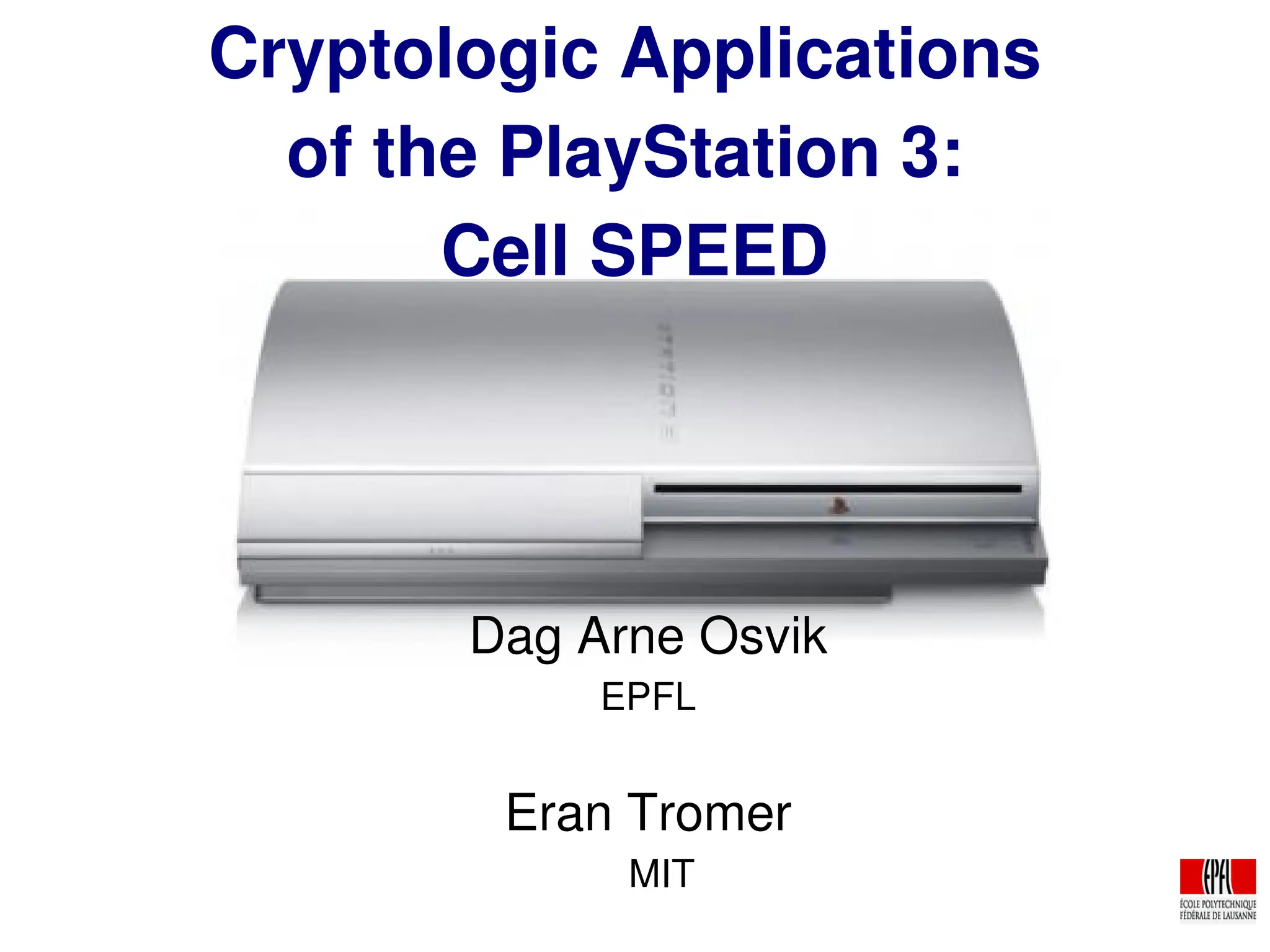
Cryptologic Applications
of the PlayStation 3:
Cell SPEED
Dag Arne Osvik
EPFL
Eran Tromer
MIT
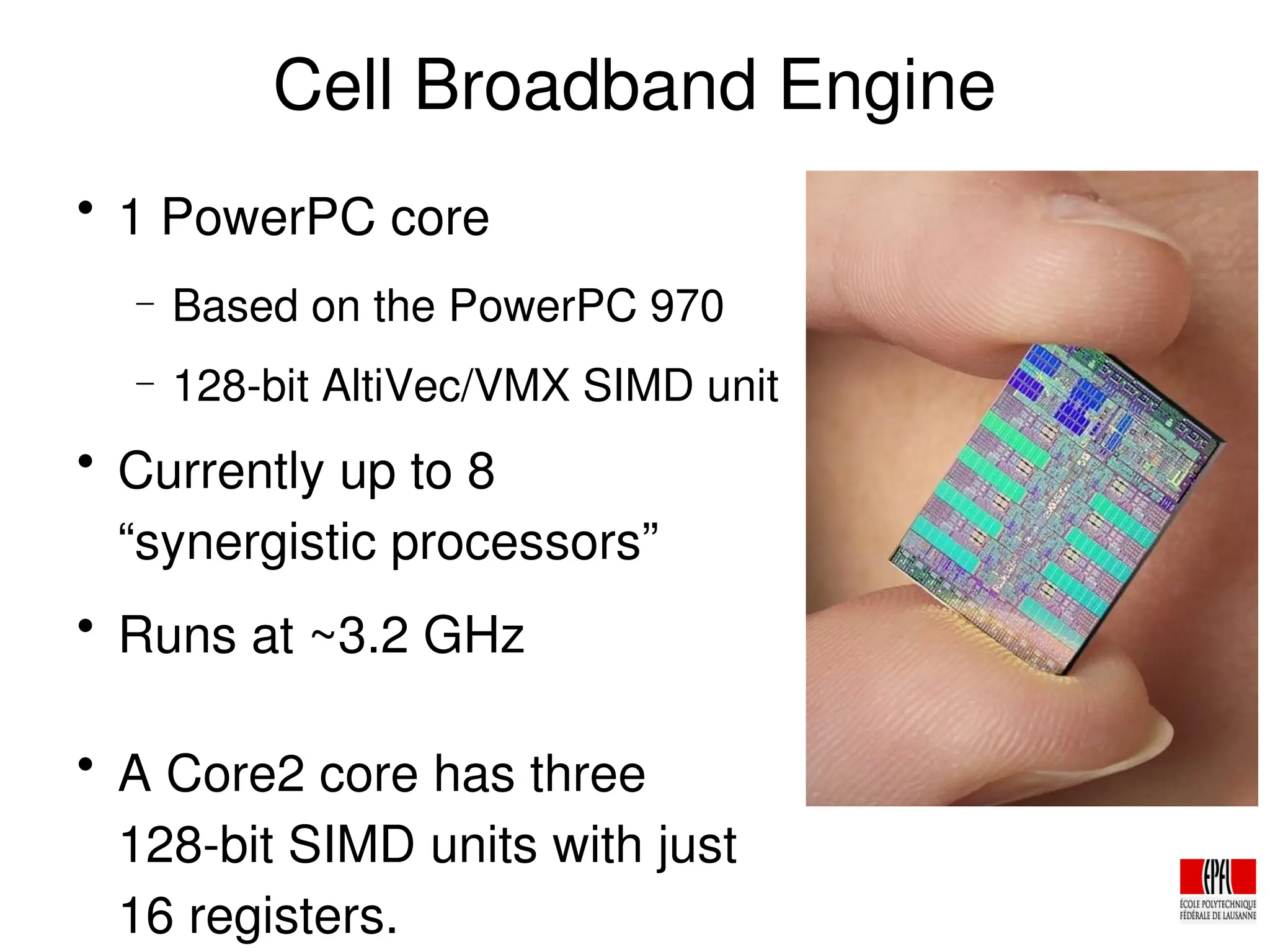
Cell Broadband Engine

1 PowerPC core
− Based on the PowerPC 970
− 128­bit AltiVec/VMX SIMD unit

Currently up to 8
“synergistic processors”

Runs at ~3.2 GHz

A Core2 core has three
128­bit SIMD units with just
16 registers.
Running DES on the Cell

Bitsliced implementation of DES
− 128­way parallelism per SPU
− S­boxes optimized for SPU instruction set

4 Gbit/sec = 226
blocks/sec per SPU

32 Gbit/sec per Cell chip

Can be used as a cryptographic accelerator
(ECB, CTR, many CBC streams)
Breaking DES on the Cell

Reduce the DES encryption from 16 rounds to
the equivalent of ~9.5 rounds, by shortcircuit
evaluation and early aborts.

Performance:
− 108M=226.69
keys/sec per SPU
− 864M=229.69
keys/sec per Cell chip
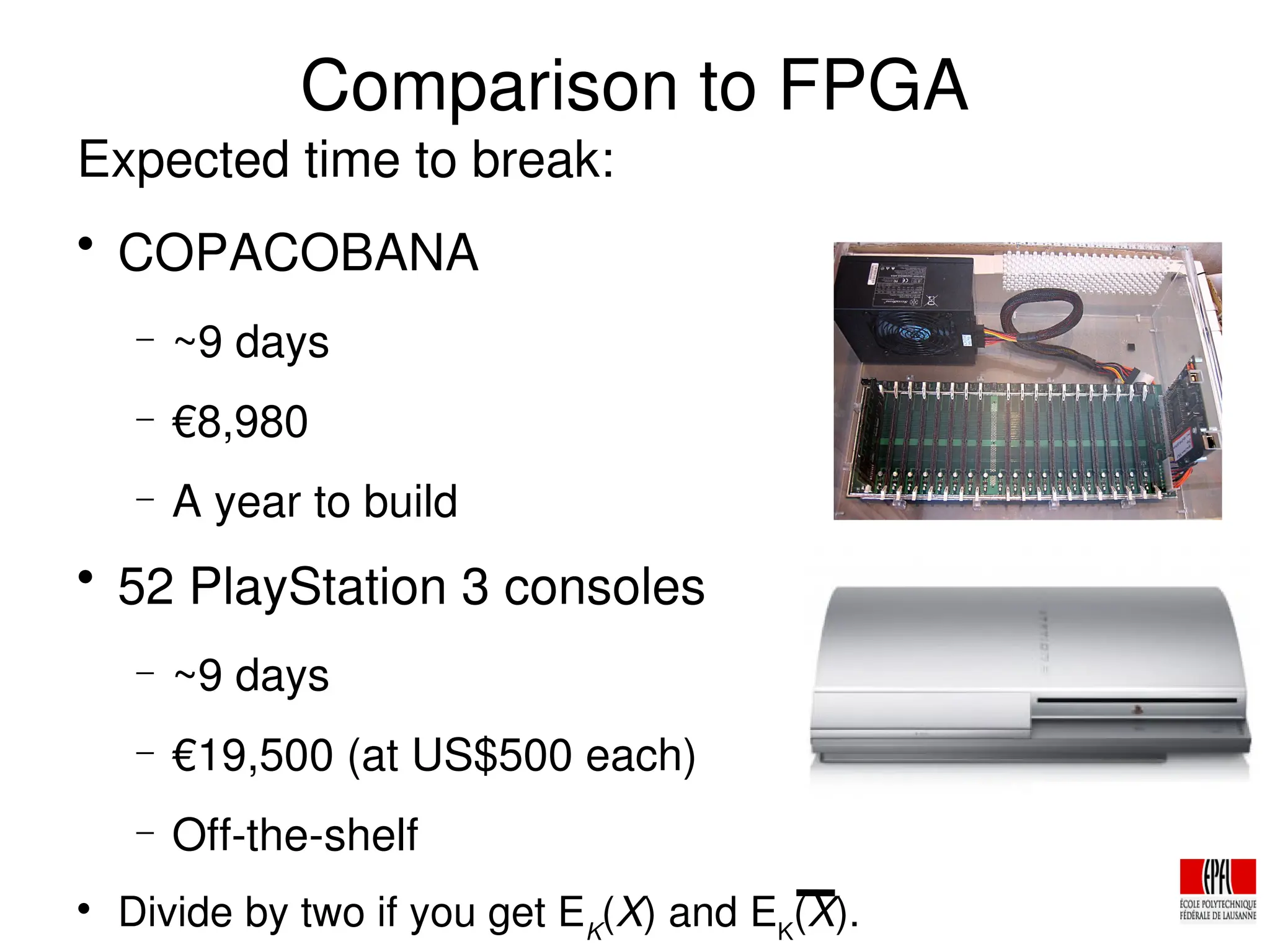
Comparison to FPGA
Expected time to break:

COPACOBANA
− ~9 days
− €8,980
− A year to build

52 PlayStation 3 consoles
− ~9 days
− €19,500 (at US$500 each)
− Off­the­shelf

Divide by two if you get EK
(X) and EK
(X).
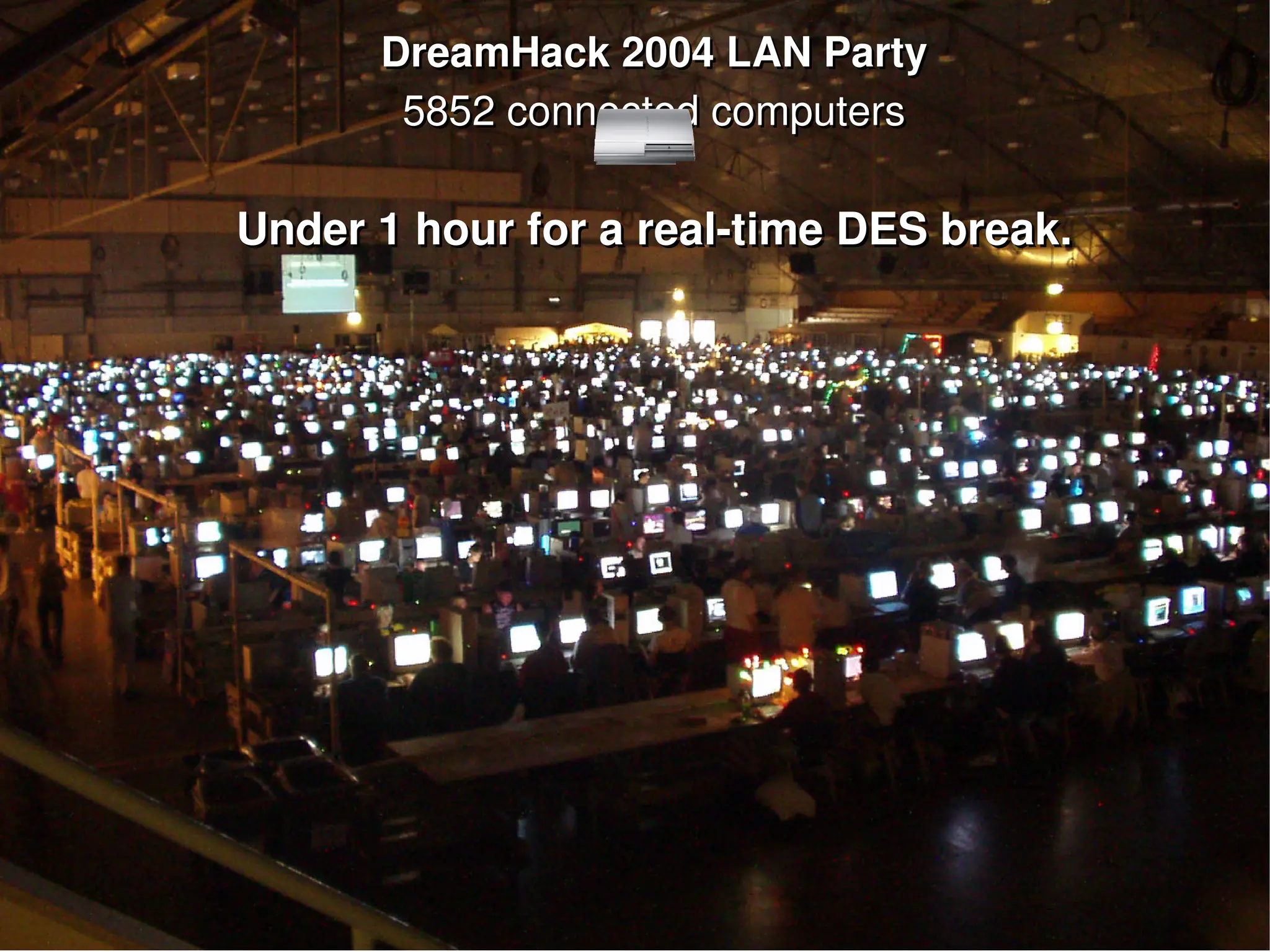
DreamHack 2004 LAN Party
5852 connected computers
Under 1 hour for a real­time DES break.
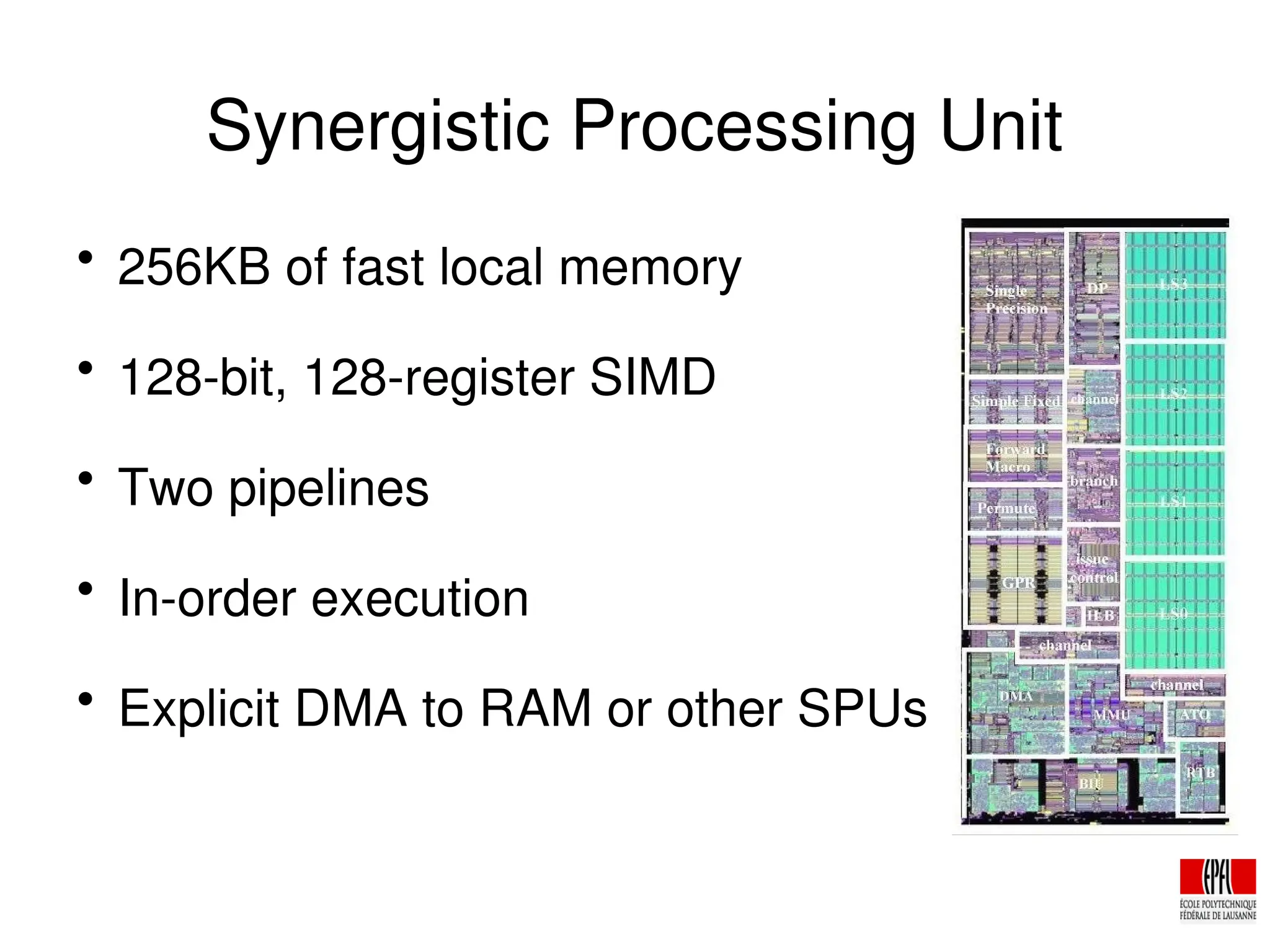
Synergistic Processing Unit

256KB of fast local memory

128­bit, 128­register SIMD

Two pipelines

In­order execution

Explicit DMA to RAM or other SPUs
SPU memory

Single­ported

6­cycle load­to­use latency

Read or write 16 or 128 bytes each cycle

DMA & instruction fetch use 128­byte interface

Prioritized: DMA > load/store > instruction fetch
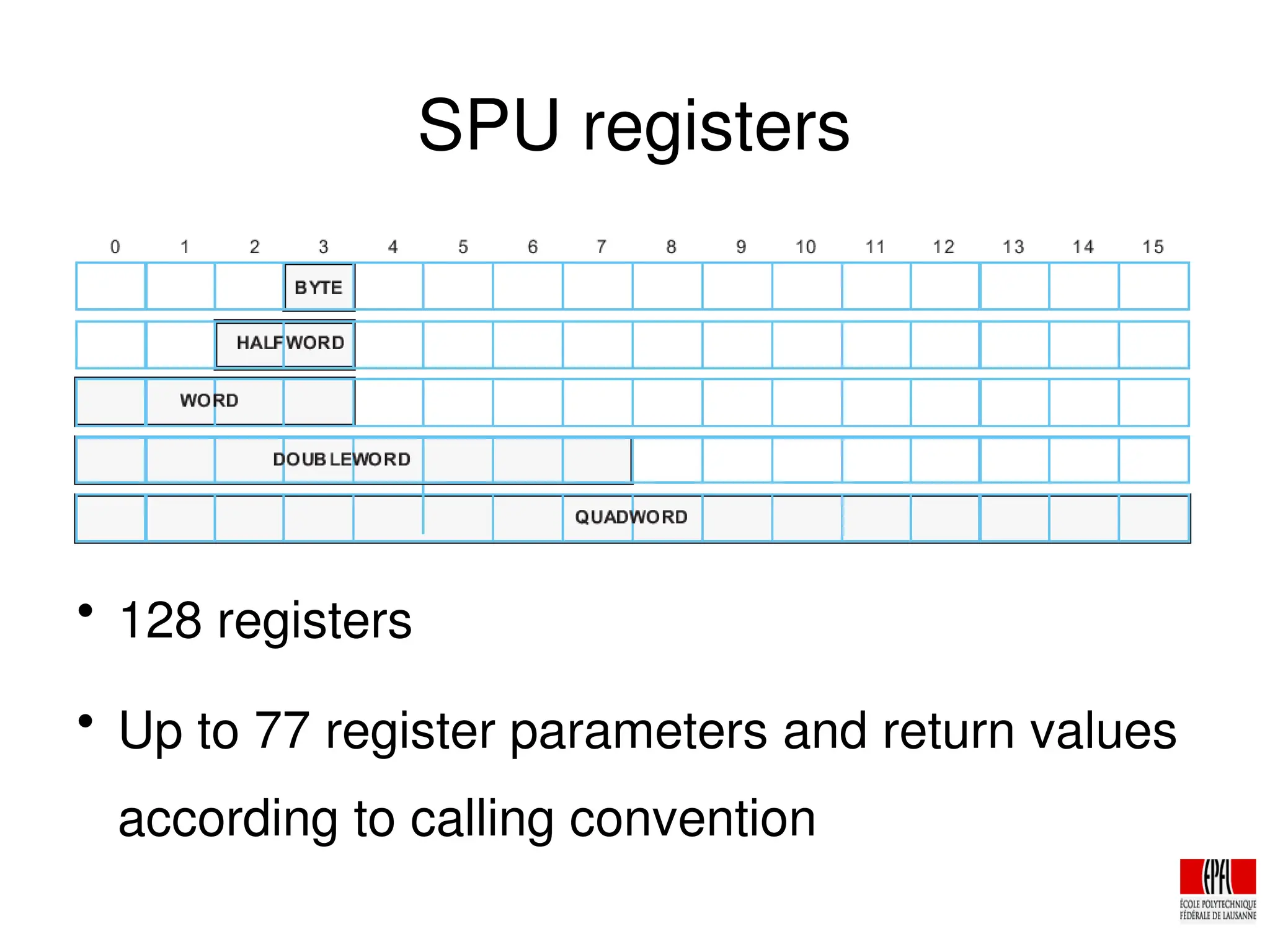
SPU registers

128 registers

Up to 77 register parameters and return values
according to calling convention
SPU instruction set

RISC (similar to PowerPC)

Fixed 32­bit size

Always aligned on 4­byte boundary

Most operations are SIMD
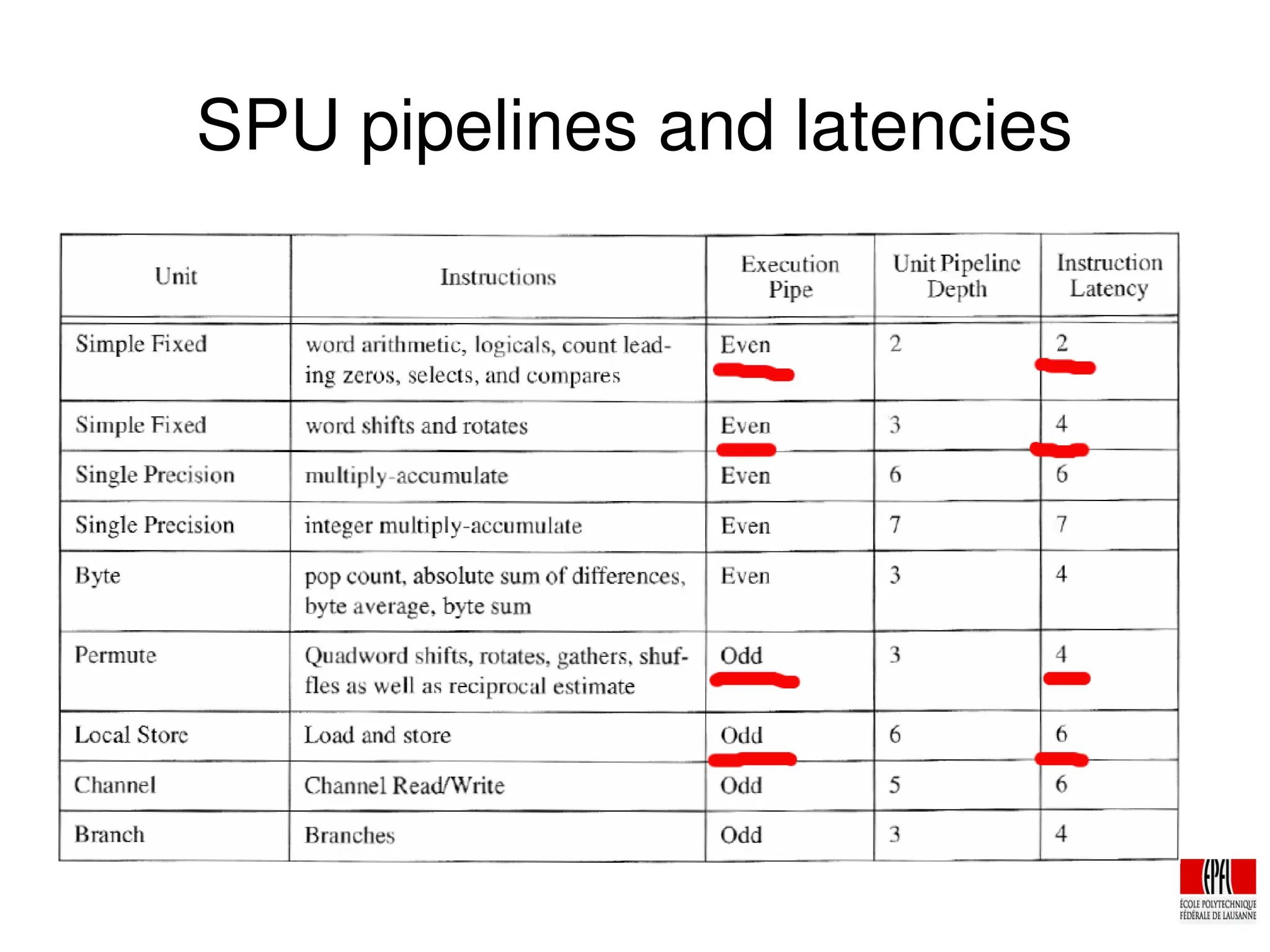
SPU pipelines and latencies
SPU limitations

Fetches 8­byte aligned pairs of instructions
− Dual issue happens only if first is even­pipe
instruction and
and second is odd­pipe instruction

Only 16x16­>32 integer multiplication

No hardware branch prediction
Special SPU instructions

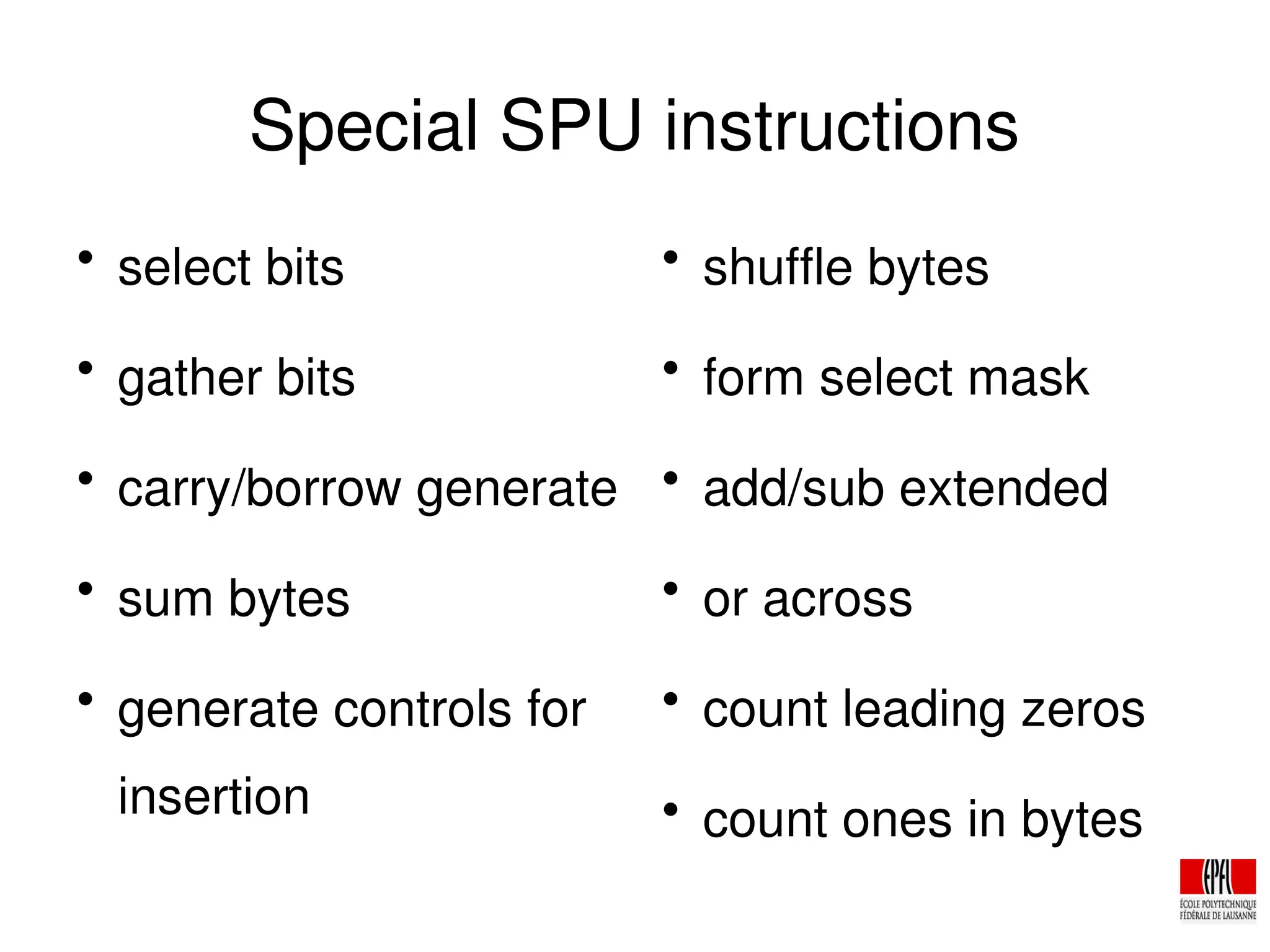
select bits

gather bits

carry/borrow generate

sum bytes

generate controls for
insertion

shuffle bytes

form select mask

add/sub extended

or across

count leading zeros

count ones in bytes
64­bit addition

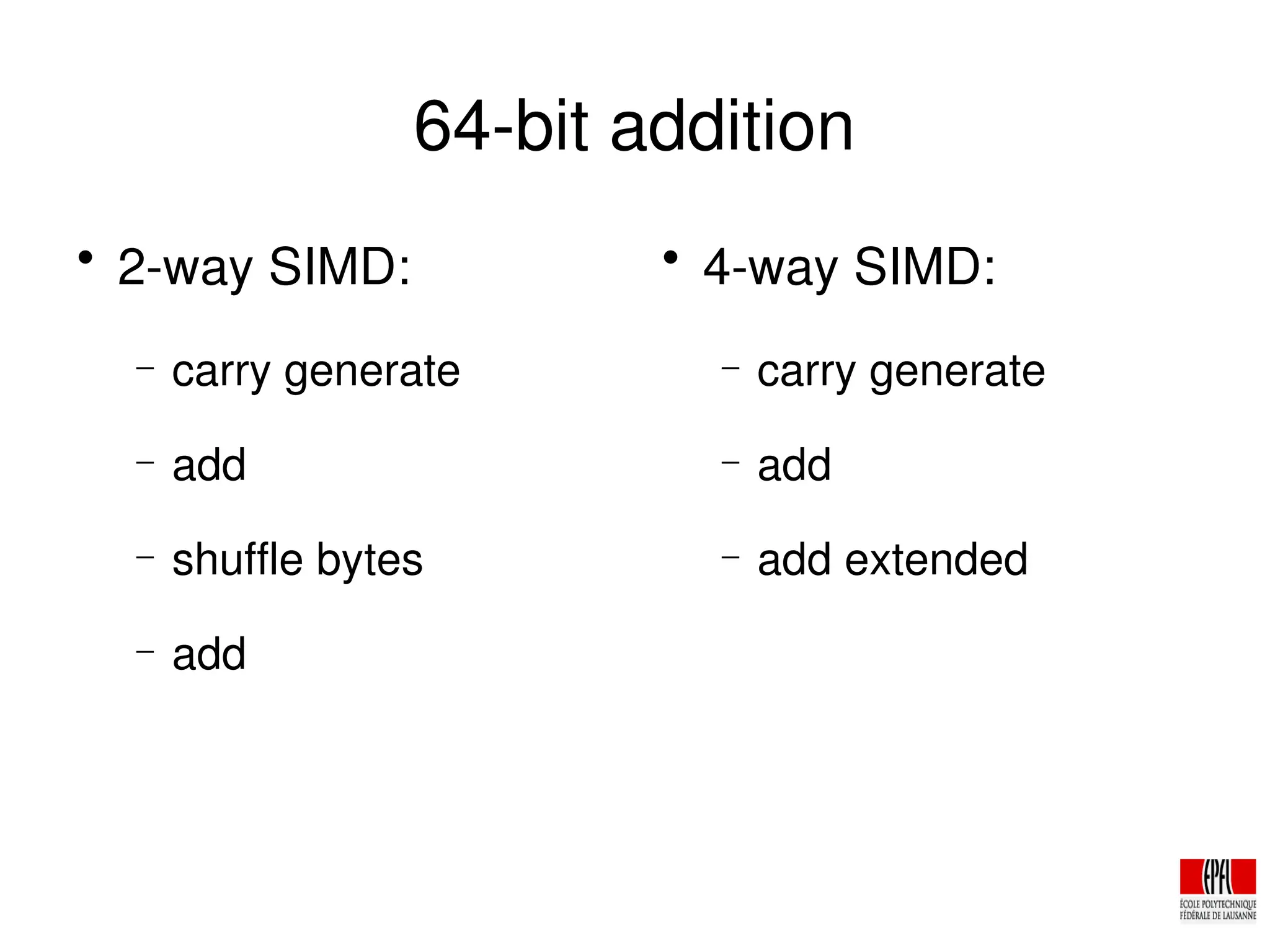
2­way SIMD:
− carry generate
− add
− shuffle bytes
− add

4­way SIMD:
− carry generate
− add
− add extended
64­bit rotate

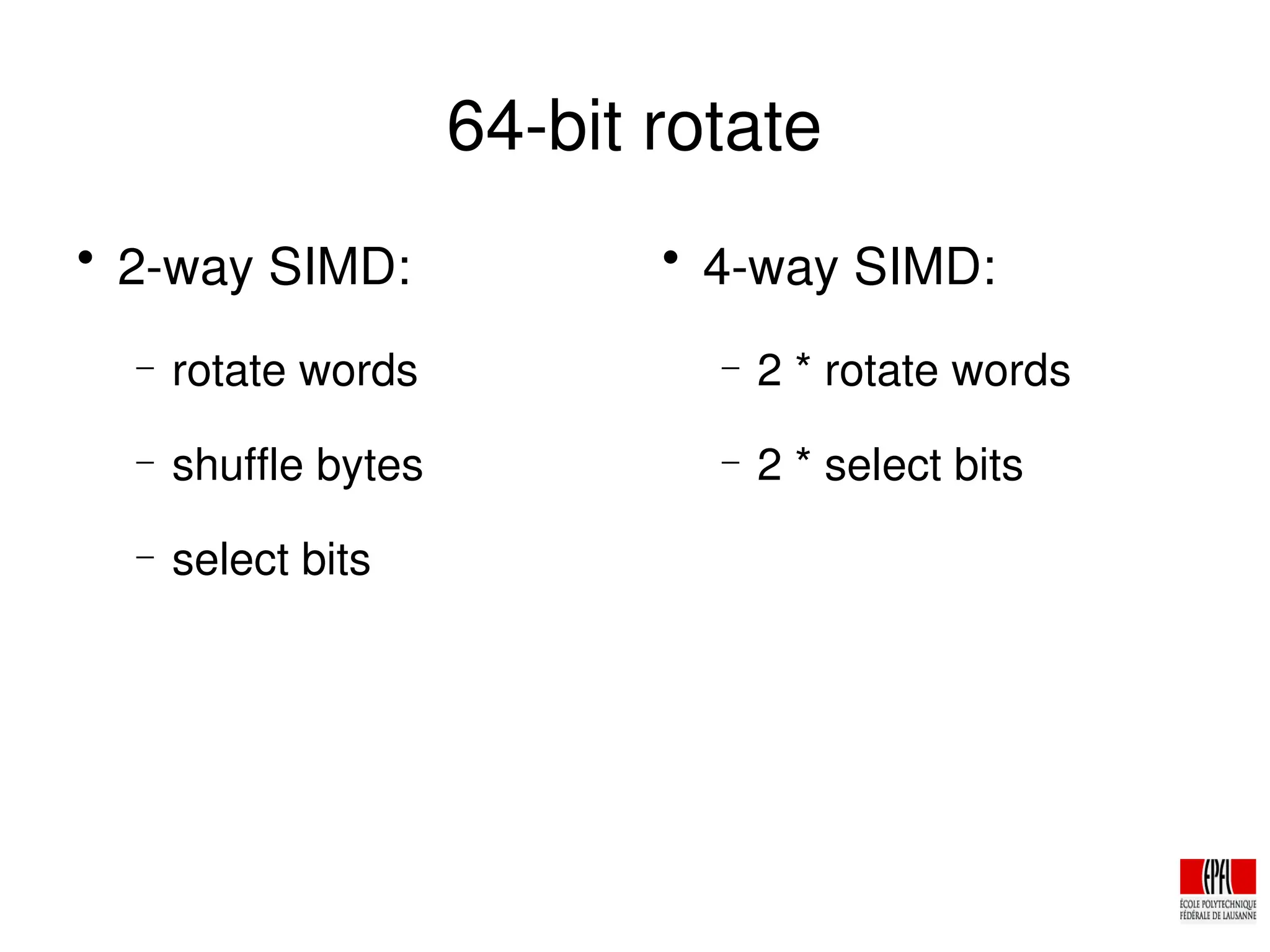
2­way SIMD:
− rotate words
− shuffle bytes
− select bits

4­way SIMD:
− 2 * rotate words
− 2 * select bits
selb

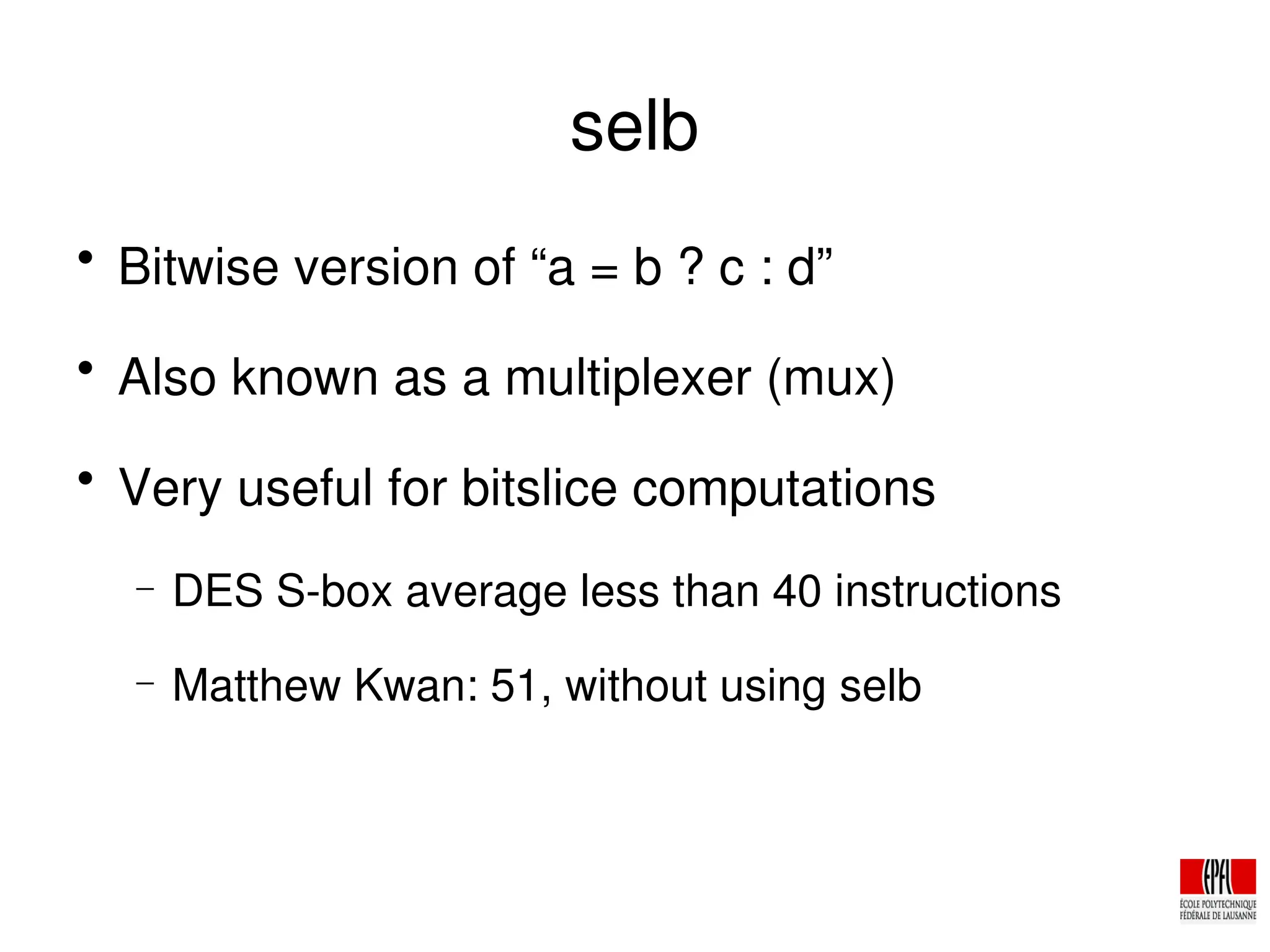
Bitwise version of “a = b ? c : d”

Also known as a multiplexer (mux)

Very useful for bitslice computations
− DES S­box average less than 40 instructions
− Matthew Kwan: 51, without using selb
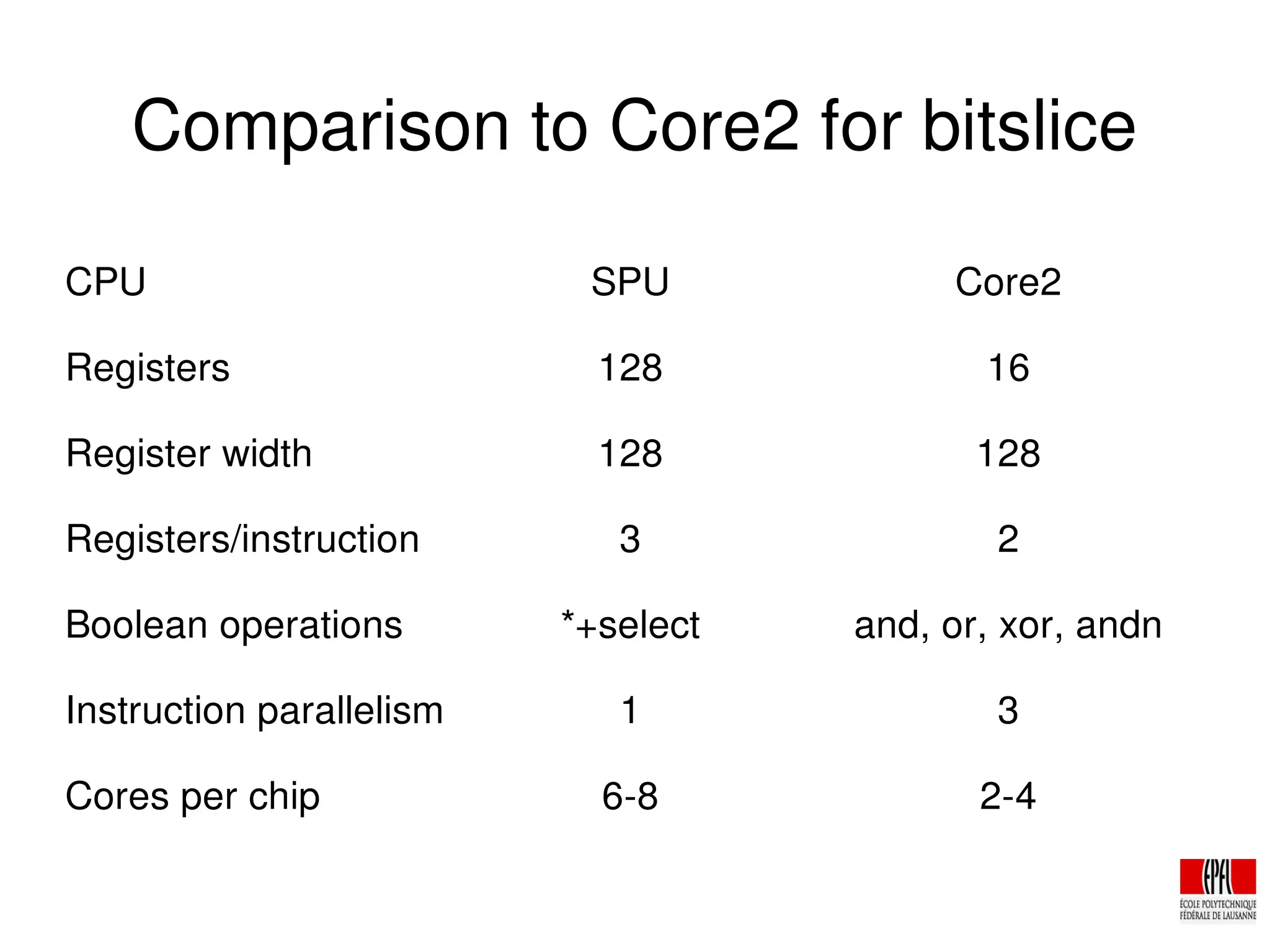
Comparison to Core2 for bitslice
CPU SPU Core2
Registers 128 16
Register width 128 128
Registers/instruction 3 2
Boolean operations *+select and, or, xor, andn
Instruction parallelism 1 3
Cores per chip 6­8 2­4
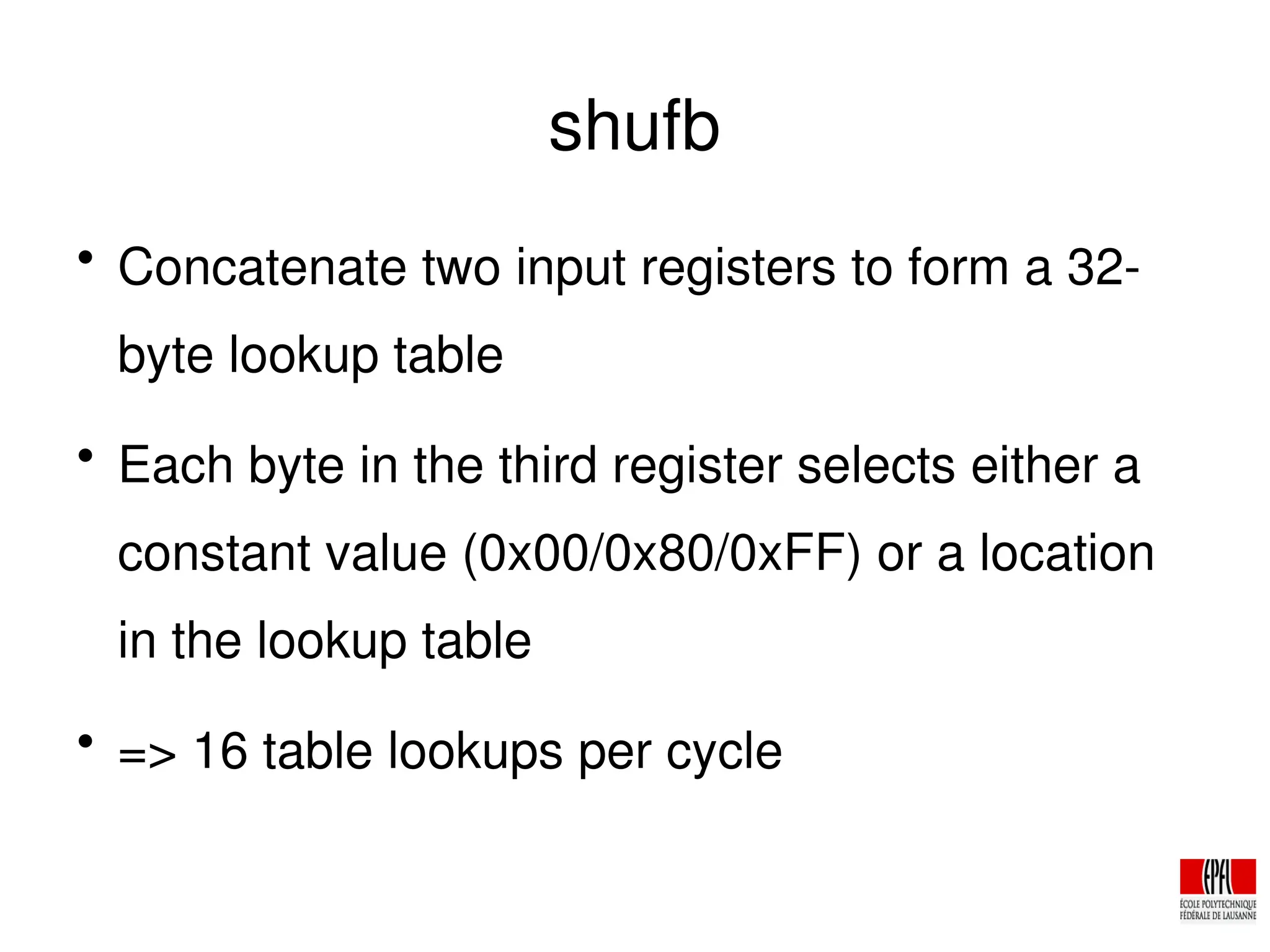
shufb

Concatenate two input registers to form a 32­
byte lookup table

Each byte in the third register selects either a
constant value (0x00/0x80/0xFF) or a location
in the lookup table

=> 16 table lookups per cycle
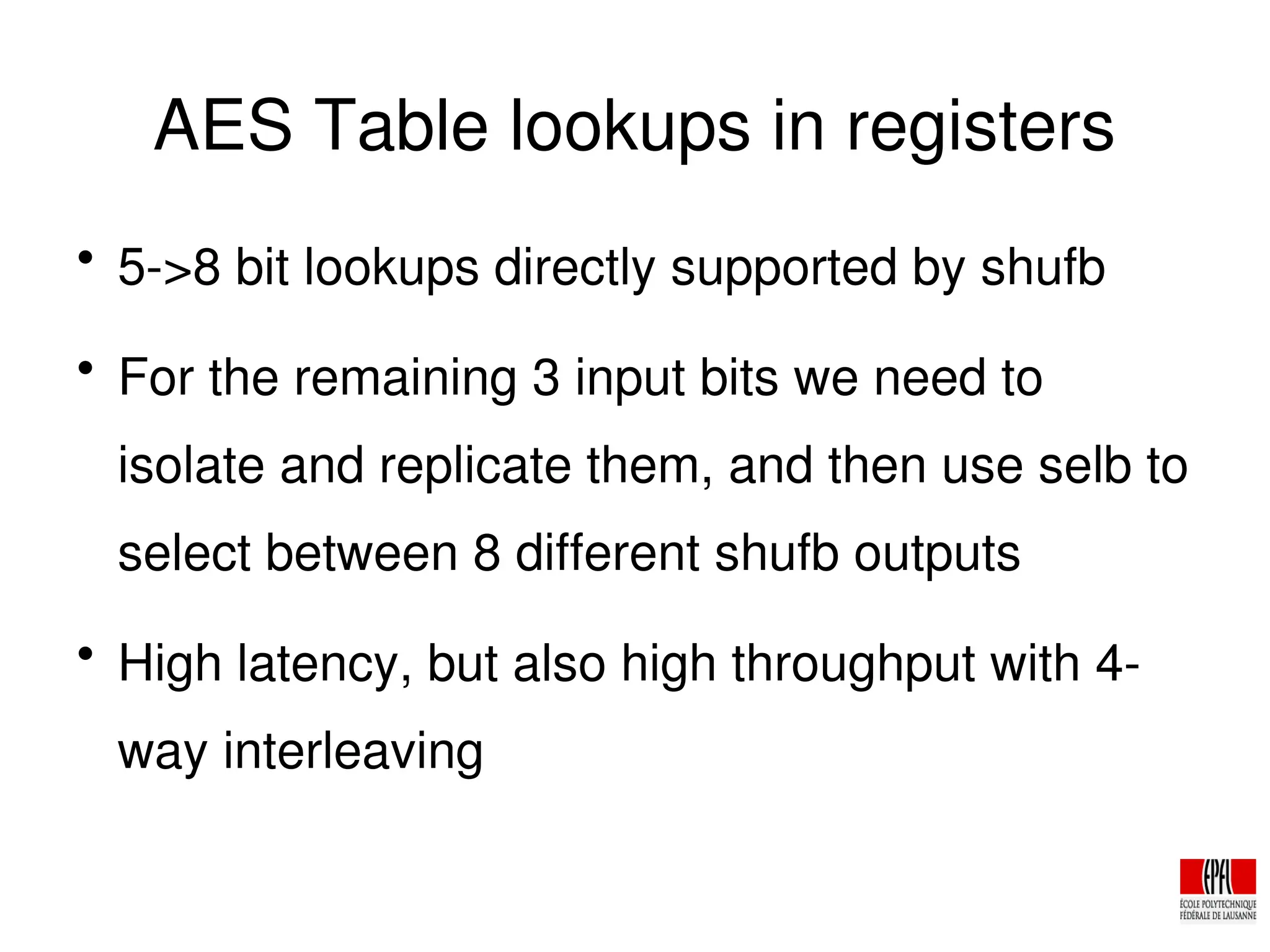
AES Table lookups in registers

5­>8 bit lookups directly supported by shufb

For the remaining 3 input bits we need to
isolate and replicate them, and then use selb to
select between 8 different shufb outputs

High latency, but also high throughput with 4­
way interleaving
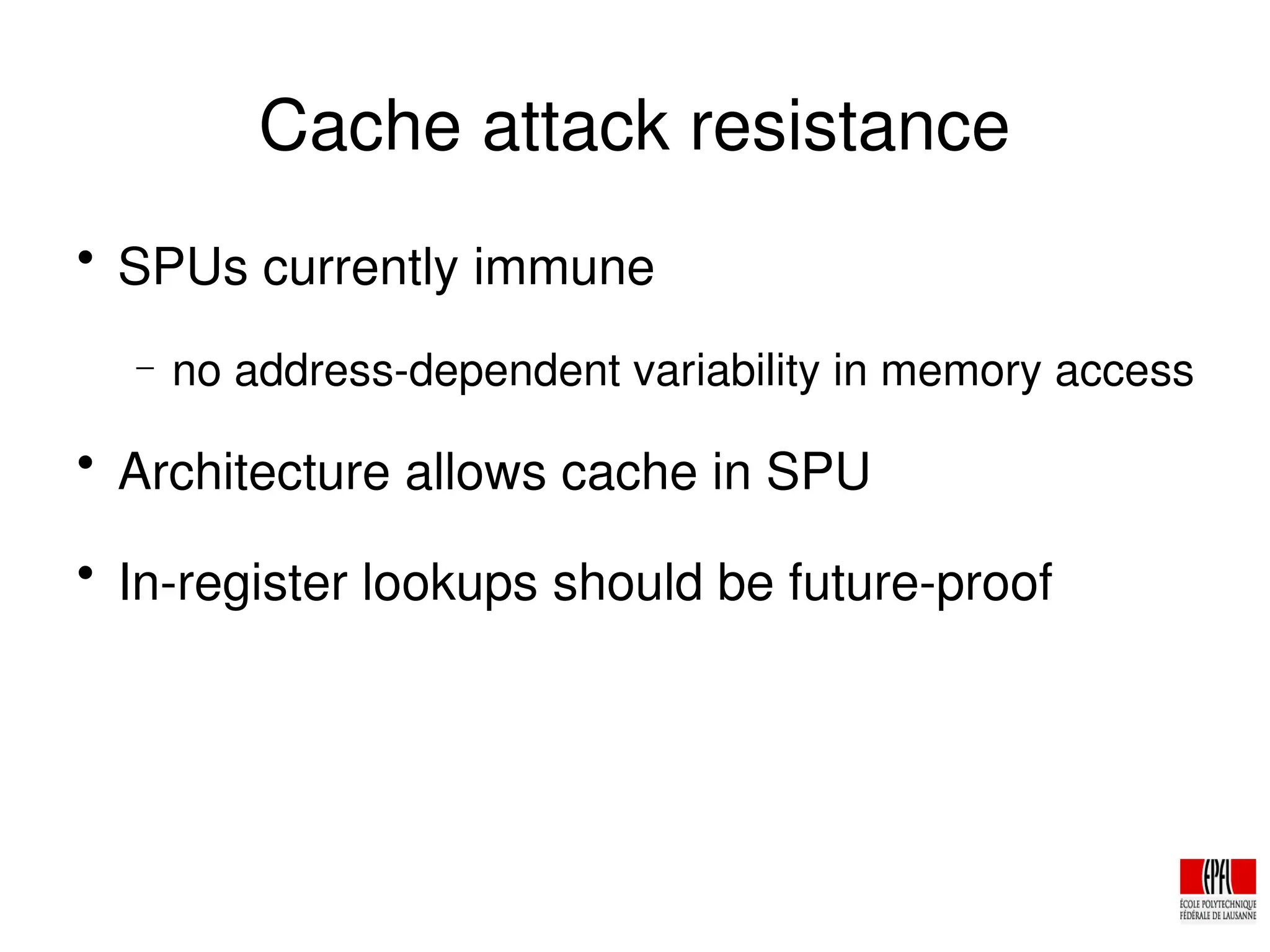
Cache attack resistance

SPUs currently immune
− no address­dependent variability in memory access

Architecture allows cache in SPU

In­register lookups should be future­proof
Branch prediction

Calculate branch address

Give branch target hint

...

Branch without penalty
Optimization summary

Do vector (SIMD) processing

Large number of registers allows interleaving
several computations, hiding latencies

Balance pipeline usage

Pre­compute branches in time to give hint

For very memory­intensive code, ensure
instruction fetch by using hbrp
Running MD5 on the Cell

32­bit addition and rotation, boolean functions
− Directly supported with 4­way SIMD
− Bitslice is slow: 128 adds require 94 instructions

Many streams in parallel hide latencies

Calculated compression function performance:
Up to 15.6 Gbit/s per SPU
Running AES on the Cell

> 2.1 Gbit/s per SPU (~3.8 GHz Pentium 4)

~17 Gbit/s for full Cell, almost 13 Gbit/s for PS3

CBC implementation only a little slower.

Bitslice would be very interesting
Other cryptographic applications for
the Cell Broadband Engine

Limited by SPU microarchitecture and memory

Good match for low­memory, straight­path
computation over small operands

Some promising applications:
− Stream cipher cryptanalysis
− Sieving for the Number Field Sieve
− Hash collisions
The future of the Cell

More SPUs on a chip

Internal cache in SPUs

Fast double precision float

Different size of local memory?

New instructions?

Cryptologic Applications of the PlayStation 3: Cell SPEED

  • 1.
    Cryptologic Applications of thePlayStation 3: Cell SPEED Dag Arne Osvik EPFL Eran Tromer MIT
  • 2.
    Cell Broadband Engine  1PowerPC core − Based on the PowerPC 970 − 128­bit AltiVec/VMX SIMD unit  Currently up to 8 “synergistic processors”  Runs at ~3.2 GHz  A Core2 core has three 128­bit SIMD units with just 16 registers.
  • 3.
    Running DES onthe Cell  Bitsliced implementation of DES − 128­way parallelism per SPU − S­boxes optimized for SPU instruction set  4 Gbit/sec = 226 blocks/sec per SPU  32 Gbit/sec per Cell chip  Can be used as a cryptographic accelerator (ECB, CTR, many CBC streams)
  • 4.
    Breaking DES onthe Cell  Reduce the DES encryption from 16 rounds to the equivalent of ~9.5 rounds, by shortcircuit evaluation and early aborts.  Performance: − 108M=226.69 keys/sec per SPU − 864M=229.69 keys/sec per Cell chip
  • 5.
    Comparison to FPGA Expectedtime to break:  COPACOBANA − ~9 days − €8,980 − A year to build  52 PlayStation 3 consoles − ~9 days − €19,500 (at US$500 each) − Off­the­shelf  Divide by two if you get EK (X) and EK (X).
  • 6.
    DreamHack 2004 LANParty DreamHack 2004 LAN Party 5852 connected computers 5852 connected computers Under 1 hour for a real­time DES break. Under 1 hour for a real­time DES break.
  • 7.
    Synergistic Processing Unit  256KBof fast local memory  128­bit, 128­register SIMD  Two pipelines  In­order execution  Explicit DMA to RAM or other SPUs
  • 8.
    SPU memory  Single­ported  6­cycle load­to­uselatency  Read or write 16 or 128 bytes each cycle  DMA & instruction fetch use 128­byte interface  Prioritized: DMA > load/store > instruction fetch
  • 9.
    SPU registers  128 registers  Upto 77 register parameters and return values according to calling convention
  • 10.
    SPU instruction set  RISC(similar to PowerPC)  Fixed 32­bit size  Always aligned on 4­byte boundary  Most operations are SIMD
  • 11.
  • 12.
    SPU limitations  Fetches 8­bytealigned pairs of instructions − Dual issue happens only if first is even­pipe instruction and and second is odd­pipe instruction  Only 16x16­>32 integer multiplication  No hardware branch prediction
  • 13.
    Special SPU instructions  selectbits  gather bits  carry/borrow generate  sum bytes  generate controls for insertion  shuffle bytes  form select mask  add/sub extended  or across  count leading zeros  count ones in bytes
  • 14.
    64­bit addition  2­way SIMD: −carry generate − add − shuffle bytes − add  4­way SIMD: − carry generate − add − add extended
  • 15.
    64­bit rotate  2­way SIMD: −rotate words − shuffle bytes − select bits  4­way SIMD: − 2 * rotate words − 2 * select bits
  • 16.
    selb  Bitwise version of“a = b ? c : d”  Also known as a multiplexer (mux)  Very useful for bitslice computations − DES S­box average less than 40 instructions − Matthew Kwan: 51, without using selb
  • 17.
    Comparison to Core2for bitslice CPU SPU Core2 Registers 128 16 Register width 128 128 Registers/instruction 3 2 Boolean operations *+select and, or, xor, andn Instruction parallelism 1 3 Cores per chip 6­8 2­4
  • 18.
    shufb  Concatenate two inputregisters to form a 32­ byte lookup table  Each byte in the third register selects either a constant value (0x00/0x80/0xFF) or a location in the lookup table  => 16 table lookups per cycle
  • 19.
    AES Table lookupsin registers  5­>8 bit lookups directly supported by shufb  For the remaining 3 input bits we need to isolate and replicate them, and then use selb to select between 8 different shufb outputs  High latency, but also high throughput with 4­ way interleaving
  • 20.
    Cache attack resistance  SPUscurrently immune − no address­dependent variability in memory access  Architecture allows cache in SPU  In­register lookups should be future­proof
  • 21.
    Branch prediction  Calculate branchaddress  Give branch target hint  ...  Branch without penalty
  • 22.
    Optimization summary  Do vector(SIMD) processing  Large number of registers allows interleaving several computations, hiding latencies  Balance pipeline usage  Pre­compute branches in time to give hint  For very memory­intensive code, ensure instruction fetch by using hbrp
  • 23.
    Running MD5 onthe Cell  32­bit addition and rotation, boolean functions − Directly supported with 4­way SIMD − Bitslice is slow: 128 adds require 94 instructions  Many streams in parallel hide latencies  Calculated compression function performance: Up to 15.6 Gbit/s per SPU
  • 24.
    Running AES onthe Cell  > 2.1 Gbit/s per SPU (~3.8 GHz Pentium 4)  ~17 Gbit/s for full Cell, almost 13 Gbit/s for PS3  CBC implementation only a little slower.  Bitslice would be very interesting
  • 25.
    Other cryptographic applicationsfor the Cell Broadband Engine  Limited by SPU microarchitecture and memory  Good match for low­memory, straight­path computation over small operands  Some promising applications: − Stream cipher cryptanalysis − Sieving for the Number Field Sieve − Hash collisions
  • 26.
    The future ofthe Cell  More SPUs on a chip  Internal cache in SPUs  Fast double precision float  Different size of local memory?  New instructions?