Beyond Porting

How Modern OpenGL can
Radically Reduce Driver Overhead
Who are we?
Cass Everitt, NVIDIA Corporation
John McDonald, NVIDIA Corporation
What will we cover?
Dynamic Buffer Generation
Efficient Texture Management
Increasing Draw Call Count
Dynamic Buffer Generation
Problem
Our goal is to generate dynamic geometry directly in place.
It will be used one time, and will be completely regenerated next frame.
Particle systems are the most common example
Vegetation / foliage also common
Typical Solution
void UpdateParticleData(uint _dstBuf) {
BindBuffer(ARRAY_BUFFER, _dstBuf);
access = MAP_UNSYNCHRONIZED | MAP_WRITE_BIT;
for particle in allParticles {
dataSize = GetParticleSize(particle);
void* dst = MapBuffer(ARRAY_BUFFER, offset, dataSize, access);
(*(Particle*)dst) = *particle;
UnmapBuffer(ARRAY_BUFFER);
offset += dataSize;
}
};
// Now render with everything.
The horror
void UpdateParticleData(uint _dstBuf) {
BindBuffer(ARRAY_BUFFER, _dstBuf);
access = MAP_UNSYNCHRONIZED | MAP_WRITE_BIT;
for particle in allParticles {
dataSize = GetParticleSize(particle);
void* dst = MapBuffer(ARRAY_BUFFER, offset, dataSize, access);
(*(Particle*)dst) = *particle;
UnmapBuffer(ARRAY_BUFFER);
This is so slow.
offset += dataSize;
}
};
// Now render with everything.
Driver interlude
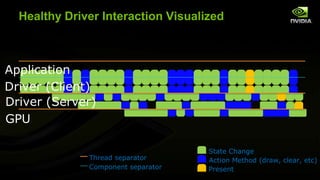
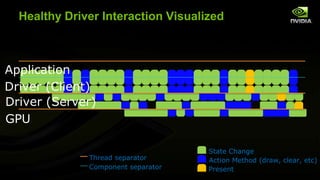
First, a quick interlude on modern GL drivers
In the application (client) thread, the driver is very thin.
It simply packages work to hand off to the server thread.

The server thread does the real processing
It turns command sequences into push buffer fragments.
Healthy Driver Interaction Visualized

Application
Driver (Client)
Driver (Server)
GPU
Thread separator
Component separator

State Change
Action Method (draw, clear, etc)
Present
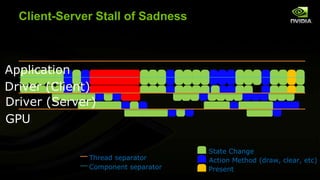
MAP_UNSYNCHRONIZED
Avoids an application-GPU sync point (a CPU-GPU sync point)
But causes the Client and Server threads to serialize
This forces all pending work in the server thread to complete
It’s quite expensive (almost always needs to be avoided)
Healthy Driver Interaction Visualized

Application
Driver (Client)
Driver (Server)
GPU
Thread separator
Component separator

State Change
Action Method (draw, clear, etc)
Present
Client-Server Stall of Sadness

Application
Driver (Client)
Driver (Server)
GPU
Thread separator
Component separator

State Change
Action Method (draw, clear, etc)
Present
It’s okay
Q: What’s better than mapping in an unsynchronized manner?
A: Keeping around a pointer to GPU-visible memory forever.
Introducing: ARB_buffer_storage
ARB_buffer_storage
Conceptually similar to ARB_texture_storage (but for buffers)
Creates an immutable pointer to storage for a buffer
The pointer is immutable, the contents are not.
So BufferData cannot be called—BufferSubData is still okay.

Allows for extra information at create time.
For our usage, we care about the PERSISTENT and COHERENT
bits.
PERSISTENT: Allow this buffer to be mapped while the GPU is using it.
COHERENT: Client writes to this buffer should be immediately visible to
the GPU.
http://www.opengl.org/registry/specs/ARB/buffer_storage.txt
ARB_buffer_storage cont’d
Also affects the mapping behavior (pass persistent and coherent
bits to MapBufferRange)
Persistently mapped buffers are good for:
Dynamic VB / IB data
Highly dynamic (~per draw call) uniform data
Multi_draw_indirect command buffers (more on this later)

Not a good fit for:
Static geometry buffers
Long lived uniform data (still should use BufferData or BufferSubData for
this)
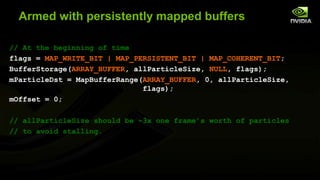
Armed with persistently mapped buffers
// At the beginning of time
flags = MAP_WRITE_BIT | MAP_PERSISTENT_BIT | MAP_COHERENT_BIT;
BufferStorage(ARRAY_BUFFER, allParticleSize, NULL, flags);
mParticleDst = MapBufferRange(ARRAY_BUFFER, 0, allParticleSize,
flags);
mOffset = 0;

// allParticleSize should be ~3x one frame’s worth of particles
// to avoid stalling.
Update Loop (old and busted)
void UpdateParticleData(uint _dstBuf) {
BindBuffer(ARRAY_BUFFER, _dstBuf);
access = MAP_UNSYNCHRONIZED | MAP_WRITE_BIT;
for particle in allParticles {
dataSize = GetParticleSize(particle);
void* dst = MapBuffer(ARRAY_BUFFER, offset, dataSize, access);
(*(Particle*)dst) = *particle;
offset += dataSize;
UnmapBuffer(ARRAY_BUFFER);
}
};
// Now render with everything.
Update Loop (new hotness)
void UpdateParticleData() {

for particle in allParticles {
dataSize = GetParticleSize(particle);
mParticleDst[mOffset] = *particle;
mOffset += dataSize; // Wrapping not shown
}
};
// Now render with everything.
Test App
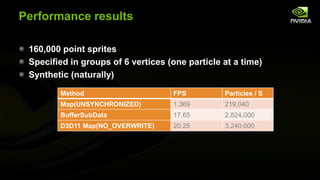
Performance results
160,000 point sprites
Specified in groups of 6 vertices (one particle at a time)
Synthetic (naturally)
Method

FPS

Particles / S

Map(UNSYNCHRONIZED)

1.369

219,040

BufferSubData

17.65

2,824,000

D3D11 Map(NO_OVERWRITE)

20.25

3,240,000
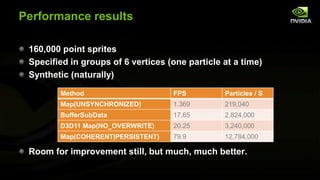
Performance results
160,000 point sprites
Specified in groups of 6 vertices (one particle at a time)
Synthetic (naturally)
Method

FPS

Particles / S

Map(UNSYNCHRONIZED)

1.369

219,040

BufferSubData

17.65

2,824,000

D3D11 Map(NO_OVERWRITE)

20.25

3,240,000

Map(COHERENT|PERSISTENT)

79.9

12,784,000

Room for improvement still, but much, much better.
The other shoe
You are responsible for not stomping on data in flight.
Why 3x?
1x: What the GPU is using right now.
2x: What the driver is holding, getting ready for the GPU to use.
3x: What you are writing to.

3x should ~ guarantee enough buffer room*…
Use fences to ensure that rendering is complete before you begin
to write new data.
Fencing
Use FenceSync to place a new fence.
When ready to scribble over that memory again, use
ClientWaitSync to ensure that memory is done.
ClientWaitSync will block the client thread until it is ready
So you should wrap this function with a performance counter
And complain to your log file (or resize the underlying buffer) if you
frequently see stalls here

For complete details on correct management of buffers with
fencing, see Efficient Buffer Management [McDonald 2012]
Efficient Texture Management
Or ―how to manage all texture memory myself‖
Problem
Changing textures breaks batches.
Not all texture data is needed all the time
Texture data is large (typically the largest memory bucket for games)

Bindless solves this, but can hurt GPU performance
Too many different textures can fall out of TexHdr$
Not a bindless problem per se
Terminology
Reserve – The act of allocating virtual memory
Commit – Tying a virtual memory allocation to a physical backing
store (Physical memory)
Texture Shape – The characteristics of a texture that affect its
memory consumption
Specifically: Height, Width, Depth, Surface Format, Mipmap Level Count
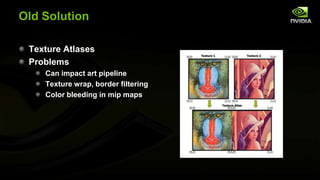
Old Solution
Texture Atlases
Problems
Can impact art pipeline
Texture wrap, border filtering
Color bleeding in mip maps
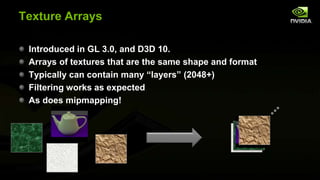
Texture Arrays
Introduced in GL 3.0, and D3D 10.
Arrays of textures that are the same shape and format
Typically can contain many ―layers‖ (2048+)
Filtering works as expected
As does mipmapping!
Sparse Bindless Texture Arrays
Organize loose textures into Texture Arrays.
Sparsely allocate Texture Arrays
Introducing ARB_sparse_texture
Consume virtual memory, but not physical memory

Use Bindless handles to deal with as many arrays as needed!
Introducing ARB_bindless_texture
uncommitted
uncommitted
uncommitted

layer
layer
layer
ARB_sparse_texture
Applications get fine-grained control of physical
memory for textures with large virtual allocations
Inspired by Mega Texture
Primary expected use cases:
Sparse texture data
Texture paging
Delayed-loading assets

http://www.opengl.org/registry/specs/ARB/sparse_texture.txt
ARB_bindless_texture
Textures specified by GPU-visible ―handle‖ (really an address)
Rather than by name and binding point

Can come from ~anywhere
Uniforms
Varying
SSBO
Other textures

Texture residency also application-controlled
Residency is ―does this live on the GPU or in sysmem?‖
https://www.opengl.org/registry/specs/ARB/bindless_texture.txt
Advantages
Artists work naturally
No preprocessing required (no bake-step required)
Although preprocessing is helpful if ARB_sparse_texture is unavailable

Reduce or eliminate TexHdr$ thrashing
Even as compared to traditional texturing

Programmers manage texture residency
Works well with arbitrary streaming
Faster on the CPU
Faster on the GPU
Disadvantages
Texture addresses are now structs (96 bits).
64 bits for bindless handle
32 bits for slice index (could reduce this to 10 bits at a perf cost)

ARB_sparse_texture implementations are a bit immature
Early adopters: please bring us your bugs.

ARB_sparse_texture requires base level be a multiple of tile size
(Smaller is okay)
Tile size is queried at runtime
Textures that are power-of-2 should almost always be safe.
Implementation Overview
When creating a new texture…
Check to see if any suitable texture array exists
Texture arrays can contain a large number of textures of the same shape
Ex. Many TEXTURE_2Ds grouped into a single TEXTURE_2D_ARRAY

If no suitable texture, create a new one.
Texture Container Creation (example)
GetIntegerv( MAX_SPARSE_ARRAY_TEXTURE_LAYERS, maxLayers );

Choose a reasonable size (e.g. array size ~100MB virtual )

If new internalFormat, choose page size
GetInternalformativ( …, internalformat, NUM_VIRTUAL_PAGE_SIZES, 1, &numIndexes);

Note: numIndexes can be 0, so have a plan
Iterate, select suitable pageSizeIndex
BindTexture( TEXTURE_2D_ARRAY, newTexArray );
TexParameteri( TEXTURE_SPARSE, TRUE );
TexParameteri( VIRTUAL_PAGE_SIZE_INDEX, pageSizeIndex );

Allocate the texture’s virtual memory using TexStorage3D
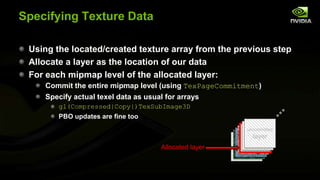
Specifying Texture Data
Using the located/created texture array from the previous step
Allocate a layer as the location of our data
For each mipmap level of the allocated layer:
Commit the entire mipmap level (using TexPageCommitment)
Specify actual texel data as usual for arrays
gl(Compressed|Copy|)TexSubImage3D
PBO updates are fine too
uncommitted

Allocated layer

free
free
layer
slice
slice
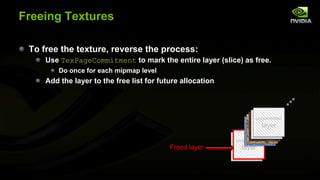
Freeing Textures
To free the texture, reverse the process:
Use TexPageCommitment to mark the entire layer (slice) as free.
Do once for each mipmap level

Add the layer to the free list for future allocation

uncommitted

free
free
layer
slice
slice

uncommitted

Freed layer

layer
Combining with Bindless to eliminate binds
At container create time:
Specify sampling parameters via SamplerParameter calls first
Call GetTextureSamplerHandleARB to return a GPU-visible pointer to the
texture+sampler container
Call MakeTextureHandleResident to ensure the resource lives on the GPU

At delete time, call MakeTextureHandleNonResident
With bindless, you explicitly manage the GPU’s working set
Using texture data in shaders
When a texture is needed with the default sampling parameters
Create a GLSL-visible TextureRef object:
struct TextureRef {
sampler2DArray container;
float slice;
};

When a texture is needed with custom sampling parameters
Create a separate sampler object for the shader with the parameters
Create a bindless handle to the pair using
GetTextureSamplerHandle, then call MakeTextureHandleResident
with the new value
And fill out a TextureRef as above for usage by GLSL
C++ Code
Basic implementation (some details missing)
BSD licensed (use as you will)
https://github.com/nvMcJohn/apitest/blob/pdoane_newtests/sparse_bindless_texarray.h
https://github.com/nvMcJohn/apitest/blob/pdoane_newtests/sparse_bindless_texarray.cpp
Increasing Draw Call Count
Let’s draw all the calls!
All the Draw Calls!
Problem
You want more draw calls of smaller objects.
D3D is slow at this.
Naïve GL is faster than D3D, but not fast enough.
XY Problem
Y: How can I have more draw calls?
X: You don’t really care if it’s more draw calls, right?
Really what you want is to be able to draw more small geometry
groupings. More objects.
Well why didn’t you just say so??
First, some background.
What makes draw calls slow?
Real world API usage
Draw Call Cost Visualization
Some background
What causes slow draw calls?
Validation is the biggest bucket (by far).
Pre-validation is ―difficult‖
―Every application does the same things.‖
Not really. Most applications are in completely disjoint states
Try this experiment: What is important to you?
Now ask your neighbor what’s important to him.
Why is prevalidation difficult?
The GPU is an exceedingly complex state machine.
(Honestly, it’s probably the most complex state machine in all of CS)

Any one of those states may have a problem that requires WAR
Usually the only problem is overall performance
But sometimes not. 

There are millions of tests covering NVIDIA GPU functionality.
FINE.
How can app devs mitigate these costs?
Minimize state changes.
All state changes are not created equal!

Cost of a draw call:
Small fixed cost + Cost of validation of changed state
Feels limiting…
Artists want lots of materials, and small amounts of geometry
Even better: What if artists just didn’t have to care about this?
Ideal Programmer->Artist Interaction
―You make pretty art. I’ll make it fit.‖
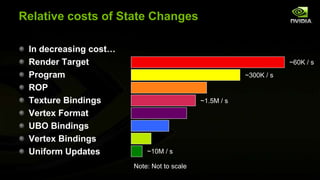
Relative costs of State Changes
In decreasing cost…
Render Target
Program
ROP
Texture Bindings
Vertex Format
UBO Bindings
Vertex Bindings
Uniform Updates

~60K / s
~300K / s

~1.5M / s

~10M / s
Note: Not to scale
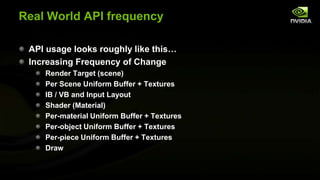
Real World API frequency
API usage looks roughly like this…
Increasing Frequency of Change
Render Target (scene)
Per Scene Uniform Buffer + Textures
IB / VB and Input Layout
Shader (Material)
Per-material Uniform Buffer + Textures
Per-object Uniform Buffer + Textures
Per-piece Uniform Buffer + Textures
Draw
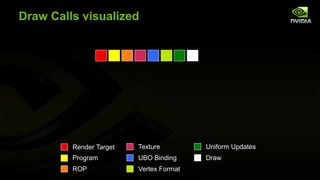
Draw Calls visualized

Render Target

Texture

Uniform Updates

Program

UBO Binding

Draw

ROP

Vertex Format
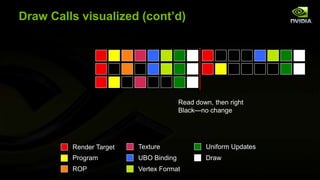
Draw Calls visualized (cont’d)

Read down, then right
Black—no change

Render Target

Texture

Uniform Updates

Program

UBO Binding

Draw

ROP

Vertex Format
Goals
Let’s minimize validation costs without affecting artists
Things we need to be fast (per app call frequency):
Uniform Updates and binding
Texture Updates and binding

These happen most often in app, ergo driving them to ~0 should
be a win.
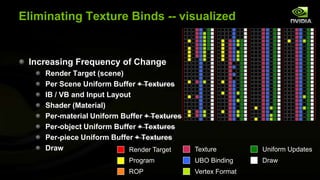
Textures
Using Sparse Bindless Texture Arrays (as previously described)
solves this.
All textures are set before any drawing begins
(No need to change textures between draw calls)

Note that from the CPU’s perspective, just using bindless is
sufficient.

That was easy.
Eliminating Texture Binds -- visualized

Increasing Frequency of Change
Render Target (scene)
Per Scene Uniform Buffer + Textures
IB / VB and Input Layout
Shader (Material)
Per-material Uniform Buffer + Textures
Per-object Uniform Buffer + Textures
Per-piece Uniform Buffer + Textures
Draw
Render Target

Texture

Uniform Updates

Program

UBO Binding

Draw

ROP

Vertex Format
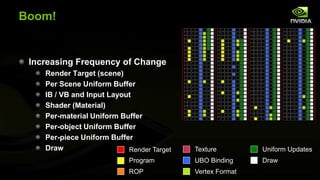
Boom!

Increasing Frequency of Change
Render Target (scene)
Per Scene Uniform Buffer
IB / VB and Input Layout
Shader (Material)
Per-material Uniform Buffer
Per-object Uniform Buffer
Per-piece Uniform Buffer
Draw
Render Target

Texture

Uniform Updates

Program

UBO Binding

Draw

ROP

Vertex Format
Buffer updates (old and busted)
Typical Scene Graph Traversal
for obj in visibleObjectSet {
update(buffer, obj);
draw(obj);
}
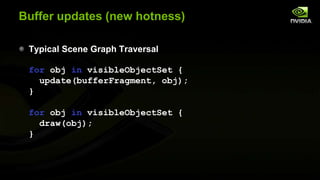
Buffer updates (new hotness)
Typical Scene Graph Traversal
for obj in visibleObjectSet {
update(bufferFragment, obj);
}
for obj in visibleObjectSet {
draw(obj);
}
bufferFragma-wha?
Rather than one buffer per object, we share UBOs for many
objects.
ie, given struct ObjectUniforms { /* … */ };
// Old (probably not explicitly instantiated,
// just scattered in GLSL)
ObjectUniforms uniformData;
// New
ObjectUniforms uniformData[ObjectsPerKickoff];

Use persistent mapping for even more win here!
For large amounts of data (bones) consider SSBO.
Introducing ARB_shader_storage_buffer_object
SSBO?
Like ―large‖ uniform buffer objects.
Minimum required size to claim support is 16M.

Accessed like uniforms in shader
Support for better packing (std430)
Caveat: They are typically implemented in hardware as textures
(and can introduce dependent texture reads)
Just one of a laundry list of things to consider, not to discourage use.
http://www.opengl.org/registry/specs/ARB/shader_storage_buffer_object.txt
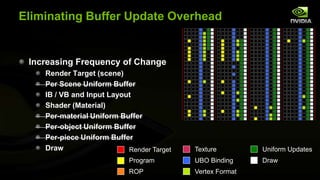
Eliminating Buffer Update Overhead

Increasing Frequency of Change
Render Target (scene)
Per Scene Uniform Buffer
IB / VB and Input Layout
Shader (Material)
Per-material Uniform Buffer
Per-object Uniform Buffer
Per-piece Uniform Buffer
Draw
Render Target

Texture

Uniform Updates

Program

UBO Binding

Draw

ROP

Vertex Format
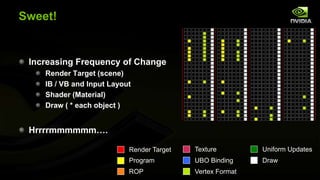
Sweet!

Increasing Frequency of Change
Render Target (scene)
IB / VB and Input Layout
Shader (Material)
Draw ( * each object )

Hrrrrmmmmmm….
Render Target

Texture

Uniform Updates

Program

UBO Binding

Draw

ROP

Vertex Format
So now…
It’d be awesome if we could do all of those kickoffs at once.
Validation is already only paid once
But we could just pay the constant startup cost once.
If only…….
So now…
It’d be awesome if we could do all of those kickoffs at once.
Validation is already only paid once
But we could just pay the constant startup cost once.
If only…….

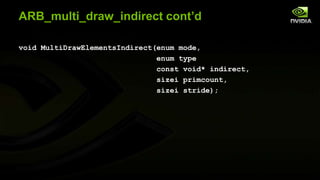
Introducing ARB_multi_draw_indirect
ARB_multi_draw_indirect
Allows you to specify parameters to draw commands from a
buffer.
This means you can generate those parameters wide (on the CPU)
Or even on the GPU, via compute program.
http://www.opengl.org/registry/specs/ARB/multi_draw_indirect.txt
ARB_multi_draw_indirect cont’d
void MultiDrawElementsIndirect(enum mode,
enum type
const void* indirect,
sizei primcount,
sizei stride);
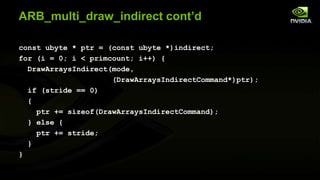
ARB_multi_draw_indirect cont’d
const ubyte * ptr = (const ubyte *)indirect;
for (i = 0; i < primcount; i++) {
DrawArraysIndirect(mode,
(DrawArraysIndirectCommand*)ptr);
if (stride == 0)
{
ptr += sizeof(DrawArraysIndirectCommand);
} else {
ptr += stride;
}
}
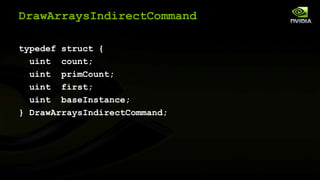
DrawArraysIndirectCommand
typedef struct {
uint count;
uint primCount;
uint first;
uint baseInstance;
} DrawArraysIndirectCommand;
Knowing which shader data is mine
Use ARB_shader_draw_parameters, a necessary companion to
ARB_multi_draw_indirect
Adds a builtin to the VS: DrawID (InstanceID already available)
This tells you which command of a MultiDraw command is being
executed.
When not using MultiDraw, the builtin is specified to be 0.

Caveat: Right now, you have to pass this down to other shader
stages as an interpolant.
Hoping to have that rectified via ARB or EXT extension ―real soon now.‖
http://www.opengl.org/registry/specs/ARB/shader_draw_parameters.txt
Applying everything
CPU Perf is massively better
5-30x increase in number of distinct objects / s

Interaction with driver is decreased ~75%
Note: GPU perf can be affected negatively (although not too
badly)

As always: Profile, profile, profile.
Previous Results

Render Target

Texture

Uniform Updates

Program

UBO Binding

Draw

ROP

Vertex Format
Visualized Results

Render Target

Texture

Uniform Updates

Program

UBO Binding

Draw

ROP

Vertex Format

MultiDraw
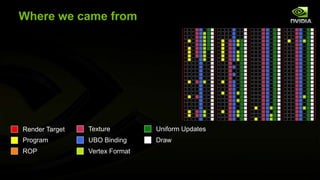
Where we came from

Render Target

Texture

Uniform Updates

Program

UBO Binding

Draw

ROP

Vertex Format
Conclusion
Go forth and work magnify.
Questions?
jmcdonald at nvidia dot com
cass at nvidia dot com

Beyond porting

  • 1.
    Beyond Porting How ModernOpenGL can Radically Reduce Driver Overhead
  • 2.
    Who are we? CassEveritt, NVIDIA Corporation John McDonald, NVIDIA Corporation
  • 3.
    What will wecover? Dynamic Buffer Generation Efficient Texture Management Increasing Draw Call Count
  • 4.
    Dynamic Buffer Generation Problem Ourgoal is to generate dynamic geometry directly in place. It will be used one time, and will be completely regenerated next frame. Particle systems are the most common example Vegetation / foliage also common
  • 5.
    Typical Solution void UpdateParticleData(uint_dstBuf) { BindBuffer(ARRAY_BUFFER, _dstBuf); access = MAP_UNSYNCHRONIZED | MAP_WRITE_BIT; for particle in allParticles { dataSize = GetParticleSize(particle); void* dst = MapBuffer(ARRAY_BUFFER, offset, dataSize, access); (*(Particle*)dst) = *particle; UnmapBuffer(ARRAY_BUFFER); offset += dataSize; } }; // Now render with everything.
  • 6.
    The horror void UpdateParticleData(uint_dstBuf) { BindBuffer(ARRAY_BUFFER, _dstBuf); access = MAP_UNSYNCHRONIZED | MAP_WRITE_BIT; for particle in allParticles { dataSize = GetParticleSize(particle); void* dst = MapBuffer(ARRAY_BUFFER, offset, dataSize, access); (*(Particle*)dst) = *particle; UnmapBuffer(ARRAY_BUFFER); This is so slow. offset += dataSize; } }; // Now render with everything.
  • 7.
    Driver interlude First, aquick interlude on modern GL drivers In the application (client) thread, the driver is very thin. It simply packages work to hand off to the server thread. The server thread does the real processing It turns command sequences into push buffer fragments.
  • 8.
    Healthy Driver InteractionVisualized Application Driver (Client) Driver (Server) GPU Thread separator Component separator State Change Action Method (draw, clear, etc) Present
  • 9.
    MAP_UNSYNCHRONIZED Avoids an application-GPUsync point (a CPU-GPU sync point) But causes the Client and Server threads to serialize This forces all pending work in the server thread to complete It’s quite expensive (almost always needs to be avoided)
  • 10.
    Healthy Driver InteractionVisualized Application Driver (Client) Driver (Server) GPU Thread separator Component separator State Change Action Method (draw, clear, etc) Present
  • 11.
    Client-Server Stall ofSadness Application Driver (Client) Driver (Server) GPU Thread separator Component separator State Change Action Method (draw, clear, etc) Present
  • 12.
    It’s okay Q: What’sbetter than mapping in an unsynchronized manner? A: Keeping around a pointer to GPU-visible memory forever. Introducing: ARB_buffer_storage
  • 13.
    ARB_buffer_storage Conceptually similar toARB_texture_storage (but for buffers) Creates an immutable pointer to storage for a buffer The pointer is immutable, the contents are not. So BufferData cannot be called—BufferSubData is still okay. Allows for extra information at create time. For our usage, we care about the PERSISTENT and COHERENT bits. PERSISTENT: Allow this buffer to be mapped while the GPU is using it. COHERENT: Client writes to this buffer should be immediately visible to the GPU. http://www.opengl.org/registry/specs/ARB/buffer_storage.txt
  • 14.
    ARB_buffer_storage cont’d Also affectsthe mapping behavior (pass persistent and coherent bits to MapBufferRange) Persistently mapped buffers are good for: Dynamic VB / IB data Highly dynamic (~per draw call) uniform data Multi_draw_indirect command buffers (more on this later) Not a good fit for: Static geometry buffers Long lived uniform data (still should use BufferData or BufferSubData for this)
  • 15.
    Armed with persistentlymapped buffers // At the beginning of time flags = MAP_WRITE_BIT | MAP_PERSISTENT_BIT | MAP_COHERENT_BIT; BufferStorage(ARRAY_BUFFER, allParticleSize, NULL, flags); mParticleDst = MapBufferRange(ARRAY_BUFFER, 0, allParticleSize, flags); mOffset = 0; // allParticleSize should be ~3x one frame’s worth of particles // to avoid stalling.
  • 16.
    Update Loop (oldand busted) void UpdateParticleData(uint _dstBuf) { BindBuffer(ARRAY_BUFFER, _dstBuf); access = MAP_UNSYNCHRONIZED | MAP_WRITE_BIT; for particle in allParticles { dataSize = GetParticleSize(particle); void* dst = MapBuffer(ARRAY_BUFFER, offset, dataSize, access); (*(Particle*)dst) = *particle; offset += dataSize; UnmapBuffer(ARRAY_BUFFER); } }; // Now render with everything.
  • 17.
    Update Loop (newhotness) void UpdateParticleData() { for particle in allParticles { dataSize = GetParticleSize(particle); mParticleDst[mOffset] = *particle; mOffset += dataSize; // Wrapping not shown } }; // Now render with everything.
  • 18.
  • 19.
    Performance results 160,000 pointsprites Specified in groups of 6 vertices (one particle at a time) Synthetic (naturally) Method FPS Particles / S Map(UNSYNCHRONIZED) 1.369 219,040 BufferSubData 17.65 2,824,000 D3D11 Map(NO_OVERWRITE) 20.25 3,240,000
  • 20.
    Performance results 160,000 pointsprites Specified in groups of 6 vertices (one particle at a time) Synthetic (naturally) Method FPS Particles / S Map(UNSYNCHRONIZED) 1.369 219,040 BufferSubData 17.65 2,824,000 D3D11 Map(NO_OVERWRITE) 20.25 3,240,000 Map(COHERENT|PERSISTENT) 79.9 12,784,000 Room for improvement still, but much, much better.
  • 21.
    The other shoe Youare responsible for not stomping on data in flight. Why 3x? 1x: What the GPU is using right now. 2x: What the driver is holding, getting ready for the GPU to use. 3x: What you are writing to. 3x should ~ guarantee enough buffer room*… Use fences to ensure that rendering is complete before you begin to write new data.
  • 22.
    Fencing Use FenceSync toplace a new fence. When ready to scribble over that memory again, use ClientWaitSync to ensure that memory is done. ClientWaitSync will block the client thread until it is ready So you should wrap this function with a performance counter And complain to your log file (or resize the underlying buffer) if you frequently see stalls here For complete details on correct management of buffers with fencing, see Efficient Buffer Management [McDonald 2012]
  • 23.
    Efficient Texture Management Or―how to manage all texture memory myself‖
  • 24.
    Problem Changing textures breaksbatches. Not all texture data is needed all the time Texture data is large (typically the largest memory bucket for games) Bindless solves this, but can hurt GPU performance Too many different textures can fall out of TexHdr$ Not a bindless problem per se
  • 25.
    Terminology Reserve – Theact of allocating virtual memory Commit – Tying a virtual memory allocation to a physical backing store (Physical memory) Texture Shape – The characteristics of a texture that affect its memory consumption Specifically: Height, Width, Depth, Surface Format, Mipmap Level Count
  • 26.
    Old Solution Texture Atlases Problems Canimpact art pipeline Texture wrap, border filtering Color bleeding in mip maps
  • 27.
    Texture Arrays Introduced inGL 3.0, and D3D 10. Arrays of textures that are the same shape and format Typically can contain many ―layers‖ (2048+) Filtering works as expected As does mipmapping!
  • 28.
    Sparse Bindless TextureArrays Organize loose textures into Texture Arrays. Sparsely allocate Texture Arrays Introducing ARB_sparse_texture Consume virtual memory, but not physical memory Use Bindless handles to deal with as many arrays as needed! Introducing ARB_bindless_texture uncommitted uncommitted uncommitted layer layer layer
  • 29.
    ARB_sparse_texture Applications get fine-grainedcontrol of physical memory for textures with large virtual allocations Inspired by Mega Texture Primary expected use cases: Sparse texture data Texture paging Delayed-loading assets http://www.opengl.org/registry/specs/ARB/sparse_texture.txt
  • 30.
    ARB_bindless_texture Textures specified byGPU-visible ―handle‖ (really an address) Rather than by name and binding point Can come from ~anywhere Uniforms Varying SSBO Other textures Texture residency also application-controlled Residency is ―does this live on the GPU or in sysmem?‖ https://www.opengl.org/registry/specs/ARB/bindless_texture.txt
  • 31.
    Advantages Artists work naturally Nopreprocessing required (no bake-step required) Although preprocessing is helpful if ARB_sparse_texture is unavailable Reduce or eliminate TexHdr$ thrashing Even as compared to traditional texturing Programmers manage texture residency Works well with arbitrary streaming Faster on the CPU Faster on the GPU
  • 32.
    Disadvantages Texture addresses arenow structs (96 bits). 64 bits for bindless handle 32 bits for slice index (could reduce this to 10 bits at a perf cost) ARB_sparse_texture implementations are a bit immature Early adopters: please bring us your bugs. ARB_sparse_texture requires base level be a multiple of tile size (Smaller is okay) Tile size is queried at runtime Textures that are power-of-2 should almost always be safe.
  • 33.
    Implementation Overview When creatinga new texture… Check to see if any suitable texture array exists Texture arrays can contain a large number of textures of the same shape Ex. Many TEXTURE_2Ds grouped into a single TEXTURE_2D_ARRAY If no suitable texture, create a new one.
  • 34.
    Texture Container Creation(example) GetIntegerv( MAX_SPARSE_ARRAY_TEXTURE_LAYERS, maxLayers ); Choose a reasonable size (e.g. array size ~100MB virtual ) If new internalFormat, choose page size GetInternalformativ( …, internalformat, NUM_VIRTUAL_PAGE_SIZES, 1, &numIndexes); Note: numIndexes can be 0, so have a plan Iterate, select suitable pageSizeIndex BindTexture( TEXTURE_2D_ARRAY, newTexArray ); TexParameteri( TEXTURE_SPARSE, TRUE ); TexParameteri( VIRTUAL_PAGE_SIZE_INDEX, pageSizeIndex ); Allocate the texture’s virtual memory using TexStorage3D
  • 35.
    Specifying Texture Data Usingthe located/created texture array from the previous step Allocate a layer as the location of our data For each mipmap level of the allocated layer: Commit the entire mipmap level (using TexPageCommitment) Specify actual texel data as usual for arrays gl(Compressed|Copy|)TexSubImage3D PBO updates are fine too uncommitted Allocated layer free free layer slice slice
  • 36.
    Freeing Textures To freethe texture, reverse the process: Use TexPageCommitment to mark the entire layer (slice) as free. Do once for each mipmap level Add the layer to the free list for future allocation uncommitted free free layer slice slice uncommitted Freed layer layer
  • 37.
    Combining with Bindlessto eliminate binds At container create time: Specify sampling parameters via SamplerParameter calls first Call GetTextureSamplerHandleARB to return a GPU-visible pointer to the texture+sampler container Call MakeTextureHandleResident to ensure the resource lives on the GPU At delete time, call MakeTextureHandleNonResident With bindless, you explicitly manage the GPU’s working set
  • 38.
    Using texture datain shaders When a texture is needed with the default sampling parameters Create a GLSL-visible TextureRef object: struct TextureRef { sampler2DArray container; float slice; }; When a texture is needed with custom sampling parameters Create a separate sampler object for the shader with the parameters Create a bindless handle to the pair using GetTextureSamplerHandle, then call MakeTextureHandleResident with the new value And fill out a TextureRef as above for usage by GLSL
  • 39.
    C++ Code Basic implementation(some details missing) BSD licensed (use as you will) https://github.com/nvMcJohn/apitest/blob/pdoane_newtests/sparse_bindless_texarray.h https://github.com/nvMcJohn/apitest/blob/pdoane_newtests/sparse_bindless_texarray.cpp
  • 40.
    Increasing Draw CallCount Let’s draw all the calls!
  • 41.
    All the DrawCalls! Problem You want more draw calls of smaller objects. D3D is slow at this. Naïve GL is faster than D3D, but not fast enough.
  • 42.
    XY Problem Y: Howcan I have more draw calls? X: You don’t really care if it’s more draw calls, right? Really what you want is to be able to draw more small geometry groupings. More objects.
  • 43.
    Well why didn’tyou just say so?? First, some background. What makes draw calls slow? Real world API usage Draw Call Cost Visualization
  • 44.
    Some background What causesslow draw calls? Validation is the biggest bucket (by far). Pre-validation is ―difficult‖ ―Every application does the same things.‖ Not really. Most applications are in completely disjoint states Try this experiment: What is important to you? Now ask your neighbor what’s important to him.
  • 45.
    Why is prevalidationdifficult? The GPU is an exceedingly complex state machine. (Honestly, it’s probably the most complex state machine in all of CS) Any one of those states may have a problem that requires WAR Usually the only problem is overall performance But sometimes not.  There are millions of tests covering NVIDIA GPU functionality.
  • 46.
    FINE. How can appdevs mitigate these costs? Minimize state changes. All state changes are not created equal! Cost of a draw call: Small fixed cost + Cost of validation of changed state
  • 47.
    Feels limiting… Artists wantlots of materials, and small amounts of geometry Even better: What if artists just didn’t have to care about this? Ideal Programmer->Artist Interaction ―You make pretty art. I’ll make it fit.‖
  • 48.
    Relative costs ofState Changes In decreasing cost… Render Target Program ROP Texture Bindings Vertex Format UBO Bindings Vertex Bindings Uniform Updates ~60K / s ~300K / s ~1.5M / s ~10M / s Note: Not to scale
  • 49.
    Real World APIfrequency API usage looks roughly like this… Increasing Frequency of Change Render Target (scene) Per Scene Uniform Buffer + Textures IB / VB and Input Layout Shader (Material) Per-material Uniform Buffer + Textures Per-object Uniform Buffer + Textures Per-piece Uniform Buffer + Textures Draw
  • 50.
    Draw Calls visualized RenderTarget Texture Uniform Updates Program UBO Binding Draw ROP Vertex Format
  • 51.
    Draw Calls visualized(cont’d) Read down, then right Black—no change Render Target Texture Uniform Updates Program UBO Binding Draw ROP Vertex Format
  • 52.
    Goals Let’s minimize validationcosts without affecting artists Things we need to be fast (per app call frequency): Uniform Updates and binding Texture Updates and binding These happen most often in app, ergo driving them to ~0 should be a win.
  • 53.
    Textures Using Sparse BindlessTexture Arrays (as previously described) solves this. All textures are set before any drawing begins (No need to change textures between draw calls) Note that from the CPU’s perspective, just using bindless is sufficient. That was easy.
  • 54.
    Eliminating Texture Binds-- visualized Increasing Frequency of Change Render Target (scene) Per Scene Uniform Buffer + Textures IB / VB and Input Layout Shader (Material) Per-material Uniform Buffer + Textures Per-object Uniform Buffer + Textures Per-piece Uniform Buffer + Textures Draw Render Target Texture Uniform Updates Program UBO Binding Draw ROP Vertex Format
  • 55.
    Boom! Increasing Frequency ofChange Render Target (scene) Per Scene Uniform Buffer IB / VB and Input Layout Shader (Material) Per-material Uniform Buffer Per-object Uniform Buffer Per-piece Uniform Buffer Draw Render Target Texture Uniform Updates Program UBO Binding Draw ROP Vertex Format
  • 56.
    Buffer updates (oldand busted) Typical Scene Graph Traversal for obj in visibleObjectSet { update(buffer, obj); draw(obj); }
  • 57.
    Buffer updates (newhotness) Typical Scene Graph Traversal for obj in visibleObjectSet { update(bufferFragment, obj); } for obj in visibleObjectSet { draw(obj); }
  • 58.
    bufferFragma-wha? Rather than onebuffer per object, we share UBOs for many objects. ie, given struct ObjectUniforms { /* … */ }; // Old (probably not explicitly instantiated, // just scattered in GLSL) ObjectUniforms uniformData; // New ObjectUniforms uniformData[ObjectsPerKickoff]; Use persistent mapping for even more win here! For large amounts of data (bones) consider SSBO. Introducing ARB_shader_storage_buffer_object
  • 59.
    SSBO? Like ―large‖ uniformbuffer objects. Minimum required size to claim support is 16M. Accessed like uniforms in shader Support for better packing (std430) Caveat: They are typically implemented in hardware as textures (and can introduce dependent texture reads) Just one of a laundry list of things to consider, not to discourage use. http://www.opengl.org/registry/specs/ARB/shader_storage_buffer_object.txt
  • 60.
    Eliminating Buffer UpdateOverhead Increasing Frequency of Change Render Target (scene) Per Scene Uniform Buffer IB / VB and Input Layout Shader (Material) Per-material Uniform Buffer Per-object Uniform Buffer Per-piece Uniform Buffer Draw Render Target Texture Uniform Updates Program UBO Binding Draw ROP Vertex Format
  • 61.
    Sweet! Increasing Frequency ofChange Render Target (scene) IB / VB and Input Layout Shader (Material) Draw ( * each object ) Hrrrrmmmmmm…. Render Target Texture Uniform Updates Program UBO Binding Draw ROP Vertex Format
  • 62.
    So now… It’d beawesome if we could do all of those kickoffs at once. Validation is already only paid once But we could just pay the constant startup cost once. If only…….
  • 63.
    So now… It’d beawesome if we could do all of those kickoffs at once. Validation is already only paid once But we could just pay the constant startup cost once. If only……. Introducing ARB_multi_draw_indirect
  • 64.
    ARB_multi_draw_indirect Allows you tospecify parameters to draw commands from a buffer. This means you can generate those parameters wide (on the CPU) Or even on the GPU, via compute program. http://www.opengl.org/registry/specs/ARB/multi_draw_indirect.txt
  • 65.
    ARB_multi_draw_indirect cont’d void MultiDrawElementsIndirect(enummode, enum type const void* indirect, sizei primcount, sizei stride);
  • 66.
    ARB_multi_draw_indirect cont’d const ubyte* ptr = (const ubyte *)indirect; for (i = 0; i < primcount; i++) { DrawArraysIndirect(mode, (DrawArraysIndirectCommand*)ptr); if (stride == 0) { ptr += sizeof(DrawArraysIndirectCommand); } else { ptr += stride; } }
  • 67.
    DrawArraysIndirectCommand typedef struct { uintcount; uint primCount; uint first; uint baseInstance; } DrawArraysIndirectCommand;
  • 68.
    Knowing which shaderdata is mine Use ARB_shader_draw_parameters, a necessary companion to ARB_multi_draw_indirect Adds a builtin to the VS: DrawID (InstanceID already available) This tells you which command of a MultiDraw command is being executed. When not using MultiDraw, the builtin is specified to be 0. Caveat: Right now, you have to pass this down to other shader stages as an interpolant. Hoping to have that rectified via ARB or EXT extension ―real soon now.‖ http://www.opengl.org/registry/specs/ARB/shader_draw_parameters.txt
  • 69.
    Applying everything CPU Perfis massively better 5-30x increase in number of distinct objects / s Interaction with driver is decreased ~75% Note: GPU perf can be affected negatively (although not too badly) As always: Profile, profile, profile.
  • 70.
    Previous Results Render Target Texture UniformUpdates Program UBO Binding Draw ROP Vertex Format
  • 71.
    Visualized Results Render Target Texture UniformUpdates Program UBO Binding Draw ROP Vertex Format MultiDraw
  • 72.
    Where we camefrom Render Target Texture Uniform Updates Program UBO Binding Draw ROP Vertex Format
  • 73.
  • 74.
    Questions? jmcdonald at nvidiadot com cass at nvidia dot com

Editor's Notes

  • #16 mParticleDst should be treated as a ring buffer.
  • #19 Lamest point sprites imaginableTriangles, but specified as 2-D coordinates. Spaced for obviousness
  • #20 Could obviously improve efficiency by only calling regular Map once per frame. This performance is worse than BufferSubData, but better Map(UNSYNCHRONIZED otherwise).
  • #21 Could obviously improve efficiency by only calling regular Map once per frame. This performance is worse than BufferSubData, but better Map(UNSYNCHRONIZED otherwise).
  • #38 With bindless, sampler* can be passed around like any other 64-bit integer. Note that if MakeTextureHandleResident succeeds, the texture is definitely on the GPUBut that MakeTextureHandleNonResident only tells the driver that it may choose to free the GPU memory consumed by the texture.
  • #39 M
  • #46 Speed and power come from fixed-functionality.But that means that the GPU is rigid in behaviors.