Roadrunner: Heterogeneous Petascale
Computing for Predictive Simulation
(Los Alamos Unclassified Report LA-UR-07-1037)
Advanced Simulation & Computing (ASC)
2007 Principal Investigator’s Meeting
Las Vegas, NV (2/20-22/2007)
John A. Turner
Group Leader, Computational Physics and Methods Group (CCS-2)
Computer, Computational, and Statistical Sciences Division (CCS)
turner@lanl.gov
2007 ASC PI Mtg, John A. Turner (turner@lanl.gov), LA-UR-07-1037 p. 2
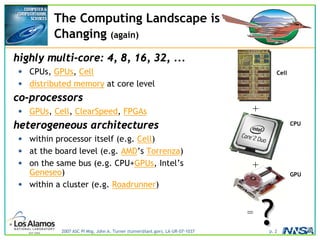
The Computing Landscape is
Changing (again)
highly multi-core: 4, 8, 16, 32, ...
• CPUs, GPUs, Cell
• distributed memory at core level
co-processors
• GPUs, Cell, ClearSpeed, FPGAs
heterogeneous architectures
• within processor itself (e.g. Cell)
• at the board level (e.g. AMD’s Torrenza)
• on the same bus (e.g. CPU+GPUs, Intel’s
Geneseo)
• within a cluster (e.g. Roadrunner)
Cell
+
CPU
+
=
GPU
?
?
2007 ASC PI Mtg, John A. Turner (turner@lanl.gov), LA-UR-07-1037 p. 3
Jan. 2007 IDC Study:
“Next Phase in HPC”
What Will Be The Next Phase in HPC, and Will It
Require New Ways of Looking at HPC Systems?
• key findings:
• individual processor core speeds relatively flat
• bandwidth per socket will grow slowly, but cores per socket
will increase at to Moore’s law (doubling every 18-24 mo.)
– “inverse Moore’s law” for bandwidth per core
• new ways of dealing with parallelism will be required
• must focus more heavily on bandwidth (flow of data) and
less on processor
2007 ASC PI Mtg, John A. Turner (turner@lanl.gov), LA-UR-07-1037 p. 4
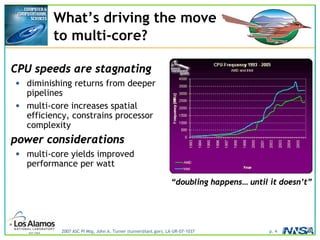
What’s driving the move
to multi-core?
CPU speeds are stagnating
• diminishing returns from deeper
pipelines
• multi-core increases spatial
efficiency, constrains processor
complexity
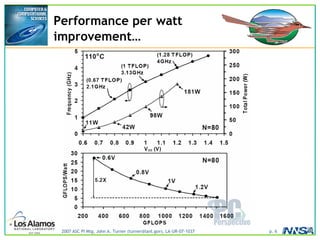
power considerations
• multi-core yields improved
performance per watt
“doubling happens… until it doesn’t”
2007 ASC PI Mtg, John A. Turner (turner@lanl.gov), LA-UR-07-1037 p. 5
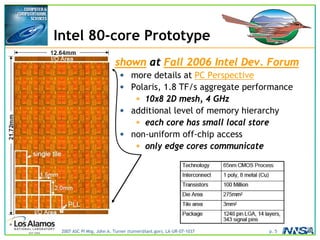
Intel 80-core Prototype
shown at Fall 2006 Intel Dev. Forum
• more details at PC Perspective
• Polaris, 1.8 TF/s aggregate performance
• 10x8 2D mesh, 4 GHz
• additional level of memory hierarchy
• each core has small local store
• non-uniform off-chip access
• only edge cores communicate
NVIDIA G80
Cell Processor
2007 ASC PI Mtg, John A. Turner (turner@lanl.gov), LA-UR-07-1037 p. 6
Performance per watt
improvement…
2007 ASC PI Mtg, John A. Turner (turner@lanl.gov), LA-UR-07-1037 p. 7
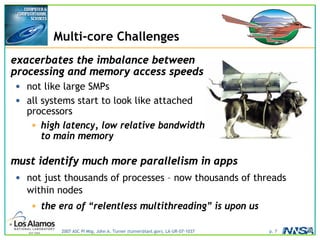
Multi-core Challenges
exacerbates the imbalance between
processing and memory access speeds
• not like large SMPs
• all systems start to look like attached
processors
• high latency, low relative bandwidth
to main memory
must identify much more parallelism in apps
• not just thousands of processes – now thousands of threads
within nodes
• the era of “relentless multithreading” is upon us
2007 ASC PI Mtg, John A. Turner (turner@lanl.gov), LA-UR-07-1037 p. 8
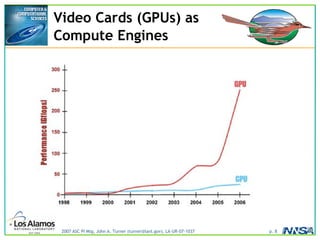
Video Cards (GPUs) as
Compute Engines
2007 ASC PI Mtg, John A. Turner (turner@lanl.gov), LA-UR-07-1037 p. 9
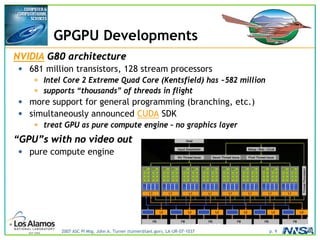
GPGPU Developments
NVIDIA G80 architecture
• 681 million transistors, 128 stream processors
• Intel Core 2 Extreme Quad Core (Kentsfield) has ~582 million
• supports “thousands” of threads in flight
• more support for general programming (branching, etc.)
• simultaneously announced CUDA SDK
• treat GPU as pure compute engine – no graphics layer
Cell Processor NVIDIA G80
“GPU”s with no video out
• pure compute engine
2007 ASC PI Mtg, John A. Turner (turner@lanl.gov), LA-UR-07-1037 p. 10
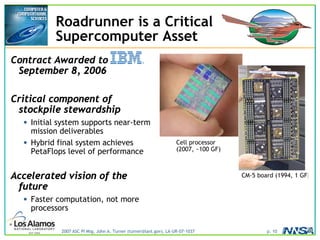
Roadrunner is a Critical
Supercomputer Asset
Contract Awarded to
September 8, 2006
Critical component of
stockpile stewardship
• Initial system supports near-term
mission deliverables
• Hybrid final system achieves
PetaFlops level of performance
Accelerated vision of the
future
• Faster computation, not more
processors
Cell processor
(2007, ~100 GF)
CM-5 board (1994, 1 GF)
2007 ASC PI Mtg, John A. Turner (turner@lanl.gov), LA-UR-07-1037 p. 11
Roadrunner Goals
Provide a large “capacity-mode” computing resource for
LANL weapons simulations
• Purchase in FY2006 and stand up quickly
• Robust HPC architecture with known usability for LANL codes
Possible upgrade to petascale-class hybrid “accelerated”
architecture in a year or two
• Capable of supporting future LANL weapons physics and system design
workloads
• Capable of achieving a sustained PetaFlop
2007 ASC PI Mtg, John A. Turner (turner@lanl.gov), LA-UR-07-1037 p. 12
Roadrunner Phases
Phase 1 (Now)
• Multiple non-accelerated clustered systems Oct. 2006
• Provides a large classified capacity at LANL
• One cluster with 7 Cell-accelerated nodes for development & testing
(Advanced Architecture Initial System — AAIS)
Phase 2: Technology Refresh & Assessment (Summer ’07)
• Improved Cell Blades & Cell software on 6 more nodes of AAIS
• Supports pre-Phase 3 assessment
Phase 3 (FY08)
• Populate entire classified system with Cell Blades
• Achieve a sustained 1 PetaFlop Linpack
• Contract Option
2007 ASC PI Mtg, John A. Turner (turner@lanl.gov), LA-UR-07-1037 p. 13
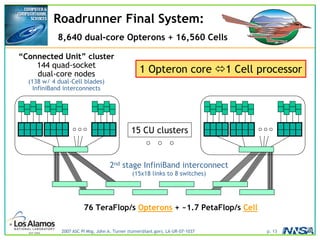
Roadrunner Final System:
8,640 dual-core Opterons + 16,560 Cells
76 TeraFlop/s Opterons + ~1.7 PetaFlop/s Cell
15 CU clusters
“Connected Unit” cluster
144 quad-socket
dual-core nodes
(138 w/ 4 dual-Cell blades)
InfiniBand interconnects
2nd stage InfiniBand interconnect
(15x18 links to 8 switches)
1 Opteron core Ù1 Cell processor
2007 ASC PI Mtg, John A. Turner (turner@lanl.gov), LA-UR-07-1037 p. 14
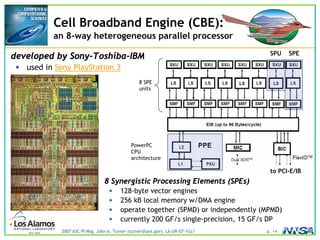
Cell Broadband Engine (CBE):
an 8-way heterogeneous parallel processor
developed by Sony-Toshiba-IBM
• used in Sony PlayStation 3
* Trademark of Sony Computer Entertainment, Inc.
8 Synergistic Processing Elements (SPEs)
• 128-byte vector engines
• 256 kB local memory w/DMA engine
• operate together (SPMD) or independently (MPMD)
• currently 200 GF/s single-precision, 15 GF/s DP
8 SPE
units
PowerPC
CPU
architecture
to PCI-E/IB
SPE
SPU
2007 ASC PI Mtg, John A. Turner (turner@lanl.gov), LA-UR-07-1037 p. 15
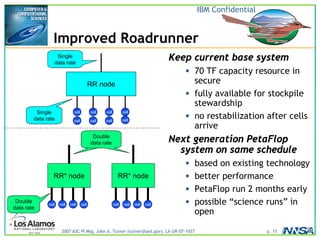
Improved Roadrunner
Keep current base system
• 70 TF capacity resource in
secure
• fully available for stockpile
stewardship
• no restabilization after cells
arrive
Next generation PetaFlop
system on same schedule
• based on existing technology
• better performance
• PetaFlop run 2 months early
• possible “science runs” in
open
RR* node
cell
RR* node
Double
data rate
Double
data rate
Double
data rate
cell cell
cell cell cell cell
cell
RR node
Single
data rate
Single
data rate
cell cell cell cell
cell cell cell cell
IBM Confidential
2007 ASC PI Mtg, John A. Turner (turner@lanl.gov), LA-UR-07-1037 p. 16
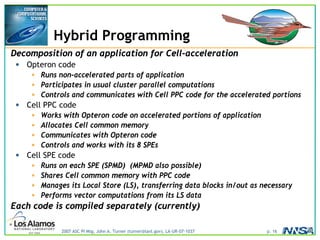
Hybrid Programming
Decomposition of an application for Cell-acceleration
• Opteron code
• Runs non-accelerated parts of application
• Participates in usual cluster parallel computations
• Controls and communicates with Cell PPC code for the accelerated portions
• Cell PPC code
• Works with Opteron code on accelerated portions of application
• Allocates Cell common memory
• Communicates with Opteron code
• Controls and works with its 8 SPEs
• Cell SPE code
• Runs on each SPE (SPMD) (MPMD also possible)
• Shares Cell common memory with PPC code
• Manages its Local Store (LS), transferring data blocks in/out as necessary
• Performs vector computations from its LS data
Each code is compiled separately (currently)
2007 ASC PI Mtg, John A. Turner (turner@lanl.gov), LA-UR-07-1037 p. 17
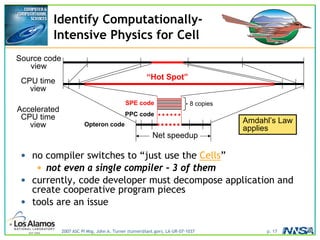
Identify Computationally-
Intensive Physics for Cell
• no compiler switches to “just use the Cells”
• not even a single compiler – 3 of them
• currently, code developer must decompose application and
create cooperative program pieces
• tools are an issue
“Hot Spot”
Source code
view
CPU time
view
Accelerated
CPU time
view
SPE code
PPC code
8 copies
Opteron code
Net speedup
Amdahl’s Law
applies
2007 ASC PI Mtg, John A. Turner (turner@lanl.gov), LA-UR-07-1037 p. 18
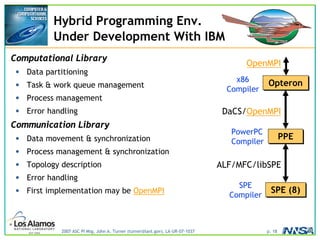
Hybrid Programming Env.
Under Development With IBM
Computational Library
• Data partitioning
• Task & work queue management
• Process management
• Error handling
Communication Library
• Data movement & synchronization
• Process management & synchronization
• Topology description
• Error handling
• First implementation may be OpenMPI
Opteron
Opteron
PPE
PPE
SPE (8)
SPE (8)
DaCS/OpenMPI
ALF/MFC/libSPE
OpenMPI
x86
Compiler
PowerPC
Compiler
SPE
Compiler
2007 ASC PI Mtg, John A. Turner (turner@lanl.gov), LA-UR-07-1037 p. 19
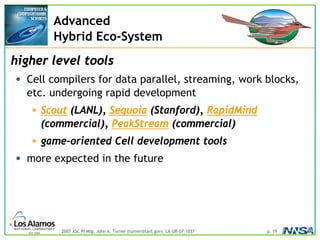
Advanced
Hybrid Eco-System
higher level tools
• Cell compilers for data parallel, streaming, work blocks,
etc. undergoing rapid development
• Scout (LANL), Sequoia (Stanford), RapidMind
(commercial), PeakStream (commercial)
• game-oriented Cell development tools
• more expected in the future
2007 ASC PI Mtg, John A. Turner (turner@lanl.gov), LA-UR-07-1037 p. 20
The bright side…
“Big Iron” sometimes inspires algorithmic advances
• hard for computational physicists to admit…
• Krylov methods as iterative solvers enabled by vector in 70s
• we’d like to think it was a “push” instead of a “pull”, but
• computational physicists often don’t think “outside of the
box” without the lure of a new, bigger, shinier box
Petascale systems will serve as catalyst for next
leap(s) forward
will be as painful as previous architectural shifts
• vector, massively-parallel, cache-based clusters, etc.
2007 ASC PI Mtg, John A. Turner (turner@lanl.gov), LA-UR-07-1037 p. 21
Heterogeneous Manycore
Architectures Are Here
we have been pursuing heterogeneous computing for
several years
• results thus far (GPU, FPGA, Cell) are encouraging
• Roadrunner is simply the first large-scale example
focus on applications of interest
• develop algorithms and tools not just for Roadrunner but
for heterogeneous computing in general
• re-think algorithms rather than simply re-implement
ultimate goal is improved simulation capabilities
• maybe “better” rather than simply “faster”
2007 ASC PI Mtg, John A. Turner (turner@lanl.gov), LA-UR-07-1037 p. 22
Dealing with the Processor /
Bandwidth Imbalance
“better, not just faster”
• high-order methods
• more computation per word of memory moved
• more accurate answer in less elapsed time
• more rigorous multiscale treatments
• e.g. simultaneous subgrid simulations
• integrated uncertainty quantification / sensitivity analysis
• ensemble calculations
• compute set of values / cells / particles
• rather than compute properties a priori, store in tables, and interpolate,
compute on-the-fly
• coupled physics: rigorous nonlinear consistency
• different problem decompositions
long-term, must (re-)design algorithms for memory
locality and latency tolerance
2007 ASC PI Mtg, John A. Turner (turner@lanl.gov), LA-UR-07-1037 p. 23
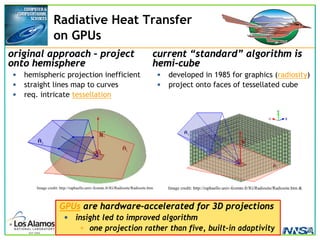
Radiative Heat Transfer
on GPUs
original approach – project
onto hemisphere
• hemispheric projection inefficient
• straight lines map to curves
• req. intricate tessellation
current “standard” algorithm is
hemi-cube
• developed in 1985 for graphics (radiosity)
• project onto faces of tessellated cube
Image credit: http://raphaello.univ-fcomte.fr/IG/Radiosite/Radiosite.htm &
Image credit: http://raphaello.univ-fcomte.fr/IG/Radiosite/Radiosite.htm
GPUs are hardware-accelerated for 3D projections
• insight led to improved algorithm
• one projection rather than five, built-in adaptivity
2007 ASC PI Mtg, John A. Turner (turner@lanl.gov), LA-UR-07-1037 p. 24
Radiative Heat Transfer
on GPU
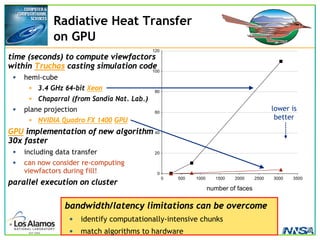
time (seconds) to compute viewfactors
within Truchas casting simulation code
• hemi-cube
• 3.4 GHz 64-bit Xeon
• Chaparral (from Sandia Nat. Lab.)
• plane projection
• NVIDIA Quadro FX 1400 GPU
GPU implementation of new algorithm
30x faster
• including data transfer
• can now consider re-computing
viewfactors during fill!
parallel execution on cluster
0
20
40
60
80
100
120
0 500 1000 1500 2000 2500 3000 3500
number of faces
bandwidth/latency limitations can be overcome
• identify computationally-intensive chunks
• match algorithms to hardware
lower is
better
2007 ASC PI Mtg, John A. Turner (turner@lanl.gov), LA-UR-07-1037 p. 25
Roadrunner Advanced
Algorithms & Assessment Team
continuation of “swat team” effort initiated in Spring 2006
• gain early experience with Cell
• focus on apps of interest to ASC
• inform Roadrunner architecture decisions
two primary goals for FY07
• develop predictive models for LINPACK performance on final system
• follow-on to performance modeling efforts for Q, etc.
• track IBM’s LINPACK implementation
• develop advanced Cell/hybrid algorithms
• assess potential performance of applications on final system
• prepare for accelerated science apps in FY08, and later for multi-physics
applications
2007 ASC PI Mtg, John A. Turner (turner@lanl.gov), LA-UR-07-1037 p. 26
Initial Cell Results are
Encouraging
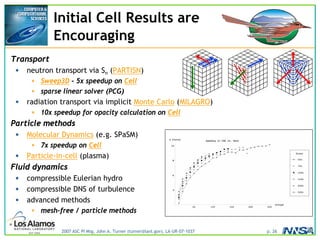
Transport
• neutron transport via Sn (PARTISN)
• Sweep3D – 5x speedup on Cell
• sparse linear solver (PCG)
• radiation transport via implicit Monte Carlo (MILAGRO)
• 10x speedup for opacity calculation on Cell
Particle methods
• Molecular Dynamics (e.g. SPaSM)
• 7x speedup on Cell
• Particle-in-cell (plasma)
Fluid dynamics
• compressible Eulerian hydro
• compressible DNS of turbulence
• advanced methods
• mesh-free / particle methods
2007 ASC PI Mtg, John A. Turner (turner@lanl.gov), LA-UR-07-1037 p. 27
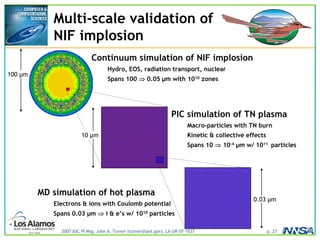
Continuum simulation of NIF implosion
Hydro, EOS, radiation transport, nuclear
Spans 100 ⇒ 0.05 µm with 1010 zones
PIC simulation of TN plasma
Macro-particles with TN burn
Kinetic & collective effects
Spans 10 ⇒ 10-4 µm w/ 1011 particles
MD simulation of hot plasma
Electrons & ions with Coulomb potential
Spans 0.03 µm ⇒ i & e’s w/ 1010 particles
Multi-scale validation of
NIF implosion
100 µm
10 µm
0.03 µm
2007 ASC PI Mtg, John A. Turner (turner@lanl.gov), LA-UR-07-1037 p. 28
Roadrunner Represents
the Future of Computing
View initial RR design as simply “rev. 0” of large-
scale many-core hybrid computing.
• rev. 1 – processors on boards in PCI-E slots
• rev. 2 – processors directly on motherboards
• rev. 3 – different processors on die
• …
Develop algorithms and software tools for many-core
heterogeneous computing – not just RR.

Roadrunner: Heterogeneous Petascale Computing for Predictive Simulation

  • 1.
    Roadrunner: Heterogeneous Petascale Computingfor Predictive Simulation (Los Alamos Unclassified Report LA-UR-07-1037) Advanced Simulation & Computing (ASC) 2007 Principal Investigator’s Meeting Las Vegas, NV (2/20-22/2007) John A. Turner Group Leader, Computational Physics and Methods Group (CCS-2) Computer, Computational, and Statistical Sciences Division (CCS) turner@lanl.gov
  • 2.
    2007 ASC PIMtg, John A. Turner (turner@lanl.gov), LA-UR-07-1037 p. 2 The Computing Landscape is Changing (again) highly multi-core: 4, 8, 16, 32, ... • CPUs, GPUs, Cell • distributed memory at core level co-processors • GPUs, Cell, ClearSpeed, FPGAs heterogeneous architectures • within processor itself (e.g. Cell) • at the board level (e.g. AMD’s Torrenza) • on the same bus (e.g. CPU+GPUs, Intel’s Geneseo) • within a cluster (e.g. Roadrunner) Cell + CPU + = GPU ? ?
  • 3.
    2007 ASC PIMtg, John A. Turner (turner@lanl.gov), LA-UR-07-1037 p. 3 Jan. 2007 IDC Study: “Next Phase in HPC” What Will Be The Next Phase in HPC, and Will It Require New Ways of Looking at HPC Systems? • key findings: • individual processor core speeds relatively flat • bandwidth per socket will grow slowly, but cores per socket will increase at to Moore’s law (doubling every 18-24 mo.) – “inverse Moore’s law” for bandwidth per core • new ways of dealing with parallelism will be required • must focus more heavily on bandwidth (flow of data) and less on processor
  • 4.
    2007 ASC PIMtg, John A. Turner (turner@lanl.gov), LA-UR-07-1037 p. 4 What’s driving the move to multi-core? CPU speeds are stagnating • diminishing returns from deeper pipelines • multi-core increases spatial efficiency, constrains processor complexity power considerations • multi-core yields improved performance per watt “doubling happens… until it doesn’t”
  • 5.
    2007 ASC PIMtg, John A. Turner (turner@lanl.gov), LA-UR-07-1037 p. 5 Intel 80-core Prototype shown at Fall 2006 Intel Dev. Forum • more details at PC Perspective • Polaris, 1.8 TF/s aggregate performance • 10x8 2D mesh, 4 GHz • additional level of memory hierarchy • each core has small local store • non-uniform off-chip access • only edge cores communicate NVIDIA G80 Cell Processor
  • 6.
    2007 ASC PIMtg, John A. Turner (turner@lanl.gov), LA-UR-07-1037 p. 6 Performance per watt improvement…
  • 7.
    2007 ASC PIMtg, John A. Turner (turner@lanl.gov), LA-UR-07-1037 p. 7 Multi-core Challenges exacerbates the imbalance between processing and memory access speeds • not like large SMPs • all systems start to look like attached processors • high latency, low relative bandwidth to main memory must identify much more parallelism in apps • not just thousands of processes – now thousands of threads within nodes • the era of “relentless multithreading” is upon us
  • 8.
    2007 ASC PIMtg, John A. Turner (turner@lanl.gov), LA-UR-07-1037 p. 8 Video Cards (GPUs) as Compute Engines
  • 9.
    2007 ASC PIMtg, John A. Turner (turner@lanl.gov), LA-UR-07-1037 p. 9 GPGPU Developments NVIDIA G80 architecture • 681 million transistors, 128 stream processors • Intel Core 2 Extreme Quad Core (Kentsfield) has ~582 million • supports “thousands” of threads in flight • more support for general programming (branching, etc.) • simultaneously announced CUDA SDK • treat GPU as pure compute engine – no graphics layer Cell Processor NVIDIA G80 “GPU”s with no video out • pure compute engine
  • 10.
    2007 ASC PIMtg, John A. Turner (turner@lanl.gov), LA-UR-07-1037 p. 10 Roadrunner is a Critical Supercomputer Asset Contract Awarded to September 8, 2006 Critical component of stockpile stewardship • Initial system supports near-term mission deliverables • Hybrid final system achieves PetaFlops level of performance Accelerated vision of the future • Faster computation, not more processors Cell processor (2007, ~100 GF) CM-5 board (1994, 1 GF)
  • 11.
    2007 ASC PIMtg, John A. Turner (turner@lanl.gov), LA-UR-07-1037 p. 11 Roadrunner Goals Provide a large “capacity-mode” computing resource for LANL weapons simulations • Purchase in FY2006 and stand up quickly • Robust HPC architecture with known usability for LANL codes Possible upgrade to petascale-class hybrid “accelerated” architecture in a year or two • Capable of supporting future LANL weapons physics and system design workloads • Capable of achieving a sustained PetaFlop
  • 12.
    2007 ASC PIMtg, John A. Turner (turner@lanl.gov), LA-UR-07-1037 p. 12 Roadrunner Phases Phase 1 (Now) • Multiple non-accelerated clustered systems Oct. 2006 • Provides a large classified capacity at LANL • One cluster with 7 Cell-accelerated nodes for development & testing (Advanced Architecture Initial System — AAIS) Phase 2: Technology Refresh & Assessment (Summer ’07) • Improved Cell Blades & Cell software on 6 more nodes of AAIS • Supports pre-Phase 3 assessment Phase 3 (FY08) • Populate entire classified system with Cell Blades • Achieve a sustained 1 PetaFlop Linpack • Contract Option
  • 13.
    2007 ASC PIMtg, John A. Turner (turner@lanl.gov), LA-UR-07-1037 p. 13 Roadrunner Final System: 8,640 dual-core Opterons + 16,560 Cells 76 TeraFlop/s Opterons + ~1.7 PetaFlop/s Cell 15 CU clusters “Connected Unit” cluster 144 quad-socket dual-core nodes (138 w/ 4 dual-Cell blades) InfiniBand interconnects 2nd stage InfiniBand interconnect (15x18 links to 8 switches) 1 Opteron core Ù1 Cell processor
  • 14.
    2007 ASC PIMtg, John A. Turner (turner@lanl.gov), LA-UR-07-1037 p. 14 Cell Broadband Engine (CBE): an 8-way heterogeneous parallel processor developed by Sony-Toshiba-IBM • used in Sony PlayStation 3 * Trademark of Sony Computer Entertainment, Inc. 8 Synergistic Processing Elements (SPEs) • 128-byte vector engines • 256 kB local memory w/DMA engine • operate together (SPMD) or independently (MPMD) • currently 200 GF/s single-precision, 15 GF/s DP 8 SPE units PowerPC CPU architecture to PCI-E/IB SPE SPU
  • 15.
    2007 ASC PIMtg, John A. Turner (turner@lanl.gov), LA-UR-07-1037 p. 15 Improved Roadrunner Keep current base system • 70 TF capacity resource in secure • fully available for stockpile stewardship • no restabilization after cells arrive Next generation PetaFlop system on same schedule • based on existing technology • better performance • PetaFlop run 2 months early • possible “science runs” in open RR* node cell RR* node Double data rate Double data rate Double data rate cell cell cell cell cell cell cell RR node Single data rate Single data rate cell cell cell cell cell cell cell cell IBM Confidential
  • 16.
    2007 ASC PIMtg, John A. Turner (turner@lanl.gov), LA-UR-07-1037 p. 16 Hybrid Programming Decomposition of an application for Cell-acceleration • Opteron code • Runs non-accelerated parts of application • Participates in usual cluster parallel computations • Controls and communicates with Cell PPC code for the accelerated portions • Cell PPC code • Works with Opteron code on accelerated portions of application • Allocates Cell common memory • Communicates with Opteron code • Controls and works with its 8 SPEs • Cell SPE code • Runs on each SPE (SPMD) (MPMD also possible) • Shares Cell common memory with PPC code • Manages its Local Store (LS), transferring data blocks in/out as necessary • Performs vector computations from its LS data Each code is compiled separately (currently)
  • 17.
    2007 ASC PIMtg, John A. Turner (turner@lanl.gov), LA-UR-07-1037 p. 17 Identify Computationally- Intensive Physics for Cell • no compiler switches to “just use the Cells” • not even a single compiler – 3 of them • currently, code developer must decompose application and create cooperative program pieces • tools are an issue “Hot Spot” Source code view CPU time view Accelerated CPU time view SPE code PPC code 8 copies Opteron code Net speedup Amdahl’s Law applies
  • 18.
    2007 ASC PIMtg, John A. Turner (turner@lanl.gov), LA-UR-07-1037 p. 18 Hybrid Programming Env. Under Development With IBM Computational Library • Data partitioning • Task & work queue management • Process management • Error handling Communication Library • Data movement & synchronization • Process management & synchronization • Topology description • Error handling • First implementation may be OpenMPI Opteron Opteron PPE PPE SPE (8) SPE (8) DaCS/OpenMPI ALF/MFC/libSPE OpenMPI x86 Compiler PowerPC Compiler SPE Compiler
  • 19.
    2007 ASC PIMtg, John A. Turner (turner@lanl.gov), LA-UR-07-1037 p. 19 Advanced Hybrid Eco-System higher level tools • Cell compilers for data parallel, streaming, work blocks, etc. undergoing rapid development • Scout (LANL), Sequoia (Stanford), RapidMind (commercial), PeakStream (commercial) • game-oriented Cell development tools • more expected in the future
  • 20.
    2007 ASC PIMtg, John A. Turner (turner@lanl.gov), LA-UR-07-1037 p. 20 The bright side… “Big Iron” sometimes inspires algorithmic advances • hard for computational physicists to admit… • Krylov methods as iterative solvers enabled by vector in 70s • we’d like to think it was a “push” instead of a “pull”, but • computational physicists often don’t think “outside of the box” without the lure of a new, bigger, shinier box Petascale systems will serve as catalyst for next leap(s) forward will be as painful as previous architectural shifts • vector, massively-parallel, cache-based clusters, etc.
  • 21.
    2007 ASC PIMtg, John A. Turner (turner@lanl.gov), LA-UR-07-1037 p. 21 Heterogeneous Manycore Architectures Are Here we have been pursuing heterogeneous computing for several years • results thus far (GPU, FPGA, Cell) are encouraging • Roadrunner is simply the first large-scale example focus on applications of interest • develop algorithms and tools not just for Roadrunner but for heterogeneous computing in general • re-think algorithms rather than simply re-implement ultimate goal is improved simulation capabilities • maybe “better” rather than simply “faster”
  • 22.
    2007 ASC PIMtg, John A. Turner (turner@lanl.gov), LA-UR-07-1037 p. 22 Dealing with the Processor / Bandwidth Imbalance “better, not just faster” • high-order methods • more computation per word of memory moved • more accurate answer in less elapsed time • more rigorous multiscale treatments • e.g. simultaneous subgrid simulations • integrated uncertainty quantification / sensitivity analysis • ensemble calculations • compute set of values / cells / particles • rather than compute properties a priori, store in tables, and interpolate, compute on-the-fly • coupled physics: rigorous nonlinear consistency • different problem decompositions long-term, must (re-)design algorithms for memory locality and latency tolerance
  • 23.
    2007 ASC PIMtg, John A. Turner (turner@lanl.gov), LA-UR-07-1037 p. 23 Radiative Heat Transfer on GPUs original approach – project onto hemisphere • hemispheric projection inefficient • straight lines map to curves • req. intricate tessellation current “standard” algorithm is hemi-cube • developed in 1985 for graphics (radiosity) • project onto faces of tessellated cube Image credit: http://raphaello.univ-fcomte.fr/IG/Radiosite/Radiosite.htm & Image credit: http://raphaello.univ-fcomte.fr/IG/Radiosite/Radiosite.htm GPUs are hardware-accelerated for 3D projections • insight led to improved algorithm • one projection rather than five, built-in adaptivity
  • 24.
    2007 ASC PIMtg, John A. Turner (turner@lanl.gov), LA-UR-07-1037 p. 24 Radiative Heat Transfer on GPU time (seconds) to compute viewfactors within Truchas casting simulation code • hemi-cube • 3.4 GHz 64-bit Xeon • Chaparral (from Sandia Nat. Lab.) • plane projection • NVIDIA Quadro FX 1400 GPU GPU implementation of new algorithm 30x faster • including data transfer • can now consider re-computing viewfactors during fill! parallel execution on cluster 0 20 40 60 80 100 120 0 500 1000 1500 2000 2500 3000 3500 number of faces bandwidth/latency limitations can be overcome • identify computationally-intensive chunks • match algorithms to hardware lower is better
  • 25.
    2007 ASC PIMtg, John A. Turner (turner@lanl.gov), LA-UR-07-1037 p. 25 Roadrunner Advanced Algorithms & Assessment Team continuation of “swat team” effort initiated in Spring 2006 • gain early experience with Cell • focus on apps of interest to ASC • inform Roadrunner architecture decisions two primary goals for FY07 • develop predictive models for LINPACK performance on final system • follow-on to performance modeling efforts for Q, etc. • track IBM’s LINPACK implementation • develop advanced Cell/hybrid algorithms • assess potential performance of applications on final system • prepare for accelerated science apps in FY08, and later for multi-physics applications
  • 26.
    2007 ASC PIMtg, John A. Turner (turner@lanl.gov), LA-UR-07-1037 p. 26 Initial Cell Results are Encouraging Transport • neutron transport via Sn (PARTISN) • Sweep3D – 5x speedup on Cell • sparse linear solver (PCG) • radiation transport via implicit Monte Carlo (MILAGRO) • 10x speedup for opacity calculation on Cell Particle methods • Molecular Dynamics (e.g. SPaSM) • 7x speedup on Cell • Particle-in-cell (plasma) Fluid dynamics • compressible Eulerian hydro • compressible DNS of turbulence • advanced methods • mesh-free / particle methods
  • 27.
    2007 ASC PIMtg, John A. Turner (turner@lanl.gov), LA-UR-07-1037 p. 27 Continuum simulation of NIF implosion Hydro, EOS, radiation transport, nuclear Spans 100 ⇒ 0.05 µm with 1010 zones PIC simulation of TN plasma Macro-particles with TN burn Kinetic & collective effects Spans 10 ⇒ 10-4 µm w/ 1011 particles MD simulation of hot plasma Electrons & ions with Coulomb potential Spans 0.03 µm ⇒ i & e’s w/ 1010 particles Multi-scale validation of NIF implosion 100 µm 10 µm 0.03 µm
  • 28.
    2007 ASC PIMtg, John A. Turner (turner@lanl.gov), LA-UR-07-1037 p. 28 Roadrunner Represents the Future of Computing View initial RR design as simply “rev. 0” of large- scale many-core hybrid computing. • rev. 1 – processors on boards in PCI-E slots • rev. 2 – processors directly on motherboards • rev. 3 – different processors on die • … Develop algorithms and software tools for many-core heterogeneous computing – not just RR.