Introduction to Software
--- Operating Sytem---
Contents
Summary
Type of Operating System
Operating System Concept
Hystory of Operating System
Operating System
Operating System
What is operating system??
The operating system is the systems
program or software that makes the
hardware usable
Operating System
What is the role of operating
system ?
To manage all the pieces of the
complex system;
Operating System
Processor & MemoryInput Output
Operating System
Operating System
Application System
Application System
How Can Operating System
Manage all the pieces of complex
system.
By a set of instruction code
Operating System
Machine
Code
Assembly
Language
High Level
Programming
Language
Operating System
Assembler
Translator
Compiler &
Interpreter
Could you list some common
commercial or free Operating
System?
Windows : OS yang banyak dipuja dan juga dicaci
Mac OS : OS Standar bagi Graphic Designer
Unix : Database Professional
BeOS: Sistem Operasi Multimedia
OS/2 Warp: Server Bisnis yang Mahal
JavaOS: tak tergantung platform
FreeBSD dan NetBSD: Favorit ISP
Linux: Sistem Operasi untuk Semua
Operating System
What are the function of
operating system?
File management
Memory management
Processor management
Operating System
File Management
Files can contain three types of
information:
• Documents
• Programs
• Data
Operating System
Memory Management
To be executed, first they must be
loaded from disk into main memory;
The files are physically scattered over
the surface of the disk
Operating System
Processor Management
The operating system provides the
user with a way to manipulate the files
on the disk. Some typical operating
system commands include
• List the names of the files from the
directory.
• Delete a file from the disk.
• Change the name of a file.
• Print the contents of a file.
• Execute an applications program.
Operating System
12
Hystory of OS
Operating systems have been
evolving through the years.
Below are the timelines of OS
evolution.
The First Generation (1945-55) Vaccum
Tube;
The Second Generation (1955-65)
Transistors and Batch Systems;
The Third Generation (1965-80) ICs and
Multiprogramming;
The Fourth Generation (1980-present)
Personal Computers.
13
Hystory of OS
The First Generation (1945-55)
Vaccuum Tube.
Computer was very primitive;
There is no programming language;
Operating systems were unheard of;
It takes time ti process the data, even the
simplest calculation.
14
Hystory of OS
The Second Generation (1955-
65) Transistors and Batch
Systems.
The introduction of transistor in mid 1950s
changed the picture of computer;
Mainframes computer was founded;
FORTRAN and assembler was introduced;
Program can be write on punch card;
15
Hystory of OS
The Second Generation (1955-
65) Transistors and Batch
Systems.
16
Hystory of OS
The Third Generation (1965-80)
ICs and Multiprogramming;
The Fourth Generation.
Computer manufacturers had two distinct
of computer, (1) scientific computer, and
(2) commercial computer. Two of this was
not compatible each other.
Memory partition was introduced by IBM;
SPOOL (Simultaneous Peripheral
Operation On Line) Technique for output
was introduced
17
Hystory of OS
The Fourth Generation (1980-
present) Personal Computers.
Large scale of invention on circuits, chips
containing thousands of transistors on a
square centimeter of silicon have brought
a dramatic change on computer. In terms
of architecture, it is called
microcomputers);
Intel came out with 8080 CPU;
In 1980, IBM designed PC and looked
around for software to run it, and Bill Gates
offered DOS/BASIC package to IBM.
18
Type of Operating System
The Operating System Zoo.
Mainframe Operating Systems;
Server Operating Systems;
Multiprocessor Operating Systems;
Personal Computer Operating Systems;
Handheld Computer Operating Systems;
Embedded Operating Systems;
Sensor Node Operating Systems;
Real Time Operating Systems;
Smart Card Operating Systems.
19
Operating Systems Concept
Basic Concept of Operating
Systems.
Process;
Address Spaces;
Files;
Input/Output;
Protection;
The Shell.
20
Operating Systems Concept
Process Creation
System Initialization;
Execution of a process creation system
call by running process;
User request to create new process;
Initiation of a batch job.
21
Operating Systems Concept
Process Termination
Normal Exit (voluntary)
Error Exit (voluntary)
Fatal Error (involuntary)
Killed by another process (involuntary)
22
Operating Systems Concept
Address Spaces
Save the program into memory;
Memory uses to executing program;
23
Operating Systems Concept
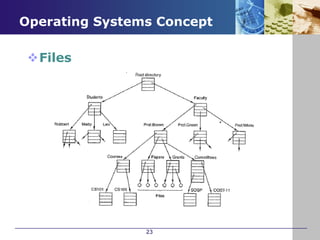
Files
24
Operating Systems Concept
Input/Output
Operating System has Input/Output system
to manage I/O Devices;
25
Operating Systems Concept
Protection
Encryption and Decryption to Protect the
data in the computer.
26
Operating Systems Concept
The Shell
The code that carries out the system calls
C l i c k t o e d i t c o m p a n y s l o g a n .

Introduction to software 2

  • 1.
    Introduction to Software ---Operating Sytem---
  • 2.
    Contents Summary Type of OperatingSystem Operating System Concept Hystory of Operating System Operating System
  • 3.
    Operating System What isoperating system?? The operating system is the systems program or software that makes the hardware usable
  • 4.
    Operating System What isthe role of operating system ? To manage all the pieces of the complex system;
  • 5.
    Operating System Processor &MemoryInput Output Operating System Operating System Application System Application System
  • 6.
    How Can OperatingSystem Manage all the pieces of complex system. By a set of instruction code Operating System Machine Code Assembly Language High Level Programming Language Operating System Assembler Translator Compiler & Interpreter
  • 7.
    Could you listsome common commercial or free Operating System? Windows : OS yang banyak dipuja dan juga dicaci Mac OS : OS Standar bagi Graphic Designer Unix : Database Professional BeOS: Sistem Operasi Multimedia OS/2 Warp: Server Bisnis yang Mahal JavaOS: tak tergantung platform FreeBSD dan NetBSD: Favorit ISP Linux: Sistem Operasi untuk Semua Operating System
  • 8.
    What are thefunction of operating system? File management Memory management Processor management Operating System
  • 9.
    File Management Files cancontain three types of information: • Documents • Programs • Data Operating System
  • 10.
    Memory Management To beexecuted, first they must be loaded from disk into main memory; The files are physically scattered over the surface of the disk Operating System
  • 11.
    Processor Management The operatingsystem provides the user with a way to manipulate the files on the disk. Some typical operating system commands include • List the names of the files from the directory. • Delete a file from the disk. • Change the name of a file. • Print the contents of a file. • Execute an applications program. Operating System
  • 12.
    12 Hystory of OS Operatingsystems have been evolving through the years. Below are the timelines of OS evolution. The First Generation (1945-55) Vaccum Tube; The Second Generation (1955-65) Transistors and Batch Systems; The Third Generation (1965-80) ICs and Multiprogramming; The Fourth Generation (1980-present) Personal Computers.
  • 13.
    13 Hystory of OS TheFirst Generation (1945-55) Vaccuum Tube. Computer was very primitive; There is no programming language; Operating systems were unheard of; It takes time ti process the data, even the simplest calculation.
  • 14.
    14 Hystory of OS TheSecond Generation (1955- 65) Transistors and Batch Systems. The introduction of transistor in mid 1950s changed the picture of computer; Mainframes computer was founded; FORTRAN and assembler was introduced; Program can be write on punch card;
  • 15.
    15 Hystory of OS TheSecond Generation (1955- 65) Transistors and Batch Systems.
  • 16.
    16 Hystory of OS TheThird Generation (1965-80) ICs and Multiprogramming; The Fourth Generation. Computer manufacturers had two distinct of computer, (1) scientific computer, and (2) commercial computer. Two of this was not compatible each other. Memory partition was introduced by IBM; SPOOL (Simultaneous Peripheral Operation On Line) Technique for output was introduced
  • 17.
    17 Hystory of OS TheFourth Generation (1980- present) Personal Computers. Large scale of invention on circuits, chips containing thousands of transistors on a square centimeter of silicon have brought a dramatic change on computer. In terms of architecture, it is called microcomputers); Intel came out with 8080 CPU; In 1980, IBM designed PC and looked around for software to run it, and Bill Gates offered DOS/BASIC package to IBM.
  • 18.
    18 Type of OperatingSystem The Operating System Zoo. Mainframe Operating Systems; Server Operating Systems; Multiprocessor Operating Systems; Personal Computer Operating Systems; Handheld Computer Operating Systems; Embedded Operating Systems; Sensor Node Operating Systems; Real Time Operating Systems; Smart Card Operating Systems.
  • 19.
    19 Operating Systems Concept BasicConcept of Operating Systems. Process; Address Spaces; Files; Input/Output; Protection; The Shell.
  • 20.
    20 Operating Systems Concept ProcessCreation System Initialization; Execution of a process creation system call by running process; User request to create new process; Initiation of a batch job.
  • 21.
    21 Operating Systems Concept ProcessTermination Normal Exit (voluntary) Error Exit (voluntary) Fatal Error (involuntary) Killed by another process (involuntary)
  • 22.
    22 Operating Systems Concept AddressSpaces Save the program into memory; Memory uses to executing program;
  • 23.
  • 24.
    24 Operating Systems Concept Input/Output OperatingSystem has Input/Output system to manage I/O Devices;
  • 25.
    25 Operating Systems Concept Protection Encryptionand Decryption to Protect the data in the computer.
  • 26.
    26 Operating Systems Concept TheShell The code that carries out the system calls
  • 27.
    C l ic k t o e d i t c o m p a n y s l o g a n .