Introduction to RFID
Auto-ID Technologies Biometric Systems Smart  Cards RFID Optical Character Recognition (OCR) Barcode Systems Auto-ID
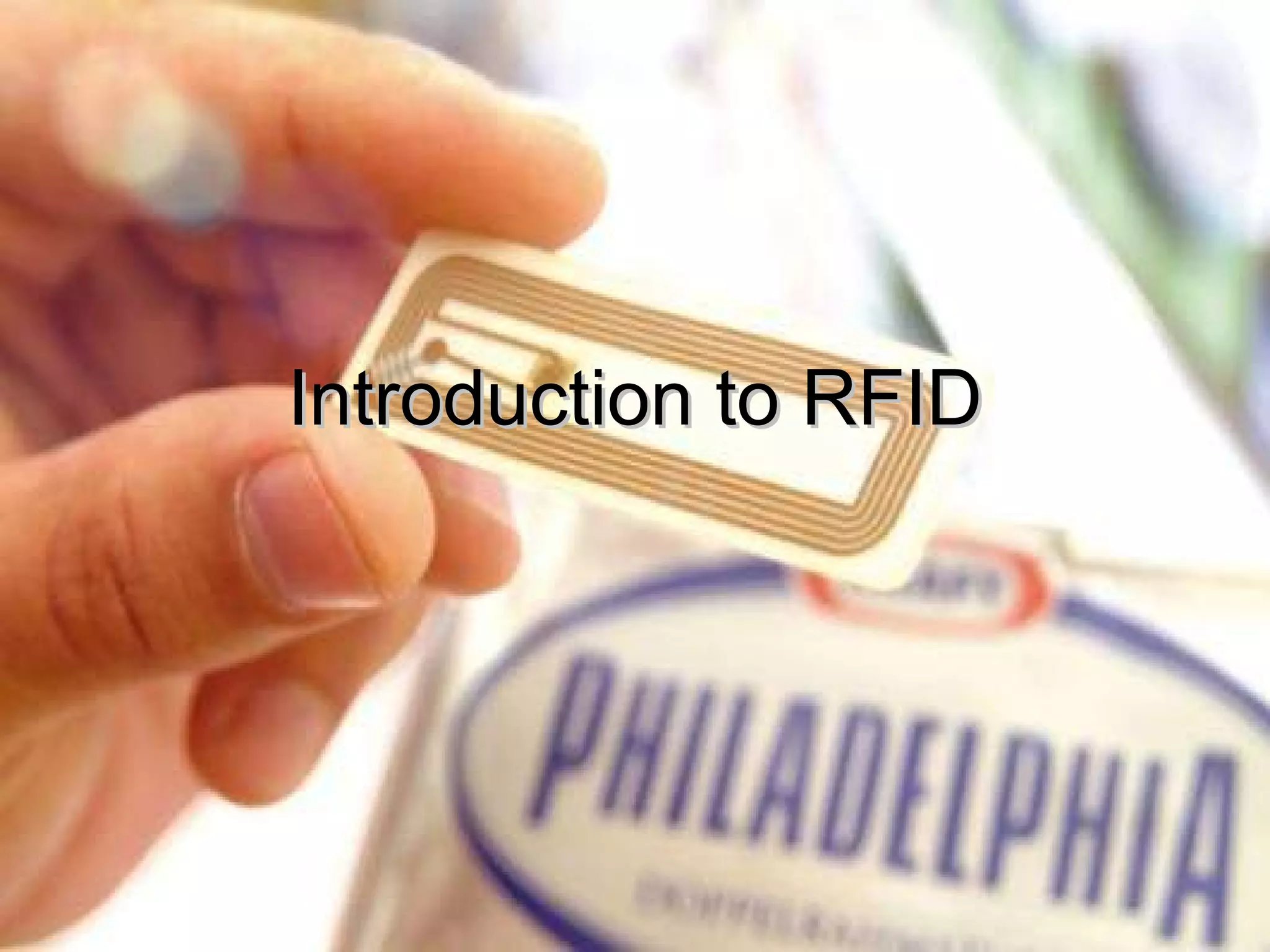
Definition RFID (Radio Frequency Identification) is a technology that enables the electronic and wireless labeling and identification of objects, humans and animals
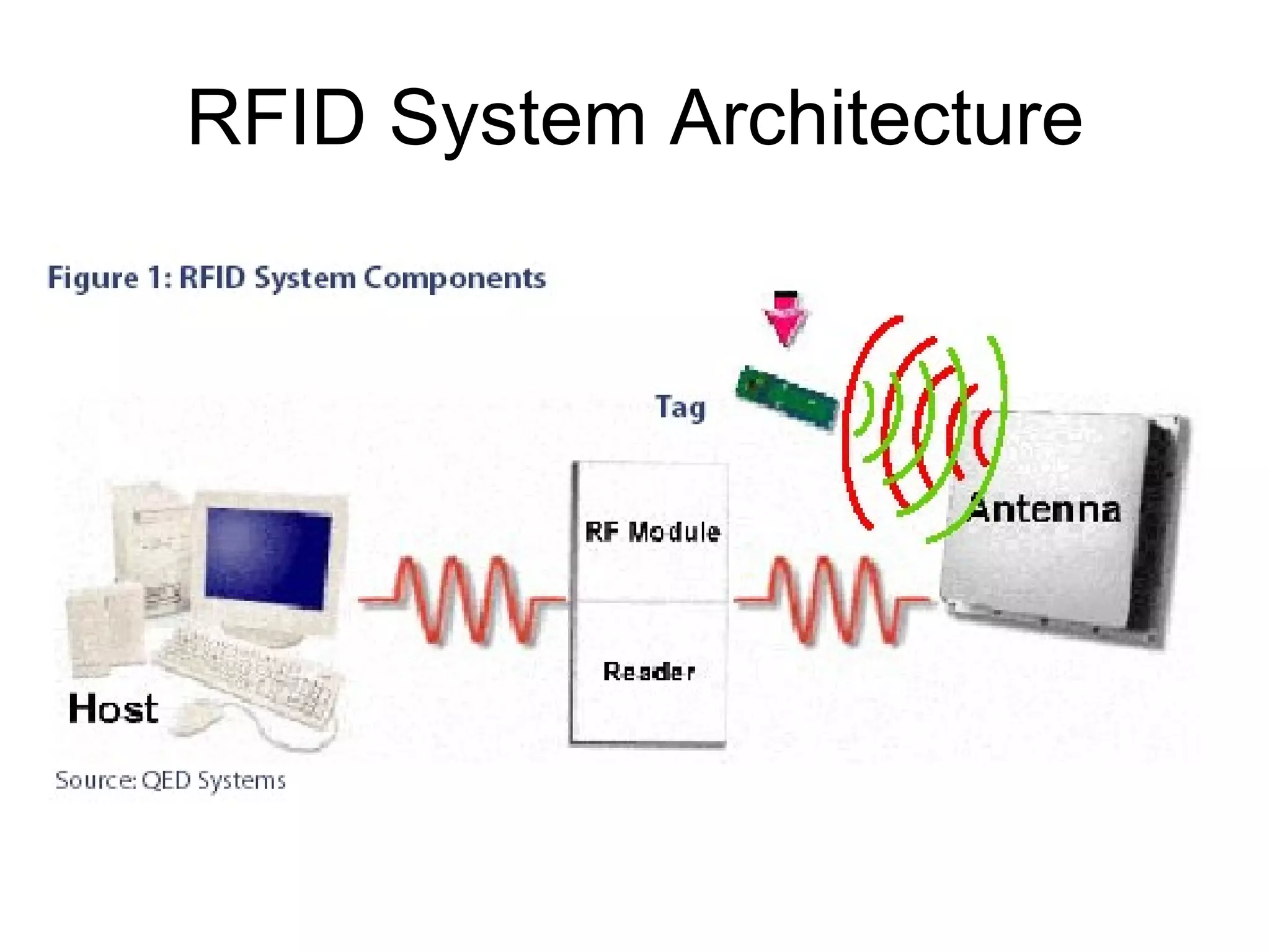
RFID Principal System Components Tag (Transponder) Chip Antenna Reader (Interrogator) RF Module (Transmitter and Receiver) Control Unit Antenna Several Interfaces (RS 232, RS 485, etc.) Host Computer Middleware
RFID System Architecture
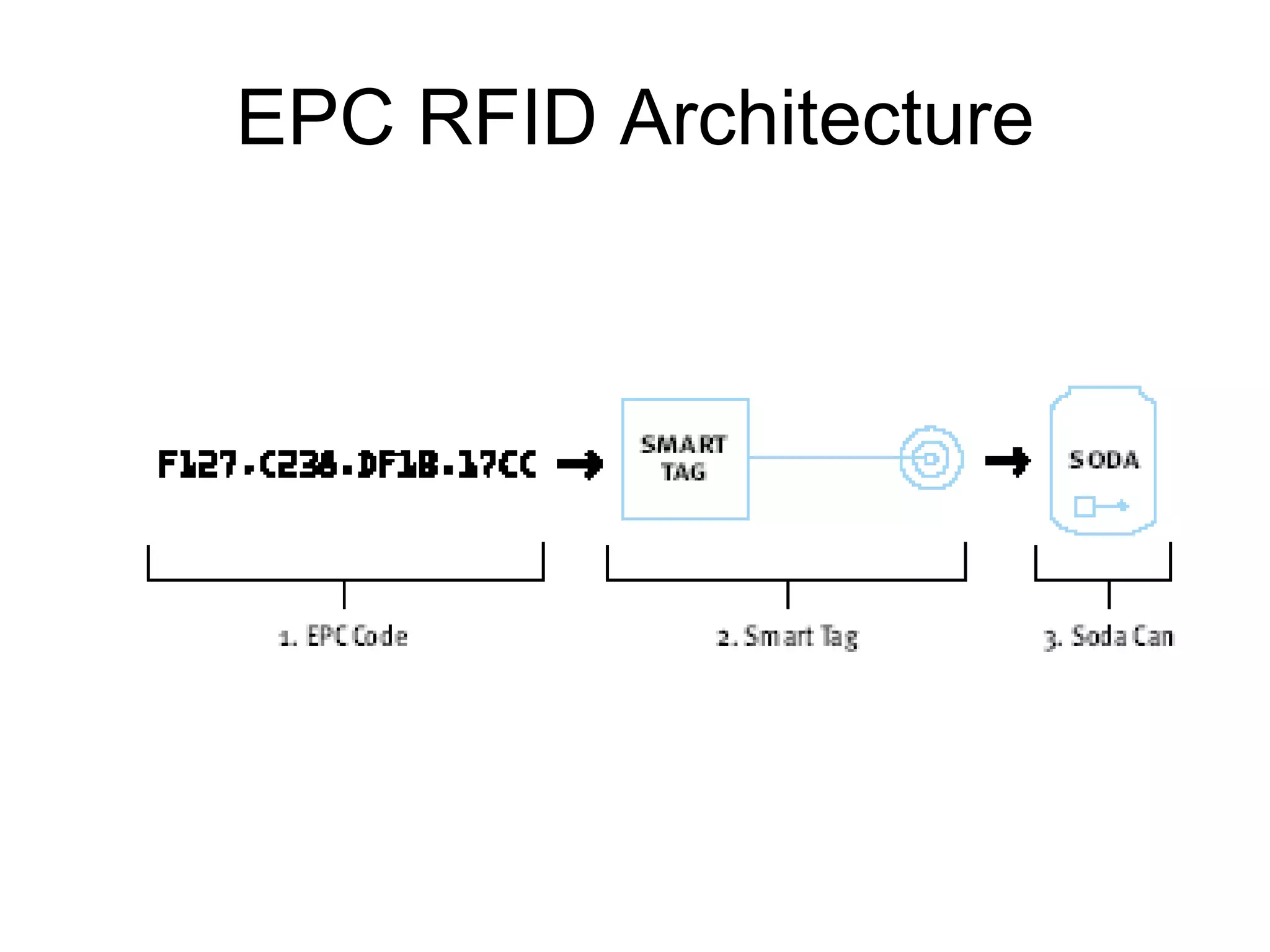
EPC RFID Architecture
EPC RFID System Architecture
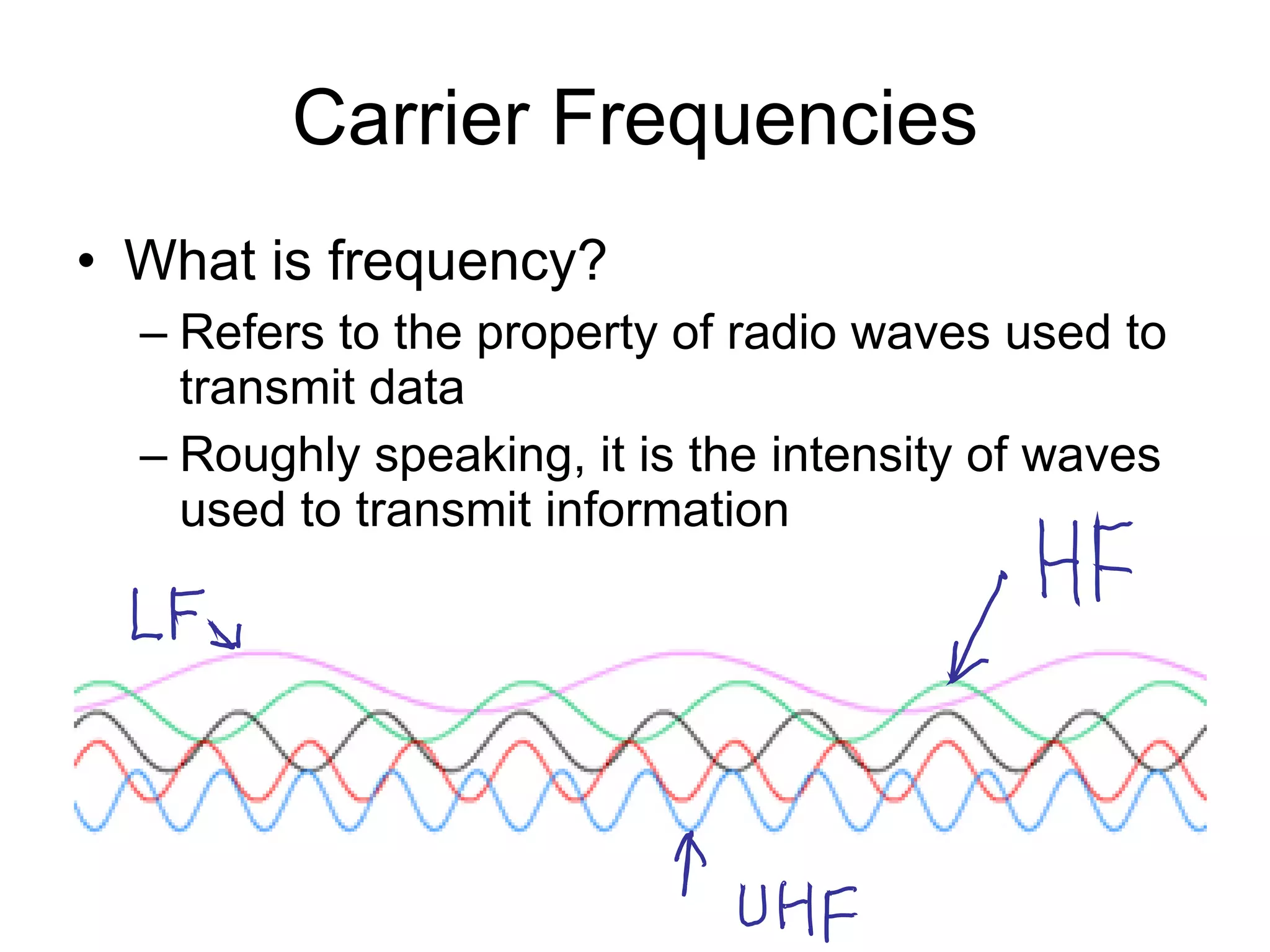
Carrier Frequencies What is frequency? Refers to the property of radio waves used to transmit data Roughly speaking, it is the intensity of waves used to transmit information
Carrier Frequency RFID systems may use a particular frequency band depending on: Application Legislature Cost considerations
Frequency Bands Frequency Band Characteristics Typical Applications Low 100-500 kHz Short to medium read range, inexpensive, low reading speed Access control Animal/Human identification Inventory Control Medium 10-15 MHz Short to medium read range Potentially inexpensive Medium reading range Access Control Smart Cards High UHF: 850-950MHz Microwave: 2.4 – 5.8 GHz Long read range High reading speed Line of sight required (Microwave) Expensive Railroad car monitoring Toll collection systems

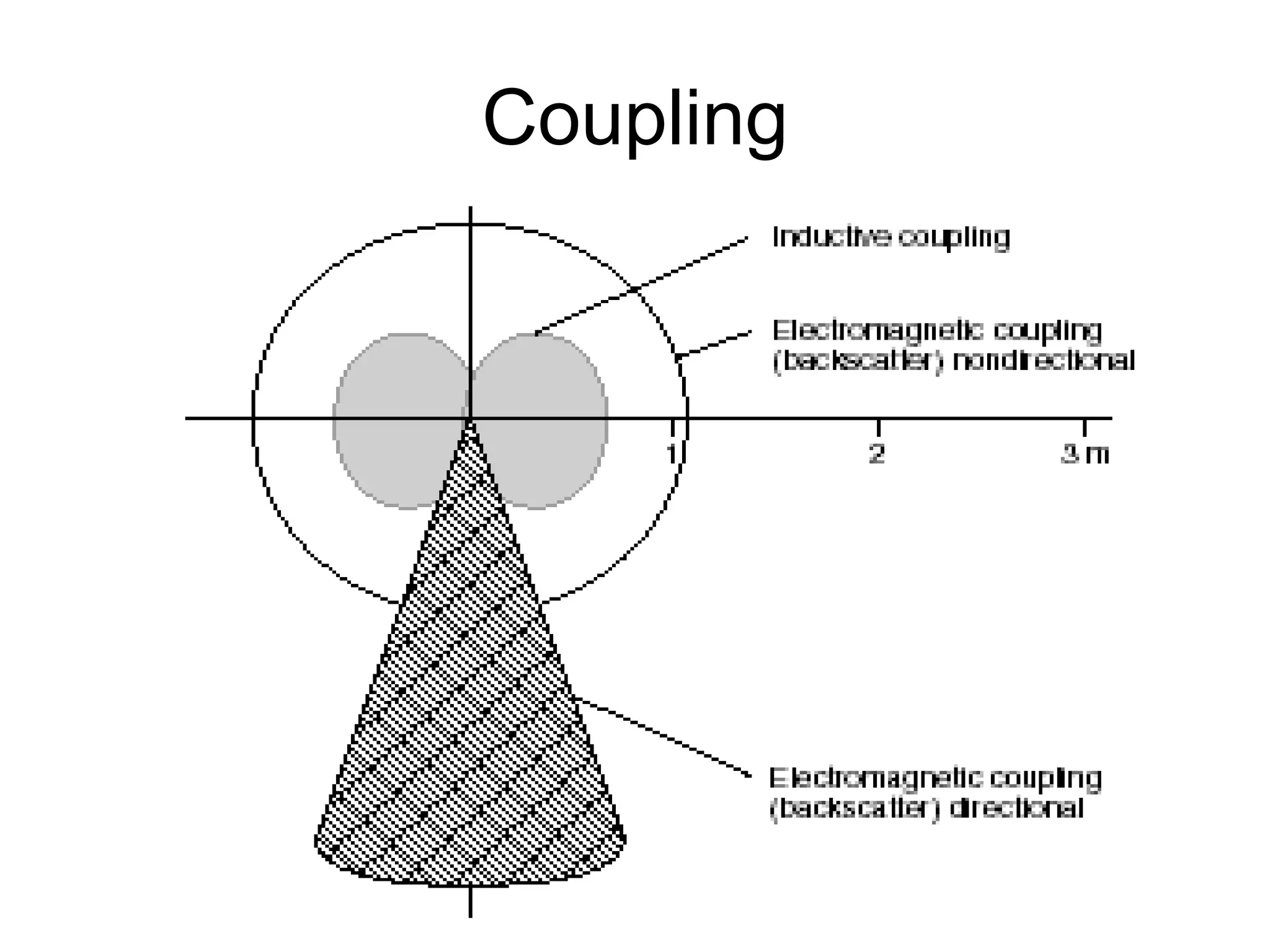
Coupling 100kHz – 30 MHz – inductive coupling HF and Microwave systems use electromagnetic coupling
Coupling
Frequency and bandwidth Frequency is of primary importance when determining data transfer rates (bandwidth) The higher the frequency, the higher the data transfer rate
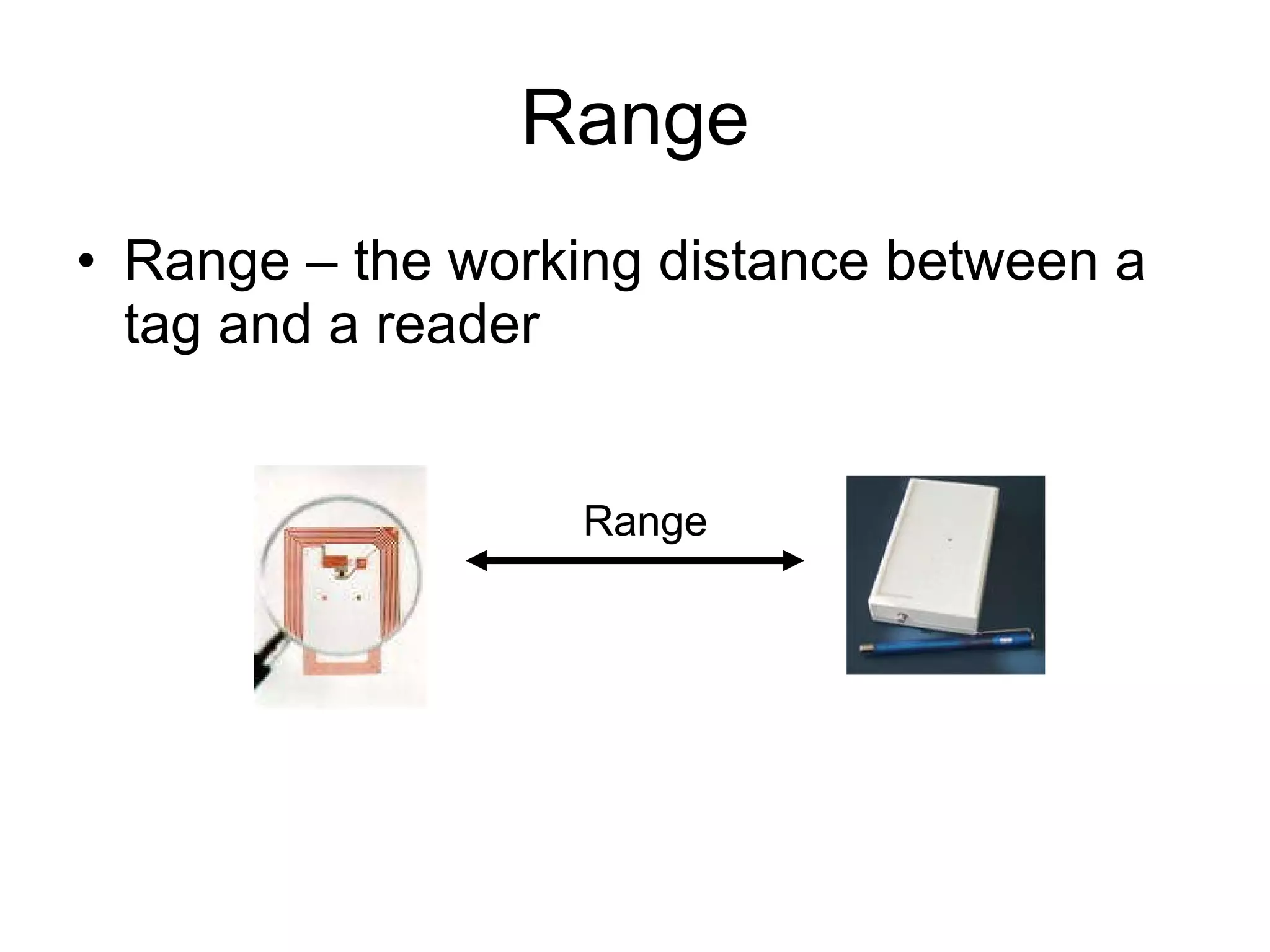
Range Range – the working distance between a tag and a reader Range
Range and Power Levels The range that can be achieved in an RFID system is determined by The power available at the reader The power available within the tag The environmental conditions and structures More important at higher frequencies than at lower frequencies 100-500mW
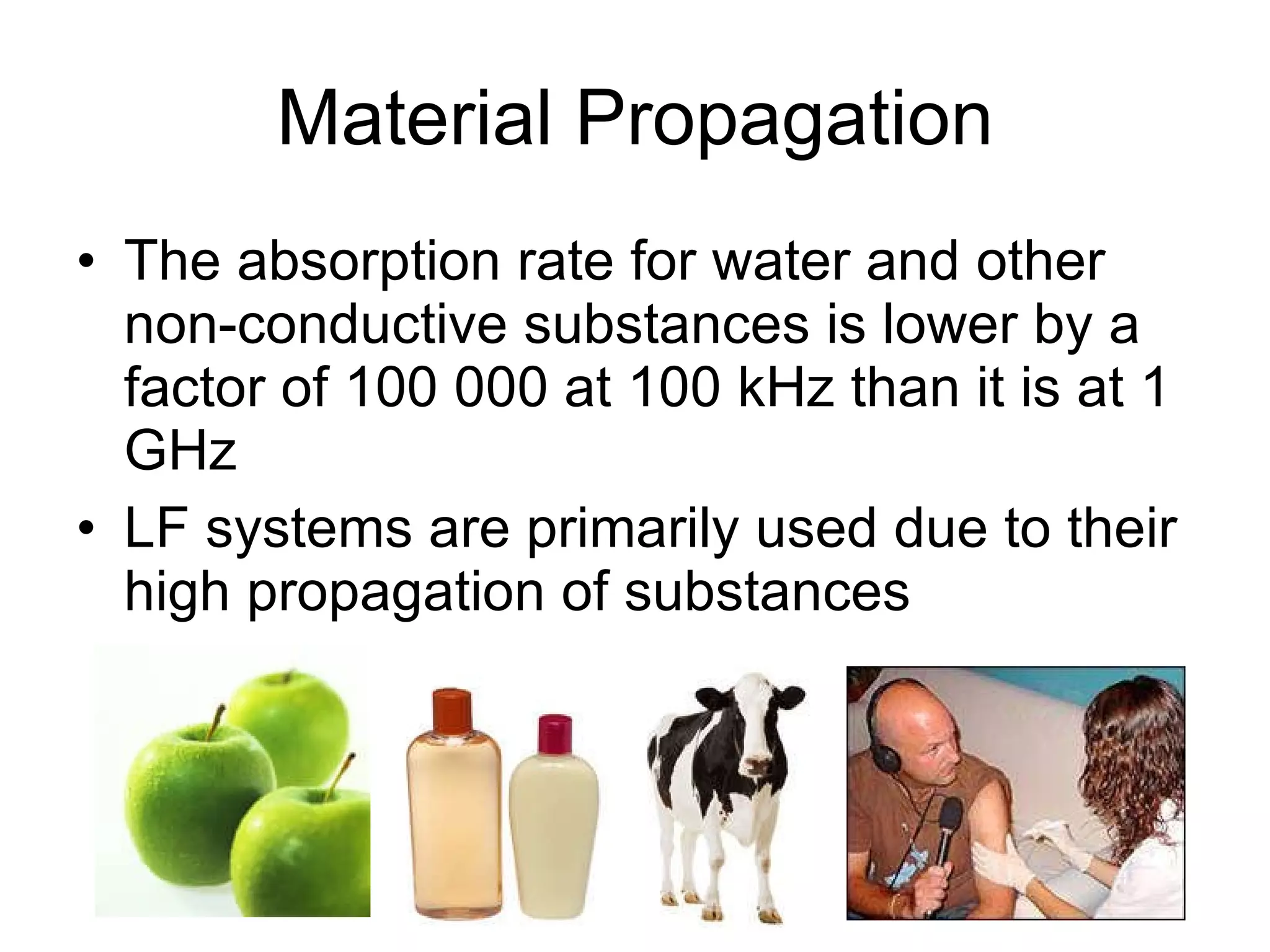
Material Propagation The absorption rate for water and other  non-conductive substances is lower by a factor of 100 000 at 100 kHz than it is at 1 GHz LF systems are primarily used due to their high propagation of substances
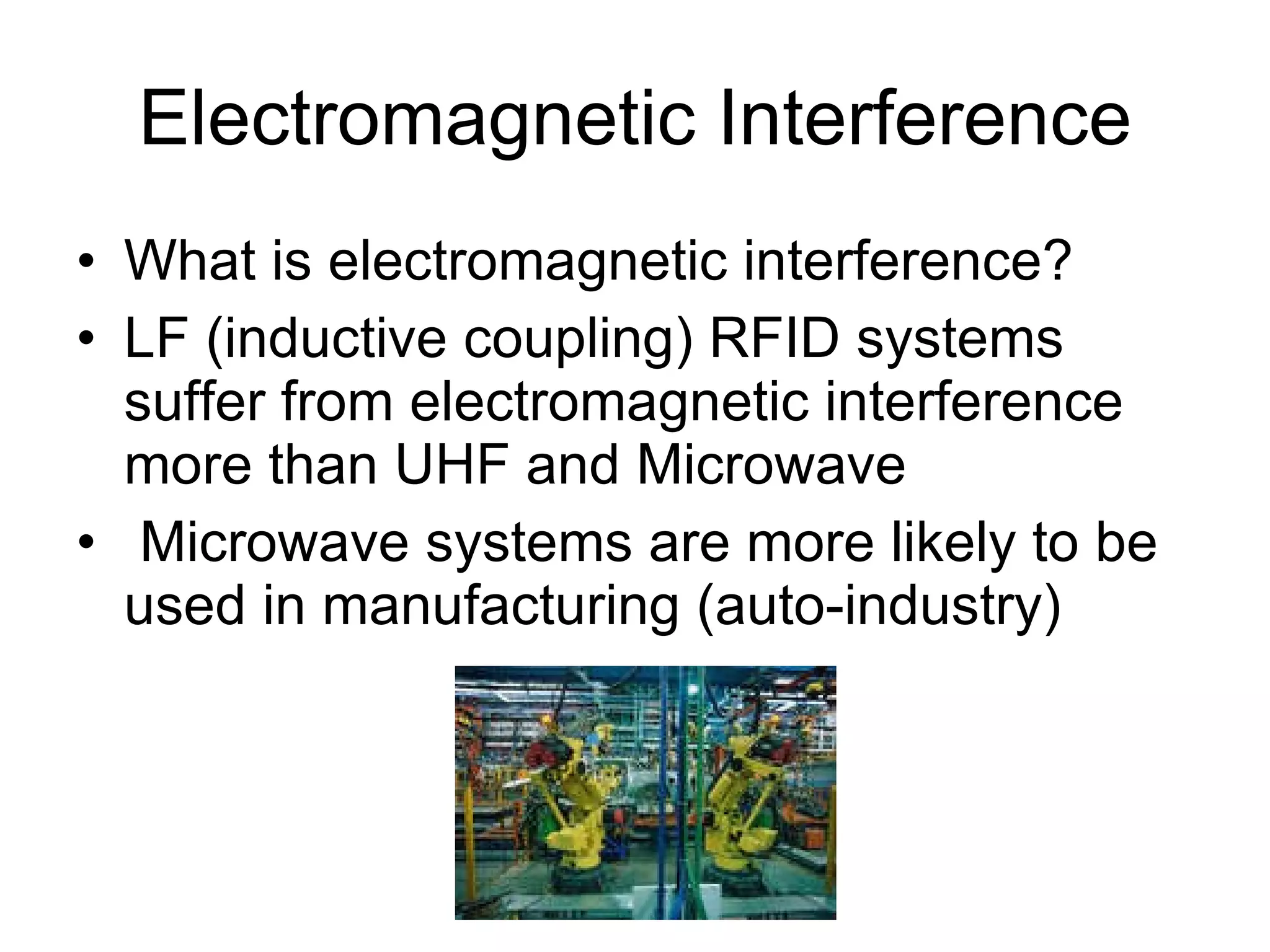
Electromagnetic Interference What is electromagnetic interference? LF (inductive coupling) RFID systems suffer from electromagnetic interference more than UHF and Microwave Microwave systems are more likely to be used in manufacturing (auto-industry)
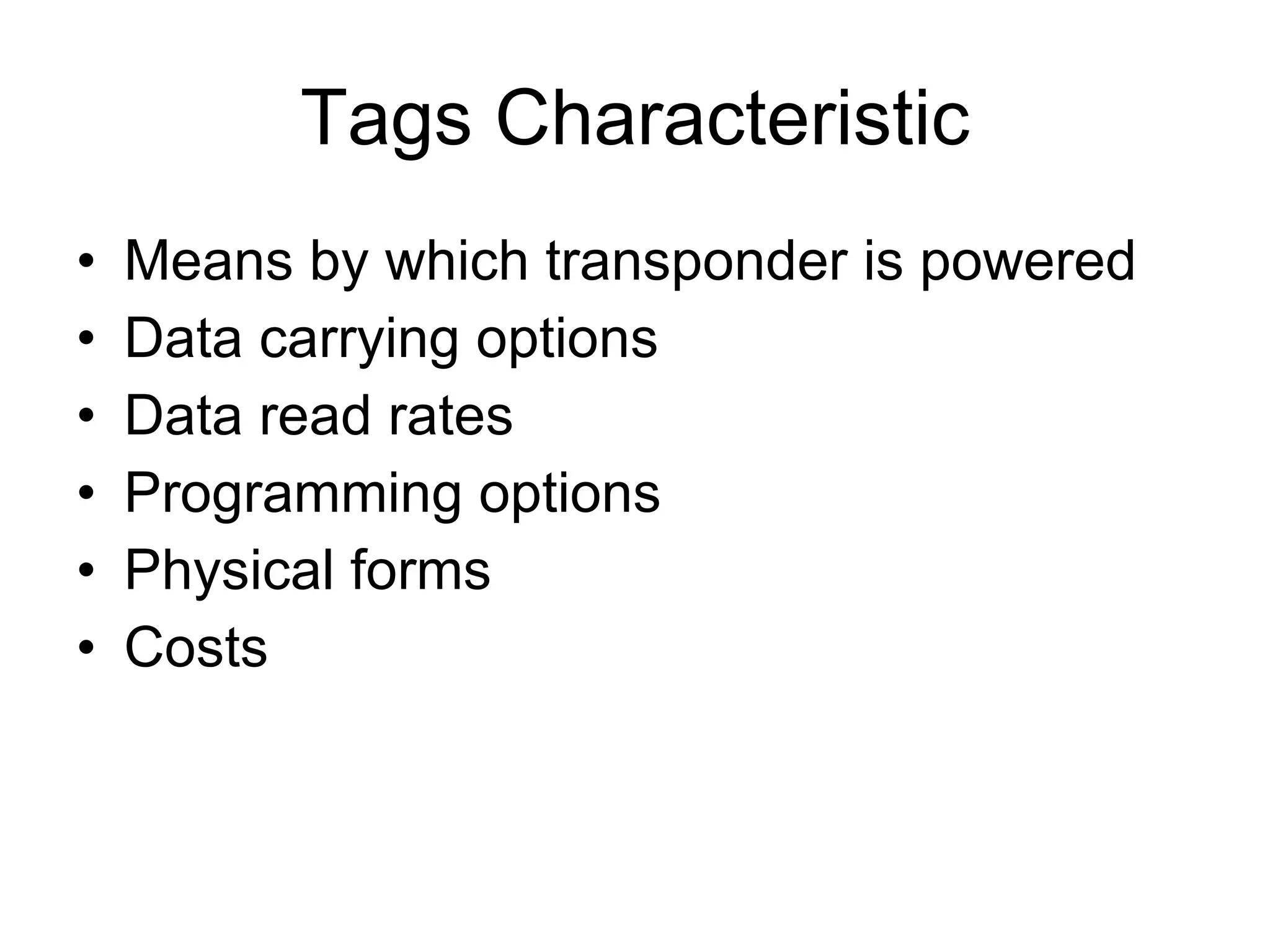
Tags Characteristic Means by which transponder is powered Data carrying options Data read rates Programming options Physical forms Costs
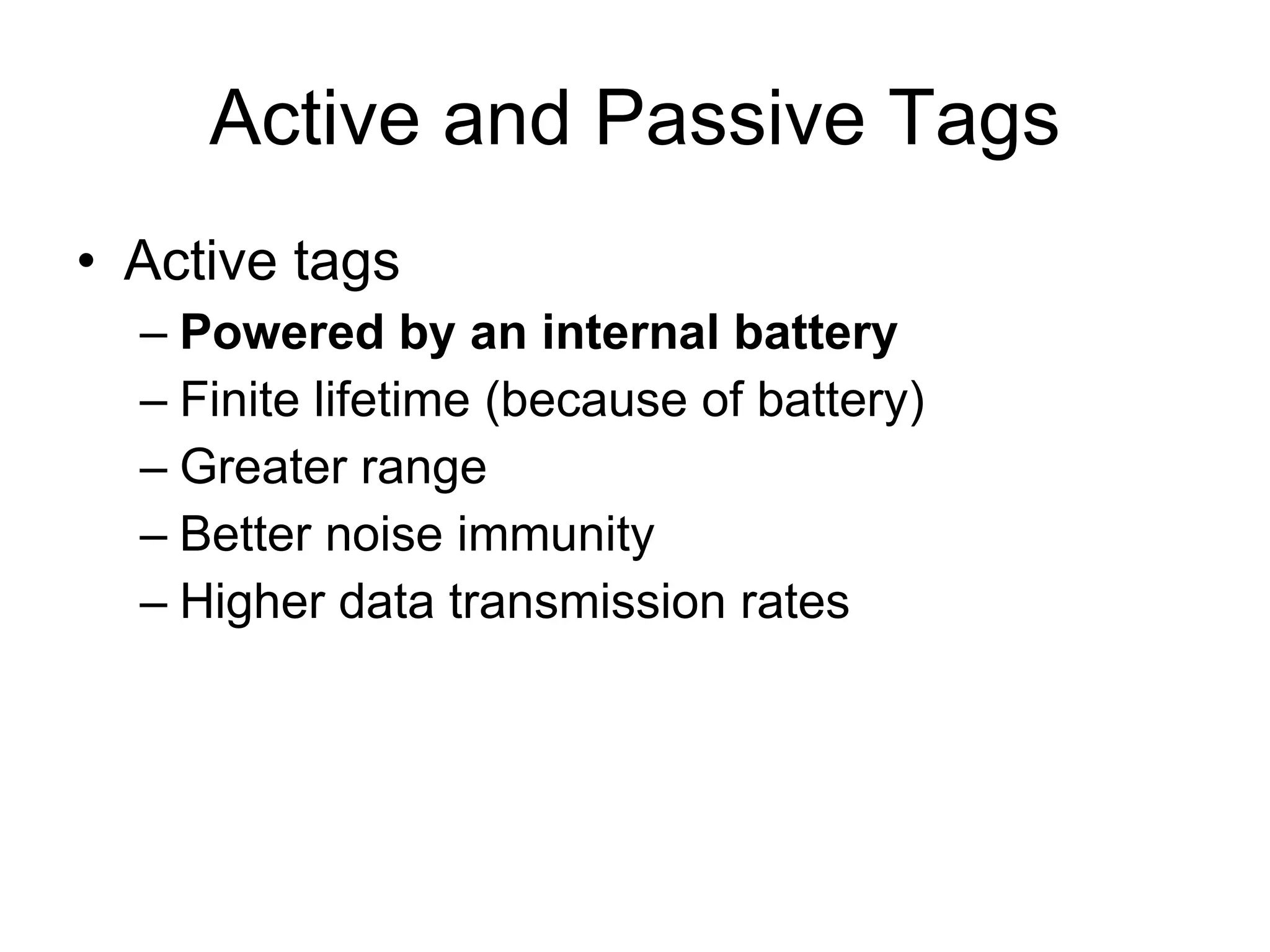
Active and Passive Tags Active tags Powered by an internal battery Finite lifetime (because of battery) Greater range Better noise immunity Higher data transmission rates
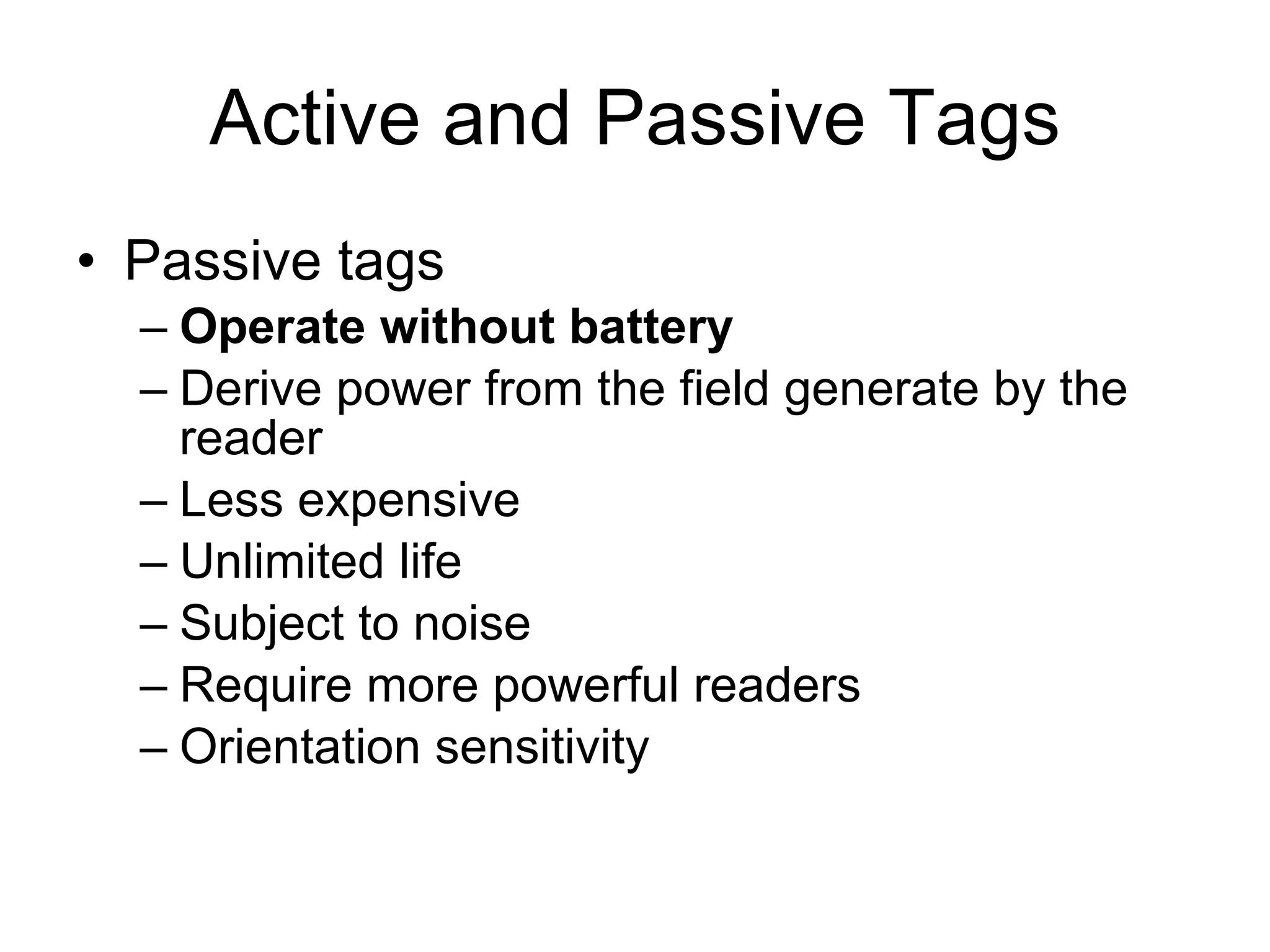
Active and Passive Tags Passive tags Operate without battery Derive power from the field generate by the reader Less expensive Unlimited life Subject to noise Require more powerful readers Orientation sensitivity
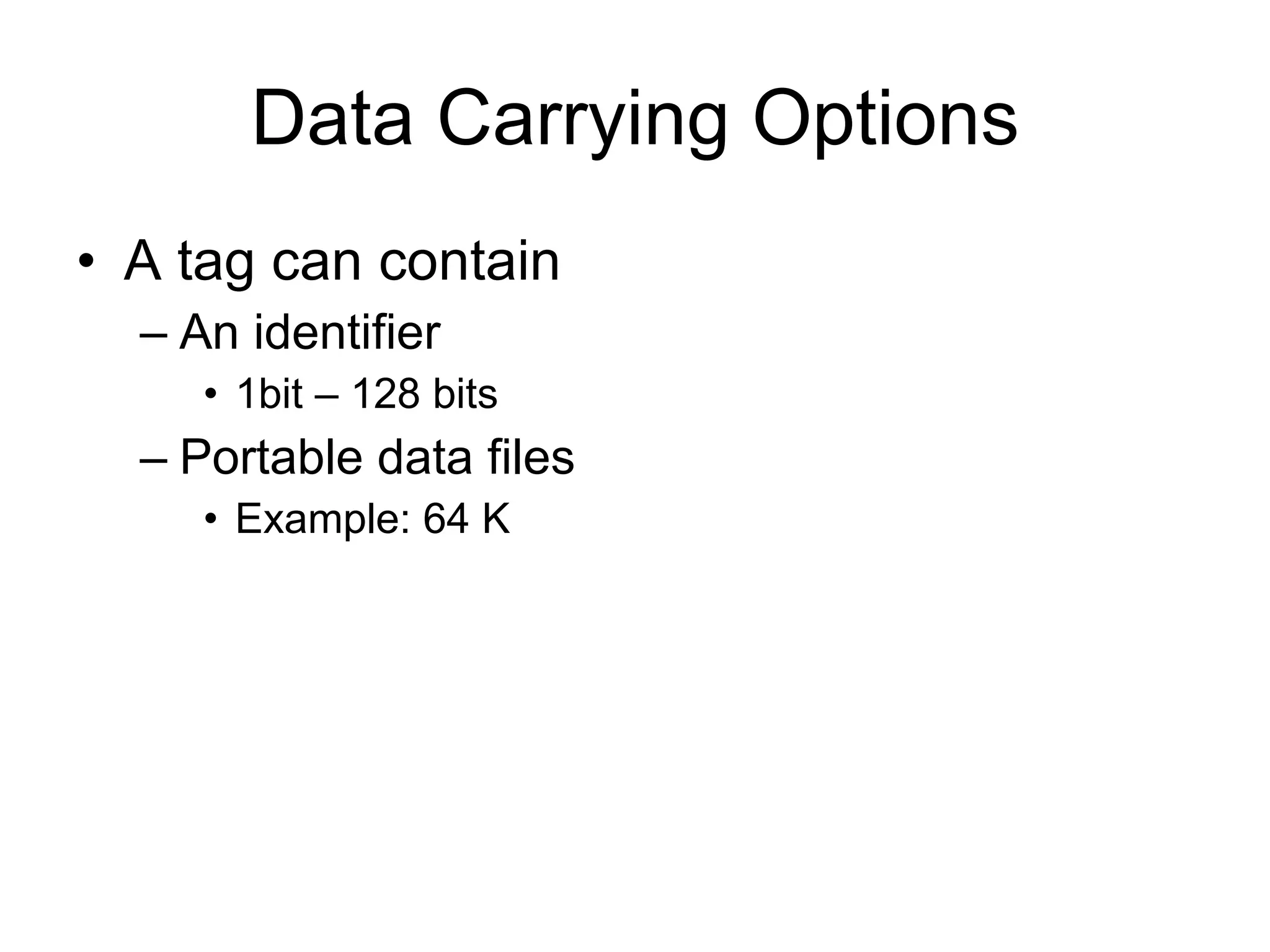
Data Carrying Options A tag can contain An identifier 1bit – 128 bits Portable data files Example: 64 K
Data Read Rate Data read rate is linked to frequency The higher the frequency, the higher the read rate
Data Programming Options Read-only Cheap Write once read many (WORM) Read/write Expansive
Why Use Read/Write Tags? Greater flexibility Customers may change requirements Standards may change Database dependence Ownership issues Lag times High risk applications
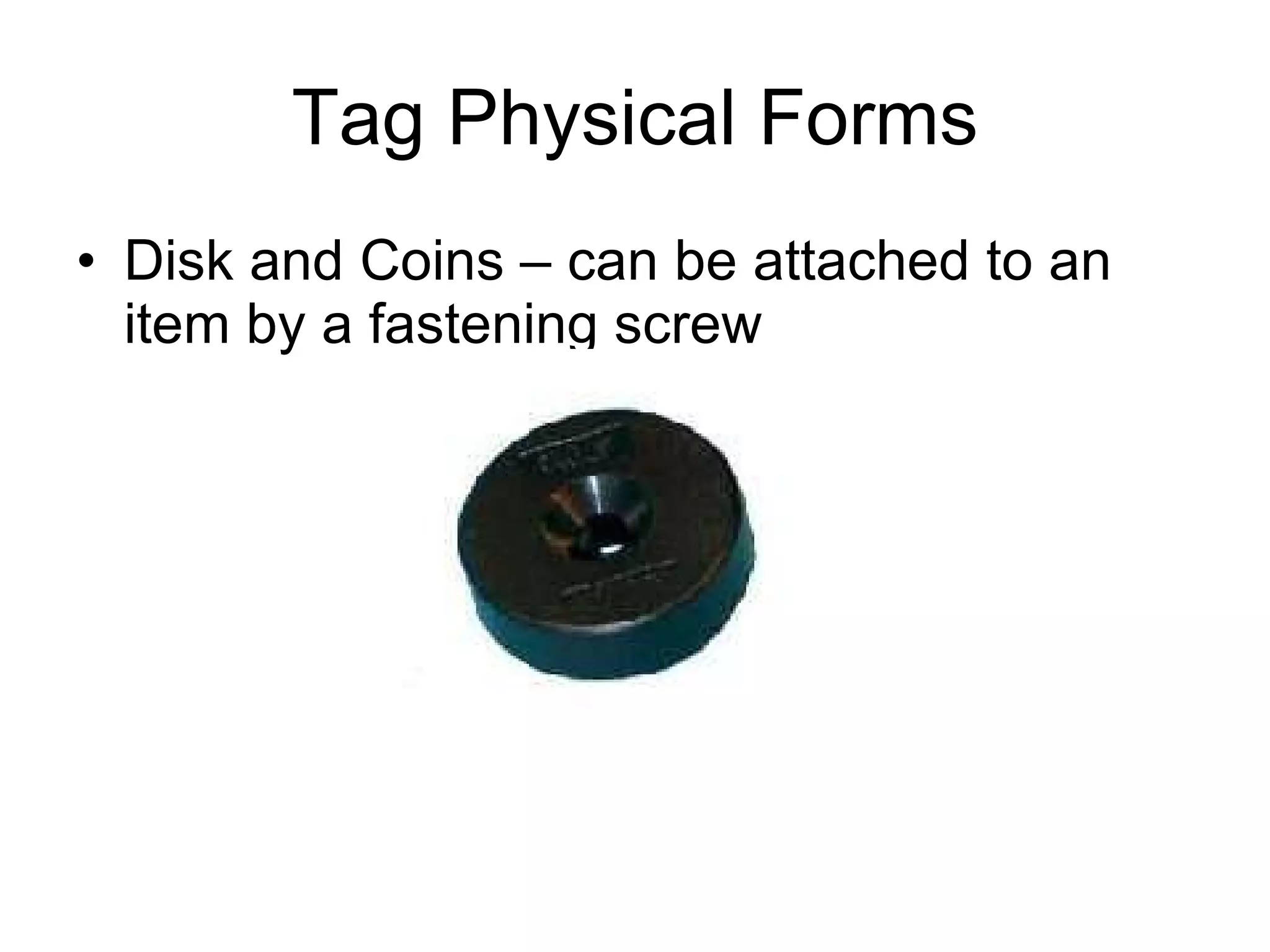
Tag Physical Forms Disk and Coins – can be attached to an item by a fastening screw
Tag Physical Forms Mount-on-Metal – special construction minimizes impact of metal in terms of interference
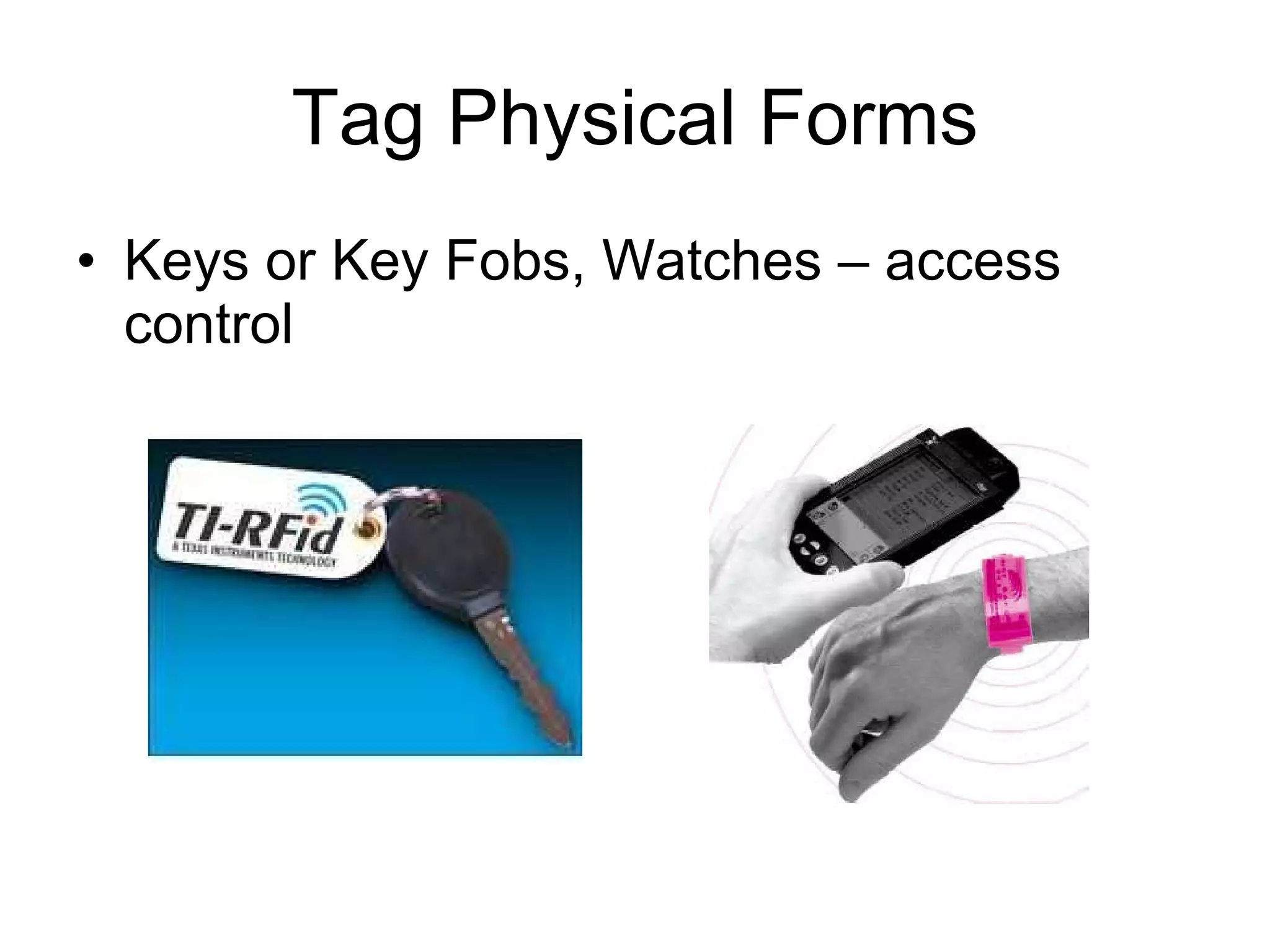
Tag Physical Forms Keys or Key Fobs, Watches – access control
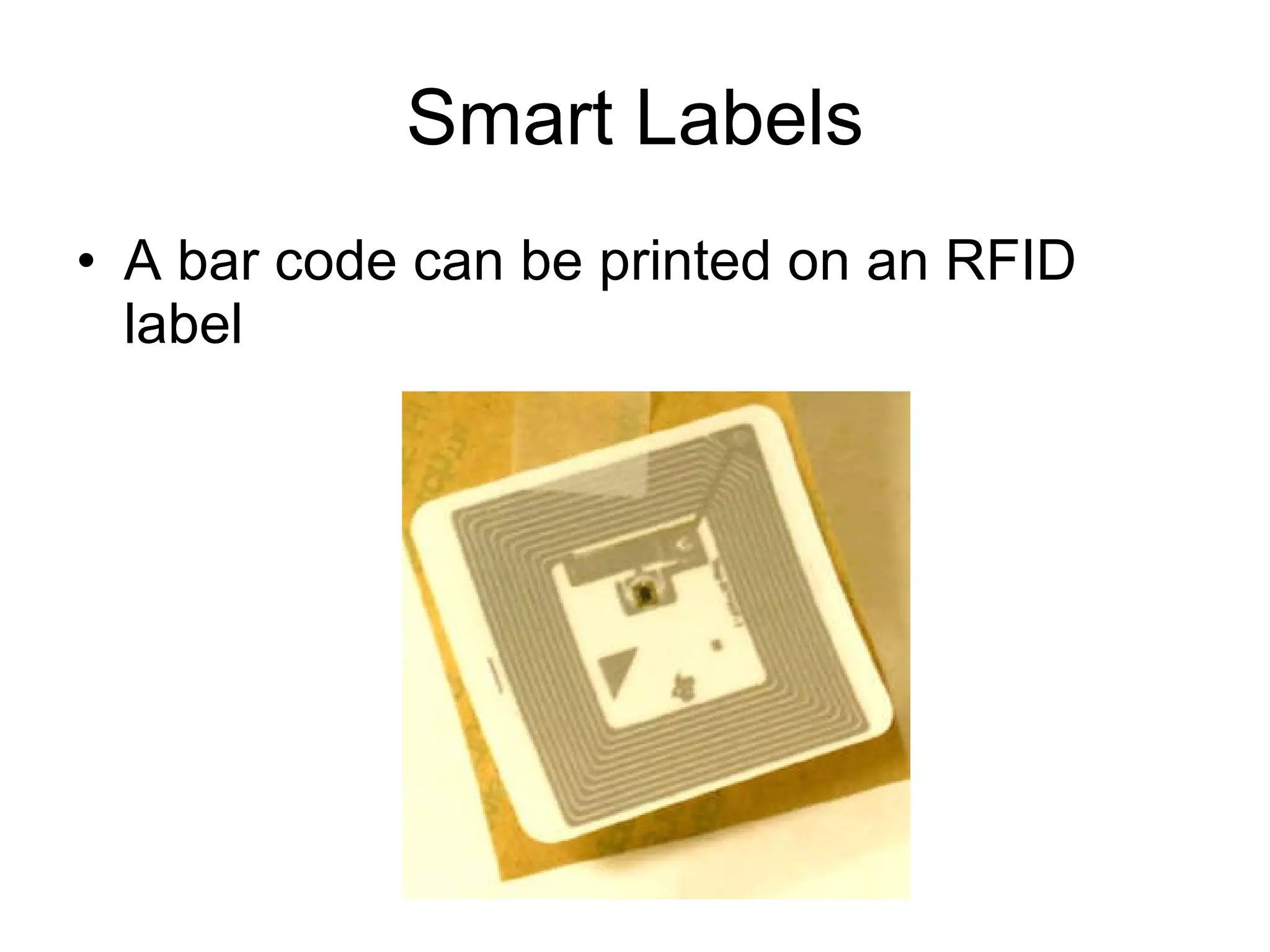
Smart Labels A bar code can be printed on an RFID label
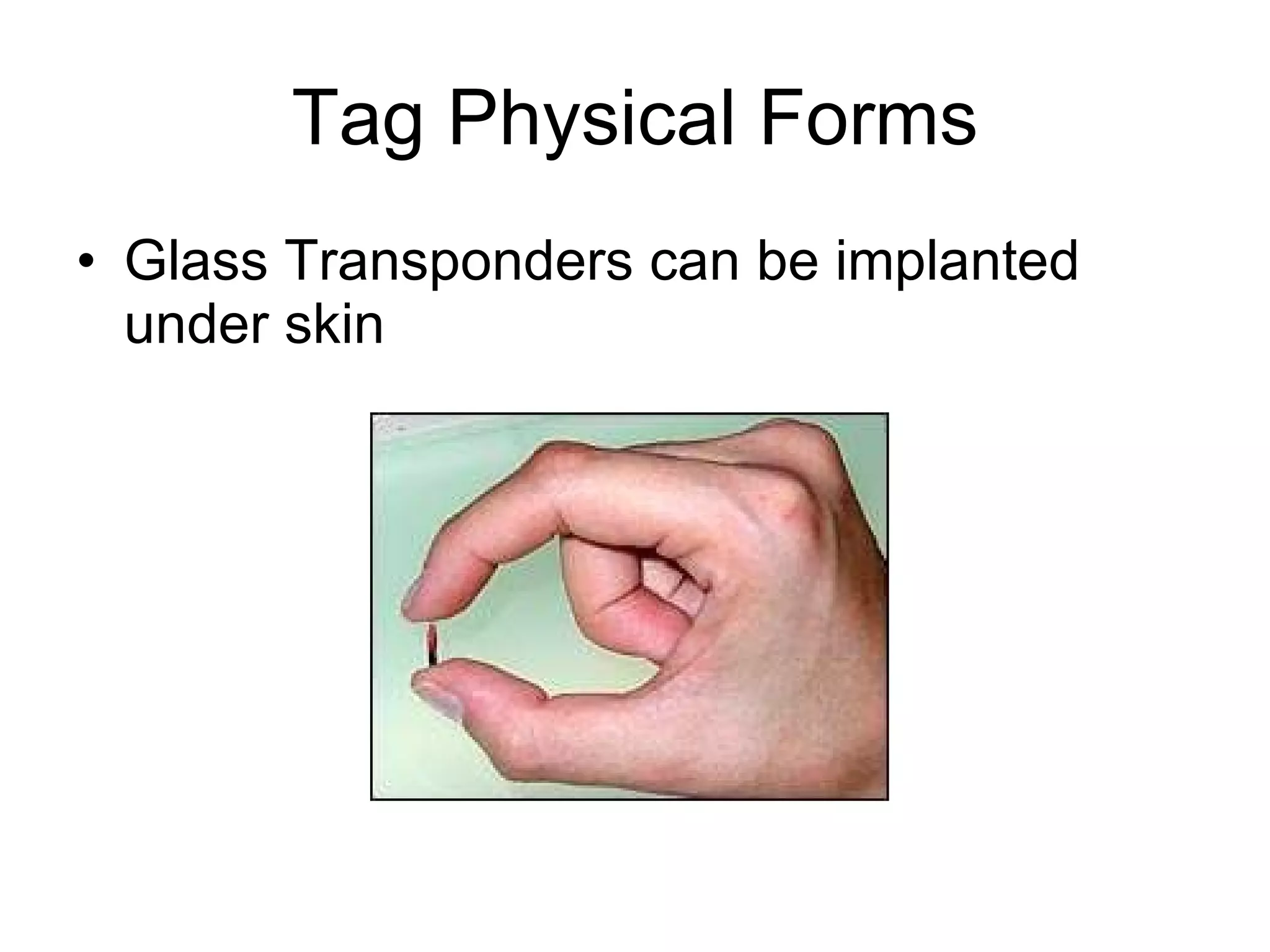
Tag Physical Forms Glass Transponders can be implanted under skin
What’s so special about RFID? Unifying Auto-ID technology Line of sight is not required Longer read ranges Faster: hundreds of items can be scanned in one read
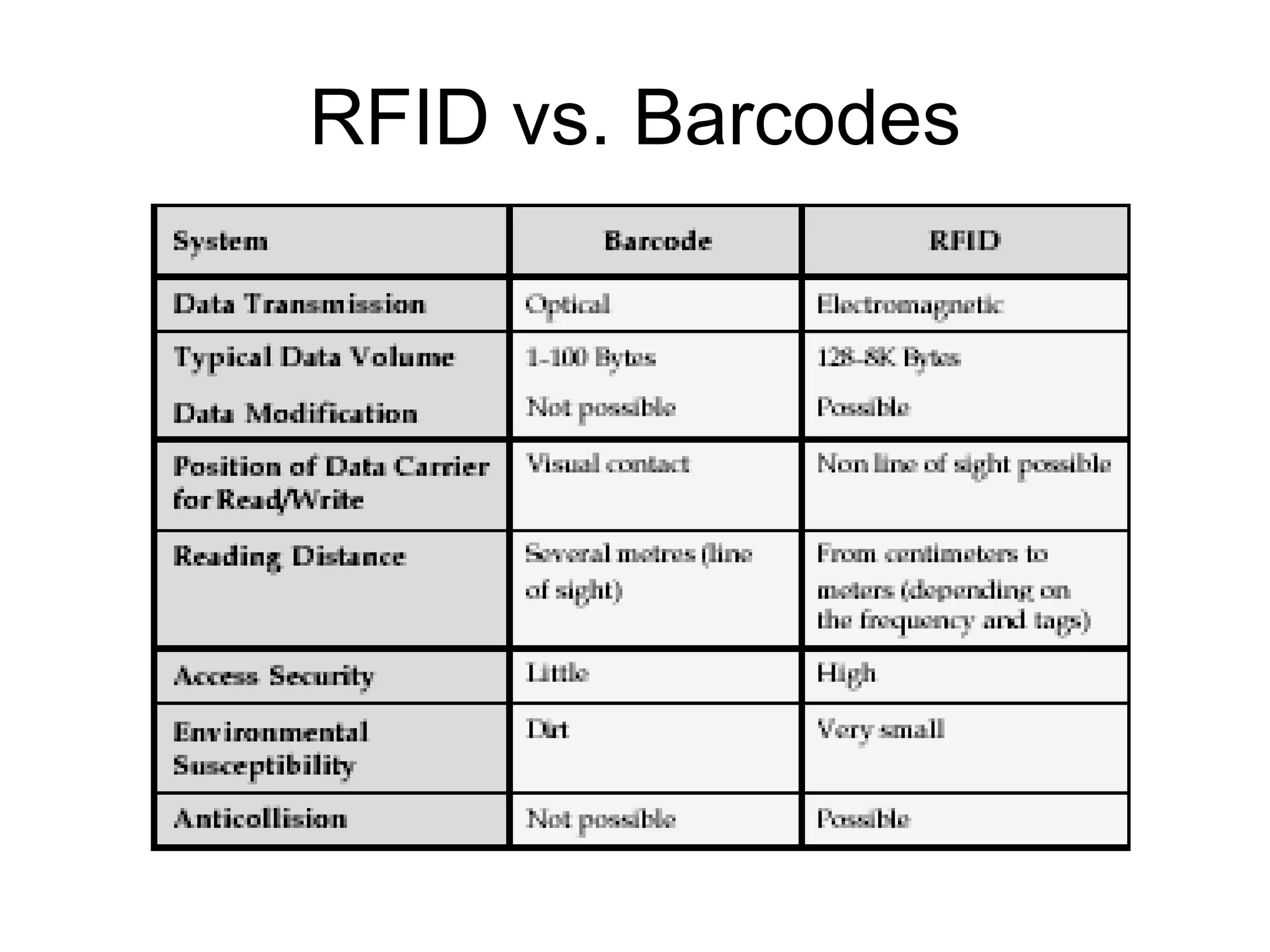
RFID vs. Barcodes
Principles of Profitable RFID Use Bar codes are unfeasible Example: rail cars Damage Speed Counting Processes  Greater speed Saves manual labor
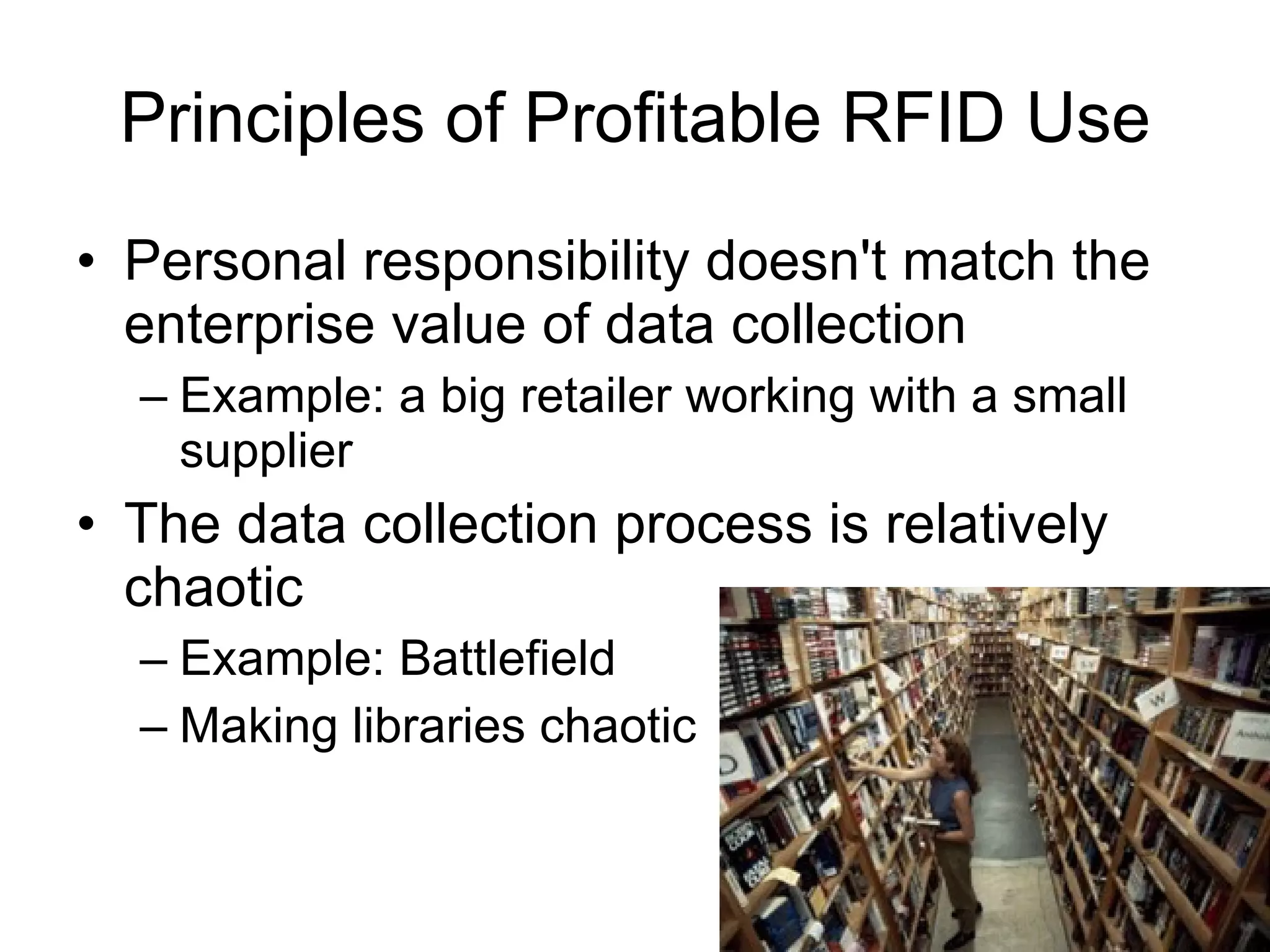
Principles of Profitable RFID Use Personal responsibility doesn't match the enterprise value of data collection Example: a big retailer working with a small supplier The data collection process is relatively chaotic Example: Battlefield Making libraries chaotic
Principles of Profitable RFID Use The exact configuration of goods must be maintained Example: Auto industry Data must be collected from consumers outside of the retail Warning: Privacy Concerns
RFID Evolution (Gartner, 2003)
RFID Growth Several market research firms predict that ~2007 RFID market will reach ~$3 billion
Questions?

Intro R F I D

  • 1.
  • 2.
    Auto-ID Technologies BiometricSystems Smart Cards RFID Optical Character Recognition (OCR) Barcode Systems Auto-ID
  • 3.
    Definition RFID (RadioFrequency Identification) is a technology that enables the electronic and wireless labeling and identification of objects, humans and animals
  • 4.
    RFID Principal SystemComponents Tag (Transponder) Chip Antenna Reader (Interrogator) RF Module (Transmitter and Receiver) Control Unit Antenna Several Interfaces (RS 232, RS 485, etc.) Host Computer Middleware
  • 5.
  • 6.
  • 7.
    EPC RFID SystemArchitecture
  • 8.
    Carrier Frequencies Whatis frequency? Refers to the property of radio waves used to transmit data Roughly speaking, it is the intensity of waves used to transmit information
  • 9.
    Carrier Frequency RFIDsystems may use a particular frequency band depending on: Application Legislature Cost considerations
  • 10.
    Frequency Bands FrequencyBand Characteristics Typical Applications Low 100-500 kHz Short to medium read range, inexpensive, low reading speed Access control Animal/Human identification Inventory Control Medium 10-15 MHz Short to medium read range Potentially inexpensive Medium reading range Access Control Smart Cards High UHF: 850-950MHz Microwave: 2.4 – 5.8 GHz Long read range High reading speed Line of sight required (Microwave) Expensive Railroad car monitoring Toll collection systems
  • 11.
    Coupling 100kHz –30 MHz – inductive coupling HF and Microwave systems use electromagnetic coupling
  • 12.
  • 13.
    Frequency and bandwidthFrequency is of primary importance when determining data transfer rates (bandwidth) The higher the frequency, the higher the data transfer rate
  • 14.
    Range Range –the working distance between a tag and a reader Range
  • 15.
    Range and PowerLevels The range that can be achieved in an RFID system is determined by The power available at the reader The power available within the tag The environmental conditions and structures More important at higher frequencies than at lower frequencies 100-500mW
  • 16.
    Material Propagation Theabsorption rate for water and other non-conductive substances is lower by a factor of 100 000 at 100 kHz than it is at 1 GHz LF systems are primarily used due to their high propagation of substances
  • 17.
    Electromagnetic Interference Whatis electromagnetic interference? LF (inductive coupling) RFID systems suffer from electromagnetic interference more than UHF and Microwave Microwave systems are more likely to be used in manufacturing (auto-industry)
  • 18.
    Tags Characteristic Meansby which transponder is powered Data carrying options Data read rates Programming options Physical forms Costs
  • 19.
    Active and PassiveTags Active tags Powered by an internal battery Finite lifetime (because of battery) Greater range Better noise immunity Higher data transmission rates
  • 20.
    Active and PassiveTags Passive tags Operate without battery Derive power from the field generate by the reader Less expensive Unlimited life Subject to noise Require more powerful readers Orientation sensitivity
  • 21.
    Data Carrying OptionsA tag can contain An identifier 1bit – 128 bits Portable data files Example: 64 K
  • 22.
    Data Read RateData read rate is linked to frequency The higher the frequency, the higher the read rate
  • 23.
    Data Programming OptionsRead-only Cheap Write once read many (WORM) Read/write Expansive
  • 24.
    Why Use Read/WriteTags? Greater flexibility Customers may change requirements Standards may change Database dependence Ownership issues Lag times High risk applications
  • 25.
    Tag Physical FormsDisk and Coins – can be attached to an item by a fastening screw
  • 26.
    Tag Physical FormsMount-on-Metal – special construction minimizes impact of metal in terms of interference
  • 27.
    Tag Physical FormsKeys or Key Fobs, Watches – access control
  • 28.
    Smart Labels Abar code can be printed on an RFID label
  • 29.
    Tag Physical FormsGlass Transponders can be implanted under skin
  • 30.
    What’s so specialabout RFID? Unifying Auto-ID technology Line of sight is not required Longer read ranges Faster: hundreds of items can be scanned in one read
  • 31.
  • 32.
    Principles of ProfitableRFID Use Bar codes are unfeasible Example: rail cars Damage Speed Counting Processes Greater speed Saves manual labor
  • 33.
    Principles of ProfitableRFID Use Personal responsibility doesn't match the enterprise value of data collection Example: a big retailer working with a small supplier The data collection process is relatively chaotic Example: Battlefield Making libraries chaotic
  • 34.
    Principles of ProfitableRFID Use The exact configuration of goods must be maintained Example: Auto industry Data must be collected from consumers outside of the retail Warning: Privacy Concerns
  • 35.
  • 36.
    RFID Growth Severalmarket research firms predict that ~2007 RFID market will reach ~$3 billion
  • 37.