Quantum Computing
Touching the Basics!
Saomya Chaudhury
12/19/2022 1
MOOGLELABS - SERVICES
Decoding Innovation In AI/ML, Blockchain, DevOps and Data
Science
Many organizations are afraid to take the leap toward AI/ML, Blockchain, DevOps, and Data Science. MoogleLabs makes the journey
streamlined and smooth for you. Founded by seasoned IT experts, the company has the resources to help your business embrace new-age
technology.
At MoogleLabs, we help you compete effectively by leveraging cutting-edge technology and in this endeavor, we have a talented team,
which is certified in the technologies it works on. We have transformed businesses with our deep understanding of technology that can
be utilized for various industries. The company is known for building a great client-business relationship by being transparent throughout
the whole journey. MoogleLabs is always ready to better itself to provide the best services to its clients.
Our Applied AI brings roadmap
to scale enterprise-grade
solutions, with the power of
analytics, automation and next-
level computing.
Scale up your business with
future-ready ML-powered
applications integrated with
AR/VR, image & video analytics.
We help you build a secured
decentralized solution for Smart
Contracts, Crypto-token and
NFT Marketplace.
We specialize in DevOps managed
services including CI/CD,
Infrastructure Management,
Cloud Managed Services,
DevSecOps, and AI Ops.
Uncover hidden stories in data
and turn it into maximized
revenue opportunities using
qualitative and quantitative
data processing techniques.
Artificial
Intelligence
Machine Learning Blockchain DevOps Data Science
12/19/2022 2
“To unlock the secrets of the UNIVERSE
one must think in terms of
Energy, Frequency &
Vibration”
Nikola Tesla
12/19/2022 3
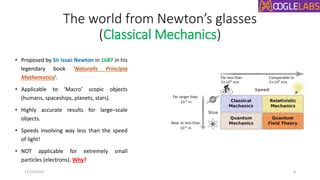
The world from Newton’s glasses
(Classical Mechanics)
• Proposed by Sir Issac Newton in 1687 in his
legendary book ‘Naturalis Principia
Mathematica’.
• Applicable to ‘Macro’ scopic objects
(humans, spaceships, planets, stars).
• Highly accurate results for large–scale
objects.
• Speeds involving way less than the speed
of light!
• NOT applicable for extremely small
particles (electrons). Why?
12/19/2022 4
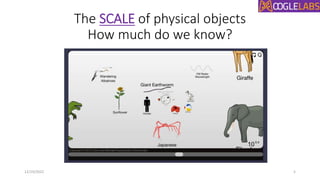
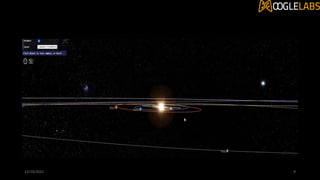
The SCALE of physical objects
How much do we know?
12/19/2022 5
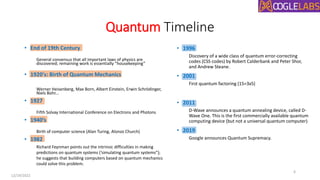
Quantum Timeline
• End of 19th Century
General consensus that all important laws of physics are
discovered; remaining work is essentially “housekeeping”
• 1920's: Birth of Quantum Mechanics
Werner Heisenberg, Max Born, Albert Einstein, Erwin Schrödinger,
Niels Bohr...
• 1927
Fifth Solvay International Conference on Electrons and Photons
• 1940’s
Birth of computer science (Alan Turing, Alonzo Church)
• 1982
Richard Feynman points out the intrinsic difficulties in making
predictions on quantum systems (‘simulating quantum systems”);
he suggests that building computers based on quantum mechanics
could solve this problem.
• 1996
Discovery of a wide class of quantum error-correcting
codes (CSS codes) by Robert Calderbank and Peter Shor,
and Andrew Steane.
• 2001
First quantum factoring (15=3x5)
• 2011
D-Wave announces a quantum annealing device, called D-
Wave One. This is the first commercially available quantum
computing device (but not a universal quantum computer)
• 2019
Google announces Quantum Supremacy.
12/19/2022
6
12/19/2022 7
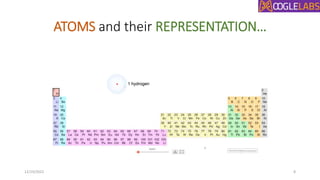
ATOMS and their REPRESENTATION…
12/19/2022 8
Isn’t it a representation like this?
12/19/2022 9
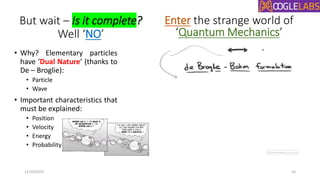
But wait – Is it complete?
Well ‘NO’
• Why? Elementary particles
have ‘Dual Nature’ (thanks to
De – Broglie):
• Particle
• Wave
• Important characteristics that
must be explained:
• Position
• Velocity
• Energy
• Probability
Enter the strange world of
‘Quantum Mechanics’
12/19/2022 10
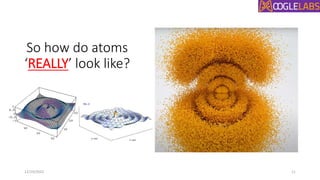
So how do atoms
‘REALLY’ look like?
12/19/2022 11
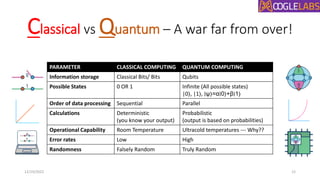
Classical vs Quantum – A war far from over!
PARAMETER CLASSICAL COMPUTING QUANTUM COMPUTING
Information storage Classical Bits/ Bits Qubits
Possible States 0 OR 1 Infinite (All possible states)
|0⟩, |1⟩, ∣ψ⟩=α∣0⟩+β∣1⟩
Order of data processing Sequential Parallel
Calculations Deterministic
(you know your output)
Probabilistic
(output is based on probabilities)
Operational Capability Room Temperature Ultracold temperatures --- Why??
Error rates Low High
Randomness Falsely Random Truly Random
12/19/2022 12
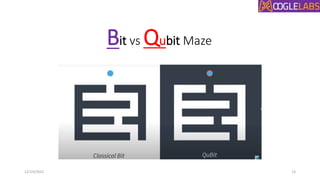
Bit vs Qubit Maze
12/19/2022 13
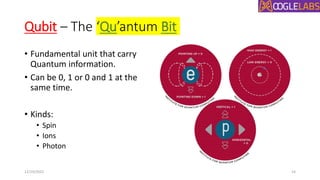
Qubit – The ‘Qu’antum Bit
• Fundamental unit that carry
Quantum information.
• Can be 0, 1 or 0 and 1 at the
same time.
• Kinds:
• Spin
• Ions
• Photon
12/19/2022 14
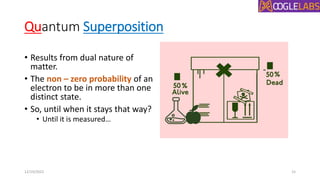
Quantum Superposition
• Results from dual nature of
matter.
• The non – zero probability of an
electron to be in more than one
distinct state.
• So, until when it stays that way?
• Until it is measured…
12/19/2022 15
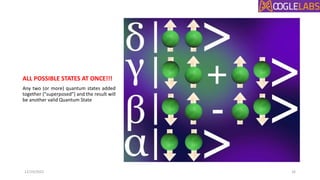
ALL POSSIBLE STATES AT ONCE!!!
Any two (or more) quantum states added
together ("superposed") and the result will
be another valid Quantum State
12/19/2022 16
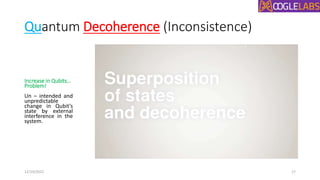
Quantum Decoherence (Inconsistence)
Increase in Qubits…
Problem!
Un – intended and
unpredictable
change in Qubit’s
state by external
interference in the
system.
12/19/2022 17
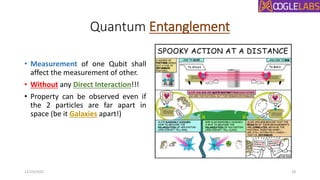
Quantum Entanglement
• Measurement of one Qubit shall
affect the measurement of other.
• Without any Direct Interaction!!!
• Property can be observed even if
the 2 particles are far apart in
space (be it Galaxies apart!)
12/19/2022 18
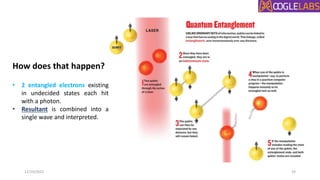
How does that happen?
• 2 entangled electrons existing
in undecided states each hit
with a photon.
• Resultant is combined into a
single wave and interpreted.
12/19/2022 19
Cartoon Representation of Entanglement!
12/19/2022 20
Quantum Supremacy
• Also known as the Quantum Advantage
• Programmable Quantum device that can solve a problem that no classical
computer can solve in any feasible amount of time.
• Status – Achieved
• Year – 2019
• Achieved by ‘Google’
• Specifications: 54 Qubit processor; Name: Sycamore
• Time taken by the best supercomputer – 10,000 years!
• Target Achieved in 200 seconds!
• Reference Paper: https://www.nature.com/articles/s41586-019-1666-5
12/19/2022 21
“The important thing is NEVER
stop questioning!
Curiosityhas its own reason for
Existence…”
Albert Einstein
12/19/2022 22

Quantum Computing

  • 1.
    Quantum Computing Touching theBasics! Saomya Chaudhury 12/19/2022 1
  • 2.
    MOOGLELABS - SERVICES DecodingInnovation In AI/ML, Blockchain, DevOps and Data Science Many organizations are afraid to take the leap toward AI/ML, Blockchain, DevOps, and Data Science. MoogleLabs makes the journey streamlined and smooth for you. Founded by seasoned IT experts, the company has the resources to help your business embrace new-age technology. At MoogleLabs, we help you compete effectively by leveraging cutting-edge technology and in this endeavor, we have a talented team, which is certified in the technologies it works on. We have transformed businesses with our deep understanding of technology that can be utilized for various industries. The company is known for building a great client-business relationship by being transparent throughout the whole journey. MoogleLabs is always ready to better itself to provide the best services to its clients. Our Applied AI brings roadmap to scale enterprise-grade solutions, with the power of analytics, automation and next- level computing. Scale up your business with future-ready ML-powered applications integrated with AR/VR, image & video analytics. We help you build a secured decentralized solution for Smart Contracts, Crypto-token and NFT Marketplace. We specialize in DevOps managed services including CI/CD, Infrastructure Management, Cloud Managed Services, DevSecOps, and AI Ops. Uncover hidden stories in data and turn it into maximized revenue opportunities using qualitative and quantitative data processing techniques. Artificial Intelligence Machine Learning Blockchain DevOps Data Science 12/19/2022 2
  • 3.
    “To unlock thesecrets of the UNIVERSE one must think in terms of Energy, Frequency & Vibration” Nikola Tesla 12/19/2022 3
  • 4.
    The world fromNewton’s glasses (Classical Mechanics) • Proposed by Sir Issac Newton in 1687 in his legendary book ‘Naturalis Principia Mathematica’. • Applicable to ‘Macro’ scopic objects (humans, spaceships, planets, stars). • Highly accurate results for large–scale objects. • Speeds involving way less than the speed of light! • NOT applicable for extremely small particles (electrons). Why? 12/19/2022 4
  • 5.
    The SCALE ofphysical objects How much do we know? 12/19/2022 5
  • 6.
    Quantum Timeline • Endof 19th Century General consensus that all important laws of physics are discovered; remaining work is essentially “housekeeping” • 1920's: Birth of Quantum Mechanics Werner Heisenberg, Max Born, Albert Einstein, Erwin Schrödinger, Niels Bohr... • 1927 Fifth Solvay International Conference on Electrons and Photons • 1940’s Birth of computer science (Alan Turing, Alonzo Church) • 1982 Richard Feynman points out the intrinsic difficulties in making predictions on quantum systems (‘simulating quantum systems”); he suggests that building computers based on quantum mechanics could solve this problem. • 1996 Discovery of a wide class of quantum error-correcting codes (CSS codes) by Robert Calderbank and Peter Shor, and Andrew Steane. • 2001 First quantum factoring (15=3x5) • 2011 D-Wave announces a quantum annealing device, called D- Wave One. This is the first commercially available quantum computing device (but not a universal quantum computer) • 2019 Google announces Quantum Supremacy. 12/19/2022 6
  • 7.
  • 8.
    ATOMS and theirREPRESENTATION… 12/19/2022 8
  • 9.
    Isn’t it arepresentation like this? 12/19/2022 9
  • 10.
    But wait –Is it complete? Well ‘NO’ • Why? Elementary particles have ‘Dual Nature’ (thanks to De – Broglie): • Particle • Wave • Important characteristics that must be explained: • Position • Velocity • Energy • Probability Enter the strange world of ‘Quantum Mechanics’ 12/19/2022 10
  • 11.
    So how doatoms ‘REALLY’ look like? 12/19/2022 11
  • 12.
    Classical vs Quantum– A war far from over! PARAMETER CLASSICAL COMPUTING QUANTUM COMPUTING Information storage Classical Bits/ Bits Qubits Possible States 0 OR 1 Infinite (All possible states) |0⟩, |1⟩, ∣ψ⟩=α∣0⟩+β∣1⟩ Order of data processing Sequential Parallel Calculations Deterministic (you know your output) Probabilistic (output is based on probabilities) Operational Capability Room Temperature Ultracold temperatures --- Why?? Error rates Low High Randomness Falsely Random Truly Random 12/19/2022 12
  • 13.
    Bit vs QubitMaze 12/19/2022 13
  • 14.
    Qubit – The‘Qu’antum Bit • Fundamental unit that carry Quantum information. • Can be 0, 1 or 0 and 1 at the same time. • Kinds: • Spin • Ions • Photon 12/19/2022 14
  • 15.
    Quantum Superposition • Resultsfrom dual nature of matter. • The non – zero probability of an electron to be in more than one distinct state. • So, until when it stays that way? • Until it is measured… 12/19/2022 15
  • 16.
    ALL POSSIBLE STATESAT ONCE!!! Any two (or more) quantum states added together ("superposed") and the result will be another valid Quantum State 12/19/2022 16
  • 17.
    Quantum Decoherence (Inconsistence) Increasein Qubits… Problem! Un – intended and unpredictable change in Qubit’s state by external interference in the system. 12/19/2022 17
  • 18.
    Quantum Entanglement • Measurementof one Qubit shall affect the measurement of other. • Without any Direct Interaction!!! • Property can be observed even if the 2 particles are far apart in space (be it Galaxies apart!) 12/19/2022 18
  • 19.
    How does thathappen? • 2 entangled electrons existing in undecided states each hit with a photon. • Resultant is combined into a single wave and interpreted. 12/19/2022 19
  • 20.
    Cartoon Representation ofEntanglement! 12/19/2022 20
  • 21.
    Quantum Supremacy • Alsoknown as the Quantum Advantage • Programmable Quantum device that can solve a problem that no classical computer can solve in any feasible amount of time. • Status – Achieved • Year – 2019 • Achieved by ‘Google’ • Specifications: 54 Qubit processor; Name: Sycamore • Time taken by the best supercomputer – 10,000 years! • Target Achieved in 200 seconds! • Reference Paper: https://www.nature.com/articles/s41586-019-1666-5 12/19/2022 21
  • 22.
    “The important thingis NEVER stop questioning! Curiosityhas its own reason for Existence…” Albert Einstein 12/19/2022 22

Editor's Notes

  • #5 Naturalis Principia Mathematica – will talk about Calculus. More specifically: Gradient Descent. Local Minimum. Because electrons move at very high speeds. Credits: https://www.clearias.com/classical-mechanics-vs-quantum-mechanics/
  • #13 Complex Probability Amplitudes