Introduction to
Professional
Development &
Applied Ethics
Presented by:
Joshua D. Conde
Agenda
Course overview Course Outline
Class
Requirements
Rules and
regulations
during the online
class
Assignment
Presentation Title
2
Course Overview
Course Overview
This course describes the skills, knowledge and
performance outcomes required to develop the
ability of students to become professional in
their field…
4
Course Overview
… by understanding the ideas of improving
one’s personality and ways on how they are
going to be valued in the business industry…
5
Course Overview
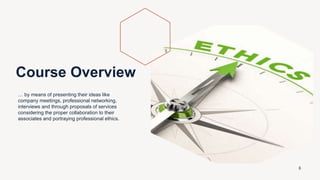
… by means of presenting their ideas like
company meetings, professional networking,
interviews and through proposals of services
considering the proper collaboration to their
associates and portraying professional ethics.
6
Course Overview
It also teaches writing skills and emphasize in
verbal communication and preparation of plans
that requires them to research career options
and company potentiality and stability to
develop a strong and effective career pathway.
7
COURSE
OUTLINE
8
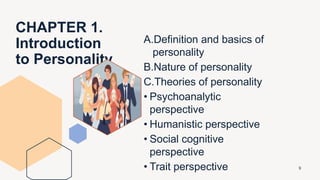
CHAPTER 1.
Introduction
to Personality
A.Definition and basics of
personality
B.Nature of personality
C.Theories of personality
• Psychoanalytic
perspective
• Humanistic perspective
• Social cognitive
perspective
• Trait perspective 9
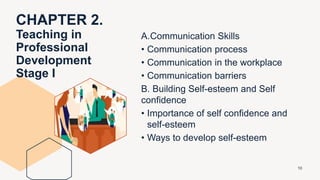
CHAPTER 2.
Teaching in
Professional
Development
Stage I
A.Communication Skills
• Communication process
• Communication in the workplace
• Communication barriers
B. Building Self-esteem and Self
confidence
• Importance of self confidence and
self-esteem
• Ways to develop self-esteem
10
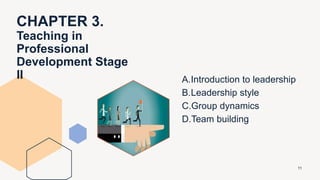
CHAPTER 3.
Teaching in
Professional
Development Stage
II A.Introduction to leadership
B.Leadership style
C.Group dynamics
D.Team building
11
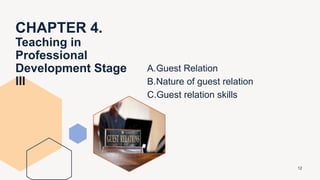
CHAPTER 4.
Teaching in
Professional
Development Stage
III
A.Guest Relation
B.Nature of guest relation
C.Guest relation skills
12
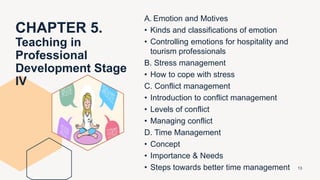
CHAPTER 5.
Teaching in
Professional
Development Stage
IV
A. Emotion and Motives
• Kinds and classifications of emotion
• Controlling emotions for hospitality and
tourism professionals
B. Stress management
• How to cope with stress
C. Conflict management
• Introduction to conflict management
• Levels of conflict
• Managing conflict
D. Time Management
• Concept
• Importance & Needs
• Steps towards better time management 13
CHAPTER 6.
Projecting A
Positive Social
Image
A. Definition & Importance of Social Image
B. Good Grooming and Proper Hygiene
C.Grooming for men and women
D.Dressing for occasion
E. Proper way of introduction
F. Body language
G.Public speaking
H.Social graces and proper telephone
etiquette
I. Business conduct and office etiquettes
J. Social graces and table manners
K. Etiquette in public areas 14
CHAPTER 7.
Projecting A
Positive Social
Image
A. Self-appraisal
B. Career planning goals and process
C.Resume building
D.Self-introduction
E. The art of participating in group
discussion/modeling
F. Personal interview session/mock interview
session
15
16
17
18
CLASS
REQUIREMENTS
19
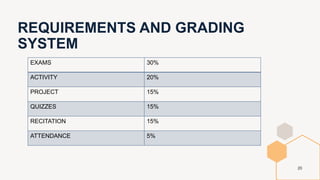
REQUIREMENTS AND GRADING
SYSTEM
20
EXAMS 30%
ACTIVITY 20%
PROJECT 15%
QUIZZES 15%
RECITATION 15%
ATTENDANCE 5%
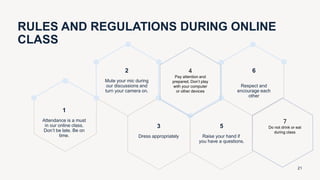
RULES AND REGULATIONS DURING ONLINE
CLASS
1
Attendance is a must
in our online class.
Don’t be late. Be on
time.
2
Mute your mic during
our discussions and
turn your camera on.
3
Dress appropriately
5
Raise your hand if
you have a questions.
6
Respect and
encourage each
other
21
4
Pay attention and
prepared. Don’t play
with your computer
or other devices
7
Do not drink or eat
during class
ASSIGNMENT
What is your expectation in this subject
and why is it important to study the
professional development and applied
ethics?
22
Thank you

Introduction to Professional Development & Applied Ethics.pptx

  • 1.
    Introduction to Professional Development & AppliedEthics Presented by: Joshua D. Conde
  • 2.
    Agenda Course overview CourseOutline Class Requirements Rules and regulations during the online class Assignment Presentation Title 2
  • 3.
  • 4.
    Course Overview This coursedescribes the skills, knowledge and performance outcomes required to develop the ability of students to become professional in their field… 4
  • 5.
    Course Overview … byunderstanding the ideas of improving one’s personality and ways on how they are going to be valued in the business industry… 5
  • 6.
    Course Overview … bymeans of presenting their ideas like company meetings, professional networking, interviews and through proposals of services considering the proper collaboration to their associates and portraying professional ethics. 6
  • 7.
    Course Overview It alsoteaches writing skills and emphasize in verbal communication and preparation of plans that requires them to research career options and company potentiality and stability to develop a strong and effective career pathway. 7
  • 8.
  • 9.
    CHAPTER 1. Introduction to Personality A.Definitionand basics of personality B.Nature of personality C.Theories of personality • Psychoanalytic perspective • Humanistic perspective • Social cognitive perspective • Trait perspective 9
  • 10.
    CHAPTER 2. Teaching in Professional Development StageI A.Communication Skills • Communication process • Communication in the workplace • Communication barriers B. Building Self-esteem and Self confidence • Importance of self confidence and self-esteem • Ways to develop self-esteem 10
  • 11.
    CHAPTER 3. Teaching in Professional DevelopmentStage II A.Introduction to leadership B.Leadership style C.Group dynamics D.Team building 11
  • 12.
    CHAPTER 4. Teaching in Professional DevelopmentStage III A.Guest Relation B.Nature of guest relation C.Guest relation skills 12
  • 13.
    CHAPTER 5. Teaching in Professional DevelopmentStage IV A. Emotion and Motives • Kinds and classifications of emotion • Controlling emotions for hospitality and tourism professionals B. Stress management • How to cope with stress C. Conflict management • Introduction to conflict management • Levels of conflict • Managing conflict D. Time Management • Concept • Importance & Needs • Steps towards better time management 13
  • 14.
    CHAPTER 6. Projecting A PositiveSocial Image A. Definition & Importance of Social Image B. Good Grooming and Proper Hygiene C.Grooming for men and women D.Dressing for occasion E. Proper way of introduction F. Body language G.Public speaking H.Social graces and proper telephone etiquette I. Business conduct and office etiquettes J. Social graces and table manners K. Etiquette in public areas 14
  • 15.
    CHAPTER 7. Projecting A PositiveSocial Image A. Self-appraisal B. Career planning goals and process C.Resume building D.Self-introduction E. The art of participating in group discussion/modeling F. Personal interview session/mock interview session 15
  • 16.
  • 17.
  • 18.
  • 19.
  • 20.
    REQUIREMENTS AND GRADING SYSTEM 20 EXAMS30% ACTIVITY 20% PROJECT 15% QUIZZES 15% RECITATION 15% ATTENDANCE 5%
  • 21.
    RULES AND REGULATIONSDURING ONLINE CLASS 1 Attendance is a must in our online class. Don’t be late. Be on time. 2 Mute your mic during our discussions and turn your camera on. 3 Dress appropriately 5 Raise your hand if you have a questions. 6 Respect and encourage each other 21 4 Pay attention and prepared. Don’t play with your computer or other devices 7 Do not drink or eat during class
  • 22.
    ASSIGNMENT What is yourexpectation in this subject and why is it important to study the professional development and applied ethics? 22
  • 23.