UNIT 9
Maintain and Enhance
Professional Practice
By: Jerick Salaguban
INTRODUCTION
• In any field, maintaining and enhancing professional practices is essential to ensure
ongoing growth, competence, and success. Professional practices refer to the
standards, behaviors, and skills that define an individual’s effectiveness and ethical
conduct within their occupation. These practices are not static; they evolve over time
due to advancements in knowledge, technology, and industry expectations.
• To maintain and enhance professional practices, individuals must engage in continuous
learning, reflect on their performance, adapt to new trends and innovations, and
demonstrate ethical behavior. This process not only improves personal effectiveness
but also contributes to the broader goals and standards of the profession.
1. MODEL HIGH STANDARDS OF PERFORMANCE
• To ensure inspired learning in every classroom in every technical training
schools/centers, teachers/trainers need to develop and maintain their
professional practice. Quality professional learning leads to improved
teaching practice and improved trainee outcomes.
1.1 MODELLING APPROPRIATE PROFESSIONAL
TECHNIQUES AND STRATEGIES FOR EFFECTIVE
PERFORMANCE
• To achieve a high standard of work performance, you must first determine
what that standard might be. The most effective way to do this is by
modelling.
• You can do this by ensuring your performance is consistent with the institution’s
goals and objectives, modelling professional techniques and strategies,
making appropriate personal work goals and plans, and applying ethical and
inclusive practices.
ANALYZE YOUR INSTITUTION’S GOALS AND OBJECTIVES
Goals and objectives may be related to all aspects of an institution, or just some. They may
be related to:
• strategic plans
• operational plans
• codes of conduct
• flexibility and client responsiveness
• client satisfaction
• financial performance
• people management
• marketing and client service
• quality and quality assurance
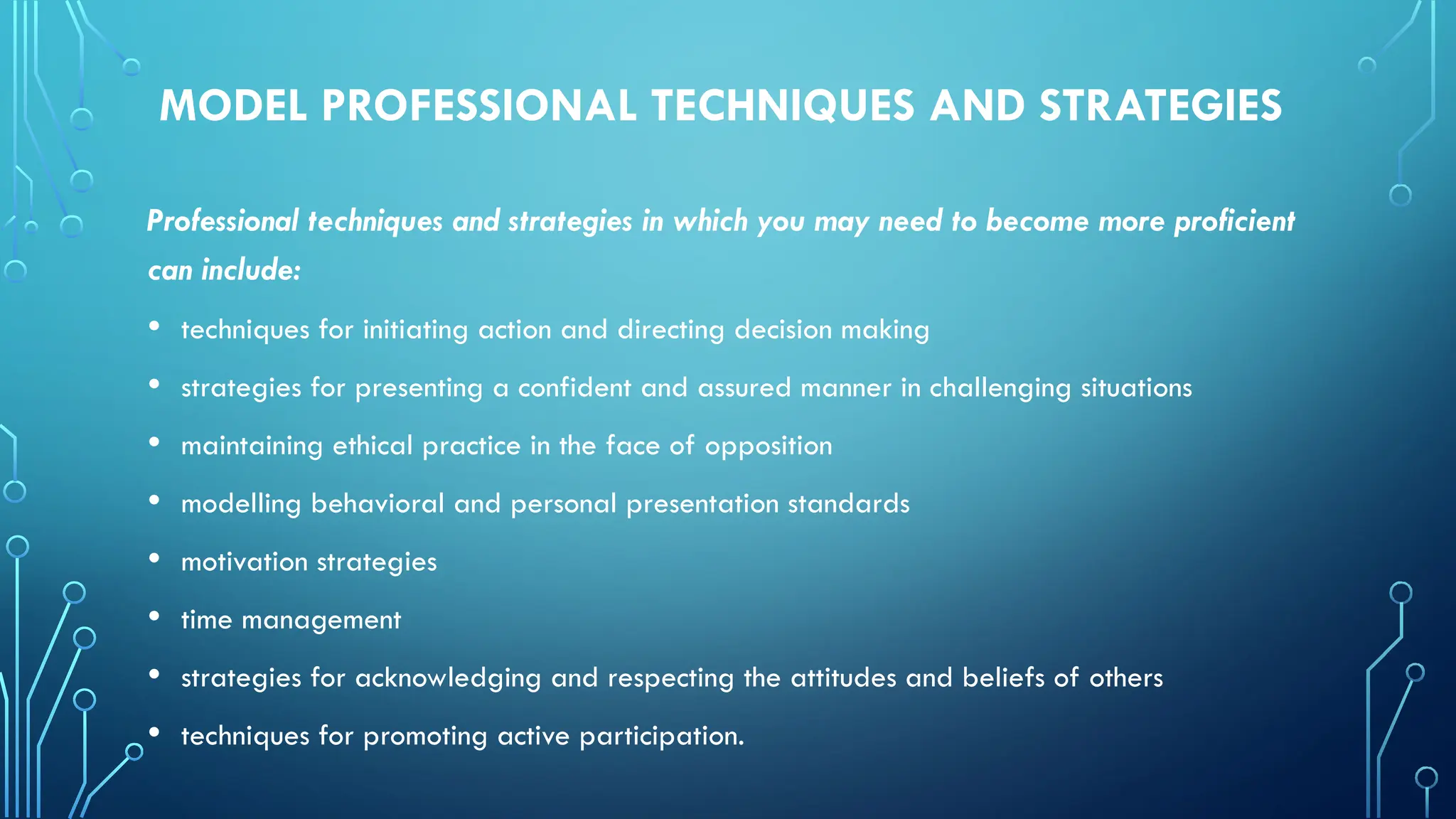
MODEL PROFESSIONAL TECHNIQUES AND STRATEGIES
Professional techniques and strategies in which you may need to become more proficient
can include:
• techniques for initiating action and directing decision making
• strategies for presenting a confident and assured manner in challenging situations
• maintaining ethical practice in the face of opposition
• modelling behavioral and personal presentation standards
• motivation strategies
• time management
• strategies for acknowledging and respecting the attitudes and beliefs of others
• techniques for promoting active participation.
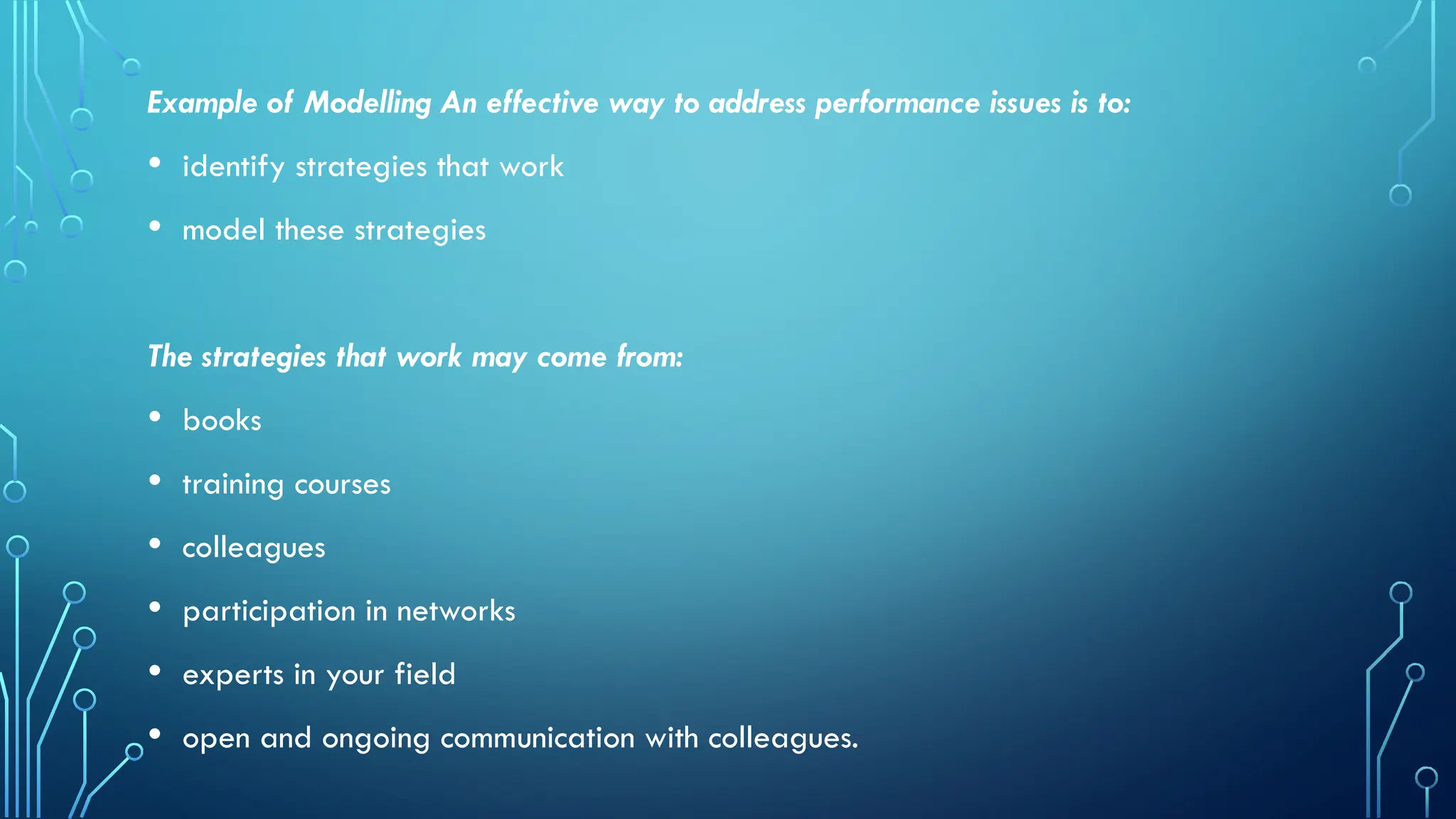
Example of Modelling An effective way to address performance issues is to:
• identify strategies that work
• model these strategies
The strategies that work may come from:
• books
• training courses
• colleagues
• participation in networks
• experts in your field
• open and ongoing communication with colleagues.
•Five Step process of modeling:
1. Select a model of excellence. Determine what outcomes you would
like to achieve, by when.
2. Observe and ideally record the model via video or other medium.
3. Practice the skill until the same set of responses is received.
4. Using video or other medium, test your skill against the model.
5. Teach (transfer) the skill to someone else.
1.2 REFLECTING INDIVIDUAL RESPONSIBILITIES AND ACCOUNTABILITIES
ARE IN PERSONAL WORK GOALS AND PLANS IN ACCORDANCE WITH
ORGANIZATIONAL/ LEGAL REQUIREMENTS
• In any professional setting, aligning personal work goals with organizational
and legal requirements is critical to ensuring not only personal success but also
compliance and ethical responsibility within the broader framework of the
organization. Personal work goals and plans should be developed with a
clear understanding of individual responsibilities and accountabilities,
particularly in relation to the organization’s objectives, legal obligations, and
professional standards.
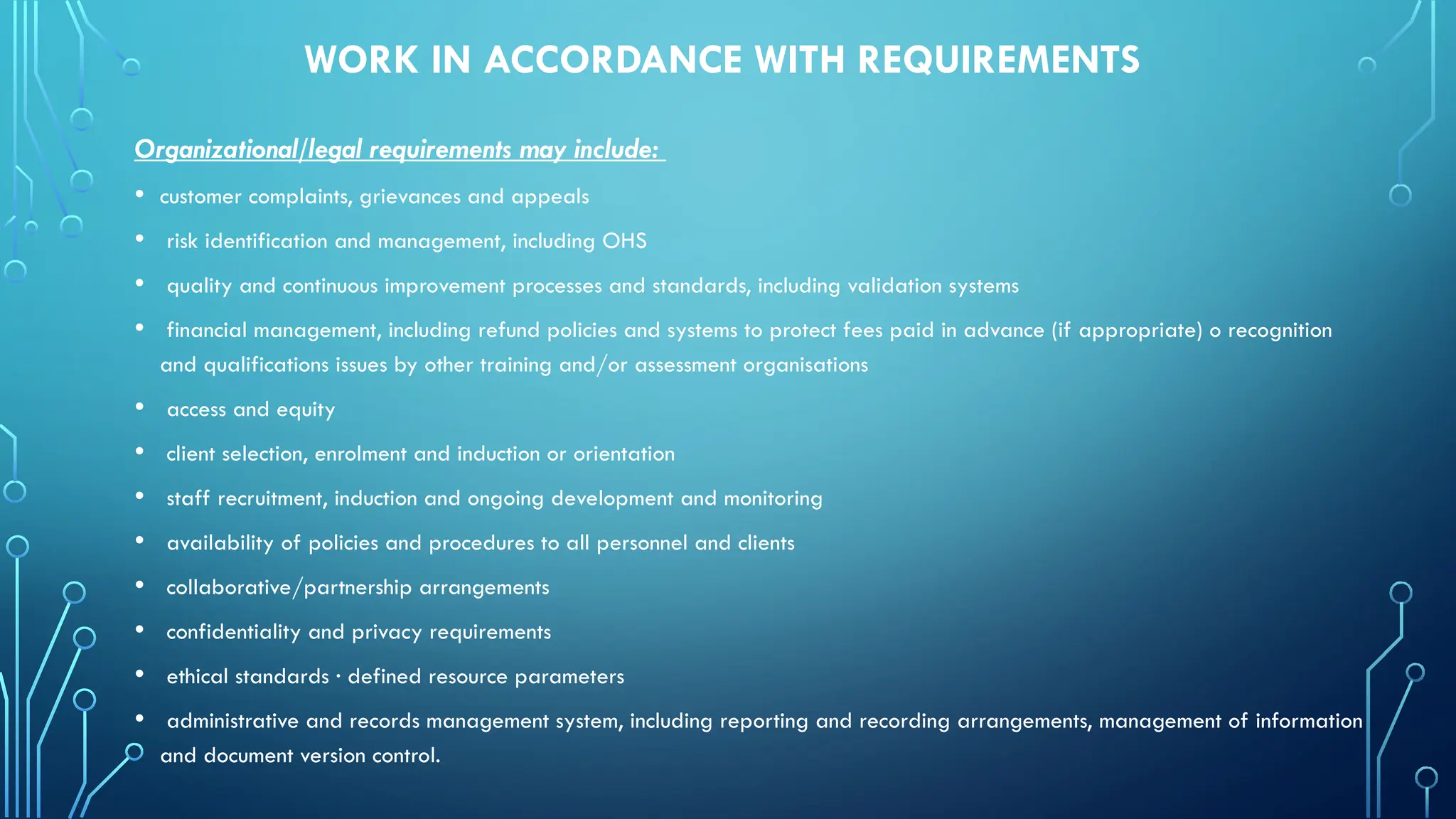
WORK IN ACCORDANCE WITH REQUIREMENTS
Organizational/legal requirements may include:
• customer complaints, grievances and appeals
• risk identification and management, including OHS
• quality and continuous improvement processes and standards, including validation systems
• financial management, including refund policies and systems to protect fees paid in advance (if appropriate) o recognition
and qualifications issues by other training and/or assessment organisations
• access and equity
• client selection, enrolment and induction or orientation
• staff recruitment, induction and ongoing development and monitoring
• availability of policies and procedures to all personnel and clients
• collaborative/partnership arrangements
• confidentiality and privacy requirements
• ethical standards · defined resource parameters
• administrative and records management system, including reporting and recording arrangements, management of information
and document version control.
SELF CHECK 1 MODEL HIGH STANDARDS OF PERFORMANCE
1. How do you model professional techniques and strategies?
2. What are the steps of modelling?
3. What are the aspects you may consider to analyze your
institutional goals and objectives?
4. List 5 organizational/legal requirements for a training institute.
2. DETERMINE PERSONAL DEVELOPMENT NEEDS
• Personal development is an ongoing process of improving oneself in various
aspects—whether it's professional skills, personal attributes, or knowledge.
Identifying personal development needs is a critical step in fostering growth,
improving performance, and achieving long-term career and life goals.
• Here’s a structured approach to help you identify your personal development
needs:
2.1 ASSESSING PERSONAL SKILLS AND KNOWLEDGE AGAINST
INDUSTRY COMPETENCIES AND OTHER RELEVANT BENCHMARKS
TO DETERMINE DEVELOPMENT NEEDS AND PRIORITIES
• Assessing your personal skills and knowledge against industry competencies and
other relevant benchmarks is a critical step in identifying areas for development
and aligning your career goals with industry standards. This process helps
ensure that your skills are up-to-date, competitive, and in line with the
expectations of employers, clients, and other stakeholders. By understanding
where your skills stand relative to industry benchmarks, you can create a
focused development plan that supports both your personal growth and career
advancement.
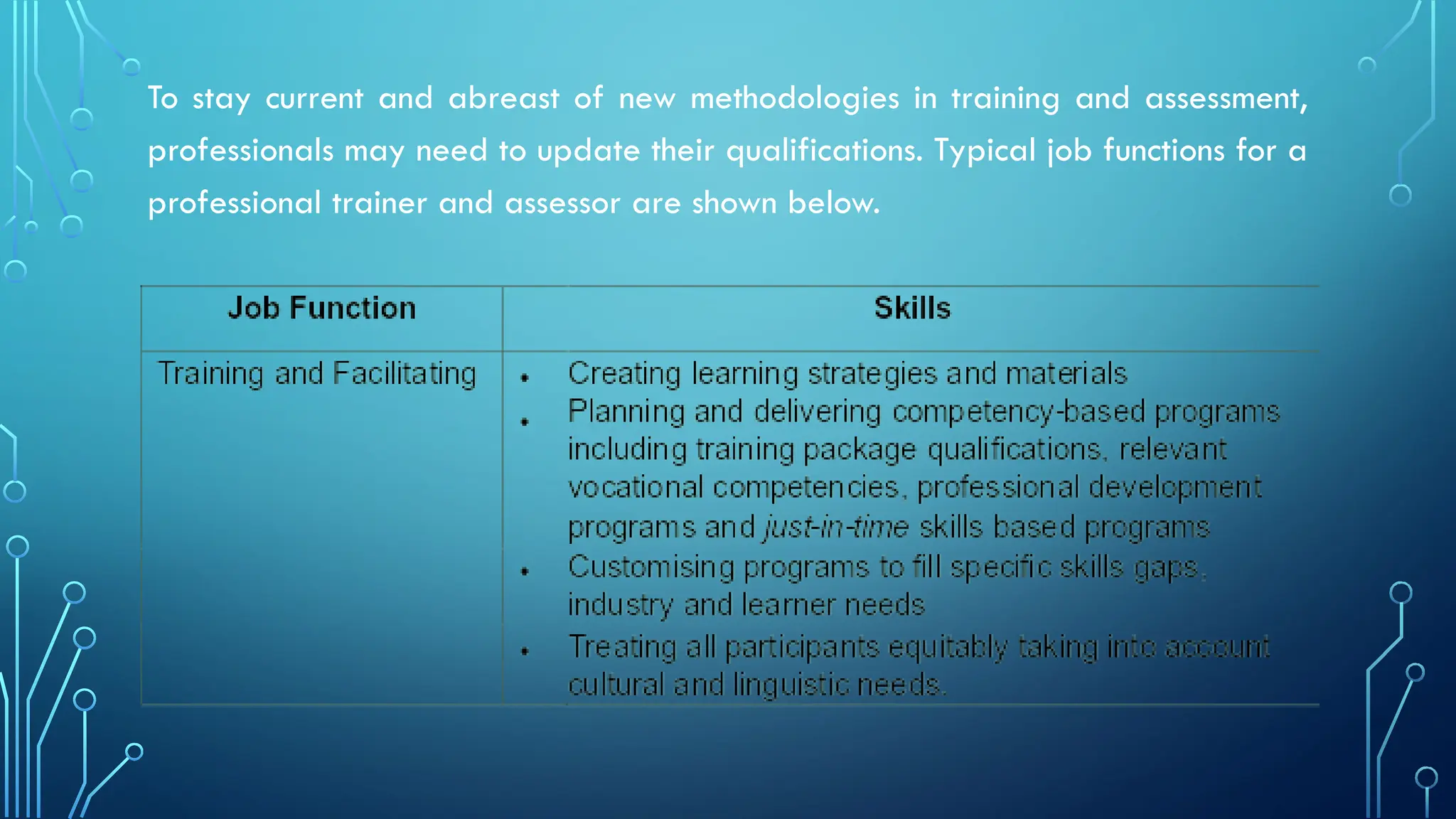
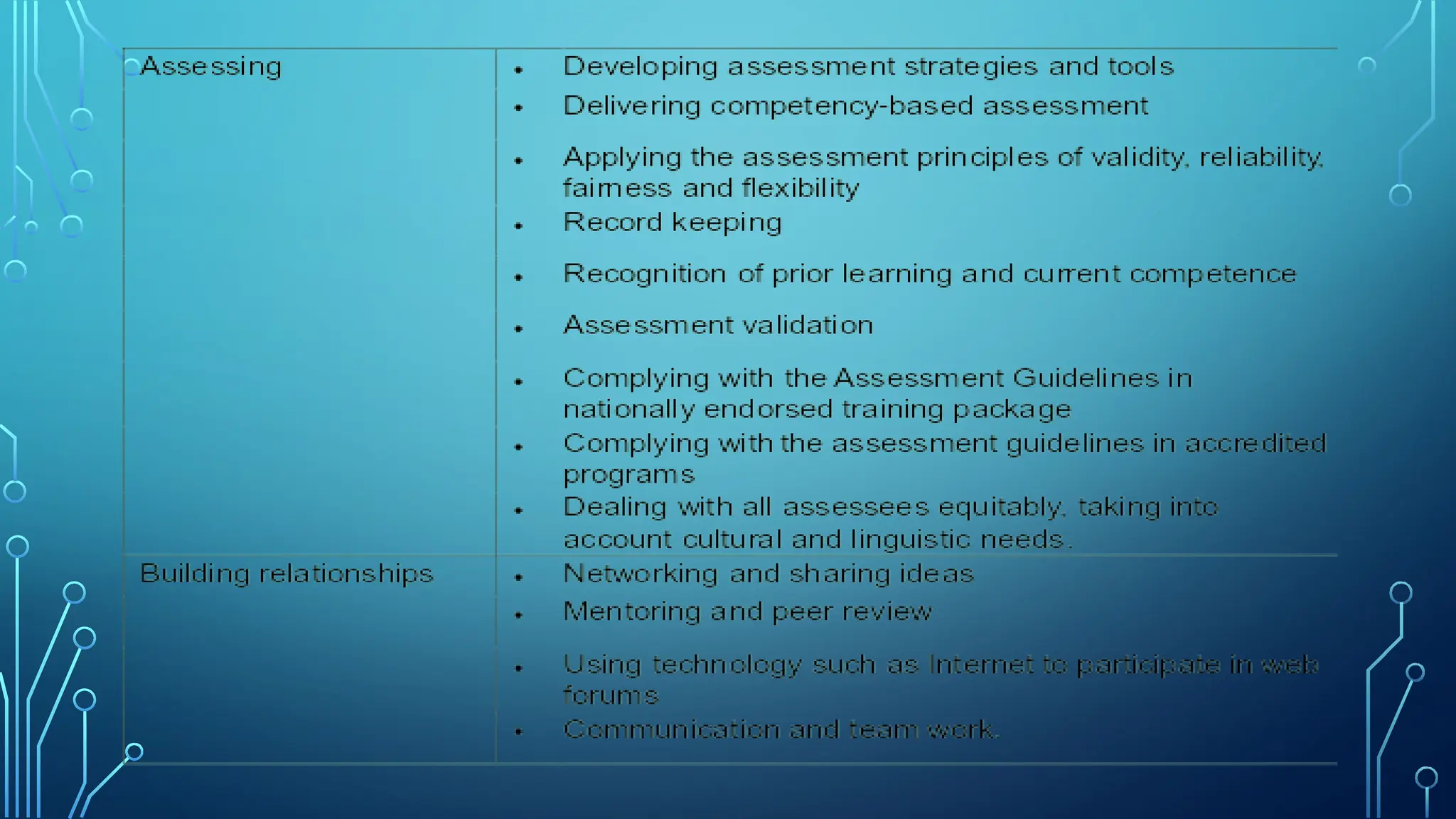
To stay current and abreast of new methodologies in training and assessment,
professionals may need to update their qualifications. Typical job functions for a
professional trainer and assessor are shown below.
2.2 IDENTIFYING FEEDBACK FROM COLLEAGUES & CLIENTS AND
PERSONAL LEARNING NEEDS FOR PROFESSIONAL DEVELOPMENT
Feedback may include:
• formal or informal performance appraisals
• obtaining comments from supervisors and colleagues
• obtaining comments from clients
• using personal reflective behavior strategies
• applying routine organizational methods for monitoring service delivery.
2.3 DEVELOPMENT AND TRENDS IMPACTING ON
PROFESSIONAL PRACTICE
Development and trends may include;
• new/revised Training Packages (may include National Competency
Standards, National Qualifications and Assessment Guidelines) in technical
and vocational area of expertise
• regulatory changes in vocational area of competency
• new developments/directions/trends in vocational education and training
• policy changes in vocational education and training
Personal Professional development plan refers to plan for each individual staff
member, outlining:
• identified skills gap if relevant
• work and personal career objectives
• identified areas requiring development
• learning opportunities/activities
• relevant work activities/projects
• links to organisational training needs
2.4 SEEKING ADVICE ON PERSONAL DEVELOPMENT
PLAN FROM RELEVANT PERSONNEL
EVALUATION AND FEEDBACK
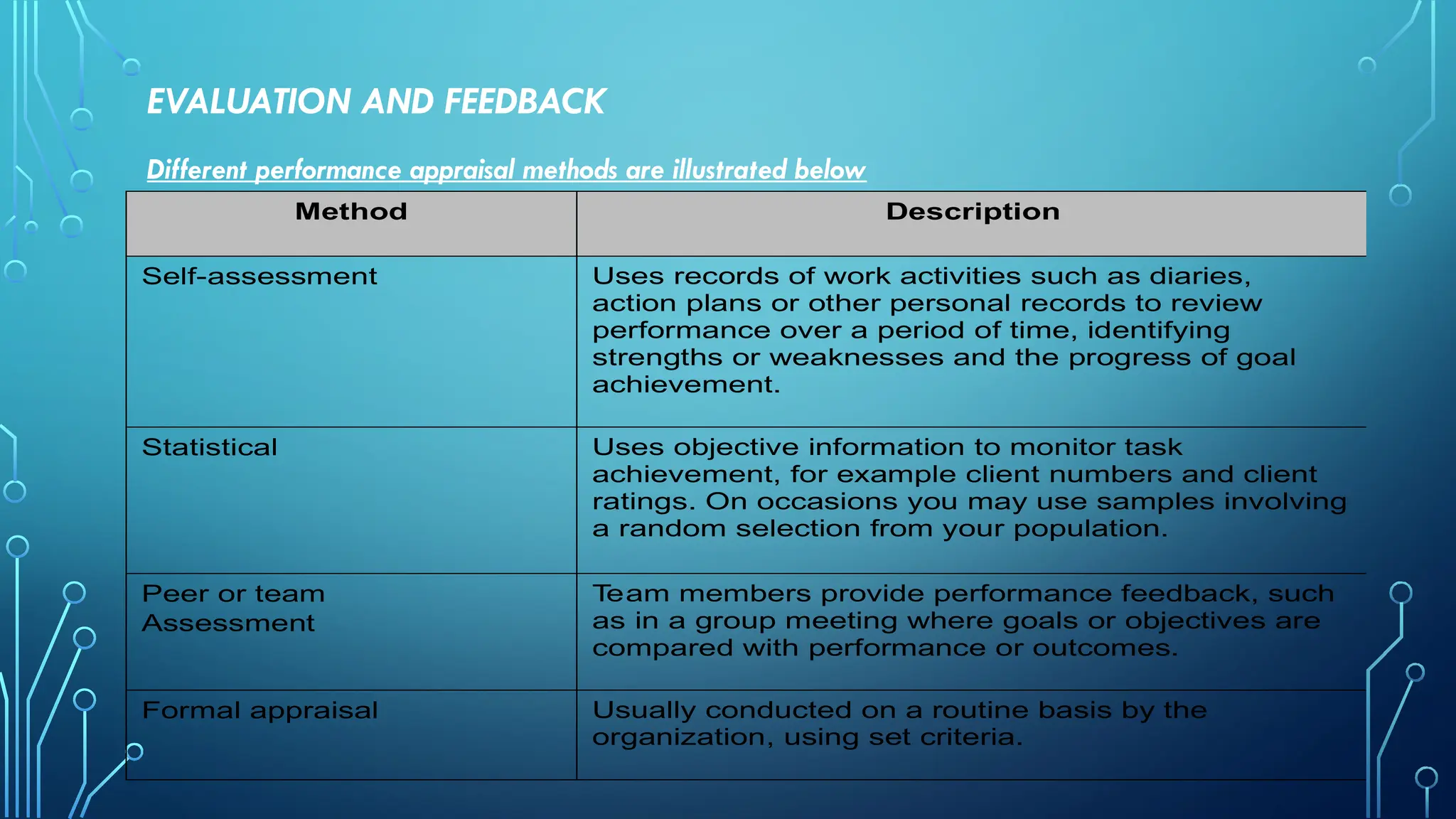
Different performance appraisal methods are illustrated below
Method Description
Self-assessment Uses records of work activities such as diaries,
action plans or other personal records to review
performance over a period of time, identifying
strengths or weaknesses and the progress of goal
achievement.
Statistical Uses objective information to monitor task
achievement, for example client numbers and client
ratings. On occasions you may use samples involving
a random selection from your population.
Peer or team
Assessment
T
eam members provide performance feedback, such
as in a group meeting where goals or objectives are
compared with performance or outcomes.
Formal appraisal Usually conducted on a routine basis by the
organization, using set criteria.
Tip: if you are asked to give feedback to someone else, make sure it
is an honest, informed opinion without any hidden agenda. Aim to:
• be tactful
• identify specific issues or actions rather than criticizing the person
• provide the feedback in private and maintain confidentiality
• build the others’ self-esteem
• only offer further advice if it is asked for.
DEVELOPING SMART GOALS
SMART goals are:
S- Specific.
M- Measurable.
A- Achievable. You shouldn’t place unrealistic demands on yourself, and remember
to take account of other demands on your time and factors that may affect
achievement.
R- Relevant/Realistic. Any goal should be aligned with your individual
responsibilities and accountabilities as well as your own aspirations.
T- Time-referenced. Time limits help with the measurement of the goal’s progress.
DEVELOP A PERSONAL PROFESSIONAL SKILL DEVELOPMENT PLAN
A Personal Professional Skill Development Plan outlines:
• Career goals
• Competencies to be developed
• Learning strategies and location
• Required resources
• Time frame
• Evidence of competency
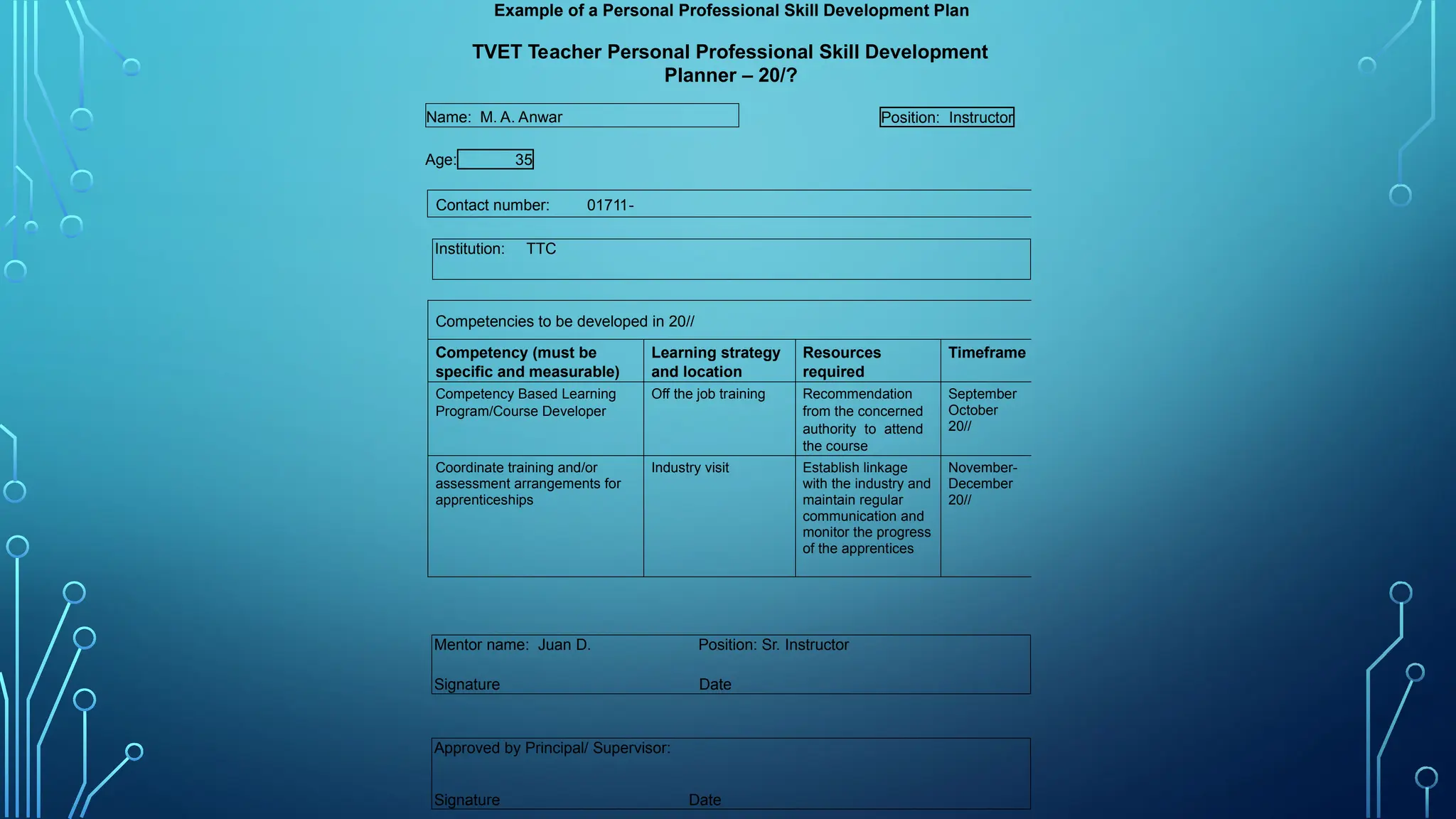
Example of a Personal Professional Skill Development Plan
TVET Teacher Personal Professional Skill Development
Planner – 20/?
Position: Instructor
Age: 35
Contact number: 01711-
Institution: TTC
Competencies to be developed in 20//
Competency (must be
specific and measurable)
Learning strategy
and location
Resources
required
Timeframe
Competency Based Learning
Program/Course Developer
Off the job training Recommendation
from the concerned
authority to attend
the course
September
October
20//
Coordinate training and/or
assessment arrangements for
apprenticeships
Industry visit Establish linkage
with the industry and
maintain regular
communication and
monitor the progress
of the apprentices
November-
December
20//
Mentor name: Juan D. Position: Sr. Instructor
Signature Date
Approved by Principal/ Supervisor:
Signature Date
Name: M. A. Anwar
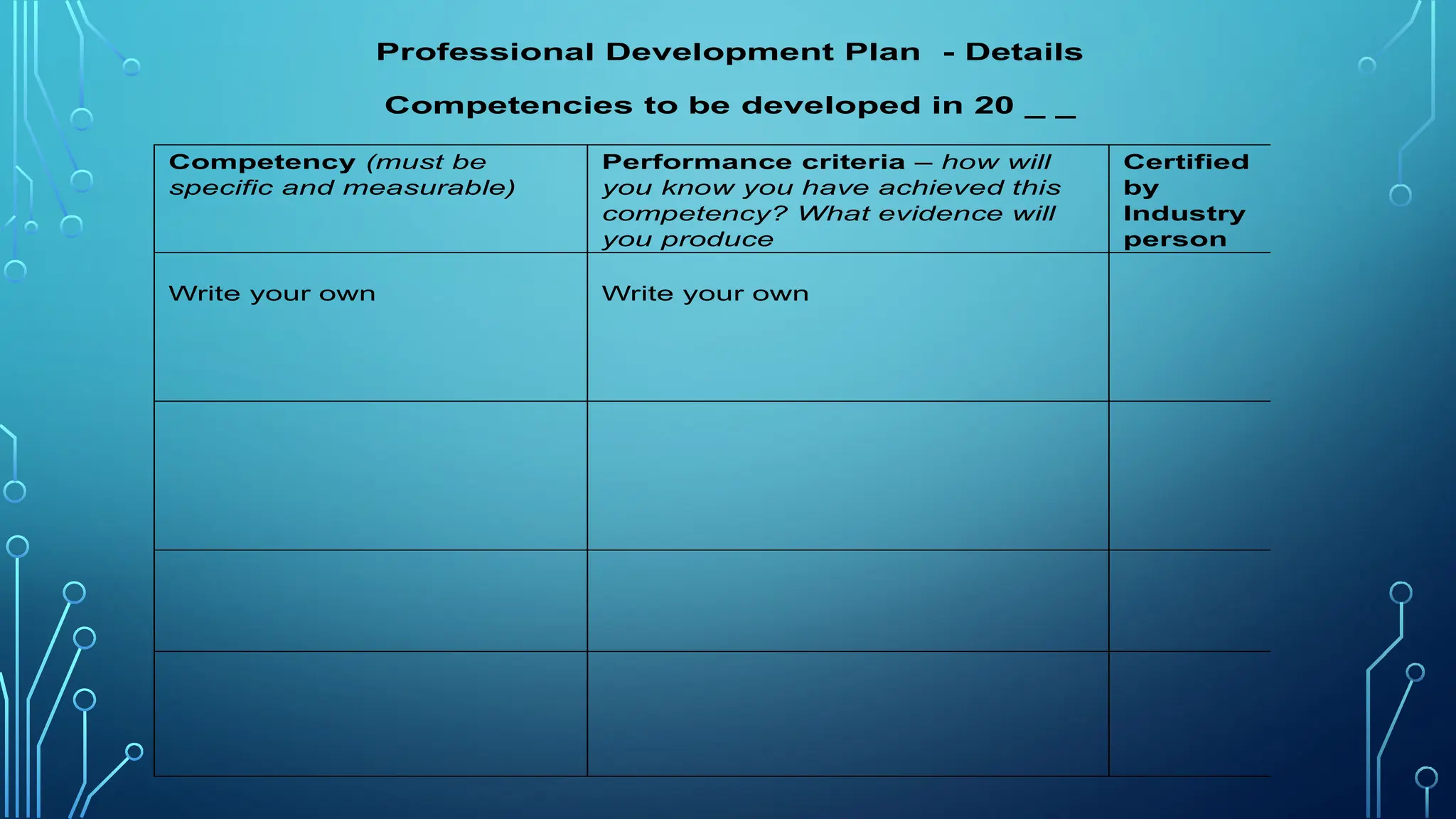
Professional Development Plan - Details
Competencies to be developed in 20 _ _
Competency (must be
specific and measurable)
Performance criteria – how will
you know you have achieved this
competency? What evidence will
you produce
Certified
by
Industry
person
Write your own Write your own
SELF CHECK NO: 2 DETERMINE PERSONAL
DEVELOPMENT NEEDS
1. How will you assess your current skills and determine the skills you may need
to develop?
2. What are the sources of getting feedback on your performance?
3. What are the developments and trends that can impact on professional
practice?
4. Who can approve your personal development plan?
5. How do you develop a Professional Development Plan?
3. PARTICIPATE IN PROFESSIONAL DEVELOPMENT
ACTIVITIES
• Professional development is a continuous process of learning, growth, and skill
enhancement that helps individuals stay competitive, improve job performance,
and achieve career goals. Participating in professional development activities
is essential for long-term success, as it allows you to expand your knowledge,
refine skills, and adapt to evolving industry demands.
• Here's a guide to help you navigate and maximize participation in
professional development activities.
3.1 IDENTIFYING DEVELOPMENT OPPORTUNITIES TO SUPPORT CONTINUOUS
LEARNING AND MAINTAIN CURRENCY OF PROFESSIONAL PRACTICE
Development opportunities may include:
• undertaking further higher education/TVET qualification participating in skills gap training
• industry attachment
• undertaking professional development in specific areas of practice
• internal training/development programs
• relevant conferences, seminars and workshops
• reading relevant journals and literature
• networking with internal/external colleagues
• coaching and/or mentoring
SOME WAYS TO PROFESSIONAL DEVELOPMENT
1. Professional Development through Mentoring
2. Professional Development through In-Service Training and Study
3. Professional Development through industry visit
4. Professional Development through Working with Other Teachers
5. Continuous Learning
6. Maintaining Currency
Currency of professional practice may include:
 vocational competency and/or technical expertise in subject matter
 professional practice as a trainer/facilitator, assessor
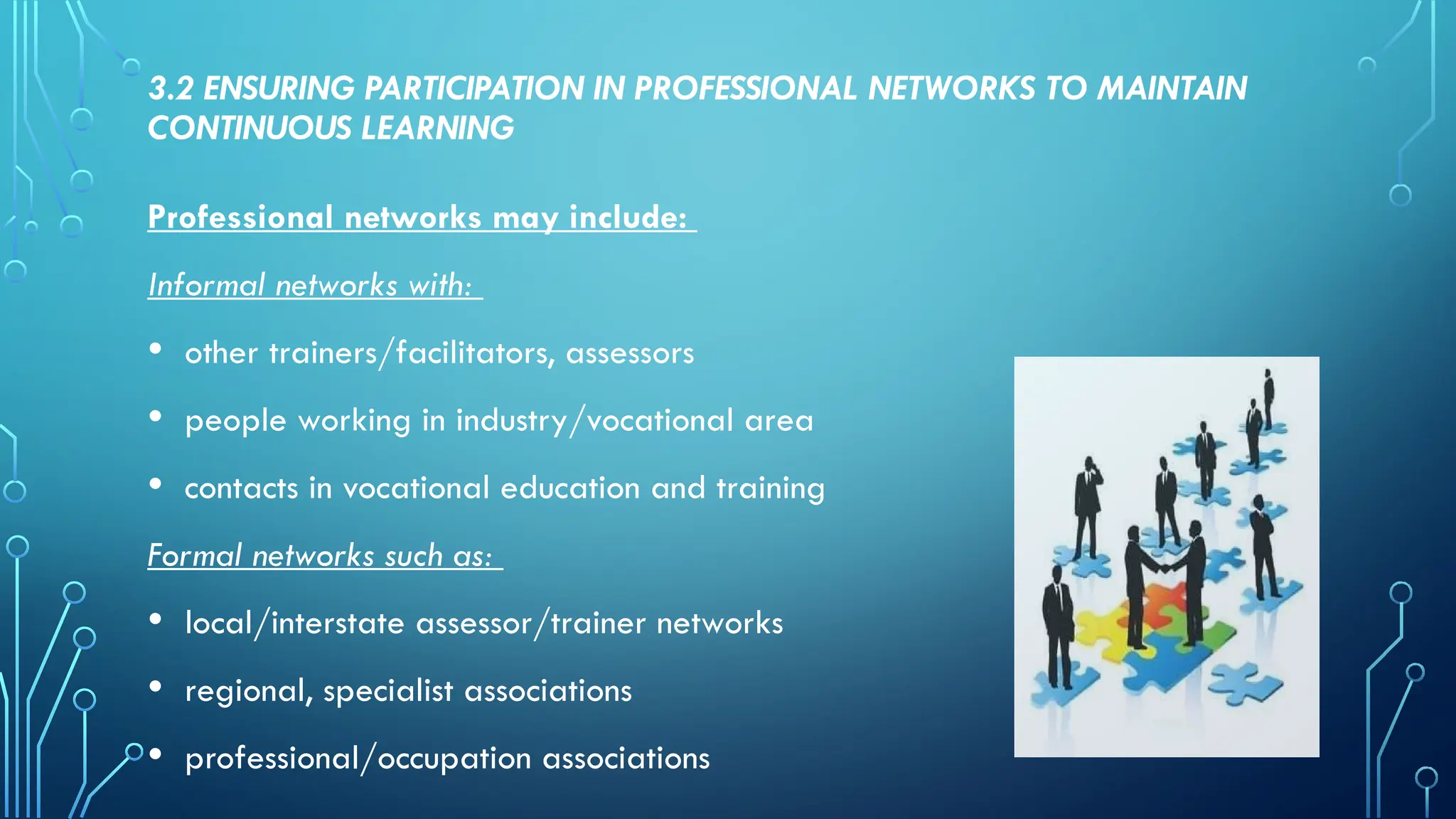
3.2 ENSURING PARTICIPATION IN PROFESSIONAL NETWORKS TO MAINTAIN
CONTINUOUS LEARNING
Professional networks may include:
Informal networks with:
• other trainers/facilitators, assessors
• people working in industry/vocational area
• contacts in vocational education and training
Formal networks such as:
• local/interstate assessor/trainer networks
• regional, specialist associations
• professional/occupation associations
SELF CHECK 3 PARTICIPATE IN PROFESSIONAL
DEVELOPMENT ACTIVITIES
1.What are the development opportunities that support
continuous learning?
2.. What are the some ways to professional development?
MAINTAIN AND ENHANCE PROFESSIONAL PTRACTICES
1. Model high standards of performance
1.1 Appropriate professional techniques and strategies are modelled for effective
performance.
1.2 Individual responsibilities and accountabilities are reflected in personal work goals
and plans in accordance with organizational and legal requirements.
2. Determine personal development needs
2.1 Personal skills and knowledge are assessed against industry competencies and
other relevant benchmarks to determine development needs and priorities.
2.2 Feedback from colleagues and clients are identified and used for personal learning
needs and areas of professional development.
2.3 Development and trends in TVET policy and operating environment are identified
and their impact on the professional practices and personal development are
determined.
2.4 Advice on personal development plan is sought from relevant personnel.
Participate in professional development activities
3.1 Development opportunities suitable to personal learning style are identified and
pursued to support continuous learning and maintain currency of professional
practice.
3.2 Participation in professional networks is ensured and maintained to support
continuous learning.
Unit 9 - Enhance professional practice..

Unit 9 - Enhance professional practice..

  • 1.
    UNIT 9 Maintain andEnhance Professional Practice By: Jerick Salaguban
  • 2.
    INTRODUCTION • In anyfield, maintaining and enhancing professional practices is essential to ensure ongoing growth, competence, and success. Professional practices refer to the standards, behaviors, and skills that define an individual’s effectiveness and ethical conduct within their occupation. These practices are not static; they evolve over time due to advancements in knowledge, technology, and industry expectations. • To maintain and enhance professional practices, individuals must engage in continuous learning, reflect on their performance, adapt to new trends and innovations, and demonstrate ethical behavior. This process not only improves personal effectiveness but also contributes to the broader goals and standards of the profession.
  • 3.
    1. MODEL HIGHSTANDARDS OF PERFORMANCE • To ensure inspired learning in every classroom in every technical training schools/centers, teachers/trainers need to develop and maintain their professional practice. Quality professional learning leads to improved teaching practice and improved trainee outcomes.
  • 4.
    1.1 MODELLING APPROPRIATEPROFESSIONAL TECHNIQUES AND STRATEGIES FOR EFFECTIVE PERFORMANCE • To achieve a high standard of work performance, you must first determine what that standard might be. The most effective way to do this is by modelling. • You can do this by ensuring your performance is consistent with the institution’s goals and objectives, modelling professional techniques and strategies, making appropriate personal work goals and plans, and applying ethical and inclusive practices.
  • 5.
    ANALYZE YOUR INSTITUTION’SGOALS AND OBJECTIVES Goals and objectives may be related to all aspects of an institution, or just some. They may be related to: • strategic plans • operational plans • codes of conduct • flexibility and client responsiveness • client satisfaction • financial performance • people management • marketing and client service • quality and quality assurance
  • 6.
    MODEL PROFESSIONAL TECHNIQUESAND STRATEGIES Professional techniques and strategies in which you may need to become more proficient can include: • techniques for initiating action and directing decision making • strategies for presenting a confident and assured manner in challenging situations • maintaining ethical practice in the face of opposition • modelling behavioral and personal presentation standards • motivation strategies • time management • strategies for acknowledging and respecting the attitudes and beliefs of others • techniques for promoting active participation.
  • 7.
    Example of ModellingAn effective way to address performance issues is to: • identify strategies that work • model these strategies The strategies that work may come from: • books • training courses • colleagues • participation in networks • experts in your field • open and ongoing communication with colleagues.
  • 8.
    •Five Step processof modeling: 1. Select a model of excellence. Determine what outcomes you would like to achieve, by when. 2. Observe and ideally record the model via video or other medium. 3. Practice the skill until the same set of responses is received. 4. Using video or other medium, test your skill against the model. 5. Teach (transfer) the skill to someone else.
  • 9.
    1.2 REFLECTING INDIVIDUALRESPONSIBILITIES AND ACCOUNTABILITIES ARE IN PERSONAL WORK GOALS AND PLANS IN ACCORDANCE WITH ORGANIZATIONAL/ LEGAL REQUIREMENTS • In any professional setting, aligning personal work goals with organizational and legal requirements is critical to ensuring not only personal success but also compliance and ethical responsibility within the broader framework of the organization. Personal work goals and plans should be developed with a clear understanding of individual responsibilities and accountabilities, particularly in relation to the organization’s objectives, legal obligations, and professional standards.
  • 10.
    WORK IN ACCORDANCEWITH REQUIREMENTS Organizational/legal requirements may include: • customer complaints, grievances and appeals • risk identification and management, including OHS • quality and continuous improvement processes and standards, including validation systems • financial management, including refund policies and systems to protect fees paid in advance (if appropriate) o recognition and qualifications issues by other training and/or assessment organisations • access and equity • client selection, enrolment and induction or orientation • staff recruitment, induction and ongoing development and monitoring • availability of policies and procedures to all personnel and clients • collaborative/partnership arrangements • confidentiality and privacy requirements • ethical standards · defined resource parameters • administrative and records management system, including reporting and recording arrangements, management of information and document version control.
  • 11.
    SELF CHECK 1MODEL HIGH STANDARDS OF PERFORMANCE 1. How do you model professional techniques and strategies? 2. What are the steps of modelling? 3. What are the aspects you may consider to analyze your institutional goals and objectives? 4. List 5 organizational/legal requirements for a training institute.
  • 13.
    2. DETERMINE PERSONALDEVELOPMENT NEEDS • Personal development is an ongoing process of improving oneself in various aspects—whether it's professional skills, personal attributes, or knowledge. Identifying personal development needs is a critical step in fostering growth, improving performance, and achieving long-term career and life goals. • Here’s a structured approach to help you identify your personal development needs:
  • 14.
    2.1 ASSESSING PERSONALSKILLS AND KNOWLEDGE AGAINST INDUSTRY COMPETENCIES AND OTHER RELEVANT BENCHMARKS TO DETERMINE DEVELOPMENT NEEDS AND PRIORITIES • Assessing your personal skills and knowledge against industry competencies and other relevant benchmarks is a critical step in identifying areas for development and aligning your career goals with industry standards. This process helps ensure that your skills are up-to-date, competitive, and in line with the expectations of employers, clients, and other stakeholders. By understanding where your skills stand relative to industry benchmarks, you can create a focused development plan that supports both your personal growth and career advancement.
  • 15.
    To stay currentand abreast of new methodologies in training and assessment, professionals may need to update their qualifications. Typical job functions for a professional trainer and assessor are shown below.
  • 18.
    2.2 IDENTIFYING FEEDBACKFROM COLLEAGUES & CLIENTS AND PERSONAL LEARNING NEEDS FOR PROFESSIONAL DEVELOPMENT Feedback may include: • formal or informal performance appraisals • obtaining comments from supervisors and colleagues • obtaining comments from clients • using personal reflective behavior strategies • applying routine organizational methods for monitoring service delivery.
  • 19.
    2.3 DEVELOPMENT ANDTRENDS IMPACTING ON PROFESSIONAL PRACTICE Development and trends may include; • new/revised Training Packages (may include National Competency Standards, National Qualifications and Assessment Guidelines) in technical and vocational area of expertise • regulatory changes in vocational area of competency • new developments/directions/trends in vocational education and training • policy changes in vocational education and training
  • 20.
    Personal Professional developmentplan refers to plan for each individual staff member, outlining: • identified skills gap if relevant • work and personal career objectives • identified areas requiring development • learning opportunities/activities • relevant work activities/projects • links to organisational training needs 2.4 SEEKING ADVICE ON PERSONAL DEVELOPMENT PLAN FROM RELEVANT PERSONNEL
  • 21.
    EVALUATION AND FEEDBACK Differentperformance appraisal methods are illustrated below Method Description Self-assessment Uses records of work activities such as diaries, action plans or other personal records to review performance over a period of time, identifying strengths or weaknesses and the progress of goal achievement. Statistical Uses objective information to monitor task achievement, for example client numbers and client ratings. On occasions you may use samples involving a random selection from your population. Peer or team Assessment T eam members provide performance feedback, such as in a group meeting where goals or objectives are compared with performance or outcomes. Formal appraisal Usually conducted on a routine basis by the organization, using set criteria.
  • 22.
    Tip: if youare asked to give feedback to someone else, make sure it is an honest, informed opinion without any hidden agenda. Aim to: • be tactful • identify specific issues or actions rather than criticizing the person • provide the feedback in private and maintain confidentiality • build the others’ self-esteem • only offer further advice if it is asked for.
  • 23.
    DEVELOPING SMART GOALS SMARTgoals are: S- Specific. M- Measurable. A- Achievable. You shouldn’t place unrealistic demands on yourself, and remember to take account of other demands on your time and factors that may affect achievement. R- Relevant/Realistic. Any goal should be aligned with your individual responsibilities and accountabilities as well as your own aspirations. T- Time-referenced. Time limits help with the measurement of the goal’s progress.
  • 24.
    DEVELOP A PERSONALPROFESSIONAL SKILL DEVELOPMENT PLAN A Personal Professional Skill Development Plan outlines: • Career goals • Competencies to be developed • Learning strategies and location • Required resources • Time frame • Evidence of competency
  • 25.
    Example of aPersonal Professional Skill Development Plan TVET Teacher Personal Professional Skill Development Planner – 20/? Position: Instructor Age: 35 Contact number: 01711- Institution: TTC Competencies to be developed in 20// Competency (must be specific and measurable) Learning strategy and location Resources required Timeframe Competency Based Learning Program/Course Developer Off the job training Recommendation from the concerned authority to attend the course September October 20// Coordinate training and/or assessment arrangements for apprenticeships Industry visit Establish linkage with the industry and maintain regular communication and monitor the progress of the apprentices November- December 20// Mentor name: Juan D. Position: Sr. Instructor Signature Date Approved by Principal/ Supervisor: Signature Date Name: M. A. Anwar
  • 26.
    Professional Development Plan- Details Competencies to be developed in 20 _ _ Competency (must be specific and measurable) Performance criteria – how will you know you have achieved this competency? What evidence will you produce Certified by Industry person Write your own Write your own
  • 27.
    SELF CHECK NO:2 DETERMINE PERSONAL DEVELOPMENT NEEDS 1. How will you assess your current skills and determine the skills you may need to develop? 2. What are the sources of getting feedback on your performance? 3. What are the developments and trends that can impact on professional practice? 4. Who can approve your personal development plan? 5. How do you develop a Professional Development Plan?
  • 29.
    3. PARTICIPATE INPROFESSIONAL DEVELOPMENT ACTIVITIES • Professional development is a continuous process of learning, growth, and skill enhancement that helps individuals stay competitive, improve job performance, and achieve career goals. Participating in professional development activities is essential for long-term success, as it allows you to expand your knowledge, refine skills, and adapt to evolving industry demands. • Here's a guide to help you navigate and maximize participation in professional development activities.
  • 30.
    3.1 IDENTIFYING DEVELOPMENTOPPORTUNITIES TO SUPPORT CONTINUOUS LEARNING AND MAINTAIN CURRENCY OF PROFESSIONAL PRACTICE Development opportunities may include: • undertaking further higher education/TVET qualification participating in skills gap training • industry attachment • undertaking professional development in specific areas of practice • internal training/development programs • relevant conferences, seminars and workshops • reading relevant journals and literature • networking with internal/external colleagues • coaching and/or mentoring
  • 31.
    SOME WAYS TOPROFESSIONAL DEVELOPMENT 1. Professional Development through Mentoring 2. Professional Development through In-Service Training and Study 3. Professional Development through industry visit 4. Professional Development through Working with Other Teachers 5. Continuous Learning 6. Maintaining Currency Currency of professional practice may include:  vocational competency and/or technical expertise in subject matter  professional practice as a trainer/facilitator, assessor
  • 32.
    3.2 ENSURING PARTICIPATIONIN PROFESSIONAL NETWORKS TO MAINTAIN CONTINUOUS LEARNING Professional networks may include: Informal networks with: • other trainers/facilitators, assessors • people working in industry/vocational area • contacts in vocational education and training Formal networks such as: • local/interstate assessor/trainer networks • regional, specialist associations • professional/occupation associations
  • 33.
    SELF CHECK 3PARTICIPATE IN PROFESSIONAL DEVELOPMENT ACTIVITIES 1.What are the development opportunities that support continuous learning? 2.. What are the some ways to professional development?
  • 35.
    MAINTAIN AND ENHANCEPROFESSIONAL PTRACTICES 1. Model high standards of performance 1.1 Appropriate professional techniques and strategies are modelled for effective performance. 1.2 Individual responsibilities and accountabilities are reflected in personal work goals and plans in accordance with organizational and legal requirements. 2. Determine personal development needs 2.1 Personal skills and knowledge are assessed against industry competencies and other relevant benchmarks to determine development needs and priorities. 2.2 Feedback from colleagues and clients are identified and used for personal learning needs and areas of professional development. 2.3 Development and trends in TVET policy and operating environment are identified and their impact on the professional practices and personal development are determined. 2.4 Advice on personal development plan is sought from relevant personnel. Participate in professional development activities 3.1 Development opportunities suitable to personal learning style are identified and pursued to support continuous learning and maintain currency of professional practice. 3.2 Participation in professional networks is ensured and maintained to support continuous learning.