UNIT I: MATTER:ORIGIN, STRUCTURE,
PROPERTIES, AND APPLICATION
• CHEMISTRY- study of matter.
Objective:
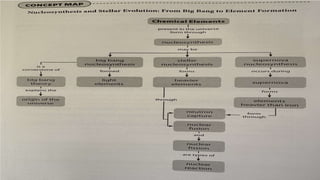
1. Explain the formation of light and heavy elements in the
context of primordial and stellar nucleosynthesis.
3.
ORIGIN AND FORMATIONOF THE
ELEMENTS
Have you ever
wonder, what is the
purpose of stars?
Big Bang Theoryprovides
an explanation for the
formation of light elements,
which later evolved into
heavier elements through
stellar evolution.
6.
Take note:
•Big BangTheory- is not a theory
about the origin of the universe
rather, it is a description or model
of the early universe- Foundations of
Big Bang Cosmology, National
Aeronautics and Space Administration
(NASA)
7.
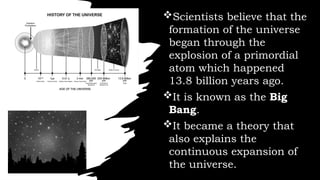
Scientists believe thatthe
formation of the universe
began through the
explosion of a primordial
atom which happened
13.8 billion years ago.
It is known as the Big
Bang.
It became a theory that
also explains the
continuous expansion of
the universe.
8.
Key Questions:
1. Whichelements emerged from the
primordial nucleosynthesis?
2. Which elements emerged from stellar
nucleosynthesis?
3. How do elements heavier than iron
formed?
4. What principles are observed in writing
nuclear equations?
9.
Pre-test. True orFalse.
1. The big bang theory explains how the stars formed in the
early universe.
2. The universe was once compact and has continuously
expanded through time.
3. Heavy elements, such as neon and magnesium, were
produced during the big bang.
4. Nuclear fusion is the reaction through which light nuclei
combine to form a heavy nucleus.
5. Energy may be released during element formation in the
universe.
11.
•Elements that composematter
originated in the early universe.
•Light Elements- formed from the
interaction between and among the
particles that compose the universe
during the big bang.
•Heavy Elements- produced during
star formation and evolution.
12.
LESSON 1: THEORIGIN OF THE LIGHT ELEMENTS
Key Question: Which Elements emerged from the primordial nucleosynthesis?
The Big Bang Theory
• Big bang theory- most popular attempt to describe
the early universe.
• It was first proposed by Abbe Georges Edouard
Lemaitre (1894-1966). (The theory was not named by
him).
• The big bang postulates that the universe emerged
from a state of enormous density and energy.
• Fred Hoyle (1949) a British Astronomer- named the
theory “big bang”
13.
•The theory wasmade in response
to Einstein’s work.
•In 1917, Albert Einstein proposed
that the universe is spatially
bound (finite) static, spherical,
perfectly symmetric cosmos, with
matter homogeneously
distributed everywhere
14.
•In 1927, Lemaitreargued that Einstein’s model
was not physically realistic. Since, slight
variation on homogeneity would result in a
loss in equilibriums resulting into expansion or
contraction
•Lemaitre published a paper stating the
universe is constantly expanding and cooling,
it was not a static universe as Einstein
previously described.
15.
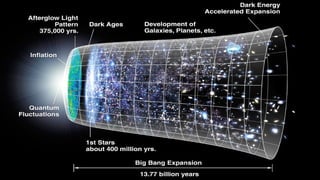
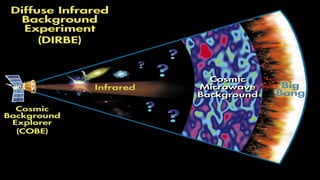
3 Key ObservationalEvidences support
the Big Bang Model
1.Hubble or Cosmic Expansion
2.Cosmic Microwave Background
(CMB)
3.Primordial or Big Bang
Nucleosynthesis. (BBN)
17.
• By theearly 1930s, American astronomer Edwin Hubble
made a major discovery at Mount Wilson Observatory in
California, USA.
• Using the 100-inch Hooker Telescope, had identified
Cepheids in a numerous spiral nebulae called galaxies
including the Andromeda Nebula.
• Cepeids- class of variable stars
• This led discovery of other galaxies
• Edwin Hubble and his Assistant, Milton Humason,
formulated Hubble’s Law or Hubble Expansion.
• States that, other galaxies are moving away relative to the
milky way at a rate proportional to distance.
19.
•The first fewminutes after the big
bang, nuclear reaction occurred due
to high temperature of the universe.
•This reaction began with the fusion of
protons and neutrons. Forming nuclei
in the process of NUCLEOSYNTHESIS.
•PRIMORDIAL or BIG BANG
NUCLEOSYNTHESIS- formed the light
elements.
20.
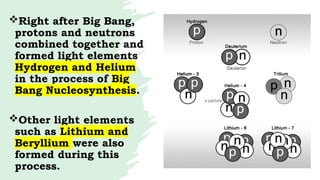
LIGHT ELEMENTS
• IncludeHydrogen Isotopes PROTIUM or HYDROGEN-1,
Deuterium- Hydrogen-2, Helium-3, Helium-4 and Lithium-7
• Isotopes are atom of an element with different number of
neutrons.
Can be represented in 3 ways.
1,2. Write the name or symbol of the element, followed by a
dash and its mass number. Ex: Hydrogen-1, H-1
3. Write the symbol of the element and place its mass
number and atomic number as left superscript and
subscript, respectively.
21.
Right after BigBang,
protons and neutrons
combined together and
formed light elements
Hydrogen and Helium
in the process of Big
Bang Nucleosynthesis.
Other light elements
such as Lithium and
Beryllium were also
formed during this
process.
22.
Stellar
Nucleosynthesi
s
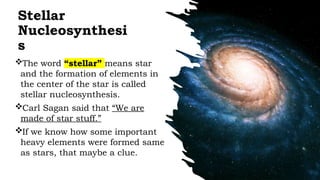
The word “stellar”means star
and the formation of elements in
the center of the star is called
stellar nucleosynthesis.
Carl Sagan said that “We are
made of star stuff.”
If we know how some important
heavy elements were formed same
as stars, that maybe a clue.
23.
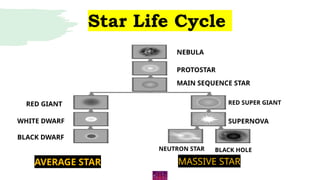
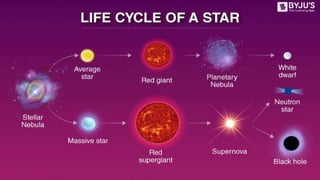
Star Life Cycle
AverageStar
The star is unable to generate heat when it runs out of hydrogen
in its core leading to its contraction and expansion. It cools down
and glows red. The Helium fused into Carbon. The star is now
RED GIANT .
Red giant star becomes exhausted of nuclear fuel, the outer
material is blown off into space leaving the inert Carbon. The
remnant is known as WHITE DWARF.
Giant cloud of gas and dust known as NEBULA.
It is formed from nebula due to the gravity that pulled Hydrogen
gas together until it spins faster and faster and becomes ignited. A
PROTOSTAR rises.
24.
Star Life Cycle
MAIN SEQUENCE STAR starts to form when
nuclear fusion occurs at the core of the star, it
begins to contract, glow and become stable.
Hydrogen is converted into Helium.
This is said to be the remain of the white dwarf
that cooled down and no longer emits light and
heat. The hypothetical BLACK DWARF.
25.
Star Life Cycle
Massivestar
It is believed that a NEUTRON STAR is
formed from supernova explosion. This is
also the smallest star
Explosion of star or SUPERNOVA releases
large amount of energy. Because of that,
elements are dispersed into the space.
26.
Star Life Cycle
Massivestar
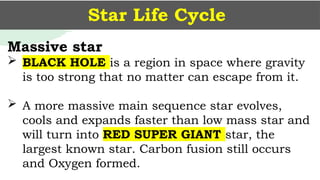
BLACK HOLE is a region in space where gravity
is too strong that no matter can escape from it.
A more massive main sequence star evolves,
cools and expands faster than low mass star and
will turn into RED SUPER GIANT star, the
largest known star. Carbon fusion still occurs
and Oxygen formed.
27.
Star Life Cycle
NEBULA
REDGIANT
MAIN SEQUENCE STAR
PROTOSTAR
NEUTRON STAR
BLACK DWARF
WHITE DWARF
RED SUPER GIANT
SUPERNOVA
BLACK HOLE
MASSIVE STAR
AVERAGE STAR
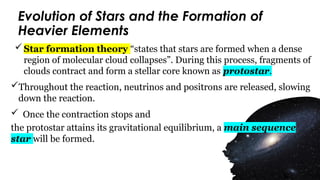
Evolution of Starsand the Formation of
Heavier Elements
Star formation theory “states that stars are formed when a dense
region of molecular cloud collapses”. During this process, fragments of
clouds contract and form a stellar core known as protostar.
Throughout the reaction, neutrinos and positrons are released, slowing
down the reaction.
Once the contraction stops and
the protostar attains its gravitational equilibrium, a main sequence
star will be formed.
31.
Evolution of Starsand the Formation of
Heavier Elements
The gravitational force of a main sequence star forces
hydrogen and helium to fuse resulting to burning of the 2
primordial elements.
At this stage, helium is converted to carbon at the core while
hydrogen is converted into helium surrounding the core
which denotes the formation of red giant.
32.
Evolution of Starsand the Formation of
Heavier Elements
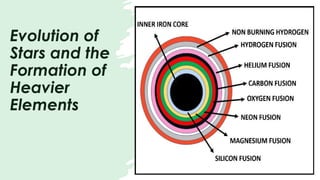
On the other hand, since massive stars possess
enough energy, mass, temperature, and pressure, the
star will undergo a series of stages where heavier
elements are fused around the shell of the core
whereas carbon will be formed through helium fusion,
neon will be formed through oxygen fusion,
magnesium from neon fusion, silicon from magnesium
fusion, and iron from silicon fusion which denotes the
formation of red giant.
33.
Evolution of Starsand the Formation of
Heavier Elements
Considering that the majority of helium surrounding
the core has been converted into carbon, the rate of
reaction will decrease causing the gravitational force to
act squeezing the entire star. With low mass stars,
considering that the amount of energy is not enough to
sustain the reaction, and that the star’s fuel has been
exhausted, the outer material covering the star will
eventually be blown-off leaving an inert carbon core
resulting to the formation of white dwarf.
Evolution of Starsand the Formation of
Heavier Elements
The first 3 minutes of Big Bang focused primarily on
the expansion and cooling of universe so as to the
synthesis of the first three elements. On the other
hand, the second cosmological event is Stellar
nucleosynthesis, a process in which heavier elements
such as Beryllium (4Be) and Iron (26Fe) were formed
by combining protons and neutrons from the nuclei of
a lighter elements.
36.
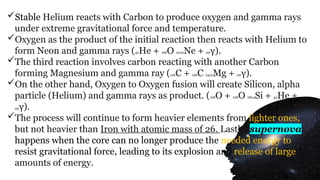
Stable Helium reactswith Carbon to produce oxygen and gamma rays
under extreme gravitational force and temperature.
Oxygen as the product of the initial reaction then reacts with Helium to
form Neon and gamma rays (42He + 168O 2010Ne + 00γ).
The third reaction involves carbon reacting with another Carbon
forming Magnesium and gamma ray (126C + 126C 2412Mg + 00γ).
On the other hand, Oxygen to Oxygen fusion will create Silicon, alpha
particle (Helium) and gamma rays as product. (168O + 168O 2814Si + 42He +
00γ).
The process will continue to form heavier elements from lighter ones,
but not heavier than Iron with atomic mass of 26. Lastly, supernova
happens when the core can no longer produce the needed energy to
resist gravitational force, leading to its explosion and release of large
amounts of energy.
37.
Pieces of Evidence
Oneremarkable evidence to support stellar nucleosynthesis and
star formation theory is the discovery of interstellar dusts and
gasses which justifies the stages of stellar formation which are
happening across the universe.
In addition, infrared radiation being emitted in the process of
stellar formation serves as a strong indication that stellar
nucleosynthesis is a concurrent with stellar formation and
evolution.
38.
Atomic Number andSynthesis of New Elements
Henry Gwyn Jeffreys Mosely
- an English chemist arranged the elements in the
periodic table by using atomic number as basis.
- This allowed him to identify and predict any element
considering the number of protons which is equal to the
atomic number.
- he emphasized that adding proton to an element
increases its atomic number and that new element will be
formed.
39.
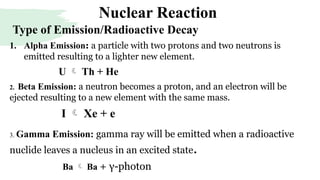
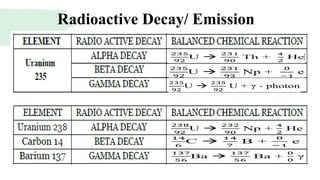
Nuclear Reaction
1. AlphaEmission: a particle with two protons and two neutrons is
emitted resulting to a lighter new element.
U Th + He
2. Beta Emission: a neutron becomes a proton, and an electron will be
ejected resulting to a new element with the same mass.
I Xe + e
3. Gamma Emission: gamma ray will be emitted when a radioactive
nuclide leaves a nucleus in an excited state.
Ba Ba + γ-photon
Type of Emission/Radioactive Decay
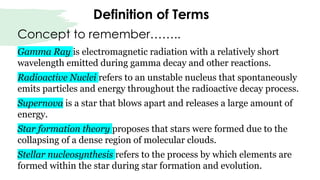
Definition of Terms
GammaRay is electromagnetic radiation with a relatively short
wavelength emitted during gamma decay and other reactions.
Radioactive Nuclei refers to an unstable nucleus that spontaneously
emits particles and energy throughout the radioactive decay process.
Supernova is a star that blows apart and releases a large amount of
energy.
Star formation theory proposes that stars were formed due to the
collapsing of a dense region of molecular clouds.
Stellar nucleosynthesis refers to the process by which elements are
formed within the star during star formation and evolution.
Concept to remember……..
Editor's Notes
#30 The contraction and gravitational force of the protostar result in an increase in temperature which triggers nuclear reaction within the star upon reaching 10 million Kelvin.
#31 The contraction and gravitational force of the protostar result in an increase in temperature which triggers nuclear reaction within the star upon reaching 10 million Kelvin.
#32 The contraction and gravitational force of the protostar result in an increase in temperature which triggers nuclear reaction within the star upon reaching 10 million Kelvin.
#33 The contraction and gravitational force of the protostar result in an increase in temperature which triggers nuclear reaction within the star upon reaching 10 million Kelvin.
#35 The contraction and gravitational force of the protostar result in an increase in temperature which triggers nuclear reaction within the star upon reaching 10 million Kelvin.
#36 The contraction and gravitational force of the protostar result in an increase in temperature which triggers nuclear reaction within the star upon reaching 10 million Kelvin.