INTRODUCTION TO
OPERATIONS
RESEARCH
What is Operations Research?
Operations
The activities carried out in an organization.
Research
The process of observation and testing characterized
by the scientific method..
Operations Research
•Research of operations
• scientific method of providing executive
departments with a quantitative basis for decisions
regarding the operations under their control.
 Operational Research is the scientific study of
operations for the purpose of making better
decisions.
 It is a discipline that deals with application of
advanced analytical methods to facilitate better
decisions .
 It represents the study of optimal resource allocation.
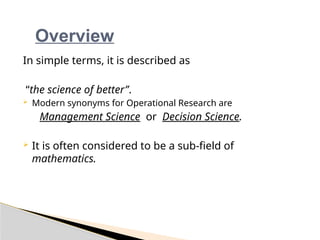
Overview
Overview
In simple terms, it is described as
“the science of better”.
 Modern synonyms for Operational Research are
Management Science or Decision Science.
 It is often considered to be a sub-field of
mathematics.
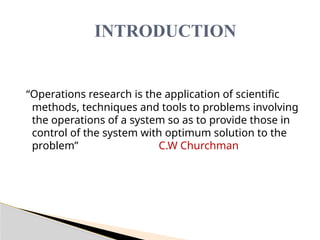
“Operations research is the application of scientific
methods, techniques and tools to problems involving
the operations of a system so as to provide those in
control of the system with optimum solution to the
problem” C.W Churchman
INTRODUCTION
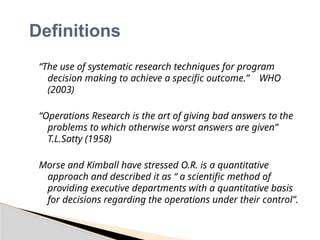
“The use of systematic research techniques for program
decision making to achieve a specific outcome.” WHO
(2003)
“Operations Research is the art of giving bad answers to the
problems to which otherwise worst answers are given”
T.L.Satty (1958)
Morse and Kimball have stressed O.R. is a quantitative
approach and described it as “ a scientific method of
providing executive departments with a quantitative basis
for decisions regarding the operations under their control”.
Definitions
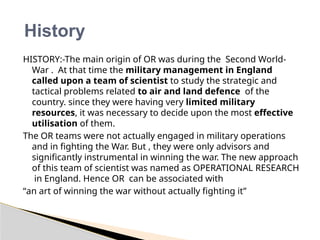
HISTORY:-The main origin of OR was during the Second World-
War . At that time the military management in England
called upon a team of scientist to study the strategic and
tactical problems related to air and land defence of the
country. since they were having very limited military
resources, it was necessary to decide upon the most effective
utilisation of them.
The OR teams were not actually engaged in military operations
and in fighting the War. But , they were only advisors and
significantly instrumental in winning the war. The new approach
of this team of scientist was named as OPERATIONAL RESEARCH
in England. Hence OR can be associated with
“an art of winning the war without actually fighting it”
History
Application of OR
 Now a days the principles and techniques of
Operational Research are being applied in every field
of human research and development (Personnel
management)
 including Health Care Sciences.
 Industrial Management.
 Finance , budgeting & investments.
 Purchasing, procurement & exploration.
 Production management.
 Marketing management.
The success of military team attracted the attention of
industrial mangers who were seeking solutions to their
complex problems. The most common problem was:
Minimise Cost and Maximise Profit
 OR came into existence in India in 1949, Regional
research laboratory, Hyderabad.
 In India, OR society founded in 1957,
 Also became a member of international Federation of OR
societies in 1960.
 The Journal OPSEARCH was published for the first time
in 1963.
Operations research in INDIA

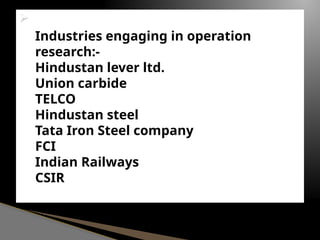
Industries engaging in operation
research:-
Hindustan lever ltd.
Union carbide
TELCO
Hindustan steel
Tata Iron Steel company
FCI
Indian Railways
CSIR
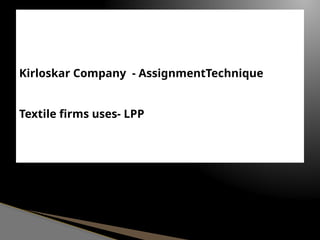
Kirloskar Company - AssignmentTechnique
Textile firms uses- LPP
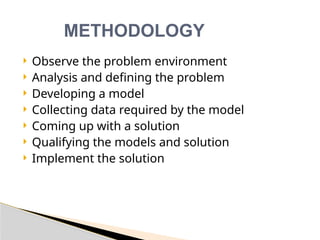
 Observe the problem environment
 Analysis and defining the problem
 Developing a model
 Collecting data required by the model
 Coming up with a solution
 Qualifying the models and solution
 Implement the solution
METHODOLOGY
 The first step in the process of O.R.
development is the problem environment
observation.
 This step includes different activities; they are
conferences, site visit, research, observations
etc.
 These activities provide sufficient information
to the O.R. specialists to formulate the
problem.
Step I: Observe the problem
environment
 In this step in addition to the problem
definition the objectives, uses and limitations of
O.R. study of the problem also defined.
 The outputs of this step are clear grasp of need
for a solution and its nature understanding.
Step II: Analyze and define the
problem
 a model is a representation of some abstract or real
situation.
 The models are basically mathematical models, which
describes systems, processes in the form of equations,
formula/relationships.
 The different activities in this step are variables
definition, formulating equations etc.
 The model is tested in the field under different
environmental constraints and modified in order to
work.
 Some times the model is modified to satisfy the
management with the results
Step III: Develop a model
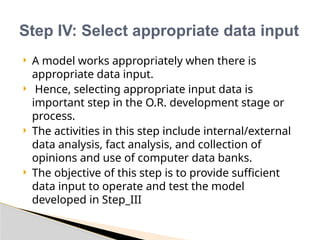
 A model works appropriately when there is
appropriate data input.
 Hence, selecting appropriate input data is
important step in the O.R. development stage or
process.
 The activities in this step include internal/external
data analysis, fact analysis, and collection of
opinions and use of computer data banks.
 The objective of this step is to provide sufficient
data input to operate and test the model
developed in Step_III
Step IV: Select appropriate data input
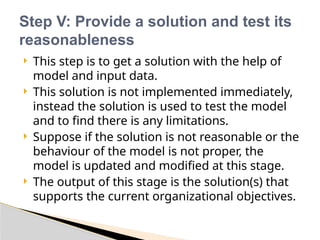
 This step is to get a solution with the help of
model and input data.
 This solution is not implemented immediately,
instead the solution is used to test the model
and to find there is any limitations.
 Suppose if the solution is not reasonable or the
behaviour of the model is not proper, the
model is updated and modified at this stage.
 The output of this stage is the solution(s) that
supports the current organizational objectives.
Step V: Provide a solution and test its
reasonableness
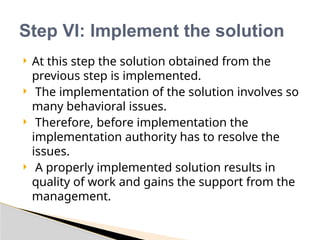
 At this step the solution obtained from the
previous step is implemented.
 The implementation of the solution involves so
many behavioral issues.
 Therefore, before implementation the
implementation authority has to resolve the
issues.
 A properly implemented solution results in
quality of work and gains the support from the
management.
Step VI: Implement the solution
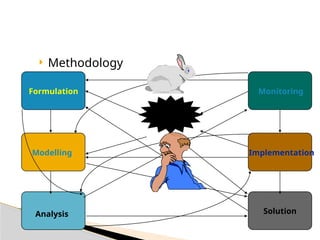
 Methodology
Solution
Formulation
Modelling
Analysis
Implementation
Monitoring
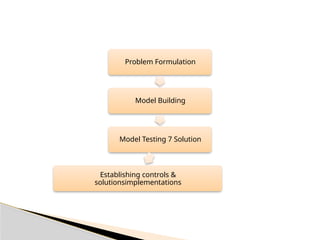
Problem Formulation
Model Building
Model Testing 7 Solution
Establishing controls &
solutionsimplementations
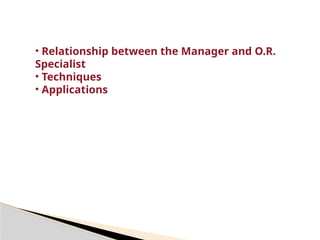
• Relationship between the Manager and O.R.
Specialist
• Techniques
• Applications
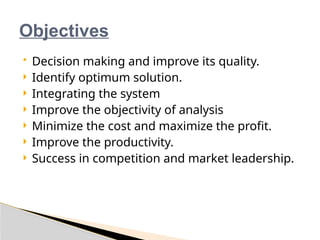
Objectives
 Decision making and improve its quality.
 Identify optimum solution.
 Integrating the system
 Improve the objectivity of analysis
 Minimize the cost and maximize the profit.
 Improve the productivity.
 Success in competition and market leadership.
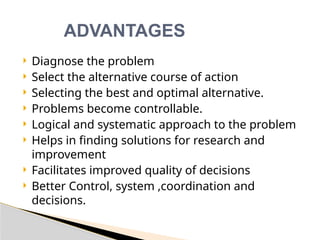
 Diagnose the problem
 Select the alternative course of action
 Selecting the best and optimal alternative.
 Problems become controllable.
 Logical and systematic approach to the problem
 Helps in finding solutions for research and
improvement
 Facilitates improved quality of decisions
 Better Control, system ,coordination and
decisions.
ADVANTAGES
 Magnitude of Computations
 Non- quantifiable factors
 Resistance from the employees for new
proposals
 Gap between manager and operations
researcher
LIMITATIONS

INTRODUCTION TO OPERATIONS RESEARCH.pptx

  • 1.
  • 2.
    What is OperationsResearch? Operations The activities carried out in an organization. Research The process of observation and testing characterized by the scientific method.. Operations Research •Research of operations • scientific method of providing executive departments with a quantitative basis for decisions regarding the operations under their control.
  • 3.
     Operational Researchis the scientific study of operations for the purpose of making better decisions.  It is a discipline that deals with application of advanced analytical methods to facilitate better decisions .  It represents the study of optimal resource allocation. Overview
  • 4.
    Overview In simple terms,it is described as “the science of better”.  Modern synonyms for Operational Research are Management Science or Decision Science.  It is often considered to be a sub-field of mathematics.
  • 5.
    “Operations research isthe application of scientific methods, techniques and tools to problems involving the operations of a system so as to provide those in control of the system with optimum solution to the problem” C.W Churchman INTRODUCTION
  • 6.
    “The use ofsystematic research techniques for program decision making to achieve a specific outcome.” WHO (2003) “Operations Research is the art of giving bad answers to the problems to which otherwise worst answers are given” T.L.Satty (1958) Morse and Kimball have stressed O.R. is a quantitative approach and described it as “ a scientific method of providing executive departments with a quantitative basis for decisions regarding the operations under their control”. Definitions
  • 7.
    HISTORY:-The main originof OR was during the Second World- War . At that time the military management in England called upon a team of scientist to study the strategic and tactical problems related to air and land defence of the country. since they were having very limited military resources, it was necessary to decide upon the most effective utilisation of them. The OR teams were not actually engaged in military operations and in fighting the War. But , they were only advisors and significantly instrumental in winning the war. The new approach of this team of scientist was named as OPERATIONAL RESEARCH in England. Hence OR can be associated with “an art of winning the war without actually fighting it” History
  • 8.
    Application of OR Now a days the principles and techniques of Operational Research are being applied in every field of human research and development (Personnel management)  including Health Care Sciences.  Industrial Management.  Finance , budgeting & investments.  Purchasing, procurement & exploration.  Production management.  Marketing management.
  • 9.
    The success ofmilitary team attracted the attention of industrial mangers who were seeking solutions to their complex problems. The most common problem was: Minimise Cost and Maximise Profit  OR came into existence in India in 1949, Regional research laboratory, Hyderabad.  In India, OR society founded in 1957,  Also became a member of international Federation of OR societies in 1960.  The Journal OPSEARCH was published for the first time in 1963. Operations research in INDIA
  • 10.
     Industries engaging inoperation research:- Hindustan lever ltd. Union carbide TELCO Hindustan steel Tata Iron Steel company FCI Indian Railways CSIR
  • 11.
    Kirloskar Company -AssignmentTechnique Textile firms uses- LPP
  • 12.
     Observe theproblem environment  Analysis and defining the problem  Developing a model  Collecting data required by the model  Coming up with a solution  Qualifying the models and solution  Implement the solution METHODOLOGY
  • 13.
     The firststep in the process of O.R. development is the problem environment observation.  This step includes different activities; they are conferences, site visit, research, observations etc.  These activities provide sufficient information to the O.R. specialists to formulate the problem. Step I: Observe the problem environment
  • 14.
     In thisstep in addition to the problem definition the objectives, uses and limitations of O.R. study of the problem also defined.  The outputs of this step are clear grasp of need for a solution and its nature understanding. Step II: Analyze and define the problem
  • 15.
     a modelis a representation of some abstract or real situation.  The models are basically mathematical models, which describes systems, processes in the form of equations, formula/relationships.  The different activities in this step are variables definition, formulating equations etc.  The model is tested in the field under different environmental constraints and modified in order to work.  Some times the model is modified to satisfy the management with the results Step III: Develop a model
  • 16.
     A modelworks appropriately when there is appropriate data input.  Hence, selecting appropriate input data is important step in the O.R. development stage or process.  The activities in this step include internal/external data analysis, fact analysis, and collection of opinions and use of computer data banks.  The objective of this step is to provide sufficient data input to operate and test the model developed in Step_III Step IV: Select appropriate data input
  • 17.
     This stepis to get a solution with the help of model and input data.  This solution is not implemented immediately, instead the solution is used to test the model and to find there is any limitations.  Suppose if the solution is not reasonable or the behaviour of the model is not proper, the model is updated and modified at this stage.  The output of this stage is the solution(s) that supports the current organizational objectives. Step V: Provide a solution and test its reasonableness
  • 18.
     At thisstep the solution obtained from the previous step is implemented.  The implementation of the solution involves so many behavioral issues.  Therefore, before implementation the implementation authority has to resolve the issues.  A properly implemented solution results in quality of work and gains the support from the management. Step VI: Implement the solution
  • 19.
  • 20.
    Problem Formulation Model Building ModelTesting 7 Solution Establishing controls & solutionsimplementations
  • 21.
    • Relationship betweenthe Manager and O.R. Specialist • Techniques • Applications
  • 22.
    Objectives  Decision makingand improve its quality.  Identify optimum solution.  Integrating the system  Improve the objectivity of analysis  Minimize the cost and maximize the profit.  Improve the productivity.  Success in competition and market leadership.
  • 23.
     Diagnose theproblem  Select the alternative course of action  Selecting the best and optimal alternative.  Problems become controllable.  Logical and systematic approach to the problem  Helps in finding solutions for research and improvement  Facilitates improved quality of decisions  Better Control, system ,coordination and decisions. ADVANTAGES
  • 24.
     Magnitude ofComputations  Non- quantifiable factors  Resistance from the employees for new proposals  Gap between manager and operations researcher LIMITATIONS