
Parallel Programming with OPENMP
Akhila Prabhakaran
Consultant Scientist/Technologist
Supercomputer Education and Research Centre
Indian Institute of Science
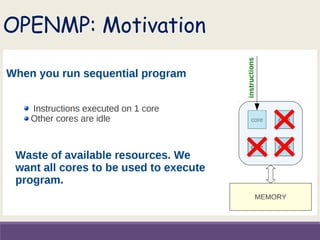
OPENMP: Motivation
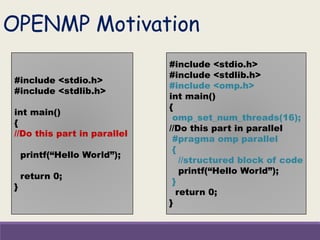
OPENMP Motivation
#include <stdio.h>
#include <stdlib.h>
int main()
{
//Do this part in parallel
printf(“Hello World”);
return 0;
}
#include <stdio.h>
#include <stdlib.h>
#include <omp.h>
int main()
{
omp_set_num_threads(16);
//Do this part in parallel
#pragma omp parallel
{
//structured block of code
printf(“Hello World”);
}
return 0;
}
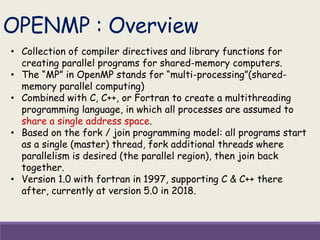
• Collection of compiler directives and library functions for
creating parallel programs for shared-memory computers.
• The “MP” in OpenMP stands for “multi-processing”(shared-
memory parallel computing)
• Combined with C, C++, or Fortran to create a multithreading
programming language, in which all processes are assumed to
share a single address space.
• Based on the fork / join programming model: all programs start
as a single (master) thread, fork additional threads where
parallelism is desired (the parallel region), then join back
together.
• Version 1.0 with fortran in 1997, supporting C & C++ there
after, currently at version 5.0 in 2018.
OPENMP : Overview
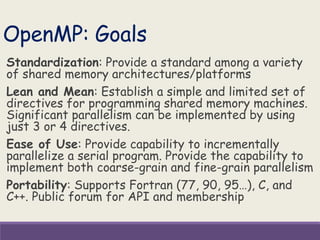
OpenMP: Goals
Standardization: Provide a standard among a variety
of shared memory architectures/platforms
Lean and Mean: Establish a simple and limited set of
directives for programming shared memory machines.
Significant parallelism can be implemented by using
just 3 or 4 directives.
Ease of Use: Provide capability to incrementally
parallelize a serial program. Provide the capability to
implement both coarse-grain and fine-grain parallelism
Portability: Supports Fortran (77, 90, 95…), C, and
C++. Public forum for API and membership
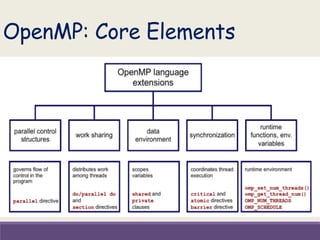
OpenMP: Core Elements
OPENMP #pragma
Special preprocessor instructions.
Typically added to a system to allow behaviors
that aren’t part of the basic C specification.
Compilers that don’t support the pragmas ignore
them.
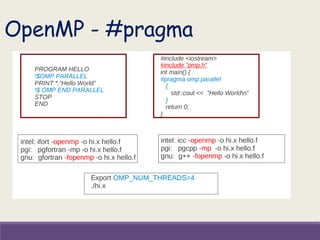
OpenMP - #pragma
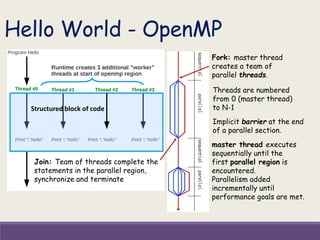
Hello World - OpenMP
Structured block of code
Fork: master thread
creates a team of
parallel threads.
Join: Team of threads complete the
statements in the parallel region,
synchronize and terminate
master thread executes
sequentially until the
first parallel region is
encountered.
Parallelism added
incrementally until
performance goals are met.
Threads are numbered
from 0 (master thread)
to N-1
Implicit barrier at the end
of a parallel section.
OPENMP: Basic functions
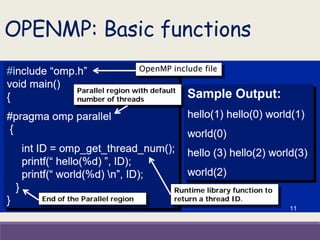
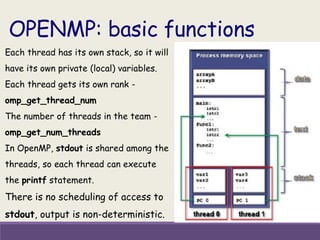
Each thread has its own stack, so it will
have its own private (local) variables.
Each thread gets its own rank -
omp_get_thread_num
The number of threads in the team -
omp_get_num_threads
In OpenMP, stdout is shared among the
threads, so each thread can execute
the printf statement.
There is no scheduling of access to
stdout, output is non-deterministic.
OPENMP: basic functions
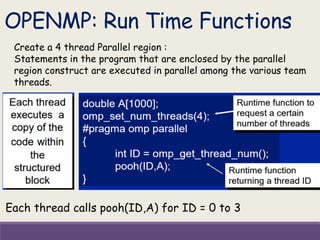
Create a 4 thread Parallel region :
Statements in the program that are enclosed by the parallel
region construct are executed in parallel among the various team
threads.
Each thread calls pooh(ID,A) for ID = 0 to 3
OPENMP: Run Time Functions
OpenMP Run Time Functions
Modify/check/get info about the number of threads
omp_get_num_threads() //number of threads in use
omp_get_thread_num() //tells which thread you are
omp_get_max_threads() //max threads that can be used
Are we in a parallel region?
omp_in_parallel()
How many processors in the system?
omp_get_num_procs()
Explicit locks
omp_[set|unset]_lock()
And several more...
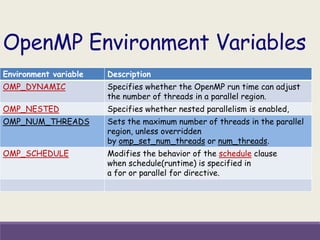
OpenMP Environment Variables
Environment variable Description
OMP_DYNAMIC Specifies whether the OpenMP run time can adjust
the number of threads in a parallel region.
OMP_NESTED Specifies whether nested parallelism is enabled,
OMP_NUM_THREADS Sets the maximum number of threads in the parallel
region, unless overridden
by omp_set_num_threads or num_threads.
OMP_SCHEDULE Modifies the behavior of the schedule clause
when schedule(runtime) is specified in
a for or parallel for directive.
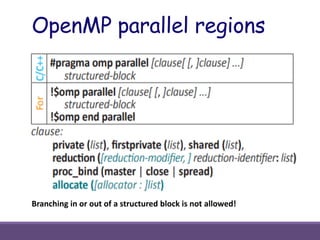
OpenMP parallel regions
Branching in or out of a structured block is not allowed!
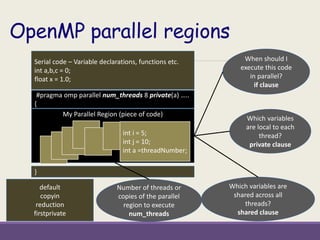
OpenMP parallel regions
My Parallel Region (piece of code)
When should I
execute this code
in parallel?
if clause
Which variables
are local to each
thread?
private clause
Which variables are
shared across all
threads?
shared clause
Serial code – Variable declarations, functions etc.
int a,b,c = 0;
float x = 1.0;
Number of threads or
copies of the parallel
region to execute
num_threads
default
copyin
reduction
firstprivate
int i = 5;
int j = 10;
int a =threadNumber;
#pragma omp parallel num_threads 8 private(a) …..
{
}
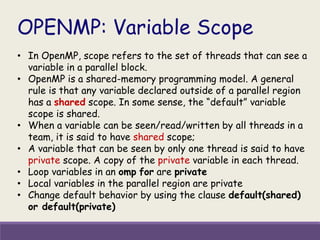
OPENMP: Variable Scope
• In OpenMP, scope refers to the set of threads that can see a
variable in a parallel block.
• OpenMP is a shared-memory programming model. A general
rule is that any variable declared outside of a parallel region
has a shared scope. In some sense, the “default” variable
scope is shared.
• When a variable can be seen/read/written by all threads in a
team, it is said to have shared scope;
• A variable that can be seen by only one thread is said to have
private scope. A copy of the private variable in each thread.
• Loop variables in an omp for are private
• Local variables in the parallel region are private
• Change default behavior by using the clause default(shared)
or default(private)
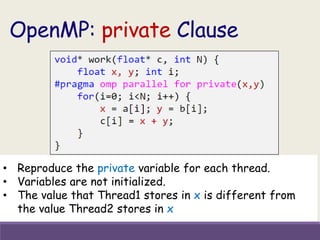
OpenMP: private Clause
• Reproduce the private variable for each thread.
• Variables are not initialized.
• The value that Thread1 stores in x is different from
the value Thread2 stores in x
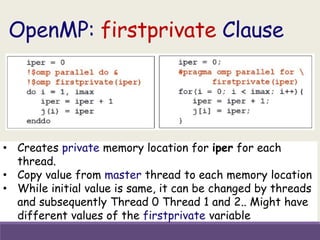
OpenMP: firstprivate Clause
• Creates private memory location for iper for each
thread.
• Copy value from master thread to each memory location
• While initial value is same, it can be changed by threads
and subsequently Thread 0 Thread 1 and 2.. Might have
different values of the firstprivate variable
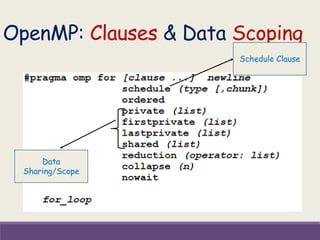
OpenMP: Clauses & Data Scoping
Schedule Clause
Data
Sharing/Scope
Matrix Vector Multiplication
#pragma omp parallel
for (i=0; i < m; i++)
{ y[i] =0.0;
for (j=0; j < SIZE; j++)
y[i] += (A[i][j] * x[j]);
}
Will this work?
Matrix Vector Multiplication
#pragma omp parallel
for (i=0; i < m; i++)
{ y[i] =0.0;
for (j=0; j < SIZE; j++)
y[i] += (A[i][j] * x[j]);
}
Will this work?
Independent tasks:
Matrix Rows = N (= 8)
Number of Threads = T (=4)
Number of Rows processed by thread = N/T
Thread 0 => rows 0,1,2,3,…(N/T – 1)
Thread 1 => rows N/T, N/T+1…… 2*N/T - 1
Thread t => rows t, t+1, t+2, …. (t*N/T -1)
#pragma omp parallel shared(A,x,y,SIZE) 
private(tid,i,j,istart,iend)
{
tid = omp_get_thread_num();
nid = omp_get_num_threads();
istart = tid*SIZE/nid;
iend = (tid+1)*SIZE/nid;
for (i=istart; i < iend; i++)
{
for (j=0; j < SIZE; j++)
y[i] += (A[i][j] * x[j]);
printf(" thread %d did row %dt
y[%d]=%.2ft",tid,i,i,y[i]);
}
} /* end of parallel construct */
Matrix Vector Multiplication
Matrix Rows = N (= 8)
Number of Threads = T (=4)
Number of Rows processed by thread = N/T
Thread 0 => rows 0,1,2,3,…(N/T – 1)
Thread 1 => rows N/T, N/T+1…… 2*N/T - 1
Thread t => rows t, t+1, t+2, …. (t*N/T -1)
omp_set_num_threads(4)
#pragma omp parallel shared(A,x,y,SIZE)
{
#pragma omp for
for (int i=0; i < SIZE; i++)
{
for (int j=0; j < SIZE; j++)
y[i] += (A[i][j] * x[j]);
}
} /* end of parallel construct */
Matrix Vector Multiplication
#pragma omp for must be inside a
parallel region (#pragma omp
parallel)
No new threads are created but the
threads already created in the
enclosing parallel region are used.
The system automatically
parallelizes the for loop by dividing
the iterations of the loop among the
threads.
User can control how to divide the
loop iterations among threads by
using the schedule clause.
User controlled Variable Scope
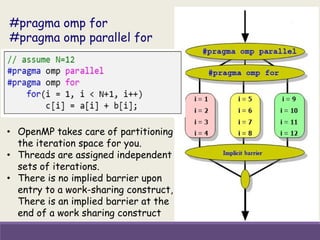
• OpenMP takes care of partitioning
the iteration space for you.
• Threads are assigned independent
sets of iterations.
• There is no implied barrier upon
entry to a work-sharing construct,
There is an implied barrier at the
end of a work sharing construct
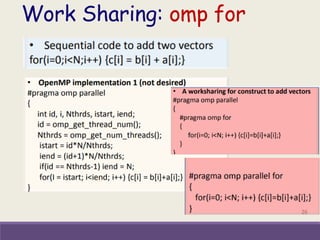
#pragma omp for
#pragma omp parallel for
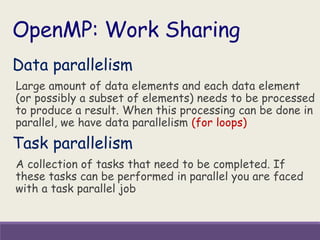
Data parallelism
Large amount of data elements and each data element
(or possibly a subset of elements) needs to be processed
to produce a result. When this processing can be done in
parallel, we have data parallelism (for loops)
Task parallelism
A collection of tasks that need to be completed. If
these tasks can be performed in parallel you are faced
with a task parallel job
OpenMP: Work Sharing
Work Sharing: omp for
Computing ∏ by method of Numerical Integration
Divide the interval (x axis) [0,1] into N parts.
Area of each rectangle is x * y [ x = 1/N, y = 4/ (1+x2)] =[1/N] *4/ (1+x2)
Approximation of x as midpoint of the interval before computing Y
Xi + Xi+1
2
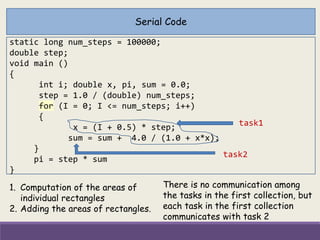
static long num_steps = 100000;
double step;
void main ()
{
int i; double x, pi, sum = 0.0;
step = 1.0 / (double) num_steps;
for (I = 0; I <= num_steps; i++)
{
x = (I + 0.5) * step;
sum = sum + 4.0 / (1.0 + x*x);
}
pi = step * sum
}
Serial Code
1. Computation of the areas of
individual rectangles
2. Adding the areas of rectangles.
There is no communication among
the tasks in the first collection, but
each task in the first collection
communicates with task 2
task1
task2
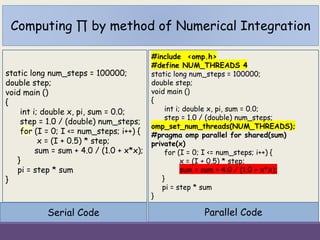
static long num_steps = 100000;
double step;
void main ()
{
int i; double x, pi, sum = 0.0;
step = 1.0 / (double) num_steps;
for (I = 0; I <= num_steps; i++) {
x = (I + 0.5) * step;
sum = sum + 4.0 / (1.0 + x*x);
}
pi = step * sum
}
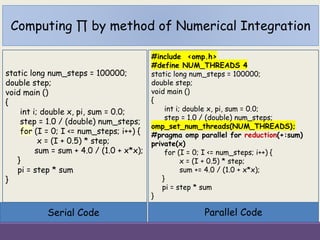
Computing ∏ by method of Numerical Integration
#include <omp.h>
#define NUM_THREADS 4
static long num_steps = 100000;
double step;
void main ()
{
int i; double x, pi, sum = 0.0;
step = 1.0 / (double) num_steps;
omp_set_num_threads(NUM_THREADS);
#pragma omp parallel for shared(sum)
private(x)
for (I = 0; I <= num_steps; i++) {
x = (I + 0.5) * step;
sum = sum + 4.0 / (1.0 + x*x);
}
pi = step * sum
}
Serial Code Parallel Code
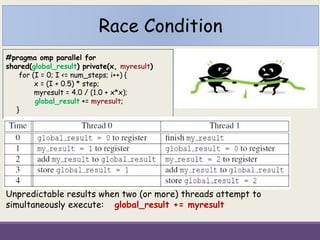
Race Condition
#pragma omp parallel for
shared(global_result) private(x, myresult)
for (I = 0; I <= num_steps; i++) {
x = (I + 0.5) * step;
myresult = 4.0 / (1.0 + x*x);
global_result += myresult;
}
Unpredictable results when two (or more) threads attempt to
simultaneously execute: global_result += myresult
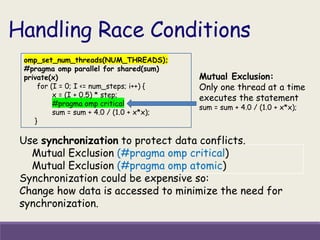
Handling Race Conditions
Use synchronization to protect data conflicts.
Mutual Exclusion (#pragma omp critical)
Mutual Exclusion (#pragma omp atomic)
Synchronization could be expensive so:
Change how data is accessed to minimize the need for
synchronization.
omp_set_num_threads(NUM_THREADS);
#pragma omp parallel for shared(sum)
private(x)
for (I = 0; I <= num_steps; i++) {
x = (I + 0.5) * step;
#pragma omp critical
sum = sum + 4.0 / (1.0 + x*x);
}
Mutual Exclusion:
Only one thread at a time
executes the statement
sum = sum + 4.0 / (1.0 + x*x);
OpenMP: Reduction
sum = 0;
Set_omp_num_threads(8)
#pragma omp parallel for
reduction (+:sum)
for (int i = 0; i < 16; i++)
{
sum += a[i]
}
Thread0 => iteration 0 & 1
Thread1 => iteration 2 & 3
………
One or more variables that are private to each thread are subject of reduction
operation at the end of the parallel region.
#pragma omp for reduction(operator : var)
Operator: + , * , - , & , | , && , ||, ^
Combines multiple local copies of the var from threads into a single copy at master.
Thread local/private
static long num_steps = 100000;
double step;
void main ()
{
int i; double x, pi, sum = 0.0;
step = 1.0 / (double) num_steps;
for (I = 0; I <= num_steps; i++) {
x = (I + 0.5) * step;
sum = sum + 4.0 / (1.0 + x*x);
}
pi = step * sum
}
Computing ∏ by method of Numerical Integration
#include <omp.h>
#define NUM_THREADS 4
static long num_steps = 100000;
double step;
void main ()
{
int i; double x, pi, sum = 0.0;
step = 1.0 / (double) num_steps;
omp_set_num_threads(NUM_THREADS);
#pragma omp parallel for reduction(+:sum)
private(x)
for (I = 0; I <= num_steps; i++) {
x = (I + 0.5) * step;
sum += 4.0 / (1.0 + x*x);
}
pi = step * sum
}
Serial Code Parallel Code
omp for Parallelization
for (int i = 2; i < 10; i++)
{
x[i] = a * x[i-1] + b
}
Can all loops be parallelized?
Loop iterations have to be independent.
Simple Test: If the results differ when the code is executed
backwards, the loop cannot by parallelized!
Between 2 Synchronization points, if atleast 1 thread
writes to a memory location, that atleast 1 other thread
reads from => The result is non-deterministic
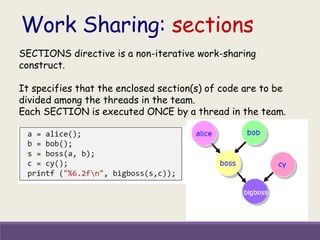
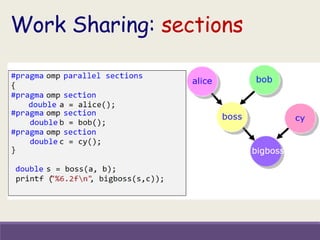
Work Sharing: sections
SECTIONS directive is a non-iterative work-sharing
construct.
It specifies that the enclosed section(s) of code are to be
divided among the threads in the team.
Each SECTION is executed ONCE by a thread in the team.
Work Sharing: sections
OpenMP: lastprivate Clause
• Creates private memory location for each thread.
• Does not initialize the private variable.
• The sequentially last iteration of the associated loops,
or the lexically last section construct [...] to the original
list item.
!$OMP DO PRIVATE(I)
LASTPRIVATE(B)
DO i = 1, 1000
B = i
ENDDO
!$OMP END DO
!—value of B here is
1000
!$OMP SECTIONS
LASTPRIVATE(B)
!$OMP SECTION
B = 2
!$OMP SECTION
B = 4
!$OMP SECTION
D = 6
!$OMP END SECTIONS
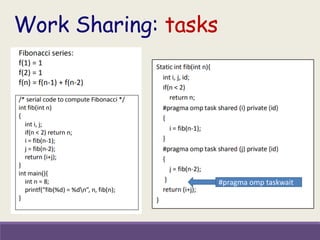
Work Sharing: tasks
#pragma omp task [clauses]……
• Tasks allow to parallelize irregular problems (Unbounded
loops & Recursive algorithms )
• A task has - Code to execute – Data environment (It owns
its data) – Internal control variables – An assigned thread
that executes the code and the data
• Each encountering thread packages a new instance of a task
(code and data)
• Some thread in the team executes the task at some later
time
Work Sharing: tasks
#pragma omp taskwait
Work Sharing: single
• The SINGLE directive specifies that the enclosed code
is to be executed by only one thread in the team.
• May be useful when dealing with sections of code that
are not thread safe (such as I/O)
!$OMP SINGLE [clause ...]
PRIVATE (list)
FIRSTPRIVATE (list)
block
!$OMP END SINGLE [ NOWAIT ]
#pragma omp single [clause ...] newline
private (list) firstprivate (list) nowait
structured_block
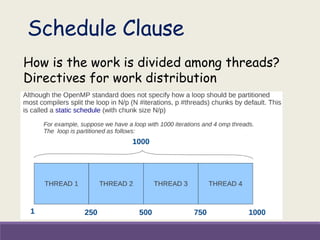
Schedule Clause
How is the work is divided among threads?
Directives for work distribution
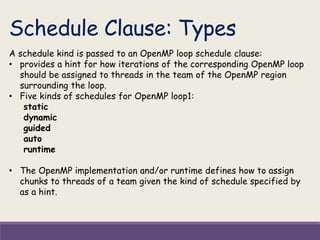
Schedule Clause: Types
A schedule kind is passed to an OpenMP loop schedule clause:
• provides a hint for how iterations of the corresponding OpenMP loop
should be assigned to threads in the team of the OpenMP region
surrounding the loop.
• Five kinds of schedules for OpenMP loop1:
static
dynamic
guided
auto
runtime
• The OpenMP implementation and/or runtime defines how to assign
chunks to threads of a team given the kind of schedule specified by
as a hint.
STATIC: Iterations of a loop are divided into chunks of size ceiling(iterations/threads).
Each thread is assigned a separate chunk.
STATIC, N: Iterations of a loop are divided into chunks of size N. Each chunk is assigned
to a thread in round-robin fashion. N >= 1 (integer expression)
DYNAMIC: Iterations of a loop are divided into chunks of size 1.
Chunks are assigned to threads on a first-come, first-serve basis as threads become
available. This continues until all work is completed.
DYNAMIC, N: Same as above, all chunks are set to size N
GUIDED: Chunks are made progressively smaller until a chunk size of one is reached. The
first chunk is of size ceiling(iterations/threads). Remaining chunks are of
size ceiling(iterations_remaining/threads).Chunks are assigned to threads on a first-
come, first-serve basis as threads become available. This continues until all work is
completed.
GUIDED, N: Minimum chunk size is N
AUTO: Delegated the decision of the scheduling to the compiler and/or runtime system
RUNTIME: Scheduling policy is determined at run time. OMP_SCHEDULE/
OMP_SET_SCHEDULE
Schedule Clause
OpenMP: Synchronization
• The programmer needs finer control over how variables
are shared.
• The programmer must ensure that threads do not
interfere with each other so that the output does not
depend on how the individual threads are scheduled.
• In particular, the programmer must manage threads so
that they read the correct values of a variable and that
multiple threads do not try to write to a variable at the
same time.
• MASTER, CRITICAL, BARRIER, FLUSH, TASKWAIT,
ORDERED, NOWAIT
Synchronization Constructs
To impose order constraints and protect shared data.
Achieved by Barriers & Mutual Exclusion
1) Barriers (Task Dependencies)
Implicit : Sync points exist at the end of
parallel –necessary barrier – cant be removed
for – can be removed by using the nowait clause
sections – can be removed by using the nowait clause
single – can be removed by using the nowait clause
Explicit : Must be used when ordering is required
#pragma omp barrier
each thread waits until all threads arrive at the barrier
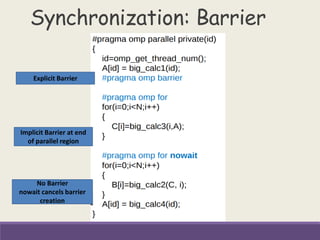
Explicit Barrier
Implicit Barrier at end
of parallel region
No Barrier
nowait cancels barrier
creation
Synchronization: Barrier
Data Dependencies
OpenMP assumes that there is NO data-
dependency across jobs running in parallel
When the omp parallel directive is placed around
a code block, it is the programmer’s
responsibility to make sure data dependency is
ruled out
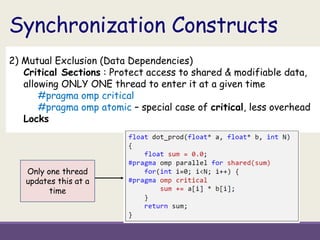
Synchronization Constructs
2) Mutual Exclusion (Data Dependencies)
Critical Sections : Protect access to shared & modifiable data,
allowing ONLY ONE thread to enter it at a given time
#pragma omp critical
#pragma omp atomic – special case of critical, less overhead
Locks
Only one thread
updates this at a
time
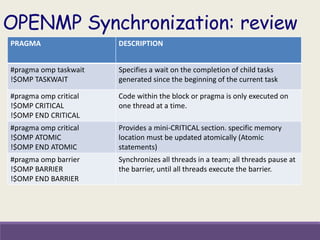
OPENMP Synchronization: review
PRAGMA DESCRIPTION
#pragma omp taskwait
!$OMP TASKWAIT
Specifies a wait on the completion of child tasks
generated since the beginning of the current task
#pragma omp critical
!$OMP CRITICAL
!$OMP END CRITICAL
Code within the block or pragma is only executed on
one thread at a time.
#pragma omp critical
!$OMP ATOMIC
!$OMP END ATOMIC
Provides a mini-CRITICAL section. specific memory
location must be updated atomically (Atomic
statements)
#pragma omp barrier
!$OMP BARRIER
!$OMP END BARRIER
Synchronizes all threads in a team; all threads pause at
the barrier, until all threads execute the barrier.
OPENMP Synchronization: review
PRAGMA DESCRIPTION
#pragma omp for ordered
[clauses...] (loop region)
#pragma omp ordered
structured_block
Used within a DO / for loop
Iterations of the enclosed loop will be executed in the
same order as if they were executed on a serial
processor. Threads will need to wait before executing
their chunk of iterations if previous iterations haven't
completed yet.
#pragma omp flush (list) Synchronization point at which all threads have the
same view of memory for all shared objects.
FLUSH is implied for
barrier
parallel - upon entry and exit
critical - upon entry and exit
ordered - upon entry and exit
for - upon exit
sections - upon exit
single - upon exi
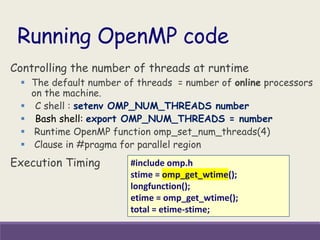
Running OpenMP code
Controlling the number of threads at runtime
▪ The default number of threads = number of online processors
on the machine.
▪ C shell : setenv OMP_NUM_THREADS number
▪ Bash shell: export OMP_NUM_THREADS = number
▪ Runtime OpenMP function omp_set_num_threads(4)
▪ Clause in #pragma for parallel region
Execution Timing #include omp.h
stime = omp_get_wtime();
longfunction();
etime = omp_get_wtime();
total = etime-stime;

Introduction to OpenMP

  • 1.
    Parallel Programming withOPENMP Akhila Prabhakaran Consultant Scientist/Technologist Supercomputer Education and Research Centre Indian Institute of Science
  • 2.
  • 3.
    OPENMP Motivation #include <stdio.h> #include<stdlib.h> int main() { //Do this part in parallel printf(“Hello World”); return 0; } #include <stdio.h> #include <stdlib.h> #include <omp.h> int main() { omp_set_num_threads(16); //Do this part in parallel #pragma omp parallel { //structured block of code printf(“Hello World”); } return 0; }
  • 4.
    • Collection ofcompiler directives and library functions for creating parallel programs for shared-memory computers. • The “MP” in OpenMP stands for “multi-processing”(shared- memory parallel computing) • Combined with C, C++, or Fortran to create a multithreading programming language, in which all processes are assumed to share a single address space. • Based on the fork / join programming model: all programs start as a single (master) thread, fork additional threads where parallelism is desired (the parallel region), then join back together. • Version 1.0 with fortran in 1997, supporting C & C++ there after, currently at version 5.0 in 2018. OPENMP : Overview
  • 5.
    OpenMP: Goals Standardization: Providea standard among a variety of shared memory architectures/platforms Lean and Mean: Establish a simple and limited set of directives for programming shared memory machines. Significant parallelism can be implemented by using just 3 or 4 directives. Ease of Use: Provide capability to incrementally parallelize a serial program. Provide the capability to implement both coarse-grain and fine-grain parallelism Portability: Supports Fortran (77, 90, 95…), C, and C++. Public forum for API and membership
  • 6.
  • 7.
    OPENMP #pragma Special preprocessorinstructions. Typically added to a system to allow behaviors that aren’t part of the basic C specification. Compilers that don’t support the pragmas ignore them.
  • 8.
  • 9.
    Hello World -OpenMP Structured block of code Fork: master thread creates a team of parallel threads. Join: Team of threads complete the statements in the parallel region, synchronize and terminate master thread executes sequentially until the first parallel region is encountered. Parallelism added incrementally until performance goals are met. Threads are numbered from 0 (master thread) to N-1 Implicit barrier at the end of a parallel section.
  • 10.
  • 11.
    Each thread hasits own stack, so it will have its own private (local) variables. Each thread gets its own rank - omp_get_thread_num The number of threads in the team - omp_get_num_threads In OpenMP, stdout is shared among the threads, so each thread can execute the printf statement. There is no scheduling of access to stdout, output is non-deterministic. OPENMP: basic functions
  • 12.
    Create a 4thread Parallel region : Statements in the program that are enclosed by the parallel region construct are executed in parallel among the various team threads. Each thread calls pooh(ID,A) for ID = 0 to 3 OPENMP: Run Time Functions
  • 13.
    OpenMP Run TimeFunctions Modify/check/get info about the number of threads omp_get_num_threads() //number of threads in use omp_get_thread_num() //tells which thread you are omp_get_max_threads() //max threads that can be used Are we in a parallel region? omp_in_parallel() How many processors in the system? omp_get_num_procs() Explicit locks omp_[set|unset]_lock() And several more...
  • 14.
    OpenMP Environment Variables Environmentvariable Description OMP_DYNAMIC Specifies whether the OpenMP run time can adjust the number of threads in a parallel region. OMP_NESTED Specifies whether nested parallelism is enabled, OMP_NUM_THREADS Sets the maximum number of threads in the parallel region, unless overridden by omp_set_num_threads or num_threads. OMP_SCHEDULE Modifies the behavior of the schedule clause when schedule(runtime) is specified in a for or parallel for directive.
  • 15.
    OpenMP parallel regions Branchingin or out of a structured block is not allowed!
  • 16.
    OpenMP parallel regions MyParallel Region (piece of code) When should I execute this code in parallel? if clause Which variables are local to each thread? private clause Which variables are shared across all threads? shared clause Serial code – Variable declarations, functions etc. int a,b,c = 0; float x = 1.0; Number of threads or copies of the parallel region to execute num_threads default copyin reduction firstprivate int i = 5; int j = 10; int a =threadNumber; #pragma omp parallel num_threads 8 private(a) ….. { }
  • 17.
    OPENMP: Variable Scope •In OpenMP, scope refers to the set of threads that can see a variable in a parallel block. • OpenMP is a shared-memory programming model. A general rule is that any variable declared outside of a parallel region has a shared scope. In some sense, the “default” variable scope is shared. • When a variable can be seen/read/written by all threads in a team, it is said to have shared scope; • A variable that can be seen by only one thread is said to have private scope. A copy of the private variable in each thread. • Loop variables in an omp for are private • Local variables in the parallel region are private • Change default behavior by using the clause default(shared) or default(private)
  • 18.
    OpenMP: private Clause •Reproduce the private variable for each thread. • Variables are not initialized. • The value that Thread1 stores in x is different from the value Thread2 stores in x
  • 19.
    OpenMP: firstprivate Clause •Creates private memory location for iper for each thread. • Copy value from master thread to each memory location • While initial value is same, it can be changed by threads and subsequently Thread 0 Thread 1 and 2.. Might have different values of the firstprivate variable
  • 20.
    OpenMP: Clauses &Data Scoping Schedule Clause Data Sharing/Scope
  • 21.
    Matrix Vector Multiplication #pragmaomp parallel for (i=0; i < m; i++) { y[i] =0.0; for (j=0; j < SIZE; j++) y[i] += (A[i][j] * x[j]); } Will this work?
  • 22.
    Matrix Vector Multiplication #pragmaomp parallel for (i=0; i < m; i++) { y[i] =0.0; for (j=0; j < SIZE; j++) y[i] += (A[i][j] * x[j]); } Will this work? Independent tasks:
  • 23.
    Matrix Rows =N (= 8) Number of Threads = T (=4) Number of Rows processed by thread = N/T Thread 0 => rows 0,1,2,3,…(N/T – 1) Thread 1 => rows N/T, N/T+1…… 2*N/T - 1 Thread t => rows t, t+1, t+2, …. (t*N/T -1) #pragma omp parallel shared(A,x,y,SIZE) private(tid,i,j,istart,iend) { tid = omp_get_thread_num(); nid = omp_get_num_threads(); istart = tid*SIZE/nid; iend = (tid+1)*SIZE/nid; for (i=istart; i < iend; i++) { for (j=0; j < SIZE; j++) y[i] += (A[i][j] * x[j]); printf(" thread %d did row %dt y[%d]=%.2ft",tid,i,i,y[i]); } } /* end of parallel construct */ Matrix Vector Multiplication
  • 24.
    Matrix Rows =N (= 8) Number of Threads = T (=4) Number of Rows processed by thread = N/T Thread 0 => rows 0,1,2,3,…(N/T – 1) Thread 1 => rows N/T, N/T+1…… 2*N/T - 1 Thread t => rows t, t+1, t+2, …. (t*N/T -1) omp_set_num_threads(4) #pragma omp parallel shared(A,x,y,SIZE) { #pragma omp for for (int i=0; i < SIZE; i++) { for (int j=0; j < SIZE; j++) y[i] += (A[i][j] * x[j]); } } /* end of parallel construct */ Matrix Vector Multiplication #pragma omp for must be inside a parallel region (#pragma omp parallel) No new threads are created but the threads already created in the enclosing parallel region are used. The system automatically parallelizes the for loop by dividing the iterations of the loop among the threads. User can control how to divide the loop iterations among threads by using the schedule clause. User controlled Variable Scope
  • 25.
    • OpenMP takescare of partitioning the iteration space for you. • Threads are assigned independent sets of iterations. • There is no implied barrier upon entry to a work-sharing construct, There is an implied barrier at the end of a work sharing construct #pragma omp for #pragma omp parallel for
  • 26.
    Data parallelism Large amountof data elements and each data element (or possibly a subset of elements) needs to be processed to produce a result. When this processing can be done in parallel, we have data parallelism (for loops) Task parallelism A collection of tasks that need to be completed. If these tasks can be performed in parallel you are faced with a task parallel job OpenMP: Work Sharing
  • 27.
  • 28.
    Computing ∏ bymethod of Numerical Integration Divide the interval (x axis) [0,1] into N parts. Area of each rectangle is x * y [ x = 1/N, y = 4/ (1+x2)] =[1/N] *4/ (1+x2) Approximation of x as midpoint of the interval before computing Y Xi + Xi+1 2
  • 29.
    static long num_steps= 100000; double step; void main () { int i; double x, pi, sum = 0.0; step = 1.0 / (double) num_steps; for (I = 0; I <= num_steps; i++) { x = (I + 0.5) * step; sum = sum + 4.0 / (1.0 + x*x); } pi = step * sum } Serial Code 1. Computation of the areas of individual rectangles 2. Adding the areas of rectangles. There is no communication among the tasks in the first collection, but each task in the first collection communicates with task 2 task1 task2
  • 30.
    static long num_steps= 100000; double step; void main () { int i; double x, pi, sum = 0.0; step = 1.0 / (double) num_steps; for (I = 0; I <= num_steps; i++) { x = (I + 0.5) * step; sum = sum + 4.0 / (1.0 + x*x); } pi = step * sum } Computing ∏ by method of Numerical Integration #include <omp.h> #define NUM_THREADS 4 static long num_steps = 100000; double step; void main () { int i; double x, pi, sum = 0.0; step = 1.0 / (double) num_steps; omp_set_num_threads(NUM_THREADS); #pragma omp parallel for shared(sum) private(x) for (I = 0; I <= num_steps; i++) { x = (I + 0.5) * step; sum = sum + 4.0 / (1.0 + x*x); } pi = step * sum } Serial Code Parallel Code
  • 31.
    Race Condition #pragma ompparallel for shared(global_result) private(x, myresult) for (I = 0; I <= num_steps; i++) { x = (I + 0.5) * step; myresult = 4.0 / (1.0 + x*x); global_result += myresult; } Unpredictable results when two (or more) threads attempt to simultaneously execute: global_result += myresult
  • 32.
    Handling Race Conditions Usesynchronization to protect data conflicts. Mutual Exclusion (#pragma omp critical) Mutual Exclusion (#pragma omp atomic) Synchronization could be expensive so: Change how data is accessed to minimize the need for synchronization. omp_set_num_threads(NUM_THREADS); #pragma omp parallel for shared(sum) private(x) for (I = 0; I <= num_steps; i++) { x = (I + 0.5) * step; #pragma omp critical sum = sum + 4.0 / (1.0 + x*x); } Mutual Exclusion: Only one thread at a time executes the statement sum = sum + 4.0 / (1.0 + x*x);
  • 33.
    OpenMP: Reduction sum =0; Set_omp_num_threads(8) #pragma omp parallel for reduction (+:sum) for (int i = 0; i < 16; i++) { sum += a[i] } Thread0 => iteration 0 & 1 Thread1 => iteration 2 & 3 ……… One or more variables that are private to each thread are subject of reduction operation at the end of the parallel region. #pragma omp for reduction(operator : var) Operator: + , * , - , & , | , && , ||, ^ Combines multiple local copies of the var from threads into a single copy at master. Thread local/private
  • 34.
    static long num_steps= 100000; double step; void main () { int i; double x, pi, sum = 0.0; step = 1.0 / (double) num_steps; for (I = 0; I <= num_steps; i++) { x = (I + 0.5) * step; sum = sum + 4.0 / (1.0 + x*x); } pi = step * sum } Computing ∏ by method of Numerical Integration #include <omp.h> #define NUM_THREADS 4 static long num_steps = 100000; double step; void main () { int i; double x, pi, sum = 0.0; step = 1.0 / (double) num_steps; omp_set_num_threads(NUM_THREADS); #pragma omp parallel for reduction(+:sum) private(x) for (I = 0; I <= num_steps; i++) { x = (I + 0.5) * step; sum += 4.0 / (1.0 + x*x); } pi = step * sum } Serial Code Parallel Code
  • 35.
    omp for Parallelization for(int i = 2; i < 10; i++) { x[i] = a * x[i-1] + b } Can all loops be parallelized? Loop iterations have to be independent. Simple Test: If the results differ when the code is executed backwards, the loop cannot by parallelized! Between 2 Synchronization points, if atleast 1 thread writes to a memory location, that atleast 1 other thread reads from => The result is non-deterministic
  • 36.
    Work Sharing: sections SECTIONSdirective is a non-iterative work-sharing construct. It specifies that the enclosed section(s) of code are to be divided among the threads in the team. Each SECTION is executed ONCE by a thread in the team.
  • 37.
  • 38.
    OpenMP: lastprivate Clause •Creates private memory location for each thread. • Does not initialize the private variable. • The sequentially last iteration of the associated loops, or the lexically last section construct [...] to the original list item. !$OMP DO PRIVATE(I) LASTPRIVATE(B) DO i = 1, 1000 B = i ENDDO !$OMP END DO !—value of B here is 1000 !$OMP SECTIONS LASTPRIVATE(B) !$OMP SECTION B = 2 !$OMP SECTION B = 4 !$OMP SECTION D = 6 !$OMP END SECTIONS
  • 39.
    Work Sharing: tasks #pragmaomp task [clauses]…… • Tasks allow to parallelize irregular problems (Unbounded loops & Recursive algorithms ) • A task has - Code to execute – Data environment (It owns its data) – Internal control variables – An assigned thread that executes the code and the data • Each encountering thread packages a new instance of a task (code and data) • Some thread in the team executes the task at some later time
  • 40.
  • 41.
    Work Sharing: single •The SINGLE directive specifies that the enclosed code is to be executed by only one thread in the team. • May be useful when dealing with sections of code that are not thread safe (such as I/O) !$OMP SINGLE [clause ...] PRIVATE (list) FIRSTPRIVATE (list) block !$OMP END SINGLE [ NOWAIT ] #pragma omp single [clause ...] newline private (list) firstprivate (list) nowait structured_block
  • 42.
    Schedule Clause How isthe work is divided among threads? Directives for work distribution
  • 43.
    Schedule Clause: Types Aschedule kind is passed to an OpenMP loop schedule clause: • provides a hint for how iterations of the corresponding OpenMP loop should be assigned to threads in the team of the OpenMP region surrounding the loop. • Five kinds of schedules for OpenMP loop1: static dynamic guided auto runtime • The OpenMP implementation and/or runtime defines how to assign chunks to threads of a team given the kind of schedule specified by as a hint.
  • 44.
    STATIC: Iterations ofa loop are divided into chunks of size ceiling(iterations/threads). Each thread is assigned a separate chunk. STATIC, N: Iterations of a loop are divided into chunks of size N. Each chunk is assigned to a thread in round-robin fashion. N >= 1 (integer expression) DYNAMIC: Iterations of a loop are divided into chunks of size 1. Chunks are assigned to threads on a first-come, first-serve basis as threads become available. This continues until all work is completed. DYNAMIC, N: Same as above, all chunks are set to size N GUIDED: Chunks are made progressively smaller until a chunk size of one is reached. The first chunk is of size ceiling(iterations/threads). Remaining chunks are of size ceiling(iterations_remaining/threads).Chunks are assigned to threads on a first- come, first-serve basis as threads become available. This continues until all work is completed. GUIDED, N: Minimum chunk size is N AUTO: Delegated the decision of the scheduling to the compiler and/or runtime system RUNTIME: Scheduling policy is determined at run time. OMP_SCHEDULE/ OMP_SET_SCHEDULE Schedule Clause
  • 45.
    OpenMP: Synchronization • Theprogrammer needs finer control over how variables are shared. • The programmer must ensure that threads do not interfere with each other so that the output does not depend on how the individual threads are scheduled. • In particular, the programmer must manage threads so that they read the correct values of a variable and that multiple threads do not try to write to a variable at the same time. • MASTER, CRITICAL, BARRIER, FLUSH, TASKWAIT, ORDERED, NOWAIT
  • 46.
    Synchronization Constructs To imposeorder constraints and protect shared data. Achieved by Barriers & Mutual Exclusion 1) Barriers (Task Dependencies) Implicit : Sync points exist at the end of parallel –necessary barrier – cant be removed for – can be removed by using the nowait clause sections – can be removed by using the nowait clause single – can be removed by using the nowait clause Explicit : Must be used when ordering is required #pragma omp barrier each thread waits until all threads arrive at the barrier
  • 47.
    Explicit Barrier Implicit Barrierat end of parallel region No Barrier nowait cancels barrier creation Synchronization: Barrier
  • 48.
    Data Dependencies OpenMP assumesthat there is NO data- dependency across jobs running in parallel When the omp parallel directive is placed around a code block, it is the programmer’s responsibility to make sure data dependency is ruled out
  • 49.
    Synchronization Constructs 2) MutualExclusion (Data Dependencies) Critical Sections : Protect access to shared & modifiable data, allowing ONLY ONE thread to enter it at a given time #pragma omp critical #pragma omp atomic – special case of critical, less overhead Locks Only one thread updates this at a time
  • 50.
    OPENMP Synchronization: review PRAGMADESCRIPTION #pragma omp taskwait !$OMP TASKWAIT Specifies a wait on the completion of child tasks generated since the beginning of the current task #pragma omp critical !$OMP CRITICAL !$OMP END CRITICAL Code within the block or pragma is only executed on one thread at a time. #pragma omp critical !$OMP ATOMIC !$OMP END ATOMIC Provides a mini-CRITICAL section. specific memory location must be updated atomically (Atomic statements) #pragma omp barrier !$OMP BARRIER !$OMP END BARRIER Synchronizes all threads in a team; all threads pause at the barrier, until all threads execute the barrier.
  • 51.
    OPENMP Synchronization: review PRAGMADESCRIPTION #pragma omp for ordered [clauses...] (loop region) #pragma omp ordered structured_block Used within a DO / for loop Iterations of the enclosed loop will be executed in the same order as if they were executed on a serial processor. Threads will need to wait before executing their chunk of iterations if previous iterations haven't completed yet. #pragma omp flush (list) Synchronization point at which all threads have the same view of memory for all shared objects. FLUSH is implied for barrier parallel - upon entry and exit critical - upon entry and exit ordered - upon entry and exit for - upon exit sections - upon exit single - upon exi
  • 52.
    Running OpenMP code Controllingthe number of threads at runtime ▪ The default number of threads = number of online processors on the machine. ▪ C shell : setenv OMP_NUM_THREADS number ▪ Bash shell: export OMP_NUM_THREADS = number ▪ Runtime OpenMP function omp_set_num_threads(4) ▪ Clause in #pragma for parallel region Execution Timing #include omp.h stime = omp_get_wtime(); longfunction(); etime = omp_get_wtime(); total = etime-stime;