Introduction toOpenMPScalable Computing Support CenterDuke Universityhttp://wiki.duke.edu/display/SCSCscsc at duke.eduJohn Pormann, Ph.D.jbp1 at duke edu
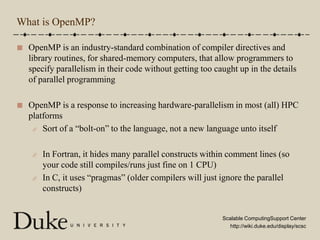
What is OpenMP?OpenMP is an industry-standard combination of compiler directives and library routines, for shared-memory computers, that allow programmers to specify parallelism in their code without getting too caught up in the details of parallel programmingOpenMP is a response to increasing hardware-parallelism in most (all) HPC platformsSort of a “bolt-on” to the language, not a new language unto itselfIn Fortran, it hides many parallel constructs within comment lines (so your code still compiles/runs just fine on 1 CPU)In C, it uses “pragmas” (older compilers will just ignore the parallel constructs)
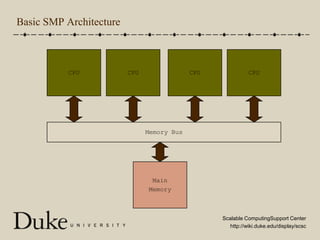
Basic SMP ArchitectureCPUCPUCPUCPUMemory BusMainMemory
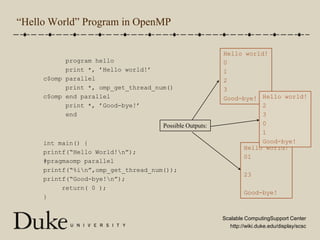
“Hello World” Program in OpenMPHello world!0123Good-bye!      program hello      print *, ’Hello world!’c$omp parallel      print *, omp_get_thread_num()c$omp end parallel      print *, ’Good-bye!’      endHello world!2301Good-bye!Possible Outputs:int main() {printf(“Hello World!\n”);#pragmaomp parallelprintf(“%i\n”,omp_get_thread_num());printf(“Good-bye!\n”);     return( 0 );}Hello world!0123Good-bye!
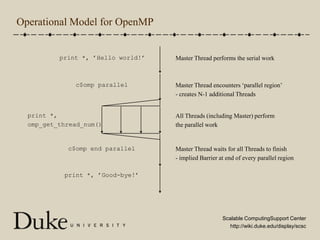
Operational Model for OpenMPMaster Thread performs the serial workprint *, ’Hello world!’Master Thread encounters ‘parallel region’- creates N-1 additional Threadsc$omp parallelAll Threads (including Master) performthe parallel workprint *, omp_get_thread_num()Master Thread waits for all Threads to finish- implied Barrier at end of every parallel regionc$omp end parallelprint *, ’Good-bye!’
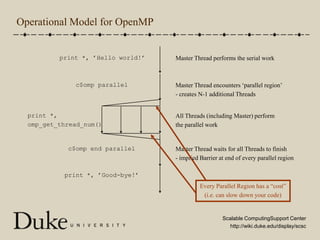
Operational Model for OpenMPMaster Thread performs the serial workprint *, ’Hello world!’Master Thread encounters ‘parallel region’- creates N-1 additional Threadsc$omp parallelAll Threads (including Master) performthe parallel workprint *, omp_get_thread_num()Master Thread waits for all Threads to finish- implied Barrier at end of every parallel regionc$omp end parallelprint *, ’Good-bye!’Every Parallel Region has a “cost”(i.e. can slow down your code)
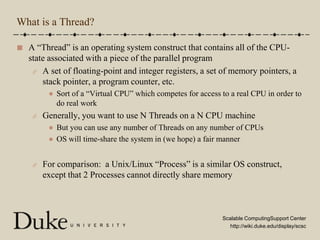
What is a Thread?A “Thread” is an operating system construct that contains all of the CPU-state associated with a piece of the parallel programA set of floating-point and integer registers, a set of memory pointers, a stack pointer, a program counter, etc.Sort of a “Virtual CPU” which competes for access to a real CPU in order to do real workGenerally, you want to use N Threads on a N CPU machineBut you can use any number of Threads on any number of CPUsOS will time-share the system in (we hope) a fair mannerFor comparison:  a Unix/Linux “Process” is a similar OS construct, except that 2 Processes cannot directly share memory
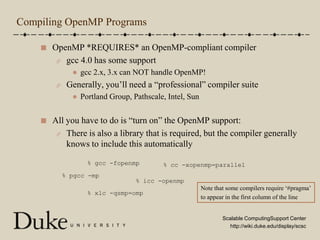
Compiling OpenMP ProgramsOpenMP *REQUIRES* an OpenMP-compliant compilergcc 4.0 has some supportgcc 2.x, 3.x can NOT handle OpenMP!Generally, you’ll need a “professional” compiler suitePortland Group, Pathscale, Intel, SunAll you have to do is “turn on” the OpenMP support:There is also a library that is required, but the compiler generally knows to include this automatically% gcc -fopenmp% cc -xopenmp=parallel% pgcc -mp% icc -openmpNote that some compilers require ‘#pragma’to appear in the first column of the line% xlc -qsmp=omp
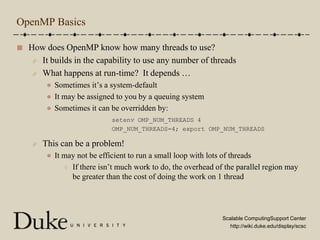
OpenMP BasicsHow does OpenMP know how many threads to use?It builds in the capability to use any number of threadsWhat happens at run-time?  It depends …Sometimes it’s a system-defaultIt may be assigned to you by a queuing systemSometimes it can be overridden by:This can be a problem!It may not be efficient to run a small loop with lots of threadsIf there isn’t much work to do, the overhead of the parallel region may be greater than the cost of doing the work on 1 threadsetenv OMP_NUM_THREADS 4OMP_NUM_THREADS=4; export OMP_NUM_THREADS
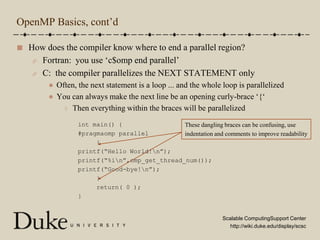
OpenMP Basics, cont’dHow does the compiler know where to end a parallel region?Fortran:  you use ‘c$omp end parallel’C:  the compiler parallelizes the NEXT STATEMENT onlyOften, the next statement is a loop ... and the whole loop is parallelizedYou can always make the next line be an opening curly-brace ‘{‘Then everything within the braces will be parallelizedint main() {#pragmaomp parallel     {printf(“Hello World!\n”);printf(“%i\n”,omp_get_thread_num());printf(“Good-bye!\n”);     }     return( 0 );}These dangling braces can be confusing, useindentation and comments to improve readability
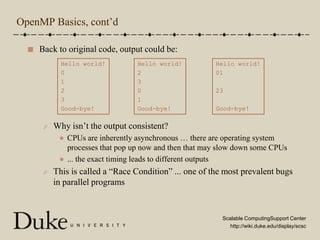
OpenMP Basics, cont’dBack to original code, output could be:Why isn’t the output consistent?CPUs are inherently asynchronous … there are operating system processes that pop up now and then that may slow down some CPUs... the exact timing leads to different outputsThis is called a “Race Condition” ... one of the most prevalent bugs in parallel programsHello world!0123Good-bye!Hello world!0123Good-bye!Hello world!2301Good-bye!
Loop ParallelismLoop-level parallelism is the most common approach to extracting parallel work from a computer programE.g. you probably have lots of loops in your program that iterate over very large arrays:Instead of 1 CPU handling all 1,000,000 entries, we use N threads which each handle (1,000,000/N) entries      do i = 1, 1000000         y(i) = alpha*x(i) + y(i)      enddofor(i=0;i<1000000;i++) {    y[i] = alpha*x[i] + y[i]}c$omp parallel do      do i = 1, 1000000         y(i) = alpha*x(i) + y(i)      enddoc$omp end parallel#pragma omp parallel forfor(i=0;i<1000000;i++) {    y[i] = alpha*x[i] + y[i]}
Loop Parallelism, cont’dc$omp parallel do      do i = 1, 1000000         y(i) = alpha*x(i) + y(i)      enddoc$omp end parallel#pragma omp parallel forfor(i=0;i<1000000;i++) {    y[i] = alpha*x[i] + y[i]}The compiler inserts code to compute the loop bounds for each threadFor 10 threads, thread 0 works on i = 1 to 100,000; thread 1 works on 100,001 to 200,000, etc.Since this is a shared memory environment, every thread can “see” all data items in all arrays … so we don’t have to coordinate each thread’s loop bounds with it’s portion of each arrayThis often makes it easier to program in OpenMP than MPI
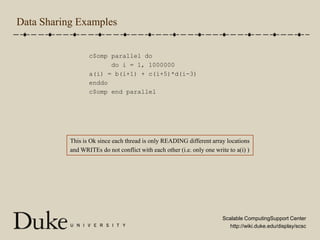
Data Sharing Examplesc$omp parallel do      do i = 1, 1000000a(i) = b(i+1) + c(i+5)*d(i-3)enddoc$omp end parallelThis is Ok since each thread is only READING different array locationsand WRITEs do not conflict with each other (i.e. only one write to a(i) )
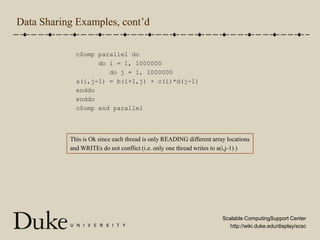
Data Sharing Examples, cont’dc$omp parallel do      do i = 1, 1000000         do j = 1, 1000000a(i,j-1) = b(i+1,j) + c(i)*d(j-1)enddoenddoc$omp end parallelThis is Ok since each thread is only READING different array locationsand WRITEs do not conflict (i.e. only one thread writes to a(i,j-1) )
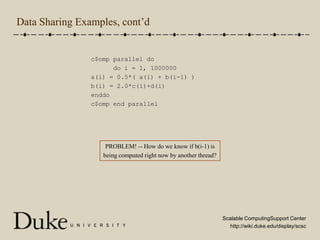
Data Sharing Examples, cont’dc$omp parallel do      do i = 1, 1000000a(i) = 0.5*( a(i) + b(i-1) )b(i) = 2.0*c(i)+d(i)enddoc$omp end parallelPROBLEM! -- How do we know if b(i-1) isbeing computed right now by another thread?
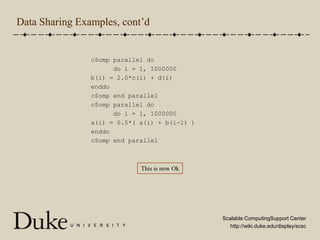
Data Sharing Examples, cont’dc$omp parallel do      do i = 1, 1000000b(i) = 2.0*c(i) + d(i)enddoc$omp end parallelc$omp parallel do      do i = 1, 1000000a(i) = 0.5*( a(i) + b(i-1) )enddoc$omp end parallelThis is now Ok
A More Complex Loop      do i = 1, 100         do j = 1, 100x = (i-1)/100y = (j-1)/100d(i,j) = mandelbrot(x,y)enddoenddofor(i=0;i<100;i++) {   for(j=0;j<100;j++) {      x = i/100;      y = j/100;      d[i][j] = mandelbrot(x,y);   }}Now, there is a function call inside the inner-most loop
A More Complex Loop, cont’dc$omp parallel do      do i = 1, 100         do j = 1, 100x = (i-1)/100y = (j-1)/100d(i,j) = mandelbrot(x,y)enddoenddoc$omp end parallel#pragma omp parallel forfor(i=0;i<100;i++) {   for(j=0;j<100;j++) {      x = i/100;      y = j/100;      d[i][j] = mandelbrot(x,y);   }}Any problems?   (what is the value of ‘x’?)
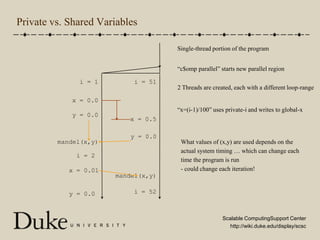
A More Complex Loop, cont’dRecall that all variables are shared across all threadsEXCEPT the loop-index/loop-boundsSo in this example, x and y are written and over-written by ALL threads for EVERY iteration in the loopThis example will compile, and even run, without any errorsBut it will produce very strange results  … since the value that a thread computes for x may be overwritten just before that thread calls the mandelbrot() functione.g. Thread-0 sets x=0.0, y=0.0 and prepares to call the functionbut just before the function call, Thread-1 writes x=0.5, y=0.0so Thread-0 actually calls mandelbrot(0.5,0) instead of (0,0)and then, Thread-0 stores the result into d(1,0)
Private vs. Shared VariablesSingle-thread portion of the program“c$omp parallel” starts new parallel regioni = 51i = 12 Threads are created, each with a different loop-rangex = 0.0“x=(i-1)/100” uses private-i and writes to global-xy = 0.0x = 0.5y = 0.0What values of (x,y) are used depends on theactual system timing … which can change eachtime the program is run- could change each iteration!mandel(x,y)i = 2x = 0.01mandel(x,y)i = 52y = 0.0
Private vs. Shared Variables, cont’dOpenMP allows the programmer to specify if additional variables need to be Private to each ThreadThis is specified as a “clause” to the c$omp or #pragma line:c$omp parallel do private(j,x,y)      do i = 1, 100         do j = 1, 100            x = (i-1)/100            y = (j-1)/100            d(i,j) = mandelbrot(x,y)         enddo      enddoc$omp end parallel#pragma omp parallel for \       private(j,x,y)for(i=0;i<100;i++) {   for(j=0;j<100;j++) {      x = i/100;      y = j/100;      d[i][j] = mandelbrot(x,y);   }}
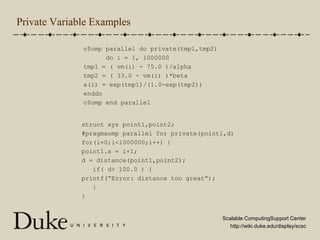
Private Variable Examplesc$omp parallel do private(tmp1,tmp2)      do i = 1, 1000000tmp1 = ( vm(i) - 75.0 )/alphatmp2 = ( 33.0 - vm(i) )*betaa(i) = exp(tmp1)/(1.0-exp(tmp2))enddoc$omp end parallelstruct xyz point1,point2;#pragmaomp parallel for private(point1,d)for(i=0;i<1000000;i++) {point1.x = i+1;d = distance(point1,point2);   if( d > 100.0 ) {printf(“Error: distance too great”);   }}
Mixing Shared and Private VariablesWhat if we want to accumulate the total count from all of the mandelbrot() calculations?      total = 0c$omp parallel do private(j,x,y)      do i = 1, 100         do j = 1, 100            x = (i-1)/100            y = (j-1)/100            d(i,j) = mandelbrot(x,y)            total = total + d(i,j)         enddo      enddoc$omp end paralleltotal = 0;#pragma omp parallel for \      private(j,x,y)for(i=0;i<100;i++) {   for(j=0;j<100;j++) {      x = i/100;      y = j/100;      d[i][j] = mandelbrot(x,y);      total += d[i][j];   }}We want ‘total’ to be shared (not private) … which is the default
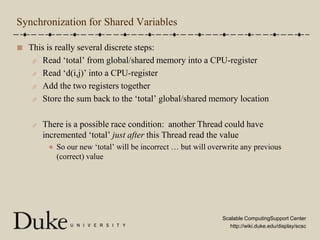
Synchronization for Shared VariablesThis is really several discrete steps:Read ‘total’ from global/shared memory into a CPU-registerRead ‘d(i,j)’ into a CPU-registerAdd the two registers togetherStore the sum back to the ‘total’ global/shared memory locationThere is a possible race condition:  another Thread could have incremented ‘total’ just after this Thread read the valueSo our new ‘total’ will be incorrect … but will overwrite any previous (correct) value
Synchronization … Critical SectionsOpenMP allows user-defined Critical SectionsOnly ONE THREAD at a time is allowed in a Critical SectionNote that Critical Sections imply SERIAL computationPARALLEL performance will likely be reduced!      total = 0c$omp parallel do private(j,x,y)      do i = 1, 100         do j = 1, 100x = (i-1)/100y = (j-1)/100d(i,j) = mandelbrot(x,y)c$omp critical            total = total + d(i,j)c$omp end criticalenddoenddoc$omp end paralleltotal = 0;#pragma omp parallel for \      private(j,x,y)for(i=0;i<100;i++) {   for(j=0;j<100;j++) {      x = i/100;      y = j/100;      d[i][j] = mandelbrot(x,y);#pragma omp critical      total += d[i][j];   }}
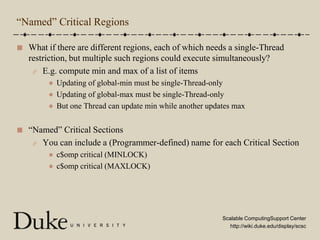
“Named” Critical RegionsWhat if there are different regions, each of which needs a single-Thread restriction, but multiple such regions could execute simultaneously?E.g. compute min and max of a list of itemsUpdating of global-min must be single-Thread-onlyUpdating of global-max must be single-Thread-onlyBut one Thread can update min while another updates max“Named” Critical SectionsYou can include a (Programmer-defined) name for each Critical Sectionc$omp critical (MINLOCK)c$omp critical (MAXLOCK)
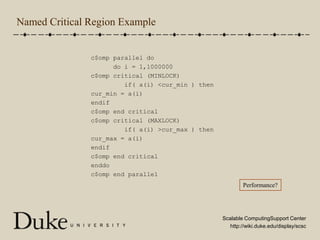
Named Critical Region Examplec$omp parallel do      do i = 1,1000000c$omp critical (MINLOCK)         if( a(i) < cur_min ) thencur_min = a(i)endifc$omp end criticalc$omp critical (MAXLOCK)         if( a(i) > cur_max ) thencur_max = a(i)endifc$omp end criticalenddoc$omp end parallelPerformance?
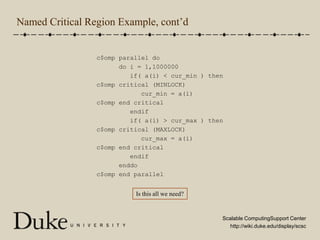
Named Critical Region Example, cont’dc$omp parallel do      do i = 1,1000000         if( a(i) < cur_min ) thenc$omp critical (MINLOCK)            cur_min = a(i)c$omp end critical         endif         if( a(i) > cur_max ) thenc$omp critical (MAXLOCK)            cur_max = a(i)c$omp end critical         endif      enddoc$omp end parallelIs this all we need?
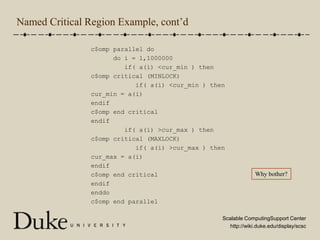
Named Critical Region Example, cont’dc$omp parallel do      do i = 1,1000000         if( a(i) < cur_min ) thenc$omp critical (MINLOCK)            if( a(i) < cur_min ) thencur_min = a(i)endifc$omp end criticalendif         if( a(i) > cur_max ) thenc$omp critical (MAXLOCK)            if( a(i) > cur_max ) thencur_max = a(i)endifc$omp end criticalendifenddoc$omp end parallelWhy bother?
“Very Small” Critical SectionsIn some cases, we may use critical reasons to provide locks on small increments to a global counter, or other “small” computationWe don’t really care what the value is, we just want to increment itWhat we really want is an ‘atomic’ update of that global variableThis uses unique hardware features on the CPU, so it is very fastBut there is a limit to what can be done#pragma omp parallel for    for(i=0;i<1000000;i++) {#pragma omp atomic      sum += a[i];    }c$omp parallel do      do i = 1, 1000000c$omp atomic         sum = sum + a(i)enddoc$omp end parallel
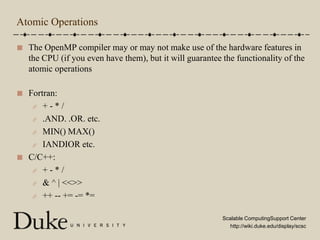
Atomic OperationsThe OpenMP compiler may or may not make use of the hardware features in the CPU (if you even have them), but it will guarantee the functionality of the atomic operationsFortran:+ - * /.AND. .OR. etc.MIN() MAX()IANDIOR etc.C/C++:+ - * /& ^ | << >>++ -- += -= *=
Synchronization … Reduction OperationsWhere Critical Sections can be any arbitrary piece of code, OpenMP also allows for optimized routines for certain standard operationsAccumulate across all Threads, Min across all Threads, etc.Called a “Reduction” Operation      total = 0c$omp parallel do private(j,x,y)c$omp+ reduction(+:total)      do i = 1, 100         do j = 1, 100x = (i-1)/100y = (j-1)/100d(i,j) = mandelbrot(x,y)            total = total + d(i,j)enddoenddoc$omp end paralleltotal = 0;#pragmaomp parallel for \private(j,x,y) \reduction(+:total)for(i=0;i<100;i++) {for(j=0;j<100;j++) {x = i/100;y = j/100;d[i][j] = mandelbrot(x,y);      total += d[i][j];   }}
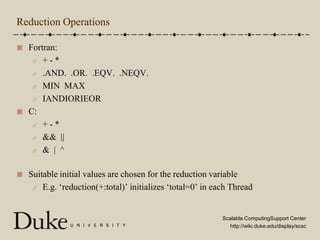
Reduction OperationsFortran:+ - *.AND.  .OR.  .EQV.  .NEQV.MIN  MAXIANDIORIEORC:+ - *&&  ||&  |  ^Suitable initial values are chosen for the reduction variableE.g. ‘reduction(+:total)’ initializes ‘total=0’ in each Thread
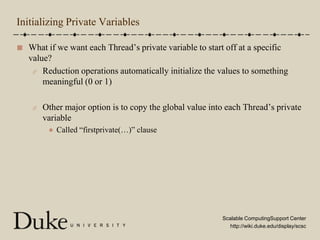
Initializing Private VariablesWhat if we want each Thread’s private variable to start off at a specific value?Reduction operations automatically initialize the values to something meaningful (0 or 1)Other major option is to copy the global value into each Thread’s private variableCalled “firstprivate(…)” clause
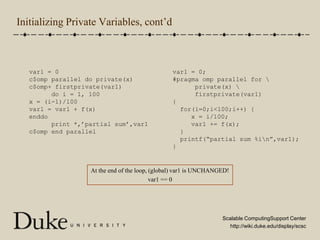
Initializing Private Variables, cont’dvar1 = 0c$omp parallel do private(x)c$omp+ firstprivate(var1)      do i = 1, 100x = (i-1)/100var1 = var1 + f(x)enddo      print *,’partial sum’,var1c$omp end parallelvar1 = 0;#pragma omp parallel for \      private(x) \      firstprivate(var1){  for(i=0;i<100;i++) {     x = i/100;     var1 += f(x);  }  printf(“partial sum %i\n”,var1);}At the end of the loop, (global) var1 is UNCHANGED!var1 == 0
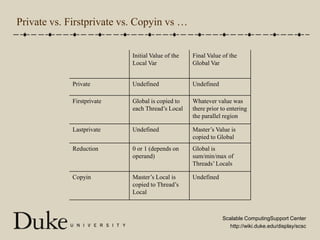
Private vs. Firstprivate vs. Copyin vs …
OpenMP and Function Calls      total = 0c$omp parallel do private(j,x,y)      do i = 1, 100         do j = 1, 100            x = (i-1)/100            y = (j-1)/100            d(i,j) = mandelbrot(x,y)c$omp critical            total = total + d(i,j)c$omp end critical         enddo      enddoc$omp end paralleltotal = 0;#pragma omp parallel for \      private(j,x,y)for(i=0;i<100;i++) {   for(j=0;j<100;j++) {      x = i/100;      y = j/100;      d[i][j] = mandelbrot(x,y);#pragma omp critical      total += d[i][j];   }}What happens inside the mandelbrot() function?Are variables defined inside mandelbrot() private or shared?
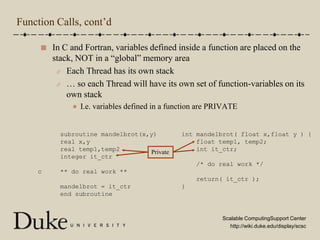
Function Calls, cont’dIn C and Fortran, variables defined inside a function are placed on the stack, NOT in a “global” memory areaEach Thread has its own stack… so each Thread will have its own set of function-variables on its own stackI.e. variables defined in a function are PRIVATE      subroutine mandelbrot(x,y)      real x,y      real temp1,temp2      integer it_ctrc     ** do real work **      mandelbrot = it_ctr      end subroutineint mandelbrot( float x,float y ) {    float temp1, temp2;    int it_ctr;    /* do real work */    return( it_ctr );}Private
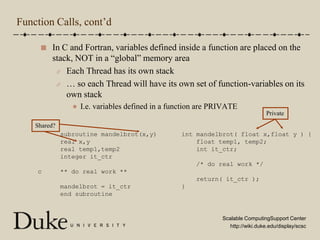
Function Calls, cont’dIn C and Fortran, variables defined inside a function are placed on the stack, NOT in a “global” memory areaEach Thread has its own stack… so each Thread will have its own set of function-variables on its own stackI.e. variables defined in a function are PRIVATEPrivateShared?      subroutine mandelbrot(x,y)      real x,y      real temp1,temp2      integer it_ctrc     ** do real work **      mandelbrot = it_ctr      end subroutineint mandelbrot( float x,float y ) {    float temp1, temp2;    int it_ctr;    /* do real work */    return( it_ctr );}
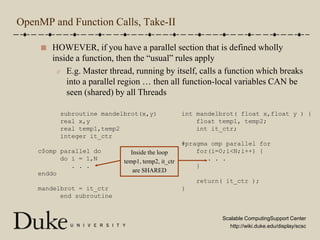
OpenMP and Function Calls, Take-IIHOWEVER, if you have a parallel section that is defined wholly inside a function, then the “usual” rules applyE.g. Master thread, running by itself, calls a function which breaks into a parallel region … then all function-local variables CAN be seen (shared) by all Threads      subroutine mandelbrot(x,y)      real x,y      real temp1,temp2      integer it_ctrc$omp parallel do      do i = 1,N         . . .enddomandelbrot = it_ctr      end subroutineint mandelbrot( float x,float y ) {    float temp1, temp2;    int it_ctr;#pragma omp parallel for    for(i=0;i<N;i++) {       . . .    }    return( it_ctr );}Inside the looptemp1, temp2, it_ctrare SHARED
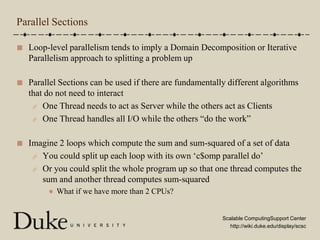
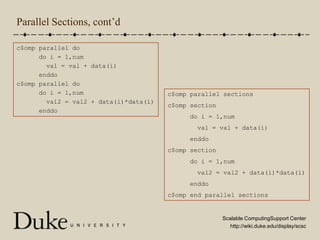
Parallel SectionsLoop-level parallelism tends to imply a Domain Decomposition or Iterative Parallelism approach to splitting a problem upParallel Sections can be used if there are fundamentally different algorithms that do not need to interactOne Thread needs to act as Server while the others act as ClientsOne Thread handles all I/O while the others “do the work”Imagine 2 loops which compute the sum and sum-squared of a set of dataYou could split up each loop with its own ‘c$omp parallel do’Or you could split the whole program up so that one thread computes the sum and another thread computes sum-squaredWhat if we have more than 2 CPUs?
Parallel Sections, cont’dc$omp parallel do      do i = 1,num        val = val + data(i)      enddoc$omp parallel do      do i = 1,num        val2 = val2 + data(i)*data(i)      enddoc$omp parallel sectionsc$omp section      do i = 1,num        val = val + data(i)      enddoc$omp section      do i = 1,num        val2 = val2 + data(i)*data(i)      enddoc$omp end parallel sections
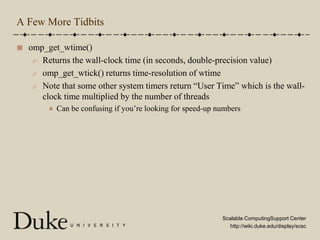
A Few More Tidbitsomp_get_wtime()Returns the wall-clock time (in seconds, double-precision value)omp_get_wtick() returns time-resolution of wtimeNote that some other system timers return “User Time” which is the wall-clock time multiplied by the number of threadsCan be confusing if you’re looking for speed-up numbers
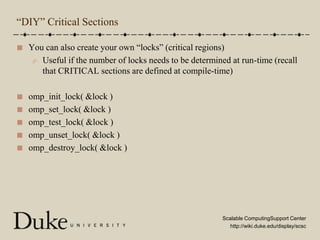
“DIY” Critical SectionsYou can also create your own “locks” (critical regions)Useful if the number of locks needs to be determined at run-time (recall that CRITICAL sections are defined at compile-time)omp_init_lock( &lock )omp_set_lock( &lock )omp_test_lock( &lock )omp_unset_lock( &lock )omp_destroy_lock( &lock )
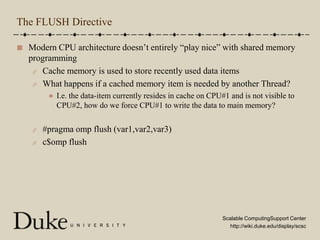
The FLUSH DirectiveModern CPU architecture doesn’t entirely “play nice” with shared memory programmingCache memory is used to store recently used data itemsWhat happens if a cached memory item is needed by another Thread?I.e. the data-item currently resides in cache on CPU#1 and is not visible to CPU#2, how do we force CPU#1 to write the data to main memory?#pragma omp flush (var1,var2,var3)c$omp flush
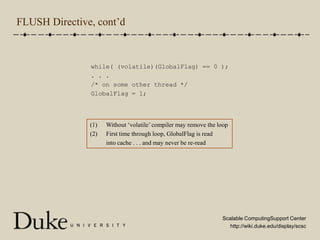
FLUSH Directive, cont’dwhile( (volatile)(GlobalFlag) == 0 );. . ./* on some other thread */GlobalFlag = 1;Without ‘volatile’ compiler may remove the loopFirst time through loop, GlobalFlag is read 	into cache . . . and may never be re-read
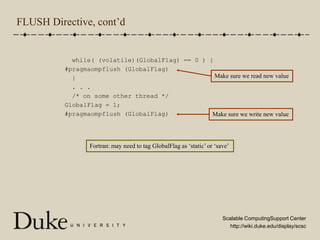
FLUSH Directive, cont’d  while( (volatile)(GlobalFlag) == 0 ) {#pragmaompflush (GlobalFlag)  }  . . .  /* on some other thread */GlobalFlag = 1;#pragmaompflush (GlobalFlag)Make sure we read new valueMake sure we write new valueFortran: may need to tag GlobalFlag as ‘static’ or ‘save’
Basic TipsOpenMP is built for large-loop parallelism with little synchronizationIf your loops require tight synchronization, you may have a hard time programming it in OpenMPIt is sometimes easier to have a single (outer) OpenMP parallel-for loop which makes function calls to a “worker” routine This kind of loopcan be pipelinedfor(i=0;i<N;i++) {   a[i] = 0.5*( a[i-1] + b[i] );}c$omp parallel do private(x)      do i=1,N         x = i*0.1         call DoWork( x )      enddo
One “Big” Parallel Region vs. Several Smaller Onesc$omp parallel do      do i = 1, N         y(i) = alpha*x(i) + y(i)      enddoc$omp end parallel      . . .c$omp parallel do      do i = 1, N         z(i) = beta*y(i) + z(i)      enddoc$omp end parallel#pragma omp parallel forfor(i=0;i<N;i++) {    y[i] = alpha*x[i] + y[i]}. . .#pragma omp parallel forfor(i=0;i<N;i++) {    z[i] = beta*y[i] + z[i];}Each parallel region has an implied barrier (high cost)
One “Big” Parallel Region, cont’dc$omp parallel c$omp do      do i = 1, N         y(i) = alpha*x(i) + y(i)      enddoc$omp enddo      . . .c$omp do      do i = 1, N         z(i) = beta*y(i) + z(i)      enddoc$omp enddoc$omp end parallel#pragma omp parallel{#pragma omp for  for(i=0;i<N;i++) {    y[i] = alpha*x[i] + y[i]  }. . .#pragma omp for  for(i=0;i<N;i++) {    z[i] = beta*y[i] + z[i];  }}  /* end of parallel region */This is still a parallel section
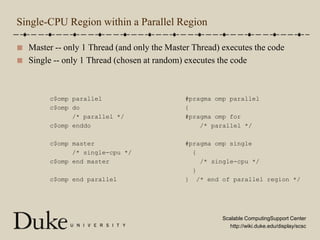
Single-CPU Region within a Parallel RegionMaster -- only 1 Thread (and only the Master Thread) executes the codeSingle -- only 1 Thread (chosen at random) executes the codec$omp parallel c$omp do      /* parallel */c$omp enddoc$omp master      /* single-cpu */c$omp end masterc$omp end parallel#pragma omp parallel{#pragma omp for    /* parallel */#pragma omp single  {    /* single-cpu */  }}  /* end of parallel region */
One “Big” Parallel Region, cont’dOne (larger) parallel region has only one implied barrierShould be lower “cost” ... hence, better performanceThe “interior” regions will be executed in parallel which may result in redundant computationsIf there is too much redundant computation, it could slow down the codeUse ‘MASTER’ or ‘SINGLE’ regions if neededNote that a small amount of redundant computation is often cheaper than breaking out to a single-CPU region and then re-starting a parallel region
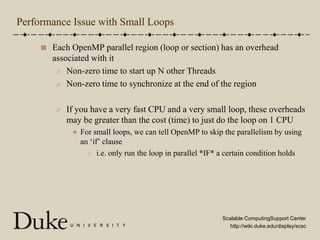
Performance Issue with Small LoopsEach OpenMP parallel region (loop or section) has an overhead associated with itNon-zero time to start up N other ThreadsNon-zero time to synchronize at the end of the regionIf you have a very fast CPU and a very small loop, these overheads may be greater than the cost (time) to just do the loop on 1 CPUFor small loops, we can tell OpenMP to skip the parallelism by using an ‘if’ clausei.e. only run the loop in parallel *IF* a certain condition holds
Small Loops, cont’dc$omp parallel do if(N>1000)      do i = 1, Ny(i) = alpha*x(i) + y(i)enddoc$omp end parallel#pragma omp parallel for \      if(N>1000)for(i=0;i<N;i++) {    y[i] = alpha*x[i] + y[i]}Where you should put this cut-off is entirely machine-dependent
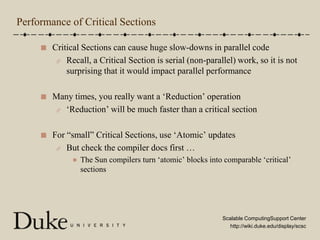
Performance of Critical SectionsCritical Sections can cause huge slow-downs in parallel codeRecall, a Critical Section is serial (non-parallel) work, so it is not surprising that it would impact parallel performanceMany times, you really want a ‘Reduction’ operation‘Reduction’ will be much faster than a critical sectionFor “small” Critical Sections, use ‘Atomic’ updatesBut check the compiler docs first …The Sun compilers turn ‘atomic’ blocks into comparable ‘critical’ sections
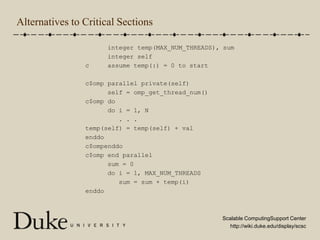
Alternatives to Critical Sections      integer temp(MAX_NUM_THREADS), sum      integer selfc     assume temp(:) = 0 to startc$omp parallel private(self)      self = omp_get_thread_num()c$omp do      do i = 1, N         . . .temp(self) = temp(self) + valenddoc$ompenddoc$omp end parallel      sum = 0      do i = 1, MAX_NUM_THREADS         sum = sum + temp(i)enddo
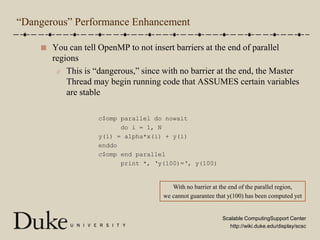
“Dangerous” Performance EnhancementYou can tell OpenMP to not insert barriers at the end of parallel regionsThis is “dangerous,” since with no barrier at the end, the Master Thread may begin running code that ASSUMES certain variables are stablec$omp parallel do nowait      do i = 1, Ny(i) = alpha*x(i) + y(i)enddoc$omp end parallel      print *, ‘y(100)=‘, y(100)With no barrier at the end of the parallel region,we cannot guarantee that y(100) has been computed yet
Race ConditionsA “Race” is a situation where multiple Threads are making progress toward some shared or common goal where timing is criticalGenerally, this means you’ve ASSUMED something is synchronized, but you haven’t FORCED it to be synchronizedE.g. all Threads are trying to find a “hit” in a databaseWhen a hit is detected, the Thread increments a global counterNormally, hits are rare events and so incrementing the counter is “not a big deal”But if two hits occur simultaneously, then we have a race conditionWhile one Thread is incrementing the counter, the other Thread may be reading itIt may read the old value or new value, depending on the exact timing
Race Conditions, cont’dSome symptoms:Running the code with 4 Threads works fine, running with 5 causes erroneous outputRunning the code with 4 Threads works fine, running it with 4 Threads again produces different resultsSometimes the code works fine, sometimes it crashes after 4 hours, sometimes it crashes after 10 hours, …Program sometimes runs fine, sometimes hits an infinite loopProgram output is sometimes jumbled (the usual line-3 appears before line-1)Any kind of indeterminacy in the running of the code, or seemingly random changes to its output, could indicate a race condition
Race Conditions, cont’dRace Conditions can be EXTREMELY hard to debugGenerally, race conditions don’t cause crashes or even logic-errorsE.g. a race condition leads two Threads to both think they are in charge of data-item-X … nothing crashes, they just keep writing and overwriting X (maybe even doing duplicate computations)Often, race conditions don’t cause crashes at the time they actually occur … the crash occurs much later in the execution and for a totally unrelated reasonE.g. a race condition leads one Thread to think that the solver converged but the other Thread thinks we need another iteration … crash occurs because one Thread tried to compute the global residualSometimes race conditions can lead to deadlockAgain, this often shows up as seemingly random deadlock when the same code is run on the same input
DeadlockA “Deadlock” condition occurs when all Threads are stopped at synchronization points and none of them are able to make progressSometimes this can be something simple:  Thread-1 enters a Critical-Section and waits for Variable-X to be incremented, and then it will release the lockThread-2 wants to increment X but needs to enter the Critical-Section in order to do thatSometimes it can be more complex or cyclic:Thread-1 enters Crit-Sec-1 and needs to enter Crit-Sec-2Thread-2 enters Crit-Sec-2 and needs to enter Crit-Sec-3Thread-3 enters Crit-Sec-3 and …
Starvation“Starvation” occurs when one Thread needs a resource (Critical Section) that is never released by another ThreadThread-1 grabs a lock/enters a critical region in order to write data to a fileEvery time Thread-1 is about to release the lock, it finds that it has another item to write ... it keeps the lock/re-enters the critical regionThread-2 continues to wait for the lock/critical region but never gets itSometimes it may show up as “almost Deadlock”, other times it may show up as a performance degradationE.g. when Thread-1 is done writing all of its data, it finally gives the lock over to Thread-2 ... output is correct but performance is terrible
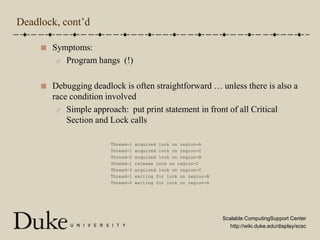
Deadlock, cont’dSymptoms:Program hangs  (!)Debugging deadlock is often straightforward … unless there is also a race condition involvedSimple approach:  put print statement in front of all Critical Section and Lock callsThread-1 acquired lock on region-AThread-1 acquired lock on region-CThread-2 acquired lock on region-BThread-1 release lock on region-CThread-3 acquired lock on region-CThread-1 waiting for lock on region-BThread-2 waiting for lock on region-A
Static Scheduling for Fixed Work-loadsOpenMP allows dynamic scheduling of parallel loopsIf one CPU gets loaded down (by OS tasks), other CPUs will pick up additional iterations in the loop to offset that performance-lossGenerally, this works well -- you don’t have to worry about all the random things that might happen, OpenMP does the “smart” thingHowever, this dynamic scheduling implies some additional “cost”If nothing else, the CPUs must check if other CPUs are loadedIf your work-load inside a parallel region is fixed, then you may want to try a “static” work-assignmentE.g. the loop is exactly 1,000,000 iterations, so the CPUs should take 100,000 each
Static Scheduling, cont’dc$omp parallel do schedule(static)      do i = 1, 1000000         y(i) = alpha*x(i) + y(i)      enddoc$omp end parallel#pragmaomp parallel for schedule(static)for(i=0;i<1000000;i++) {y[i] = alpha*x[i] + y[i]}If the per-iteration work-load is variable,  or you are sharing the CPUs with many other users,then a dynamic scheduling algorithm (the default) may be better
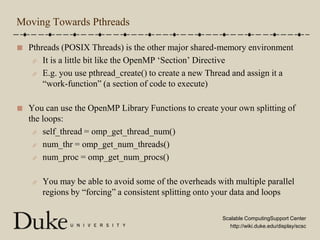
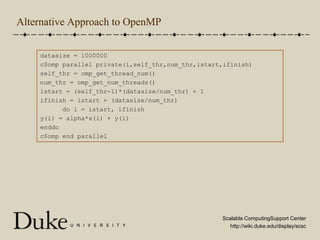
Moving Towards PthreadsPthreads (POSIX Threads) is the other major shared-memory environmentIt is a little bit like the OpenMP ‘Section’ DirectiveE.g. you use pthread_create() to create a new Thread and assign it a “work-function” (a section of code to execute)You can use the OpenMP Library Functions to create your own splitting of the loops:self_thread = omp_get_thread_num()num_thr = omp_get_num_threads()num_proc = omp_get_num_procs()You may be able to avoid some of the overheads with multiple parallel regions by “forcing” a consistent splitting onto your data and loops
Alternative Approach to OpenMPdatasize = 1000000c$omp parallel private(i,self_thr,num_thr,istart,ifinish)self_thr = omp_get_thread_num()num_thr = omp_get_num_threads()istart = (self_thr-1)*(datasize/num_thr) + 1ifinish = istart + (datasize/num_thr)      do i = istart, ifinishy(i) = alpha*x(i) + y(i)enddoc$omp end parallel
Alternative Approach to OpenMP, cont’ddatasize = 1000000#pragmaomp parallel private(i,self_thr,num_thr,istart,ifinish)      {self_thr = omp_get_thread_num();num_thr = omp_get_num_threads();istart = (self_thr-1)*(datasize/num_thr);ifinish = istart + (datasize/num_thr);for(i=istart;i<ifinish;i++) {y[i] = alpha*x[i] + y[i];        }      }
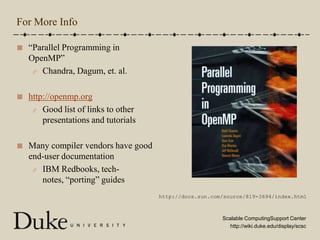
For More Info“Parallel Programming in OpenMP”Chandra, Dagum, et. al.http://openmp.orgGood list of links to other presentations and tutorialsMany compiler vendors have good end-user documentationIBM Redbooks, tech-notes, “porting” guideshttp://docs.sun.com/source/819-3694/index.html
Where to go from here?http://wiki.duke.edu/display/scsc/  . . . scsc at duke.eduGet on our mailing lists:SCSC seminars

Intro to OpenMP

  • 1.
    Introduction toOpenMPScalable ComputingSupport CenterDuke Universityhttp://wiki.duke.edu/display/SCSCscsc at duke.eduJohn Pormann, Ph.D.jbp1 at duke edu
  • 2.
    What is OpenMP?OpenMPis an industry-standard combination of compiler directives and library routines, for shared-memory computers, that allow programmers to specify parallelism in their code without getting too caught up in the details of parallel programmingOpenMP is a response to increasing hardware-parallelism in most (all) HPC platformsSort of a “bolt-on” to the language, not a new language unto itselfIn Fortran, it hides many parallel constructs within comment lines (so your code still compiles/runs just fine on 1 CPU)In C, it uses “pragmas” (older compilers will just ignore the parallel constructs)
  • 3.
  • 4.
    “Hello World” Programin OpenMPHello world!0123Good-bye! program hello print *, ’Hello world!’c$omp parallel print *, omp_get_thread_num()c$omp end parallel print *, ’Good-bye!’ endHello world!2301Good-bye!Possible Outputs:int main() {printf(“Hello World!\n”);#pragmaomp parallelprintf(“%i\n”,omp_get_thread_num());printf(“Good-bye!\n”); return( 0 );}Hello world!0123Good-bye!
  • 5.
    Operational Model forOpenMPMaster Thread performs the serial workprint *, ’Hello world!’Master Thread encounters ‘parallel region’- creates N-1 additional Threadsc$omp parallelAll Threads (including Master) performthe parallel workprint *, omp_get_thread_num()Master Thread waits for all Threads to finish- implied Barrier at end of every parallel regionc$omp end parallelprint *, ’Good-bye!’
  • 6.
    Operational Model forOpenMPMaster Thread performs the serial workprint *, ’Hello world!’Master Thread encounters ‘parallel region’- creates N-1 additional Threadsc$omp parallelAll Threads (including Master) performthe parallel workprint *, omp_get_thread_num()Master Thread waits for all Threads to finish- implied Barrier at end of every parallel regionc$omp end parallelprint *, ’Good-bye!’Every Parallel Region has a “cost”(i.e. can slow down your code)
  • 7.
    What is aThread?A “Thread” is an operating system construct that contains all of the CPU-state associated with a piece of the parallel programA set of floating-point and integer registers, a set of memory pointers, a stack pointer, a program counter, etc.Sort of a “Virtual CPU” which competes for access to a real CPU in order to do real workGenerally, you want to use N Threads on a N CPU machineBut you can use any number of Threads on any number of CPUsOS will time-share the system in (we hope) a fair mannerFor comparison: a Unix/Linux “Process” is a similar OS construct, except that 2 Processes cannot directly share memory
  • 8.
    Compiling OpenMP ProgramsOpenMP*REQUIRES* an OpenMP-compliant compilergcc 4.0 has some supportgcc 2.x, 3.x can NOT handle OpenMP!Generally, you’ll need a “professional” compiler suitePortland Group, Pathscale, Intel, SunAll you have to do is “turn on” the OpenMP support:There is also a library that is required, but the compiler generally knows to include this automatically% gcc -fopenmp% cc -xopenmp=parallel% pgcc -mp% icc -openmpNote that some compilers require ‘#pragma’to appear in the first column of the line% xlc -qsmp=omp
  • 9.
    OpenMP BasicsHow doesOpenMP know how many threads to use?It builds in the capability to use any number of threadsWhat happens at run-time? It depends …Sometimes it’s a system-defaultIt may be assigned to you by a queuing systemSometimes it can be overridden by:This can be a problem!It may not be efficient to run a small loop with lots of threadsIf there isn’t much work to do, the overhead of the parallel region may be greater than the cost of doing the work on 1 threadsetenv OMP_NUM_THREADS 4OMP_NUM_THREADS=4; export OMP_NUM_THREADS
  • 10.
    OpenMP Basics, cont’dHowdoes the compiler know where to end a parallel region?Fortran: you use ‘c$omp end parallel’C: the compiler parallelizes the NEXT STATEMENT onlyOften, the next statement is a loop ... and the whole loop is parallelizedYou can always make the next line be an opening curly-brace ‘{‘Then everything within the braces will be parallelizedint main() {#pragmaomp parallel {printf(“Hello World!\n”);printf(“%i\n”,omp_get_thread_num());printf(“Good-bye!\n”); } return( 0 );}These dangling braces can be confusing, useindentation and comments to improve readability
  • 11.
    OpenMP Basics, cont’dBackto original code, output could be:Why isn’t the output consistent?CPUs are inherently asynchronous … there are operating system processes that pop up now and then that may slow down some CPUs... the exact timing leads to different outputsThis is called a “Race Condition” ... one of the most prevalent bugs in parallel programsHello world!0123Good-bye!Hello world!0123Good-bye!Hello world!2301Good-bye!
  • 12.
    Loop ParallelismLoop-level parallelismis the most common approach to extracting parallel work from a computer programE.g. you probably have lots of loops in your program that iterate over very large arrays:Instead of 1 CPU handling all 1,000,000 entries, we use N threads which each handle (1,000,000/N) entries do i = 1, 1000000 y(i) = alpha*x(i) + y(i) enddofor(i=0;i<1000000;i++) { y[i] = alpha*x[i] + y[i]}c$omp parallel do do i = 1, 1000000 y(i) = alpha*x(i) + y(i) enddoc$omp end parallel#pragma omp parallel forfor(i=0;i<1000000;i++) { y[i] = alpha*x[i] + y[i]}
  • 13.
    Loop Parallelism, cont’dc$ompparallel do do i = 1, 1000000 y(i) = alpha*x(i) + y(i) enddoc$omp end parallel#pragma omp parallel forfor(i=0;i<1000000;i++) { y[i] = alpha*x[i] + y[i]}The compiler inserts code to compute the loop bounds for each threadFor 10 threads, thread 0 works on i = 1 to 100,000; thread 1 works on 100,001 to 200,000, etc.Since this is a shared memory environment, every thread can “see” all data items in all arrays … so we don’t have to coordinate each thread’s loop bounds with it’s portion of each arrayThis often makes it easier to program in OpenMP than MPI
  • 14.
    Data Sharing Examplesc$ompparallel do do i = 1, 1000000a(i) = b(i+1) + c(i+5)*d(i-3)enddoc$omp end parallelThis is Ok since each thread is only READING different array locationsand WRITEs do not conflict with each other (i.e. only one write to a(i) )
  • 15.
    Data Sharing Examples,cont’dc$omp parallel do do i = 1, 1000000 do j = 1, 1000000a(i,j-1) = b(i+1,j) + c(i)*d(j-1)enddoenddoc$omp end parallelThis is Ok since each thread is only READING different array locationsand WRITEs do not conflict (i.e. only one thread writes to a(i,j-1) )
  • 16.
    Data Sharing Examples,cont’dc$omp parallel do do i = 1, 1000000a(i) = 0.5*( a(i) + b(i-1) )b(i) = 2.0*c(i)+d(i)enddoc$omp end parallelPROBLEM! -- How do we know if b(i-1) isbeing computed right now by another thread?
  • 17.
    Data Sharing Examples,cont’dc$omp parallel do do i = 1, 1000000b(i) = 2.0*c(i) + d(i)enddoc$omp end parallelc$omp parallel do do i = 1, 1000000a(i) = 0.5*( a(i) + b(i-1) )enddoc$omp end parallelThis is now Ok
  • 18.
    A More ComplexLoop do i = 1, 100 do j = 1, 100x = (i-1)/100y = (j-1)/100d(i,j) = mandelbrot(x,y)enddoenddofor(i=0;i<100;i++) { for(j=0;j<100;j++) { x = i/100; y = j/100; d[i][j] = mandelbrot(x,y); }}Now, there is a function call inside the inner-most loop
  • 19.
    A More ComplexLoop, cont’dc$omp parallel do do i = 1, 100 do j = 1, 100x = (i-1)/100y = (j-1)/100d(i,j) = mandelbrot(x,y)enddoenddoc$omp end parallel#pragma omp parallel forfor(i=0;i<100;i++) { for(j=0;j<100;j++) { x = i/100; y = j/100; d[i][j] = mandelbrot(x,y); }}Any problems? (what is the value of ‘x’?)
  • 20.
    A More ComplexLoop, cont’dRecall that all variables are shared across all threadsEXCEPT the loop-index/loop-boundsSo in this example, x and y are written and over-written by ALL threads for EVERY iteration in the loopThis example will compile, and even run, without any errorsBut it will produce very strange results … since the value that a thread computes for x may be overwritten just before that thread calls the mandelbrot() functione.g. Thread-0 sets x=0.0, y=0.0 and prepares to call the functionbut just before the function call, Thread-1 writes x=0.5, y=0.0so Thread-0 actually calls mandelbrot(0.5,0) instead of (0,0)and then, Thread-0 stores the result into d(1,0)
  • 21.
    Private vs. SharedVariablesSingle-thread portion of the program“c$omp parallel” starts new parallel regioni = 51i = 12 Threads are created, each with a different loop-rangex = 0.0“x=(i-1)/100” uses private-i and writes to global-xy = 0.0x = 0.5y = 0.0What values of (x,y) are used depends on theactual system timing … which can change eachtime the program is run- could change each iteration!mandel(x,y)i = 2x = 0.01mandel(x,y)i = 52y = 0.0
  • 22.
    Private vs. SharedVariables, cont’dOpenMP allows the programmer to specify if additional variables need to be Private to each ThreadThis is specified as a “clause” to the c$omp or #pragma line:c$omp parallel do private(j,x,y) do i = 1, 100 do j = 1, 100 x = (i-1)/100 y = (j-1)/100 d(i,j) = mandelbrot(x,y) enddo enddoc$omp end parallel#pragma omp parallel for \ private(j,x,y)for(i=0;i<100;i++) { for(j=0;j<100;j++) { x = i/100; y = j/100; d[i][j] = mandelbrot(x,y); }}
  • 23.
    Private Variable Examplesc$ompparallel do private(tmp1,tmp2) do i = 1, 1000000tmp1 = ( vm(i) - 75.0 )/alphatmp2 = ( 33.0 - vm(i) )*betaa(i) = exp(tmp1)/(1.0-exp(tmp2))enddoc$omp end parallelstruct xyz point1,point2;#pragmaomp parallel for private(point1,d)for(i=0;i<1000000;i++) {point1.x = i+1;d = distance(point1,point2); if( d > 100.0 ) {printf(“Error: distance too great”); }}
  • 24.
    Mixing Shared andPrivate VariablesWhat if we want to accumulate the total count from all of the mandelbrot() calculations? total = 0c$omp parallel do private(j,x,y) do i = 1, 100 do j = 1, 100 x = (i-1)/100 y = (j-1)/100 d(i,j) = mandelbrot(x,y) total = total + d(i,j) enddo enddoc$omp end paralleltotal = 0;#pragma omp parallel for \ private(j,x,y)for(i=0;i<100;i++) { for(j=0;j<100;j++) { x = i/100; y = j/100; d[i][j] = mandelbrot(x,y); total += d[i][j]; }}We want ‘total’ to be shared (not private) … which is the default
  • 25.
    Synchronization for SharedVariablesThis is really several discrete steps:Read ‘total’ from global/shared memory into a CPU-registerRead ‘d(i,j)’ into a CPU-registerAdd the two registers togetherStore the sum back to the ‘total’ global/shared memory locationThere is a possible race condition: another Thread could have incremented ‘total’ just after this Thread read the valueSo our new ‘total’ will be incorrect … but will overwrite any previous (correct) value
  • 26.
    Synchronization … CriticalSectionsOpenMP allows user-defined Critical SectionsOnly ONE THREAD at a time is allowed in a Critical SectionNote that Critical Sections imply SERIAL computationPARALLEL performance will likely be reduced! total = 0c$omp parallel do private(j,x,y) do i = 1, 100 do j = 1, 100x = (i-1)/100y = (j-1)/100d(i,j) = mandelbrot(x,y)c$omp critical total = total + d(i,j)c$omp end criticalenddoenddoc$omp end paralleltotal = 0;#pragma omp parallel for \ private(j,x,y)for(i=0;i<100;i++) { for(j=0;j<100;j++) { x = i/100; y = j/100; d[i][j] = mandelbrot(x,y);#pragma omp critical total += d[i][j]; }}
  • 27.
    “Named” Critical RegionsWhatif there are different regions, each of which needs a single-Thread restriction, but multiple such regions could execute simultaneously?E.g. compute min and max of a list of itemsUpdating of global-min must be single-Thread-onlyUpdating of global-max must be single-Thread-onlyBut one Thread can update min while another updates max“Named” Critical SectionsYou can include a (Programmer-defined) name for each Critical Sectionc$omp critical (MINLOCK)c$omp critical (MAXLOCK)
  • 28.
    Named Critical RegionExamplec$omp parallel do do i = 1,1000000c$omp critical (MINLOCK) if( a(i) < cur_min ) thencur_min = a(i)endifc$omp end criticalc$omp critical (MAXLOCK) if( a(i) > cur_max ) thencur_max = a(i)endifc$omp end criticalenddoc$omp end parallelPerformance?
  • 29.
    Named Critical RegionExample, cont’dc$omp parallel do do i = 1,1000000 if( a(i) < cur_min ) thenc$omp critical (MINLOCK) cur_min = a(i)c$omp end critical endif if( a(i) > cur_max ) thenc$omp critical (MAXLOCK) cur_max = a(i)c$omp end critical endif enddoc$omp end parallelIs this all we need?
  • 30.
    Named Critical RegionExample, cont’dc$omp parallel do do i = 1,1000000 if( a(i) < cur_min ) thenc$omp critical (MINLOCK) if( a(i) < cur_min ) thencur_min = a(i)endifc$omp end criticalendif if( a(i) > cur_max ) thenc$omp critical (MAXLOCK) if( a(i) > cur_max ) thencur_max = a(i)endifc$omp end criticalendifenddoc$omp end parallelWhy bother?
  • 31.
    “Very Small” CriticalSectionsIn some cases, we may use critical reasons to provide locks on small increments to a global counter, or other “small” computationWe don’t really care what the value is, we just want to increment itWhat we really want is an ‘atomic’ update of that global variableThis uses unique hardware features on the CPU, so it is very fastBut there is a limit to what can be done#pragma omp parallel for for(i=0;i<1000000;i++) {#pragma omp atomic sum += a[i]; }c$omp parallel do do i = 1, 1000000c$omp atomic sum = sum + a(i)enddoc$omp end parallel
  • 32.
    Atomic OperationsThe OpenMPcompiler may or may not make use of the hardware features in the CPU (if you even have them), but it will guarantee the functionality of the atomic operationsFortran:+ - * /.AND. .OR. etc.MIN() MAX()IANDIOR etc.C/C++:+ - * /& ^ | << >>++ -- += -= *=
  • 33.
    Synchronization … ReductionOperationsWhere Critical Sections can be any arbitrary piece of code, OpenMP also allows for optimized routines for certain standard operationsAccumulate across all Threads, Min across all Threads, etc.Called a “Reduction” Operation total = 0c$omp parallel do private(j,x,y)c$omp+ reduction(+:total) do i = 1, 100 do j = 1, 100x = (i-1)/100y = (j-1)/100d(i,j) = mandelbrot(x,y) total = total + d(i,j)enddoenddoc$omp end paralleltotal = 0;#pragmaomp parallel for \private(j,x,y) \reduction(+:total)for(i=0;i<100;i++) {for(j=0;j<100;j++) {x = i/100;y = j/100;d[i][j] = mandelbrot(x,y); total += d[i][j]; }}
  • 34.
    Reduction OperationsFortran:+ -*.AND. .OR. .EQV. .NEQV.MIN MAXIANDIORIEORC:+ - *&& ||& | ^Suitable initial values are chosen for the reduction variableE.g. ‘reduction(+:total)’ initializes ‘total=0’ in each Thread
  • 35.
    Initializing Private VariablesWhatif we want each Thread’s private variable to start off at a specific value?Reduction operations automatically initialize the values to something meaningful (0 or 1)Other major option is to copy the global value into each Thread’s private variableCalled “firstprivate(…)” clause
  • 36.
    Initializing Private Variables,cont’dvar1 = 0c$omp parallel do private(x)c$omp+ firstprivate(var1) do i = 1, 100x = (i-1)/100var1 = var1 + f(x)enddo print *,’partial sum’,var1c$omp end parallelvar1 = 0;#pragma omp parallel for \ private(x) \ firstprivate(var1){ for(i=0;i<100;i++) { x = i/100; var1 += f(x); } printf(“partial sum %i\n”,var1);}At the end of the loop, (global) var1 is UNCHANGED!var1 == 0
  • 37.
    Private vs. Firstprivatevs. Copyin vs …
  • 38.
    OpenMP and FunctionCalls total = 0c$omp parallel do private(j,x,y) do i = 1, 100 do j = 1, 100 x = (i-1)/100 y = (j-1)/100 d(i,j) = mandelbrot(x,y)c$omp critical total = total + d(i,j)c$omp end critical enddo enddoc$omp end paralleltotal = 0;#pragma omp parallel for \ private(j,x,y)for(i=0;i<100;i++) { for(j=0;j<100;j++) { x = i/100; y = j/100; d[i][j] = mandelbrot(x,y);#pragma omp critical total += d[i][j]; }}What happens inside the mandelbrot() function?Are variables defined inside mandelbrot() private or shared?
  • 39.
    Function Calls, cont’dInC and Fortran, variables defined inside a function are placed on the stack, NOT in a “global” memory areaEach Thread has its own stack… so each Thread will have its own set of function-variables on its own stackI.e. variables defined in a function are PRIVATE subroutine mandelbrot(x,y) real x,y real temp1,temp2 integer it_ctrc ** do real work ** mandelbrot = it_ctr end subroutineint mandelbrot( float x,float y ) { float temp1, temp2; int it_ctr; /* do real work */ return( it_ctr );}Private
  • 40.
    Function Calls, cont’dInC and Fortran, variables defined inside a function are placed on the stack, NOT in a “global” memory areaEach Thread has its own stack… so each Thread will have its own set of function-variables on its own stackI.e. variables defined in a function are PRIVATEPrivateShared? subroutine mandelbrot(x,y) real x,y real temp1,temp2 integer it_ctrc ** do real work ** mandelbrot = it_ctr end subroutineint mandelbrot( float x,float y ) { float temp1, temp2; int it_ctr; /* do real work */ return( it_ctr );}
  • 41.
    OpenMP and FunctionCalls, Take-IIHOWEVER, if you have a parallel section that is defined wholly inside a function, then the “usual” rules applyE.g. Master thread, running by itself, calls a function which breaks into a parallel region … then all function-local variables CAN be seen (shared) by all Threads subroutine mandelbrot(x,y) real x,y real temp1,temp2 integer it_ctrc$omp parallel do do i = 1,N . . .enddomandelbrot = it_ctr end subroutineint mandelbrot( float x,float y ) { float temp1, temp2; int it_ctr;#pragma omp parallel for for(i=0;i<N;i++) { . . . } return( it_ctr );}Inside the looptemp1, temp2, it_ctrare SHARED
  • 42.
    Parallel SectionsLoop-level parallelismtends to imply a Domain Decomposition or Iterative Parallelism approach to splitting a problem upParallel Sections can be used if there are fundamentally different algorithms that do not need to interactOne Thread needs to act as Server while the others act as ClientsOne Thread handles all I/O while the others “do the work”Imagine 2 loops which compute the sum and sum-squared of a set of dataYou could split up each loop with its own ‘c$omp parallel do’Or you could split the whole program up so that one thread computes the sum and another thread computes sum-squaredWhat if we have more than 2 CPUs?
  • 43.
    Parallel Sections, cont’dc$ompparallel do do i = 1,num val = val + data(i) enddoc$omp parallel do do i = 1,num val2 = val2 + data(i)*data(i) enddoc$omp parallel sectionsc$omp section do i = 1,num val = val + data(i) enddoc$omp section do i = 1,num val2 = val2 + data(i)*data(i) enddoc$omp end parallel sections
  • 44.
    A Few MoreTidbitsomp_get_wtime()Returns the wall-clock time (in seconds, double-precision value)omp_get_wtick() returns time-resolution of wtimeNote that some other system timers return “User Time” which is the wall-clock time multiplied by the number of threadsCan be confusing if you’re looking for speed-up numbers
  • 45.
    “DIY” Critical SectionsYoucan also create your own “locks” (critical regions)Useful if the number of locks needs to be determined at run-time (recall that CRITICAL sections are defined at compile-time)omp_init_lock( &lock )omp_set_lock( &lock )omp_test_lock( &lock )omp_unset_lock( &lock )omp_destroy_lock( &lock )
  • 46.
    The FLUSH DirectiveModernCPU architecture doesn’t entirely “play nice” with shared memory programmingCache memory is used to store recently used data itemsWhat happens if a cached memory item is needed by another Thread?I.e. the data-item currently resides in cache on CPU#1 and is not visible to CPU#2, how do we force CPU#1 to write the data to main memory?#pragma omp flush (var1,var2,var3)c$omp flush
  • 47.
    FLUSH Directive, cont’dwhile((volatile)(GlobalFlag) == 0 );. . ./* on some other thread */GlobalFlag = 1;Without ‘volatile’ compiler may remove the loopFirst time through loop, GlobalFlag is read into cache . . . and may never be re-read
  • 48.
    FLUSH Directive, cont’d while( (volatile)(GlobalFlag) == 0 ) {#pragmaompflush (GlobalFlag) } . . . /* on some other thread */GlobalFlag = 1;#pragmaompflush (GlobalFlag)Make sure we read new valueMake sure we write new valueFortran: may need to tag GlobalFlag as ‘static’ or ‘save’
  • 49.
    Basic TipsOpenMP isbuilt for large-loop parallelism with little synchronizationIf your loops require tight synchronization, you may have a hard time programming it in OpenMPIt is sometimes easier to have a single (outer) OpenMP parallel-for loop which makes function calls to a “worker” routine This kind of loopcan be pipelinedfor(i=0;i<N;i++) { a[i] = 0.5*( a[i-1] + b[i] );}c$omp parallel do private(x) do i=1,N x = i*0.1 call DoWork( x ) enddo
  • 50.
    One “Big” ParallelRegion vs. Several Smaller Onesc$omp parallel do do i = 1, N y(i) = alpha*x(i) + y(i) enddoc$omp end parallel . . .c$omp parallel do do i = 1, N z(i) = beta*y(i) + z(i) enddoc$omp end parallel#pragma omp parallel forfor(i=0;i<N;i++) { y[i] = alpha*x[i] + y[i]}. . .#pragma omp parallel forfor(i=0;i<N;i++) { z[i] = beta*y[i] + z[i];}Each parallel region has an implied barrier (high cost)
  • 51.
    One “Big” ParallelRegion, cont’dc$omp parallel c$omp do do i = 1, N y(i) = alpha*x(i) + y(i) enddoc$omp enddo . . .c$omp do do i = 1, N z(i) = beta*y(i) + z(i) enddoc$omp enddoc$omp end parallel#pragma omp parallel{#pragma omp for for(i=0;i<N;i++) { y[i] = alpha*x[i] + y[i] }. . .#pragma omp for for(i=0;i<N;i++) { z[i] = beta*y[i] + z[i]; }} /* end of parallel region */This is still a parallel section
  • 52.
    Single-CPU Region withina Parallel RegionMaster -- only 1 Thread (and only the Master Thread) executes the codeSingle -- only 1 Thread (chosen at random) executes the codec$omp parallel c$omp do /* parallel */c$omp enddoc$omp master /* single-cpu */c$omp end masterc$omp end parallel#pragma omp parallel{#pragma omp for /* parallel */#pragma omp single { /* single-cpu */ }} /* end of parallel region */
  • 53.
    One “Big” ParallelRegion, cont’dOne (larger) parallel region has only one implied barrierShould be lower “cost” ... hence, better performanceThe “interior” regions will be executed in parallel which may result in redundant computationsIf there is too much redundant computation, it could slow down the codeUse ‘MASTER’ or ‘SINGLE’ regions if neededNote that a small amount of redundant computation is often cheaper than breaking out to a single-CPU region and then re-starting a parallel region
  • 54.
    Performance Issue withSmall LoopsEach OpenMP parallel region (loop or section) has an overhead associated with itNon-zero time to start up N other ThreadsNon-zero time to synchronize at the end of the regionIf you have a very fast CPU and a very small loop, these overheads may be greater than the cost (time) to just do the loop on 1 CPUFor small loops, we can tell OpenMP to skip the parallelism by using an ‘if’ clausei.e. only run the loop in parallel *IF* a certain condition holds
  • 55.
    Small Loops, cont’dc$ompparallel do if(N>1000) do i = 1, Ny(i) = alpha*x(i) + y(i)enddoc$omp end parallel#pragma omp parallel for \ if(N>1000)for(i=0;i<N;i++) { y[i] = alpha*x[i] + y[i]}Where you should put this cut-off is entirely machine-dependent
  • 56.
    Performance of CriticalSectionsCritical Sections can cause huge slow-downs in parallel codeRecall, a Critical Section is serial (non-parallel) work, so it is not surprising that it would impact parallel performanceMany times, you really want a ‘Reduction’ operation‘Reduction’ will be much faster than a critical sectionFor “small” Critical Sections, use ‘Atomic’ updatesBut check the compiler docs first …The Sun compilers turn ‘atomic’ blocks into comparable ‘critical’ sections
  • 57.
    Alternatives to CriticalSections integer temp(MAX_NUM_THREADS), sum integer selfc assume temp(:) = 0 to startc$omp parallel private(self) self = omp_get_thread_num()c$omp do do i = 1, N . . .temp(self) = temp(self) + valenddoc$ompenddoc$omp end parallel sum = 0 do i = 1, MAX_NUM_THREADS sum = sum + temp(i)enddo
  • 58.
    “Dangerous” Performance EnhancementYoucan tell OpenMP to not insert barriers at the end of parallel regionsThis is “dangerous,” since with no barrier at the end, the Master Thread may begin running code that ASSUMES certain variables are stablec$omp parallel do nowait do i = 1, Ny(i) = alpha*x(i) + y(i)enddoc$omp end parallel print *, ‘y(100)=‘, y(100)With no barrier at the end of the parallel region,we cannot guarantee that y(100) has been computed yet
  • 59.
    Race ConditionsA “Race”is a situation where multiple Threads are making progress toward some shared or common goal where timing is criticalGenerally, this means you’ve ASSUMED something is synchronized, but you haven’t FORCED it to be synchronizedE.g. all Threads are trying to find a “hit” in a databaseWhen a hit is detected, the Thread increments a global counterNormally, hits are rare events and so incrementing the counter is “not a big deal”But if two hits occur simultaneously, then we have a race conditionWhile one Thread is incrementing the counter, the other Thread may be reading itIt may read the old value or new value, depending on the exact timing
  • 60.
    Race Conditions, cont’dSomesymptoms:Running the code with 4 Threads works fine, running with 5 causes erroneous outputRunning the code with 4 Threads works fine, running it with 4 Threads again produces different resultsSometimes the code works fine, sometimes it crashes after 4 hours, sometimes it crashes after 10 hours, …Program sometimes runs fine, sometimes hits an infinite loopProgram output is sometimes jumbled (the usual line-3 appears before line-1)Any kind of indeterminacy in the running of the code, or seemingly random changes to its output, could indicate a race condition
  • 61.
    Race Conditions, cont’dRaceConditions can be EXTREMELY hard to debugGenerally, race conditions don’t cause crashes or even logic-errorsE.g. a race condition leads two Threads to both think they are in charge of data-item-X … nothing crashes, they just keep writing and overwriting X (maybe even doing duplicate computations)Often, race conditions don’t cause crashes at the time they actually occur … the crash occurs much later in the execution and for a totally unrelated reasonE.g. a race condition leads one Thread to think that the solver converged but the other Thread thinks we need another iteration … crash occurs because one Thread tried to compute the global residualSometimes race conditions can lead to deadlockAgain, this often shows up as seemingly random deadlock when the same code is run on the same input
  • 62.
    DeadlockA “Deadlock” conditionoccurs when all Threads are stopped at synchronization points and none of them are able to make progressSometimes this can be something simple: Thread-1 enters a Critical-Section and waits for Variable-X to be incremented, and then it will release the lockThread-2 wants to increment X but needs to enter the Critical-Section in order to do thatSometimes it can be more complex or cyclic:Thread-1 enters Crit-Sec-1 and needs to enter Crit-Sec-2Thread-2 enters Crit-Sec-2 and needs to enter Crit-Sec-3Thread-3 enters Crit-Sec-3 and …
  • 63.
    Starvation“Starvation” occurs whenone Thread needs a resource (Critical Section) that is never released by another ThreadThread-1 grabs a lock/enters a critical region in order to write data to a fileEvery time Thread-1 is about to release the lock, it finds that it has another item to write ... it keeps the lock/re-enters the critical regionThread-2 continues to wait for the lock/critical region but never gets itSometimes it may show up as “almost Deadlock”, other times it may show up as a performance degradationE.g. when Thread-1 is done writing all of its data, it finally gives the lock over to Thread-2 ... output is correct but performance is terrible
  • 64.
    Deadlock, cont’dSymptoms:Program hangs (!)Debugging deadlock is often straightforward … unless there is also a race condition involvedSimple approach: put print statement in front of all Critical Section and Lock callsThread-1 acquired lock on region-AThread-1 acquired lock on region-CThread-2 acquired lock on region-BThread-1 release lock on region-CThread-3 acquired lock on region-CThread-1 waiting for lock on region-BThread-2 waiting for lock on region-A
  • 65.
    Static Scheduling forFixed Work-loadsOpenMP allows dynamic scheduling of parallel loopsIf one CPU gets loaded down (by OS tasks), other CPUs will pick up additional iterations in the loop to offset that performance-lossGenerally, this works well -- you don’t have to worry about all the random things that might happen, OpenMP does the “smart” thingHowever, this dynamic scheduling implies some additional “cost”If nothing else, the CPUs must check if other CPUs are loadedIf your work-load inside a parallel region is fixed, then you may want to try a “static” work-assignmentE.g. the loop is exactly 1,000,000 iterations, so the CPUs should take 100,000 each
  • 66.
    Static Scheduling, cont’dc$ompparallel do schedule(static) do i = 1, 1000000 y(i) = alpha*x(i) + y(i) enddoc$omp end parallel#pragmaomp parallel for schedule(static)for(i=0;i<1000000;i++) {y[i] = alpha*x[i] + y[i]}If the per-iteration work-load is variable, or you are sharing the CPUs with many other users,then a dynamic scheduling algorithm (the default) may be better
  • 67.
    Moving Towards PthreadsPthreads(POSIX Threads) is the other major shared-memory environmentIt is a little bit like the OpenMP ‘Section’ DirectiveE.g. you use pthread_create() to create a new Thread and assign it a “work-function” (a section of code to execute)You can use the OpenMP Library Functions to create your own splitting of the loops:self_thread = omp_get_thread_num()num_thr = omp_get_num_threads()num_proc = omp_get_num_procs()You may be able to avoid some of the overheads with multiple parallel regions by “forcing” a consistent splitting onto your data and loops
  • 68.
    Alternative Approach toOpenMPdatasize = 1000000c$omp parallel private(i,self_thr,num_thr,istart,ifinish)self_thr = omp_get_thread_num()num_thr = omp_get_num_threads()istart = (self_thr-1)*(datasize/num_thr) + 1ifinish = istart + (datasize/num_thr) do i = istart, ifinishy(i) = alpha*x(i) + y(i)enddoc$omp end parallel
  • 69.
    Alternative Approach toOpenMP, cont’ddatasize = 1000000#pragmaomp parallel private(i,self_thr,num_thr,istart,ifinish) {self_thr = omp_get_thread_num();num_thr = omp_get_num_threads();istart = (self_thr-1)*(datasize/num_thr);ifinish = istart + (datasize/num_thr);for(i=istart;i<ifinish;i++) {y[i] = alpha*x[i] + y[i]; } }
  • 70.
    For More Info“ParallelProgramming in OpenMP”Chandra, Dagum, et. al.http://openmp.orgGood list of links to other presentations and tutorialsMany compiler vendors have good end-user documentationIBM Redbooks, tech-notes, “porting” guideshttp://docs.sun.com/source/819-3694/index.html
  • 71.
    Where to gofrom here?http://wiki.duke.edu/display/scsc/ . . . scsc at duke.eduGet on our mailing lists:SCSC seminars

Editor's Notes

  • #2 Welcome to thisslidecast titled Introduction to OpenMPMy name is John Pormann and I work at the Scalable Computing Support Center at Duke University.Our website and contact info are shown here.