Online Education By Hamed Poursharafoddin حامدپورشرف الدین
1.
H . Purs ra d in
o ha fo d
Fa ulty o Fo ig La ua e
c f re n ng g s
Is ha Unive ity
fa n rs
Ma 2 0
y 09
1
2.
What is OnlineLearning?
Electronic learning(or e-Learning or
eLearning)is a type of Technology
supported education/learning (TSL)
where the medium of instruction is
through computer technology,
particularly involving digital
technologies. (Wikipedia)
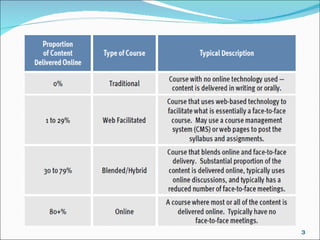
Online courses are those in which at
least 80 percent of the course
content is delivered online. (Babson
Survey Research Group in the
United States, 2008)
2
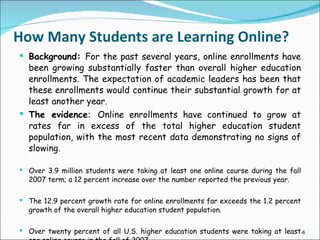
How Many Studentsare Learning Online?
Background: For the past several years, online enrollments have
been growing substantially faster than overall higher education
enrollments. The expectation of academic leaders has been that
these enrollments would continue their substantial growth for at
least another year.
The evidence: Online enrollments have continued to grow at
rates far in excess of the total higher education student
population, with the most recent data demonstrating no signs of
slowing.
Over 3.9 million students were taking at least one online course during the fall
2007 term; a 12 percent increase over the number reported the previous year.
The 12.9 percent growth rate for online enrollments far exceeds the 1.2 percent
growth of the overall higher education student population.
Over twenty percent of all U.S. higher education students were taking at least 4
5.
E-LEARNING IN IRAN:
E-learning in Iran is still in its infancy
stages and there are only a few online
programs. The history of e-learning in
Iran at present time did not exceed
more than 6 years, yet from a realistic
point of view we might say that e-based
learning in Iran has had a 5 year
experience and even younger. E-learning
in Iran is delivered by both the private
sector and government organizations.
There have been risen a plenty of
virtual universities or centers like
Amirkabir University of Technology,
Iran University of Science and
Technology, Shiraz virtual University
and some Islamic virtual collages and 5
6.
E-LEARNING IN IRAN:
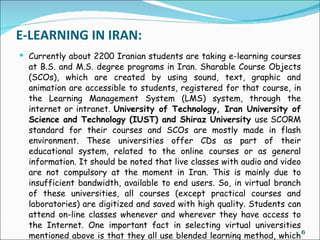
Currently about 2200 Iranian students are taking e-learning courses
at B.S. and M.S. degree programs in Iran. Sharable Course Objects
(SCOs), which are created by using sound, text, graphic and
animation are accessible to students, registered for that course, in
the Learning Management System (LMS) system, through the
internet or intranet. University of Technology, Iran University of
Science and Technology (IUST) and Shiraz University use SCORM
standard for their courses and SCOs are mostly made in flash
environment. These universities offer CDs as part of their
educational system, related to the online courses or as general
information. It should be noted that live classes with audio and video
are not compulsory at the moment in Iran. This is mainly due to
insufficient bandwidth, available to end users. So, in virtual branch
of these universities, all courses (except practical courses and
laboratories) are digitized and saved with high quality. Students can
attend on-line classes whenever and wherever they have access to
the Internet. One important fact in selecting virtual universities
mentioned above is that they all use blended learning method, which 6
7.
E-LEARNING IN IRAN:
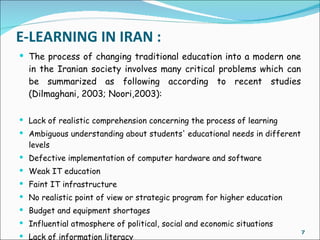
The process of changing traditional education into a modern one
in the Iranian society involves many critical problems which can
be summarized as following according to recent studies
(Dilmaghani, 2003; Noori,2003):
Lack of realistic comprehension concerning the process of learning
Ambiguous understanding about students' educational needs in different
levels
Defective implementation of computer hardware and software
Weak IT education
Faint IT infrastructure
No realistic point of view or strategic program for higher education
Budget and equipment shortages
Influential atmosphere of political, social and economic situations
7
Lack of information literacy
8.
Advantages and Disadvantagesof Online Study:
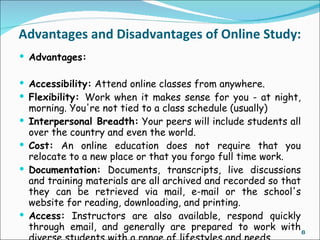
Advantages:
Accessibility: Attend online classes from anywhere.
Flexibility: Work when it makes sense for you - at night,
morning. You're not tied to a class schedule (usually)
Interpersonal Breadth: Your peers will include students all
over the country and even the world.
Cost: An online education does not require that you
relocate to a new place or that you forgo full time work.
Documentation: Documents, transcripts, live discussions
and training materials are all archived and recorded so that
they can be retrieved via mail, e-mail or the school's
website for reading, downloading, and printing.
Access: Instructors are also available, respond quickly
through email, and generally are prepared to work with 8
9.
Advantages and Disadvantagesof Online Study:
Disadvantages:
Employment: You may find that you
have to discuss the validity of your
degree. Information about the
school's accreditation and, if
needed, copies of syllabuses and
sample assignments will convince
employers.
Communications: Most of your
communication will be through email.
You might miss the sound of an
instructor or peer's voice.
Courses: Not all courses of study
are easily available online. If you're
interested in a more unusual field,
9
you may have to search for a
Instructional Strategies forOnline Courses:
Effective online instruction depends on
learning experiences appropriately
designed and facilitated by
knowledgeable educators. Because
learners have different learning styles
or a combination of styles, online
educators should design activities that
address their modes of learning in order
to provide significant experiences for
each class participant. In designing
online courses, this can best be
accomplished by utilizing multiple
instructional strategies. Teaching
models exist which apply to traditional
higher education learning environments,
and when designing courses for the
online environment, these strategies 11
12.
Instructional Strategies forOnline Courses:
Traditionally, in a teacher-centered classroom, instructors
control their environment because they have a monopoly on
information. In an online course, with instant access to vast
resources of data and information, students are no longer
totally dependent on faculty for knowledge. As faculty is
beginning to teach online, learning is becoming more
collaborative, contextual and active. Educators must first
design their curriculum, goals and objectives and then
consider how the online environment can best serve the
instructional objectives and activities of that curriculum.
This requires changes in pedagogy, with instructors taking
the role of facilitators of information while guiding
students toward solutions. In order for online learning to
be successful, teachers as well as learners must take on
new roles in the teaching-learning relationship, and faculty
must be willing to release control of learning to the
12
students.
13.
Instructional Strategies forOnline Courses:
Instructional strategies are tools available to educators for
designing and facilitate learning . Below are four instructional
strategies which have been effectively used in the traditional
classroom and can likewise be used in the online learning
environment:
LECTURE :
The lecture is one of the most frequently used instructional
methods in adult education. It assumes the educator to be the
expert and is an efficient way of disseminating information.
DISCUSSION :
Discussion is the instructional strategy most favored by adult
learners because it is interactive and encourages active,
participatory learning. The discussion format encourages
learners to analyze alternative ways of thinking and acting and
assists learners in exploring their own experiences so they can
become better critical thinkers. The discussion is often the 13
14.
Instructional Strategies forOnline Courses:
LEARNING CONTRACTS:
Learning contracts connect educational needs to individual
student needs and are useful when there is diversity in learner
needs and interests in a class. A learning contract is a formal
agreement written by a learner which details what will be
learned, how the learning will be accomplished, the period of time
involved, and the specific evaluation criteria to be used in judging
the completion of the learning. Learning contracts help the
educator and learner share the responsibility for learning.
PROJECT :
Online projects give students an opportunity to pursue their
special interests and can be done individually or within groups.
Projects also provide students with practical experience and a
sense of accomplishment.
14