Introduction to Apache Mesos
Omid Vahdaty, DevOps ninja
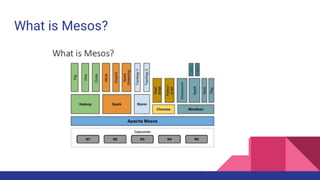
What is Mesos?
What is Mesos?
● is a cluster manager that provides efficient resource isolation and sharing across distributed
applications or frameworks.
● Open source
● sits between the application layer and the operating system and makes it easier to deploy and
manage applications in large-scale clustered environments more efficiently
● sits between the application layer and the operating system and makes it easier to deploy and
manage applications in large-scale clustered environments more efficiently
Benefits
● leverages features of the modern kernel—"cgroups" in Linux
● provides isolation for CPU, memory, I/O, file system, rack locality, etc.
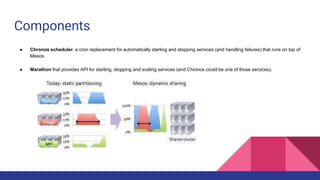
● introduces a distributed two-level scheduling mechanism called resource offers.
● decides how many resources to offer each framework, while frameworks decide which resources to
accept and which computations to run on them
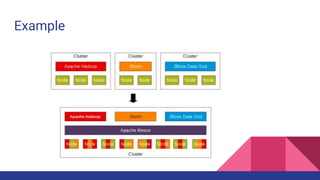
● The idea is to deploy multiple distributed systems to a shared pool of nodes in order to increase
resource utilization.
● it could easily switch resources away from framework1 (for example, doing big-data analysis) and
allocate them to framework2 (for example, a web server)
● is essentially data center kernel—which means it's the software that actually isolates the running
Components
● Chronos scheduler, a cron replacement for automatically starting and stopping services (and handling failures) that runs on top of
Mesos.
● Marathon that provides API for starting, stopping and scaling services (and Chronos could be one of those services).
Example
Architecture
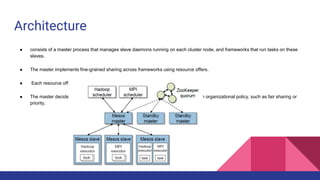
● consists of a master process that manages slave daemons running on each cluster node, and frameworks that run tasks on these
slaves.
● The master implements fine-grained sharing across frameworks using resource offers.
● Each resource offer is a list of free resources on multiple slaves.
● The master decides how many resources to offer to each framework according to an organizational policy, such as fair sharing or
priority.
Components
● a scheduler that registers with the master to be offered resources
● an executor process that is launched on slave nodes to run the framework's tasks.
● the master determines how many resources to offer to each framework
● the frameworks schedulers select which of the offered resources to use
Features
Fault-tolerant replicated master using ZooKeeper
Scalability to thousands of nodes
Isolation between tasks with Linux containers
Multi-resource scheduling (memory and CPU aware)
Java, Python and C++ APIs for developing new parallel applications
Web UI for viewing cluster state
Use Cases
● Hadoop on Mesos
● Spark on Mesos
● Storm on Mesos
● Jenkins on mesos
● Dockers on mesos
● Scaling architecture of your app
● Parallel programing (c++ API exits)

Introduction to mesos

  • 1.
    Introduction to ApacheMesos Omid Vahdaty, DevOps ninja
  • 2.
  • 3.
    What is Mesos? ●is a cluster manager that provides efficient resource isolation and sharing across distributed applications or frameworks. ● Open source ● sits between the application layer and the operating system and makes it easier to deploy and manage applications in large-scale clustered environments more efficiently ● sits between the application layer and the operating system and makes it easier to deploy and manage applications in large-scale clustered environments more efficiently
  • 4.
    Benefits ● leverages featuresof the modern kernel—"cgroups" in Linux ● provides isolation for CPU, memory, I/O, file system, rack locality, etc. ● introduces a distributed two-level scheduling mechanism called resource offers. ● decides how many resources to offer each framework, while frameworks decide which resources to accept and which computations to run on them ● The idea is to deploy multiple distributed systems to a shared pool of nodes in order to increase resource utilization. ● it could easily switch resources away from framework1 (for example, doing big-data analysis) and allocate them to framework2 (for example, a web server) ● is essentially data center kernel—which means it's the software that actually isolates the running
  • 5.
    Components ● Chronos scheduler,a cron replacement for automatically starting and stopping services (and handling failures) that runs on top of Mesos. ● Marathon that provides API for starting, stopping and scaling services (and Chronos could be one of those services).
  • 6.
  • 7.
    Architecture ● consists ofa master process that manages slave daemons running on each cluster node, and frameworks that run tasks on these slaves. ● The master implements fine-grained sharing across frameworks using resource offers. ● Each resource offer is a list of free resources on multiple slaves. ● The master decides how many resources to offer to each framework according to an organizational policy, such as fair sharing or priority.
  • 8.
    Components ● a schedulerthat registers with the master to be offered resources ● an executor process that is launched on slave nodes to run the framework's tasks. ● the master determines how many resources to offer to each framework ● the frameworks schedulers select which of the offered resources to use
  • 9.
    Features Fault-tolerant replicated masterusing ZooKeeper Scalability to thousands of nodes Isolation between tasks with Linux containers Multi-resource scheduling (memory and CPU aware) Java, Python and C++ APIs for developing new parallel applications Web UI for viewing cluster state
  • 10.
    Use Cases ● Hadoopon Mesos ● Spark on Mesos ● Storm on Mesos ● Jenkins on mesos ● Dockers on mesos ● Scaling architecture of your app ● Parallel programing (c++ API exits)