Distributed Resource Scheduling Frameworks
Is there a clear winner?
- VARUN SAXENA,NAGANARASIMHA G R
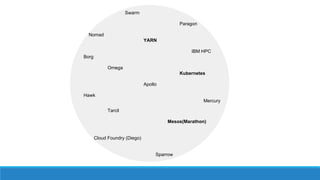
Swarm
Paragon
Nomad
YARN
IBM HPC
Borg
Omega
Kubernetes
Apollo
Hawk
Mercury
Tarcil
Mesos(Marathon)
Cloud Foundry (Diego)
Sparrow
Agenda
❑Aspects of Distributed Scheduling Framework
❑Architectural evolution of resource scheduling
❑Overview of prominent open source schedulers
❑Functional comparison between prominent schedulers
❑Upcoming features in YARN, bridging the gap
Aspects of Distributed Scheduling Framework
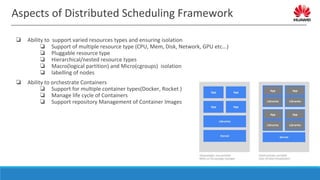
❏ Ability to support varied resources types and ensuring isolation
❏ Support of multiple resource type (CPU, Mem, Disk, Network, GPU etc...)
❏ Pluggable resource type
❏ Hierarchical/nested resource types
❏ Macro(logical partition) and Micro(cgroups) isolation
❏ labelling of nodes
❏ Ability to orchestrate Containers
❏ Support for multiple container types(Docker, Rocket )
❏ Manage life cycle of Containers
❏ Support repository Management of Container Images
Aspects of Distributed Scheduling Framework
❏ Ability to support wide variety of applications
➢ Big Data (stateful, DAG, ad hoc, batch)
➢ Long running services (stateless, stateful apps)
➢ Support of DevOps and MicroServices Model
❏ Networking support
➢ Network proxy/wiring of containers
➢ DNS support
➢ Service discoverability
❏ Disk Volumes (Persistence storage)
➢ Ability to mounting of multiple Types of Persistent volumes
● local Block Storage (SSD/SATA)
● Raid based persistent disks (SSD/SATA).
● Software based storages : NFS
● Elastic storage for Files/ Objects ( GlusterFS , AWS)
➢ Dynamic mounting
Aspects of Distributed Scheduling Framework
❏ Scalability and Reliability
➢ Daemon Services reliability and scalability
➢ Application reliability.
➢ Application recoverability
➢ Integrated Load Balancer
❏ Security
➢ Namespaces
➢ RBAC
➢ Pluggable authentication for the enterprise. LDAP integrations ...
➢ enforce secure communication in all layers, App - Service , Clients - Service, Clients - Apps
❏ Others
➢ Automatable : Deploy and Build
➢ DevOps Collaboration
Agenda
❑Aspects of Distributed Scheduling Framework
❑Architectural evolution of resource scheduling
❑Overview of prominent open source schedulers
❑Functional comparison between prominent schedulers
❑Upcoming features in YARN, bridging the gap
Architectural evolution of resource scheduling
Monolithic Scheduling ❏ Many of the cluster schedulers are Monolithic. Enterprise- IBM
HPC, Open source - Kubernetes, JobTracker in Hadoop v1
❏ A single scheduler process runs on one machine and assigns
tasks to machines and it alone handles all different kinds of
workloads. All tasks run through the same scheduling logic .
❏ Pro’s
➢ Sophisticated optimizations to avoid negative interference
between workloads competing for resources can be
achieved using ML tech. Ex- Yarn, Paragon and Quasar
❏ Con’s
➢ Support different applications with different needs,
Increases the complexity of its logic and implementation,
which eventually leads to scheduling latency
➢ Queueing effects (e.g., head-of-line blocking) and backlog
of tasks unless the scheduler is carefully designed.
➢ Theoretically might not be scaleable for very large cluster.
Ex. Hadoop MRV1
Architectural evolution of resource scheduling
Two Level Scheduling ❏ Separates the concerns of resource allocation and App’s task
placement.
❏ Task placement logic to be tailored towards specific applications, but
also maintains the ability to share the cluster between them.
❏ Cluster RM can offer the resources to app level scheduler (pioneered
by Mesos) or application-level schedulers to to request resources.
❏ Pro’s
➢ Easy to carve out a dynamic partition out of cluster and get the
application executed in isolation
➢ A very flexible approach that allows for custom, workload-specific
scheduling policies.
❏ Con’s
➢ Information hiding: Cluster RM will not be aware of the App’s task
and will not be able(/complicates) to optimize the resource usage
(preemption)
➢ Interface become complex in request based model.
➢ Resource can get underutlized.
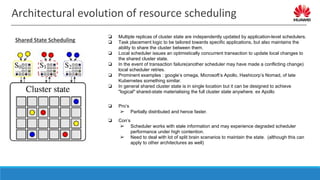
Architectural evolution of resource scheduling
Shared State Scheduling
❏ Multiple replicas of cluster state are independently updated by application-level schedulers.
❏ Task placement logic to be tailored towards specific applications, but also maintains the
ability to share the cluster between them.
❏ Local scheduler issues an optimistically concurrent transaction to update local changes to
the shared cluster state.
❏ In the event of transaction failure(another scheduler may have made a conflicting change)
local scheduler retries.
❏ Prominent examples : google’s omega, Microsoft’s Apollo, Hashicorp’s Nomad, of late
Kubernetes something similar.
❏ In general shared cluster state is in single location but it can be designed to achieve
"logical" shared-state materialising the full cluster state anywhere. ex Apollo
❏ Pro’s
➢ Partially distributed and hence faster.
❏ Con’s
➢ Scheduler works with stale information and may experience degraded scheduler
performance under high contention.
➢ Need to deal with lot of split brain scenarios to maintain the state. (although this can
apply to other architectures as well)
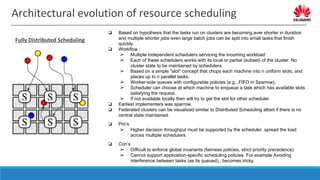
Architectural evolution of resource scheduling
Fully Distributed Scheduling
❏ Based on hypothesis that the tasks run on clusters are becoming ever shorter in duration
and multiple shorter jobs even large batch jobs can be split into small tasks that finish
quickly.
❏ Workflow :
➢ Multiple Independent schedulers servicing the incoming workload
➢ Each of these schedulers works with its local or partial (subset) of the cluster. No
cluster state to be maintained by schedulers.
➢ Based on a simple "slot" concept that chops each machine into n uniform slots, and
places up to n parallel tasks.
➢ Worker-side queues with configurable policies (e.g., FIFO in Sparrow),
➢ Scheduler can choose at which machine to enqueue a task which has available slots
satisfying the request.
➢ If not available locally then will try to get the slot for other scheduler.
❏ Earliest implementers was sparrow.
❏ Federated clusters can be visualized similar to Distributed Scheduling albeit if there is no
central state maintained.
❏ Pro’s
➢ Higher decision throughput must be supported by the scheduler. spread the load
across multiple schedulers.
❏ Con’s
➢ Difficult to enforce global invariants (fairness policies, strict priority precedence)
➢ Cannot support application-specific scheduling policies. For example Avoiding
interference between tasks (as its queued),, becomes tricky.
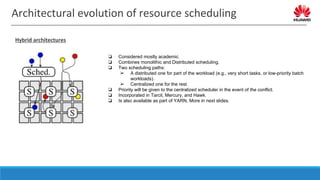
Architectural evolution of resource scheduling
❏ Considered mostly academic.
❏ Combines monolithic and Distributed scheduling.
❏ Two scheduling paths:
➢ A distributed one for part of the workload (e.g., very short tasks, or low-priority batch
workloads).
➢ Centralized one for the rest.
❏ Priority will be given to the centralized scheduler in the event of the conflict.
❏ Incorporated in Tarcil, Mercury, and Hawk.
❏ Is also available as part of YARN, More in next slides.
Hybrid architectures
Agenda
❑Aspects of Distributed Scheduling Framework
❑Architectural evolution of resource scheduling
❑Overview of prominent open source schedulers
❑Functional comparison between prominent schedulers
❑Upcoming features in YARN, bridging the gap
Overview of Kubernetes
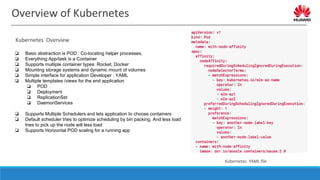
Kubernetes Overview
❏ Basic abstraction is POD : Co-locating helper processes,
❏ Everything App/task is a Container
❏ Supports multiple container types: Rocket, Docker
❏ Mounting storage systems and dynamic mount of volumes
❏ Simple interface for application Developer : YAML
❏ Multiple templates /views for the end application
❏ POD
❏ Deployment
❏ ReplicationSet
❏ DaemonServices
❏ Supports Multiple Schedulers and lets application to choose containers
❏ Default scheduler tries to optimize scheduling by bin packing. And less load
tries to pick up the node will less load
❏ Supports Horizontal POD scaling for a running app
Kubernetes YAML file
Overview of Kubernetes
Kubernetes Architecture
1. Master – Cluster controlling unit
2. etcd – HA Key/value store
3. API Server - Observing the state of the cluster
4. Controller Manager – runs multiple controllers
5. Scheduler Server – assigns workloads to nodes
6. Kubelet - server/slave node that runs pods
7. Proxy Service – host subnetting to external parties
8. Pods – One or more containers
9. Services – load balancer for containers
10. Replication Controller – For horizontally-s
Overview of Swarm
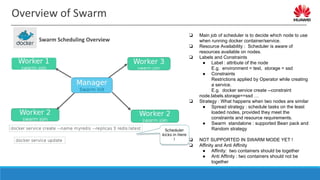
Swarm Scheduling Overview
❏ Main job of scheduler is to decide which node to use
when running docker container/service.
❏ Resource Availability : Scheduler is aware of
resources available on nodes.
❏ Labels and Constraints
● Label : attribute of the node
E.g. environment = test, storage = ssd
● Constraints
Restrictions applied by Operator while creating
a service.
E.g. docker service create --constraint
node.labels.storage==ssd …
❏ Strategy : What happens when two nodes are similar
● Spread strategy : schedule tasks on the least
loaded nodes, provided they meet the
constraints and resource requirements.
● Swarm standalone : supported Bean pack and
Random strategy
❏ NOT SUPPORTED IN SWARM MODE YET !
❏ Affinity and Anti Affinity
● Affinity: two containers should be together
● Anti Affinity : two containers should not be
together
Overview of Mesos
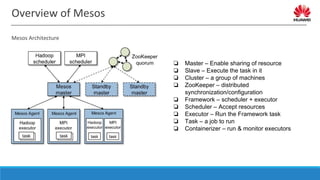
❏ Master – Enable sharing of resource
❏ Slave – Execute the task in it
❏ Cluster – a group of machines
❏ ZooKeeper – distributed
synchronization/configuration
❏ Framework – scheduler + executor
❏ Scheduler – Accept resources
❏ Executor – Run the Framework task
❏ Task – a job to run
❏ Containerizer – run & monitor executors
Mesos Architecture
Overview of Mesos
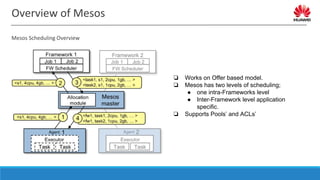
❏ Works on Offer based model.
❏ Mesos has two levels of scheduling;
● one intra-Frameworks level
● Inter-Framework level application
specific.
❏ Supports Pools’ and ACLs’
Mesos Scheduling Overview
Overview of Mesos
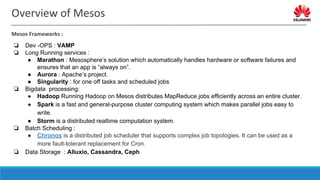
❏ Dev -OPS : VAMP
❏ Long Running services :
● Marathon : Mesosphere’s solution which automatically handles hardware or software failures and
ensures that an app is “always on”.
● Aurora : Apache’s project.
● Singularity : for one off tasks and scheduled jobs
❏ Bigdata processing:
● Hadoop Running Hadoop on Mesos distributes MapReduce jobs efficiently across an entire cluster.
● Spark is a fast and general-purpose cluster computing system which makes parallel jobs easy to
write.
● Storm is a distributed realtime computation system.
❏ Batch Scheduling :
● Chronos is a distributed job scheduler that supports complex job topologies. It can be used as a
more fault-tolerant replacement for Cron.
❏ Data Storage : Alluxio, Cassandra, Ceph
Mesos Frameworks :
Overview of YARN
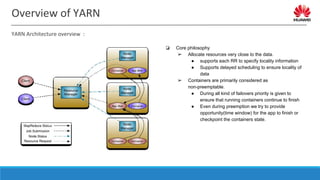
YARN Architecture overview :
❏ Core philosophy
➢ Allocate resources very close to the data.
● supports each RR to specify locality information
● Supports delayed scheduling to ensure locality of
data
➢ Containers are primarily considered as
non-preemptable.
● During all kind of failovers priority is given to
ensure that running containers continue to finish
● Even during preemption we try to provide
opportunity(time window) for the app to finish or
checkpoint the containers state.
Overview of YARN
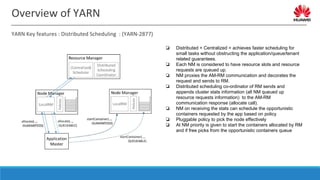
YARN Key features : Distributed Scheduling : (YARN-2877)
❏ Distributed + Centralized = achieves faster scheduling for
small tasks without obstructing the application/queue/tenant
related guarantees.
❏ Each NM is considered to have resource slots and resource
requests are queued up.
❏ NM proxies the AM-RM communication and decorates the
request and sends to RM.
❏ Distributed scheduling co-ordinator of RM sends and
appends cluster stats information (all NM queued up
resource requests information) to the AM-RM
communication response (allocate call).
❏ NM on receiving the stats can schedule the opportunistic
containers requested by the app based on policy
❏ Pluggable policy to pick the node effectively
❏ At NM priority is given to start the containers allocated by RM
and if free picks from the opportunistic containers queue
Overview of YARN
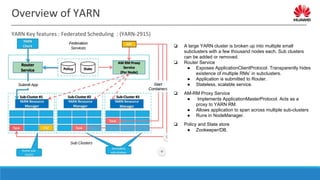
YARN Key features : Federated Scheduling : (YARN-2915)
❏ A large YARN cluster is broken up into multiple small
subclusters with a few thousand nodes each. Sub clusters
can be added or removed.
❏ Router Service
● Exposes ApplicationClientProtocol. Transparently hides
existence of multiple RMs’ in subclusters.
● Application is submitted to Router.
● Stateless, scalable service.
❏ AM-RM Proxy Service
● Implements ApplicationMasterProtocol. Acts as a
proxy to YARN RM.
● Allows application to span across multiple sub-clusters
● Runs in NodeManager.
❏ Policy and State store
● Zookeeper/DB.
Overview of YARN
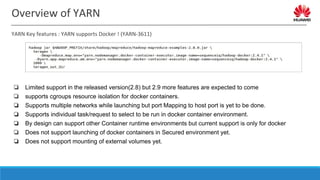
YARN Key features : YARN supports Docker ! (YARN-3611)
❏ Limited support in the released version(2.8) but 2.9 more features are expected to come
❏ supports cgroups resource isolation for docker containers.
❏ Supports multiple networks while launching but port Mapping to host port is yet to be done.
❏ Supports individual task/request to select to be run in docker container environment.
❏ By design can support other Container runtime environments but current support is only for docker
❏ Does not support launching of docker containers in Secured environment yet.
❏ Does not support mounting of external volumes yet.
Overview of YARN
YARN Key features : Rich Placement Constraints in YARN (YARN-6592)
{
Priority: 1,
Sizing: {Resource: <8G, 4vcores>, NumAllocations: 1 },
AllocationTags: ["hbase-rs"],
PlacementConstraintExpression: {
AND: [ // Anti-affinity between RegionServers
{Target: allocation-tag NOT_IN “hbase-rs”, Scope: host },
// Allow at most 2 RegionServers per failure-domain/rack
{ MaxCardinality: 2, Scope: failure_domain }
]
}
},
➢ AllocationRequestID
➢ Priority
➢ AllocationTags​: tags to be associated with all allocations
returned by this SchedulingRequest
➢ ResourceSizing
○ Number of allocations
○ Size of each allocation
➢ Placement Constraint Expression
Scheduling Request Sample scheduling Request
Overview of YARN
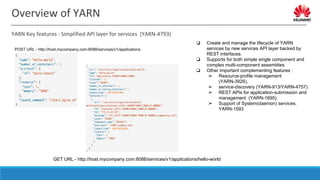
YARN Key features : Simplified API layer for services (YARN-4793)
❏ Create and manage the lifecycle of YARN
services by new services API layer backed by
REST interfaces.
❏ Supports for both simple single component and
complex multi-component assemblies
❏ Other important complementing features :
➢ Resource-profile management
(YARN-3926),
➢ service-discovery (YARN-913/YARN-4757).
➢ REST APIs for application-submission and
management (YARN-1695).
➢ Support of System(daemon) services.
YARN-1593
POST URL - http://host.mycompany.com:8088/services/v1/applications
GET URL - http://host.mycompany.com:8088/services/v1/applications/hello-world
Agenda
❑Aspects of Distributed Scheduling Framework
❑Architectural evolution of resource scheduling
❑Overview of prominent open source schedulers
❑Functional comparison between prominent schedulers
❑Conclusion
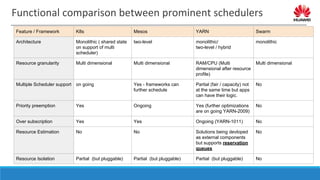
Functional comparison between prominent schedulers
Feature / Framework K8s Mesos YARN Swarm
Architecture Monolithic ( shared state
on support of multi
scheduler)
two-level monolithic/
two-level / hybrid
monolithic
Resource granularity Multi dimensional Multi dimensional RAM/CPU (Multi
dimensional after resource
profile)
Multi dimensional
Multiple Scheduler support on going Yes - frameworks can
further schedule
Partial (fair / capacity) not
at the same time but apps
can have their logic.
No
Priority preemption Yes Ongoing Yes (further optimizations
are on going YARN-2009)
No
Over subscription Yes Yes Ongoing (YARN-1011) No
Resource Estimation No No Solutions being devloped
as external components
but supports reservation
queues
No
Resource Isolation Partial (but pluggable) Partial (but pluggable) Partial (but pluggable) No
Functional comparison between prominent schedulers
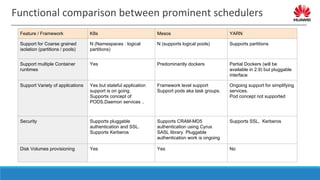
Feature / Framework K8s Mesos YARN
Support for Coarse grained
isolation (partitions / pools)
N (Namespaces : logical
partitions)
N (supports logical pools) Supports partitions
Support multiple Container
runtimes
Yes Predominantly dockers Partial Dockers (will be
available in 2.9) but pluggable
interface
Support Variety of applications Yes but stateful application
support is on going.
Supports concept of
PODS,Daemon services ..
Framework level support
Support pods aka task groups.
Ongoing support for simplifying
services.
Pod concept not supported
Security Supports pluggable
authentication and SSL.
Supports Kerberos
Supports CRAM-MD5
authentication using Cyrus
SASL library. Pluggable
authentication work is ongoing
Supports SSL, Kerberos
Disk Volumes provisioning Yes Yes No
Functional comparison between prominent schedulers
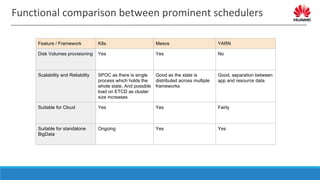
Feature / Framework K8s Mesos YARN
Disk Volumes provisioning Yes Yes No
Scalability and Reliability SPOC as there is single
process which holds the
whole state, And possible
load on ETCD as cluster
size increases
Good as the state is
distributed across multiple
frameworks
Good, separation between
app and resource data
Suitable for Cloud Yes Yes Fairly
Suitable for standalone
BigData
Ongoing Yes Yes
Agenda
❑Aspects of Distributed Scheduling Framework
❑Architectural evolution of resource scheduling
❑Overview of prominent open source schedulers
❑Functional comparison between prominent schedulers
❑Conclusion
Conclusion
❏ All schedulers are in fact trying to solve the same set of problems, duplicating
effort building various shapes and sizes of resource managers, container managers
or long-running service schedulers.
❏ It will lead to a fragmented experience with different terminology and concepts for
very similar things, different interfaces or APIs, different troubleshooting
procedures , documentation and so on, which will only be driving up operations
costs.
References
❏ YARN - https://issues.apache.org/jira/browse/YARN/ & http://hadoop.apache.org/docs/current/
❏ Swarm scheduling - https://www.slideshare.net/AtharvaChauthaiwale/docker-swarm-scheduling-in-112
❏ Kubernetes Design -
https://github.com/kubernetes/community/blob/master/contributors/design-proposals/architecture.md
❏ Mesos Architecture - http://mesos.apache.org/documentation/latest/architecture/
❏ Kubernetes Scheduler - http://stackoverflow.com/questions/28857993/how-does-kubernetes-scheduler-work
❏ Mesos Scheduler -
http://cloudarchitectmusings.com/2015/04/08/playing-traffic-cop-resource-allocation-in-apache-mesos/
❏ Kubernetes – Marathon -
https://www.quora.com/What-is-the-difference-between-Googles-Kubernetes-and-Mesospheres-Marathon
❏ Scheduler architectures :
https://www.cl.cam.ac.uk/research/srg/netos/camsas/blog/2016-03-09-scheduler-architectures.html#fn3l
❏ CONTAINER ORCHESTRATION COMPARISON GUIDE -
https://apprenda.com/thank-you/gaw-container-orchestration-comparison-guide-k/
❏ Future of Resource Manager by IBM -
https://www.ibm.com/developerworks/community/blogs/1ba56fe3-efad-432f-a1ab-58ba3910b073/entry/tho
ughts_on_future_of_resource_managers_and_schedulers_in_the_cloud?lang=en
and many more ...
Thank You !

Distributed Resource Scheduling Frameworks

  • 1.
    Distributed Resource SchedulingFrameworks Is there a clear winner? - VARUN SAXENA,NAGANARASIMHA G R
  • 2.
  • 3.
    Agenda ❑Aspects of DistributedScheduling Framework ❑Architectural evolution of resource scheduling ❑Overview of prominent open source schedulers ❑Functional comparison between prominent schedulers ❑Upcoming features in YARN, bridging the gap
  • 4.
    Aspects of DistributedScheduling Framework ❏ Ability to support varied resources types and ensuring isolation ❏ Support of multiple resource type (CPU, Mem, Disk, Network, GPU etc...) ❏ Pluggable resource type ❏ Hierarchical/nested resource types ❏ Macro(logical partition) and Micro(cgroups) isolation ❏ labelling of nodes ❏ Ability to orchestrate Containers ❏ Support for multiple container types(Docker, Rocket ) ❏ Manage life cycle of Containers ❏ Support repository Management of Container Images
  • 5.
    Aspects of DistributedScheduling Framework ❏ Ability to support wide variety of applications ➢ Big Data (stateful, DAG, ad hoc, batch) ➢ Long running services (stateless, stateful apps) ➢ Support of DevOps and MicroServices Model ❏ Networking support ➢ Network proxy/wiring of containers ➢ DNS support ➢ Service discoverability ❏ Disk Volumes (Persistence storage) ➢ Ability to mounting of multiple Types of Persistent volumes ● local Block Storage (SSD/SATA) ● Raid based persistent disks (SSD/SATA). ● Software based storages : NFS ● Elastic storage for Files/ Objects ( GlusterFS , AWS) ➢ Dynamic mounting
  • 6.
    Aspects of DistributedScheduling Framework ❏ Scalability and Reliability ➢ Daemon Services reliability and scalability ➢ Application reliability. ➢ Application recoverability ➢ Integrated Load Balancer ❏ Security ➢ Namespaces ➢ RBAC ➢ Pluggable authentication for the enterprise. LDAP integrations ... ➢ enforce secure communication in all layers, App - Service , Clients - Service, Clients - Apps ❏ Others ➢ Automatable : Deploy and Build ➢ DevOps Collaboration
  • 7.
    Agenda ❑Aspects of DistributedScheduling Framework ❑Architectural evolution of resource scheduling ❑Overview of prominent open source schedulers ❑Functional comparison between prominent schedulers ❑Upcoming features in YARN, bridging the gap
  • 8.
    Architectural evolution ofresource scheduling Monolithic Scheduling ❏ Many of the cluster schedulers are Monolithic. Enterprise- IBM HPC, Open source - Kubernetes, JobTracker in Hadoop v1 ❏ A single scheduler process runs on one machine and assigns tasks to machines and it alone handles all different kinds of workloads. All tasks run through the same scheduling logic . ❏ Pro’s ➢ Sophisticated optimizations to avoid negative interference between workloads competing for resources can be achieved using ML tech. Ex- Yarn, Paragon and Quasar ❏ Con’s ➢ Support different applications with different needs, Increases the complexity of its logic and implementation, which eventually leads to scheduling latency ➢ Queueing effects (e.g., head-of-line blocking) and backlog of tasks unless the scheduler is carefully designed. ➢ Theoretically might not be scaleable for very large cluster. Ex. Hadoop MRV1
  • 9.
    Architectural evolution ofresource scheduling Two Level Scheduling ❏ Separates the concerns of resource allocation and App’s task placement. ❏ Task placement logic to be tailored towards specific applications, but also maintains the ability to share the cluster between them. ❏ Cluster RM can offer the resources to app level scheduler (pioneered by Mesos) or application-level schedulers to to request resources. ❏ Pro’s ➢ Easy to carve out a dynamic partition out of cluster and get the application executed in isolation ➢ A very flexible approach that allows for custom, workload-specific scheduling policies. ❏ Con’s ➢ Information hiding: Cluster RM will not be aware of the App’s task and will not be able(/complicates) to optimize the resource usage (preemption) ➢ Interface become complex in request based model. ➢ Resource can get underutlized.
  • 10.
    Architectural evolution ofresource scheduling Shared State Scheduling ❏ Multiple replicas of cluster state are independently updated by application-level schedulers. ❏ Task placement logic to be tailored towards specific applications, but also maintains the ability to share the cluster between them. ❏ Local scheduler issues an optimistically concurrent transaction to update local changes to the shared cluster state. ❏ In the event of transaction failure(another scheduler may have made a conflicting change) local scheduler retries. ❏ Prominent examples : google’s omega, Microsoft’s Apollo, Hashicorp’s Nomad, of late Kubernetes something similar. ❏ In general shared cluster state is in single location but it can be designed to achieve "logical" shared-state materialising the full cluster state anywhere. ex Apollo ❏ Pro’s ➢ Partially distributed and hence faster. ❏ Con’s ➢ Scheduler works with stale information and may experience degraded scheduler performance under high contention. ➢ Need to deal with lot of split brain scenarios to maintain the state. (although this can apply to other architectures as well)
  • 11.
    Architectural evolution ofresource scheduling Fully Distributed Scheduling ❏ Based on hypothesis that the tasks run on clusters are becoming ever shorter in duration and multiple shorter jobs even large batch jobs can be split into small tasks that finish quickly. ❏ Workflow : ➢ Multiple Independent schedulers servicing the incoming workload ➢ Each of these schedulers works with its local or partial (subset) of the cluster. No cluster state to be maintained by schedulers. ➢ Based on a simple "slot" concept that chops each machine into n uniform slots, and places up to n parallel tasks. ➢ Worker-side queues with configurable policies (e.g., FIFO in Sparrow), ➢ Scheduler can choose at which machine to enqueue a task which has available slots satisfying the request. ➢ If not available locally then will try to get the slot for other scheduler. ❏ Earliest implementers was sparrow. ❏ Federated clusters can be visualized similar to Distributed Scheduling albeit if there is no central state maintained. ❏ Pro’s ➢ Higher decision throughput must be supported by the scheduler. spread the load across multiple schedulers. ❏ Con’s ➢ Difficult to enforce global invariants (fairness policies, strict priority precedence) ➢ Cannot support application-specific scheduling policies. For example Avoiding interference between tasks (as its queued),, becomes tricky.
  • 12.
    Architectural evolution ofresource scheduling ❏ Considered mostly academic. ❏ Combines monolithic and Distributed scheduling. ❏ Two scheduling paths: ➢ A distributed one for part of the workload (e.g., very short tasks, or low-priority batch workloads). ➢ Centralized one for the rest. ❏ Priority will be given to the centralized scheduler in the event of the conflict. ❏ Incorporated in Tarcil, Mercury, and Hawk. ❏ Is also available as part of YARN, More in next slides. Hybrid architectures
  • 13.
    Agenda ❑Aspects of DistributedScheduling Framework ❑Architectural evolution of resource scheduling ❑Overview of prominent open source schedulers ❑Functional comparison between prominent schedulers ❑Upcoming features in YARN, bridging the gap
  • 14.
    Overview of Kubernetes KubernetesOverview ❏ Basic abstraction is POD : Co-locating helper processes, ❏ Everything App/task is a Container ❏ Supports multiple container types: Rocket, Docker ❏ Mounting storage systems and dynamic mount of volumes ❏ Simple interface for application Developer : YAML ❏ Multiple templates /views for the end application ❏ POD ❏ Deployment ❏ ReplicationSet ❏ DaemonServices ❏ Supports Multiple Schedulers and lets application to choose containers ❏ Default scheduler tries to optimize scheduling by bin packing. And less load tries to pick up the node will less load ❏ Supports Horizontal POD scaling for a running app Kubernetes YAML file
  • 15.
    Overview of Kubernetes KubernetesArchitecture 1. Master – Cluster controlling unit 2. etcd – HA Key/value store 3. API Server - Observing the state of the cluster 4. Controller Manager – runs multiple controllers 5. Scheduler Server – assigns workloads to nodes 6. Kubelet - server/slave node that runs pods 7. Proxy Service – host subnetting to external parties 8. Pods – One or more containers 9. Services – load balancer for containers 10. Replication Controller – For horizontally-s
  • 16.
    Overview of Swarm SwarmScheduling Overview ❏ Main job of scheduler is to decide which node to use when running docker container/service. ❏ Resource Availability : Scheduler is aware of resources available on nodes. ❏ Labels and Constraints ● Label : attribute of the node E.g. environment = test, storage = ssd ● Constraints Restrictions applied by Operator while creating a service. E.g. docker service create --constraint node.labels.storage==ssd … ❏ Strategy : What happens when two nodes are similar ● Spread strategy : schedule tasks on the least loaded nodes, provided they meet the constraints and resource requirements. ● Swarm standalone : supported Bean pack and Random strategy ❏ NOT SUPPORTED IN SWARM MODE YET ! ❏ Affinity and Anti Affinity ● Affinity: two containers should be together ● Anti Affinity : two containers should not be together
  • 17.
    Overview of Mesos ❏Master – Enable sharing of resource ❏ Slave – Execute the task in it ❏ Cluster – a group of machines ❏ ZooKeeper – distributed synchronization/configuration ❏ Framework – scheduler + executor ❏ Scheduler – Accept resources ❏ Executor – Run the Framework task ❏ Task – a job to run ❏ Containerizer – run & monitor executors Mesos Architecture
  • 18.
    Overview of Mesos ❏Works on Offer based model. ❏ Mesos has two levels of scheduling; ● one intra-Frameworks level ● Inter-Framework level application specific. ❏ Supports Pools’ and ACLs’ Mesos Scheduling Overview
  • 19.
    Overview of Mesos ❏Dev -OPS : VAMP ❏ Long Running services : ● Marathon : Mesosphere’s solution which automatically handles hardware or software failures and ensures that an app is “always on”. ● Aurora : Apache’s project. ● Singularity : for one off tasks and scheduled jobs ❏ Bigdata processing: ● Hadoop Running Hadoop on Mesos distributes MapReduce jobs efficiently across an entire cluster. ● Spark is a fast and general-purpose cluster computing system which makes parallel jobs easy to write. ● Storm is a distributed realtime computation system. ❏ Batch Scheduling : ● Chronos is a distributed job scheduler that supports complex job topologies. It can be used as a more fault-tolerant replacement for Cron. ❏ Data Storage : Alluxio, Cassandra, Ceph Mesos Frameworks :
  • 20.
    Overview of YARN YARNArchitecture overview : ❏ Core philosophy ➢ Allocate resources very close to the data. ● supports each RR to specify locality information ● Supports delayed scheduling to ensure locality of data ➢ Containers are primarily considered as non-preemptable. ● During all kind of failovers priority is given to ensure that running containers continue to finish ● Even during preemption we try to provide opportunity(time window) for the app to finish or checkpoint the containers state.
  • 21.
    Overview of YARN YARNKey features : Distributed Scheduling : (YARN-2877) ❏ Distributed + Centralized = achieves faster scheduling for small tasks without obstructing the application/queue/tenant related guarantees. ❏ Each NM is considered to have resource slots and resource requests are queued up. ❏ NM proxies the AM-RM communication and decorates the request and sends to RM. ❏ Distributed scheduling co-ordinator of RM sends and appends cluster stats information (all NM queued up resource requests information) to the AM-RM communication response (allocate call). ❏ NM on receiving the stats can schedule the opportunistic containers requested by the app based on policy ❏ Pluggable policy to pick the node effectively ❏ At NM priority is given to start the containers allocated by RM and if free picks from the opportunistic containers queue
  • 22.
    Overview of YARN YARNKey features : Federated Scheduling : (YARN-2915) ❏ A large YARN cluster is broken up into multiple small subclusters with a few thousand nodes each. Sub clusters can be added or removed. ❏ Router Service ● Exposes ApplicationClientProtocol. Transparently hides existence of multiple RMs’ in subclusters. ● Application is submitted to Router. ● Stateless, scalable service. ❏ AM-RM Proxy Service ● Implements ApplicationMasterProtocol. Acts as a proxy to YARN RM. ● Allows application to span across multiple sub-clusters ● Runs in NodeManager. ❏ Policy and State store ● Zookeeper/DB.
  • 23.
    Overview of YARN YARNKey features : YARN supports Docker ! (YARN-3611) ❏ Limited support in the released version(2.8) but 2.9 more features are expected to come ❏ supports cgroups resource isolation for docker containers. ❏ Supports multiple networks while launching but port Mapping to host port is yet to be done. ❏ Supports individual task/request to select to be run in docker container environment. ❏ By design can support other Container runtime environments but current support is only for docker ❏ Does not support launching of docker containers in Secured environment yet. ❏ Does not support mounting of external volumes yet.
  • 24.
    Overview of YARN YARNKey features : Rich Placement Constraints in YARN (YARN-6592) { Priority: 1, Sizing: {Resource: <8G, 4vcores>, NumAllocations: 1 }, AllocationTags: ["hbase-rs"], PlacementConstraintExpression: { AND: [ // Anti-affinity between RegionServers {Target: allocation-tag NOT_IN “hbase-rs”, Scope: host }, // Allow at most 2 RegionServers per failure-domain/rack { MaxCardinality: 2, Scope: failure_domain } ] } }, ➢ AllocationRequestID ➢ Priority ➢ AllocationTags​: tags to be associated with all allocations returned by this SchedulingRequest ➢ ResourceSizing ○ Number of allocations ○ Size of each allocation ➢ Placement Constraint Expression Scheduling Request Sample scheduling Request
  • 25.
    Overview of YARN YARNKey features : Simplified API layer for services (YARN-4793) ❏ Create and manage the lifecycle of YARN services by new services API layer backed by REST interfaces. ❏ Supports for both simple single component and complex multi-component assemblies ❏ Other important complementing features : ➢ Resource-profile management (YARN-3926), ➢ service-discovery (YARN-913/YARN-4757). ➢ REST APIs for application-submission and management (YARN-1695). ➢ Support of System(daemon) services. YARN-1593 POST URL - http://host.mycompany.com:8088/services/v1/applications GET URL - http://host.mycompany.com:8088/services/v1/applications/hello-world
  • 26.
    Agenda ❑Aspects of DistributedScheduling Framework ❑Architectural evolution of resource scheduling ❑Overview of prominent open source schedulers ❑Functional comparison between prominent schedulers ❑Conclusion
  • 27.
    Functional comparison betweenprominent schedulers Feature / Framework K8s Mesos YARN Swarm Architecture Monolithic ( shared state on support of multi scheduler) two-level monolithic/ two-level / hybrid monolithic Resource granularity Multi dimensional Multi dimensional RAM/CPU (Multi dimensional after resource profile) Multi dimensional Multiple Scheduler support on going Yes - frameworks can further schedule Partial (fair / capacity) not at the same time but apps can have their logic. No Priority preemption Yes Ongoing Yes (further optimizations are on going YARN-2009) No Over subscription Yes Yes Ongoing (YARN-1011) No Resource Estimation No No Solutions being devloped as external components but supports reservation queues No Resource Isolation Partial (but pluggable) Partial (but pluggable) Partial (but pluggable) No
  • 28.
    Functional comparison betweenprominent schedulers Feature / Framework K8s Mesos YARN Support for Coarse grained isolation (partitions / pools) N (Namespaces : logical partitions) N (supports logical pools) Supports partitions Support multiple Container runtimes Yes Predominantly dockers Partial Dockers (will be available in 2.9) but pluggable interface Support Variety of applications Yes but stateful application support is on going. Supports concept of PODS,Daemon services .. Framework level support Support pods aka task groups. Ongoing support for simplifying services. Pod concept not supported Security Supports pluggable authentication and SSL. Supports Kerberos Supports CRAM-MD5 authentication using Cyrus SASL library. Pluggable authentication work is ongoing Supports SSL, Kerberos Disk Volumes provisioning Yes Yes No
  • 29.
    Functional comparison betweenprominent schedulers Feature / Framework K8s Mesos YARN Disk Volumes provisioning Yes Yes No Scalability and Reliability SPOC as there is single process which holds the whole state, And possible load on ETCD as cluster size increases Good as the state is distributed across multiple frameworks Good, separation between app and resource data Suitable for Cloud Yes Yes Fairly Suitable for standalone BigData Ongoing Yes Yes
  • 30.
    Agenda ❑Aspects of DistributedScheduling Framework ❑Architectural evolution of resource scheduling ❑Overview of prominent open source schedulers ❑Functional comparison between prominent schedulers ❑Conclusion
  • 31.
    Conclusion ❏ All schedulersare in fact trying to solve the same set of problems, duplicating effort building various shapes and sizes of resource managers, container managers or long-running service schedulers. ❏ It will lead to a fragmented experience with different terminology and concepts for very similar things, different interfaces or APIs, different troubleshooting procedures , documentation and so on, which will only be driving up operations costs.
  • 32.
    References ❏ YARN -https://issues.apache.org/jira/browse/YARN/ & http://hadoop.apache.org/docs/current/ ❏ Swarm scheduling - https://www.slideshare.net/AtharvaChauthaiwale/docker-swarm-scheduling-in-112 ❏ Kubernetes Design - https://github.com/kubernetes/community/blob/master/contributors/design-proposals/architecture.md ❏ Mesos Architecture - http://mesos.apache.org/documentation/latest/architecture/ ❏ Kubernetes Scheduler - http://stackoverflow.com/questions/28857993/how-does-kubernetes-scheduler-work ❏ Mesos Scheduler - http://cloudarchitectmusings.com/2015/04/08/playing-traffic-cop-resource-allocation-in-apache-mesos/ ❏ Kubernetes – Marathon - https://www.quora.com/What-is-the-difference-between-Googles-Kubernetes-and-Mesospheres-Marathon ❏ Scheduler architectures : https://www.cl.cam.ac.uk/research/srg/netos/camsas/blog/2016-03-09-scheduler-architectures.html#fn3l ❏ CONTAINER ORCHESTRATION COMPARISON GUIDE - https://apprenda.com/thank-you/gaw-container-orchestration-comparison-guide-k/ ❏ Future of Resource Manager by IBM - https://www.ibm.com/developerworks/community/blogs/1ba56fe3-efad-432f-a1ab-58ba3910b073/entry/tho ughts_on_future_of_resource_managers_and_schedulers_in_the_cloud?lang=en and many more ...
  • 33.