THE GOOGLE FILE SYSTEM
By Sanjay Ghemawat, Howard Gobioff, and
Shun-Tak Leung
1
INTRODUCTION
• Google
• Applications process lots of data
• Need good file system
• Solution : Google File System
Large, distributed, highly fault tolerant file system.
2
DESIGN MOTIVATIONS
1. Fault-tolerance and auto-recovery need to be built
into the system.
2. Standard I/O assumptions (e.g. block size) have
to be re-examined.
3. Record appends are the prevalent form of
writing.
4. Google applications and GFS should be co-
designed.
3
INTERFACE
 Create
 Delete
 Open
 Close
 Read
 Write
 Snapshot
 Record Append
4
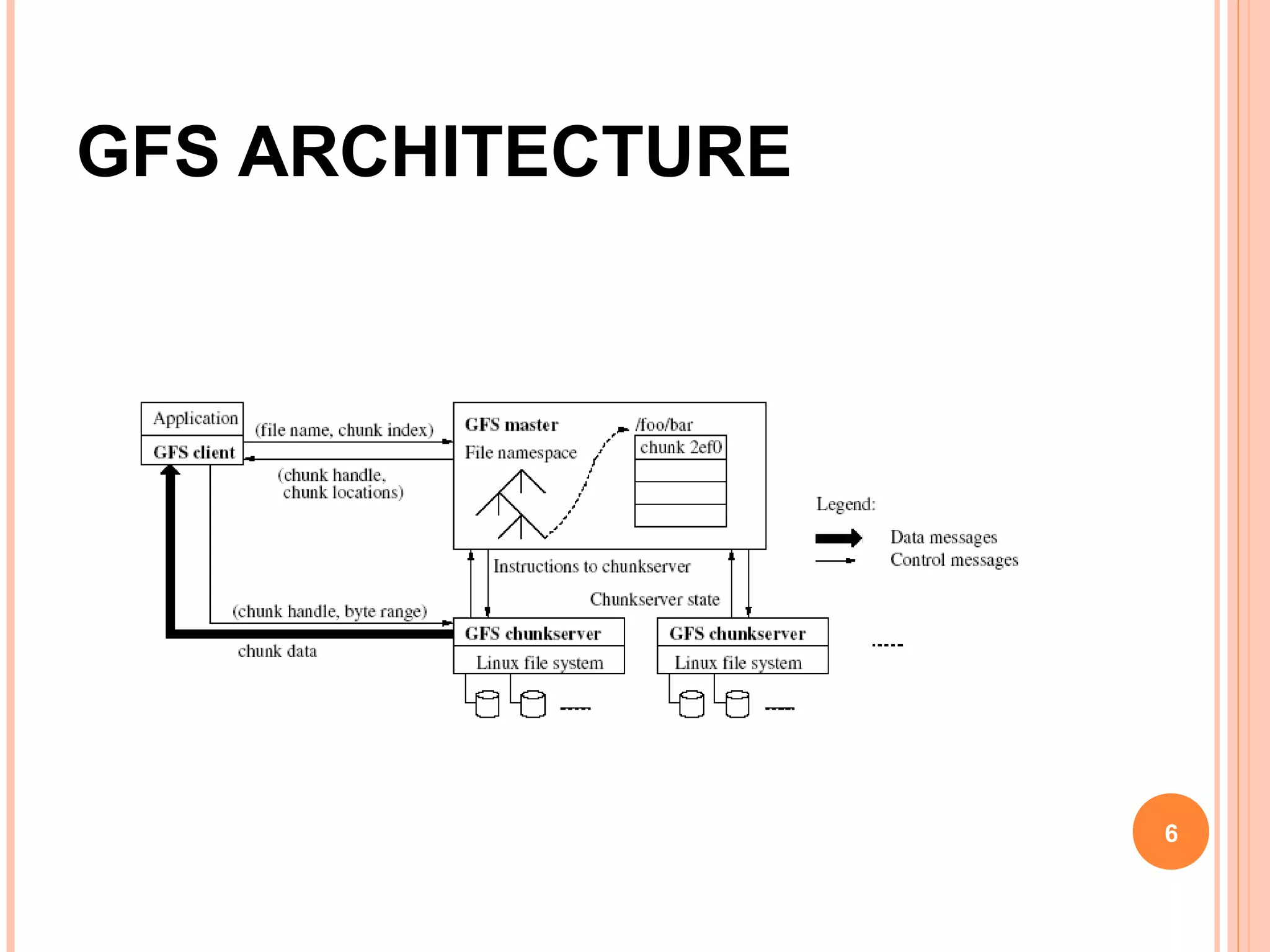
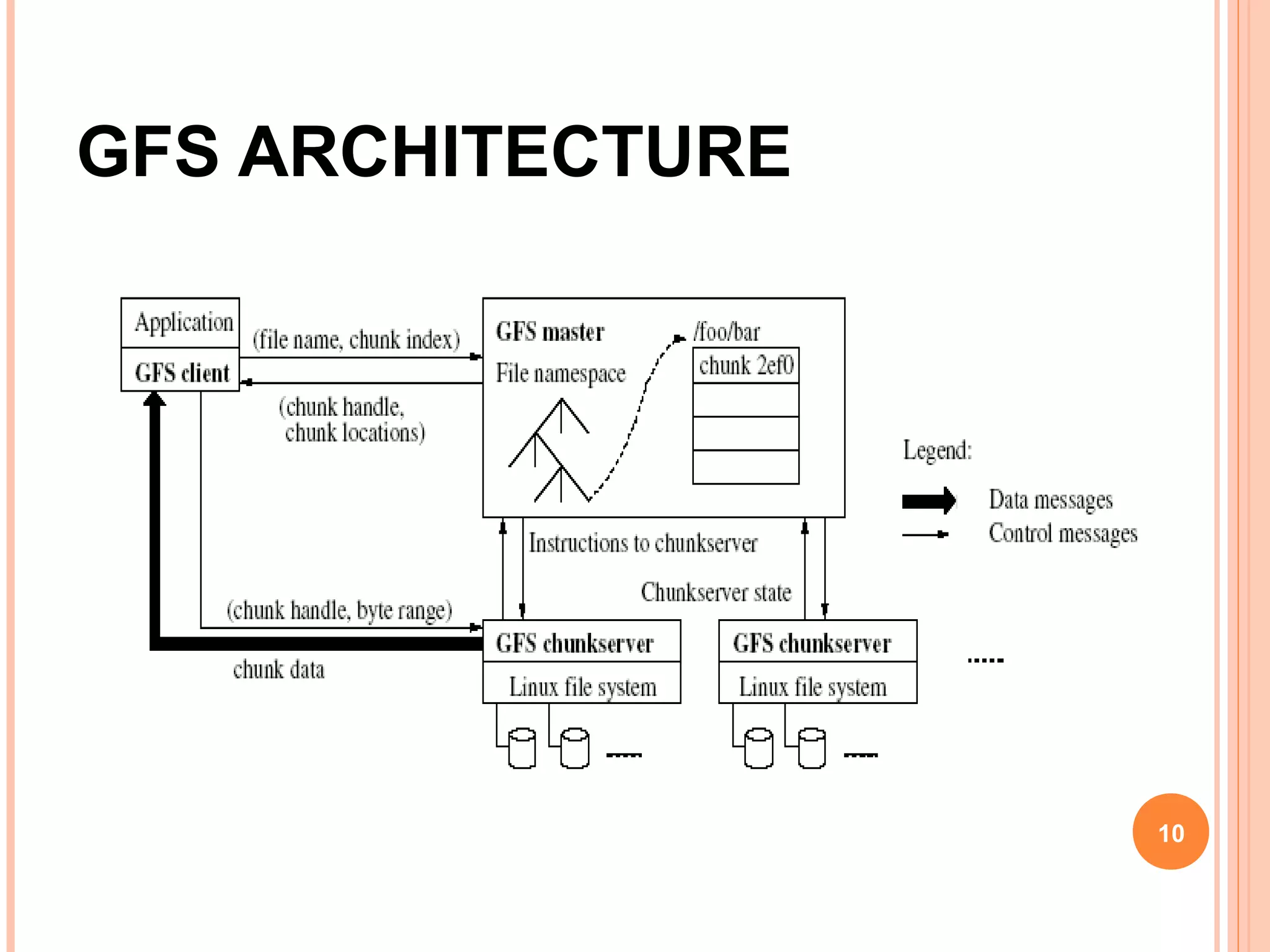
GFS ARCHITECTURE
On a single-machine FS:
 An upper layer maintains the metadata.
 A lower layer (i.e. disk) stores the data in units
called “blocks”.
In the GFS:
 A master process maintains the metadata.
A lower layer (i.e. a set of chunk servers) stores the
data in units called “chunks”.
5
GFS ARCHITECTURE
6
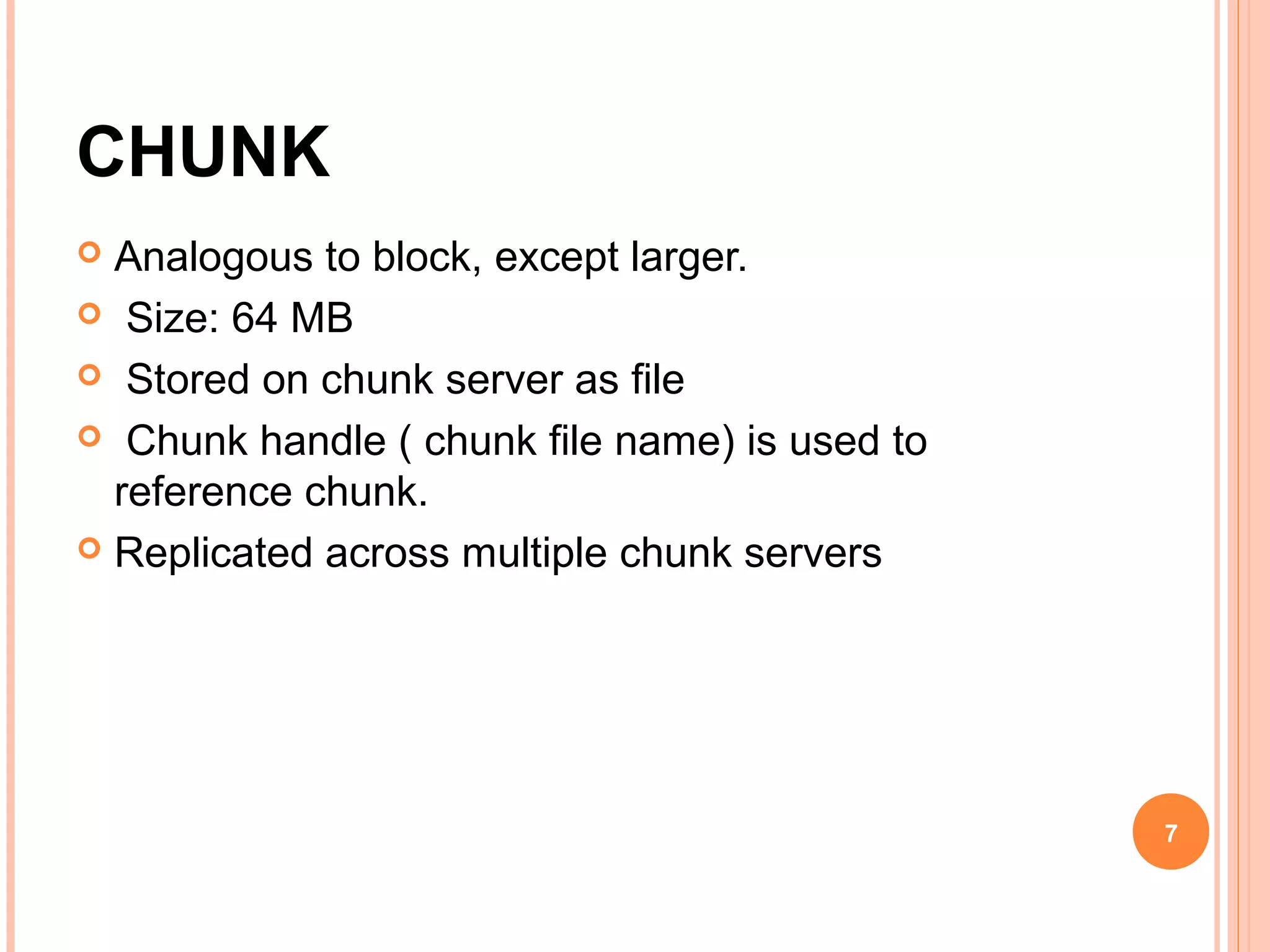
CHUNK
 Analogous to block, except larger.
 Size: 64 MB
 Stored on chunk server as file
 Chunk handle ( chunk file name) is used to
reference chunk.
 Replicated across multiple chunk servers
7
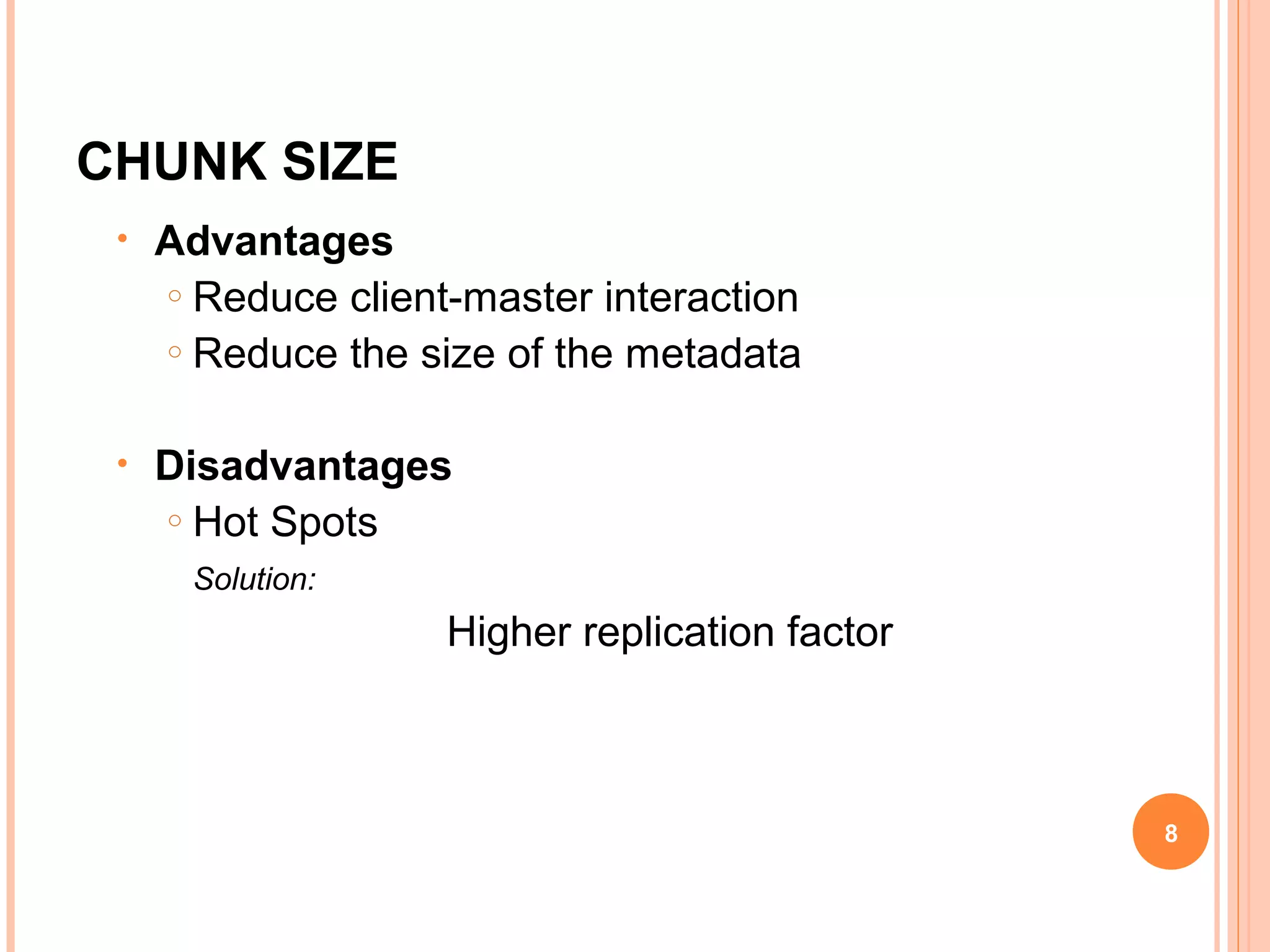
CHUNK SIZE
• Advantages
o Reduce client-master interaction
o Reduce the size of the metadata
• Disadvantages
o Hot Spots
Solution:
Higher replication factor
8
MASTER
 Single master is centralized
 Stores all metadata:
o File namespace
o File to chunk mappings
o Chunk location information
9
GFS ARCHITECTURE
10
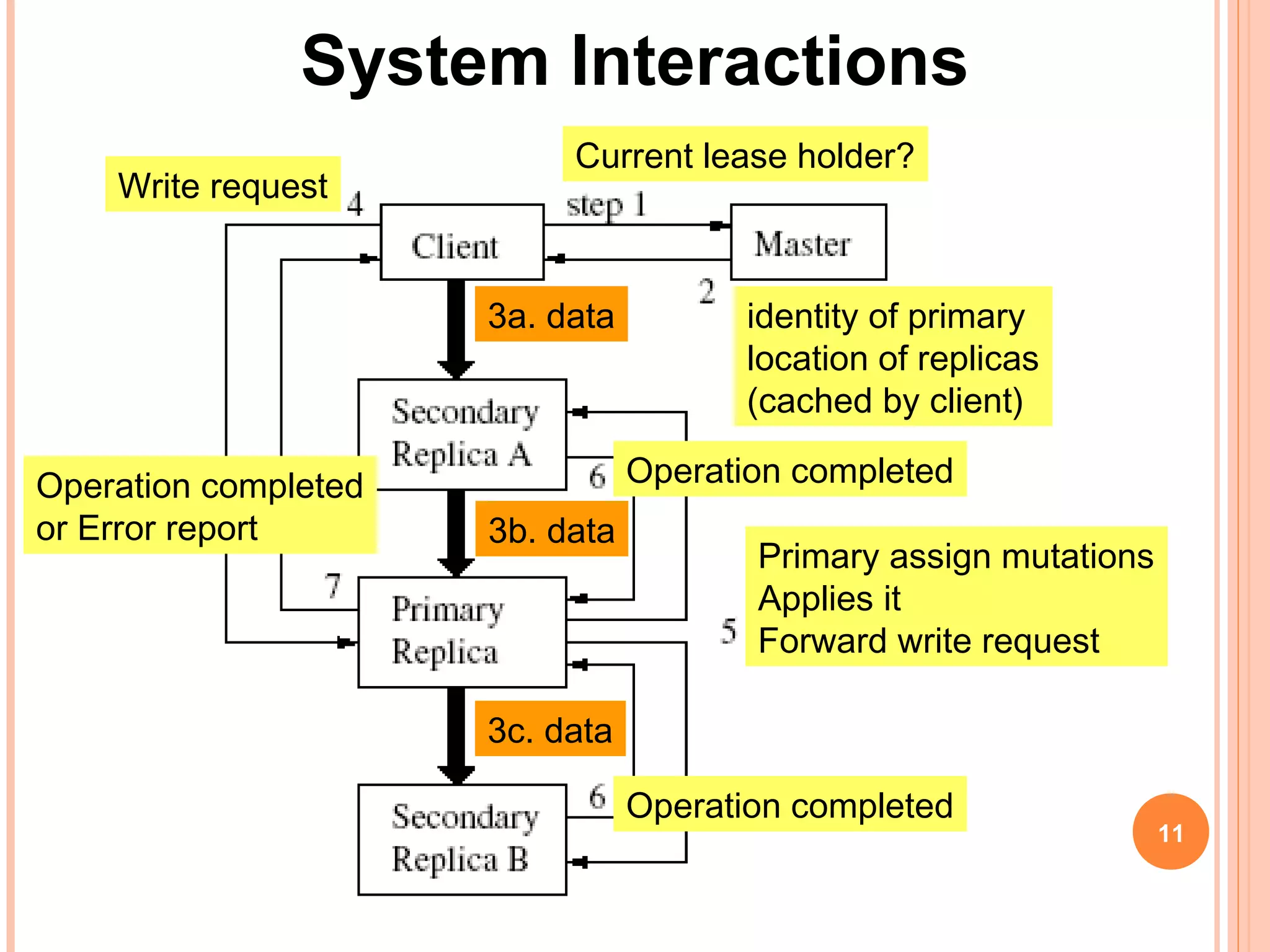
System Interactions
Current lease holder?
identity of primary
location of replicas
(cached by client)
3a. data
3b. data
3c. data
Write request
Primary assign mutations
Applies it
Forward write request
Operation completed
Operation completed
Operation completed
or Error report
11
SYSTEM INTERACTIONS
 Record appends
- Client specifies only data
 Snapshot
-Makes a copy of a file or a directory
tree
12
OPERATION LOG
 Historical record of critical metadata changes
 Defines the order of concurrent operations
 Critical
 Replicated on multiple remote machines
 Respond to client only when log locally and remotely
 Fast recovery by using checkpoints
 Use a compact B-tree like form directly mapping into
memory
 Switch to a new log, Create new checkpoints in a
separate threads
13
MASTER OPERATIONS
 Namespace Management and Locking
 Chunk Creation
 Chunk Re-replication
 Chunk Rebalancing
 Garbage Collection
14
FAULT TOLERANCE AND DIAGNOSIS
1.High Availability
They keep the overall system highly
available with two simple yet effective
strategies.
Fast Recovery and replication
15
1.1 Fast Recovery : Master and chunk
servers are designed to restart and restore
states in a few seconds.
1.2 Chunk Replication : Across multiple
machines, across multiple racks.
16
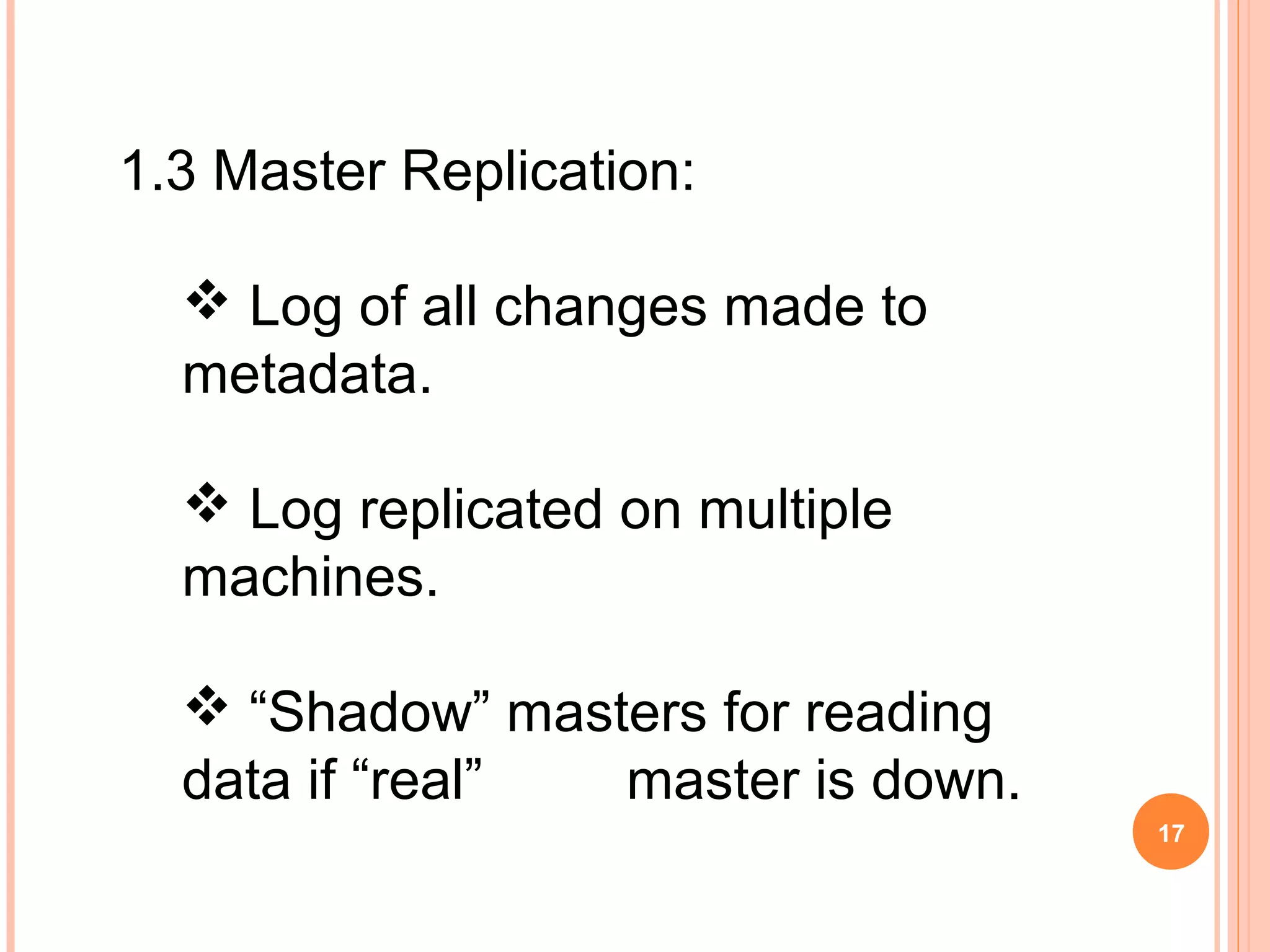
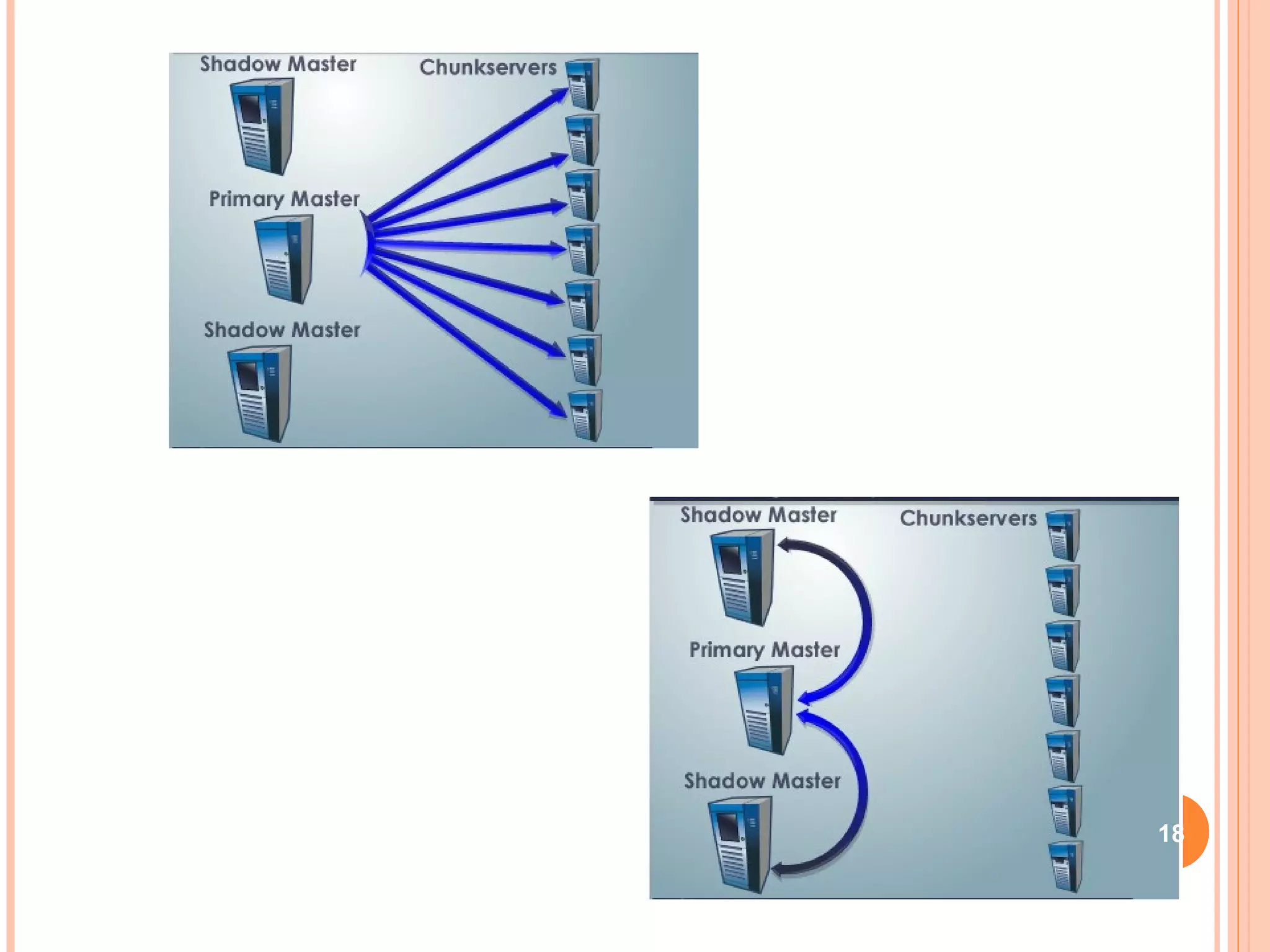
1.3 Master Replication:
 Log of all changes made to
metadata.
 Log replicated on multiple
machines.
 “Shadow” masters for reading
data if “real” master is down.
17
18
2. Data Integrity
Each chunk has an associated checksum.
3. Diagnostic Logging
Logging is maintained for keeping the details
of interactions between machines. (exact
request and responses sent on the wire
except data being transferred.)
19
MEASUREMENTS
They measured performance on a GFS
cluster consisting one master, two master
replicas, 16 chunk servers and 16 clients.
20
All machines are configured with
1.Dual 1.4 GHz PIII processors
2. 2 GB memory
3. Two 80 GB 5400 rpm disks
4. 100 Mbps full duplex
Ethernet connection to an HP 2524
switch.
21
22
23
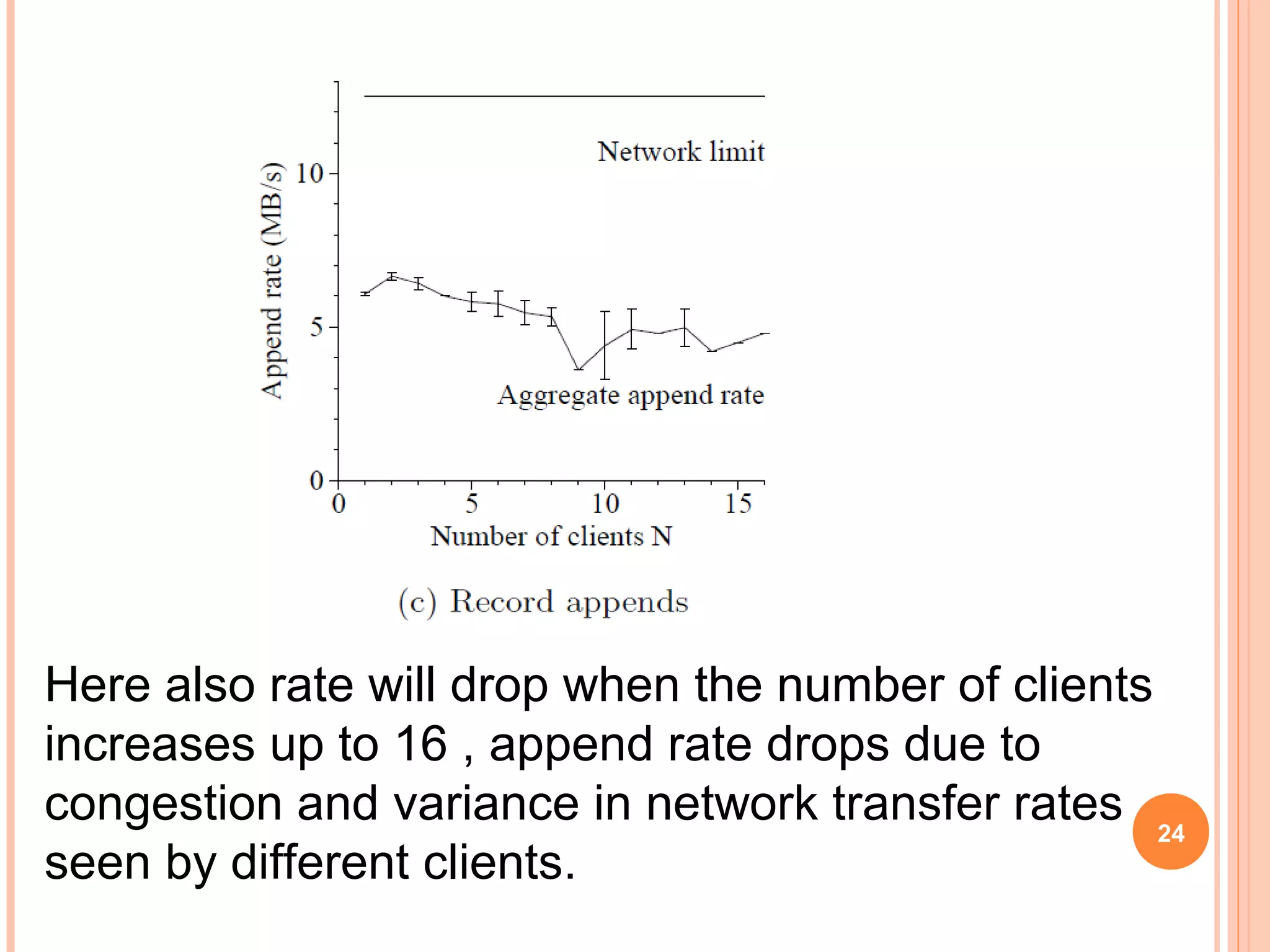
Here also rate will drop when the number of clients
increases up to 16 , append rate drops due to
congestion and variance in network transfer rates
seen by different clients.
24
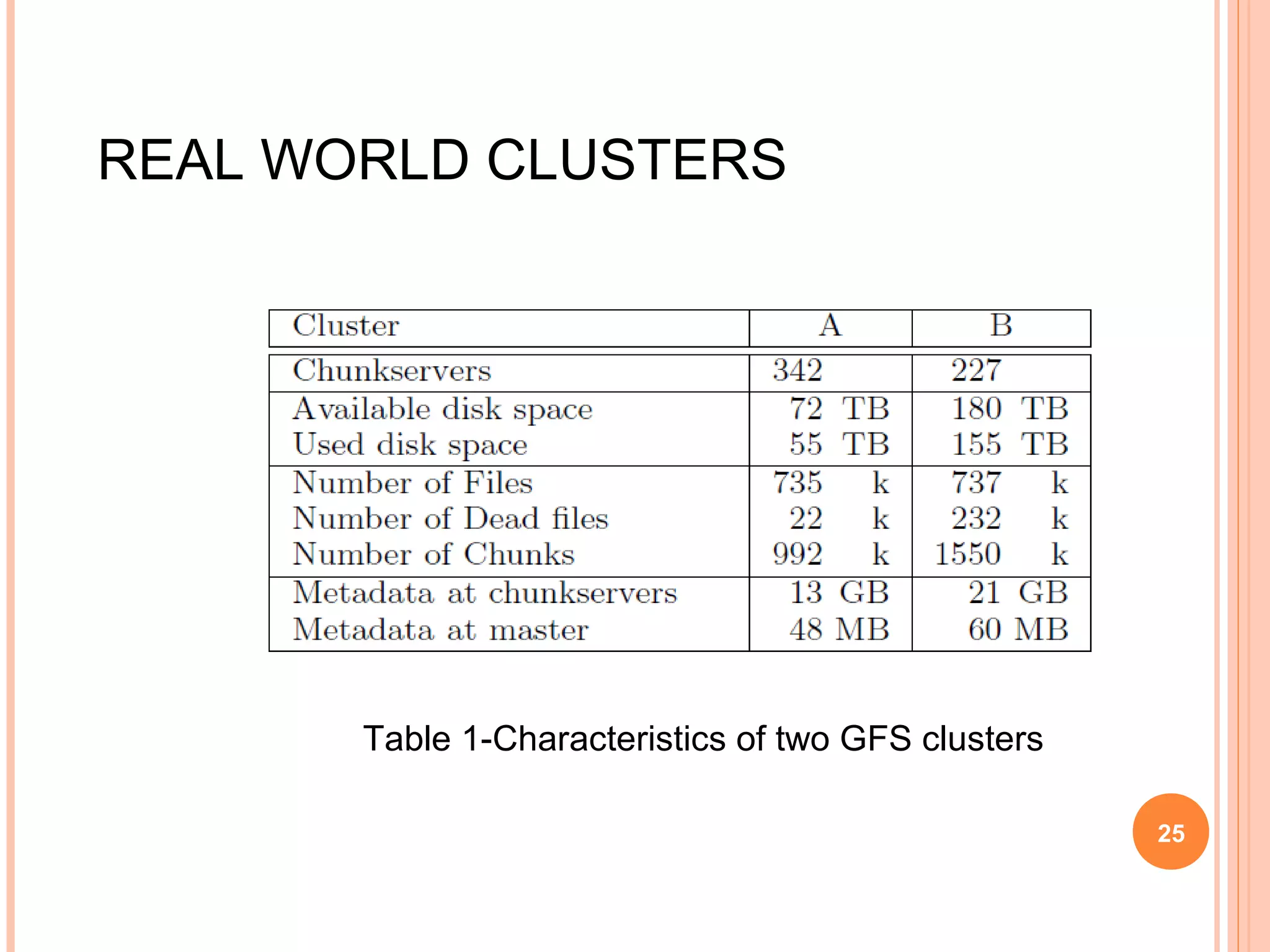
REAL WORLD CLUSTERS
Table 1-Characteristics of two GFS clusters
25
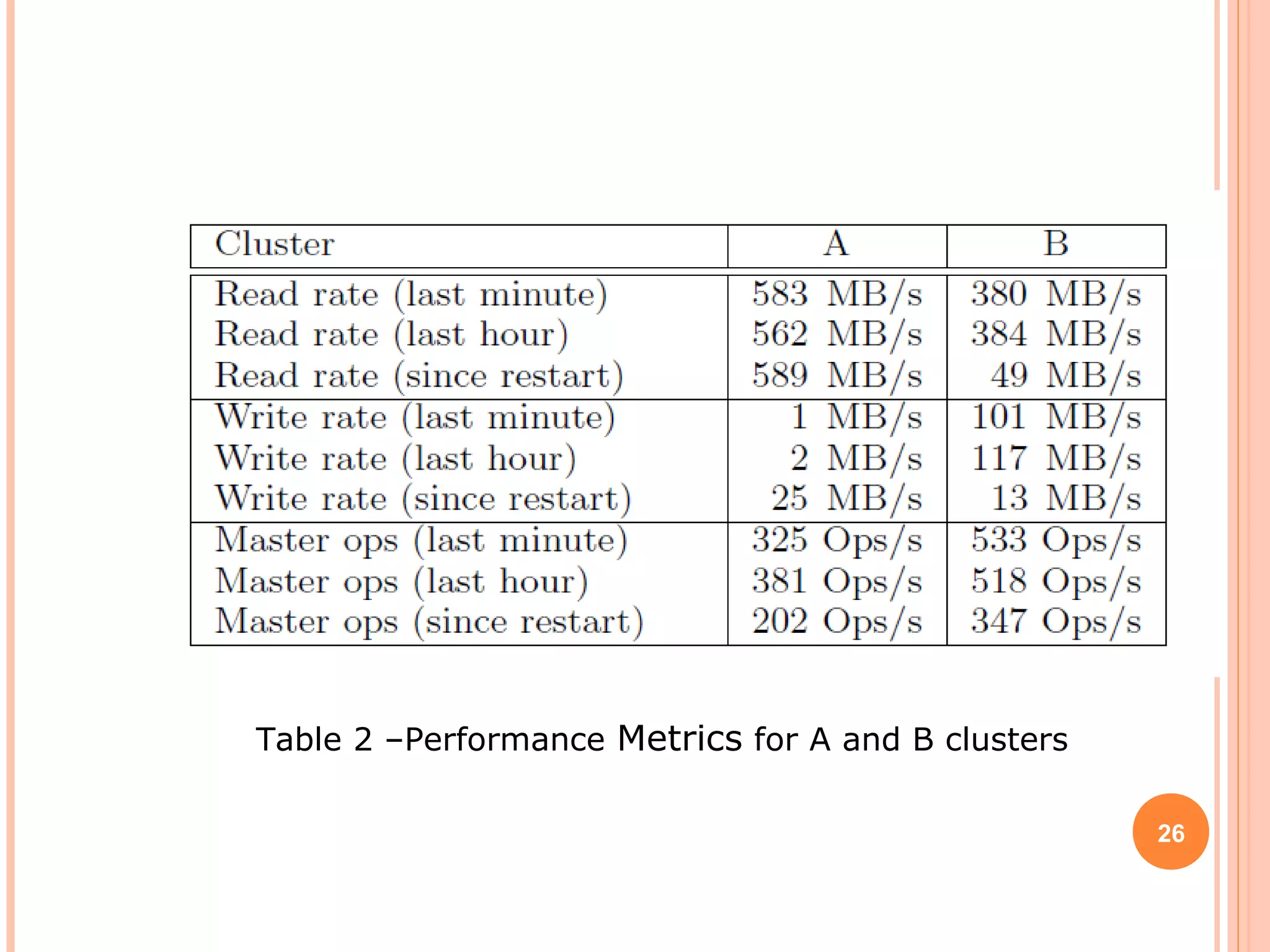
Table 2 –Performance Metrics for A and B clusters
26
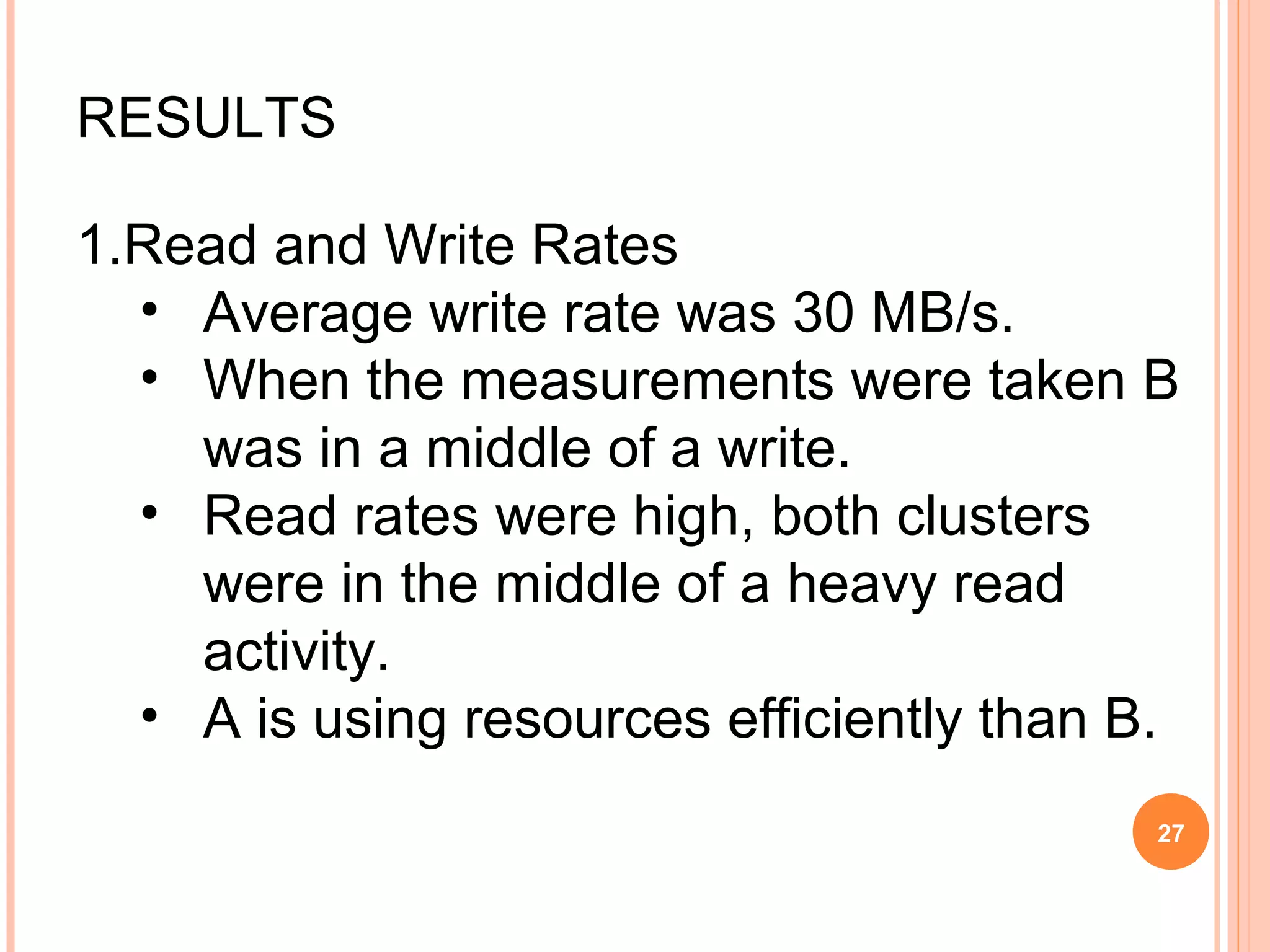
RESULTS
1.Read and Write Rates
• Average write rate was 30 MB/s.
• When the measurements were taken B
was in a middle of a write.
• Read rates were high, both clusters
were in the middle of a heavy read
activity.
• A is using resources efficiently than B.
27
2. Master Loads
Master can easily keep up with 200 to 500
operations per second.
28
3. Recovery Time.
• Killed a single chunk server
( 15, 000 chunks containing 600 GB of
data) in cluster B.
•All chunks were replicated in 23.2
minutes at an effective replication rate
of 440 MB/s.
29
Killed two chunk servers (16 000 chunks
and 660 GB of data).
Failure reduced 266 chunks to having a
single replica.
30
These 266 chunks were cloned at a
higher priority and all restored within 2
minutes.
Putting the cluster in a state where it
could tolerate another chunk server
failure
31
WORKLOAD BREAKDOWN
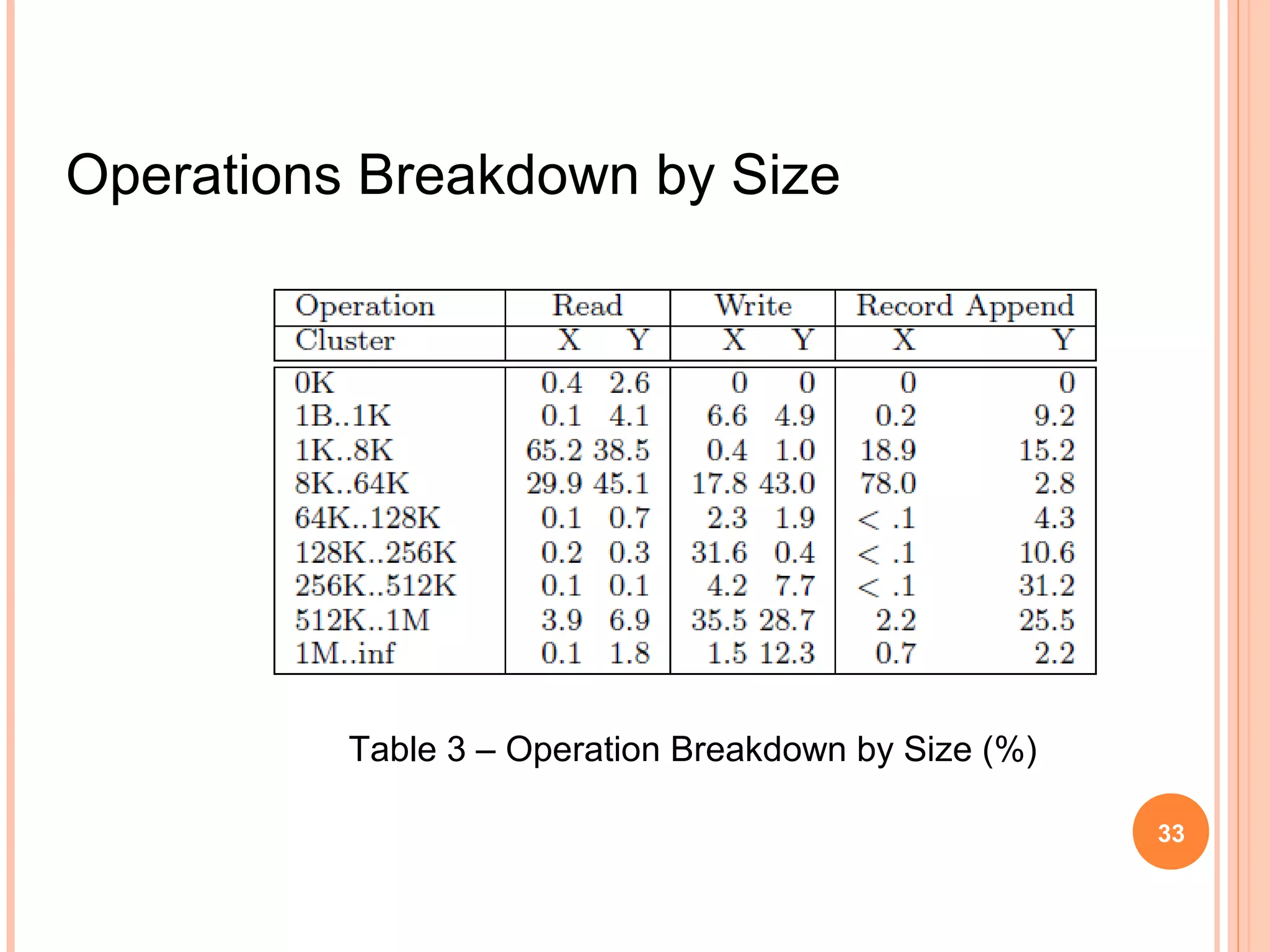
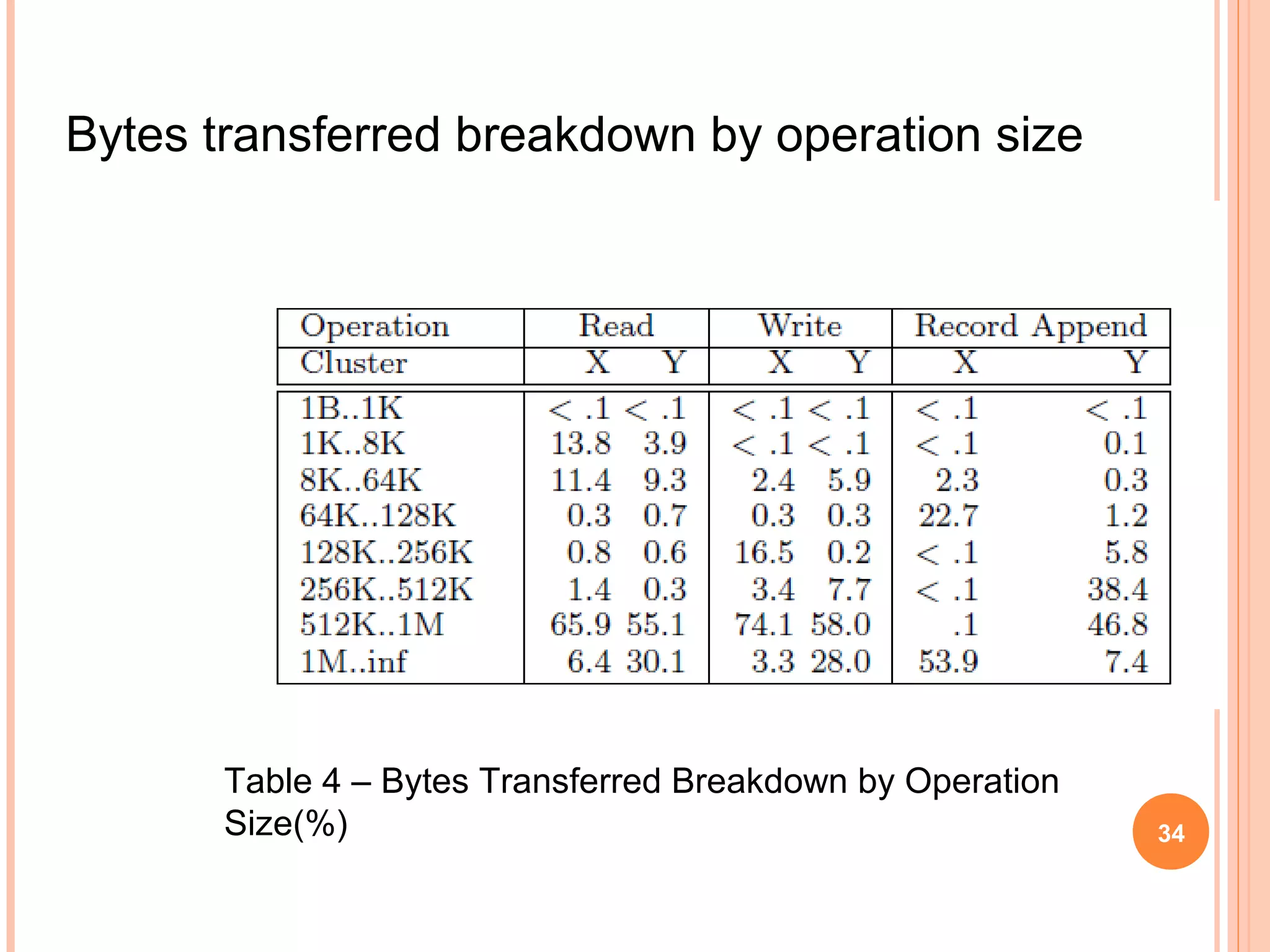
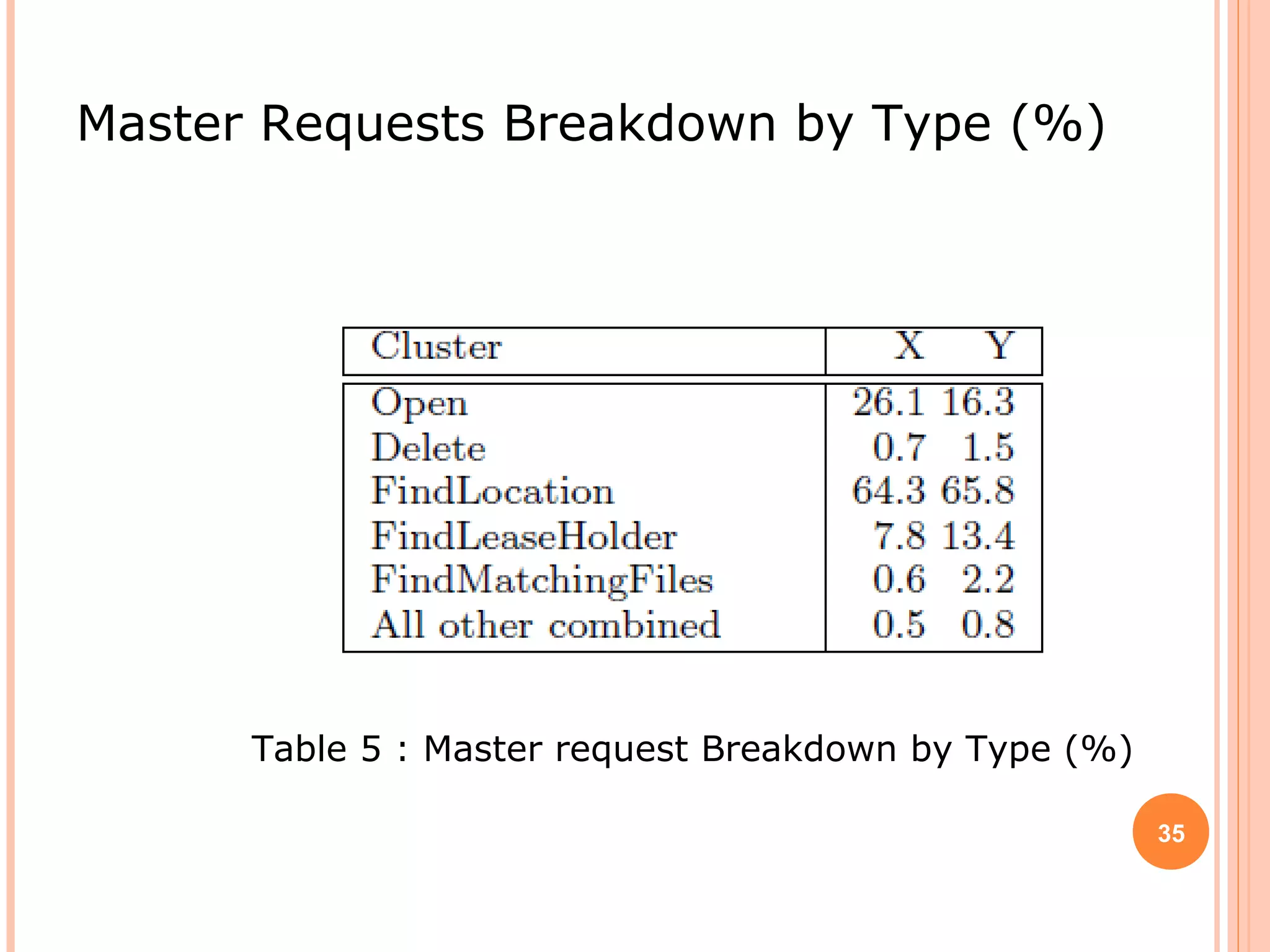
Cluster X and Y are used to represent
breakdown of the workloads on two
GFS. Cluster X is for research and
development while Y is for production
data processing.
32
Operations Breakdown by Size
Table 3 – Operation Breakdown by Size (%)
33
Bytes transferred breakdown by operation size
Table 4 – Bytes Transferred Breakdown by Operation
Size(%) 34
Master Requests Breakdown by Type (%)
Table 5 : Master request Breakdown by Type (%)
35
CONCLUSIONS
• GFS demonstrates the qualities essential for
supporting large scale data processing
workloads on commodity hardware.
• It provides fault tolerance by constant
monitoring, replicating crucial data and fast,
automatic recovery.
• It delivers high aggregate throughput to many
concurrent readers and writers by separating file
system control from data transfer. 36
Thank You.
37
Q and A
38

Google File System

  • 1.
    THE GOOGLE FILESYSTEM By Sanjay Ghemawat, Howard Gobioff, and Shun-Tak Leung 1
  • 2.
    INTRODUCTION • Google • Applicationsprocess lots of data • Need good file system • Solution : Google File System Large, distributed, highly fault tolerant file system. 2
  • 3.
    DESIGN MOTIVATIONS 1. Fault-toleranceand auto-recovery need to be built into the system. 2. Standard I/O assumptions (e.g. block size) have to be re-examined. 3. Record appends are the prevalent form of writing. 4. Google applications and GFS should be co- designed. 3
  • 4.
    INTERFACE  Create  Delete Open  Close  Read  Write  Snapshot  Record Append 4
  • 5.
    GFS ARCHITECTURE On asingle-machine FS:  An upper layer maintains the metadata.  A lower layer (i.e. disk) stores the data in units called “blocks”. In the GFS:  A master process maintains the metadata. A lower layer (i.e. a set of chunk servers) stores the data in units called “chunks”. 5
  • 6.
  • 7.
    CHUNK  Analogous toblock, except larger.  Size: 64 MB  Stored on chunk server as file  Chunk handle ( chunk file name) is used to reference chunk.  Replicated across multiple chunk servers 7
  • 8.
    CHUNK SIZE • Advantages oReduce client-master interaction o Reduce the size of the metadata • Disadvantages o Hot Spots Solution: Higher replication factor 8
  • 9.
    MASTER  Single masteris centralized  Stores all metadata: o File namespace o File to chunk mappings o Chunk location information 9
  • 10.
  • 11.
    System Interactions Current leaseholder? identity of primary location of replicas (cached by client) 3a. data 3b. data 3c. data Write request Primary assign mutations Applies it Forward write request Operation completed Operation completed Operation completed or Error report 11
  • 12.
    SYSTEM INTERACTIONS  Recordappends - Client specifies only data  Snapshot -Makes a copy of a file or a directory tree 12
  • 13.
    OPERATION LOG  Historicalrecord of critical metadata changes  Defines the order of concurrent operations  Critical  Replicated on multiple remote machines  Respond to client only when log locally and remotely  Fast recovery by using checkpoints  Use a compact B-tree like form directly mapping into memory  Switch to a new log, Create new checkpoints in a separate threads 13
  • 14.
    MASTER OPERATIONS  NamespaceManagement and Locking  Chunk Creation  Chunk Re-replication  Chunk Rebalancing  Garbage Collection 14
  • 15.
    FAULT TOLERANCE ANDDIAGNOSIS 1.High Availability They keep the overall system highly available with two simple yet effective strategies. Fast Recovery and replication 15
  • 16.
    1.1 Fast Recovery: Master and chunk servers are designed to restart and restore states in a few seconds. 1.2 Chunk Replication : Across multiple machines, across multiple racks. 16
  • 17.
    1.3 Master Replication: Log of all changes made to metadata.  Log replicated on multiple machines.  “Shadow” masters for reading data if “real” master is down. 17
  • 18.
  • 19.
    2. Data Integrity Eachchunk has an associated checksum. 3. Diagnostic Logging Logging is maintained for keeping the details of interactions between machines. (exact request and responses sent on the wire except data being transferred.) 19
  • 20.
    MEASUREMENTS They measured performanceon a GFS cluster consisting one master, two master replicas, 16 chunk servers and 16 clients. 20
  • 21.
    All machines areconfigured with 1.Dual 1.4 GHz PIII processors 2. 2 GB memory 3. Two 80 GB 5400 rpm disks 4. 100 Mbps full duplex Ethernet connection to an HP 2524 switch. 21
  • 22.
  • 23.
  • 24.
    Here also ratewill drop when the number of clients increases up to 16 , append rate drops due to congestion and variance in network transfer rates seen by different clients. 24
  • 25.
    REAL WORLD CLUSTERS Table1-Characteristics of two GFS clusters 25
  • 26.
    Table 2 –PerformanceMetrics for A and B clusters 26
  • 27.
    RESULTS 1.Read and WriteRates • Average write rate was 30 MB/s. • When the measurements were taken B was in a middle of a write. • Read rates were high, both clusters were in the middle of a heavy read activity. • A is using resources efficiently than B. 27
  • 28.
    2. Master Loads Mastercan easily keep up with 200 to 500 operations per second. 28
  • 29.
    3. Recovery Time. •Killed a single chunk server ( 15, 000 chunks containing 600 GB of data) in cluster B. •All chunks were replicated in 23.2 minutes at an effective replication rate of 440 MB/s. 29
  • 30.
    Killed two chunkservers (16 000 chunks and 660 GB of data). Failure reduced 266 chunks to having a single replica. 30
  • 31.
    These 266 chunkswere cloned at a higher priority and all restored within 2 minutes. Putting the cluster in a state where it could tolerate another chunk server failure 31
  • 32.
    WORKLOAD BREAKDOWN Cluster Xand Y are used to represent breakdown of the workloads on two GFS. Cluster X is for research and development while Y is for production data processing. 32
  • 33.
    Operations Breakdown bySize Table 3 – Operation Breakdown by Size (%) 33
  • 34.
    Bytes transferred breakdownby operation size Table 4 – Bytes Transferred Breakdown by Operation Size(%) 34
  • 35.
    Master Requests Breakdownby Type (%) Table 5 : Master request Breakdown by Type (%) 35
  • 36.
    CONCLUSIONS • GFS demonstratesthe qualities essential for supporting large scale data processing workloads on commodity hardware. • It provides fault tolerance by constant monitoring, replicating crucial data and fast, automatic recovery. • It delivers high aggregate throughput to many concurrent readers and writers by separating file system control from data transfer. 36
  • 37.
  • 38.

Editor's Notes

  • #4 Beacause components failures are accepted even this kind of large system When we are regularly working , all TB sized, KB sized files are also suppoted by the system. Most files are mutatetd by appending rather than overwriting excepting data It is fine, if we have a file system without imposing burden on the application
  • #5 1.System supports usual operations , as well as GFS has snapshot & record append operations also. 2. Snapshot creates a copy of a file or directory tree at low cost 3. Record append allows multiple clients to append data at the same file
  • #8 1.Files are devided into fixed size chunk 2. Chunk handle  immutable and globally unique 64 bit at the time of chunk creation 3. By defult stored in three chunk servers
  • #9 Larger size --  Adavtages Read write interaction between master and client make lesser Likely to perform many operations
  • #18 To keep itself informed a shadow master reads a replica of the growing operation log and applies the same changes to its data structures exactly as the primary does. Keep handshake messages with chunkservers to monitor their status. It depends only on primary master only for replica location updates only from primary’s decision to create and delete replicas.
  • #20 Logs will be used to reconstruct the entire interaction history to diagnose a problem. Serve as traces for load testing and performance analysis.
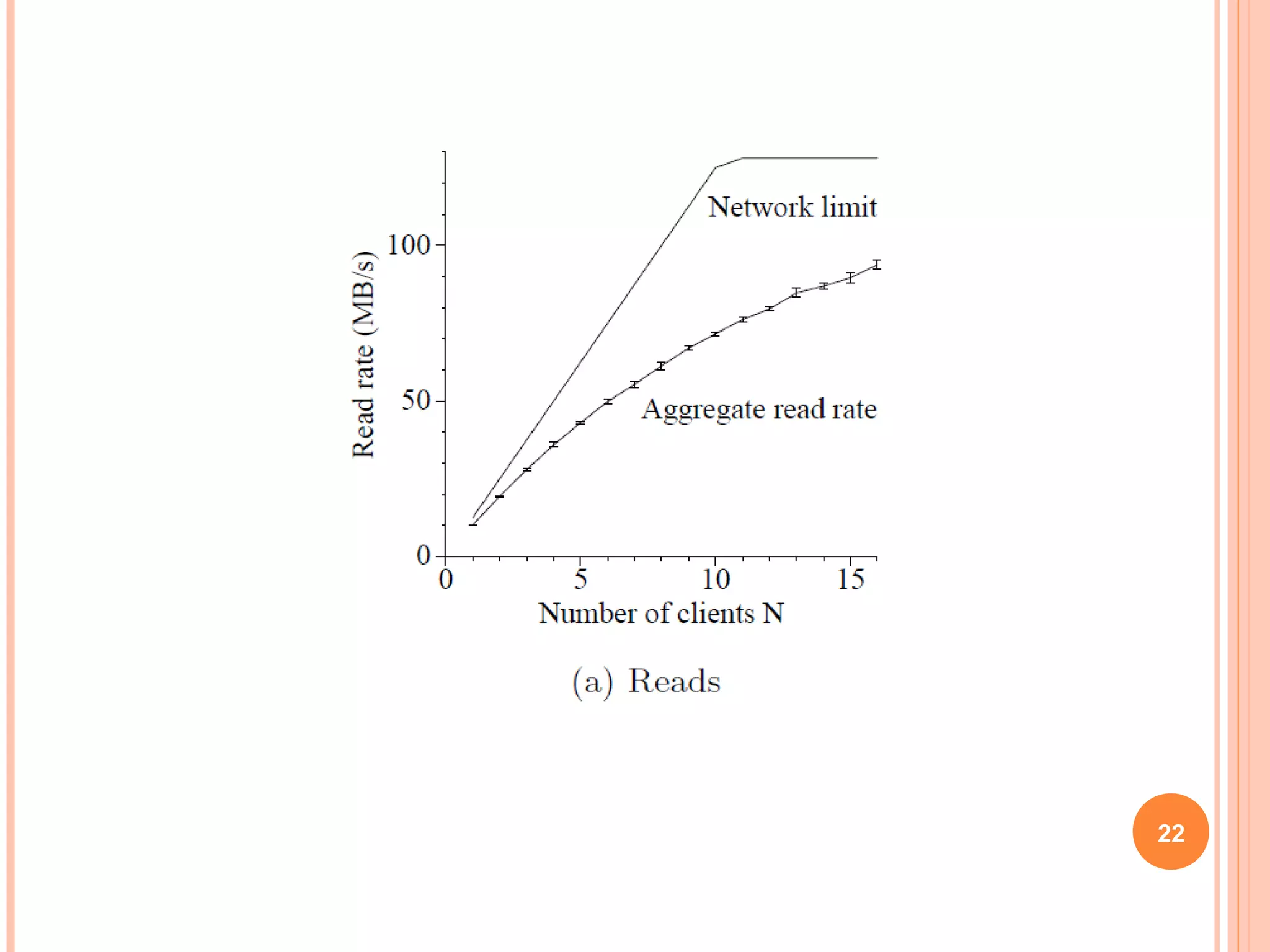
  • #23 For one client read rate is 10 MB/s 80% of the estimated value For 16 clients 94 MB/s i.e for one client 6 MB/s 75% of the estimated value.
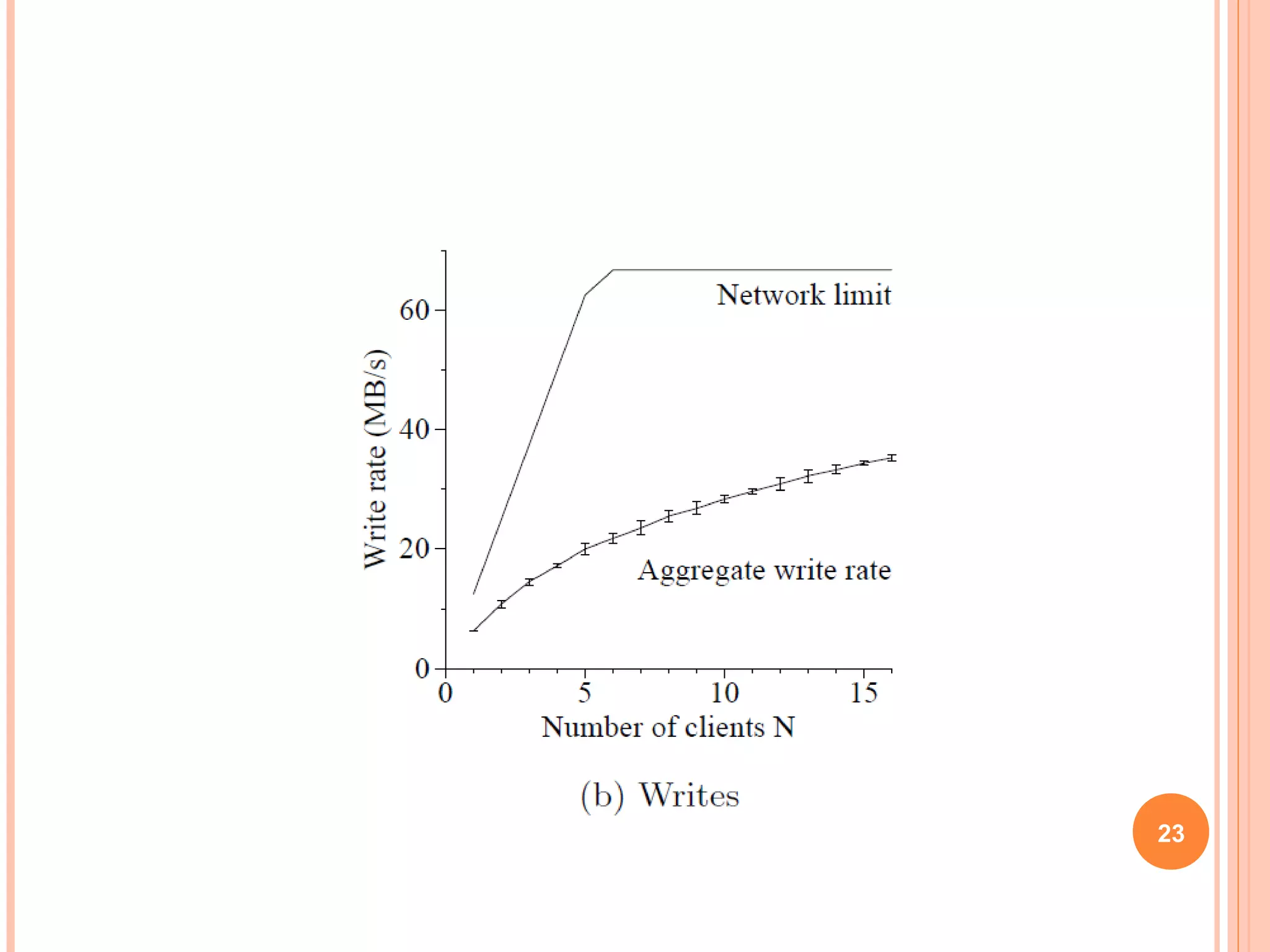
  • #24 Write rate for one client 6.3 MB/s. Half of the estimated value. (12.5 MB/s) Aggregate write rate for 16 clients 35 MB/s 2.2 MB/s per one client. Half of the estimated value.
  • #25 For one client it is 6.0 MB/s and for 16 clients it is 4.8 MB/s.
  • #26 A- used for research and development. It reads through a few MBs to TBs of data, analyze or process them and write the results. B – Used for production data processing. task lasts much longer. Metadata at chunkservers – checksums, chunk version number Metadata at Masters are so small. does not limit the system’s capacity. File names in compressed form, ownerships and permission, mapping from files to chunks, chunks current version, replica location etc. Recovery is fast.
  • #28 Because A can support up to 750 MB/s it is using 580 MB/s. B can support 1300 MB/s but using only 380 MB/s.