Presented By-
Mahesh Garhwal
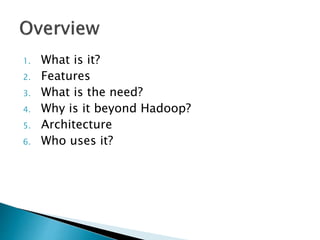
1. What is it?
2. Features
3. What is the need?
4. Why is it beyond Hadoop?
5. Architecture
6. Who uses it?
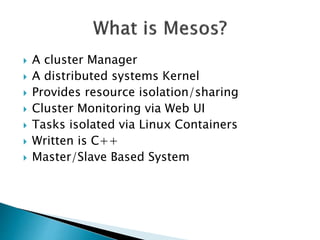
 A cluster Manager
 A distributed systems Kernel
 Provides resource isolation/sharing
 Cluster Monitoring via Web UI
 Tasks isolated via Linux Containers
 Written is C++
 Master/Slave Based System
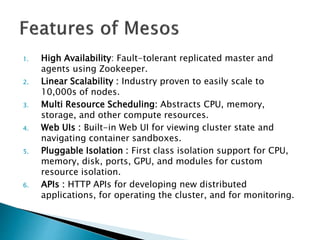
1. High Availability: Fault-tolerant replicated master and
agents using Zookeeper.
2. Linear Scalability : Industry proven to easily scale to
10,000s of nodes.
3. Multi Resource Scheduling: Abstracts CPU, memory,
storage, and other compute resources.
4. Web UIs : Built-in Web UI for viewing cluster state and
navigating container sandboxes.
5. Pluggable Isolation : First class isolation support for CPU,
memory, disk, ports, GPU, and modules for custom
resource isolation.
6. APIs : HTTP APIs for developing new distributed
applications, for operating the cluster, and for monitoring.
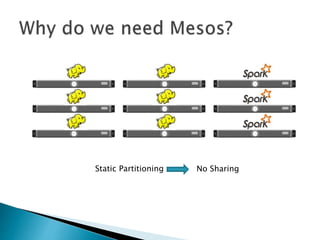
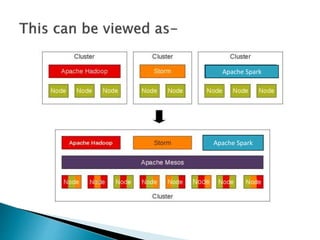
Static Partitioning No Sharing
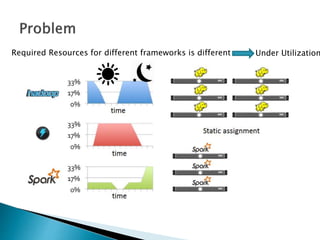
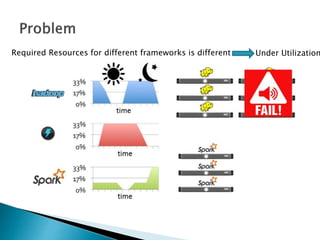
Required Resources for different frameworks is different Under Utilization
Apache Spark
Apache Spark
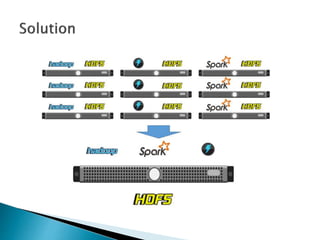
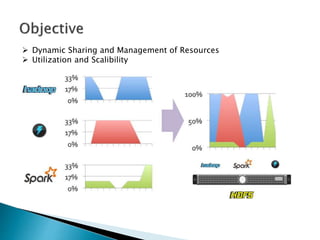
 Dynamic Sharing and Management of Resources
 Utilization and Scalibility
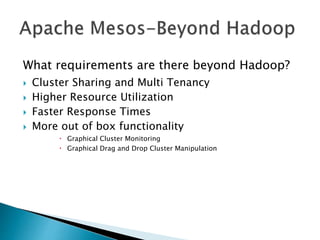
What requirements are there beyond Hadoop?
 Cluster Sharing and Multi Tenancy
 Higher Resource Utilization
 Faster Response Times
 More out of box functionality
 Graphical Cluster Monitoring
 Graphical Drag and Drop Cluster Manipulation
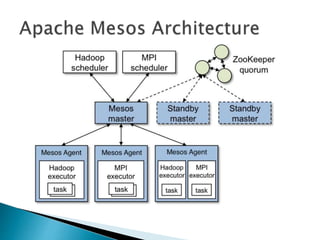
1. Zookeepers: Apache ZooKeeper is a centralised
configuration manager, used by distributed
applications such as Mesos to coordinate activity
across a cluster. Mesos uses ZooKeeper to elect a
leading master and for slaves to join the cluster.
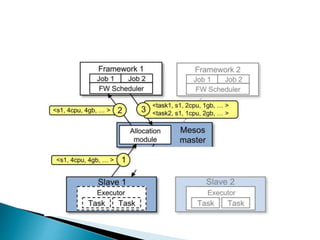
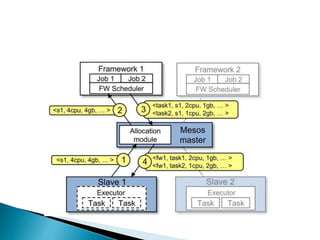
2. Mesos Master: A Mesos master is a Mesos
instance in control of the cluster. A cluster will
typically have multiple Mesos masters to provide
fault-tolerance, with one instance elected the
leading master.
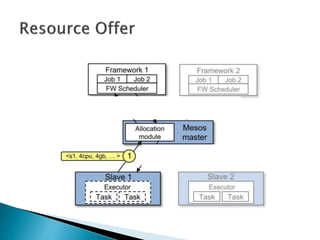
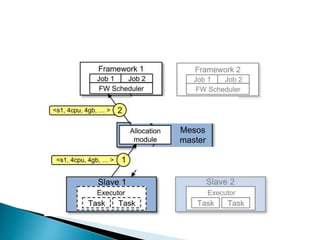
3. Mesos Slaves: A Mesos slave is a Mesos instance
which offers resources to the cluster. They are
the ‘worker’ instances - tasks are allocated to the
slaves by the Mesos master.
4. Frameworks: Frameworks bridge the gap between
the Mesos layer and your applications. They are
higher level abstractions which simplify the
process of launching tasks on the cluster.
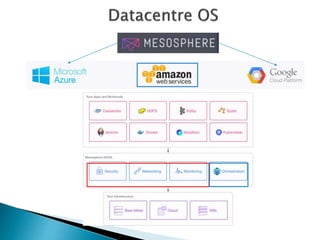
 DC/OS is a distributed operating system based
on the Apache Mesos distributed systems kernel.
It enables the management of multiple machines
as if they were a single computer. It automates
resource management, schedules process
placement, facilitates inter-process
communication, and simplifies the installation
and management of distributed services. Its
included web interface and available command-
line interface (CLI) facilitate remote management
and monitoring of the cluster and its services.
 Marathon is a framework for Mesos that is
designed to launch long-running applications,
and, in Mesosphere, serves as a replacement for
a traditional init system. It has many features
that simplify running applications in a clustered
environment, such as high-availability, node
constraints, application health checks, an API for
scriptability and service discovery, and an easy to
use web user interface. It adds its scaling and
self-healing capabilities to the Mesosphere
feature set.
 Chronos is a framework for Mesos that was
originally developed by Airbnb as a
replacement for cron. As such, it is a fully-
featured, distributed, and fault-tolerant
scheduler for Mesos, which eases the
orchestration of jobs, which are collections of
tasks. It includes an API that allows for
scripting of scheduling jobs, and a web UI for
ease of use.

Apache mesos

  • 1.
  • 2.
    1. What isit? 2. Features 3. What is the need? 4. Why is it beyond Hadoop? 5. Architecture 6. Who uses it?
  • 3.
     A clusterManager  A distributed systems Kernel  Provides resource isolation/sharing  Cluster Monitoring via Web UI  Tasks isolated via Linux Containers  Written is C++  Master/Slave Based System
  • 4.
    1. High Availability:Fault-tolerant replicated master and agents using Zookeeper. 2. Linear Scalability : Industry proven to easily scale to 10,000s of nodes. 3. Multi Resource Scheduling: Abstracts CPU, memory, storage, and other compute resources. 4. Web UIs : Built-in Web UI for viewing cluster state and navigating container sandboxes. 5. Pluggable Isolation : First class isolation support for CPU, memory, disk, ports, GPU, and modules for custom resource isolation. 6. APIs : HTTP APIs for developing new distributed applications, for operating the cluster, and for monitoring.
  • 5.
  • 6.
    Required Resources fordifferent frameworks is different Under Utilization
  • 7.
    Required Resources fordifferent frameworks is different Under Utilization
  • 9.
  • 10.
     Dynamic Sharingand Management of Resources  Utilization and Scalibility
  • 11.
    What requirements arethere beyond Hadoop?  Cluster Sharing and Multi Tenancy  Higher Resource Utilization  Faster Response Times  More out of box functionality  Graphical Cluster Monitoring  Graphical Drag and Drop Cluster Manipulation
  • 13.
    1. Zookeepers: ApacheZooKeeper is a centralised configuration manager, used by distributed applications such as Mesos to coordinate activity across a cluster. Mesos uses ZooKeeper to elect a leading master and for slaves to join the cluster. 2. Mesos Master: A Mesos master is a Mesos instance in control of the cluster. A cluster will typically have multiple Mesos masters to provide fault-tolerance, with one instance elected the leading master.
  • 14.
    3. Mesos Slaves:A Mesos slave is a Mesos instance which offers resources to the cluster. They are the ‘worker’ instances - tasks are allocated to the slaves by the Mesos master. 4. Frameworks: Frameworks bridge the gap between the Mesos layer and your applications. They are higher level abstractions which simplify the process of launching tasks on the cluster.
  • 21.
     DC/OS isa distributed operating system based on the Apache Mesos distributed systems kernel. It enables the management of multiple machines as if they were a single computer. It automates resource management, schedules process placement, facilitates inter-process communication, and simplifies the installation and management of distributed services. Its included web interface and available command- line interface (CLI) facilitate remote management and monitoring of the cluster and its services.
  • 23.
     Marathon isa framework for Mesos that is designed to launch long-running applications, and, in Mesosphere, serves as a replacement for a traditional init system. It has many features that simplify running applications in a clustered environment, such as high-availability, node constraints, application health checks, an API for scriptability and service discovery, and an easy to use web user interface. It adds its scaling and self-healing capabilities to the Mesosphere feature set.
  • 24.
     Chronos isa framework for Mesos that was originally developed by Airbnb as a replacement for cron. As such, it is a fully- featured, distributed, and fault-tolerant scheduler for Mesos, which eases the orchestration of jobs, which are collections of tasks. It includes an API that allows for scripting of scheduling jobs, and a web UI for ease of use.