INTRODUCTION TO MALWARE
ANALYSIS
Hussein Muhaisen
AKA System Exploited
WHAT IS MALWARE ?
• Malware is a Binary that does
MaliciousActivities
• Malware is used by attackers to
perform malicious actions and gain
control over their targets or spying
on them
• RATS,Keyloggers , Ransomware.
These are all examples of malware
that are widely common and used
nowadays.
TYPES OF MALWARE
• Virus orWorm : Malware that is capable of copying itself
and spreading to other computers.A virus needs user
intervention,whereas a worm can spread without user
intervention
• Trojan : Malware that disguises itself as a regular program
to trick users to install it on their systems. Once installed,
it can perform malicious actions such as stealing sensitive
data, uploading files to the attacker's server, or monitoring
webcams
• Backdoor / Remote Access Trojan (RAT):This is a type of
Trojan that enables the attacker to gain access to and
execute commands on the compromised system
• Botnet:This is a group of computers infected with the
same malware (called bots), waiting to receive instructions
from the command-and-control server controlled by the
attacker. The attacker can then issue a command to these
bots, which can perform malicious activities such as DDOS
attacks.
• Ransomware: Malware that holds the system for ransom
by locking users out of their computer or by encrypting
their files.
• Rootkit: Malware that provides the attacker with privileged
access to the infected system and conceals its presence or
the presence of other software.
WHAT IS
MALWARE
ANALYSIS
• Malware analysis is the process
of analyzing a malware sample
and be able to exfiltrate as
much as information as possible
, malware analysis is really
important because by analyzing
how the malware functions ,
how it spreads , and the type
of malware used. Helps us
defend against future attacks
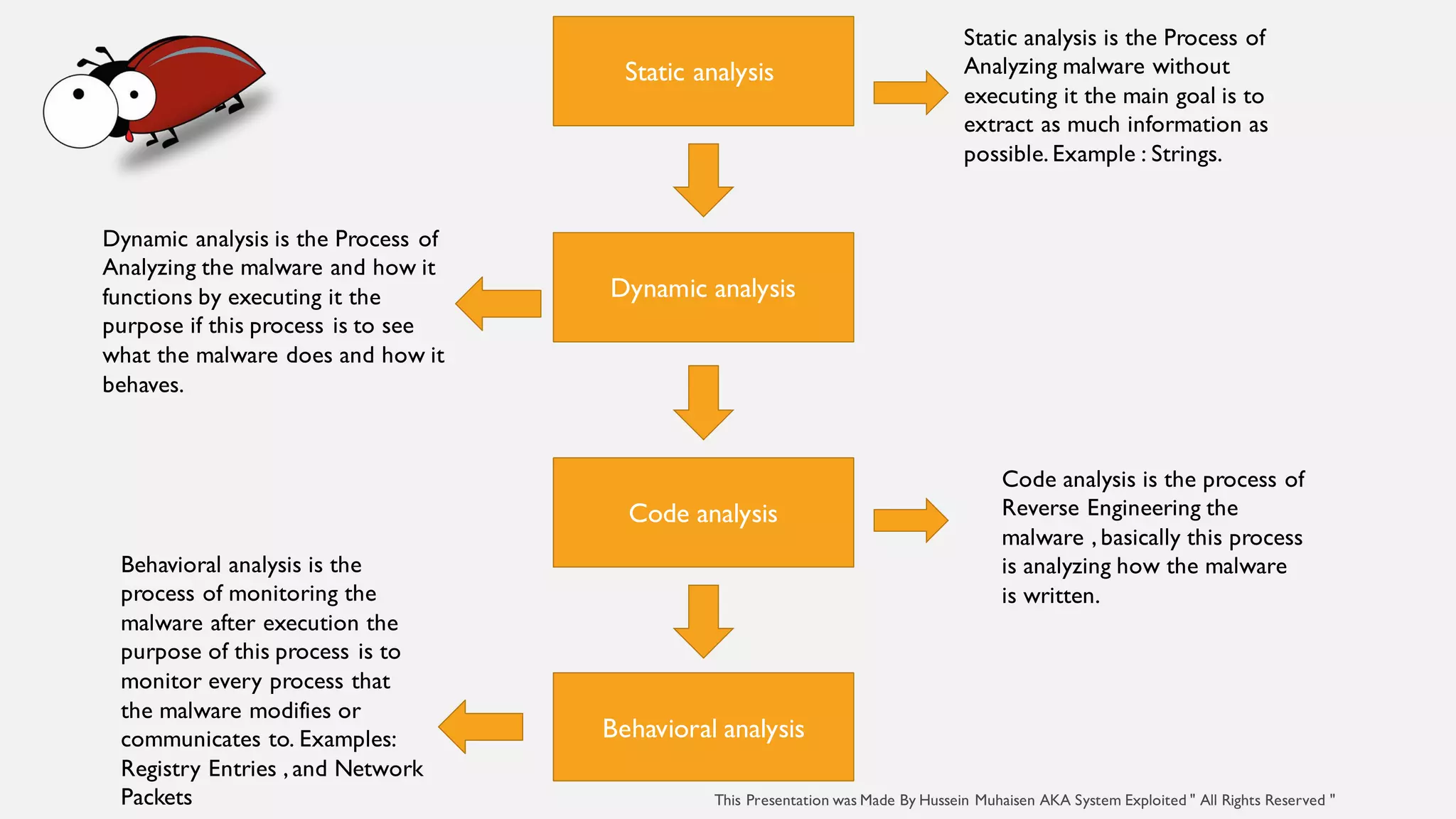
Static analysis
Dynamic analysis
Code analysis
Behavioral analysis
Static analysis is the Process of
Analyzing malware without
executing it the main goal is to
extract as much information as
possible. Example : Strings.
Dynamic analysis is the Process of
Analyzing the malware and how it
functions by executing it the
purpose if this process is to see
what the malware does and how it
behaves.
Code analysis is the process of
Reverse Engineering the
malware , basically this process
is analyzing how the malware
is written.
Behavioral analysis is the
process of monitoring the
malware after execution the
purpose of this process is to
monitor every process that
the malware modifies or
communicates to. Examples:
Registry Entries , and Network
Packets
WHAT’S NEXT ?
• Setup an Dedicated Isolated
Environment ForAnalyzing Malware
• LearnWindows Internals and Linux
Internals , and how Computers work
in general
• Learn / Understand Programming and
Mostly Assembly and C/C++ ,and
Java
• Understand Network Fundamentals
• UnderstandThe Operating System
Architecture
THANK YOU <3

Introduction to Malware analysis

  • 1.
    INTRODUCTION TO MALWARE ANALYSIS HusseinMuhaisen AKA System Exploited
  • 2.
    WHAT IS MALWARE? • Malware is a Binary that does MaliciousActivities • Malware is used by attackers to perform malicious actions and gain control over their targets or spying on them • RATS,Keyloggers , Ransomware. These are all examples of malware that are widely common and used nowadays.
  • 3.
    TYPES OF MALWARE •Virus orWorm : Malware that is capable of copying itself and spreading to other computers.A virus needs user intervention,whereas a worm can spread without user intervention • Trojan : Malware that disguises itself as a regular program to trick users to install it on their systems. Once installed, it can perform malicious actions such as stealing sensitive data, uploading files to the attacker's server, or monitoring webcams • Backdoor / Remote Access Trojan (RAT):This is a type of Trojan that enables the attacker to gain access to and execute commands on the compromised system • Botnet:This is a group of computers infected with the same malware (called bots), waiting to receive instructions from the command-and-control server controlled by the attacker. The attacker can then issue a command to these bots, which can perform malicious activities such as DDOS attacks. • Ransomware: Malware that holds the system for ransom by locking users out of their computer or by encrypting their files. • Rootkit: Malware that provides the attacker with privileged access to the infected system and conceals its presence or the presence of other software.
  • 4.
    WHAT IS MALWARE ANALYSIS • Malwareanalysis is the process of analyzing a malware sample and be able to exfiltrate as much as information as possible , malware analysis is really important because by analyzing how the malware functions , how it spreads , and the type of malware used. Helps us defend against future attacks
  • 5.
    Static analysis Dynamic analysis Codeanalysis Behavioral analysis Static analysis is the Process of Analyzing malware without executing it the main goal is to extract as much information as possible. Example : Strings. Dynamic analysis is the Process of Analyzing the malware and how it functions by executing it the purpose if this process is to see what the malware does and how it behaves. Code analysis is the process of Reverse Engineering the malware , basically this process is analyzing how the malware is written. Behavioral analysis is the process of monitoring the malware after execution the purpose of this process is to monitor every process that the malware modifies or communicates to. Examples: Registry Entries , and Network Packets
  • 6.
    WHAT’S NEXT ? •Setup an Dedicated Isolated Environment ForAnalyzing Malware • LearnWindows Internals and Linux Internals , and how Computers work in general • Learn / Understand Programming and Mostly Assembly and C/C++ ,and Java • Understand Network Fundamentals • UnderstandThe Operating System Architecture
  • 7.