Prepared by:
Padual, Azhie Rose
BSED-ENG 1
MACRO & MICRO
LINGUISTIC
STUDIES
Lesson 1.4:
LESSON
OBJECTIVES
Define the differences
between macro and micro
linguistics
Comprehend the roles of
macro and micro linguistics
and its branches
Identify and be inform
about the various branhes
of macro and micro
linguistics and;
01
02
03
is the study of language from a scientific
point of view.
LINGUISTICS
ROBINS (1985)
"Linguistics is the study of human language as a
universal and recognizable part of human behavior
as well as human faculties, perhaps one of the most
important parts of human life as we know it and one
of the most far reaching human abilities, in terms
of the whole range of mankind's achievements."
WHAT IS A LINGUISTICS?
MAIN BRANCHES OF LINGUISTICS
Micro
Macro
MICRO
Phonetics
Morphology
Phonology
Symantics
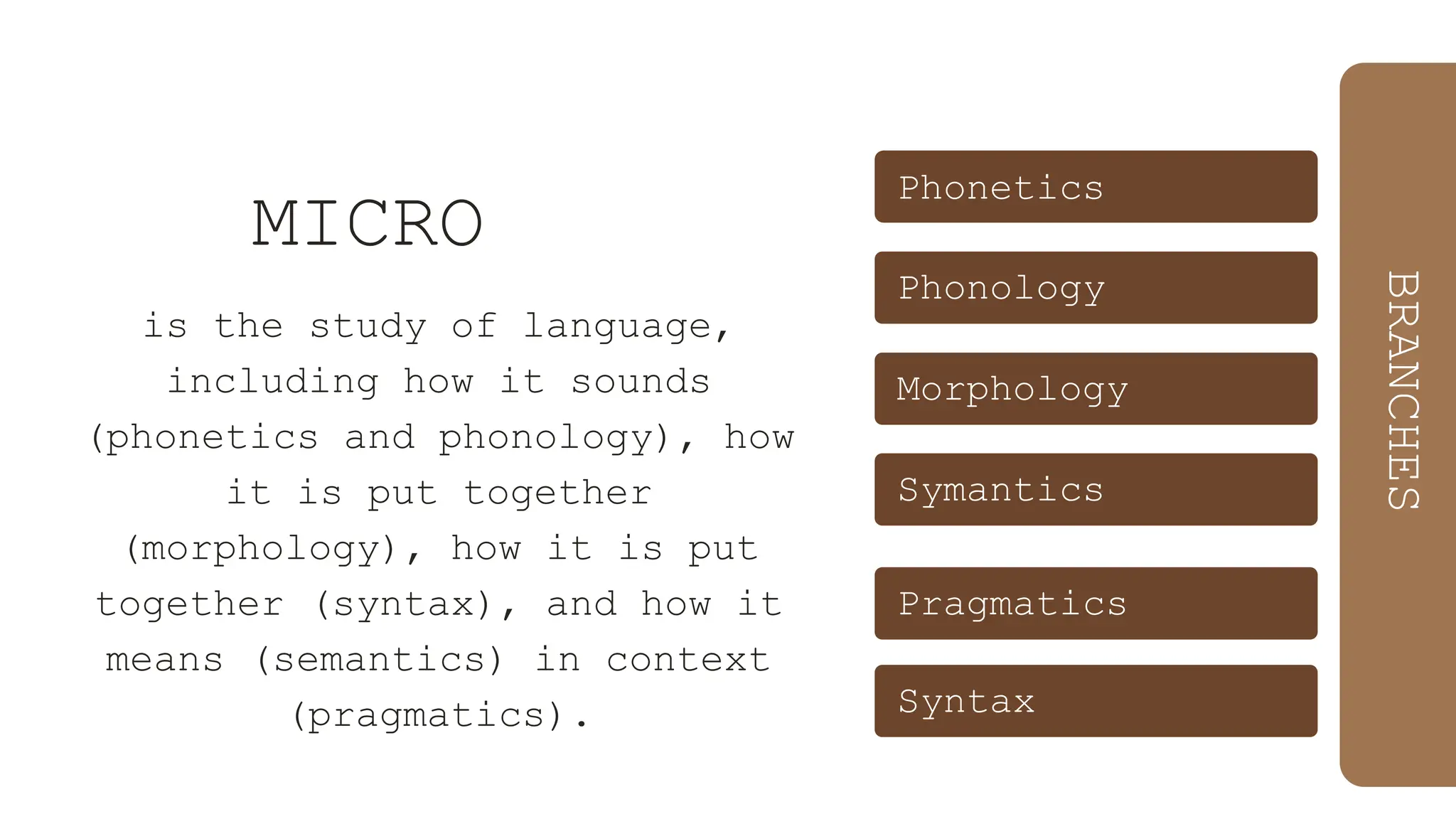
is the study of language,
including how it sounds
(phonetics and phonology), how
it is put together
(morphology), how it is put
together (syntax), and how it
means (semantics) in context
(pragmatics).
Pragmatics
Syntax
BRANCHES
MICRO
Phonetics
is the study of how language sounds. It looks at how
sounds are made, how they travel, and how people
hear them. Phonetics is further broken down into
three distinct branches that are:
Ariculatory Phonetics
Acoustic Phonetics
Auditory Phonetics
MICRO
Phonetics
is the study of how language sounds. It looks at how
sounds are made, how they travel, and how people
hear them. Phonetics is further broken down into
three distinct branches that are:
Ariculatory Phonetics
• deals with the study of how speech sounds
are made (articulation).
MICRO
Phonetics
is the study of how language sounds. It looks at how
sounds are made, how they travel, and how people
hear them. Phonetics is further broken down into
three distinct branches that are:
Acoustic Phonetics
• examines the physical qualities of sounds
as they are transferred from the lips. to
the air and received by the ear drum.
MICRO
Phonetics
is the study of how language sounds. It looks at how
sounds are made, how they travel, and how people
hear them. Phonetics is further broken down into
three distinct branches that are:
Auditory Phonetics
• deals with the study of how the ear,
auditory nerve, and brain always respond to
speech sounds.
MICRO
Phonology
Is the study of how sounds are put together
as units of speech in each language. It also
looks at the rules for how sounds are
divided into small sounds in each language
MICRO
Morphology
Deals with how words are made, how they are
used, and how small letters are used to make
words. It looks at how words are broken up
into small parts that mean something
(morphemes).
There are two more types of morphology:
derivational morphology, and inflectional
MICRO
Semantics
Is the study of what words mean. It’s about
learning how words are put together and how
to make sentences that create meaning.
MICRO
Pragmatics
It is concerned with the meaning of language
as well, but it concentrates on actual
meaning in context rather than individual
word meanings.
Is the study of a language’s phrase
building, clauses, and sentences. It is
concerned with the basic word order utilized
MACRO LINGUISTICS
Intra-
Disciplinary
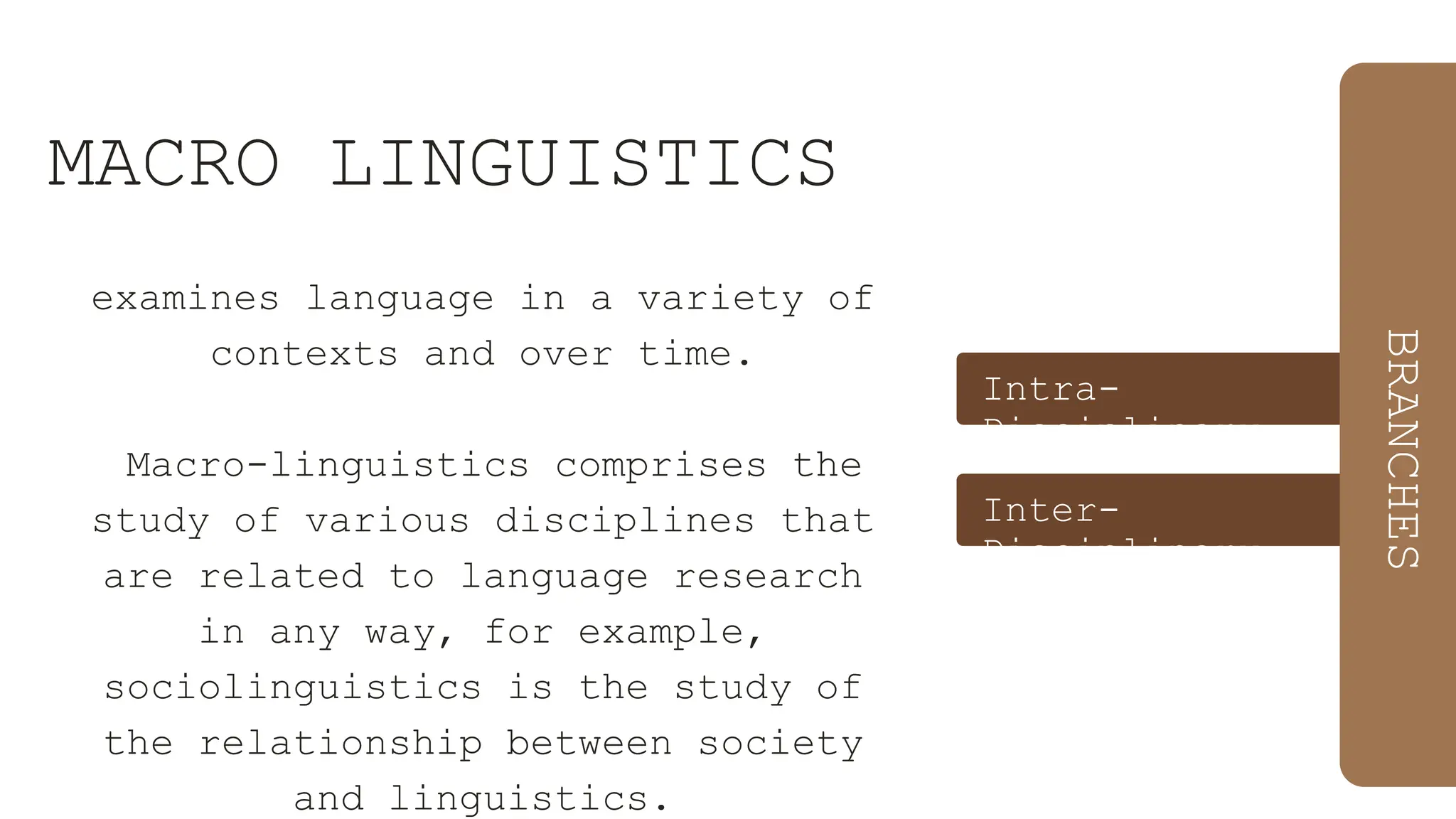
examines language in a variety of
contexts and over time.
Macro-linguistics comprises the
study of various disciplines that
are related to language research
in any way, for example,
sociolinguistics is the study of
the relationship between society
and linguistics.
Inter-
Disciplinary
BRANCHES
MACRO LINGUISTICS
Sociolinguistics
Inter-disciplinary linguistics studies
linguistics in relation to other disciplines
such as geography, sociology, psychology,
neurology, and so on.
Inter Disciplinary
Psycholinguistics
Neurolinguistics
Computational linguistics
Sociolinguistics
Geographic Linguistic
Cognitive Linguisti
MACRO LINGUISTICS
• Sociolinguistics
The term sociolinguistics refers to the
study of the link between language and
society. Sociolinguistics is the
discipline of linguistics that studies
how society affects language. It is
closely related to anthropology,
sociology, and culture.
2.
3.
4.
Inter Disciplinary
5.
6.
7.
MACRO LINGUISTICS
1.
The study of the mental aspects of language
and communication is known os
psycholinguistics. Its domain la particularly
concerned with the representation and
processing of language in the brain.
Psycholinguistics is a branch of cognitive
science that studies languages and psychology.
2. Psycholinguistics 3.
4.
Inter Disciplinary
5.
6.
7.
MACRO LINGUISTICS
1.
Is the study of how language is
represented in the brain, as well as how
and where the brain stores language
knowledge. It emphasizes on what occurs in
our brains during language acquisition and
when we apply this knowledge to use.
2.
3. Neurolinguistics
4.
Inter Disciplinary
5.
6.
7.
MACRO LINGUISTICS
1.
Is a branch of linguistics that looks at
modeling natural language based on rules
from a computer point of view. It is the
part of linguistics that looks at how
computer science techniques can be used to
look at language and speech and change it.
2.
3.
Inter Disciplinary
5.
6.
7.
4. Computational
linguistics
MACRO LINGUISTICS
1.
Is a branch of linguistics that looks at
and tries to figure out style and tone in
both spoken and written languages. It is
an interdisciplinary field
2.
3.
Inter Disciplinary
5. Stylistics.
6.
7.
4.
MACRO LINGUISTICS
1.
Also called dialect geography, is the
study of how a language or dialect changes
from one place to another Language
geography is a branch of human geography
that looks at how languages or their parts
are spread around the world,
2.
3.
Inter Disciplinary
5.
6. Geography
Linguistics
7.
4.
MACRO LINGUISTICS
1.
Is a branch of linguistics that first
appeared in the 1970s. It is an
interdisciplinary field that studies
language, the mind, and sociocultural
experience. Cognitive linguistics is based
on the Idea that meaning and for more
separable in the study of language.
2.
3.
Inter Disciplinary
5.
6. Geog
Linguist
7. Cognitive
Linguistics
4.
MACRO LINGUISTICS
Theoretical
Linguistics
Is a deal made with the study of linguistics in
its own field. Here are the different parts of
macro linguistics that belong to the same
field.
Intra Disciplinary
Descriptive
Linguistic
Applied Linguistic
Historical
linguistics
Comaparative
Linguistic
MACRO LINGUISTICS
1. Theoretical
Linguistics
Which is also called “General Linguistics,”
is the study of concrete theories that
scholars of language have put forward about
different parts of linguistics. General
linguistics is the theoretical study of how
to describe a language and how to look into
Intra Disciplinary 2. Des
Linguis
3. Appl
4. Hist
linguis
5. Coma
Linguis
MACRO LINGUISTICS 1.Theor
Is about describing and analyzing how a
language works and is used by a certain
group of speakers at a certain time.
Intra Disciplinary
2. Descriptive
Linguistic
3. Appl
4. Hist
linguis
5. Coma
Linguis
MACRO LINGUISTICS 1.Theor
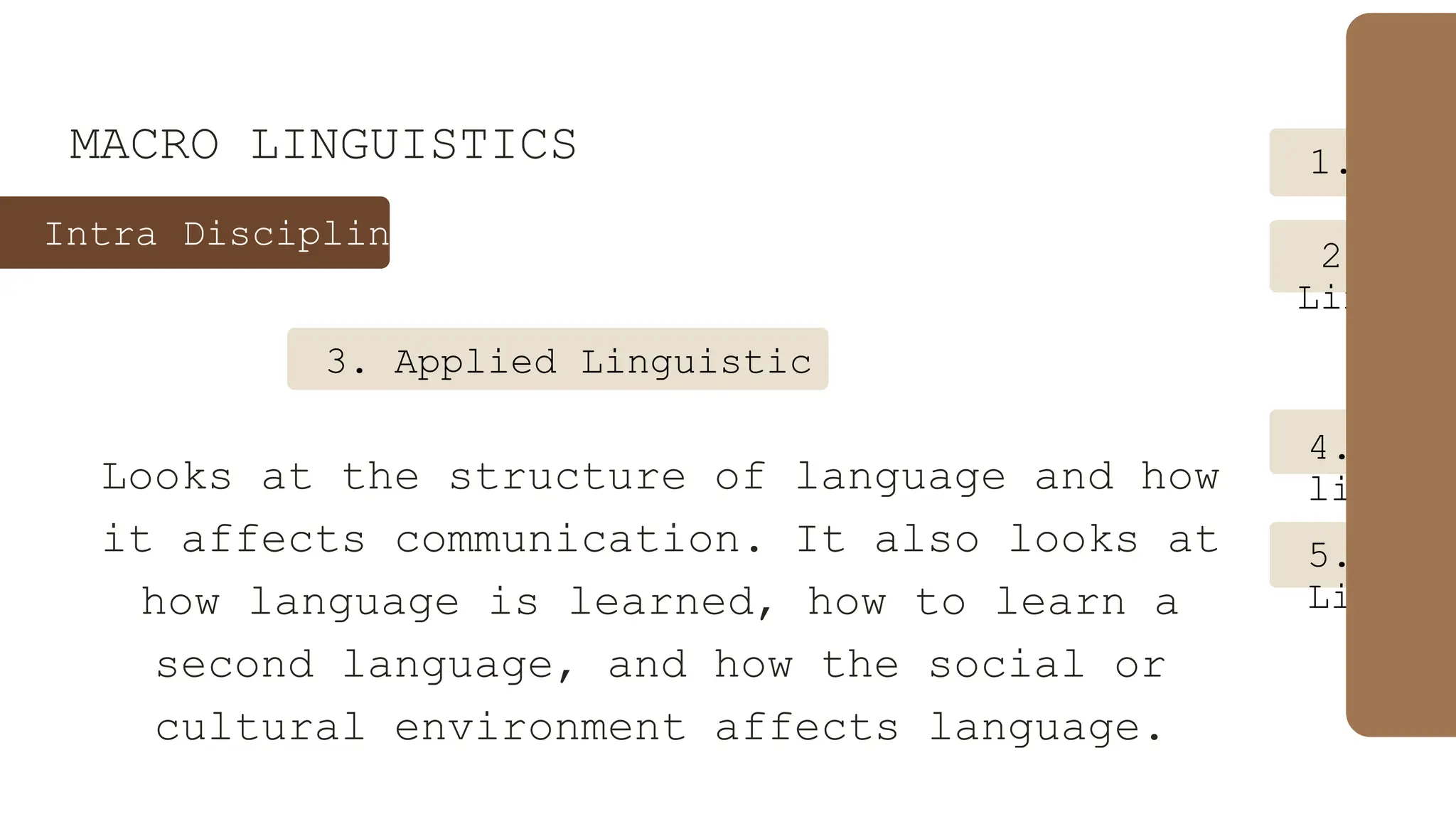
Looks at the structure of language and how
it affects communication. It also looks at
how language is learned, how to learn a
second language, and how the social or
cultural environment affects language.
Intra Disciplinary
2. Des
Linguis
3. Applied Linguistic
4. Hist
linguis
5. Coma
Linguis
MACRO LINGUISTICS 1.Theor
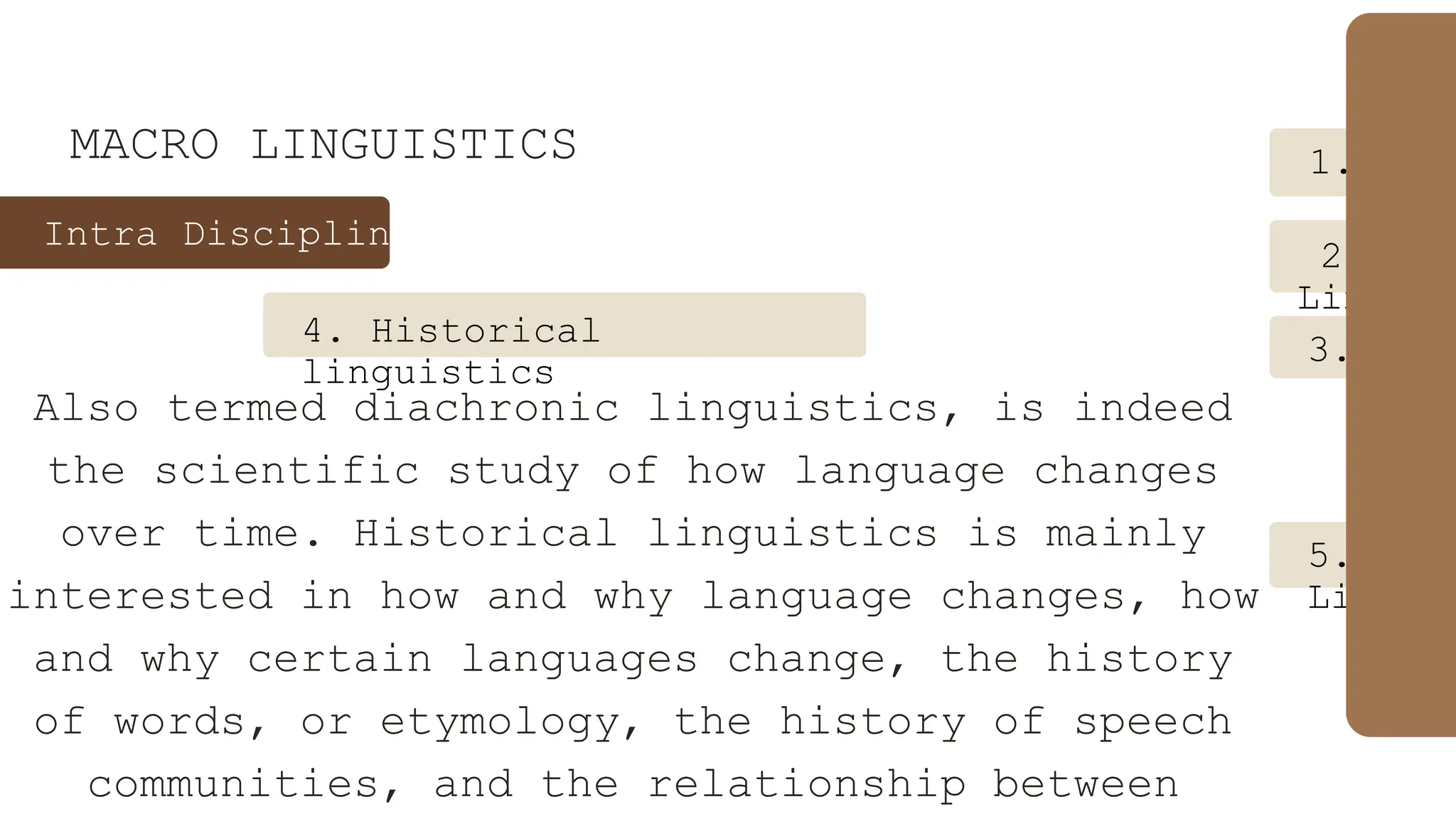
Also termed diachronic linguistics, is indeed
the scientific study of how language changes
over time. Historical linguistics is mainly
interested in how and why language changes, how
and why certain languages change, the history
of words, or etymology, the history of speech
communities, and the relationship between
Intra Disciplinary
2. Des
Linguis
3. Appl
4. Historical
linguistics
5. Coma
Linguis
MACRO LINGUISTICS 1.Theor
Is a branch of linguistics that looks at how
different languages are alike and how they are
different. It is a part of historical
linguistics that focuses on comparing languages
to find out how they changed over time.
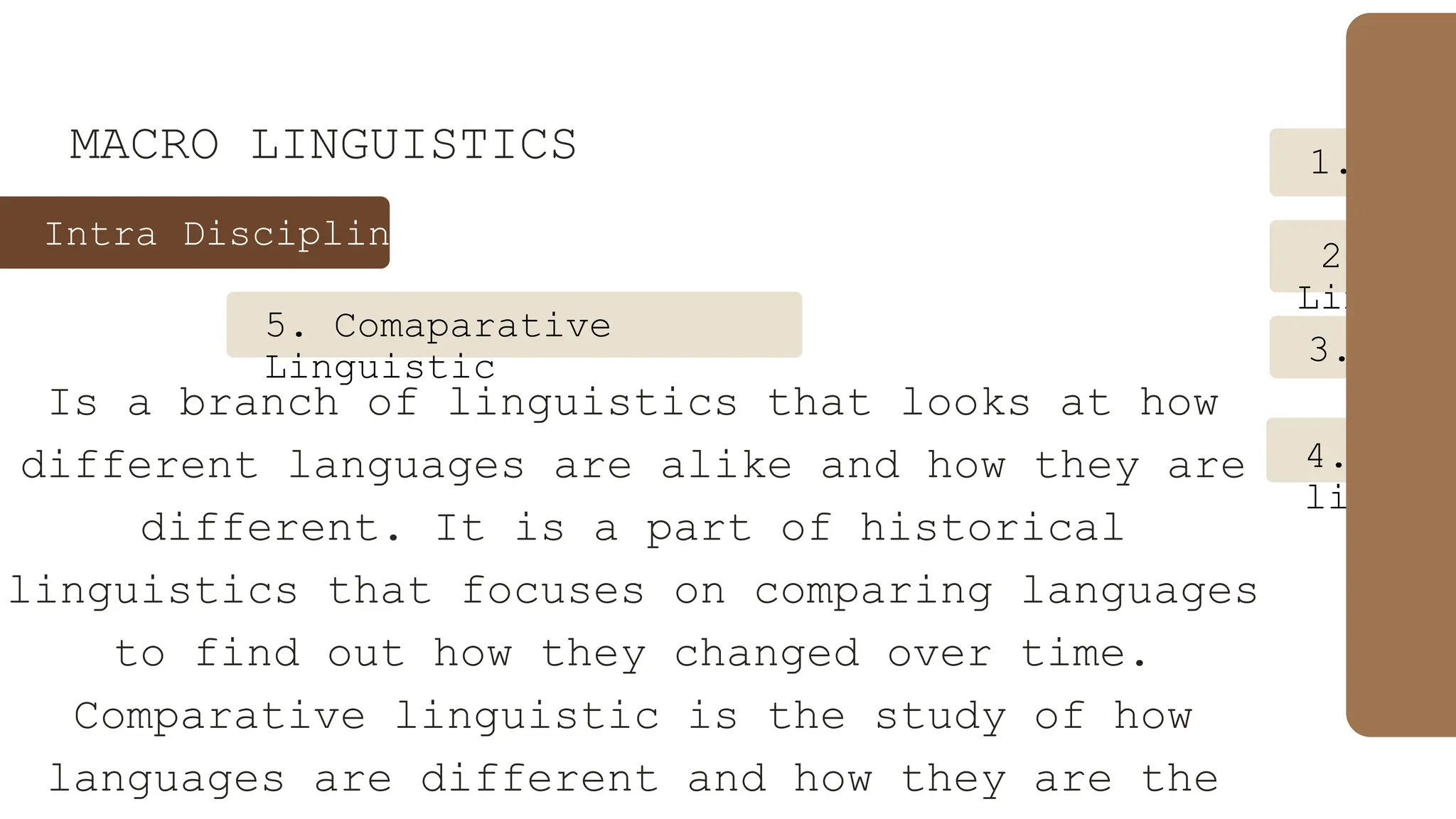
Comparative linguistic is the study of how
languages are different and how they are the
Intra Disciplinary
2. Des
Linguis
3. Appl
4. Hist
linguis
5. Comaparative
Linguistic
ASSESSMENT 1
Direction: Using a Venn diagram, observe the differences
and similarities of macro and micro linguistics. Minimum of
(1) per similiraties and differences is allowed.
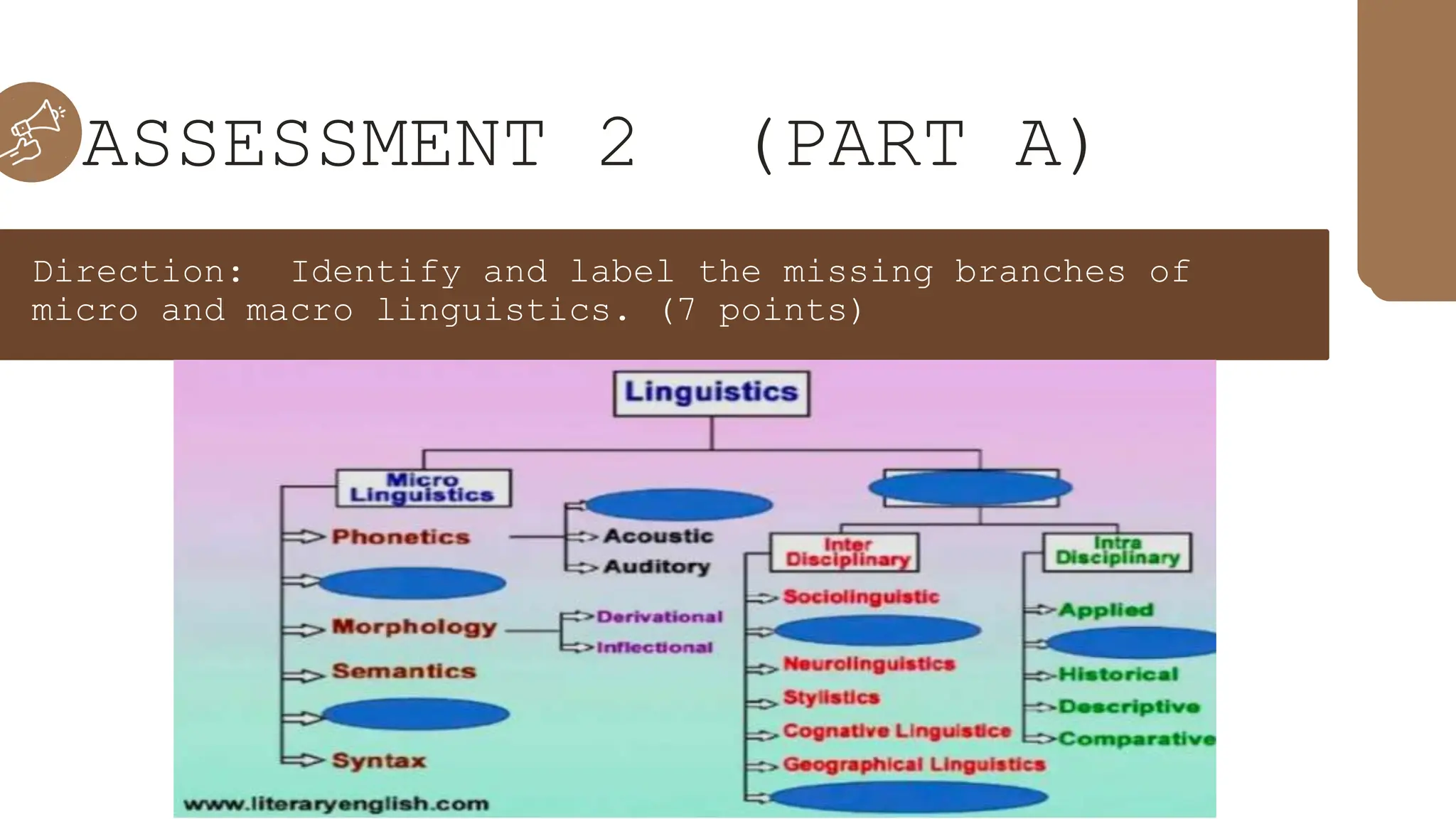
ASSESSMENT 2 (PART A)
Direction: Identify and label the missing branches of
micro and macro linguistics. (7 points)
ASSESSMENT 2 (PART B)
Direction: Answer the following question (3 points):
Give one branch of micro or macro
linguistics that you think is essential
and cannot be replace In linguistics.
Provide your reason and argument using
1-2 paragraphs only.
ASSESSMENT 3
Direction: Create an essay with factual evidences base on the
topic given:
(1) What do you think is the role of macro and
micro linguistic and its branches in today’s
English language where modernization, and
technology are given more priority than
language development? Do you think technology
is a rival or ally when
it comes to development of language? Provide
argumentative facts and basis.
REFERENCES
Linguistics Micro & Macro Levels PDF PDF Linguistics | Speech. (n.d.).
Scribd.
https://www.scribd.com/document/459047193/Linguistics-Micro-Macro-
Levels-pdf
Масro Micro PDF Linguistics Lexicology (n.d.). Scribd
https://www.scribd.com/document/394230957/Macro-Micro
S. (2021. October 6). Branches of Linguistics | Micro vs Macro
Linguistica Literary English. Linguistics
Literary English linguistics/
Literary English https://literaryenglish.com/branches-of-linguistics-
micro-vs-macro-Linguistics/
Prepared by:
Padual, Azhie Rose
BSED-ENG 1
THANK YOU FOR
LISTENING!
Lesson 1.4:

micro and macro linguistics

  • 1.
    Prepared by: Padual, AzhieRose BSED-ENG 1 MACRO & MICRO LINGUISTIC STUDIES Lesson 1.4:
  • 2.
    LESSON OBJECTIVES Define the differences betweenmacro and micro linguistics Comprehend the roles of macro and micro linguistics and its branches Identify and be inform about the various branhes of macro and micro linguistics and; 01 02 03
  • 3.
    is the studyof language from a scientific point of view. LINGUISTICS ROBINS (1985) "Linguistics is the study of human language as a universal and recognizable part of human behavior as well as human faculties, perhaps one of the most important parts of human life as we know it and one of the most far reaching human abilities, in terms of the whole range of mankind's achievements." WHAT IS A LINGUISTICS?
  • 4.
    MAIN BRANCHES OFLINGUISTICS Micro Macro
  • 5.
    MICRO Phonetics Morphology Phonology Symantics is the studyof language, including how it sounds (phonetics and phonology), how it is put together (morphology), how it is put together (syntax), and how it means (semantics) in context (pragmatics). Pragmatics Syntax BRANCHES
  • 6.
    MICRO Phonetics is the studyof how language sounds. It looks at how sounds are made, how they travel, and how people hear them. Phonetics is further broken down into three distinct branches that are: Ariculatory Phonetics Acoustic Phonetics Auditory Phonetics
  • 7.
    MICRO Phonetics is the studyof how language sounds. It looks at how sounds are made, how they travel, and how people hear them. Phonetics is further broken down into three distinct branches that are: Ariculatory Phonetics • deals with the study of how speech sounds are made (articulation).
  • 8.
    MICRO Phonetics is the studyof how language sounds. It looks at how sounds are made, how they travel, and how people hear them. Phonetics is further broken down into three distinct branches that are: Acoustic Phonetics • examines the physical qualities of sounds as they are transferred from the lips. to the air and received by the ear drum.
  • 9.
    MICRO Phonetics is the studyof how language sounds. It looks at how sounds are made, how they travel, and how people hear them. Phonetics is further broken down into three distinct branches that are: Auditory Phonetics • deals with the study of how the ear, auditory nerve, and brain always respond to speech sounds.
  • 10.
    MICRO Phonology Is the studyof how sounds are put together as units of speech in each language. It also looks at the rules for how sounds are divided into small sounds in each language
  • 11.
    MICRO Morphology Deals with howwords are made, how they are used, and how small letters are used to make words. It looks at how words are broken up into small parts that mean something (morphemes). There are two more types of morphology: derivational morphology, and inflectional
  • 12.
    MICRO Semantics Is the studyof what words mean. It’s about learning how words are put together and how to make sentences that create meaning.
  • 13.
    MICRO Pragmatics It is concernedwith the meaning of language as well, but it concentrates on actual meaning in context rather than individual word meanings. Is the study of a language’s phrase building, clauses, and sentences. It is concerned with the basic word order utilized
  • 14.
    MACRO LINGUISTICS Intra- Disciplinary examines languagein a variety of contexts and over time. Macro-linguistics comprises the study of various disciplines that are related to language research in any way, for example, sociolinguistics is the study of the relationship between society and linguistics. Inter- Disciplinary BRANCHES
  • 15.
    MACRO LINGUISTICS Sociolinguistics Inter-disciplinary linguisticsstudies linguistics in relation to other disciplines such as geography, sociology, psychology, neurology, and so on. Inter Disciplinary Psycholinguistics Neurolinguistics Computational linguistics Sociolinguistics Geographic Linguistic Cognitive Linguisti
  • 16.
    MACRO LINGUISTICS • Sociolinguistics Theterm sociolinguistics refers to the study of the link between language and society. Sociolinguistics is the discipline of linguistics that studies how society affects language. It is closely related to anthropology, sociology, and culture. 2. 3. 4. Inter Disciplinary 5. 6. 7.
  • 17.
    MACRO LINGUISTICS 1. The studyof the mental aspects of language and communication is known os psycholinguistics. Its domain la particularly concerned with the representation and processing of language in the brain. Psycholinguistics is a branch of cognitive science that studies languages and psychology. 2. Psycholinguistics 3. 4. Inter Disciplinary 5. 6. 7.
  • 18.
    MACRO LINGUISTICS 1. Is thestudy of how language is represented in the brain, as well as how and where the brain stores language knowledge. It emphasizes on what occurs in our brains during language acquisition and when we apply this knowledge to use. 2. 3. Neurolinguistics 4. Inter Disciplinary 5. 6. 7.
  • 19.
    MACRO LINGUISTICS 1. Is abranch of linguistics that looks at modeling natural language based on rules from a computer point of view. It is the part of linguistics that looks at how computer science techniques can be used to look at language and speech and change it. 2. 3. Inter Disciplinary 5. 6. 7. 4. Computational linguistics
  • 20.
    MACRO LINGUISTICS 1. Is abranch of linguistics that looks at and tries to figure out style and tone in both spoken and written languages. It is an interdisciplinary field 2. 3. Inter Disciplinary 5. Stylistics. 6. 7. 4.
  • 21.
    MACRO LINGUISTICS 1. Also calleddialect geography, is the study of how a language or dialect changes from one place to another Language geography is a branch of human geography that looks at how languages or their parts are spread around the world, 2. 3. Inter Disciplinary 5. 6. Geography Linguistics 7. 4.
  • 22.
    MACRO LINGUISTICS 1. Is abranch of linguistics that first appeared in the 1970s. It is an interdisciplinary field that studies language, the mind, and sociocultural experience. Cognitive linguistics is based on the Idea that meaning and for more separable in the study of language. 2. 3. Inter Disciplinary 5. 6. Geog Linguist 7. Cognitive Linguistics 4.
  • 23.
    MACRO LINGUISTICS Theoretical Linguistics Is adeal made with the study of linguistics in its own field. Here are the different parts of macro linguistics that belong to the same field. Intra Disciplinary Descriptive Linguistic Applied Linguistic Historical linguistics Comaparative Linguistic
  • 24.
    MACRO LINGUISTICS 1. Theoretical Linguistics Whichis also called “General Linguistics,” is the study of concrete theories that scholars of language have put forward about different parts of linguistics. General linguistics is the theoretical study of how to describe a language and how to look into Intra Disciplinary 2. Des Linguis 3. Appl 4. Hist linguis 5. Coma Linguis
  • 25.
    MACRO LINGUISTICS 1.Theor Isabout describing and analyzing how a language works and is used by a certain group of speakers at a certain time. Intra Disciplinary 2. Descriptive Linguistic 3. Appl 4. Hist linguis 5. Coma Linguis
  • 26.
    MACRO LINGUISTICS 1.Theor Looksat the structure of language and how it affects communication. It also looks at how language is learned, how to learn a second language, and how the social or cultural environment affects language. Intra Disciplinary 2. Des Linguis 3. Applied Linguistic 4. Hist linguis 5. Coma Linguis
  • 27.
    MACRO LINGUISTICS 1.Theor Alsotermed diachronic linguistics, is indeed the scientific study of how language changes over time. Historical linguistics is mainly interested in how and why language changes, how and why certain languages change, the history of words, or etymology, the history of speech communities, and the relationship between Intra Disciplinary 2. Des Linguis 3. Appl 4. Historical linguistics 5. Coma Linguis
  • 28.
    MACRO LINGUISTICS 1.Theor Isa branch of linguistics that looks at how different languages are alike and how they are different. It is a part of historical linguistics that focuses on comparing languages to find out how they changed over time. Comparative linguistic is the study of how languages are different and how they are the Intra Disciplinary 2. Des Linguis 3. Appl 4. Hist linguis 5. Comaparative Linguistic
  • 29.
    ASSESSMENT 1 Direction: Usinga Venn diagram, observe the differences and similarities of macro and micro linguistics. Minimum of (1) per similiraties and differences is allowed.
  • 30.
    ASSESSMENT 2 (PARTA) Direction: Identify and label the missing branches of micro and macro linguistics. (7 points)
  • 31.
    ASSESSMENT 2 (PARTB) Direction: Answer the following question (3 points): Give one branch of micro or macro linguistics that you think is essential and cannot be replace In linguistics. Provide your reason and argument using 1-2 paragraphs only.
  • 32.
    ASSESSMENT 3 Direction: Createan essay with factual evidences base on the topic given: (1) What do you think is the role of macro and micro linguistic and its branches in today’s English language where modernization, and technology are given more priority than language development? Do you think technology is a rival or ally when it comes to development of language? Provide argumentative facts and basis.
  • 33.
    REFERENCES Linguistics Micro &Macro Levels PDF PDF Linguistics | Speech. (n.d.). Scribd. https://www.scribd.com/document/459047193/Linguistics-Micro-Macro- Levels-pdf Масro Micro PDF Linguistics Lexicology (n.d.). Scribd https://www.scribd.com/document/394230957/Macro-Micro S. (2021. October 6). Branches of Linguistics | Micro vs Macro Linguistica Literary English. Linguistics Literary English linguistics/ Literary English https://literaryenglish.com/branches-of-linguistics- micro-vs-macro-Linguistics/
  • 34.
    Prepared by: Padual, AzhieRose BSED-ENG 1 THANK YOU FOR LISTENING! Lesson 1.4: