CL4 Language and Culture for Business Prof. Peter Cullen Module V B1 Linguistics www.cl4englishlistening.wordpress.com
What is “Language” and what is “Linguistics”? Language: is a  system of communication has an  emitter  who produces signals has a  receiver  who receives signals All “languages” have a  function  (BASIC, language of bees, etc.) BUT not all languages have the same  structure Human language  has its own specific structure, and is very different from animal languages
What is “Language” and what is “Linguistics”? Linguistics: is the scientific study of  human  language it involves the formulation of hypotheses  that make sense out of multiple factors these hypotheses must be clear and  verifyable = explicit and valid attempts to identify  general laws  of  language  BUT – it is  descriptive  and not  proscriptive
What is “Language” and what is “Linguistics”? Grammar is  practical : it defines the laws of communication. Linguistics aims at  understanding  the language we produce according to systematic laws which are as general as possible.
What is “Language” and what is “Linguistics”? The characteristics of human language: Human language is  discrete : elements are clearly distinguished from each other by well defined limits “ Pat” ≠ “Pad” Other forms of language are  continuous : communicators can increasingly “specialise” the signal i.e.  Explorer bees can indicate distance, richness of food, and direction by introducing increasingly subtle changes in the rhythm, orientation and duration of its dance
What is “Language” and what is “Linguistics”? Animal languages do not have  phonemes  – articulated differentiated sounds that, individually, have no meaning, but when composed form specific signals – words. Human languages can form a very high number of  signs - structures which have both  signifyers  or  markers  and meaning Phonemes have no inherent significance, but DO distinguish significance. This is called  dual articulation
What is “Language” and what is “Linguistics”? Animal languages have a  finite  number of signs The words of human languages do not make up a  finite  set – new words are created all the time. This creativity allows the composition of complex sentences, including clauses. This is called  recursion .
What is “Language” and what is “Linguistics”? i.e.  1)  “Maria hit me.” Using a verb, such as  to say , we can tranform this sentence into a  complex sentence : with a  main clause  and a  dependent clause 2) “The boys said that Maria hit me.” We can also tranform this sentence into a  dependent clause  by using a verb such as  to believe. 3) “The neighbours believe that the boys said that Maria hit me.”  (she’s so violent!)
What is “Language” and what is “Linguistics”? If we make sentence 3) depend on a verb such as  to claim , the sentence becomes even more complex: 4) The Browns claim that the neighbours believe that the boys say that Maria hit me. ( this is reported speech gone mad!) As you can imagine, this process could go on forever. Another way to make infinite sentences is to add the word  and 5)  George runs George runs  and  shouts George runs  and  shouts  and  sweats   (this is getting wierd)
What is “Language” and what is “Linguistics”? Linguistics has two contrasting aspects: competence  and  performance Our capacity to produce infinite sentences MUST be self-limited in practice. Discretion  and  recursion  separate human language from animal languages. Human language is dependent on  structure Agreement  (Maria hit s ) Grammatical and non-grammatical  (Maria the hit ball)
What is “Language” and what is “Linguistics”? Language – meaning the ability of all humans to develop a system of comunication with those characteristics described above (descretion and recursion) Language – meaning the specific form that this system takes in each of the various humna communities. What elements are common to all languages (linguistic universals)? Which elements differ from language to language? Languages differ in a limited way.  They may be divided into  linguistic types
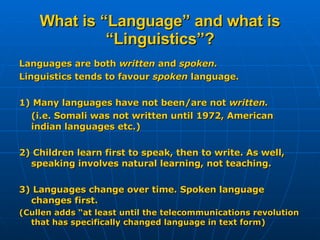
What is “Language” and what is “Linguistics”? Languages are both  written  and  spoken. Linguistics tends to favour  spoken  language. 1) Many languages have not been/are not  written. (i.e. Somali was not written until 1972, American indian languages etc.) 2) Children learn first to speak, then to write. As well, speaking involves natural learning, not teaching. 3) Languages change over time. Spoken language changes first. (Cullen adds “at least until the telecommunications revolution that has specifically changed language in text form)
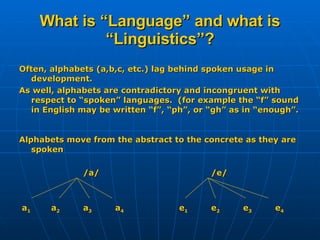
What is “Language” and what is “Linguistics”? Often, alphabets (a,b,c, etc.) lag behind spoken usage in development. As well, alphabets are contradictory and incongruent with respect to “spoken” languages.  (for example the “f” sound in English may be written “f”, “ph”, or “gh” as in “enough”. Alphabets move from the abstract to the concrete as they are spoken /a/ /e/ a 1 a 2 a 3 a 4 e 1 e 2 e 3 e 4
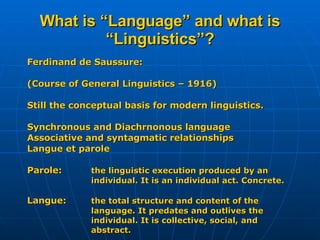
What is “Language” and what is “Linguistics”? Ferdinand de Saussure:  (Course of General Linguistics – 1916) Still the conceptual basis for modern linguistics. Synchronous and Diachrnonous language Associative and syntagmatic relationships Langue et parole Parole:  the linguistic execution produced by an  individual. It is an individual act. Concrete. Langue: the total structure and content of the language. It predates and outlives the individual. It is collective, social, and  abstract.
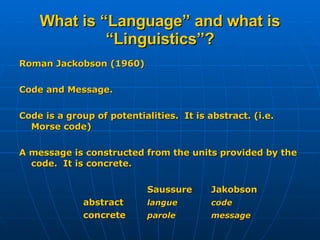
What is “Language” and what is “Linguistics”? Roman Jackobson (1960) Code and Message. Code is a group of potentialities.  It is abstract. (i.e. Morse code) A message is constructed from the units provided by the code.  It is concrete. Saussure Jakobson abstract langue code concrete parole message
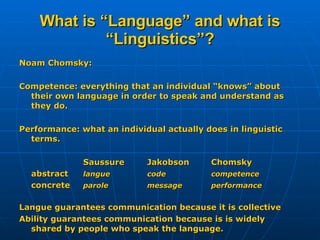
What is “Language” and what is “Linguistics”? Noam Chomsky: Competence: everything that an individual “knows” about their own language in order to speak and understand as they do. Performance: what an individual actually does in linguistic terms. Saussure Jakobson Chomsky abstract langue code competence concrete parole message performance Langue guarantees communication because it is collective Ability guarantees communication because is is widely shared by people who speak the language.
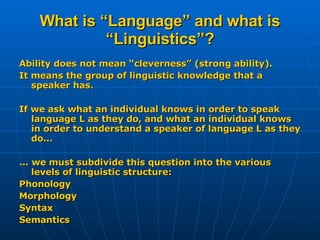
What is “Language” and what is “Linguistics”? Ability does not mean “cleverness” (strong ability). It means the group of linguistic knowledge that a speaker has. If we ask what an individual knows in order to speak language L as they do, and what an individual knows in order to understand a speaker of language L as they do... ... we must subdivide this question into the various levels of linguistic structure: Phonology Morphology Syntax Semantics
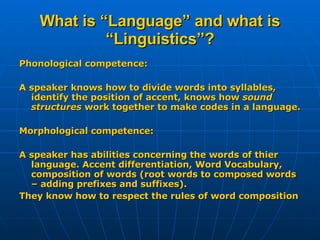
What is “Language” and what is “Linguistics”? Phonological competence: A speaker knows how to divide words into syllables, identify the position of accent, knows how  sound structures  work together to make codes in a language. Morphological competence: A speaker has abilities concerning the words of thier language. Accent differentiation, Word Vocabulary, composition of words (root words to composed words – adding prefixes and suffixes). They know how to respect the rules of word composition
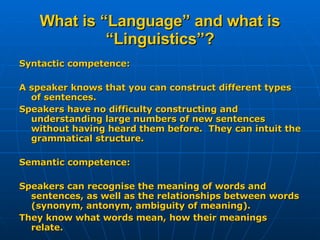
What is “Language” and what is “Linguistics”? Syntactic competence: A speaker knows that you can construct different types of sentences. Speakers have no difficulty constructing and understanding large numbers of new sentences without having heard them before.  They can intuit the grammatical structure. Semantic competence: Speakers can recognise the meaning of words and sentences, as well as the relationships between words (synonym, antonym, ambiguity of meaning). They know what words mean, how their meanings relate.
What is “Language” and what is “Linguistics”? Grammar: A body of linguistic knowledge stored in the mind, constructed from a complex balance of biologically innate factors (i.e. that rules are dependent on structure) and experience acquired within the native linguistic community (i.e. the words of a language are acquired through experience) Primary linguistic data – experiential learning. A culture of communication? OH YES!!!!
What is “Language” and what is “Linguistics”? One language cannot produce all linguistic possibilites. A language is a code Codes are comprised of:  basic units rules for combining the units i.e. “fingers and toes” in English do not translate equally into Italian. Each language makes “choices”. Not only choices of vocabulary and sound, But also choices of morphology and syntax
What is “Language” and what is “Linguistics”? Syntagmatic relationships: sounds represented by units of code (letters) lose their individual properties and act as a “spoken chain”.  i.e. “at”, “ate” Paradigmatic or associative expression:  the syntagmatic relationship carries through more than one word i.e. gender agreement in Italian “il mio amico” This paradigm excludes all other possible forms.
What is “Language” and what is “Linguistics”? Synchronic  and  Diachronic  structures: Language changes over time: they are  diachronous  in nature (change over time). A linguistic analysis may look at the substitution of one element for another as time passes. But we can study language as it is at the moment without considering the “time factor” This is called synchronic analysis – looking at elements that occur at the same time. Synchrony does not mean “present” – it means without studying the time factor – i.e. Today’s Latin grammar  (note: A-B axis = synchronous C-D = diachronous)
What is “Language” and what is “Linguistics”? Linguistic signs: Words are signs, that is, they combine marker and meaning. Signs have various properties: Distinction: each sign indicates something different. Linearity: signs carry over time or space – they are arranged in successive order. Arbitrary: no natural law imposes the choice of meaning for any given sign. This means they evolve. The study of linguistic signs is called  semiotics.
What is “Language” and what is “Linguistics”? According to Jakobsen, the components necessary for linguistic communication are: The speaker The subject of speech or conversation The message The channel for transmitting communication The code The listener Each component has a corresponding linguistic function
What is “Language” and what is “Linguistics”? Each component of linguistic communication has a corresponding linguistic function. Emotive – an expressive function of the speaker Referential – informational function Poetic – forces listener to appreciate the construction of the message itelf Phatic – a function that verifies the channel Metalinguistic – when the code is used to speak about the code itself (i.e. a grammar book) Conative – commands and imperatives Jakobson theorised that each text held a prevailing function (of these 6). i.e., a driving manual is primarily referential, although may contain conative functions.
What is “Language” and what is “Linguistics”? Dialects: Many languages can be  stratified  – that is, broken into sub-categories that include regional and local variations. Written English Formal spoken English Informal spoken English Regional forms of spoken English Regionally specific dialects Provincial capital dialects Local dialects This stratification moves from the abstract and national to the concrete and local
What is “Language” and what is “Linguistics”? A stratification for English may be: Written work according to Oxbridge or Chicago rules based on the OED or Webster’s Dictionary. RP or Webster’s based American Geographically neutral, but nationally based informal speech (slurring, slang, contextual references) Yorkshire dialect or Maritime Canadian Geordie (Newcastle upon Tyne) Lunenburg county (NS, Canada)
What is “Language” and what is “Linguistics”? The mix is cultural – often not occuring in writing. The standarisation of writing is cultural, and follows settlement patterns. (migration, immigration and mixing). i.e. RP developed from migrants to London from Bedfordshire, Northhamptonshire, and Huntingtonshire in the 14° and 15° centuries. Even RP is considered a dialect, and has changed over the past 50 years (HRH now pronounces “Land”, “Laend”, not “Leand”. The BBC is now quite mixed.
What is “Language” and what is “Linguistics”? Linguistic prejudice:  The stratification of a language, or the comparison of two languages, does not carry any moral weight based on concepts of civilisation, standard/dialect, aesthetics, or difficulty. All languages and dialects have specific phonology, morphology and syntax. RP is a dialect too – with it’s own cultural heritage. Global English has successfully challenged previous standard models.
What is “Language” and what is “Linguistics”? David Crystal: The development of Global English focuses primarily on spoken models. The assumption today is that there is little macro-regional differentiation in standard English, but this may change. Many traditionally non-English speaking populations now use components of English in everyday life, as well as for specific functions (work, entertainment, etc.), and they adapt the language to fit their needs. This phenomenon does not confine itself to source regions, but may spread from one area to another as people move. i.e. Chinese trading in Nigeria, using English.
What is “Language” and what is “Linguistics”? Language may be used for inclusion or exclusion. It is a culturally informed method and expression of communication. Accent or dialect may be used as an identifyer – with positive and negative results. Our means of communication is not an end in itself, it is part of our cultural expression. Globalisation has changed the way we order our  strata
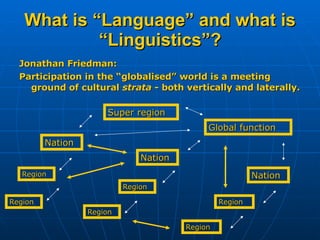
What is “Language” and what is “Linguistics”? Jonathan Friedman: Participation in the “globalised” world is a meeting ground of cultural  strata  - both vertically and laterally. Global function Nation Nation Nation Region Region Region Region Region Region Super region

Linguistics

  • 1.
    CL4 Language andCulture for Business Prof. Peter Cullen Module V B1 Linguistics www.cl4englishlistening.wordpress.com
  • 2.
    What is “Language”and what is “Linguistics”? Language: is a system of communication has an emitter who produces signals has a receiver who receives signals All “languages” have a function (BASIC, language of bees, etc.) BUT not all languages have the same structure Human language has its own specific structure, and is very different from animal languages
  • 3.
    What is “Language”and what is “Linguistics”? Linguistics: is the scientific study of human language it involves the formulation of hypotheses that make sense out of multiple factors these hypotheses must be clear and verifyable = explicit and valid attempts to identify general laws of language BUT – it is descriptive and not proscriptive
  • 4.
    What is “Language”and what is “Linguistics”? Grammar is practical : it defines the laws of communication. Linguistics aims at understanding the language we produce according to systematic laws which are as general as possible.
  • 5.
    What is “Language”and what is “Linguistics”? The characteristics of human language: Human language is discrete : elements are clearly distinguished from each other by well defined limits “ Pat” ≠ “Pad” Other forms of language are continuous : communicators can increasingly “specialise” the signal i.e. Explorer bees can indicate distance, richness of food, and direction by introducing increasingly subtle changes in the rhythm, orientation and duration of its dance
  • 6.
    What is “Language”and what is “Linguistics”? Animal languages do not have phonemes – articulated differentiated sounds that, individually, have no meaning, but when composed form specific signals – words. Human languages can form a very high number of signs - structures which have both signifyers or markers and meaning Phonemes have no inherent significance, but DO distinguish significance. This is called dual articulation
  • 7.
    What is “Language”and what is “Linguistics”? Animal languages have a finite number of signs The words of human languages do not make up a finite set – new words are created all the time. This creativity allows the composition of complex sentences, including clauses. This is called recursion .
  • 8.
    What is “Language”and what is “Linguistics”? i.e. 1) “Maria hit me.” Using a verb, such as to say , we can tranform this sentence into a complex sentence : with a main clause and a dependent clause 2) “The boys said that Maria hit me.” We can also tranform this sentence into a dependent clause by using a verb such as to believe. 3) “The neighbours believe that the boys said that Maria hit me.” (she’s so violent!)
  • 9.
    What is “Language”and what is “Linguistics”? If we make sentence 3) depend on a verb such as to claim , the sentence becomes even more complex: 4) The Browns claim that the neighbours believe that the boys say that Maria hit me. ( this is reported speech gone mad!) As you can imagine, this process could go on forever. Another way to make infinite sentences is to add the word and 5) George runs George runs and shouts George runs and shouts and sweats (this is getting wierd)
  • 10.
    What is “Language”and what is “Linguistics”? Linguistics has two contrasting aspects: competence and performance Our capacity to produce infinite sentences MUST be self-limited in practice. Discretion and recursion separate human language from animal languages. Human language is dependent on structure Agreement (Maria hit s ) Grammatical and non-grammatical (Maria the hit ball)
  • 11.
    What is “Language”and what is “Linguistics”? Language – meaning the ability of all humans to develop a system of comunication with those characteristics described above (descretion and recursion) Language – meaning the specific form that this system takes in each of the various humna communities. What elements are common to all languages (linguistic universals)? Which elements differ from language to language? Languages differ in a limited way. They may be divided into linguistic types
  • 12.
    What is “Language”and what is “Linguistics”? Languages are both written and spoken. Linguistics tends to favour spoken language. 1) Many languages have not been/are not written. (i.e. Somali was not written until 1972, American indian languages etc.) 2) Children learn first to speak, then to write. As well, speaking involves natural learning, not teaching. 3) Languages change over time. Spoken language changes first. (Cullen adds “at least until the telecommunications revolution that has specifically changed language in text form)
  • 13.
    What is “Language”and what is “Linguistics”? Often, alphabets (a,b,c, etc.) lag behind spoken usage in development. As well, alphabets are contradictory and incongruent with respect to “spoken” languages. (for example the “f” sound in English may be written “f”, “ph”, or “gh” as in “enough”. Alphabets move from the abstract to the concrete as they are spoken /a/ /e/ a 1 a 2 a 3 a 4 e 1 e 2 e 3 e 4
  • 14.
    What is “Language”and what is “Linguistics”? Ferdinand de Saussure: (Course of General Linguistics – 1916) Still the conceptual basis for modern linguistics. Synchronous and Diachrnonous language Associative and syntagmatic relationships Langue et parole Parole: the linguistic execution produced by an individual. It is an individual act. Concrete. Langue: the total structure and content of the language. It predates and outlives the individual. It is collective, social, and abstract.
  • 15.
    What is “Language”and what is “Linguistics”? Roman Jackobson (1960) Code and Message. Code is a group of potentialities. It is abstract. (i.e. Morse code) A message is constructed from the units provided by the code. It is concrete. Saussure Jakobson abstract langue code concrete parole message
  • 16.
    What is “Language”and what is “Linguistics”? Noam Chomsky: Competence: everything that an individual “knows” about their own language in order to speak and understand as they do. Performance: what an individual actually does in linguistic terms. Saussure Jakobson Chomsky abstract langue code competence concrete parole message performance Langue guarantees communication because it is collective Ability guarantees communication because is is widely shared by people who speak the language.
  • 17.
    What is “Language”and what is “Linguistics”? Ability does not mean “cleverness” (strong ability). It means the group of linguistic knowledge that a speaker has. If we ask what an individual knows in order to speak language L as they do, and what an individual knows in order to understand a speaker of language L as they do... ... we must subdivide this question into the various levels of linguistic structure: Phonology Morphology Syntax Semantics
  • 18.
    What is “Language”and what is “Linguistics”? Phonological competence: A speaker knows how to divide words into syllables, identify the position of accent, knows how sound structures work together to make codes in a language. Morphological competence: A speaker has abilities concerning the words of thier language. Accent differentiation, Word Vocabulary, composition of words (root words to composed words – adding prefixes and suffixes). They know how to respect the rules of word composition
  • 19.
    What is “Language”and what is “Linguistics”? Syntactic competence: A speaker knows that you can construct different types of sentences. Speakers have no difficulty constructing and understanding large numbers of new sentences without having heard them before. They can intuit the grammatical structure. Semantic competence: Speakers can recognise the meaning of words and sentences, as well as the relationships between words (synonym, antonym, ambiguity of meaning). They know what words mean, how their meanings relate.
  • 20.
    What is “Language”and what is “Linguistics”? Grammar: A body of linguistic knowledge stored in the mind, constructed from a complex balance of biologically innate factors (i.e. that rules are dependent on structure) and experience acquired within the native linguistic community (i.e. the words of a language are acquired through experience) Primary linguistic data – experiential learning. A culture of communication? OH YES!!!!
  • 21.
    What is “Language”and what is “Linguistics”? One language cannot produce all linguistic possibilites. A language is a code Codes are comprised of: basic units rules for combining the units i.e. “fingers and toes” in English do not translate equally into Italian. Each language makes “choices”. Not only choices of vocabulary and sound, But also choices of morphology and syntax
  • 22.
    What is “Language”and what is “Linguistics”? Syntagmatic relationships: sounds represented by units of code (letters) lose their individual properties and act as a “spoken chain”. i.e. “at”, “ate” Paradigmatic or associative expression: the syntagmatic relationship carries through more than one word i.e. gender agreement in Italian “il mio amico” This paradigm excludes all other possible forms.
  • 23.
    What is “Language”and what is “Linguistics”? Synchronic and Diachronic structures: Language changes over time: they are diachronous in nature (change over time). A linguistic analysis may look at the substitution of one element for another as time passes. But we can study language as it is at the moment without considering the “time factor” This is called synchronic analysis – looking at elements that occur at the same time. Synchrony does not mean “present” – it means without studying the time factor – i.e. Today’s Latin grammar (note: A-B axis = synchronous C-D = diachronous)
  • 24.
    What is “Language”and what is “Linguistics”? Linguistic signs: Words are signs, that is, they combine marker and meaning. Signs have various properties: Distinction: each sign indicates something different. Linearity: signs carry over time or space – they are arranged in successive order. Arbitrary: no natural law imposes the choice of meaning for any given sign. This means they evolve. The study of linguistic signs is called semiotics.
  • 25.
    What is “Language”and what is “Linguistics”? According to Jakobsen, the components necessary for linguistic communication are: The speaker The subject of speech or conversation The message The channel for transmitting communication The code The listener Each component has a corresponding linguistic function
  • 26.
    What is “Language”and what is “Linguistics”? Each component of linguistic communication has a corresponding linguistic function. Emotive – an expressive function of the speaker Referential – informational function Poetic – forces listener to appreciate the construction of the message itelf Phatic – a function that verifies the channel Metalinguistic – when the code is used to speak about the code itself (i.e. a grammar book) Conative – commands and imperatives Jakobson theorised that each text held a prevailing function (of these 6). i.e., a driving manual is primarily referential, although may contain conative functions.
  • 27.
    What is “Language”and what is “Linguistics”? Dialects: Many languages can be stratified – that is, broken into sub-categories that include regional and local variations. Written English Formal spoken English Informal spoken English Regional forms of spoken English Regionally specific dialects Provincial capital dialects Local dialects This stratification moves from the abstract and national to the concrete and local
  • 28.
    What is “Language”and what is “Linguistics”? A stratification for English may be: Written work according to Oxbridge or Chicago rules based on the OED or Webster’s Dictionary. RP or Webster’s based American Geographically neutral, but nationally based informal speech (slurring, slang, contextual references) Yorkshire dialect or Maritime Canadian Geordie (Newcastle upon Tyne) Lunenburg county (NS, Canada)
  • 29.
    What is “Language”and what is “Linguistics”? The mix is cultural – often not occuring in writing. The standarisation of writing is cultural, and follows settlement patterns. (migration, immigration and mixing). i.e. RP developed from migrants to London from Bedfordshire, Northhamptonshire, and Huntingtonshire in the 14° and 15° centuries. Even RP is considered a dialect, and has changed over the past 50 years (HRH now pronounces “Land”, “Laend”, not “Leand”. The BBC is now quite mixed.
  • 30.
    What is “Language”and what is “Linguistics”? Linguistic prejudice: The stratification of a language, or the comparison of two languages, does not carry any moral weight based on concepts of civilisation, standard/dialect, aesthetics, or difficulty. All languages and dialects have specific phonology, morphology and syntax. RP is a dialect too – with it’s own cultural heritage. Global English has successfully challenged previous standard models.
  • 31.
    What is “Language”and what is “Linguistics”? David Crystal: The development of Global English focuses primarily on spoken models. The assumption today is that there is little macro-regional differentiation in standard English, but this may change. Many traditionally non-English speaking populations now use components of English in everyday life, as well as for specific functions (work, entertainment, etc.), and they adapt the language to fit their needs. This phenomenon does not confine itself to source regions, but may spread from one area to another as people move. i.e. Chinese trading in Nigeria, using English.
  • 32.
    What is “Language”and what is “Linguistics”? Language may be used for inclusion or exclusion. It is a culturally informed method and expression of communication. Accent or dialect may be used as an identifyer – with positive and negative results. Our means of communication is not an end in itself, it is part of our cultural expression. Globalisation has changed the way we order our strata
  • 33.
    What is “Language”and what is “Linguistics”? Jonathan Friedman: Participation in the “globalised” world is a meeting ground of cultural strata - both vertically and laterally. Global function Nation Nation Nation Region Region Region Region Region Region Super region