Introduction to Spoken Language
Objective:
1. To get an overview of the expectations of the ELLB
   course.
2. To get an understanding of the terminology that is
   used within the Spoken Language unit (ELLB3).

Success Criteria:
1. To acquire the relevant terminology need for the
   analysis of text in class and the exam.
2. To apply the terminology critically, sophisticatedly
   and thought-provokingly.
Assessment Objectives AO1, AO2, AO3.
 AO1 select and apply relevant concepts and
  approaches from integrated linguistic and literary
  study, using appropriate terminology and
  accurate, coherent written expression;
 AO2  demonstrate detailed critical understanding in
  analysing the ways in which structure, form and
  language shape meanings in a range of spoken and
  written texts;
 AO3  use integrated approaches to explore
  relationships between texts, analysing and evaluating
  the significance of contextual factors in their
  production and reception.
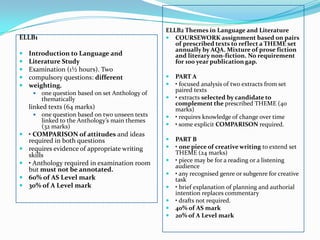
ELLB2 Themes in Language and Literature
ELLB1                                              COURSEWORK assignment based on pairs
                                                     of prescribed texts to reflect a THEME set
                                                     annually by AQA. Mixture of prose fiction
   Introduction to Language and                     and literary non-fiction. No requirement
   Literature Study                                 for 100 year publication gap.
   Examination (1½ hours). Two
   compulsory questions: different                  PART A
   weighting.                                       • focused analysis of two extracts from set
        one question based on set Anthology of       paired texts
         thematically                                • extracts selected by candidate to
                                                      complement the prescribed THEME (40
    linked texts (64 marks)                           marks)
        one question based on two unseen texts      • requires knowledge of change over time
         linked to the Anthology’s main themes
         (32 marks)                                  • some explicit COMPARISON required.
 • COMPARISON of attitudes and ideas
    required in both questions                       PART B
   requires evidence of appropriate writing         • one piece of creative writing to extend set
    skills                                            THEME (24 marks)
                                                     • piece may be for a reading or a listening
   • Anthology required in examination room          audience
    but must not be annotated.
                                                     • any recognised genre or subgenre for creative
   60% of AS Level mark                              task
   30% of A Level mark                              • brief explanation of planning and authorial
                                                      intention replaces commentary
                                                     • drafts not required.
                                                     40% of AS mark
                                                     20% of A Level mark
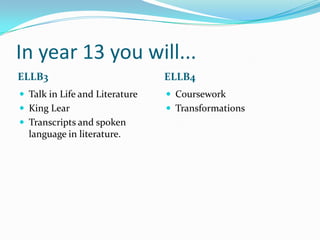
In year 13 you will...
ELLB3                           ELLB4
 Talk in Life and Literature    Coursework
 King Lear                      Transformations
 Transcripts and spoken
  language in literature.
Dialect and Sociolect
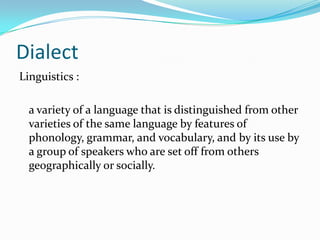
Dialect
Linguistics :

  a variety of a language that is distinguished from other
  varieties of the same language by features of
  phonology, grammar, and vocabulary, and by its use by
  a group of speakers who are set off from others
  geographically or socially.
Let’s Start
 Have a look at the glossary.


 Identify between 5 – 10 terms in the glossary that you
  will try and use by the end of the session.


 ... 4 minutes
Have a look at the following clip...
 http://www.youtube.com/watch?v=qSNK-9v7_JI


 Using the transcript and your glossary, identify as
  many features of spoken language as you can.
 Make sure that you can also comment on the effect of
  the feature (i.e. Why it is used in natural conversation)


 ... 15 minutes
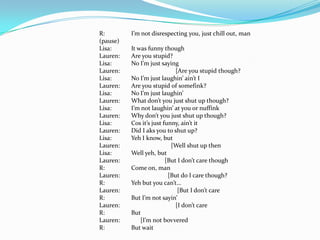
R:        I’m not disrespecting you, just chill out, man
(pause)
Lisa:     It was funny though
Lauren:   Are you stupid?
Lisa:     No I’m just saying
Lauren:                      [Are you stupid though?
Lisa:     No I’m just laughin’ ain’t I
Lauren:   Are you stupid of somefink?
Lisa:     No I’m just laughin’
Lauren:   What don’t you just shut up though?
Lisa:     I’m not laughin’ at you or nuffink
Lauren:   Why don’t you just shut up though?
Lisa:     Cos it’s just funny, ain’t it
Lauren:   Did I aks you to shut up?
Lisa:     Yeh I know, but
Lauren:                    [Well shut up then
Lisa:     Well yeh, but
Lauren:                  [But I don’t care though
R:        Come on, man
Lauren:                   [But do I care though?
R:        Yeh but you can’t…
Lauren:                       [But I don’t care
R:        But I’m not sayin’
Lauren:                      [I don’t care
R:        But
Lauren:       [I’m not bovvered
R:        But wait
Discussion of annotations
... 5 minutes
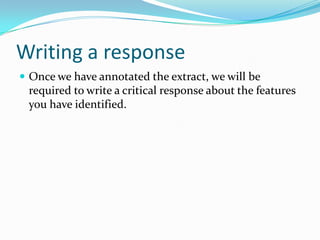
Writing a response
 Once we have annotated the extract, we will be
 required to write a critical response about the features
 you have identified.
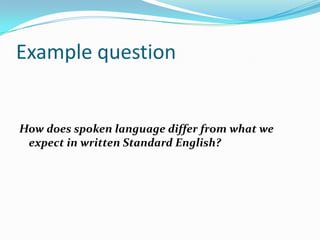
Example question


How does spoken language differ from what we
 expect in written Standard English?
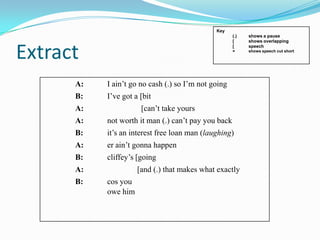
Key
                                                     (.)   shows a pause
                                                     [     shows overlapping


Extract                                              [
                                                     =
                                                           speech
                                                           shows speech cut short


      A:   I ain’t go no cash (.) so I’m not going
      B:   I’ve got a [bit
      A:              [can’t take yours
      A:   not worth it man (.) can’t pay you back
      B:   it’s an interest free loan man (laughing)
      A:   er ain’t gonna happen
      B:   cliffey’s [going
      A:             [and (.) that makes what exactly
      B:   cos you
           owe him
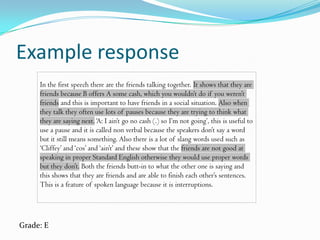
Example response
     In the first speech there are the friends talking together. It shows that they are
     friends because B offers A some cash, which you wouldn’t do if you weren’t
     friends and this is important to have friends in a social situation. Also when
     they talk they often use lots of pauses because they are trying to think what
     they are saying next. ‘A: I ain’t go no cash (.) so I’m not going’, this is useful to
     use a pause and it is called non verbal because the speakers don’t say a word
     but it still means something. Also there is a lot of slang words used such as
     ‘Cliffey’ and ‘cos’ and ‘ain’t’ and these show that the friends are not good at
     speaking in proper Standard English otherwise they would use proper words
     but they don’t. Both the friends butt-in to what the other one is saying and
     this shows that they are friends and are able to finish each other’s sentences.
     This is a feature of spoken language because it is interruptions.


Grade: E
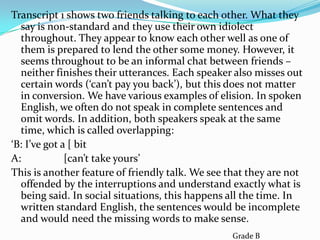
Transcript 1 shows two friends talking to each other. What they
  say is non-standard and they use their own idiolect
  throughout. They appear to know each other well as one of
  them is prepared to lend the other some money. However, it
  seems throughout to be an informal chat between friends –
  neither finishes their utterances. Each speaker also misses out
  certain words (‘can’t pay you back’), but this does not matter
  in conversion. We have various examples of elision. In spoken
  English, we often do not speak in complete sentences and
  omit words. In addition, both speakers speak at the same
  time, which is called overlapping:
‘B: I’ve got a [ bit
A:            [can’t take yours’
This is another feature of friendly talk. We see that they are not
  offended by the interruptions and understand exactly what is
  being said. In social situations, this happens all the time. In
  written standard English, the sentences would be incomplete
  and would need the missing words to make sense.
                                                  Grade B
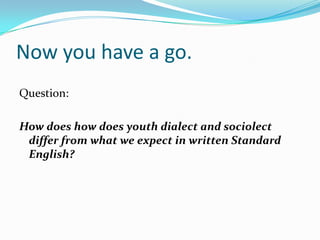
Now you have a go.
Question:

How does how does youth dialect and sociolect
 differ from what we expect in written Standard
 English?
Feedback
Summer Project

Introduction to Language and Literature

  • 1.
  • 2.
    Objective: 1. To getan overview of the expectations of the ELLB course. 2. To get an understanding of the terminology that is used within the Spoken Language unit (ELLB3). Success Criteria: 1. To acquire the relevant terminology need for the analysis of text in class and the exam. 2. To apply the terminology critically, sophisticatedly and thought-provokingly.
  • 3.
    Assessment Objectives AO1,AO2, AO3.  AO1 select and apply relevant concepts and approaches from integrated linguistic and literary study, using appropriate terminology and accurate, coherent written expression;  AO2  demonstrate detailed critical understanding in analysing the ways in which structure, form and language shape meanings in a range of spoken and written texts;  AO3  use integrated approaches to explore relationships between texts, analysing and evaluating the significance of contextual factors in their production and reception.
  • 4.
    ELLB2 Themes inLanguage and Literature ELLB1  COURSEWORK assignment based on pairs of prescribed texts to reflect a THEME set annually by AQA. Mixture of prose fiction  Introduction to Language and and literary non-fiction. No requirement  Literature Study for 100 year publication gap.  Examination (1½ hours). Two  compulsory questions: different  PART A  weighting.  • focused analysis of two extracts from set  one question based on set Anthology of paired texts thematically  • extracts selected by candidate to complement the prescribed THEME (40 linked texts (64 marks) marks)  one question based on two unseen texts  • requires knowledge of change over time linked to the Anthology’s main themes (32 marks)  • some explicit COMPARISON required.  • COMPARISON of attitudes and ideas required in both questions  PART B  requires evidence of appropriate writing  • one piece of creative writing to extend set skills THEME (24 marks)  • piece may be for a reading or a listening  • Anthology required in examination room audience but must not be annotated.  • any recognised genre or subgenre for creative  60% of AS Level mark task  30% of A Level mark  • brief explanation of planning and authorial intention replaces commentary  • drafts not required.  40% of AS mark  20% of A Level mark
  • 5.
    In year 13you will... ELLB3 ELLB4  Talk in Life and Literature  Coursework  King Lear  Transformations  Transcripts and spoken language in literature.
  • 6.
  • 7.
    Dialect Linguistics : a variety of a language that is distinguished from other varieties of the same language by features of phonology, grammar, and vocabulary, and by its use by a group of speakers who are set off from others geographically or socially.
  • 8.
    Let’s Start  Havea look at the glossary.  Identify between 5 – 10 terms in the glossary that you will try and use by the end of the session.  ... 4 minutes
  • 9.
    Have a lookat the following clip...  http://www.youtube.com/watch?v=qSNK-9v7_JI  Using the transcript and your glossary, identify as many features of spoken language as you can.  Make sure that you can also comment on the effect of the feature (i.e. Why it is used in natural conversation)  ... 15 minutes
  • 10.
    R: I’m not disrespecting you, just chill out, man (pause) Lisa: It was funny though Lauren: Are you stupid? Lisa: No I’m just saying Lauren: [Are you stupid though? Lisa: No I’m just laughin’ ain’t I Lauren: Are you stupid of somefink? Lisa: No I’m just laughin’ Lauren: What don’t you just shut up though? Lisa: I’m not laughin’ at you or nuffink Lauren: Why don’t you just shut up though? Lisa: Cos it’s just funny, ain’t it Lauren: Did I aks you to shut up? Lisa: Yeh I know, but Lauren: [Well shut up then Lisa: Well yeh, but Lauren: [But I don’t care though R: Come on, man Lauren: [But do I care though? R: Yeh but you can’t… Lauren: [But I don’t care R: But I’m not sayin’ Lauren: [I don’t care R: But Lauren: [I’m not bovvered R: But wait
  • 11.
  • 12.
    Writing a response Once we have annotated the extract, we will be required to write a critical response about the features you have identified.
  • 13.
    Example question How doesspoken language differ from what we expect in written Standard English?
  • 14.
    Key (.) shows a pause [ shows overlapping Extract [ = speech shows speech cut short A: I ain’t go no cash (.) so I’m not going B: I’ve got a [bit A: [can’t take yours A: not worth it man (.) can’t pay you back B: it’s an interest free loan man (laughing) A: er ain’t gonna happen B: cliffey’s [going A: [and (.) that makes what exactly B: cos you owe him
  • 15.
    Example response In the first speech there are the friends talking together. It shows that they are friends because B offers A some cash, which you wouldn’t do if you weren’t friends and this is important to have friends in a social situation. Also when they talk they often use lots of pauses because they are trying to think what they are saying next. ‘A: I ain’t go no cash (.) so I’m not going’, this is useful to use a pause and it is called non verbal because the speakers don’t say a word but it still means something. Also there is a lot of slang words used such as ‘Cliffey’ and ‘cos’ and ‘ain’t’ and these show that the friends are not good at speaking in proper Standard English otherwise they would use proper words but they don’t. Both the friends butt-in to what the other one is saying and this shows that they are friends and are able to finish each other’s sentences. This is a feature of spoken language because it is interruptions. Grade: E
  • 16.
    Transcript 1 showstwo friends talking to each other. What they say is non-standard and they use their own idiolect throughout. They appear to know each other well as one of them is prepared to lend the other some money. However, it seems throughout to be an informal chat between friends – neither finishes their utterances. Each speaker also misses out certain words (‘can’t pay you back’), but this does not matter in conversion. We have various examples of elision. In spoken English, we often do not speak in complete sentences and omit words. In addition, both speakers speak at the same time, which is called overlapping: ‘B: I’ve got a [ bit A: [can’t take yours’ This is another feature of friendly talk. We see that they are not offended by the interruptions and understand exactly what is being said. In social situations, this happens all the time. In written standard English, the sentences would be incomplete and would need the missing words to make sense. Grade B
  • 17.
    Now you havea go. Question: How does how does youth dialect and sociolect differ from what we expect in written Standard English?
  • 18.
  • 19.