Interlinear glossing for
  multilingual research


             KATE BEECHING
ASSOCIATE PROFESSOR, APPLIED LINGUISTICS
 HEAD, INTERNATIONAL CORPUS LINGUISTICS
          RESEARCH UNIT (ICLRU)
              UWE, BRISTOL
International students and post-graduate
            discourse analytic research

International students in the UK conducting discourse-
  analytic research on languages other than English, either
  at MA or PhD level, face four major hurdles:
a) understanding what is meant by „contributing to
  knowledge‟;
b) applying „Anglo-Saxon‟ models in contexts in which
  those models may be inappropriate or require
  adaptation;
c) presenting foreign-language data in such a way as to be
  understandable to supervisors and examiners who may
  have no knowledge of their language;
d) (Academic) writing in English.
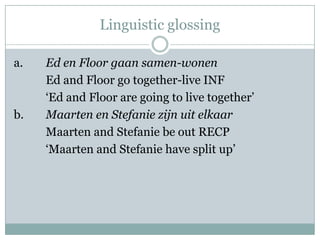
Linguistic glossing

a.   Ed en Floor gaan samen-wonen
     Ed and Floor go together-live INF
     „Ed and Floor are going to live together‟
b.   Maarten en Stefanie zijn uit elkaar
     Maarten and Stefanie be out RECP
     „Maarten and Stefanie have split up‟
Too much information… or not enough?

I will argue in this paper that:
 It is not always possible for non-linguistically trained
  students/researchers to give detailed morphologically
  glosses;
 Morphological glosses do not provide us with the
  pragmatic information we need in studies of everyday
  interactional (and intercultural) communication
 > flexible glossing strategies which are fit for purpose
  AND
 > discursive explanations of language used in context.
Case Study 1

„Negotiating nurturance and autonomy: a mother-
  daughter case study‟

 MA ICC dissertation student
 Native speaker of German
 Writing in English and drawing on substantial
  amounts of literature/analytical and classificatory
  frameworks in English
 Data in German
Methodology

 Record conversations between „the mother‟ and „the
  daughter‟
 Transcribe critical incidents – in this case, the
  daughter announcing that she is leaving home and
  moving to Kiel, and that she won‟t be home for the
  annual „curly kale hike‟
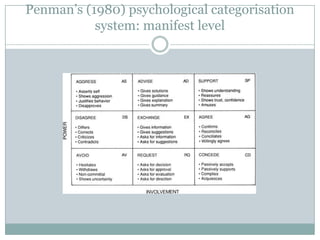
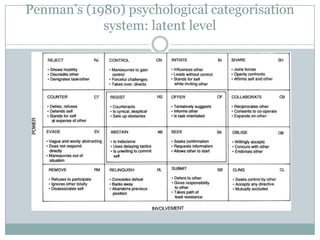
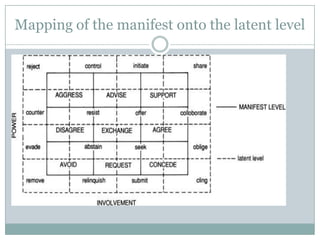
 Coding the data, using Penman‟s categorisation
  system for power and involvement
Penman‟s (1980) psychological categorisation
           system: manifest level
Penman‟s (1980) psychological categorisation
            system: latent level
Mapping of the manifest onto the latent level
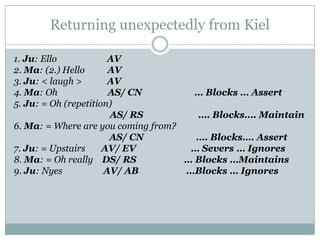
Returning unexpectedly from Kiel

1. Ju: Ello            AV
2. Ma: (2.) Hello      AV
3. Ju: < laugh >       AV
4. Ma: Oh              AS/ CN         … Blocks … Assert
5. Ju: = Oh (repetition)
                       AS/ RS         …. Blocks…. Maintain
6. Ma: = Where are you coming from?
                       AS/ CN         …. Blocks…. Assert
7. Ju: = Upstairs     AV/ EV         … Severs … Ignores
8. Ma: = Oh really DS/ RS           … Blocks …Maintains
9. Ju: Nyes           AV/ AB        …Blocks … Ignores
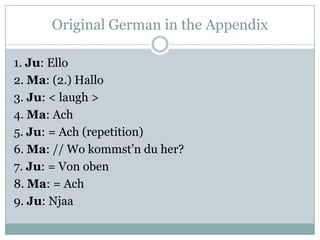
Original German in the Appendix

1. Ju: Ello
2. Ma: (2.) Hallo
3. Ju: < laugh >
4. Ma: Ach
5. Ju: = Ach (repetition)
6. Ma: // Wo kommst‟n du her?
7. Ju: = Von oben
8. Ma: = Ach
9. Ju: Njaa
Ambiguity of „Ach‟: dictionary definitions

 „Ach‟       = „Oh [dear]‟ (sympathetic)
   „Ach‟     = „Oh‟ (feeling sorry, surly)
   „Ach‟     = „Ah, Alas [dated]‟
    (complaining, moaning)
   „Ach‟     = „Oh‟ (surprised)
    „Ach ja?/ Ach wirklich?‟ = „Oh really?‟
   „Ach der!„                = „Oh him!„
   „Ach so!„                = „I see!
   „Ach nein!‟               = „No, no‟
   „Ach was!/ Ach wo!‟        = „Of course not‟
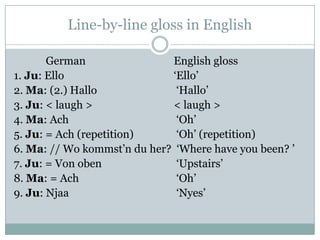
Line-by-line gloss in English

       German                English gloss
1. Ju: Ello                  „Ello‟
2. Ma: (2.) Hallo             „Hallo‟
3. Ju: < laugh >             < laugh >
4. Ma: Ach                    „Oh‟
5. Ju: = Ach (repetition)     „Oh‟ (repetition)
6. Ma: // Wo kommst‟n du her? „Where have you been? ‟
7. Ju: = Von oben             „Upstairs‟
8. Ma: = Ach                  „Oh‟
9. Ju: Njaa                   „Nyes‟
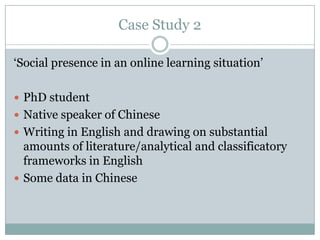
Case Study 2

„Social presence in an online learning situation‟

 PhD student
 Native speaker of Chinese
 Writing in English and drawing on substantial
  amounts of literature/analytical and classificatory
  frameworks in English
 Some data in Chinese
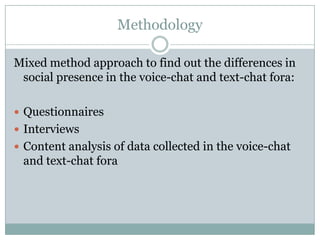
Methodology

Mixed method approach to find out the differences in
 social presence in the voice-chat and text-chat fora:

 Questionnaires
 Interviews
 Content analysis of data collected in the voice-chat
 and text-chat fora
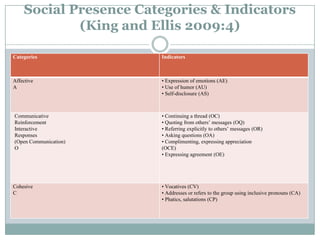
Social Presence Categories & Indicators
            (King and Ellis 2009:4)

Categories             Indicators


Affective              • Expression of emotions (AE)
A                      • Use of humor (AU)
                       • Self-disclosure (AS)


Communicative          • Continuing a thread (OC)
Reinforcement          • Quoting from others’ messages (OQ)
Interactive            • Referring explicitly to others’ messages (OR)
Responses              • Asking questions (OA)
(Open Communication)   • Complimenting, expressing appreciation
O                      (OCE)
                       • Expressing agreement (OE)


Cohesive               • Vocatives (CV)
C                      • Addresses or refers to the group using inclusive pronouns (CA)
                       • Phatics, salutations (CP)
The interaction analysis of a voice-based
               chat activity

A: Can you hear me? [OA]
B: Yeah, I can. [OE]
A: So how‟s your homework? Hehe. [OA][AE]
B: Hehe. Well-done. Well-done. [AE][OCE]
A: Oh.
B: 亲爱的,你报名了吗?
 “My dear, have you got registered?” [OA]
A: 什么东西?
 “For what?” [OA]
B: 考试,预约考试。
 “The exam, for the final exam.” [OC]
A: Yeah, I did that. [OC]
   你预约了吗?
 “And you?” [OA]
B: Yeah. [OC]
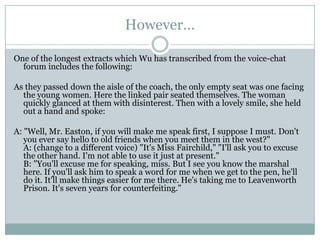
However…

One of the longest extracts which Wu has transcribed from the voice-chat
  forum includes the following:

As they passed down the aisle of the coach, the only empty seat was one facing
  the young women. Here the linked pair seated themselves. The woman
  quickly glanced at them with disinterest. Then with a lovely smile, she held
  out a hand and spoke:

A: "Well, Mr. Easton, if you will make me speak first, I suppose I must. Don't
   you ever say hello to old friends when you meet them in the west?"
   A: (change to a different voice) "It's Miss Fairchild," "I'll ask you to excuse
   the other hand. I'm not able to use it just at present."
   B: "You'll excuse me for speaking, miss. But I see you know the marshal
   here. If you'll ask him to speak a word for me when we get to the pen, he'll
   do it. It'll make things easier for me there. He's taking me to Leavenworth
   Prison. It's seven years for counterfeiting."
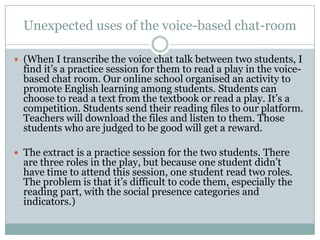
Unexpected uses of the voice-based chat-room

 (When I transcribe the voice chat talk between two students, I
  find it‟s a practice session for them to read a play in the voice-
  based chat room. Our online school organised an activity to
  promote English learning among students. Students can
  choose to read a text from the textbook or read a play. It‟s a
  competition. Students send their reading files to our platform.
  Teachers will download the files and listen to them. Those
  students who are judged to be good will get a reward.

 The extract is a practice session for the two students. There
  are three roles in the play, but because one student didn‟t
  have time to attend this session, one student read two roles.
  The problem is that it‟s difficult to code them, especially the
  reading part, with the social presence categories and
  indicators.)
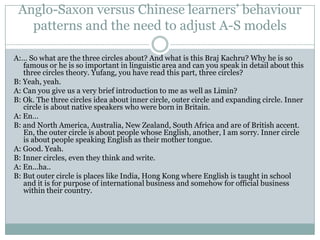
Anglo-Saxon versus Chinese learners‟ behaviour
   patterns and the need to adjust A-S models

A:… So what are the three circles about? And what is this Braj Kachru? Why he is so
   famous or he is so important in linguistic area and can you speak in detail about this
   three circles theory. Yufang, you have read this part, three circles?
B: Yeah, yeah.
A: Can you give us a very brief introduction to me as well as Limin?
B: Ok. The three circles idea about inner circle, outer circle and expanding circle. Inner
   circle is about native speakers who were born in Britain.
A: En…
B: and North America, Australia, New Zealand, South Africa and are of British accent.
   En, the outer circle is about people whose English, another, I am sorry. Inner circle
   is about people speaking English as their mother tongue.
A: Good. Yeah.
B: Inner circles, even they think and write.
A: En...ha..
B: But outer circle is places like India, Hong Kong where English is taught in school
   and it is for purpose of international business and somehow for official business
   within their country.
Writing (academic) English

 Whereas the daughter‟s level of power and involvement
  due to avoidance is still low on the manifest scale, the
  mother‟s reaction shows a positive position to the
  daughter in that she pities (1) that her daughter will not
  be taking part in the curly kale hike. While there is no
  explicit category for expressions of regret or pity (2) , the
  mother‟s „Oh‟ is coded as „Agree‟ as it confirms the
  relationship of the two in a positive manner but
  somewhat neutral level of power.
 (1) is genuinely disappointed
 (2) I think you mean disappointment? (cf „Wie schade!‟ ?)
Edit the following?

The slight approach of the mother is then answered
 with another „Agree‟ of the daughter in that she tries
 to reconcile her annihilation of the family meeting
 that it‟s just due to money that she cannot come to
 the gathering.
Possible rewording

 The mother moves tentatively closer to the daughter
 and is answered with another „Agree‟ from the
 daughter who tries to soften her refusal to join in the
 family walk by saying that it‟s just due to money that
 she cannot come to the gathering.
Researching multilingually

 Is stimulating and rewarding
 Requires flexibility and the ability to negotiate
  meaning
 Is hard work for student and supervisor


 Interlinear glossing is essential
 But does not preclude discursive explanation of
  context and interpretation
 And the supervisor‟s help with expression in English
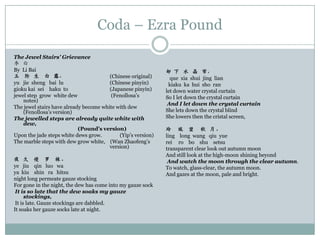
Coda – Ezra Pound
The Jewel Stairs’ Grievance
李 白
By Li Bai                                                     却 下 水 晶 帘,
玉 阶 生 白 露,                              (Chinese original)      que xia shui jing lian
yu jie sheng bai lu                     (Chinese pinyin)       kiaku ka hui sho ran
gioku kai sei haku to                   (Japanese pinyin)     let down water crystal curtain
jewel step grow white dew                (Fenollosa‟s         So I let down the crystal curtain
    notes)
                                                               And I let down the crystal curtain
The jewel stairs have already become white with dew
    (Fenollosa‟s version)                                     She lets down the crystal blind
The jewelled steps are already quite white with               She lowers then the cristal screen,
    dew,
                            (Pound’s version)                 玲 珑 望 秋 月。
Upon the jade steps white dews grow.        (Yip‟s version)   ling long wang qiu yue
The marble steps with dew grow white, (Wan Zhaofeng‟s         rei ro bo shu setsu
                                        version)              transparent clear look out autumn moon
                                                              And still look at the high-moon shining beyond
夜 久 侵 罗 袜。                                                     And watch the moon through the clear autumn.
ye jiu qin luo wa                                             To watch, glass-clear, the autumn moon.
ya kiu shin ra hitsu                                          And gazes at the moon, pale and bright.
night long permeate gauze stocking
For gone in the night, the dew has come into my gauze sock
 It is so late that the dew soaks my gauze
      stockings,
 It is late. Gauze stockings are dabbled.
It soaks her gauze socks late at night.
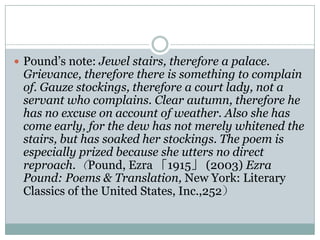
 Pound‟s note: Jewel stairs, therefore a palace.
 Grievance, therefore there is something to complain
 of. Gauze stockings, therefore a court lady, not a
 servant who complains. Clear autumn, therefore he
 has no excuse on account of weather. Also she has
 come early, for the dew has not merely whitened the
 stairs, but has soaked her stockings. The poem is
 especially prized because she utters no direct
 reproach.(Pound, Ezra 「1915」 (2003) Ezra
 Pound: Poems & Translation, New York: Literary
 Classics of the United States, Inc.,252)

Kate Beeching

  • 1.
    Interlinear glossing for multilingual research KATE BEECHING ASSOCIATE PROFESSOR, APPLIED LINGUISTICS HEAD, INTERNATIONAL CORPUS LINGUISTICS RESEARCH UNIT (ICLRU) UWE, BRISTOL
  • 2.
    International students andpost-graduate discourse analytic research International students in the UK conducting discourse- analytic research on languages other than English, either at MA or PhD level, face four major hurdles: a) understanding what is meant by „contributing to knowledge‟; b) applying „Anglo-Saxon‟ models in contexts in which those models may be inappropriate or require adaptation; c) presenting foreign-language data in such a way as to be understandable to supervisors and examiners who may have no knowledge of their language; d) (Academic) writing in English.
  • 3.
    Linguistic glossing a. Ed en Floor gaan samen-wonen Ed and Floor go together-live INF „Ed and Floor are going to live together‟ b. Maarten en Stefanie zijn uit elkaar Maarten and Stefanie be out RECP „Maarten and Stefanie have split up‟
  • 4.
    Too much information…or not enough? I will argue in this paper that:  It is not always possible for non-linguistically trained students/researchers to give detailed morphologically glosses;  Morphological glosses do not provide us with the pragmatic information we need in studies of everyday interactional (and intercultural) communication  > flexible glossing strategies which are fit for purpose AND  > discursive explanations of language used in context.
  • 5.
    Case Study 1 „Negotiatingnurturance and autonomy: a mother- daughter case study‟  MA ICC dissertation student  Native speaker of German  Writing in English and drawing on substantial amounts of literature/analytical and classificatory frameworks in English  Data in German
  • 6.
    Methodology  Record conversationsbetween „the mother‟ and „the daughter‟  Transcribe critical incidents – in this case, the daughter announcing that she is leaving home and moving to Kiel, and that she won‟t be home for the annual „curly kale hike‟  Coding the data, using Penman‟s categorisation system for power and involvement
  • 7.
    Penman‟s (1980) psychologicalcategorisation system: manifest level
  • 8.
    Penman‟s (1980) psychologicalcategorisation system: latent level
  • 9.
    Mapping of themanifest onto the latent level
  • 10.
    Returning unexpectedly fromKiel 1. Ju: Ello AV 2. Ma: (2.) Hello AV 3. Ju: < laugh > AV 4. Ma: Oh AS/ CN … Blocks … Assert 5. Ju: = Oh (repetition) AS/ RS …. Blocks…. Maintain 6. Ma: = Where are you coming from? AS/ CN …. Blocks…. Assert 7. Ju: = Upstairs AV/ EV … Severs … Ignores 8. Ma: = Oh really DS/ RS … Blocks …Maintains 9. Ju: Nyes AV/ AB …Blocks … Ignores
  • 11.
    Original German inthe Appendix 1. Ju: Ello 2. Ma: (2.) Hallo 3. Ju: < laugh > 4. Ma: Ach 5. Ju: = Ach (repetition) 6. Ma: // Wo kommst‟n du her? 7. Ju: = Von oben 8. Ma: = Ach 9. Ju: Njaa
  • 12.
    Ambiguity of „Ach‟:dictionary definitions  „Ach‟ = „Oh [dear]‟ (sympathetic)  „Ach‟ = „Oh‟ (feeling sorry, surly)  „Ach‟ = „Ah, Alas [dated]‟ (complaining, moaning)  „Ach‟ = „Oh‟ (surprised)  „Ach ja?/ Ach wirklich?‟ = „Oh really?‟  „Ach der!„ = „Oh him!„  „Ach so!„ = „I see!  „Ach nein!‟ = „No, no‟  „Ach was!/ Ach wo!‟ = „Of course not‟
  • 13.
    Line-by-line gloss inEnglish German English gloss 1. Ju: Ello „Ello‟ 2. Ma: (2.) Hallo „Hallo‟ 3. Ju: < laugh > < laugh > 4. Ma: Ach „Oh‟ 5. Ju: = Ach (repetition) „Oh‟ (repetition) 6. Ma: // Wo kommst‟n du her? „Where have you been? ‟ 7. Ju: = Von oben „Upstairs‟ 8. Ma: = Ach „Oh‟ 9. Ju: Njaa „Nyes‟
  • 14.
    Case Study 2 „Socialpresence in an online learning situation‟  PhD student  Native speaker of Chinese  Writing in English and drawing on substantial amounts of literature/analytical and classificatory frameworks in English  Some data in Chinese
  • 15.
    Methodology Mixed method approachto find out the differences in social presence in the voice-chat and text-chat fora:  Questionnaires  Interviews  Content analysis of data collected in the voice-chat and text-chat fora
  • 16.
    Social Presence Categories& Indicators (King and Ellis 2009:4) Categories Indicators Affective • Expression of emotions (AE) A • Use of humor (AU) • Self-disclosure (AS) Communicative • Continuing a thread (OC) Reinforcement • Quoting from others’ messages (OQ) Interactive • Referring explicitly to others’ messages (OR) Responses • Asking questions (OA) (Open Communication) • Complimenting, expressing appreciation O (OCE) • Expressing agreement (OE) Cohesive • Vocatives (CV) C • Addresses or refers to the group using inclusive pronouns (CA) • Phatics, salutations (CP)
  • 17.
    The interaction analysisof a voice-based chat activity A: Can you hear me? [OA] B: Yeah, I can. [OE] A: So how‟s your homework? Hehe. [OA][AE] B: Hehe. Well-done. Well-done. [AE][OCE] A: Oh. B: 亲爱的,你报名了吗? “My dear, have you got registered?” [OA] A: 什么东西? “For what?” [OA] B: 考试,预约考试。 “The exam, for the final exam.” [OC] A: Yeah, I did that. [OC] 你预约了吗? “And you?” [OA] B: Yeah. [OC]
  • 18.
    However… One of thelongest extracts which Wu has transcribed from the voice-chat forum includes the following: As they passed down the aisle of the coach, the only empty seat was one facing the young women. Here the linked pair seated themselves. The woman quickly glanced at them with disinterest. Then with a lovely smile, she held out a hand and spoke: A: "Well, Mr. Easton, if you will make me speak first, I suppose I must. Don't you ever say hello to old friends when you meet them in the west?" A: (change to a different voice) "It's Miss Fairchild," "I'll ask you to excuse the other hand. I'm not able to use it just at present." B: "You'll excuse me for speaking, miss. But I see you know the marshal here. If you'll ask him to speak a word for me when we get to the pen, he'll do it. It'll make things easier for me there. He's taking me to Leavenworth Prison. It's seven years for counterfeiting."
  • 19.
    Unexpected uses ofthe voice-based chat-room  (When I transcribe the voice chat talk between two students, I find it‟s a practice session for them to read a play in the voice- based chat room. Our online school organised an activity to promote English learning among students. Students can choose to read a text from the textbook or read a play. It‟s a competition. Students send their reading files to our platform. Teachers will download the files and listen to them. Those students who are judged to be good will get a reward.  The extract is a practice session for the two students. There are three roles in the play, but because one student didn‟t have time to attend this session, one student read two roles. The problem is that it‟s difficult to code them, especially the reading part, with the social presence categories and indicators.)
  • 20.
    Anglo-Saxon versus Chineselearners‟ behaviour patterns and the need to adjust A-S models A:… So what are the three circles about? And what is this Braj Kachru? Why he is so famous or he is so important in linguistic area and can you speak in detail about this three circles theory. Yufang, you have read this part, three circles? B: Yeah, yeah. A: Can you give us a very brief introduction to me as well as Limin? B: Ok. The three circles idea about inner circle, outer circle and expanding circle. Inner circle is about native speakers who were born in Britain. A: En… B: and North America, Australia, New Zealand, South Africa and are of British accent. En, the outer circle is about people whose English, another, I am sorry. Inner circle is about people speaking English as their mother tongue. A: Good. Yeah. B: Inner circles, even they think and write. A: En...ha.. B: But outer circle is places like India, Hong Kong where English is taught in school and it is for purpose of international business and somehow for official business within their country.
  • 21.
    Writing (academic) English Whereas the daughter‟s level of power and involvement due to avoidance is still low on the manifest scale, the mother‟s reaction shows a positive position to the daughter in that she pities (1) that her daughter will not be taking part in the curly kale hike. While there is no explicit category for expressions of regret or pity (2) , the mother‟s „Oh‟ is coded as „Agree‟ as it confirms the relationship of the two in a positive manner but somewhat neutral level of power.  (1) is genuinely disappointed  (2) I think you mean disappointment? (cf „Wie schade!‟ ?)
  • 22.
    Edit the following? Theslight approach of the mother is then answered with another „Agree‟ of the daughter in that she tries to reconcile her annihilation of the family meeting that it‟s just due to money that she cannot come to the gathering.
  • 23.
    Possible rewording  Themother moves tentatively closer to the daughter and is answered with another „Agree‟ from the daughter who tries to soften her refusal to join in the family walk by saying that it‟s just due to money that she cannot come to the gathering.
  • 24.
    Researching multilingually  Isstimulating and rewarding  Requires flexibility and the ability to negotiate meaning  Is hard work for student and supervisor  Interlinear glossing is essential  But does not preclude discursive explanation of context and interpretation  And the supervisor‟s help with expression in English
  • 25.
    Coda – EzraPound The Jewel Stairs’ Grievance 李 白 By Li Bai 却 下 水 晶 帘, 玉 阶 生 白 露, (Chinese original) que xia shui jing lian yu jie sheng bai lu (Chinese pinyin) kiaku ka hui sho ran gioku kai sei haku to (Japanese pinyin) let down water crystal curtain jewel step grow white dew (Fenollosa‟s So I let down the crystal curtain notes) And I let down the crystal curtain The jewel stairs have already become white with dew (Fenollosa‟s version) She lets down the crystal blind The jewelled steps are already quite white with She lowers then the cristal screen, dew, (Pound’s version) 玲 珑 望 秋 月。 Upon the jade steps white dews grow. (Yip‟s version) ling long wang qiu yue The marble steps with dew grow white, (Wan Zhaofeng‟s rei ro bo shu setsu version) transparent clear look out autumn moon And still look at the high-moon shining beyond 夜 久 侵 罗 袜。 And watch the moon through the clear autumn. ye jiu qin luo wa To watch, glass-clear, the autumn moon. ya kiu shin ra hitsu And gazes at the moon, pale and bright. night long permeate gauze stocking For gone in the night, the dew has come into my gauze sock It is so late that the dew soaks my gauze stockings, It is late. Gauze stockings are dabbled. It soaks her gauze socks late at night.
  • 26.
     Pound‟s note:Jewel stairs, therefore a palace. Grievance, therefore there is something to complain of. Gauze stockings, therefore a court lady, not a servant who complains. Clear autumn, therefore he has no excuse on account of weather. Also she has come early, for the dew has not merely whitened the stairs, but has soaked her stockings. The poem is especially prized because she utters no direct reproach.(Pound, Ezra 「1915」 (2003) Ezra Pound: Poems & Translation, New York: Literary Classics of the United States, Inc.,252)