Submitted By: Nasir Farid
Submitted To: Mr.Janas Khan
1st
Semester
Generations….
GENERATIONS
The development of computers has followed difference steps in the technology used and these
steps of technological differences are called as generations.
The computer has evolved from a large-sized simple calculating machine to a smaller but much
more powerful machine. The evolution of computer to the current state is defined in terms of the
generations of computer. Each generation of computer is designed based on a new technological
development, resulting in better, cheaper and smaller computers that are more powerful, faster
and efficient than their predecessors. Currently, there are five generations of computer. In the
following subsections, we will discuss the generations of computer in terms of—
i. The technology used by them (hardware and software),
ii. Computing characteristics (speed, i.e., number of instructions executed per second),
iii. Physical appearance, and
iv. Their applications.
History of Computers
From the earliest times the need to carry out calculations has been developing. The first steps
involved the development of counting and calculation aids such as the counting board and the
abacus.
Pascal (1623-62) was the son of a tax collector and a mathematical genius. He designed the first
Mechanical calculator (Pascaline) based on gears. It performed addition and subtraction.
Leibnitz (1646-1716) was a German mathematician and built the first calculator to do
Multiplication and division, it was not reliable due to accuracy of contemporary parts.
Babbage (1792-1872) was a British inventor who designed an ‘analytical engine’ incorporating
the ideas of a memory and card input/output for data and instructions. Again the current
Technology did not permit the complete construction of the machine.
Babbage is largely remembered because of the work of Augusta Ada (Countess of Lovelace)
who was probably the first computer programmer.
Burroughs (1855-98) introduced the first commercially successful mechanical adding machine
of which a million were sold by 1926.
Hollerith developed an electromechanical punched-card tabulator to tabulate the data for 1890
U.S. census. Data was entered on punched cards and could be sorted according to the census
requirements. The machine was powered by electricity. He formed the Tabulating Machine
Company which became International Business Machines (IBM). IBM is still one of the
largest computer companies in the world.
Aiken (1900-73) a Harvard professor with the backing of IBM built the Harvard Mark I
computer (51ft long) in 1944. It was based on relays (operate in milliseconds) as opposed to the
use of gears. It required 3 seconds for a multiplication.
Eckert and Mauchly designed and built the ENIAC in 1946 for military computations. It used
vacuum tubes (valves) which were completely electronic (operated in microseconds) as opposed
to the relay which was electromechanical. It weighed 30 tons, used 18000 valves, and required
140 k watts of power. It was 1000 times faster than the Mark I multiplying in 3 milliseconds.
ENIAC was a decimal machine and could not be programmed without altering its setup
manually.
Atanasoff had built a specialized computer in 1941 and was visited by Mauchly before the
construction of the ENIAC. He sued Mauchly in a case which was decided in his favors in 1974!
Von Neumann was a scientific genius and was a consultant on the ENIAC project. He
formulated plans with Mauchly and Eckert for a new computer (EDVAC) which was to store
programs as well as data.
This is called the stored program concept and Von Neumann is credited with it. Almost all
modern computers are based on this idea and are referred to as von Neumann machines.
He also concluded that the binary system was more suitable for computers since switches have
only two values. He went on to design his own computer at Princeton which was a general
purpose machine.
Alan Turing was a British mathematician who also made significant contributions to the early
development of computing, especially to the theory of computation.
He developed an abstract theoretical model of a computer called a Turing machine which is used
to capture the notion of computable i.e. what problems can and what problems cannot be
computed. Not all problems can be solved on a computer.
Note: A Turing machine is an abstract model and not a physical computer.
From the 1950’s, the computer age took off in full force. The years since then have been divided
into periods or generations based on the technology used.
First Generation Computers (1951-58): Vacuum Tubes
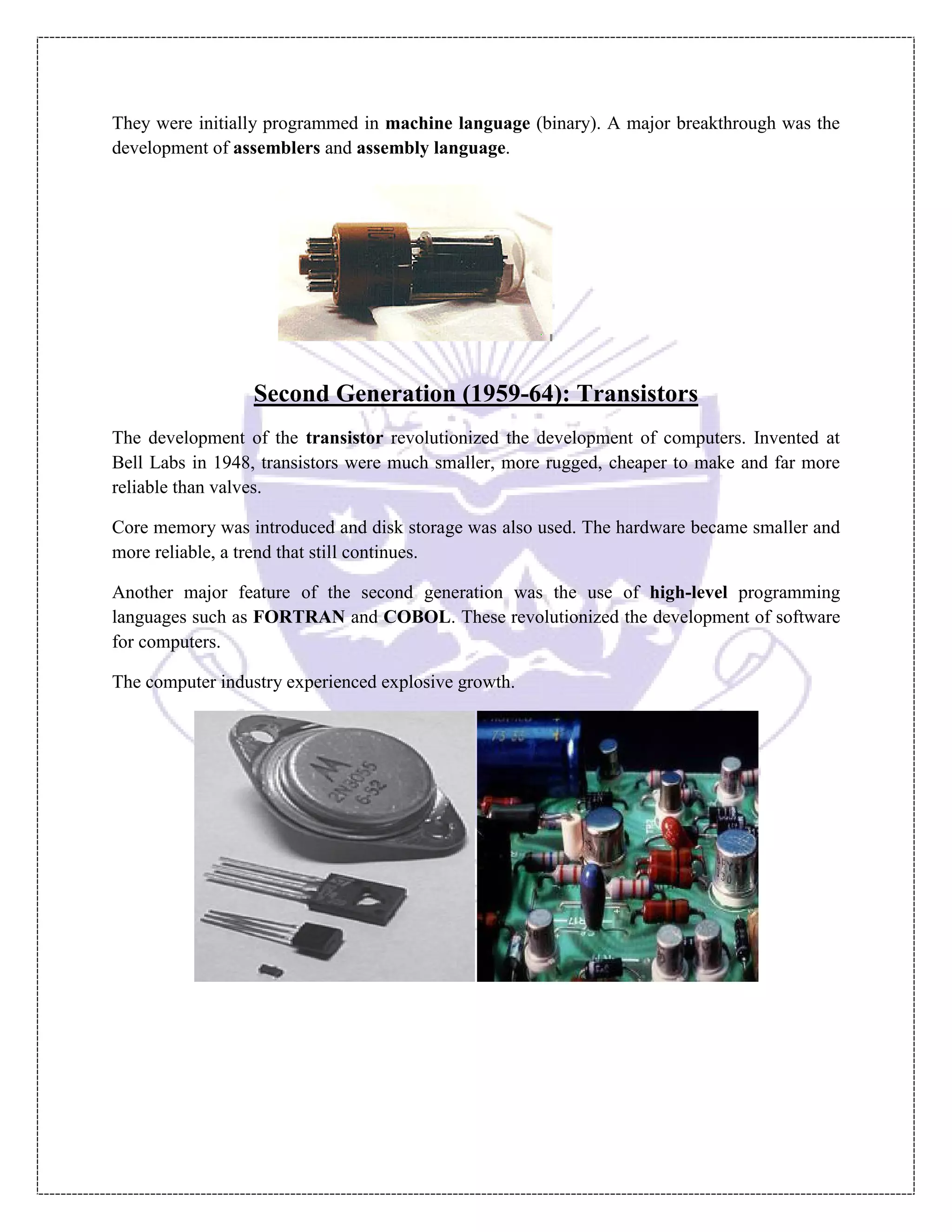
These machines were used in business for accounting and payroll applications. Valves were
unreliable components generating a lot of heat (still a problem in computers). They had very
limited memory capacity. Magnetic drums were developed to store information and tapes were
also developed for secondary storage.
They were initially programmed in machine language (binary). A major breakthrough was the
development of assemblers and assembly language.
Second Generation (1959-64): Transistors
The development of the transistor revolutionized the development of computers. Invented at
Bell Labs in 1948, transistors were much smaller, more rugged, cheaper to make and far more
reliable than valves.
Core memory was introduced and disk storage was also used. The hardware became smaller and
more reliable, a trend that still continues.
Another major feature of the second generation was the use of high-level programming
languages such as FORTRAN and COBOL. These revolutionized the development of software
for computers.
The computer industry experienced explosive growth.
Third Generation (1965-71): Integrated Circuits (ICs)
IC’s were again smaller, cheaper, faster and more reliable than transistors. Speeds went from the
microsecond to the nanosecond (billionth) to the picoseconds (trillionth) range. ICs were used for
main memory despite the disadvantage of being volatile. Minicomputers were developed at this
time.
Terminals replaced punched cards for data entry and disk packs became popular for secondary
storage. IBM introduced the idea of a compatible family of computers, 360 families, easing the
problem of upgrading to a more powerful machine.
Substantial operating systems were developed to manage and share the computing resources
and time sharing operating systems were developed. These greatly improved the efficiency of
computers.
Computers had by now pervaded most areas of business and administration.
The number of transistors that be fabricated on a chip is referred to as the scale of integration
(SI). Early chips had SSI (small SI) of tens to a few hundreds. Later chips were MSI (Medium
SI): hundreds to a few thousands and then came LSI chips (Large SI) in the thousands range.
Fourth Generation (1971 - ) VLSI (Very Large SI)
VLSI allowed the equivalent of tens of thousands of transistors to be incorporated on a single
chip. This led to the development of the microprocessor a processor on a chip.
Intel produced the 4004 which was followed by the 8008, 8080, 8088 and 8086 etc. Other
companies developing microprocessors included Motorola (6800, 68000), Texas Instruments
and Zilog.
Personal computers were developed and IBM launched the IBM PC based on the 8088 and 8086
microprocessors.
Mainframe computers have grown in power. Memory chips are in the megabit range. VLSI chips
had enough transistors to build 20 ENIACs.
Secondary storage has also evolved at fantastic rates with storage devices holding gigabytes
(1000Mb = 1 GB) of data.
On the software side, more powerful operating systems are available such as UNIX.
Applications software has become cheaper and easier to use. Software development techniques
have vastly improved.
Fourth generation languages 4GLs make the development process much easier and faster.
[Languages are also classified according to generations from machine language (1GL), assembly
language (2GL), and high level languages (3GL) to 4Gls].
Software is often developed as application packages. VisiCalc a spreadsheet program was the
pioneering application package and the original killer application.
Killer application: A piece of software that is so useful that people will buy a computer to use
that application.
Fifth Generation (Present and Next): Using Artificial Intelligence
This generation is based on parallel processing hardware and AI (Artificial Intelligence)
software.
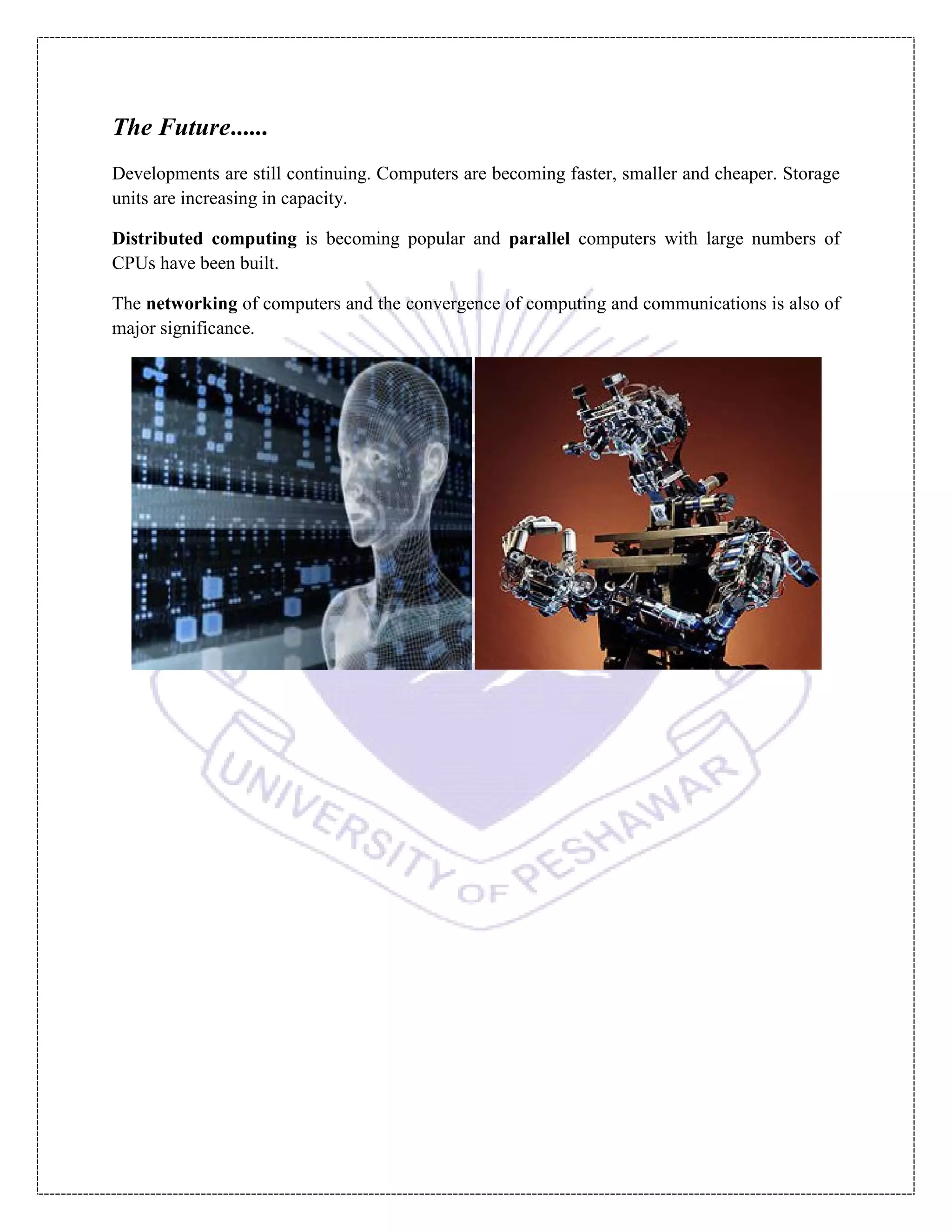
AI is an emerging branch in computer science which interprets means and methods of making
computers think like human beings.
All the higher level languages like C and C++, Java, .Net, etc., are used in this generation.
AI includes:
 Robotics
 Neural networks
 Game Playing
 Development of expert systems to make decisions in real life situations.
 Natural language understanding and generation.
The main features of Fifth Generation are:
 Development of true artificial intelligence
 Development of Natural language processing
 Advancement in Parallel Processing
 Advancement in Superconductor technology
 More user friendly interfaces with multimedia features
 Availability of very powerful and compact computers at cheaper rates
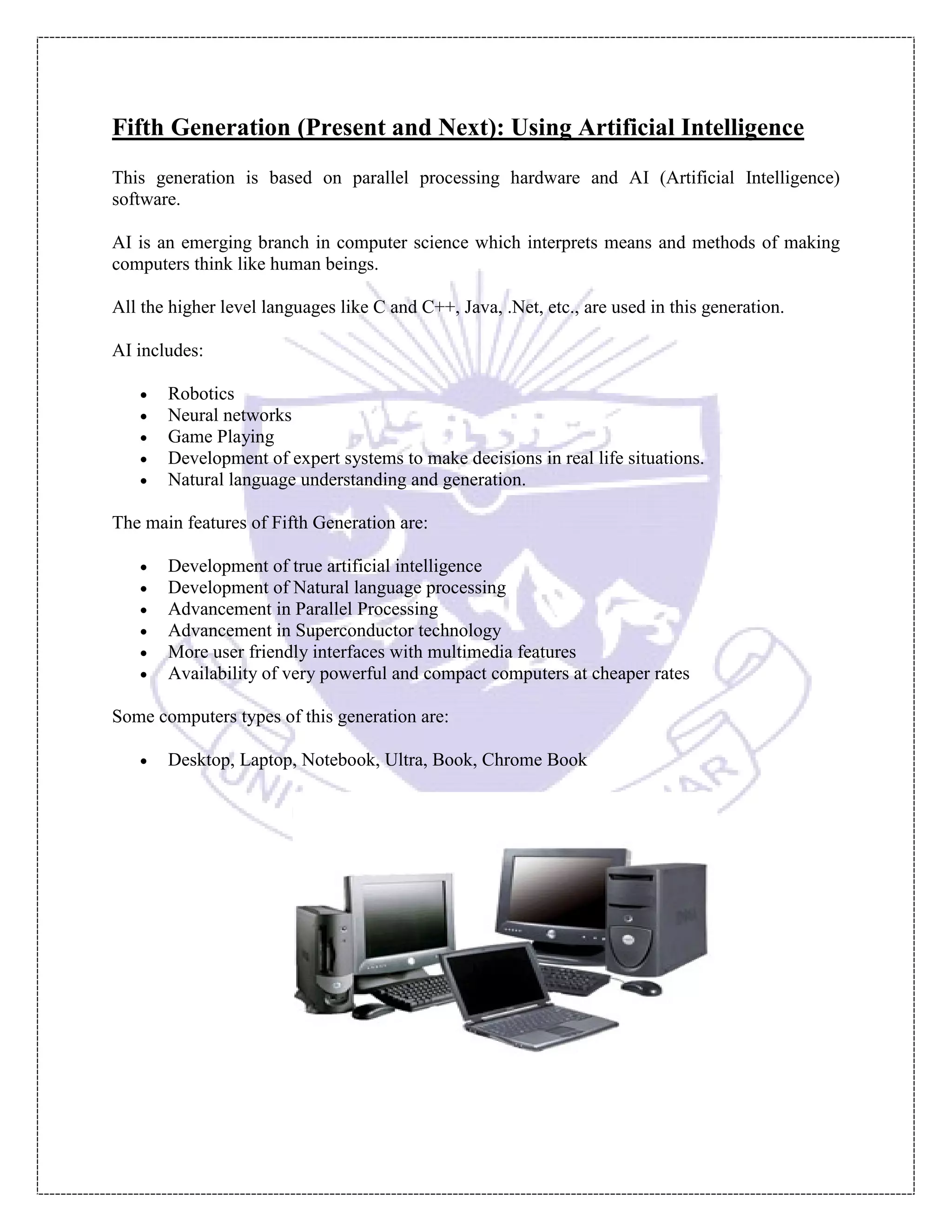
Some computers types of this generation are:
 Desktop, Laptop, Notebook, Ultra, Book, Chrome Book
The Future......
Developments are still continuing. Computers are becoming faster, smaller and cheaper. Storage
units are increasing in capacity.
Distributed computing is becoming popular and parallel computers with large numbers of
CPUs have been built.
The networking of computers and the convergence of computing and communications is also of
major significance.

History of Computer

  • 1.
    Submitted By: NasirFarid Submitted To: Mr.Janas Khan 1st Semester Generations….
  • 2.
    GENERATIONS The development ofcomputers has followed difference steps in the technology used and these steps of technological differences are called as generations. The computer has evolved from a large-sized simple calculating machine to a smaller but much more powerful machine. The evolution of computer to the current state is defined in terms of the generations of computer. Each generation of computer is designed based on a new technological development, resulting in better, cheaper and smaller computers that are more powerful, faster and efficient than their predecessors. Currently, there are five generations of computer. In the following subsections, we will discuss the generations of computer in terms of— i. The technology used by them (hardware and software), ii. Computing characteristics (speed, i.e., number of instructions executed per second), iii. Physical appearance, and iv. Their applications. History of Computers From the earliest times the need to carry out calculations has been developing. The first steps involved the development of counting and calculation aids such as the counting board and the abacus. Pascal (1623-62) was the son of a tax collector and a mathematical genius. He designed the first Mechanical calculator (Pascaline) based on gears. It performed addition and subtraction. Leibnitz (1646-1716) was a German mathematician and built the first calculator to do Multiplication and division, it was not reliable due to accuracy of contemporary parts. Babbage (1792-1872) was a British inventor who designed an ‘analytical engine’ incorporating the ideas of a memory and card input/output for data and instructions. Again the current Technology did not permit the complete construction of the machine. Babbage is largely remembered because of the work of Augusta Ada (Countess of Lovelace) who was probably the first computer programmer. Burroughs (1855-98) introduced the first commercially successful mechanical adding machine of which a million were sold by 1926. Hollerith developed an electromechanical punched-card tabulator to tabulate the data for 1890 U.S. census. Data was entered on punched cards and could be sorted according to the census requirements. The machine was powered by electricity. He formed the Tabulating Machine
  • 3.
    Company which becameInternational Business Machines (IBM). IBM is still one of the largest computer companies in the world. Aiken (1900-73) a Harvard professor with the backing of IBM built the Harvard Mark I computer (51ft long) in 1944. It was based on relays (operate in milliseconds) as opposed to the use of gears. It required 3 seconds for a multiplication. Eckert and Mauchly designed and built the ENIAC in 1946 for military computations. It used vacuum tubes (valves) which were completely electronic (operated in microseconds) as opposed to the relay which was electromechanical. It weighed 30 tons, used 18000 valves, and required 140 k watts of power. It was 1000 times faster than the Mark I multiplying in 3 milliseconds. ENIAC was a decimal machine and could not be programmed without altering its setup manually. Atanasoff had built a specialized computer in 1941 and was visited by Mauchly before the construction of the ENIAC. He sued Mauchly in a case which was decided in his favors in 1974! Von Neumann was a scientific genius and was a consultant on the ENIAC project. He formulated plans with Mauchly and Eckert for a new computer (EDVAC) which was to store programs as well as data. This is called the stored program concept and Von Neumann is credited with it. Almost all modern computers are based on this idea and are referred to as von Neumann machines. He also concluded that the binary system was more suitable for computers since switches have only two values. He went on to design his own computer at Princeton which was a general purpose machine. Alan Turing was a British mathematician who also made significant contributions to the early development of computing, especially to the theory of computation. He developed an abstract theoretical model of a computer called a Turing machine which is used to capture the notion of computable i.e. what problems can and what problems cannot be computed. Not all problems can be solved on a computer. Note: A Turing machine is an abstract model and not a physical computer. From the 1950’s, the computer age took off in full force. The years since then have been divided into periods or generations based on the technology used. First Generation Computers (1951-58): Vacuum Tubes These machines were used in business for accounting and payroll applications. Valves were unreliable components generating a lot of heat (still a problem in computers). They had very limited memory capacity. Magnetic drums were developed to store information and tapes were also developed for secondary storage.
  • 4.
    They were initiallyprogrammed in machine language (binary). A major breakthrough was the development of assemblers and assembly language. Second Generation (1959-64): Transistors The development of the transistor revolutionized the development of computers. Invented at Bell Labs in 1948, transistors were much smaller, more rugged, cheaper to make and far more reliable than valves. Core memory was introduced and disk storage was also used. The hardware became smaller and more reliable, a trend that still continues. Another major feature of the second generation was the use of high-level programming languages such as FORTRAN and COBOL. These revolutionized the development of software for computers. The computer industry experienced explosive growth.
  • 5.
    Third Generation (1965-71):Integrated Circuits (ICs) IC’s were again smaller, cheaper, faster and more reliable than transistors. Speeds went from the microsecond to the nanosecond (billionth) to the picoseconds (trillionth) range. ICs were used for main memory despite the disadvantage of being volatile. Minicomputers were developed at this time. Terminals replaced punched cards for data entry and disk packs became popular for secondary storage. IBM introduced the idea of a compatible family of computers, 360 families, easing the problem of upgrading to a more powerful machine. Substantial operating systems were developed to manage and share the computing resources and time sharing operating systems were developed. These greatly improved the efficiency of computers. Computers had by now pervaded most areas of business and administration. The number of transistors that be fabricated on a chip is referred to as the scale of integration (SI). Early chips had SSI (small SI) of tens to a few hundreds. Later chips were MSI (Medium SI): hundreds to a few thousands and then came LSI chips (Large SI) in the thousands range.
  • 6.
    Fourth Generation (1971- ) VLSI (Very Large SI) VLSI allowed the equivalent of tens of thousands of transistors to be incorporated on a single chip. This led to the development of the microprocessor a processor on a chip. Intel produced the 4004 which was followed by the 8008, 8080, 8088 and 8086 etc. Other companies developing microprocessors included Motorola (6800, 68000), Texas Instruments and Zilog. Personal computers were developed and IBM launched the IBM PC based on the 8088 and 8086 microprocessors. Mainframe computers have grown in power. Memory chips are in the megabit range. VLSI chips had enough transistors to build 20 ENIACs. Secondary storage has also evolved at fantastic rates with storage devices holding gigabytes (1000Mb = 1 GB) of data. On the software side, more powerful operating systems are available such as UNIX. Applications software has become cheaper and easier to use. Software development techniques have vastly improved. Fourth generation languages 4GLs make the development process much easier and faster. [Languages are also classified according to generations from machine language (1GL), assembly language (2GL), and high level languages (3GL) to 4Gls]. Software is often developed as application packages. VisiCalc a spreadsheet program was the pioneering application package and the original killer application. Killer application: A piece of software that is so useful that people will buy a computer to use that application.
  • 7.
    Fifth Generation (Presentand Next): Using Artificial Intelligence This generation is based on parallel processing hardware and AI (Artificial Intelligence) software. AI is an emerging branch in computer science which interprets means and methods of making computers think like human beings. All the higher level languages like C and C++, Java, .Net, etc., are used in this generation. AI includes:  Robotics  Neural networks  Game Playing  Development of expert systems to make decisions in real life situations.  Natural language understanding and generation. The main features of Fifth Generation are:  Development of true artificial intelligence  Development of Natural language processing  Advancement in Parallel Processing  Advancement in Superconductor technology  More user friendly interfaces with multimedia features  Availability of very powerful and compact computers at cheaper rates Some computers types of this generation are:  Desktop, Laptop, Notebook, Ultra, Book, Chrome Book
  • 8.
    The Future...... Developments arestill continuing. Computers are becoming faster, smaller and cheaper. Storage units are increasing in capacity. Distributed computing is becoming popular and parallel computers with large numbers of CPUs have been built. The networking of computers and the convergence of computing and communications is also of major significance.