AP POLYCET 2018 STUDY MATERIAL FOR
PHYSICS(EM)
SBTET, AP, AMARAVATI
CHAPTER 12
Electromagnetism
Summary: H.C. Oersted played a key role in understanding
“Electromagnetism”.
Oersted proved electricity and magnetism are related phenomena.
The unit of magnetic induction field strength is named as oersted, in his
honour.
Magnetic field:
The region around a magnet where its influence is felt is called “magnetic
field”.
• The strength of the field varies with the distance from the magnet.
• The magnetic field is three dimensional.
• That implies that the magnetic field surrounds its source.
• Hence, a magnetic field exists in the region surrounding a bar
magnet and is characterised by strength and direction.
Magnetic field lines:
• Outside the bar magnet, the magnetic lines of force are closed loops.
• The tangent drawn to the field line at a point gives the direction of the
field.
• The field is strong when the lines are crowded (near the poles of the
magnet) and if weak when the lines are apart.
• The field is said to be non-uniform, when strength or direction changes
from point to point.
• The field is said to be uniform, if both strength and direction are constant
throughout the field.
Magnetic flux density:
• The number of lines passing through the plane of area ‘A’ perpendicular
The field is called “magnetic flux.” It is denoted by ‘ɸ’.
• The S.I. unit of magnetic flux is “weber”.
• The strength of the magnetic field is called magnetic flux density(B)
• Magnetic flux density = Magnetic flux /Area.
B = ɸ/A or ɸ = B/A
• Unit of magnetic flux density is weber/(meter)2
or Tesla.
Magnetic field due to current carrying straight wire:
• Current carrying wire produces magnetic field.
• The direction of the magnetic field, around a current carrying wire is
determined by right hand thumb rule.
• THUMB indicates the direction of current.
• The curled fingers show the direction of magnetic field.
Magnetic field due to a circular coil:
• The direction of the field is perpendicular to the plane of the coil.
• With Right Hand Thumb rule, the thumb points the direction of
magnetic field, the curled fingers show the direction of current.
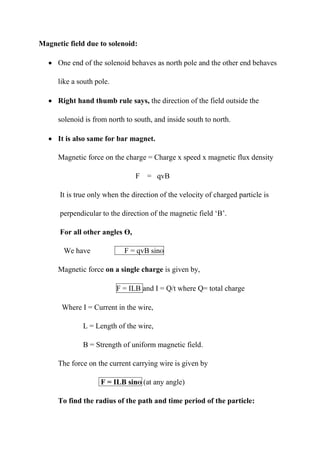
Magnetic field due to solenoid:
• One end of the solenoid behaves as north pole and the other end behaves
like a south pole.
• Right hand thumb rule says, the direction of the field outside the
solenoid is from north to south, and inside south to north.
• It is also same for bar magnet.
Magnetic force on the charge = Charge x speed x magnetic flux density
F = qvB
It is true only when the direction of the velocity of charged particle is
perpendicular to the direction of the magnetic field ‘B’.
For all other angles Ɵ,
We have F = qvB sinƟ
Magnetic force on a single charge is given by,
F = ILB and I = Q/t where Q= total charge
Where I = Current in the wire,
L = Length of the wire,
B = Strength of uniform magnetic field.
The force on the current carrying wire is given by
F = ILB sinƟ (at any angle)
To find the radius of the path and time period of the particle:
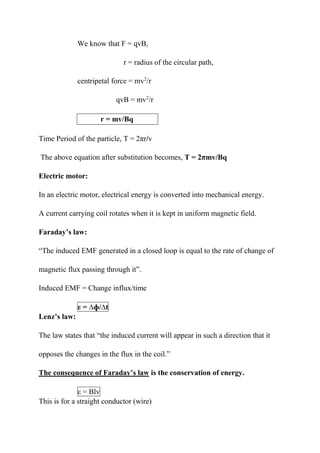
We know that F = qvB,
r = radius of the circular path,
centripetal force = mv2
/r
qvB = mv2
/r
r = mv/Bq
Time Period of the particle, T = 2πr/v
The above equation after substitution becomes, T = 2πmv/Bq
Electric motor:
In an electric motor, electrical energy is converted into mechanical energy.
A current carrying coil rotates when it is kept in uniform magnetic field.
Faraday’s law:
“The induced EMF generated in a closed loop is equal to the rate of change of
magnetic flux passing through it”.
Induced EMF = Change influx/time
ε = ∆ɸ/∆t
Lenz’s law:
The law states that “the induced current will appear in such a direction that it
opposes the changes in the flux in the coil.”
The consequence of Faraday’s law is the conservation of energy.
ε = Blv
This is for a straight conductor (wire)
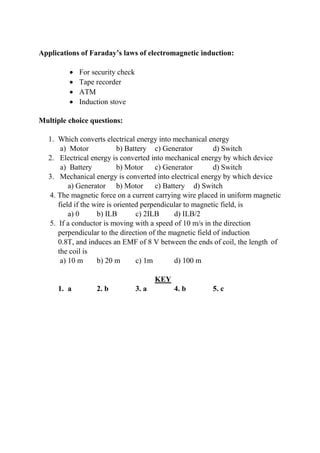
Applications of Faraday’s laws of electromagnetic induction:
• For security check
• Tape recorder
• ATM
• Induction stove
Multiple choice questions:
1. Which converts electrical energy into mechanical energy
a) Motor b) Battery c) Generator d) Switch
2. Electrical energy is converted into mechanical energy by which device
a) Battery b) Motor c) Generator d) Switch
3. Mechanical energy is converted into electrical energy by which device
a) Generator b) Motor c) Battery d) Switch
4. The magnetic force on a current carrying wire placed in uniform magnetic
field if the wire is oriented perpendicular to magnetic field, is
a) 0 b) ILB c) 2ILB d) ILB/2
5. If a conductor is moving with a speed of 10 m/s in the direction
perpendicular to the direction of the magnetic field of induction
0.8T, and induces an EMF of 8 V between the ends of coil, the length of
the coil is
a) 10 m b) 20 m c) 1m d) 100 m
KEY
1. a 2. b 3. a 4. b 5. c

Chapter 12 physics

  • 1.
    AP POLYCET 2018STUDY MATERIAL FOR PHYSICS(EM) SBTET, AP, AMARAVATI
  • 2.
    CHAPTER 12 Electromagnetism Summary: H.C.Oersted played a key role in understanding “Electromagnetism”. Oersted proved electricity and magnetism are related phenomena. The unit of magnetic induction field strength is named as oersted, in his honour. Magnetic field: The region around a magnet where its influence is felt is called “magnetic field”. • The strength of the field varies with the distance from the magnet. • The magnetic field is three dimensional. • That implies that the magnetic field surrounds its source. • Hence, a magnetic field exists in the region surrounding a bar magnet and is characterised by strength and direction. Magnetic field lines: • Outside the bar magnet, the magnetic lines of force are closed loops. • The tangent drawn to the field line at a point gives the direction of the field. • The field is strong when the lines are crowded (near the poles of the magnet) and if weak when the lines are apart. • The field is said to be non-uniform, when strength or direction changes from point to point.
  • 3.
    • The fieldis said to be uniform, if both strength and direction are constant throughout the field. Magnetic flux density: • The number of lines passing through the plane of area ‘A’ perpendicular The field is called “magnetic flux.” It is denoted by ‘ɸ’. • The S.I. unit of magnetic flux is “weber”. • The strength of the magnetic field is called magnetic flux density(B) • Magnetic flux density = Magnetic flux /Area. B = ɸ/A or ɸ = B/A • Unit of magnetic flux density is weber/(meter)2 or Tesla. Magnetic field due to current carrying straight wire: • Current carrying wire produces magnetic field. • The direction of the magnetic field, around a current carrying wire is determined by right hand thumb rule. • THUMB indicates the direction of current. • The curled fingers show the direction of magnetic field. Magnetic field due to a circular coil: • The direction of the field is perpendicular to the plane of the coil. • With Right Hand Thumb rule, the thumb points the direction of magnetic field, the curled fingers show the direction of current.
  • 4.
    Magnetic field dueto solenoid: • One end of the solenoid behaves as north pole and the other end behaves like a south pole. • Right hand thumb rule says, the direction of the field outside the solenoid is from north to south, and inside south to north. • It is also same for bar magnet. Magnetic force on the charge = Charge x speed x magnetic flux density F = qvB It is true only when the direction of the velocity of charged particle is perpendicular to the direction of the magnetic field ‘B’. For all other angles Ɵ, We have F = qvB sinƟ Magnetic force on a single charge is given by, F = ILB and I = Q/t where Q= total charge Where I = Current in the wire, L = Length of the wire, B = Strength of uniform magnetic field. The force on the current carrying wire is given by F = ILB sinƟ (at any angle) To find the radius of the path and time period of the particle:
  • 5.
    We know thatF = qvB, r = radius of the circular path, centripetal force = mv2 /r qvB = mv2 /r r = mv/Bq Time Period of the particle, T = 2πr/v The above equation after substitution becomes, T = 2πmv/Bq Electric motor: In an electric motor, electrical energy is converted into mechanical energy. A current carrying coil rotates when it is kept in uniform magnetic field. Faraday’s law: “The induced EMF generated in a closed loop is equal to the rate of change of magnetic flux passing through it”. Induced EMF = Change influx/time ε = ∆ɸ/∆t Lenz’s law: The law states that “the induced current will appear in such a direction that it opposes the changes in the flux in the coil.” The consequence of Faraday’s law is the conservation of energy. ε = Blv This is for a straight conductor (wire)
  • 6.
    Applications of Faraday’slaws of electromagnetic induction: • For security check • Tape recorder • ATM • Induction stove Multiple choice questions: 1. Which converts electrical energy into mechanical energy a) Motor b) Battery c) Generator d) Switch 2. Electrical energy is converted into mechanical energy by which device a) Battery b) Motor c) Generator d) Switch 3. Mechanical energy is converted into electrical energy by which device a) Generator b) Motor c) Battery d) Switch 4. The magnetic force on a current carrying wire placed in uniform magnetic field if the wire is oriented perpendicular to magnetic field, is a) 0 b) ILB c) 2ILB d) ILB/2 5. If a conductor is moving with a speed of 10 m/s in the direction perpendicular to the direction of the magnetic field of induction 0.8T, and induces an EMF of 8 V between the ends of coil, the length of the coil is a) 10 m b) 20 m c) 1m d) 100 m KEY 1. a 2. b 3. a 4. b 5. c