Unit Overview 
Five easy-to-implement classroom activities teach the basics of heritable 
traits. Three take-home activities help students share what they're learning 
with their families. 
Learning Objectives 
 Traits are observable characteristics 
that are passed from parent to child. 
 An individual will have many traits in 
common with others and more so with 
siblings and parents. 
 An individual's overall combination of 
traits makes them unique. 
 Some traits are more common in a 
population than others. 
 An equal number of traits are passed 
from each parent. 
 DNA is a set of instructions that 
specifies the traits of an organism. 
Time Required 
approx. 120 mins 
Grade Band 
Prior Knowledge Needed 
Targeted Standards 
CBSE: Life Science; Reproduction and 
Heredity AAAS Benchmarks: The Living 
Environment: Heredity 
 Variations in DNA lead to the inheritance of different traits. 
Suggested Implementation 
8-10 
None 
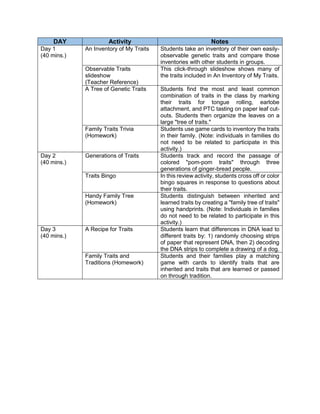
Below is a suggested sequence for implementing the activities contained in 
the unit. Please see each individual activity for implementation instructions, 
suggestions for adaptations and extensions, and applicable standards. 
UNIT CONTENT 
Introduction to Heredity 
Lesson Plans 
An Inventory of My Traits 
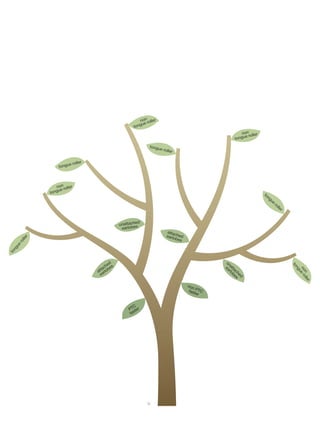
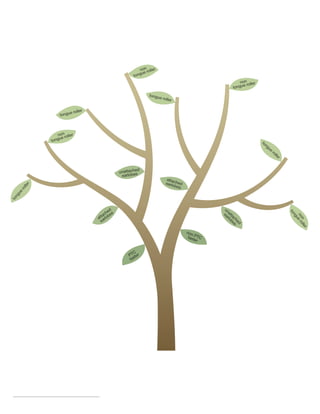
A Tree of Genetic Traits 
Generations of Traits 
Traits Bingo 
A Recipe for Traits 
Take-Home Activities 
Family Traits Trivia 
Handy Family Tree 
Family Traits & Traditions 
Teacher Resources 
Inherited Traits: 
A Quick Reference 
Sample Parent Letter (doc) 
Note About PTC Safety
DAY Activity Notes 
Day 1 
(40 mins.) 
An Inventory of My Traits Students take an inventory of their own easily-observable 
genetic traits and compare those 
inventories with other students in groups. 
Observable Traits 
slideshow 
(Teacher Reference) 
This click-through slideshow shows many of 
the traits included in An Inventory of My Traits. 
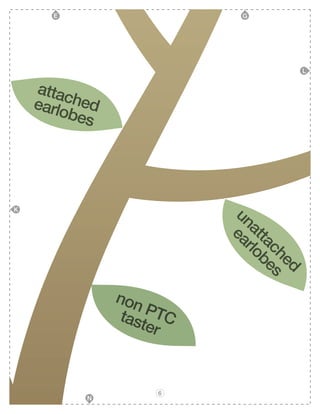
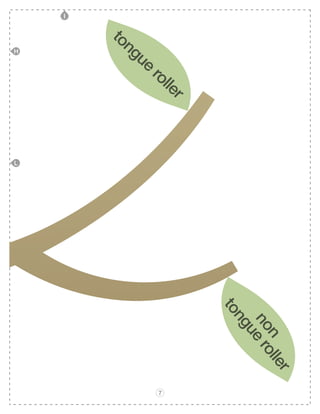
A Tree of Genetic Traits Students find the most and least common 
combination of traits in the class by marking 
their traits for tongue rolling, earlobe 
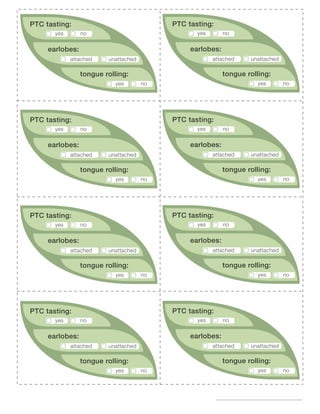
attachment, and PTC tasting on paper leaf cut-outs. 
Students then organize the leaves on a 
large "tree of traits." 
Family Traits Trivia 
(Homework) 
Students use game cards to inventory the traits 
in their family. (Note: individuals in families do 
not need to be related to participate in this 
activity.) 
Day 2 
(40 mins.) 
Generations of Traits Students track and record the passage of 
colored "pom-pom traits" through three 
generations of ginger-bread people. 
Traits Bingo In this review activity, students cross off or color 
bingo squares in response to questions about 
their traits. 
Handy Family Tree 
(Homework) 
Students distinguish between inherited and 
learned traits by creating a "family tree of traits" 
using handprints. (Note: Individuals in families 
do not need to be related to participate in this 
activity.) 
Day 3 
(40 mins.) 
A Recipe for Traits Students learn that differences in DNA lead to 
different traits by: 1) randomly choosing strips 
of paper that represent DNA, then 2) decoding 
the DNA strips to complete a drawing of a dog. 
Family Traits and 
Traditions (Homework) 
Students and their families play a matching 
game with cards to identify traits that are 
inherited and traits that are learned or passed 
on through tradition.
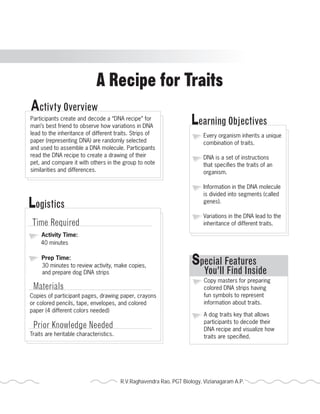
A Recipe for Traits 
Every organism inherits a unique 
combination of traits. 
DNA is a set of instructions 
that specifies the traits of an 
organism. 
Information in the DNA molecule 
is divided into segments (called 
genes). 
Variations in the DNA lead to the 
inheritance of different traits. 
Special Features 
You’ll Find Inside 
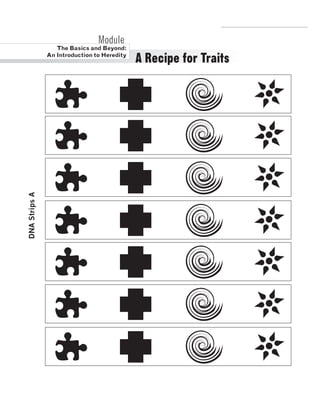
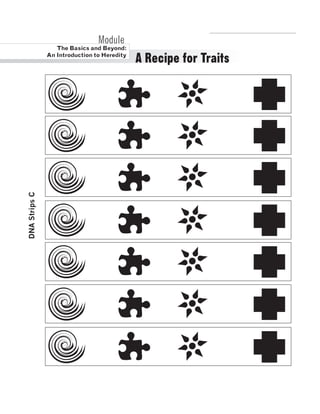
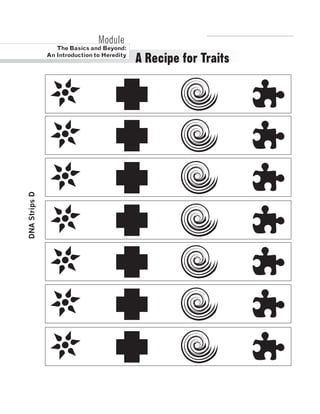
Copy masters for preparing 
colored DNA strips having 
fun symbols to represent 
information about traits. 
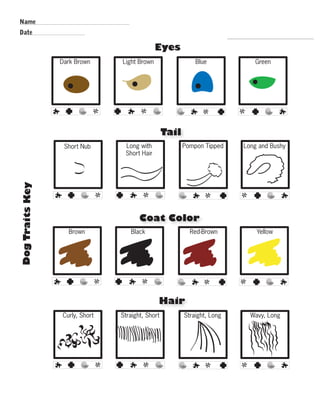
A dog traits key that allows 
participants to decode their 
DNA recipe and visualize how 
traits are specified. 
Activty Overview 
Participants create and decode a “DNA recipe” for 
man’s best friend to observe how variations in DNA 
lead to the inheritance of different traits. Strips of 
paper (representing DNA) are randomly selected 
and used to assemble a DNA molecule. Participants 
read the DNA recipe to create a drawing of their 
pet, and compare it with others in the group to note 
similarities and differences. 
Logistics 
Time Required 
Activity Time: 
40 minutes 
Prep Time: 
30 minutes to review activity, make copies, 
and prepare dog DNA strips 
Materials 
Copies of participant pages, drawing paper, crayons 
or colored pencils, tape, envelopes, and colored 
paper (4 different colors needed) 
Prior Knowledge Needed 
Traits are heritable characteristics. 
Learning Objectives 
R.V.Raghavendra Rao, PGT Biology, Vizianagaram A.P. 2013 Heredity
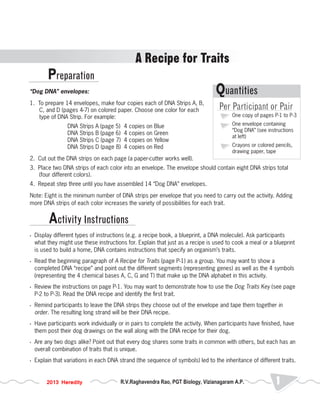
Preparation 
A Recipe for Traits 
“Dog DNA” envelopes: 
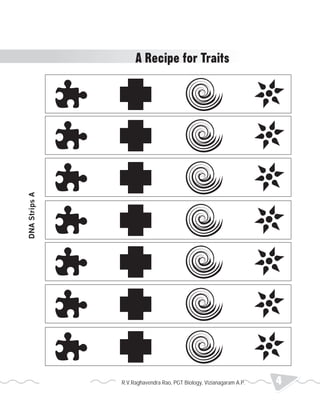
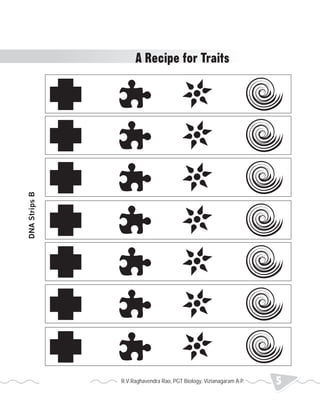
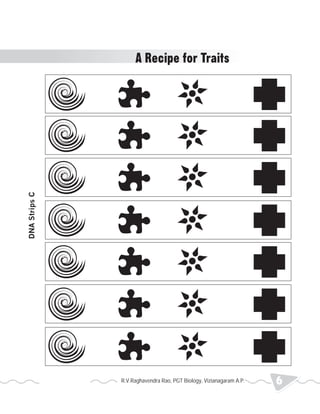
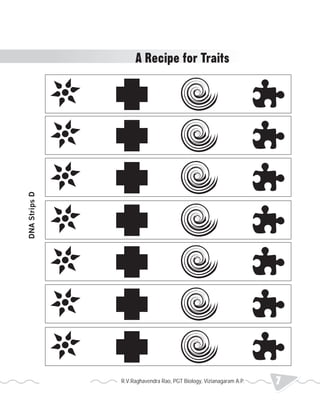
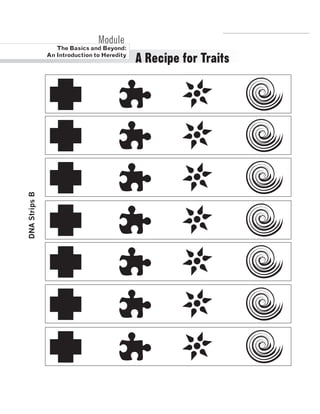
1. To prepare 14 envelopes, make four copies each of DNA Strips A, B, 
C, and D (pages 4-7) on colored paper. Choose one color for each 
type of DNA Strip. For example: 
DNA Strips A (page 5) 4 copies on Blue 
DNA Strips B (page 6) 4 copies on Green 
DNA Strips C (page 7) 4 copies on Yellow 
DNA Strips D (page 8) 4 copies on Red 
Quantities 
Per Participant or Pair 
One copy of pages P-1 to P-3 
One envelope containing 
“Dog DNA” (see instructions 
at left) 
Crayons or colored pencils, 
drawing paper, tape 
2. Cut out the DNA strips on each page (a paper-cutter works well). 
3. Place two DNA strips of each color into an envelope. The envelope should contain eight DNA strips total 
(four different colors). 
4. Repeat step three until you have assembled 14 “Dog DNA” envelopes. 
Note: Eight is the minimum number of DNA strips per envelope that you need to carry out the activity. Adding 
more DNA strips of each color increases the variety of possibilities for each trait. 
Activity Instructions 
• Display different types of instructions (e.g. a recipe book, a blueprint, a DNA molecule). Ask participants 
what they might use these instructions for. Explain that just as a recipe is used to cook a meal or a blueprint 
is used to build a home, DNA contains instructions that specify an organism’s traits. 
• Read the beginning paragraph of A Recipe for Traits (page P-1) as a group. You may want to show a 
completed DNA “recipe” and point out the different segments (representing genes) as well as the 4 symbols 
(representing the 4 chemical bases A, C, G and T) that make up the DNA alphabet in this activity. 
• Review the instructions on page P-1. You may want to demonstrate how to use the Dog Traits Key (see page 
P-2 to P-3). Read the DNA recipe and identify the first trait. 
• Remind participants to leave the DNA strips they choose out of the envelope and tape them together in 
order. The resulting long strand will be their DNA recipe. 
• Have participants work individually or in pairs to complete the activity. When participants have finished, have 
them post their dog drawings on the wall along with the DNA recipe for their dog. 
• Are any two dogs alike? Point out that every dog shares some traits in common with others, but each has an 
overall combination of traits that is unique. 
• Explain that variations in each DNA strand (the sequence of symbols) led to the inheritance of different traits. 
2013 Heredity R.V.Raghavendra Rao, PGT Biology, Vizianagaram A.P. 1
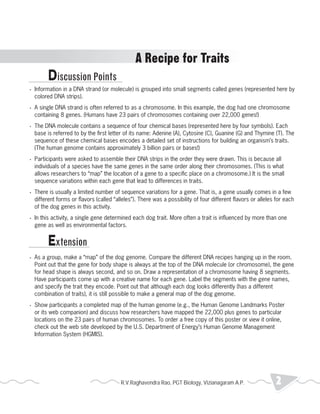
Discussion Points 
A Recipe for Traits 
• Information in a DNA strand (or molecule) is grouped into small segments called genes (represented here by 
colored DNA strips). 
• A single DNA strand is often referred to as a chromosome. In this example, the dog had one chromosome 
containing 8 genes. (Humans have 23 pairs of chromosomes containing over 22,000 genes!) 
• The DNA molecule contains a sequence of four chemical bases (represented here by four symbols). Each 
base is referred to by the first letter of its name: Adenine (A), Cytosine (C), Guanine (G) and Thymine (T). The 
sequence of these chemical bases encodes a detailed set of instructions for building an organism’s traits. 
(The human genome contains approximately 3 billion pairs or bases!) 
• Participants were asked to assemble their DNA strips in the order they were drawn. This is because all 
individuals of a species have the same genes in the same order along their chromosomes. (This is what 
allows researchers to “map” the location of a gene to a specific place on a chromosome.) It is the small 
sequence variations within each gene that lead to differences in traits. 
• There is usually a limited number of sequence variations for a gene. That is, a gene usually comes in a few 
different forms or flavors (called “alleles”). There was a possibility of four different flavors or alleles for each 
of the dog genes in this activity. 
• In this activity, a single gene determined each dog trait. More often a trait is influenced by more than one 
gene as well as environmental factors. 
Extension 
• As a group, make a “map” of the dog genome. Compare the different DNA recipes hanging up in the room. 
Point out that the gene for body shape is always at the top of the DNA molecule (or chromosome), the gene 
for head shape is always second, and so on. Draw a representation of a chromosome having 8 segments. 
Have participants come up with a creative name for each gene. Label the segments with the gene names, 
and specify the trait they encode. Point out that although each dog looks differently (has a different 
combination of traits), it is still possible to make a general map of the dog genome. 
• Show participants a completed map of the human genome (e.g., the Human Genome Landmarks Poster 
or its web companion) and discuss how researchers have mapped the 22,000 plus genes to particular 
locations on the 23 pairs of human chromosomes. To order a free copy of this poster or view it online, 
check out the web site developed by the U.S. Department of Energy’s Human Genome Management 
Information System (HGMIS). 
R.V.Raghavendra Rao, PGT Biology, Vizianagaram A.P. 2 2013 Heredity
DNA Strips A 
A Recipe for Traits 
R.V.Raghavendra Rao, PGT Biology, Vizianagaram A.P. 4 2013 Heredity
DNA Strips B 
A Recipe for Traits 
R.V.Raghavendra Rao, PGT Biology, Vizianagaram A.P. 5 2013 Heredity
DNA Strips C 
A Recipe for Traits 
R.V.Raghavendra Rao, PGT Biology, Vizianagaram A.P. 6 2013 Heredity
DNA Strips D 
A Recipe for Traits 
R.V.Raghavendra Rao, PGT Biology, Vizianagaram A.P. 7 2013 Heredity
A Recipe for Traits 
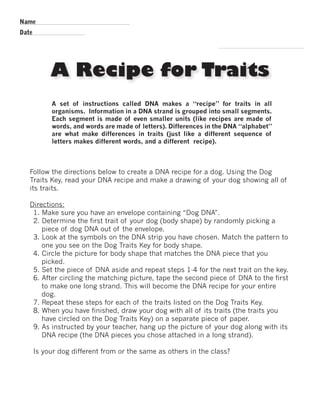
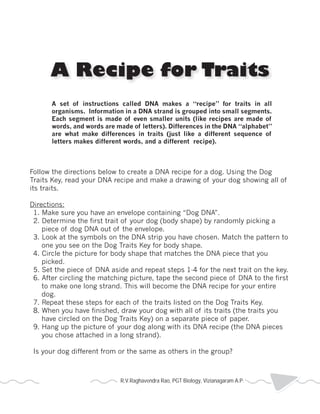
A set of instructions called DNA makes a “recipe” for traits in all 
organisms. Information in a DNA strand is grouped into small segments. 
Each segment is made of even smaller units (like recipes are made of 
words, and words are made of letters). Differences in the DNA “alphabet” 
are what make differences in traits (just like a different sequence of 
letters makes different words, and a different recipe). 
Follow the directions below to create a DNA recipe for a dog. Using the Dog 
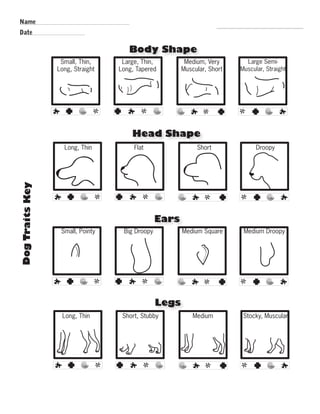
Traits Key, read your DNA recipe and make a drawing of your dog showing all of 
its traits. 
Directions: 
1. Make sure you have an envelope containing “Dog DNA”. 
2. Determine the first trait of your dog (body shape) by randomly picking a 
piece of dog DNA out of the envelope. 
3. Look at the symbols on the DNA strip you have chosen. Match the pattern to 
one you see on the Dog Traits Key for body shape. 
4. Circle the picture for body shape that matches the DNA piece that you 
picked. 
5. Set the piece of DNA aside and repeat steps 1-4 for the next trait on the key. 
6. After circling the matching picture, tape the second piece of DNA to the first 
to make one long strand. This will become the DNA recipe for your entire 
dog. 
7. Repeat these steps for each of the traits listed on the Dog Traits Key. 
8. When you have finished, draw your dog with all of its traits (the traits you 
have circled on the Dog Traits Key) on a separate piece of paper. 
9. Hang up the picture of your dog along with its DNA recipe (the DNA pieces 
you chose attached in a long strand). 
Is your dog different from or the same as others in the group? 
R.V.Raghavendra Rao, PGT Biology, Vizianagaram A.P. 2013 Heredity
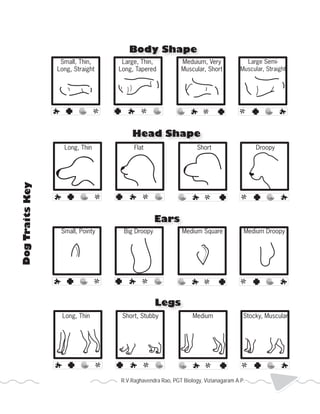
Body Shape 
Head Shape 
Ears 
Legs 
Dog Traits Key 
Small, Thin, 
Long, Straight 
Large, Thin, 
Long, Tapered 
Meduium, Very 
Muscular, Short 
Large Semi- 
Muscular, Straight 
Long, Thin Flat Short Droopy 
Small, Pointy Big Droopy Medium Square Medium Droopy 
Long, Thin Short, Stubby Medium Stocky, Muscular 
R.V.Raghavendra Rao, PGT Biology, Vizianagaram A.P. 2013 Heredity
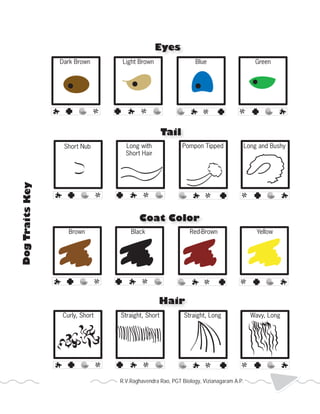
Eyes 
Dark Brown Light Brown Blue Green 
Tail 
Coat Color 
Hair 
Short Nub Long with 
Short Hair 
Pompon Tipped Long and Bushy 
Brown Black Red-Brown Yellow 
Curly, Short Straight, Short Straight, Long Wavy, Long 
Dog Traits Key 
R.V.Raghavendra Rao, PGT Biology, Vizianagaram A.P. 2013 Heredity
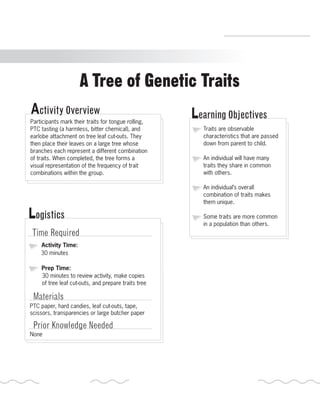
A Tree of Genetic Traits 
Activity Overview Learning Objectives 
Traits are observable 
characteristics that are passed 
down from parent to child. 
An individual will have many 
traits they share in common 
with others. 
An individual’s overall 
combination of traits makes 
them unique. 
Some traits are more common 
in a population than others. 
Participants mark their traits for tongue rolling, 
PTC tasting (a harmless, bitter chemical), and 
earlobe attachment on tree leaf cut-outs. They 
then place their leaves on a large tree whose 
branches each represent a different combination 
of traits. When completed, the tree forms a 
visual representation of the frequency of trait 
combinations within the group. 
Logistics 
Time Required 
Activity Time: 
30 minutes 
Prep Time: 
30 minutes to review activity, make copies 
of tree leaf cut-outs, and prepare traits tree 
Materials 
PTC paper, hard candies, leaf cut-outs, tape, 
scissors, transparencies or large butcher paper 
Prior Knowledge Needed 
None 
R.V.Raghavendra Rao 
Department of Biology
R.V.Raghavendra Rao 
Department of Biology 
Quantities 
Per Participant 
One leaf cut-out, hard candy, 
piece of PTC paper 
1 
A Tree of Genetic Traits 
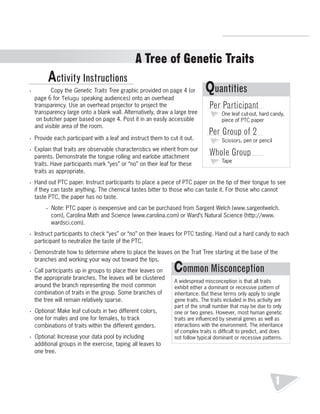
Activity Instructions 
Per Group of 2 
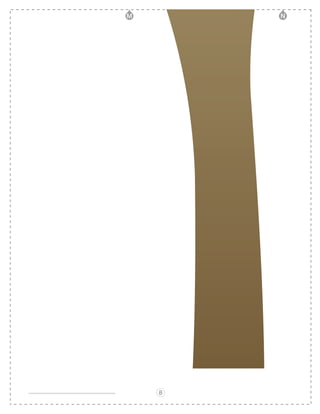
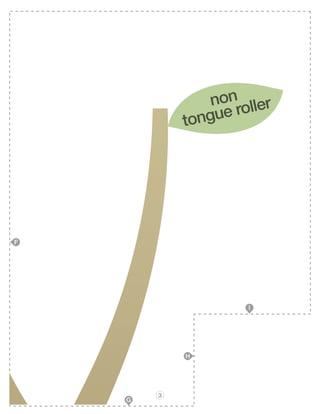
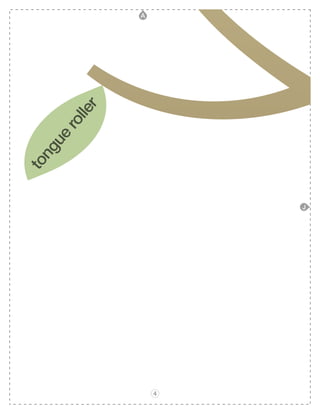
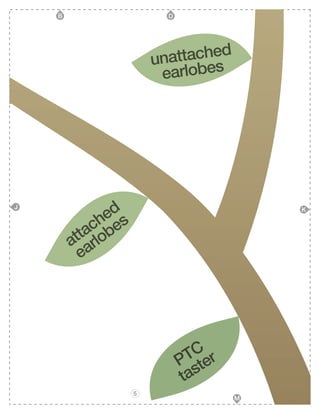
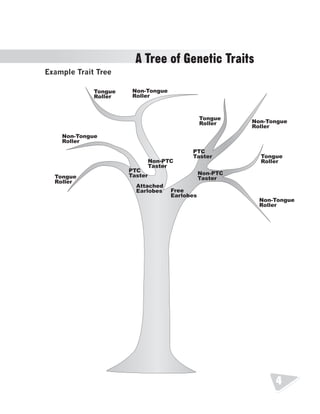
• Copy the Genetic Traits Tree graphic provided on page 4 (or 
page 6 for Telugu speaking audiences) onto an overhead 
transparency. Use an overhead projector to project the 
transparency large onto a blank wall. Alternatively, draw a large tree 
on butcher paper based on page 4. Post it in an easily accessible 
and visible area of the room. 
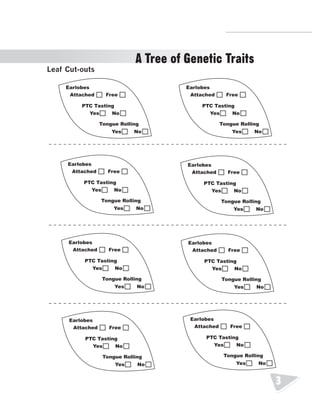
• Provide each participant with a leaf and instruct them to cut it out. 
Scissors, pen or pencil 
• Explain that traits are observable characteristics we inherit from our 
Whole Group 
parents. Demonstrate the tongue rolling and earlobe attachment 
traits. Have participants mark “yes” or “no” on their leaf for these 
Tape 
traits as appropriate. 
• Hand out PTC paper. Instruct participants to place a piece of PTC paper on the tip of their tongue to see 
if they can taste anything. The chemical tastes bitter to those who can taste it. For those who cannot 
taste PTC, the paper has no taste. 
• Note: PTC paper is inexpensive and can be purchased from Sargent Welch (www.sargentwelch. 
com), Carolina Math and Science (www.carolina.com) or Ward’s Natural Science (http://www. 
wardsci.com). 
• Instruct participants to check “yes” or “no” on their leaves for PTC tasting. Hand out a hard candy to each 
participant to neutralize the taste of the PTC. 
• Demonstrate how to determine where to place the leaves on the Trait Tree starting at the base of the 
branches and working your way out toward the tips. 
Common • Call participants up in groups to place their leaves on 
Misconception 
the appropriate branches. The leaves will be clustered 
A widespread misconception is that all traits 
around the branch representing the most common 
exhibit either a dominant or recessive pattern of 
combination of traits in the group. Some branches of 
inheritance. But these terms only apply to single 
the tree will remain relatively sparse. 
gene traits. The traits included in this activity are 
part of the small number that may be due to only 
• Optional: Make leaf cut-outs in two different colors, 
one or two genes. However, most human genetic 
one for males and one for females, to track 
traits are influenced by several genes as well as 
combinations of traits within the different genders. 
interactions with the environment. The inheritance 
of complex traits is difficult to predict, and does 
• Optional: Increase your data pool by including 
not follow typical dominant or recessive patterns. 
additional groups in the exercise, taping all leaves to 
one tree.
R.V.Raghavendra Rao 
Department of Biology 
2 
A Tree of Genetic Traits 
Discussion Points 
• Some traits are more common in a population than others. What is the most common combination of traits 
in the group? What is the least common combination of traits in the group? 
• Every person has a unique combination of traits. If we were to look at more traits than three, we would 
eventually need a branch on the Trait Tree for each person in the group.
R.V.Raghavendra Rao 
Department of Biology 
3 
A Tree of Genetic Traits 
LAenaf I nCvuetn-toourtys of My Traits: Leaf Cut-Outs 
Earlobes 
Attached Free 
PTC Tasting 
Yes No 
Tongue Rolling 
Yes No 
Earlobes 
Attached Free 
PTC Tasting 
Yes No 
Tongue Rolling 
Yes No 
Earlobes 
Attached Free 
PTC Tasting 
Yes No 
Tongue Rolling 
Yes No 
Earlobes 
Attached Free 
PTC Tasting 
Yes No 
Tongue Rolling 
Yes No 
Earlobes 
Attached Free 
PTC Tasting 
Yes No 
Tongue Rolling 
Yes No 
Earlobes 
Attached Free 
PTC Tasting 
Yes No 
Tongue Rolling 
Yes No 
Earlobes 
Attached Free 
PTC Tasting 
Yes No 
Tongue Rolling 
Yes No 
Earlobes 
Attached Free 
PTC Tasting 
Yes No 
Tongue Rolling 
Yes No
4 
A Tree of Genetic Traits 
Example Trait Tree 
Non-PTC 
Taster 
PTC 
Taster 
PTC 
Taster Non-PTC 
Tongue Taster 
Roller 
Attached 
Earlobes Free 
Earlobes 
Tongue 
Roller 
Tongue 
Roller 
Tongue 
Roller 
Non-Tongue 
Roller 
Non-Tongue 
Roller 
Non-Tongue 
Roller 
Non-Tongue 
Roller
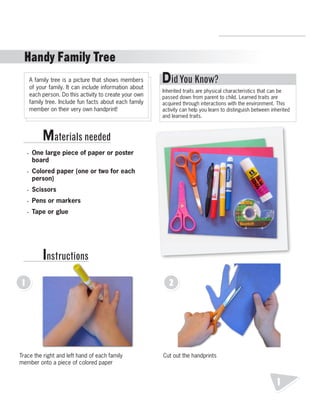
Materials needed 
• One large piece of paper or poster 
board 
• Colored paper (one or two for each 
person) 
• Scissors 
• Pens or markers 
• Tape or glue 
Instructions 
R.V.Raghavendra Rao 
Inherited traits are physical characteristics that can be 
passed down from parent to child. Learned traits are 
acquired through interactions with the environment. This 
activity can help you learn to distinguish between inherited 
and learned traits. 
1 2 
1 
Handy Family Tree 
Trace the right and left hand of each family 
member onto a piece of colored paper 
Cut out the handprints 
A family tree is a picture that shows members 
of your family. It can include information about 
each person. Do this activity to create your own 
family tree. Include fun facts about each family 
member on their very own handprint! 
Did You Know? 
Department of Biology
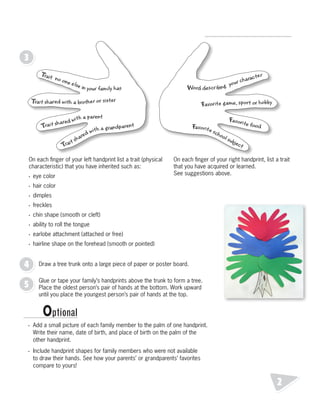
Trait no one else in your family has 
Trait shared with a brother or sister 
Trait shared with a parent 
Trait shared with a grandparent 
On each finger of your left handprint list a trait (physical 
characteristic) that you have inherited such as: 
• eye color 
• hair color 
• dimples 
• freckles 
• chin shape (smooth or cleft) 
• ability to roll the tongue 
• earlobe attachment (attached or free) 
• hairline shape on the forehead (smooth or pointed) 
R.V.Raghavendra Rao 
On each finger of your right handprint, list a trait 
that you have acquired or learned. 
See suggestions above. 
Glue or tape your family’s handprints above the trunk to form a tree. 
Place the oldest person’s pair of hands at the bottom. Work upward 
until you place the youngest person’s pair of hands at the top. 
Optional 
Word describing your character 
Favorite game, sport or hobby 
Favorite food 
Favorite school subject 
3 
4 
5 
2 
Draw a tree trunk onto a large piece of paper or poster board. 
• Add a small picture of each family member to the palm of one handprint. 
Write their name, date of birth, and place of birth on the palm of the 
other handprint. 
• Include handprint shapes for family members who were not available 
to draw their hands. See how your parents’ or grandparents’ favorites 
compare to yours! 
Department of Biology
R.V.Raghavendra Rao 
Department of Biology 
Inherited Human Traits: A Quick Reference 
Special Features 
You’ll Find Inside 
Photos of common heritable 
traits and accompanying 
background information. 
Activity Overview 
Background information about genes, traits and 
inheritance that supports the activities included in 
the Heredity & Traits section of the Learn.Genetics 
website. Includes a pictorial reference of inherited 
human traits, along with inheritance patterns, 
frequencies and other interesting facts about each. 
1
R.V.Raghavendra Rao 
Department of Biology 
Inherited Human Traits: A Quick Reference 
Background Information 
Physical traits are observable characteristics determined by specific segments of DNA called genes. Multiple 
genes are grouped together to form chromosomes, which reside in the nucleus of the cell. Every cell (except 
eggs and sperm) in an individual’s body contains two copies of each gene. This is due to the fact that both 
mother and father contribute a copy at the time of conception. This original genetic material is copied each time 
a cell divides so that all cells contain the same DNA. Genes store the information needed for the cell to assemble 
proteins, which eventually yield specific physical traits. 
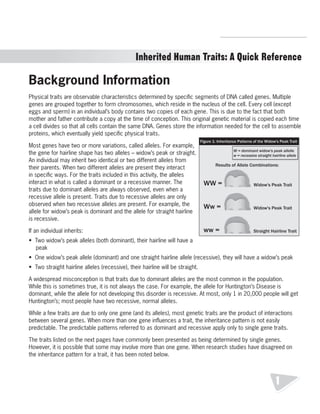
Figure 1: Inheritance Patterns of the Widow's Peak Trait 
Most genes have two or more variations, called alleles. For example, 
the gene for hairline shape has two alleles – widow’s peak or straight. 
W = dominant widow's peak allelle 
w = recessive straight hairline allele 
An individual may inherit two identical or two different alleles from 
their parents. When two different alleles are present they interact 
Results of Allele Combinations: 
in specific ways. For the traits included in this activity, the alleles 
interact in what is called a dominant or a recessive manner. The 
WW = 
Widow's Peak Trait 
traits due to dominant alleles are always observed, even when a 
recessive allele is present. Traits due to recessive alleles are only 
observed when two recessive alleles are present. For example, the 
Ww = 
allele for widow’s peak is dominant and the allele for straight hairline 
Widow's Peak Trait 
is recessive. 
If an individual inherits: 
ww = 
Straight Hairline Trait 
• Two widow’s peak alleles (both dominant), their hairline will have a 
peak 
• One widow’s peak allele (dominant) and one straight hairline allele (recessive), they will have a widow’s peak 
• Two straight hairline alleles (recessive), their hairline will be straight. 
A widespread misconception is that traits due to dominant alleles are the most common in the population. 
While this is sometimes true, it is not always the case. For example, the allele for Huntington’s Disease is 
dominant, while the allele for not developing this disorder is recessive. At most, only 1 in 20,000 people will get 
Huntington’s; most people have two recessive, normal alleles. 
While a few traits are due to only one gene (and its alleles), most genetic traits are the product of interactions 
between several genes. When more than one gene influences a trait, the inheritance pattern is not easily 
predictable. The predictable patterns referred to as dominant and recessive apply only to single gene traits. 
The traits listed on the next pages have commonly been presented as being determined by single genes. 
However, it is possible that some may involve more than one gene. When research studies have disagreed on 
the inheritance pattern for a trait, it has been noted below. 
1
R.V.Raghavendra Rao 
Inherited Human Traits: A Quick Reference 
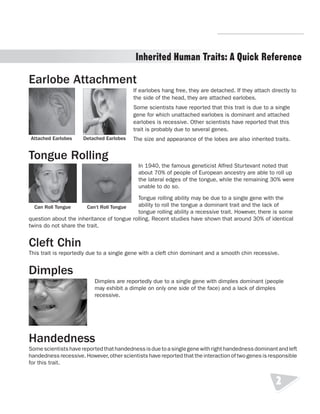
Earlobe Attachment 
Attached Earlobes Detached Earlobes 
If earlobes hang free, they are detached. If they attach directly to 
the side of the head, they are attached earlobes. 
Some scientists have reported that this trait is due to a single 
gene for which unattached earlobes is dominant and attached 
earlobes is recessive. Other scientists have reported that this 
trait is probably due to several genes. 
The size and appearance of the lobes are also inherited traits. 
Tongue Rolling 
In 1940, the famous geneticist Alfred Sturtevant noted that 
about 70% of people of European ancestry are able to roll up 
the lateral edges of the tongue, while the remaining 30% were 
unable to do so. 
Tongue rolling ability may be due to a single gene with the 
ability to roll the tongue a dominant trait and the lack of 
tongue rolling ability a recessive trait. However, there is some 
question about the inheritance of tongue rolling. Recent studies have shown that around 30% of identical 
twins do not share the trait. 
Cleft Chin 
This trait is reportedly due to a single gene with a cleft chin dominant and a smooth chin recessive. 
Dimples 
Dimples are reportedly due to a single gene with dimples dominant (people 
may exhibit a dimple on only one side of the face) and a lack of dimples 
recessive. 
Handedness 
Some scientists have reported that handedness is due to a single gene with right handedness dominant and left 
handedness recessive. However, other scientists have reported that the interaction of two genes is responsible 
for this trait. 
2 
Can Roll Tongue Can’t Roll Tongue 
Department of Biology
R.V.Raghavendra Rao 
Inherited Human Traits: A Quick Reference 
Freckles 
This trait is reportedly due to a single gene; the presence of freckles is dominant, the absence of freckles 
is recessive1. 
Naturally Curly Hair 
Early geneticists reported that curly hair was dominant and straight hair was recessive. More recent studies 
suggest that more than one gene may be involved. 
Allergies 
While allergic reactions are induced by things a person comes in contact with, such as dust, particular 
foods, and pollen, the tendency to have allergies is inherited. If a parent has allergies, there is a one in 
four (25%) chance that their child will also have allergy problems. This risk increases if both parents have 
allergies2. 
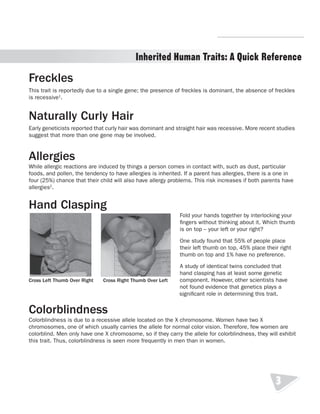
Hand Clasping 
Fold your hands together by interlocking your 
fingers without thinking about it. Which thumb 
is on top – your left or your right? 
One study found that 55% of people place 
their left thumb on top, 45% place their right 
thumb on top and 1% have no preference. 
A study of identical twins concluded that 
hand clasping has at least some genetic 
component. However, other scientists have 
not found evidence that genetics plays a 
significant role in determining this trait. 
Colorblindness 
Colorblindness is due to a recessive allele located on the X chromosome. Women have two X 
chromosomes, one of which usually carries the allele for normal color vision. Therefore, few women are 
colorblind. Men only have one X chromosome, so if they carry the allele for colorblindness, they will exhibit 
this trait. Thus, colorblindness is seen more frequently in men than in women. 
3 
Cross Left Thumb Over Right Cross Right Thumb Over Left 
Department of Biology
R.V.Raghavendra Rao 
Inherited Human Traits: A Quick Reference 
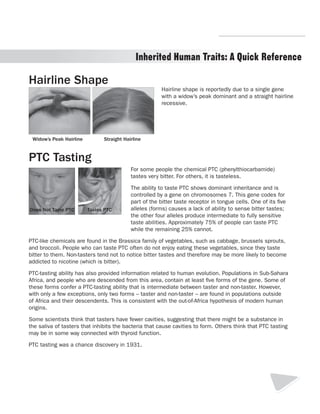
Hairline shape is reportedly due to a single gene 
with a widow’s peak dominant and a straight hairline 
recessive. 
Hairline Shape 
Widow’s Peak Hairline Straight Hairline 
PTC Tasting 
For some people the chemical PTC (phenylthiocarbamide) 
tastes very bitter. For others, it is tasteless. 
The ability to taste PTC shows dominant inheritance and is 
controlled by a gene on chromosomes 7. This gene codes for 
part of the bitter taste receptor in tongue cells. One of its five 
alleles (forms) causes a lack of ability to sense bitter tastes; 
the other four alleles produce intermediate to fully sensitive 
taste abilities. Approximately 75% of people can taste PTC 
while the remaining 25% cannot. 
PTC-like chemicals are found in the Brassica family of vegetables, such as cabbage, brussels sprouts, 
and broccoli. People who can taste PTC often do not enjoy eating these vegetables, since they taste 
bitter to them. Non-tasters tend not to notice bitter tastes and therefore may be more likely to become 
addicted to nicotine (which is bitter). 
PTC-tasting ability has also provided information related to human evolution. Populations in Sub-Sahara 
Africa, and people who are descended from this area, contain at least five forms of the gene. Some of 
these forms confer a PTC-tasting ability that is intermediate between taster and non-taster. However, 
with only a few exceptions, only two forms – taster and non-taster – are found in populations outside 
of Africa and their descendents. This is consistent with the out-of-Africa hypothesis of modern human 
origins. 
Some scientists think that tasters have fewer cavities, suggesting that there might be a substance in 
the saliva of tasters that inhibits the bacteria that cause cavities to form. Others think that PTC tasting 
may be in some way connected with thyroid function. 
PTC tasting was a chance discovery in 1931. 
4 
Does Not Taste PTC Tastes PTC 
Department of Biology
R.V.Raghavendra Rao 
Department of Biology 
Pick the Risk: The Polygenic Pedigree Challenge 
Activity Overview 
Participants are challenged to track and record the 
passage of colored pom poms (representing genes) 
through generations of a family using a pedigree. 
Participants learn that common chronic diseases 
(such as heart disease) run in families and are 
caused by the combined action of multiple genes. 
Activity Time: 
Prep Time: 
30 - 45 minutes 30 minutes 
Logistics 
Time Required 
Materials 
Copies of participant pages, colored pencils or 
crayons, disposable cups, colored pom poms 
Prior Knowledge Needed 
Genes are passed from parents to offspring 
and contribute to observable physical 
characteristics. Pedigrees are used to track 
genetic information. 
Learning Objectives 
An inherited trait can be determined 
by one or by many genes. 
All humans have the same genes, 
but each inherits slightly different 
forms or “flavors” of each gene. 
Many common diseases (such as 
heart disease) run in families and 
have a genetic component. 
Most common diseases are caused 
by the combined action of multiple 
genes and environmental factors. 
An individual’s risk of developing 
a common disease is estimated 
by looking at siblings, parents and 
grandparents in a family medical 
history.
Pick the Risk: The Polygenic Pedigree Challenge 
Quantities 
Per Group of 2 
To engage participants in this topic: 
• Compare the prevalence of rare genetic disorders caused by a single 
gene such as cystic fibrosis (1 in 10,000) with the prevalence of more 
common diseases such as heart disease (1 in 3). 
• Ask the participants: Do common diseases like heart disease, diabetes, 
or colon cancer have a genetic component? 
• Explain that most common diseases do have a genetic component and 
tend to run in families. However, common diseases differ from rare 
genetic disorders in that they are usually not caused by defects in a 
single gene. Rather, they result from the combined effects of multiple 
genes and environmental factors. Thus, they are called multifactorial diseases. 
• Explain that because more than one gene is involved in most common diseases, the inheritance of a 
common disease is not predictable. 
• Information found in a family health history and recorded on a pedigree is used to estimate an individual’s 
genetic risk (low, medium, or high) of developing a common disease. 
Begin activity: 
• Explain that the following activity will explore how common “polygenic” diseases (in this case, heart disease) 
are inherited. 
• Invite participants to find a partner with whom they will work to complete the activity; pass out the participant 
pages and other materials. 
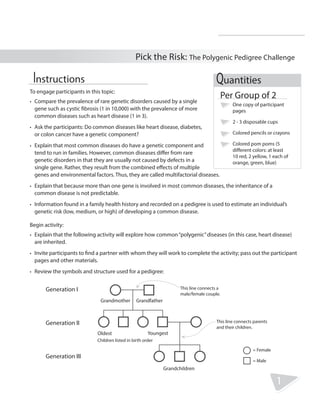
• Review the symbols and structure used for a pedigree: 
1 
Instructions 
One copy of participant 
pages 
2 - 3 disposable cups 
Colored pencils or crayons 
Colored pom poms (5 
different colors: at least 
10 red, 2 yellow, 1 each of 
orange, green, blue) 
Generation I 
Grandmother 
Grandfather 
Children listed in birth order 
This line connects parents 
and their children. 
= Female 
= Male 
This line connects a 
male/female couple. 
Oldest Youngest 
Grandchildren 
Generation II 
Generation III 
R.V.Raghavendra Rao 
Department of Biology
R.V.Raghavendra Rao 
Department of Biology 
Pick the Risk: The Polygenic Pedigree Challenge 
Common Misconception 
Participants may think that all heritable traits 
(and genetic disorders) are caused by a single 
gene and exhibit dominant or recessive patterns 
of inheritance. But more commonly, traits result 
from the combined action of many genes and 
environmental factors. Such multifactorial traits 
can exhibit varied and complex patterns of 
inheritance that are not easy to predict. 
2 
• Invite participants to begin by following the instructions 
found on pages P-1 and P-2; each pair of participants should 
complete the pedigree analysis and answer the questions that 
follow. 
Group discussion: 
• Point out that this activity differs from reality in the following 
ways: 
»» The number of genes contributing to a polygenic disease is 
usually not known. 
»» The number of genes carried by parents or offspring that 
can increase heart disease risk is not known. 
»» Environmental factors can also vary an individual’s risk of developing multifactorial diseases. 
• Discuss the following questions as a group, comparing and contrasting the Pedigree results obtained by 
each pair: 
»» The grandfather in this family was a “high risk” individual. How many of his children were either medium 
or high risk individuals? How many of his grandchildren were either medium or high risk individuals? 
(Answers will vary.) 
»» Did the number of “medium risk” and “high risk” individuals decrease or increase over subsequent 
generations? Why do you think that happened? (Answer: Decrease. Risk of inheriting heart disease 
from an affected individual (suchas a grandparent) decreases through the generations because it is 
unlikely that all of the necessary risk factors [genes] will be passed down to less closely related family 
members.) 
»» In this activity you were able to label family members as having a low, medium or high risk of developing 
heart disease. In reality, do you think it might be difficult to predict an individual’s risk of developing heart 
disease? Why? (Answer: An individual’s risk of developing heart disease IS difficult to predict because of 
the reasons outlined under the first group discussion point.) 
»» If a parent is diagnosed with heart disease, does that mean the children will have it also? Defend your 
answer. (Be sure to include the key word “risk” in your answer.) (Answer: Not necessarily. But because 
heart disease does have a genetic component, children of an affected parent have an increased risk of 
developing heart disease relative to the population at large.) 
• Emphasize that these are a few of the reasons why heart disease and other common diseases are so 
complex, and why the inheritance pattern for such diseases are difficult to predict. 
• Therefore, individuals are placed in general categories (high, medium, or low risk groups) based on features 
from their family health history that correlate with a certain probability of developing a disease. 
»» For example, it is said that an individual who has a parent (or possibly a grandparent) with heart disease 
may be “at risk” and should take steps to protect themselves. 
• Describe the important features to identify in a family health history (see chart at http://learn.genetics.utah. 
edu/units/health), including what is meant by a “close” relative.
R.V.Raghavendra Rao 
Department of Biology 
Pick the Risk: The Polygenic Pedigree Challenge 
3 
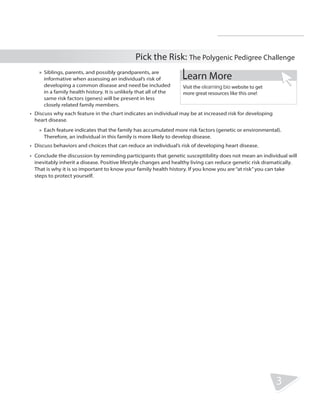
»» Siblings, parents, and possibly grandparents, are 
informative when assessing an individual’s risk of 
developing a common disease and need be included 
in a family health history. It is unlikely that all of the 
same risk factors (genes) will be present in less 
closely related family members. 
Learn More 
Visit the elearning bio website to get 
more great resources like this one! 
• Discuss why each feature in the chart indicates an individual may be at increased risk for developing 
heart disease. 
»» Each feature indicates that the family has accumulated more risk factors (genetic or environmental). 
Therefore, an individual in this family is more likely to develop disease. 
• Discuss behaviors and choices that can reduce an individual’s risk of developing heart disease. 
• Conclude the discussion by reminding participants that genetic susceptibility does not mean an individual will 
inevitably inherit a disease. Positive lifestyle changes and healthy living can reduce genetic risk dramatically. 
That is why it is so important to know your family health history. If you know you are “at risk” you can take 
steps to protect yourself.
Risk Continuum 
Activity Overview Learning Objectives 
People can be assigned to a 
risk group for developing heart 
and other diseases based on 
family history/genetics. 
Lifestyle choices can positively 
or negatively influence the risk 
of developing heart disease. 
A higher risk means a greater 
chance of developing heart 
disease, not an inevitability of 
developing it. 
Though a lower risk means 
there is a reduced chance, it is 
still possible for members of 
this risk group to develop heart 
disease. 
Special Features 
You’ll Find Inside 
Diagrams to help set up the 
demonstration. 
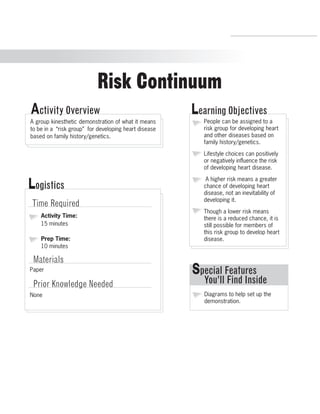
A group kinesthetic demonstration of what it means 
to be in a “risk group” for developing heart disease 
based on family history/genetics. 
Logistics 
Time Required 
Activity Time: 
15 minutes 
Prep Time: 
10 minutes 
Materials 
Paper 
Prior Knowledge Needed 
None 
R.V.Raghavendra Rao 
Department of Biology
R.V.Raghavendra Rao 
Department of Biology 
Risk Continuum 
Activity Instructions 
Participant Action 
1. Starting with the participant most at risk (left) 
have each person choose a Lifestyle Choice 
card without looking. 
1 
1 
1 
2 
3 
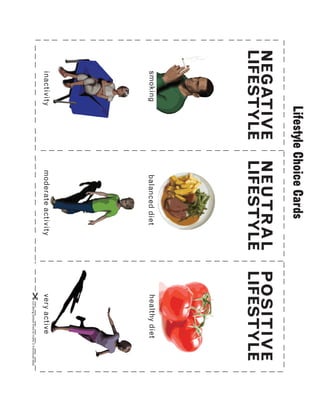
10 copies of Lifestyle Choice 
Cards, cut to form individual 
cards, (30 total). Shuffle 
them and place them in a bag 
or other container. 
Leader Action 
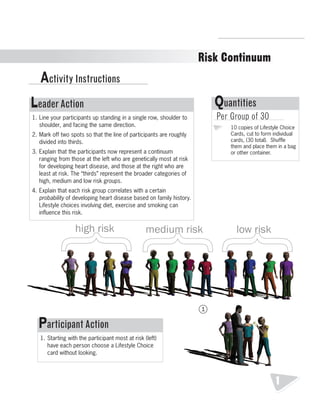
1. Line your participants up standing in a single row, shoulder to 
shoulder, and facing the same direction. 
2. Mark off two spots so that the line of participants are roughly 
divided into thirds. 
3. Explain that the participants now represent a continuum 
ranging from those at the left who are genetically most at risk 
for developing heart disease, and those at the right who are 
least at risk. The “thirds” represent the broader categories of 
high, medium and low risk groups. 
4. Explain that each risk group correlates with a certain 
probability of developing heart disease based on family history. 
Lifestyle choices involving diet, exercise and smoking can 
influence this risk. 
Quantities 
Per Group of 30
Risk Continuum 
2 
3 
4 
5 
6 
7 
8 
9 
1 space 
2 spaces 
Participant Action (cont.) 2 
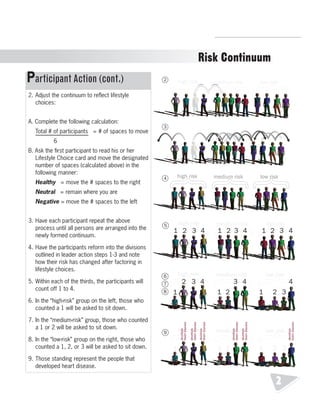
2. Adjust the continuum to reflect lifestyle 
choices: 
A. Complete the following calculation: 
Total # of participants = # of spaces to move 
6 
B. Ask the first participant to read his or her 
Lifestyle Choice card and move the designated 
number of spaces (calculated above) in the 
following manner: 
Healthy = move the # spaces to the right 
Neutral = remain where you are 
Negative = move the # spaces to the left 
3. Have each participant repeat the above 
process until all persons are arranged into the 
newly formed continuum. 
4. Have the participants reform into the divisions 
outlined in leader action steps 1-3 and note 
how their risk has changed after factoring in 
lifestyle choices. 
5. Within each of the thirds, the participants will 
count off 1 to 4. 
6. In the “high-risk” group on the left, those who 
counted a 1 will be asked to sit down. 
7. In the “medium-risk” group, those who counted 
a 1 or 2 will be asked to sit down. 
8. In the “low-risk” group on the right, those who 
counted a 1, 2, or 3 will be asked to sit down. 
9. Those standing represent the people that 
developed heart disease. 
R.V.Raghavendra Rao 
Department of Biology
R.V.Raghavendra Rao 
Department of Biology 
Risk Continuum 
Discussion Points 
• People in all risk groups develop heart disease with the largest percentage being from the “high” risk group. 
• Not all people in the high risk group develop heart disease. 
• Making positive or neutral lifestyle choices can influence your risk enough to prevent developing heart disease. 
(Ask participants for which this was true to raise their hands). 
• Sometimes, people who make positive or neutral lifestyle choices still develop heart disease (Ask participants for 
which this was true to raise their hands). 
• Some people who make negative lifestyle choices do not develop heart disease, even though their risk is 
increased. 
3
Lifestyle Choice Cards
R.V.Raghavendra Rao 
Department of Biology 
Did You Know? 
Inherited traits are physical 
characteristics that can be passed 
down from parent to child. 
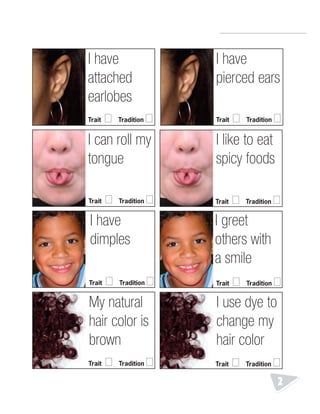
Hint 
Cards with matching pictures have 
different phrases. One card in 
the pair describes a trait, and the 
other card in the pair describes a 
tradition. 
1 
Traits and Traditions: A Make-a-Match Game 
Traits can be inherited from a parent, or traits can be learned. 
Family and cultural traditions often influence learned traits. 
Can you think of a trait you have inherited? How about a 
trait that you have acquired by learning or tradition? Play this 
game to discover some common traits and traditions! 
Preparation 
Object of the game 
• Cut out the game cards. You may want to glue or tape the pages to heavy paper first. 
• Use your memory to find the cards with matching pictures. The person to collect the most matches wins! 
Instructions 
1. Place the game cards face down and spread them out. Decide which player will go first. 
2. The first player turns over two cards, looking for a match. All players should have a chance to see the 
pictures on the two cards. 
3. Read each card. Decide whether it describes an inherited trait (something you are born with) or a tradition 
(something you learn). Record your answer by checking the box next to “trait” or “tradition”. 
4. If the pictures on the cards MATCH, the player keeps the cards and 
takes another turn. If the pictures on the cards DO NOT MATCH, the 
player does not keep the cards. The cards are again turned face 
down. 
5. The next player turns over two more cards, looking for a match. 
Continue to label each card as either a trait or a tradition. 
6. Play until all the matches have been found. The person to collect the 
most matches wins! 
This project is supported by grant U33MC00157 from the Health Resources and Services Administration, Maternal and Child Health 
Bureau, Genetic Services Branch and the March of Dimes. 
To learn about our permissions policy, visit http://learn.genetics.utah.edu/permissions/
R.V.Raghavendra Rao 
Department of Biology 
2 
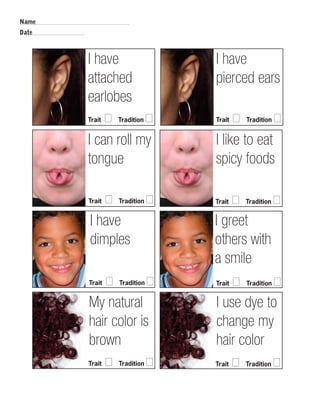
I have 
attached 
earlobes 
Trait □ Tradition □ 
I have 
pierced ears 
Trait □ Tradition □ 
I can roll my 
tongue 
I like to eat 
spicy foods 
Trait □ Tradition □ Trait □ Tradition □ 
I have 
dimples 
I greet 
others with 
a smile 
Trait □ Tradition □ Trait □ Tradition □ 
My natural 
hair color is 
brown 
I use dye to 
change my 
hair color 
Trait □ Tradition □ Trait □ Tradition □
R.V.Raghavendra Rao 
Department of Biology 
3 
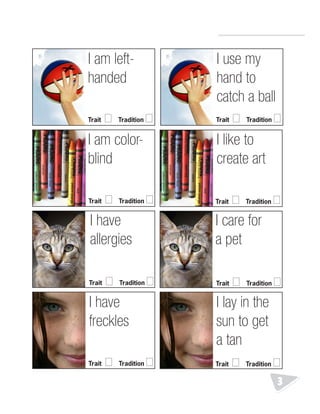
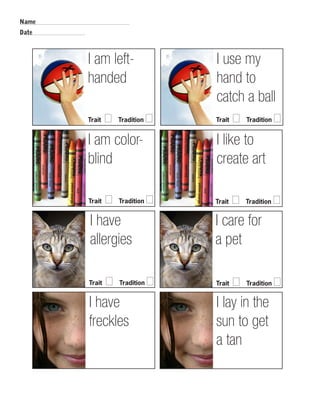
I am left-handed 
Trait □ Tradition □ 
I use my 
hand to 
catch a ball 
Trait □ Tradition □ 
I am color-blind 
I like to 
create art 
Trait □ Tradition □ Trait □ Tradition □ 
I have 
allergies 
I care for 
a pet 
Trait □ Tradition □ Trait □ Tradition □ 
I have 
freckles 
I lay in the 
sun to get 
a tan 
Trait □ Tradition □ Trait □ Tradition □
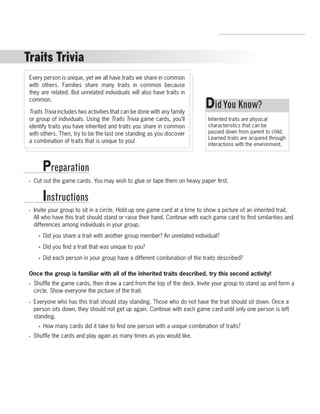
Traits Trivia 
Every person is unique, yet we all have traits we share in common 
with others. Families share many traits in common because 
they are related. But unrelated individuals will also have traits in 
common. 
Traits Trivia includes two activities that can be done with any family 
or group of individuals. Using the Traits Trivia game cards, you’ll 
identify traits you have inherited and traits you share in common 
with others. Then, try to be the last one standing as you discover 
a combination of traits that is unique to you! 
Preparation 
Instructions 
R.V.Raghavendra Rao 
Department of Biology 
• Cut out the game cards. You may wish to glue or tape them on heavy paper first. 
• Invite your group to sit in a circle. Hold up one game card at a time to show a picture of an inherited trait. 
All who have this trait should stand or raise their hand. Continue with each game card to find similarities and 
differences among individuals in your group. 
»» Did you share a trait with another group member? An unrelated individual? 
»» Did you find a trait that was unique to you? 
»» Did each person in your group have a different combination of the traits described? 
Once the group is familiar with all of the inherited traits described, try this second activity! 
• Shuffle the game cards, then draw a card from the top of the deck. Invite your group to stand up and form a 
circle. Show everyone the picture of the trait. 
• Everyone who has this trait should stay standing. Those who do not have the trait should sit down. Once a 
person sits down, they should not get up again. Continue with each game card until only one person is left 
standing. 
»» How many cards did it take to find one person with a unique combination of traits? 
• Shuffle the cards and play again as many times as you would like. 
Did You Know? 
Inherited traits are physical 
characteristics that can be 
passed down from parent to child. 
Learned traits are acquired through 
interactions with the environment.
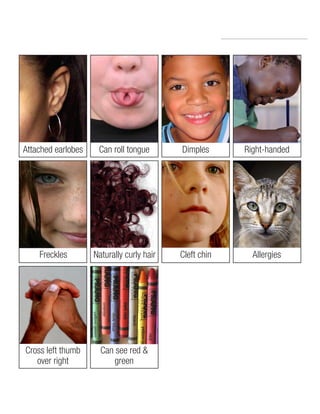
Attached earlobes Can roll tongue Dimples Right-handed 
Freckles Naturally curly hair Cleft chin Allergies 
Cross left thumb 
over right 
Can see red & 
green 
R.V.Raghavendra Rao 
Department of Biology
R.V.Raghavendra Rao 
Department of Biology 
What’s Your Family Health Story? 
How to Gather Family Health Information 
Recording family health information and sharing it with your 
doctor is an important first step to improving your health, 
regardless of your family structure. 
Tracking diseases that run in your family will help your doctor better predict what you need 
to do to stay healthy. 
The next time you’re at a family gathering, make 
sharing your family health stories a tradition. It may 
save your life and the lives of those you love! 
Getting Started 
Explain to your relatives that you are interested 
in the family’s health story. Collect some basic 
health information about your family members 
using the Health Family Tree Information Boxes. 
Let them know that any information they 
provide will help you and your entire family 
improve their health. 
“The knowledge a person has 
of their family’s health history 
could be life saving, if that person 
chooses to heed the possibilities” 
- Judy 
Common Health Problems that Run in Families 
• Heart disease 
• Cancer 
• Stroke 
• Diabetes 
• Asthma 
• Osteoporosis 
• High blood pressure 
• High cholesterol 
• Depression 
“ The only thing you have 
control over in your family 
health history is to empower 
yourself enough to be aware 
of what you’re potentially at 
risk of so you can recognize 
the symptoms or prevent 
the disease from occuring.” 
- Arianna 
Corin Royal Drummond
R.V.Raghavendra Rao 
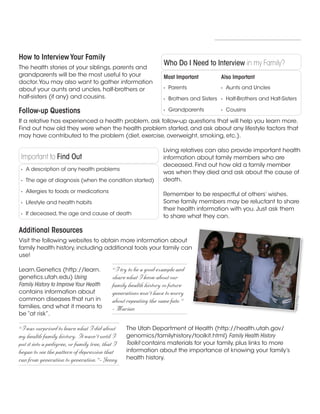
How to Interview Your Family 
The health stories of your siblings, parents and 
grandparents will be the most useful to your 
doctor. You may also want to gather information 
about your aunts and uncles, half-brothers or 
half-sisters (if any) and cousins. 
Follow-up Questions 
If a relative has experienced a health problem, ask follow-up questions that will help you learn more. 
Find out how old they were when the health problem started, and ask about any lifestyle factors that 
may have contributed to the problem (diet, exercise, overweight, smoking, etc.). 
Living relatives can also provide important health 
information about family members who are 
deceased. Find out how old a family member 
was when they died and ask about the cause of 
death. 
Remember to be respectful of others’ wishes. 
Some family members may be reluctant to share 
their health information with you. Just ask them 
to share what they can. 
Important to Find Out 
• A description of any health problems 
• The age at diagnosis (when the condition started) 
• Allergies to foods or medications 
• Lifestyle and health habits 
• If deceased, the age and cause of death 
Additional Resources 
Visit the following websites to obtain more information about 
family health history, including additional tools your family can 
use! 
Learn.Genetics (http://learn. 
genetics.utah.edu) Using 
Family History to Improve Your Health 
contains information about 
common diseases that run in 
families, and what it means to 
be “at risk”. 
“I try to be a good example and 
share what I know about our 
family health history so future 
generations won’t have to worry 
about repeating the same fate.” 
- Marian 
The Utah Department of Health (http://health.utah.gov/ 
genomics/familyhistory/toolkit.html) Family Health History 
Toolkit contains materials for your family, plus links to more 
information about the importance of knowing your family’s 
health history. 
“I was surprised to learn what I did about 
my health family history. It wasn’t until I 
put it into a pedigree, or family tree, that I 
began to see the pattern of depression that 
ran from generation to generation.”- Jenny 
Who Do I Need to Interview in my Family? 
Also Important 
• Aunts and Uncles 
• Half-Brothers and Half-Sisters 
• Cousins 
Most Important 
• Parents 
• Brothers and Sisters 
• Grandparents 
Maya Jones 
Department of Biology
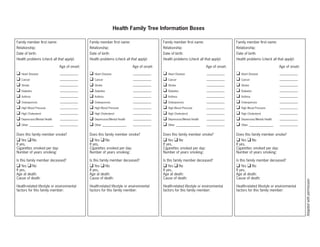
Health Family Tree Information Boxes 
Family member first name: 
Relationship: 
Date of birth: 
Health problems (check all that apply): 
❑ Heart Disease 
❑ Cancer 
❑ Stroke 
❑ Diabetes 
❑ Asthma 
❑ Osteoporosis 
❑ High Blood Pressure 
❑ High Cholesterol 
❑ Depression/Mental Health 
❑ Other ____________ 
Age of onset: 
_________ 
_________ 
_________ 
_________ 
_________ 
_________ 
_________ 
_________ 
_________ 
_________ 
Does this family member smoke? 
❑ Yes ❑ No 
If yes, 
Cigarettes smoked per day: 
Number of years smoking: 
Is this family member deceased? 
❑ Yes ❑ No 
If yes, 
Age at death: 
Cause of death: 
Health-related lifestyle or environmental 
factors for this family member: 
Family member first name: 
Relationship: 
Date of birth: 
Health problems (check all that apply): 
❑ Heart Disease 
❑ Cancer 
❑ Stroke 
❑ Diabetes 
❑ Asthma 
❑ Osteoporosis 
❑ High Blood Pressure 
❑ High Cholesterol 
❑ Depression/Mental Health 
❑ Other ____________ 
Age of onset: 
_________ 
_________ 
_________ 
_________ 
_________ 
_________ 
_________ 
_________ 
_________ 
_________ 
Does this family member smoke? 
❑ Yes ❑ No 
If yes, 
Cigarettes smoked per day: 
Number of years smoking: 
Is this family member deceased? 
❑ Yes ❑ No 
If yes, 
Age at death: 
Cause of death: 
Health-related lifestyle or environmental 
factors for this family member: 
Family member first name: 
Relationship: 
Date of birth: 
Health problems (check all that apply): 
❑ Heart Disease 
❑ Cancer 
❑ Stroke 
❑ Diabetes 
❑ Asthma 
❑ Osteoporosis 
❑ High Blood Pressure 
❑ High Cholesterol 
❑ Depression/Mental Health 
❑ Other ____________ 
Age of onset: 
_________ 
_________ 
_________ 
_________ 
_________ 
_________ 
_________ 
_________ 
_________ 
_________ 
Does this family member smoke? 
❑ Yes ❑ No 
If yes, 
Cigarettes smoked per day: 
Number of years smoking: 
Is this family member deceased? 
❑ Yes ❑ No 
If yes, 
Age at death: 
Cause of death: 
Health-related lifestyle or environmental 
factors for this family member: 
Family member first name: 
Relationship: 
Date of birth: 
Health problems (check all that apply): 
❑ Heart Disease 
❑ Cancer 
❑ Stroke 
❑ Diabetes 
❑ Asthma 
❑ Osteoporosis 
❑ High Blood Pressure 
❑ High Cholesterol 
❑ Depression/Mental Health 
❑ Other ____________ 
Age of onset: 
_________ 
_________ 
_________ 
_________ 
_________ 
_________ 
_________ 
_________ 
_________ 
_________ 
Does this family member smoke? 
❑ Yes ❑ No 
If yes, 
Cigarettes smoked per day: 
Number of years smoking: 
Is this family member deceased? 
❑ Yes ❑ No 
If yes, 
Age at death: 
Cause of death: 
Health-related lifestyle or environmental 
factors for this family member: 
Adapted with permission
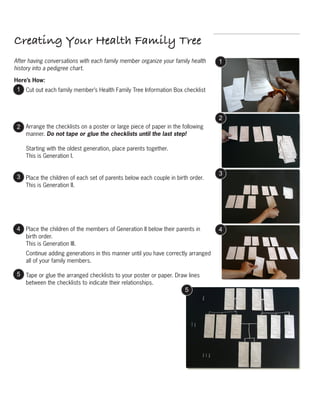
Creating Your Health Family Tree 
After having conversations with each family member organize your family health 
history into a pedigree chart. 
Here’s How: 
Cut out each family member’s Health Family Tree Information Box checklist 
Arrange the checklists on a poster or large piece of paper in the following 
manner. Do not tape or glue the checklists until the last step! 
Starting with the oldest generation, place parents together. 
This is Generation I. 
Place the children of each set of parents below each couple in birth order. 
This is Generation II. 
Place the children of the members of Generation II below their parents in 
birth order. 
This is Generation III. 
Continue adding generations in this manner until you have correctly arranged 
all of your family members. 
Tape or glue the arranged checklists to your poster or paper. Draw lines 
between the checklists to indicate their relationships. 
1 
2 
3 
4 
5 
1 
2 
3 
4 
5 
R.V.Raghavendra Rao 
Department of Biology
Name 
Date 
Family Traits and Traditions: A Make-a-Match Game 
Traits can be inherited from a parent, or traits can be learned. 
Family and cultural traditions often influence learned traits. 
Can you think of a trait you have inherited? How about a trait 
that you have acquired by learning or tradition? Play this 
game with your family to discover some common traits and 
traditions! 
Preparation 
Object of the game 
R.V.Raghavendra Rao 
Department of Biology 
Note to Families 
We have been learning about “traits” 
at school. Inherited traits are physical 
characteristics that can be passed down 
from parent to child. This family activity can 
help your child learn to identify inherited and 
learned traits. 
• Cut out the game cards. You may want to glue or tape the pages to 
heavy paper first. 
• Use your memory to find the cards with matching pictures. The person 
to collect the most matches wins! 
Instructions 
Hint 
Cards with matching pictures have 
different phrases. One card in 
the pair describes a trait, and the 
other card in the pair describes a 
tradition. 
1. Place the game cards face down and spread them out. Decide which member of your family will go first. 
2. The first player turns over two cards, looking for a match. All players should have a chance to see the 
pictures on the two cards. 
3. Read each card. Decide whether it describes an inherited trait (something you are born with) or a tradition 
(something you learn from others). Record your answer by checking the box next to “trait” or “tradition” . 
4. If the pictures on the cards MATCH, the player keeps the cards. They then take another turn. If the pictures 
on the cards DO NOT MATCH, the player does not keep the cards and turns them face down. 
5. The next player turns over two cards, looking for a match. Continue to label each card as either a trait or a 
tradition. 
6. Play until all the matches have been found. The person to collect the most matches wins!
Name 
Date 
I have 
attached 
earlobes 
Trait □ Tradition □ 
I have 
pierced ears 
Trait □ Tradition □ 
I can roll my 
tongue 
I like to eat 
spicy foods 
Trait □ Tradition □ Trait □ Tradition □ 
I have 
dimples 
I greet 
others with 
a smile 
Trait □ Tradition □ Trait □ Tradition □ 
My natural 
hair color is 
brown 
I use dye to 
change my 
hair color 
Trait □ Tradition □ Trait □ Tradition □
Name 
Date 
I am left-handed 
Trait □ Tradition □ 
I use my 
hand to 
catch a ball 
Trait □ Tradition □ 
I am color-blind 
I like to 
create art 
Trait □ Tradition □ Trait □ Tradition □ 
I have 
allergies 
I care for 
a pet 
Trait □ Tradition □ Trait □ Tradition □ 
I have 
freckles 
I lay in the 
sun to get 
a tan
Name 
Date 
Family Traits Trivia 
R.V.Raghavendra Rao 
Department of Biology 
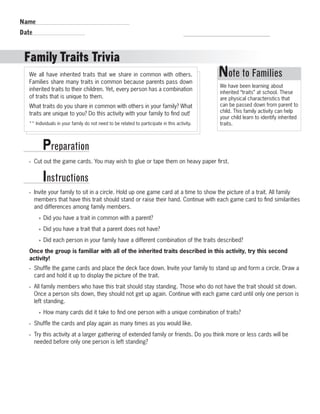
We all have inherited traits that we share in common with others. 
Families share many traits in common because parents pass down 
inherited traits to their children. Yet, every person has a combination 
of traits that is unique to them. 
What traits do you share in common with others in your family? What 
traits are unique to you? Do this activity with your family to find out! 
** Individuals in your family do not need to be related to participate in this activity. 
Preparation 
Instructions 
Note to Families 
We have been learning about 
inherited “traits” at school. These 
are physical characteristics that 
can be passed down from parent to 
child. This family activity can help 
your child learn to identify inherited 
traits. 
• Cut out the game cards. You may wish to glue or tape them on heavy paper first. 
• Invite your family to sit in a circle. Hold up one game card at a time to show the picture of a trait. All family 
members that have this trait should stand or raise their hand. Continue with each game card to find similarities 
and differences among family members. 
»» Did you have a trait in common with a parent? 
»» Did you have a trait that a parent does not have? 
»» Did each person in your family have a different combination of the traits described? 
Once the group is familiar with all of the inherited traits described in this activity, try this second 
activity! 
• Shuffle the game cards and place the deck face down. Invite your family to stand up and form a circle. Draw a 
card and hold it up to display the picture of the trait. 
• All family members who have this trait should stay standing. Those who do not have the trait should sit down. 
Once a person sits down, they should not get up again. Continue with each game card until only one person is 
left standing. 
»» How many cards did it take to find one person with a unique combination of traits? 
• Shuffle the cards and play again as many times as you would like. 
• Try this activity at a larger gathering of extended family or friends. Do you think more or less cards will be 
needed before only one person is left standing?
Name 
Date 
R.V.Raghavendra Rao 
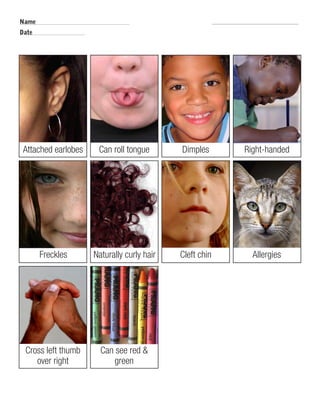
Attached earlobes Can roll tongue Dimples Right-handed 
Freckles Naturally curly hair Cleft chin Allergies 
Cross left thumb 
over right 
Can see red & 
green 
Department of Biology
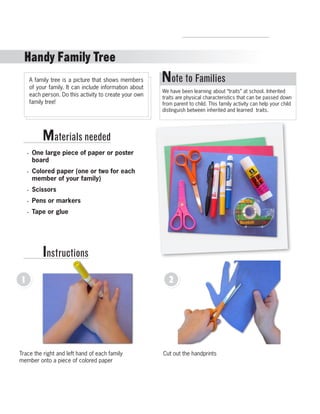
Handy Family Tree 
Materials needed 
• One large piece of paper or poster 
board 
• Colored paper (one or two for each 
member of your family) 
• Scissors 
• Pens or markers 
• Tape or glue 
Instructions 
R.V.Raghavendra Rao 
Note to Families 
We have been learning about “traits” at school. Inherited 
traits are physical characteristics that can be passed down 
from parent to child. This family activity can help your child 
distinguish between inherited and learned traits. 
1 2 
Trace the right and left hand of each family 
member onto a piece of colored paper 
Cut out the handprints 
A family tree is a picture that shows members 
of your family. It can include information about 
each person. Do this activity to create your own 
family tree! 
Department of Biology
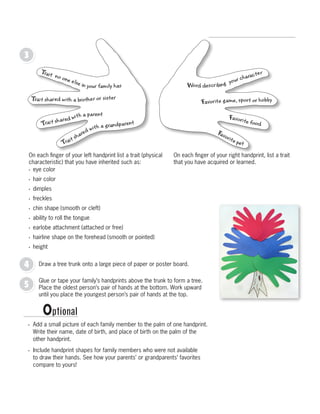
Trait no one else in your family has 
Trait shared with a brother or sister 
Trait shared with a parent 
Trait shared with a grandparent 
On each finger of your left handprint list a trait (physical 
characteristic) that you have inherited such as: 
• eye color 
• hair color 
• dimples 
• freckles 
• chin shape (smooth or cleft) 
• ability to roll the tongue 
• earlobe attachment (attached or free) 
• hairline shape on the forehead (smooth or pointed) 
• height 
R.V.Raghavendra Rao 
On each finger of your right handprint, list a trait 
that you have acquired or learned. 
Glue or tape your family’s handprints above the trunk to form a tree. 
Place the oldest person’s pair of hands at the bottom. Work upward 
until you place the youngest person’s pair of hands at the top. 
Optional 
Word describing your character 
Favorite game, sport or hobby 
Favorite food 
Favorite pet 
3 
4 
5 
Draw a tree trunk onto a large piece of paper or poster board. 
• Add a small picture of each family member to the palm of one handprint. 
Write their name, date of birth, and place of birth on the palm of the 
other handprint. 
• Include handprint shapes for family members who were not available 
to draw their hands. See how your parents’ or grandparents’ favorites 
compare to yours! 
Department of Biology
Name 
Date R.V.Raghavendra Rao 
Department of Biology 
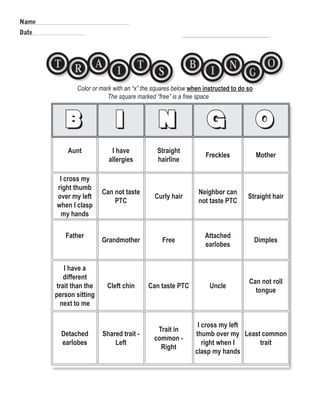
TRAiTs bingo 
Color or mark with an “x” the squares below when instructed to do so 
The square marked “free” is a free space 
B I N G O 
Aunt I have 
allergies 
Straight 
hairline Freckles Mother 
I cross my 
right thumb 
over my left 
when I clasp 
my hands 
Can not taste 
PTC Curly hair Neighbor can 
not taste PTC Straight hair 
Father Grandmother Free Attached 
earlobes Dimples 
I have a 
different 
trait than the 
person sitting 
next to me 
Cleft chin Can taste PTC Uncle Can not roll 
tongue 
Detached 
earlobes 
Shared trait - 
Left 
Trait in 
common - 
Right 
I cross my left 
thumb over my 
right when I 
clasp my hands 
Least common 
trait
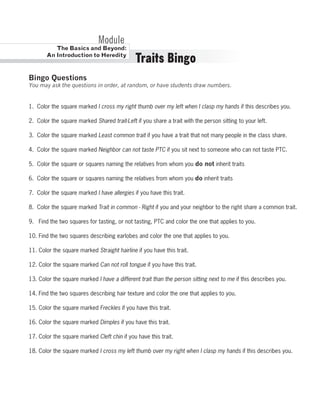
Traits Bingo 
Module 
The Basics and Beyond: 
An Introduction to Heredity 
Bingo Questions 
You may ask the questions in order, at random, or have students draw numbers. 
1. Color the square marked I cross my right thumb over my left when I clasp my hands if this describes you. 
2. Color the square marked Shared trait-Left if you share a trait with the person sitting to your left. 
3. Color the square marked Least common trait if you have a trait that not many people in the class share. 
4. Color the square marked Neighbor can not taste PTC if you sit next to someone who can not taste PTC. 
5. Color the square or squares naming the relatives from whom you do not inherit traits 
6. Color the square or squares naming the relatives from whom you do inherit traits 
7. Color the square marked I have allergies if you have this trait. 
8. Color the square marked Trait in common - Right if you and your neighbor to the right share a common trait. 
9. Find the two squares for tasting, or not tasting, PTC and color the one that applies to you. 
10. Find the two squares describing earlobes and color the one that applies to you. 
11. Color the square marked Straight hairline if you have this trait. 
12. Color the square marked Can not roll tongue if you have this trait. 
13. Color the square marked I have a different trait than the person sitting next to me if this describes you. 
14. Find the two squares describing hair texture and color the one that applies to you. 
15. Color the square marked Freckles if you have this trait. 
16. Color the square marked Dimples if you have this trait. 
17. Color the square marked Cleft chin if you have this trait. 
18. Color the square marked I cross my left thumb over my right when I clasp my hands if this describes you.
R.V.Raghavendra Rao 
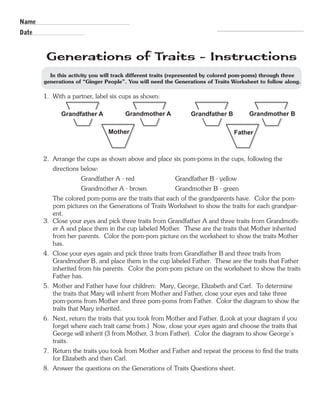
Generations of Traits - Instructions 
In this activity you will track different traits (represented by colored pom-poms) through three 
generations of “Ginger People”. You will need the Generations of Traits Worksheet to follow along. 
1. With a partner, label six cups as shown: 
Grandfather A Grandmother A Grandfather B Grandmother B 
Mother Father 
2. Arrange the cups as shown above and place six pom-poms in the cups, following the 
directions below: 
Grandfather A - red Grandfather B - yellow 
Grandmother A - brown Grandmother B - green 
The colored pom-poms are the traits that each of the grandparents have. Color the pom-pom 
pictures on the Generations of Traits Worksheet to show the traits for each grandpar-ent. 
3. Close your eyes and pick three traits from Grandfather A and three traits from Grandmoth-er 
A and place them in the cup labeled Mother. These are the traits that Mother inherited 
from her parents. Color the pom-pom picture on the worksheet to show the traits Mother 
has. 
4. Close your eyes again and pick three traits from Grandfather B and three traits from 
Grandmother B, and place them in the cup labeled Father. These are the traits that Father 
inherited from his parents. Color the pom-pom picture on the worksheet to show the traits 
Father has. 
5. Mother and Father have four children: Mary, George, Elizabeth and Carl. To determine 
the traits that Mary will inherit from Mother and Father, close your eyes and take three 
pom-poms from Mother and three pom-poms from Father. Color the diagram to show the 
traits that Mary inherited. 
6. Next, return the traits that you took from Mother and Father. (Look at your diagram if you 
forget where each trait came from.) Now, close your eyes again and choose the traits that 
George will inherit (3 from Mother, 3 from Father). Color the diagram to show George’s 
traits. 
7. Return the traits you took from Mother and Father and repeat the process to find the traits 
for Elizabeth and then Carl. 
8. Answer the questions on the Generations of Traits Questions sheet. 
Name 
Date 
Department of Biology
R.V.Raghavendra Rao 
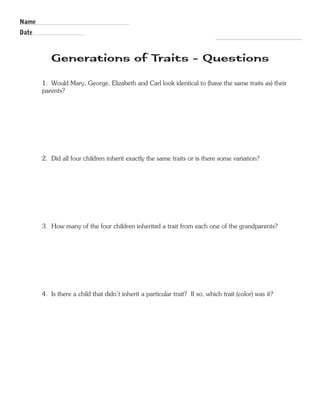
Generations of Traits - Questions 
1. Would Mary, George, Elizabeth and Carl look identical to (have the same traits as) their 
parents? 
2. Did all four children inherit exactly the same traits or is there some variation? 
3. How many of the four children inherited a trait from each one of the grandparents? 
4. Is there a child that didn’t inherit a particular trait? If so, which trait (color) was it? 
Name 
Date 
Department of Biology
Module 
The Basics and Beyond: 
R.V.Raghavendra Rao 
An Introduction to Heredity 
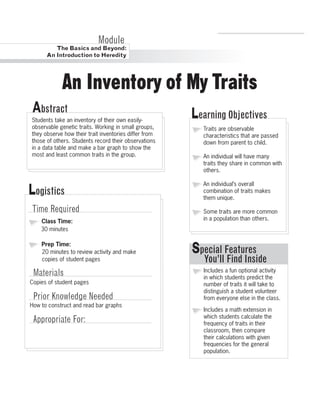
An Inventory of My Traits 
Abstract Learning Objectives 
Traits are observable 
characteristics that are passed 
down from parent to child. 
An individual will have many 
traits they share in common with 
others. 
An individual’s overall 
combination of traits makes 
them unique. 
Some traits are more common 
in a population than others. 
Special Features 
You’ll Find Inside 
Includes a fun optional activity 
in which students predict the 
number of traits it will take to 
distinguish a student volunteer 
from everyone else in the class. 
Includes a math extension in 
which students calculate the 
frequency of traits in their 
classroom, then compare 
their calculations with given 
frequencies for the general 
population. 
Students take an inventory of their own easily-observable 
genetic traits. Working in small groups, 
they observe how their trait inventories differ from 
those of others. Students record their observations 
in a data table and make a bar graph to show the 
most and least common traits in the group. 
Logistics 
Time Required 
Class Time: 
30 minutes 
Prep Time: 
20 minutes to review activity and make 
copies of student pages 
Materials 
Copies of student pages 
Prior Knowledge Needed 
Appropriate For: 
How to construct and read bar graphs 
Department of Biology 
Grade 9-10
R.V.Raghavendra Rao 
Department of Biology 
An Inventory of My Traits 
Module 
The Basics and Beyond: 
An Introduction to Heredity 
Classroom Implementation 
Activity instructions: 
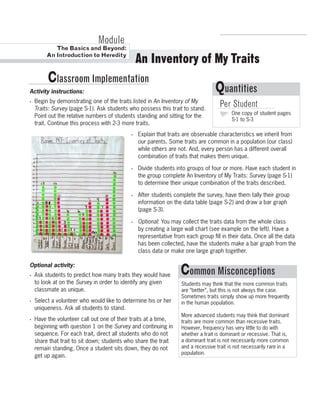
• Begin by demonstrating one of the traits listed in An Inventory of My 
Traits: Survey (page S-1). Ask students who possess this trait to stand. 
Point out the relative numbers of students standing and sitting for the 
trait. Continue this process with 2-3 more traits. 
Quantities 
Per Student 
• Explain that traits are observable characteristics we inherit from 
our parents. Some traits are common in a population (our class) 
while others are not. And, every person has a different overall 
combination of traits that makes them unique. 
• Divide students into groups of four or more. Have each student in 
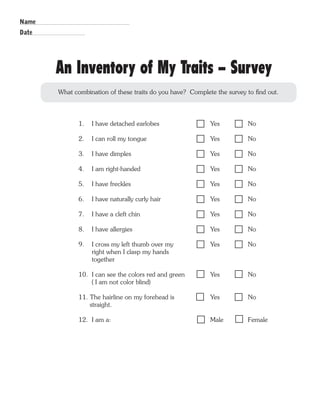
the group complete An Inventory of My Traits: Survey (page S-1) 
to determine their unique combination of the traits described. 
• After students complete the survey, have them tally their group 
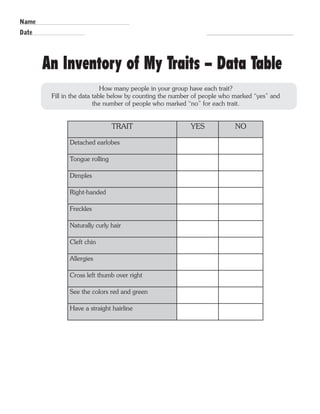
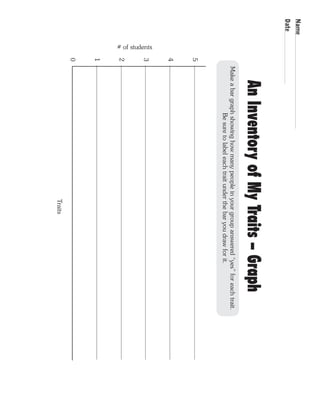
information on the data table (page S-2) and draw a bar graph 
(page S-3). 
• Optional: You may collect the traits data from the whole class 
by creating a large wall chart (see example on the left). Have a 
representative from each group fill in their data. Once all the data 
has been collected, have the students make a bar graph from the 
class data or make one large graph together. 
Optional activity: 
• Ask students to predict how many traits they would have 
to look at on the Survey in order to identify any given 
classmate as unique. 
• Select a volunteer who would like to determine his or her 
uniqueness. Ask all students to stand. 
• Have the volunteer call out one of their traits at a time, 
beginning with question 1 on the Survey and continuing in 
sequence. For each trait, direct all students who do not 
share that trait to sit down; students who share the trait 
remain standing. Once a student sits down, they do not 
get up again. 
One copy of student pages 
S-1 to S-3 
Common Misconceptions 
Students may think that the more common traits 
are “better”, but this is not always the case. 
Sometimes traits simply show up more frequently 
in the human population. 
More advanced students may think that dominant 
traits are more common than recessive traits. 
However, frequency has very little to do with 
whether a trait is dominant or recessive. That is, 
a dominant trait is not necessarily more common 
and a recessive trait is not necessarily rare in a 
population.
R.V.Raghavendra Rao 
Department of Biology 
An Inventory of My Traits 
Module 
The Basics and Beyond: 
An Introduction to Heredity 
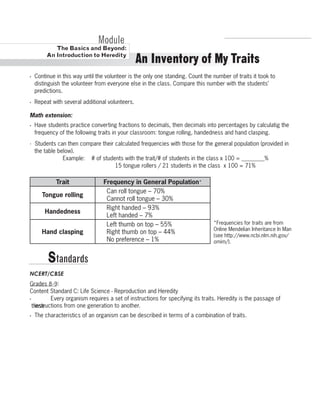
• Continue in this way until the volunteer is the only one standing. Count the number of traits it took to 
distinguish the volunteer from everyone else in the class. Compare this number with the students’ 
predictions. 
• Repeat with several additional volunteers. 
Math extension: 
• Have students practice converting fractions to decimals, then decimals into percentages by calculatig the 
frequency of the following traits in your classroom: tongue rolling, handedness and hand clasping. 
∙ Students can then compare their calculated frequencies with those for the general population (provided in 
the table below). 
Example: # of students with the trait/# of students in the class x 100 = ________% 
15 tongue rollers / 21 students in the class x 100 = 71% 
Trait Frequency in General Population* 
Tongue rolling Can roll tongue – 70% 
Cannot roll tongue – 30% 
Handedness Right handed – 93% 
Left handed – 7% 
Hand clasping 
Left thumb on top – 55% 
Right thumb on top – 44% 
No preference – 1% 
Standards 
*Frequencies for traits are from 
Online Mendelian Inheritance In Man 
(see http://www.ncbi.nlm.nih.gov/ 
omim/). 
NCERT/CBSE 
Grades 8-9: 
Content Standard C: Life Science - Reproduction and Heredity 
• Every organism requires a set of instructions for specifying its traits. Heredity is the passage of 
these 
instructions from one generation to another. 
• The characteristics of an organism can be described in terms of a combination of traits.
R.V.Raghavendra Rao 
An Inventory of My Traits 
Module 
The Basics and Beyond: 
An Introduction to Heredity 
Additional Resources 
Visit the Teach.Genetics website to get more great 
resources like these! 
Department of Biology
An Inventory of My Traits - Survey 
What combination of these traits do you have? Complete the survey to find out. 
1. I have detached earlobes Yes No 
2. I can roll my tongue Yes No 
3. I have dimples Yes No 
4. I am right-handed Yes No 
5. I have freckles Yes No 
6. I have naturally curly hair Yes No 
7. I have a cleft chin Yes No 
8. I have allergies Yes No 
9. I cross my left thumb over my Yes No 
right when I clasp my hands 
together 
10. I can see the colors red and green Yes No 
( I am not color blind) 
11. The hairline on my forehead is Yes No 
straight. 
12. I am a: Male Female 
Name 
Date
R.V.Raghavendra Rao 
An Inventory of My Traits - Data Table 
How many people in your group have each trait? 
Fill in the data table below by counting the number of people who marked “yes” and 
the number of people who marked “no” for each trait. 
TRAIT YES NO 
Detached earlobes 
Tongue rolling 
Dimples 
Right-handed 
Freckles 
Naturally curly hair 
Cleft chin 
Allergies 
Cross left thumb over right 
See the colors red and green 
Have a straight hairline 
Name 
Date 
Department of Biology
Name 
Date 
An Inventory of My Traits - Graph 
Make a bar graph showing how many people in your group answered “yes” for each trait. 
Be sure to label each trait under the bar you draw for it. 
# of students 
5 
4 
3 
2 
1 
0 
Traits
PTC tasting: 
yes no 
attached unattached 
yes no 
earlobes: 
tongue rolling: 
PTC tasting: 
yes no 
attached unattached 
yes no 
earlobes: 
tongue rolling: 
PTC tasting: 
yes no 
attached unattached 
yes no 
earlobes: 
tongue rolling: 
PTC tasting: 
yes no 
attached unattached 
yes no 
earlobes: 
tongue rolling: 
PTC tasting: 
yes no 
attached unattached 
yes no 
earlobes: 
tongue rolling: 
PTC tasting: 
yes no 
attached unattached 
yes no 
earlobes: 
tongue rolling: 
PTC tasting: 
yes no 
attached unattached 
yes no 
earlobes: 
tongue rolling: 
PTC tasting: 
yes no 
attached unattached 
yes no 
earlobes: 
tongue rolling: 
R.V.Raghavendra Rao 
Department of Biology
R.V.Raghavendra Rao 
Department of Biology 
A Recipe for Traits 
A set of instructions called DNA makes a “recipe” for traits in all 
organisms. Information in a DNA strand is grouped into small segments. 
Each segment is made of even smaller units (like recipes are made of 
words, and words are made of letters). Differences in the DNA “alphabet” 
are what make differences in traits (just like a different sequence of 
letters makes different words, and a different recipe). 
Name 
Date 
Follow the directions below to create a DNA recipe for a dog. Using the Dog 
Traits Key, read your DNA recipe and make a drawing of your dog showing all of 
its traits. 
Directions: 
1. Make sure you have an envelope containing “Dog DNA”. 
2. Determine the first trait of your dog (body shape) by randomly picking a 
piece of dog DNA out of the envelope. 
3. Look at the symbols on the DNA strip you have chosen. Match the pattern to 
one you see on the Dog Traits Key for body shape. 
4. Circle the picture for body shape that matches the DNA piece that you 
picked. 
5. Set the piece of DNA aside and repeat steps 1-4 for the next trait on the key. 
6. After circling the matching picture, tape the second piece of DNA to the first 
to make one long strand. This will become the DNA recipe for your entire 
dog. 
7. Repeat these steps for each of the traits listed on the Dog Traits Key. 
8. When you have finished, draw your dog with all of its traits (the traits you 
have circled on the Dog Traits Key) on a separate piece of paper. 
9. As instructed by your teacher, hang up the picture of your dog along with its 
DNA recipe (the DNA pieces you chose attached in a long strand). 
Is your dog different from or the same as others in the class?
Body Shape 
Head Shape 
Ears 
Legs 
Dog Traits Key 
Small, Thin, 
Long, Straight 
Large, Thin, 
Long, Tapered 
Medium, Very 
Muscular, Short 
Large Semi- 
Muscular, Straight 
Long, Thin Flat Short Droopy 
Small, Pointy Big Droopy Medium Square Medium Droopy 
Long, Thin Short, Stubby Medium Stocky, Muscular 
Name 
Date 
R.V.Raghavendra Rao 
Department of Biology
Eyes 
R.V.Raghavendra Rao 
Dark Brown Light Brown Blue Green 
Tail 
Coat Color 
Hair 
Short Nub Long with 
Short Hair 
Pompon Tipped Long and Bushy 
Brown Black Red-Brown Yellow 
Curly, Short Straight, Short Straight, Long Wavy, Long 
Name 
Date 
Dog Traits Key 
Department of Biology
DNA Strips A 
A Recipe for Traits 
Module 
The Basics and Beyond: 
An Introduction to Heredity 
R.V.Raghavendra Rao 
Department of Biology
DNA Strips B 
A Recipe for Traits 
Module 
The Basics and Beyond: 
An Introduction to Heredity 
R.V.Raghavendra Rao 
Department of Biology
DNA Strips C 
R.V.Raghavendra Rao 
A Recipe for Traits 
Module 
The Basics and Beyond: 
An Introduction to Heredity 
Department of Biology
DNA Strips D 
R.V.Raghavendra Rao 
A Recipe for Traits 
Module 
The Basics and Beyond: 
An Introduction to Heredity 
Department of Biology
R.V.Raghavendra Rao 
Department of Biology
R.V.Raghavendra Rao 
Department of Biology
Introduction to heredity curriculum final

Introduction to heredity curriculum final

  • 1.
    Unit Overview Fiveeasy-to-implement classroom activities teach the basics of heritable traits. Three take-home activities help students share what they're learning with their families. Learning Objectives  Traits are observable characteristics that are passed from parent to child.  An individual will have many traits in common with others and more so with siblings and parents.  An individual's overall combination of traits makes them unique.  Some traits are more common in a population than others.  An equal number of traits are passed from each parent.  DNA is a set of instructions that specifies the traits of an organism. Time Required approx. 120 mins Grade Band Prior Knowledge Needed Targeted Standards CBSE: Life Science; Reproduction and Heredity AAAS Benchmarks: The Living Environment: Heredity  Variations in DNA lead to the inheritance of different traits. Suggested Implementation 8-10 None Below is a suggested sequence for implementing the activities contained in the unit. Please see each individual activity for implementation instructions, suggestions for adaptations and extensions, and applicable standards. UNIT CONTENT Introduction to Heredity Lesson Plans An Inventory of My Traits A Tree of Genetic Traits Generations of Traits Traits Bingo A Recipe for Traits Take-Home Activities Family Traits Trivia Handy Family Tree Family Traits & Traditions Teacher Resources Inherited Traits: A Quick Reference Sample Parent Letter (doc) Note About PTC Safety
  • 2.
    DAY Activity Notes Day 1 (40 mins.) An Inventory of My Traits Students take an inventory of their own easily-observable genetic traits and compare those inventories with other students in groups. Observable Traits slideshow (Teacher Reference) This click-through slideshow shows many of the traits included in An Inventory of My Traits. A Tree of Genetic Traits Students find the most and least common combination of traits in the class by marking their traits for tongue rolling, earlobe attachment, and PTC tasting on paper leaf cut-outs. Students then organize the leaves on a large "tree of traits." Family Traits Trivia (Homework) Students use game cards to inventory the traits in their family. (Note: individuals in families do not need to be related to participate in this activity.) Day 2 (40 mins.) Generations of Traits Students track and record the passage of colored "pom-pom traits" through three generations of ginger-bread people. Traits Bingo In this review activity, students cross off or color bingo squares in response to questions about their traits. Handy Family Tree (Homework) Students distinguish between inherited and learned traits by creating a "family tree of traits" using handprints. (Note: Individuals in families do not need to be related to participate in this activity.) Day 3 (40 mins.) A Recipe for Traits Students learn that differences in DNA lead to different traits by: 1) randomly choosing strips of paper that represent DNA, then 2) decoding the DNA strips to complete a drawing of a dog. Family Traits and Traditions (Homework) Students and their families play a matching game with cards to identify traits that are inherited and traits that are learned or passed on through tradition.
  • 3.
    A Recipe forTraits Every organism inherits a unique combination of traits. DNA is a set of instructions that specifies the traits of an organism. Information in the DNA molecule is divided into segments (called genes). Variations in the DNA lead to the inheritance of different traits. Special Features You’ll Find Inside Copy masters for preparing colored DNA strips having fun symbols to represent information about traits. A dog traits key that allows participants to decode their DNA recipe and visualize how traits are specified. Activty Overview Participants create and decode a “DNA recipe” for man’s best friend to observe how variations in DNA lead to the inheritance of different traits. Strips of paper (representing DNA) are randomly selected and used to assemble a DNA molecule. Participants read the DNA recipe to create a drawing of their pet, and compare it with others in the group to note similarities and differences. Logistics Time Required Activity Time: 40 minutes Prep Time: 30 minutes to review activity, make copies, and prepare dog DNA strips Materials Copies of participant pages, drawing paper, crayons or colored pencils, tape, envelopes, and colored paper (4 different colors needed) Prior Knowledge Needed Traits are heritable characteristics. Learning Objectives R.V.Raghavendra Rao, PGT Biology, Vizianagaram A.P. 2013 Heredity
  • 4.
    Preparation A Recipefor Traits “Dog DNA” envelopes: 1. To prepare 14 envelopes, make four copies each of DNA Strips A, B, C, and D (pages 4-7) on colored paper. Choose one color for each type of DNA Strip. For example: DNA Strips A (page 5) 4 copies on Blue DNA Strips B (page 6) 4 copies on Green DNA Strips C (page 7) 4 copies on Yellow DNA Strips D (page 8) 4 copies on Red Quantities Per Participant or Pair One copy of pages P-1 to P-3 One envelope containing “Dog DNA” (see instructions at left) Crayons or colored pencils, drawing paper, tape 2. Cut out the DNA strips on each page (a paper-cutter works well). 3. Place two DNA strips of each color into an envelope. The envelope should contain eight DNA strips total (four different colors). 4. Repeat step three until you have assembled 14 “Dog DNA” envelopes. Note: Eight is the minimum number of DNA strips per envelope that you need to carry out the activity. Adding more DNA strips of each color increases the variety of possibilities for each trait. Activity Instructions • Display different types of instructions (e.g. a recipe book, a blueprint, a DNA molecule). Ask participants what they might use these instructions for. Explain that just as a recipe is used to cook a meal or a blueprint is used to build a home, DNA contains instructions that specify an organism’s traits. • Read the beginning paragraph of A Recipe for Traits (page P-1) as a group. You may want to show a completed DNA “recipe” and point out the different segments (representing genes) as well as the 4 symbols (representing the 4 chemical bases A, C, G and T) that make up the DNA alphabet in this activity. • Review the instructions on page P-1. You may want to demonstrate how to use the Dog Traits Key (see page P-2 to P-3). Read the DNA recipe and identify the first trait. • Remind participants to leave the DNA strips they choose out of the envelope and tape them together in order. The resulting long strand will be their DNA recipe. • Have participants work individually or in pairs to complete the activity. When participants have finished, have them post their dog drawings on the wall along with the DNA recipe for their dog. • Are any two dogs alike? Point out that every dog shares some traits in common with others, but each has an overall combination of traits that is unique. • Explain that variations in each DNA strand (the sequence of symbols) led to the inheritance of different traits. 2013 Heredity R.V.Raghavendra Rao, PGT Biology, Vizianagaram A.P. 1
  • 5.
    Discussion Points ARecipe for Traits • Information in a DNA strand (or molecule) is grouped into small segments called genes (represented here by colored DNA strips). • A single DNA strand is often referred to as a chromosome. In this example, the dog had one chromosome containing 8 genes. (Humans have 23 pairs of chromosomes containing over 22,000 genes!) • The DNA molecule contains a sequence of four chemical bases (represented here by four symbols). Each base is referred to by the first letter of its name: Adenine (A), Cytosine (C), Guanine (G) and Thymine (T). The sequence of these chemical bases encodes a detailed set of instructions for building an organism’s traits. (The human genome contains approximately 3 billion pairs or bases!) • Participants were asked to assemble their DNA strips in the order they were drawn. This is because all individuals of a species have the same genes in the same order along their chromosomes. (This is what allows researchers to “map” the location of a gene to a specific place on a chromosome.) It is the small sequence variations within each gene that lead to differences in traits. • There is usually a limited number of sequence variations for a gene. That is, a gene usually comes in a few different forms or flavors (called “alleles”). There was a possibility of four different flavors or alleles for each of the dog genes in this activity. • In this activity, a single gene determined each dog trait. More often a trait is influenced by more than one gene as well as environmental factors. Extension • As a group, make a “map” of the dog genome. Compare the different DNA recipes hanging up in the room. Point out that the gene for body shape is always at the top of the DNA molecule (or chromosome), the gene for head shape is always second, and so on. Draw a representation of a chromosome having 8 segments. Have participants come up with a creative name for each gene. Label the segments with the gene names, and specify the trait they encode. Point out that although each dog looks differently (has a different combination of traits), it is still possible to make a general map of the dog genome. • Show participants a completed map of the human genome (e.g., the Human Genome Landmarks Poster or its web companion) and discuss how researchers have mapped the 22,000 plus genes to particular locations on the 23 pairs of human chromosomes. To order a free copy of this poster or view it online, check out the web site developed by the U.S. Department of Energy’s Human Genome Management Information System (HGMIS). R.V.Raghavendra Rao, PGT Biology, Vizianagaram A.P. 2 2013 Heredity
  • 6.
    DNA Strips A A Recipe for Traits R.V.Raghavendra Rao, PGT Biology, Vizianagaram A.P. 4 2013 Heredity
  • 7.
    DNA Strips B A Recipe for Traits R.V.Raghavendra Rao, PGT Biology, Vizianagaram A.P. 5 2013 Heredity
  • 8.
    DNA Strips C A Recipe for Traits R.V.Raghavendra Rao, PGT Biology, Vizianagaram A.P. 6 2013 Heredity
  • 9.
    DNA Strips D A Recipe for Traits R.V.Raghavendra Rao, PGT Biology, Vizianagaram A.P. 7 2013 Heredity
  • 10.
    A Recipe forTraits A set of instructions called DNA makes a “recipe” for traits in all organisms. Information in a DNA strand is grouped into small segments. Each segment is made of even smaller units (like recipes are made of words, and words are made of letters). Differences in the DNA “alphabet” are what make differences in traits (just like a different sequence of letters makes different words, and a different recipe). Follow the directions below to create a DNA recipe for a dog. Using the Dog Traits Key, read your DNA recipe and make a drawing of your dog showing all of its traits. Directions: 1. Make sure you have an envelope containing “Dog DNA”. 2. Determine the first trait of your dog (body shape) by randomly picking a piece of dog DNA out of the envelope. 3. Look at the symbols on the DNA strip you have chosen. Match the pattern to one you see on the Dog Traits Key for body shape. 4. Circle the picture for body shape that matches the DNA piece that you picked. 5. Set the piece of DNA aside and repeat steps 1-4 for the next trait on the key. 6. After circling the matching picture, tape the second piece of DNA to the first to make one long strand. This will become the DNA recipe for your entire dog. 7. Repeat these steps for each of the traits listed on the Dog Traits Key. 8. When you have finished, draw your dog with all of its traits (the traits you have circled on the Dog Traits Key) on a separate piece of paper. 9. Hang up the picture of your dog along with its DNA recipe (the DNA pieces you chose attached in a long strand). Is your dog different from or the same as others in the group? R.V.Raghavendra Rao, PGT Biology, Vizianagaram A.P. 2013 Heredity
  • 11.
    Body Shape HeadShape Ears Legs Dog Traits Key Small, Thin, Long, Straight Large, Thin, Long, Tapered Meduium, Very Muscular, Short Large Semi- Muscular, Straight Long, Thin Flat Short Droopy Small, Pointy Big Droopy Medium Square Medium Droopy Long, Thin Short, Stubby Medium Stocky, Muscular R.V.Raghavendra Rao, PGT Biology, Vizianagaram A.P. 2013 Heredity
  • 12.
    Eyes Dark BrownLight Brown Blue Green Tail Coat Color Hair Short Nub Long with Short Hair Pompon Tipped Long and Bushy Brown Black Red-Brown Yellow Curly, Short Straight, Short Straight, Long Wavy, Long Dog Traits Key R.V.Raghavendra Rao, PGT Biology, Vizianagaram A.P. 2013 Heredity
  • 13.
    A Tree ofGenetic Traits Activity Overview Learning Objectives Traits are observable characteristics that are passed down from parent to child. An individual will have many traits they share in common with others. An individual’s overall combination of traits makes them unique. Some traits are more common in a population than others. Participants mark their traits for tongue rolling, PTC tasting (a harmless, bitter chemical), and earlobe attachment on tree leaf cut-outs. They then place their leaves on a large tree whose branches each represent a different combination of traits. When completed, the tree forms a visual representation of the frequency of trait combinations within the group. Logistics Time Required Activity Time: 30 minutes Prep Time: 30 minutes to review activity, make copies of tree leaf cut-outs, and prepare traits tree Materials PTC paper, hard candies, leaf cut-outs, tape, scissors, transparencies or large butcher paper Prior Knowledge Needed None R.V.Raghavendra Rao Department of Biology
  • 14.
    R.V.Raghavendra Rao Departmentof Biology Quantities Per Participant One leaf cut-out, hard candy, piece of PTC paper 1 A Tree of Genetic Traits Activity Instructions Per Group of 2 • Copy the Genetic Traits Tree graphic provided on page 4 (or page 6 for Telugu speaking audiences) onto an overhead transparency. Use an overhead projector to project the transparency large onto a blank wall. Alternatively, draw a large tree on butcher paper based on page 4. Post it in an easily accessible and visible area of the room. • Provide each participant with a leaf and instruct them to cut it out. Scissors, pen or pencil • Explain that traits are observable characteristics we inherit from our Whole Group parents. Demonstrate the tongue rolling and earlobe attachment traits. Have participants mark “yes” or “no” on their leaf for these Tape traits as appropriate. • Hand out PTC paper. Instruct participants to place a piece of PTC paper on the tip of their tongue to see if they can taste anything. The chemical tastes bitter to those who can taste it. For those who cannot taste PTC, the paper has no taste. • Note: PTC paper is inexpensive and can be purchased from Sargent Welch (www.sargentwelch. com), Carolina Math and Science (www.carolina.com) or Ward’s Natural Science (http://www. wardsci.com). • Instruct participants to check “yes” or “no” on their leaves for PTC tasting. Hand out a hard candy to each participant to neutralize the taste of the PTC. • Demonstrate how to determine where to place the leaves on the Trait Tree starting at the base of the branches and working your way out toward the tips. Common • Call participants up in groups to place their leaves on Misconception the appropriate branches. The leaves will be clustered A widespread misconception is that all traits around the branch representing the most common exhibit either a dominant or recessive pattern of combination of traits in the group. Some branches of inheritance. But these terms only apply to single the tree will remain relatively sparse. gene traits. The traits included in this activity are part of the small number that may be due to only • Optional: Make leaf cut-outs in two different colors, one or two genes. However, most human genetic one for males and one for females, to track traits are influenced by several genes as well as combinations of traits within the different genders. interactions with the environment. The inheritance of complex traits is difficult to predict, and does • Optional: Increase your data pool by including not follow typical dominant or recessive patterns. additional groups in the exercise, taping all leaves to one tree.
  • 15.
    R.V.Raghavendra Rao Departmentof Biology 2 A Tree of Genetic Traits Discussion Points • Some traits are more common in a population than others. What is the most common combination of traits in the group? What is the least common combination of traits in the group? • Every person has a unique combination of traits. If we were to look at more traits than three, we would eventually need a branch on the Trait Tree for each person in the group.
  • 16.
    R.V.Raghavendra Rao Departmentof Biology 3 A Tree of Genetic Traits LAenaf I nCvuetn-toourtys of My Traits: Leaf Cut-Outs Earlobes Attached Free PTC Tasting Yes No Tongue Rolling Yes No Earlobes Attached Free PTC Tasting Yes No Tongue Rolling Yes No Earlobes Attached Free PTC Tasting Yes No Tongue Rolling Yes No Earlobes Attached Free PTC Tasting Yes No Tongue Rolling Yes No Earlobes Attached Free PTC Tasting Yes No Tongue Rolling Yes No Earlobes Attached Free PTC Tasting Yes No Tongue Rolling Yes No Earlobes Attached Free PTC Tasting Yes No Tongue Rolling Yes No Earlobes Attached Free PTC Tasting Yes No Tongue Rolling Yes No
  • 17.
    4 A Treeof Genetic Traits Example Trait Tree Non-PTC Taster PTC Taster PTC Taster Non-PTC Tongue Taster Roller Attached Earlobes Free Earlobes Tongue Roller Tongue Roller Tongue Roller Non-Tongue Roller Non-Tongue Roller Non-Tongue Roller Non-Tongue Roller
  • 18.
    Materials needed •One large piece of paper or poster board • Colored paper (one or two for each person) • Scissors • Pens or markers • Tape or glue Instructions R.V.Raghavendra Rao Inherited traits are physical characteristics that can be passed down from parent to child. Learned traits are acquired through interactions with the environment. This activity can help you learn to distinguish between inherited and learned traits. 1 2 1 Handy Family Tree Trace the right and left hand of each family member onto a piece of colored paper Cut out the handprints A family tree is a picture that shows members of your family. It can include information about each person. Do this activity to create your own family tree. Include fun facts about each family member on their very own handprint! Did You Know? Department of Biology
  • 19.
    Trait no oneelse in your family has Trait shared with a brother or sister Trait shared with a parent Trait shared with a grandparent On each finger of your left handprint list a trait (physical characteristic) that you have inherited such as: • eye color • hair color • dimples • freckles • chin shape (smooth or cleft) • ability to roll the tongue • earlobe attachment (attached or free) • hairline shape on the forehead (smooth or pointed) R.V.Raghavendra Rao On each finger of your right handprint, list a trait that you have acquired or learned. See suggestions above. Glue or tape your family’s handprints above the trunk to form a tree. Place the oldest person’s pair of hands at the bottom. Work upward until you place the youngest person’s pair of hands at the top. Optional Word describing your character Favorite game, sport or hobby Favorite food Favorite school subject 3 4 5 2 Draw a tree trunk onto a large piece of paper or poster board. • Add a small picture of each family member to the palm of one handprint. Write their name, date of birth, and place of birth on the palm of the other handprint. • Include handprint shapes for family members who were not available to draw their hands. See how your parents’ or grandparents’ favorites compare to yours! Department of Biology
  • 20.
    R.V.Raghavendra Rao Departmentof Biology Inherited Human Traits: A Quick Reference Inherited Human Traits: A Quick Reference Special Features You’ll Find Inside Photos of common heritable traits and accompanying background information. Activity Overview Background information about genes, traits and inheritance that supports the activities included in the Heredity & Traits section of the Learn.Genetics website. Includes a pictorial reference of inherited human traits, along with inheritance patterns, frequencies and other interesting facts about each. 1
  • 21.
    R.V.Raghavendra Rao Departmentof Biology Inherited Human Traits: A Quick Reference Background Information Physical traits are observable characteristics determined by specific segments of DNA called genes. Multiple genes are grouped together to form chromosomes, which reside in the nucleus of the cell. Every cell (except eggs and sperm) in an individual’s body contains two copies of each gene. This is due to the fact that both mother and father contribute a copy at the time of conception. This original genetic material is copied each time a cell divides so that all cells contain the same DNA. Genes store the information needed for the cell to assemble proteins, which eventually yield specific physical traits. Figure 1: Inheritance Patterns of the Widow's Peak Trait Most genes have two or more variations, called alleles. For example, the gene for hairline shape has two alleles – widow’s peak or straight. W = dominant widow's peak allelle w = recessive straight hairline allele An individual may inherit two identical or two different alleles from their parents. When two different alleles are present they interact Results of Allele Combinations: in specific ways. For the traits included in this activity, the alleles interact in what is called a dominant or a recessive manner. The WW = Widow's Peak Trait traits due to dominant alleles are always observed, even when a recessive allele is present. Traits due to recessive alleles are only observed when two recessive alleles are present. For example, the Ww = allele for widow’s peak is dominant and the allele for straight hairline Widow's Peak Trait is recessive. If an individual inherits: ww = Straight Hairline Trait • Two widow’s peak alleles (both dominant), their hairline will have a peak • One widow’s peak allele (dominant) and one straight hairline allele (recessive), they will have a widow’s peak • Two straight hairline alleles (recessive), their hairline will be straight. A widespread misconception is that traits due to dominant alleles are the most common in the population. While this is sometimes true, it is not always the case. For example, the allele for Huntington’s Disease is dominant, while the allele for not developing this disorder is recessive. At most, only 1 in 20,000 people will get Huntington’s; most people have two recessive, normal alleles. While a few traits are due to only one gene (and its alleles), most genetic traits are the product of interactions between several genes. When more than one gene influences a trait, the inheritance pattern is not easily predictable. The predictable patterns referred to as dominant and recessive apply only to single gene traits. The traits listed on the next pages have commonly been presented as being determined by single genes. However, it is possible that some may involve more than one gene. When research studies have disagreed on the inheritance pattern for a trait, it has been noted below. 1
  • 22.
    R.V.Raghavendra Rao InheritedHuman Traits: A Quick Reference Earlobe Attachment Attached Earlobes Detached Earlobes If earlobes hang free, they are detached. If they attach directly to the side of the head, they are attached earlobes. Some scientists have reported that this trait is due to a single gene for which unattached earlobes is dominant and attached earlobes is recessive. Other scientists have reported that this trait is probably due to several genes. The size and appearance of the lobes are also inherited traits. Tongue Rolling In 1940, the famous geneticist Alfred Sturtevant noted that about 70% of people of European ancestry are able to roll up the lateral edges of the tongue, while the remaining 30% were unable to do so. Tongue rolling ability may be due to a single gene with the ability to roll the tongue a dominant trait and the lack of tongue rolling ability a recessive trait. However, there is some question about the inheritance of tongue rolling. Recent studies have shown that around 30% of identical twins do not share the trait. Cleft Chin This trait is reportedly due to a single gene with a cleft chin dominant and a smooth chin recessive. Dimples Dimples are reportedly due to a single gene with dimples dominant (people may exhibit a dimple on only one side of the face) and a lack of dimples recessive. Handedness Some scientists have reported that handedness is due to a single gene with right handedness dominant and left handedness recessive. However, other scientists have reported that the interaction of two genes is responsible for this trait. 2 Can Roll Tongue Can’t Roll Tongue Department of Biology
  • 23.
    R.V.Raghavendra Rao InheritedHuman Traits: A Quick Reference Freckles This trait is reportedly due to a single gene; the presence of freckles is dominant, the absence of freckles is recessive1. Naturally Curly Hair Early geneticists reported that curly hair was dominant and straight hair was recessive. More recent studies suggest that more than one gene may be involved. Allergies While allergic reactions are induced by things a person comes in contact with, such as dust, particular foods, and pollen, the tendency to have allergies is inherited. If a parent has allergies, there is a one in four (25%) chance that their child will also have allergy problems. This risk increases if both parents have allergies2. Hand Clasping Fold your hands together by interlocking your fingers without thinking about it. Which thumb is on top – your left or your right? One study found that 55% of people place their left thumb on top, 45% place their right thumb on top and 1% have no preference. A study of identical twins concluded that hand clasping has at least some genetic component. However, other scientists have not found evidence that genetics plays a significant role in determining this trait. Colorblindness Colorblindness is due to a recessive allele located on the X chromosome. Women have two X chromosomes, one of which usually carries the allele for normal color vision. Therefore, few women are colorblind. Men only have one X chromosome, so if they carry the allele for colorblindness, they will exhibit this trait. Thus, colorblindness is seen more frequently in men than in women. 3 Cross Left Thumb Over Right Cross Right Thumb Over Left Department of Biology
  • 24.
    R.V.Raghavendra Rao InheritedHuman Traits: A Quick Reference Hairline shape is reportedly due to a single gene with a widow’s peak dominant and a straight hairline recessive. Hairline Shape Widow’s Peak Hairline Straight Hairline PTC Tasting For some people the chemical PTC (phenylthiocarbamide) tastes very bitter. For others, it is tasteless. The ability to taste PTC shows dominant inheritance and is controlled by a gene on chromosomes 7. This gene codes for part of the bitter taste receptor in tongue cells. One of its five alleles (forms) causes a lack of ability to sense bitter tastes; the other four alleles produce intermediate to fully sensitive taste abilities. Approximately 75% of people can taste PTC while the remaining 25% cannot. PTC-like chemicals are found in the Brassica family of vegetables, such as cabbage, brussels sprouts, and broccoli. People who can taste PTC often do not enjoy eating these vegetables, since they taste bitter to them. Non-tasters tend not to notice bitter tastes and therefore may be more likely to become addicted to nicotine (which is bitter). PTC-tasting ability has also provided information related to human evolution. Populations in Sub-Sahara Africa, and people who are descended from this area, contain at least five forms of the gene. Some of these forms confer a PTC-tasting ability that is intermediate between taster and non-taster. However, with only a few exceptions, only two forms – taster and non-taster – are found in populations outside of Africa and their descendents. This is consistent with the out-of-Africa hypothesis of modern human origins. Some scientists think that tasters have fewer cavities, suggesting that there might be a substance in the saliva of tasters that inhibits the bacteria that cause cavities to form. Others think that PTC tasting may be in some way connected with thyroid function. PTC tasting was a chance discovery in 1931. 4 Does Not Taste PTC Tastes PTC Department of Biology
  • 25.
    R.V.Raghavendra Rao Departmentof Biology Pick the Risk: The Polygenic Pedigree Challenge Activity Overview Participants are challenged to track and record the passage of colored pom poms (representing genes) through generations of a family using a pedigree. Participants learn that common chronic diseases (such as heart disease) run in families and are caused by the combined action of multiple genes. Activity Time: Prep Time: 30 - 45 minutes 30 minutes Logistics Time Required Materials Copies of participant pages, colored pencils or crayons, disposable cups, colored pom poms Prior Knowledge Needed Genes are passed from parents to offspring and contribute to observable physical characteristics. Pedigrees are used to track genetic information. Learning Objectives An inherited trait can be determined by one or by many genes. All humans have the same genes, but each inherits slightly different forms or “flavors” of each gene. Many common diseases (such as heart disease) run in families and have a genetic component. Most common diseases are caused by the combined action of multiple genes and environmental factors. An individual’s risk of developing a common disease is estimated by looking at siblings, parents and grandparents in a family medical history.
  • 26.
    Pick the Risk:The Polygenic Pedigree Challenge Quantities Per Group of 2 To engage participants in this topic: • Compare the prevalence of rare genetic disorders caused by a single gene such as cystic fibrosis (1 in 10,000) with the prevalence of more common diseases such as heart disease (1 in 3). • Ask the participants: Do common diseases like heart disease, diabetes, or colon cancer have a genetic component? • Explain that most common diseases do have a genetic component and tend to run in families. However, common diseases differ from rare genetic disorders in that they are usually not caused by defects in a single gene. Rather, they result from the combined effects of multiple genes and environmental factors. Thus, they are called multifactorial diseases. • Explain that because more than one gene is involved in most common diseases, the inheritance of a common disease is not predictable. • Information found in a family health history and recorded on a pedigree is used to estimate an individual’s genetic risk (low, medium, or high) of developing a common disease. Begin activity: • Explain that the following activity will explore how common “polygenic” diseases (in this case, heart disease) are inherited. • Invite participants to find a partner with whom they will work to complete the activity; pass out the participant pages and other materials. • Review the symbols and structure used for a pedigree: 1 Instructions One copy of participant pages 2 - 3 disposable cups Colored pencils or crayons Colored pom poms (5 different colors: at least 10 red, 2 yellow, 1 each of orange, green, blue) Generation I Grandmother Grandfather Children listed in birth order This line connects parents and their children. = Female = Male This line connects a male/female couple. Oldest Youngest Grandchildren Generation II Generation III R.V.Raghavendra Rao Department of Biology
  • 27.
    R.V.Raghavendra Rao Departmentof Biology Pick the Risk: The Polygenic Pedigree Challenge Common Misconception Participants may think that all heritable traits (and genetic disorders) are caused by a single gene and exhibit dominant or recessive patterns of inheritance. But more commonly, traits result from the combined action of many genes and environmental factors. Such multifactorial traits can exhibit varied and complex patterns of inheritance that are not easy to predict. 2 • Invite participants to begin by following the instructions found on pages P-1 and P-2; each pair of participants should complete the pedigree analysis and answer the questions that follow. Group discussion: • Point out that this activity differs from reality in the following ways: »» The number of genes contributing to a polygenic disease is usually not known. »» The number of genes carried by parents or offspring that can increase heart disease risk is not known. »» Environmental factors can also vary an individual’s risk of developing multifactorial diseases. • Discuss the following questions as a group, comparing and contrasting the Pedigree results obtained by each pair: »» The grandfather in this family was a “high risk” individual. How many of his children were either medium or high risk individuals? How many of his grandchildren were either medium or high risk individuals? (Answers will vary.) »» Did the number of “medium risk” and “high risk” individuals decrease or increase over subsequent generations? Why do you think that happened? (Answer: Decrease. Risk of inheriting heart disease from an affected individual (suchas a grandparent) decreases through the generations because it is unlikely that all of the necessary risk factors [genes] will be passed down to less closely related family members.) »» In this activity you were able to label family members as having a low, medium or high risk of developing heart disease. In reality, do you think it might be difficult to predict an individual’s risk of developing heart disease? Why? (Answer: An individual’s risk of developing heart disease IS difficult to predict because of the reasons outlined under the first group discussion point.) »» If a parent is diagnosed with heart disease, does that mean the children will have it also? Defend your answer. (Be sure to include the key word “risk” in your answer.) (Answer: Not necessarily. But because heart disease does have a genetic component, children of an affected parent have an increased risk of developing heart disease relative to the population at large.) • Emphasize that these are a few of the reasons why heart disease and other common diseases are so complex, and why the inheritance pattern for such diseases are difficult to predict. • Therefore, individuals are placed in general categories (high, medium, or low risk groups) based on features from their family health history that correlate with a certain probability of developing a disease. »» For example, it is said that an individual who has a parent (or possibly a grandparent) with heart disease may be “at risk” and should take steps to protect themselves. • Describe the important features to identify in a family health history (see chart at http://learn.genetics.utah. edu/units/health), including what is meant by a “close” relative.
  • 28.
    R.V.Raghavendra Rao Departmentof Biology Pick the Risk: The Polygenic Pedigree Challenge 3 »» Siblings, parents, and possibly grandparents, are informative when assessing an individual’s risk of developing a common disease and need be included in a family health history. It is unlikely that all of the same risk factors (genes) will be present in less closely related family members. Learn More Visit the elearning bio website to get more great resources like this one! • Discuss why each feature in the chart indicates an individual may be at increased risk for developing heart disease. »» Each feature indicates that the family has accumulated more risk factors (genetic or environmental). Therefore, an individual in this family is more likely to develop disease. • Discuss behaviors and choices that can reduce an individual’s risk of developing heart disease. • Conclude the discussion by reminding participants that genetic susceptibility does not mean an individual will inevitably inherit a disease. Positive lifestyle changes and healthy living can reduce genetic risk dramatically. That is why it is so important to know your family health history. If you know you are “at risk” you can take steps to protect yourself.
  • 29.
    Risk Continuum ActivityOverview Learning Objectives People can be assigned to a risk group for developing heart and other diseases based on family history/genetics. Lifestyle choices can positively or negatively influence the risk of developing heart disease. A higher risk means a greater chance of developing heart disease, not an inevitability of developing it. Though a lower risk means there is a reduced chance, it is still possible for members of this risk group to develop heart disease. Special Features You’ll Find Inside Diagrams to help set up the demonstration. A group kinesthetic demonstration of what it means to be in a “risk group” for developing heart disease based on family history/genetics. Logistics Time Required Activity Time: 15 minutes Prep Time: 10 minutes Materials Paper Prior Knowledge Needed None R.V.Raghavendra Rao Department of Biology
  • 30.
    R.V.Raghavendra Rao Departmentof Biology Risk Continuum Activity Instructions Participant Action 1. Starting with the participant most at risk (left) have each person choose a Lifestyle Choice card without looking. 1 1 1 2 3 10 copies of Lifestyle Choice Cards, cut to form individual cards, (30 total). Shuffle them and place them in a bag or other container. Leader Action 1. Line your participants up standing in a single row, shoulder to shoulder, and facing the same direction. 2. Mark off two spots so that the line of participants are roughly divided into thirds. 3. Explain that the participants now represent a continuum ranging from those at the left who are genetically most at risk for developing heart disease, and those at the right who are least at risk. The “thirds” represent the broader categories of high, medium and low risk groups. 4. Explain that each risk group correlates with a certain probability of developing heart disease based on family history. Lifestyle choices involving diet, exercise and smoking can influence this risk. Quantities Per Group of 30
  • 31.
    Risk Continuum 2 3 4 5 6 7 8 9 1 space 2 spaces Participant Action (cont.) 2 2. Adjust the continuum to reflect lifestyle choices: A. Complete the following calculation: Total # of participants = # of spaces to move 6 B. Ask the first participant to read his or her Lifestyle Choice card and move the designated number of spaces (calculated above) in the following manner: Healthy = move the # spaces to the right Neutral = remain where you are Negative = move the # spaces to the left 3. Have each participant repeat the above process until all persons are arranged into the newly formed continuum. 4. Have the participants reform into the divisions outlined in leader action steps 1-3 and note how their risk has changed after factoring in lifestyle choices. 5. Within each of the thirds, the participants will count off 1 to 4. 6. In the “high-risk” group on the left, those who counted a 1 will be asked to sit down. 7. In the “medium-risk” group, those who counted a 1 or 2 will be asked to sit down. 8. In the “low-risk” group on the right, those who counted a 1, 2, or 3 will be asked to sit down. 9. Those standing represent the people that developed heart disease. R.V.Raghavendra Rao Department of Biology
  • 32.
    R.V.Raghavendra Rao Departmentof Biology Risk Continuum Discussion Points • People in all risk groups develop heart disease with the largest percentage being from the “high” risk group. • Not all people in the high risk group develop heart disease. • Making positive or neutral lifestyle choices can influence your risk enough to prevent developing heart disease. (Ask participants for which this was true to raise their hands). • Sometimes, people who make positive or neutral lifestyle choices still develop heart disease (Ask participants for which this was true to raise their hands). • Some people who make negative lifestyle choices do not develop heart disease, even though their risk is increased. 3
  • 33.
  • 34.
    R.V.Raghavendra Rao Departmentof Biology Did You Know? Inherited traits are physical characteristics that can be passed down from parent to child. Hint Cards with matching pictures have different phrases. One card in the pair describes a trait, and the other card in the pair describes a tradition. 1 Traits and Traditions: A Make-a-Match Game Traits can be inherited from a parent, or traits can be learned. Family and cultural traditions often influence learned traits. Can you think of a trait you have inherited? How about a trait that you have acquired by learning or tradition? Play this game to discover some common traits and traditions! Preparation Object of the game • Cut out the game cards. You may want to glue or tape the pages to heavy paper first. • Use your memory to find the cards with matching pictures. The person to collect the most matches wins! Instructions 1. Place the game cards face down and spread them out. Decide which player will go first. 2. The first player turns over two cards, looking for a match. All players should have a chance to see the pictures on the two cards. 3. Read each card. Decide whether it describes an inherited trait (something you are born with) or a tradition (something you learn). Record your answer by checking the box next to “trait” or “tradition”. 4. If the pictures on the cards MATCH, the player keeps the cards and takes another turn. If the pictures on the cards DO NOT MATCH, the player does not keep the cards. The cards are again turned face down. 5. The next player turns over two more cards, looking for a match. Continue to label each card as either a trait or a tradition. 6. Play until all the matches have been found. The person to collect the most matches wins! This project is supported by grant U33MC00157 from the Health Resources and Services Administration, Maternal and Child Health Bureau, Genetic Services Branch and the March of Dimes. To learn about our permissions policy, visit http://learn.genetics.utah.edu/permissions/
  • 35.
    R.V.Raghavendra Rao Departmentof Biology 2 I have attached earlobes Trait □ Tradition □ I have pierced ears Trait □ Tradition □ I can roll my tongue I like to eat spicy foods Trait □ Tradition □ Trait □ Tradition □ I have dimples I greet others with a smile Trait □ Tradition □ Trait □ Tradition □ My natural hair color is brown I use dye to change my hair color Trait □ Tradition □ Trait □ Tradition □
  • 36.
    R.V.Raghavendra Rao Departmentof Biology 3 I am left-handed Trait □ Tradition □ I use my hand to catch a ball Trait □ Tradition □ I am color-blind I like to create art Trait □ Tradition □ Trait □ Tradition □ I have allergies I care for a pet Trait □ Tradition □ Trait □ Tradition □ I have freckles I lay in the sun to get a tan Trait □ Tradition □ Trait □ Tradition □
  • 37.
    Traits Trivia Everyperson is unique, yet we all have traits we share in common with others. Families share many traits in common because they are related. But unrelated individuals will also have traits in common. Traits Trivia includes two activities that can be done with any family or group of individuals. Using the Traits Trivia game cards, you’ll identify traits you have inherited and traits you share in common with others. Then, try to be the last one standing as you discover a combination of traits that is unique to you! Preparation Instructions R.V.Raghavendra Rao Department of Biology • Cut out the game cards. You may wish to glue or tape them on heavy paper first. • Invite your group to sit in a circle. Hold up one game card at a time to show a picture of an inherited trait. All who have this trait should stand or raise their hand. Continue with each game card to find similarities and differences among individuals in your group. »» Did you share a trait with another group member? An unrelated individual? »» Did you find a trait that was unique to you? »» Did each person in your group have a different combination of the traits described? Once the group is familiar with all of the inherited traits described, try this second activity! • Shuffle the game cards, then draw a card from the top of the deck. Invite your group to stand up and form a circle. Show everyone the picture of the trait. • Everyone who has this trait should stay standing. Those who do not have the trait should sit down. Once a person sits down, they should not get up again. Continue with each game card until only one person is left standing. »» How many cards did it take to find one person with a unique combination of traits? • Shuffle the cards and play again as many times as you would like. Did You Know? Inherited traits are physical characteristics that can be passed down from parent to child. Learned traits are acquired through interactions with the environment.
  • 38.
    Attached earlobes Canroll tongue Dimples Right-handed Freckles Naturally curly hair Cleft chin Allergies Cross left thumb over right Can see red & green R.V.Raghavendra Rao Department of Biology
  • 39.
    R.V.Raghavendra Rao Departmentof Biology What’s Your Family Health Story? How to Gather Family Health Information Recording family health information and sharing it with your doctor is an important first step to improving your health, regardless of your family structure. Tracking diseases that run in your family will help your doctor better predict what you need to do to stay healthy. The next time you’re at a family gathering, make sharing your family health stories a tradition. It may save your life and the lives of those you love! Getting Started Explain to your relatives that you are interested in the family’s health story. Collect some basic health information about your family members using the Health Family Tree Information Boxes. Let them know that any information they provide will help you and your entire family improve their health. “The knowledge a person has of their family’s health history could be life saving, if that person chooses to heed the possibilities” - Judy Common Health Problems that Run in Families • Heart disease • Cancer • Stroke • Diabetes • Asthma • Osteoporosis • High blood pressure • High cholesterol • Depression “ The only thing you have control over in your family health history is to empower yourself enough to be aware of what you’re potentially at risk of so you can recognize the symptoms or prevent the disease from occuring.” - Arianna Corin Royal Drummond
  • 40.
    R.V.Raghavendra Rao Howto Interview Your Family The health stories of your siblings, parents and grandparents will be the most useful to your doctor. You may also want to gather information about your aunts and uncles, half-brothers or half-sisters (if any) and cousins. Follow-up Questions If a relative has experienced a health problem, ask follow-up questions that will help you learn more. Find out how old they were when the health problem started, and ask about any lifestyle factors that may have contributed to the problem (diet, exercise, overweight, smoking, etc.). Living relatives can also provide important health information about family members who are deceased. Find out how old a family member was when they died and ask about the cause of death. Remember to be respectful of others’ wishes. Some family members may be reluctant to share their health information with you. Just ask them to share what they can. Important to Find Out • A description of any health problems • The age at diagnosis (when the condition started) • Allergies to foods or medications • Lifestyle and health habits • If deceased, the age and cause of death Additional Resources Visit the following websites to obtain more information about family health history, including additional tools your family can use! Learn.Genetics (http://learn. genetics.utah.edu) Using Family History to Improve Your Health contains information about common diseases that run in families, and what it means to be “at risk”. “I try to be a good example and share what I know about our family health history so future generations won’t have to worry about repeating the same fate.” - Marian The Utah Department of Health (http://health.utah.gov/ genomics/familyhistory/toolkit.html) Family Health History Toolkit contains materials for your family, plus links to more information about the importance of knowing your family’s health history. “I was surprised to learn what I did about my health family history. It wasn’t until I put it into a pedigree, or family tree, that I began to see the pattern of depression that ran from generation to generation.”- Jenny Who Do I Need to Interview in my Family? Also Important • Aunts and Uncles • Half-Brothers and Half-Sisters • Cousins Most Important • Parents • Brothers and Sisters • Grandparents Maya Jones Department of Biology
  • 41.
    Health Family TreeInformation Boxes Family member first name: Relationship: Date of birth: Health problems (check all that apply): ❑ Heart Disease ❑ Cancer ❑ Stroke ❑ Diabetes ❑ Asthma ❑ Osteoporosis ❑ High Blood Pressure ❑ High Cholesterol ❑ Depression/Mental Health ❑ Other ____________ Age of onset: _________ _________ _________ _________ _________ _________ _________ _________ _________ _________ Does this family member smoke? ❑ Yes ❑ No If yes, Cigarettes smoked per day: Number of years smoking: Is this family member deceased? ❑ Yes ❑ No If yes, Age at death: Cause of death: Health-related lifestyle or environmental factors for this family member: Family member first name: Relationship: Date of birth: Health problems (check all that apply): ❑ Heart Disease ❑ Cancer ❑ Stroke ❑ Diabetes ❑ Asthma ❑ Osteoporosis ❑ High Blood Pressure ❑ High Cholesterol ❑ Depression/Mental Health ❑ Other ____________ Age of onset: _________ _________ _________ _________ _________ _________ _________ _________ _________ _________ Does this family member smoke? ❑ Yes ❑ No If yes, Cigarettes smoked per day: Number of years smoking: Is this family member deceased? ❑ Yes ❑ No If yes, Age at death: Cause of death: Health-related lifestyle or environmental factors for this family member: Family member first name: Relationship: Date of birth: Health problems (check all that apply): ❑ Heart Disease ❑ Cancer ❑ Stroke ❑ Diabetes ❑ Asthma ❑ Osteoporosis ❑ High Blood Pressure ❑ High Cholesterol ❑ Depression/Mental Health ❑ Other ____________ Age of onset: _________ _________ _________ _________ _________ _________ _________ _________ _________ _________ Does this family member smoke? ❑ Yes ❑ No If yes, Cigarettes smoked per day: Number of years smoking: Is this family member deceased? ❑ Yes ❑ No If yes, Age at death: Cause of death: Health-related lifestyle or environmental factors for this family member: Family member first name: Relationship: Date of birth: Health problems (check all that apply): ❑ Heart Disease ❑ Cancer ❑ Stroke ❑ Diabetes ❑ Asthma ❑ Osteoporosis ❑ High Blood Pressure ❑ High Cholesterol ❑ Depression/Mental Health ❑ Other ____________ Age of onset: _________ _________ _________ _________ _________ _________ _________ _________ _________ _________ Does this family member smoke? ❑ Yes ❑ No If yes, Cigarettes smoked per day: Number of years smoking: Is this family member deceased? ❑ Yes ❑ No If yes, Age at death: Cause of death: Health-related lifestyle or environmental factors for this family member: Adapted with permission
  • 42.
    Creating Your HealthFamily Tree After having conversations with each family member organize your family health history into a pedigree chart. Here’s How: Cut out each family member’s Health Family Tree Information Box checklist Arrange the checklists on a poster or large piece of paper in the following manner. Do not tape or glue the checklists until the last step! Starting with the oldest generation, place parents together. This is Generation I. Place the children of each set of parents below each couple in birth order. This is Generation II. Place the children of the members of Generation II below their parents in birth order. This is Generation III. Continue adding generations in this manner until you have correctly arranged all of your family members. Tape or glue the arranged checklists to your poster or paper. Draw lines between the checklists to indicate their relationships. 1 2 3 4 5 1 2 3 4 5 R.V.Raghavendra Rao Department of Biology
  • 43.
    Name Date FamilyTraits and Traditions: A Make-a-Match Game Traits can be inherited from a parent, or traits can be learned. Family and cultural traditions often influence learned traits. Can you think of a trait you have inherited? How about a trait that you have acquired by learning or tradition? Play this game with your family to discover some common traits and traditions! Preparation Object of the game R.V.Raghavendra Rao Department of Biology Note to Families We have been learning about “traits” at school. Inherited traits are physical characteristics that can be passed down from parent to child. This family activity can help your child learn to identify inherited and learned traits. • Cut out the game cards. You may want to glue or tape the pages to heavy paper first. • Use your memory to find the cards with matching pictures. The person to collect the most matches wins! Instructions Hint Cards with matching pictures have different phrases. One card in the pair describes a trait, and the other card in the pair describes a tradition. 1. Place the game cards face down and spread them out. Decide which member of your family will go first. 2. The first player turns over two cards, looking for a match. All players should have a chance to see the pictures on the two cards. 3. Read each card. Decide whether it describes an inherited trait (something you are born with) or a tradition (something you learn from others). Record your answer by checking the box next to “trait” or “tradition” . 4. If the pictures on the cards MATCH, the player keeps the cards. They then take another turn. If the pictures on the cards DO NOT MATCH, the player does not keep the cards and turns them face down. 5. The next player turns over two cards, looking for a match. Continue to label each card as either a trait or a tradition. 6. Play until all the matches have been found. The person to collect the most matches wins!
  • 44.
    Name Date Ihave attached earlobes Trait □ Tradition □ I have pierced ears Trait □ Tradition □ I can roll my tongue I like to eat spicy foods Trait □ Tradition □ Trait □ Tradition □ I have dimples I greet others with a smile Trait □ Tradition □ Trait □ Tradition □ My natural hair color is brown I use dye to change my hair color Trait □ Tradition □ Trait □ Tradition □
  • 45.
    Name Date Iam left-handed Trait □ Tradition □ I use my hand to catch a ball Trait □ Tradition □ I am color-blind I like to create art Trait □ Tradition □ Trait □ Tradition □ I have allergies I care for a pet Trait □ Tradition □ Trait □ Tradition □ I have freckles I lay in the sun to get a tan
  • 46.
    Name Date FamilyTraits Trivia R.V.Raghavendra Rao Department of Biology We all have inherited traits that we share in common with others. Families share many traits in common because parents pass down inherited traits to their children. Yet, every person has a combination of traits that is unique to them. What traits do you share in common with others in your family? What traits are unique to you? Do this activity with your family to find out! ** Individuals in your family do not need to be related to participate in this activity. Preparation Instructions Note to Families We have been learning about inherited “traits” at school. These are physical characteristics that can be passed down from parent to child. This family activity can help your child learn to identify inherited traits. • Cut out the game cards. You may wish to glue or tape them on heavy paper first. • Invite your family to sit in a circle. Hold up one game card at a time to show the picture of a trait. All family members that have this trait should stand or raise their hand. Continue with each game card to find similarities and differences among family members. »» Did you have a trait in common with a parent? »» Did you have a trait that a parent does not have? »» Did each person in your family have a different combination of the traits described? Once the group is familiar with all of the inherited traits described in this activity, try this second activity! • Shuffle the game cards and place the deck face down. Invite your family to stand up and form a circle. Draw a card and hold it up to display the picture of the trait. • All family members who have this trait should stay standing. Those who do not have the trait should sit down. Once a person sits down, they should not get up again. Continue with each game card until only one person is left standing. »» How many cards did it take to find one person with a unique combination of traits? • Shuffle the cards and play again as many times as you would like. • Try this activity at a larger gathering of extended family or friends. Do you think more or less cards will be needed before only one person is left standing?
  • 47.
    Name Date R.V.RaghavendraRao Attached earlobes Can roll tongue Dimples Right-handed Freckles Naturally curly hair Cleft chin Allergies Cross left thumb over right Can see red & green Department of Biology
  • 48.
    Handy Family Tree Materials needed • One large piece of paper or poster board • Colored paper (one or two for each member of your family) • Scissors • Pens or markers • Tape or glue Instructions R.V.Raghavendra Rao Note to Families We have been learning about “traits” at school. Inherited traits are physical characteristics that can be passed down from parent to child. This family activity can help your child distinguish between inherited and learned traits. 1 2 Trace the right and left hand of each family member onto a piece of colored paper Cut out the handprints A family tree is a picture that shows members of your family. It can include information about each person. Do this activity to create your own family tree! Department of Biology
  • 49.
    Trait no oneelse in your family has Trait shared with a brother or sister Trait shared with a parent Trait shared with a grandparent On each finger of your left handprint list a trait (physical characteristic) that you have inherited such as: • eye color • hair color • dimples • freckles • chin shape (smooth or cleft) • ability to roll the tongue • earlobe attachment (attached or free) • hairline shape on the forehead (smooth or pointed) • height R.V.Raghavendra Rao On each finger of your right handprint, list a trait that you have acquired or learned. Glue or tape your family’s handprints above the trunk to form a tree. Place the oldest person’s pair of hands at the bottom. Work upward until you place the youngest person’s pair of hands at the top. Optional Word describing your character Favorite game, sport or hobby Favorite food Favorite pet 3 4 5 Draw a tree trunk onto a large piece of paper or poster board. • Add a small picture of each family member to the palm of one handprint. Write their name, date of birth, and place of birth on the palm of the other handprint. • Include handprint shapes for family members who were not available to draw their hands. See how your parents’ or grandparents’ favorites compare to yours! Department of Biology
  • 50.
    Name Date R.V.RaghavendraRao Department of Biology TRAiTs bingo Color or mark with an “x” the squares below when instructed to do so The square marked “free” is a free space B I N G O Aunt I have allergies Straight hairline Freckles Mother I cross my right thumb over my left when I clasp my hands Can not taste PTC Curly hair Neighbor can not taste PTC Straight hair Father Grandmother Free Attached earlobes Dimples I have a different trait than the person sitting next to me Cleft chin Can taste PTC Uncle Can not roll tongue Detached earlobes Shared trait - Left Trait in common - Right I cross my left thumb over my right when I clasp my hands Least common trait
  • 51.
    Traits Bingo Module The Basics and Beyond: An Introduction to Heredity Bingo Questions You may ask the questions in order, at random, or have students draw numbers. 1. Color the square marked I cross my right thumb over my left when I clasp my hands if this describes you. 2. Color the square marked Shared trait-Left if you share a trait with the person sitting to your left. 3. Color the square marked Least common trait if you have a trait that not many people in the class share. 4. Color the square marked Neighbor can not taste PTC if you sit next to someone who can not taste PTC. 5. Color the square or squares naming the relatives from whom you do not inherit traits 6. Color the square or squares naming the relatives from whom you do inherit traits 7. Color the square marked I have allergies if you have this trait. 8. Color the square marked Trait in common - Right if you and your neighbor to the right share a common trait. 9. Find the two squares for tasting, or not tasting, PTC and color the one that applies to you. 10. Find the two squares describing earlobes and color the one that applies to you. 11. Color the square marked Straight hairline if you have this trait. 12. Color the square marked Can not roll tongue if you have this trait. 13. Color the square marked I have a different trait than the person sitting next to me if this describes you. 14. Find the two squares describing hair texture and color the one that applies to you. 15. Color the square marked Freckles if you have this trait. 16. Color the square marked Dimples if you have this trait. 17. Color the square marked Cleft chin if you have this trait. 18. Color the square marked I cross my left thumb over my right when I clasp my hands if this describes you.
  • 52.
    R.V.Raghavendra Rao Generationsof Traits - Instructions In this activity you will track different traits (represented by colored pom-poms) through three generations of “Ginger People”. You will need the Generations of Traits Worksheet to follow along. 1. With a partner, label six cups as shown: Grandfather A Grandmother A Grandfather B Grandmother B Mother Father 2. Arrange the cups as shown above and place six pom-poms in the cups, following the directions below: Grandfather A - red Grandfather B - yellow Grandmother A - brown Grandmother B - green The colored pom-poms are the traits that each of the grandparents have. Color the pom-pom pictures on the Generations of Traits Worksheet to show the traits for each grandpar-ent. 3. Close your eyes and pick three traits from Grandfather A and three traits from Grandmoth-er A and place them in the cup labeled Mother. These are the traits that Mother inherited from her parents. Color the pom-pom picture on the worksheet to show the traits Mother has. 4. Close your eyes again and pick three traits from Grandfather B and three traits from Grandmother B, and place them in the cup labeled Father. These are the traits that Father inherited from his parents. Color the pom-pom picture on the worksheet to show the traits Father has. 5. Mother and Father have four children: Mary, George, Elizabeth and Carl. To determine the traits that Mary will inherit from Mother and Father, close your eyes and take three pom-poms from Mother and three pom-poms from Father. Color the diagram to show the traits that Mary inherited. 6. Next, return the traits that you took from Mother and Father. (Look at your diagram if you forget where each trait came from.) Now, close your eyes again and choose the traits that George will inherit (3 from Mother, 3 from Father). Color the diagram to show George’s traits. 7. Return the traits you took from Mother and Father and repeat the process to find the traits for Elizabeth and then Carl. 8. Answer the questions on the Generations of Traits Questions sheet. Name Date Department of Biology
  • 53.
    R.V.Raghavendra Rao Generationsof Traits - Questions 1. Would Mary, George, Elizabeth and Carl look identical to (have the same traits as) their parents? 2. Did all four children inherit exactly the same traits or is there some variation? 3. How many of the four children inherited a trait from each one of the grandparents? 4. Is there a child that didn’t inherit a particular trait? If so, which trait (color) was it? Name Date Department of Biology
  • 54.
    Module The Basicsand Beyond: R.V.Raghavendra Rao An Introduction to Heredity An Inventory of My Traits Abstract Learning Objectives Traits are observable characteristics that are passed down from parent to child. An individual will have many traits they share in common with others. An individual’s overall combination of traits makes them unique. Some traits are more common in a population than others. Special Features You’ll Find Inside Includes a fun optional activity in which students predict the number of traits it will take to distinguish a student volunteer from everyone else in the class. Includes a math extension in which students calculate the frequency of traits in their classroom, then compare their calculations with given frequencies for the general population. Students take an inventory of their own easily-observable genetic traits. Working in small groups, they observe how their trait inventories differ from those of others. Students record their observations in a data table and make a bar graph to show the most and least common traits in the group. Logistics Time Required Class Time: 30 minutes Prep Time: 20 minutes to review activity and make copies of student pages Materials Copies of student pages Prior Knowledge Needed Appropriate For: How to construct and read bar graphs Department of Biology Grade 9-10
  • 55.
    R.V.Raghavendra Rao Departmentof Biology An Inventory of My Traits Module The Basics and Beyond: An Introduction to Heredity Classroom Implementation Activity instructions: • Begin by demonstrating one of the traits listed in An Inventory of My Traits: Survey (page S-1). Ask students who possess this trait to stand. Point out the relative numbers of students standing and sitting for the trait. Continue this process with 2-3 more traits. Quantities Per Student • Explain that traits are observable characteristics we inherit from our parents. Some traits are common in a population (our class) while others are not. And, every person has a different overall combination of traits that makes them unique. • Divide students into groups of four or more. Have each student in the group complete An Inventory of My Traits: Survey (page S-1) to determine their unique combination of the traits described. • After students complete the survey, have them tally their group information on the data table (page S-2) and draw a bar graph (page S-3). • Optional: You may collect the traits data from the whole class by creating a large wall chart (see example on the left). Have a representative from each group fill in their data. Once all the data has been collected, have the students make a bar graph from the class data or make one large graph together. Optional activity: • Ask students to predict how many traits they would have to look at on the Survey in order to identify any given classmate as unique. • Select a volunteer who would like to determine his or her uniqueness. Ask all students to stand. • Have the volunteer call out one of their traits at a time, beginning with question 1 on the Survey and continuing in sequence. For each trait, direct all students who do not share that trait to sit down; students who share the trait remain standing. Once a student sits down, they do not get up again. One copy of student pages S-1 to S-3 Common Misconceptions Students may think that the more common traits are “better”, but this is not always the case. Sometimes traits simply show up more frequently in the human population. More advanced students may think that dominant traits are more common than recessive traits. However, frequency has very little to do with whether a trait is dominant or recessive. That is, a dominant trait is not necessarily more common and a recessive trait is not necessarily rare in a population.
  • 56.
    R.V.Raghavendra Rao Departmentof Biology An Inventory of My Traits Module The Basics and Beyond: An Introduction to Heredity • Continue in this way until the volunteer is the only one standing. Count the number of traits it took to distinguish the volunteer from everyone else in the class. Compare this number with the students’ predictions. • Repeat with several additional volunteers. Math extension: • Have students practice converting fractions to decimals, then decimals into percentages by calculatig the frequency of the following traits in your classroom: tongue rolling, handedness and hand clasping. ∙ Students can then compare their calculated frequencies with those for the general population (provided in the table below). Example: # of students with the trait/# of students in the class x 100 = ________% 15 tongue rollers / 21 students in the class x 100 = 71% Trait Frequency in General Population* Tongue rolling Can roll tongue – 70% Cannot roll tongue – 30% Handedness Right handed – 93% Left handed – 7% Hand clasping Left thumb on top – 55% Right thumb on top – 44% No preference – 1% Standards *Frequencies for traits are from Online Mendelian Inheritance In Man (see http://www.ncbi.nlm.nih.gov/ omim/). NCERT/CBSE Grades 8-9: Content Standard C: Life Science - Reproduction and Heredity • Every organism requires a set of instructions for specifying its traits. Heredity is the passage of these instructions from one generation to another. • The characteristics of an organism can be described in terms of a combination of traits.
  • 57.
    R.V.Raghavendra Rao AnInventory of My Traits Module The Basics and Beyond: An Introduction to Heredity Additional Resources Visit the Teach.Genetics website to get more great resources like these! Department of Biology
  • 58.
    An Inventory ofMy Traits - Survey What combination of these traits do you have? Complete the survey to find out. 1. I have detached earlobes Yes No 2. I can roll my tongue Yes No 3. I have dimples Yes No 4. I am right-handed Yes No 5. I have freckles Yes No 6. I have naturally curly hair Yes No 7. I have a cleft chin Yes No 8. I have allergies Yes No 9. I cross my left thumb over my Yes No right when I clasp my hands together 10. I can see the colors red and green Yes No ( I am not color blind) 11. The hairline on my forehead is Yes No straight. 12. I am a: Male Female Name Date
  • 59.
    R.V.Raghavendra Rao AnInventory of My Traits - Data Table How many people in your group have each trait? Fill in the data table below by counting the number of people who marked “yes” and the number of people who marked “no” for each trait. TRAIT YES NO Detached earlobes Tongue rolling Dimples Right-handed Freckles Naturally curly hair Cleft chin Allergies Cross left thumb over right See the colors red and green Have a straight hairline Name Date Department of Biology
  • 60.
    Name Date AnInventory of My Traits - Graph Make a bar graph showing how many people in your group answered “yes” for each trait. Be sure to label each trait under the bar you draw for it. # of students 5 4 3 2 1 0 Traits
  • 61.
    PTC tasting: yesno attached unattached yes no earlobes: tongue rolling: PTC tasting: yes no attached unattached yes no earlobes: tongue rolling: PTC tasting: yes no attached unattached yes no earlobes: tongue rolling: PTC tasting: yes no attached unattached yes no earlobes: tongue rolling: PTC tasting: yes no attached unattached yes no earlobes: tongue rolling: PTC tasting: yes no attached unattached yes no earlobes: tongue rolling: PTC tasting: yes no attached unattached yes no earlobes: tongue rolling: PTC tasting: yes no attached unattached yes no earlobes: tongue rolling: R.V.Raghavendra Rao Department of Biology
  • 62.
    R.V.Raghavendra Rao Departmentof Biology A Recipe for Traits A set of instructions called DNA makes a “recipe” for traits in all organisms. Information in a DNA strand is grouped into small segments. Each segment is made of even smaller units (like recipes are made of words, and words are made of letters). Differences in the DNA “alphabet” are what make differences in traits (just like a different sequence of letters makes different words, and a different recipe). Name Date Follow the directions below to create a DNA recipe for a dog. Using the Dog Traits Key, read your DNA recipe and make a drawing of your dog showing all of its traits. Directions: 1. Make sure you have an envelope containing “Dog DNA”. 2. Determine the first trait of your dog (body shape) by randomly picking a piece of dog DNA out of the envelope. 3. Look at the symbols on the DNA strip you have chosen. Match the pattern to one you see on the Dog Traits Key for body shape. 4. Circle the picture for body shape that matches the DNA piece that you picked. 5. Set the piece of DNA aside and repeat steps 1-4 for the next trait on the key. 6. After circling the matching picture, tape the second piece of DNA to the first to make one long strand. This will become the DNA recipe for your entire dog. 7. Repeat these steps for each of the traits listed on the Dog Traits Key. 8. When you have finished, draw your dog with all of its traits (the traits you have circled on the Dog Traits Key) on a separate piece of paper. 9. As instructed by your teacher, hang up the picture of your dog along with its DNA recipe (the DNA pieces you chose attached in a long strand). Is your dog different from or the same as others in the class?
  • 63.
    Body Shape HeadShape Ears Legs Dog Traits Key Small, Thin, Long, Straight Large, Thin, Long, Tapered Medium, Very Muscular, Short Large Semi- Muscular, Straight Long, Thin Flat Short Droopy Small, Pointy Big Droopy Medium Square Medium Droopy Long, Thin Short, Stubby Medium Stocky, Muscular Name Date R.V.Raghavendra Rao Department of Biology
  • 64.
    Eyes R.V.Raghavendra Rao Dark Brown Light Brown Blue Green Tail Coat Color Hair Short Nub Long with Short Hair Pompon Tipped Long and Bushy Brown Black Red-Brown Yellow Curly, Short Straight, Short Straight, Long Wavy, Long Name Date Dog Traits Key Department of Biology
  • 65.
    DNA Strips A A Recipe for Traits Module The Basics and Beyond: An Introduction to Heredity R.V.Raghavendra Rao Department of Biology
  • 66.
    DNA Strips B A Recipe for Traits Module The Basics and Beyond: An Introduction to Heredity R.V.Raghavendra Rao Department of Biology
  • 67.
    DNA Strips C R.V.Raghavendra Rao A Recipe for Traits Module The Basics and Beyond: An Introduction to Heredity Department of Biology
  • 68.
    DNA Strips D R.V.Raghavendra Rao A Recipe for Traits Module The Basics and Beyond: An Introduction to Heredity Department of Biology
  • 70.
  • 73.