Global Action Networks    and  GAN-Net  … making globalization work for  all!
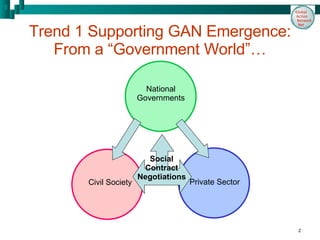
Trend 1 Supporting GAN Emergence: From a “Government World”… National Governments Private Sector Civil Society Social Contract Negotiations
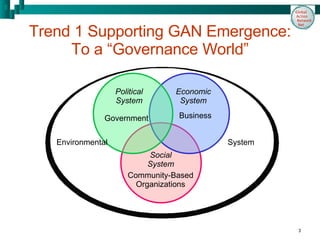
Trend 1 Supporting GAN Emergence: To a “Governance World” Political System Government Economic System Business Social System Community-Based Organizations Environmental   System
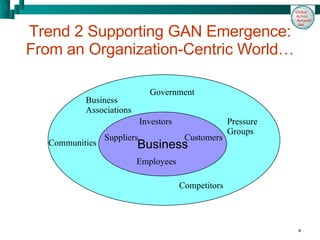
Trend 2 Supporting GAN Emergence: From an Organization-Centric World… Business Business Suppliers Customers Investors Government Pressure Groups Communities Competitors Employees Business Associations
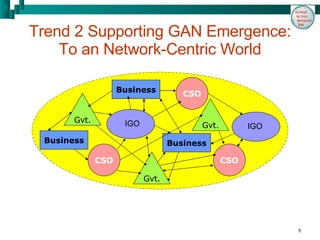
Trend 2 Supporting GAN Emergence: To an Network-Centric World CSO CSO CSO Business Business Business Gvt. Gvt. Gvt. IGO IGO
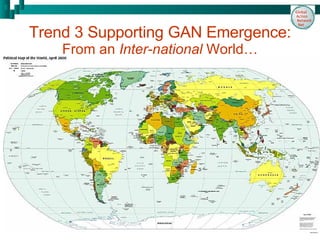
Trend 3 Supporting GAN Emergence:  From an  Inter-national  World…
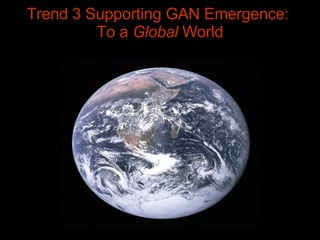
Trend 3 Supporting GAN Emergence:  To a  Global  World
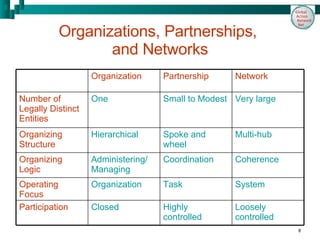
Organizations, Partnerships,  and Networks Organization Partnership Network Number of Legally Distinct Entities One Small to Modest Very large Organizing Structure Hierarchical Spoke and wheel Multi-hub Organizing Logic Administering/ Managing Coordination Coherence Operating Focus Organization Task System Participation Closed Highly controlled Loosely controlled
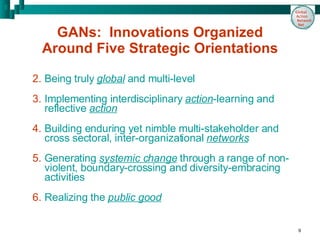
GANs:  Innovations Organized Around Five Strategic Orientations Being truly   global  and multi-level Implementing interdisciplinary  action -learning and reflective  action Building enduring yet nimble multi-stakeholder and cross sectoral, inter-organizational  networks Generating  systemic change  through a range of non-violent, boundary-crossing and diversity-embracing activities Realizing the  public good
In Summary, GANs are: … global governance innovations optimizing: democratic imperatives:  transparency  participation accountability market effectiveness: adaptability  efficiency  scalability
Several dozen GANs—and growing… Building Partnerships for Development in Water and Sanitation  Climate Group Extractive Industries Transparency Initiative Fair Labor Association Forest Stewardship Council  Global Alliance for Improved Nutrition Global Compact  Global Fund to Fight AIDS, Tuberculosis and Malaria  Global Knowledge Partnership Global Reporting Initiative  Global Water Partnership  Global Partnership for the Prevention of Armed Conflict International Centre for Trade and Sustainable Development  Marine Stewardship Council Microcredit Summit Campaign  Social Accountability International  The Access Initiative (TAI)/ Partnership for Principle 10  Transparency International Youth Employment Systems
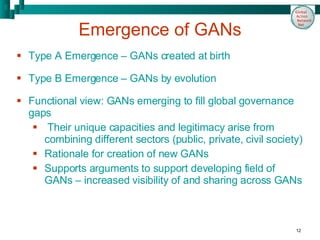
Emergence of GANs Type A Emergence – GANs created at birth Type B Emergence – GANs by evolution Functional view: GANs emerging to fill global governance gaps Their unique capacities and legitimacy arise from combining different sectors (public, private, civil society) Rationale for creation of new GANs Supports arguments to support developing field of GANs – increased visibility of and sharing across GANs
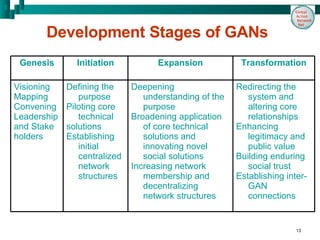
Development Stages of GANs   Genesis Initiation Expansion Transformation Visioning  Mapping Convening Leadership and Stake holders Defining the purpose Piloting core technical solutions Establishing initial centralized network structures Deepening understanding of the purpose  Broadening application of core technical solutions and innovating novel social solutions Increasing network membership and decentralizing network structures Redirecting the system and altering core relationships Enhancing legitimacy and public value Building enduring social trust  Establishing inter-GAN connections
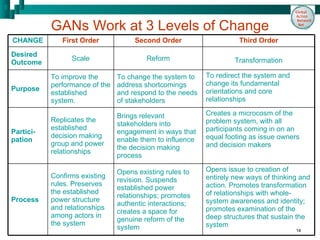
GANs Work at 3 Levels of Change CHANGE First Order Second Order Third Order Desired Outcome Scale  Reform Transformation Purpose To improve the performance of the established system. To change the system to address shortcomings and respond to the needs of stakeholders To redirect the system and change its fundamental orientations and core relationships  Partici-pation Replicates the established decision making group and power relationships  Brings relevant stakeholders into engagement in ways that enable them to influence the decision making process  Creates a microcosm of the problem system, with all participants coming in on an equal footing as issue owners and decision makers  Process Confirms existing rules. Preserves the established power structure and relationships among actors in the system  Opens existing rules to revision. Suspends established power relationships; promotes authentic interactions; creates a space for genuine reform of the system  Opens issue to creation of entirely new ways of thinking and action. Promotes transformation of relationships with whole-system awareness and identity; promotes examination of the deep structures that sustain the system
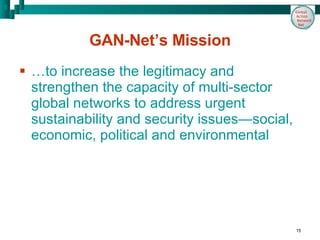
GAN-Net’s Mission …to increase the legitimacy and strengthen the capacity of multi-sector global networks to address urgent sustainability and security issues—social, economic, political and environmental
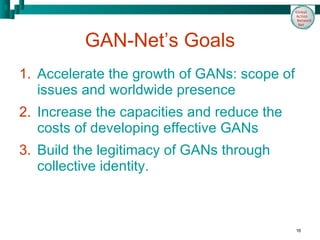
GAN-Net’s Goals Accelerate the growth of GANs: scope of issues and worldwide presence Increase the capacities and reduce the costs of developing effective GANs Build the legitimacy of GANs through collective identity.
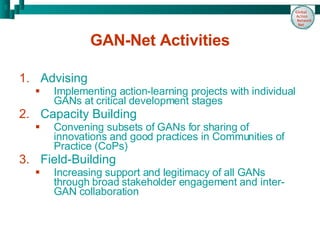
GAN-Net Activities Advising  Implementing action-learning projects with individual GANs at critical development stages Capacity Building Convening subsets of GANs for sharing of innovations and good practices in Communities of Practice (CoPs) Field-Building Increasing support and legitimacy of all GANs through broad stakeholder engagement and inter-GAN collaboration
GAN-Net Strategic Activities   Capacity-Building and Field Building Supporting individual GANs at critical junctures Fostering joint learning and innovation through CoPs Increasing the support and legitimacy of GANs and the GAN strategy
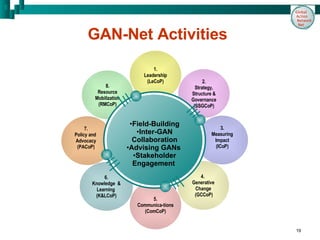
GAN-Net Activities   1. Leadership (LeCoP) 3. Measuring Impact (ICoP) 5. Communica-tions (ComCoP) 4.  Generative Change (GCCoP) 6. Knowledge  & Learning  (K&LCoP) 7. Policy and  Advocacy (PACoP) 8. Resource Mobilization (RMCoP) 2. Strategy, Structure & Governance (SSGCoP) Field-Building Inter-GAN Collaboration Advising GANs  Stakeholder Engagement
Who is GAN-Net? … a growing network of GANs, funders, and other stakeholders who are committed to this field Global Council of GAN Leaders and Supporters GAN-Net Board of Directors  GAN-Net Stewards GAN-Net Associates GAN-Net Partners
… making globalization work for all!

Introduction to GAN-Net

  • 1.
    Global Action Networks and GAN-Net … making globalization work for all!
  • 2.
    Trend 1 SupportingGAN Emergence: From a “Government World”… National Governments Private Sector Civil Society Social Contract Negotiations
  • 3.
    Trend 1 SupportingGAN Emergence: To a “Governance World” Political System Government Economic System Business Social System Community-Based Organizations Environmental System
  • 4.
    Trend 2 SupportingGAN Emergence: From an Organization-Centric World… Business Business Suppliers Customers Investors Government Pressure Groups Communities Competitors Employees Business Associations
  • 5.
    Trend 2 SupportingGAN Emergence: To an Network-Centric World CSO CSO CSO Business Business Business Gvt. Gvt. Gvt. IGO IGO
  • 6.
    Trend 3 SupportingGAN Emergence: From an Inter-national World…
  • 7.
    Trend 3 SupportingGAN Emergence: To a Global World
  • 8.
    Organizations, Partnerships, and Networks Organization Partnership Network Number of Legally Distinct Entities One Small to Modest Very large Organizing Structure Hierarchical Spoke and wheel Multi-hub Organizing Logic Administering/ Managing Coordination Coherence Operating Focus Organization Task System Participation Closed Highly controlled Loosely controlled
  • 9.
    GANs: InnovationsOrganized Around Five Strategic Orientations Being truly global and multi-level Implementing interdisciplinary action -learning and reflective action Building enduring yet nimble multi-stakeholder and cross sectoral, inter-organizational networks Generating systemic change through a range of non-violent, boundary-crossing and diversity-embracing activities Realizing the public good
  • 10.
    In Summary, GANsare: … global governance innovations optimizing: democratic imperatives: transparency participation accountability market effectiveness: adaptability efficiency scalability
  • 11.
    Several dozen GANs—andgrowing… Building Partnerships for Development in Water and Sanitation Climate Group Extractive Industries Transparency Initiative Fair Labor Association Forest Stewardship Council Global Alliance for Improved Nutrition Global Compact Global Fund to Fight AIDS, Tuberculosis and Malaria Global Knowledge Partnership Global Reporting Initiative Global Water Partnership Global Partnership for the Prevention of Armed Conflict International Centre for Trade and Sustainable Development Marine Stewardship Council Microcredit Summit Campaign Social Accountability International The Access Initiative (TAI)/ Partnership for Principle 10 Transparency International Youth Employment Systems
  • 12.
    Emergence of GANsType A Emergence – GANs created at birth Type B Emergence – GANs by evolution Functional view: GANs emerging to fill global governance gaps Their unique capacities and legitimacy arise from combining different sectors (public, private, civil society) Rationale for creation of new GANs Supports arguments to support developing field of GANs – increased visibility of and sharing across GANs
  • 13.
    Development Stages ofGANs Genesis Initiation Expansion Transformation Visioning Mapping Convening Leadership and Stake holders Defining the purpose Piloting core technical solutions Establishing initial centralized network structures Deepening understanding of the purpose Broadening application of core technical solutions and innovating novel social solutions Increasing network membership and decentralizing network structures Redirecting the system and altering core relationships Enhancing legitimacy and public value Building enduring social trust Establishing inter-GAN connections
  • 14.
    GANs Work at3 Levels of Change CHANGE First Order Second Order Third Order Desired Outcome Scale Reform Transformation Purpose To improve the performance of the established system. To change the system to address shortcomings and respond to the needs of stakeholders To redirect the system and change its fundamental orientations and core relationships Partici-pation Replicates the established decision making group and power relationships Brings relevant stakeholders into engagement in ways that enable them to influence the decision making process Creates a microcosm of the problem system, with all participants coming in on an equal footing as issue owners and decision makers Process Confirms existing rules. Preserves the established power structure and relationships among actors in the system Opens existing rules to revision. Suspends established power relationships; promotes authentic interactions; creates a space for genuine reform of the system Opens issue to creation of entirely new ways of thinking and action. Promotes transformation of relationships with whole-system awareness and identity; promotes examination of the deep structures that sustain the system
  • 15.
    GAN-Net’s Mission …toincrease the legitimacy and strengthen the capacity of multi-sector global networks to address urgent sustainability and security issues—social, economic, political and environmental
  • 16.
    GAN-Net’s Goals Acceleratethe growth of GANs: scope of issues and worldwide presence Increase the capacities and reduce the costs of developing effective GANs Build the legitimacy of GANs through collective identity.
  • 17.
    GAN-Net Activities Advising Implementing action-learning projects with individual GANs at critical development stages Capacity Building Convening subsets of GANs for sharing of innovations and good practices in Communities of Practice (CoPs) Field-Building Increasing support and legitimacy of all GANs through broad stakeholder engagement and inter-GAN collaboration
  • 18.
    GAN-Net Strategic Activities Capacity-Building and Field Building Supporting individual GANs at critical junctures Fostering joint learning and innovation through CoPs Increasing the support and legitimacy of GANs and the GAN strategy
  • 19.
    GAN-Net Activities 1. Leadership (LeCoP) 3. Measuring Impact (ICoP) 5. Communica-tions (ComCoP) 4. Generative Change (GCCoP) 6. Knowledge & Learning (K&LCoP) 7. Policy and Advocacy (PACoP) 8. Resource Mobilization (RMCoP) 2. Strategy, Structure & Governance (SSGCoP) Field-Building Inter-GAN Collaboration Advising GANs Stakeholder Engagement
  • 20.
    Who is GAN-Net?… a growing network of GANs, funders, and other stakeholders who are committed to this field Global Council of GAN Leaders and Supporters GAN-Net Board of Directors GAN-Net Stewards GAN-Net Associates GAN-Net Partners
  • 21.