Business Friendly
and Competitive
LGUs
Socially- and
Environmentally-
Protective LGUs
Disaster-Resilient
LGUs
Empowered and
Accountable LGUs
Conflict-Free and
Safe Communities
LGRRC
CORE SERVICES
KM PROCESSES
THEMATIC
AREAS
Development
Partners
POINTS OF
COLLABORATION
Framework (KM is one of the strategy of the LGRRC and
DILG as knowledge-centric organization
• Effective Local Governance
– Public Education and Good Governance Citizenship
development
– Knowledge Sharing
– Multi – Media Development and
– Capacity Development
• Knowledge Creation (KM Processes)
• Knowledge Sharing
• Knowledge organization and Management
• 5 Thematic Areas – Business Friendly LGUs; Disaster Resilient;
empowered and accountable LGUs; conflict free and safe
communities; and Socially- and Environmentally-Protective LGUs
• Points of Collaborators, CO, DILG
Description
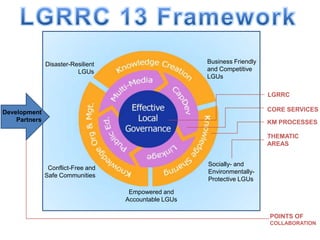
• The LGRRC framework is aimed at contributing attainment of Effective Local
Governance, which is set at the core of the diagram
• The LGRRC as platform for such purpose offered four principal services – the Public
Education, Multi-media, Capacity development, linkage and networking.
Engagement this services would capacitate the local government units, our clients,
in effecting strategic interventions in achieving their respective goals.
• However, the knowledge processes must also be in-placed in order to effectively
and efficiently deliver such services. The three components of such processes are
knowledge creation, knowledge sharing and knowledge organization and
management. These are strategically directed towards strengthening the core
services of the facility.
• Outside the circle are the four thematic programs of the PNOY administration –
Disaster resilient communities, business – friendly and competitive LGU,
empowered and accountable LGUs and Safe and conflict-free communities.
Interventions are aligned on these four thematic areas.
• Stakeholders – both public, private and civil societies are collaborators of this
endeavor. Acting in various capacities, these stakeholders wanted to contribute
for a better governance outcomes.

Decription lgrrc framework

  • 1.
    Business Friendly and Competitive LGUs Socially-and Environmentally- Protective LGUs Disaster-Resilient LGUs Empowered and Accountable LGUs Conflict-Free and Safe Communities LGRRC CORE SERVICES KM PROCESSES THEMATIC AREAS Development Partners POINTS OF COLLABORATION
  • 2.
    Framework (KM isone of the strategy of the LGRRC and DILG as knowledge-centric organization • Effective Local Governance – Public Education and Good Governance Citizenship development – Knowledge Sharing – Multi – Media Development and – Capacity Development • Knowledge Creation (KM Processes) • Knowledge Sharing • Knowledge organization and Management • 5 Thematic Areas – Business Friendly LGUs; Disaster Resilient; empowered and accountable LGUs; conflict free and safe communities; and Socially- and Environmentally-Protective LGUs • Points of Collaborators, CO, DILG
  • 3.
    Description • The LGRRCframework is aimed at contributing attainment of Effective Local Governance, which is set at the core of the diagram • The LGRRC as platform for such purpose offered four principal services – the Public Education, Multi-media, Capacity development, linkage and networking. Engagement this services would capacitate the local government units, our clients, in effecting strategic interventions in achieving their respective goals. • However, the knowledge processes must also be in-placed in order to effectively and efficiently deliver such services. The three components of such processes are knowledge creation, knowledge sharing and knowledge organization and management. These are strategically directed towards strengthening the core services of the facility. • Outside the circle are the four thematic programs of the PNOY administration – Disaster resilient communities, business – friendly and competitive LGU, empowered and accountable LGUs and Safe and conflict-free communities. Interventions are aligned on these four thematic areas. • Stakeholders – both public, private and civil societies are collaborators of this endeavor. Acting in various capacities, these stakeholders wanted to contribute for a better governance outcomes.