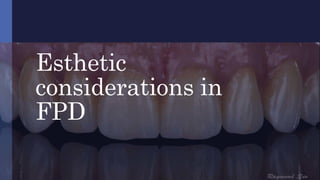
Esthetic
considerations in
FPD
Contents
• Introduction
• What is aesthetics
• History
• Factors in aesthetics
• Principles in aesthetics
• Recent advances
• Conclusion
Introduction
• Fixed partial denture in appearance zone  concepts of dental
esthetics applied
• Simulate appearance of natural tooth
• Attractive smile  improves appearance & self esteem/ self image
• Dentistry has moved (classic era  conservative era)
• More and more conservative procedures (developments in bonding
agents)
• Changes from need-based treatment to want-based treatment
• Dental visits are esthetically motivated
What is aesthetics?
• Aesthetics is a branch of psychology described as
converting a tangible sensation to a psychological
(usually pleasurable) experience
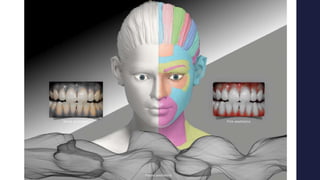
• Dental aesthetics is a broad term concentrating on a
smile, and composed of 3 constituents:
1. white aesthetics (concerning the teeth),
2. pink aesthetics (concerning the gingiva)
3. facial aesthetics (concerning extra-oral features,
predominantly the lips)
History
• Link between colour and form can be traced to the Greek and Egyptian
empires
• Ancient Greeks methods by which beauty could be quantified and
predictably reproduced by artisans and artists
• Pythagoras in 530 BC  the Golden Number, represented by the Greek
symbol, ∆ [(∆5-1) ÷ 2]. The reciprocal of ∆ is 0.618 and has been termed the
Golden or Divine Proportion.
• Radiating symmetry found in natural world and architecture (jay hambidge)
Factors in esthetics
• Esthetics & functionality
• Patient’s self image
• Media & Fashion influence
• Patient’s expectations
• Natural looking restorations
• Advances in ceramics
• Advances in luting agents
Advances in materials
• Ceramics  improved translucency
• Vaccum firing (vines 1958)
• 1976, McLean and Seeddevelope mercially possible foil-reinforced crown
system
• 1993 ,Andersonand Oden described atechnique for manufacturing individual
all-ceramic crowns made up of densely sintered high-purity alumina
• Wohlwend developed and marketed a material for the bonding of porcelain
that used the principle of leucite crystal dispersion(Empress)
Principles in esthetics
• Mid line
• Incisal length
• Zenith points
• Gingival health & interdental
embrasures
• Gingival levels & harmony
• Tooth axis
• Interdental contact areas
• Embrasures
• Individual and collective teeth
dimensions
• Single tooth proportions
Principles in esthetics
• Golden proportions
• Tooth character
• Shape & position of teeth
• Tooth arrangement
• Colour of teeth
• SPA factor
• Smile line
• Lip line
• Symmetry
Appearance zone
• Typical display of maxillary anteriors and premolars
• Study by Tjan , nearly 80% displayed entire length of maxillary
anterior teeth
• Women show twice as much maxillary central incisor than men
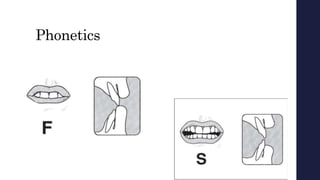
• Phonetics also influence size and position of maxillary incisors
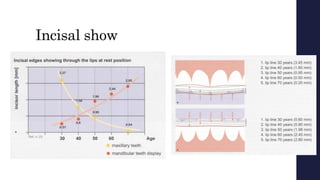
• Before 30 years , less mandibular incisors seen
• After 30 , more mandibular incisors seen (sagging of
musculature)
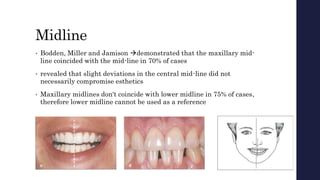
Midline
• Bodden, Miller and Jamison demonstrated that the maxillary mid-
line coincided with the mid-line in 70% of cases
• revealed that slight deviations in the central mid-line did not
necessarily compromise esthetics
• Maxillary midlines don't coincide with lower midline in 75% of cases,
therefore lower midline cannot be used as a reference
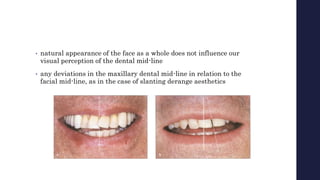
• natural appearance of the face as a whole does not influence our
visual perception of the dental mid-line
• any deviations in the maxillary dental mid-line in relation to the
facial mid-line, as in the case of slanting derange aesthetics
Incisal curve
• Incisal curve perpendicular to midline & parallel to interpupillary
line
Incisal length
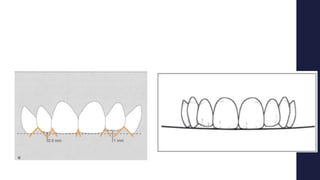
• most important determinant in the creation of a smile
• position of the incisal edge acts as the parameter upon which the rest of the
treatment is built
• Several reference teeth serve as the reference point for the correct incisal
edge position for the remaining teeth.
• The age and gender of the patient, along with the length and curvature of
the upper lip, will determine the length of the incisal edge
• Central incisors not seen at rest  older appearance
• Can be lengthened to give youthful appearance
• Incisors can be elongated or shortened according to requirement
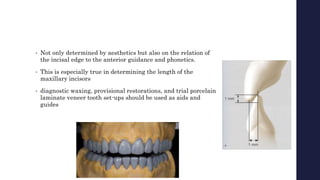
• Not only determined by aesthetics but also on the relation of
the incisal edge to the anterior guidance and phonetics.
• This is especially true in determining the length of the
maxillary incisors
• diagnostic waxing, provisional restorations, and trial porcelain
laminate veneer tooth set-ups should be used as aids and
guides
Incisal show
Phonetics
Zenith points
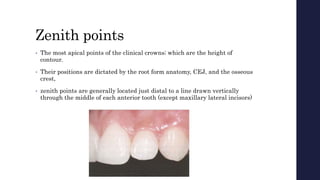
• The most apical points of the clinical crowns; which are the height of
contour.
• Their positions are dictated by the root form anatomy, CEJ, and the osseous
crest,
• zenith points are generally located just distal to a line drawn vertically
through the middle of each anterior tooth (except maxillary lateral incisors)
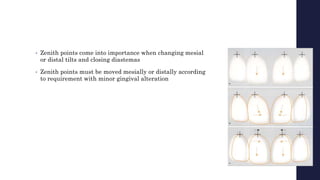
• Zenith points come into importance when changing mesial
or distal tilts and closing diastemas
• Zenith points must be moved mesially or distally according
to requirement with minor gingival alteration
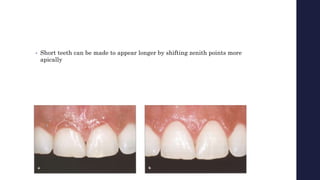
• Short teeth can be made to appear longer by shifting zenith points more
apically
Gingival health and interdental
embrasures
• Healthy interdental papillae should be thin and terminate on the tooth in
knife edge contour
• level of healthy gingiva is dictated by the position of the alveolar bone
beneath it
• Healthy gingiva lies 3 mm away from the intact bone on the facial aspect
and the tip of the stable papilla maintains a distance of 5 mm from the
intercrestal bone
• initiation of the prosthodontic treatment should be postponed until the
health of the gingival tissue has been reinstated.
• The postponement will allow the clinician to assess the inflammation and
devise treatment
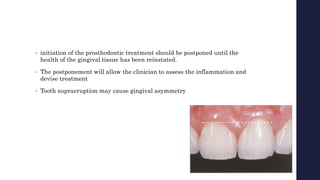
• Tooth supraeruption may cause gingival asymmetry
Gingival Levels and Harmony
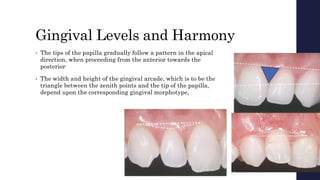
• The tips of the papilla gradually follow a pattern in the apical
direction, when proceeding from the anterior towards the
posterior
• The width and height of the gingival arcade, which is to be the
triangle between the zenith points and the tip of the papilla,
depend upon the corresponding gingival morphotype,
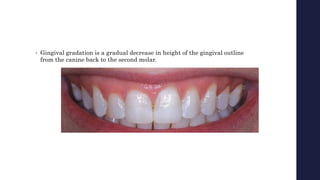
• Gingival gradation is a gradual decrease in height of the gingival outline
from the canine back to the second molar.
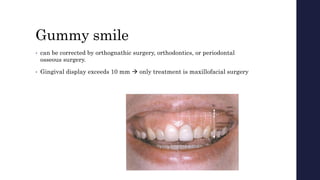
Gummy smile
• can be corrected by orthognathic surgery, orthodontics, or periodontal
osseous surgery.
• Gingival display exceeds 10 mm  only treatment is maxillofacial surgery
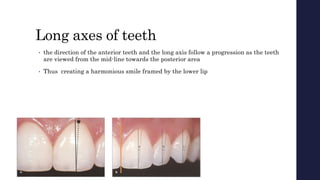
Long axes of teeth
• the direction of the anterior teeth and the long axis follow a progression as the teeth
are viewed from the mid-line towards the posterior area
• Thus creating a harmonious smile framed by the lower lip
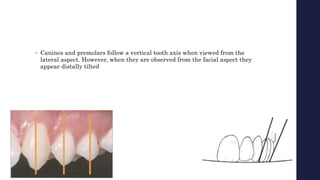
• Canines and premolars follow a vertical tooth axis when viewed from the
lateral aspect. However, when they are observed from the facial aspect they
appear distally tilted
Interdental contact areas / points
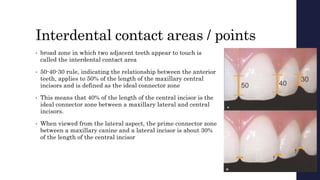
• broad zone in which two adjacent teeth appear to touch is
called the interdental contact area
• 50-40-30 rule, indicating the relationship between the anterior
teeth, applies to 50% of the length of the maxillary central
incisors and is defined as the ideal connector zone
• This means that 40% of the length of the central incisor is the
ideal connector zone between a maxillary lateral and central
incisors.
• When viewed from the lateral aspect, the prime connector zone
between a maxillary canine and a lateral incisor is about 30%
of the length of the central incisor
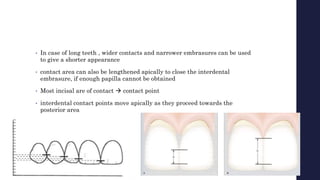
• In case of long teeth , wider contacts and narrower embrasures can be used
to give a shorter appearance
• contact area can also be lengthened apically to close the interdental
embrasure, if enough papilla cannot be obtained
• Most incisal are of contact  contact point
• interdental contact points move apically as they proceed towards the
posterior area
Embrasures
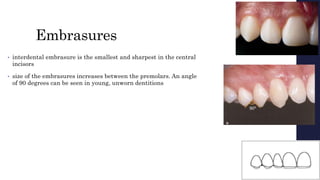
• interdental embrasure is the smallest and sharpest in the central
incisors
• size of the embrasures increases between the premolars. An angle
of 90 degrees can be seen in young, unworn dentitions
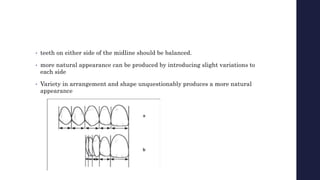
• teeth on either side of the midline should be balanced.
• more natural appearance can be produced by introducing slight variations to
each side
• Variety in arrangement and shape unquestionably produces a more natural
appearance
Individual and collective tooth
dimensions
• maxillary central incisors are especially important in determining the size
and shape of the anterior dentition and its overall visual effect’
• maxillary central incisors dominate in shape, size and position
• consistent arch form and correct proportion to the facial morphology are
essential in the pleasing dentition
• Proportion must be in harmony with strong or weak characteristics of the
face
• The size and character of the buccal corridor created when a person smiles
are controlled by the size and position of the canines
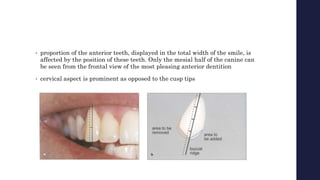
• proportion of the anterior teeth, displayed in the total width of the smile, is
affected by the position of these teeth. Only the mesial half of the canine can
be seen from the frontal view of the most pleasing anterior dentition
• cervical aspect is prominent as opposed to the cusp tips
Single tooth proportions
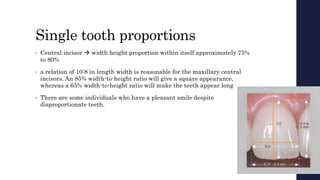
• Central incisor  width height proportion within itself approximately 75%
to 80%
• a relation of 10:8 in length width is reasonable for the maxillary central
incisors. An 85% width-to-height ratio will give a square appearance,
whereas a 65% width-to-height ratio will make the teeth appear long
• There are some individuals who have a pleasant smile despite
disproportionate teeth.
Golden proportion
• Lombardi suggests that we view the patient as a whole when seeking to
achieve harmony. To achieve facial harmony, the overall anterior dental com
position must be approached as a whole picture, with the facial features as
their frame.
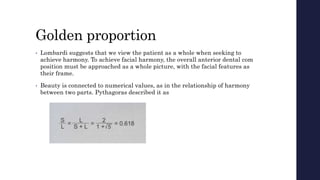
• Beauty is connected to numerical values, as in the relationship of harmony
between two parts. Pythagoras described it as
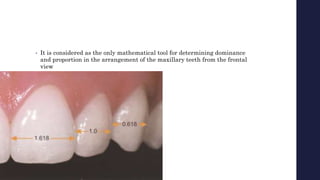
• It is considered as the only mathematical tool for determining dominance
and proportion in the arrangement of the maxillary teeth from the frontal
view
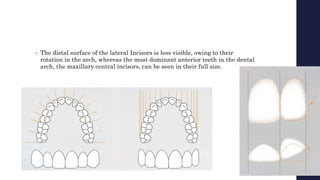
• The distal surface of the lateral Incisors is less visible, owing to their
rotation in the arch, whereas the most dominant anterior teeth in the dental
arch, the maxillary central incisors, can be seen in their full size.
RED proportion
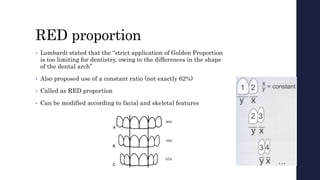
• Lombardi stated that the “strict application of Golden Proportion
is too limiting for dentistry, owing to the differences in the shape
of the dental arch”
• Also proposed use of a constant ratio (not exactly 62%)
• Called as RED proportion
• Can be modified according to facial and skeletal features
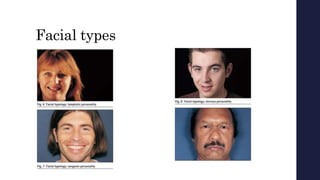
Facial types
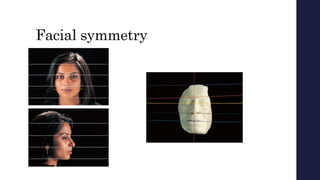
Facial symmetry
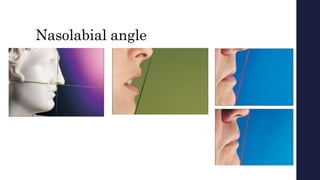
Nasolabial angle
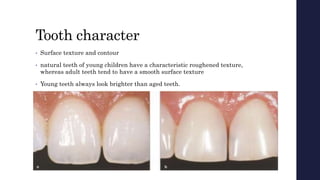
Tooth character
• Surface texture and contour
• natural teeth of young children have a characteristic roughened texture,
whereas adult teeth tend to have a smooth surface texture
• Young teeth always look brighter than aged teeth.
• Visual perception
• The greater the contrast the greater the visibility.
• Visibility increases with an increase in light reflection.
• Visibility diminishes as light deflection increases
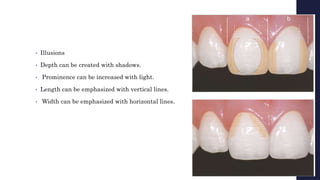
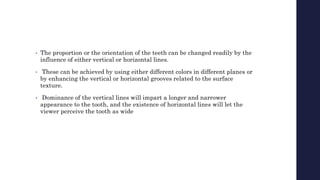
• Illusions
• Depth can be created with shadows.
• Prominence can be increased with light.
• Length can be emphasized with vertical lines.
• Width can be emphasized with horizontal lines.
• The proportion or the orientation of the teeth can be changed readily by the
influence of either vertical or horizontal lines.
• These can be achieved by using either different colors in different planes or
by enhancing the vertical or horizontal grooves related to the surface
texture.
• Dominance of the vertical lines will impart a longer and narrower
appearance to the tooth, and the existence of horizontal lines will let the
viewer perceive the tooth as wide
Shape and position of teeth
• Esthetic Harmony and Support
• Correct shaping and positioning of incisors are crucial.
• Influences facial muscles and lips.
• Tooth Shape Perception
• Related to the shape of the dental arch.
• Geometric Categories of Dental Arch Alignment
1. Ovoid
2. Square
3. Tapered
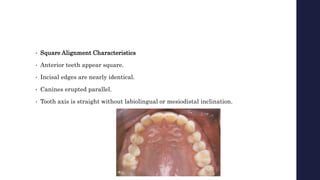
• Square Alignment Characteristics
• Anterior teeth appear square.
• Incisal edges are nearly identical.
• Canines erupted parallel.
• Tooth axis is straight without labiolingual or mesiodistal inclination.
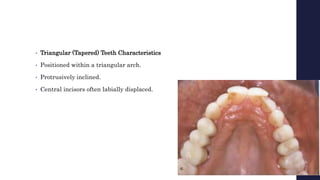
• Triangular (Tapered) Teeth Characteristics
• Positioned within a triangular arch.
• Protrusively inclined.
• Central incisors often labially displaced.
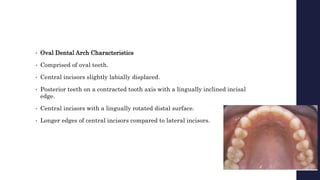
• Oval Dental Arch Characteristics
• Comprised of oval teeth.
• Central incisors slightly labially displaced.
• Posterior teeth on a contracted tooth axis with a lingually inclined incisal
edge.
• Central incisors with a lingually rotated distal surface.
• Longer edges of central incisors compared to lateral incisors.
• Restoration of Incisors
• Adherence to the natural form of the tooth is important.
• Use homologous teeth as a reference if available.
• Morphologic shape of the face, gender, and age characteristics aid in
developing tooth form
Colour of teeth
• Perception of Tooth Color
• Influenced by tooth shape and morphologic placement.
• Considerable variation in color across the entire dental arch.
• Brightest teeth: maxillary central incisors.
• Lateral incisors: similar hue, lower color value.
• Canines: highest chroma saturation, lowest value.
• First and second premolars: similar to lateral incisors in value, lighter and
brighter than canines
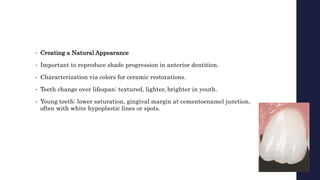
• Creating a Natural Appearance
• Important to reproduce shade progression in anterior dentition.
• Characterization via colors for ceramic restorations.
• Teeth change over lifespan: textured, lighter, brighter in youth.
• Young teeth: lower saturation, gingival margin at cementoenamel junction,
often with white hypoplastic lines or spots.
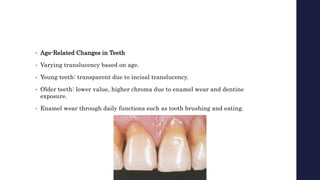
• Age-Related Changes in Teeth
• Varying translucency based on age.
• Young teeth: transparent due to incisal translucency.
• Older teeth: lower value, higher chroma due to enamel wear and dentine
exposure.
• Enamel wear through daily functions such as tooth brushing and eating.
• Restoration Considerations
• Depth and extent of translucent porcelains based on translucency pattern.
• Mean value determined by chromas distributed over the tooth surface.
• Basic hue related to enamel, dentin, and light interaction
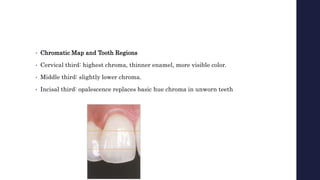
• Chromatic Map and Tooth Regions
• Cervical third: highest chroma, thinner enamel, more visible color.
• Middle third: slightly lower chroma.
• Incisal third: opalescence replaces basic hue chroma in unworn teeth
• Fluorescence and Opalescence
• Inner dentin body and external enamel create these phenomena.
• Tooth color determined by varying saturation levels.
• Fluorescence: absorbs light energy, emits at different wavelength, creates
tooth value.
• Increasing fluorescence can increase value in restoration.
• Achieving Natural-Looking Restorations
• Consider age, gender, and personality of the patient.
• Older teeth: smoother, darker, higher saturation or chroma.
• Lower incisors in older patients: flat, broad incisal edges showing dentin
core.
SPA factor
• Clinical investigations by Frush and Fisher concerning the sex, personality
and age (SPA) factor arrived at the norms for these investigations
• femininity can be expressed in terms of delicacy and softness, whereas
masculinity can be expressed in terms of vigor and angularity.
• incisal edges and transitional line angles of feminine teeth are rounded,
while the edges tend to be translucent.
• males, square incisal edges that appear to be blunt can enhance the
masculine appearance.
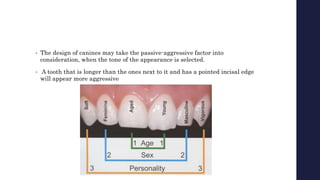
• The design of canines may take the passive-aggressive factor into
consideration, when the tone of the appearance is selected.
• A tooth that is longer than the ones next to it and has a pointed incisal edge
will appear more aggressive
Gradation
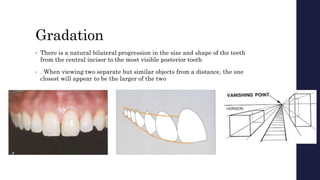
• There is a natural bilateral progression in the size and shape of the teeth
from the central incisor to the most visible posterior tooth
• . When viewing two separate but similar objects from a distance, the one
closest will appear to be the larger of the two
Smile line
• The smile line is the lower margin of the upper lip that limits the visibility
of the teeth
• Follows the edges of the maxillary anterior teeth
• .Curvature follows the inner border of the lower lip.
• Angles of the mouth parallel to the bipupillary line and occlusal plane.
• Tips of the canines barely touch the lower lip.
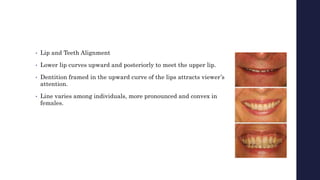
• Lip and Teeth Alignment
• Lower lip curves upward and posteriorly to meet the upper lip.
• Dentition framed in the upward curve of the lips attracts viewer’s
attention.
• Line varies among individuals, more pronounced and convex in
females.
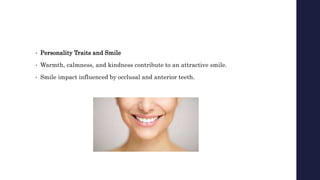
• Personality Traits and Smile
• Warmth, calmness, and kindness contribute to an attractive smile.
• Smile impact influenced by occlusal and anterior teeth.
Lip line
• Volume, shape, and length of lips assessed at rest and active.
• Upper lip line correlates with maxillary anterior teeth and gingiva display.
• Lip line, length, and curvature vary by age and face anatomy.
• Incisal edge alignment with bipupillary and occlusal plane.
• Lip line should be evaluated before restoration
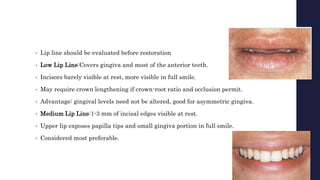
• Low Lip Line:Covers gingiva and most of the anterior teeth.
• Incisors barely visible at rest, more visible in full smile.
• May require crown lengthening if crown-root ratio and occlusion permit.
• Advantage: gingival levels need not be altered, good for asymmetric gingiva.
• Medium Lip Line:1-3 mm of incisal edges visible at rest.
• Upper lip exposes papilla tips and small gingiva portion in full smile.
• Considered most preferable.
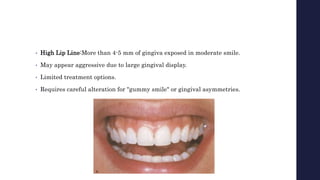
• High Lip Line:More than 4-5 mm of gingiva exposed in moderate smile.
• May appear aggressive due to large gingival display.
• Limited treatment options.
• Requires careful alteration for "gummy smile" or gingival asymmetries.
• Restoration Considerations
• Gingival levels should be altered only if conditions allow.
• Address gingival asymmetries carefully, using orthodontics, periodontics, or
orthognathic surgery.
• Ensure esthetic demands of the patient are met.
• Importance of correct smile line evaluation before restoration.
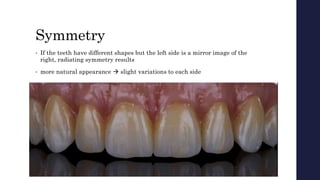
Symmetry
• If the teeth have different shapes but the left side is a mirror image of the
right, radiating symmetry results
• more natural appearance  slight variations to each side
Shade selection
• Scientific Basis and Artistic Aspects:
• Scientific understanding of color.
• Artistic aspects of shade selection.
• Color Perception Factors:
• Observer
• Object
• Light source
•Observer:
•Color blindness considerations.
•Higher prevalence in men (9.3% in men vs. 0% in women).
•ADA study: 9.8% of men and 0.1% of women dentists have color vision deficiency
•Object:
•Light modification through absorption, reflection, transmission, or refraction.
•Influence of surrounding environment (e.g., operatory walls, cabinets).
•Light Source:
•Types: natural, incandescent, and fluorescent.
•Impact on color perception.
•Variability in natural sunlight.
•Characteristics of artificial light sources (incandescent vs. fluorescent).
• Special Light Sources:
• Color-corrected lights:
• Uniform distribution of color.
• Importance in initial shade selection.
• Consideration of metamerism
Colour
• Characteristics of Color:
1.Hue:
1. Distinguishes one color from another.
2. Primary or combination of colors.
2.Chroma:
1. Saturation or intensity of a hue.
2. High chroma (red) vs. low chroma (pink).
3.Value:
1. Lightness or darkness of a hue.
2. Most important in shade matching.
3. Preference for lighter shades for ease of staining.
• Factors for Natural-Appearing Restorations:
• Color, translucency, contour, surface texture, and luster.
• Translucency Patterns:
• Affects value (increased translucency = decreased value).
• Variations with age and individuals.
• Younger teeth: more incisal translucency.
• Older teeth: lower value and higher chroma.
• Form and Contours:
• Importance in esthetics:
• Matching outline form and shade.
• Influence of contralateral tooth for proper contours.
• Surface Texture:
• Role in esthetics:
• Reflectance pattern simulation.
• Surface characterization (stippling, ridges, striations)
in young teeth.
• Smoother surfaces in older teeth.
• Team Approach:
• Dentist and Technician Collaboration:
• Communication of detailed information (age, gender, shade
diagram, casts, photographs).
Sequence
• Guidelines for Shade Matching:
1.Use Consistent Shade Guide:
1. Ensure the shade guide matches the porcelain used by the
technician.
2. Avoid reliance on conversion charts for accuracy.
2.Shade Matching Timing:
1. Perform shade matching before tooth preparation.
2. Prevents dehydration and color change of teeth.
3. Avoids debris contamination from enamel, metal, and cement
grindings.
• Eliminate Distractions:
• Remove lipstick to avoid color interference.
• Remove large, bright items like earrings and glasses.
• Address heavy facial makeup (e.g., rouge) to ensure an accurate
match.
Steps for vita classic
•Patient and Operator Positioning:
•Seat the patient upright with the mouth at the operator's eye level.
•The operator should position themselves between the patient and the light source.
•Observation Technique:
•Make quick observations (5 seconds or less) to avoid retinal cone fatigue.
•Rest the eyes by glancing at a blue/Gray object to reset color sensitivity.
•Shade Matching Sequence:
•Match the shade by value, chroma, and hue, in that order.
•Alternatively, choose the hue group first (A, B, C, or D) using the canine.
•Select the final shade tab by concurrently considering chroma and value.
•Elimination Process:
•Quickly scan the shade guide and eliminate the worst matches first.
•Moisten the remaining tabs and compare them side-by-side with the tooth.
•Match the gingival portion of the shade tabs with the gingival area of the tooth.
•Neck of Shade Tabs:
•Remove the necks of the shade tabs to avoid distraction from extrinsic colorants.
• Final Matching:
• Compare the incisal segments of the tabs with the incisal portion of the
tooth.
• Initially select the shade using a color-corrected light and then repeat under
at least one other light source to minimize metamerism.
• Value Selection:
• Since value is the most important dimension, view the tabs through half-
closed eyes to better match the relative lightness or darkness of the tooth.
• Arrange the shade guide according to value to facilitate the correct selection
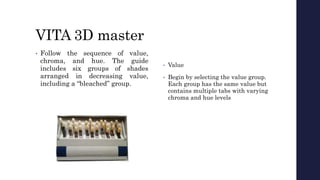
VITA 3D master
• Follow the sequence of value,
chroma, and hue. The guide
includes six groups of shades
arranged in decreasing value,
including a “bleached” group.
• Value
• Begin by selecting the value group.
Each group has the same value but
contains multiple tabs with varying
chroma and hue levels
• Chroma Selection:
• Choose the chroma level within the
selected value group using the middle
(M) group tabs.
• Hue selection
• Make the final choice of hue by
comparing the chosen chroma level
tab with adjacent tabs in the same
value group.Determine if the tooth
exhibits more red (R) or more yellow
(L) than the middle (M) tab.
•Measuring Characterizing Features:
•Use a periodontal probe or another millimeter-measuring device to establish the location and
extent of these distinguishing features.
•Creating a Lifelike Restoration:
•Develop color, translucency, and characterizations within the porcelain based on the observed
features to create a more lifelike restoration
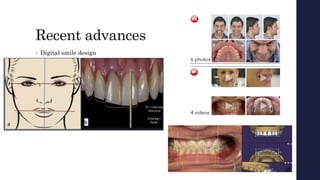
Recent advances
• Digital smile design
Conclusion
References
• The science and art of porcelain laminate veneers galip gruel
• Fundamentals of fixed prosthodontics Herbert T shillingburg 4th edition
• Ahmad I. Anterior dental aesthetics: Historical perspective. British dental journal [Internet].
2005 Jun 1 [cited 2024 Jul 8];198(12):737–42. Available from:
https://www.nature.com/articles/4812411
• Ahmad I. Anterior dental aesthetics: Dental perspective [Internet]. ResearchGate. Springer
Nature; 2005 [cited 2024 Jul 8]. Available from:
https://www.researchgate.net/publication/7571862_Anterior_dental_aesthetics_Dental_persp
ective
• Ahmad I. Anterior dental aesthetics: Facial perspective. British dental journal [Internet]. 2005
Jul 1 [cited 2024 Jul 8];199(1):15–21. Available from:
https://pubmed.ncbi.nlm.nih.gov/16003415/
• Ahmad I. Anterior dental aesthetics: Dentofacial perspective. British dental journal [Internet].
2005 Jul 1 [cited 2024 Jul 8];199(2):81–8. Available from:
https://pubmed.ncbi.nlm.nih.gov/16041333/

esthetic considerations in fixed partial dentures.pptx

  • 1.
  • 2.
    Contents • Introduction • Whatis aesthetics • History • Factors in aesthetics • Principles in aesthetics • Recent advances • Conclusion
  • 3.
    Introduction • Fixed partialdenture in appearance zone  concepts of dental esthetics applied • Simulate appearance of natural tooth • Attractive smile  improves appearance & self esteem/ self image • Dentistry has moved (classic era  conservative era) • More and more conservative procedures (developments in bonding agents) • Changes from need-based treatment to want-based treatment • Dental visits are esthetically motivated
  • 4.
    What is aesthetics? •Aesthetics is a branch of psychology described as converting a tangible sensation to a psychological (usually pleasurable) experience • Dental aesthetics is a broad term concentrating on a smile, and composed of 3 constituents: 1. white aesthetics (concerning the teeth), 2. pink aesthetics (concerning the gingiva) 3. facial aesthetics (concerning extra-oral features, predominantly the lips)
  • 6.
    History • Link betweencolour and form can be traced to the Greek and Egyptian empires • Ancient Greeks methods by which beauty could be quantified and predictably reproduced by artisans and artists • Pythagoras in 530 BC  the Golden Number, represented by the Greek symbol, ∆ [(∆5-1) ÷ 2]. The reciprocal of ∆ is 0.618 and has been termed the Golden or Divine Proportion. • Radiating symmetry found in natural world and architecture (jay hambidge)
  • 7.
    Factors in esthetics •Esthetics & functionality • Patient’s self image • Media & Fashion influence • Patient’s expectations • Natural looking restorations • Advances in ceramics • Advances in luting agents
  • 8.
    Advances in materials •Ceramics  improved translucency • Vaccum firing (vines 1958) • 1976, McLean and Seeddevelope mercially possible foil-reinforced crown system • 1993 ,Andersonand Oden described atechnique for manufacturing individual all-ceramic crowns made up of densely sintered high-purity alumina • Wohlwend developed and marketed a material for the bonding of porcelain that used the principle of leucite crystal dispersion(Empress)
  • 9.
    Principles in esthetics •Mid line • Incisal length • Zenith points • Gingival health & interdental embrasures • Gingival levels & harmony • Tooth axis • Interdental contact areas • Embrasures • Individual and collective teeth dimensions • Single tooth proportions
  • 10.
    Principles in esthetics •Golden proportions • Tooth character • Shape & position of teeth • Tooth arrangement • Colour of teeth • SPA factor • Smile line • Lip line • Symmetry
  • 11.
    Appearance zone • Typicaldisplay of maxillary anteriors and premolars • Study by Tjan , nearly 80% displayed entire length of maxillary anterior teeth • Women show twice as much maxillary central incisor than men • Phonetics also influence size and position of maxillary incisors • Before 30 years , less mandibular incisors seen • After 30 , more mandibular incisors seen (sagging of musculature)
  • 12.
    Midline • Bodden, Millerand Jamison demonstrated that the maxillary mid- line coincided with the mid-line in 70% of cases • revealed that slight deviations in the central mid-line did not necessarily compromise esthetics • Maxillary midlines don't coincide with lower midline in 75% of cases, therefore lower midline cannot be used as a reference
  • 13.
    • natural appearanceof the face as a whole does not influence our visual perception of the dental mid-line • any deviations in the maxillary dental mid-line in relation to the facial mid-line, as in the case of slanting derange aesthetics
  • 14.
    Incisal curve • Incisalcurve perpendicular to midline & parallel to interpupillary line
  • 15.
    Incisal length • mostimportant determinant in the creation of a smile • position of the incisal edge acts as the parameter upon which the rest of the treatment is built • Several reference teeth serve as the reference point for the correct incisal edge position for the remaining teeth.
  • 16.
    • The ageand gender of the patient, along with the length and curvature of the upper lip, will determine the length of the incisal edge • Central incisors not seen at rest  older appearance • Can be lengthened to give youthful appearance • Incisors can be elongated or shortened according to requirement
  • 17.
    • Not onlydetermined by aesthetics but also on the relation of the incisal edge to the anterior guidance and phonetics. • This is especially true in determining the length of the maxillary incisors • diagnostic waxing, provisional restorations, and trial porcelain laminate veneer tooth set-ups should be used as aids and guides
  • 18.
  • 19.
  • 20.
    Zenith points • Themost apical points of the clinical crowns; which are the height of contour. • Their positions are dictated by the root form anatomy, CEJ, and the osseous crest, • zenith points are generally located just distal to a line drawn vertically through the middle of each anterior tooth (except maxillary lateral incisors)
  • 21.
    • Zenith pointscome into importance when changing mesial or distal tilts and closing diastemas • Zenith points must be moved mesially or distally according to requirement with minor gingival alteration
  • 22.
    • Short teethcan be made to appear longer by shifting zenith points more apically
  • 23.
    Gingival health andinterdental embrasures • Healthy interdental papillae should be thin and terminate on the tooth in knife edge contour • level of healthy gingiva is dictated by the position of the alveolar bone beneath it • Healthy gingiva lies 3 mm away from the intact bone on the facial aspect and the tip of the stable papilla maintains a distance of 5 mm from the intercrestal bone
  • 24.
    • initiation ofthe prosthodontic treatment should be postponed until the health of the gingival tissue has been reinstated. • The postponement will allow the clinician to assess the inflammation and devise treatment • Tooth supraeruption may cause gingival asymmetry
  • 25.
    Gingival Levels andHarmony • The tips of the papilla gradually follow a pattern in the apical direction, when proceeding from the anterior towards the posterior • The width and height of the gingival arcade, which is to be the triangle between the zenith points and the tip of the papilla, depend upon the corresponding gingival morphotype,
  • 26.
    • Gingival gradationis a gradual decrease in height of the gingival outline from the canine back to the second molar.
  • 27.
    Gummy smile • canbe corrected by orthognathic surgery, orthodontics, or periodontal osseous surgery. • Gingival display exceeds 10 mm  only treatment is maxillofacial surgery
  • 28.
    Long axes ofteeth • the direction of the anterior teeth and the long axis follow a progression as the teeth are viewed from the mid-line towards the posterior area • Thus creating a harmonious smile framed by the lower lip
  • 29.
    • Canines andpremolars follow a vertical tooth axis when viewed from the lateral aspect. However, when they are observed from the facial aspect they appear distally tilted
  • 30.
    Interdental contact areas/ points • broad zone in which two adjacent teeth appear to touch is called the interdental contact area • 50-40-30 rule, indicating the relationship between the anterior teeth, applies to 50% of the length of the maxillary central incisors and is defined as the ideal connector zone • This means that 40% of the length of the central incisor is the ideal connector zone between a maxillary lateral and central incisors. • When viewed from the lateral aspect, the prime connector zone between a maxillary canine and a lateral incisor is about 30% of the length of the central incisor
  • 31.
    • In caseof long teeth , wider contacts and narrower embrasures can be used to give a shorter appearance • contact area can also be lengthened apically to close the interdental embrasure, if enough papilla cannot be obtained • Most incisal are of contact  contact point • interdental contact points move apically as they proceed towards the posterior area
  • 32.
    Embrasures • interdental embrasureis the smallest and sharpest in the central incisors • size of the embrasures increases between the premolars. An angle of 90 degrees can be seen in young, unworn dentitions
  • 34.
    • teeth oneither side of the midline should be balanced. • more natural appearance can be produced by introducing slight variations to each side • Variety in arrangement and shape unquestionably produces a more natural appearance
  • 35.
    Individual and collectivetooth dimensions • maxillary central incisors are especially important in determining the size and shape of the anterior dentition and its overall visual effect’ • maxillary central incisors dominate in shape, size and position • consistent arch form and correct proportion to the facial morphology are essential in the pleasing dentition • Proportion must be in harmony with strong or weak characteristics of the face • The size and character of the buccal corridor created when a person smiles are controlled by the size and position of the canines
  • 36.
    • proportion ofthe anterior teeth, displayed in the total width of the smile, is affected by the position of these teeth. Only the mesial half of the canine can be seen from the frontal view of the most pleasing anterior dentition • cervical aspect is prominent as opposed to the cusp tips
  • 37.
    Single tooth proportions •Central incisor  width height proportion within itself approximately 75% to 80% • a relation of 10:8 in length width is reasonable for the maxillary central incisors. An 85% width-to-height ratio will give a square appearance, whereas a 65% width-to-height ratio will make the teeth appear long • There are some individuals who have a pleasant smile despite disproportionate teeth.
  • 38.
    Golden proportion • Lombardisuggests that we view the patient as a whole when seeking to achieve harmony. To achieve facial harmony, the overall anterior dental com position must be approached as a whole picture, with the facial features as their frame. • Beauty is connected to numerical values, as in the relationship of harmony between two parts. Pythagoras described it as
  • 39.
    • It isconsidered as the only mathematical tool for determining dominance and proportion in the arrangement of the maxillary teeth from the frontal view
  • 40.
    • The distalsurface of the lateral Incisors is less visible, owing to their rotation in the arch, whereas the most dominant anterior teeth in the dental arch, the maxillary central incisors, can be seen in their full size.
  • 41.
    RED proportion • Lombardistated that the “strict application of Golden Proportion is too limiting for dentistry, owing to the differences in the shape of the dental arch” • Also proposed use of a constant ratio (not exactly 62%) • Called as RED proportion • Can be modified according to facial and skeletal features
  • 42.
  • 43.
  • 44.
  • 45.
    Tooth character • Surfacetexture and contour • natural teeth of young children have a characteristic roughened texture, whereas adult teeth tend to have a smooth surface texture • Young teeth always look brighter than aged teeth.
  • 46.
    • Visual perception •The greater the contrast the greater the visibility. • Visibility increases with an increase in light reflection. • Visibility diminishes as light deflection increases
  • 47.
    • Illusions • Depthcan be created with shadows. • Prominence can be increased with light. • Length can be emphasized with vertical lines. • Width can be emphasized with horizontal lines.
  • 48.
    • The proportionor the orientation of the teeth can be changed readily by the influence of either vertical or horizontal lines. • These can be achieved by using either different colors in different planes or by enhancing the vertical or horizontal grooves related to the surface texture. • Dominance of the vertical lines will impart a longer and narrower appearance to the tooth, and the existence of horizontal lines will let the viewer perceive the tooth as wide
  • 49.
    Shape and positionof teeth • Esthetic Harmony and Support • Correct shaping and positioning of incisors are crucial. • Influences facial muscles and lips. • Tooth Shape Perception • Related to the shape of the dental arch. • Geometric Categories of Dental Arch Alignment 1. Ovoid 2. Square 3. Tapered
  • 50.
    • Square AlignmentCharacteristics • Anterior teeth appear square. • Incisal edges are nearly identical. • Canines erupted parallel. • Tooth axis is straight without labiolingual or mesiodistal inclination.
  • 51.
    • Triangular (Tapered)Teeth Characteristics • Positioned within a triangular arch. • Protrusively inclined. • Central incisors often labially displaced.
  • 52.
    • Oval DentalArch Characteristics • Comprised of oval teeth. • Central incisors slightly labially displaced. • Posterior teeth on a contracted tooth axis with a lingually inclined incisal edge. • Central incisors with a lingually rotated distal surface. • Longer edges of central incisors compared to lateral incisors.
  • 53.
    • Restoration ofIncisors • Adherence to the natural form of the tooth is important. • Use homologous teeth as a reference if available. • Morphologic shape of the face, gender, and age characteristics aid in developing tooth form
  • 54.
    Colour of teeth •Perception of Tooth Color • Influenced by tooth shape and morphologic placement. • Considerable variation in color across the entire dental arch. • Brightest teeth: maxillary central incisors. • Lateral incisors: similar hue, lower color value. • Canines: highest chroma saturation, lowest value. • First and second premolars: similar to lateral incisors in value, lighter and brighter than canines
  • 55.
    • Creating aNatural Appearance • Important to reproduce shade progression in anterior dentition. • Characterization via colors for ceramic restorations. • Teeth change over lifespan: textured, lighter, brighter in youth. • Young teeth: lower saturation, gingival margin at cementoenamel junction, often with white hypoplastic lines or spots.
  • 56.
    • Age-Related Changesin Teeth • Varying translucency based on age. • Young teeth: transparent due to incisal translucency. • Older teeth: lower value, higher chroma due to enamel wear and dentine exposure. • Enamel wear through daily functions such as tooth brushing and eating.
  • 57.
    • Restoration Considerations •Depth and extent of translucent porcelains based on translucency pattern. • Mean value determined by chromas distributed over the tooth surface. • Basic hue related to enamel, dentin, and light interaction
  • 58.
    • Chromatic Mapand Tooth Regions • Cervical third: highest chroma, thinner enamel, more visible color. • Middle third: slightly lower chroma. • Incisal third: opalescence replaces basic hue chroma in unworn teeth
  • 59.
    • Fluorescence andOpalescence • Inner dentin body and external enamel create these phenomena. • Tooth color determined by varying saturation levels. • Fluorescence: absorbs light energy, emits at different wavelength, creates tooth value. • Increasing fluorescence can increase value in restoration.
  • 60.
    • Achieving Natural-LookingRestorations • Consider age, gender, and personality of the patient. • Older teeth: smoother, darker, higher saturation or chroma. • Lower incisors in older patients: flat, broad incisal edges showing dentin core.
  • 61.
    SPA factor • Clinicalinvestigations by Frush and Fisher concerning the sex, personality and age (SPA) factor arrived at the norms for these investigations • femininity can be expressed in terms of delicacy and softness, whereas masculinity can be expressed in terms of vigor and angularity. • incisal edges and transitional line angles of feminine teeth are rounded, while the edges tend to be translucent. • males, square incisal edges that appear to be blunt can enhance the masculine appearance.
  • 62.
    • The designof canines may take the passive-aggressive factor into consideration, when the tone of the appearance is selected. • A tooth that is longer than the ones next to it and has a pointed incisal edge will appear more aggressive
  • 63.
    Gradation • There isa natural bilateral progression in the size and shape of the teeth from the central incisor to the most visible posterior tooth • . When viewing two separate but similar objects from a distance, the one closest will appear to be the larger of the two
  • 64.
    Smile line • Thesmile line is the lower margin of the upper lip that limits the visibility of the teeth • Follows the edges of the maxillary anterior teeth • .Curvature follows the inner border of the lower lip. • Angles of the mouth parallel to the bipupillary line and occlusal plane. • Tips of the canines barely touch the lower lip.
  • 65.
    • Lip andTeeth Alignment • Lower lip curves upward and posteriorly to meet the upper lip. • Dentition framed in the upward curve of the lips attracts viewer’s attention. • Line varies among individuals, more pronounced and convex in females.
  • 66.
    • Personality Traitsand Smile • Warmth, calmness, and kindness contribute to an attractive smile. • Smile impact influenced by occlusal and anterior teeth.
  • 67.
    Lip line • Volume,shape, and length of lips assessed at rest and active. • Upper lip line correlates with maxillary anterior teeth and gingiva display. • Lip line, length, and curvature vary by age and face anatomy. • Incisal edge alignment with bipupillary and occlusal plane.
  • 68.
    • Lip lineshould be evaluated before restoration • Low Lip Line:Covers gingiva and most of the anterior teeth. • Incisors barely visible at rest, more visible in full smile. • May require crown lengthening if crown-root ratio and occlusion permit. • Advantage: gingival levels need not be altered, good for asymmetric gingiva. • Medium Lip Line:1-3 mm of incisal edges visible at rest. • Upper lip exposes papilla tips and small gingiva portion in full smile. • Considered most preferable.
  • 69.
    • High LipLine:More than 4-5 mm of gingiva exposed in moderate smile. • May appear aggressive due to large gingival display. • Limited treatment options. • Requires careful alteration for "gummy smile" or gingival asymmetries.
  • 70.
    • Restoration Considerations •Gingival levels should be altered only if conditions allow. • Address gingival asymmetries carefully, using orthodontics, periodontics, or orthognathic surgery. • Ensure esthetic demands of the patient are met. • Importance of correct smile line evaluation before restoration.
  • 71.
    Symmetry • If theteeth have different shapes but the left side is a mirror image of the right, radiating symmetry results • more natural appearance  slight variations to each side
  • 72.
    Shade selection • ScientificBasis and Artistic Aspects: • Scientific understanding of color. • Artistic aspects of shade selection. • Color Perception Factors: • Observer • Object • Light source
  • 73.
    •Observer: •Color blindness considerations. •Higherprevalence in men (9.3% in men vs. 0% in women). •ADA study: 9.8% of men and 0.1% of women dentists have color vision deficiency •Object: •Light modification through absorption, reflection, transmission, or refraction. •Influence of surrounding environment (e.g., operatory walls, cabinets). •Light Source: •Types: natural, incandescent, and fluorescent. •Impact on color perception. •Variability in natural sunlight. •Characteristics of artificial light sources (incandescent vs. fluorescent).
  • 74.
    • Special LightSources: • Color-corrected lights: • Uniform distribution of color. • Importance in initial shade selection. • Consideration of metamerism
  • 75.
    Colour • Characteristics ofColor: 1.Hue: 1. Distinguishes one color from another. 2. Primary or combination of colors. 2.Chroma: 1. Saturation or intensity of a hue. 2. High chroma (red) vs. low chroma (pink). 3.Value: 1. Lightness or darkness of a hue. 2. Most important in shade matching. 3. Preference for lighter shades for ease of staining.
  • 76.
    • Factors forNatural-Appearing Restorations: • Color, translucency, contour, surface texture, and luster. • Translucency Patterns: • Affects value (increased translucency = decreased value). • Variations with age and individuals. • Younger teeth: more incisal translucency. • Older teeth: lower value and higher chroma.
  • 77.
    • Form andContours: • Importance in esthetics: • Matching outline form and shade. • Influence of contralateral tooth for proper contours. • Surface Texture: • Role in esthetics: • Reflectance pattern simulation. • Surface characterization (stippling, ridges, striations) in young teeth. • Smoother surfaces in older teeth.
  • 78.
    • Team Approach: •Dentist and Technician Collaboration: • Communication of detailed information (age, gender, shade diagram, casts, photographs).
  • 79.
    Sequence • Guidelines forShade Matching: 1.Use Consistent Shade Guide: 1. Ensure the shade guide matches the porcelain used by the technician. 2. Avoid reliance on conversion charts for accuracy. 2.Shade Matching Timing: 1. Perform shade matching before tooth preparation. 2. Prevents dehydration and color change of teeth. 3. Avoids debris contamination from enamel, metal, and cement grindings.
  • 80.
    • Eliminate Distractions: •Remove lipstick to avoid color interference. • Remove large, bright items like earrings and glasses. • Address heavy facial makeup (e.g., rouge) to ensure an accurate match.
  • 81.
    Steps for vitaclassic •Patient and Operator Positioning: •Seat the patient upright with the mouth at the operator's eye level. •The operator should position themselves between the patient and the light source. •Observation Technique: •Make quick observations (5 seconds or less) to avoid retinal cone fatigue. •Rest the eyes by glancing at a blue/Gray object to reset color sensitivity.
  • 82.
    •Shade Matching Sequence: •Matchthe shade by value, chroma, and hue, in that order. •Alternatively, choose the hue group first (A, B, C, or D) using the canine. •Select the final shade tab by concurrently considering chroma and value.
  • 83.
    •Elimination Process: •Quickly scanthe shade guide and eliminate the worst matches first. •Moisten the remaining tabs and compare them side-by-side with the tooth. •Match the gingival portion of the shade tabs with the gingival area of the tooth. •Neck of Shade Tabs: •Remove the necks of the shade tabs to avoid distraction from extrinsic colorants.
  • 84.
    • Final Matching: •Compare the incisal segments of the tabs with the incisal portion of the tooth. • Initially select the shade using a color-corrected light and then repeat under at least one other light source to minimize metamerism.
  • 85.
    • Value Selection: •Since value is the most important dimension, view the tabs through half- closed eyes to better match the relative lightness or darkness of the tooth. • Arrange the shade guide according to value to facilitate the correct selection
  • 86.
    VITA 3D master •Follow the sequence of value, chroma, and hue. The guide includes six groups of shades arranged in decreasing value, including a “bleached” group. • Value • Begin by selecting the value group. Each group has the same value but contains multiple tabs with varying chroma and hue levels
  • 87.
    • Chroma Selection: •Choose the chroma level within the selected value group using the middle (M) group tabs. • Hue selection • Make the final choice of hue by comparing the chosen chroma level tab with adjacent tabs in the same value group.Determine if the tooth exhibits more red (R) or more yellow (L) than the middle (M) tab.
  • 88.
    •Measuring Characterizing Features: •Usea periodontal probe or another millimeter-measuring device to establish the location and extent of these distinguishing features. •Creating a Lifelike Restoration: •Develop color, translucency, and characterizations within the porcelain based on the observed features to create a more lifelike restoration
  • 89.
  • 90.
  • 91.
    References • The scienceand art of porcelain laminate veneers galip gruel • Fundamentals of fixed prosthodontics Herbert T shillingburg 4th edition • Ahmad I. Anterior dental aesthetics: Historical perspective. British dental journal [Internet]. 2005 Jun 1 [cited 2024 Jul 8];198(12):737–42. Available from: https://www.nature.com/articles/4812411 • Ahmad I. Anterior dental aesthetics: Dental perspective [Internet]. ResearchGate. Springer Nature; 2005 [cited 2024 Jul 8]. Available from: https://www.researchgate.net/publication/7571862_Anterior_dental_aesthetics_Dental_persp ective • Ahmad I. Anterior dental aesthetics: Facial perspective. British dental journal [Internet]. 2005 Jul 1 [cited 2024 Jul 8];199(1):15–21. Available from: https://pubmed.ncbi.nlm.nih.gov/16003415/ • Ahmad I. Anterior dental aesthetics: Dentofacial perspective. British dental journal [Internet]. 2005 Jul 1 [cited 2024 Jul 8];199(2):81–8. Available from: https://pubmed.ncbi.nlm.nih.gov/16041333/

Editor's Notes

  • #13 If the mouth is not centered in the face, the midline of the smile should be in harmony with facial features nearest the mouth,
  • #15 incisal curve should be perpendicular to the midline, which is in the middle of the face, and parallel with the interpupillary line if compromises must be made, the midline of the smile should correspond to the features nearest it
  • #20 incisal edges of the maxillary incisors touch the inner edge of the vermilion border of the lower lip when making the f sound: frontal view (left) and midsagittal view (right) incisal edges of the mandibular incisors are 1.0 mm inferior and 1.0 mm lingual to the incisal edges of the maxillary incisors when making the s sound:
  • #25 ; it will also allow the clinician to see the position of the gingiva when the hypertrophic soft tissue shrinks, (b) Once the tissue has returned to its healthy state, the gingival scallops, the position of the papilla, the zenith points, and gingival asymmetries are evaluated
  • #29 long axes of the maxillary incisor crowns converge slightly toward the midline.
  • #32 Beginning with the mesial of the central incisors, the interproximal contacts of the maxillary anterior teeth are situated successively more gingivally, all the way to the distal of the canines
  • #33 Embrasures become progressively larger from central incisor to lateral incisor to canine. & become smaller with age
  • #34 incisal edges of the maxillary central incisors and the cusp tips of the canines should be on the same gently curved horizontal line, with the lateral incisors approximately 1.0 mm above the line
  • #40 golden proportion has to be followed strictly, the ratios between the widths of the incisors should be 1.618 for the central, to 1 for the lateral, and 0.618 for the canine. The author suggests using those numbers and proportions only as valuable parameters,
  • #42 downside of the golden proportion, as mentioned, is that it indicates only the width. However, it is generally agreed that the width alone does not mean much. Its perception is related directly to the height-width ratio and the objects next to them
  • #43 Lymphatic (rounded full features with a timidpersonality)• Sanguine (prominent thick well-defined featuresassociated with intransigence and spontaneity) • Nervous (large forehead, thin delicatefeatures with an anxious disposition)• Bilious (rectangular and muscular featurescoupled with a dominant persona)
  • #44 It is not obligatory for all the facial horizontal lines to be parallel to gain aesthetic approval . Ideally, the interpupillary line should be parallel to the incisal plane and perpendicular to the facial midline
  • #45 The nasolabial angle is the intersection of two lines using the nose and lips as reference points. The two lines are tangents of the subnasale and the maxillary lip profile (Fig. 25). For males, this angle rages from 90° to 95° and for females from 100° to 105°.
  • #65 Patient's Smile Perception Patients with unesthetic teeth may forget how to smile fully. Post-restoration, patients often smile more, revealing a semi-gummy smile. Evaluate the false smiling line carefully to avoid unexpected results.
  • #66 Eye focus on occlusal and incisal planes due to elevation of the lower lip. Maxillary Teeth Visibility Connecting or incisal line convex, caudal, and incisal. Runs parallel to the upper margin of the lower lip.
  • #79 Use of custom shade tabs and feedback for optimal results