CONSTRUCTION & MATERIALS
RAR - 902
ROOFING PRODUCTS
Prakhar Srivastava
Priyanshu Tiwari
Samriddhi Agrawal
Saumya Patel
Shivangini Singh
Shambhavi Srivastava
Suyash Yadav
Tanvi Giri
Faculty of Architecture and Planning, Dr. A.P.J. Abdul Kalam Technical University
Content
Introduction……………………………………………………………………….
Evolution………………………………………………………………………….
Metal Roofing…………………………………………………………………….
Galvanized Iron Sheets…………………………………………………………
PVC Roofing……………………………………………………………………..
Pre-Coated Roofing Sheets……………………………………………………
Polycarbonate Roofing…………………………………………………………
Asbestos Roofing Sheets………………………………………………………
Self-Supported Roofing…………………………………………………………
INTRODUCTION
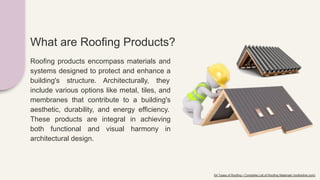
What are Roofing Products?
Roofing products encompass materials and
systems designed to protect and enhance a
building's structure. Architecturally, they
include various options like metal, tiles, and
membranes that contribute to a building's
aesthetic, durability, and energy efficiency.
These products are integral in achieving
both functional and visual harmony in
architectural design.
64 Types of Roofing • Complete List of Roofing Materials (roofonline.com)
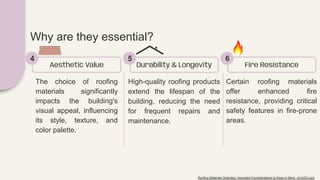
Why are they essential?
They shield the building
from rain, snow, wind,
and sunlight, preventing
water damage and
structural deterioration.
Weather Protection
1
Roofing materials contribute
to energy efficiency by
insulating the building,
reducing heat loss in winter
and heat gain in summer.
Thermal Insulation
2
The roof provides stability
and support to the overall
structure, distributing weight
and resisting environmental
stresses like wind and snow
loads.
Structural Integrity
3
Roofing Materials Selection: Important Considerations to Keep in Mind - Arch2O.com
The choice of roofing
materials significantly
impacts the building's
visual appeal, influencing
its style, texture, and
color palette.
Aesthetic Value
4
High-quality roofing products
extend the lifespan of the
building, reducing the need
for frequent repairs and
maintenance.
Durability & Longevity
5
Certain roofing materials
offer enhanced fire
resistance, providing critical
safety features in fire-prone
areas.
Fire Resistance
6
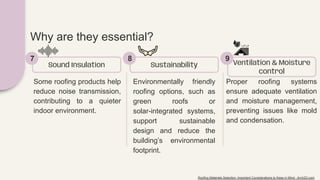
Why are they essential?
Roofing Materials Selection: Important Considerations to Keep in Mind - Arch2O.com
Some roofing products help
reduce noise transmission,
contributing to a quieter
indoor environment.
Sound Insulation
7
Environmentally friendly
roofing options, such as
green roofs or
solar-integrated systems,
support sustainable
design and reduce the
building’s environmental
footprint.
Sustainability
8
Proper roofing systems
ensure adequate ventilation
and moisture management,
preventing issues like mold
and condensation.
Ventilation & Moisture
control
9
Why are they essential?
Roofing Materials Selection: Important Considerations to Keep in Mind - Arch2O.com
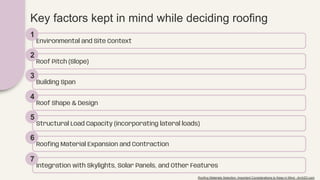
Key factors kept in mind while deciding roofing
Environmental and Site Context
1
Roof Pitch (Slope)
2
Building Span
3
Roof Shape & Design
4
Structural Load Capacity (incorporating lateral loads)
5
Roofing Material Expansion and Contraction
6
Integration with Skylights, Solar Panels, and Other Features
7
Roofing Materials Selection: Important Considerations to Keep in Mind - Arch2O.com
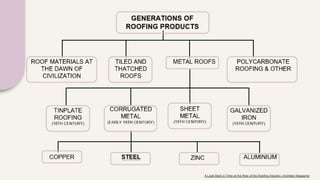
EVOLUTION
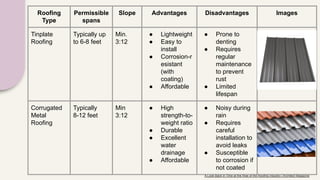
A Look Back in Time at the Rise of the Roofing Industry | Architect Magazine
Roofing
Type
Permissible
spans
Slope Advantages Disadvantages Images
Tinplate
Roofing
Typically up
to 6-8 feet
Min.
3:12
● Lightweight
● Easy to
install
● Corrosion-r
esistant
(with
coating)
● Affordable
● Prone to
denting
● Requires
regular
maintenance
to prevent
rust
● Limited
lifespan
Corrugated
Metal
Roofing
Typically
8-12 feet
Min
3:12
● High
strength-to-
weight ratio
● Durable
● Excellent
water
drainage
● Affordable
● Noisy during
rain
● Requires
careful
installation to
avoid leaks
● Susceptible
to corrosion if
not coated
A Look Back in Time at the Rise of the Roofing Industry | Architect Magazine
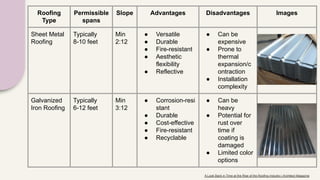
Roofing
Type
Permissible
spans
Slope Advantages Disadvantages Images
Sheet Metal
Roofing
Typically
8-10 feet
Min
2:12
● Versatile
● Durable
● Fire-resistant
● Aesthetic
flexibility
● Reflective
● Can be
expensive
● Prone to
thermal
expansion/c
ontraction
● Installation
complexity
Galvanized
Iron Roofing
Typically
6-12 feet
Min
3:12
● Corrosion-resi
stant
● Durable
● Cost-effective
● Fire-resistant
● Recyclable
● Can be
heavy
● Potential for
rust over
time if
coating is
damaged
● Limited color
options
A Look Back in Time at the Rise of the Roofing Industry | Architect Magazine
Post-War and Contemporary Developments
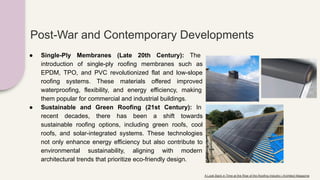
● Single-Ply Membranes (Late 20th Century): The
introduction of single-ply roofing membranes such as
EPDM, TPO, and PVC revolutionized flat and low-slope
roofing systems. These materials offered improved
waterproofing, flexibility, and energy efficiency, making
them popular for commercial and industrial buildings.
● Sustainable and Green Roofing (21st Century): In
recent decades, there has been a shift towards
sustainable roofing options, including green roofs, cool
roofs, and solar-integrated systems. These technologies
not only enhance energy efficiency but also contribute to
environmental sustainability, aligning with modern
architectural trends that prioritize eco-friendly design.
A Look Back in Time at the Rise of the Roofing Industry | Architect Magazine
Current Trends
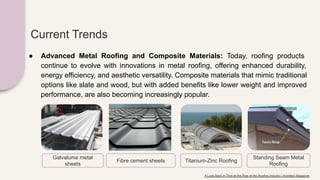
● Advanced Metal Roofing and Composite Materials: Today, roofing products
continue to evolve with innovations in metal roofing, offering enhanced durability,
energy efficiency, and aesthetic versatility. Composite materials that mimic traditional
options like slate and wood, but with added benefits like lower weight and improved
performance, are also becoming increasingly popular.
Galvalume metal
sheets
Fibre cement sheets Titanium-Zinc Roofing
Standing Seam Metal
Roofing
A Look Back in Time at the Rise of the Roofing Industry | Architect Magazine
METAL ROOFING
WHAT IS METAL
ROOFING
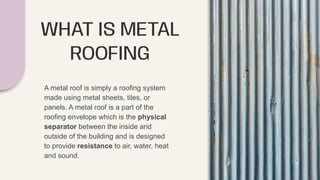
A metal roof is simply a roofing system
made using metal sheets, tiles, or
panels. A metal roof is a part of the
roofing envelope which is the physical
separator between the inside and
outside of the building and is designed
to provide resistance to air, water, heat
and sound.
● Longevity: Steel roofs can last between 40 to 70 years, significantly
longer than traditional asphalt roofing, which typically lasts 12 to 20
years.
● Durability: Steel roofs are highly durable and can withstand extreme
weather conditions, including heavy snow, high winds (up to 140 mph),
and hail. They are also resistant to cracking, shrinking, and eroding.
● Energy Efficiency: Steel roofs reflect solar radiant heat, which can
reduce cooling costs by 10-25%. This makes them an energy-efficient
option, especially in hot climates.
● Safety: Steel roofs are non-combustible, providing excellent
protection against fire hazards such as wildfires and lightning strikes.
Advantages Of Metal Roofing
ADVANTAGES OF METAL ROOFING
● Environmental: Friendliness: Steel roofing materials are often made
from 25-95% recycled content and are 100% recyclable at the end of
their life. This makes them a sustainable choice compared to other
roofing materials.
● Aesthetics: Modern steel roofs come in a variety of styles, colors,
and finishes, allowing for greater customization to match different
architectural designs.
● Low Maintenance: Steel roofs require minimal maintenance
compared to other roofing materials. They are less prone to issues
like moss and mildew growth.
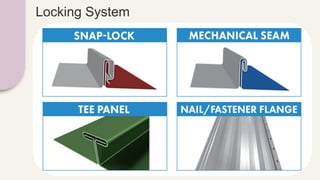
Locking System
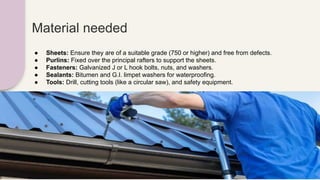
Material needed
● Sheets: Ensure they are of a suitable grade (750 or higher) and free from defects.
● Purlins: Fixed over the principal rafters to support the sheets.
● Fasteners: Galvanized J or L hook bolts, nuts, and washers.
● Sealants: Bitumen and G.I. limpet washers for waterproofing.
● Tools: Drill, cutting tools (like a circular saw), and safety equipment.
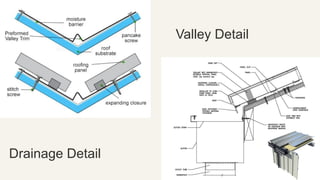
Drainage Detail
Valley Detail
TYPE OF METAL
ROOFING
Common Type Of Metal Roofing
● Copper Roofing
● Aluminium Roofing
● Zinc Roofing
● Tin Roofing
● Galvanized Roofing
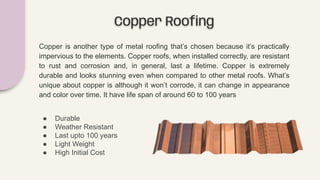
Copper Roofing
Copper is another type of metal roofing that’s chosen because it’s practically
impervious to the elements. Copper roofs, when installed correctly, are resistant
to rust and corrosion and, in general, last a lifetime. Copper is extremely
durable and looks stunning even when compared to other metal roofs. What’s
unique about copper is although it won’t corrode, it can change in appearance
and color over time. It have life span of around 60 to 100 years
● Durable
● Weather Resistant
● Last upto 100 years
● Light Weight
● High Initial Cost
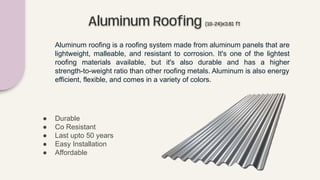
Aluminum Roofing (10-24)x3.61 ft
Aluminum roofing is a roofing system made from aluminum panels that are
lightweight, malleable, and resistant to corrosion. It's one of the lightest
roofing materials available, but it's also durable and has a higher
strength-to-weight ratio than other roofing metals. Aluminum is also energy
efficient, flexible, and comes in a variety of colors.
● Durable
● Co Resistant
● Last upto 50 years
● Easy Installation
● Affordable
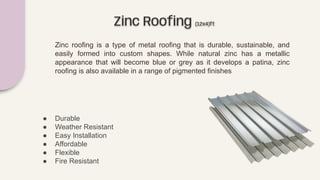
Zinc Roofing (12x4)ft
Zinc roofing is a type of metal roofing that is durable, sustainable, and
easily formed into custom shapes. While natural zinc has a metallic
appearance that will become blue or grey as it develops a patina, zinc
roofing is also available in a range of pigmented finishes
● Durable
● Weather Resistant
● Easy Installation
● Affordable
● Flexible
● Fire Resistant
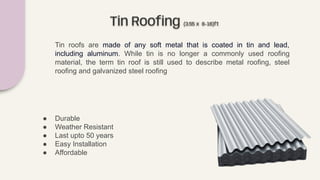
Tin Roofing (3.55 x 8-16)ft
Tin roofs are made of any soft metal that is coated in tin and lead,
including aluminum. While tin is no longer a commonly used roofing
material, the term tin roof is still used to describe metal roofing, steel
roofing and galvanized steel roofing
● Durable
● Weather Resistant
● Last upto 50 years
● Easy Installation
● Affordable
TYPICAL
CONSTRUCTION
& ASSEMBLY
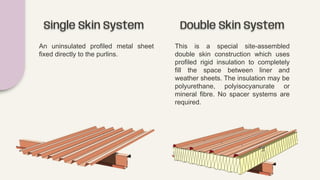
Single Skin System
An uninsulated profiled metal sheet
fixed directly to the purlins.
Double Skin System
This is a special site-assembled
double skin construction which uses
profiled rigid insulation to completely
fill the space between liner and
weather sheets. The insulation may be
polyurethane, polyisocyanurate or
mineral fibre. No spacer systems are
required.
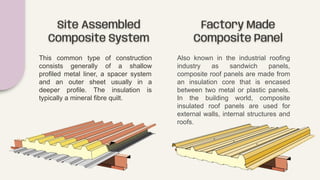
Site Assembled
Composite System
This common type of construction
consists generally of a shallow
profiled metal liner, a spacer system
and an outer sheet usually in a
deeper profile. The insulation is
typically a mineral fibre quilt.
Factory Made
Composite Panel
Also known in the industrial roofing
industry as sandwich panels,
composite roof panels are made from
an insulation core that is encased
between two metal or plastic panels.
In the building world, composite
insulated roof panels are used for
external walls, internal structures and
roofs.
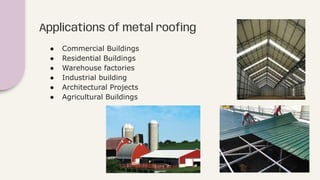
Applications of metal roofing
● Commercial Buildings
● Residential Buildings
● Warehouse factories
● Industrial building
● Architectural Projects
● Agricultural Buildings
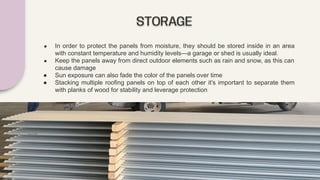
STORAGE
● In order to protect the panels from moisture, they should be stored inside in an area
with constant temperature and humidity levels—a garage or shed is usually ideal.
● Keep the panels away from direct outdoor elements such as rain and snow, as this can
cause damage
● Sun exposure can also fade the color of the panels over time
● Stacking multiple roofing panels on top of each other it's important to separate them
with planks of wood for stability and leverage protection
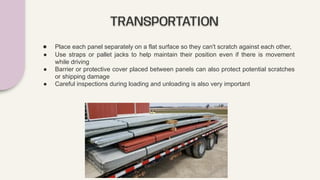
TRANSPORTATION
● Place each panel separately on a flat surface so they can't scratch against each other,
● Use straps or pallet jacks to help maintain their position even if there is movement
while driving
● Barrier or protective cover placed between panels can also protect potential scratches
or shipping damage
● Careful inspections during loading and unloading is also very important
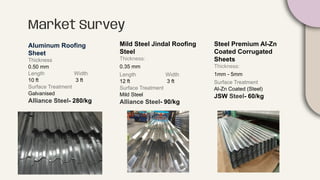
Market Survey
Aluminum Roofing
Sheet
Thickness
0.50 mm
Length Width
10 ft 3 ft
Surface Treatment
Galvanised
Alliance Steel- 280/kg
Steel Premium Al-Zn
Coated Corrugated
Sheets
Thickness:
1mm - 5mm
Surface Treatment
Al-Zn Coated (Steel)
JSW Steel- 60/kg
Mild Steel Jindal Roofing
Steel
Thickness:
0.35 mm
Length Width
12 ft 3 ft
Surface Treatment
Mild Steel
Alliance Steel- 90/kg
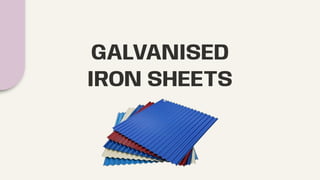
GALVANISED
IRON SHEETS
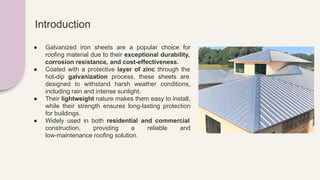
Introduction
● Galvanized iron sheets are a popular choice for
roofing material due to their exceptional durability,
corrosion resistance, and cost-effectiveness.
● Coated with a protective layer of zinc through the
hot-dip galvanization process, these sheets are
designed to withstand harsh weather conditions,
including rain and intense sunlight.
● Their lightweight nature makes them easy to install,
while their strength ensures long-lasting protection
for buildings.
● Widely used in both residential and commercial
construction, providing a reliable and
low-maintenance roofing solution.
Types
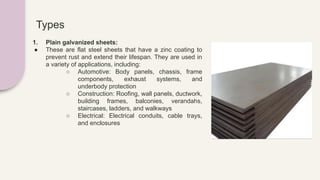
1. Plain galvanized sheets:
● These are flat steel sheets that have a zinc coating to
prevent rust and extend their lifespan. They are used in
a variety of applications, including:
○ Automotive: Body panels, chassis, frame
components, exhaust systems, and
underbody protection
○ Construction: Roofing, wall panels, ductwork,
building frames, balconies, verandahs,
staircases, ladders, and walkways
○ Electrical: Electrical conduits, cable trays,
and enclosures
Types
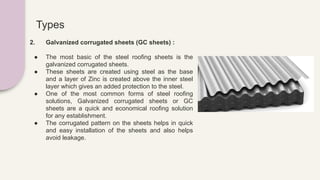
2. Galvanized corrugated sheets (GC sheets) :
● The most basic of the steel roofing sheets is the
galvanized corrugated sheets.
● These sheets are created using steel as the base
and a layer of Zinc is created above the inner steel
layer which gives an added protection to the steel.
● One of the most common forms of steel roofing
solutions, Galvanized corrugated sheets or GC
sheets are a quick and economical roofing solution
for any establishment.
● The corrugated pattern on the sheets helps in quick
and easy installation of the sheets and also helps
avoid leakage.
Types
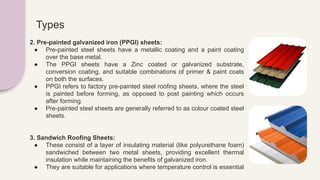
2. Pre-painted galvanized iron (PPGI) sheets:
● Pre-painted steel sheets have a metallic coating and a paint coating
over the base metal.
● The PPGI sheets have a Zinc coated or galvanized substrate,
conversion coating, and suitable combinations of primer & paint coats
on both the surfaces.
● PPGI refers to factory pre-painted steel roofing sheets, where the steel
is painted before forming, as opposed to post painting which occurs
after forming.
● Pre-painted steel sheets are generally referred to as colour coated steel
sheets.
3. Sandwich Roofing Sheets:
● These consist of a layer of insulating material (like polyurethane foam)
sandwiched between two metal sheets, providing excellent thermal
insulation while maintaining the benefits of galvanized iron.
● They are suitable for applications where temperature control is essential
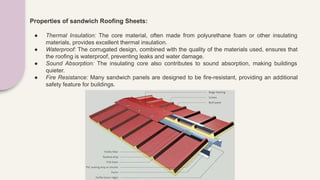
Properties of sandwich Roofing Sheets:
● Thermal Insulation: The core material, often made from polyurethane foam or other insulating
materials, provides excellent thermal insulation.
● Waterproof: The corrugated design, combined with the quality of the materials used, ensures that
the roofing is waterproof, preventing leaks and water damage.
● Sound Absorption: The insulating core also contributes to sound absorption, making buildings
quieter.
● Fire Resistance: Many sandwich panels are designed to be fire-resistant, providing an additional
safety feature for buildings.
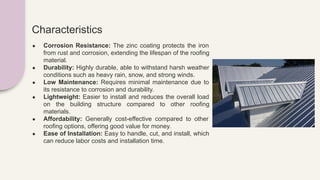
Characteristics
● Corrosion Resistance: The zinc coating protects the iron
from rust and corrosion, extending the lifespan of the roofing
material.
● Durability: Highly durable, able to withstand harsh weather
conditions such as heavy rain, snow, and strong winds.
● Low Maintenance: Requires minimal maintenance due to
its resistance to corrosion and durability.
● Lightweight: Easier to install and reduces the overall load
on the building structure compared to other roofing
materials.
● Affordability: Generally cost-effective compared to other
roofing options, offering good value for money.
● Ease of Installation: Easy to handle, cut, and install, which
can reduce labor costs and installation time.
Material specification
● The sheets shall be of 750 grade of coating unless otherwise specified.
● The sheets shall be free from cracks, split edges, twists, surface flaws, etc.
● They shall be clean, bright, and smooth.
● The sheets shall not show signs of rust or white powdery deposits on the
surface.
● In corrugated sheets, the corrugations shall be uniform in depth and pitch and
parallel with the side.
● Purlins of the specified material or M.S rolled sections shall be fixed over the
principal rafters.
● The galvanized coating on J or L hooks, and bolts shall be continuous and free
from defects.
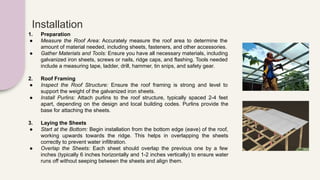
Installation
1. Preparation
● Measure the Roof Area: Accurately measure the roof area to determine the
amount of material needed, including sheets, fasteners, and other accessories.
● Gather Materials and Tools: Ensure you have all necessary materials, including
galvanized iron sheets, screws or nails, ridge caps, and flashing. Tools needed
include a measuring tape, ladder, drill, hammer, tin snips, and safety gear.
2. Roof Framing
● Inspect the Roof Structure: Ensure the roof framing is strong and level to
support the weight of the galvanized iron sheets.
● Install Purlins: Attach purlins to the roof structure, typically spaced 2-4 feet
apart, depending on the design and local building codes. Purlins provide the
base for attaching the sheets.
3. Laying the Sheets
● Start at the Bottom: Begin installation from the bottom edge (eave) of the roof,
working upwards towards the ridge. This helps in overlapping the sheets
correctly to prevent water infiltration.
● Overlap the Sheets: Each sheet should overlap the previous one by a few
inches (typically 6 inches horizontally and 1-2 inches vertically) to ensure water
runs off without seeping between the sheets and align them.
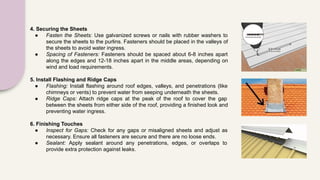
4. Securing the Sheets
● Fasten the Sheets: Use galvanized screws or nails with rubber washers to
secure the sheets to the purlins. Fasteners should be placed in the valleys of
the sheets to avoid water ingress.
● Spacing of Fasteners: Fasteners should be spaced about 6-8 inches apart
along the edges and 12-18 inches apart in the middle areas, depending on
wind and load requirements.
5. Install Flashing and Ridge Caps
● Flashing: Install flashing around roof edges, valleys, and penetrations (like
chimneys or vents) to prevent water from seeping underneath the sheets.
● Ridge Caps: Attach ridge caps at the peak of the roof to cover the gap
between the sheets from either side of the roof, providing a finished look and
preventing water ingress.
6. Finishing Touches
● Inspect for Gaps: Check for any gaps or misaligned sheets and adjust as
necessary. Ensure all fasteners are secure and there are no loose ends.
● Sealant: Apply sealant around any penetrations, edges, or overlaps to
provide extra protection against leaks.
ADVANTAGES
Galvanized iron sheets are
strong and can withstand
extreme weather conditions,
such as heavy rain, strong
winds, and hail, making them
a reliable roofing option.
Durability
1
The zinc coating provides
excellent protection against rust
and corrosion, ensuring the
roof’s longevity, even in humid or
coastal environments.
Corrosion Resistance
2
Compared to other roofing
materials, galvanized iron sheets
are relatively affordable while
offering long-term performance,
making them a cost-effective
choice.
Cost effective
3
https://rooflux.com/pvc-roofing-11-significant-benefits/
ADVANTAGES
Due to their corrosion
resistance and durability,
galvanized iron roofs require
minimal maintenance,
reducing the need for
frequent repairs or
replacements.
Low maintenance
1
These sheets are lightweight,
which makes them easy to
transport and install, and reduces
the load on the building structure.
Lightweight
2
Galvanized iron sheets are
available in various sizes,
shapes, and thicknesses,
allowing them to be used in
different architectural designs
and styles.
Versatility
3
https://rooflux.com/pvc-roofing-11-significant-benefits/
DISADVANTAGES
Although the zinc coating
provides corrosion
resistance, it can wear off
over time, especially in highly
corrosive environments,
leading to rust and
degradation of the roof.
Rust over time
1
Galvanized iron sheets have high
thermal conductivity, which
means they can absorb and
retain heat, making the interior of
the building hotter, especially in
warm climates, unless proper
insulation is used.
Thermal Conductivity
2
Metal roofs, including those
made of galvanized iron, can be
noisy during heavy rain, hail, or
strong winds, which can be a
nuisance for occupants.
Noise
3
https://rooflux.com/pvc-roofing-11-significant-benefits/
DISADVANTAGES
While durable, galvanized iron
sheets can still be dented or
damaged by impacts from heavy
objects, such as falling branches
or hailstones.
Denting and Damage
4
Galvanized iron sheets have a
more industrial appearance, which
might not suit all architectural
styles or aesthetic preferences
without additional treatments or
coatings.
Aesthetic Limitations
5
https://rooflux.com/pvc-roofing-11-significant-benefits/
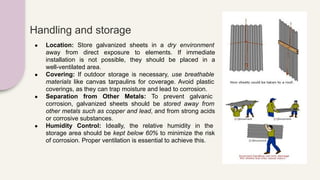
Handling and storage
● Location: Store galvanized sheets in a dry environment
away from direct exposure to elements. If immediate
installation is not possible, they should be placed in a
well-ventilated area.
● Covering: If outdoor storage is necessary, use breathable
materials like canvas tarpaulins for coverage. Avoid plastic
coverings, as they can trap moisture and lead to corrosion.
● Separation from Other Metals: To prevent galvanic
corrosion, galvanized sheets should be stored away from
other metals such as copper and lead, and from strong acids
or corrosive substances.
● Humidity Control: Ideally, the relative humidity in the
storage area should be kept below 60% to minimize the risk
of corrosion. Proper ventilation is essential to achieve this.
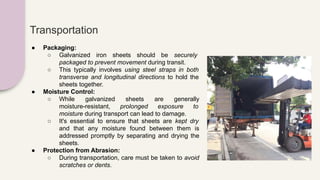
Transportation
● Packaging:
○ Galvanized iron sheets should be securely
packaged to prevent movement during transit.
○ This typically involves using steel straps in both
transverse and longitudinal directions to hold the
sheets together.
● Moisture Control:
○ While galvanized sheets are generally
moisture-resistant, prolonged exposure to
moisture during transport can lead to damage.
○ It's essential to ensure that sheets are kept dry
and that any moisture found between them is
addressed promptly by separating and drying the
sheets.
● Protection from Abrasion:
○ During transportation, care must be taken to avoid
scratches or dents.
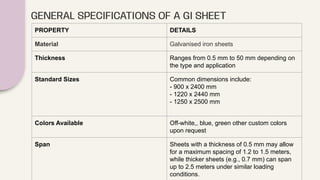
GENERAL SPECIFICATIONS OF A GI SHEET
PROPERTY DETAILS
Material Galvanised iron sheets
Thickness Ranges from 0.5 mm to 50 mm depending on
the type and application
Standard Sizes Common dimensions include:
- 900 x 2400 mm
- 1220 x 2440 mm
- 1250 x 2500 mm
Colors Available Off-white,, blue, green other custom colors
upon request
Span Sheets with a thickness of 0.5 mm may allow
for a maximum spacing of 1.2 to 1.5 meters,
while thicker sheets (e.g., 0.7 mm) can span
up to 2.5 meters under similar loading
conditions.
MARKET SURVEY
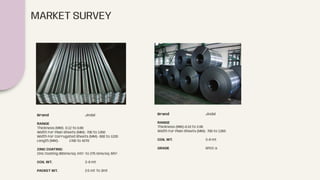
Brand Jindal
RANGE
Thickness (MM)- 0.12 to 0.80
Width For Plain Sheets (MM)- 700 to 1350
Width For Corrugated Sheets (MM)- 600 to 1220
Length (MM)- 1700 to 4270
ZINC COATING:
Zinc Coating 90Gms/sq. mtr. to 275 Gms/sq. Mtr.
COIL WT. 3-8 mt
PACKET WT. 2.5 mt To 3mt
Brand Jindal
RANGE
Thickness (MM)-0.10 to 2.00
Width For Plain Sheets (MM)- 700 to 1350
COIL WT. 3-8 mt
GRADE SPCC a
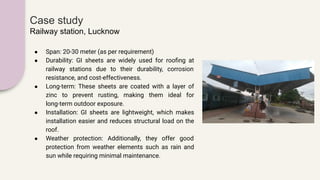
Case study
Railway station, Lucknow
● Span: 20-30 meter (as per requirement)
● Durability: GI sheets are widely used for roofing at
railway stations due to their durability, corrosion
resistance, and cost-effectiveness.
● Long-term: These sheets are coated with a layer of
zinc to prevent rusting, making them ideal for
long-term outdoor exposure.
● Installation: GI sheets are lightweight, which makes
installation easier and reduces structural load on the
roof.
● Weather protection: Additionally, they offer good
protection from weather elements such as rain and
sun while requiring minimal maintenance.
PVC
ROOFING
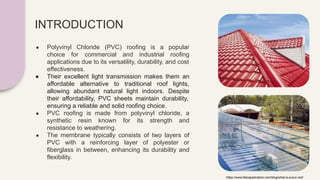
INTRODUCTION
● Polyvinyl Chloride (PVC) roofing is a popular
choice for commercial and industrial roofing
applications due to its versatility, durability, and cost
effectiveness.
● Their excellent light transmission makes them an
affordable alternative to traditional roof lights,
allowing abundant natural light indoors. Despite
their affordability, PVC sheets maintain durability,
ensuring a reliable and solid roofing choice.
● PVC roofing is made from polyvinyl chloride, a
synthetic resin known for its strength and
resistance to weathering.
● The membrane typically consists of two layers of
PVC with a reinforcing layer of polyester or
fiberglass in between, enhancing its durability and
flexibility.
https://www.titanapplicators.com/blog/what-is-a-pvc-roof
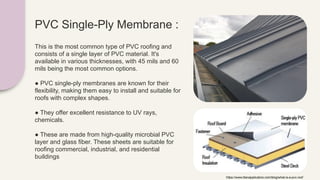
PVC Single-Ply Membrane :
This is the most common type of PVC roofing and
consists of a single layer of PVC material. It's
available in various thicknesses, with 45 mils and 60
mils being the most common options.
● PVC single-ply membranes are known for their
flexibility, making them easy to install and suitable for
roofs with complex shapes.
● They offer excellent resistance to UV rays,
chemicals.
● These are made from high-quality microbial PVC
layer and glass fiber. These sheets are suitable for
roofing commercial, industrial, and residential
buildings
https://www.titanapplicators.com/blog/what-is-a-pvc-roof
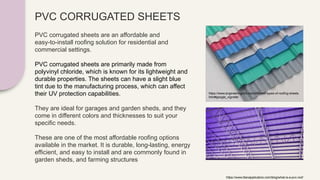
PVC CORRUGATED SHEETS
PVC corrugated sheets are an affordable and
easy-to-install roofing solution for residential and
commercial settings.
PVC corrugated sheets are primarily made from
polyvinyl chloride, which is known for its lightweight and
durable properties. The sheets can have a slight blue
tint due to the manufacturing process, which can affect
their UV protection capabilities.
They are ideal for garages and garden sheds, and they
come in different colors and thicknesses to suit your
specific needs.
These are one of the most affordable roofing options
available in the market. It is durable, long-lasting, energy
efficient, and easy to install and are commonly found in
garden sheds, and farming structures
https://www.titanapplicators.com/blog/what-is-a-pvc-roof
https://www.engineeringcivil.com/different-types-of-roofing-sheets.
html#google_vignette
ADVANTAGES
PVC roofs are highly durable
and can last 20-30 years with
proper maintenance. They
withstand extreme weather
conditions, including high
winds, heavy rains, and hail.
Durability
1
PVC roofing membranes have a
high reflectivity index, reflecting a
significant amount of solar
radiation. This helps keep
buildings cooler, reducing energy
costs associated with air
conditioning and mitigating the
urban heat island effect.
Energy Efficiency
2
These roofs require minimal
maintenance, typically needing
only routine inspections and
occasional cleaning. This low
maintenance requirement makes
them an attractive option for
building owners.
Low Maintenance
3
https://rooflux.com/pvc-roofing-11-significant-benefits/
ADVANTAGES
PVC roofing is inherently
waterproof, providing
excellent protection against
leaks. The heat-welded
seams ensure a seamless
roofing system that can
withstand ponding water.
Waterproofing
4
PVC is resistant to a variety of
chemicals, making it suitable for
industrial settings. Additionally, it
is fire-resistant; it does not
support combustion and can
self-extinguish when the source
of fire is removed.
Fire Resistance
5
https://rooflux.com/pvc-roofing-11-significant-benefits/
DISADVANTAGES
The upfront cost of PVC
roofing can be higher
compared to traditional
roofing materials. While the
long-term savings on
maintenance and energy can
offset this initial investment, it
may be a barrier for some
property owners.
Initial Cost
1
PVC can expand and contract
with temperature fluctuations,
which may lead to issues if not
properly installed. This sensitivity
requires careful consideration
during installation to avoid future
problems.
Temperature
2
Improper installation or
inadequate drainage can lead to
water pooling, which may cause
structural damage and leaks
over time. Regular inspections
and maintenance are necessary
to mitigate this risk.
Water Pooling
3
https://rooflux.com/pvc-roofing-11-significant-benefits/
DISADVANTAGES
The production of PVC involves
the use of fossil fuels and can
generate harmful byproducts.
While it is recyclable, the
environmental impact of its
production is a concern for some.
Environmental Concerns
4
Older PVC roofs may be difficult
to repair due to changes in
manufacturing standards over the
years. This can lead to higher
costs for maintenance and repairs
if issues arise.
Repair Challenges
5
https://rooflux.com/pvc-roofing-11-significant-benefits/
DRAINAGE SYSTEM
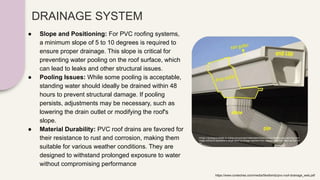
● Slope and Positioning: For PVC roofing systems,
a minimum slope of 5 to 10 degrees is required to
ensure proper drainage. This slope is critical for
preventing water pooling on the roof surface, which
can lead to leaks and other structural issues.
● Pooling Issues: While some pooling is acceptable,
standing water should ideally be drained within 48
hours to prevent structural damage. If pooling
persists, adjustments may be necessary, such as
lowering the drain outlet or modifying the roof's
slope.
● Material Durability: PVC roof drains are favored for
their resistance to rust and corrosion, making them
suitable for various weather conditions. They are
designed to withstand prolonged exposure to water
without compromising performance
https://zjrping.en.made-in-china.com/product/MKDQWIfATmaY/China-Plastic-Pipe-Roofing-Dra
inage-Gutters-Systems-K-Style-Roof-Drainage-System-PVC-Square-Pipe-PVC-Rain-Gutter.ht
ml
https://www.conteches.com/media/5kwlbmdz/pvc-roof-drainage_web.pdf
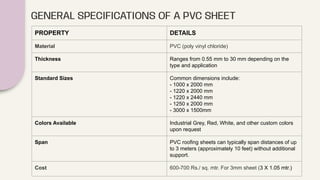
GENERAL SPECIFICATIONS OF A PVC SHEET
PROPERTY DETAILS
Material PVC (poly vinyl chloride)
Thickness Ranges from 0.55 mm to 30 mm depending on the
type and application
Standard Sizes Common dimensions include:
- 1000 x 2000 mm
- 1220 x 2000 mm
- 1220 x 2440 mm
- 1250 x 2000 mm
- 3000 x 1500mm
Colors Available Industrial Grey, Red, White, and other custom colors
upon request
Span PVC roofing sheets can typically span distances of up
to 3 meters (approximately 10 feet) without additional
support.
Cost 600-700 Rs./ sq. mtr. For 3mm sheet (3 X 1.05 mtr.)
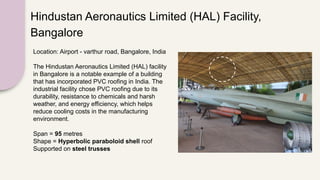
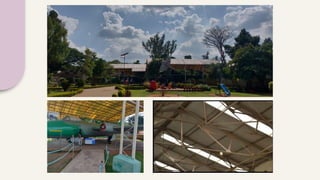
Hindustan Aeronautics Limited (HAL) Facility,
Bangalore
Location: Airport - varthur road, Bangalore, India
The Hindustan Aeronautics Limited (HAL) facility
in Bangalore is a notable example of a building
that has incorporated PVC roofing in India. The
industrial facility chose PVC roofing due to its
durability, resistance to chemicals and harsh
weather, and energy efficiency, which helps
reduce cooling costs in the manufacturing
environment.
Span = 95 metres
Shape = Hyperbolic paraboloid shell roof
Supported on steel trusses
Key Features of HAL's PVC Roofing
1. Durability: The PVC roofing at HAL is designed to withstand the rigors of an industrial
environment, including exposure to chemicals and extreme temperatures, which are
common in aviation manufacturing.
2. Energy Efficiency: The reflective properties of the PVC membrane help reduce heat
absorption, contributing to lower cooling costs in the facility, which is essential for
maintaining optimal working conditions.
3. Low Maintenance: The PVC roofing requires minimal maintenance, allowing HAL to
focus on its core operations without the burden of frequent roof repairs or
replacements.
4. Installation Method: The roofing system was installed using a fully adhered method,
ensuring a watertight seal that enhances the longevity of the roof.
5. Environmental Considerations: PVC roofing is recyclable, aligning with HAL's
commitment to sustainable practices in its operations.
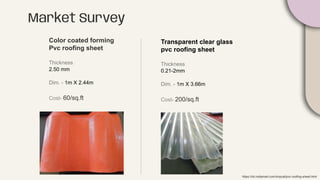
Market Survey
Color coated forming
Pvc roofing sheet
Thickness
2.50 mm
Dim. - 1m X 2.44m
Cost- 60/sq.ft
Transparent clear glass
pvc roofing sheet
Thickness
0.21-2mm
Dim. - 1m X 3.66m
Cost- 200/sq.ft
https://dir.indiamart.com/impcat/pvc-roofing-sheet.html
PRE COATING
ROOFING
SHEETS
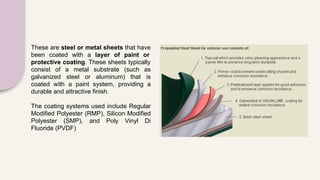
These are steel or metal sheets that have
been coated with a layer of paint or
protective coating. These sheets typically
consist of a metal substrate (such as
galvanized steel or aluminum) that is
coated with a paint system, providing a
durable and attractive finish.
The coating systems used include Regular
Modified Polyester (RMP), Silicon Modified
Polyester (SMP), and Poly Vinyl Di
Fluoride (PVDF)
Applications
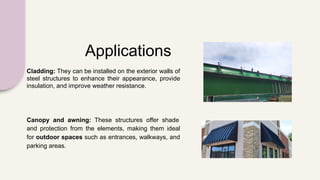
Cladding: They can be installed on the exterior walls of
steel structures to enhance their appearance, provide
insulation, and improve weather resistance.
Canopy and awning: These structures offer shade
and protection from the elements, making them ideal
for outdoor spaces such as entrances, walkways, and
parking areas.
Applications
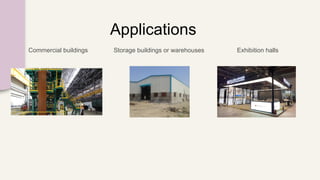
Commercial buildings Storage buildings or warehouses Exhibition halls
Characteristics
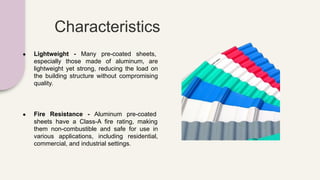
● Lightweight - Many pre-coated sheets,
especially those made of aluminum, are
lightweight yet strong, reducing the load on
the building structure without compromising
quality.
● Fire Resistance - Aluminum pre-coated
sheets have a Class-A fire rating, making
them non-combustible and safe for use in
various applications, including residential,
commercial, and industrial settings.
● Weather Resistance - It provide excellent protection against harsh weather conditions, such
as heavy winds, rain, and bright sunlight, ensuring that the color and shine are retained for an
extended period.
● Eco-Friendliness - Aluminum pre-coated sheets are highly recyclable, with only a small
amount of energy required to produce them from recycled materials, making them an
environmentally friendly choice.
● Thermal Efficiency - The coatings on pre-coated sheets can help reflect heat, reducing
cooling costs and improving the overall energy efficiency of the building.
https://www.jswcoatedsteel.in
Installation Steps
Framework
● The spacing between purlins should be according to the
manufacturer’s recommendation, typically 1.2-1.5 meters
apart for roofing sheets.
Roof Layout and Planning
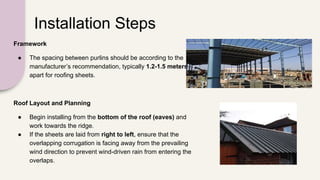
● Begin installing from the bottom of the roof (eaves) and
work towards the ridge.
● If the sheets are laid from right to left, ensure that the
overlapping corrugation is facing away from the prevailing
wind direction to prevent wind-driven rain from entering the
overlaps.
Installation of Sheets
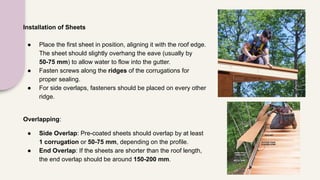
● Place the first sheet in position, aligning it with the roof edge.
The sheet should slightly overhang the eave (usually by
50-75 mm) to allow water to flow into the gutter.
● Fasten screws along the ridges of the corrugations for
proper sealing.
● For side overlaps, fasteners should be placed on every other
ridge.
Overlapping:
● Side Overlap: Pre-coated sheets should overlap by at least
1 corrugation or 50-75 mm, depending on the profile.
● End Overlap: If the sheets are shorter than the roof length,
the end overlap should be around 150-200 mm.
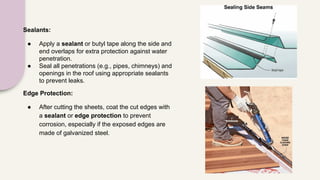
Sealants:
● Apply a sealant or butyl tape along the side and
end overlaps for extra protection against water
penetration.
● Seal all penetrations (e.g., pipes, chimneys) and
openings in the roof using appropriate sealants
to prevent leaks.
Edge Protection:
● After cutting the sheets, coat the cut edges with
a sealant or edge protection to prevent
corrosion, especially if the exposed edges are
made of galvanized steel.
ADVANTAGES
They are manufactured using
high-quality materials and
coatings that provide
excellent resistance to
corrosion, abrasion, and
weathering.
Durability
1
It reflects solar heat, reducing
indoor temperatures, and lowers
air conditioning costs. and
support in natural daylighting
and are made from recyclable
materials
Energy Efficiency
2
Pre-coated sheets are
resistant to corrosion, UV
radiation, and weathering,
ensuring a longer lifespan
and reducing the need for
frequent repairs or
replacements.
Low Maintenance
3
ADVANTAGES
The waterproof coating
provides a seamless barrier
that prevents water
infiltration, reducing the risk
of leaks and water damage
to the structure below.
Waterproofing
4
sheets are designed with thermal
insulation properties. They can
help regulate indoor
temperatures by reflecting heat,
reducing the need for excessive
cooling
Fire Resistance
5
https://medium.com/jsw-everglow/technical-specifications.aspx
DISADVANTAGES
the initial investment can be
higher compared to some
other roofing materials, which
may deter budget-conscious
buyers.
Initial Cost
1
Temperature fluctuations can
cause to expand and contract.
Over time, this can lead to
material fatigue, warping,
Temperature
2
can be noisy during heavy rain
or high winds. This can be
mitigated with insulation, but it
adds to the cost.
Noise
3
https://rooflux.com/pvc-roofing-11-significant-benefits/
DISADVANTAGES
The manufacturing process for
pre-coated roofing sheets,
especially metal ones, involves
significant energy consumption
and can release greenhouse
gases and other pollutants,
contributing to environmental
degradation. They are non
biodegradable, which can be a
concern for environmentally
conscious consumers.
Environmental Concerns
4
Repairing pre-coated sheets
often requires skilled labor,
increasing the complexity and
cost of repairs.
Repair Challenges
5
https://sterlingroofinggroup.com/4-different-types-of-roofing-sheets-pros-and-cons
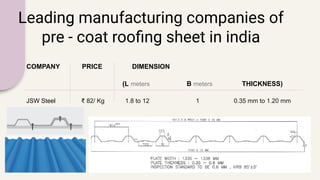
Leading manufacturing companies of
pre - coat roofing sheet in india
COMPANY PRICE DIMENSION
(L meters B meters THICKNESS)
JSW Steel ₹ 82/ Kg 1.8 to 12 1 0.35 mm to 1.20 mm
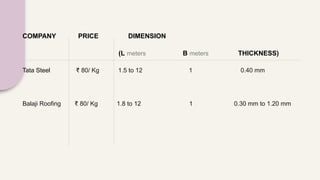
COMPANY PRICE DIMENSION
(L meters B meters THICKNESS)
Tata Steel ₹ 80/ Kg 1.5 to 12 1 0.40 mm
Balaji Roofing ₹ 80/ Kg 1.8 to 12 1 0.30 mm to 1.20 mm
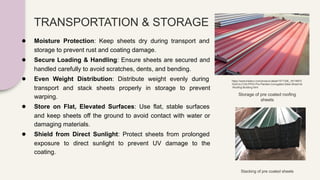
TRANSPORTATION & STORAGE
● Moisture Protection: Keep sheets dry during transport and
storage to prevent rust and coating damage.
● Secure Loading & Handling: Ensure sheets are secured and
handled carefully to avoid scratches, dents, and bending.
● Even Weight Distribution: Distribute weight evenly during
transport and stack sheets properly in storage to prevent
warping.
● Store on Flat, Elevated Surfaces: Use flat, stable surfaces
and keep sheets off the ground to avoid contact with water or
damaging materials.
● Shield from Direct Sunlight: Protect sheets from prolonged
exposure to direct sunlight to prevent UV damage to the
coating.
Storage of pre coated roofing
sheets
https://www.tradevv.com/product-detail/1571336_18118973
/Dx51d-Z120-PPGI-Pre-Painted-Corrugated-Steel-Sheet-for
-Roofing-Building.html
Stacking of pre coated sheets
POLYCARBONATE
ROOFING
POLYCARBONATE
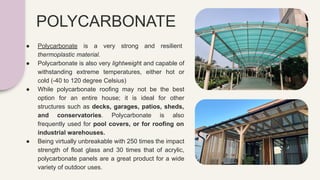
● Polycarbonate is a very strong and resilient
thermoplastic material.
● Polycarbonate is also very lightweight and capable of
withstanding extreme temperatures, either hot or
cold (-40 to 120 degree Celsius)
● While polycarbonate roofing may not be the best
option for an entire house; it is ideal for other
structures such as decks, garages, patios, sheds,
and conservatories. Polycarbonate is also
frequently used for pool covers, or for roofing on
industrial warehouses.
● Being virtually unbreakable with 250 times the impact
strength of float glass and 30 times that of acrylic,
polycarbonate panels are a great product for a wide
variety of outdoor uses.
Characteristics
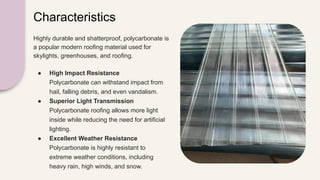
Highly durable and shatterproof, polycarbonate is
a popular modern roofing material used for
skylights, greenhouses, and roofing.
● High Impact Resistance
Polycarbonate can withstand impact from
hail, falling debris, and even vandalism.
● Superior Light Transmission
Polycarbonate roofing allows more light
inside while reducing the need for artificial
lighting.
● Excellent Weather Resistance
Polycarbonate is highly resistant to
extreme weather conditions, including
heavy rain, high winds, and snow.
Applications of Polycarbonate Sheets
Features
•Cover larger surfaces without
doing laps
•more fixable for installation
•Anti-static function
•Easy to install
•Self cleaning.
•Save space in container
•easy for domestic
transportation.
Typical Application
•Roofing light sheet and
sunshade for building
•Skylight, lighting for corridors,
balcony, passages, and
subway entries, walkways.
•Conservatories, agricultural
greenhouse, zoos, botanical
gardens.
•Industrial roofing and glazing
•Natatorium Swimming pools
•roofing/cover/sheet Stadiums,
Hospitals, School
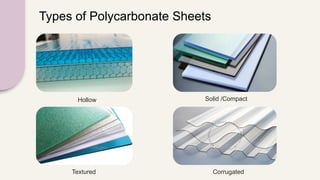
Types of Polycarbonate Sheets
Hollow Solid /Compact
Textured Corrugated
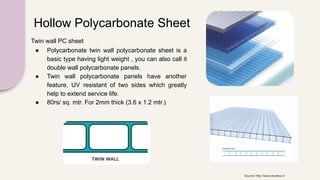
Hollow Polycarbonate Sheet
Twin wall PC sheet
● Polycarbonate twin wall polycarbonate sheet is a
basic type having light weight , you can also call it
double wall polycarbonate panels.
● Twin wall polycarbonate panels have another
feature, UV resistant of two sides which greatly
help to extend service life.
● 80rs/ sq. mtr. For 2mm thick (3.6 x 1.2 mtr.)
Source: http://www.skylites.in
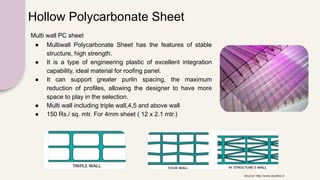
Hollow Polycarbonate Sheet
Multi wall PC sheet
● Multiwall Polycarbonate Sheet has the features of stable
structure, high strength.
● It is a type of engineering plastic of excellent integration
capability, ideal material for roofing panel.
● It can support greater purlin spacing, the maximum
reduction of profiles, allowing the designer to have more
space to play in the selection.
● Multi wall including triple wall,4,5 and above wall
● 150 Rs./ sq. mtr. For 4mm sheet ( 12 x 2.1 mtr.)
Source: http://www.skylites.in
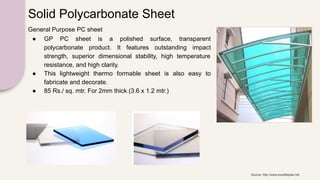
Solid Polycarbonate Sheet
General Purpose PC sheet
● GP PC sheet is a polished surface, transparent
polycarbonate product. It features outstanding impact
strength, superior dimensional stability, high temperature
resistance, and high clarity.
● This lightweight thermo formable sheet is also easy to
fabricate and decorate.
● 85 Rs./ sq. mtr. For 2mm thick (3.6 x 1.2 mtr.)
Source: http://www.exceliteplas.net
Solid Polycarbonate Sheet
Hard Coated Solid PC sheet
● Anti-scratch coating improves hardness of polycarbonate sheets.
● Anti- scratch PC sheet perfectly solves the shortcoming of polycarbonate sheets.
● It is widely used in various industries.
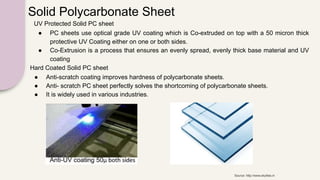
UV Protected Solid PC sheet
● PC sheets use optical grade UV coating which is Co-extruded on top with a 50 micron thick
protective UV Coating either on one or both sides.
● Co-Extrusion is a process that ensures an evenly spread, evenly thick base material and UV
coating
Source: http://www.skylites.in
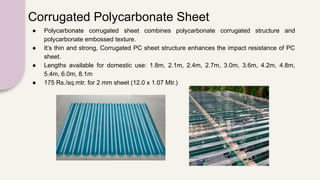
Corrugated Polycarbonate Sheet
● Polycarbonate corrugated sheet combines polycarbonate corrugated structure and
polycarbonate embossed texture.
● It’s thin and strong, Corrugated PC sheet structure enhances the impact resistance of PC
sheet.
● Lengths available for domestic use: 1.8m, 2.1m, 2.4m, 2.7m, 3.0m, 3.6m, 4.2m, 4.8m,
5.4m, 6.0m, 8.1m
● 175 Rs./sq.mtr. for 2 mm sheet (12.0 x 1.07 Mtr.)
ADVANTAGES
Polycarbonate is highly
impact-resistant, making it
much tougher than glass and
less prone to shattering. It
can withstand harsh weather
conditions, including UV
exposure, without yellowing
or becoming brittle, which
contributes to its long
lifespan.
Durability
1
Multi-wall polycarbonate sheets
provide good thermal insulation,
helping to maintain indoor
temperatures and reduce
energy consumption for heating
and cooling. They allow natural
light to penetrate, reducing the
need for artificial lighting during
the day, which can lead to
significant energy savings.
Energy Efficiency
2
Polycarbonate sheets require
minimal maintenance
compared to traditional
materials. They are easy to
clean with simple washing
and do not require frequent
replacements.
Low Maintenance
3
ADVANTAGES
Polycarbonate sheets can be
easily sealed at joints and
edges, providing excellent
waterproofing. Proper
installation ensures that
water does not seep through,
protecting underlying
structures. The non-porous
nature of polycarbonate
prevents water absorption,
reducing the risk of mold and
mildew growth.
Waterproofing
4
Polycarbonate is inherently fire
retardant, meaning it has a high
resistance to flames and will not
contribute to fire spread. It is
often rated with a flame
resistance classification. In the
event of a fire, polycarbonate
sheets emit less smoke
compared to other plastic
materials, which is crucial for
safety.
Fire Resistance
5
https://plasticsheetsshop.co.uk/blog/polycarbonate-advantages-and-disadvantages/
DISADVANTAGES
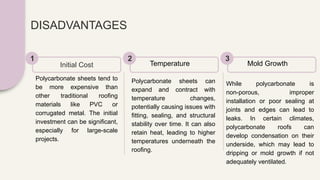
Polycarbonate sheets tend to
be more expensive than
other traditional roofing
materials like PVC or
corrugated metal. The initial
investment can be significant,
especially for large-scale
projects.
Initial Cost
1
Polycarbonate sheets can
expand and contract with
temperature changes,
potentially causing issues with
fitting, sealing, and structural
stability over time. It can also
retain heat, leading to higher
temperatures underneath the
roofing.
Temperature
2
While polycarbonate is
non-porous, improper
installation or poor sealing at
joints and edges can lead to
leaks. In certain climates,
polycarbonate roofs can
develop condensation on their
underside, which may lead to
dripping or mold growth if not
adequately ventilated.
Mold Growth
3
DISADVANTAGES
Polycarbonate is a plastic
material and is not
biodegradable. Disposal at the
end of its life can be
environmentally challenging,
contributing to plastic waste
issues.
Environmental Concerns
4
Polycarbonate can scratch more
easily than glass, especially if not
coated with a protective layer.
Repairing or replacing damaged
sheets can be challenging,
especially if the sheets are part of
a large, continuous roof.
Repair Challenges
5
https://plasticsheetsshop.co.uk/blog/polycarbonate-advantages-and-disadvantages/
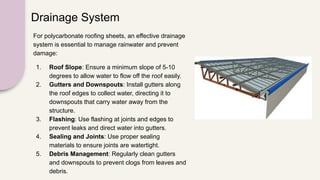
Drainage System
For polycarbonate roofing sheets, an effective drainage
system is essential to manage rainwater and prevent
damage:
1. Roof Slope: Ensure a minimum slope of 5-10
degrees to allow water to flow off the roof easily.
2. Gutters and Downspouts: Install gutters along
the roof edges to collect water, directing it to
downspouts that carry water away from the
structure.
3. Flashing: Use flashing at joints and edges to
prevent leaks and direct water into gutters.
4. Sealing and Joints: Use proper sealing
materials to ensure joints are watertight.
5. Debris Management: Regularly clean gutters
and downspouts to prevent clogs from leaves and
debris.
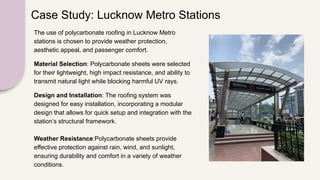
Case Study: Lucknow Metro Stations
The use of polycarbonate roofing in Lucknow Metro
stations is chosen to provide weather protection,
aesthetic appeal, and passenger comfort.
Material Selection: Polycarbonate sheets were selected
for their lightweight, high impact resistance, and ability to
transmit natural light while blocking harmful UV rays.
Design and Installation: The roofing system was
designed for easy installation, incorporating a modular
design that allows for quick setup and integration with the
station’s structural framework.
Weather Resistance:Polycarbonate sheets provide
effective protection against rain, wind, and sunlight,
ensuring durability and comfort in a variety of weather
conditions.
Case Study: Lucknow Metro Stations
Energy Efficiency:The natural light transmission of polycarbonate reduces the need for
artificial lighting during the day, contributing to energy savings and a pleasant atmosphere.
Aesthetic Integration:The modern, sleek appearance of polycarbonate roofing
complements the contemporary design of the metro stations, adding to the urban appeal.
Low Maintenance: Polycarbonate's durability and resistance to UV degradation result in
low maintenance costs, making it a cost-effective long-term roofing solution.
Safety: Inherently fire-resistant and highly impact-resistant, polycarbonate sheets contribute
to the overall safety and reliability of the metro station infrastructure.
ASBESTOS
ROOFING SHEETS
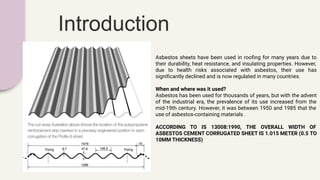
Introduction
Asbestos sheets have been used in roofing for many years due to
their durability, heat resistance, and insulating properties. However,
due to health risks associated with asbestos, their use has
significantly declined and is now regulated in many countries.
When and where was it used?
Asbestos has been used for thousands of years, but with the advent
of the industrial era, the prevalence of its use increased from the
mid-19th century. However, it was between 1950 and 1985 that the
use of asbestos-containing materials .
ACCORDING TO IS 13008:1990, THE OVERALL WIDTH OF
ASBESTOS CEMENT CORRUGATED SHEET IS 1.015 METER (0.5 TO
10MM THICKNESS)
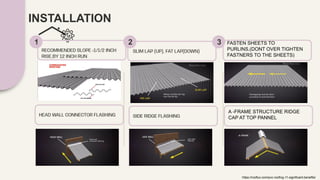
INSTALLATION
HEAD WALL CONNECTOR FLASHING
1
SLIM LAP (UP), FAT LAP(DOWN)
2 FASTEN SHEETS TO
PURLINS.(DONT OVER TIGHTEN
FASTNERS TO THE SHEETS)
3
https://rooflux.com/pvc-roofing-11-significant-benefits/
RECOMMENDED SLOPE =1/1/2 INCH
RISE,BY 12 INCH RUN
SIDE RIDGE FLASHING
A -FRAME STRUCTURE RIDGE
CAP AT TOP PANNEL
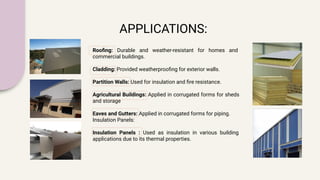
APPLICATIONS:
Roofing: Durable and weather-resistant for homes and
commercial buildings.
Cladding: Provided weatherproofing for exterior walls.
Partition Walls: Used for insulation and fire resistance.
Agricultural Buildings: Applied in corrugated forms for sheds
and storage
Eaves and Gutters: Applied in corrugated forms for piping.
Insulation Panels:
Insulation Panels : Used as insulation in various building
applications due to its thermal properties.
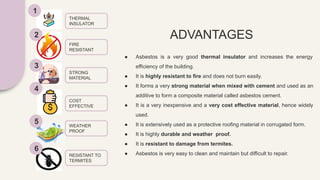
ADVANTAGES
● Asbestos is a very good thermal insulator and increases the energy
efficiency of the building.
● It is highly resistant to fire and does not burn easily.
● It forms a very strong material when mixed with cement and used as an
additive to form a composite material called asbestos cement.
● It is a very inexpensive and a very cost effective material, hence widely
used.
● It is extensively used as a protective roofing material in corrugated form.
● It is highly durable and weather proof.
● It is resistant to damage from termites.
● Asbestos is very easy to clean and maintain but difficult to repair.
1
2
3
4
5
6
THERMAL
INSULATOR
FIRE
RESISTANT
STRONG
MATERIAL
COST
EFFECTIVE
WEATHER
PROOF
RESISTANT TO
TERMITES
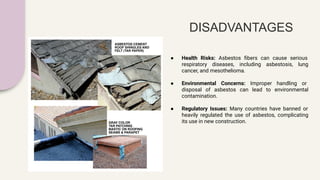
DISADVANTAGES
● Health Risks: Asbestos fibers can cause serious
respiratory diseases, including asbestosis, lung
cancer, and mesothelioma.
● Environmental Concerns: Improper handling or
disposal of asbestos can lead to environmental
contamination.
● Regulatory Issues: Many countries have banned or
heavily regulated the use of asbestos, complicating
its use in new construction.
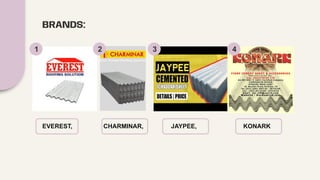
BRANDS:
EVEREST, CHARMINAR, JAYPEE, KONARK
1 2 3 4
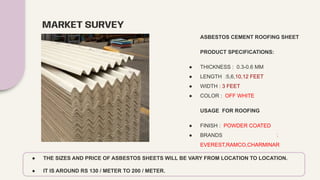
MARKET SURVEY
ASBESTOS CEMENT ROOFING SHEET
PRODUCT SPECIFICATIONS:
● THICKNESS : 0.3-0.6 MM
● LENGTH :5,6,10,12 FEET
● WIDTH : 3 FEET
● COLOR : OFF WHITE
USAGE FOR ROOFING
● FINISH : POWDER COATED
● BRANDS :
EVEREST,RAMCO,CHARMINAR
● THE SIZES AND PRICE OF ASBESTOS SHEETS WILL BE VARY FROM LOCATION TO LOCATION.
● IT IS AROUND RS 130 / METER TO 200 / METER.
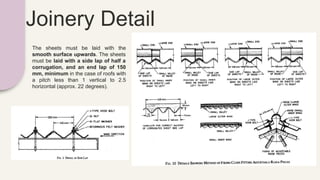
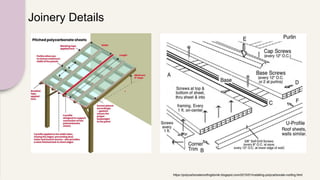
Joinery Detail
The sheets must be laid with the
smooth surface upwards. The sheets
must be laid with a side lap of half a
corrugation, and an end lap of 150
mm, minimum in the case of roofs with
a pitch less than 1 vertical to 2.5
horizontal (approx. 22 degrees).
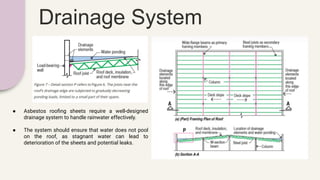
Drainage System
● Asbestos roofing sheets require a well-designed
drainage system to handle rainwater effectively.
● The system should ensure that water does not pool
on the roof, as stagnant water can lead to
deterioration of the sheets and potential leaks.
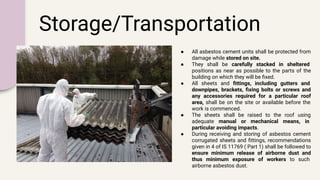
Storage/Transportation
● All asbestos cement units shall be protected from
damage while stored on site.
● They shall be carefully stacked in sheltered
positions as near as possible to the parts of the
building on which they will be fixed.
● All sheets and fittings, including gutters and
downpipes, brackets, fixing bolts or screws and
any accessories required for a particular roof
area, shall be on the site or available before the
work is commenced.
● The sheets shall be raised to the roof using
adequate manual or mechanical means, in
particular avoiding impacts.
● During receiving and storing of asbestos cement
corrugated sheets and fittings, recommendations
given in 4 of IS 11769 ( Part 1) shall be followed to
ensure minimum release of airborne dust and
thus minimum exposure of workers to such
airborne asbestos dust.
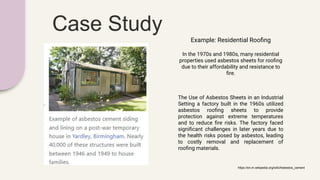
Case Study
Example: Residential Roofing
In the 1970s and 1980s, many residential
properties used asbestos sheets for roofing
due to their affordability and resistance to
fire.
The Use of Asbestos Sheets in an Industrial
Setting a factory built in the 1960s utilized
asbestos roofing sheets to provide
protection against extreme temperatures
and to reduce fire risks. The factory faced
significant challenges in later years due to
the health risks posed by asbestos, leading
to costly removal and replacement of
roofing materials.
https://en.m.wikipedia.org/wiki/Asbestos_cement
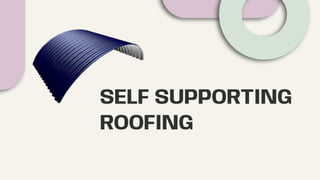
SELF SUPPORTING
ROOFING
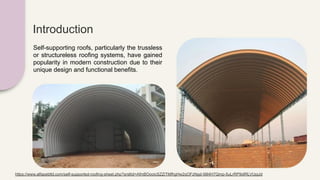
Introduction
Self-supporting roofs, particularly the trussless
or structureless roofing systems, have gained
popularity in modern construction due to their
unique design and functional benefits.
https://www.alfapebltd.com/self-supported-roofing-sheet.php?srsltid=AfmBOooicSZZiTMfhgHw2qOFzNgd-56l4H7Qmp-5uLrRP9dIRLVUpjJd
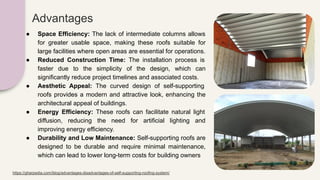
● Space Efficiency: The lack of intermediate columns allows
for greater usable space, making these roofs suitable for
large facilities where open areas are essential for operations.
● Reduced Construction Time: The installation process is
faster due to the simplicity of the design, which can
significantly reduce project timelines and associated costs.
● Aesthetic Appeal: The curved design of self-supporting
roofs provides a modern and attractive look, enhancing the
architectural appeal of buildings.
● Energy Efficiency: These roofs can facilitate natural light
diffusion, reducing the need for artificial lighting and
improving energy efficiency.
● Durability and Low Maintenance: Self-supporting roofs are
designed to be durable and require minimal maintenance,
which can lead to lower long-term costs for building owners
Advantages
https://gharpedia.com/blog/advantages-disadvantages-of-self-supporting-roofing-system/
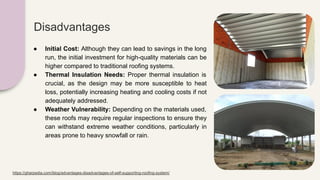
Disadvantages
● Initial Cost: Although they can lead to savings in the long
run, the initial investment for high-quality materials can be
higher compared to traditional roofing systems.
● Thermal Insulation Needs: Proper thermal insulation is
crucial, as the design may be more susceptible to heat
loss, potentially increasing heating and cooling costs if not
adequately addressed.
● Weather Vulnerability: Depending on the materials used,
these roofs may require regular inspections to ensure they
can withstand extreme weather conditions, particularly in
areas prone to heavy snowfall or rain.
https://gharpedia.com/blog/advantages-disadvantages-of-self-supporting-roofing-system/
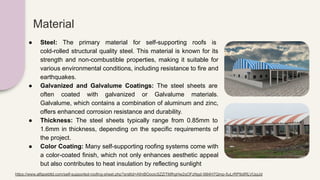
Material
● Steel: The primary material for self-supporting roofs is
cold-rolled structural quality steel. This material is known for its
strength and non-combustible properties, making it suitable for
various environmental conditions, including resistance to fire and
earthquakes.
● Galvanized and Galvalume Coatings: The steel sheets are
often coated with galvanized or Galvalume materials.
Galvalume, which contains a combination of aluminum and zinc,
offers enhanced corrosion resistance and durability.
● Thickness: The steel sheets typically range from 0.85mm to
1.6mm in thickness, depending on the specific requirements of
the project.
● Color Coating: Many self-supporting roofing systems come with
a color-coated finish, which not only enhances aesthetic appeal
but also contributes to heat insulation by reflecting sunlight
https://www.alfapebltd.com/self-supported-roofing-sheet.php?srsltid=AfmBOooicSZZiTMfhgHw2qOFzNgd-56l4H7Qmp-5uLrRP9dIRLVUpjJd
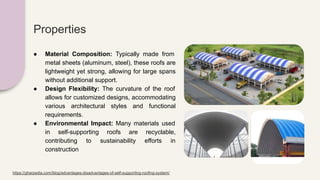
Properties
● Material Composition: Typically made from
metal sheets (aluminum, steel), these roofs are
lightweight yet strong, allowing for large spans
without additional support.
● Design Flexibility: The curvature of the roof
allows for customized designs, accommodating
various architectural styles and functional
requirements.
● Environmental Impact: Many materials used
in self-supporting roofs are recyclable,
contributing to sustainability efforts in
construction
https://gharpedia.com/blog/advantages-disadvantages-of-self-supporting-roofing-system/
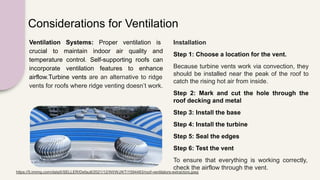
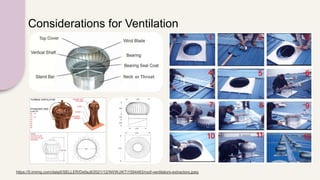
Considerations for Ventilation
Ventilation Systems: Proper ventilation is
crucial to maintain indoor air quality and
temperature control. Self-supporting roofs can
incorporate ventilation features to enhance
airflow.Turbine vents are an alternative to ridge
vents for roofs where ridge venting doesn’t work.
Installation
Step 1: Choose a location for the vent.
Because turbine vents work via convection, they
should be installed near the peak of the roof to
catch the rising hot air from inside.
Step 2: Mark and cut the hole through the
roof decking and metal
Step 3: Install the base
Step 4: Install the turbine
Step 5: Seal the edges
Step 6: Test the vent
To ensure that everything is working correctly,
check the airflow through the vent.
https://5.imimg.com/data5/SELLER/Default/2021/12/WI/WJ/KT/1594483/roof-ventilators-extractors.jpeg
Considerations for Ventilation
https://5.imimg.com/data5/SELLER/Default/2021/12/WI/WJ/KT/1594483/roof-ventilators-extractors.jpeg
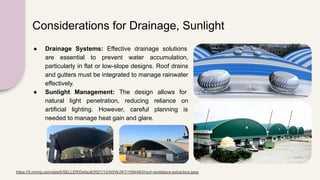
Considerations for Drainage, Sunlight
● Drainage Systems: Effective drainage solutions
are essential to prevent water accumulation,
particularly in flat or low-slope designs. Roof drains
and gutters must be integrated to manage rainwater
effectively.
● Sunlight Management: The design allows for
natural light penetration, reducing reliance on
artificial lighting. However, careful planning is
needed to manage heat gain and glare.
https://5.imimg.com/data5/SELLER/Default/2021/12/WI/WJ/KT/1594483/roof-ventilators-extractors.jpeg
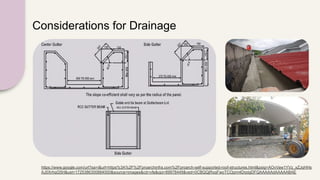
Considerations for Drainage
https://www.google.com/url?sa=i&url=https%3A%2F%2Fproarchinfra.com%2Fproarch-self-supported-roof-structures.html&psig=AOvVaw1YVz_xZJqHHs
AJ0XrhqG5H&ust=1725386300884000&source=images&cd=vfe&opi=89978449&ved=0CBQQjRxqFwoTCOjzm4DrpIgDFQAAAAAdAAAAABAE
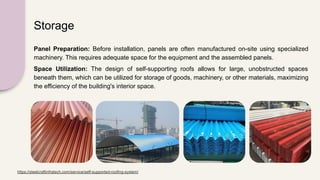
Storage
Panel Preparation: Before installation, panels are often manufactured on-site using specialized
machinery. This requires adequate space for the equipment and the assembled panels.
Space Utilization: The design of self-supporting roofs allows for large, unobstructed spaces
beneath them, which can be utilized for storage of goods, machinery, or other materials, maximizing
the efficiency of the building's interior space.
https://steelcraftinfratech.com/service/self-supported-roofing-system/
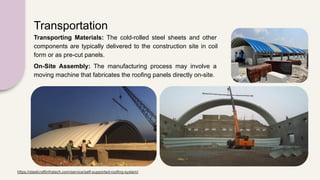
Transportation
Transporting Materials: The cold-rolled steel sheets and other
components are typically delivered to the construction site in coil
form or as pre-cut panels.
On-Site Assembly: The manufacturing process may involve a
moving machine that fabricates the roofing panels directly on-site.
https://steelcraftinfratech.com/service/self-supported-roofing-system/
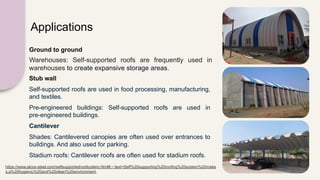
Applications
Ground to ground
Warehouses: Self-supported roofs are frequently used in
warehouses to create expansive storage areas.
Stub wall
Self-supported roofs are used in food processing, manufacturing,
and textiles.
Pre-engineered buildings: Self-supported roofs are used in
pre-engineered buildings.
Cantilever
Shades: Cantilevered canopies are often used over entrances to
buildings. And also used for parking.
Stadium roofs: Cantilever roofs are often used for stadium roofs.
https://www.alcox-steel.com/selfsupportedroofsystem.html#:~:text=Self%20supporting%20roofing%20system%20make
s,a%20hygienic%20and%20clean%20environment.
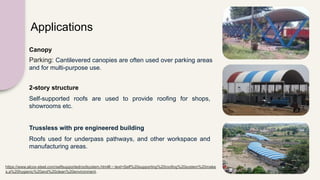
Applications
Canopy
Parking: Cantilevered canopies are often used over parking areas
and for multi-purpose use.
2-story structure
Self-supported roofs are used to provide roofing for shops,
showrooms etc.
Trussless with pre engineered building
Roofs used for underpass pathways, and other workspace and
manufacturing areas.
https://www.alcox-steel.com/selfsupportedroofsystem.html#:~:text=Self%20supporting%20roofing%20system%20make
s,a%20hygienic%20and%20clean%20environment.
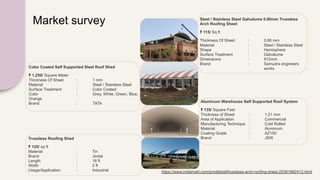
Steel / Stainless Steel Galvalume 0.80mm Trussless
Arch Roofing Sheet
₹ 115/ Sq ft
Thickness Of Sheet : 0.80 mm
Material : Steel / Stainless Steel
Shape : Hemisphere
Surface Treatment : Galvalume
Dimensions : 912mm
Brand : Samudra engineers
works
Market survey
Color Coated Self Supported Steel Roof Shed
₹ 1,250/ Square Meter
Thickness Of Sheet : 1 mm
Material : Steel / Stainless Steel
Surface Treatment : Color Coated
Color : Grey, White, Green, Blue,
Orange
Brand : TATA
https://www.indiamart.com/proddetail/trussless-arch-roofing-sheet-25381682412.html
Aluminum Warehouse Self Supported Roof System
₹ 135/ Square Feet
Thickness of Sheet : 1.21 mm
Area of Application : Commercial
Manufacturing Technique : Cold Rolled
Material : Aluminum
Coating Grade : AZ150
Brand : JSW
Trussless Roofing Shed
₹ 125/ sq ft
Material : Tin
Brand : Jindal
Length : 18 ft
Width : 2 ft
Usage/Application : Industrial
Market survey
https://www.indiamart.com/proddetail/trussless-arch-roofing-sheet-25381682412.html
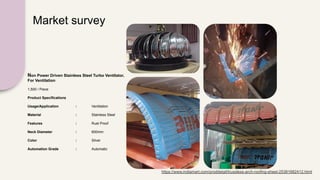
Non Power Driven Stainless Steel Turbo Ventilator,
For Ventilation
1,500 / Piece
Product Specifications
Usage/Application : Ventilation
Material : Stainless Steel
Features : Rust Proof
Neck Diameter : 600mm
Color : Silver
Automation Grade : Automatic
THANK YOU…

ROOFING PRODUCTS and its type and application

  • 1.
    CONSTRUCTION & MATERIALS RAR- 902 ROOFING PRODUCTS Prakhar Srivastava Priyanshu Tiwari Samriddhi Agrawal Saumya Patel Shivangini Singh Shambhavi Srivastava Suyash Yadav Tanvi Giri Faculty of Architecture and Planning, Dr. A.P.J. Abdul Kalam Technical University
  • 2.
    Content Introduction………………………………………………………………………. Evolution…………………………………………………………………………. Metal Roofing……………………………………………………………………. Galvanized IronSheets………………………………………………………… PVC Roofing…………………………………………………………………….. Pre-Coated Roofing Sheets…………………………………………………… Polycarbonate Roofing………………………………………………………… Asbestos Roofing Sheets……………………………………………………… Self-Supported Roofing…………………………………………………………
  • 3.
  • 4.
    What are RoofingProducts? Roofing products encompass materials and systems designed to protect and enhance a building's structure. Architecturally, they include various options like metal, tiles, and membranes that contribute to a building's aesthetic, durability, and energy efficiency. These products are integral in achieving both functional and visual harmony in architectural design. 64 Types of Roofing • Complete List of Roofing Materials (roofonline.com)
  • 5.
    Why are theyessential? They shield the building from rain, snow, wind, and sunlight, preventing water damage and structural deterioration. Weather Protection 1 Roofing materials contribute to energy efficiency by insulating the building, reducing heat loss in winter and heat gain in summer. Thermal Insulation 2 The roof provides stability and support to the overall structure, distributing weight and resisting environmental stresses like wind and snow loads. Structural Integrity 3 Roofing Materials Selection: Important Considerations to Keep in Mind - Arch2O.com
  • 6.
    The choice ofroofing materials significantly impacts the building's visual appeal, influencing its style, texture, and color palette. Aesthetic Value 4 High-quality roofing products extend the lifespan of the building, reducing the need for frequent repairs and maintenance. Durability & Longevity 5 Certain roofing materials offer enhanced fire resistance, providing critical safety features in fire-prone areas. Fire Resistance 6 Why are they essential? Roofing Materials Selection: Important Considerations to Keep in Mind - Arch2O.com
  • 7.
    Some roofing productshelp reduce noise transmission, contributing to a quieter indoor environment. Sound Insulation 7 Environmentally friendly roofing options, such as green roofs or solar-integrated systems, support sustainable design and reduce the building’s environmental footprint. Sustainability 8 Proper roofing systems ensure adequate ventilation and moisture management, preventing issues like mold and condensation. Ventilation & Moisture control 9 Why are they essential? Roofing Materials Selection: Important Considerations to Keep in Mind - Arch2O.com
  • 8.
    Key factors keptin mind while deciding roofing Environmental and Site Context 1 Roof Pitch (Slope) 2 Building Span 3 Roof Shape & Design 4 Structural Load Capacity (incorporating lateral loads) 5 Roofing Material Expansion and Contraction 6 Integration with Skylights, Solar Panels, and Other Features 7 Roofing Materials Selection: Important Considerations to Keep in Mind - Arch2O.com
  • 9.
  • 10.
    A Look Backin Time at the Rise of the Roofing Industry | Architect Magazine
  • 11.
    Roofing Type Permissible spans Slope Advantages DisadvantagesImages Tinplate Roofing Typically up to 6-8 feet Min. 3:12 ● Lightweight ● Easy to install ● Corrosion-r esistant (with coating) ● Affordable ● Prone to denting ● Requires regular maintenance to prevent rust ● Limited lifespan Corrugated Metal Roofing Typically 8-12 feet Min 3:12 ● High strength-to- weight ratio ● Durable ● Excellent water drainage ● Affordable ● Noisy during rain ● Requires careful installation to avoid leaks ● Susceptible to corrosion if not coated A Look Back in Time at the Rise of the Roofing Industry | Architect Magazine
  • 12.
    Roofing Type Permissible spans Slope Advantages DisadvantagesImages Sheet Metal Roofing Typically 8-10 feet Min 2:12 ● Versatile ● Durable ● Fire-resistant ● Aesthetic flexibility ● Reflective ● Can be expensive ● Prone to thermal expansion/c ontraction ● Installation complexity Galvanized Iron Roofing Typically 6-12 feet Min 3:12 ● Corrosion-resi stant ● Durable ● Cost-effective ● Fire-resistant ● Recyclable ● Can be heavy ● Potential for rust over time if coating is damaged ● Limited color options A Look Back in Time at the Rise of the Roofing Industry | Architect Magazine
  • 13.
    Post-War and ContemporaryDevelopments ● Single-Ply Membranes (Late 20th Century): The introduction of single-ply roofing membranes such as EPDM, TPO, and PVC revolutionized flat and low-slope roofing systems. These materials offered improved waterproofing, flexibility, and energy efficiency, making them popular for commercial and industrial buildings. ● Sustainable and Green Roofing (21st Century): In recent decades, there has been a shift towards sustainable roofing options, including green roofs, cool roofs, and solar-integrated systems. These technologies not only enhance energy efficiency but also contribute to environmental sustainability, aligning with modern architectural trends that prioritize eco-friendly design. A Look Back in Time at the Rise of the Roofing Industry | Architect Magazine
  • 14.
    Current Trends ● AdvancedMetal Roofing and Composite Materials: Today, roofing products continue to evolve with innovations in metal roofing, offering enhanced durability, energy efficiency, and aesthetic versatility. Composite materials that mimic traditional options like slate and wood, but with added benefits like lower weight and improved performance, are also becoming increasingly popular. Galvalume metal sheets Fibre cement sheets Titanium-Zinc Roofing Standing Seam Metal Roofing A Look Back in Time at the Rise of the Roofing Industry | Architect Magazine
  • 15.
  • 16.
    WHAT IS METAL ROOFING Ametal roof is simply a roofing system made using metal sheets, tiles, or panels. A metal roof is a part of the roofing envelope which is the physical separator between the inside and outside of the building and is designed to provide resistance to air, water, heat and sound.
  • 17.
    ● Longevity: Steelroofs can last between 40 to 70 years, significantly longer than traditional asphalt roofing, which typically lasts 12 to 20 years. ● Durability: Steel roofs are highly durable and can withstand extreme weather conditions, including heavy snow, high winds (up to 140 mph), and hail. They are also resistant to cracking, shrinking, and eroding. ● Energy Efficiency: Steel roofs reflect solar radiant heat, which can reduce cooling costs by 10-25%. This makes them an energy-efficient option, especially in hot climates. ● Safety: Steel roofs are non-combustible, providing excellent protection against fire hazards such as wildfires and lightning strikes. Advantages Of Metal Roofing
  • 18.
    ADVANTAGES OF METALROOFING ● Environmental: Friendliness: Steel roofing materials are often made from 25-95% recycled content and are 100% recyclable at the end of their life. This makes them a sustainable choice compared to other roofing materials. ● Aesthetics: Modern steel roofs come in a variety of styles, colors, and finishes, allowing for greater customization to match different architectural designs. ● Low Maintenance: Steel roofs require minimal maintenance compared to other roofing materials. They are less prone to issues like moss and mildew growth.
  • 19.
  • 20.
    Material needed ● Sheets:Ensure they are of a suitable grade (750 or higher) and free from defects. ● Purlins: Fixed over the principal rafters to support the sheets. ● Fasteners: Galvanized J or L hook bolts, nuts, and washers. ● Sealants: Bitumen and G.I. limpet washers for waterproofing. ● Tools: Drill, cutting tools (like a circular saw), and safety equipment.
  • 21.
  • 22.
  • 23.
    Common Type OfMetal Roofing ● Copper Roofing ● Aluminium Roofing ● Zinc Roofing ● Tin Roofing ● Galvanized Roofing
  • 24.
    Copper Roofing Copper isanother type of metal roofing that’s chosen because it’s practically impervious to the elements. Copper roofs, when installed correctly, are resistant to rust and corrosion and, in general, last a lifetime. Copper is extremely durable and looks stunning even when compared to other metal roofs. What’s unique about copper is although it won’t corrode, it can change in appearance and color over time. It have life span of around 60 to 100 years ● Durable ● Weather Resistant ● Last upto 100 years ● Light Weight ● High Initial Cost
  • 25.
    Aluminum Roofing (10-24)x3.61ft Aluminum roofing is a roofing system made from aluminum panels that are lightweight, malleable, and resistant to corrosion. It's one of the lightest roofing materials available, but it's also durable and has a higher strength-to-weight ratio than other roofing metals. Aluminum is also energy efficient, flexible, and comes in a variety of colors. ● Durable ● Co Resistant ● Last upto 50 years ● Easy Installation ● Affordable
  • 26.
    Zinc Roofing (12x4)ft Zincroofing is a type of metal roofing that is durable, sustainable, and easily formed into custom shapes. While natural zinc has a metallic appearance that will become blue or grey as it develops a patina, zinc roofing is also available in a range of pigmented finishes ● Durable ● Weather Resistant ● Easy Installation ● Affordable ● Flexible ● Fire Resistant
  • 27.
    Tin Roofing (3.55x 8-16)ft Tin roofs are made of any soft metal that is coated in tin and lead, including aluminum. While tin is no longer a commonly used roofing material, the term tin roof is still used to describe metal roofing, steel roofing and galvanized steel roofing ● Durable ● Weather Resistant ● Last upto 50 years ● Easy Installation ● Affordable
  • 28.
  • 29.
    Single Skin System Anuninsulated profiled metal sheet fixed directly to the purlins. Double Skin System This is a special site-assembled double skin construction which uses profiled rigid insulation to completely fill the space between liner and weather sheets. The insulation may be polyurethane, polyisocyanurate or mineral fibre. No spacer systems are required.
  • 30.
    Site Assembled Composite System Thiscommon type of construction consists generally of a shallow profiled metal liner, a spacer system and an outer sheet usually in a deeper profile. The insulation is typically a mineral fibre quilt. Factory Made Composite Panel Also known in the industrial roofing industry as sandwich panels, composite roof panels are made from an insulation core that is encased between two metal or plastic panels. In the building world, composite insulated roof panels are used for external walls, internal structures and roofs.
  • 31.
    Applications of metalroofing ● Commercial Buildings ● Residential Buildings ● Warehouse factories ● Industrial building ● Architectural Projects ● Agricultural Buildings
  • 32.
    STORAGE ● In orderto protect the panels from moisture, they should be stored inside in an area with constant temperature and humidity levels—a garage or shed is usually ideal. ● Keep the panels away from direct outdoor elements such as rain and snow, as this can cause damage ● Sun exposure can also fade the color of the panels over time ● Stacking multiple roofing panels on top of each other it's important to separate them with planks of wood for stability and leverage protection
  • 33.
    TRANSPORTATION ● Place eachpanel separately on a flat surface so they can't scratch against each other, ● Use straps or pallet jacks to help maintain their position even if there is movement while driving ● Barrier or protective cover placed between panels can also protect potential scratches or shipping damage ● Careful inspections during loading and unloading is also very important
  • 34.
    Market Survey Aluminum Roofing Sheet Thickness 0.50mm Length Width 10 ft 3 ft Surface Treatment Galvanised Alliance Steel- 280/kg Steel Premium Al-Zn Coated Corrugated Sheets Thickness: 1mm - 5mm Surface Treatment Al-Zn Coated (Steel) JSW Steel- 60/kg Mild Steel Jindal Roofing Steel Thickness: 0.35 mm Length Width 12 ft 3 ft Surface Treatment Mild Steel Alliance Steel- 90/kg
  • 35.
  • 36.
    Introduction ● Galvanized ironsheets are a popular choice for roofing material due to their exceptional durability, corrosion resistance, and cost-effectiveness. ● Coated with a protective layer of zinc through the hot-dip galvanization process, these sheets are designed to withstand harsh weather conditions, including rain and intense sunlight. ● Their lightweight nature makes them easy to install, while their strength ensures long-lasting protection for buildings. ● Widely used in both residential and commercial construction, providing a reliable and low-maintenance roofing solution.
  • 37.
    Types 1. Plain galvanizedsheets: ● These are flat steel sheets that have a zinc coating to prevent rust and extend their lifespan. They are used in a variety of applications, including: ○ Automotive: Body panels, chassis, frame components, exhaust systems, and underbody protection ○ Construction: Roofing, wall panels, ductwork, building frames, balconies, verandahs, staircases, ladders, and walkways ○ Electrical: Electrical conduits, cable trays, and enclosures
  • 38.
    Types 2. Galvanized corrugatedsheets (GC sheets) : ● The most basic of the steel roofing sheets is the galvanized corrugated sheets. ● These sheets are created using steel as the base and a layer of Zinc is created above the inner steel layer which gives an added protection to the steel. ● One of the most common forms of steel roofing solutions, Galvanized corrugated sheets or GC sheets are a quick and economical roofing solution for any establishment. ● The corrugated pattern on the sheets helps in quick and easy installation of the sheets and also helps avoid leakage.
  • 39.
    Types 2. Pre-painted galvanizediron (PPGI) sheets: ● Pre-painted steel sheets have a metallic coating and a paint coating over the base metal. ● The PPGI sheets have a Zinc coated or galvanized substrate, conversion coating, and suitable combinations of primer & paint coats on both the surfaces. ● PPGI refers to factory pre-painted steel roofing sheets, where the steel is painted before forming, as opposed to post painting which occurs after forming. ● Pre-painted steel sheets are generally referred to as colour coated steel sheets. 3. Sandwich Roofing Sheets: ● These consist of a layer of insulating material (like polyurethane foam) sandwiched between two metal sheets, providing excellent thermal insulation while maintaining the benefits of galvanized iron. ● They are suitable for applications where temperature control is essential
  • 40.
    Properties of sandwichRoofing Sheets: ● Thermal Insulation: The core material, often made from polyurethane foam or other insulating materials, provides excellent thermal insulation. ● Waterproof: The corrugated design, combined with the quality of the materials used, ensures that the roofing is waterproof, preventing leaks and water damage. ● Sound Absorption: The insulating core also contributes to sound absorption, making buildings quieter. ● Fire Resistance: Many sandwich panels are designed to be fire-resistant, providing an additional safety feature for buildings.
  • 41.
    Characteristics ● Corrosion Resistance:The zinc coating protects the iron from rust and corrosion, extending the lifespan of the roofing material. ● Durability: Highly durable, able to withstand harsh weather conditions such as heavy rain, snow, and strong winds. ● Low Maintenance: Requires minimal maintenance due to its resistance to corrosion and durability. ● Lightweight: Easier to install and reduces the overall load on the building structure compared to other roofing materials. ● Affordability: Generally cost-effective compared to other roofing options, offering good value for money. ● Ease of Installation: Easy to handle, cut, and install, which can reduce labor costs and installation time.
  • 42.
    Material specification ● Thesheets shall be of 750 grade of coating unless otherwise specified. ● The sheets shall be free from cracks, split edges, twists, surface flaws, etc. ● They shall be clean, bright, and smooth. ● The sheets shall not show signs of rust or white powdery deposits on the surface. ● In corrugated sheets, the corrugations shall be uniform in depth and pitch and parallel with the side. ● Purlins of the specified material or M.S rolled sections shall be fixed over the principal rafters. ● The galvanized coating on J or L hooks, and bolts shall be continuous and free from defects.
  • 43.
    Installation 1. Preparation ● Measurethe Roof Area: Accurately measure the roof area to determine the amount of material needed, including sheets, fasteners, and other accessories. ● Gather Materials and Tools: Ensure you have all necessary materials, including galvanized iron sheets, screws or nails, ridge caps, and flashing. Tools needed include a measuring tape, ladder, drill, hammer, tin snips, and safety gear. 2. Roof Framing ● Inspect the Roof Structure: Ensure the roof framing is strong and level to support the weight of the galvanized iron sheets. ● Install Purlins: Attach purlins to the roof structure, typically spaced 2-4 feet apart, depending on the design and local building codes. Purlins provide the base for attaching the sheets. 3. Laying the Sheets ● Start at the Bottom: Begin installation from the bottom edge (eave) of the roof, working upwards towards the ridge. This helps in overlapping the sheets correctly to prevent water infiltration. ● Overlap the Sheets: Each sheet should overlap the previous one by a few inches (typically 6 inches horizontally and 1-2 inches vertically) to ensure water runs off without seeping between the sheets and align them.
  • 44.
    4. Securing theSheets ● Fasten the Sheets: Use galvanized screws or nails with rubber washers to secure the sheets to the purlins. Fasteners should be placed in the valleys of the sheets to avoid water ingress. ● Spacing of Fasteners: Fasteners should be spaced about 6-8 inches apart along the edges and 12-18 inches apart in the middle areas, depending on wind and load requirements. 5. Install Flashing and Ridge Caps ● Flashing: Install flashing around roof edges, valleys, and penetrations (like chimneys or vents) to prevent water from seeping underneath the sheets. ● Ridge Caps: Attach ridge caps at the peak of the roof to cover the gap between the sheets from either side of the roof, providing a finished look and preventing water ingress. 6. Finishing Touches ● Inspect for Gaps: Check for any gaps or misaligned sheets and adjust as necessary. Ensure all fasteners are secure and there are no loose ends. ● Sealant: Apply sealant around any penetrations, edges, or overlaps to provide extra protection against leaks.
  • 45.
    ADVANTAGES Galvanized iron sheetsare strong and can withstand extreme weather conditions, such as heavy rain, strong winds, and hail, making them a reliable roofing option. Durability 1 The zinc coating provides excellent protection against rust and corrosion, ensuring the roof’s longevity, even in humid or coastal environments. Corrosion Resistance 2 Compared to other roofing materials, galvanized iron sheets are relatively affordable while offering long-term performance, making them a cost-effective choice. Cost effective 3 https://rooflux.com/pvc-roofing-11-significant-benefits/
  • 46.
    ADVANTAGES Due to theircorrosion resistance and durability, galvanized iron roofs require minimal maintenance, reducing the need for frequent repairs or replacements. Low maintenance 1 These sheets are lightweight, which makes them easy to transport and install, and reduces the load on the building structure. Lightweight 2 Galvanized iron sheets are available in various sizes, shapes, and thicknesses, allowing them to be used in different architectural designs and styles. Versatility 3 https://rooflux.com/pvc-roofing-11-significant-benefits/
  • 47.
    DISADVANTAGES Although the zinccoating provides corrosion resistance, it can wear off over time, especially in highly corrosive environments, leading to rust and degradation of the roof. Rust over time 1 Galvanized iron sheets have high thermal conductivity, which means they can absorb and retain heat, making the interior of the building hotter, especially in warm climates, unless proper insulation is used. Thermal Conductivity 2 Metal roofs, including those made of galvanized iron, can be noisy during heavy rain, hail, or strong winds, which can be a nuisance for occupants. Noise 3 https://rooflux.com/pvc-roofing-11-significant-benefits/
  • 48.
    DISADVANTAGES While durable, galvanizediron sheets can still be dented or damaged by impacts from heavy objects, such as falling branches or hailstones. Denting and Damage 4 Galvanized iron sheets have a more industrial appearance, which might not suit all architectural styles or aesthetic preferences without additional treatments or coatings. Aesthetic Limitations 5 https://rooflux.com/pvc-roofing-11-significant-benefits/
  • 49.
    Handling and storage ●Location: Store galvanized sheets in a dry environment away from direct exposure to elements. If immediate installation is not possible, they should be placed in a well-ventilated area. ● Covering: If outdoor storage is necessary, use breathable materials like canvas tarpaulins for coverage. Avoid plastic coverings, as they can trap moisture and lead to corrosion. ● Separation from Other Metals: To prevent galvanic corrosion, galvanized sheets should be stored away from other metals such as copper and lead, and from strong acids or corrosive substances. ● Humidity Control: Ideally, the relative humidity in the storage area should be kept below 60% to minimize the risk of corrosion. Proper ventilation is essential to achieve this.
  • 50.
    Transportation ● Packaging: ○ Galvanizediron sheets should be securely packaged to prevent movement during transit. ○ This typically involves using steel straps in both transverse and longitudinal directions to hold the sheets together. ● Moisture Control: ○ While galvanized sheets are generally moisture-resistant, prolonged exposure to moisture during transport can lead to damage. ○ It's essential to ensure that sheets are kept dry and that any moisture found between them is addressed promptly by separating and drying the sheets. ● Protection from Abrasion: ○ During transportation, care must be taken to avoid scratches or dents.
  • 51.
    GENERAL SPECIFICATIONS OFA GI SHEET PROPERTY DETAILS Material Galvanised iron sheets Thickness Ranges from 0.5 mm to 50 mm depending on the type and application Standard Sizes Common dimensions include: - 900 x 2400 mm - 1220 x 2440 mm - 1250 x 2500 mm Colors Available Off-white,, blue, green other custom colors upon request Span Sheets with a thickness of 0.5 mm may allow for a maximum spacing of 1.2 to 1.5 meters, while thicker sheets (e.g., 0.7 mm) can span up to 2.5 meters under similar loading conditions.
  • 52.
    MARKET SURVEY Brand Jindal RANGE Thickness(MM)- 0.12 to 0.80 Width For Plain Sheets (MM)- 700 to 1350 Width For Corrugated Sheets (MM)- 600 to 1220 Length (MM)- 1700 to 4270 ZINC COATING: Zinc Coating 90Gms/sq. mtr. to 275 Gms/sq. Mtr. COIL WT. 3-8 mt PACKET WT. 2.5 mt To 3mt Brand Jindal RANGE Thickness (MM)-0.10 to 2.00 Width For Plain Sheets (MM)- 700 to 1350 COIL WT. 3-8 mt GRADE SPCC a
  • 53.
    Case study Railway station,Lucknow ● Span: 20-30 meter (as per requirement) ● Durability: GI sheets are widely used for roofing at railway stations due to their durability, corrosion resistance, and cost-effectiveness. ● Long-term: These sheets are coated with a layer of zinc to prevent rusting, making them ideal for long-term outdoor exposure. ● Installation: GI sheets are lightweight, which makes installation easier and reduces structural load on the roof. ● Weather protection: Additionally, they offer good protection from weather elements such as rain and sun while requiring minimal maintenance.
  • 54.
  • 55.
    INTRODUCTION ● Polyvinyl Chloride(PVC) roofing is a popular choice for commercial and industrial roofing applications due to its versatility, durability, and cost effectiveness. ● Their excellent light transmission makes them an affordable alternative to traditional roof lights, allowing abundant natural light indoors. Despite their affordability, PVC sheets maintain durability, ensuring a reliable and solid roofing choice. ● PVC roofing is made from polyvinyl chloride, a synthetic resin known for its strength and resistance to weathering. ● The membrane typically consists of two layers of PVC with a reinforcing layer of polyester or fiberglass in between, enhancing its durability and flexibility. https://www.titanapplicators.com/blog/what-is-a-pvc-roof
  • 56.
    PVC Single-Ply Membrane: This is the most common type of PVC roofing and consists of a single layer of PVC material. It's available in various thicknesses, with 45 mils and 60 mils being the most common options. ● PVC single-ply membranes are known for their flexibility, making them easy to install and suitable for roofs with complex shapes. ● They offer excellent resistance to UV rays, chemicals. ● These are made from high-quality microbial PVC layer and glass fiber. These sheets are suitable for roofing commercial, industrial, and residential buildings https://www.titanapplicators.com/blog/what-is-a-pvc-roof
  • 57.
    PVC CORRUGATED SHEETS PVCcorrugated sheets are an affordable and easy-to-install roofing solution for residential and commercial settings. PVC corrugated sheets are primarily made from polyvinyl chloride, which is known for its lightweight and durable properties. The sheets can have a slight blue tint due to the manufacturing process, which can affect their UV protection capabilities. They are ideal for garages and garden sheds, and they come in different colors and thicknesses to suit your specific needs. These are one of the most affordable roofing options available in the market. It is durable, long-lasting, energy efficient, and easy to install and are commonly found in garden sheds, and farming structures https://www.titanapplicators.com/blog/what-is-a-pvc-roof https://www.engineeringcivil.com/different-types-of-roofing-sheets. html#google_vignette
  • 58.
    ADVANTAGES PVC roofs arehighly durable and can last 20-30 years with proper maintenance. They withstand extreme weather conditions, including high winds, heavy rains, and hail. Durability 1 PVC roofing membranes have a high reflectivity index, reflecting a significant amount of solar radiation. This helps keep buildings cooler, reducing energy costs associated with air conditioning and mitigating the urban heat island effect. Energy Efficiency 2 These roofs require minimal maintenance, typically needing only routine inspections and occasional cleaning. This low maintenance requirement makes them an attractive option for building owners. Low Maintenance 3 https://rooflux.com/pvc-roofing-11-significant-benefits/
  • 59.
    ADVANTAGES PVC roofing isinherently waterproof, providing excellent protection against leaks. The heat-welded seams ensure a seamless roofing system that can withstand ponding water. Waterproofing 4 PVC is resistant to a variety of chemicals, making it suitable for industrial settings. Additionally, it is fire-resistant; it does not support combustion and can self-extinguish when the source of fire is removed. Fire Resistance 5 https://rooflux.com/pvc-roofing-11-significant-benefits/
  • 60.
    DISADVANTAGES The upfront costof PVC roofing can be higher compared to traditional roofing materials. While the long-term savings on maintenance and energy can offset this initial investment, it may be a barrier for some property owners. Initial Cost 1 PVC can expand and contract with temperature fluctuations, which may lead to issues if not properly installed. This sensitivity requires careful consideration during installation to avoid future problems. Temperature 2 Improper installation or inadequate drainage can lead to water pooling, which may cause structural damage and leaks over time. Regular inspections and maintenance are necessary to mitigate this risk. Water Pooling 3 https://rooflux.com/pvc-roofing-11-significant-benefits/
  • 61.
    DISADVANTAGES The production ofPVC involves the use of fossil fuels and can generate harmful byproducts. While it is recyclable, the environmental impact of its production is a concern for some. Environmental Concerns 4 Older PVC roofs may be difficult to repair due to changes in manufacturing standards over the years. This can lead to higher costs for maintenance and repairs if issues arise. Repair Challenges 5 https://rooflux.com/pvc-roofing-11-significant-benefits/
  • 62.
    DRAINAGE SYSTEM ● Slopeand Positioning: For PVC roofing systems, a minimum slope of 5 to 10 degrees is required to ensure proper drainage. This slope is critical for preventing water pooling on the roof surface, which can lead to leaks and other structural issues. ● Pooling Issues: While some pooling is acceptable, standing water should ideally be drained within 48 hours to prevent structural damage. If pooling persists, adjustments may be necessary, such as lowering the drain outlet or modifying the roof's slope. ● Material Durability: PVC roof drains are favored for their resistance to rust and corrosion, making them suitable for various weather conditions. They are designed to withstand prolonged exposure to water without compromising performance https://zjrping.en.made-in-china.com/product/MKDQWIfATmaY/China-Plastic-Pipe-Roofing-Dra inage-Gutters-Systems-K-Style-Roof-Drainage-System-PVC-Square-Pipe-PVC-Rain-Gutter.ht ml https://www.conteches.com/media/5kwlbmdz/pvc-roof-drainage_web.pdf
  • 63.
    GENERAL SPECIFICATIONS OFA PVC SHEET PROPERTY DETAILS Material PVC (poly vinyl chloride) Thickness Ranges from 0.55 mm to 30 mm depending on the type and application Standard Sizes Common dimensions include: - 1000 x 2000 mm - 1220 x 2000 mm - 1220 x 2440 mm - 1250 x 2000 mm - 3000 x 1500mm Colors Available Industrial Grey, Red, White, and other custom colors upon request Span PVC roofing sheets can typically span distances of up to 3 meters (approximately 10 feet) without additional support. Cost 600-700 Rs./ sq. mtr. For 3mm sheet (3 X 1.05 mtr.)
  • 64.
    Hindustan Aeronautics Limited(HAL) Facility, Bangalore Location: Airport - varthur road, Bangalore, India The Hindustan Aeronautics Limited (HAL) facility in Bangalore is a notable example of a building that has incorporated PVC roofing in India. The industrial facility chose PVC roofing due to its durability, resistance to chemicals and harsh weather, and energy efficiency, which helps reduce cooling costs in the manufacturing environment. Span = 95 metres Shape = Hyperbolic paraboloid shell roof Supported on steel trusses
  • 65.
    Key Features ofHAL's PVC Roofing 1. Durability: The PVC roofing at HAL is designed to withstand the rigors of an industrial environment, including exposure to chemicals and extreme temperatures, which are common in aviation manufacturing. 2. Energy Efficiency: The reflective properties of the PVC membrane help reduce heat absorption, contributing to lower cooling costs in the facility, which is essential for maintaining optimal working conditions. 3. Low Maintenance: The PVC roofing requires minimal maintenance, allowing HAL to focus on its core operations without the burden of frequent roof repairs or replacements. 4. Installation Method: The roofing system was installed using a fully adhered method, ensuring a watertight seal that enhances the longevity of the roof. 5. Environmental Considerations: PVC roofing is recyclable, aligning with HAL's commitment to sustainable practices in its operations.
  • 67.
    Market Survey Color coatedforming Pvc roofing sheet Thickness 2.50 mm Dim. - 1m X 2.44m Cost- 60/sq.ft Transparent clear glass pvc roofing sheet Thickness 0.21-2mm Dim. - 1m X 3.66m Cost- 200/sq.ft https://dir.indiamart.com/impcat/pvc-roofing-sheet.html
  • 68.
  • 69.
    These are steelor metal sheets that have been coated with a layer of paint or protective coating. These sheets typically consist of a metal substrate (such as galvanized steel or aluminum) that is coated with a paint system, providing a durable and attractive finish. The coating systems used include Regular Modified Polyester (RMP), Silicon Modified Polyester (SMP), and Poly Vinyl Di Fluoride (PVDF)
  • 70.
    Applications Cladding: They canbe installed on the exterior walls of steel structures to enhance their appearance, provide insulation, and improve weather resistance. Canopy and awning: These structures offer shade and protection from the elements, making them ideal for outdoor spaces such as entrances, walkways, and parking areas.
  • 71.
    Applications Commercial buildings Storagebuildings or warehouses Exhibition halls
  • 72.
    Characteristics ● Lightweight -Many pre-coated sheets, especially those made of aluminum, are lightweight yet strong, reducing the load on the building structure without compromising quality. ● Fire Resistance - Aluminum pre-coated sheets have a Class-A fire rating, making them non-combustible and safe for use in various applications, including residential, commercial, and industrial settings.
  • 73.
    ● Weather Resistance- It provide excellent protection against harsh weather conditions, such as heavy winds, rain, and bright sunlight, ensuring that the color and shine are retained for an extended period. ● Eco-Friendliness - Aluminum pre-coated sheets are highly recyclable, with only a small amount of energy required to produce them from recycled materials, making them an environmentally friendly choice. ● Thermal Efficiency - The coatings on pre-coated sheets can help reflect heat, reducing cooling costs and improving the overall energy efficiency of the building. https://www.jswcoatedsteel.in
  • 74.
    Installation Steps Framework ● Thespacing between purlins should be according to the manufacturer’s recommendation, typically 1.2-1.5 meters apart for roofing sheets. Roof Layout and Planning ● Begin installing from the bottom of the roof (eaves) and work towards the ridge. ● If the sheets are laid from right to left, ensure that the overlapping corrugation is facing away from the prevailing wind direction to prevent wind-driven rain from entering the overlaps.
  • 75.
    Installation of Sheets ●Place the first sheet in position, aligning it with the roof edge. The sheet should slightly overhang the eave (usually by 50-75 mm) to allow water to flow into the gutter. ● Fasten screws along the ridges of the corrugations for proper sealing. ● For side overlaps, fasteners should be placed on every other ridge. Overlapping: ● Side Overlap: Pre-coated sheets should overlap by at least 1 corrugation or 50-75 mm, depending on the profile. ● End Overlap: If the sheets are shorter than the roof length, the end overlap should be around 150-200 mm.
  • 76.
    Sealants: ● Apply asealant or butyl tape along the side and end overlaps for extra protection against water penetration. ● Seal all penetrations (e.g., pipes, chimneys) and openings in the roof using appropriate sealants to prevent leaks. Edge Protection: ● After cutting the sheets, coat the cut edges with a sealant or edge protection to prevent corrosion, especially if the exposed edges are made of galvanized steel.
  • 77.
    ADVANTAGES They are manufacturedusing high-quality materials and coatings that provide excellent resistance to corrosion, abrasion, and weathering. Durability 1 It reflects solar heat, reducing indoor temperatures, and lowers air conditioning costs. and support in natural daylighting and are made from recyclable materials Energy Efficiency 2 Pre-coated sheets are resistant to corrosion, UV radiation, and weathering, ensuring a longer lifespan and reducing the need for frequent repairs or replacements. Low Maintenance 3
  • 78.
    ADVANTAGES The waterproof coating providesa seamless barrier that prevents water infiltration, reducing the risk of leaks and water damage to the structure below. Waterproofing 4 sheets are designed with thermal insulation properties. They can help regulate indoor temperatures by reflecting heat, reducing the need for excessive cooling Fire Resistance 5 https://medium.com/jsw-everglow/technical-specifications.aspx
  • 79.
    DISADVANTAGES the initial investmentcan be higher compared to some other roofing materials, which may deter budget-conscious buyers. Initial Cost 1 Temperature fluctuations can cause to expand and contract. Over time, this can lead to material fatigue, warping, Temperature 2 can be noisy during heavy rain or high winds. This can be mitigated with insulation, but it adds to the cost. Noise 3 https://rooflux.com/pvc-roofing-11-significant-benefits/
  • 80.
    DISADVANTAGES The manufacturing processfor pre-coated roofing sheets, especially metal ones, involves significant energy consumption and can release greenhouse gases and other pollutants, contributing to environmental degradation. They are non biodegradable, which can be a concern for environmentally conscious consumers. Environmental Concerns 4 Repairing pre-coated sheets often requires skilled labor, increasing the complexity and cost of repairs. Repair Challenges 5 https://sterlingroofinggroup.com/4-different-types-of-roofing-sheets-pros-and-cons
  • 81.
    Leading manufacturing companiesof pre - coat roofing sheet in india COMPANY PRICE DIMENSION (L meters B meters THICKNESS) JSW Steel ₹ 82/ Kg 1.8 to 12 1 0.35 mm to 1.20 mm
  • 82.
    COMPANY PRICE DIMENSION (Lmeters B meters THICKNESS) Tata Steel ₹ 80/ Kg 1.5 to 12 1 0.40 mm Balaji Roofing ₹ 80/ Kg 1.8 to 12 1 0.30 mm to 1.20 mm
  • 83.
    TRANSPORTATION & STORAGE ●Moisture Protection: Keep sheets dry during transport and storage to prevent rust and coating damage. ● Secure Loading & Handling: Ensure sheets are secured and handled carefully to avoid scratches, dents, and bending. ● Even Weight Distribution: Distribute weight evenly during transport and stack sheets properly in storage to prevent warping. ● Store on Flat, Elevated Surfaces: Use flat, stable surfaces and keep sheets off the ground to avoid contact with water or damaging materials. ● Shield from Direct Sunlight: Protect sheets from prolonged exposure to direct sunlight to prevent UV damage to the coating. Storage of pre coated roofing sheets https://www.tradevv.com/product-detail/1571336_18118973 /Dx51d-Z120-PPGI-Pre-Painted-Corrugated-Steel-Sheet-for -Roofing-Building.html Stacking of pre coated sheets
  • 84.
  • 85.
    POLYCARBONATE ● Polycarbonate isa very strong and resilient thermoplastic material. ● Polycarbonate is also very lightweight and capable of withstanding extreme temperatures, either hot or cold (-40 to 120 degree Celsius) ● While polycarbonate roofing may not be the best option for an entire house; it is ideal for other structures such as decks, garages, patios, sheds, and conservatories. Polycarbonate is also frequently used for pool covers, or for roofing on industrial warehouses. ● Being virtually unbreakable with 250 times the impact strength of float glass and 30 times that of acrylic, polycarbonate panels are a great product for a wide variety of outdoor uses.
  • 86.
    Characteristics Highly durable andshatterproof, polycarbonate is a popular modern roofing material used for skylights, greenhouses, and roofing. ● High Impact Resistance Polycarbonate can withstand impact from hail, falling debris, and even vandalism. ● Superior Light Transmission Polycarbonate roofing allows more light inside while reducing the need for artificial lighting. ● Excellent Weather Resistance Polycarbonate is highly resistant to extreme weather conditions, including heavy rain, high winds, and snow.
  • 87.
    Applications of PolycarbonateSheets Features •Cover larger surfaces without doing laps •more fixable for installation •Anti-static function •Easy to install •Self cleaning. •Save space in container •easy for domestic transportation. Typical Application •Roofing light sheet and sunshade for building •Skylight, lighting for corridors, balcony, passages, and subway entries, walkways. •Conservatories, agricultural greenhouse, zoos, botanical gardens. •Industrial roofing and glazing •Natatorium Swimming pools •roofing/cover/sheet Stadiums, Hospitals, School
  • 88.
    Types of PolycarbonateSheets Hollow Solid /Compact Textured Corrugated
  • 89.
    Hollow Polycarbonate Sheet Twinwall PC sheet ● Polycarbonate twin wall polycarbonate sheet is a basic type having light weight , you can also call it double wall polycarbonate panels. ● Twin wall polycarbonate panels have another feature, UV resistant of two sides which greatly help to extend service life. ● 80rs/ sq. mtr. For 2mm thick (3.6 x 1.2 mtr.) Source: http://www.skylites.in
  • 90.
    Hollow Polycarbonate Sheet Multiwall PC sheet ● Multiwall Polycarbonate Sheet has the features of stable structure, high strength. ● It is a type of engineering plastic of excellent integration capability, ideal material for roofing panel. ● It can support greater purlin spacing, the maximum reduction of profiles, allowing the designer to have more space to play in the selection. ● Multi wall including triple wall,4,5 and above wall ● 150 Rs./ sq. mtr. For 4mm sheet ( 12 x 2.1 mtr.) Source: http://www.skylites.in
  • 91.
    Solid Polycarbonate Sheet GeneralPurpose PC sheet ● GP PC sheet is a polished surface, transparent polycarbonate product. It features outstanding impact strength, superior dimensional stability, high temperature resistance, and high clarity. ● This lightweight thermo formable sheet is also easy to fabricate and decorate. ● 85 Rs./ sq. mtr. For 2mm thick (3.6 x 1.2 mtr.) Source: http://www.exceliteplas.net
  • 92.
    Solid Polycarbonate Sheet HardCoated Solid PC sheet ● Anti-scratch coating improves hardness of polycarbonate sheets. ● Anti- scratch PC sheet perfectly solves the shortcoming of polycarbonate sheets. ● It is widely used in various industries. UV Protected Solid PC sheet ● PC sheets use optical grade UV coating which is Co-extruded on top with a 50 micron thick protective UV Coating either on one or both sides. ● Co-Extrusion is a process that ensures an evenly spread, evenly thick base material and UV coating Source: http://www.skylites.in
  • 93.
    Corrugated Polycarbonate Sheet ●Polycarbonate corrugated sheet combines polycarbonate corrugated structure and polycarbonate embossed texture. ● It’s thin and strong, Corrugated PC sheet structure enhances the impact resistance of PC sheet. ● Lengths available for domestic use: 1.8m, 2.1m, 2.4m, 2.7m, 3.0m, 3.6m, 4.2m, 4.8m, 5.4m, 6.0m, 8.1m ● 175 Rs./sq.mtr. for 2 mm sheet (12.0 x 1.07 Mtr.)
  • 94.
    ADVANTAGES Polycarbonate is highly impact-resistant,making it much tougher than glass and less prone to shattering. It can withstand harsh weather conditions, including UV exposure, without yellowing or becoming brittle, which contributes to its long lifespan. Durability 1 Multi-wall polycarbonate sheets provide good thermal insulation, helping to maintain indoor temperatures and reduce energy consumption for heating and cooling. They allow natural light to penetrate, reducing the need for artificial lighting during the day, which can lead to significant energy savings. Energy Efficiency 2 Polycarbonate sheets require minimal maintenance compared to traditional materials. They are easy to clean with simple washing and do not require frequent replacements. Low Maintenance 3
  • 95.
    ADVANTAGES Polycarbonate sheets canbe easily sealed at joints and edges, providing excellent waterproofing. Proper installation ensures that water does not seep through, protecting underlying structures. The non-porous nature of polycarbonate prevents water absorption, reducing the risk of mold and mildew growth. Waterproofing 4 Polycarbonate is inherently fire retardant, meaning it has a high resistance to flames and will not contribute to fire spread. It is often rated with a flame resistance classification. In the event of a fire, polycarbonate sheets emit less smoke compared to other plastic materials, which is crucial for safety. Fire Resistance 5 https://plasticsheetsshop.co.uk/blog/polycarbonate-advantages-and-disadvantages/
  • 96.
    DISADVANTAGES Polycarbonate sheets tendto be more expensive than other traditional roofing materials like PVC or corrugated metal. The initial investment can be significant, especially for large-scale projects. Initial Cost 1 Polycarbonate sheets can expand and contract with temperature changes, potentially causing issues with fitting, sealing, and structural stability over time. It can also retain heat, leading to higher temperatures underneath the roofing. Temperature 2 While polycarbonate is non-porous, improper installation or poor sealing at joints and edges can lead to leaks. In certain climates, polycarbonate roofs can develop condensation on their underside, which may lead to dripping or mold growth if not adequately ventilated. Mold Growth 3
  • 97.
    DISADVANTAGES Polycarbonate is aplastic material and is not biodegradable. Disposal at the end of its life can be environmentally challenging, contributing to plastic waste issues. Environmental Concerns 4 Polycarbonate can scratch more easily than glass, especially if not coated with a protective layer. Repairing or replacing damaged sheets can be challenging, especially if the sheets are part of a large, continuous roof. Repair Challenges 5 https://plasticsheetsshop.co.uk/blog/polycarbonate-advantages-and-disadvantages/
  • 99.
    Drainage System For polycarbonateroofing sheets, an effective drainage system is essential to manage rainwater and prevent damage: 1. Roof Slope: Ensure a minimum slope of 5-10 degrees to allow water to flow off the roof easily. 2. Gutters and Downspouts: Install gutters along the roof edges to collect water, directing it to downspouts that carry water away from the structure. 3. Flashing: Use flashing at joints and edges to prevent leaks and direct water into gutters. 4. Sealing and Joints: Use proper sealing materials to ensure joints are watertight. 5. Debris Management: Regularly clean gutters and downspouts to prevent clogs from leaves and debris.
  • 100.
    Case Study: LucknowMetro Stations The use of polycarbonate roofing in Lucknow Metro stations is chosen to provide weather protection, aesthetic appeal, and passenger comfort. Material Selection: Polycarbonate sheets were selected for their lightweight, high impact resistance, and ability to transmit natural light while blocking harmful UV rays. Design and Installation: The roofing system was designed for easy installation, incorporating a modular design that allows for quick setup and integration with the station’s structural framework. Weather Resistance:Polycarbonate sheets provide effective protection against rain, wind, and sunlight, ensuring durability and comfort in a variety of weather conditions.
  • 101.
    Case Study: LucknowMetro Stations Energy Efficiency:The natural light transmission of polycarbonate reduces the need for artificial lighting during the day, contributing to energy savings and a pleasant atmosphere. Aesthetic Integration:The modern, sleek appearance of polycarbonate roofing complements the contemporary design of the metro stations, adding to the urban appeal. Low Maintenance: Polycarbonate's durability and resistance to UV degradation result in low maintenance costs, making it a cost-effective long-term roofing solution. Safety: Inherently fire-resistant and highly impact-resistant, polycarbonate sheets contribute to the overall safety and reliability of the metro station infrastructure.
  • 102.
  • 103.
    Introduction Asbestos sheets havebeen used in roofing for many years due to their durability, heat resistance, and insulating properties. However, due to health risks associated with asbestos, their use has significantly declined and is now regulated in many countries. When and where was it used? Asbestos has been used for thousands of years, but with the advent of the industrial era, the prevalence of its use increased from the mid-19th century. However, it was between 1950 and 1985 that the use of asbestos-containing materials . ACCORDING TO IS 13008:1990, THE OVERALL WIDTH OF ASBESTOS CEMENT CORRUGATED SHEET IS 1.015 METER (0.5 TO 10MM THICKNESS)
  • 104.
    INSTALLATION HEAD WALL CONNECTORFLASHING 1 SLIM LAP (UP), FAT LAP(DOWN) 2 FASTEN SHEETS TO PURLINS.(DONT OVER TIGHTEN FASTNERS TO THE SHEETS) 3 https://rooflux.com/pvc-roofing-11-significant-benefits/ RECOMMENDED SLOPE =1/1/2 INCH RISE,BY 12 INCH RUN SIDE RIDGE FLASHING A -FRAME STRUCTURE RIDGE CAP AT TOP PANNEL
  • 105.
    APPLICATIONS: Roofing: Durable andweather-resistant for homes and commercial buildings. Cladding: Provided weatherproofing for exterior walls. Partition Walls: Used for insulation and fire resistance. Agricultural Buildings: Applied in corrugated forms for sheds and storage Eaves and Gutters: Applied in corrugated forms for piping. Insulation Panels: Insulation Panels : Used as insulation in various building applications due to its thermal properties.
  • 106.
    ADVANTAGES ● Asbestos isa very good thermal insulator and increases the energy efficiency of the building. ● It is highly resistant to fire and does not burn easily. ● It forms a very strong material when mixed with cement and used as an additive to form a composite material called asbestos cement. ● It is a very inexpensive and a very cost effective material, hence widely used. ● It is extensively used as a protective roofing material in corrugated form. ● It is highly durable and weather proof. ● It is resistant to damage from termites. ● Asbestos is very easy to clean and maintain but difficult to repair. 1 2 3 4 5 6 THERMAL INSULATOR FIRE RESISTANT STRONG MATERIAL COST EFFECTIVE WEATHER PROOF RESISTANT TO TERMITES
  • 107.
    DISADVANTAGES ● Health Risks:Asbestos fibers can cause serious respiratory diseases, including asbestosis, lung cancer, and mesothelioma. ● Environmental Concerns: Improper handling or disposal of asbestos can lead to environmental contamination. ● Regulatory Issues: Many countries have banned or heavily regulated the use of asbestos, complicating its use in new construction.
  • 108.
  • 109.
    MARKET SURVEY ASBESTOS CEMENTROOFING SHEET PRODUCT SPECIFICATIONS: ● THICKNESS : 0.3-0.6 MM ● LENGTH :5,6,10,12 FEET ● WIDTH : 3 FEET ● COLOR : OFF WHITE USAGE FOR ROOFING ● FINISH : POWDER COATED ● BRANDS : EVEREST,RAMCO,CHARMINAR ● THE SIZES AND PRICE OF ASBESTOS SHEETS WILL BE VARY FROM LOCATION TO LOCATION. ● IT IS AROUND RS 130 / METER TO 200 / METER.
  • 110.
    Joinery Detail The sheetsmust be laid with the smooth surface upwards. The sheets must be laid with a side lap of half a corrugation, and an end lap of 150 mm, minimum in the case of roofs with a pitch less than 1 vertical to 2.5 horizontal (approx. 22 degrees).
  • 111.
    Drainage System ● Asbestosroofing sheets require a well-designed drainage system to handle rainwater effectively. ● The system should ensure that water does not pool on the roof, as stagnant water can lead to deterioration of the sheets and potential leaks.
  • 112.
    Storage/Transportation ● All asbestoscement units shall be protected from damage while stored on site. ● They shall be carefully stacked in sheltered positions as near as possible to the parts of the building on which they will be fixed. ● All sheets and fittings, including gutters and downpipes, brackets, fixing bolts or screws and any accessories required for a particular roof area, shall be on the site or available before the work is commenced. ● The sheets shall be raised to the roof using adequate manual or mechanical means, in particular avoiding impacts. ● During receiving and storing of asbestos cement corrugated sheets and fittings, recommendations given in 4 of IS 11769 ( Part 1) shall be followed to ensure minimum release of airborne dust and thus minimum exposure of workers to such airborne asbestos dust.
  • 113.
    Case Study Example: ResidentialRoofing In the 1970s and 1980s, many residential properties used asbestos sheets for roofing due to their affordability and resistance to fire. The Use of Asbestos Sheets in an Industrial Setting a factory built in the 1960s utilized asbestos roofing sheets to provide protection against extreme temperatures and to reduce fire risks. The factory faced significant challenges in later years due to the health risks posed by asbestos, leading to costly removal and replacement of roofing materials. https://en.m.wikipedia.org/wiki/Asbestos_cement
  • 114.
  • 115.
    Introduction Self-supporting roofs, particularlythe trussless or structureless roofing systems, have gained popularity in modern construction due to their unique design and functional benefits. https://www.alfapebltd.com/self-supported-roofing-sheet.php?srsltid=AfmBOooicSZZiTMfhgHw2qOFzNgd-56l4H7Qmp-5uLrRP9dIRLVUpjJd
  • 116.
    ● Space Efficiency:The lack of intermediate columns allows for greater usable space, making these roofs suitable for large facilities where open areas are essential for operations. ● Reduced Construction Time: The installation process is faster due to the simplicity of the design, which can significantly reduce project timelines and associated costs. ● Aesthetic Appeal: The curved design of self-supporting roofs provides a modern and attractive look, enhancing the architectural appeal of buildings. ● Energy Efficiency: These roofs can facilitate natural light diffusion, reducing the need for artificial lighting and improving energy efficiency. ● Durability and Low Maintenance: Self-supporting roofs are designed to be durable and require minimal maintenance, which can lead to lower long-term costs for building owners Advantages https://gharpedia.com/blog/advantages-disadvantages-of-self-supporting-roofing-system/
  • 117.
    Disadvantages ● Initial Cost:Although they can lead to savings in the long run, the initial investment for high-quality materials can be higher compared to traditional roofing systems. ● Thermal Insulation Needs: Proper thermal insulation is crucial, as the design may be more susceptible to heat loss, potentially increasing heating and cooling costs if not adequately addressed. ● Weather Vulnerability: Depending on the materials used, these roofs may require regular inspections to ensure they can withstand extreme weather conditions, particularly in areas prone to heavy snowfall or rain. https://gharpedia.com/blog/advantages-disadvantages-of-self-supporting-roofing-system/
  • 118.
    Material ● Steel: Theprimary material for self-supporting roofs is cold-rolled structural quality steel. This material is known for its strength and non-combustible properties, making it suitable for various environmental conditions, including resistance to fire and earthquakes. ● Galvanized and Galvalume Coatings: The steel sheets are often coated with galvanized or Galvalume materials. Galvalume, which contains a combination of aluminum and zinc, offers enhanced corrosion resistance and durability. ● Thickness: The steel sheets typically range from 0.85mm to 1.6mm in thickness, depending on the specific requirements of the project. ● Color Coating: Many self-supporting roofing systems come with a color-coated finish, which not only enhances aesthetic appeal but also contributes to heat insulation by reflecting sunlight https://www.alfapebltd.com/self-supported-roofing-sheet.php?srsltid=AfmBOooicSZZiTMfhgHw2qOFzNgd-56l4H7Qmp-5uLrRP9dIRLVUpjJd
  • 119.
    Properties ● Material Composition:Typically made from metal sheets (aluminum, steel), these roofs are lightweight yet strong, allowing for large spans without additional support. ● Design Flexibility: The curvature of the roof allows for customized designs, accommodating various architectural styles and functional requirements. ● Environmental Impact: Many materials used in self-supporting roofs are recyclable, contributing to sustainability efforts in construction https://gharpedia.com/blog/advantages-disadvantages-of-self-supporting-roofing-system/
  • 120.
    Considerations for Ventilation VentilationSystems: Proper ventilation is crucial to maintain indoor air quality and temperature control. Self-supporting roofs can incorporate ventilation features to enhance airflow.Turbine vents are an alternative to ridge vents for roofs where ridge venting doesn’t work. Installation Step 1: Choose a location for the vent. Because turbine vents work via convection, they should be installed near the peak of the roof to catch the rising hot air from inside. Step 2: Mark and cut the hole through the roof decking and metal Step 3: Install the base Step 4: Install the turbine Step 5: Seal the edges Step 6: Test the vent To ensure that everything is working correctly, check the airflow through the vent. https://5.imimg.com/data5/SELLER/Default/2021/12/WI/WJ/KT/1594483/roof-ventilators-extractors.jpeg
  • 121.
  • 122.
    Considerations for Drainage,Sunlight ● Drainage Systems: Effective drainage solutions are essential to prevent water accumulation, particularly in flat or low-slope designs. Roof drains and gutters must be integrated to manage rainwater effectively. ● Sunlight Management: The design allows for natural light penetration, reducing reliance on artificial lighting. However, careful planning is needed to manage heat gain and glare. https://5.imimg.com/data5/SELLER/Default/2021/12/WI/WJ/KT/1594483/roof-ventilators-extractors.jpeg
  • 123.
  • 124.
    Storage Panel Preparation: Beforeinstallation, panels are often manufactured on-site using specialized machinery. This requires adequate space for the equipment and the assembled panels. Space Utilization: The design of self-supporting roofs allows for large, unobstructed spaces beneath them, which can be utilized for storage of goods, machinery, or other materials, maximizing the efficiency of the building's interior space. https://steelcraftinfratech.com/service/self-supported-roofing-system/
  • 125.
    Transportation Transporting Materials: Thecold-rolled steel sheets and other components are typically delivered to the construction site in coil form or as pre-cut panels. On-Site Assembly: The manufacturing process may involve a moving machine that fabricates the roofing panels directly on-site. https://steelcraftinfratech.com/service/self-supported-roofing-system/
  • 126.
    Applications Ground to ground Warehouses:Self-supported roofs are frequently used in warehouses to create expansive storage areas. Stub wall Self-supported roofs are used in food processing, manufacturing, and textiles. Pre-engineered buildings: Self-supported roofs are used in pre-engineered buildings. Cantilever Shades: Cantilevered canopies are often used over entrances to buildings. And also used for parking. Stadium roofs: Cantilever roofs are often used for stadium roofs. https://www.alcox-steel.com/selfsupportedroofsystem.html#:~:text=Self%20supporting%20roofing%20system%20make s,a%20hygienic%20and%20clean%20environment.
  • 127.
    Applications Canopy Parking: Cantilevered canopiesare often used over parking areas and for multi-purpose use. 2-story structure Self-supported roofs are used to provide roofing for shops, showrooms etc. Trussless with pre engineered building Roofs used for underpass pathways, and other workspace and manufacturing areas. https://www.alcox-steel.com/selfsupportedroofsystem.html#:~:text=Self%20supporting%20roofing%20system%20make s,a%20hygienic%20and%20clean%20environment.
  • 128.
    Steel / StainlessSteel Galvalume 0.80mm Trussless Arch Roofing Sheet ₹ 115/ Sq ft Thickness Of Sheet : 0.80 mm Material : Steel / Stainless Steel Shape : Hemisphere Surface Treatment : Galvalume Dimensions : 912mm Brand : Samudra engineers works Market survey Color Coated Self Supported Steel Roof Shed ₹ 1,250/ Square Meter Thickness Of Sheet : 1 mm Material : Steel / Stainless Steel Surface Treatment : Color Coated Color : Grey, White, Green, Blue, Orange Brand : TATA https://www.indiamart.com/proddetail/trussless-arch-roofing-sheet-25381682412.html Aluminum Warehouse Self Supported Roof System ₹ 135/ Square Feet Thickness of Sheet : 1.21 mm Area of Application : Commercial Manufacturing Technique : Cold Rolled Material : Aluminum Coating Grade : AZ150 Brand : JSW Trussless Roofing Shed ₹ 125/ sq ft Material : Tin Brand : Jindal Length : 18 ft Width : 2 ft Usage/Application : Industrial
  • 129.
    Market survey https://www.indiamart.com/proddetail/trussless-arch-roofing-sheet-25381682412.html Non PowerDriven Stainless Steel Turbo Ventilator, For Ventilation 1,500 / Piece Product Specifications Usage/Application : Ventilation Material : Stainless Steel Features : Rust Proof Neck Diameter : 600mm Color : Silver Automation Grade : Automatic
  • 130.