
Selective vs Comprehensive
Primary Health Care in Nepal
Presented by
BPH V
Manik Rajbhandari
La Grandee International College
Pokhara University
11/06/2018 1
Background of PHC
• After the second world war developing countries had poorer health
status along with minimal access to health care services.
• For example, MMR<10 per lakh in developed countries and 500 to
1000 per lakh in developing countries.
• Similarly, IMR<10 per thousand in developed countries and 100 to
200 per thousand in developing countries.
• Life expectancy >70 in developed countries and < 50 in developing
countries.
11/06/2018 2
• There was inadequacy of health resources and inequality in the
distribution of health services not only between the countries but even
with in a country between the rich and poor population.
• Most people in the developed countries and the elite of the developed
countries(only 20% of world’s population) were enjoying the
determinants of good health.
• This wide disparity was unacceptable and it was necessary to address
the 80% of the world’s people to have equal access to health services.
11/06/2018 3
• Therefore The Declaration of Alma-Ata Conference was held on
Primary Health Care in Kazakhstan, 6–12 September 1978.
• According to Declaration of Alma-Ata, “Primary health care is a
essential health care based on practical, scientifically sound and
socially acceptable methods and technology made universally
accessible to individuals and families in the community through their
full participation and at a cost that the community and country can
afford to maintain every stage of their development in the spirit of
self-determination.”
11/06/2018 4
Comprehensive Primary Health Care
• PHC is necessarily comprehensive addressing primary care for all of
reproductive and child health, communicable and non-communicable
diseases and accidents and injuries through health communication,
technologies and care provision.
• CPHC also include nutrition, geriatric health care, palliative care and
rehabilitative care services.
• “Some argue that comprehensive primary health care was an
experiment that failed; others contend that it was never truly tested.”
• There were some important successes, particularly in the 1980s.
11/06/2018 5
• Mozambique, Cuba, and Nicaragua expanded their primary health care
coverage and greatly improved their population health indices.
• Whereas the progress in Mozambique and Nicaragua was short-lived
• But Cuba has maintained steady progress.
11/06/2018 6
Selective Primary Health Care
• One year after the Alma-Alta declaration, Julia Walsh and Kenneth
Warren presented “selective primary health care”.
• They proposed that a selective PHC, maximize improvement of health
in developing countries.
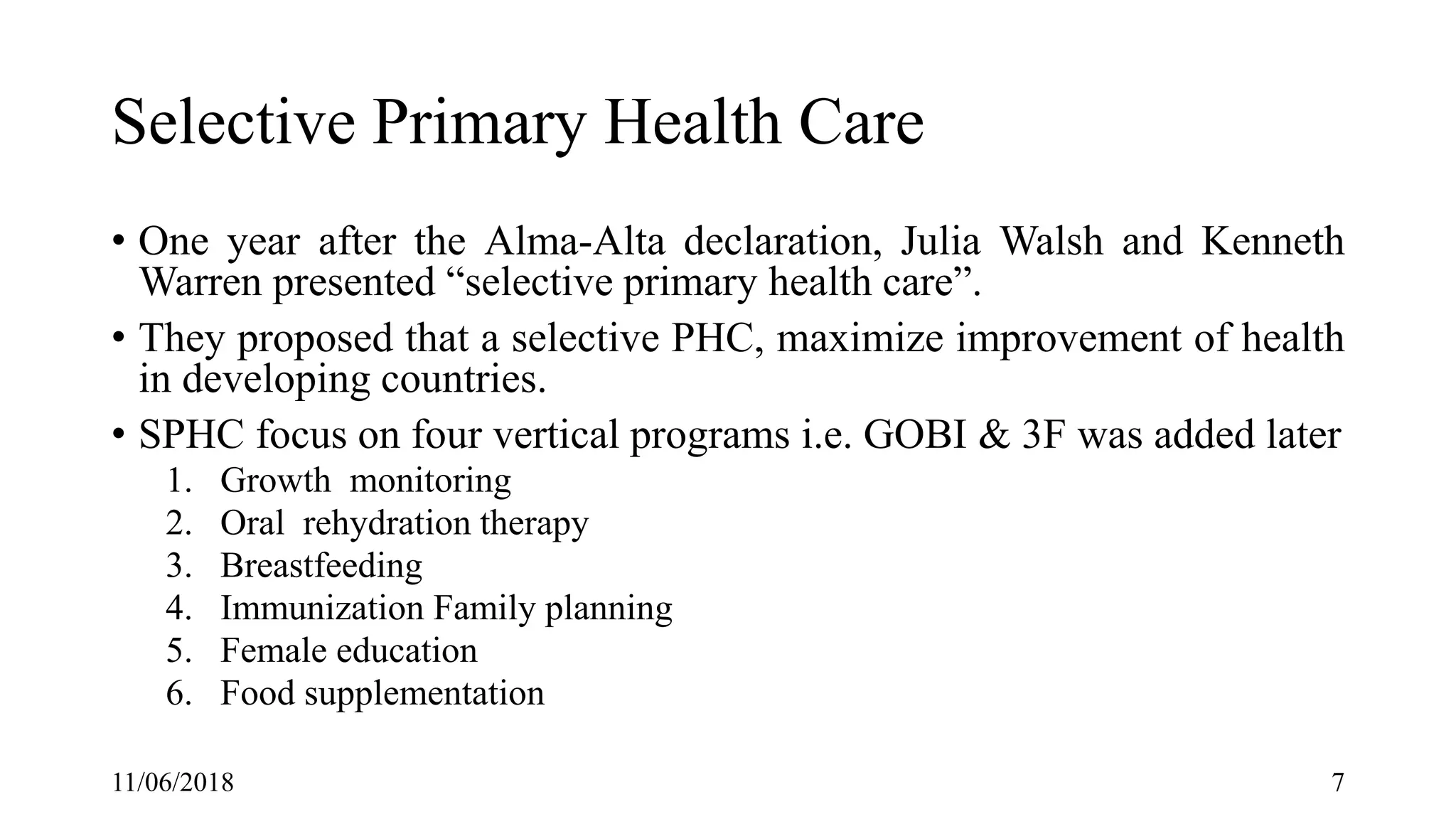
• SPHC focus on four vertical programs i.e. GOBI & 3F was added later
1. Growth monitoring
2. Oral rehydration therapy
3. Breastfeeding
4. Immunization Family planning
5. Female education
6. Food supplementation
11/06/2018 7
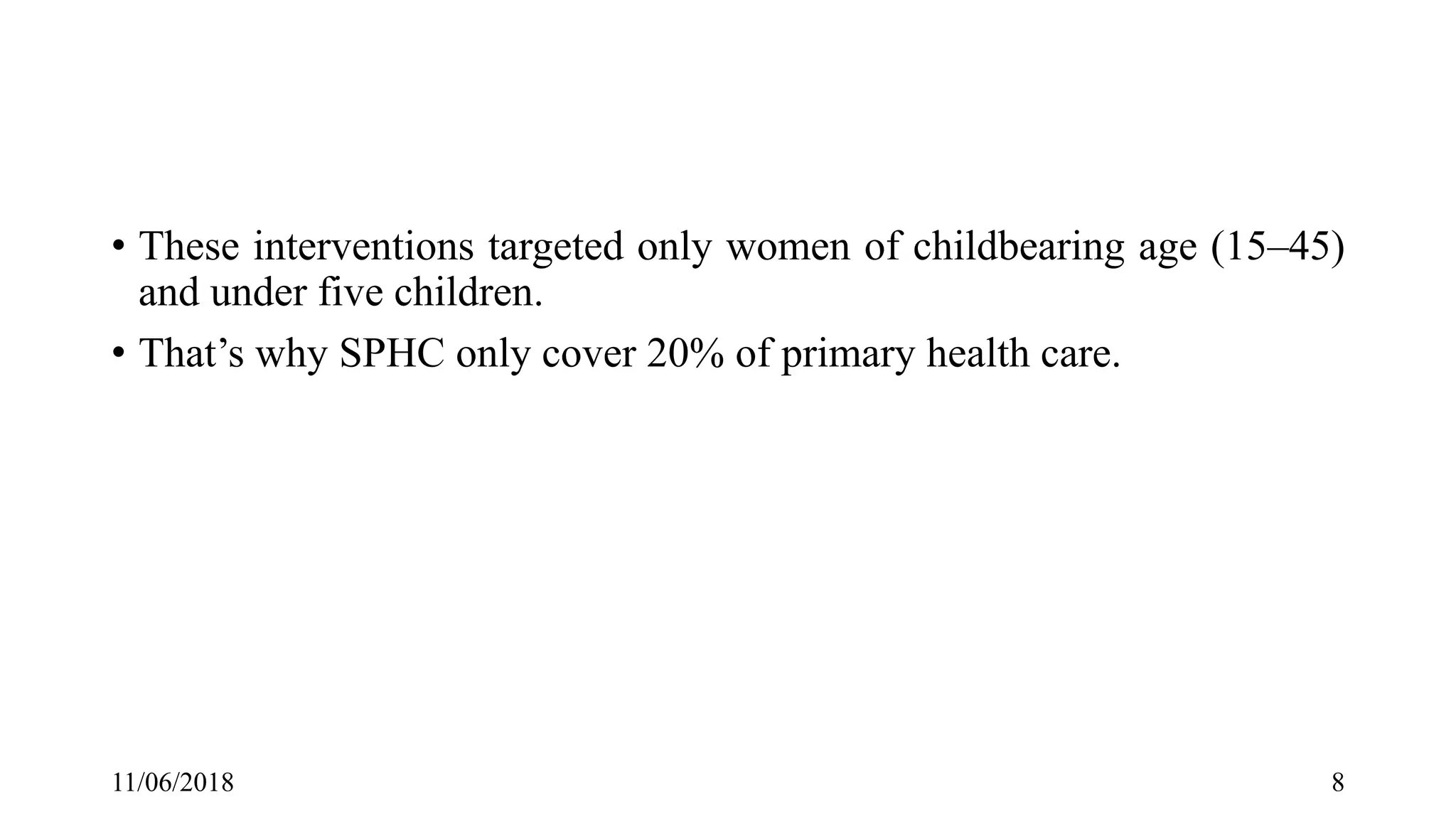
• These interventions targeted only women of childbearing age (15–45)
and under five children.
• That’s why SPHC only cover 20% of primary health care.
11/06/2018 8
Objectives
General objectives
• To review arrival literatures to find about comprehensive and selective
primary health care.
Specific Objectives
• To find out the status of SPHC and CPHC in Nepal.
• To find out the different between SPHC and CPHC.
11/06/2018 9
Methodology
For this review, Literature was searched using PubMed. Literature was
search on March 7, 2018. Restrictions were put on location, and
language of publication. The key word used to prepare this article are
primary health care, SPHC, CPHC, Ama-Aata conference and so on. By
using PubMed search engine, we find 800 articles in which we read first
50 article and 3 are used in it.
11/06/2018 10
Results
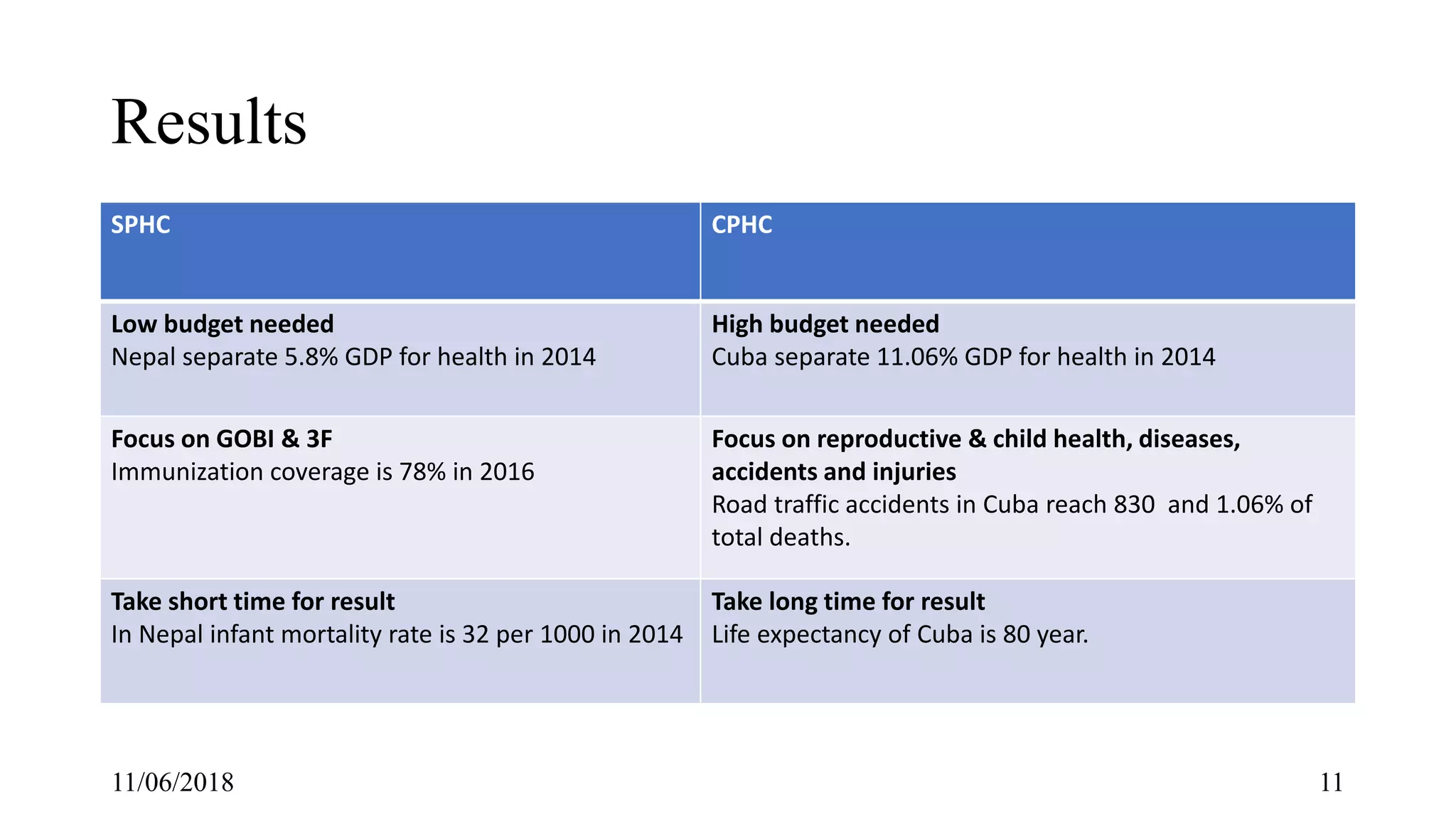
SPHC CPHC
Low budget needed
Nepal separate 5.8% GDP for health in 2014
High budget needed
Cuba separate 11.06% GDP for health in 2014
Focus on GOBI & 3F
Immunization coverage is 78% in 2016
Focus on reproductive & child health, diseases,
accidents and injuries
Road traffic accidents in Cuba reach 830 and 1.06% of
total deaths.
Take short time for result
In Nepal infant mortality rate is 32 per 1000 in 2014
Take long time for result
Life expectancy of Cuba is 80 year.
11/06/2018 11
SPHC CPHC
SPHC is an approach to implement specific
strategy for the improvement of health.
CPHC is a strategy towards achieving “ health for
all” which covers the different approaches for the
improvement of health.
Its main aim is to reduction of specific disease for
the improvement of overall health of the country
and individuals.
Its main aim is to Improve the overall health
status of public(specially people of rural areas
and vulnerable) through organized approaches.
Emphasize on selective, cost effective
interventions.
12
11/06/2018 12
SPHC CPHC
Planning by donors(Top down approach) Planning by community participation
Health care providers are specially medical
doctors.
Health care providers are multi-disciplinary teams
from public health, agriculture, environment etc
Fragmented interventions. Comprehensive interventions.
Success of SPHC-eradication of smallpox and
elimination of polio from Nepal.
Success of CPHC-Health care system in Kerala state
of india, Cuba, China etc.
11/06/2018 13
Situation of SPHC & CPHC in Nepal
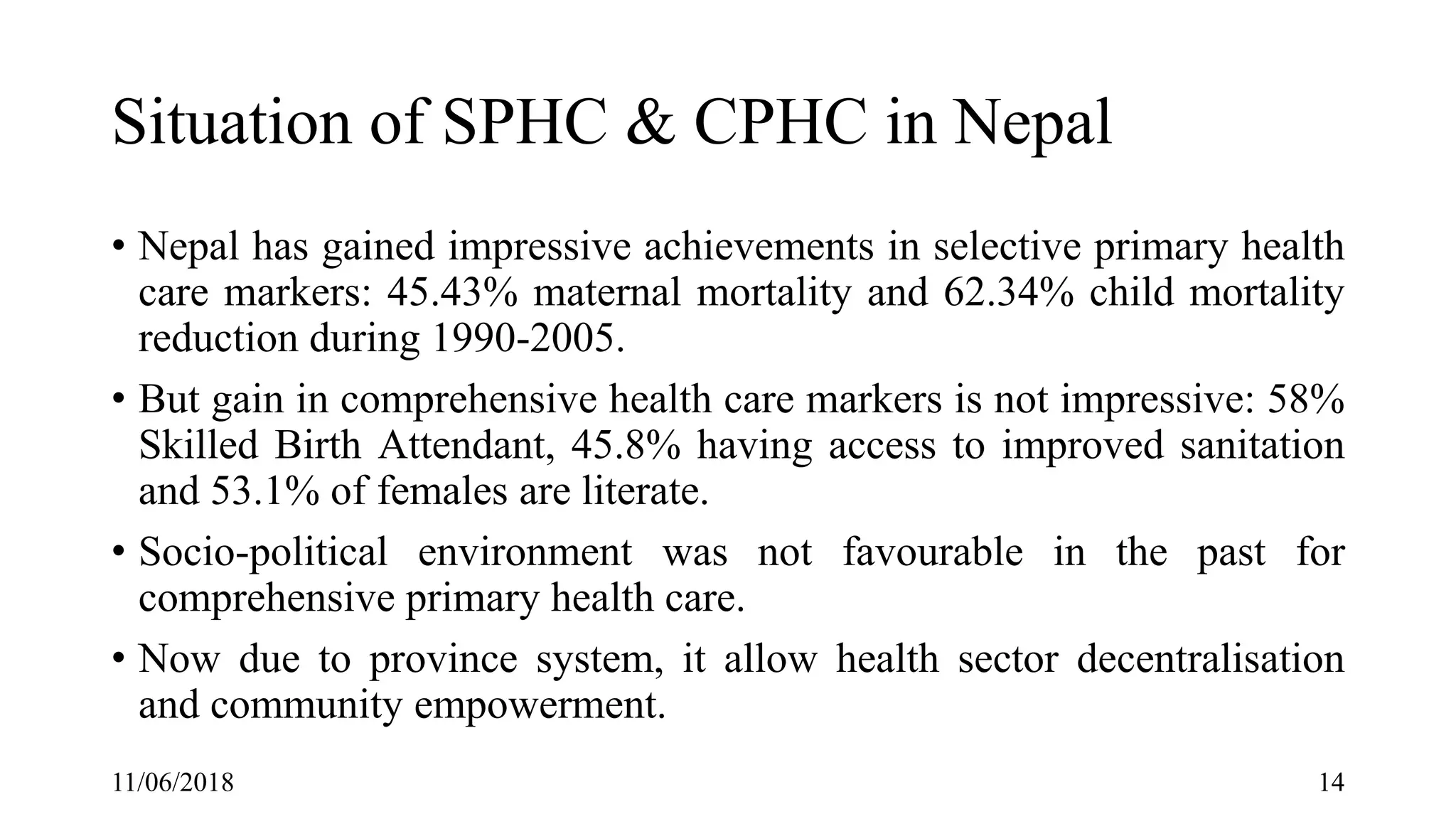
• Nepal has gained impressive achievements in selective primary health
care markers: 45.43% maternal mortality and 62.34% child mortality
reduction during 1990-2005.
• But gain in comprehensive health care markers is not impressive: 58%
Skilled Birth Attendant, 45.8% having access to improved sanitation
and 53.1% of females are literate.
• Socio-political environment was not favourable in the past for
comprehensive primary health care.
• Now due to province system, it allow health sector decentralisation
and community empowerment.
11/06/2018 14
• Health activities were focussed more on selective health care strategy
in the form of disease control, immunisation, vitamin A
supplementation, oral rehydration solution use and contraceptive use.
• Nepal's rural hilly geography posed great challenge on logistic supply,
communication and retention of health workers rendering public
health centres of low quality with negative perceptions of consumers.
• Nepal is on the pathway to build equitable comprehensive primary
health care.
11/06/2018 15
Conclusion
• Primary health care is a basic and essential health care for prevention
and treatment of disease.
• In developing country, SPHC is better to control and prevention
specific disease which have high mortality and morbidity.
• SPHC shows rapid effect by decreasing prevalence and mobility of
disease.
• SPHC especially focus on child and reproductive age women.
• CPHC is also effective to increase life expectancy and improve
determinant of health.
• CPHC need multi sectoral coordination.
11/06/2018 16
Recommendations
• To decrease the mortality and morbidity of infectious disease SPHC is
best choice.
• Nepal need to go slow towards CPHC by controlling infectious
disease.
• More intersectoral coordination necessary for CPHC.
11/06/2018 17
References
1. Karkee R, Jha N. Primary health care development: where is Nepal
after 30 years of Alma Ata Declaration? JNMA; journal of the Nepal
Medical Association. 2010;49(178):178-84.
2. Demographic and Health Survey 2016. Minister of health
3. Magnussen L, Ehiri J, Jolly P. Comprehensive Versus Selective
Primary Health Care: Lessons For Global Health. Health Affairs.
2004;23(3):167-76.
11/06/2018 18
11/06/2018 19

Selective Vs Comprehensive Primary Health Care in Nepal

  • 1.
    Selective vs Comprehensive PrimaryHealth Care in Nepal Presented by BPH V Manik Rajbhandari La Grandee International College Pokhara University 11/06/2018 1
  • 2.
    Background of PHC •After the second world war developing countries had poorer health status along with minimal access to health care services. • For example, MMR<10 per lakh in developed countries and 500 to 1000 per lakh in developing countries. • Similarly, IMR<10 per thousand in developed countries and 100 to 200 per thousand in developing countries. • Life expectancy >70 in developed countries and < 50 in developing countries. 11/06/2018 2
  • 3.
    • There wasinadequacy of health resources and inequality in the distribution of health services not only between the countries but even with in a country between the rich and poor population. • Most people in the developed countries and the elite of the developed countries(only 20% of world’s population) were enjoying the determinants of good health. • This wide disparity was unacceptable and it was necessary to address the 80% of the world’s people to have equal access to health services. 11/06/2018 3
  • 4.
    • Therefore TheDeclaration of Alma-Ata Conference was held on Primary Health Care in Kazakhstan, 6–12 September 1978. • According to Declaration of Alma-Ata, “Primary health care is a essential health care based on practical, scientifically sound and socially acceptable methods and technology made universally accessible to individuals and families in the community through their full participation and at a cost that the community and country can afford to maintain every stage of their development in the spirit of self-determination.” 11/06/2018 4
  • 5.
    Comprehensive Primary HealthCare • PHC is necessarily comprehensive addressing primary care for all of reproductive and child health, communicable and non-communicable diseases and accidents and injuries through health communication, technologies and care provision. • CPHC also include nutrition, geriatric health care, palliative care and rehabilitative care services. • “Some argue that comprehensive primary health care was an experiment that failed; others contend that it was never truly tested.” • There were some important successes, particularly in the 1980s. 11/06/2018 5
  • 6.
    • Mozambique, Cuba,and Nicaragua expanded their primary health care coverage and greatly improved their population health indices. • Whereas the progress in Mozambique and Nicaragua was short-lived • But Cuba has maintained steady progress. 11/06/2018 6
  • 7.
    Selective Primary HealthCare • One year after the Alma-Alta declaration, Julia Walsh and Kenneth Warren presented “selective primary health care”. • They proposed that a selective PHC, maximize improvement of health in developing countries. • SPHC focus on four vertical programs i.e. GOBI & 3F was added later 1. Growth monitoring 2. Oral rehydration therapy 3. Breastfeeding 4. Immunization Family planning 5. Female education 6. Food supplementation 11/06/2018 7
  • 8.
    • These interventionstargeted only women of childbearing age (15–45) and under five children. • That’s why SPHC only cover 20% of primary health care. 11/06/2018 8
  • 9.
    Objectives General objectives • Toreview arrival literatures to find about comprehensive and selective primary health care. Specific Objectives • To find out the status of SPHC and CPHC in Nepal. • To find out the different between SPHC and CPHC. 11/06/2018 9
  • 10.
    Methodology For this review,Literature was searched using PubMed. Literature was search on March 7, 2018. Restrictions were put on location, and language of publication. The key word used to prepare this article are primary health care, SPHC, CPHC, Ama-Aata conference and so on. By using PubMed search engine, we find 800 articles in which we read first 50 article and 3 are used in it. 11/06/2018 10
  • 11.
    Results SPHC CPHC Low budgetneeded Nepal separate 5.8% GDP for health in 2014 High budget needed Cuba separate 11.06% GDP for health in 2014 Focus on GOBI & 3F Immunization coverage is 78% in 2016 Focus on reproductive & child health, diseases, accidents and injuries Road traffic accidents in Cuba reach 830 and 1.06% of total deaths. Take short time for result In Nepal infant mortality rate is 32 per 1000 in 2014 Take long time for result Life expectancy of Cuba is 80 year. 11/06/2018 11
  • 12.
    SPHC CPHC SPHC isan approach to implement specific strategy for the improvement of health. CPHC is a strategy towards achieving “ health for all” which covers the different approaches for the improvement of health. Its main aim is to reduction of specific disease for the improvement of overall health of the country and individuals. Its main aim is to Improve the overall health status of public(specially people of rural areas and vulnerable) through organized approaches. Emphasize on selective, cost effective interventions. 12 11/06/2018 12
  • 13.
    SPHC CPHC Planning bydonors(Top down approach) Planning by community participation Health care providers are specially medical doctors. Health care providers are multi-disciplinary teams from public health, agriculture, environment etc Fragmented interventions. Comprehensive interventions. Success of SPHC-eradication of smallpox and elimination of polio from Nepal. Success of CPHC-Health care system in Kerala state of india, Cuba, China etc. 11/06/2018 13
  • 14.
    Situation of SPHC& CPHC in Nepal • Nepal has gained impressive achievements in selective primary health care markers: 45.43% maternal mortality and 62.34% child mortality reduction during 1990-2005. • But gain in comprehensive health care markers is not impressive: 58% Skilled Birth Attendant, 45.8% having access to improved sanitation and 53.1% of females are literate. • Socio-political environment was not favourable in the past for comprehensive primary health care. • Now due to province system, it allow health sector decentralisation and community empowerment. 11/06/2018 14
  • 15.
    • Health activitieswere focussed more on selective health care strategy in the form of disease control, immunisation, vitamin A supplementation, oral rehydration solution use and contraceptive use. • Nepal's rural hilly geography posed great challenge on logistic supply, communication and retention of health workers rendering public health centres of low quality with negative perceptions of consumers. • Nepal is on the pathway to build equitable comprehensive primary health care. 11/06/2018 15
  • 16.
    Conclusion • Primary healthcare is a basic and essential health care for prevention and treatment of disease. • In developing country, SPHC is better to control and prevention specific disease which have high mortality and morbidity. • SPHC shows rapid effect by decreasing prevalence and mobility of disease. • SPHC especially focus on child and reproductive age women. • CPHC is also effective to increase life expectancy and improve determinant of health. • CPHC need multi sectoral coordination. 11/06/2018 16
  • 17.
    Recommendations • To decreasethe mortality and morbidity of infectious disease SPHC is best choice. • Nepal need to go slow towards CPHC by controlling infectious disease. • More intersectoral coordination necessary for CPHC. 11/06/2018 17
  • 18.
    References 1. Karkee R,Jha N. Primary health care development: where is Nepal after 30 years of Alma Ata Declaration? JNMA; journal of the Nepal Medical Association. 2010;49(178):178-84. 2. Demographic and Health Survey 2016. Minister of health 3. Magnussen L, Ehiri J, Jolly P. Comprehensive Versus Selective Primary Health Care: Lessons For Global Health. Health Affairs. 2004;23(3):167-76. 11/06/2018 18
  • 19.