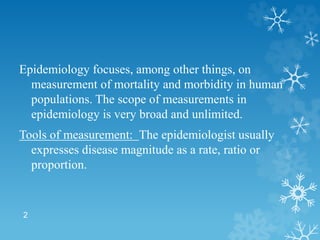
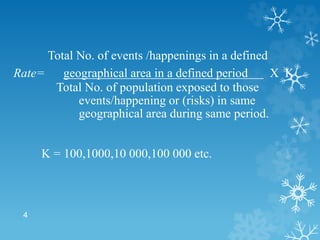
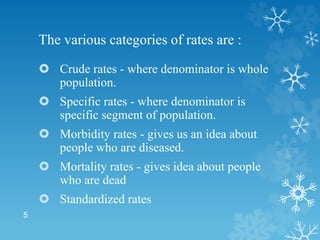
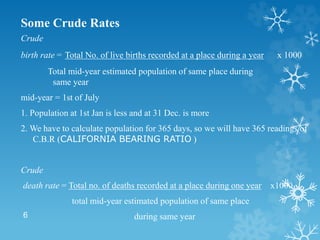
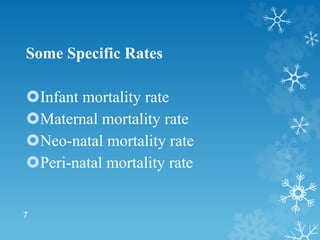
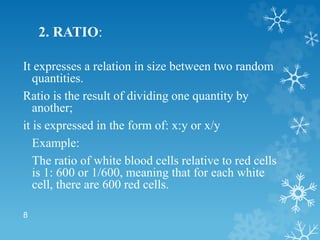
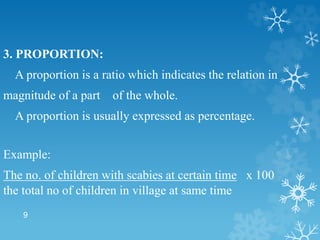
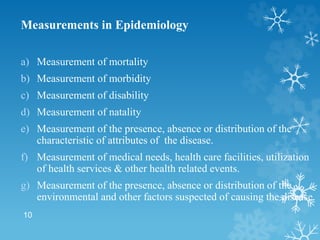
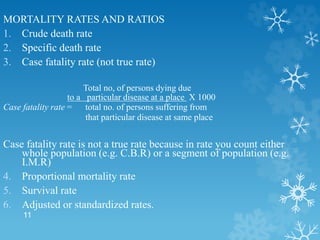
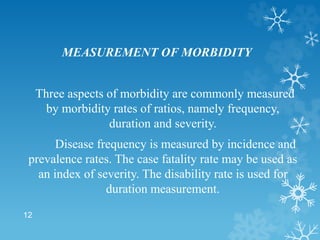
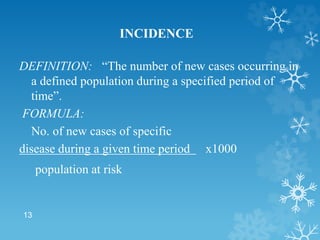
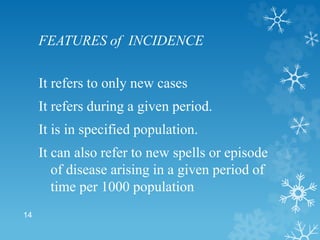
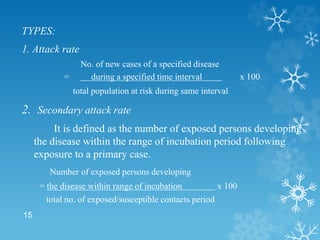
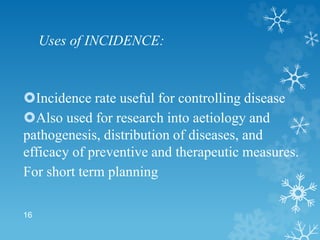
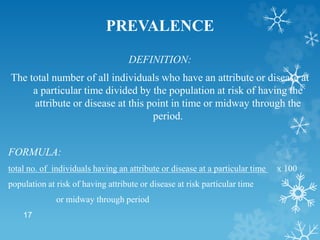
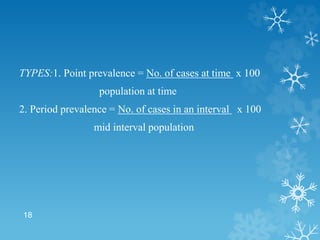
Epidemiologists use various measurements to quantify disease occurrence in populations. Rates, ratios, and proportions are commonly used. A rate is a measure of events occurring in a population over time, comprising a numerator, denominator, time period, and multiplier. Specific rates measure events in subgroups, like infant mortality rate. A ratio expresses the relative size of two quantities. A proportion indicates the relation of a part to the whole, often expressed as a percentage. Incidence measures new disease cases over time while prevalence measures total current cases. Both help identify at-risk groups and plan health services and facilities.






![Epidemiological Mehods [Autosaved].pptx](https://cdn.slidesharecdn.com/ss_thumbnails/epidemiologicalmehodsautosaved-220801131722-24a0478e-thumbnail.jpg?width=640&height=640&fit=bounds)


![CASE_PRESENTATION_ON_subdural_hematoma(SDH)[1 FINAL PPT]-1.pptx](https://cdn.slidesharecdn.com/ss_thumbnails/casepresentationonsubduralhematomasdh1finalppt-1-260129172522-d405d375-thumbnail.jpg?width=640&height=640&fit=bounds)


