1
UNIT -2
PLAIN CEMENT CONCRETE
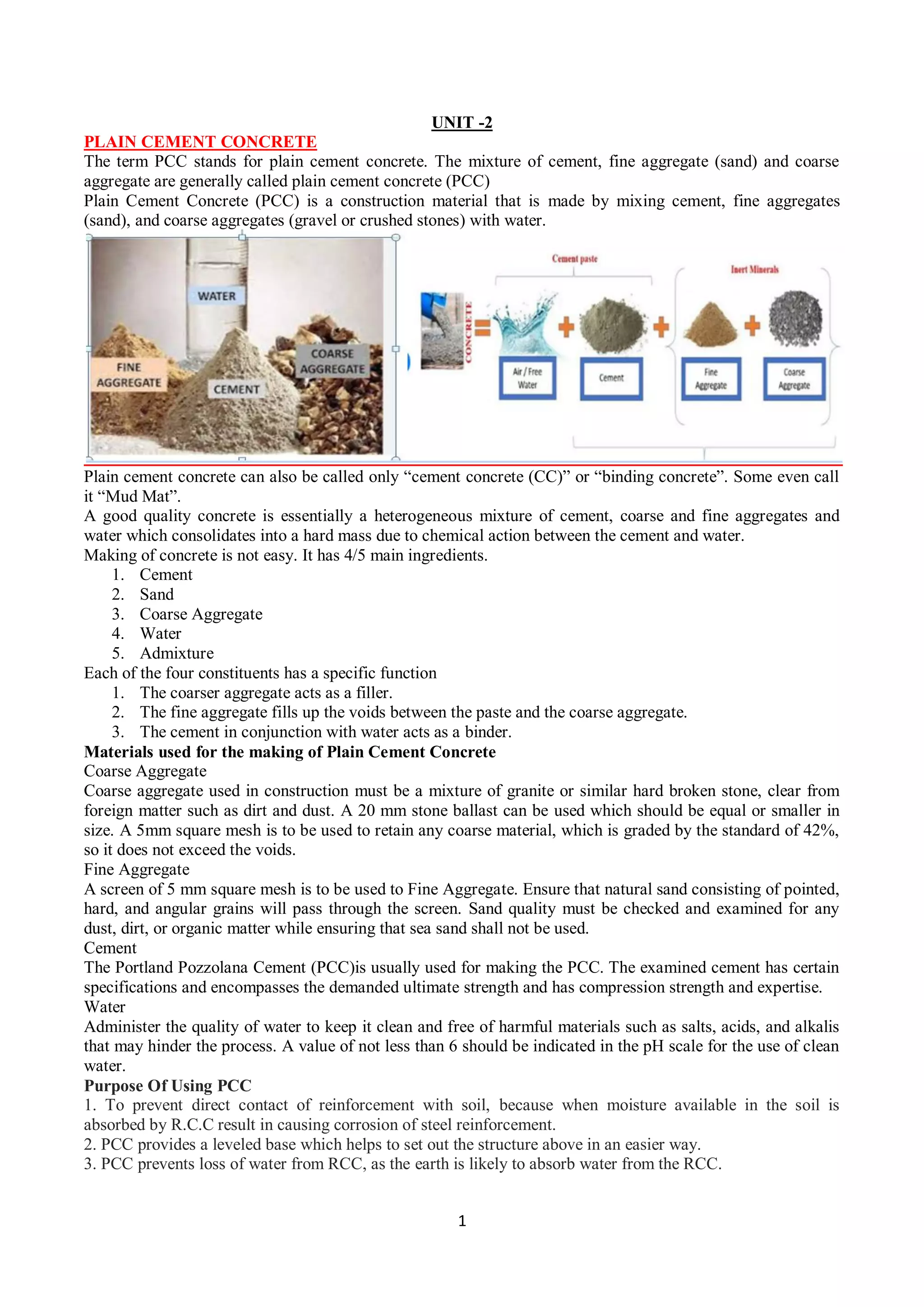
The term PCC stands for plain cement concrete. The mixture of cement, fine aggregate (sand) and coarse
aggregate are generally called plain cement concrete (PCC)
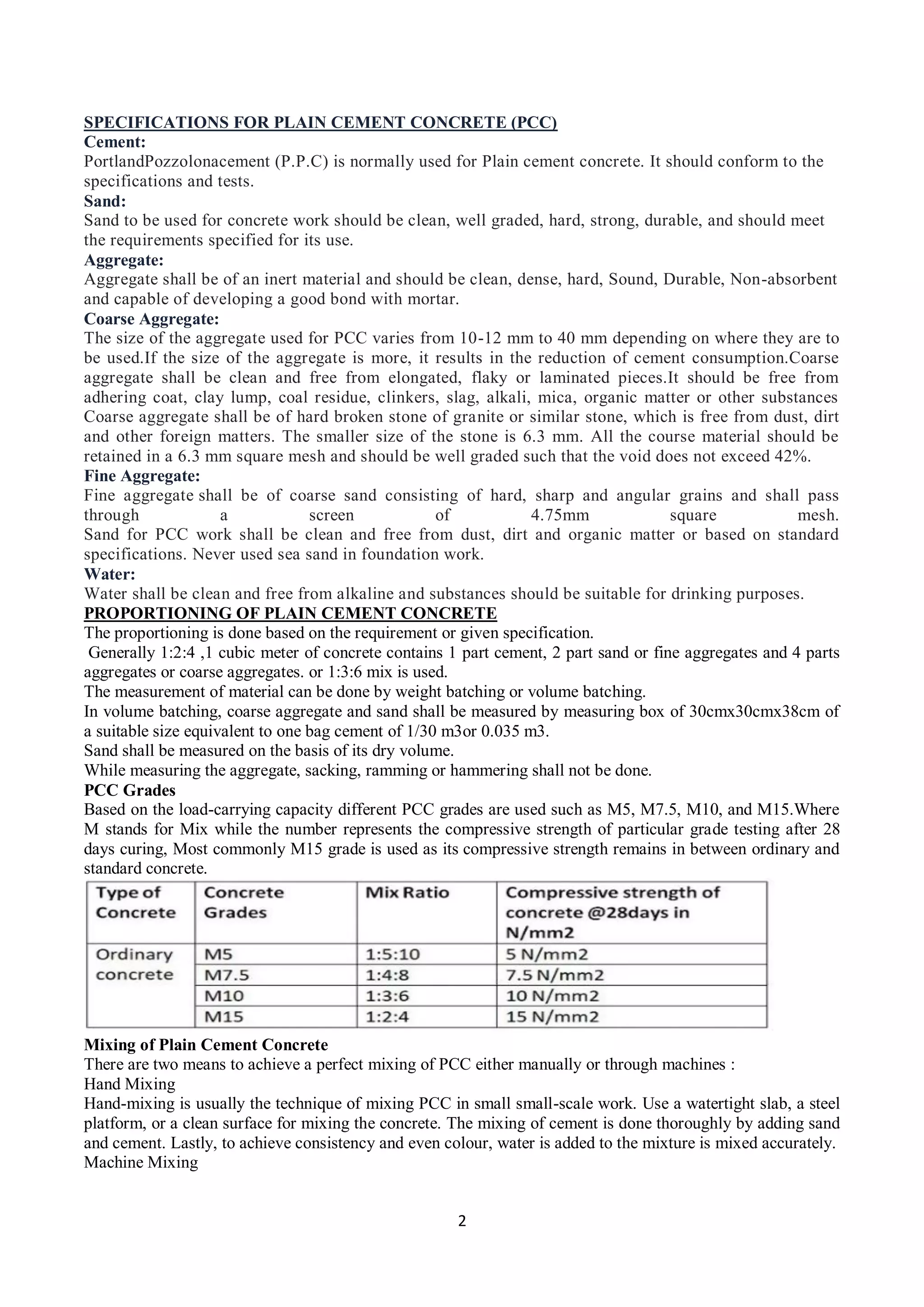
Plain Cement Concrete (PCC) is a construction material that is made by mixing cement, fine aggregates
(sand), and coarse aggregates (gravel or crushed stones) with water.
Plain cement concrete can also be called only “cement concrete (CC)” or “binding concrete”. Some even call
it “Mud Mat”.
A good quality concrete is essentially a heterogeneous mixture of cement, coarse and fine aggregates and
water which consolidates into a hard mass due to chemical action between the cement and water.
Making of concrete is not easy. It has 4/5 main ingredients.
1. Cement
2. Sand
3. Coarse Aggregate
4. Water
5. Admixture
Each of the four constituents has a specific function
1. The coarser aggregate acts as a filler.
2. The fine aggregate fills up the voids between the paste and the coarse aggregate.
3. The cement in conjunction with water acts as a binder.
Materials used for the making of Plain Cement Concrete
Coarse Aggregate
Coarse aggregate used in construction must be a mixture of granite or similar hard broken stone, clear from
foreign matter such as dirt and dust. A 20 mm stone ballast can be used which should be equal or smaller in
size. A 5mm square mesh is to be used to retain any coarse material, which is graded by the standard of 42%,
so it does not exceed the voids.
Fine Aggregate
A screen of 5 mm square mesh is to be used to Fine Aggregate. Ensure that natural sand consisting of pointed,
hard, and angular grains will pass through the screen. Sand quality must be checked and examined for any
dust, dirt, or organic matter while ensuring that sea sand shall not be used.
Cement
The Portland Pozzolana Cement (PCC)is usually used for making the PCC. The examined cement has certain
specifications and encompasses the demanded ultimate strength and has compression strength and expertise.
Water
Administer the quality of water to keep it clean and free of harmful materials such as salts, acids, and alkalis
that may hinder the process. A value of not less than 6 should be indicated in the pH scale for the use of clean
water.
Purpose Of Using PCC
1. To prevent direct contact of reinforcement with soil, because when moisture available in the soil is
absorbed by R.C.C result in causing corrosion of steel reinforcement.
2. PCC provides a leveled base which helps to set out the structure above in an easier way.
3. PCC prevents loss of water from RCC, as the earth is likely to absorb water from the RCC.
2
SPECIFICATIONS FOR PLAIN CEMENT CONCRETE (PCC)
Cement:
PortlandPozzolonacement (P.P.C) is normally used for Plain cement concrete. It should conform to the
specifications and tests.
Sand:
Sand to be used for concrete work should be clean, well graded, hard, strong, durable, and should meet
the requirements specified for its use.
Aggregate:
Aggregate shall be of an inert material and should be clean, dense, hard, Sound, Durable, Non-absorbent
and capable of developing a good bond with mortar.
Coarse Aggregate:
The size of the aggregate used for PCC varies from 10-12 mm to 40 mm depending on where they are to
be used.If the size of the aggregate is more, it results in the reduction of cement consumption.Coarse
aggregate shall be clean and free from elongated, flaky or laminated pieces.It should be free from
adhering coat, clay lump, coal residue, clinkers, slag, alkali, mica, organic matter or other substances
Coarse aggregate shall be of hard broken stone of granite or similar stone, which is free from dust, dirt
and other foreign matters. The smaller size of the stone is 6.3 mm. All the course material should be
retained in a 6.3 mm square mesh and should be well graded such that the void does not exceed 42%.
Fine Aggregate:
Fine aggregate shall be of coarse sand consisting of hard, sharp and angular grains and shall pass
through a screen of 4.75mm square mesh.
Sand for PCC work shall be clean and free from dust, dirt and organic matter or based on standard
specifications. Never used sea sand in foundation work.
Water:
Water shall be clean and free from alkaline and substances should be suitable for drinking purposes.
PROPORTIONING OF PLAIN CEMENT CONCRETE
The proportioning is done based on the requirement or given specification.
Generally 1:2:4 ,1 cubic meter of concrete contains 1 part cement, 2 part sand or fine aggregates and 4 parts
aggregates or coarse aggregates. or 1:3:6 mix is used.
The measurement of material can be done by weight batching or volume batching.
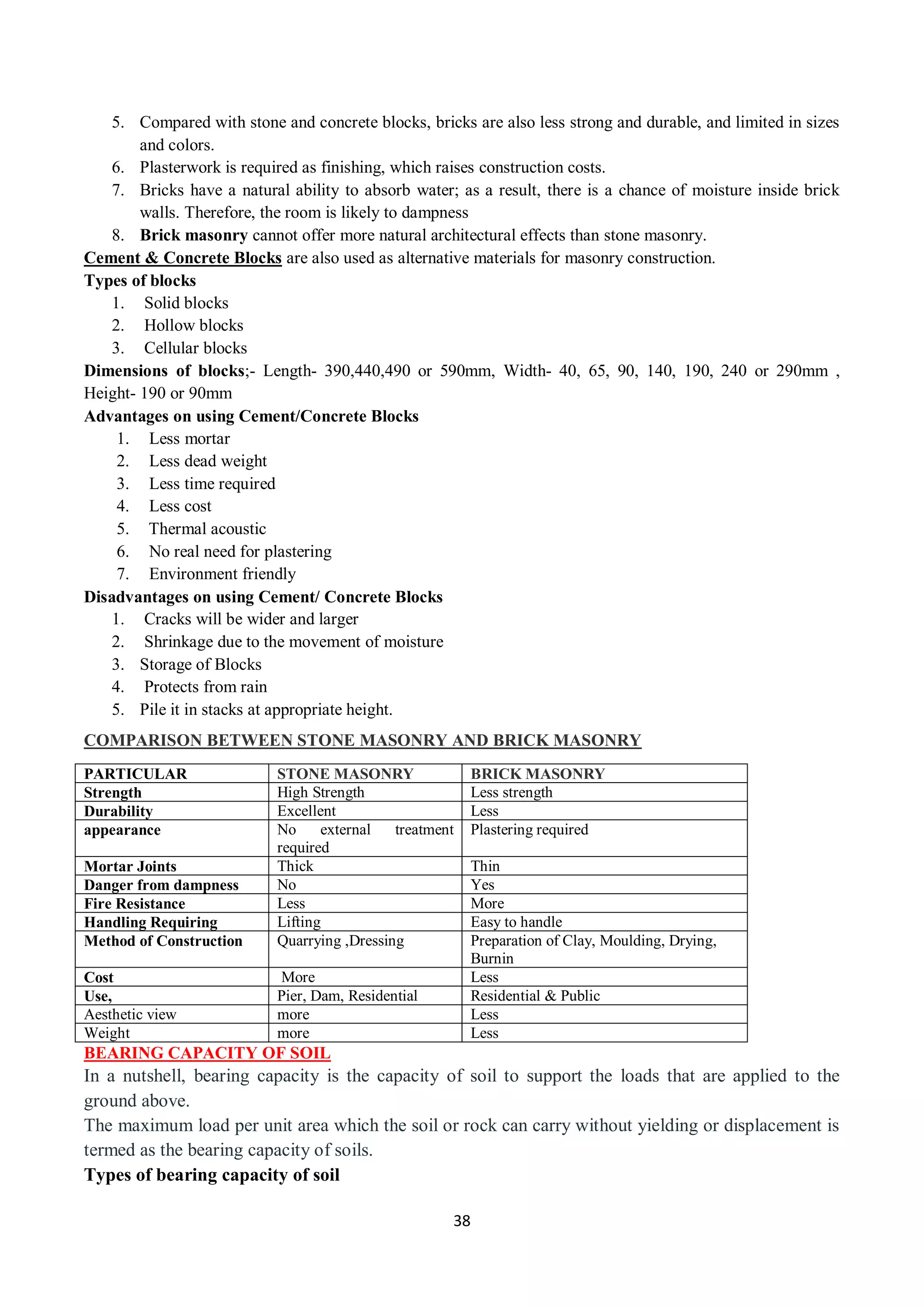
In volume batching, coarse aggregate and sand shall be measured by measuring box of 30cmx30cmx38cm of
a suitable size equivalent to one bag cement of 1/30 m3or 0.035 m3.
Sand shall be measured on the basis of its dry volume.
While measuring the aggregate, sacking, ramming or hammering shall not be done.
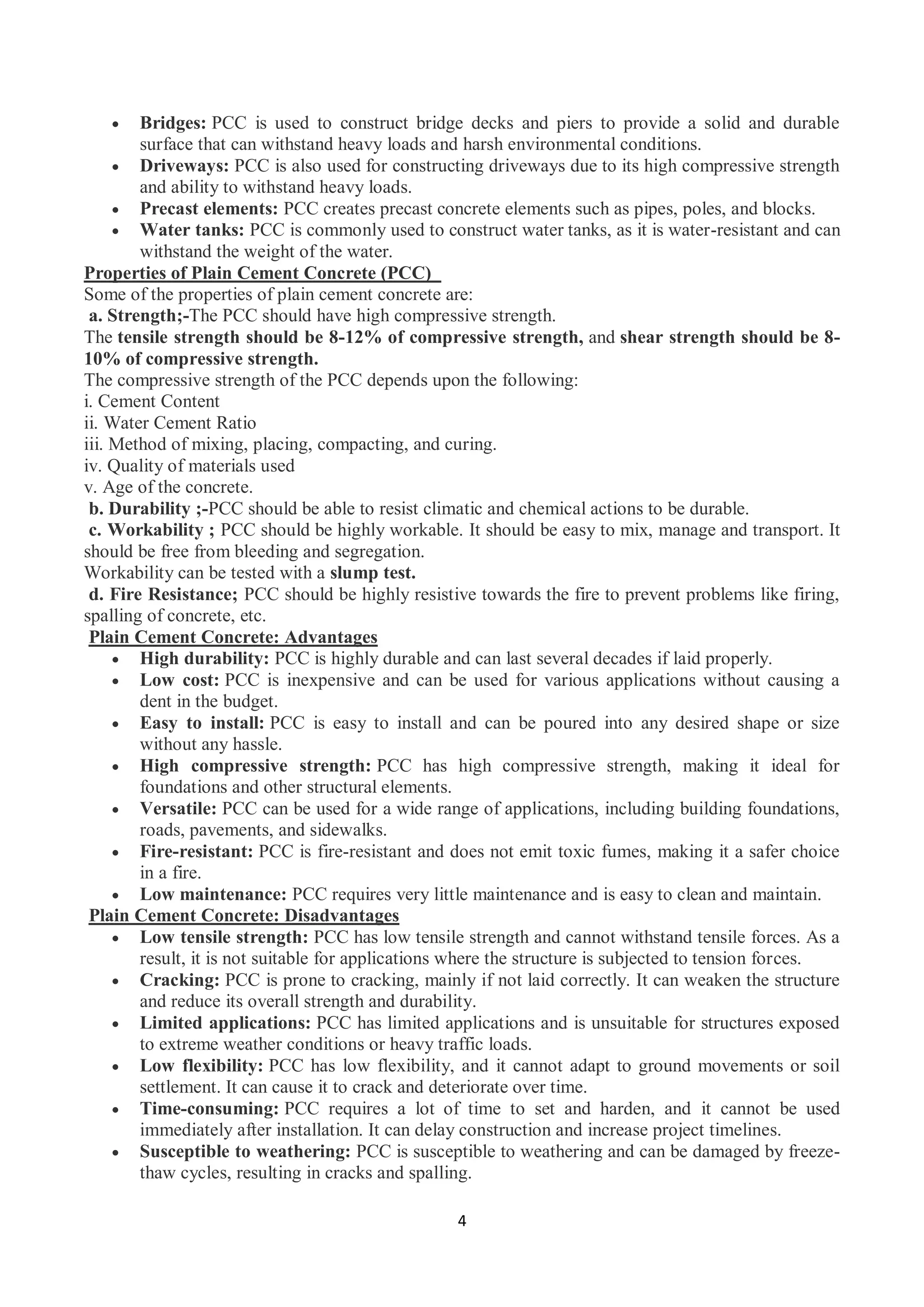
PCC Grades
Based on the load-carrying capacity different PCC grades are used such as M5, M7.5, M10, and M15.Where
M stands for Mix while the number represents the compressive strength of particular grade testing after 28
days curing, Most commonly M15 grade is used as its compressive strength remains in between ordinary and
standard concrete.
Mixing of Plain Cement Concrete
There are two means to achieve a perfect mixing of PCC either manually or through machines :
Hand Mixing
Hand-mixing is usually the technique of mixing PCC in small small-scale work. Use a watertight slab, a steel
platform, or a clean surface for mixing the concrete. The mixing of cement is done thoroughly by adding sand
and cement. Lastly, to achieve consistency and even colour, water is added to the mixture is mixed accurately.
Machine Mixing
3
Hopper is used for placing the cement, fine aggregate, and dry coarse aggregate in the specified measured
quantity.
A mixing drum is to be used to mix the dry materials. The process should be done for a minimum of four
cycles, followed by adding the specific quantity of water steadily while the drum is in action.
To achieve the specific cement-water ratio, water for mixing should be introduced in sufficient quantity before
25% of the mixing time has passed.A plastic mix of uniform colour is to observe the mixing process.
Laying of Plain Cement Concrete
The PCC is laid in layers not more than 150mm thick. Mechanical vibrators are used to thoroughly vibrate the
RCC to obtain dense concrete.
Perform hand compaction to ensure that the concrete is evenly pasted in the corners of the framework. A
wooden tampering rod would help achieve uniformity and assure all the corners are completely walked.
Administer the hand compaction and make sure it is completed within the phase where the initial selling
starts. Usually, this is within 30 minutes of adding water to the dry mixture.
Curing of Plain Cement Concrete
It should be ensured that in the case of rainy weather the freshly laid concrete should be protected by using a
cover. After about one to two hours, the concrete begins to harden. Cover the concrete with sand, gunny bags,
or quick-drying materials.
The surface is laid for over 24 hours is to be cured by submerging the surface with water of about 25mm depth
or covering the surface with weight absorbent materials.
A period of 14 days is the minimum time for curing to be performed
USE OF PCC:-
1. PCC is laid on the soil surface and acts as a shield for the reinforced concrete against direct contact
with soil and water
2. As bed concrete below the wall footings, column footings and on walls below beams.
3. As sill concrete to get a hard and even surface at window and ventilator sills.
4. As to coping concrete over the parapet and compound walls.
5. For flagging the area around the buildings.
6. To make pavements.
7. To make tennis courts, basketball courts etc.
8. Plinth Protection
9. Storm/ Sewer at drains, small retaining walls.
10. Foundation work and flooring of buildings.
11. rigid pavement construction
12. small-scale canal construction,
13. stone masonry works
14. Retaining walls, storm drains.
Plain Cement Concrete: Uses
PCC, or Plain Cement Concrete, is a construction material used in engineering for various
applications. Some of its common uses include:
 Foundation: PCC is used as a base material for the foundation of buildings and structures. It
provides a strong, stable, level surface for constructing the superstructure.
 Pavement: PCC is commonly used in the construction of pavements, such as sidewalks,
driveways, and parking lots. It provides a durable, long-lasting surface that can withstand
heavy loads and traffic.
 Retaining walls: PCC is used to construct retaining walls to prevent soil erosion and stabilise
the soil structure.
 Floor slabs: PCC is used in the construction of floor slabs, which provide a smooth and level
surface for installing flooring materials.
 Culverts: PCC is used in the construction of culverts, which are structures that allow water to
flow under roads, railways, or other obstructions.
4
 Bridges: PCC is used to construct bridge decks and piers to provide a solid and durable
surface that can withstand heavy loads and harsh environmental conditions.
 Driveways: PCC is also used for constructing driveways due to its high compressive strength
and ability to withstand heavy loads.
 Precast elements: PCC creates precast concrete elements such as pipes, poles, and blocks.
 Water tanks: PCC is commonly used to construct water tanks, as it is water-resistant and can
withstand the weight of the water.
Properties of Plain Cement Concrete (PCC)
Some of the properties of plain cement concrete are:
a. Strength;-The PCC should have high compressive strength.
The tensile strength should be 8-12% of compressive strength, and shear strength should be 8-
10% of compressive strength.
The compressive strength of the PCC depends upon the following:
i. Cement Content
ii. Water Cement Ratio
iii. Method of mixing, placing, compacting, and curing.
iv. Quality of materials used
v. Age of the concrete.
b. Durability ;-PCC should be able to resist climatic and chemical actions to be durable.
c. Workability ; PCC should be highly workable. It should be easy to mix, manage and transport. It
should be free from bleeding and segregation.
Workability can be tested with a slump test.
d. Fire Resistance; PCC should be highly resistive towards the fire to prevent problems like firing,
spalling of concrete, etc.
Plain Cement Concrete: Advantages
 High durability: PCC is highly durable and can last several decades if laid properly.
 Low cost: PCC is inexpensive and can be used for various applications without causing a
dent in the budget.
 Easy to install: PCC is easy to install and can be poured into any desired shape or size
without any hassle.
 High compressive strength: PCC has high compressive strength, making it ideal for
foundations and other structural elements.
 Versatile: PCC can be used for a wide range of applications, including building foundations,
roads, pavements, and sidewalks.
 Fire-resistant: PCC is fire-resistant and does not emit toxic fumes, making it a safer choice
in a fire.
 Low maintenance: PCC requires very little maintenance and is easy to clean and maintain.
Plain Cement Concrete: Disadvantages
 Low tensile strength: PCC has low tensile strength and cannot withstand tensile forces. As a
result, it is not suitable for applications where the structure is subjected to tension forces.
 Cracking: PCC is prone to cracking, mainly if not laid correctly. It can weaken the structure
and reduce its overall strength and durability.
 Limited applications: PCC has limited applications and is unsuitable for structures exposed
to extreme weather conditions or heavy traffic loads.
 Low flexibility: PCC has low flexibility, and it cannot adapt to ground movements or soil
settlement. It can cause it to crack and deteriorate over time.
 Time-consuming: PCC requires a lot of time to set and harden, and it cannot be used
immediately after installation. It can delay construction and increase project timelines.
 Susceptible to weathering: PCC is susceptible to weathering and can be damaged by freeze-
thaw cycles, resulting in cracks and spalling.
5
REINFORCED CEMENT CONCRETE (RCC)
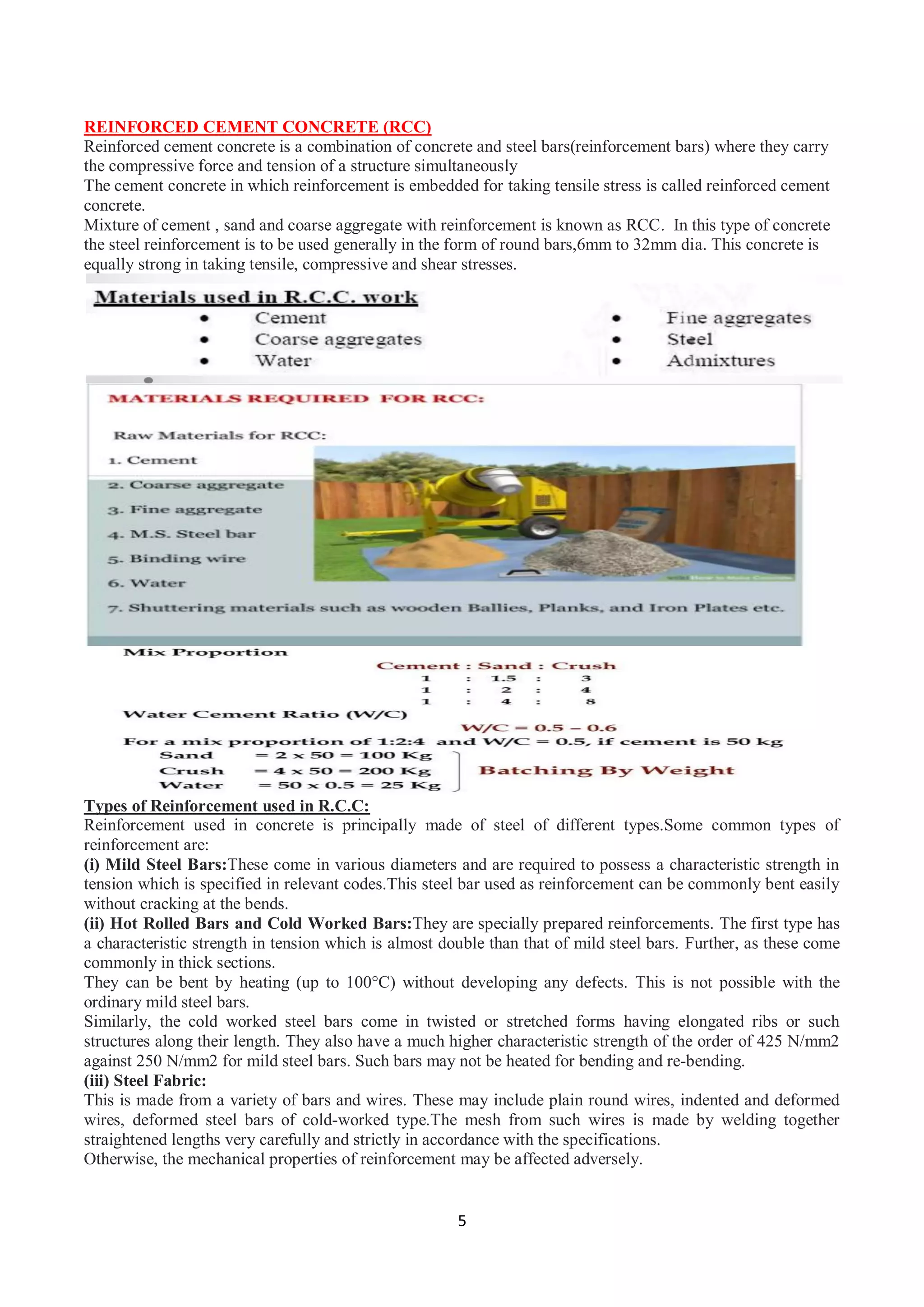
Reinforced cement concrete is a combination of concrete and steel bars(reinforcement bars) where they carry
the compressive force and tension of a structure simultaneously
The cement concrete in which reinforcement is embedded for taking tensile stress is called reinforced cement
concrete.
Mixture of cement , sand and coarse aggregate with reinforcement is known as RCC. In this type of concrete
the steel reinforcement is to be used generally in the form of round bars,6mm to 32mm dia. This concrete is
equally strong in taking tensile, compressive and shear stresses.
Types of Reinforcement used in R.C.C:
Reinforcement used in concrete is principally made of steel of different types.Some common types of
reinforcement are:
(i) Mild Steel Bars:These come in various diameters and are required to possess a characteristic strength in
tension which is specified in relevant codes.This steel bar used as reinforcement can be commonly bent easily
without cracking at the bends.
(ii) Hot Rolled Bars and Cold Worked Bars:They are specially prepared reinforcements. The first type has
a characteristic strength in tension which is almost double than that of mild steel bars. Further, as these come
commonly in thick sections.
They can be bent by heating (up to 100°C) without developing any defects. This is not possible with the
ordinary mild steel bars.
Similarly, the cold worked steel bars come in twisted or stretched forms having elongated ribs or such
structures along their length. They also have a much higher characteristic strength of the order of 425 N/mm2
against 250 N/mm2 for mild steel bars. Such bars may not be heated for bending and re-bending.
(iii) Steel Fabric:
This is made from a variety of bars and wires. These may include plain round wires, indented and deformed
wires, deformed steel bars of cold-worked type.The mesh from such wires is made by welding together
straightened lengths very carefully and strictly in accordance with the specifications.
Otherwise, the mechanical properties of reinforcement may be affected adversely.
6
PRODUCTION PROCESS OF CONCRETE
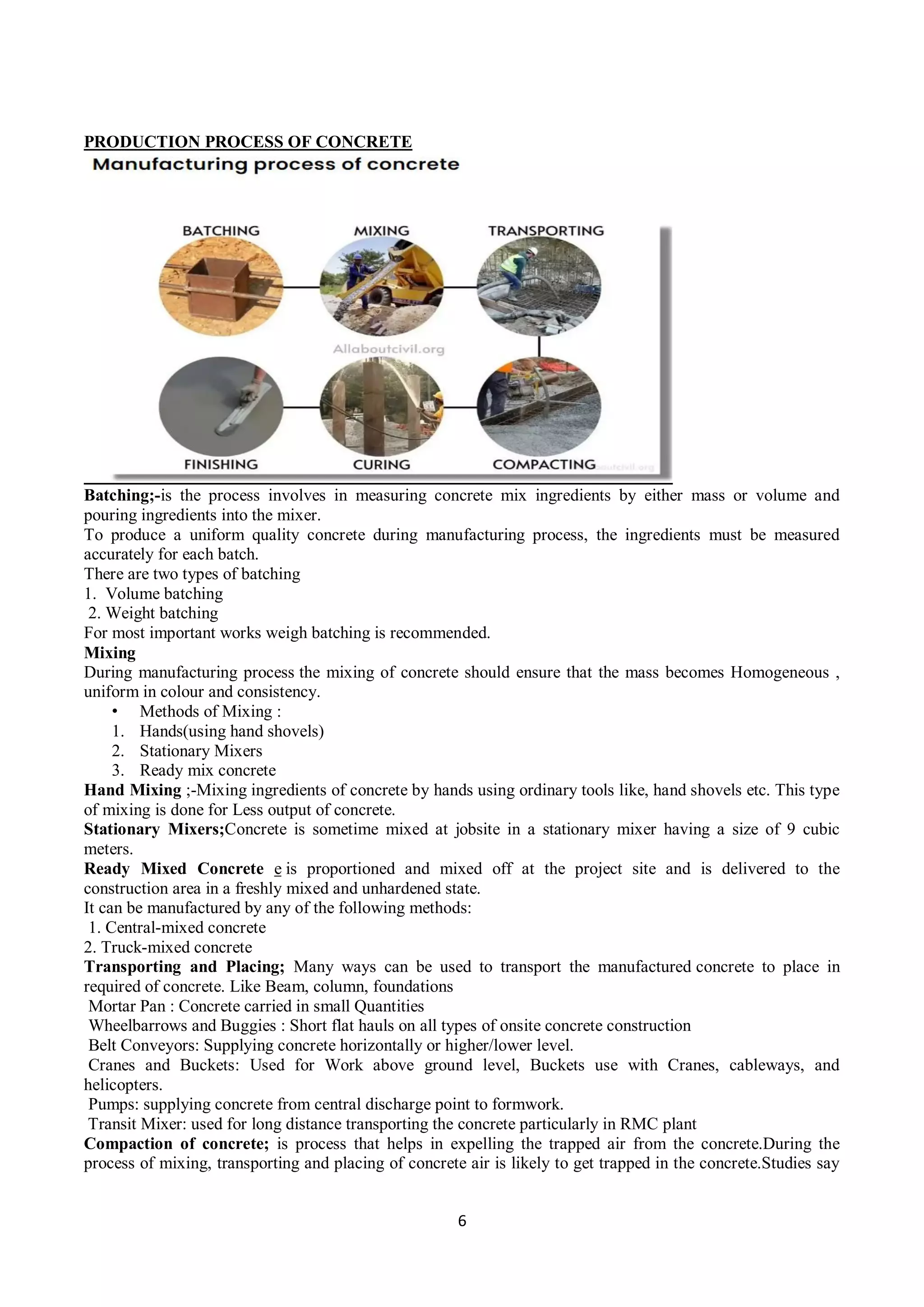
Batching;-is the process involves in measuring concrete mix ingredients by either mass or volume and
pouring ingredients into the mixer.
To produce a uniform quality concrete during manufacturing process, the ingredients must be measured
accurately for each batch.
There are two types of batching
1. Volume batching
2. Weight batching
For most important works weigh batching is recommended.
Mixing
During manufacturing process the mixing of concrete should ensure that the mass becomes Homogeneous ,
uniform in colour and consistency.
• Methods of Mixing :
1. Hands(using hand shovels)
2. Stationary Mixers
3. Ready mix concrete
Hand Mixing ;-Mixing ingredients of concrete by hands using ordinary tools like, hand shovels etc. This type
of mixing is done for Less output of concrete.
Stationary Mixers;Concrete is sometime mixed at jobsite in a stationary mixer having a size of 9 cubic
meters.
Ready Mixed Concrete e is proportioned and mixed off at the project site and is delivered to the
construction area in a freshly mixed and unhardened state.
It can be manufactured by any of the following methods:
1. Central-mixed concrete
2. Truck-mixed concrete
Transporting and Placing; Many ways can be used to transport the manufactured concrete to place in
required of concrete. Like Beam, column, foundations
Mortar Pan : Concrete carried in small Quantities
Wheelbarrows and Buggies : Short flat hauls on all types of onsite concrete construction
Belt Conveyors: Supplying concrete horizontally or higher/lower level.
Cranes and Buckets: Used for Work above ground level, Buckets use with Cranes, cableways, and
helicopters.
Pumps: supplying concrete from central discharge point to formwork.
Transit Mixer: used for long distance transporting the concrete particularly in RMC plant
Compaction of concrete; is process that helps in expelling the trapped air from the concrete.During the
process of mixing, transporting and placing of concrete air is likely to get trapped in the concrete.Studies say
7
that 1% air in the concrete can approximately reduces the strength of concrete by 6%. If air is not expelled
from concrete, it will result in forming honeycombs and reduced strength.
Different Methods of Concrete Compaction
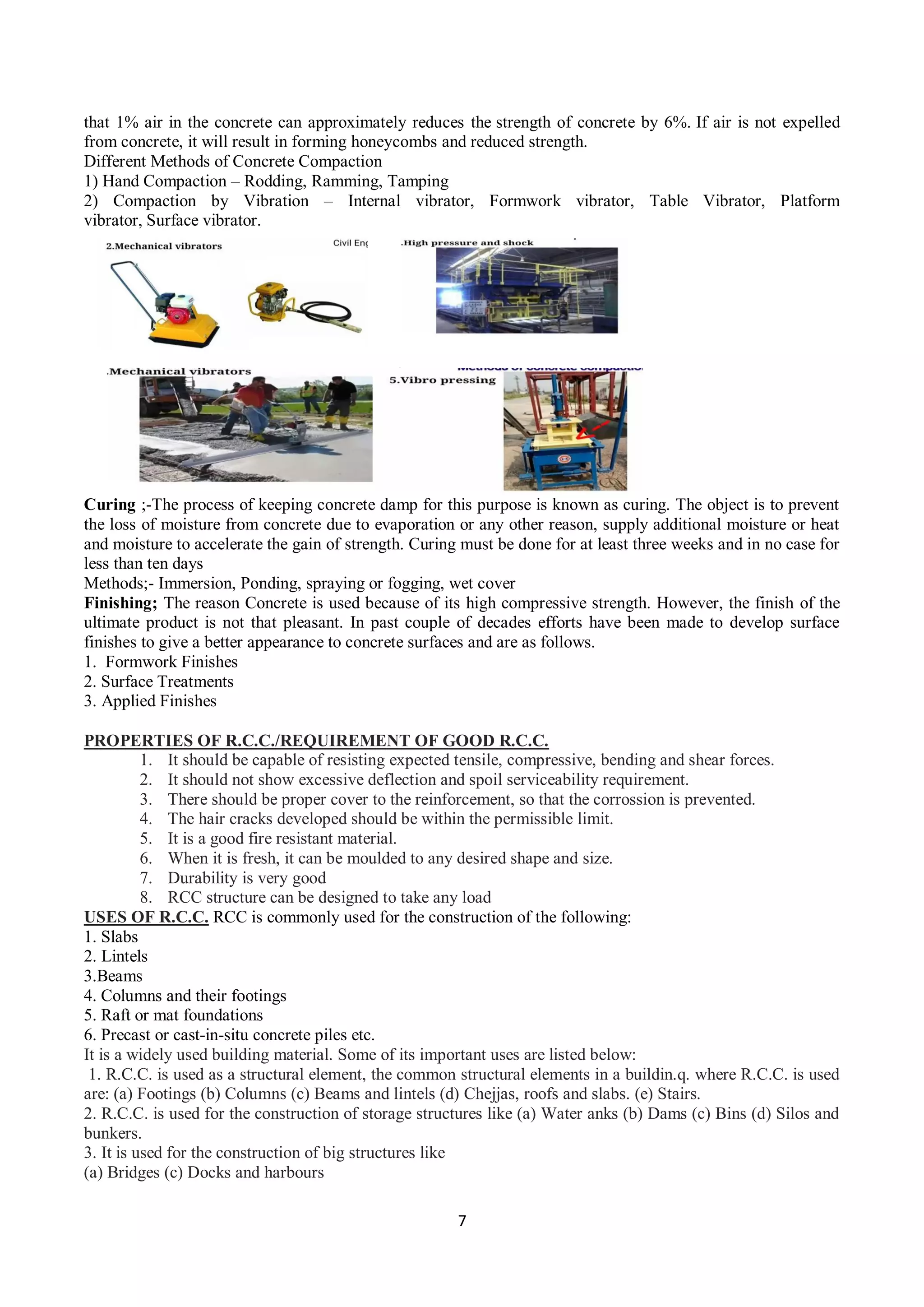
1) Hand Compaction – Rodding, Ramming, Tamping
2) Compaction by Vibration – Internal vibrator, Formwork vibrator, Table Vibrator, Platform
vibrator, Surface vibrator.
Curing ;-The process of keeping concrete damp for this purpose is known as curing. The object is to prevent
the loss of moisture from concrete due to evaporation or any other reason, supply additional moisture or heat
and moisture to accelerate the gain of strength. Curing must be done for at least three weeks and in no case for
less than ten days
Methods;- Immersion, Ponding, spraying or fogging, wet cover
Finishing; The reason Concrete is used because of its high compressive strength. However, the finish of the
ultimate product is not that pleasant. In past couple of decades efforts have been made to develop surface
finishes to give a better appearance to concrete surfaces and are as follows.
1. Formwork Finishes
2. Surface Treatments
3. Applied Finishes
PROPERTIES OF R.C.C./REQUIREMENT OF GOOD R.C.C.
1. It should be capable of resisting expected tensile, compressive, bending and shear forces.
2. It should not show excessive deflection and spoil serviceability requirement.
3. There should be proper cover to the reinforcement, so that the corrossion is prevented.
4. The hair cracks developed should be within the permissible limit.
5. It is a good fire resistant material.
6. When it is fresh, it can be moulded to any desired shape and size.
7. Durability is very good
8. RCC structure can be designed to take any load
USES OF R.C.C. RCC is commonly used for the construction of the following:
1. Slabs
2. Lintels
3.Beams
4. Columns and their footings
5. Raft or mat foundations
6. Precast or cast-in-situ concrete piles etc.
It is a widely used building material. Some of its important uses are listed below:
1. R.C.C. is used as a structural element, the common structural elements in a buildin.q. where R.C.C. is used
are: (a) Footings (b) Columns (c) Beams and lintels (d) Chejjas, roofs and slabs. (e) Stairs.
2. R.C.C. is used for the construction of storage structures like (a) Water anks (b) Dams (c) Bins (d) Silos and
bunkers.
3. It is used for the construction of big structures like
(a) Bridges (c) Docks and harbours
8
4. It is used for pre-casting (a) Railway sleepers
(b) Retaining walls (d) Under water structures.
(b) Electric poles
5. R.C.C. is used for constructing tall structures like
(a) Multistorey buildings (c) Towers. 6. It is used for paving (a) Roads
(b) Chimneys
(b) Airports.
7. R.C.C. is used in building atomic plants to prevent danger of radiation. For this purpose R.C.C. walls built
are 1.5 m to 2.0 m thick.
ADVANTAGES OF REINFORCED CEMENT CONCRETE:
1. It has considerable compressive strength and good tensile strenth
2. Casted into any shape: To caste concrete into the desired shape, it is important to use fresh concrete
which is in the fluid form.
3. Resistant to fire and weather: With proper cover RCC can withstand fire for three to four hours.
With proper quality control and durability considerations RCC will be able to manage through every
kind of weather.
4. Maintenance: Concrete structures requires low maintenance after completion of work as compared to
structures made of steel and timber.
5. Availability: Since steel and concrete are common materials for construction, they are easily
available and can be used for the preparation of reinforced cement concrete.
6. Economical: Compared to other material such as steel structures it is an economic option.
7. Rigidity: As Reinforced concrete are stiff; they provide good rigidity.
8. Versatility/ durability
9. A lower grade of skilled labor is required
10. It can be produced easily at the construction site.
11. Maintenance cost of the reinforced concrete structure is almost ignorable.
DISADVANTAGES OF REINFORCED CEMENT CONCRETE(RCC)
1. construction time
2. Concrete Quality Control
3. Cracking of concrete
4. The tensile strength of reinforced concrete is about one-tenth of its compressive strength.
5. The main steps of using reinforced concrete are mixing, casting, and curing. All of this affects the
final strength.
6. The cost of the forms used for casting RC is relatively higher.
7. Shrinkage causes crack development and strength loss
8. Sustained loads develop creep in structures.
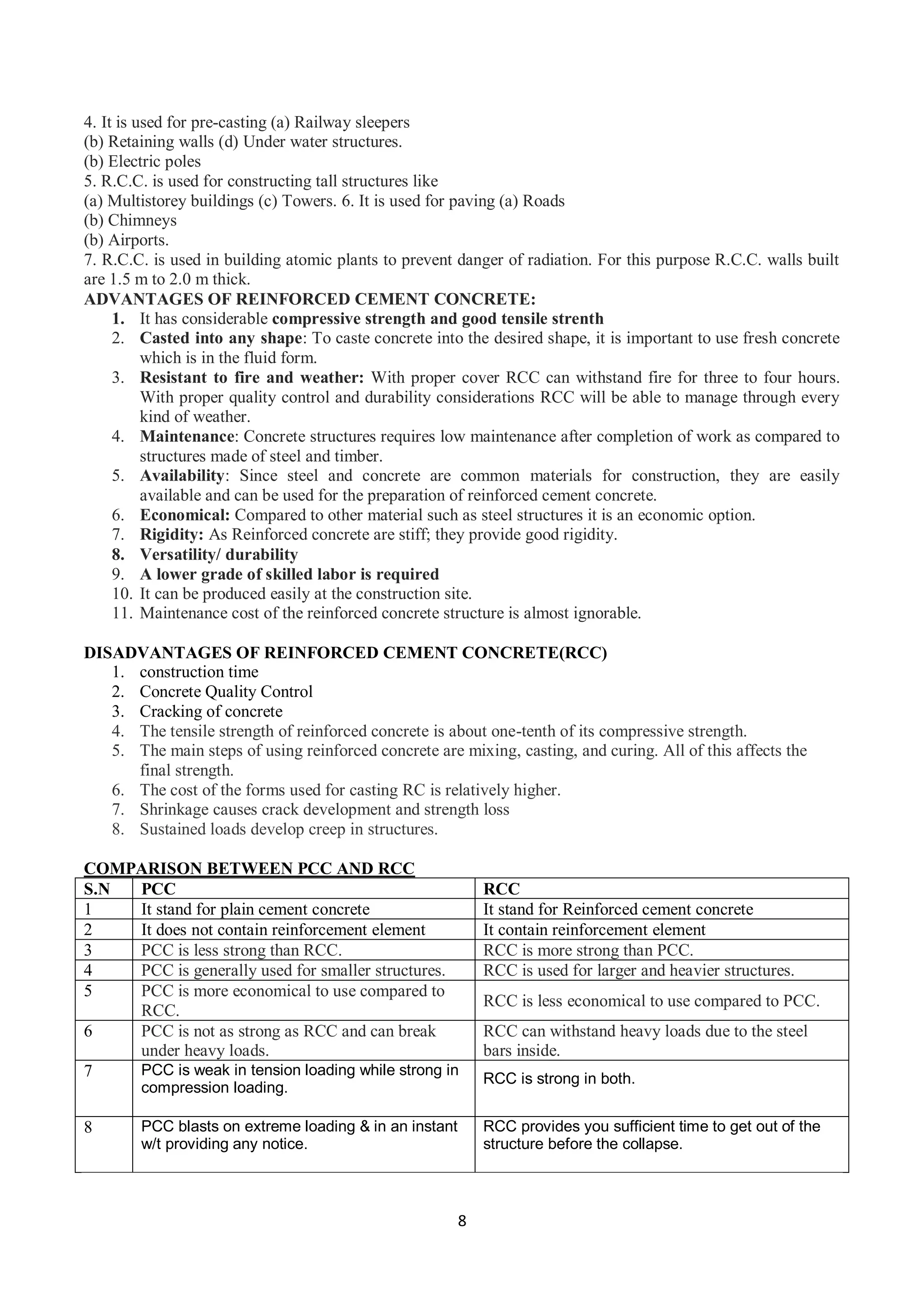
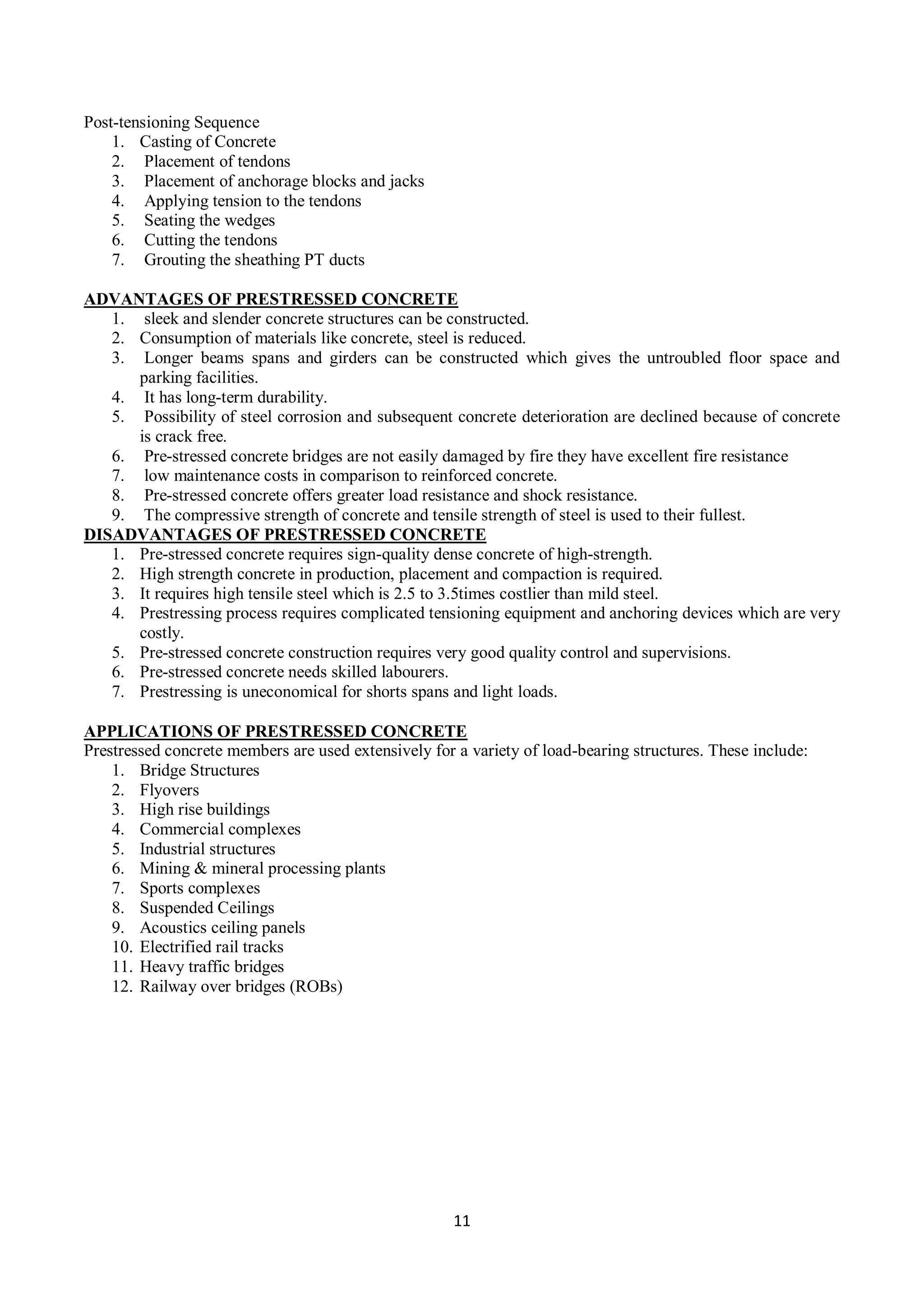
COMPARISON BETWEEN PCC AND RCC
S.N PCC RCC
1 It stand for plain cement concrete It stand for Reinforced cement concrete
2 It does not contain reinforcement element It contain reinforcement element
3 PCC is less strong than RCC. RCC is more strong than PCC.
4 PCC is generally used for smaller structures. RCC is used for larger and heavier structures.
5 PCC is more economical to use compared to
RCC.
RCC is less economical to use compared to PCC.
6 PCC is not as strong as RCC and can break
under heavy loads.
RCC can withstand heavy loads due to the steel
bars inside.
7 PCC is weak in tension loading while strong in
compression loading.
RCC is strong in both.
8 PCC blasts on extreme loading & in an instant
w/t providing any notice.
RCC provides you sufficient time to get out of the
structure before the collapse.
9
PRESTRESSED CONCRETE
Pre-stressing means tensioning the reinforcement. Concrete can withstand a great amount of compressive
stress but it has a very low tensile strength. Because of low tensile strength, concrete gets cracks when
subjected to maximum load.
As the name indicates prestressed concrete is a form of concrete in which internal stresses are introduced
before its application so that it can counteract the tensile stresses produced in concrete due to external load.
Why prestressed concrete is used?
Before any concrete structure fails, cracks are formed in the concrete and then the structure collapses and
cracks are formed due to deflection or moment in structure. When water comes in contact with these cracks
the steel gets corroded.
To avoid these cracks, to increase the strength of member and to reduce the deflection prestressing is done.
Principal of Prestressing :-
Where the load causes tensile stresses that portion of concrete will be put under compression by means of
prestressing so that the load causing tension will first have to cancel the compression induced by Prestressing
Materials used in Prestressed concrete
Steel:
Ordinary mild steel and deformed bars are used in RCC are not used in PSC (prestressed concrete) because
their yield strength is not very high. In the prestressed concrete, loss of prestress (about 20 %) occurs due to
many factors. If mild steel bars or HYSD bars are used then very little prestress will be left after the losses and
will be of no use. Therefore, high tensile strength steel is used for prestressing. In addition to the high
strength, the steel used in prestressing must have a higher ultimate elongation. Various forms of steel used for
prestressing as follows:
Tendons:
Tendons are high strength tensile wires available in various diameters from 1.5 mm to 8 mm. the following
table gives the ultimate tensile strength of steel wires used for prestressing.
Diameter of wire (mm) Ultimate tensile strength (MPa)
1.5 2350
2.0 2200
3.0 1900
4.0 1750
5.0 1600
7.0 1500
8.0 1500
Wires strands or cables:
A strand or cable is made of a bundle of wires spun together. The overall diameter of a cable or strand is from
7 to 17 mm. They are used for post-tensioning systems.
Bars:
High tensile steel bars of diameter 10 mm or more are also used in prestressing.
Concrete:
Since high tensile steel is used in prestressed concrete, the concrete used should also be of good quality and
high strength. Therefore, the code recommends a minimum mix of M 40 for pre-tensioned system and M 30
for post tensioned system. These mixes have high strength and a high value of modulus of elasticity of
concrete which results in less deflection.
The concrete used in prestressed concrete should be well compacted. High strength concrete is used in
prestressed concrete for following reasons:
 Use of high strength concrete results in smaller sections.
 High strength concrete offers high resistance in tension, shear, bond and bearing.
 Less loss of prestress occurs with high strength concrete.
10
When repeated loading tests are performed on the different prestressed concrete beams with the varying
proportions of steel contained in grouted post tensioned cables. Similar tests when performed on the
reinforced concrete beams which are reinforced with plain steel bars or cold worked deformed mild steel bars.
Under the repetitions of working load it is observed that the deformations on prestressed concrete beams are
slightly increased. Under the similar loads deformations were recorded and it was found that the cracks
developed in the reinforced concrete beams.
METHOD OF PRESTRESSING
Pre-tensioning
• Post-tensioning
Pre-tensioning
In the pre-tensioning process, the steel is stretched before the concrete is placed. High tensile steel (ultimate
strength of 2100 N/mm2) wires or tendons are used between two ends and stretched to 70 to 80% of their
ultimate strength.
After that, the concrete is poured around the tendons and allowed to cure. Once the concrete gains desired
strength, the stretching forces are released.
When highly stressed steel attempts to contract, the concrete gets compressed then the concrete will be in a
permanent state of maintaining pre-stressed strength.
In place of tendons wire strands or cables, high tensile steel bars can also be used for pre-tensioning. examples
of pre-tensioning concrete precast products are foundation pile railway, sleepers. electrical or lighting Pols,
floor, slab beam, pipe partition wall etc.
Pretensioning Sequence :-
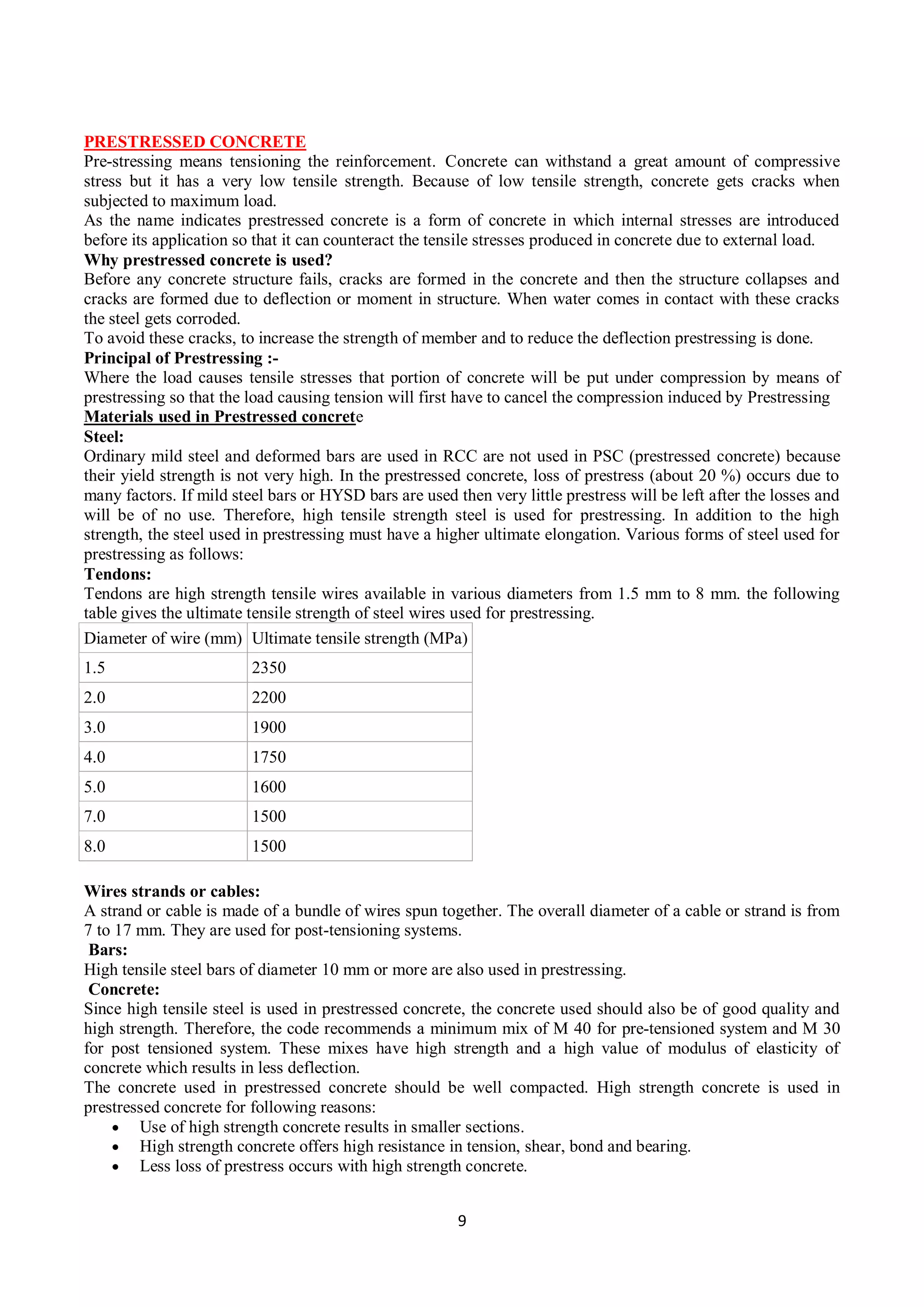
1. Anchoring the tendons against the end abutments
2. Placing of jacks
3. Applying tension to the tendons
4. Casting of concrete
5. Cutting of tendons
Post-tensioning
In post-tensioning the steel is stretched after the concrete hardens .unlike pre-tensioning work post-tensioning
is usually carried out at the project site. In the case of post-tensioning, a duct is placed into the concrete
structure.
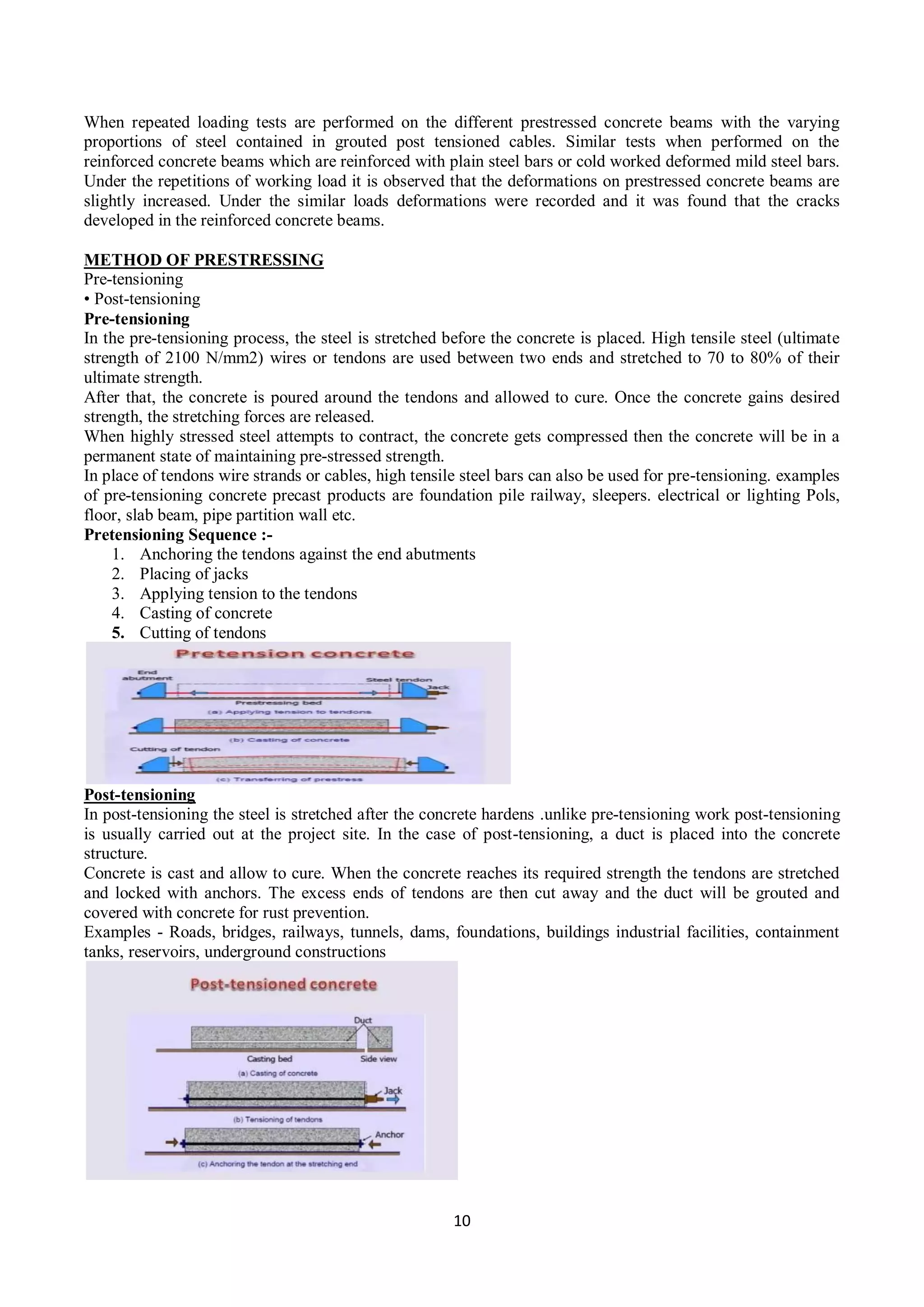
Concrete is cast and allow to cure. When the concrete reaches its required strength the tendons are stretched
and locked with anchors. The excess ends of tendons are then cut away and the duct will be grouted and
covered with concrete for rust prevention.
Examples - Roads, bridges, railways, tunnels, dams, foundations, buildings industrial facilities, containment
tanks, reservoirs, underground constructions
11
Post-tensioning Sequence
1. Casting of Concrete
2. Placement of tendons
3. Placement of anchorage blocks and jacks
4. Applying tension to the tendons
5. Seating the wedges
6. Cutting the tendons
7. Grouting the sheathing PT ducts
ADVANTAGES OF PRESTRESSED CONCRETE
1. sleek and slender concrete structures can be constructed.
2. Consumption of materials like concrete, steel is reduced.
3. Longer beams spans and girders can be constructed which gives the untroubled floor space and
parking facilities.
4. It has long-term durability.
5. Possibility of steel corrosion and subsequent concrete deterioration are declined because of concrete
is crack free.
6. Pre-stressed concrete bridges are not easily damaged by fire they have excellent fire resistance
7. low maintenance costs in comparison to reinforced concrete.
8. Pre-stressed concrete offers greater load resistance and shock resistance.
9. The compressive strength of concrete and tensile strength of steel is used to their fullest.
DISADVANTAGES OF PRESTRESSED CONCRETE
1. Pre-stressed concrete requires sign-quality dense concrete of high-strength.
2. High strength concrete in production, placement and compaction is required.
3. It requires high tensile steel which is 2.5 to 3.5times costlier than mild steel.
4. Prestressing process requires complicated tensioning equipment and anchoring devices which are very
costly.
5. Pre-stressed concrete construction requires very good quality control and supervisions.
6. Pre-stressed concrete needs skilled labourers.
7. Prestressing is uneconomical for shorts spans and light loads.
APPLICATIONS OF PRESTRESSED CONCRETE
Prestressed concrete members are used extensively for a variety of load-bearing structures. These include:
1. Bridge Structures
2. Flyovers
3. High rise buildings
4. Commercial complexes
5. Industrial structures
6. Mining & mineral processing plants
7. Sports complexes
8. Suspended Ceilings
9. Acoustics ceiling panels
10. Electrified rail tracks
11. Heavy traffic bridges
12. Railway over bridges (ROBs)
12
COMPONENTS OF BUILDING
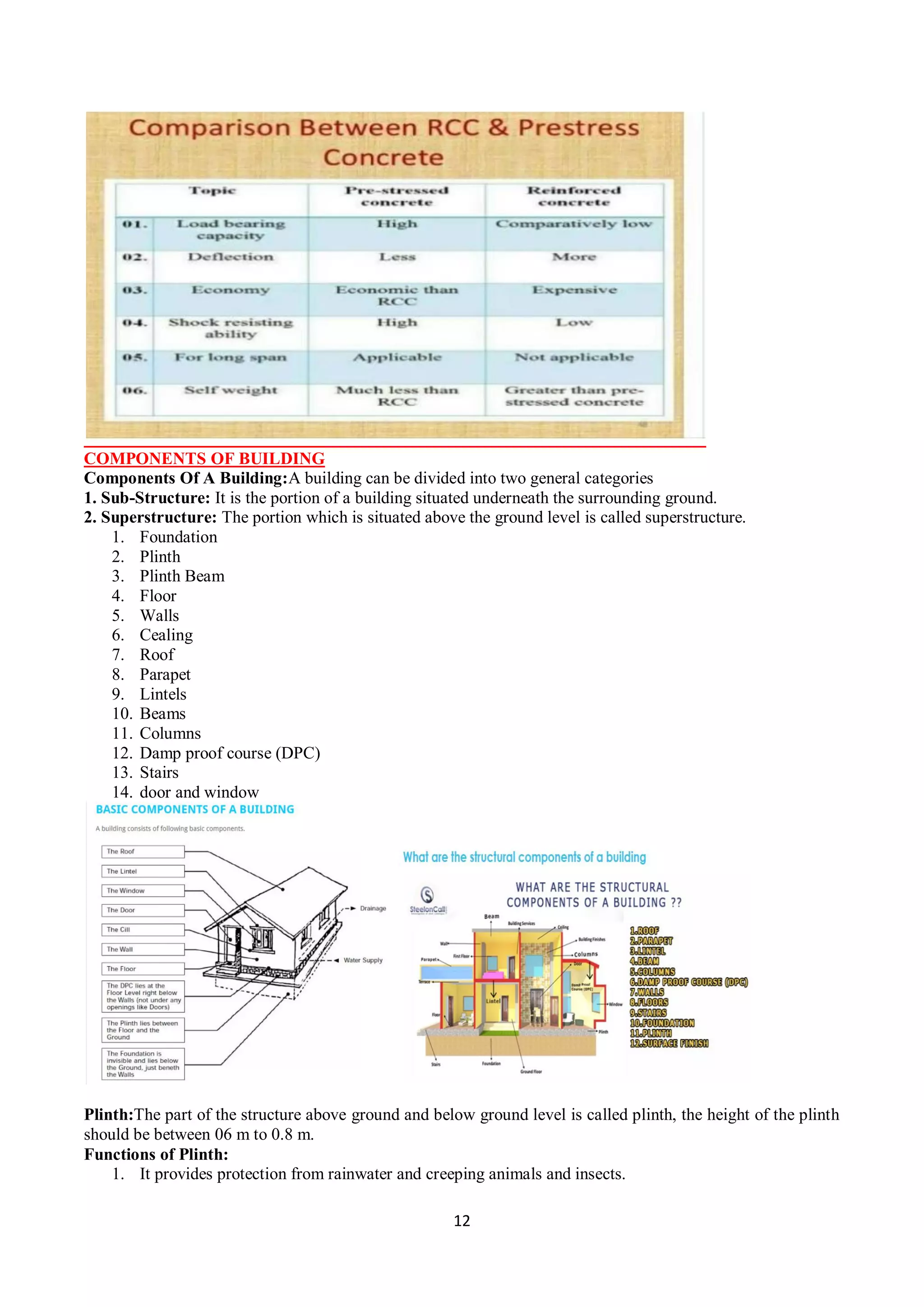
Components Of A Building:A building can be divided into two general categories
1. Sub-Structure: It is the portion of a building situated underneath the surrounding ground.
2. Superstructure: The portion which is situated above the ground level is called superstructure.
1. Foundation
2. Plinth
3. Plinth Beam
4. Floor
5. Walls
6. Cealing
7. Roof
8. Parapet
9. Lintels
10. Beams
11. Columns
12. Damp proof course (DPC)
13. Stairs
14. door and window
Plinth:The part of the structure above ground and below ground level is called plinth, the height of the plinth
should be between 06 m to 0.8 m.
Functions of Plinth:
1. It provides protection from rainwater and creeping animals and insects.
13
2. It also provides space for courses that ultimately support flooring tiles.
2. Floor:The floor is a horizontal surface for the use of occupants in each room.The ground floor is usually
above the plinth, while a floor slab serves as a floor for the upper floor covered by a variety of floor materials
such as mosaic tile, granite, marble, quota, etc.
Functions of Floor:
1. In general, the floor should provide good resistance to wear and tear caused by its daily use.
2. It should be easy to wash and clean, fire-resistant, easy to repair.
The various types of floors commonly used for ground floor in India are murum, clay floors, brick floors, tiled
floors, timber floors, etc.
3. Wall as Building Components:
Walls are vertical building components that can support the roof or act as a partition wall or compound wall.
The various forms of masonry have walls such as brick masonry, stone masonry, composite masonry, hollow
cement concrete block masonry, cement concrete block masonry, etc.
Functions of Wall:
1. The walls form the outer boundary of the building that separates the rooms from each other.
2. It supports roofs in load-bearing structures.
They serves as the partition walls in the framed structure because the partition walls do not carry any weight
of the structure.
4. Column:
Column is the vertical member or component of a framed structure made of reinforced cement concrete.
Functions of column:
Column supports flooring at various levels in a framed structure or RCC as it takes a brief weight of the
structure.
In a load-bearing structure, the column is made of bricks or stones.
5. Beam:
Beam is the horizontal components of the building structure made of steel, reinforced cement concrete, wood,
etc.
Functions of beam:
1. It supports the transverse load of the building structure.
2. It carries the tensile weight of a structure.
6. Roof:A roof is building components cover at the top of a building designed to protect from elements such
as rain, sun, and wind.
It is designed and constructed to meet the requirements of different climates and available materials.
Functions of roof:
The basic function is to provide protection from various elements for people and their property.
It also provides insulation, retains heat in winter, or cools the air in summer.
7. Doors and windows:Doors: These are openings that allow entry into the building and circulation through
various rooms.
Windows: These are usually built into the outer wall providing air and light inside the rooms.
Functions of Doors:
The doors are used for the free movement of people inside and outside the house. They should be minimal for
each room because more doors cause cause-obstruction. Exterior doors are a means of separating the home
from the surroundings in terms of privacy and security. The door should be located near the end of the room,
especially in residential buildings.
Functions of Windows:Windows are building components provided for the entry of light into the building for
the free circulation of air.
8. Lintel:The lintel is a small horizontal building component acts as a beam always provided over openings
such as door, window or any other. It is made of R.C.C., timber, stone slabs or precast concrete, nowadays
commonly made in R.C.C. in framed structure.
Functions of lintel:
It supports part of the wall at the opening.
9. Sill as building components: The lower structure of a window or door opening is called a sill. The sills are
modern building components constructed in stone slabs such as kota, kadapa or ceramic tiles. The portion of
the cob is sometimes well kept flat.
14
Functions of Sill:
This provides a suitable finish for the window opening.
It provides protection to the wall below the window.
It also supports the vertical members of the opening.
Also, drains rainwater from the face of the wall immediately after the opening.
10. Staircase: Staircase is a tilt passage with steps connected to the floor at various levels composed of
R.C.C., steel or wood.
Nowadays, it is usually made in reinforced cement concrete in a framed structure.
Functions of Staircase:
It provides easy access from one floor to another.
11. Parapet as building components: Parapet is a part of a low height wall built along the edge of the roof.
It is built with brick masonry then applied with plaster.
Functions of parapet:
Fall protection for men, machinery, debris, etc. It also provide fire protection.
LOAD BEARING AND FRAMED STRUCTURES
Load bearing; In the load bearing structural system, the loads gets transferred from slabs to foundations
through walls
Framed structure;in framed structural system, loads from slabs gets transferred to beams, beams to columns
and finally from columns to the foundation
LOAD BEARING STUCTURE
A structure in which loads are transferred through wall to the foundation is refer to load bearing structure
It is the structure in which the loads of the roofs as well as lateral loads such as earthquake, wind etc. are
borne by walls, and through walls they are transferred to lower floor and eventually to foundations. It is also
known as wall bearing structure.
load bearing structure is probably the oldest and commonest type of structure.Load bearing structure consists
of heavy masonry walls of brick or stone that support the entire structure.In load bearing structure, vertical
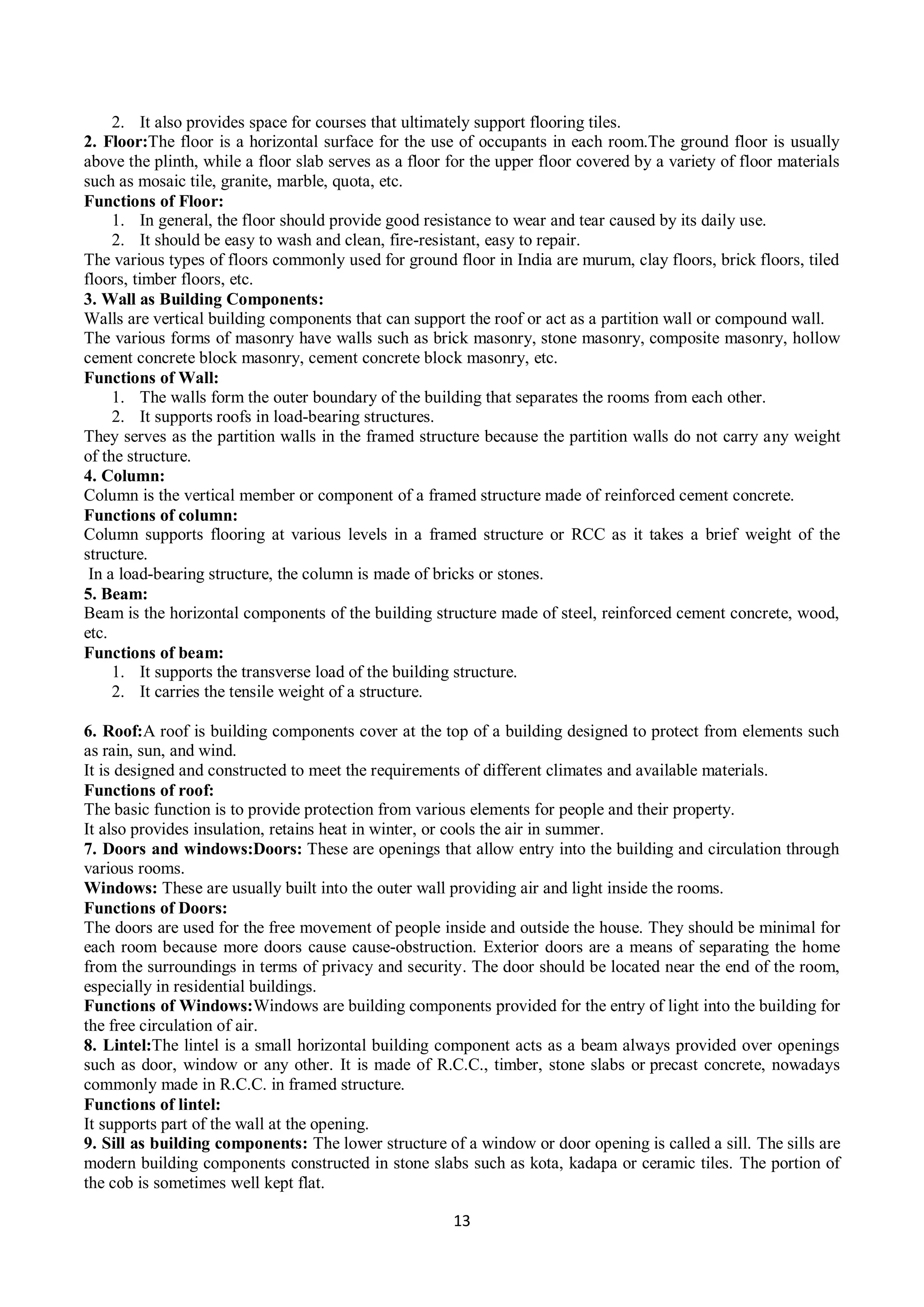
load transfer path is from slab/floor to walls and walls to load bearing footing i.e. soil.
This system comprises thick brick or stone masonry supporting the whole structure, including slab, floor slab
made of wood, steel, and reinforced cement concrete. Load-bearing structures were preferred for the
construction of small houses and low-rise buildings in earlier days. But nowadays, they are rarely adopted.
These structures are suitable for the construction of buildings up to two floors only.Such a system is used in
the construction of residential buildings having small room sizes. Load bearing structure is economical for
residential and commercial buildings up the second floor.
Load Bearing Member of A Structure
1. Load Bearing Walls This wall transfers the loads from the stab over it to the foundation. These can
be constructed of trick or stone rnesonry, block materials and concrete.
2. Beams are the essential load-bearing structural members that can be made of wood. steel and
concrete. It is primarily employed to carry the load of the building. Its load-carrying capacity depends
on its width and length. They are subjected to heavy compressive and shear forces.
3. Column It is one of the essential structural members that playa vital role in transferring the dead and
live load of the building to the foundation.
4. Braces It is an essendal framework structural member helps to make framework stiffen making them
rigid.
5. Trusses Trusses are the load-bearing member that supports the roof in a structure of the building.
Load from the top uniformly distributed to the truss. They are subjected to tension and compression
forces but not any moment
15
Advantages of load bearing structure
1. It is good and inexpensive for building less than 2 floors construction because bricks are cheaper.
2. These structures offer excellent fire resistance
3. It has a thick brick wall which gives the walls more weather resistance, noise protection.
4. The construction materials required for these structures are economical.
5. The construction process of these structures is simple and doesn't need time-consuming preparation.
6. . These structures provide excellent strength and disability to the house.
Disadvantages of Load Bearing structure
There are some drawbacks to load bearing structures that have limited their use in the construction industry.
1. Buildings with up to three stories are best suited for this load-bearing structure.
2. Compared to other construction techniques, load-bearing masonry structures require more man hours
and take longer to build.
3. Masonry structures don’t offer enough weatherproof thermal insulation.
4. The placement of the walls cannot be changed after construction has begun.
5. The masonry walls’ combined weight is heavy, which ultimately makes the building heavier overall.
6. In comparison to frame structures, non-reinforced units are unable to withstand the high tensile and
shear stresses, which results in poor resistance of masonry walls or poor performance against
earthquake loads.
FRAMED STRUCTURES
A framed structure is a structure having the combination of structural components i.e. beam, column and
slab connected together to resist the gravity and different lateral loads. It is also known as beam column
structure.
These structures are generally used to overcome the large forces, moments developing due to the applied
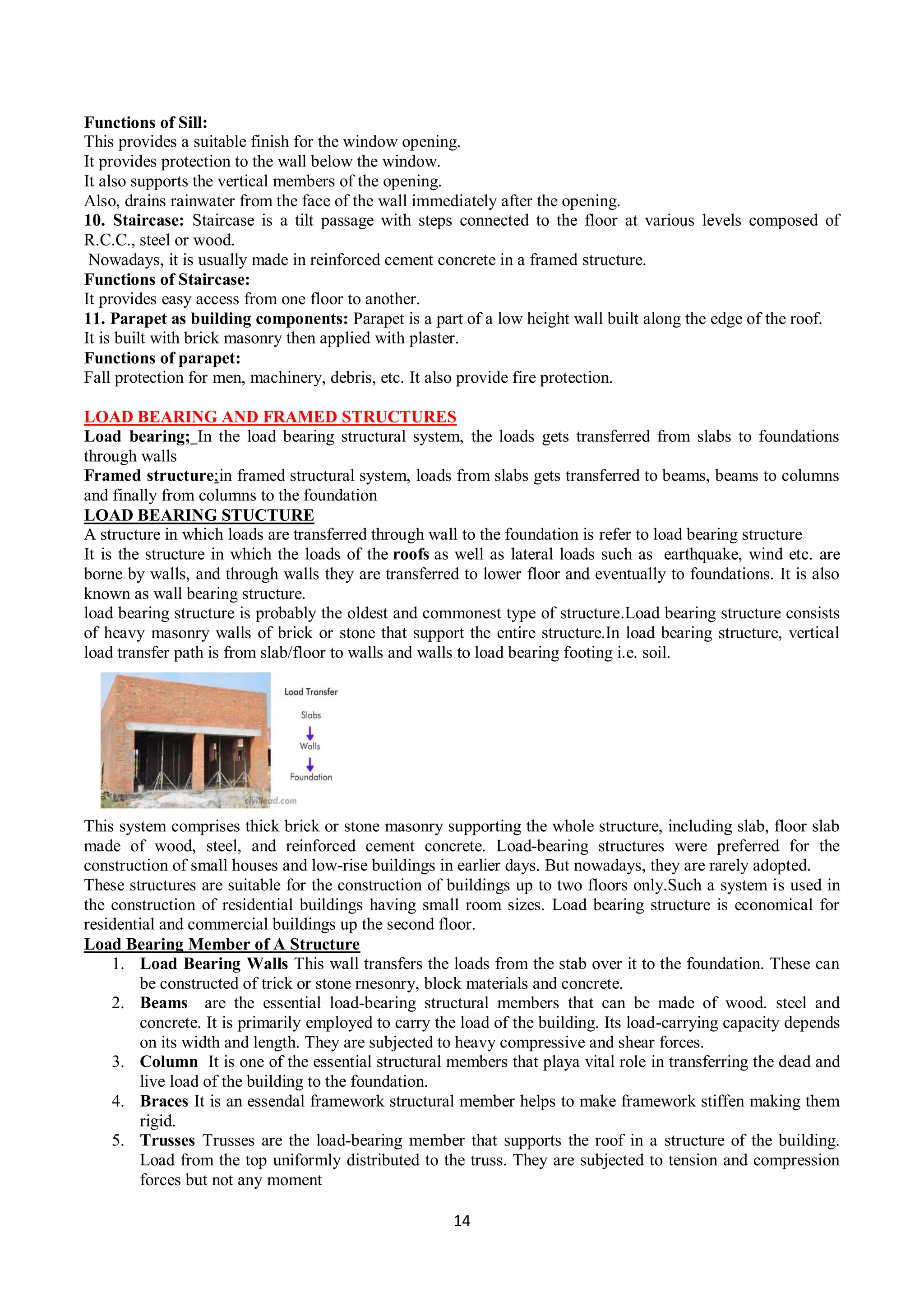
loads. Framed structure consists of beam, column, and slab.In a framed structure, vertical load transfer path is
from slab/floor to beams, beams to columns and columns to load bearing footings and then to soil.
A concrete frame consists of the formation of a structure by a network of beams and columns. The concrete
frame forms the structural ‘skeleton’ of the building connecting the beams and columns.
The beams and columns in this structure are built on a concrete foundation. Thus the concrete frame supports
the floor, ceiling, walls, cladding, etc., of the building.The columns are erected on their independent
foundation in this type, braced together by beam and slab.
The space between column and beam is filled up by panel wall as per requirement. The panel wall has to carry
its weight, and it acts as a partition wall or the external wall or room. The frame carries the entire load of the
structure. The cost of the frame is about 40% of the total construction cost.
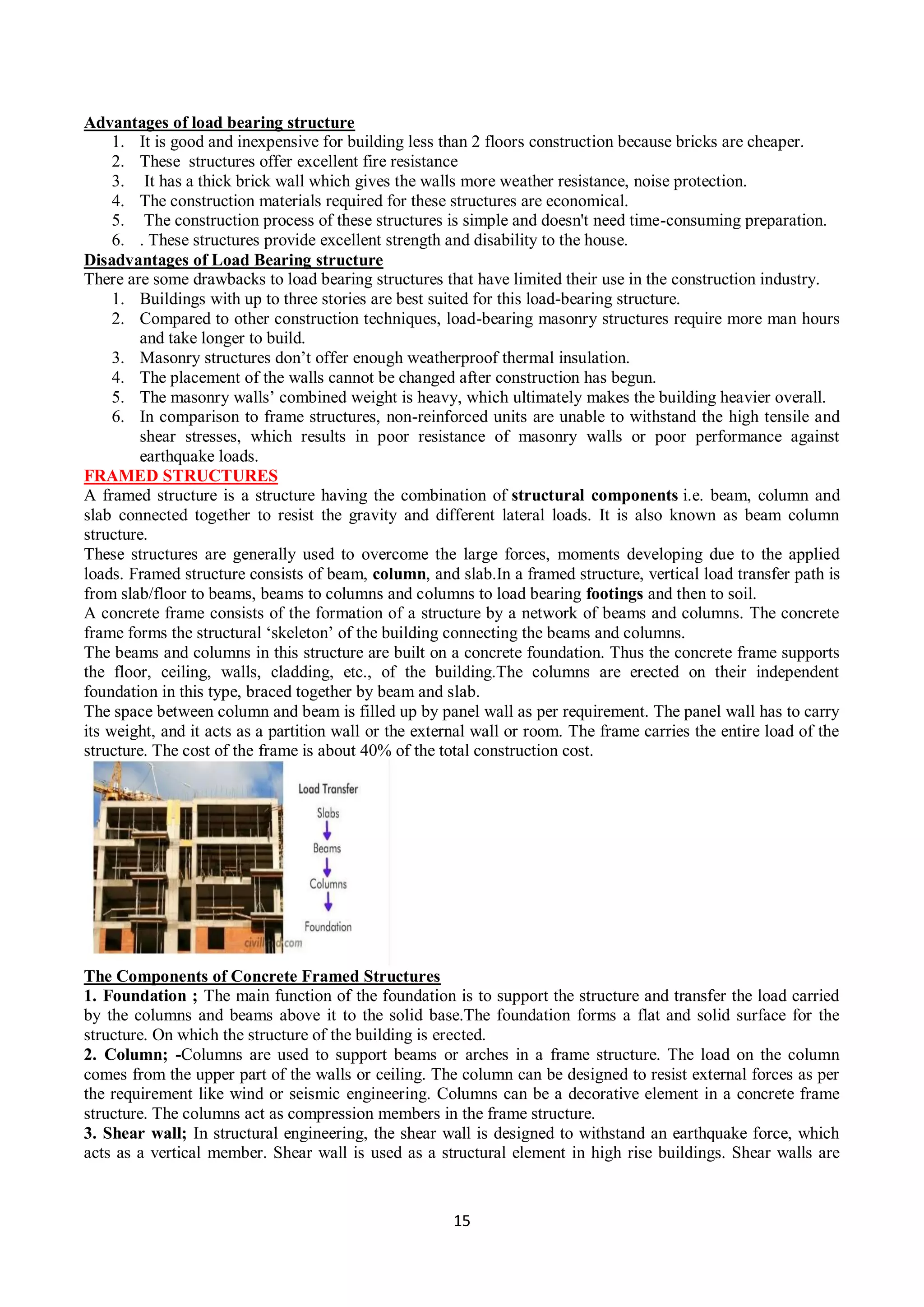
The Components of Concrete Framed Structures
1. Foundation ; The main function of the foundation is to support the structure and transfer the load carried
by the columns and beams above it to the solid base.The foundation forms a flat and solid surface for the
structure. On which the structure of the building is erected.
2. Column; -Columns are used to support beams or arches in a frame structure. The load on the column
comes from the upper part of the walls or ceiling. The column can be designed to resist external forces as per
the requirement like wind or seismic engineering. Columns can be a decorative element in a concrete frame
structure. The columns act as compression members in the frame structure.
3. Shear wall; In structural engineering, the shear wall is designed to withstand an earthquake force, which
acts as a vertical member. Shear wall is used as a structural element in high rise buildings. Shear walls are
16
known as long columns in tall buildings. The shear wall looks like a wall. They resist external loads such as
wind and earthquake loads.
4. Beam; Beams are various horizontal load-bearing members in a framed structure. The function of the beam
carries the load of the slab and the direct load of the masonry walls and their self-weight. In a concrete frame,
some beams are supported on other beams. The beam can be supported on the column to form an integral part
of the frame. The beam has mainly flexural members in the concrete frame. They are divided into two types
according to the function.
Main Beams; The main function of this type of beam is transmitting floor load and secondary different beam
load in columns.
Secondary Beams This type of beam work is designed to transfer the floor load to the main beam.
5. Slab; Concrete slabs are a common structural element of modern buildings. The slab is a flat, horizontal
surface made of cast concrete. Is. Steel-reinforced slabs usually have a thickness of 100 to 150 mm. Mostly
slab is used to build floors and ceilings.
6. Elevator Shaft; An elevator shaft is a vertical element made of concrete. In which special provision is
made for the elevator to go up and down. This shaft-type design helps to resist horizontal loads and also
resists vertical loads.
Type of framed structure
• They are classified into two main types as follows
1. Rigid frame structure
2. Braced frame structure
Rigid frame structure
The rigid frame structure is also known as the moment frame systems. It has linear elements connected to each
other like beams and columns.A rigid framed structure means providing long-time service with resistance to
deformation. It is used in high-rise buildings of steel and reinforced concrete.
These frames are constructed by various processes at the site and are poured into a concrete monolithic
system. This type of frame structure provides more stability.
Braced frame structure.
A braced frame is a type of frame structural system. Which is designed to resist wind, seismic forces, and
external forces.This frame structure is made by diagonal members to resist lateral force. In this type of
structural frame, the structure is constructed using diagonal structural members in rectangular fields. Braced
structural frames are more efficient than rigid structural frames against natural disasters like earthquakes and
cyclones.
Advantages of framed structure
1. Better Speed of Construction:
2. Reduction in Cost of Construction
3. Variable Factor of Safety
4. Better Space Utilization:
5. inherently quieter, stronger, safer, more energy efficient,
17
6. Can be shaped into any shape
7. Good compressive strength
8. No finish required
9. Can be clad
10. Pre cast construction is faster.
11. larger buildings can be built this way.
12. Pre concrete is faster
Disadvantages of framed structure
1. Costly
2. lack of tensile strength. Though the concrete is strong in compression, it is very weak in tension.
3. Need skilled workmen
4. Factors like mixing, casting, and curing affect the strength of the concrete frame structure.
5. Formwork is required to cast the slab, which increases the cost.
6. Cracks develop in concrete due to compression in concrete.
7. Concrete has less compressive strength than steel. Due to which the cross-section of columns and
beams in multistory heavy buildings becomes larger.
8. If the concrete is not compacted properly, the steel starts losing its tensile strength. As a result, the life
of the structure is reduced.
Comparison between load bearing and Framed structure
PARTICULAR LOAD BEARING STRUCTURE FRAMED STRUCTURE
Components heavy masonry walls of brick or
stone
consists of beam, column, and slab.
Load Transfer Path from slab/floor to walls and walls
to load bearing footing i.e. soil.
from slab/floor to beams, beams to
columns and columns to load
bearing footings and then to soil.
Height of Structure Limited storey buildings Multi storey buildings of any heights
Resistant to Earthquake poor resistant to earth quake more resistant to Earthquake
Thickness of Wall Thicker Thinner
Walls Construction walls have to be built first. walls are constructed after the frame is
ready.
Carpet Area Less. More
Excavation Required More Less
Labour Required Intensive Less intensive
Speed of Construction Less More
Life of Structure not much affected even though
some standards are not strictly
followed
Life is reduced if not done with proper
technique, and specifications i.e. codes
are not strictly followed.
Load bearing structure and frame structure differences
Sr.
No.
Load bearing structure Framed structure
1. The price is lower. Cost is more.
2. Up to two storeys are suitable. Adaptable to a wide range of storeys.
3.
Less space is used since the walls are
thicker and the floor surface is less.
Because walls are lighter than load-
bearing systems, there is more usable
floor space.
4. Slow construction Fast construction
5.
After construction, it is impossible to
change the location of the walls.
When required, walls’ positions can be
adjusted.
18
6.
Taken deeper into the soil’s
subsurface.
Only the columns are inserted deeply and
given a foundation footing.
7.
This building requires additional
labour.
Although the framed construction needed
different abilities, it is less labour-intensive.
8.
Even if several rules are not rigorously
adhered to in this structure, life is not
significantly affected.
If suitable technology is not used and
standards, or codes, are not rigorously
followed, the life of the building is lowered
in framed structures.
9.
Restrictions on how many wall holes
may be provided, which will impact the
amount of light and ventilation in the
space.
It’s conceivable for walls to have huge
gaps.
10.
Unlike a framed building, load-bearing
structures may be built without the
need for costly equipment and plants.
Framed buildings must be built with
expensive equipment and machinery.
11.
Walls must be constructed first since
they support the slab and roof
The RCC framed structure is often built
first, followed by the exterior and partition
walls, which increases speed.
12.
Large-span areas are not feasible for
a load-bearing structure. span
restriction, i.e., room dimensions.
Large-span areas are achievable for a
framed structure. Room sizes are not
restricted, for example.
FOUNDATIONS,
Building Foundation is the part of a building which is in direct contact with the ground and transmits loads of
the superstructure to the supporting soil/ rock.
OBJECTIVES OF A FOUNDATION
A foundation is provided for the following purposes.
1. To support structure
2. Distributes the loads over a larger area
3. Minimizes the differential settlements
4. Increases stability & prevents overturning
5. Distribute non-uniform load uniformly to the soil
6. To give enough stability to the structures against various disturbing forces, such as wind and rain.
7. To prepare a level surface for concreting and masonry work.
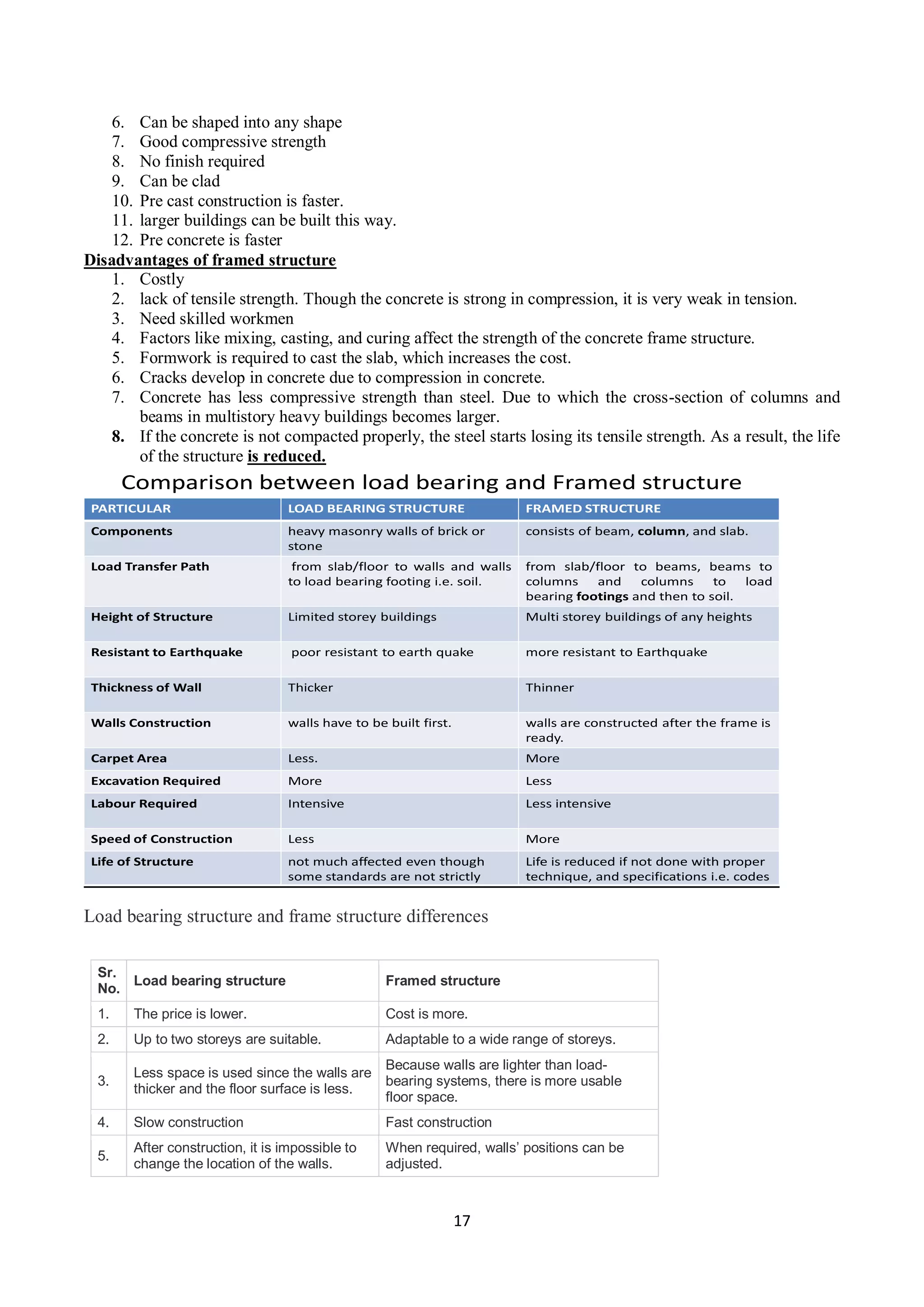
TYPES OF FOUNDATIONS
1. SHALLOW FOUNDATION;- when the depth of foundation is equal to or less than its width .
2. DEEP FOUNDATION when depth of foundation is greater than its width
19
SHALLOW FOUNDATION
Shallow Foundations :- The foundations provided immediately beneath the lowest part of the structure, near to
the ground level are known as shallow foundations.
Shallow foundation: If the depth of foundation is less than the width of foundation then it is known as Shallow
or stepped Foundation.
It can be used where the bearing capacity of soil on which the structure is to be constructed is maximum.
Minimum depth of this Foundation is 800mm and maximum depth not to be taken more than 4 meters
SUITABILITY CONDITION
1. Bearing capacity of soil is more.
2. ground water table(W.T) is low.
3. dewatering of foundation is not required.
4. top layers of soil are uniform and stable.
5. Load on the structure is less
APPLICATION
1. small, simple structures such as houses, garages, and sheds.
2. some larger structures such as bridges and towers
TYPES OF SHALLOW FOUNDATION
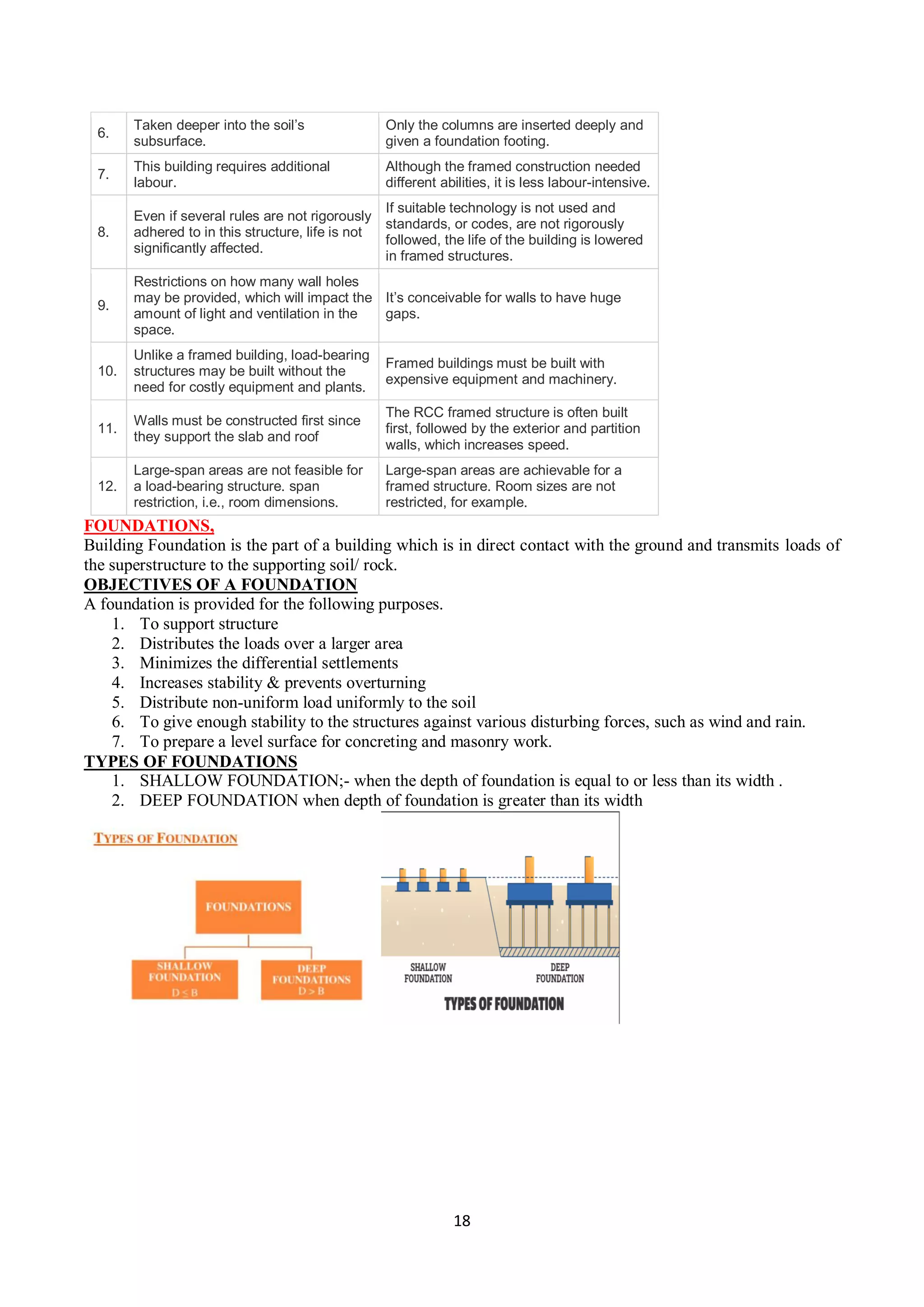
Spread footings – spread footings are those which spread the super imposed load of wall or column over a
larger area . Spread footings support either a column or wall.
• Spread or Isolated Footings: used to support individual column.
• Isolated spread footings under individual columns which can be square, rectangular or circular.
• These are the most common type of foundation, primarily because of their cost and ease of
construction.
They are most often used:
1. in small to medium size structures,
2. on sites with moderate to good soil conditions,
3. on some large structures when they are located at sites underlain by exceptionally good soil or
shallow bedrock.
20
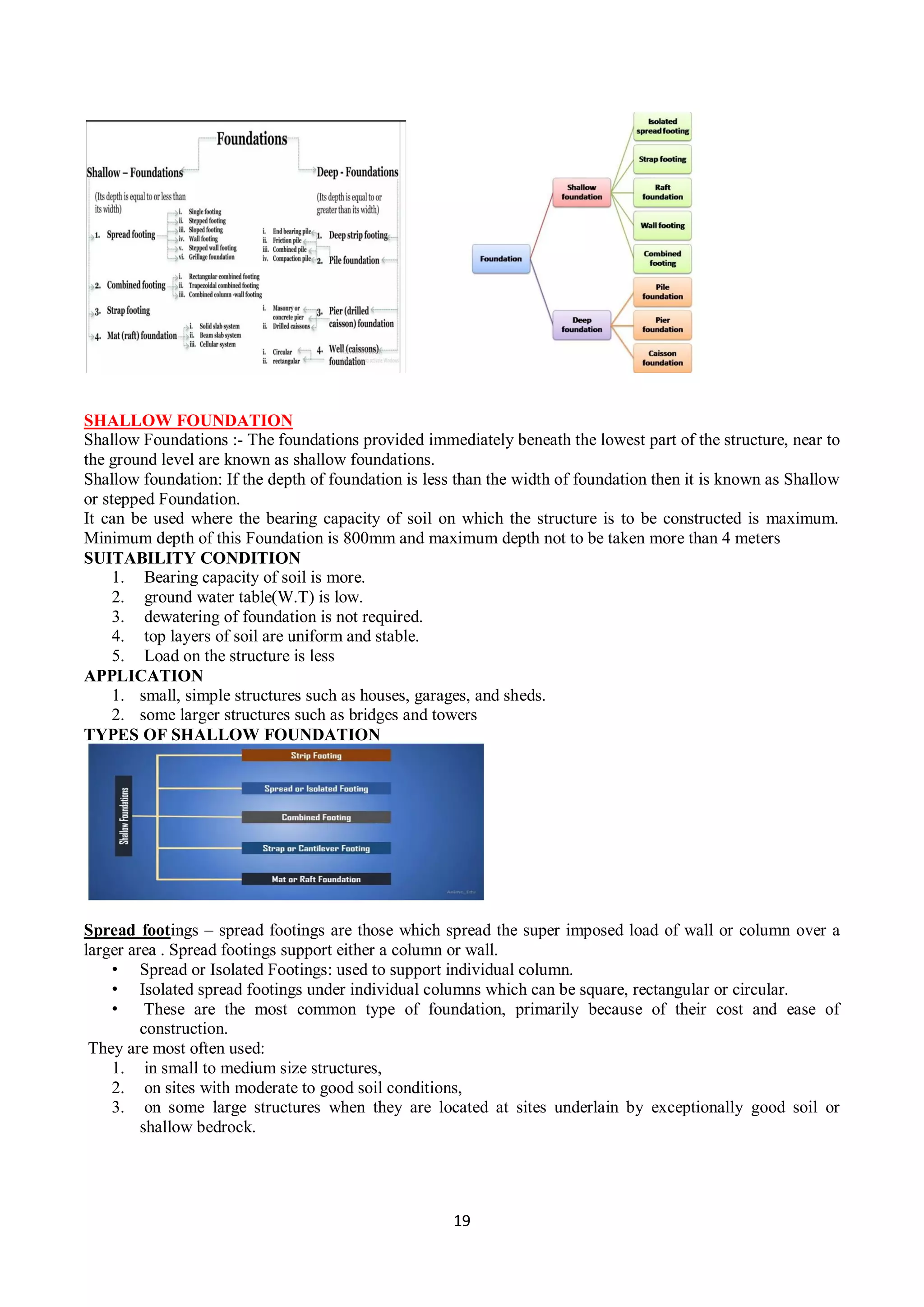
Types
. Single footing for a column
ii. Stepped footing for a column
iii. Sloped footing for a column
iv. Wall footing without step
v. Stepped footing for wall
vi. Grillage foundation
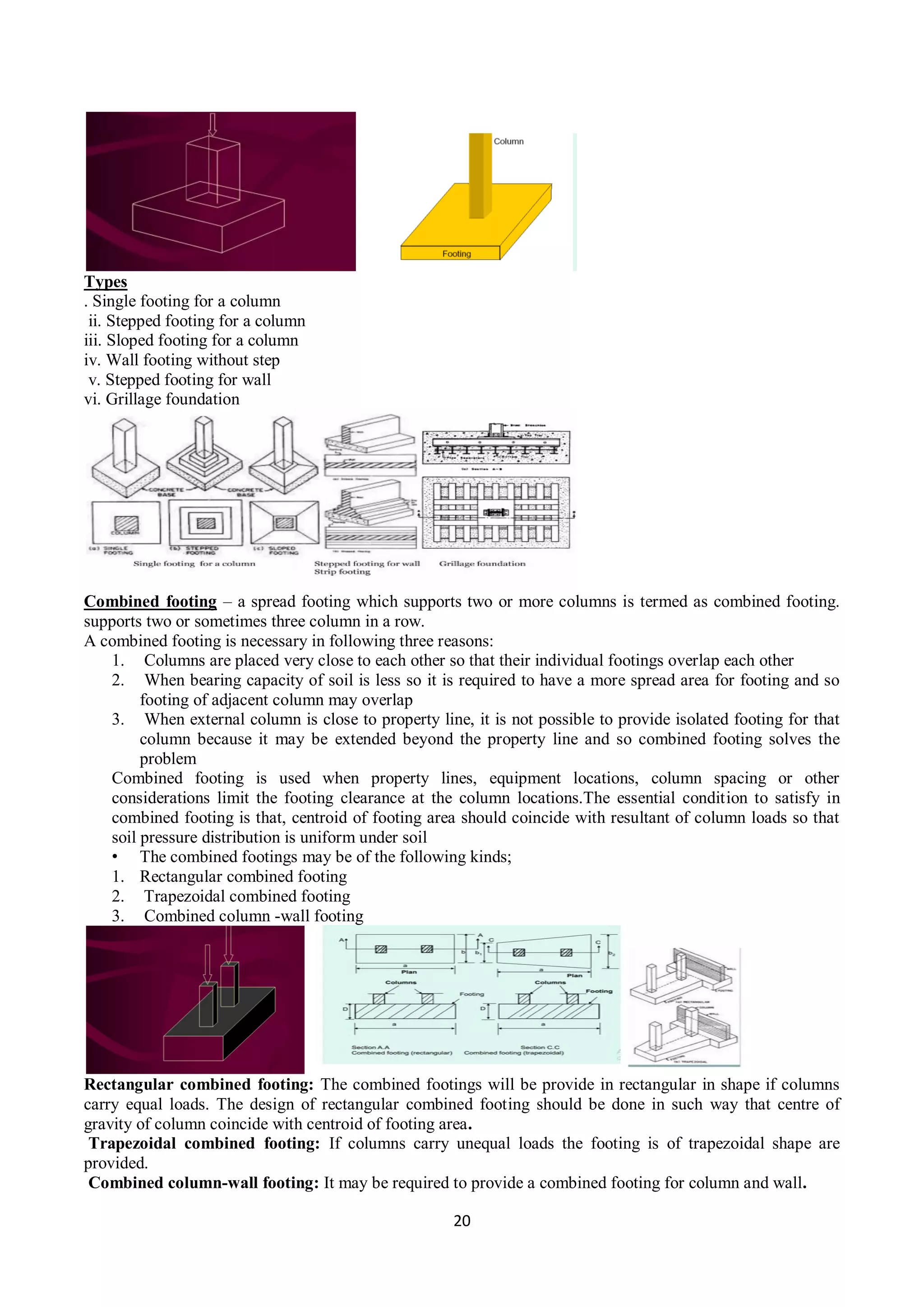
Combined footing – a spread footing which supports two or more columns is termed as combined footing.
supports two or sometimes three column in a row.
A combined footing is necessary in following three reasons:
1. Columns are placed very close to each other so that their individual footings overlap each other
2. When bearing capacity of soil is less so it is required to have a more spread area for footing and so
footing of adjacent column may overlap
3. When external column is close to property line, it is not possible to provide isolated footing for that
column because it may be extended beyond the property line and so combined footing solves the
problem
Combined footing is used when property lines, equipment locations, column spacing or other
considerations limit the footing clearance at the column locations.The essential condition to satisfy in
combined footing is that, centroid of footing area should coincide with resultant of column loads so that
soil pressure distribution is uniform under soil
• The combined footings may be of the following kinds;
1. Rectangular combined footing
2. Trapezoidal combined footing
3. Combined column -wall footing
Rectangular combined footing: The combined footings will be provide in rectangular in shape if columns
carry equal loads. The design of rectangular combined footing should be done in such way that centre of
gravity of column coincide with centroid of footing area.
Trapezoidal combined footing: If columns carry unequal loads the footing is of trapezoidal shape are
provided.
Combined column-wall footing: It may be required to provide a combined footing for column and wall.
21
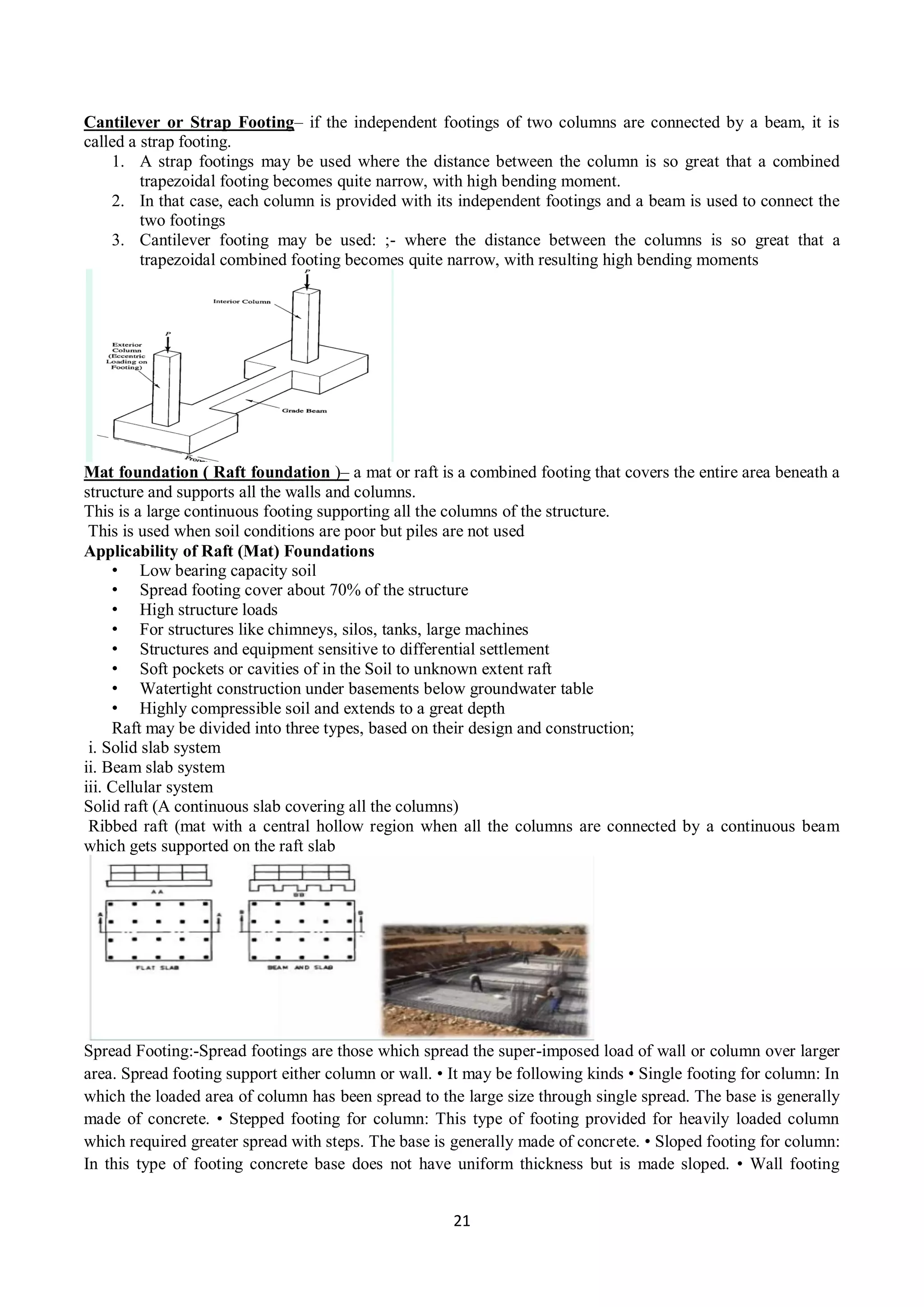
Cantilever or Strap Footing– if the independent footings of two columns are connected by a beam, it is
called a strap footing.
1. A strap footings may be used where the distance between the column is so great that a combined
trapezoidal footing becomes quite narrow, with high bending moment.
2. In that case, each column is provided with its independent footings and a beam is used to connect the
two footings
3. Cantilever footing may be used: ;- where the distance between the columns is so great that a
trapezoidal combined footing becomes quite narrow, with resulting high bending moments
Mat foundation ( Raft foundation )– a mat or raft is a combined footing that covers the entire area beneath a
structure and supports all the walls and columns.
This is a large continuous footing supporting all the columns of the structure.
This is used when soil conditions are poor but piles are not used
Applicability of Raft (Mat) Foundations
• Low bearing capacity soil
• Spread footing cover about 70% of the structure
• High structure loads
• For structures like chimneys, silos, tanks, large machines
• Structures and equipment sensitive to differential settlement
• Soft pockets or cavities of in the Soil to unknown extent raft
• Watertight construction under basements below groundwater table
• Highly compressible soil and extends to a great depth
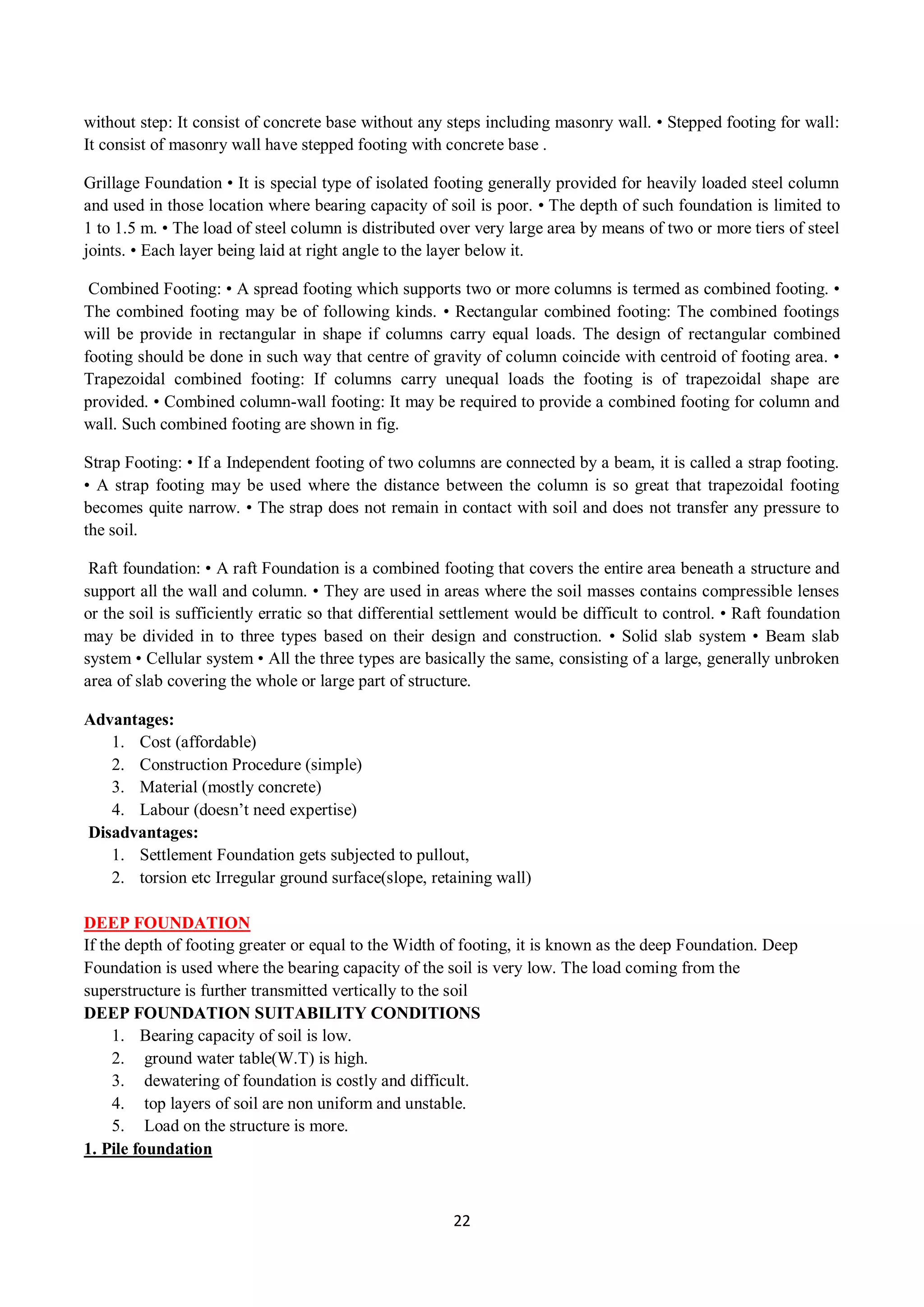
Raft may be divided into three types, based on their design and construction;
i. Solid slab system
ii. Beam slab system
iii. Cellular system
Solid raft (A continuous slab covering all the columns)
Ribbed raft (mat with a central hollow region when all the columns are connected by a continuous beam
which gets supported on the raft slab
Spread Footing:-Spread footings are those which spread the super-imposed load of wall or column over larger
area. Spread footing support either column or wall. • It may be following kinds • Single footing for column: In
which the loaded area of column has been spread to the large size through single spread. The base is generally
made of concrete. • Stepped footing for column: This type of footing provided for heavily loaded column
which required greater spread with steps. The base is generally made of concrete. • Sloped footing for column:
In this type of footing concrete base does not have uniform thickness but is made sloped. • Wall footing
22
without step: It consist of concrete base without any steps including masonry wall. • Stepped footing for wall:
It consist of masonry wall have stepped footing with concrete base .
Grillage Foundation • It is special type of isolated footing generally provided for heavily loaded steel column
and used in those location where bearing capacity of soil is poor. • The depth of such foundation is limited to
1 to 1.5 m. • The load of steel column is distributed over very large area by means of two or more tiers of steel
joints. • Each layer being laid at right angle to the layer below it.
Combined Footing: • A spread footing which supports two or more columns is termed as combined footing. •
The combined footing may be of following kinds. • Rectangular combined footing: The combined footings
will be provide in rectangular in shape if columns carry equal loads. The design of rectangular combined
footing should be done in such way that centre of gravity of column coincide with centroid of footing area. •
Trapezoidal combined footing: If columns carry unequal loads the footing is of trapezoidal shape are
provided. • Combined column-wall footing: It may be required to provide a combined footing for column and
wall. Such combined footing are shown in fig.
Strap Footing: • If a Independent footing of two columns are connected by a beam, it is called a strap footing.
• A strap footing may be used where the distance between the column is so great that trapezoidal footing
becomes quite narrow. • The strap does not remain in contact with soil and does not transfer any pressure to
the soil.
Raft foundation: • A raft Foundation is a combined footing that covers the entire area beneath a structure and
support all the wall and column. • They are used in areas where the soil masses contains compressible lenses
or the soil is sufficiently erratic so that differential settlement would be difficult to control. • Raft foundation
may be divided in to three types based on their design and construction. • Solid slab system • Beam slab
system • Cellular system • All the three types are basically the same, consisting of a large, generally unbroken
area of slab covering the whole or large part of structure.
Advantages:
1. Cost (affordable)
2. Construction Procedure (simple)
3. Material (mostly concrete)
4. Labour (doesn’t need expertise)
Disadvantages:
1. Settlement Foundation gets subjected to pullout,
2. torsion etc Irregular ground surface(slope, retaining wall)
DEEP FOUNDATION
If the depth of footing greater or equal to the Width of footing, it is known as the deep Foundation. Deep
Foundation is used where the bearing capacity of the soil is very low. The load coming from the
superstructure is further transmitted vertically to the soil
DEEP FOUNDATION SUITABILITY CONDITIONS
1. Bearing capacity of soil is low.
2. ground water table(W.T) is high.
3. dewatering of foundation is costly and difficult.
4. top layers of soil are non uniform and unstable.
5. Load on the structure is more.
1. Pile foundation
23
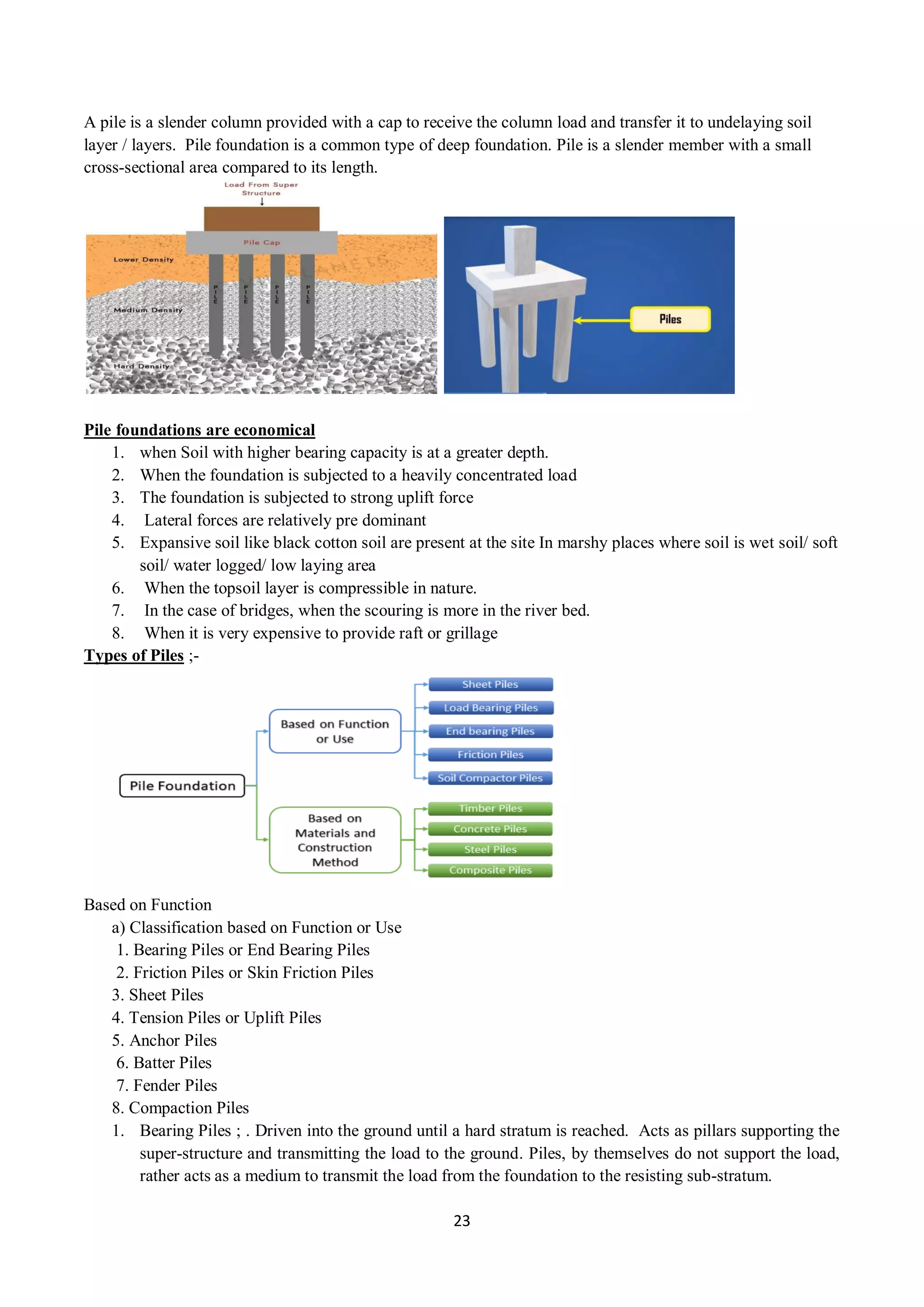
A pile is a slender column provided with a cap to receive the column load and transfer it to undelaying soil
layer / layers. Pile foundation is a common type of deep foundation. Pile is a slender member with a small
cross-sectional area compared to its length.
Pile foundations are economical
1. when Soil with higher bearing capacity is at a greater depth.
2. When the foundation is subjected to a heavily concentrated load
3. The foundation is subjected to strong uplift force
4. Lateral forces are relatively pre dominant
5. Expansive soil like black cotton soil are present at the site In marshy places where soil is wet soil/ soft
soil/ water logged/ low laying area
6. When the topsoil layer is compressible in nature.
7. In the case of bridges, when the scouring is more in the river bed.
8. When it is very expensive to provide raft or grillage
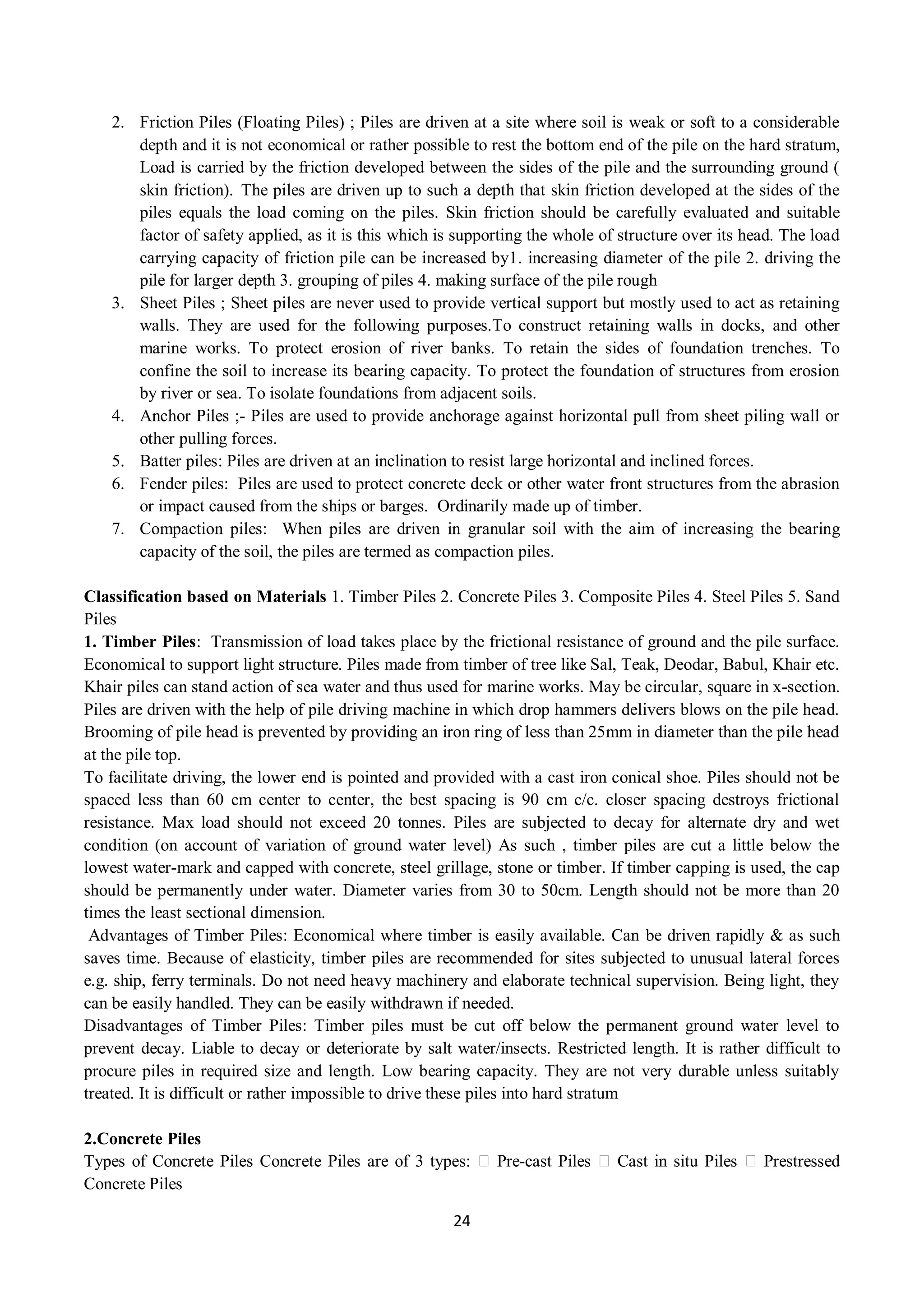
Types of Piles ;-
Based on Function
a) Classification based on Function or Use
1. Bearing Piles or End Bearing Piles
2. Friction Piles or Skin Friction Piles
3. Sheet Piles
4. Tension Piles or Uplift Piles
5. Anchor Piles
6. Batter Piles
7. Fender Piles
8. Compaction Piles
1. Bearing Piles ; . Driven into the ground until a hard stratum is reached. Acts as pillars supporting the
super-structure and transmitting the load to the ground. Piles, by themselves do not support the load,
rather acts as a medium to transmit the load from the foundation to the resisting sub-stratum.
24
2. Friction Piles (Floating Piles) ; Piles are driven at a site where soil is weak or soft to a considerable
depth and it is not economical or rather possible to rest the bottom end of the pile on the hard stratum,
Load is carried by the friction developed between the sides of the pile and the surrounding ground (
skin friction). The piles are driven up to such a depth that skin friction developed at the sides of the
piles equals the load coming on the piles. Skin friction should be carefully evaluated and suitable
factor of safety applied, as it is this which is supporting the whole of structure over its head. The load
carrying capacity of friction pile can be increased by1. increasing diameter of the pile 2. driving the
pile for larger depth 3. grouping of piles 4. making surface of the pile rough
3. Sheet Piles ; Sheet piles are never used to provide vertical support but mostly used to act as retaining
walls. They are used for the following purposes.To construct retaining walls in docks, and other
marine works. To protect erosion of river banks. To retain the sides of foundation trenches. To
confine the soil to increase its bearing capacity. To protect the foundation of structures from erosion
by river or sea. To isolate foundations from adjacent soils.
4. Anchor Piles ;- Piles are used to provide anchorage against horizontal pull from sheet piling wall or
other pulling forces.
5. Batter piles: Piles are driven at an inclination to resist large horizontal and inclined forces.
6. Fender piles: Piles are used to protect concrete deck or other water front structures from the abrasion
or impact caused from the ships or barges. Ordinarily made up of timber.
7. Compaction piles: When piles are driven in granular soil with the aim of increasing the bearing
capacity of the soil, the piles are termed as compaction piles.
Classification based on Materials 1. Timber Piles 2. Concrete Piles 3. Composite Piles 4. Steel Piles 5. Sand
Piles
1. Timber Piles: Transmission of load takes place by the frictional resistance of ground and the pile surface.
Economical to support light structure. Piles made from timber of tree like Sal, Teak, Deodar, Babul, Khair etc.
Khair piles can stand action of sea water and thus used for marine works. May be circular, square in x-section.
Piles are driven with the help of pile driving machine in which drop hammers delivers blows on the pile head.
Brooming of pile head is prevented by providing an iron ring of less than 25mm in diameter than the pile head
at the pile top.
To facilitate driving, the lower end is pointed and provided with a cast iron conical shoe. Piles should not be
spaced less than 60 cm center to center, the best spacing is 90 cm c/c. closer spacing destroys frictional
resistance. Max load should not exceed 20 tonnes. Piles are subjected to decay for alternate dry and wet
condition (on account of variation of ground water level) As such , timber piles are cut a little below the
lowest water-mark and capped with concrete, steel grillage, stone or timber. If timber capping is used, the cap
should be permanently under water. Diameter varies from 30 to 50cm. Length should not be more than 20
times the least sectional dimension.
Advantages of Timber Piles: Economical where timber is easily available. Can be driven rapidly & as such
saves time. Because of elasticity, timber piles are recommended for sites subjected to unusual lateral forces
e.g. ship, ferry terminals. Do not need heavy machinery and elaborate technical supervision. Being light, they
can be easily handled. They can be easily withdrawn if needed.
Disadvantages of Timber Piles: Timber piles must be cut off below the permanent ground water level to
prevent decay. Liable to decay or deteriorate by salt water/insects. Restricted length. It is rather difficult to
procure piles in required size and length. Low bearing capacity. They are not very durable unless suitably
treated. It is difficult or rather impossible to drive these piles into hard stratum
2.Concrete Piles
Types of Concrete Piles Concrete Piles are of 3 types: Pre-cast Piles Cast in situ Piles Prestressed
Concrete Piles
25
Pre-cast Piles: Reinforced concrete piles, molded in circular, square, rectangular or octagonal form. Cast
and cured in the casting yard, then transported to the site of driving. If space available it can be cast and cured
near the work site. Driven in similar manner as timber piles with the help of piles drivers. Diameter normally
varies from 35cm to 65cm, length varies from 4.5m to 30m.
Function of reinforcement in a pre-cast pile is to resist the stresses during handling, driving and final loading
on the pile rather than strengthen the pile to act as a column. Longitudinal reinforcements usually 20mm to
50mm in diameter, stirrups 6mm to 10mm in dia. For 90 cm length at head and toe, stirrups spacing is 8cm
c/c and for remaining intermediate length it is about 30cm c/c. Circular piles are seldom tapered. When
tapered piles length is restricted to 12m. A concrete cover of 5cm is maintained throughout, over the main
steel bars.
Advantages of Pre-cast Piles: Very effective Simple quality control Improves the entire area
Disadvantages of Pre-cast Piles: Limited in length Difficult to transport Not suitable for densely built
up area Requires costly equipment
Cast-in-Situ Piles: Cast in position inside the ground. First of all a bore is dug by driving a casing pipe into
the ground. Then the soil from the casing is jetted out and filled with cement concrete after placing necessary
reinforcement in it. Cast-in-situ piles are of two types: I. Cased Cast-in-Situ Piles: metallic shell is left inside
the ground along with the core II. Uncased Cast-in-Situ Piles: metallic shell is withdrawn
Advantages of Cast-in-Situ Concrete Piles: Not limited in length Can be cast at any place Requires
less equipment Cost is less and is depended on the siz
Disadvantages of Cast-in-Situ Concrete Piles: Quality control is difficult Load carrying is mostly done
through end bearing only Skin frictional resistance is very low.
Advantages of Concrete piles: Durability is independent of ground water level. For large size and
greater bearing power number of piles required is much less. Can be cast to any length, size or shape.
Can be used to marine work without any treatment. Material required for manufacture is easily obtainable.
Concrete piles can be monolithically bonded into pile cap which is not possible in wooden piles.
Disadvantages of Concrete piles: Costlier than timber piles. Can not be driven rapidly. Required
elaborate tech supervision and heavy driving machines. Must be reinforced to withstand handling stresses.
Prestressed Concrete Piles The greatest disadvantage of large weightt and difficulty in handling of pre-cast
pile is eliminated by prestressed concrete piles. The weight is reduced by casting 200mm to 300mm diameter
fiber tubes inside the piles at the time of concreting. The pre tensioning cables are subjected to required pull
(tension) in the casting bed. The fiber tube is held in position inside the form work and the piles reinforced
with pre stressed cables are concreted in a row.
Prestressed concrete piles are provided with lifting hooks at 1/5th ( 0.2L, L= length of pile ) of pile length
from each end. Piles length 50 times the thickness →single point pick up More than 50 times the thickness
→two point pick up at 0.2L from either end. Piles 500 sq. mm and smaller→ cast solid. Piles over 500 sq.
mm may be cast with 200mm to 300mm cored hole (void). Pre stressed piles are always pre- cast.
Advantages of Prestressed Concrete Piles It has greater ability to withstand extremely hard driving. It is
more durable in sea water because of absence of crack. It has greater column capacity. It has lesser
handling costs because of light weight. It requires lesser pick-up points. It has larger moment of inertia
than the conventional piles of same dimension since the concrete is all in compression.
Composite Piles ;-Piles of two different materials are driven one over the other, so as to enable them to act
together to perform the function of a single pile. This type of composite pile is used with the object of
achieving economy in the cost of piling work.
2. PIER FOUNDATION
A pier foundation is a collection of large-diameter cylindrical columns to support the superstructure and
transfer large super-imposed loads to the firm strata below. It stood several feet above the ground.Pier footing
26
transferred the load of the superstructure to the underlying soil or rock. It is constructed by digging a hole in
the ground and then filling it with concrete or stone.
It is also known as “Post foundation” of "Column Foundation".
Pier is a deep foundation structure above ground level that transmits a more massive load, which cannot be
carried by shallow foundations. It is usually shallower than piles. Pier foundation is a cylindrical structural
member that transfer heavy load from superstructure to the soil by end bearing. Unlike piles, it can only
transfer load by end bearing only and by not skin friction.
Suitable Condition for Pier Foundation
Pier foundation is used in the below conditions:
1. When decomposed rocks are present in the top strata, and there are underlying strata of sound rock
below them, in such conditions pier foundations, are used.
2. As stiff clays offer a lot of resistance when driving a bearing pile, piers foundations can be
conveniently used in such situations.
3. It is used if the house is built from log, timber, or frame as the pillars are small relative to other
foundations
4. If a structure needed to be built on a slope, a pier foundation is used
5. The soil must have a low bearing capacity of water unless the pillars will sink under the weight of the
house
Types of Pier Foundation
Depending on the material used for the construction, there are four types of pier foundations. These are:
1. Masonry piers
2. concrete piers
3. Drilled caissons or piers
4. Timber piers
5. Steel piers
Depending on the structural configuration, there are four types of pier foundations.
1. Beam and Girder
2. Column and Cap
3. Slab
4. Pile
5. Masonry Piers
Masonry piers are one of the most popular foundation types for both residential and commercial buildings.
They are extremely durable and can last for many years with proper maintenance. They are made from
concrete, brick, or stone and are typically reinforced with steel rods or rebar.
Masonry piers are typically used for buildings that are located in areas with high soil-bearing capacity. They
are also often used in areas where the ground is not level or where there is a high water table. They can be
built on any type of soil, but they are most commonly used on sandy or clay soils.
Concrete Piers
27
A concrete pier foundation is a type of foundation that uses piers made of concrete to support a structure. The
piers are typically placed at regular intervals underneath the structure and are often used in conjunction with
other types of foundation, such as a footing foundation.
Concrete pier footings are extremely strong and can support a large amount of weight. They are also resistant
to fire and termites. They require very little maintenance and can last for many years with proper care.
Timber Piers
Timber piers are another popular type of foundation for both residential and commercial buildings. They are
made from pressure-treated lumber and are typically reinforced with steel rods or rebar.
Timber piers are typically used in areas with high soil-bearing capacity. They are also often used in areas
where the ground is not level or where there is a high water table. Timber piers can be built on any type of
soil, but they are most commonly used on sandy soil or clay soils.
Steel Pier Foundation
A steel pier foundation is a type of deep foundation that is used to support structures that are built on soft or
unstable ground. Steel piers are driven into the ground until they reach a firm layer of soil or rock. The steel
piers foundation is then connected to the structure using steel cables or rods. This type of foundation is often
used for bridges, buildings, and other large structures.
Drilled Caissons or Piers
Drilled caissons usually refer to the cylindrical foundation. A drilled caisson is largely a compressed member
subjected to an axial load at the top and a reaction at the bottom. There are three types of drilled caissons:
1. Concrete caisson with enlarged bottom
2. Caisson of steel pipe with concrete filled in the pipe
3. Caissons with concrete and steel core in the steel pipe
Beam and Girder Piers
Beam and girder pier foundations are suitable for small bridges and buildings. In this type of foundation, the
pier is constructed by using a beam or girder. The beam or girder is supported by columns. The columns are
either round or square in shape. The beam or girder pier foundation is suitable for small bridges and buildings.
Column and Cap Piers
Column and cap pier foundation is suitable for medium and large bridges. In this type of foundation, the pier
is constructed by using a column. The column is supported by a cap. The cap is either round or square in
shape. The column and cap pier foundation is suitable for medium and large bridges.
Slab Piers
A slab pier foundation is suitable for buildings. In this type of foundation, the pier is constructed by using a
slab. The slab is supported by columns. The columns are either round or square in shape. The slab pier
foundation is suitable for buildings.
Pile Piers
A pile pier foundation is suitable for bridges and buildings. In this type of foundation, the pier is constructed
by using a pile. The pile is driven into the ground. The pile pier foundation is suitable for bridges and
buildings.
Advantages of Pier Foundation
 This method is easy and requires less amount of material and labor. The required material is easily
available.
 There is a wide range of variety when it comes to design. Here we can use different materials to
enhance the beauty scene and it stays within our budget too.
 Pier foundation saves money and time because it does not require extensive digging and a lot of
concrete
28
 It causes minimal disruption to the soil environment. A shovel can be used for digging and the
existing roots and soil organisms remain mostly undisturbed. At the end of the building’s useful life, it
will be easier to restore the site to its natural state than a site with a full basement.
 Since it elevates the house above the ground, a flood cannot cause any damage to the structures.
 The space between the house and the ground is large enough to install utilities such as plumbing and
electrical wiring.
 Workers can easily get under the space between the house and the ground as there is enough room to
crawl to solve plumbing and electrical related issues
 It is comfortable to walk on a floor that does not rest on a hard surface and is good for people with
arthritis and back pain
 inspection is possible because the shaft diameter is large
 In the case of drilled pier construction, the ground vibration that is usually associated with driven piles
is absent.
 The bearing capacity can be increased by reducing the bottom (in non-caving materials).
Disadvantages of Pier Foundation
 This type of foundation tends to get wet in the crawl space. Therefore necessary steps must be taken
to remove any water from the crawl area.
 Creeping places in this type of foundation can be attractive for insects and other animals to live in. To
control this problem a screen should be installed over the opening.
 In the winter months when cold air enters due to crawling, the whole house becomes cold.
 Houses on foundation poles may shake from their foundations in earthquake-prone areas.
Difference Between Pier Vs Pile Foundation:
 Pile foundation transfer load through friction and bearing and pier foundation transfer load through
bearing only.
 It is preferred in a location where the top level consists of disintegrating rocks above sound rocks, the
difference between a cast-in-situ pile and a pier is arbitrary, a cast-in-situ pile in diameter is greater
than 0.6 m.
 The difference between pile foundation and pier foundation is in the method of construction.
Although pile foundations transfer loads through friction and bearing, pier foundations transfer loads
only through bearings.
 Typically, pier foundations are shallower than pile foundations. Pier foundation is preferred over the
place where the top-level has decomposed rock above the sound rocks. In such a situation it becomes
difficult to drive effective piles through decomposed rock.
 In the case of hard soils, which offer great resistance to the driving of a bearing pile, a pier foundation
can be easily erected.
 A pile is a vertical column of a relatively larger cross-section than a pile, installed in a dry area by
digging a large diameter cylindrical hole to the desired depth and backfilling it with concrete.
3. CAISSONS Caissons are water light structures made up of wood, steel or reinforced concrete, constructed
in connection with excavation for foundations of bridges, piers, abutments in river and lake dock structure
fore shore protection etc. The caisson remains in its pose and ultimately becomes as integral parts of the
permanent structure.
Suitability conditions; are the suitable conditions for the caisson foundation:
1. When the soil contains large boulders, which obstruct the penetration of piles.
2. When a massive substructure is required to extend to or below the rear bed to provide resistance
against destructive forces due to floating objects and score etc.
3. When the foundation is subjected to a large lateral load.
4. When the depth of the water level in the river and sea is high.
5. When there are river forces included in the load compositions.
29
6. When the load is needed to carry at the end, caissons are preferred.
7. When the present groundwater level is aggressive inflow, caissons are suitable.
Caisson can be broadly classified into the following three types:
1. Open Caisson
2. Box Caisson (Floating Caisson)
3. Pneumatic Caisson
Open Caissons ;-Depending on shape they are classified in to: -Single wall open caisson: This is a box type
structure with no top or bottom mainly consisting of vertical walls. -Cylindrical open caisson: This may be
defined as a cylindrical shell made up of timber, masonry, steel or reinforced concrete shod with a cutting
edge and which is sunk by excavating the soil within the shell. It is also known as well caisson. -Open caisson
with dredging walls: This type of caisson has the distinction of being emoyed for the deepest foundation for
bridge piers, abutments etc. The caisson is square or rectangular in pplan which is sub divided into smaller
sections from inside forming open walls
Box Caisson ;- It is similar to open caisson except it is closed at the bottom. Caisson is cast and cured on land
and then launched in water and towed to the site for sinking. They are used where the strata of sufficient
bearing capacity is available near the ground.
Monolithic caissons: These large single-column caissons are made of reinforced concrete.
Sump caissons: Often used by offshore oil drillers to recirculate contaminated water, sump caissons have the
ability to pump water from below.
Compressed Air Caissons; This type of caissons is suitable for parched working conditions where other
methods might seem inconvenient.
Pneumatic Caisson ;- This type of caisson is closed at top and open at bottom. The water is excluded from the
caisson chamber by means of compressed air. The working chamber and shafts are made air tight. In order
that the workmen can work underneath the caisson and water may not find its way inside from below, the
pressure of the compressd air in the shaft is just kept a little higher than the water at that depth
Advantages of Deep Foundation
 Constructions are possible in weak soil or water.
 High-rise buildings can be constructed with the use of deep foundation.
 There will be no design constraints for the architects as a deep foundation will facilitate in completion
of complex structures.
 There will be proper land use since the marshy land and wetlands also could be converted into
commercial use.
Disadvantages of Deep Foundation
1. They are a costly structure.
2. Construction of a deep foundation might have a negative effect on the nearby structures in the vicinity
Proper design, supervision, and construction by skilled resources are needed.
3. There is a high risk in the construction of a deep foundation
MASONRY
Masonry is bricks or pieces of stone which have been stuck together with cement as part of a wall or
building.
Masonry consists of building structures from single units that are laid and bound together with mortar. Brick,
stone and concrete blocks are the most common materials used in masonry construction
Functions of Masonry
1. Carry loads of ceilings/roof/ upper floors.
2. Divide and define internal spaces.
3. Prevent vegetation/vermin entering interior
4. privacy
5. .Control/provide openings – access/lights/ventilation
30
Use of masonry in various places
1. Foundation Walls
2. Structural Support Walls
3. Facing Materials
4. Decorative Walls
1. brick masonry
2. stone masonry
3. concrete block masonry
4. composite masonry construction
Types of Masonry:
01. Stone Masonry: In stone masonry, stones of different types, like marble, granite, sandstone,
limestone, and cast stones are used to construct the walls. The best bonding material for stone
masonry is the mortar of cement and limestone-sand. The durability of a stone is higher than that of
bricks and blocks. However, some of the stones have heavyweight. In a building of multi-story,
stones like granite are not recommended, due to their heavy weight.
02. Brick Masonry: Bricks are of different types, like clay bricks, kiln burnt bricks, fly-ash bricks,
concrete bricks, and engineering bricks. Among these types of bricks, the most common and often
recommended bricks are the kiln bricks. The durability and cost affordability of these bricks is better
than other types of bricks. These bricks are comparatively lighter than the stones like granite, marble,
sandstone, and cast stones. The masonry work of the bricks is easier and faster then that of other
masonry materials.
03. Block Masonry: Blocks are made up of concrete. The liquid concrete is poured into a frame-
chamber and compressed. The compression increases the compaction and strength of the block.
Blocks are of different types, like hollow concrete blocks, concrete stretcher blocks, concrete corner
blocks, concrete pillar blocks, etc. Each type of block is used as per the requirement.
04. Concrete Bags Masonry: A bagged concrete masonry is very easy and less time-consuming. It
also does not require any specific skilled labor for carrying out the construction. The plastic fiber
bags filled with the concrete material are compiled upon one another, and afterward, the water is
poured on the bags of the concrete to prevent drying soon. On drying and hardening, the concrete of
all the bags gets stuck with one another.
05. Gabion Masonry: A gabion wall is a retaining wall. Mostly a gabion wall is used in holding
behind the soil, water, other material. A gabion wall consists of stones piled upon one another and
are tied with wires. The wire does not allow the stones to dismantle. Most of the gabion walls are not
vertically stood, but rather they are slope back-side, so that the stones may not exert pressure (caused
by soil) on the wires.
06. Composite Masonry: A composite masonry is a type of masonry work carried out with two or
more than two building units or materials. For example, we can install veneer sheathing on the walls
constructed with bricks or blocks. Sometimes the hollow blocks are covered with a thin layer of
brick masonry. Composite masonry is carried out for strengthening and providing durability to the
structure. However, the cost of the construction gets higher, then the single-unit masonry. In case of
31
preventing the building from weathering and chemical and water attack, the walls are covered with
stone, marble, and veneer sheathing.
07. Reinforced Masonry: When steel rods or cables are placed in the concrete structure, it is called
a reinforced masonry. A reinforced masonry cost, a bit, higher, but the strength of such types of
masonry is invincible. The labor cost and the time saving is also appreciated in this type of masonry.
08. Veneer Masonry: Veneers are flat panels of wood, plastic or fiber. Walls constructed
with Masonry veneer consist of a single non-structural external layer of masonry, typically made of
brick, stone or manufactured stone. Masonry veneer can have an air space behind it and is technically
called "anchored veneer". A masonry veneer attached directly to the backing is called an "adhered
veneer".
Types of Masonry based on bonding material.
01. Masonry in cement Mortar: Masonry of any construction unit with a bonding material of
cement mortar is known as the “Cement Mortar Masonry”. A cement mortar is a mixture of cement,
sand, and water. The cost of this type of masonry depends on the type of cement used in the
preparation of the mortar. OPC is the most commonly used cement in almost all types of
construction. PPC is cement, which is resistant to a water attack. SRP cement, as the name mentions,
is a Sulfate Resisting Cement. SRP is used in areas where there are very frequent attacks of sulfate
and other types of chemicals. In seashore building, the use of PPC and SRP is very common, while
in a dry environment, OPC is used.
02. Masonry in lime Mortar: Limestone mortar is made up of lime of any kind (quick lime, slaked
lime, fat lime, or hydraulic lime) mixed with sand and water. Lime mortar masonry is generally
carried out in reconditioning the old buildings. Application of lime mortar is more successful on the
soft and vulnerable construction units, like old bricks, weathered walls, and depreciated structures.
03. Masonry in mud Mortar: Masonry with mud mortar is the cheapest way of construction. Mud
is mixed with wheat or rice straws, to provide the effect of reinforcement. The mud/ clay mortar is
applied on the dry (un-watered) bricks, stones, and blocks. Note that the mud mortar is more
successful on bricks than granite or other stoned units of construction.
STONE MASONRY; The art of building structures using stones and binding materials like cement is called
stone masonry.Stone masonry refers to the process of construction using stones by affixing them to one
another with mortar.
Materials for stone masonry
Following two materials are used for stone masonry:
1. Mortar
2. Stones
Mortar is a homogenous mixture produced by mixing of binder with inert material (such as sand) and water to
make a paste of required consistency and is used to bind a masonry unit.
Lime mortar is a type of mortar composed of lime and an aggregate such as sand, mixed with water.
Cement mortar composes of cement, sand and mortar. More suitable for making high strength mortars.
Lime Cement mortar also known as Gauged or composite mortar. Rate of stiffening of lime mortar is
improved.
Use of different stones
a) Granite: It is used in facing work walls, steps, sills, bridge piers, columns, and road metal.
b) Gneiss: It is used in street paving and rough stone masonry wall.
c) Marble: It is used in flooring, steps and ornamental work as it can be carved easily and at the same time, it
can take a nice polish.
d) Slate: It is mostly used in roofing work and in sills and damp-proof courses.
e) Quartzite: It is used in retaining walls, road metal, concrete aggregate, pitching rubble masonry and facing
of buildings.
32
f) Sandstone: It is used in facing work, steps, walls, road metal, and ornamental carving.
g) Limestone: It is used in floors, steps, walls, road metal, manufacture of lime in a blast furnace, etc.
h) Basalt and trap: It is used in road metal, for rubble masonry, foundation works, etc.
i) Laterite: It is used as building stone and in road metal and rough stone masonry work.
j) Murum: It is a metamorphic rock, which is brown or red in color. It is used in road metal and garden walls.
k) Chalk: It is pure White limestone which is soft and easy to form a powder. It is used in the manufacture of
Portland cement and the penetration of glazier’s putty.
Classification of stone masonry
1. Rubble masonry
2. Ashlar masonry
Rubble masonry Wall is made up of stones of irregular sizes and shapes i.e. stones are roughly dressed. The
stones from the quarry are broken into small pieces and are directly used in construction work.
Ashlar masonry Wall is made of accurately dressed stones with extremely fine bed and end joints. Block may
be either square and rectangular shaped.
Rubble masonry Following types:
1.Random rubble masonry –
I- Un-coursed random rubble masonry:
• Roughest and cheapest form of stone walling.
• Stones are of different sizes. Greater care must be taken to arrange them so that they distribute loads
uniformly and no long vertical joints are formed.
ii. Coursed random rubble masonry:
• Work is roughly levelled up to form courses of 30 cm to 40 cm thick.
• All courses are of not same height.
• For construction, quoins are built first and line is stretched between tops of quoins.
• The intervening walling is then brought up to this level by using different size of stones. This
masonry is better than un-coursed random rubble masonry.
2. Square rubble masonry
i. Un-coursed square rubble masonry:
• Uses stones having straight bed and sides.
• Stones are usually squared and brought to hammer dressed or straight cut finish.
• Good appearance can be achieved by using risers( large stone) , leveller (thinner stones), and sneck
(small stones) in a pattern having their depths
ii. Coursed square rubble masonry:
• Same stones as uncoursed masonry but the work is levelled up to courses of varying depth.
• Courses are of different heights.
• Each course consists of quoins, throughs of same height with smaller stones built in between upto the
height of large stones.
• 3. Polygonal rubble masonry
• The stones are hammer finished on face to an irregular polygonal shape.
• These Stones are bedded in position to show face joints running irregularly in all directions.
33
• Two types: Rough picked and close picked.
4. Flint rubble masonry
• Flint or cobbles used; may be coursed or uncoursed; thickness from 7.5 to 15 cm; length 15 to 30 cm; made
of silica; stones are hard but brittle.
• Strength of flint wall may be increased by lacing courses of bricks or long stones at vertical interval of
1 to 2 metres.
5. Dry rubble masonry • Coursed; mortar not used in joints; cheapest and require more skill in construction;
used for non load bearing walls such as compound
Ashlar Masonry
1. Ashlar fine tooled: Finest type of stone masonry; stones are cut to rectangular sizes; beds, joints and faces
are chiselled to remove unevenness; thickness of course not less than 15 cm; thickness of mortar joint should
not be more than 5 mm
2. Ashlar rough tooled: exposed face is dressed by rough tooling; a strip of 25 mm wide made by chisel is
provided around the perimeter of the rough dressed face of each stone. Thickness of mortar should not be
more than 6mm.
3. Ashlar chamfered : Strip provided around the perimeter of exposed face is bevelled at angle of 450 by
chisel to a depth of 25 mm. Due to this a groove is formed in between adjacent blocks of stone.
4. Ashlar facing: Provided along with concrete block or brick to give better appearance; beds and faces of
each block are properly dressed. Exposed faces of stone are rough tooled and chamfered
Uses
1) Building foundations, walls, piers, pillars, and architectural works.
2) Lintels, Beams, beams Arches, domes etc.,
3) Roofs and Roof coverings.
4) Cladding Works
5) Dams, light houses, monumental structures.
6) Paving jobs
7) Railway, ballast, black boards and electrical switch
Advantages of Stone Masonry
1. Strength; As a result of using stones during construction, the final outcome of your building will be
strong. Stone has an average compressive strength of about 104.9 MPa, proving to be a better option
than most of the other materials when looking at this aspect.
2. Weather Resistance;-Buildings are subjected to all types of weather throughout the year. This is
therefore an important aspect to consider. Stone masonry has the capacity to resist any effect that
could be caused by the elements of weather for example rain, hail, and snow just to name a few.
3. Durability;-Stone masonry has a great advantage over other construction methods because the stone
is able to withstand wear, pressure, and damage. Such instances that may cause wear or tear on
normal occasions include, moving furniture that would scratch a wooden surface or leave dents on
walls. Stone will not face such challenges. It is also resistant to bending, wrapping, splintering,
denting, and even swelling all of which contribute to its durability.
4. Design Possibilities;-The aesthetic look that can be obtained from stone gives it an edge. Stones
come in a variety of textures, sizes, and even colors. Therefore, there is an endless list of designs to
choose from.
5. Maintenance;-Due to its durability, the buildings constructed through stone masonry require very
little maintenance as opposed to other methods such as brick masonry that will need plastering and
color washing.
6. It provides a natural look and feel.
7. This wall can raise the value of the property.
8. It is Natural and Eco-friendly.
34
Disadvantages of Stone Masonry
1. Weight;-The stones used are heavy and produce thick walls. This is disadvantageous because it
reduces the floor spacing. The handling of these stones can therefore be quite difficult.
2. Require Skilled Workers;-The people employed in this construction technique need to be skilled
because a lot of care is required. This is because there is little to no room for mistakes whereby
alterations, repairs or even relocations cannot be made easily once made. Careful installation is also
needed for the safety of the homeowners.
3. Handling; Due to the thickness and heavyweight of the stones, handling these aspects can be
challenging and accidents can easily happen. More care is therefore needed for the safety of the
people, the materials, and even the equipment being used.
4. Construction Cost;-The construction cost of stone masonry is a bit on the higher side because of the
skilled labor required, the expensive equipment to be used and many other costs incurred.
5. Transportation; Stones are mostly found in designated areas such as quarries and therefore,
transportation of these stones to the sites is necessary. This is then more costly because of the weight
of the stones.
6. Time Consuming;-The total construction period takes a lot of time. This is first because
transportation of the stones is done slowly due to caution. There is then the construction that will take
more time as compared to other methods of construction.
7. Stone walls are thick and heavy, reducing floor space.
BRICK MASONARY
It is built by placing bricks in mortar in a systematic manner to construct solid mass that withstand exerted
loads.Brick masonry may be built using a variety of different bricks and mortars, each of which has its own
distinct characteristics and applications.
The bond in brick masonry, which adheres bricks together, is produced by filling joints between bricks with
suitable mortar.
Types of Bricks
1. Common Burnt Clay Bricks
2. Concrete Bricks
3. Sand Lime Bricks (Calcium Silicate Bricks)
4. Fly ash Clay Bricks
5. Engineering Bricks
6. Other Brick Types include bullnose, channel, coping, cownose and hollow bricks.
Types of Brick Masonry
1. Brick Work in Mud
The mud is used to fill up various joints brick masonry work. Thickness of the mortar joint is 12 mm. it is the
cheapest type of brick masonry. employed for construction of walls with maximum height of 4 m
2. Brick Work in Cement
This type of brick masonry is construction by laying bricks in cement mortar rather than mud which is used in
brick work in mud. There are three major classes of brick work in cement
35
Wall Brick Bonds
 Running bond: Bricks are staggered by 1/2 brick from the course above and below, in a classic one-
over-two pattern. A simple, structural bond used for basic wall construction. All bricks are laid
lengthwise, with the long sides, or "stretchers" facing out.
 Common bond: Running bond pattern with intermittent courses of "header bricks" (bricks laid with
their ends facing out). Often used for double-thickness walls so that header bricks are flush on the
ends with two stretchers laid side by side.
 English bond: Similar to common bond but alternating running bond (with all stretcher bricks) and
all header bricks with each course.
 Flemish bond: Stretcher and header bricks alternating in each course.
 Stack bond: All stretcher bricks laid in a grid of identical courses. Joints are not staggered between
courses. A non-structural bond used primarily for decorative interior walls.
a. Stretcher Bond
Stretcher refers to the long face or part of the brick. Stretcher bond is constructed by laying the bricks in the
mortar such that only the stretcher face of the bricks remain exposed.
Stretcher bond is also commonly referred to as the Running bond as it consists of a continuous running
pattern. This type of bond is the simplest form of the bond used in brick masonry. It is most commonly used in
the UK.
Stretcher bond is most commonly used as a facade for the main masonry structure and the construction of
garden walls, boundary walls, division walls, chimney stacks etc. It can also be used as outer facing walls in
reinforced concrete framed structures.
Advantages of Stretcher Bond
The major advantages of the stretcher bond in brick masonry can be listed as follows:
a. It is easy and simple to construct.
b. Skilled manpower is not required for the construction of stretcher bond.
Disadvantages of Stretcher Bond
a. Stretcher bond cannot be used in case of full-width thick brick walls as they are suitable only for half brick
thick walls such as the partition walls.
b. When the structure has long span or height, the masonry walls cannot be constructed using the stretcher
bond as it cannot withstand the loads imposed.
c. For landscaping and architectural masonry constructions, stretcher bond is not desirable.
b. Header Bond
As the name itself implies, header bond is formed by utilizing the header face of the brick. The header is the
shorter square face of the brick as seen in the elevation.
Header bond is similar to the stretcher bond except that the header faces of the bricks are exposed. Also,
unlike the stretcher bond, header bond is used for the walls with full brick thickness.Header bond is also
sometimes referred to as the heading bond. The arrangement of the bricks is done such that the overlap is
equal to half the width of the brick. This is accomplished by using three-quarter brickbats as quoins i.e. the
offsets are made by half a brick.
The header bond is desirable in case of curved brick masonry construction such as curved brick walls.
Advantages of Header Bond
a. It is easy and simple to construct.
36
b. Skilled manpower is not required for the construction as in stretcher bond.
Disadvantages of Header Bond
It does not have considerable strength in the direction of the wall.
b. It is not desirable for the construction of aesthetically important masonry structures.
c. English Bond
English bond essentially consists of alternate header courses and stretcher courses of bricks. The overlap in
English bond is formed by inserting a queen closer next to a quoin header. It is mostly used in Asian countries
like India, Bangladesh, etc. It is more strong and durable as compared to header and stretcher bond.
Advantages of English Bond
a. It offers great strength and stability.
b. It can be used for the construction of masonry walls of almost all thickness.
c. Highly skilled manpower is not required for the construction of such a bond.
Disadvantages of English Bond
a. It is not very aesthetically pleasing.
b. This type of bond construction is comparatively expensive.
c. There is a higher possibility of moisture ingress through the traverse joints.
d. Flemish Bond
Flemish bond is brick bond in which each course essentially consists of alternately placed headers and
stretchers. The bond is thus developed by laying the header face and the stretcher face of the brick alternately
in mortar such that every alternate course begins with a quoin header at the corner. To the next of quoin
header, quoin closer is placed in alternate courses to develop face lap. In Flemish bond, the header face is
centrally supported over the stretcher below it.
The Flemish bond can be further divided into the following types:
i. Single Flemish Bond:The single flemish bond is the intermediate bond between the English bond and the
Double Flemish bond. It consists of double flemish bond on the facing side and English bond on the backing
face. Thus, single flemish bond gains adequate strength from the English bond whereas maintains the aesthetic
appearance utilizing the Flemish bond.
ii. Double Flemish Bond:The double Flemish bond consists of Flemish bond on both the backing side and the
facing side of the masonry. It is highly appealing aesthetically and is thus used in architecturally important
masonry structures.
Advantages of Flemish Bond
a. It is very economical.
b. It is highly appealing in terms of appearance.
Disadvantages of Flemish Bond
a. It requires highly skilled manpower for construction.
b. It is not as strong as the English bond.
e. Rat Trap Bond
Rat trap bond is also commonly referred to as the Chinese brick bond. It can be defined as the bond in which
the bricks are laid edgewise i.e. the shiner and the rowlock face of the brick is visible on the facing side of the
wall.In other words, the rat trap bond is the masonry bond in which the bricks are laid vertically to form a
cavity in the masonry wall. It is regarded as a form of modular masonry.It is constructed such that the
masonry wall thickness is maintained the same as that of a typical or conventional masonry brick wall.The
internal cavity thus formed is duly bridged by the rowlocks.
f. Zigzag Bond
zigzag bond is a bond in which the laying of the bricks is done in a zigzag manner. The zigzag bond is similar
to the Herring-bone bond.It offers a good aesthetic appearance and thus is mostly used for paving works in
residential masonry constructions, floors, footpaths etc.However, the zigzag bond is non-load bearing in
nature and cannot be used in the construction of main walls in masonry constructions.
g. Herring-Bone Bond
In herring-bone bond, bricks are laid at 45degree in both the directions from the centre in each course of the
wall.It is similar to the zigzag bond. Such type of bond is highly desirable for the construction of very thick
masonry wall i.e. for masonry walls equal to or greater than four bricks thick.Herring-bone bond is most
commonly used for the paving works. It can also be used for the construction of boundary walls as it can offer
medium load-bearing strength.
h. Facing Bond
37
Facing bond is the type of brick bond in which the bricks are laid such that a header course comes only after
several courses of stretcher course. It is mostly adopted for the construction of thick walls.Facing bond is
highly desirable when the facing wall and the backing wall with different thickness have to be constructed.
However, due to such variation in thickness, the number of joints in the facing and the backing face is not
equal as a result the load distribution is not uniform. Such, non-uniformity may also lead to the unequal
settlement of the masonry walls.
i. Dutch Bond
Dutch bond is simply a type of advanced or modified English bond i.e. Dutch bond consists of alternate
courses of the headers and stretchers.
The only modification in Dutch bond is that each stretcher course starts with a three-quarter bat and thus every
alternate stretching course consists of a header placed next to the three-quarter bat which is provided at the
quoin.
j. Diagonal Bond
Diagonal bond is the bond in which the bricks are placed in a diagonal manner i.e. the bricks are placed in an
end to end fashion.
Diagonal bond is desirable for the masonry walls that are two to four brick thick.
Brick Masonry Construction Procedure
1. Initially, mix the mortar with water and blend it until a smooth and plastic mortar is produced.
2. After that, place the mortar on foundation line evenly using trowel (25mm thickness and one brick
wide is recommended for laid mortar).
3. Then, lay the first course of stretcher bricks in the mortar. Start with second brick, apply mortar to the
head joint end of each brick, After that shove the bricks into place firmly so that the mortar is
squeezed out of all side of the joints.
4. Utilize a level to examine the course for correct height. ensure that bricks are plumb and level.
5. Place another mortar line alongside the first course, then begin laying the second course.
6. Use the two half bricks to begin the second to ensure that the first two courses are staggered for
structural purposes.
7. To finish the second course of the lead, lay three header bricks and make sure that they are plumb and
level.
8. The third and fifth courses consists of stretchers similar to the first course. The fourth course begins
with single header, followed by stretchers. Use the level to make sure that the lead is true on each
course. Lastly, this pattern of brick laying is used till the target height is reached.
Advantages of brick masonry
1. Simple construction process
2. does not require highly skilled labor
3. Bricks are also lightweight (lower dead loads), easy to handle and transport,
4. cheaper than stones and concrete blocks.
5. Brick walls are thinner, Brick masonry construction can be done for thin walls.
6. Openings for doors and windows are easily made with bricks,
7. Brick masonry has more fire and weather resistance than stone masoanry.
8. costs are also reduced because the joints are thinner.
9. Brick masonry has a lower dead load when contrasted with stone masonry and masonry constructed
from aerated concrete blocks.
10. its renovation is easier, less time-consuming.
Disadvantages of brick masonry
1. Brick masonry has less strength than stone masonry made from natural stone.
2. Not as durable compared to stone.
3. The building procedure is one that takes a lot of time.
4. brick is not earthquake-resistant Bricks have a low resistance against tension and torsion loads,
making them more susceptible to seismic damage.
38
5. Compared with stone and concrete blocks, bricks are also less strong and durable, and limited in sizes
and colors.
6. Plasterwork is required as finishing, which raises construction costs.
7. Bricks have a natural ability to absorb water; as a result, there is a chance of moisture inside brick
walls. Therefore, the room is likely to dampness
8. Brick masonry cannot offer more natural architectural effects than stone masonry.
Cement & Concrete Blocks are also used as alternative materials for masonry construction.
Types of blocks
1. Solid blocks
2. Hollow blocks
3. Cellular blocks
Dimensions of blocks;- Length- 390,440,490 or 590mm, Width- 40, 65, 90, 140, 190, 240 or 290mm ,
Height- 190 or 90mm
Advantages on using Cement/Concrete Blocks
1. Less mortar
2. Less dead weight
3. Less time required
4. Less cost
5. Thermal acoustic
6. No real need for plastering
7. Environment friendly
Disadvantages on using Cement/ Concrete Blocks
1. Cracks will be wider and larger
2. Shrinkage due to the movement of moisture
3. Storage of Blocks
4. Protects from rain
5. Pile it in stacks at appropriate height.
COMPARISON BETWEEN STONE MASONRY AND BRICK MASONRY
PARTICULAR STONE MASONRY BRICK MASONRY
Strength High Strength Less strength
Durability Excellent Less
appearance No external treatment
required
Plastering required
Mortar Joints Thick Thin
Danger from dampness No Yes
Fire Resistance Less More
Handling Requiring Lifting Easy to handle
Method of Construction Quarrying ,Dressing Preparation of Clay, Moulding, Drying,
Burnin
Cost More Less
Use, Pier, Dam, Residential Residential & Public
Aesthetic view more Less
Weight more Less
BEARING CAPACITY OF SOIL
In a nutshell, bearing capacity is the capacity of soil to support the loads that are applied to the
ground above.
The maximum load per unit area which the soil or rock can carry without yielding or displacement is
termed as the bearing capacity of soils.
Types of bearing capacity of soil
39
The most commonly used types of bearing capacity of soil are ‘ultimate bearing capacity’ and
‘allowable bearing capacity’. Let’s take a look at the definitions of these terms first.
1. Ultimate bearing capacity of soil;- The ultimate bearing capacity of soil is the maximum vertical
pressure that can be applied to the ground surface, at which point a shear failure mechanism develops
in the supporting soil.
In essence, the ultimate soil bearing capacity test identifies the maximum amount of load the soil can
take before it fails, or gives way completely. This figure isn’t used on its own in the foundation
design process, as it’s also important to consider how soil will settle under pressure, which could
affect its ability to support a structure.
2.Allowable bearing capacity of soil;-The allowable bearing capacity of soil is the amount of load the
soil can take without experiencing shear failure or exceeding the allowable amount of settlement.
This is the figure that is used in the design of foundations.
The allowable bearing capacity is always lower than the ultimate bearing pressure because it takes
into account the settlement of soil, not just the load required to cause shear failure.
Bearing capacity types and formulae
Factors affecting bearing capacity of soil
1. Type of soil
2. soil strength,
3. foundation width and depth,
4. soil weight and surcharge,
5. spacing between foundations.
6. earthquake and dynamic motion,
7. frost action,
8. subsurface void,
9. expansive and collapsible soil,
10. potential heave,
11. soil erosion and seepage,
12. soil reinforcement.
40
3D PRINTING
3D printing is a process of making a three-dimensional solid object of virtually any shape from a
digital model
3D printing or additive manufacturing is the construction of a three-dimensional object from
a CAD model or a digital 3D mode
The computer-controlled sequential layering of materials to produce three-dimensional shapes is
known as 3D printing
Material is used in construction 3D printing
While 3D-printed structures can be built out of various materials, the most popular process uses a
material mix of concrete, fiber, sand, and geopolymers. Homes made entirely of biodegradable
materials, such as mud, soil, straw, and rice husks, have also been 3D printed. Soil, rice fibers from
RiceHouse, and lime made up the specially created 3D printing material mix.
General principle
1. Modeling
2. Printing
3. Finishing
Modeling; Additive manufacturing takes virtual blueprints from computer aided design (CAD) or
animation modeling software and "slices" them into digital cross-sections for the machine to
successively use as a guideline for printing.
Printing ;- To perform a print, the machine reads the design and lays down successive layers of
liquid, powder, or sheet material to build the model from a series of cross sections.
These layers, which correspond to the virtual cross sections from the CAD model, are joined
together or automatically fused to create the final shape.
The primary advantage of this technique is its ability to create almost any shape or geometric feature.
Finishing ;-Though the printer-produced resolution is sufficient for many applications, printing a
slightly oversized version of the desired object in standard resolution, and then removing material
with a higher-resolution subtractive
Methods of 3d printing
1. Selective laser sintering (SLS)
2. Stereolithography
3. Fused deposition modeling (FDM)
4. Laminated object manufacturing
41
Selective laser sintering (SLS) is an additive manufacturing technique that uses a high power laser
(for example, a carbon dioxide laser) to fuse small particles of plastic, metal (direct metal laser
sintering),ceramic or glass powders into a mass that has a desired 3-dimensional shape
Stereolithography is an additive manufacturing process using a vat of liquid UV- curable
photopolymer ”resi n” and a UV laser to build parts a layer at a time.
CAD (Computer Assisted Design) Programs help users create STL Files for the 3D Printers to read.
STL (STereoLithography) file format – a file format which uses many little triangles to make a 3
dimensional plot of the objects intended surface.
Fused deposition modeling (FDM) is an additive manufacturing technology commonly used for
modeling, prototyping, and production applications
Laminated object manufacturing (LOM) is a rapid prototyping system developed by Helisys Inc.
In it, layers of adhesive-coated paper, plastic or metal laminates are successively glued together and
cut to shape with a knife or laser cutter.
Need of 3 d printing
1. Faster work
2. more accurate construction of complex or bespoke items
3. reduces risks of injury at work
4. reduces waiting times
5. lowering labour costs
6. producing less waste
7. reduces the environmental impact
8. build optimized shapes to limit the amount of materials used.”
9. Construction in harsh or dangerous environments
Advantages of 3d printing in construction
1. design flexibility
2. does not compromise structural strength
3. error reduction
4. a faster design process and a shorter supply chain
5. faster and more precise construction
6. lower labor costs and waste production
7. cheaper construction
8. generate the most complicated geometric shapes
9. allow construction in difficult or dangerous areas where human labor is not acceptable,
10. reduce injury
42
11. less waste and fewer logistical processes
12. reduces the environmental impact
13. making bespoke residences more accessible to the general public
14. easier and more efficient pipe and electric installation
15. prototyping in a quick
16. print-on-demand
17. improve form
18. better durability
Disadvantages of 3d printing in construction
1. limited resources
2. build size restrictions
3. post-production process;-cleaning ,smoothing, water jetting, sanding, a chemical soak and
rinse, air or heat drying, assembling, and other post-processing operation
4. massive volumes
5. Component layout; parts are created layer by layer with 3d printing (also known as additive
manufacturing). although these layers attach, they can delaminate when subjected to specific
forces or orientations.
6. job cuts in the manufacturing sector
7. Inaccuracies in design;-another issue with 3d printing is that it is directly tied to the type of
machine or method utilized. certain printers have lower tolerances, resulting in finished
products that are not identical to the original design
8. copyright concerns
9. cannot print all materials
10. height limitation for contour crafting
CONSTRUCTION EQUIPMENT
Construction equipments are one of the very important resources of modern-day construction,
especially in infrastructure projects. Such projects utilize equipments for most of the works including
earthmoving operations, aggregate production, concrete production and its placement, and so on.
In fact, one cannot think of any major construction activity without the involvement of construction
equipment.
The Construction Equipment means all appliance/equipments of whatever nature required in or for
execution, completion or maintenance of work or temporary works but does not include materials or
other things intended to form or forming part of the permanent work
TYPES / CLASSIFICATION OF CONSTRUCTION EQUIPMENT
Depending on the application, construction machines are classified into various categories
1. Earthmoving equipments
2. Construction vehicles
3. Material handling equipments
4. Construction equipments
5. Hoisting equipment
6. Conveying equipment
7. Aggregate and concrete production equipment
8. Pile-driving equipment
9. Tunneling and rock drilling equipment
43
10. Pumping and dewatering equipment
Functional Classification of Construction Equipment
1. Earthwork Equipment
 Excavation and lifting equipment—back actor (or backhaul, face shovels, draglines, grata or
clamshell and trenchers.
 Earth cutting and moving equipment—bulldozers, scrapers, front-end loaders
 Transportation equipment—tippers dump truck, scrapers rail wagons and conveyors.
 Compacting and finishing equipment—tamping foot rollers, smooth wheel rollers,
pneumatic rollers, vibratory rollers, plate compactors, impact compactors and graders.
2. Materials Hoisting Plant
 Mobile cranes—crawler mounted, self-propelled rubber-tired, truck-mounted
 Tower cranes—stationary, travelling and climbing types.
 Hoists—mobile, fixed, fork-lifts.
3. Concreting Plant & Equipment
 Production equipment-batching plants, concrete mixers.
 Transportation equipment—truck mixers, concrete dumpers
 Placing equipment—concrete pumps, concrete buckets, elevators, conveyors, hoists,
 grouting equipment.
 Precasting special equipment—vibrating and tilting tables, battery moulds, surface
finishes equipment, prestressing equipment, GRC equipment, steam curing equipment,
shifting equipment.
 Erection equipment
 Concrete vibrating, repairing and curing equipment,
 Concrete laboratory testing equipment.
4. Support and Utility Services Equipment
 Pumping equipment.
  Sewage treatment equipment.
 Pipeline laying equipment.
 Power generation and transmission line erection equipment.
 Compressed air equipment.
 Heating, ventilation and air-conditioning (HVAC) equipment.
44
 Workshop including wood working equipment.
5. Special Purpose Heavy Construction Plant
uehtacemk Hkmssagahmtace cg Hcestruhtace Fquapofet
Types of Heavy Construction Equipment
1. Backhoe
2. Dragline Excavator
3. Bulldozers
4. Graders
5. Wheel Tractor Scraper
6. Trenchers
7. Loaders
8. Tower Cranes
9. Pavers
10. Compactors
11. Telehandlers
12. Feller Bunchers
13. Dump Trucks
14. Pile Boring Machine
15. Pile Driving Machine
FACTORS AFFECTING SELECTION OF CONSTRUCTION EQUIPMENT
1. USE OF EQUIPMENT AVAILABLE WITH THE ORGANIZATION
2. SUITABILITY FOR JOB CONDITION WITH SPECIAL REFERENCE TO CLIMATIC
AND OPERATING CONDITIONS
3. UNIFORMITY OF TYPE
4. SIZE OF EQUIPMENT
5. USE OF STANDARD EQUIPMENT
6. COUNTRY OF ORIGIN
7. UNIT COST OF PRODUCTION
8. AVAILABILITY OF SPARE PARTS AND SELECTION OF MANUFACTURERS
9. SUITABILITY OF LOCAL LABOUR FOR OPERATION
EARTHMOVING EQUIPMENTS
Earth-moving equipment generally refers to any piece of heavy machinery that can move and grade
soil and rock.
Earthmoving equipment is used in the construction industry to : -
1. Excavation ; dig foundations
2. shift large amounts of earth,
3. loading
4. landscape areas
5. trenching
Earth moving equipment
1. Excavator( power shovel)
2. Clamshell
3. Dragline
45
4. Wheel loader
5. Backhoe( jcb)
6. Dozer
7. Grader
8. Wheel Scraper
9. Trencher
EARTH MOVINGEQUIPMENTS:
The equipment which perform excavation,digging of large quantities of earth , moving them
todistances , placement , compacting, leveling,dozing, grading, hauling etc., are called earthmoving
equipment
Classification:
1. Excavating equipment
2. Excavating and earth moving equipment
EXCAVATOR
Excavators consist of a cab, boom, stick and bucket (or other attachment). The cab sits on a rotating
platform and has an undercarriage outfitted with either tracks or wheels.
USE OF EXCAVATOR;-excavators are used for a wide variety of functions, including:
1. Digging
2. Demolition
3. Material handling
4. Mulching
5. River dredging
6. Landscaping
7. Open pit mining
8. Brush cutting
9. Drilling
10. Snow removal
11. And more
POWER SHOVEL
Power shovel is a bucket-equipped machine,
Uses of power shovel
used for
1. Excavation
2. Loading
3. Partial transportation
4. Rehandling
5. earth or fragmented rock and for mineral extraction
6. digging in gravel banks, clay pits, cuts in road works, roadside berms etc.
7. Digging of trenches, holes, foundations
8. ground preparation
9. General grading/landscaping
46
10. Forestry work
11. Demolition
12. Heavy lift, e.g. lifting and placing of pipes
13. River dredging
14. Driving piles, in conjunction with a pile driver
15. Road construction
16. stockpiling.
17. can remove big sized boulders.
TYPES:
On the basis of mounting
1. wheel mounted (high speed - firm ground)
2. crawler mounted (low speed - unstable soil)
On the basis Of bucket movement
1. Front hoe
2. Back hoe
Factor affecting selection of power shovel
For selecting the best size of the shovel for the given job, the following factors must be examined :
1. The cost of per cubic meter of output : Minimum cost per cubic metre of output.
 Size of job
 Cost of transporting
 Depreciation rate
 Downtime cost – Time lost during repair & adjustments
 Cost of wage – Less for large shovel
 Cost of drilling , blasting, excavating- Less expenditure for large size shovel
2. The job/site conditions
 For high lifts to dump - long boom of a large shovel.
 For excavating blasted rocks, hard and tough bed of soil - large size dipper.
47
 High hourly output - large shovel
 Size of hauling unit determines size of shovel.
Factors affecting output
a) Class of material
b) Depth of cut Depth shallow – output reduced Depth greater – output increased
c) Angle of swing Horizontal angle (ex-pressed in degrees) between the position of the dipper when
it is excavating and the position when it is discharging the load.The output of shovel is inversely
proportion of the cycle time and thus to the angle of swing.
d) Job conditions Job conditions may be classified as excellent, good, fair and poor depending upon
the situations of work site and climatic condition
e) Management conditions Excellent management conditions yield maximum output while poor one
may yield the minimum.
f) Size of hauling units Small size of hauling unit – small shovel size
g) Skill of Operator Skillful operator – output increases
h) Physical condition of the shovel Good condition – output increases Bad shape – subjected to wear
and tear
BACK HOE
The backhoe loader is heavy construction machinery combined with three types of construction
equipment. It consists of a tractor, a loader, and a backhoe.
Backhoe loaders are one of the most popular earthmoving machinery in India.Backhoe loaders or
backhoes are tyre mounted machines with a shovel at the front and a bucket attached to a jointed arm
at the rear end. A backhoe, also called a rear tactor or back actor, is a piece of excavating digger
equipment or consisting of a digging bucket on the end of a two-part articulated arm.
Backhoe loaders are medium-sized machines that can be used for applications such as excavation
works, digging trenches, placing pipes, filling up trenches, lifting materials, etc.
Some backhoe loaders come with retractable buckets that can either be replaced with equipment
used for other construction activities or buckets of varying sizes that can be used for applications
such as digging trenches varying in width.
Back hoe use
48
1. Digging of trenches, holes, foundations
2. Material handling
3. ground preparation/cleaning up a worksite
4. Leveling road
5. General grading/landscaping
6. Snow clearing
7. Forestry work
8. Demolition
9. Heavy lift, e.g. lifting and placing of pipes
10. River dredging
11. Driving piles, in conjunction with a pile driver
12. stockpiling.
Wheel loader
Wheel loaders, also known as front loaders, are versatile heavy-duty machinery with a high load
carrying capacity. A wheel loader consists of an arm with a hauling bucket or scoop that efficiently
carries large-scale materials.
This machine, also called as the front-end loader, can be used as earth loader, earth transporter over
short distances, and earth excavator in
loose soil.
Besides construction sites, they can also be used for agricultural and landscaping purposes. Loaders
come in various sizes, making them ideal for projects of any size.
Classification
1. Wheel mounted loader
2. Crawler mounted loader
3. Rigid frame
4. Articulated
Uses;
A loader is a heavy equipment machine often used in construction, primarily used to load material (such as
asphalt, demolition debris, dirt, snow, feed, gravel, logs, raw minerals, recycled material, rock, sand, and
woodchips) into or onto another type of machinery (such as a dump truck, conveyor belt, feed-hopper, or
railcar).
49
1. Ground preparation
2. Digging, carrying, hauling, and transporting material on-site
3. Leveling
4. Grading land
5. Placing loads into other vehicles
6. Rehandling
7. Transporting machine part and heavy material
8. Laying pipes
9. Snow removal
10. Demolition
11. Road construction.
12. Agricultural projects.
13. Forestry works.
14. stockpiling.
DRAGLINE
Filling of the bucket is done by pulling or dragging it against the material towards the machine
because of which the machine is known as dragline
What elements make up a dragline, and how does it work?
 Machine body: this is the location of the engines and operator’s cabin. The other
elements of the machine are assembled off of this main body. The body can
have continuous tracks or be situated on pontoons, as the case may be.
Depending on its type and size, the dragline can have different amounts of displacement,
drag, and rotation motors with various powers.
 Mast or boom: the metal structure which rises from the body of the machine and from
which the lifting cable hangs, holding the shovel.
 Shovel or scoop: the toothed container that performs the tasks of scraping and
loading materials. It moves up and down via the lifting cable, and it moves
forward (digging) and backward via the drag wire. With both cables and the operator’s
expertise with the machine, the shovel can move, excavate, load and unload materials, etc.
Depending on the machine’s dimensions, the working conditions, and the materials’
characteristics, various techniques for operating the shovel are used.
50
 Lifting cable: the cable that hangs from the tip of the mast. It holds the scoop or shovel
and makes it go up and down.
 Drag wire: it is fixed to the shovel and the machine body. It is shortened or lengthened
to move the shovel forward or backward, as well as to change its inclination as needed,
in coordination with the movement of the lifting cable.
CLASSIFICATION
• On the basis of propelling mechanism
1. Self propelled;- a. Crawler mounted b. Walking type
2. Propelled by external agent;- a. Wagon mounted b. Track mounted
USE OF DRAGELINE
1. used for; excavation, loading and transporting material
2. Rehandling material
3. Road excavation
4. Deep down pile driving
5. Construction of ports, harbor etc.
6. Surface mining
7. Deep down excavation
8. Under water excavation
9. stockpiling.
Clamshell
A clamshell is a one-piece container consisting of two halves joined by a hinge area which
allows the structure to come together to close. Clamshells are often made of a shaped
plastic material, in a way that is similar to a blister pack. The name of the clamshell is taken
from the shell of a clam, which it resembles both in form and function
51
This is so named due to resemblance of its bucket to a clam which is like a shell-fish with hinged
double shell. • The front end is essentially a crane boom with a specially designed bucket loosely
attached at the end through cables as in a drag line. • The capacity of a clam shell bucket is
usually given in cubic meters. • The basic parts of clam shell bucket are the closing line, hoist
line, sheaves, brackets, tagline, shell and hinge.
Classification
• Hydraulic Clam-shell bucket
• Mechanical/cable Clam-shell bucket
• Hydraulic Clam-shell for Telescopic Arm
• Hydraulic Clam-shell : l The Hydraulic clam-shell bucket is designed to be attached onto an
excavator. l The dual or quad hydraulic cylinders/rams mounted on the outer rim of the
bucket provide excellent digging force. l The inner side of the bucket has a smooth surface
for easy unloading of high viscosity material such as mud and clay, while the outer layer is
reinforced with additional layer of wear strips. l The bowl's radius has been optimized to
match with the locus of the hydraulic cylinder/ram to deliver consistently full load for
maximum productivity. l Hydraulic designs are meant for attaching to an excavator while the
mechanical cable operated are designed to work with a broad range of cranes. l The buckets
are constructed with high tensile steel and wear resistant steel with capacity starting from 1
cubic meter and upwards.
• Mechanical/Cable Clam-shell : lThe fully mechanical clam-shell is designed specifically to
be used on a crane for large capacity dredging and digging applications. lThe opening and
closing action is operated via cable. lThe inner side of the bucket has a smooth surface for
easy unloading of high viscosity material such as mud and clay, while the outer layer is
reinforced with additional layer of wear strips. lThe hanger is constructed with high tensile
steel. lThe design concept and criteria of a dredging versus a general purpose
loading/unloading mechanical/cable clam-shell differs greatly due to its differences in the
nature of application and working condition. lThe geometry and weight distribution of a good
clam-shell design play a significant role in determining its overall efficiency.
• Hydraulic Clam-shell for Telescopic Arm : lTelescopic dipper arms are gaining popularity
where dip excavation work needs to be carried out in tightly spaced environment. lThe single
centered mount hydraulic cylinder/ram clam-shell bucket is specifically designed to be used
on a telescopic dipper arm. lThe unique and powerful customized hydraulic cylinder/ram
delivers smooth opening and closing actions with strong penetration force which is a
prerequisite for an effective Telescopic clam-shell bucket.
Uses of clamshell;- Clamshells are used primarily to remove materials from vertical excavations
such as cofferdams, pier foundations, and sheet-lined trenches.
Used for handling loose material such as crushed stone, sand, gravel, coal etc. • Main feature is
vertical lifting of material from one location to another. • Mainly used for removing material from
coffer dam, sewer main holes, well foundations etc
1. excavation , digging pit
2. material handling
3. dredging,
4. Foundation work
5. Trenching
52
6. stockpiling.
7. handle loosely aggregated materials
BULLDOZER/ DOZER
A bulldozer is a large powerful tractor, equipped with a substantial (large) metal plate (known as a blade) in
front used to push large quantities of soil, sand, rubble, or other such material (flattens areas of ground) during
construction or conversion work
CONSTRUCTION: consist of heavy blade with concave profile. blade is attached to the body with two
arms, a supporting frame & held by two push arms
classification of bulldozers
On the basis of blade control
1. cable controlled or
2. hydraulic controlled
• Depending upon mountings
1. crawler tractor mounted bulldozers
2. Wheel tractor mounted bulldozers
53
• Depending on nature of blade:
1. Front casting dozer(straight) or bulldozer
2. Angle dozer
3. Tilt dozer
Bulldozer use
1. Clear site of work
2. construction of road ;- Prepare roads on hilly areas as well as hard ground
3. Leveling of land , sites, slopes, dumped soil.
4. Excavate the material and haul in between 100 meters distance.
5. excavation; - digging of ditches
6. Spreading earth
7. Backfilling trenches
8. Maintaining haul roads embankments
9. Distribute on the surface of various bulk and lumpy materials (sand, crushed stone, gravel,
etc.).
10. Felling of trees, uprooting of stumps, removal of stones, clearing of sites and roads.
11. Pushing scrapers at the final stage of loading the bucket (work as a "pusher").
12. Demolition
SCRAPER
In civil engineering, a wheel tractor-scraper is a piece ofheavy equipment used for earthmoving.
The rear part has a vertically moveable hopper (also knownas the bowl) with a sharp horizontal front
edge. The hoppercan be hydraulically lowered and raised. When the hopperis lowered, the front edge
cuts into the soil or clay like acheese slicer and fills the hopper. When the hopper is full (8 to 34 m³
(10 to 45 yd³) heaped,depending on type) it is raised, and closed with a verticalblade (known as the
apron).The scraper can transport its load to the fill area where theblade is raised, the back panel of
54
the hopper, or the ejector,is hydraulically pushed forward and the load tumbles out.Then the empty
scraper returns to the cut site and repeatsthe cycle.
• Single-Engine Wheeled Scrapers
• Most often, a single-engine scraper lacks the power or traction to scrape material into its bowl
on its own. It needs a bulldozer or tractor to help it load material by pushing it along. The
dozer creates extra power to push against the weight of the dirt or other scraped material on
top, as well as the force of gravity. A dozer can help scrapers take shortcuts, especially on
inclines.
• Dual-Engine Wheeled Scrapers
• Duel-engine wheeled scrapers are able to load and pull the load themselves, which makes
them ideal for rougher terrain. These scrapers are four-wheel-drive vehicles that have two
engines, giving them extra power capacity. They’re also heavier, helping them gain better
traction as they move. This two-engine configuration uses a self-loading push-pull system:
One engine pushes as the other pulls, each helping the other to load.
• Elevating Scrapers
• Elevating scrapers use a chain-like conveyor belt that works like a paddlewheel. A hydraulic
motor turns the chain. As this occurs, paddles attached to the chain push dirt upward into the
bowl.
• Unlike other types of scrapers, which come with an ejector, elevating scrapers use a
retractable floor to release dirt from the bottom of the machine. Elevated scrapers work with
minimal spillage and are well-suited for both hard and soft materials.
55
• Pull Type Scrapers
• Pull scrapers are unpowered trailers that must be attached to a tractor and pulled in order to
load. Early scrapers such as the Fresno scraper fell into this category; they were typically
pulled by horses. Because they lack a motor, pull scrapers are best used for lighter terrain
such as sand, soil, or soft materials.
• Pull scrapers come in two types. Carrier scrapers, which work better for wet and sticky
material, use a hydraulic ejector or “pushoff wall” to unload, while dump scrapers utilize a
hydraulic cylinder to pivot or turn the bowl over so it can dump its contents. This process
works well for loose, dry soil.
Use of wheel scraper
1. Excavation ,loading and transporting
2. Leveling
3. Grading
4. Road building
5. Forestry applications
6. Earthmoving
GRADERS
motor grader, is a construction machine with a long blade used to create a flat surface during the
grading process
A grader, also commonly referred to as a road grader, a blade, a maintainer, or a motor grader, is a
construction machine with a long blade used to create a flat surface. Graders are commonly used in
the construction and maintenance of dirt roads and gravel roads.
CONSTRUCTION:
• front of the grader frame is supported on a pair of front wheels & rear on tandem wheels.
• curved blade is supported on the circle and be turned through 360 degree.
• blade has replaceble edges.
• cutting depth - 2-4cms.
Classification;
On the basis of blade
1. Single blade
2. Double blade
On the basis of mounting
1. Self propelled
2. Towed type
uses:
1. gravel road repairing
56
2. road shoulder reshaping
3. bank cutting
4. ditch filling
5. base course spreading
6. material mixing
7. snow, land clearance
8. sites for creating smooth and flat surfaces.
9. Create inclines
10. Create drainage ditches
11. Mix and spread materials
12. to prepare the base course to create a wide flat surface for the asphalt to be placed on
13. produce inclined surfaces, to give cant (camber) to roads.
TRENCHING MACHINE
These machines excavate trenches of constant width with accuracy and speed. The width of trenches
ranged from 250 to 450 mm, while depths up to 4m.These machines are generally crawler mounted.
Type/ classification
These machines can either wheel type or ladder types
Types of Trenchers
There are styles of trenchers, differentiated by how you operate them.
Walk-behind trenchers, or portable trenchers, give you the ability to dig trenches more easily in a
more narrow space.
Ride-on trenchers give you higher performance and cover greater digging depths when compared to
the walk-behind variety. Within these styles, there are multiple types of trenchers including:
Chain trenchers: Chain trenchers have a chainsaw-like design. They use a digging belt or chain to
cut into the ground. Due to their flexibility, chain trenchers can cut narrow and deep trenches for
utility companies.
Wheel trenchers: Wheel trenchers, also called rockwheels, have a toothed metal wheel that you can
use for hard or soft soils. Wheel trenchers work best in areas where there are many rock formations.
Micro trenchers: Micro trenchers are used for cutting “micro trenches” — ones with dimensions
significantly smaller than those cut by conventional trenchers — ranging from 0.5 to 2 inches wide
and around 2 feet in depth.
USES:
For laying
57
1. water, gas, oil pipe lines
2. telephone cables
3. drainage
4. Sewers
use
•Trenching for
1. laying pipes,
2. electric cables,
3. sewage lines
4. telephone wire
5. Eclectic mains,
6. gas lines,
7. oil pipelines,
8. heating system pipes
9. drain ditches,
LIFTING EQUIPMENT’S
Many construction projects require working at heights, so taking them on means you’ll probably
need good lifting equipment.
They can be used to lower or lift
1. material,
2. people,
3. Machinery and other equipment
Lifting equipment’s types
1. Hoists
2. Cranes
3. Forklifts
4. Lifting Tables and Platforms
5. Hydraulic Elevators
6. Scissor Lifts
7. Boom Lifts
8. Cherry Pickers
HOISTS
A hoist is a device used for lifting or lowering a load by means of a drum or lift-wheel around which
rope or chain wraps.
Hoists are basically elevators used primarily for construction.Construction hoists typically consist of
a cabin and a tower, allowing for quick maneuvering of materials to an overhead location. They
usually run on diesel engines or electric motors. Some can even be hydraulically powered and use
chains as a lifting mechanism. Then they move the load vertically to greater heights.
Same as elevators but operator does not go up but operated from one point to others.
Types/ Classification
1. Operated b/w fixed guide rails.
2. Operated by Hand, Compressed air or by electric power
three main types of hoists used in construction:
Mobile hoists
58
Lift loads to heights of 98 ft. Can be dismantled and moved to another location
Load capacity is 1100 lbs. Protective screen with gates should be at least 6 ft high for safety reasons
Passenger hoists
For lifting people and cargo, Controlled from the cage, Can have one or twin cages mounted on a
static tower, Common weight capacity is 12 people or 2200 lbs
Small package hoists
Have a small lifting arm, electric motor, and wire rope
Mounted to a structure or scaffolding. Weight capacity of 1100 lbs. Hoists are easy and safe to use,
which makes them a common sight on many construction sites.
Other hoist are
Movable pulley
A pulley is a wheel on an axle or shaft that is designed to support movement and change of direction
of a cable or belt along its circumference. Pulleys are used in a variety of ways to lift loads, apply
forces, and to transmit power. In nautical contexts, the assembly of the wheel, axle, and supporting
shell is referred to as a “block.”
A pulley may also be called a sheave or drum and may have a groove between two flanges around its
circumference. The drive element of a pulley system can be a rope, cable, belt, or chain that runs
over the pulley inside the groove.
Rope and pulley
The pulley and sheave blocks suitable for lifting rough surfaces and heavy loads. For this purpose,
the chains and wire ropes are used. The alloy chains are best suited for hoisting operation. The
weakest component of this system is the load hook. The hook fails by straightening. Once the hook
gets elongated or straightened, it should be replaced. A typical sheave and pulley block is shown in
fig.
Chain hoist
The chain hoists are the popular mechanism for lifting loads of upto tones. The system consists of
two sets of chains, namely the hand and load chain. The hand chains are particularly useful for the
isolated location, where an electric motor or other types of mechanical equipments are not available.
The pull applied through the hand chain is transmitted to the load chain with a multiplication factor
of over 20.
CRANES
A crane is a type of machine, generally equipped with a hoist, wire ropes or chains, and sheaves, that
can be used both to lift and lower materials and to move them horizontally. A crane is a type
of machine, generally equipped with a hoist rope, wire ropes or chains, and sheaves, that can be used
both to lift and lower materials and to move them horizontally
When you think about lifting equipment, cranes are probably the first thing you picture. That’s no
surprise since cranes are highly versatile and thus the most commonly used type of lifting equipment
in construction
They come in a variety of sizes, they’re easy to transport and operate, and they can carry huge loads.
Their types range from small hydraulic cranes suitable for short-term projects to tower cranes
attached to skyscrapers.
Classification
59
cranes into three main categories:
1. Mobile
2. Tower
3. Static
Static crane; -A static crane is a permanent/semi-permanent structure fixed to the ground or building
that lifts and moves loads along a fixed path.
A mobile crane is mounted on treads or wheels and can be moved from job site to job site.
STATIC CRANE
A static crane is a permanent/semi-permanent structure secured to the ground or building that is
restricted to a fixed path.
1. Derrick cranes
DERRICK CRANE
Construction Equipments 182
PARTS:
1. mast
2. boom
3. bull wheel.
4. types:
5. guy-derrick
6. stiff leg derrick.
Operation:
1. the boom can revolve through 360 degree.
2. it can carry loads upto 200 tons.
3. when the load is less than 50 tons guy ropes are replaced by trussed structure.
4. stiff leg derrick can carry 7- 50 tons.
Uses
1. loading and unloading cargoes at ports.
2. to handle loose materials like sand, ballast, coal.
60
3. in construction projects, industrial, multistoreyed building construction.
4. plant erecting
2. Tower crane
It has a truss structure welded from angle bars and channels. Ladders are provided for ease. They can
be assembled and dismantled. Used in industrial and residential high rise building. Also commonly
used in industrial plants with steel structures.
Tower cranes are a familiar sight on most construction projects. They are usually assembled and
erected on-site with a horizontal or luffing jib
Construction;-
Tower crane operators are capable of seeing most of the lifting operations from the cab, although
a banksman is required at ground level both for overseeing the loading of the crane and for issuing
signals and guidance to the operator
Parts of Tower crane are as follows:
1. Counterweight
2. Counter jib
3. Turntable
4. Mast (Tower)
5. Climbing support collar
6. Hydraulic climbing section
7. Operator’s cabin
8. Jib
9. Trolley
10. Hook block
11. Rear pendant
12. Fore pendant, etc.
Types
• Self-supporting static.
• Supporting static.
• Travelling or rail-mounted.
• Climbing
Self-supporting static tower crane
The tower (typically 30 m tall) is anchored at ground level using mass or reinforced
concrete bases. Piles may be required if the ground conditions are poor. Lifting capacities range from
2.5 tonnes with the trolley at the minimum radius and 1 tonne at the maximum radius at the end of
61
the jib. This type of tower crane is most appropriate on confined sites where there is not
enough room for a travelling crane.
Supporting static tower crane
This is similar to a self-supporting tower crane but is used where high lifts are required. To gain
additional stability, the tower is tied at suitable intervals to the face of the structure, from a minimum
distance of 2 metres. This will induce additional stresses in the structure which must
be accommodated in the design and this is likely to incur additional costs.
Travelling or rail-mounted tower crane
On sites that cannot accommodate static cranes, a travelling or rail-mounted tower crane may be the
most suitable option. The tower is supported at the base by precast concrete ballast blocks placed
evenly to both sides. This is then mounted on heavy-wheeled bogies that move along a rail track
which is laid on sleepers and ballast. Traversing corners is possible by constructing radius rails or
turntables. It is important that the track is not placed on a gradient more than 1 in 200, and that it is
carefully monitored and maintained as any imperfections or slight movement
could render the tower unstable.The typical lifting capacities are 1 tonne at the maximum radius and
4 tonnes at the minimum radius.
Climbing tower crane
Climbing tower cranes are suitable for structures that are particularly tall. The tower is erected within
the structure and raised as the structure itself becomes higher during the construction process.
Typically, the crane is fixed to a base and raised two storeys at a time or after floors have been cast
and cured. After the first four floors are in position, self-adjusting wedges and collars are fixed to
the floor around the tower to transfer its load to the floors, thereby helping with stability.
Once work is complete, the crane is dismantled in sections. The decision to use a climbing tower
crane must be taken carefully, since frames or collars will need to be designed to suit the structure in
question, and the structure must be capable of supporting the required loads.
MOBILE CRANE
Mobile cranes are an instrumental piece of equipment, mounted on a prime mover and controlled by
pulleys and cables. Their design facilitates their transportation to and from different sites. In most
cases, they don’t require much effort to assemble or setup. Mobile crane is used in big construction
projects for lifting heavy loads. It is used for loading and unloading for material in coal mines.
Loading and unloading of ships. To take the load from ground level and place it into the trucks.
Types/classification
1. Crawler mounted or
2. Wheel mounted.
62
crawler mounted ; -are highly maneouverabile and operate on unmade ground. suitable for rough
terrains.operate in a limited area.
truck mounted cranes have high mobility.speed - 70-75 km/hr. load – 3 to 160 tons
Mobile wheeled cranes
Mobile wheeled cranes are mounted on a wheeled chassis with stabilisers that can be used when
lifting to prevent movement. Generally, crane is controlled and driven by an operator inside the cab.
The slewing ring beneath the cab allows for a 360-degree turning circle, and the boom extends
upwards supported by suspension ropes.
Lifting capacity: Tends to vary from 3 - 50 tonnes, but is generally around 10 tonnes.
Speed limits apply depending on the type of vehicle and road.
Mobile wheeled cranes are commonly used for moving moderately heavy loads, equipment and
other plant in goods yards or storage areas.
Truck-mounted cranes
Truck-mounted cranes are mounted on a truck or lorry specially adapted to carry an increased load.
The lorry can be driven from a front cab as a conventional vehicle, as well as having additional
controls for a lattice mast or telescopic boom which extends in sections. Fly jib attachments can be
used to increase lifting height.
Lifting capacity: Can vary from 5 - 2,000 tonnes 35 - 100 being most commonly used.
Speed limits apply depending on the type of vehicle and road.
As this type of crane is very transportable and has a short site preparation time they are commonly
used for short hire periods.
1. Telescopic Crane:telescopic crane used in construction
Telescopic crane mounted over a truck, equipped with boom (arm) which consist nos of concentrated
steel tubes that is used to increase the length of boom. It is outfitted with hydraulic mechanism.
Telescopic cranes are useful for short term construction work also for the rescue operation during
some emergencies.Due to its look and operation like a telescope, it is called telescopic crane.
Telescopic crane is a type of fixed crane.
2. Rough terrain crane:rough terrain crane used in construction
Rough terrain crane is very similar to crawler crane (is a type of mobile crane) but in this crane is
mounted over an undercarriage that has four large rubber tires, where crawler mounted crane is
mounted over a truck.
This crane is designed to carry a load on a off-road condition. Rough terrain cranes can easily pick
and carry a large load on rough terrain.In Rough terrain crane, single engine is used to power
undercarriage as well as crane.
Advantages of Rough Terrain Crane
Below are the advantages of rough terrain crane:
 The design of the rough terrain crane makes it capable of maneuvering over surfaces that
limit the movement of the rubber wheels.
 Rough Terrain Cranes have a wider wheelbase and a larger engine than truck cranes
 The wider center of gravity makes it far more stable than any other type of crane.
 The tires are larger for better control
 All-wheel drive and steering make it highly effective to move on the rough surface.
Disadvantages of Rough Terrain Crane
63
The main disadvantages of Rough Terrain Crane are:
 One major drawback of using Rough Terrain Crane is that it can’t be driven on public
highways along with other traffic.
 The lowered boom on the crane tends to block the driver’s right and left view, leading to
many serious accidents.
Advantages of Truck-Mounted Crane
Following are the advantages of Truck-mounted Crane:
 It can travel on highways itself.
 Its features make it easy to move and less expensive.
 They can be rotated up to 180 degrees, sometimes the expensive ones can even rotate 360
degrees!
 They can be used for multiple purposes.
 It can be used for loading and unloading of motor Truck rolling stock.
 It is highly flexible.
 Truck-Mounted Cranes travel nearly at 65 km/h.
Disadvantages of Truck-Mounted Crane
The disadvantages are:
 It moves at a low-speed around sites but is needed to be transported on the sites.
 They are not usually used for longer hire periods.
Crawler Crane
A Crawler Crane is a type of mobile crane that moves on tracks which are called crawlers. So, from
here the name “Crawler” comes from. They are available with either a telescopic or lattice boom. It
can move around the site without a set-up.
The tracks provide stability enabling the crane to operate without the help of outriggers.
Crawler Crane.Source-commons.wikimedia.org
Advantages of Crawler Crane
The advantages of Crawler Crane are:
 Crawler Crane can move on any surface of the earth, even it can move on a soft surface due
to its crawlers.
 It can be used on unprepared sites as its load is distributed in a greater area.
 Crawler Crane is powered by one engine and may consist of two or more cable operated
drums
Disadvantages of Crawler Crane
The disadvantages of Crawler Crane are:
 Because of the heavy weight of the Crawler Crane, these machines move very slowly.
 It can’t be moved from one site to another easily.
 It is not cost-efficient due to its features.
But it can be moved with trucks, which can eventually save some money and make it cost-efficient.
Track-mounted cranes
Track-mounted cranes are mounted on a diesel powered crawler unit together with a lattice mast that
can accommodate a fly jib attachment with additional lifting ropes to allow for better site coverage.
They can move at low speed around sites but need to be transported to and rigged on the site.
Lifting capacity: Tends to vary from 5 30 tonnes.
Average speed: Usually does not exceed 2 km/h.
64
The flexibility of this crane is its main advantage, as it can be adapted to act as a dragline with the
addition of a winch drum at the front. The tracks allow for it to be operational on poor ground
conditions.
Railroad Cranes move on railway tracks. They are mainly used for construction and repair of railway
tracks and their maintenance. They have three primary purposes:
 Freight handling
 Permanent way maintenance
 Accident recovery work
Advantages of Railroad Crane
The benefits of railroad cranes are:
 They are very efficient and safe as they use tracks to move.
 The loading capacity is between 15 tons to 250 tons.
 They have a rapid self-propelling system.
Disadvantages of Railroad Crane
The only disadvantage of Railroad Crane is
 They can’t travel on roads or any other place, other than railways due to their flanged wheels.
Floating Crane
Floating Cranes are ships equipped with a crane that is specialized in lifting heavy loads. They are
typically used for offshore construction. They are used in bridge building and port construction, but
they can also be used for lifting awkward and unconventional loads from on and off the ship.
Floating Crane.
The advantages of Floating Crane
The advantages of the floating crane are
 They can be used in rivers, ports, protected water, coastal waters, and on the open sea.
 They can be used to load or unload sunken ships from the water.
 They have a lifting capacity of approximately 9000 tons.
 They are easily portable to water.
Disadvantages of floating crane
When it comes to floating cranes, the disadvantages are far less than the advantages. The only
disadvantage of floating cranes is:
 They are fixed and thus, cannot be rotated.
Aerial Crane/Flying Crane
An Aerial crane or flying crane is a helicopter that is used to lift heavy loads. They are also called
“Sky Cranes”. The most common use of the aerial crane is in the logging industry to lift large trees
out of remote areas where the land is unsuitable for the use of ordinary cranes.
Aerial Crane. Source-www.kuantanport.com.my
Advantage of Aerial crane/Flying Crane
The advantages are
 They are capable of reaching anywhere and everywhere as helicopters fly.
 They can lift anything from boats, cars to swimming pools, etc.
 They are most convenient to lift loads to high rise buildings.
 After a disaster, they can be used to lift goods and unload them to remote areas for rescue
purposes.
Disadvantages of Aerial crane/Flying Crane
65
The major disadvantages are listed below
 Overloading can lead to serious accidents
 They are quite expensive and only used for special purposes.
In the near future, Drones might replace Aerial cranes, which can cause revolutionary changes in the
design of aerial cranes.
Gantry crane
Also known as portal cranes, gantry cranes typically consist of two A frames connected by a
lattice cross member which straddles the work area. The lifting gear is suspended from the
horizontal cross member and can move along it on rails. On small gantry cranes, the A frame is
wheel mounted, whereas larger cranes are mounted on powered bogies that run on rail tracks.
Larger cranes tend to have the lifting gear mounted with a driving cab on the cross member.
Lifting capacity: Small gantry cranes have a 10 tonne capacity, but larger versions can lift up to 100
tonnes.
This form of crane is commonly used for repetitive work on low to medium-rise developments, or
in stock yards to move equipment and materials.
1.overhead crane
Used for handling loads over a long rectangular area. It consists of bridge which is fixed by two
gantry griders at th ends supported by tram wheels. Next the crab consits of hoisting gear mounted
on frame of bridge. Frame itself mounted on another set of wheels to move along main griders. Used
in storage, erection, foundry, steelpalnts etc.,
2. Traveler crane
These have their crabs moving on girders supported on legs instead of gratry trucks as used in the
overhead cranes. The legs are capable of moving on tracks laid on the floor. Used in dumping yards,
casting yards, erection industries etc.,
Advantages
1. Mobile Crane set up time will be very quick when compared to tower crane.
2. When compared to other cranes mobile cranes performance will be very powerful.
3. What ever the heavy objects may be it is very safe to lift the objects.
4. It is more Accessible and we can use this in any where in remote areas also.
5. strong Enough to Handle Many Lifting Tasks:
6. Doesn’t Require Plenty Space:
FORK LIFT LIFTING MACHINE
A forklift is a powered industrial truck used to lift and move materials over short distances. It is
provided with fork which receives the load at G.L. & elevates hydraulically to desired height.
• No need of Manual lifting.
• Self loading & unloading.
Forklifts are widely accessible and convenient for material transportation, and they’re best suited for
single-level construction projects
Types of Forklifts
• Power Supply Specialized
1. Electric
2. Internal Combustion (diesel / gasoline / LP gas)
• Specialized
1. Narrow Aisle
66
2. Rough Terrain
3. Variable Reach
Telescopic Forklifts
•Telescopic forklifts, also known as telehandlers, feature an
extendable boom equipped with a lifting attachment.
• These combine the features of a telescopic boom lift with a
traditional forklift, allowing you to use forks at extended
heights.
•The additional upward and forward capacity of this forklift
makes it an efficient choice for construction projects that
require moving items in tricky locations.
Rough Terrain Forklifts
•Rough terrain forklifts are used to move building materials
and other items over rough terrain. They can traverse long
distances, efficiently carrying items from one end of the
worksite to the other despite challenging terrain
Boom Lifts
A boom lift is a type of aerial work platform that allows for horizontal
and vertical reach. In other words, a boom machine lifts you up (and
over) for work in hard-to-reach places.
Boom Lifts
Types
1. Articulating boom lift
2. Telescopic boom lift.
67
• Articulating Boom Lifts
• also known as knuckle lifts, are known
for their distinctive arm shape. The
base of the arm is mounted to a
turntable, allowing it to make a full
circular rotation. The arm itself features
multiple joints that allow it to bend in
various directions. The flexible design
bends around and over obstacles,
lifting the worker so they can access
tight and hard-to-reach areas.
• Common uses for articulating boom
lifts include electrical and piping
repairs, exterior cleaning jobs and
maintenance projects. Atrium lifts, or
spider lifts, are another type of
articulating boom lift used for small
spaces. Extremely narrow and
lightweight, these aerial lifts are
mounted on four “legs” to provide
maximum elevation in small indoor
areas.
Telescopic boom lifts
•Telescopic boom lifts feature an
extendable arm that can reach varying
heights. Unlike articulated boom lifts,
the telescopic boom features a straight
arm attached to a freely rotating
turntable.
•The bucket on this lift is typically
small, holding one or two people at a
time. Telescopic boom lifts are known
for their exceptionally long reach and
are best suited for specialized work
handled by a single worker, like
electrical repairs or tree trimming.
Most manufacturers offer an electric-
powered option with solid tires for
interior use and a gas-powered option
with inflated tires for rough exterior
use
Cherry Pickers
•Cherry pickers, also known as aerial lifts or bucket trucks, are
wheeled vehicles that feature a railed aerial platform
attached to a hydraulic crane. Workers most commonly use
cherry pickers to access trees, utility lines and fruit in
orchards.
•However, they can also be used for maintenance work,
remodeling and warehouse installation jobs.
68
Lifting Tables and Platforms
•Lifting tables and platforms are mainly
used to elevate materials and people
on small distances, enabling work at
heights.
• They come in many different
configurations to allow for common
or specialized use, and they’re
powered in several ways:
1. Manual The operator;- uses a crank,
screw, or pump.
2. Pneumatic Has a pressurized air
cylinder and a compression
mechanism.
3. Hydraulic Pressurized hydraulic
fluids power a linear actuator.
Scissor Lifts
•Like lifting tables, scissor lifts are used to carry people,
allowing them to undertake construction work at different
heights.
• Scissor lifts are commonly used for exterior building
repairs, window installation, cladding, or even window
cleaning.
• main benefits of using scissor lifts
1. Compact
2. Cheap
3. Simple to operate, with straightforward commands
4. Cost-effective and easy to maintain
5. Customizable
AUTOMATION & ROBOTICS IN CONSTRUCTION;
Automation;-Controlling a process by electronic devices, reducing human intervention to a
minimum.
Robotics; -Technology dealing with the design, construction, and operation of robots in automation.
NEED:-
1. high valve
2. eficiency
3. productivity
4. need to be time bound
5. complexity
6. quality
69
7. safety
8. cost
9. pushing the boundaries ( i.e. mass tiling )
WHERE CAN WE USE IT
1. high rise buildings
2. housing projects
3. dams
4. educational institutions
5. hospitals
6. subways
7. commercial buildings
8. recreational expanses
9. power plants
10. airports
11. flyovers, bridges ROADS,ETC
12. demolition
AREA OF USE
1. surveying
2. paving
3. concrete finishing
4. welding
5. brick laying
6. drilling
7. mass tiling
8. inspection
9. exosuits(load)
10. prefabrication
11. recycling
12. prefab masonry
13. autonomous trucks
ROBOTS IN CONSTRUCTION INDUSTRY
1. fire proofing spray robot
2. ceiling panel positioning robot
3. steel beam positioning manipulator
4. wall finishing robot
5. concrete crusher
6. robot for blasting
7. robot for cement industry
8. concrete horizontal distributor
9. concrete floor finishing robot
10. Remote controlled demolition robots
11. Surveyin; Drones for aerial mapping and surveying construction sites, Drones used for
aerial survey and logistics support
70
12. Paving ; Robots pave road with bricks or concrete
13. Concrete Finishing ;- Automated concrete trowelling and paving
14. Welding of 3D structure ,steel beam assembly and steel cutting
15. Brick laying;- Works in tandem with construction workers, but lays three time more bricks
than humans.
16. Drilling;- Robots provide accurate, efficient drilling in concrete ceilings and promises far
less strain on workers
17. Mass tiling;- Robotic production of tiling work
18. Inspection;- Non destructive technical diagnostics of bridges, tunnels and other structures
19. Exosuits and Exoskeleton helps construction workers handle heavier loads without hurting
their bodies
20. Pre fabrication;- In this case, the panels are design within the spatial constraints of the robot
21. Recycling;- Robots help sort construction material and waste for easier recycling
22. Prefab masonary;- Factory based mobile semi automated masonry wall production unit
including automated mortar distribution
CHALLENGES FACING AUTOMATION AND ROBOTIC
EGRONOMIC ASPECT
1. harsh worksite ambience
2. exposure to dust
3. calibration in relation to environment
4. some alterations might be needed
financial aspect
1. capital costs
2. operating costs
3. negative externalities
4. depreciation
ADVENT OF LEAN CONSTRUCTION
Lean construction is a "way to design production systems to minimize waste of materials. time, and
effort in order to generate the maximum possible amount of value" (Koskela et al. 2002)
Lean construction is a methodology that seeks to streamline construction projects by eliminating
waste and increasing efficiency.
Lean construction is a method that helps construction companies improve their process efficiency
and quality while minimizing waste. Lean construction is a methodology that intends to optimize the
flow of materials and information throughout the construction process.
eables companies to achieve continuous improvements throughout the project life cycle.
The goal is to eliminate waste and increase efficiency by reducing or eliminating non-value-added
activities.
Lean construction principles
• There are several key principles that underpin lean construction, including:
1. Continuous improvement – always seek ways to improve the project and eliminate waste
2. Value-based decision-making – prioritize activities that add value for the customer
3. Early involvement of all stakeholders – ensure everyone is involved early on in the project
to avoid problems later
71
4. Teamwork – encourage teamwork and collaboration to foster a spirit of continuous
improvement
5. Just-in-time delivery – deliver materials and components when they are needed, rather than
stockpiling them
6. Defining value: Clearly defining what the customer wants and needs, and aligning the project
objectives with those needs.
7. Mapping the value stream: Identifying and analyzing the flow of materials and information
throughout the project to identify opportunities for improvement.
8. Creating flow: Optimizing the flow of materials and information to eliminate waste and
improve efficiency.
9. Establishing pull: Using a “pull” system only to produce what is needed when needed, rather
than relying on forecasts or predictions.
10. Pursuing perfection: Continuously seeking ways to improve the process and eliminate
waste, focusing on achieving “perfection” or eliminating all waste.
LEAN CONSTRUCTION ADVANTAGES
1. potential for increased productivity. By eliminating waste and streamlining processes,
2. Less time,You can free up time
3. resources that can be better used elsewhere.
4. Reduced costs,
5. shorter project duration,
6. improved quality.
7. Best value
8. Peaceful ambiance
9. Lean construction can help improve communication and collaboration between all parties
involved in a project.
10. Worker accountability is boosted immensely.
11. Adoption of this method increases job satisfaction.
DISADVANTAGES OF LEAN CONSTRUCTION
1. The effectiveness of this depends upon the compliance of the entire management team and
the workers on the plan.
2. The workers may be reluctant to adapt to the new construction methodology.
3. The management team must be able to guide the employees directly and efficiently for better
results.

Introduction to Civil Engg. Unit-II.pdf

  • 1.
    1 UNIT -2 PLAIN CEMENTCONCRETE The term PCC stands for plain cement concrete. The mixture of cement, fine aggregate (sand) and coarse aggregate are generally called plain cement concrete (PCC) Plain Cement Concrete (PCC) is a construction material that is made by mixing cement, fine aggregates (sand), and coarse aggregates (gravel or crushed stones) with water. Plain cement concrete can also be called only “cement concrete (CC)” or “binding concrete”. Some even call it “Mud Mat”. A good quality concrete is essentially a heterogeneous mixture of cement, coarse and fine aggregates and water which consolidates into a hard mass due to chemical action between the cement and water. Making of concrete is not easy. It has 4/5 main ingredients. 1. Cement 2. Sand 3. Coarse Aggregate 4. Water 5. Admixture Each of the four constituents has a specific function 1. The coarser aggregate acts as a filler. 2. The fine aggregate fills up the voids between the paste and the coarse aggregate. 3. The cement in conjunction with water acts as a binder. Materials used for the making of Plain Cement Concrete Coarse Aggregate Coarse aggregate used in construction must be a mixture of granite or similar hard broken stone, clear from foreign matter such as dirt and dust. A 20 mm stone ballast can be used which should be equal or smaller in size. A 5mm square mesh is to be used to retain any coarse material, which is graded by the standard of 42%, so it does not exceed the voids. Fine Aggregate A screen of 5 mm square mesh is to be used to Fine Aggregate. Ensure that natural sand consisting of pointed, hard, and angular grains will pass through the screen. Sand quality must be checked and examined for any dust, dirt, or organic matter while ensuring that sea sand shall not be used. Cement The Portland Pozzolana Cement (PCC)is usually used for making the PCC. The examined cement has certain specifications and encompasses the demanded ultimate strength and has compression strength and expertise. Water Administer the quality of water to keep it clean and free of harmful materials such as salts, acids, and alkalis that may hinder the process. A value of not less than 6 should be indicated in the pH scale for the use of clean water. Purpose Of Using PCC 1. To prevent direct contact of reinforcement with soil, because when moisture available in the soil is absorbed by R.C.C result in causing corrosion of steel reinforcement. 2. PCC provides a leveled base which helps to set out the structure above in an easier way. 3. PCC prevents loss of water from RCC, as the earth is likely to absorb water from the RCC.
  • 2.
    2 SPECIFICATIONS FOR PLAINCEMENT CONCRETE (PCC) Cement: PortlandPozzolonacement (P.P.C) is normally used for Plain cement concrete. It should conform to the specifications and tests. Sand: Sand to be used for concrete work should be clean, well graded, hard, strong, durable, and should meet the requirements specified for its use. Aggregate: Aggregate shall be of an inert material and should be clean, dense, hard, Sound, Durable, Non-absorbent and capable of developing a good bond with mortar. Coarse Aggregate: The size of the aggregate used for PCC varies from 10-12 mm to 40 mm depending on where they are to be used.If the size of the aggregate is more, it results in the reduction of cement consumption.Coarse aggregate shall be clean and free from elongated, flaky or laminated pieces.It should be free from adhering coat, clay lump, coal residue, clinkers, slag, alkali, mica, organic matter or other substances Coarse aggregate shall be of hard broken stone of granite or similar stone, which is free from dust, dirt and other foreign matters. The smaller size of the stone is 6.3 mm. All the course material should be retained in a 6.3 mm square mesh and should be well graded such that the void does not exceed 42%. Fine Aggregate: Fine aggregate shall be of coarse sand consisting of hard, sharp and angular grains and shall pass through a screen of 4.75mm square mesh. Sand for PCC work shall be clean and free from dust, dirt and organic matter or based on standard specifications. Never used sea sand in foundation work. Water: Water shall be clean and free from alkaline and substances should be suitable for drinking purposes. PROPORTIONING OF PLAIN CEMENT CONCRETE The proportioning is done based on the requirement or given specification. Generally 1:2:4 ,1 cubic meter of concrete contains 1 part cement, 2 part sand or fine aggregates and 4 parts aggregates or coarse aggregates. or 1:3:6 mix is used. The measurement of material can be done by weight batching or volume batching. In volume batching, coarse aggregate and sand shall be measured by measuring box of 30cmx30cmx38cm of a suitable size equivalent to one bag cement of 1/30 m3or 0.035 m3. Sand shall be measured on the basis of its dry volume. While measuring the aggregate, sacking, ramming or hammering shall not be done. PCC Grades Based on the load-carrying capacity different PCC grades are used such as M5, M7.5, M10, and M15.Where M stands for Mix while the number represents the compressive strength of particular grade testing after 28 days curing, Most commonly M15 grade is used as its compressive strength remains in between ordinary and standard concrete. Mixing of Plain Cement Concrete There are two means to achieve a perfect mixing of PCC either manually or through machines : Hand Mixing Hand-mixing is usually the technique of mixing PCC in small small-scale work. Use a watertight slab, a steel platform, or a clean surface for mixing the concrete. The mixing of cement is done thoroughly by adding sand and cement. Lastly, to achieve consistency and even colour, water is added to the mixture is mixed accurately. Machine Mixing
  • 3.
    3 Hopper is usedfor placing the cement, fine aggregate, and dry coarse aggregate in the specified measured quantity. A mixing drum is to be used to mix the dry materials. The process should be done for a minimum of four cycles, followed by adding the specific quantity of water steadily while the drum is in action. To achieve the specific cement-water ratio, water for mixing should be introduced in sufficient quantity before 25% of the mixing time has passed.A plastic mix of uniform colour is to observe the mixing process. Laying of Plain Cement Concrete The PCC is laid in layers not more than 150mm thick. Mechanical vibrators are used to thoroughly vibrate the RCC to obtain dense concrete. Perform hand compaction to ensure that the concrete is evenly pasted in the corners of the framework. A wooden tampering rod would help achieve uniformity and assure all the corners are completely walked. Administer the hand compaction and make sure it is completed within the phase where the initial selling starts. Usually, this is within 30 minutes of adding water to the dry mixture. Curing of Plain Cement Concrete It should be ensured that in the case of rainy weather the freshly laid concrete should be protected by using a cover. After about one to two hours, the concrete begins to harden. Cover the concrete with sand, gunny bags, or quick-drying materials. The surface is laid for over 24 hours is to be cured by submerging the surface with water of about 25mm depth or covering the surface with weight absorbent materials. A period of 14 days is the minimum time for curing to be performed USE OF PCC:- 1. PCC is laid on the soil surface and acts as a shield for the reinforced concrete against direct contact with soil and water 2. As bed concrete below the wall footings, column footings and on walls below beams. 3. As sill concrete to get a hard and even surface at window and ventilator sills. 4. As to coping concrete over the parapet and compound walls. 5. For flagging the area around the buildings. 6. To make pavements. 7. To make tennis courts, basketball courts etc. 8. Plinth Protection 9. Storm/ Sewer at drains, small retaining walls. 10. Foundation work and flooring of buildings. 11. rigid pavement construction 12. small-scale canal construction, 13. stone masonry works 14. Retaining walls, storm drains. Plain Cement Concrete: Uses PCC, or Plain Cement Concrete, is a construction material used in engineering for various applications. Some of its common uses include:  Foundation: PCC is used as a base material for the foundation of buildings and structures. It provides a strong, stable, level surface for constructing the superstructure.  Pavement: PCC is commonly used in the construction of pavements, such as sidewalks, driveways, and parking lots. It provides a durable, long-lasting surface that can withstand heavy loads and traffic.  Retaining walls: PCC is used to construct retaining walls to prevent soil erosion and stabilise the soil structure.  Floor slabs: PCC is used in the construction of floor slabs, which provide a smooth and level surface for installing flooring materials.  Culverts: PCC is used in the construction of culverts, which are structures that allow water to flow under roads, railways, or other obstructions.
  • 4.
    4  Bridges: PCCis used to construct bridge decks and piers to provide a solid and durable surface that can withstand heavy loads and harsh environmental conditions.  Driveways: PCC is also used for constructing driveways due to its high compressive strength and ability to withstand heavy loads.  Precast elements: PCC creates precast concrete elements such as pipes, poles, and blocks.  Water tanks: PCC is commonly used to construct water tanks, as it is water-resistant and can withstand the weight of the water. Properties of Plain Cement Concrete (PCC) Some of the properties of plain cement concrete are: a. Strength;-The PCC should have high compressive strength. The tensile strength should be 8-12% of compressive strength, and shear strength should be 8- 10% of compressive strength. The compressive strength of the PCC depends upon the following: i. Cement Content ii. Water Cement Ratio iii. Method of mixing, placing, compacting, and curing. iv. Quality of materials used v. Age of the concrete. b. Durability ;-PCC should be able to resist climatic and chemical actions to be durable. c. Workability ; PCC should be highly workable. It should be easy to mix, manage and transport. It should be free from bleeding and segregation. Workability can be tested with a slump test. d. Fire Resistance; PCC should be highly resistive towards the fire to prevent problems like firing, spalling of concrete, etc. Plain Cement Concrete: Advantages  High durability: PCC is highly durable and can last several decades if laid properly.  Low cost: PCC is inexpensive and can be used for various applications without causing a dent in the budget.  Easy to install: PCC is easy to install and can be poured into any desired shape or size without any hassle.  High compressive strength: PCC has high compressive strength, making it ideal for foundations and other structural elements.  Versatile: PCC can be used for a wide range of applications, including building foundations, roads, pavements, and sidewalks.  Fire-resistant: PCC is fire-resistant and does not emit toxic fumes, making it a safer choice in a fire.  Low maintenance: PCC requires very little maintenance and is easy to clean and maintain. Plain Cement Concrete: Disadvantages  Low tensile strength: PCC has low tensile strength and cannot withstand tensile forces. As a result, it is not suitable for applications where the structure is subjected to tension forces.  Cracking: PCC is prone to cracking, mainly if not laid correctly. It can weaken the structure and reduce its overall strength and durability.  Limited applications: PCC has limited applications and is unsuitable for structures exposed to extreme weather conditions or heavy traffic loads.  Low flexibility: PCC has low flexibility, and it cannot adapt to ground movements or soil settlement. It can cause it to crack and deteriorate over time.  Time-consuming: PCC requires a lot of time to set and harden, and it cannot be used immediately after installation. It can delay construction and increase project timelines.  Susceptible to weathering: PCC is susceptible to weathering and can be damaged by freeze- thaw cycles, resulting in cracks and spalling.
  • 5.
    5 REINFORCED CEMENT CONCRETE(RCC) Reinforced cement concrete is a combination of concrete and steel bars(reinforcement bars) where they carry the compressive force and tension of a structure simultaneously The cement concrete in which reinforcement is embedded for taking tensile stress is called reinforced cement concrete. Mixture of cement , sand and coarse aggregate with reinforcement is known as RCC. In this type of concrete the steel reinforcement is to be used generally in the form of round bars,6mm to 32mm dia. This concrete is equally strong in taking tensile, compressive and shear stresses. Types of Reinforcement used in R.C.C: Reinforcement used in concrete is principally made of steel of different types.Some common types of reinforcement are: (i) Mild Steel Bars:These come in various diameters and are required to possess a characteristic strength in tension which is specified in relevant codes.This steel bar used as reinforcement can be commonly bent easily without cracking at the bends. (ii) Hot Rolled Bars and Cold Worked Bars:They are specially prepared reinforcements. The first type has a characteristic strength in tension which is almost double than that of mild steel bars. Further, as these come commonly in thick sections. They can be bent by heating (up to 100°C) without developing any defects. This is not possible with the ordinary mild steel bars. Similarly, the cold worked steel bars come in twisted or stretched forms having elongated ribs or such structures along their length. They also have a much higher characteristic strength of the order of 425 N/mm2 against 250 N/mm2 for mild steel bars. Such bars may not be heated for bending and re-bending. (iii) Steel Fabric: This is made from a variety of bars and wires. These may include plain round wires, indented and deformed wires, deformed steel bars of cold-worked type.The mesh from such wires is made by welding together straightened lengths very carefully and strictly in accordance with the specifications. Otherwise, the mechanical properties of reinforcement may be affected adversely.
  • 6.
    6 PRODUCTION PROCESS OFCONCRETE Batching;-is the process involves in measuring concrete mix ingredients by either mass or volume and pouring ingredients into the mixer. To produce a uniform quality concrete during manufacturing process, the ingredients must be measured accurately for each batch. There are two types of batching 1. Volume batching 2. Weight batching For most important works weigh batching is recommended. Mixing During manufacturing process the mixing of concrete should ensure that the mass becomes Homogeneous , uniform in colour and consistency. • Methods of Mixing : 1. Hands(using hand shovels) 2. Stationary Mixers 3. Ready mix concrete Hand Mixing ;-Mixing ingredients of concrete by hands using ordinary tools like, hand shovels etc. This type of mixing is done for Less output of concrete. Stationary Mixers;Concrete is sometime mixed at jobsite in a stationary mixer having a size of 9 cubic meters. Ready Mixed Concrete e is proportioned and mixed off at the project site and is delivered to the construction area in a freshly mixed and unhardened state. It can be manufactured by any of the following methods: 1. Central-mixed concrete 2. Truck-mixed concrete Transporting and Placing; Many ways can be used to transport the manufactured concrete to place in required of concrete. Like Beam, column, foundations Mortar Pan : Concrete carried in small Quantities Wheelbarrows and Buggies : Short flat hauls on all types of onsite concrete construction Belt Conveyors: Supplying concrete horizontally or higher/lower level. Cranes and Buckets: Used for Work above ground level, Buckets use with Cranes, cableways, and helicopters. Pumps: supplying concrete from central discharge point to formwork. Transit Mixer: used for long distance transporting the concrete particularly in RMC plant Compaction of concrete; is process that helps in expelling the trapped air from the concrete.During the process of mixing, transporting and placing of concrete air is likely to get trapped in the concrete.Studies say
  • 7.
    7 that 1% airin the concrete can approximately reduces the strength of concrete by 6%. If air is not expelled from concrete, it will result in forming honeycombs and reduced strength. Different Methods of Concrete Compaction 1) Hand Compaction – Rodding, Ramming, Tamping 2) Compaction by Vibration – Internal vibrator, Formwork vibrator, Table Vibrator, Platform vibrator, Surface vibrator. Curing ;-The process of keeping concrete damp for this purpose is known as curing. The object is to prevent the loss of moisture from concrete due to evaporation or any other reason, supply additional moisture or heat and moisture to accelerate the gain of strength. Curing must be done for at least three weeks and in no case for less than ten days Methods;- Immersion, Ponding, spraying or fogging, wet cover Finishing; The reason Concrete is used because of its high compressive strength. However, the finish of the ultimate product is not that pleasant. In past couple of decades efforts have been made to develop surface finishes to give a better appearance to concrete surfaces and are as follows. 1. Formwork Finishes 2. Surface Treatments 3. Applied Finishes PROPERTIES OF R.C.C./REQUIREMENT OF GOOD R.C.C. 1. It should be capable of resisting expected tensile, compressive, bending and shear forces. 2. It should not show excessive deflection and spoil serviceability requirement. 3. There should be proper cover to the reinforcement, so that the corrossion is prevented. 4. The hair cracks developed should be within the permissible limit. 5. It is a good fire resistant material. 6. When it is fresh, it can be moulded to any desired shape and size. 7. Durability is very good 8. RCC structure can be designed to take any load USES OF R.C.C. RCC is commonly used for the construction of the following: 1. Slabs 2. Lintels 3.Beams 4. Columns and their footings 5. Raft or mat foundations 6. Precast or cast-in-situ concrete piles etc. It is a widely used building material. Some of its important uses are listed below: 1. R.C.C. is used as a structural element, the common structural elements in a buildin.q. where R.C.C. is used are: (a) Footings (b) Columns (c) Beams and lintels (d) Chejjas, roofs and slabs. (e) Stairs. 2. R.C.C. is used for the construction of storage structures like (a) Water anks (b) Dams (c) Bins (d) Silos and bunkers. 3. It is used for the construction of big structures like (a) Bridges (c) Docks and harbours
  • 8.
    8 4. It isused for pre-casting (a) Railway sleepers (b) Retaining walls (d) Under water structures. (b) Electric poles 5. R.C.C. is used for constructing tall structures like (a) Multistorey buildings (c) Towers. 6. It is used for paving (a) Roads (b) Chimneys (b) Airports. 7. R.C.C. is used in building atomic plants to prevent danger of radiation. For this purpose R.C.C. walls built are 1.5 m to 2.0 m thick. ADVANTAGES OF REINFORCED CEMENT CONCRETE: 1. It has considerable compressive strength and good tensile strenth 2. Casted into any shape: To caste concrete into the desired shape, it is important to use fresh concrete which is in the fluid form. 3. Resistant to fire and weather: With proper cover RCC can withstand fire for three to four hours. With proper quality control and durability considerations RCC will be able to manage through every kind of weather. 4. Maintenance: Concrete structures requires low maintenance after completion of work as compared to structures made of steel and timber. 5. Availability: Since steel and concrete are common materials for construction, they are easily available and can be used for the preparation of reinforced cement concrete. 6. Economical: Compared to other material such as steel structures it is an economic option. 7. Rigidity: As Reinforced concrete are stiff; they provide good rigidity. 8. Versatility/ durability 9. A lower grade of skilled labor is required 10. It can be produced easily at the construction site. 11. Maintenance cost of the reinforced concrete structure is almost ignorable. DISADVANTAGES OF REINFORCED CEMENT CONCRETE(RCC) 1. construction time 2. Concrete Quality Control 3. Cracking of concrete 4. The tensile strength of reinforced concrete is about one-tenth of its compressive strength. 5. The main steps of using reinforced concrete are mixing, casting, and curing. All of this affects the final strength. 6. The cost of the forms used for casting RC is relatively higher. 7. Shrinkage causes crack development and strength loss 8. Sustained loads develop creep in structures. COMPARISON BETWEEN PCC AND RCC S.N PCC RCC 1 It stand for plain cement concrete It stand for Reinforced cement concrete 2 It does not contain reinforcement element It contain reinforcement element 3 PCC is less strong than RCC. RCC is more strong than PCC. 4 PCC is generally used for smaller structures. RCC is used for larger and heavier structures. 5 PCC is more economical to use compared to RCC. RCC is less economical to use compared to PCC. 6 PCC is not as strong as RCC and can break under heavy loads. RCC can withstand heavy loads due to the steel bars inside. 7 PCC is weak in tension loading while strong in compression loading. RCC is strong in both. 8 PCC blasts on extreme loading & in an instant w/t providing any notice. RCC provides you sufficient time to get out of the structure before the collapse.
  • 9.
    9 PRESTRESSED CONCRETE Pre-stressing meanstensioning the reinforcement. Concrete can withstand a great amount of compressive stress but it has a very low tensile strength. Because of low tensile strength, concrete gets cracks when subjected to maximum load. As the name indicates prestressed concrete is a form of concrete in which internal stresses are introduced before its application so that it can counteract the tensile stresses produced in concrete due to external load. Why prestressed concrete is used? Before any concrete structure fails, cracks are formed in the concrete and then the structure collapses and cracks are formed due to deflection or moment in structure. When water comes in contact with these cracks the steel gets corroded. To avoid these cracks, to increase the strength of member and to reduce the deflection prestressing is done. Principal of Prestressing :- Where the load causes tensile stresses that portion of concrete will be put under compression by means of prestressing so that the load causing tension will first have to cancel the compression induced by Prestressing Materials used in Prestressed concrete Steel: Ordinary mild steel and deformed bars are used in RCC are not used in PSC (prestressed concrete) because their yield strength is not very high. In the prestressed concrete, loss of prestress (about 20 %) occurs due to many factors. If mild steel bars or HYSD bars are used then very little prestress will be left after the losses and will be of no use. Therefore, high tensile strength steel is used for prestressing. In addition to the high strength, the steel used in prestressing must have a higher ultimate elongation. Various forms of steel used for prestressing as follows: Tendons: Tendons are high strength tensile wires available in various diameters from 1.5 mm to 8 mm. the following table gives the ultimate tensile strength of steel wires used for prestressing. Diameter of wire (mm) Ultimate tensile strength (MPa) 1.5 2350 2.0 2200 3.0 1900 4.0 1750 5.0 1600 7.0 1500 8.0 1500 Wires strands or cables: A strand or cable is made of a bundle of wires spun together. The overall diameter of a cable or strand is from 7 to 17 mm. They are used for post-tensioning systems. Bars: High tensile steel bars of diameter 10 mm or more are also used in prestressing. Concrete: Since high tensile steel is used in prestressed concrete, the concrete used should also be of good quality and high strength. Therefore, the code recommends a minimum mix of M 40 for pre-tensioned system and M 30 for post tensioned system. These mixes have high strength and a high value of modulus of elasticity of concrete which results in less deflection. The concrete used in prestressed concrete should be well compacted. High strength concrete is used in prestressed concrete for following reasons:  Use of high strength concrete results in smaller sections.  High strength concrete offers high resistance in tension, shear, bond and bearing.  Less loss of prestress occurs with high strength concrete.
  • 10.
    10 When repeated loadingtests are performed on the different prestressed concrete beams with the varying proportions of steel contained in grouted post tensioned cables. Similar tests when performed on the reinforced concrete beams which are reinforced with plain steel bars or cold worked deformed mild steel bars. Under the repetitions of working load it is observed that the deformations on prestressed concrete beams are slightly increased. Under the similar loads deformations were recorded and it was found that the cracks developed in the reinforced concrete beams. METHOD OF PRESTRESSING Pre-tensioning • Post-tensioning Pre-tensioning In the pre-tensioning process, the steel is stretched before the concrete is placed. High tensile steel (ultimate strength of 2100 N/mm2) wires or tendons are used between two ends and stretched to 70 to 80% of their ultimate strength. After that, the concrete is poured around the tendons and allowed to cure. Once the concrete gains desired strength, the stretching forces are released. When highly stressed steel attempts to contract, the concrete gets compressed then the concrete will be in a permanent state of maintaining pre-stressed strength. In place of tendons wire strands or cables, high tensile steel bars can also be used for pre-tensioning. examples of pre-tensioning concrete precast products are foundation pile railway, sleepers. electrical or lighting Pols, floor, slab beam, pipe partition wall etc. Pretensioning Sequence :- 1. Anchoring the tendons against the end abutments 2. Placing of jacks 3. Applying tension to the tendons 4. Casting of concrete 5. Cutting of tendons Post-tensioning In post-tensioning the steel is stretched after the concrete hardens .unlike pre-tensioning work post-tensioning is usually carried out at the project site. In the case of post-tensioning, a duct is placed into the concrete structure. Concrete is cast and allow to cure. When the concrete reaches its required strength the tendons are stretched and locked with anchors. The excess ends of tendons are then cut away and the duct will be grouted and covered with concrete for rust prevention. Examples - Roads, bridges, railways, tunnels, dams, foundations, buildings industrial facilities, containment tanks, reservoirs, underground constructions
  • 11.
    11 Post-tensioning Sequence 1. Castingof Concrete 2. Placement of tendons 3. Placement of anchorage blocks and jacks 4. Applying tension to the tendons 5. Seating the wedges 6. Cutting the tendons 7. Grouting the sheathing PT ducts ADVANTAGES OF PRESTRESSED CONCRETE 1. sleek and slender concrete structures can be constructed. 2. Consumption of materials like concrete, steel is reduced. 3. Longer beams spans and girders can be constructed which gives the untroubled floor space and parking facilities. 4. It has long-term durability. 5. Possibility of steel corrosion and subsequent concrete deterioration are declined because of concrete is crack free. 6. Pre-stressed concrete bridges are not easily damaged by fire they have excellent fire resistance 7. low maintenance costs in comparison to reinforced concrete. 8. Pre-stressed concrete offers greater load resistance and shock resistance. 9. The compressive strength of concrete and tensile strength of steel is used to their fullest. DISADVANTAGES OF PRESTRESSED CONCRETE 1. Pre-stressed concrete requires sign-quality dense concrete of high-strength. 2. High strength concrete in production, placement and compaction is required. 3. It requires high tensile steel which is 2.5 to 3.5times costlier than mild steel. 4. Prestressing process requires complicated tensioning equipment and anchoring devices which are very costly. 5. Pre-stressed concrete construction requires very good quality control and supervisions. 6. Pre-stressed concrete needs skilled labourers. 7. Prestressing is uneconomical for shorts spans and light loads. APPLICATIONS OF PRESTRESSED CONCRETE Prestressed concrete members are used extensively for a variety of load-bearing structures. These include: 1. Bridge Structures 2. Flyovers 3. High rise buildings 4. Commercial complexes 5. Industrial structures 6. Mining & mineral processing plants 7. Sports complexes 8. Suspended Ceilings 9. Acoustics ceiling panels 10. Electrified rail tracks 11. Heavy traffic bridges 12. Railway over bridges (ROBs)
  • 12.
    12 COMPONENTS OF BUILDING ComponentsOf A Building:A building can be divided into two general categories 1. Sub-Structure: It is the portion of a building situated underneath the surrounding ground. 2. Superstructure: The portion which is situated above the ground level is called superstructure. 1. Foundation 2. Plinth 3. Plinth Beam 4. Floor 5. Walls 6. Cealing 7. Roof 8. Parapet 9. Lintels 10. Beams 11. Columns 12. Damp proof course (DPC) 13. Stairs 14. door and window Plinth:The part of the structure above ground and below ground level is called plinth, the height of the plinth should be between 06 m to 0.8 m. Functions of Plinth: 1. It provides protection from rainwater and creeping animals and insects.
  • 13.
    13 2. It alsoprovides space for courses that ultimately support flooring tiles. 2. Floor:The floor is a horizontal surface for the use of occupants in each room.The ground floor is usually above the plinth, while a floor slab serves as a floor for the upper floor covered by a variety of floor materials such as mosaic tile, granite, marble, quota, etc. Functions of Floor: 1. In general, the floor should provide good resistance to wear and tear caused by its daily use. 2. It should be easy to wash and clean, fire-resistant, easy to repair. The various types of floors commonly used for ground floor in India are murum, clay floors, brick floors, tiled floors, timber floors, etc. 3. Wall as Building Components: Walls are vertical building components that can support the roof or act as a partition wall or compound wall. The various forms of masonry have walls such as brick masonry, stone masonry, composite masonry, hollow cement concrete block masonry, cement concrete block masonry, etc. Functions of Wall: 1. The walls form the outer boundary of the building that separates the rooms from each other. 2. It supports roofs in load-bearing structures. They serves as the partition walls in the framed structure because the partition walls do not carry any weight of the structure. 4. Column: Column is the vertical member or component of a framed structure made of reinforced cement concrete. Functions of column: Column supports flooring at various levels in a framed structure or RCC as it takes a brief weight of the structure. In a load-bearing structure, the column is made of bricks or stones. 5. Beam: Beam is the horizontal components of the building structure made of steel, reinforced cement concrete, wood, etc. Functions of beam: 1. It supports the transverse load of the building structure. 2. It carries the tensile weight of a structure. 6. Roof:A roof is building components cover at the top of a building designed to protect from elements such as rain, sun, and wind. It is designed and constructed to meet the requirements of different climates and available materials. Functions of roof: The basic function is to provide protection from various elements for people and their property. It also provides insulation, retains heat in winter, or cools the air in summer. 7. Doors and windows:Doors: These are openings that allow entry into the building and circulation through various rooms. Windows: These are usually built into the outer wall providing air and light inside the rooms. Functions of Doors: The doors are used for the free movement of people inside and outside the house. They should be minimal for each room because more doors cause cause-obstruction. Exterior doors are a means of separating the home from the surroundings in terms of privacy and security. The door should be located near the end of the room, especially in residential buildings. Functions of Windows:Windows are building components provided for the entry of light into the building for the free circulation of air. 8. Lintel:The lintel is a small horizontal building component acts as a beam always provided over openings such as door, window or any other. It is made of R.C.C., timber, stone slabs or precast concrete, nowadays commonly made in R.C.C. in framed structure. Functions of lintel: It supports part of the wall at the opening. 9. Sill as building components: The lower structure of a window or door opening is called a sill. The sills are modern building components constructed in stone slabs such as kota, kadapa or ceramic tiles. The portion of the cob is sometimes well kept flat.
  • 14.
    14 Functions of Sill: Thisprovides a suitable finish for the window opening. It provides protection to the wall below the window. It also supports the vertical members of the opening. Also, drains rainwater from the face of the wall immediately after the opening. 10. Staircase: Staircase is a tilt passage with steps connected to the floor at various levels composed of R.C.C., steel or wood. Nowadays, it is usually made in reinforced cement concrete in a framed structure. Functions of Staircase: It provides easy access from one floor to another. 11. Parapet as building components: Parapet is a part of a low height wall built along the edge of the roof. It is built with brick masonry then applied with plaster. Functions of parapet: Fall protection for men, machinery, debris, etc. It also provide fire protection. LOAD BEARING AND FRAMED STRUCTURES Load bearing; In the load bearing structural system, the loads gets transferred from slabs to foundations through walls Framed structure;in framed structural system, loads from slabs gets transferred to beams, beams to columns and finally from columns to the foundation LOAD BEARING STUCTURE A structure in which loads are transferred through wall to the foundation is refer to load bearing structure It is the structure in which the loads of the roofs as well as lateral loads such as earthquake, wind etc. are borne by walls, and through walls they are transferred to lower floor and eventually to foundations. It is also known as wall bearing structure. load bearing structure is probably the oldest and commonest type of structure.Load bearing structure consists of heavy masonry walls of brick or stone that support the entire structure.In load bearing structure, vertical load transfer path is from slab/floor to walls and walls to load bearing footing i.e. soil. This system comprises thick brick or stone masonry supporting the whole structure, including slab, floor slab made of wood, steel, and reinforced cement concrete. Load-bearing structures were preferred for the construction of small houses and low-rise buildings in earlier days. But nowadays, they are rarely adopted. These structures are suitable for the construction of buildings up to two floors only.Such a system is used in the construction of residential buildings having small room sizes. Load bearing structure is economical for residential and commercial buildings up the second floor. Load Bearing Member of A Structure 1. Load Bearing Walls This wall transfers the loads from the stab over it to the foundation. These can be constructed of trick or stone rnesonry, block materials and concrete. 2. Beams are the essential load-bearing structural members that can be made of wood. steel and concrete. It is primarily employed to carry the load of the building. Its load-carrying capacity depends on its width and length. They are subjected to heavy compressive and shear forces. 3. Column It is one of the essential structural members that playa vital role in transferring the dead and live load of the building to the foundation. 4. Braces It is an essendal framework structural member helps to make framework stiffen making them rigid. 5. Trusses Trusses are the load-bearing member that supports the roof in a structure of the building. Load from the top uniformly distributed to the truss. They are subjected to tension and compression forces but not any moment
  • 15.
    15 Advantages of loadbearing structure 1. It is good and inexpensive for building less than 2 floors construction because bricks are cheaper. 2. These structures offer excellent fire resistance 3. It has a thick brick wall which gives the walls more weather resistance, noise protection. 4. The construction materials required for these structures are economical. 5. The construction process of these structures is simple and doesn't need time-consuming preparation. 6. . These structures provide excellent strength and disability to the house. Disadvantages of Load Bearing structure There are some drawbacks to load bearing structures that have limited their use in the construction industry. 1. Buildings with up to three stories are best suited for this load-bearing structure. 2. Compared to other construction techniques, load-bearing masonry structures require more man hours and take longer to build. 3. Masonry structures don’t offer enough weatherproof thermal insulation. 4. The placement of the walls cannot be changed after construction has begun. 5. The masonry walls’ combined weight is heavy, which ultimately makes the building heavier overall. 6. In comparison to frame structures, non-reinforced units are unable to withstand the high tensile and shear stresses, which results in poor resistance of masonry walls or poor performance against earthquake loads. FRAMED STRUCTURES A framed structure is a structure having the combination of structural components i.e. beam, column and slab connected together to resist the gravity and different lateral loads. It is also known as beam column structure. These structures are generally used to overcome the large forces, moments developing due to the applied loads. Framed structure consists of beam, column, and slab.In a framed structure, vertical load transfer path is from slab/floor to beams, beams to columns and columns to load bearing footings and then to soil. A concrete frame consists of the formation of a structure by a network of beams and columns. The concrete frame forms the structural ‘skeleton’ of the building connecting the beams and columns. The beams and columns in this structure are built on a concrete foundation. Thus the concrete frame supports the floor, ceiling, walls, cladding, etc., of the building.The columns are erected on their independent foundation in this type, braced together by beam and slab. The space between column and beam is filled up by panel wall as per requirement. The panel wall has to carry its weight, and it acts as a partition wall or the external wall or room. The frame carries the entire load of the structure. The cost of the frame is about 40% of the total construction cost. The Components of Concrete Framed Structures 1. Foundation ; The main function of the foundation is to support the structure and transfer the load carried by the columns and beams above it to the solid base.The foundation forms a flat and solid surface for the structure. On which the structure of the building is erected. 2. Column; -Columns are used to support beams or arches in a frame structure. The load on the column comes from the upper part of the walls or ceiling. The column can be designed to resist external forces as per the requirement like wind or seismic engineering. Columns can be a decorative element in a concrete frame structure. The columns act as compression members in the frame structure. 3. Shear wall; In structural engineering, the shear wall is designed to withstand an earthquake force, which acts as a vertical member. Shear wall is used as a structural element in high rise buildings. Shear walls are
  • 16.
    16 known as longcolumns in tall buildings. The shear wall looks like a wall. They resist external loads such as wind and earthquake loads. 4. Beam; Beams are various horizontal load-bearing members in a framed structure. The function of the beam carries the load of the slab and the direct load of the masonry walls and their self-weight. In a concrete frame, some beams are supported on other beams. The beam can be supported on the column to form an integral part of the frame. The beam has mainly flexural members in the concrete frame. They are divided into two types according to the function. Main Beams; The main function of this type of beam is transmitting floor load and secondary different beam load in columns. Secondary Beams This type of beam work is designed to transfer the floor load to the main beam. 5. Slab; Concrete slabs are a common structural element of modern buildings. The slab is a flat, horizontal surface made of cast concrete. Is. Steel-reinforced slabs usually have a thickness of 100 to 150 mm. Mostly slab is used to build floors and ceilings. 6. Elevator Shaft; An elevator shaft is a vertical element made of concrete. In which special provision is made for the elevator to go up and down. This shaft-type design helps to resist horizontal loads and also resists vertical loads. Type of framed structure • They are classified into two main types as follows 1. Rigid frame structure 2. Braced frame structure Rigid frame structure The rigid frame structure is also known as the moment frame systems. It has linear elements connected to each other like beams and columns.A rigid framed structure means providing long-time service with resistance to deformation. It is used in high-rise buildings of steel and reinforced concrete. These frames are constructed by various processes at the site and are poured into a concrete monolithic system. This type of frame structure provides more stability. Braced frame structure. A braced frame is a type of frame structural system. Which is designed to resist wind, seismic forces, and external forces.This frame structure is made by diagonal members to resist lateral force. In this type of structural frame, the structure is constructed using diagonal structural members in rectangular fields. Braced structural frames are more efficient than rigid structural frames against natural disasters like earthquakes and cyclones. Advantages of framed structure 1. Better Speed of Construction: 2. Reduction in Cost of Construction 3. Variable Factor of Safety 4. Better Space Utilization: 5. inherently quieter, stronger, safer, more energy efficient,
  • 17.
    17 6. Can beshaped into any shape 7. Good compressive strength 8. No finish required 9. Can be clad 10. Pre cast construction is faster. 11. larger buildings can be built this way. 12. Pre concrete is faster Disadvantages of framed structure 1. Costly 2. lack of tensile strength. Though the concrete is strong in compression, it is very weak in tension. 3. Need skilled workmen 4. Factors like mixing, casting, and curing affect the strength of the concrete frame structure. 5. Formwork is required to cast the slab, which increases the cost. 6. Cracks develop in concrete due to compression in concrete. 7. Concrete has less compressive strength than steel. Due to which the cross-section of columns and beams in multistory heavy buildings becomes larger. 8. If the concrete is not compacted properly, the steel starts losing its tensile strength. As a result, the life of the structure is reduced. Comparison between load bearing and Framed structure PARTICULAR LOAD BEARING STRUCTURE FRAMED STRUCTURE Components heavy masonry walls of brick or stone consists of beam, column, and slab. Load Transfer Path from slab/floor to walls and walls to load bearing footing i.e. soil. from slab/floor to beams, beams to columns and columns to load bearing footings and then to soil. Height of Structure Limited storey buildings Multi storey buildings of any heights Resistant to Earthquake poor resistant to earth quake more resistant to Earthquake Thickness of Wall Thicker Thinner Walls Construction walls have to be built first. walls are constructed after the frame is ready. Carpet Area Less. More Excavation Required More Less Labour Required Intensive Less intensive Speed of Construction Less More Life of Structure not much affected even though some standards are not strictly followed Life is reduced if not done with proper technique, and specifications i.e. codes are not strictly followed. Load bearing structure and frame structure differences Sr. No. Load bearing structure Framed structure 1. The price is lower. Cost is more. 2. Up to two storeys are suitable. Adaptable to a wide range of storeys. 3. Less space is used since the walls are thicker and the floor surface is less. Because walls are lighter than load- bearing systems, there is more usable floor space. 4. Slow construction Fast construction 5. After construction, it is impossible to change the location of the walls. When required, walls’ positions can be adjusted.
  • 18.
    18 6. Taken deeper intothe soil’s subsurface. Only the columns are inserted deeply and given a foundation footing. 7. This building requires additional labour. Although the framed construction needed different abilities, it is less labour-intensive. 8. Even if several rules are not rigorously adhered to in this structure, life is not significantly affected. If suitable technology is not used and standards, or codes, are not rigorously followed, the life of the building is lowered in framed structures. 9. Restrictions on how many wall holes may be provided, which will impact the amount of light and ventilation in the space. It’s conceivable for walls to have huge gaps. 10. Unlike a framed building, load-bearing structures may be built without the need for costly equipment and plants. Framed buildings must be built with expensive equipment and machinery. 11. Walls must be constructed first since they support the slab and roof The RCC framed structure is often built first, followed by the exterior and partition walls, which increases speed. 12. Large-span areas are not feasible for a load-bearing structure. span restriction, i.e., room dimensions. Large-span areas are achievable for a framed structure. Room sizes are not restricted, for example. FOUNDATIONS, Building Foundation is the part of a building which is in direct contact with the ground and transmits loads of the superstructure to the supporting soil/ rock. OBJECTIVES OF A FOUNDATION A foundation is provided for the following purposes. 1. To support structure 2. Distributes the loads over a larger area 3. Minimizes the differential settlements 4. Increases stability & prevents overturning 5. Distribute non-uniform load uniformly to the soil 6. To give enough stability to the structures against various disturbing forces, such as wind and rain. 7. To prepare a level surface for concreting and masonry work. TYPES OF FOUNDATIONS 1. SHALLOW FOUNDATION;- when the depth of foundation is equal to or less than its width . 2. DEEP FOUNDATION when depth of foundation is greater than its width
  • 19.
    19 SHALLOW FOUNDATION Shallow Foundations:- The foundations provided immediately beneath the lowest part of the structure, near to the ground level are known as shallow foundations. Shallow foundation: If the depth of foundation is less than the width of foundation then it is known as Shallow or stepped Foundation. It can be used where the bearing capacity of soil on which the structure is to be constructed is maximum. Minimum depth of this Foundation is 800mm and maximum depth not to be taken more than 4 meters SUITABILITY CONDITION 1. Bearing capacity of soil is more. 2. ground water table(W.T) is low. 3. dewatering of foundation is not required. 4. top layers of soil are uniform and stable. 5. Load on the structure is less APPLICATION 1. small, simple structures such as houses, garages, and sheds. 2. some larger structures such as bridges and towers TYPES OF SHALLOW FOUNDATION Spread footings – spread footings are those which spread the super imposed load of wall or column over a larger area . Spread footings support either a column or wall. • Spread or Isolated Footings: used to support individual column. • Isolated spread footings under individual columns which can be square, rectangular or circular. • These are the most common type of foundation, primarily because of their cost and ease of construction. They are most often used: 1. in small to medium size structures, 2. on sites with moderate to good soil conditions, 3. on some large structures when they are located at sites underlain by exceptionally good soil or shallow bedrock.
  • 20.
    20 Types . Single footingfor a column ii. Stepped footing for a column iii. Sloped footing for a column iv. Wall footing without step v. Stepped footing for wall vi. Grillage foundation Combined footing – a spread footing which supports two or more columns is termed as combined footing. supports two or sometimes three column in a row. A combined footing is necessary in following three reasons: 1. Columns are placed very close to each other so that their individual footings overlap each other 2. When bearing capacity of soil is less so it is required to have a more spread area for footing and so footing of adjacent column may overlap 3. When external column is close to property line, it is not possible to provide isolated footing for that column because it may be extended beyond the property line and so combined footing solves the problem Combined footing is used when property lines, equipment locations, column spacing or other considerations limit the footing clearance at the column locations.The essential condition to satisfy in combined footing is that, centroid of footing area should coincide with resultant of column loads so that soil pressure distribution is uniform under soil • The combined footings may be of the following kinds; 1. Rectangular combined footing 2. Trapezoidal combined footing 3. Combined column -wall footing Rectangular combined footing: The combined footings will be provide in rectangular in shape if columns carry equal loads. The design of rectangular combined footing should be done in such way that centre of gravity of column coincide with centroid of footing area. Trapezoidal combined footing: If columns carry unequal loads the footing is of trapezoidal shape are provided. Combined column-wall footing: It may be required to provide a combined footing for column and wall.
  • 21.
    21 Cantilever or StrapFooting– if the independent footings of two columns are connected by a beam, it is called a strap footing. 1. A strap footings may be used where the distance between the column is so great that a combined trapezoidal footing becomes quite narrow, with high bending moment. 2. In that case, each column is provided with its independent footings and a beam is used to connect the two footings 3. Cantilever footing may be used: ;- where the distance between the columns is so great that a trapezoidal combined footing becomes quite narrow, with resulting high bending moments Mat foundation ( Raft foundation )– a mat or raft is a combined footing that covers the entire area beneath a structure and supports all the walls and columns. This is a large continuous footing supporting all the columns of the structure. This is used when soil conditions are poor but piles are not used Applicability of Raft (Mat) Foundations • Low bearing capacity soil • Spread footing cover about 70% of the structure • High structure loads • For structures like chimneys, silos, tanks, large machines • Structures and equipment sensitive to differential settlement • Soft pockets or cavities of in the Soil to unknown extent raft • Watertight construction under basements below groundwater table • Highly compressible soil and extends to a great depth Raft may be divided into three types, based on their design and construction; i. Solid slab system ii. Beam slab system iii. Cellular system Solid raft (A continuous slab covering all the columns) Ribbed raft (mat with a central hollow region when all the columns are connected by a continuous beam which gets supported on the raft slab Spread Footing:-Spread footings are those which spread the super-imposed load of wall or column over larger area. Spread footing support either column or wall. • It may be following kinds • Single footing for column: In which the loaded area of column has been spread to the large size through single spread. The base is generally made of concrete. • Stepped footing for column: This type of footing provided for heavily loaded column which required greater spread with steps. The base is generally made of concrete. • Sloped footing for column: In this type of footing concrete base does not have uniform thickness but is made sloped. • Wall footing
  • 22.
    22 without step: Itconsist of concrete base without any steps including masonry wall. • Stepped footing for wall: It consist of masonry wall have stepped footing with concrete base . Grillage Foundation • It is special type of isolated footing generally provided for heavily loaded steel column and used in those location where bearing capacity of soil is poor. • The depth of such foundation is limited to 1 to 1.5 m. • The load of steel column is distributed over very large area by means of two or more tiers of steel joints. • Each layer being laid at right angle to the layer below it. Combined Footing: • A spread footing which supports two or more columns is termed as combined footing. • The combined footing may be of following kinds. • Rectangular combined footing: The combined footings will be provide in rectangular in shape if columns carry equal loads. The design of rectangular combined footing should be done in such way that centre of gravity of column coincide with centroid of footing area. • Trapezoidal combined footing: If columns carry unequal loads the footing is of trapezoidal shape are provided. • Combined column-wall footing: It may be required to provide a combined footing for column and wall. Such combined footing are shown in fig. Strap Footing: • If a Independent footing of two columns are connected by a beam, it is called a strap footing. • A strap footing may be used where the distance between the column is so great that trapezoidal footing becomes quite narrow. • The strap does not remain in contact with soil and does not transfer any pressure to the soil. Raft foundation: • A raft Foundation is a combined footing that covers the entire area beneath a structure and support all the wall and column. • They are used in areas where the soil masses contains compressible lenses or the soil is sufficiently erratic so that differential settlement would be difficult to control. • Raft foundation may be divided in to three types based on their design and construction. • Solid slab system • Beam slab system • Cellular system • All the three types are basically the same, consisting of a large, generally unbroken area of slab covering the whole or large part of structure. Advantages: 1. Cost (affordable) 2. Construction Procedure (simple) 3. Material (mostly concrete) 4. Labour (doesn’t need expertise) Disadvantages: 1. Settlement Foundation gets subjected to pullout, 2. torsion etc Irregular ground surface(slope, retaining wall) DEEP FOUNDATION If the depth of footing greater or equal to the Width of footing, it is known as the deep Foundation. Deep Foundation is used where the bearing capacity of the soil is very low. The load coming from the superstructure is further transmitted vertically to the soil DEEP FOUNDATION SUITABILITY CONDITIONS 1. Bearing capacity of soil is low. 2. ground water table(W.T) is high. 3. dewatering of foundation is costly and difficult. 4. top layers of soil are non uniform and unstable. 5. Load on the structure is more. 1. Pile foundation
  • 23.
    23 A pile isa slender column provided with a cap to receive the column load and transfer it to undelaying soil layer / layers. Pile foundation is a common type of deep foundation. Pile is a slender member with a small cross-sectional area compared to its length. Pile foundations are economical 1. when Soil with higher bearing capacity is at a greater depth. 2. When the foundation is subjected to a heavily concentrated load 3. The foundation is subjected to strong uplift force 4. Lateral forces are relatively pre dominant 5. Expansive soil like black cotton soil are present at the site In marshy places where soil is wet soil/ soft soil/ water logged/ low laying area 6. When the topsoil layer is compressible in nature. 7. In the case of bridges, when the scouring is more in the river bed. 8. When it is very expensive to provide raft or grillage Types of Piles ;- Based on Function a) Classification based on Function or Use 1. Bearing Piles or End Bearing Piles 2. Friction Piles or Skin Friction Piles 3. Sheet Piles 4. Tension Piles or Uplift Piles 5. Anchor Piles 6. Batter Piles 7. Fender Piles 8. Compaction Piles 1. Bearing Piles ; . Driven into the ground until a hard stratum is reached. Acts as pillars supporting the super-structure and transmitting the load to the ground. Piles, by themselves do not support the load, rather acts as a medium to transmit the load from the foundation to the resisting sub-stratum.
  • 24.
    24 2. Friction Piles(Floating Piles) ; Piles are driven at a site where soil is weak or soft to a considerable depth and it is not economical or rather possible to rest the bottom end of the pile on the hard stratum, Load is carried by the friction developed between the sides of the pile and the surrounding ground ( skin friction). The piles are driven up to such a depth that skin friction developed at the sides of the piles equals the load coming on the piles. Skin friction should be carefully evaluated and suitable factor of safety applied, as it is this which is supporting the whole of structure over its head. The load carrying capacity of friction pile can be increased by1. increasing diameter of the pile 2. driving the pile for larger depth 3. grouping of piles 4. making surface of the pile rough 3. Sheet Piles ; Sheet piles are never used to provide vertical support but mostly used to act as retaining walls. They are used for the following purposes.To construct retaining walls in docks, and other marine works. To protect erosion of river banks. To retain the sides of foundation trenches. To confine the soil to increase its bearing capacity. To protect the foundation of structures from erosion by river or sea. To isolate foundations from adjacent soils. 4. Anchor Piles ;- Piles are used to provide anchorage against horizontal pull from sheet piling wall or other pulling forces. 5. Batter piles: Piles are driven at an inclination to resist large horizontal and inclined forces. 6. Fender piles: Piles are used to protect concrete deck or other water front structures from the abrasion or impact caused from the ships or barges. Ordinarily made up of timber. 7. Compaction piles: When piles are driven in granular soil with the aim of increasing the bearing capacity of the soil, the piles are termed as compaction piles. Classification based on Materials 1. Timber Piles 2. Concrete Piles 3. Composite Piles 4. Steel Piles 5. Sand Piles 1. Timber Piles: Transmission of load takes place by the frictional resistance of ground and the pile surface. Economical to support light structure. Piles made from timber of tree like Sal, Teak, Deodar, Babul, Khair etc. Khair piles can stand action of sea water and thus used for marine works. May be circular, square in x-section. Piles are driven with the help of pile driving machine in which drop hammers delivers blows on the pile head. Brooming of pile head is prevented by providing an iron ring of less than 25mm in diameter than the pile head at the pile top. To facilitate driving, the lower end is pointed and provided with a cast iron conical shoe. Piles should not be spaced less than 60 cm center to center, the best spacing is 90 cm c/c. closer spacing destroys frictional resistance. Max load should not exceed 20 tonnes. Piles are subjected to decay for alternate dry and wet condition (on account of variation of ground water level) As such , timber piles are cut a little below the lowest water-mark and capped with concrete, steel grillage, stone or timber. If timber capping is used, the cap should be permanently under water. Diameter varies from 30 to 50cm. Length should not be more than 20 times the least sectional dimension. Advantages of Timber Piles: Economical where timber is easily available. Can be driven rapidly & as such saves time. Because of elasticity, timber piles are recommended for sites subjected to unusual lateral forces e.g. ship, ferry terminals. Do not need heavy machinery and elaborate technical supervision. Being light, they can be easily handled. They can be easily withdrawn if needed. Disadvantages of Timber Piles: Timber piles must be cut off below the permanent ground water level to prevent decay. Liable to decay or deteriorate by salt water/insects. Restricted length. It is rather difficult to procure piles in required size and length. Low bearing capacity. They are not very durable unless suitably treated. It is difficult or rather impossible to drive these piles into hard stratum 2.Concrete Piles Types of Concrete Piles Concrete Piles are of 3 types: Pre-cast Piles Cast in situ Piles Prestressed Concrete Piles
  • 25.
    25 Pre-cast Piles: Reinforcedconcrete piles, molded in circular, square, rectangular or octagonal form. Cast and cured in the casting yard, then transported to the site of driving. If space available it can be cast and cured near the work site. Driven in similar manner as timber piles with the help of piles drivers. Diameter normally varies from 35cm to 65cm, length varies from 4.5m to 30m. Function of reinforcement in a pre-cast pile is to resist the stresses during handling, driving and final loading on the pile rather than strengthen the pile to act as a column. Longitudinal reinforcements usually 20mm to 50mm in diameter, stirrups 6mm to 10mm in dia. For 90 cm length at head and toe, stirrups spacing is 8cm c/c and for remaining intermediate length it is about 30cm c/c. Circular piles are seldom tapered. When tapered piles length is restricted to 12m. A concrete cover of 5cm is maintained throughout, over the main steel bars. Advantages of Pre-cast Piles: Very effective Simple quality control Improves the entire area Disadvantages of Pre-cast Piles: Limited in length Difficult to transport Not suitable for densely built up area Requires costly equipment Cast-in-Situ Piles: Cast in position inside the ground. First of all a bore is dug by driving a casing pipe into the ground. Then the soil from the casing is jetted out and filled with cement concrete after placing necessary reinforcement in it. Cast-in-situ piles are of two types: I. Cased Cast-in-Situ Piles: metallic shell is left inside the ground along with the core II. Uncased Cast-in-Situ Piles: metallic shell is withdrawn Advantages of Cast-in-Situ Concrete Piles: Not limited in length Can be cast at any place Requires less equipment Cost is less and is depended on the siz Disadvantages of Cast-in-Situ Concrete Piles: Quality control is difficult Load carrying is mostly done through end bearing only Skin frictional resistance is very low. Advantages of Concrete piles: Durability is independent of ground water level. For large size and greater bearing power number of piles required is much less. Can be cast to any length, size or shape. Can be used to marine work without any treatment. Material required for manufacture is easily obtainable. Concrete piles can be monolithically bonded into pile cap which is not possible in wooden piles. Disadvantages of Concrete piles: Costlier than timber piles. Can not be driven rapidly. Required elaborate tech supervision and heavy driving machines. Must be reinforced to withstand handling stresses. Prestressed Concrete Piles The greatest disadvantage of large weightt and difficulty in handling of pre-cast pile is eliminated by prestressed concrete piles. The weight is reduced by casting 200mm to 300mm diameter fiber tubes inside the piles at the time of concreting. The pre tensioning cables are subjected to required pull (tension) in the casting bed. The fiber tube is held in position inside the form work and the piles reinforced with pre stressed cables are concreted in a row. Prestressed concrete piles are provided with lifting hooks at 1/5th ( 0.2L, L= length of pile ) of pile length from each end. Piles length 50 times the thickness →single point pick up More than 50 times the thickness →two point pick up at 0.2L from either end. Piles 500 sq. mm and smaller→ cast solid. Piles over 500 sq. mm may be cast with 200mm to 300mm cored hole (void). Pre stressed piles are always pre- cast. Advantages of Prestressed Concrete Piles It has greater ability to withstand extremely hard driving. It is more durable in sea water because of absence of crack. It has greater column capacity. It has lesser handling costs because of light weight. It requires lesser pick-up points. It has larger moment of inertia than the conventional piles of same dimension since the concrete is all in compression. Composite Piles ;-Piles of two different materials are driven one over the other, so as to enable them to act together to perform the function of a single pile. This type of composite pile is used with the object of achieving economy in the cost of piling work. 2. PIER FOUNDATION A pier foundation is a collection of large-diameter cylindrical columns to support the superstructure and transfer large super-imposed loads to the firm strata below. It stood several feet above the ground.Pier footing
  • 26.
    26 transferred the loadof the superstructure to the underlying soil or rock. It is constructed by digging a hole in the ground and then filling it with concrete or stone. It is also known as “Post foundation” of "Column Foundation". Pier is a deep foundation structure above ground level that transmits a more massive load, which cannot be carried by shallow foundations. It is usually shallower than piles. Pier foundation is a cylindrical structural member that transfer heavy load from superstructure to the soil by end bearing. Unlike piles, it can only transfer load by end bearing only and by not skin friction. Suitable Condition for Pier Foundation Pier foundation is used in the below conditions: 1. When decomposed rocks are present in the top strata, and there are underlying strata of sound rock below them, in such conditions pier foundations, are used. 2. As stiff clays offer a lot of resistance when driving a bearing pile, piers foundations can be conveniently used in such situations. 3. It is used if the house is built from log, timber, or frame as the pillars are small relative to other foundations 4. If a structure needed to be built on a slope, a pier foundation is used 5. The soil must have a low bearing capacity of water unless the pillars will sink under the weight of the house Types of Pier Foundation Depending on the material used for the construction, there are four types of pier foundations. These are: 1. Masonry piers 2. concrete piers 3. Drilled caissons or piers 4. Timber piers 5. Steel piers Depending on the structural configuration, there are four types of pier foundations. 1. Beam and Girder 2. Column and Cap 3. Slab 4. Pile 5. Masonry Piers Masonry piers are one of the most popular foundation types for both residential and commercial buildings. They are extremely durable and can last for many years with proper maintenance. They are made from concrete, brick, or stone and are typically reinforced with steel rods or rebar. Masonry piers are typically used for buildings that are located in areas with high soil-bearing capacity. They are also often used in areas where the ground is not level or where there is a high water table. They can be built on any type of soil, but they are most commonly used on sandy or clay soils. Concrete Piers
  • 27.
    27 A concrete pierfoundation is a type of foundation that uses piers made of concrete to support a structure. The piers are typically placed at regular intervals underneath the structure and are often used in conjunction with other types of foundation, such as a footing foundation. Concrete pier footings are extremely strong and can support a large amount of weight. They are also resistant to fire and termites. They require very little maintenance and can last for many years with proper care. Timber Piers Timber piers are another popular type of foundation for both residential and commercial buildings. They are made from pressure-treated lumber and are typically reinforced with steel rods or rebar. Timber piers are typically used in areas with high soil-bearing capacity. They are also often used in areas where the ground is not level or where there is a high water table. Timber piers can be built on any type of soil, but they are most commonly used on sandy soil or clay soils. Steel Pier Foundation A steel pier foundation is a type of deep foundation that is used to support structures that are built on soft or unstable ground. Steel piers are driven into the ground until they reach a firm layer of soil or rock. The steel piers foundation is then connected to the structure using steel cables or rods. This type of foundation is often used for bridges, buildings, and other large structures. Drilled Caissons or Piers Drilled caissons usually refer to the cylindrical foundation. A drilled caisson is largely a compressed member subjected to an axial load at the top and a reaction at the bottom. There are three types of drilled caissons: 1. Concrete caisson with enlarged bottom 2. Caisson of steel pipe with concrete filled in the pipe 3. Caissons with concrete and steel core in the steel pipe Beam and Girder Piers Beam and girder pier foundations are suitable for small bridges and buildings. In this type of foundation, the pier is constructed by using a beam or girder. The beam or girder is supported by columns. The columns are either round or square in shape. The beam or girder pier foundation is suitable for small bridges and buildings. Column and Cap Piers Column and cap pier foundation is suitable for medium and large bridges. In this type of foundation, the pier is constructed by using a column. The column is supported by a cap. The cap is either round or square in shape. The column and cap pier foundation is suitable for medium and large bridges. Slab Piers A slab pier foundation is suitable for buildings. In this type of foundation, the pier is constructed by using a slab. The slab is supported by columns. The columns are either round or square in shape. The slab pier foundation is suitable for buildings. Pile Piers A pile pier foundation is suitable for bridges and buildings. In this type of foundation, the pier is constructed by using a pile. The pile is driven into the ground. The pile pier foundation is suitable for bridges and buildings. Advantages of Pier Foundation  This method is easy and requires less amount of material and labor. The required material is easily available.  There is a wide range of variety when it comes to design. Here we can use different materials to enhance the beauty scene and it stays within our budget too.  Pier foundation saves money and time because it does not require extensive digging and a lot of concrete
  • 28.
    28  It causesminimal disruption to the soil environment. A shovel can be used for digging and the existing roots and soil organisms remain mostly undisturbed. At the end of the building’s useful life, it will be easier to restore the site to its natural state than a site with a full basement.  Since it elevates the house above the ground, a flood cannot cause any damage to the structures.  The space between the house and the ground is large enough to install utilities such as plumbing and electrical wiring.  Workers can easily get under the space between the house and the ground as there is enough room to crawl to solve plumbing and electrical related issues  It is comfortable to walk on a floor that does not rest on a hard surface and is good for people with arthritis and back pain  inspection is possible because the shaft diameter is large  In the case of drilled pier construction, the ground vibration that is usually associated with driven piles is absent.  The bearing capacity can be increased by reducing the bottom (in non-caving materials). Disadvantages of Pier Foundation  This type of foundation tends to get wet in the crawl space. Therefore necessary steps must be taken to remove any water from the crawl area.  Creeping places in this type of foundation can be attractive for insects and other animals to live in. To control this problem a screen should be installed over the opening.  In the winter months when cold air enters due to crawling, the whole house becomes cold.  Houses on foundation poles may shake from their foundations in earthquake-prone areas. Difference Between Pier Vs Pile Foundation:  Pile foundation transfer load through friction and bearing and pier foundation transfer load through bearing only.  It is preferred in a location where the top level consists of disintegrating rocks above sound rocks, the difference between a cast-in-situ pile and a pier is arbitrary, a cast-in-situ pile in diameter is greater than 0.6 m.  The difference between pile foundation and pier foundation is in the method of construction. Although pile foundations transfer loads through friction and bearing, pier foundations transfer loads only through bearings.  Typically, pier foundations are shallower than pile foundations. Pier foundation is preferred over the place where the top-level has decomposed rock above the sound rocks. In such a situation it becomes difficult to drive effective piles through decomposed rock.  In the case of hard soils, which offer great resistance to the driving of a bearing pile, a pier foundation can be easily erected.  A pile is a vertical column of a relatively larger cross-section than a pile, installed in a dry area by digging a large diameter cylindrical hole to the desired depth and backfilling it with concrete. 3. CAISSONS Caissons are water light structures made up of wood, steel or reinforced concrete, constructed in connection with excavation for foundations of bridges, piers, abutments in river and lake dock structure fore shore protection etc. The caisson remains in its pose and ultimately becomes as integral parts of the permanent structure. Suitability conditions; are the suitable conditions for the caisson foundation: 1. When the soil contains large boulders, which obstruct the penetration of piles. 2. When a massive substructure is required to extend to or below the rear bed to provide resistance against destructive forces due to floating objects and score etc. 3. When the foundation is subjected to a large lateral load. 4. When the depth of the water level in the river and sea is high. 5. When there are river forces included in the load compositions.
  • 29.
    29 6. When theload is needed to carry at the end, caissons are preferred. 7. When the present groundwater level is aggressive inflow, caissons are suitable. Caisson can be broadly classified into the following three types: 1. Open Caisson 2. Box Caisson (Floating Caisson) 3. Pneumatic Caisson Open Caissons ;-Depending on shape they are classified in to: -Single wall open caisson: This is a box type structure with no top or bottom mainly consisting of vertical walls. -Cylindrical open caisson: This may be defined as a cylindrical shell made up of timber, masonry, steel or reinforced concrete shod with a cutting edge and which is sunk by excavating the soil within the shell. It is also known as well caisson. -Open caisson with dredging walls: This type of caisson has the distinction of being emoyed for the deepest foundation for bridge piers, abutments etc. The caisson is square or rectangular in pplan which is sub divided into smaller sections from inside forming open walls Box Caisson ;- It is similar to open caisson except it is closed at the bottom. Caisson is cast and cured on land and then launched in water and towed to the site for sinking. They are used where the strata of sufficient bearing capacity is available near the ground. Monolithic caissons: These large single-column caissons are made of reinforced concrete. Sump caissons: Often used by offshore oil drillers to recirculate contaminated water, sump caissons have the ability to pump water from below. Compressed Air Caissons; This type of caissons is suitable for parched working conditions where other methods might seem inconvenient. Pneumatic Caisson ;- This type of caisson is closed at top and open at bottom. The water is excluded from the caisson chamber by means of compressed air. The working chamber and shafts are made air tight. In order that the workmen can work underneath the caisson and water may not find its way inside from below, the pressure of the compressd air in the shaft is just kept a little higher than the water at that depth Advantages of Deep Foundation  Constructions are possible in weak soil or water.  High-rise buildings can be constructed with the use of deep foundation.  There will be no design constraints for the architects as a deep foundation will facilitate in completion of complex structures.  There will be proper land use since the marshy land and wetlands also could be converted into commercial use. Disadvantages of Deep Foundation 1. They are a costly structure. 2. Construction of a deep foundation might have a negative effect on the nearby structures in the vicinity Proper design, supervision, and construction by skilled resources are needed. 3. There is a high risk in the construction of a deep foundation MASONRY Masonry is bricks or pieces of stone which have been stuck together with cement as part of a wall or building. Masonry consists of building structures from single units that are laid and bound together with mortar. Brick, stone and concrete blocks are the most common materials used in masonry construction Functions of Masonry 1. Carry loads of ceilings/roof/ upper floors. 2. Divide and define internal spaces. 3. Prevent vegetation/vermin entering interior 4. privacy 5. .Control/provide openings – access/lights/ventilation
  • 30.
    30 Use of masonryin various places 1. Foundation Walls 2. Structural Support Walls 3. Facing Materials 4. Decorative Walls 1. brick masonry 2. stone masonry 3. concrete block masonry 4. composite masonry construction Types of Masonry: 01. Stone Masonry: In stone masonry, stones of different types, like marble, granite, sandstone, limestone, and cast stones are used to construct the walls. The best bonding material for stone masonry is the mortar of cement and limestone-sand. The durability of a stone is higher than that of bricks and blocks. However, some of the stones have heavyweight. In a building of multi-story, stones like granite are not recommended, due to their heavy weight. 02. Brick Masonry: Bricks are of different types, like clay bricks, kiln burnt bricks, fly-ash bricks, concrete bricks, and engineering bricks. Among these types of bricks, the most common and often recommended bricks are the kiln bricks. The durability and cost affordability of these bricks is better than other types of bricks. These bricks are comparatively lighter than the stones like granite, marble, sandstone, and cast stones. The masonry work of the bricks is easier and faster then that of other masonry materials. 03. Block Masonry: Blocks are made up of concrete. The liquid concrete is poured into a frame- chamber and compressed. The compression increases the compaction and strength of the block. Blocks are of different types, like hollow concrete blocks, concrete stretcher blocks, concrete corner blocks, concrete pillar blocks, etc. Each type of block is used as per the requirement. 04. Concrete Bags Masonry: A bagged concrete masonry is very easy and less time-consuming. It also does not require any specific skilled labor for carrying out the construction. The plastic fiber bags filled with the concrete material are compiled upon one another, and afterward, the water is poured on the bags of the concrete to prevent drying soon. On drying and hardening, the concrete of all the bags gets stuck with one another. 05. Gabion Masonry: A gabion wall is a retaining wall. Mostly a gabion wall is used in holding behind the soil, water, other material. A gabion wall consists of stones piled upon one another and are tied with wires. The wire does not allow the stones to dismantle. Most of the gabion walls are not vertically stood, but rather they are slope back-side, so that the stones may not exert pressure (caused by soil) on the wires. 06. Composite Masonry: A composite masonry is a type of masonry work carried out with two or more than two building units or materials. For example, we can install veneer sheathing on the walls constructed with bricks or blocks. Sometimes the hollow blocks are covered with a thin layer of brick masonry. Composite masonry is carried out for strengthening and providing durability to the structure. However, the cost of the construction gets higher, then the single-unit masonry. In case of
  • 31.
    31 preventing the buildingfrom weathering and chemical and water attack, the walls are covered with stone, marble, and veneer sheathing. 07. Reinforced Masonry: When steel rods or cables are placed in the concrete structure, it is called a reinforced masonry. A reinforced masonry cost, a bit, higher, but the strength of such types of masonry is invincible. The labor cost and the time saving is also appreciated in this type of masonry. 08. Veneer Masonry: Veneers are flat panels of wood, plastic or fiber. Walls constructed with Masonry veneer consist of a single non-structural external layer of masonry, typically made of brick, stone or manufactured stone. Masonry veneer can have an air space behind it and is technically called "anchored veneer". A masonry veneer attached directly to the backing is called an "adhered veneer". Types of Masonry based on bonding material. 01. Masonry in cement Mortar: Masonry of any construction unit with a bonding material of cement mortar is known as the “Cement Mortar Masonry”. A cement mortar is a mixture of cement, sand, and water. The cost of this type of masonry depends on the type of cement used in the preparation of the mortar. OPC is the most commonly used cement in almost all types of construction. PPC is cement, which is resistant to a water attack. SRP cement, as the name mentions, is a Sulfate Resisting Cement. SRP is used in areas where there are very frequent attacks of sulfate and other types of chemicals. In seashore building, the use of PPC and SRP is very common, while in a dry environment, OPC is used. 02. Masonry in lime Mortar: Limestone mortar is made up of lime of any kind (quick lime, slaked lime, fat lime, or hydraulic lime) mixed with sand and water. Lime mortar masonry is generally carried out in reconditioning the old buildings. Application of lime mortar is more successful on the soft and vulnerable construction units, like old bricks, weathered walls, and depreciated structures. 03. Masonry in mud Mortar: Masonry with mud mortar is the cheapest way of construction. Mud is mixed with wheat or rice straws, to provide the effect of reinforcement. The mud/ clay mortar is applied on the dry (un-watered) bricks, stones, and blocks. Note that the mud mortar is more successful on bricks than granite or other stoned units of construction. STONE MASONRY; The art of building structures using stones and binding materials like cement is called stone masonry.Stone masonry refers to the process of construction using stones by affixing them to one another with mortar. Materials for stone masonry Following two materials are used for stone masonry: 1. Mortar 2. Stones Mortar is a homogenous mixture produced by mixing of binder with inert material (such as sand) and water to make a paste of required consistency and is used to bind a masonry unit. Lime mortar is a type of mortar composed of lime and an aggregate such as sand, mixed with water. Cement mortar composes of cement, sand and mortar. More suitable for making high strength mortars. Lime Cement mortar also known as Gauged or composite mortar. Rate of stiffening of lime mortar is improved. Use of different stones a) Granite: It is used in facing work walls, steps, sills, bridge piers, columns, and road metal. b) Gneiss: It is used in street paving and rough stone masonry wall. c) Marble: It is used in flooring, steps and ornamental work as it can be carved easily and at the same time, it can take a nice polish. d) Slate: It is mostly used in roofing work and in sills and damp-proof courses. e) Quartzite: It is used in retaining walls, road metal, concrete aggregate, pitching rubble masonry and facing of buildings.
  • 32.
    32 f) Sandstone: Itis used in facing work, steps, walls, road metal, and ornamental carving. g) Limestone: It is used in floors, steps, walls, road metal, manufacture of lime in a blast furnace, etc. h) Basalt and trap: It is used in road metal, for rubble masonry, foundation works, etc. i) Laterite: It is used as building stone and in road metal and rough stone masonry work. j) Murum: It is a metamorphic rock, which is brown or red in color. It is used in road metal and garden walls. k) Chalk: It is pure White limestone which is soft and easy to form a powder. It is used in the manufacture of Portland cement and the penetration of glazier’s putty. Classification of stone masonry 1. Rubble masonry 2. Ashlar masonry Rubble masonry Wall is made up of stones of irregular sizes and shapes i.e. stones are roughly dressed. The stones from the quarry are broken into small pieces and are directly used in construction work. Ashlar masonry Wall is made of accurately dressed stones with extremely fine bed and end joints. Block may be either square and rectangular shaped. Rubble masonry Following types: 1.Random rubble masonry – I- Un-coursed random rubble masonry: • Roughest and cheapest form of stone walling. • Stones are of different sizes. Greater care must be taken to arrange them so that they distribute loads uniformly and no long vertical joints are formed. ii. Coursed random rubble masonry: • Work is roughly levelled up to form courses of 30 cm to 40 cm thick. • All courses are of not same height. • For construction, quoins are built first and line is stretched between tops of quoins. • The intervening walling is then brought up to this level by using different size of stones. This masonry is better than un-coursed random rubble masonry. 2. Square rubble masonry i. Un-coursed square rubble masonry: • Uses stones having straight bed and sides. • Stones are usually squared and brought to hammer dressed or straight cut finish. • Good appearance can be achieved by using risers( large stone) , leveller (thinner stones), and sneck (small stones) in a pattern having their depths ii. Coursed square rubble masonry: • Same stones as uncoursed masonry but the work is levelled up to courses of varying depth. • Courses are of different heights. • Each course consists of quoins, throughs of same height with smaller stones built in between upto the height of large stones. • 3. Polygonal rubble masonry • The stones are hammer finished on face to an irregular polygonal shape. • These Stones are bedded in position to show face joints running irregularly in all directions.
  • 33.
    33 • Two types:Rough picked and close picked. 4. Flint rubble masonry • Flint or cobbles used; may be coursed or uncoursed; thickness from 7.5 to 15 cm; length 15 to 30 cm; made of silica; stones are hard but brittle. • Strength of flint wall may be increased by lacing courses of bricks or long stones at vertical interval of 1 to 2 metres. 5. Dry rubble masonry • Coursed; mortar not used in joints; cheapest and require more skill in construction; used for non load bearing walls such as compound Ashlar Masonry 1. Ashlar fine tooled: Finest type of stone masonry; stones are cut to rectangular sizes; beds, joints and faces are chiselled to remove unevenness; thickness of course not less than 15 cm; thickness of mortar joint should not be more than 5 mm 2. Ashlar rough tooled: exposed face is dressed by rough tooling; a strip of 25 mm wide made by chisel is provided around the perimeter of the rough dressed face of each stone. Thickness of mortar should not be more than 6mm. 3. Ashlar chamfered : Strip provided around the perimeter of exposed face is bevelled at angle of 450 by chisel to a depth of 25 mm. Due to this a groove is formed in between adjacent blocks of stone. 4. Ashlar facing: Provided along with concrete block or brick to give better appearance; beds and faces of each block are properly dressed. Exposed faces of stone are rough tooled and chamfered Uses 1) Building foundations, walls, piers, pillars, and architectural works. 2) Lintels, Beams, beams Arches, domes etc., 3) Roofs and Roof coverings. 4) Cladding Works 5) Dams, light houses, monumental structures. 6) Paving jobs 7) Railway, ballast, black boards and electrical switch Advantages of Stone Masonry 1. Strength; As a result of using stones during construction, the final outcome of your building will be strong. Stone has an average compressive strength of about 104.9 MPa, proving to be a better option than most of the other materials when looking at this aspect. 2. Weather Resistance;-Buildings are subjected to all types of weather throughout the year. This is therefore an important aspect to consider. Stone masonry has the capacity to resist any effect that could be caused by the elements of weather for example rain, hail, and snow just to name a few. 3. Durability;-Stone masonry has a great advantage over other construction methods because the stone is able to withstand wear, pressure, and damage. Such instances that may cause wear or tear on normal occasions include, moving furniture that would scratch a wooden surface or leave dents on walls. Stone will not face such challenges. It is also resistant to bending, wrapping, splintering, denting, and even swelling all of which contribute to its durability. 4. Design Possibilities;-The aesthetic look that can be obtained from stone gives it an edge. Stones come in a variety of textures, sizes, and even colors. Therefore, there is an endless list of designs to choose from. 5. Maintenance;-Due to its durability, the buildings constructed through stone masonry require very little maintenance as opposed to other methods such as brick masonry that will need plastering and color washing. 6. It provides a natural look and feel. 7. This wall can raise the value of the property. 8. It is Natural and Eco-friendly.
  • 34.
    34 Disadvantages of StoneMasonry 1. Weight;-The stones used are heavy and produce thick walls. This is disadvantageous because it reduces the floor spacing. The handling of these stones can therefore be quite difficult. 2. Require Skilled Workers;-The people employed in this construction technique need to be skilled because a lot of care is required. This is because there is little to no room for mistakes whereby alterations, repairs or even relocations cannot be made easily once made. Careful installation is also needed for the safety of the homeowners. 3. Handling; Due to the thickness and heavyweight of the stones, handling these aspects can be challenging and accidents can easily happen. More care is therefore needed for the safety of the people, the materials, and even the equipment being used. 4. Construction Cost;-The construction cost of stone masonry is a bit on the higher side because of the skilled labor required, the expensive equipment to be used and many other costs incurred. 5. Transportation; Stones are mostly found in designated areas such as quarries and therefore, transportation of these stones to the sites is necessary. This is then more costly because of the weight of the stones. 6. Time Consuming;-The total construction period takes a lot of time. This is first because transportation of the stones is done slowly due to caution. There is then the construction that will take more time as compared to other methods of construction. 7. Stone walls are thick and heavy, reducing floor space. BRICK MASONARY It is built by placing bricks in mortar in a systematic manner to construct solid mass that withstand exerted loads.Brick masonry may be built using a variety of different bricks and mortars, each of which has its own distinct characteristics and applications. The bond in brick masonry, which adheres bricks together, is produced by filling joints between bricks with suitable mortar. Types of Bricks 1. Common Burnt Clay Bricks 2. Concrete Bricks 3. Sand Lime Bricks (Calcium Silicate Bricks) 4. Fly ash Clay Bricks 5. Engineering Bricks 6. Other Brick Types include bullnose, channel, coping, cownose and hollow bricks. Types of Brick Masonry 1. Brick Work in Mud The mud is used to fill up various joints brick masonry work. Thickness of the mortar joint is 12 mm. it is the cheapest type of brick masonry. employed for construction of walls with maximum height of 4 m 2. Brick Work in Cement This type of brick masonry is construction by laying bricks in cement mortar rather than mud which is used in brick work in mud. There are three major classes of brick work in cement
  • 35.
    35 Wall Brick Bonds Running bond: Bricks are staggered by 1/2 brick from the course above and below, in a classic one- over-two pattern. A simple, structural bond used for basic wall construction. All bricks are laid lengthwise, with the long sides, or "stretchers" facing out.  Common bond: Running bond pattern with intermittent courses of "header bricks" (bricks laid with their ends facing out). Often used for double-thickness walls so that header bricks are flush on the ends with two stretchers laid side by side.  English bond: Similar to common bond but alternating running bond (with all stretcher bricks) and all header bricks with each course.  Flemish bond: Stretcher and header bricks alternating in each course.  Stack bond: All stretcher bricks laid in a grid of identical courses. Joints are not staggered between courses. A non-structural bond used primarily for decorative interior walls. a. Stretcher Bond Stretcher refers to the long face or part of the brick. Stretcher bond is constructed by laying the bricks in the mortar such that only the stretcher face of the bricks remain exposed. Stretcher bond is also commonly referred to as the Running bond as it consists of a continuous running pattern. This type of bond is the simplest form of the bond used in brick masonry. It is most commonly used in the UK. Stretcher bond is most commonly used as a facade for the main masonry structure and the construction of garden walls, boundary walls, division walls, chimney stacks etc. It can also be used as outer facing walls in reinforced concrete framed structures. Advantages of Stretcher Bond The major advantages of the stretcher bond in brick masonry can be listed as follows: a. It is easy and simple to construct. b. Skilled manpower is not required for the construction of stretcher bond. Disadvantages of Stretcher Bond a. Stretcher bond cannot be used in case of full-width thick brick walls as they are suitable only for half brick thick walls such as the partition walls. b. When the structure has long span or height, the masonry walls cannot be constructed using the stretcher bond as it cannot withstand the loads imposed. c. For landscaping and architectural masonry constructions, stretcher bond is not desirable. b. Header Bond As the name itself implies, header bond is formed by utilizing the header face of the brick. The header is the shorter square face of the brick as seen in the elevation. Header bond is similar to the stretcher bond except that the header faces of the bricks are exposed. Also, unlike the stretcher bond, header bond is used for the walls with full brick thickness.Header bond is also sometimes referred to as the heading bond. The arrangement of the bricks is done such that the overlap is equal to half the width of the brick. This is accomplished by using three-quarter brickbats as quoins i.e. the offsets are made by half a brick. The header bond is desirable in case of curved brick masonry construction such as curved brick walls. Advantages of Header Bond a. It is easy and simple to construct.
  • 36.
    36 b. Skilled manpoweris not required for the construction as in stretcher bond. Disadvantages of Header Bond It does not have considerable strength in the direction of the wall. b. It is not desirable for the construction of aesthetically important masonry structures. c. English Bond English bond essentially consists of alternate header courses and stretcher courses of bricks. The overlap in English bond is formed by inserting a queen closer next to a quoin header. It is mostly used in Asian countries like India, Bangladesh, etc. It is more strong and durable as compared to header and stretcher bond. Advantages of English Bond a. It offers great strength and stability. b. It can be used for the construction of masonry walls of almost all thickness. c. Highly skilled manpower is not required for the construction of such a bond. Disadvantages of English Bond a. It is not very aesthetically pleasing. b. This type of bond construction is comparatively expensive. c. There is a higher possibility of moisture ingress through the traverse joints. d. Flemish Bond Flemish bond is brick bond in which each course essentially consists of alternately placed headers and stretchers. The bond is thus developed by laying the header face and the stretcher face of the brick alternately in mortar such that every alternate course begins with a quoin header at the corner. To the next of quoin header, quoin closer is placed in alternate courses to develop face lap. In Flemish bond, the header face is centrally supported over the stretcher below it. The Flemish bond can be further divided into the following types: i. Single Flemish Bond:The single flemish bond is the intermediate bond between the English bond and the Double Flemish bond. It consists of double flemish bond on the facing side and English bond on the backing face. Thus, single flemish bond gains adequate strength from the English bond whereas maintains the aesthetic appearance utilizing the Flemish bond. ii. Double Flemish Bond:The double Flemish bond consists of Flemish bond on both the backing side and the facing side of the masonry. It is highly appealing aesthetically and is thus used in architecturally important masonry structures. Advantages of Flemish Bond a. It is very economical. b. It is highly appealing in terms of appearance. Disadvantages of Flemish Bond a. It requires highly skilled manpower for construction. b. It is not as strong as the English bond. e. Rat Trap Bond Rat trap bond is also commonly referred to as the Chinese brick bond. It can be defined as the bond in which the bricks are laid edgewise i.e. the shiner and the rowlock face of the brick is visible on the facing side of the wall.In other words, the rat trap bond is the masonry bond in which the bricks are laid vertically to form a cavity in the masonry wall. It is regarded as a form of modular masonry.It is constructed such that the masonry wall thickness is maintained the same as that of a typical or conventional masonry brick wall.The internal cavity thus formed is duly bridged by the rowlocks. f. Zigzag Bond zigzag bond is a bond in which the laying of the bricks is done in a zigzag manner. The zigzag bond is similar to the Herring-bone bond.It offers a good aesthetic appearance and thus is mostly used for paving works in residential masonry constructions, floors, footpaths etc.However, the zigzag bond is non-load bearing in nature and cannot be used in the construction of main walls in masonry constructions. g. Herring-Bone Bond In herring-bone bond, bricks are laid at 45degree in both the directions from the centre in each course of the wall.It is similar to the zigzag bond. Such type of bond is highly desirable for the construction of very thick masonry wall i.e. for masonry walls equal to or greater than four bricks thick.Herring-bone bond is most commonly used for the paving works. It can also be used for the construction of boundary walls as it can offer medium load-bearing strength. h. Facing Bond
  • 37.
    37 Facing bond isthe type of brick bond in which the bricks are laid such that a header course comes only after several courses of stretcher course. It is mostly adopted for the construction of thick walls.Facing bond is highly desirable when the facing wall and the backing wall with different thickness have to be constructed. However, due to such variation in thickness, the number of joints in the facing and the backing face is not equal as a result the load distribution is not uniform. Such, non-uniformity may also lead to the unequal settlement of the masonry walls. i. Dutch Bond Dutch bond is simply a type of advanced or modified English bond i.e. Dutch bond consists of alternate courses of the headers and stretchers. The only modification in Dutch bond is that each stretcher course starts with a three-quarter bat and thus every alternate stretching course consists of a header placed next to the three-quarter bat which is provided at the quoin. j. Diagonal Bond Diagonal bond is the bond in which the bricks are placed in a diagonal manner i.e. the bricks are placed in an end to end fashion. Diagonal bond is desirable for the masonry walls that are two to four brick thick. Brick Masonry Construction Procedure 1. Initially, mix the mortar with water and blend it until a smooth and plastic mortar is produced. 2. After that, place the mortar on foundation line evenly using trowel (25mm thickness and one brick wide is recommended for laid mortar). 3. Then, lay the first course of stretcher bricks in the mortar. Start with second brick, apply mortar to the head joint end of each brick, After that shove the bricks into place firmly so that the mortar is squeezed out of all side of the joints. 4. Utilize a level to examine the course for correct height. ensure that bricks are plumb and level. 5. Place another mortar line alongside the first course, then begin laying the second course. 6. Use the two half bricks to begin the second to ensure that the first two courses are staggered for structural purposes. 7. To finish the second course of the lead, lay three header bricks and make sure that they are plumb and level. 8. The third and fifth courses consists of stretchers similar to the first course. The fourth course begins with single header, followed by stretchers. Use the level to make sure that the lead is true on each course. Lastly, this pattern of brick laying is used till the target height is reached. Advantages of brick masonry 1. Simple construction process 2. does not require highly skilled labor 3. Bricks are also lightweight (lower dead loads), easy to handle and transport, 4. cheaper than stones and concrete blocks. 5. Brick walls are thinner, Brick masonry construction can be done for thin walls. 6. Openings for doors and windows are easily made with bricks, 7. Brick masonry has more fire and weather resistance than stone masoanry. 8. costs are also reduced because the joints are thinner. 9. Brick masonry has a lower dead load when contrasted with stone masonry and masonry constructed from aerated concrete blocks. 10. its renovation is easier, less time-consuming. Disadvantages of brick masonry 1. Brick masonry has less strength than stone masonry made from natural stone. 2. Not as durable compared to stone. 3. The building procedure is one that takes a lot of time. 4. brick is not earthquake-resistant Bricks have a low resistance against tension and torsion loads, making them more susceptible to seismic damage.
  • 38.
    38 5. Compared withstone and concrete blocks, bricks are also less strong and durable, and limited in sizes and colors. 6. Plasterwork is required as finishing, which raises construction costs. 7. Bricks have a natural ability to absorb water; as a result, there is a chance of moisture inside brick walls. Therefore, the room is likely to dampness 8. Brick masonry cannot offer more natural architectural effects than stone masonry. Cement & Concrete Blocks are also used as alternative materials for masonry construction. Types of blocks 1. Solid blocks 2. Hollow blocks 3. Cellular blocks Dimensions of blocks;- Length- 390,440,490 or 590mm, Width- 40, 65, 90, 140, 190, 240 or 290mm , Height- 190 or 90mm Advantages on using Cement/Concrete Blocks 1. Less mortar 2. Less dead weight 3. Less time required 4. Less cost 5. Thermal acoustic 6. No real need for plastering 7. Environment friendly Disadvantages on using Cement/ Concrete Blocks 1. Cracks will be wider and larger 2. Shrinkage due to the movement of moisture 3. Storage of Blocks 4. Protects from rain 5. Pile it in stacks at appropriate height. COMPARISON BETWEEN STONE MASONRY AND BRICK MASONRY PARTICULAR STONE MASONRY BRICK MASONRY Strength High Strength Less strength Durability Excellent Less appearance No external treatment required Plastering required Mortar Joints Thick Thin Danger from dampness No Yes Fire Resistance Less More Handling Requiring Lifting Easy to handle Method of Construction Quarrying ,Dressing Preparation of Clay, Moulding, Drying, Burnin Cost More Less Use, Pier, Dam, Residential Residential & Public Aesthetic view more Less Weight more Less BEARING CAPACITY OF SOIL In a nutshell, bearing capacity is the capacity of soil to support the loads that are applied to the ground above. The maximum load per unit area which the soil or rock can carry without yielding or displacement is termed as the bearing capacity of soils. Types of bearing capacity of soil
  • 39.
    39 The most commonlyused types of bearing capacity of soil are ‘ultimate bearing capacity’ and ‘allowable bearing capacity’. Let’s take a look at the definitions of these terms first. 1. Ultimate bearing capacity of soil;- The ultimate bearing capacity of soil is the maximum vertical pressure that can be applied to the ground surface, at which point a shear failure mechanism develops in the supporting soil. In essence, the ultimate soil bearing capacity test identifies the maximum amount of load the soil can take before it fails, or gives way completely. This figure isn’t used on its own in the foundation design process, as it’s also important to consider how soil will settle under pressure, which could affect its ability to support a structure. 2.Allowable bearing capacity of soil;-The allowable bearing capacity of soil is the amount of load the soil can take without experiencing shear failure or exceeding the allowable amount of settlement. This is the figure that is used in the design of foundations. The allowable bearing capacity is always lower than the ultimate bearing pressure because it takes into account the settlement of soil, not just the load required to cause shear failure. Bearing capacity types and formulae Factors affecting bearing capacity of soil 1. Type of soil 2. soil strength, 3. foundation width and depth, 4. soil weight and surcharge, 5. spacing between foundations. 6. earthquake and dynamic motion, 7. frost action, 8. subsurface void, 9. expansive and collapsible soil, 10. potential heave, 11. soil erosion and seepage, 12. soil reinforcement.
  • 40.
    40 3D PRINTING 3D printingis a process of making a three-dimensional solid object of virtually any shape from a digital model 3D printing or additive manufacturing is the construction of a three-dimensional object from a CAD model or a digital 3D mode The computer-controlled sequential layering of materials to produce three-dimensional shapes is known as 3D printing Material is used in construction 3D printing While 3D-printed structures can be built out of various materials, the most popular process uses a material mix of concrete, fiber, sand, and geopolymers. Homes made entirely of biodegradable materials, such as mud, soil, straw, and rice husks, have also been 3D printed. Soil, rice fibers from RiceHouse, and lime made up the specially created 3D printing material mix. General principle 1. Modeling 2. Printing 3. Finishing Modeling; Additive manufacturing takes virtual blueprints from computer aided design (CAD) or animation modeling software and "slices" them into digital cross-sections for the machine to successively use as a guideline for printing. Printing ;- To perform a print, the machine reads the design and lays down successive layers of liquid, powder, or sheet material to build the model from a series of cross sections. These layers, which correspond to the virtual cross sections from the CAD model, are joined together or automatically fused to create the final shape. The primary advantage of this technique is its ability to create almost any shape or geometric feature. Finishing ;-Though the printer-produced resolution is sufficient for many applications, printing a slightly oversized version of the desired object in standard resolution, and then removing material with a higher-resolution subtractive Methods of 3d printing 1. Selective laser sintering (SLS) 2. Stereolithography 3. Fused deposition modeling (FDM) 4. Laminated object manufacturing
  • 41.
    41 Selective laser sintering(SLS) is an additive manufacturing technique that uses a high power laser (for example, a carbon dioxide laser) to fuse small particles of plastic, metal (direct metal laser sintering),ceramic or glass powders into a mass that has a desired 3-dimensional shape Stereolithography is an additive manufacturing process using a vat of liquid UV- curable photopolymer ”resi n” and a UV laser to build parts a layer at a time. CAD (Computer Assisted Design) Programs help users create STL Files for the 3D Printers to read. STL (STereoLithography) file format – a file format which uses many little triangles to make a 3 dimensional plot of the objects intended surface. Fused deposition modeling (FDM) is an additive manufacturing technology commonly used for modeling, prototyping, and production applications Laminated object manufacturing (LOM) is a rapid prototyping system developed by Helisys Inc. In it, layers of adhesive-coated paper, plastic or metal laminates are successively glued together and cut to shape with a knife or laser cutter. Need of 3 d printing 1. Faster work 2. more accurate construction of complex or bespoke items 3. reduces risks of injury at work 4. reduces waiting times 5. lowering labour costs 6. producing less waste 7. reduces the environmental impact 8. build optimized shapes to limit the amount of materials used.” 9. Construction in harsh or dangerous environments Advantages of 3d printing in construction 1. design flexibility 2. does not compromise structural strength 3. error reduction 4. a faster design process and a shorter supply chain 5. faster and more precise construction 6. lower labor costs and waste production 7. cheaper construction 8. generate the most complicated geometric shapes 9. allow construction in difficult or dangerous areas where human labor is not acceptable, 10. reduce injury
  • 42.
    42 11. less wasteand fewer logistical processes 12. reduces the environmental impact 13. making bespoke residences more accessible to the general public 14. easier and more efficient pipe and electric installation 15. prototyping in a quick 16. print-on-demand 17. improve form 18. better durability Disadvantages of 3d printing in construction 1. limited resources 2. build size restrictions 3. post-production process;-cleaning ,smoothing, water jetting, sanding, a chemical soak and rinse, air or heat drying, assembling, and other post-processing operation 4. massive volumes 5. Component layout; parts are created layer by layer with 3d printing (also known as additive manufacturing). although these layers attach, they can delaminate when subjected to specific forces or orientations. 6. job cuts in the manufacturing sector 7. Inaccuracies in design;-another issue with 3d printing is that it is directly tied to the type of machine or method utilized. certain printers have lower tolerances, resulting in finished products that are not identical to the original design 8. copyright concerns 9. cannot print all materials 10. height limitation for contour crafting CONSTRUCTION EQUIPMENT Construction equipments are one of the very important resources of modern-day construction, especially in infrastructure projects. Such projects utilize equipments for most of the works including earthmoving operations, aggregate production, concrete production and its placement, and so on. In fact, one cannot think of any major construction activity without the involvement of construction equipment. The Construction Equipment means all appliance/equipments of whatever nature required in or for execution, completion or maintenance of work or temporary works but does not include materials or other things intended to form or forming part of the permanent work TYPES / CLASSIFICATION OF CONSTRUCTION EQUIPMENT Depending on the application, construction machines are classified into various categories 1. Earthmoving equipments 2. Construction vehicles 3. Material handling equipments 4. Construction equipments 5. Hoisting equipment 6. Conveying equipment 7. Aggregate and concrete production equipment 8. Pile-driving equipment 9. Tunneling and rock drilling equipment
  • 43.
    43 10. Pumping anddewatering equipment Functional Classification of Construction Equipment 1. Earthwork Equipment  Excavation and lifting equipment—back actor (or backhaul, face shovels, draglines, grata or clamshell and trenchers.  Earth cutting and moving equipment—bulldozers, scrapers, front-end loaders  Transportation equipment—tippers dump truck, scrapers rail wagons and conveyors.  Compacting and finishing equipment—tamping foot rollers, smooth wheel rollers, pneumatic rollers, vibratory rollers, plate compactors, impact compactors and graders. 2. Materials Hoisting Plant  Mobile cranes—crawler mounted, self-propelled rubber-tired, truck-mounted  Tower cranes—stationary, travelling and climbing types.  Hoists—mobile, fixed, fork-lifts. 3. Concreting Plant & Equipment  Production equipment-batching plants, concrete mixers.  Transportation equipment—truck mixers, concrete dumpers  Placing equipment—concrete pumps, concrete buckets, elevators, conveyors, hoists,  grouting equipment.  Precasting special equipment—vibrating and tilting tables, battery moulds, surface finishes equipment, prestressing equipment, GRC equipment, steam curing equipment, shifting equipment.  Erection equipment  Concrete vibrating, repairing and curing equipment,  Concrete laboratory testing equipment. 4. Support and Utility Services Equipment  Pumping equipment.   Sewage treatment equipment.  Pipeline laying equipment.  Power generation and transmission line erection equipment.  Compressed air equipment.  Heating, ventilation and air-conditioning (HVAC) equipment.
  • 44.
    44  Workshop includingwood working equipment. 5. Special Purpose Heavy Construction Plant uehtacemk Hkmssagahmtace cg Hcestruhtace Fquapofet Types of Heavy Construction Equipment 1. Backhoe 2. Dragline Excavator 3. Bulldozers 4. Graders 5. Wheel Tractor Scraper 6. Trenchers 7. Loaders 8. Tower Cranes 9. Pavers 10. Compactors 11. Telehandlers 12. Feller Bunchers 13. Dump Trucks 14. Pile Boring Machine 15. Pile Driving Machine FACTORS AFFECTING SELECTION OF CONSTRUCTION EQUIPMENT 1. USE OF EQUIPMENT AVAILABLE WITH THE ORGANIZATION 2. SUITABILITY FOR JOB CONDITION WITH SPECIAL REFERENCE TO CLIMATIC AND OPERATING CONDITIONS 3. UNIFORMITY OF TYPE 4. SIZE OF EQUIPMENT 5. USE OF STANDARD EQUIPMENT 6. COUNTRY OF ORIGIN 7. UNIT COST OF PRODUCTION 8. AVAILABILITY OF SPARE PARTS AND SELECTION OF MANUFACTURERS 9. SUITABILITY OF LOCAL LABOUR FOR OPERATION EARTHMOVING EQUIPMENTS Earth-moving equipment generally refers to any piece of heavy machinery that can move and grade soil and rock. Earthmoving equipment is used in the construction industry to : - 1. Excavation ; dig foundations 2. shift large amounts of earth, 3. loading 4. landscape areas 5. trenching Earth moving equipment 1. Excavator( power shovel) 2. Clamshell 3. Dragline
  • 45.
    45 4. Wheel loader 5.Backhoe( jcb) 6. Dozer 7. Grader 8. Wheel Scraper 9. Trencher EARTH MOVINGEQUIPMENTS: The equipment which perform excavation,digging of large quantities of earth , moving them todistances , placement , compacting, leveling,dozing, grading, hauling etc., are called earthmoving equipment Classification: 1. Excavating equipment 2. Excavating and earth moving equipment EXCAVATOR Excavators consist of a cab, boom, stick and bucket (or other attachment). The cab sits on a rotating platform and has an undercarriage outfitted with either tracks or wheels. USE OF EXCAVATOR;-excavators are used for a wide variety of functions, including: 1. Digging 2. Demolition 3. Material handling 4. Mulching 5. River dredging 6. Landscaping 7. Open pit mining 8. Brush cutting 9. Drilling 10. Snow removal 11. And more POWER SHOVEL Power shovel is a bucket-equipped machine, Uses of power shovel used for 1. Excavation 2. Loading 3. Partial transportation 4. Rehandling 5. earth or fragmented rock and for mineral extraction 6. digging in gravel banks, clay pits, cuts in road works, roadside berms etc. 7. Digging of trenches, holes, foundations 8. ground preparation 9. General grading/landscaping
  • 46.
    46 10. Forestry work 11.Demolition 12. Heavy lift, e.g. lifting and placing of pipes 13. River dredging 14. Driving piles, in conjunction with a pile driver 15. Road construction 16. stockpiling. 17. can remove big sized boulders. TYPES: On the basis of mounting 1. wheel mounted (high speed - firm ground) 2. crawler mounted (low speed - unstable soil) On the basis Of bucket movement 1. Front hoe 2. Back hoe Factor affecting selection of power shovel For selecting the best size of the shovel for the given job, the following factors must be examined : 1. The cost of per cubic meter of output : Minimum cost per cubic metre of output.  Size of job  Cost of transporting  Depreciation rate  Downtime cost – Time lost during repair & adjustments  Cost of wage – Less for large shovel  Cost of drilling , blasting, excavating- Less expenditure for large size shovel 2. The job/site conditions  For high lifts to dump - long boom of a large shovel.  For excavating blasted rocks, hard and tough bed of soil - large size dipper.
  • 47.
    47  High hourlyoutput - large shovel  Size of hauling unit determines size of shovel. Factors affecting output a) Class of material b) Depth of cut Depth shallow – output reduced Depth greater – output increased c) Angle of swing Horizontal angle (ex-pressed in degrees) between the position of the dipper when it is excavating and the position when it is discharging the load.The output of shovel is inversely proportion of the cycle time and thus to the angle of swing. d) Job conditions Job conditions may be classified as excellent, good, fair and poor depending upon the situations of work site and climatic condition e) Management conditions Excellent management conditions yield maximum output while poor one may yield the minimum. f) Size of hauling units Small size of hauling unit – small shovel size g) Skill of Operator Skillful operator – output increases h) Physical condition of the shovel Good condition – output increases Bad shape – subjected to wear and tear BACK HOE The backhoe loader is heavy construction machinery combined with three types of construction equipment. It consists of a tractor, a loader, and a backhoe. Backhoe loaders are one of the most popular earthmoving machinery in India.Backhoe loaders or backhoes are tyre mounted machines with a shovel at the front and a bucket attached to a jointed arm at the rear end. A backhoe, also called a rear tactor or back actor, is a piece of excavating digger equipment or consisting of a digging bucket on the end of a two-part articulated arm. Backhoe loaders are medium-sized machines that can be used for applications such as excavation works, digging trenches, placing pipes, filling up trenches, lifting materials, etc. Some backhoe loaders come with retractable buckets that can either be replaced with equipment used for other construction activities or buckets of varying sizes that can be used for applications such as digging trenches varying in width. Back hoe use
  • 48.
    48 1. Digging oftrenches, holes, foundations 2. Material handling 3. ground preparation/cleaning up a worksite 4. Leveling road 5. General grading/landscaping 6. Snow clearing 7. Forestry work 8. Demolition 9. Heavy lift, e.g. lifting and placing of pipes 10. River dredging 11. Driving piles, in conjunction with a pile driver 12. stockpiling. Wheel loader Wheel loaders, also known as front loaders, are versatile heavy-duty machinery with a high load carrying capacity. A wheel loader consists of an arm with a hauling bucket or scoop that efficiently carries large-scale materials. This machine, also called as the front-end loader, can be used as earth loader, earth transporter over short distances, and earth excavator in loose soil. Besides construction sites, they can also be used for agricultural and landscaping purposes. Loaders come in various sizes, making them ideal for projects of any size. Classification 1. Wheel mounted loader 2. Crawler mounted loader 3. Rigid frame 4. Articulated Uses; A loader is a heavy equipment machine often used in construction, primarily used to load material (such as asphalt, demolition debris, dirt, snow, feed, gravel, logs, raw minerals, recycled material, rock, sand, and woodchips) into or onto another type of machinery (such as a dump truck, conveyor belt, feed-hopper, or railcar).
  • 49.
    49 1. Ground preparation 2.Digging, carrying, hauling, and transporting material on-site 3. Leveling 4. Grading land 5. Placing loads into other vehicles 6. Rehandling 7. Transporting machine part and heavy material 8. Laying pipes 9. Snow removal 10. Demolition 11. Road construction. 12. Agricultural projects. 13. Forestry works. 14. stockpiling. DRAGLINE Filling of the bucket is done by pulling or dragging it against the material towards the machine because of which the machine is known as dragline What elements make up a dragline, and how does it work?  Machine body: this is the location of the engines and operator’s cabin. The other elements of the machine are assembled off of this main body. The body can have continuous tracks or be situated on pontoons, as the case may be. Depending on its type and size, the dragline can have different amounts of displacement, drag, and rotation motors with various powers.  Mast or boom: the metal structure which rises from the body of the machine and from which the lifting cable hangs, holding the shovel.  Shovel or scoop: the toothed container that performs the tasks of scraping and loading materials. It moves up and down via the lifting cable, and it moves forward (digging) and backward via the drag wire. With both cables and the operator’s expertise with the machine, the shovel can move, excavate, load and unload materials, etc. Depending on the machine’s dimensions, the working conditions, and the materials’ characteristics, various techniques for operating the shovel are used.
  • 50.
    50  Lifting cable:the cable that hangs from the tip of the mast. It holds the scoop or shovel and makes it go up and down.  Drag wire: it is fixed to the shovel and the machine body. It is shortened or lengthened to move the shovel forward or backward, as well as to change its inclination as needed, in coordination with the movement of the lifting cable. CLASSIFICATION • On the basis of propelling mechanism 1. Self propelled;- a. Crawler mounted b. Walking type 2. Propelled by external agent;- a. Wagon mounted b. Track mounted USE OF DRAGELINE 1. used for; excavation, loading and transporting material 2. Rehandling material 3. Road excavation 4. Deep down pile driving 5. Construction of ports, harbor etc. 6. Surface mining 7. Deep down excavation 8. Under water excavation 9. stockpiling. Clamshell A clamshell is a one-piece container consisting of two halves joined by a hinge area which allows the structure to come together to close. Clamshells are often made of a shaped plastic material, in a way that is similar to a blister pack. The name of the clamshell is taken from the shell of a clam, which it resembles both in form and function
  • 51.
    51 This is sonamed due to resemblance of its bucket to a clam which is like a shell-fish with hinged double shell. • The front end is essentially a crane boom with a specially designed bucket loosely attached at the end through cables as in a drag line. • The capacity of a clam shell bucket is usually given in cubic meters. • The basic parts of clam shell bucket are the closing line, hoist line, sheaves, brackets, tagline, shell and hinge. Classification • Hydraulic Clam-shell bucket • Mechanical/cable Clam-shell bucket • Hydraulic Clam-shell for Telescopic Arm • Hydraulic Clam-shell : l The Hydraulic clam-shell bucket is designed to be attached onto an excavator. l The dual or quad hydraulic cylinders/rams mounted on the outer rim of the bucket provide excellent digging force. l The inner side of the bucket has a smooth surface for easy unloading of high viscosity material such as mud and clay, while the outer layer is reinforced with additional layer of wear strips. l The bowl's radius has been optimized to match with the locus of the hydraulic cylinder/ram to deliver consistently full load for maximum productivity. l Hydraulic designs are meant for attaching to an excavator while the mechanical cable operated are designed to work with a broad range of cranes. l The buckets are constructed with high tensile steel and wear resistant steel with capacity starting from 1 cubic meter and upwards. • Mechanical/Cable Clam-shell : lThe fully mechanical clam-shell is designed specifically to be used on a crane for large capacity dredging and digging applications. lThe opening and closing action is operated via cable. lThe inner side of the bucket has a smooth surface for easy unloading of high viscosity material such as mud and clay, while the outer layer is reinforced with additional layer of wear strips. lThe hanger is constructed with high tensile steel. lThe design concept and criteria of a dredging versus a general purpose loading/unloading mechanical/cable clam-shell differs greatly due to its differences in the nature of application and working condition. lThe geometry and weight distribution of a good clam-shell design play a significant role in determining its overall efficiency. • Hydraulic Clam-shell for Telescopic Arm : lTelescopic dipper arms are gaining popularity where dip excavation work needs to be carried out in tightly spaced environment. lThe single centered mount hydraulic cylinder/ram clam-shell bucket is specifically designed to be used on a telescopic dipper arm. lThe unique and powerful customized hydraulic cylinder/ram delivers smooth opening and closing actions with strong penetration force which is a prerequisite for an effective Telescopic clam-shell bucket. Uses of clamshell;- Clamshells are used primarily to remove materials from vertical excavations such as cofferdams, pier foundations, and sheet-lined trenches. Used for handling loose material such as crushed stone, sand, gravel, coal etc. • Main feature is vertical lifting of material from one location to another. • Mainly used for removing material from coffer dam, sewer main holes, well foundations etc 1. excavation , digging pit 2. material handling 3. dredging, 4. Foundation work 5. Trenching
  • 52.
    52 6. stockpiling. 7. handleloosely aggregated materials BULLDOZER/ DOZER A bulldozer is a large powerful tractor, equipped with a substantial (large) metal plate (known as a blade) in front used to push large quantities of soil, sand, rubble, or other such material (flattens areas of ground) during construction or conversion work CONSTRUCTION: consist of heavy blade with concave profile. blade is attached to the body with two arms, a supporting frame & held by two push arms classification of bulldozers On the basis of blade control 1. cable controlled or 2. hydraulic controlled • Depending upon mountings 1. crawler tractor mounted bulldozers 2. Wheel tractor mounted bulldozers
  • 53.
    53 • Depending onnature of blade: 1. Front casting dozer(straight) or bulldozer 2. Angle dozer 3. Tilt dozer Bulldozer use 1. Clear site of work 2. construction of road ;- Prepare roads on hilly areas as well as hard ground 3. Leveling of land , sites, slopes, dumped soil. 4. Excavate the material and haul in between 100 meters distance. 5. excavation; - digging of ditches 6. Spreading earth 7. Backfilling trenches 8. Maintaining haul roads embankments 9. Distribute on the surface of various bulk and lumpy materials (sand, crushed stone, gravel, etc.). 10. Felling of trees, uprooting of stumps, removal of stones, clearing of sites and roads. 11. Pushing scrapers at the final stage of loading the bucket (work as a "pusher"). 12. Demolition SCRAPER In civil engineering, a wheel tractor-scraper is a piece ofheavy equipment used for earthmoving. The rear part has a vertically moveable hopper (also knownas the bowl) with a sharp horizontal front edge. The hoppercan be hydraulically lowered and raised. When the hopperis lowered, the front edge cuts into the soil or clay like acheese slicer and fills the hopper. When the hopper is full (8 to 34 m³ (10 to 45 yd³) heaped,depending on type) it is raised, and closed with a verticalblade (known as the apron).The scraper can transport its load to the fill area where theblade is raised, the back panel of
  • 54.
    54 the hopper, orthe ejector,is hydraulically pushed forward and the load tumbles out.Then the empty scraper returns to the cut site and repeatsthe cycle. • Single-Engine Wheeled Scrapers • Most often, a single-engine scraper lacks the power or traction to scrape material into its bowl on its own. It needs a bulldozer or tractor to help it load material by pushing it along. The dozer creates extra power to push against the weight of the dirt or other scraped material on top, as well as the force of gravity. A dozer can help scrapers take shortcuts, especially on inclines. • Dual-Engine Wheeled Scrapers • Duel-engine wheeled scrapers are able to load and pull the load themselves, which makes them ideal for rougher terrain. These scrapers are four-wheel-drive vehicles that have two engines, giving them extra power capacity. They’re also heavier, helping them gain better traction as they move. This two-engine configuration uses a self-loading push-pull system: One engine pushes as the other pulls, each helping the other to load. • Elevating Scrapers • Elevating scrapers use a chain-like conveyor belt that works like a paddlewheel. A hydraulic motor turns the chain. As this occurs, paddles attached to the chain push dirt upward into the bowl. • Unlike other types of scrapers, which come with an ejector, elevating scrapers use a retractable floor to release dirt from the bottom of the machine. Elevated scrapers work with minimal spillage and are well-suited for both hard and soft materials.
  • 55.
    55 • Pull TypeScrapers • Pull scrapers are unpowered trailers that must be attached to a tractor and pulled in order to load. Early scrapers such as the Fresno scraper fell into this category; they were typically pulled by horses. Because they lack a motor, pull scrapers are best used for lighter terrain such as sand, soil, or soft materials. • Pull scrapers come in two types. Carrier scrapers, which work better for wet and sticky material, use a hydraulic ejector or “pushoff wall” to unload, while dump scrapers utilize a hydraulic cylinder to pivot or turn the bowl over so it can dump its contents. This process works well for loose, dry soil. Use of wheel scraper 1. Excavation ,loading and transporting 2. Leveling 3. Grading 4. Road building 5. Forestry applications 6. Earthmoving GRADERS motor grader, is a construction machine with a long blade used to create a flat surface during the grading process A grader, also commonly referred to as a road grader, a blade, a maintainer, or a motor grader, is a construction machine with a long blade used to create a flat surface. Graders are commonly used in the construction and maintenance of dirt roads and gravel roads. CONSTRUCTION: • front of the grader frame is supported on a pair of front wheels & rear on tandem wheels. • curved blade is supported on the circle and be turned through 360 degree. • blade has replaceble edges. • cutting depth - 2-4cms. Classification; On the basis of blade 1. Single blade 2. Double blade On the basis of mounting 1. Self propelled 2. Towed type uses: 1. gravel road repairing
  • 56.
    56 2. road shoulderreshaping 3. bank cutting 4. ditch filling 5. base course spreading 6. material mixing 7. snow, land clearance 8. sites for creating smooth and flat surfaces. 9. Create inclines 10. Create drainage ditches 11. Mix and spread materials 12. to prepare the base course to create a wide flat surface for the asphalt to be placed on 13. produce inclined surfaces, to give cant (camber) to roads. TRENCHING MACHINE These machines excavate trenches of constant width with accuracy and speed. The width of trenches ranged from 250 to 450 mm, while depths up to 4m.These machines are generally crawler mounted. Type/ classification These machines can either wheel type or ladder types Types of Trenchers There are styles of trenchers, differentiated by how you operate them. Walk-behind trenchers, or portable trenchers, give you the ability to dig trenches more easily in a more narrow space. Ride-on trenchers give you higher performance and cover greater digging depths when compared to the walk-behind variety. Within these styles, there are multiple types of trenchers including: Chain trenchers: Chain trenchers have a chainsaw-like design. They use a digging belt or chain to cut into the ground. Due to their flexibility, chain trenchers can cut narrow and deep trenches for utility companies. Wheel trenchers: Wheel trenchers, also called rockwheels, have a toothed metal wheel that you can use for hard or soft soils. Wheel trenchers work best in areas where there are many rock formations. Micro trenchers: Micro trenchers are used for cutting “micro trenches” — ones with dimensions significantly smaller than those cut by conventional trenchers — ranging from 0.5 to 2 inches wide and around 2 feet in depth. USES: For laying
  • 57.
    57 1. water, gas,oil pipe lines 2. telephone cables 3. drainage 4. Sewers use •Trenching for 1. laying pipes, 2. electric cables, 3. sewage lines 4. telephone wire 5. Eclectic mains, 6. gas lines, 7. oil pipelines, 8. heating system pipes 9. drain ditches, LIFTING EQUIPMENT’S Many construction projects require working at heights, so taking them on means you’ll probably need good lifting equipment. They can be used to lower or lift 1. material, 2. people, 3. Machinery and other equipment Lifting equipment’s types 1. Hoists 2. Cranes 3. Forklifts 4. Lifting Tables and Platforms 5. Hydraulic Elevators 6. Scissor Lifts 7. Boom Lifts 8. Cherry Pickers HOISTS A hoist is a device used for lifting or lowering a load by means of a drum or lift-wheel around which rope or chain wraps. Hoists are basically elevators used primarily for construction.Construction hoists typically consist of a cabin and a tower, allowing for quick maneuvering of materials to an overhead location. They usually run on diesel engines or electric motors. Some can even be hydraulically powered and use chains as a lifting mechanism. Then they move the load vertically to greater heights. Same as elevators but operator does not go up but operated from one point to others. Types/ Classification 1. Operated b/w fixed guide rails. 2. Operated by Hand, Compressed air or by electric power three main types of hoists used in construction: Mobile hoists
  • 58.
    58 Lift loads toheights of 98 ft. Can be dismantled and moved to another location Load capacity is 1100 lbs. Protective screen with gates should be at least 6 ft high for safety reasons Passenger hoists For lifting people and cargo, Controlled from the cage, Can have one or twin cages mounted on a static tower, Common weight capacity is 12 people or 2200 lbs Small package hoists Have a small lifting arm, electric motor, and wire rope Mounted to a structure or scaffolding. Weight capacity of 1100 lbs. Hoists are easy and safe to use, which makes them a common sight on many construction sites. Other hoist are Movable pulley A pulley is a wheel on an axle or shaft that is designed to support movement and change of direction of a cable or belt along its circumference. Pulleys are used in a variety of ways to lift loads, apply forces, and to transmit power. In nautical contexts, the assembly of the wheel, axle, and supporting shell is referred to as a “block.” A pulley may also be called a sheave or drum and may have a groove between two flanges around its circumference. The drive element of a pulley system can be a rope, cable, belt, or chain that runs over the pulley inside the groove. Rope and pulley The pulley and sheave blocks suitable for lifting rough surfaces and heavy loads. For this purpose, the chains and wire ropes are used. The alloy chains are best suited for hoisting operation. The weakest component of this system is the load hook. The hook fails by straightening. Once the hook gets elongated or straightened, it should be replaced. A typical sheave and pulley block is shown in fig. Chain hoist The chain hoists are the popular mechanism for lifting loads of upto tones. The system consists of two sets of chains, namely the hand and load chain. The hand chains are particularly useful for the isolated location, where an electric motor or other types of mechanical equipments are not available. The pull applied through the hand chain is transmitted to the load chain with a multiplication factor of over 20. CRANES A crane is a type of machine, generally equipped with a hoist, wire ropes or chains, and sheaves, that can be used both to lift and lower materials and to move them horizontally. A crane is a type of machine, generally equipped with a hoist rope, wire ropes or chains, and sheaves, that can be used both to lift and lower materials and to move them horizontally When you think about lifting equipment, cranes are probably the first thing you picture. That’s no surprise since cranes are highly versatile and thus the most commonly used type of lifting equipment in construction They come in a variety of sizes, they’re easy to transport and operate, and they can carry huge loads. Their types range from small hydraulic cranes suitable for short-term projects to tower cranes attached to skyscrapers. Classification
  • 59.
    59 cranes into threemain categories: 1. Mobile 2. Tower 3. Static Static crane; -A static crane is a permanent/semi-permanent structure fixed to the ground or building that lifts and moves loads along a fixed path. A mobile crane is mounted on treads or wheels and can be moved from job site to job site. STATIC CRANE A static crane is a permanent/semi-permanent structure secured to the ground or building that is restricted to a fixed path. 1. Derrick cranes DERRICK CRANE Construction Equipments 182 PARTS: 1. mast 2. boom 3. bull wheel. 4. types: 5. guy-derrick 6. stiff leg derrick. Operation: 1. the boom can revolve through 360 degree. 2. it can carry loads upto 200 tons. 3. when the load is less than 50 tons guy ropes are replaced by trussed structure. 4. stiff leg derrick can carry 7- 50 tons. Uses 1. loading and unloading cargoes at ports. 2. to handle loose materials like sand, ballast, coal.
  • 60.
    60 3. in constructionprojects, industrial, multistoreyed building construction. 4. plant erecting 2. Tower crane It has a truss structure welded from angle bars and channels. Ladders are provided for ease. They can be assembled and dismantled. Used in industrial and residential high rise building. Also commonly used in industrial plants with steel structures. Tower cranes are a familiar sight on most construction projects. They are usually assembled and erected on-site with a horizontal or luffing jib Construction;- Tower crane operators are capable of seeing most of the lifting operations from the cab, although a banksman is required at ground level both for overseeing the loading of the crane and for issuing signals and guidance to the operator Parts of Tower crane are as follows: 1. Counterweight 2. Counter jib 3. Turntable 4. Mast (Tower) 5. Climbing support collar 6. Hydraulic climbing section 7. Operator’s cabin 8. Jib 9. Trolley 10. Hook block 11. Rear pendant 12. Fore pendant, etc. Types • Self-supporting static. • Supporting static. • Travelling or rail-mounted. • Climbing Self-supporting static tower crane The tower (typically 30 m tall) is anchored at ground level using mass or reinforced concrete bases. Piles may be required if the ground conditions are poor. Lifting capacities range from 2.5 tonnes with the trolley at the minimum radius and 1 tonne at the maximum radius at the end of
  • 61.
    61 the jib. Thistype of tower crane is most appropriate on confined sites where there is not enough room for a travelling crane. Supporting static tower crane This is similar to a self-supporting tower crane but is used where high lifts are required. To gain additional stability, the tower is tied at suitable intervals to the face of the structure, from a minimum distance of 2 metres. This will induce additional stresses in the structure which must be accommodated in the design and this is likely to incur additional costs. Travelling or rail-mounted tower crane On sites that cannot accommodate static cranes, a travelling or rail-mounted tower crane may be the most suitable option. The tower is supported at the base by precast concrete ballast blocks placed evenly to both sides. This is then mounted on heavy-wheeled bogies that move along a rail track which is laid on sleepers and ballast. Traversing corners is possible by constructing radius rails or turntables. It is important that the track is not placed on a gradient more than 1 in 200, and that it is carefully monitored and maintained as any imperfections or slight movement could render the tower unstable.The typical lifting capacities are 1 tonne at the maximum radius and 4 tonnes at the minimum radius. Climbing tower crane Climbing tower cranes are suitable for structures that are particularly tall. The tower is erected within the structure and raised as the structure itself becomes higher during the construction process. Typically, the crane is fixed to a base and raised two storeys at a time or after floors have been cast and cured. After the first four floors are in position, self-adjusting wedges and collars are fixed to the floor around the tower to transfer its load to the floors, thereby helping with stability. Once work is complete, the crane is dismantled in sections. The decision to use a climbing tower crane must be taken carefully, since frames or collars will need to be designed to suit the structure in question, and the structure must be capable of supporting the required loads. MOBILE CRANE Mobile cranes are an instrumental piece of equipment, mounted on a prime mover and controlled by pulleys and cables. Their design facilitates their transportation to and from different sites. In most cases, they don’t require much effort to assemble or setup. Mobile crane is used in big construction projects for lifting heavy loads. It is used for loading and unloading for material in coal mines. Loading and unloading of ships. To take the load from ground level and place it into the trucks. Types/classification 1. Crawler mounted or 2. Wheel mounted.
  • 62.
    62 crawler mounted ;-are highly maneouverabile and operate on unmade ground. suitable for rough terrains.operate in a limited area. truck mounted cranes have high mobility.speed - 70-75 km/hr. load – 3 to 160 tons Mobile wheeled cranes Mobile wheeled cranes are mounted on a wheeled chassis with stabilisers that can be used when lifting to prevent movement. Generally, crane is controlled and driven by an operator inside the cab. The slewing ring beneath the cab allows for a 360-degree turning circle, and the boom extends upwards supported by suspension ropes. Lifting capacity: Tends to vary from 3 - 50 tonnes, but is generally around 10 tonnes. Speed limits apply depending on the type of vehicle and road. Mobile wheeled cranes are commonly used for moving moderately heavy loads, equipment and other plant in goods yards or storage areas. Truck-mounted cranes Truck-mounted cranes are mounted on a truck or lorry specially adapted to carry an increased load. The lorry can be driven from a front cab as a conventional vehicle, as well as having additional controls for a lattice mast or telescopic boom which extends in sections. Fly jib attachments can be used to increase lifting height. Lifting capacity: Can vary from 5 - 2,000 tonnes 35 - 100 being most commonly used. Speed limits apply depending on the type of vehicle and road. As this type of crane is very transportable and has a short site preparation time they are commonly used for short hire periods. 1. Telescopic Crane:telescopic crane used in construction Telescopic crane mounted over a truck, equipped with boom (arm) which consist nos of concentrated steel tubes that is used to increase the length of boom. It is outfitted with hydraulic mechanism. Telescopic cranes are useful for short term construction work also for the rescue operation during some emergencies.Due to its look and operation like a telescope, it is called telescopic crane. Telescopic crane is a type of fixed crane. 2. Rough terrain crane:rough terrain crane used in construction Rough terrain crane is very similar to crawler crane (is a type of mobile crane) but in this crane is mounted over an undercarriage that has four large rubber tires, where crawler mounted crane is mounted over a truck. This crane is designed to carry a load on a off-road condition. Rough terrain cranes can easily pick and carry a large load on rough terrain.In Rough terrain crane, single engine is used to power undercarriage as well as crane. Advantages of Rough Terrain Crane Below are the advantages of rough terrain crane:  The design of the rough terrain crane makes it capable of maneuvering over surfaces that limit the movement of the rubber wheels.  Rough Terrain Cranes have a wider wheelbase and a larger engine than truck cranes  The wider center of gravity makes it far more stable than any other type of crane.  The tires are larger for better control  All-wheel drive and steering make it highly effective to move on the rough surface. Disadvantages of Rough Terrain Crane
  • 63.
    63 The main disadvantagesof Rough Terrain Crane are:  One major drawback of using Rough Terrain Crane is that it can’t be driven on public highways along with other traffic.  The lowered boom on the crane tends to block the driver’s right and left view, leading to many serious accidents. Advantages of Truck-Mounted Crane Following are the advantages of Truck-mounted Crane:  It can travel on highways itself.  Its features make it easy to move and less expensive.  They can be rotated up to 180 degrees, sometimes the expensive ones can even rotate 360 degrees!  They can be used for multiple purposes.  It can be used for loading and unloading of motor Truck rolling stock.  It is highly flexible.  Truck-Mounted Cranes travel nearly at 65 km/h. Disadvantages of Truck-Mounted Crane The disadvantages are:  It moves at a low-speed around sites but is needed to be transported on the sites.  They are not usually used for longer hire periods. Crawler Crane A Crawler Crane is a type of mobile crane that moves on tracks which are called crawlers. So, from here the name “Crawler” comes from. They are available with either a telescopic or lattice boom. It can move around the site without a set-up. The tracks provide stability enabling the crane to operate without the help of outriggers. Crawler Crane.Source-commons.wikimedia.org Advantages of Crawler Crane The advantages of Crawler Crane are:  Crawler Crane can move on any surface of the earth, even it can move on a soft surface due to its crawlers.  It can be used on unprepared sites as its load is distributed in a greater area.  Crawler Crane is powered by one engine and may consist of two or more cable operated drums Disadvantages of Crawler Crane The disadvantages of Crawler Crane are:  Because of the heavy weight of the Crawler Crane, these machines move very slowly.  It can’t be moved from one site to another easily.  It is not cost-efficient due to its features. But it can be moved with trucks, which can eventually save some money and make it cost-efficient. Track-mounted cranes Track-mounted cranes are mounted on a diesel powered crawler unit together with a lattice mast that can accommodate a fly jib attachment with additional lifting ropes to allow for better site coverage. They can move at low speed around sites but need to be transported to and rigged on the site. Lifting capacity: Tends to vary from 5 30 tonnes. Average speed: Usually does not exceed 2 km/h.
  • 64.
    64 The flexibility ofthis crane is its main advantage, as it can be adapted to act as a dragline with the addition of a winch drum at the front. The tracks allow for it to be operational on poor ground conditions. Railroad Cranes move on railway tracks. They are mainly used for construction and repair of railway tracks and their maintenance. They have three primary purposes:  Freight handling  Permanent way maintenance  Accident recovery work Advantages of Railroad Crane The benefits of railroad cranes are:  They are very efficient and safe as they use tracks to move.  The loading capacity is between 15 tons to 250 tons.  They have a rapid self-propelling system. Disadvantages of Railroad Crane The only disadvantage of Railroad Crane is  They can’t travel on roads or any other place, other than railways due to their flanged wheels. Floating Crane Floating Cranes are ships equipped with a crane that is specialized in lifting heavy loads. They are typically used for offshore construction. They are used in bridge building and port construction, but they can also be used for lifting awkward and unconventional loads from on and off the ship. Floating Crane. The advantages of Floating Crane The advantages of the floating crane are  They can be used in rivers, ports, protected water, coastal waters, and on the open sea.  They can be used to load or unload sunken ships from the water.  They have a lifting capacity of approximately 9000 tons.  They are easily portable to water. Disadvantages of floating crane When it comes to floating cranes, the disadvantages are far less than the advantages. The only disadvantage of floating cranes is:  They are fixed and thus, cannot be rotated. Aerial Crane/Flying Crane An Aerial crane or flying crane is a helicopter that is used to lift heavy loads. They are also called “Sky Cranes”. The most common use of the aerial crane is in the logging industry to lift large trees out of remote areas where the land is unsuitable for the use of ordinary cranes. Aerial Crane. Source-www.kuantanport.com.my Advantage of Aerial crane/Flying Crane The advantages are  They are capable of reaching anywhere and everywhere as helicopters fly.  They can lift anything from boats, cars to swimming pools, etc.  They are most convenient to lift loads to high rise buildings.  After a disaster, they can be used to lift goods and unload them to remote areas for rescue purposes. Disadvantages of Aerial crane/Flying Crane
  • 65.
    65 The major disadvantagesare listed below  Overloading can lead to serious accidents  They are quite expensive and only used for special purposes. In the near future, Drones might replace Aerial cranes, which can cause revolutionary changes in the design of aerial cranes. Gantry crane Also known as portal cranes, gantry cranes typically consist of two A frames connected by a lattice cross member which straddles the work area. The lifting gear is suspended from the horizontal cross member and can move along it on rails. On small gantry cranes, the A frame is wheel mounted, whereas larger cranes are mounted on powered bogies that run on rail tracks. Larger cranes tend to have the lifting gear mounted with a driving cab on the cross member. Lifting capacity: Small gantry cranes have a 10 tonne capacity, but larger versions can lift up to 100 tonnes. This form of crane is commonly used for repetitive work on low to medium-rise developments, or in stock yards to move equipment and materials. 1.overhead crane Used for handling loads over a long rectangular area. It consists of bridge which is fixed by two gantry griders at th ends supported by tram wheels. Next the crab consits of hoisting gear mounted on frame of bridge. Frame itself mounted on another set of wheels to move along main griders. Used in storage, erection, foundry, steelpalnts etc., 2. Traveler crane These have their crabs moving on girders supported on legs instead of gratry trucks as used in the overhead cranes. The legs are capable of moving on tracks laid on the floor. Used in dumping yards, casting yards, erection industries etc., Advantages 1. Mobile Crane set up time will be very quick when compared to tower crane. 2. When compared to other cranes mobile cranes performance will be very powerful. 3. What ever the heavy objects may be it is very safe to lift the objects. 4. It is more Accessible and we can use this in any where in remote areas also. 5. strong Enough to Handle Many Lifting Tasks: 6. Doesn’t Require Plenty Space: FORK LIFT LIFTING MACHINE A forklift is a powered industrial truck used to lift and move materials over short distances. It is provided with fork which receives the load at G.L. & elevates hydraulically to desired height. • No need of Manual lifting. • Self loading & unloading. Forklifts are widely accessible and convenient for material transportation, and they’re best suited for single-level construction projects Types of Forklifts • Power Supply Specialized 1. Electric 2. Internal Combustion (diesel / gasoline / LP gas) • Specialized 1. Narrow Aisle
  • 66.
    66 2. Rough Terrain 3.Variable Reach Telescopic Forklifts •Telescopic forklifts, also known as telehandlers, feature an extendable boom equipped with a lifting attachment. • These combine the features of a telescopic boom lift with a traditional forklift, allowing you to use forks at extended heights. •The additional upward and forward capacity of this forklift makes it an efficient choice for construction projects that require moving items in tricky locations. Rough Terrain Forklifts •Rough terrain forklifts are used to move building materials and other items over rough terrain. They can traverse long distances, efficiently carrying items from one end of the worksite to the other despite challenging terrain Boom Lifts A boom lift is a type of aerial work platform that allows for horizontal and vertical reach. In other words, a boom machine lifts you up (and over) for work in hard-to-reach places. Boom Lifts Types 1. Articulating boom lift 2. Telescopic boom lift.
  • 67.
    67 • Articulating BoomLifts • also known as knuckle lifts, are known for their distinctive arm shape. The base of the arm is mounted to a turntable, allowing it to make a full circular rotation. The arm itself features multiple joints that allow it to bend in various directions. The flexible design bends around and over obstacles, lifting the worker so they can access tight and hard-to-reach areas. • Common uses for articulating boom lifts include electrical and piping repairs, exterior cleaning jobs and maintenance projects. Atrium lifts, or spider lifts, are another type of articulating boom lift used for small spaces. Extremely narrow and lightweight, these aerial lifts are mounted on four “legs” to provide maximum elevation in small indoor areas. Telescopic boom lifts •Telescopic boom lifts feature an extendable arm that can reach varying heights. Unlike articulated boom lifts, the telescopic boom features a straight arm attached to a freely rotating turntable. •The bucket on this lift is typically small, holding one or two people at a time. Telescopic boom lifts are known for their exceptionally long reach and are best suited for specialized work handled by a single worker, like electrical repairs or tree trimming. Most manufacturers offer an electric- powered option with solid tires for interior use and a gas-powered option with inflated tires for rough exterior use Cherry Pickers •Cherry pickers, also known as aerial lifts or bucket trucks, are wheeled vehicles that feature a railed aerial platform attached to a hydraulic crane. Workers most commonly use cherry pickers to access trees, utility lines and fruit in orchards. •However, they can also be used for maintenance work, remodeling and warehouse installation jobs.
  • 68.
    68 Lifting Tables andPlatforms •Lifting tables and platforms are mainly used to elevate materials and people on small distances, enabling work at heights. • They come in many different configurations to allow for common or specialized use, and they’re powered in several ways: 1. Manual The operator;- uses a crank, screw, or pump. 2. Pneumatic Has a pressurized air cylinder and a compression mechanism. 3. Hydraulic Pressurized hydraulic fluids power a linear actuator. Scissor Lifts •Like lifting tables, scissor lifts are used to carry people, allowing them to undertake construction work at different heights. • Scissor lifts are commonly used for exterior building repairs, window installation, cladding, or even window cleaning. • main benefits of using scissor lifts 1. Compact 2. Cheap 3. Simple to operate, with straightforward commands 4. Cost-effective and easy to maintain 5. Customizable AUTOMATION & ROBOTICS IN CONSTRUCTION; Automation;-Controlling a process by electronic devices, reducing human intervention to a minimum. Robotics; -Technology dealing with the design, construction, and operation of robots in automation. NEED:- 1. high valve 2. eficiency 3. productivity 4. need to be time bound 5. complexity 6. quality
  • 69.
    69 7. safety 8. cost 9.pushing the boundaries ( i.e. mass tiling ) WHERE CAN WE USE IT 1. high rise buildings 2. housing projects 3. dams 4. educational institutions 5. hospitals 6. subways 7. commercial buildings 8. recreational expanses 9. power plants 10. airports 11. flyovers, bridges ROADS,ETC 12. demolition AREA OF USE 1. surveying 2. paving 3. concrete finishing 4. welding 5. brick laying 6. drilling 7. mass tiling 8. inspection 9. exosuits(load) 10. prefabrication 11. recycling 12. prefab masonry 13. autonomous trucks ROBOTS IN CONSTRUCTION INDUSTRY 1. fire proofing spray robot 2. ceiling panel positioning robot 3. steel beam positioning manipulator 4. wall finishing robot 5. concrete crusher 6. robot for blasting 7. robot for cement industry 8. concrete horizontal distributor 9. concrete floor finishing robot 10. Remote controlled demolition robots 11. Surveyin; Drones for aerial mapping and surveying construction sites, Drones used for aerial survey and logistics support
  • 70.
    70 12. Paving ;Robots pave road with bricks or concrete 13. Concrete Finishing ;- Automated concrete trowelling and paving 14. Welding of 3D structure ,steel beam assembly and steel cutting 15. Brick laying;- Works in tandem with construction workers, but lays three time more bricks than humans. 16. Drilling;- Robots provide accurate, efficient drilling in concrete ceilings and promises far less strain on workers 17. Mass tiling;- Robotic production of tiling work 18. Inspection;- Non destructive technical diagnostics of bridges, tunnels and other structures 19. Exosuits and Exoskeleton helps construction workers handle heavier loads without hurting their bodies 20. Pre fabrication;- In this case, the panels are design within the spatial constraints of the robot 21. Recycling;- Robots help sort construction material and waste for easier recycling 22. Prefab masonary;- Factory based mobile semi automated masonry wall production unit including automated mortar distribution CHALLENGES FACING AUTOMATION AND ROBOTIC EGRONOMIC ASPECT 1. harsh worksite ambience 2. exposure to dust 3. calibration in relation to environment 4. some alterations might be needed financial aspect 1. capital costs 2. operating costs 3. negative externalities 4. depreciation ADVENT OF LEAN CONSTRUCTION Lean construction is a "way to design production systems to minimize waste of materials. time, and effort in order to generate the maximum possible amount of value" (Koskela et al. 2002) Lean construction is a methodology that seeks to streamline construction projects by eliminating waste and increasing efficiency. Lean construction is a method that helps construction companies improve their process efficiency and quality while minimizing waste. Lean construction is a methodology that intends to optimize the flow of materials and information throughout the construction process. eables companies to achieve continuous improvements throughout the project life cycle. The goal is to eliminate waste and increase efficiency by reducing or eliminating non-value-added activities. Lean construction principles • There are several key principles that underpin lean construction, including: 1. Continuous improvement – always seek ways to improve the project and eliminate waste 2. Value-based decision-making – prioritize activities that add value for the customer 3. Early involvement of all stakeholders – ensure everyone is involved early on in the project to avoid problems later
  • 71.
    71 4. Teamwork –encourage teamwork and collaboration to foster a spirit of continuous improvement 5. Just-in-time delivery – deliver materials and components when they are needed, rather than stockpiling them 6. Defining value: Clearly defining what the customer wants and needs, and aligning the project objectives with those needs. 7. Mapping the value stream: Identifying and analyzing the flow of materials and information throughout the project to identify opportunities for improvement. 8. Creating flow: Optimizing the flow of materials and information to eliminate waste and improve efficiency. 9. Establishing pull: Using a “pull” system only to produce what is needed when needed, rather than relying on forecasts or predictions. 10. Pursuing perfection: Continuously seeking ways to improve the process and eliminate waste, focusing on achieving “perfection” or eliminating all waste. LEAN CONSTRUCTION ADVANTAGES 1. potential for increased productivity. By eliminating waste and streamlining processes, 2. Less time,You can free up time 3. resources that can be better used elsewhere. 4. Reduced costs, 5. shorter project duration, 6. improved quality. 7. Best value 8. Peaceful ambiance 9. Lean construction can help improve communication and collaboration between all parties involved in a project. 10. Worker accountability is boosted immensely. 11. Adoption of this method increases job satisfaction. DISADVANTAGES OF LEAN CONSTRUCTION 1. The effectiveness of this depends upon the compliance of the entire management team and the workers on the plan. 2. The workers may be reluctant to adapt to the new construction methodology. 3. The management team must be able to guide the employees directly and efficiently for better results.