Multi-Label Classification with
Meta Labels
Jesse Read(1), Antti Puurula(2), Albert Bifet(3)
(1) Aalto University and HIIT, Finland
(2) University of Waikato, New Zealand
(3) Huawei Noah’s Ark Lab, Hong Kong
17 December 2014
Overview
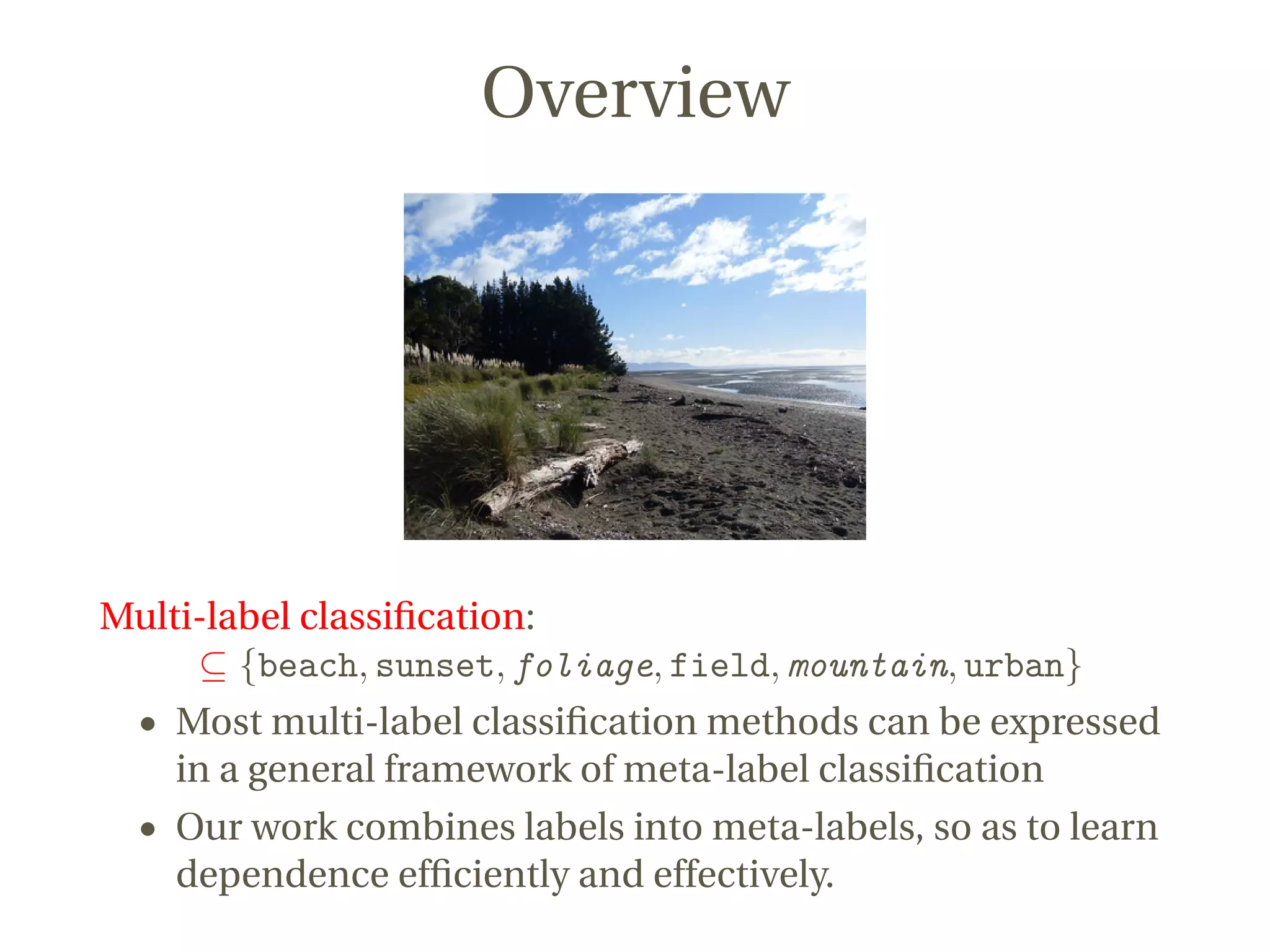
Multi-label classification:
⊆ {beach, sunset, foliage, field, mountain, urban}
• Most multi-label classification methods can be expressed
in a general framework of meta-label classification
• Our work combines labels into meta-labels, so as to learn
dependence efficiently and effectively.
Multi-label Learning
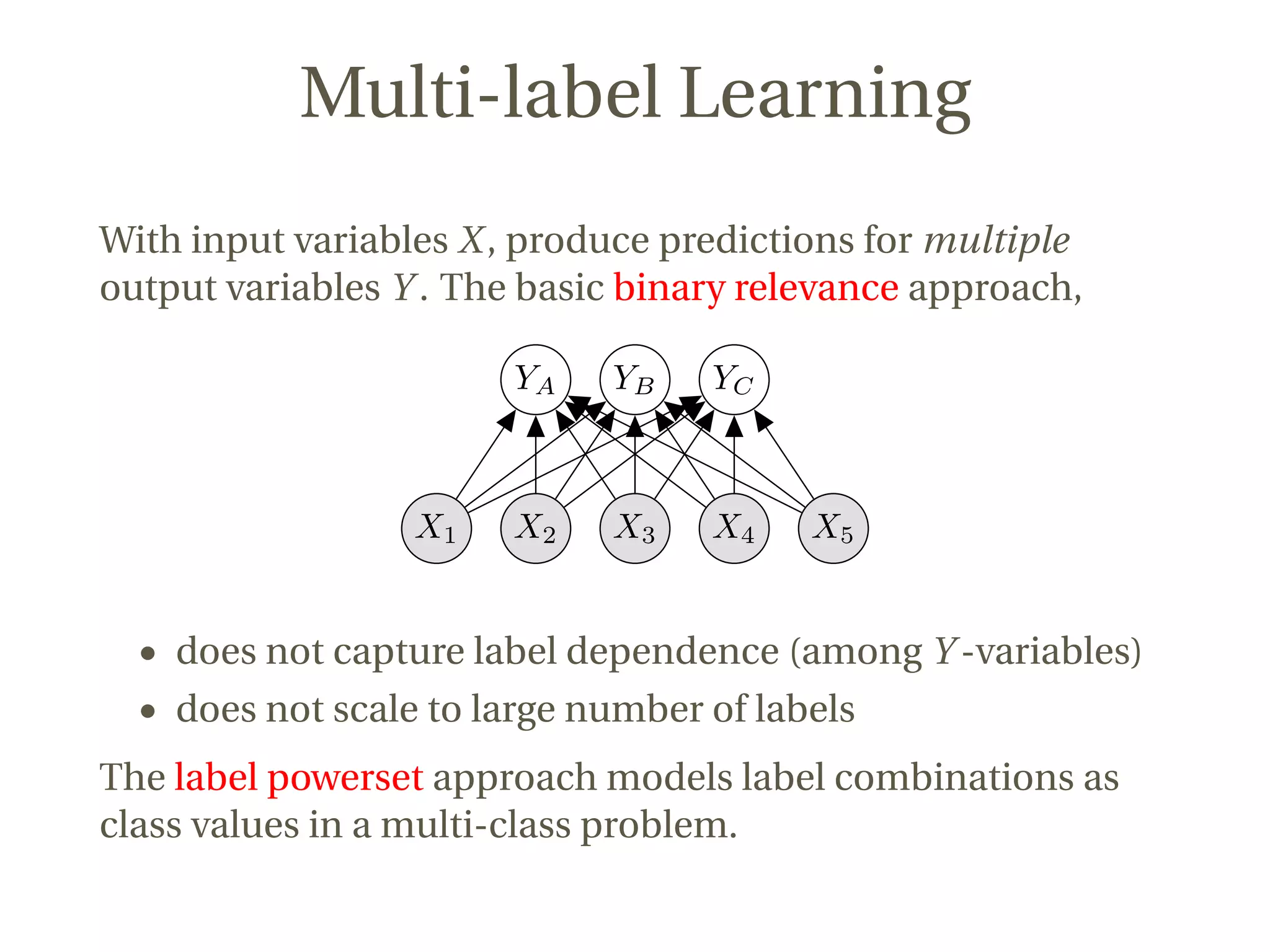
With input variables X, produce predictions for multiple
output variables Y . The basic binary relevance approach,
YCYBYA
X5X4X3X2X1
• does not capture label dependence (among Y -variables)
• does not scale to large number of labels
The label powerset approach models label combinations as
class values in a multi-class problem.
Meta Labels
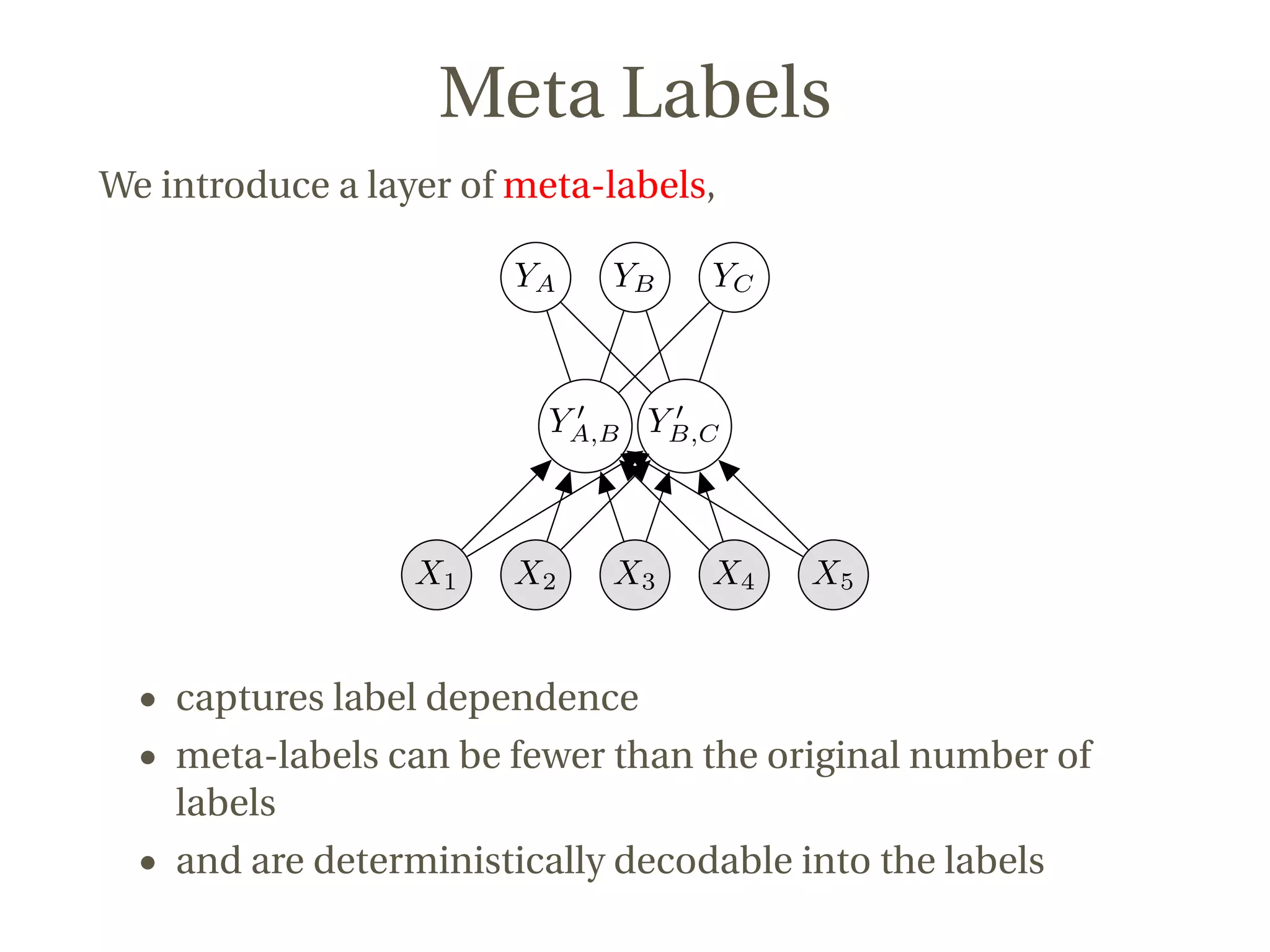
We introduce a layer of meta-labels,
YCYBYA
YB,CYA,B
X5X4X3X2X1
• captures label dependence
• meta-labels can be fewer than the original number of
labels
• and are deterministically decodable into the labels
Producing Meta Labels
dataset
instance labels
1 B
2 B,C
3 C
4 B
5 A,C
6 A,C
7 A,C
8 A,B,C
9 C
binary relevance
YA YB YC
0 1 0
0 1 1
0 0 1
0 1 0
1 0 1
1 0 1
1 0 1
1 1 1
0 0 1
label powerset
YA,B,C
B
BC
C
B
AC
AC
AC
ABC
C
meta labels
YA,C YB,C
∅ B
∅ BC
∅ C
∅ B
AC C
AC C
AC C
∅ BC
∅ C
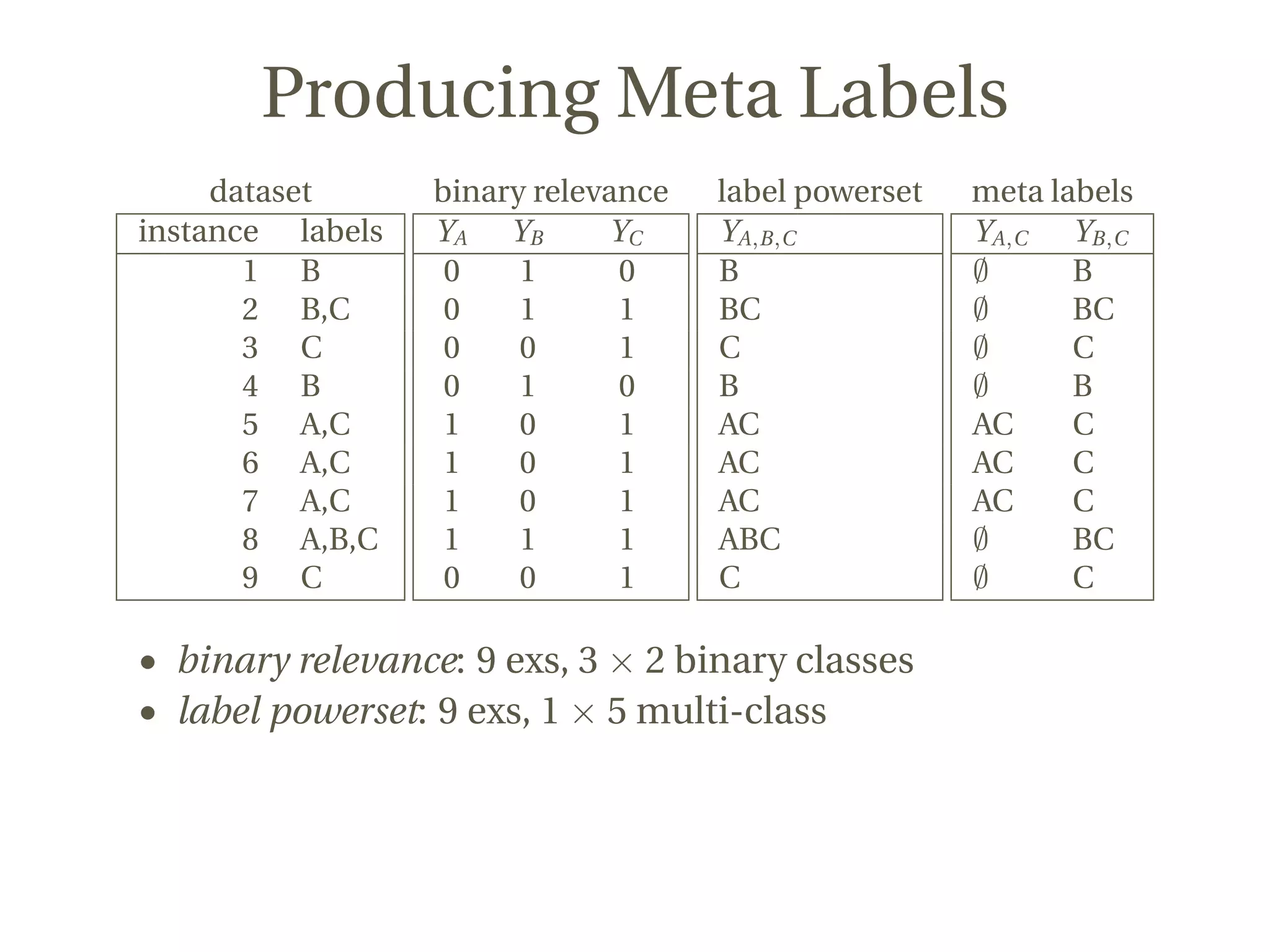
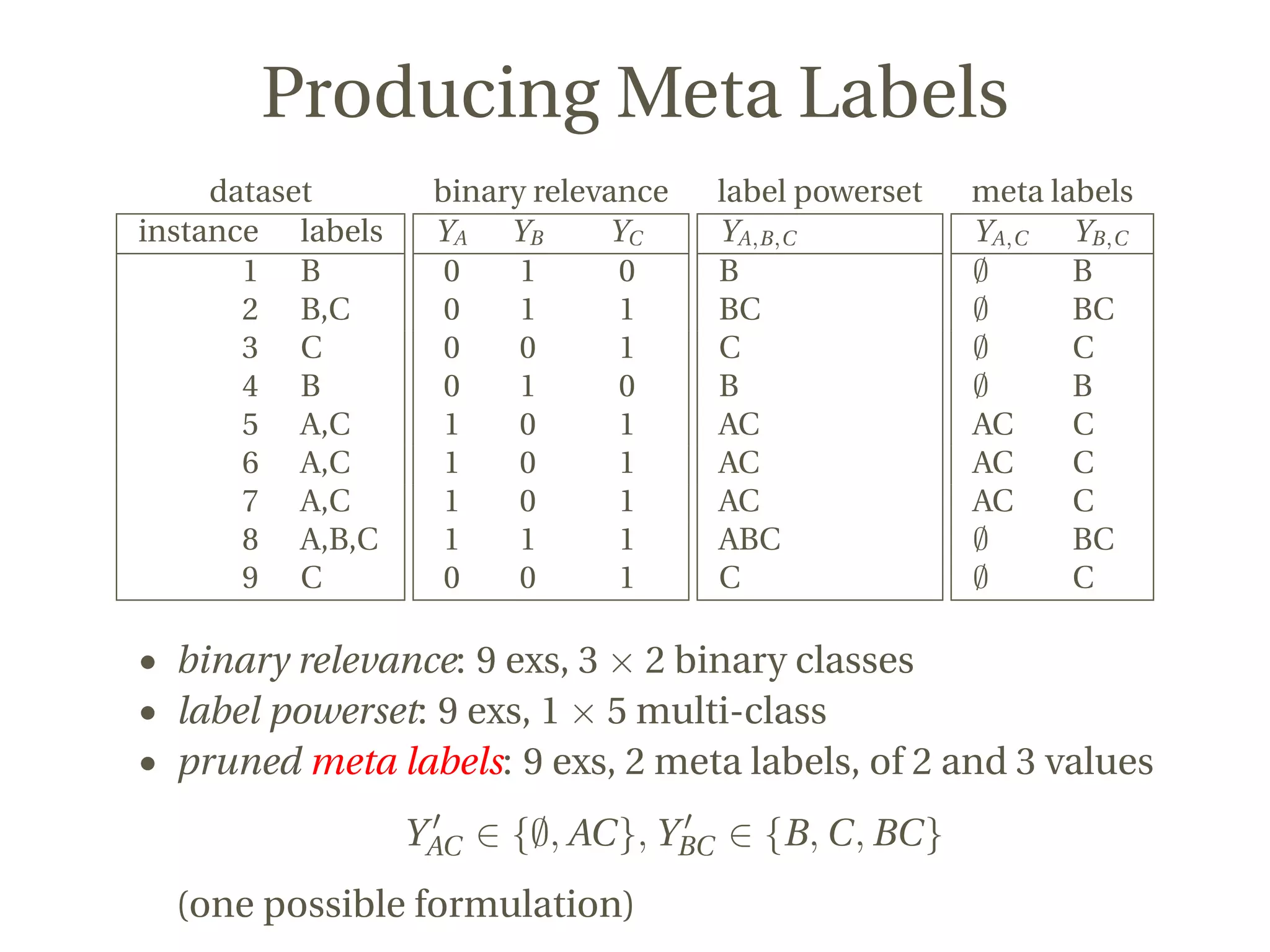
• binary relevance: 9 exs, 3 × 2 binary classes
• label powerset: 9 exs, 1 × 5 multi-class
Producing Meta Labels
dataset
instance labels
1 B
2 B,C
3 C
4 B
5 A,C
6 A,C
7 A,C
8 A,B,C
9 C
binary relevance
YA YB YC
0 1 0
0 1 1
0 0 1
0 1 0
1 0 1
1 0 1
1 0 1
1 1 1
0 0 1
label powerset
YA,B,C
B
BC
C
B
AC
AC
AC
ABC
C
meta labels
YA,C YB,C
∅ B
∅ BC
∅ C
∅ B
AC C
AC C
AC C
∅ BC
∅ C
• binary relevance: 9 exs, 3 × 2 binary classes
• label powerset: 9 exs, 1 × 5 multi-class
• pruned meta labels: 9 exs, 2 meta labels, of 2 and 3 values
YAC ∈ {∅, AC}, YBC ∈ {B, C, BC}
(one possible formulation)
Example 2
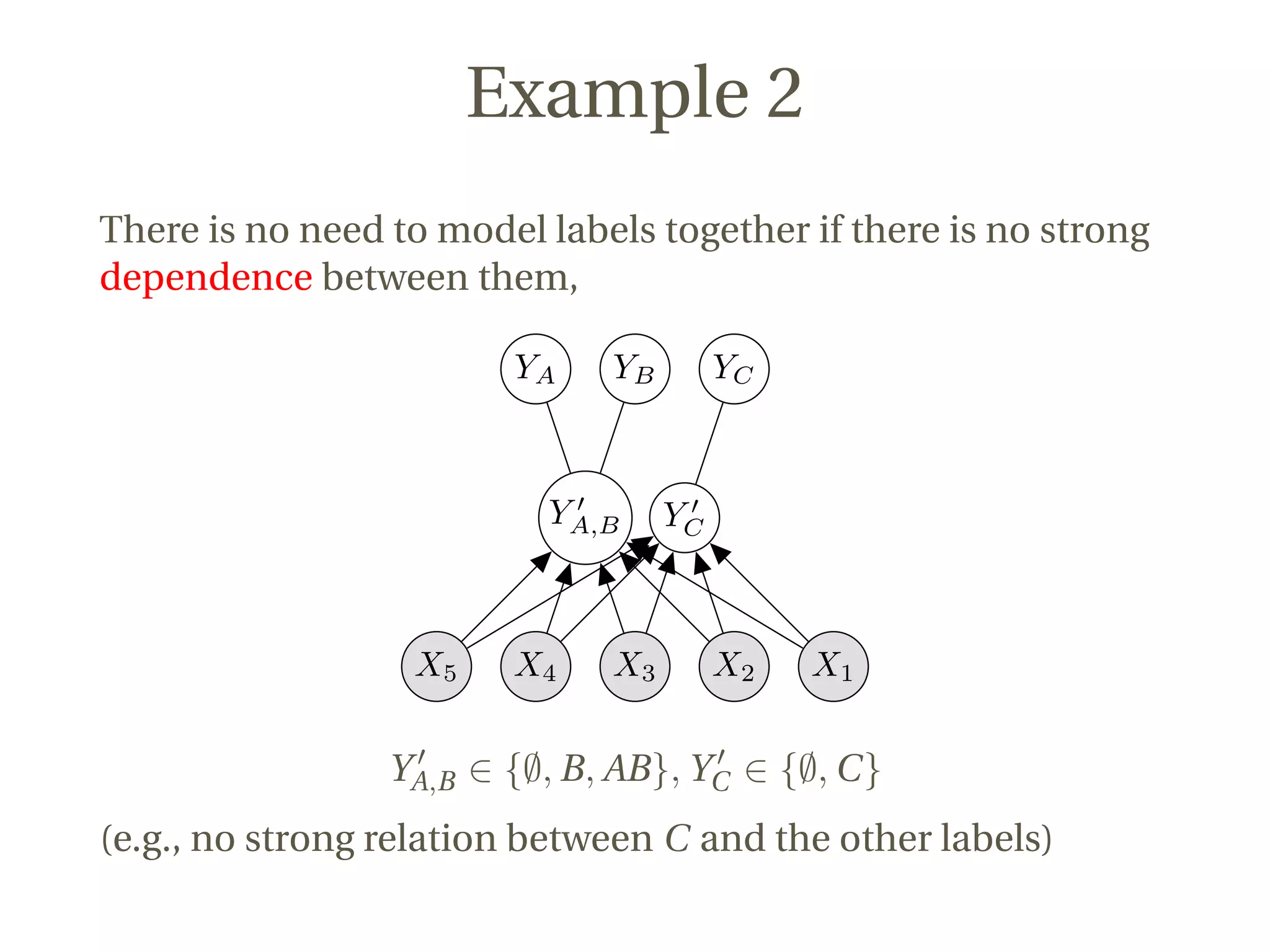
There is no need to model labels together if there is no strong
dependence between them,
YCYBYA
YCYA,B
X1X2X3X4X5
YA,B ∈ {∅, B, AB}, YC ∈ {∅, C}
(e.g., no strong relation between C and the other labels)
General process for
classification with meta-labels
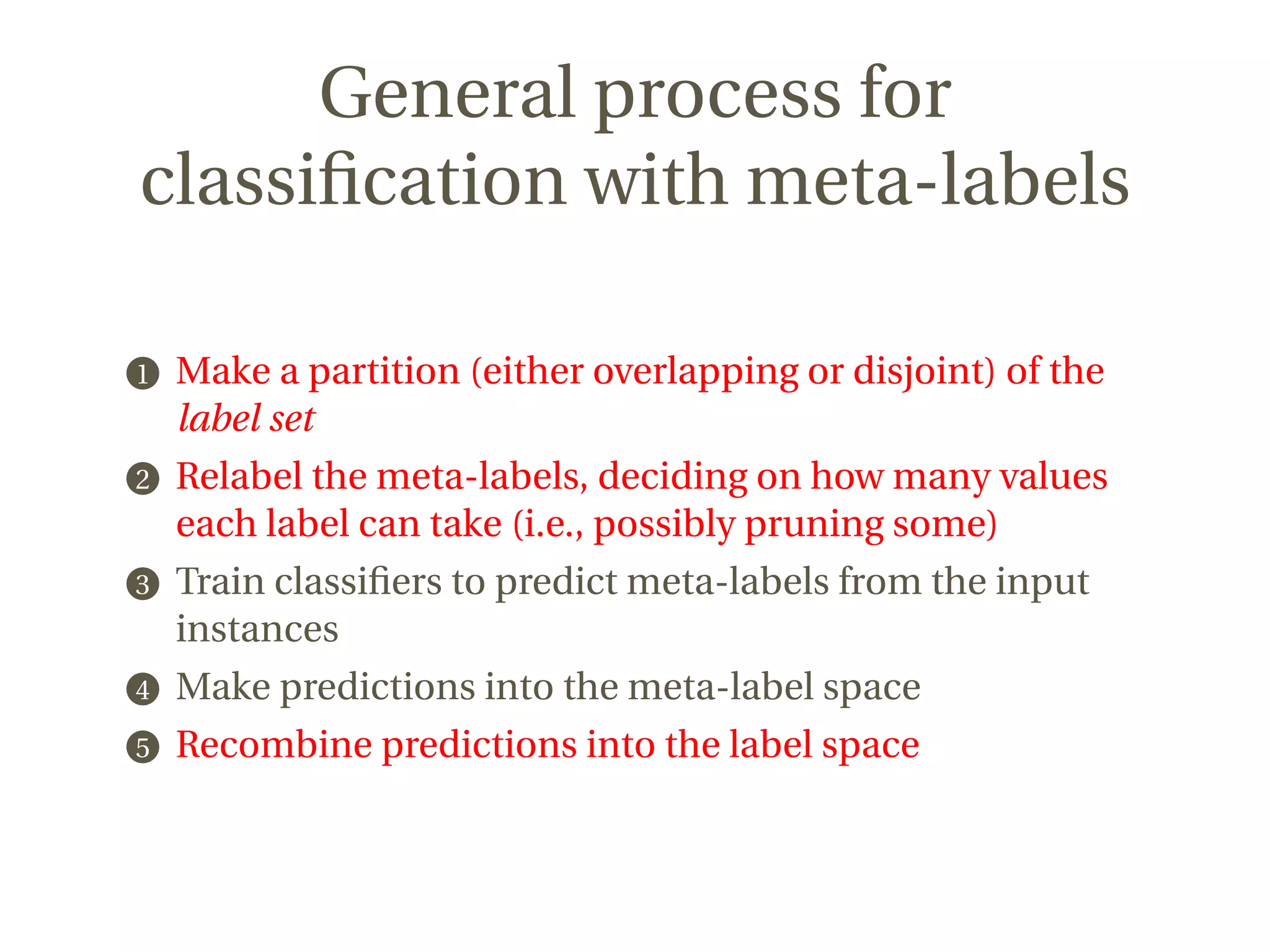
1 Make a partition (either overlapping or disjoint) of the
label set
2 Relabel the meta-labels, deciding on how many values
each label can take (i.e., possibly pruning some)
3 Train classifiers to predict meta-labels from the input
instances
4 Make predictions into the meta-label space
5 Recombine predictions into the label space
Voting Using Meta Labels
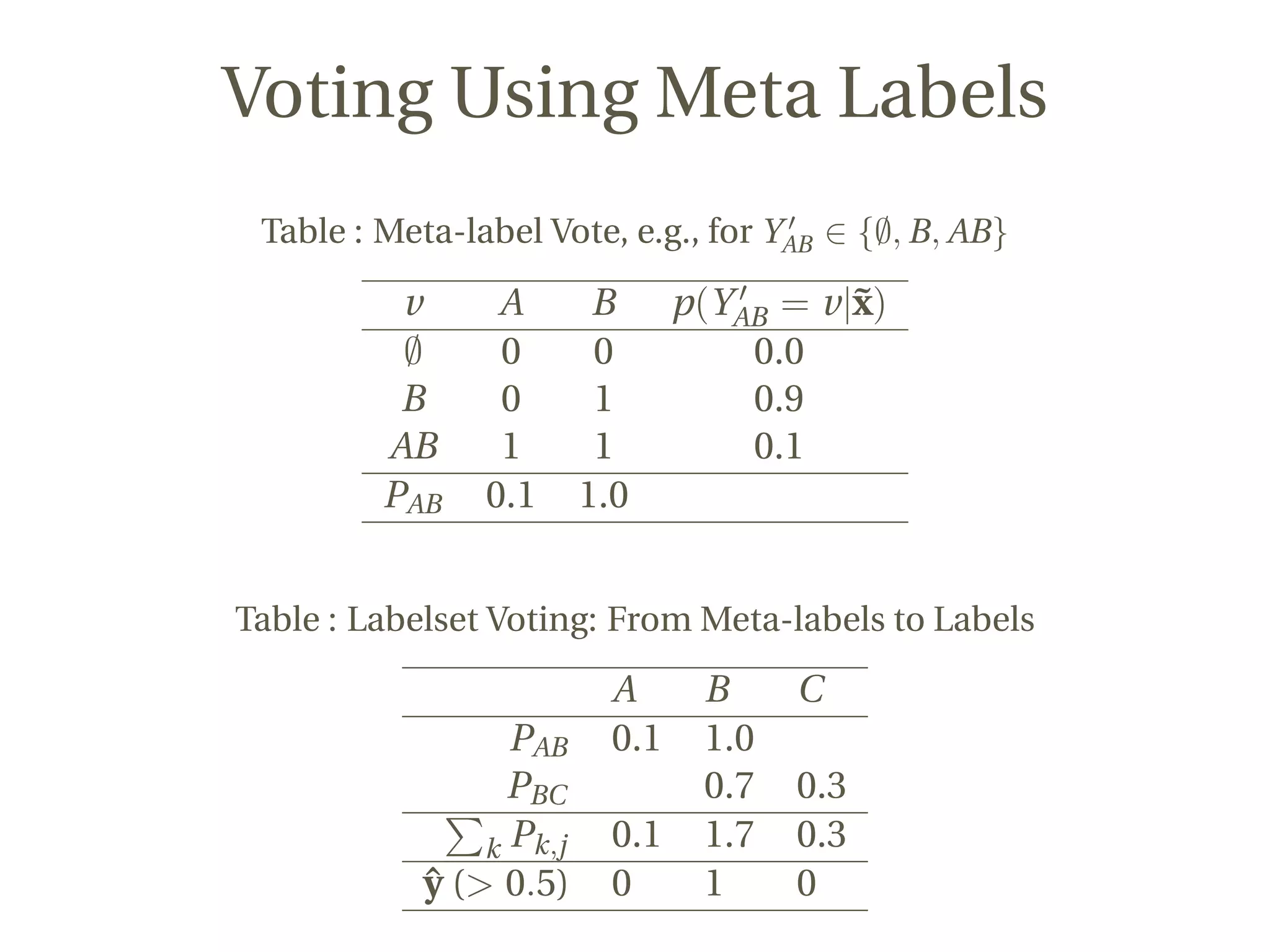
Table : Meta-label Vote, e.g., for YAB ∈ {∅, B, AB}
v A B p(YAB = v|˜x)
∅ 0 0 0.0
B 0 1 0.9
AB 1 1 0.1
PAB 0.1 1.0
Table : Labelset Voting: From Meta-labels to Labels
A B C
PAB 0.1 1.0
PBC 0.7 0.3
k Pk,j 0.1 1.7 0.3
ˆy (> 0.5) 0 1 0
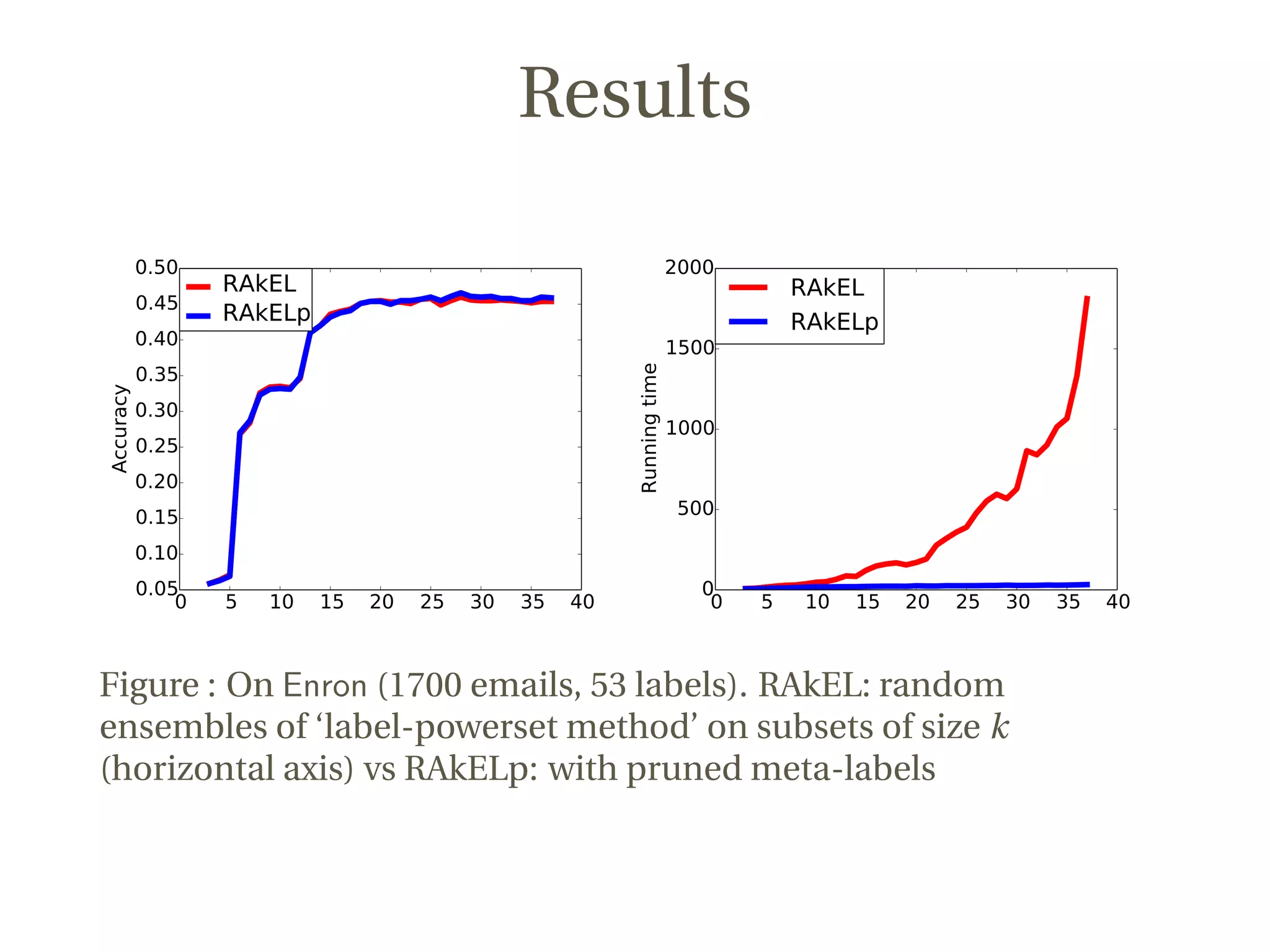
Results
0 5 10 15 20 25 30 35 400.05
0.10
0.15
0.20
0.25
0.30
0.35
0.40
0.45
0.50
Accuracy
RAkEL
RAkELp
0 5 10 15 20 25 30 35 400
500
1000
1500
2000
Runningtime
RAkEL
RAkELp
Figure : On Enron (1700 emails, 53 labels). RAkEL: random
ensembles of ‘label-powerset method’ on subsets of size k
(horizontal axis) vs RAkELp: with pruned meta-labels
Summary
• General framework of meta-labels for multi-label
classification
• Unifies various approaches from the literature
• New models RAkELp and EpRd have large improvement
in running time
• Part of solution for LSHTC4 (1st place) and WISE (2nd
Place) Kaggle challenges
• Code available at
http://meka.sourceforge.net
Multi-Label Classification with
Meta Labels
Jesse Read(1), Antti Puurula(2), Albert Bifet(3)
(1) Aalto University and HIIT, Finland
(2) University of Waikato, New Zealand
(3) Huawei Noah’s Ark Lab, Hong Kong
17 December 2014

Multi-label Classification with Meta-labels

  • 1.
    Multi-Label Classification with MetaLabels Jesse Read(1), Antti Puurula(2), Albert Bifet(3) (1) Aalto University and HIIT, Finland (2) University of Waikato, New Zealand (3) Huawei Noah’s Ark Lab, Hong Kong 17 December 2014
  • 2.
    Overview Multi-label classification: ⊆ {beach,sunset, foliage, field, mountain, urban} • Most multi-label classification methods can be expressed in a general framework of meta-label classification • Our work combines labels into meta-labels, so as to learn dependence efficiently and effectively.
  • 3.
    Multi-label Learning With inputvariables X, produce predictions for multiple output variables Y . The basic binary relevance approach, YCYBYA X5X4X3X2X1 • does not capture label dependence (among Y -variables) • does not scale to large number of labels The label powerset approach models label combinations as class values in a multi-class problem.
  • 4.
    Meta Labels We introducea layer of meta-labels, YCYBYA YB,CYA,B X5X4X3X2X1 • captures label dependence • meta-labels can be fewer than the original number of labels • and are deterministically decodable into the labels
  • 5.
    Producing Meta Labels dataset instancelabels 1 B 2 B,C 3 C 4 B 5 A,C 6 A,C 7 A,C 8 A,B,C 9 C binary relevance YA YB YC 0 1 0 0 1 1 0 0 1 0 1 0 1 0 1 1 0 1 1 0 1 1 1 1 0 0 1 label powerset YA,B,C B BC C B AC AC AC ABC C meta labels YA,C YB,C ∅ B ∅ BC ∅ C ∅ B AC C AC C AC C ∅ BC ∅ C • binary relevance: 9 exs, 3 × 2 binary classes • label powerset: 9 exs, 1 × 5 multi-class
  • 6.
    Producing Meta Labels dataset instancelabels 1 B 2 B,C 3 C 4 B 5 A,C 6 A,C 7 A,C 8 A,B,C 9 C binary relevance YA YB YC 0 1 0 0 1 1 0 0 1 0 1 0 1 0 1 1 0 1 1 0 1 1 1 1 0 0 1 label powerset YA,B,C B BC C B AC AC AC ABC C meta labels YA,C YB,C ∅ B ∅ BC ∅ C ∅ B AC C AC C AC C ∅ BC ∅ C • binary relevance: 9 exs, 3 × 2 binary classes • label powerset: 9 exs, 1 × 5 multi-class • pruned meta labels: 9 exs, 2 meta labels, of 2 and 3 values YAC ∈ {∅, AC}, YBC ∈ {B, C, BC} (one possible formulation)
  • 7.
    Example 2 There isno need to model labels together if there is no strong dependence between them, YCYBYA YCYA,B X1X2X3X4X5 YA,B ∈ {∅, B, AB}, YC ∈ {∅, C} (e.g., no strong relation between C and the other labels)
  • 8.
    General process for classificationwith meta-labels 1 Make a partition (either overlapping or disjoint) of the label set 2 Relabel the meta-labels, deciding on how many values each label can take (i.e., possibly pruning some) 3 Train classifiers to predict meta-labels from the input instances 4 Make predictions into the meta-label space 5 Recombine predictions into the label space
  • 9.
    Voting Using MetaLabels Table : Meta-label Vote, e.g., for YAB ∈ {∅, B, AB} v A B p(YAB = v|˜x) ∅ 0 0 0.0 B 0 1 0.9 AB 1 1 0.1 PAB 0.1 1.0 Table : Labelset Voting: From Meta-labels to Labels A B C PAB 0.1 1.0 PBC 0.7 0.3 k Pk,j 0.1 1.7 0.3 ˆy (> 0.5) 0 1 0
  • 10.
    Results 0 5 1015 20 25 30 35 400.05 0.10 0.15 0.20 0.25 0.30 0.35 0.40 0.45 0.50 Accuracy RAkEL RAkELp 0 5 10 15 20 25 30 35 400 500 1000 1500 2000 Runningtime RAkEL RAkELp Figure : On Enron (1700 emails, 53 labels). RAkEL: random ensembles of ‘label-powerset method’ on subsets of size k (horizontal axis) vs RAkELp: with pruned meta-labels
  • 11.
    Summary • General frameworkof meta-labels for multi-label classification • Unifies various approaches from the literature • New models RAkELp and EpRd have large improvement in running time • Part of solution for LSHTC4 (1st place) and WISE (2nd Place) Kaggle challenges • Code available at http://meka.sourceforge.net
  • 12.
    Multi-Label Classification with MetaLabels Jesse Read(1), Antti Puurula(2), Albert Bifet(3) (1) Aalto University and HIIT, Finland (2) University of Waikato, New Zealand (3) Huawei Noah’s Ark Lab, Hong Kong 17 December 2014