DEFINITION
• Accounting is an art of recording,
  classifying and summarizing in terms
  of money transactions and events of
  a financial character and interpreting
  the results thereof.
FUNCTIONS OF
         ACCOUNTING
•   Recording
•   Classification
•   Summarizing
•   Deals with financial transactions
•   Interprets
Types Of Accounting
         Information
•   Financial Accounting
•   Cost Accounting
•   Management Accounting
•   Tax Accounting
Financial Accounting
    Financial Accounting refers to
 information describing the financial
resources, obligations and activities of
         an economic entity.
Cost Accounting
   Function of cost accounting is to
ascertain the cost of a product and to
help the management in the control of
                 cost.
Management
        Accounting
It is accounting for the management i.e,
  accounting which provides necessary
   information to the management for
    discharging its functions. It is the
  reproduction of financial accounts in
       such a way as will enable the
 management to take decisions and to
            control activities.
Tax Accounting
The preparation of income tax returns is
a specialized field within accounting. To
a great extent, tax returns are based on
     financial accounting information.
    However the information often is
adjusted or reorganized to confirm with
   income tax reporting requirements .
CLASSIFICATION OF
        ACCOUNTS
•   Assets
•   Liabilities
•   Owner’s equity
•   Revenues
•   Expenses
Assets
   Assets means the resources of the
 business or the commodities possessed
by the business. E.g: land, building, cash,
         stock or inventory etc.
Liabilities
   Liabilities mean the claims of the
  suppliers of cash or commodities on
credit up to his/her balance due on the
 date. E.g: suppliers of goods and cash.
Owner’s equity
   It means the claims of owner of the
 business for his interest up to his/her
investment after finalizing the expenses
 and revenue up to the date. E.g: capital
         invested by the owner.
Revenue
  Revenue means any type of income
directly or indirectly of the business.
E.g: interest received, sale of goods,
          dividend received.
Expenses
Expenses means any type of expenses
directly or indirectly of the business.
E.g: rent expense, salary expense etc.
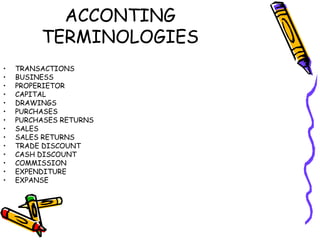
ACCONTING
         TERMINOLOGIES
•   TRANSACTIONS
•   BUSINESS
•   PROPERIETOR
•   CAPITAL
•   DRAWINGS
•   PURCHASES
•   PURCHASES RETURNS
•   SALES
•   SALES RETURNS
•   TRADE DISCOUNT
•   CASH DISCOUNT
•   COMMISSION
•   EXPENDITURE
•   EXPANSE
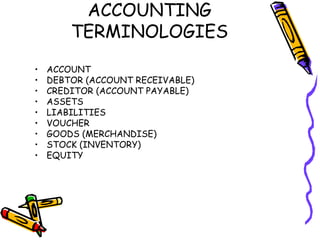
ACCOUNTING
        TERMINOLOGIES
•   ACCOUNT
•   DEBTOR (ACCOUNT RECEIVABLE)
•   CREDITOR (ACCOUNT PAYABLE)
•   ASSETS
•   LIABILITIES
•   VOUCHER
•   GOODS (MERCHANDISE)
•   STOCK (INVENTORY)
•   EQUITY
Transaction
Any dealing between two persons or
  things is a transaction. It may relate to
  purchase e.g sale of goods, receipt and
  payment of cash etc
• Cash transactions
• Credit transactions
Business
It includes any activity undertaken for
  the purpose of earning profit e.g
  banking business, insurance business
  etc
Proprietor
He is the owner of the business. He
 invests capital in it, gives his time
 & attention. He is entitled to
 receive the profit or bear loss
 arising.
Capital
The amount with which the trader
 starts his business or the amount
 which is actually invested in the
 business at any given time.
Drawings
The cash or goods taken away by the
 proprietors from the business for
 his personal use.
Purchases
Goods purchased are called
   purchases.
• Cash purchases
• Credit purchases
Purchases Returns
If goods purchased are found
  defective or unsatisfactory, they
  are returned to the persons from
  whome they were purchased or to
  suppliers.
Sales
Goods sold are called sales.
• Cash sales
• Credit sales
Sales return
If a person to whome goods have
  been sold finds that they are
  defective or unsatisfactory &
  returns them are called sales
  return or returns inward.
Trade Discount
It is rebate or allowance from the
  scheduled price granted by the
  seller to the buyer.
Cash Discount
It is the deduction or allowance
  allowed by a creditor to a debtor.
Commission
It is the form of remuneration for
  the services rendered by one
  person to another.
Expenditure
An expenditure takes place when
 assets or services are acquired.
Expense
An expenditure whose benefit is
 finished or enjoyed immediately
 such as salaries, rent etc.
Account
A summarize record of transactions
 relating to a person or thing is
 called an account.
Debtor
A person who owes money to another is
 a debtor.
Creditor
A person who pays out something or
 to whome money is owing is a
 creditor.
Assets
These are the things of value
 possessed by a trader such as
 building, land, machinery, furniyure
 etc
Liabilities
They are debts due by a business to its
 proprietor & others.
Voucher
Any written evidence in support of a
 business transaction is called a
 voucher.
Goods (Merchandise)
It includes all merchandise
  commodities which are purchased
  by a business for selling.
Stock (Inventory)
Goods or merchandise on hand, that
 is goods remaining unsold is called
 stock, stack in trade or
 inventory.
Equity
A claim can be enforced against the
 assets of the film is called equity.
Recommended book
• Accounting by MEIGSWILLIAMS
  HAKA BETTNER

Accounting

  • 2.
    DEFINITION • Accounting isan art of recording, classifying and summarizing in terms of money transactions and events of a financial character and interpreting the results thereof.
  • 3.
    FUNCTIONS OF ACCOUNTING • Recording • Classification • Summarizing • Deals with financial transactions • Interprets
  • 4.
    Types Of Accounting Information • Financial Accounting • Cost Accounting • Management Accounting • Tax Accounting
  • 5.
    Financial Accounting Financial Accounting refers to information describing the financial resources, obligations and activities of an economic entity.
  • 6.
    Cost Accounting Function of cost accounting is to ascertain the cost of a product and to help the management in the control of cost.
  • 7.
    Management Accounting It is accounting for the management i.e, accounting which provides necessary information to the management for discharging its functions. It is the reproduction of financial accounts in such a way as will enable the management to take decisions and to control activities.
  • 8.
    Tax Accounting The preparationof income tax returns is a specialized field within accounting. To a great extent, tax returns are based on financial accounting information. However the information often is adjusted or reorganized to confirm with income tax reporting requirements .
  • 9.
    CLASSIFICATION OF ACCOUNTS • Assets • Liabilities • Owner’s equity • Revenues • Expenses
  • 10.
    Assets Assets means the resources of the business or the commodities possessed by the business. E.g: land, building, cash, stock or inventory etc.
  • 11.
    Liabilities Liabilities mean the claims of the suppliers of cash or commodities on credit up to his/her balance due on the date. E.g: suppliers of goods and cash.
  • 12.
    Owner’s equity It means the claims of owner of the business for his interest up to his/her investment after finalizing the expenses and revenue up to the date. E.g: capital invested by the owner.
  • 13.
    Revenue Revenuemeans any type of income directly or indirectly of the business. E.g: interest received, sale of goods, dividend received.
  • 14.
    Expenses Expenses means anytype of expenses directly or indirectly of the business. E.g: rent expense, salary expense etc.
  • 15.
    ACCONTING TERMINOLOGIES • TRANSACTIONS • BUSINESS • PROPERIETOR • CAPITAL • DRAWINGS • PURCHASES • PURCHASES RETURNS • SALES • SALES RETURNS • TRADE DISCOUNT • CASH DISCOUNT • COMMISSION • EXPENDITURE • EXPANSE
  • 16.
    ACCOUNTING TERMINOLOGIES • ACCOUNT • DEBTOR (ACCOUNT RECEIVABLE) • CREDITOR (ACCOUNT PAYABLE) • ASSETS • LIABILITIES • VOUCHER • GOODS (MERCHANDISE) • STOCK (INVENTORY) • EQUITY
  • 17.
    Transaction Any dealing betweentwo persons or things is a transaction. It may relate to purchase e.g sale of goods, receipt and payment of cash etc • Cash transactions • Credit transactions
  • 18.
    Business It includes anyactivity undertaken for the purpose of earning profit e.g banking business, insurance business etc
  • 19.
    Proprietor He is theowner of the business. He invests capital in it, gives his time & attention. He is entitled to receive the profit or bear loss arising.
  • 20.
    Capital The amount withwhich the trader starts his business or the amount which is actually invested in the business at any given time.
  • 21.
    Drawings The cash orgoods taken away by the proprietors from the business for his personal use.
  • 22.
    Purchases Goods purchased arecalled purchases. • Cash purchases • Credit purchases
  • 23.
    Purchases Returns If goodspurchased are found defective or unsatisfactory, they are returned to the persons from whome they were purchased or to suppliers.
  • 24.
    Sales Goods sold arecalled sales. • Cash sales • Credit sales
  • 25.
    Sales return If aperson to whome goods have been sold finds that they are defective or unsatisfactory & returns them are called sales return or returns inward.
  • 26.
    Trade Discount It isrebate or allowance from the scheduled price granted by the seller to the buyer.
  • 27.
    Cash Discount It isthe deduction or allowance allowed by a creditor to a debtor.
  • 28.
    Commission It is theform of remuneration for the services rendered by one person to another.
  • 29.
    Expenditure An expenditure takesplace when assets or services are acquired.
  • 30.
    Expense An expenditure whosebenefit is finished or enjoyed immediately such as salaries, rent etc.
  • 31.
    Account A summarize recordof transactions relating to a person or thing is called an account.
  • 32.
    Debtor A person whoowes money to another is a debtor.
  • 33.
    Creditor A person whopays out something or to whome money is owing is a creditor.
  • 34.
    Assets These are thethings of value possessed by a trader such as building, land, machinery, furniyure etc
  • 35.
    Liabilities They are debtsdue by a business to its proprietor & others.
  • 36.
    Voucher Any written evidencein support of a business transaction is called a voucher.
  • 37.
    Goods (Merchandise) It includesall merchandise commodities which are purchased by a business for selling.
  • 38.
    Stock (Inventory) Goods ormerchandise on hand, that is goods remaining unsold is called stock, stack in trade or inventory.
  • 39.
    Equity A claim canbe enforced against the assets of the film is called equity.
  • 40.
    Recommended book • Accountingby MEIGSWILLIAMS HAKA BETTNER