



WELCOME
PROMOTING FINANCIAL INCLUSION –
Issues & Challenges
Presentation BY
Dr. S. V. Shinde
Associate Professor
D.A.V. Velankar College of Commerce,
Solapur.
Presentation Objective :-
To explain the nature, scope, issues,
dimensions and challenges of financial
inclusion in India.
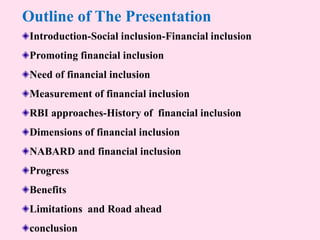
Outline of The Presentation
Introduction-Social inclusion-Financial inclusion
Promoting financial inclusion
Need of financial inclusion
Measurement of financial inclusion
RBI approaches-History of financial inclusion
Dimensions of financial inclusion
NABARD and financial inclusion
Progress
Benefits
Limitations and Road ahead
conclusion
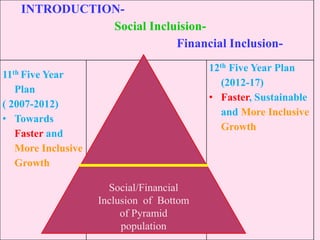
INTRODUCTION-
Social Incluision-
Financial Inclusion-
11th Five Year
Plan
( 2007-2012)
• Towards
Faster and
More Inclusive
Growth
12th Five Year Plan
(2012-17)
• Faster, Sustainable
and More Inclusive
Growth
Social/Financial
Inclusion of Bottom
of Pyramid
population
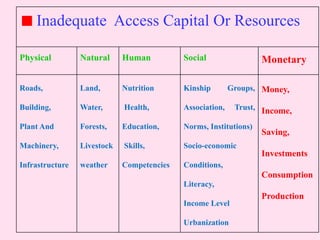
Inadequate Access Capital Or Resources
Physical Natural Human Social Monetary
Roads,
Building,
Plant And
Machinery,
Infrastructure
Land,
Water,
Forests,
Livestock
weather
Nutrition
Health,
Education,
Skills,
Competencies
Kinship Groups,
Association, Trust,
Norms, Institutions)
Socio-economic
Conditions,
Literacy,
Income Level
Urbanization
Money,
Income,
Saving,
Investments
Consumption
Production
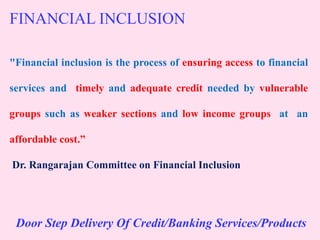
FINANCIAL INCLUSION
"Financial inclusion is the process of ensuring access to financial
services and timely and adequate credit needed by vulnerable
groups such as weaker sections and low income groups at an
affordable cost.”
Dr. Rangarajan Committee on Financial Inclusion
Door Step Delivery Of Credit/Banking Services/Products
source-cricil
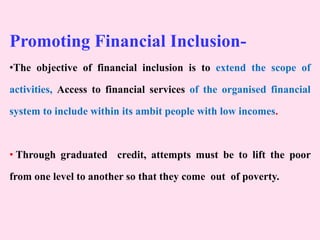
Promoting Financial Inclusion-
•The objective of financial inclusion is to extend the scope of
activities, Access to financial services of the organised financial
system to include within its ambit people with low incomes.
• Through graduated credit, attempts must be to lift the poor
from one level to another so that they come out of poverty.
Dr. Rangarajan Committee on Financial Inclusion
Dr.Usha Thorat Committee on Financial Inclusion
Prof.Raghuram G.Rajan’s Governor, RBI
Nachiket Mor committee Committee on Financial
Inclusion
CRISIL Report on Financial Inclusion
Jan-Dhan 15-8-2014
Kofi Annan
Former UN
Secretary-General
According to Former UN Secretary-General
Kofi Annan, “The stark reality is that most poor
people in the world still lack access to
sustainable financial services, whether it is
savings, credit or insurance. The great challenge
before us is to address the constraints that
exclude people from full participation in the
financial sector. Together, we can and must build
inclusive financial sectors that help people
improve their lives.”
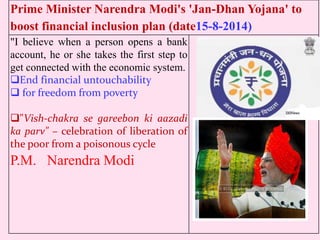
Prime Minister Narendra Modi's 'Jan-Dhan Yojana' to
boost financial inclusion plan (date15-8-2014)
"I believe when a person opens a bank
account, he or she takes the first step to
get connected with the economic system.
End financial untouchability
 for freedom from poverty
"Vish-chakra se gareebon ki aazadi
ka parv" – celebration of liberation of
the poor from a poisonous cycle
P.M. Narendra Modi
Financial untouchability must come to an end
To compalate bank-account-for-all program by jan 26
Rs.30 THOUSAND life cover over and above Rs.1 lakh
accident insurance
Accounts opened before Jan 26 to come with Rs.30 thousand
life cover
Bank account wiil give the poor ammunition to fight poverty
Financial inclusion best way to alleviate poverty
A day of records for insurance industry, with 1.5 cr new a/c
Bank plan to give overdraft facility under Jan Dhan Yojana
Govt plans to bring 7.5 cr people under banking services this year
Around 10 cr people are not covered by the banking system
DR. MANMOHAN SINGH
“For growth to be truly inclusive, banking
must reach out to many more people than
it reaches now.”
RBI must remain committed to further
expansion of banking services so that
banks can touch the lives of more and
more of our ordinary people….”
– 'Dainik Bhaskar Financial Inclusion Conclave
2012’
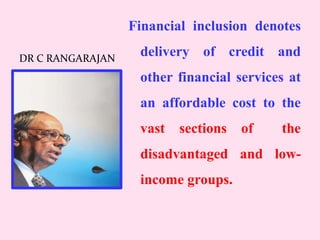
Financial inclusion denotes
delivery of credit and
other financial services at
an affordable cost to the
vast sections of the
disadvantaged and low-
income groups.
DR C RANGARAJAN
Need of Financial Inclusion-
NO Transaction account
NO Time Deposits
NO Financial Advice
NO Appropriate small credit
NO Insurance
NO Mortgage Loans
NO Superannuation
NO Enterprise based loan
ESSENTIALS OF FINANCIAL INCLUSION
Banks have to reach at –
The bottom of the pyramid
Last mile stone
Remote corners
Unreached villages
Across untraveled roads
Underprivileged segments
5 A’S OF ENSURING FINANCIAL INCLUSION
Adequacy,
Availability.
Awareness of financial services
Affordability
Accessibility
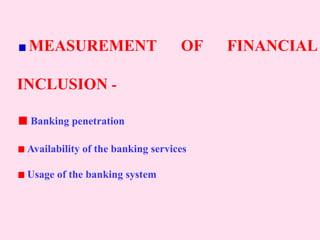
MEASUREMENT OF FINANCIAL
INCLUSION -
Banking penetration
Availability of the banking services
Usage of the banking system
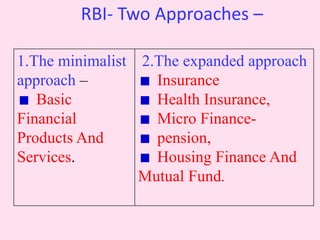
RBI- Two Approaches –
1.The minimalist
approach –
Basic
Financial
Products And
Services.
2.The expanded approach
Insurance
Health Insurance,
Micro Finance-
pension,
Housing Finance And
Mutual Fund.
The Financial Inclusion -Four Core
Dimensions-
[i] What is provided-
[ii] How it is provided-
[iii] Who receives it-
[iv] Who provides it-
[i] What Is Provided:-
1.The first step:- :Awareness
2.Opening of Account :Empowerment
3.Smart Card :Providing Identity
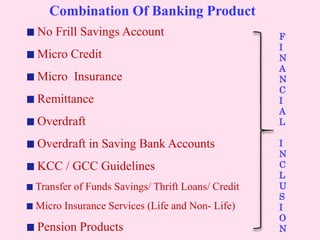
Combination Of Banking Product
No Frill Savings Account
Micro Credit
Micro Insurance
Remittance
Overdraft
Overdraft in Saving Bank Accounts
KCC / GCC Guidelines
Transfer of Funds Savings/ Thrift Loans/ Credit
Micro Insurance Services (Life and Non- Life)
Pension Products
F
I
N
A
N
C
I
A
L
I
N
C
L
U
S
I
O
N
[II] How It Is Provided:-
With Quality
Convenience
Affordability,
Safety and Dignity of Treatment
Client Protection.
Adequacy,
Availability.
Accessibility
[iii] Who Receives It:-Who are excluded ?
Poor
Women
Farmers
Disabled
Uneducated
Un-employed
Ethnic Minorities
Physically challenged people
Old people as well as children
Agricultural and Industrial Labourers
People engaged in un-organised sectors
Socially under-privileged in rural and urban areas
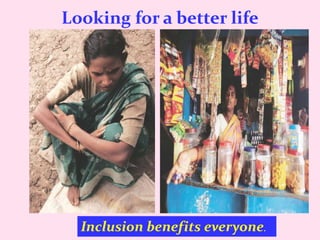
Looking for a better life
Inclusion benefits everyone.
Looking for a better life
"Growth will be irrelevant if it excludes the poor."
P. Chidambaram,
Looking for a better life
IV-Who Provides It-
GOI & RBI-
THE BANK FOR EVERYONE
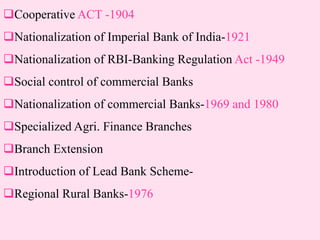
Cooperative ACT -1904
Nationalization of Imperial Bank of India-1921
Nationalization of RBI-Banking Regulation Act -1949
Social control of commercial Banks
Nationalization of commercial Banks-1969 and 1980
Specialized Agri. Finance Branches
Branch Extension
Introduction of Lead Bank Scheme-
Regional Rural Banks-1976
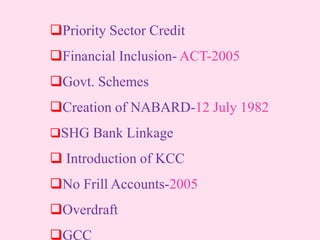
Priority Sector Credit
Financial Inclusion- ACT-2005
Govt. Schemes
Creation of NABARD-12 July 1982
SHG Bank Linkage
 Introduction of KCC
No Frill Accounts-2005
Overdraft
GCC
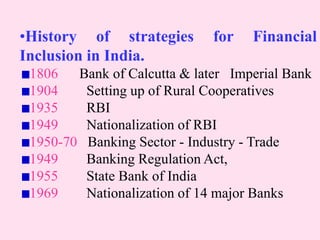
•History of strategies for Financial
Inclusion in India.
1806 Bank of Calcutta & later Imperial Bank
1904 Setting up of Rural Cooperatives
1935 RBI
1949 Nationalization of RBI
1950-70 Banking Sector - Industry - Trade
1949 Banking Regulation Act,
1955 State Bank of India
1969 Nationalization of 14 major Banks
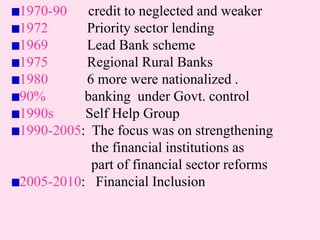
1970-90 credit to neglected and weaker
1972 Priority sector lending
1969 Lead Bank scheme
1975 Regional Rural Banks
1980 6 more were nationalized .
90% banking under Govt. control
1990s Self Help Group
1990-2005: The focus was on strengthening
the financial institutions as
part of financial sector reforms
2005-2010: Financial Inclusion
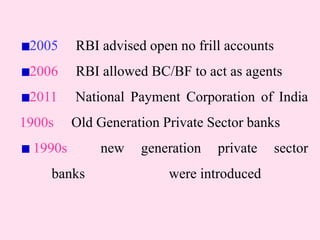
2005 RBI advised open no frill accounts
2006 RBI allowed BC/BF to act as agents
2011 National Payment Corporation of India
1900s Old Generation Private Sector banks
1990s new generation private sector
banks were introduced
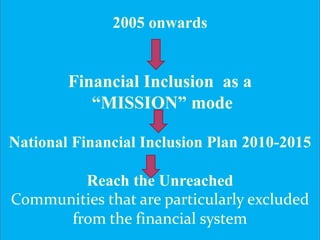
2005 onwards
Financial Inclusion as a
“MISSION” mode
National Financial Inclusion Plan 2010-2015
Reach the Unreached
Communities that are particularly excluded
from the financial system
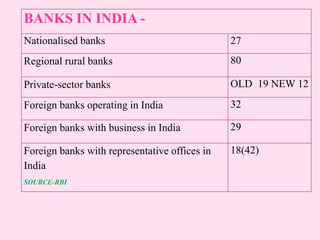
BANKS IN INDIA -
Nationalised banks 27
Regional rural banks 80
Private-sector banks OLD 19 NEW 12
Foreign banks operating in India 32
Foreign banks with business in India 29
Foreign banks with representative offices in
India
SOURCE-RBI
18(42)
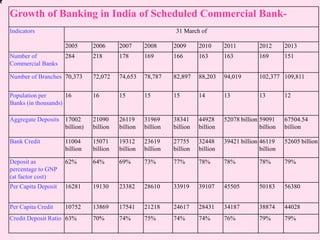
Growth of Banking in India of Scheduled Commercial Bank-
Indicators 31 March of
2005 2006 2007 2008 2009 2010 2011 2012 2013
Number of
Commercial Banks
284 218 178 169 166 163 163 169 151
Number of Branches 70,373 72,072 74,653 78,787 82,897 88,203 94,019 102,377 109,811
Population per
Banks (in thousands)
16 16 15 15 15 14 13 13 12
Aggregate Deposits 17002
billion)
21090
billion
26119
billion
31969
billion
38341
billion
44928
billion
52078 billion 59091
billion
67504.54
billion
Bank Credit 11004
billion
15071
billion
19312
billion
23619
billion
27755
billion
32448
billion
39421 billion 46119
billion
52605 billion
Deposit as
percentage to GNP
(at factor cost)
62% 64% 69% 73% 77% 78% 78% 78% 79%
Per Capita Deposit 16281 19130 23382 28610 33919 39107 45505 50183 56380
Per Capita Credit 10752 13869 17541 21218 24617 28431 34187 38874 44028
Credit Deposit Ratio 63% 70% 74% 75% 74% 74% 76% 79% 79%
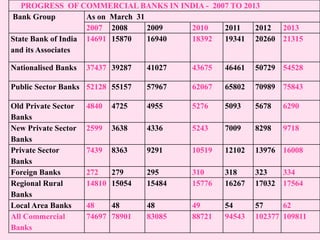
PROGRESS OF COMMERCIAL BANKS IN INDIA - 2007 TO 2013
Bank Group As on March 31
2007 2008 2009 2010 2011 2012 2013
State Bank of India
and its Associates
14691 15870 16940 18392 19341 20260 21315
Nationalised Banks 37437 39287 41027 43675 46461 50729 54528
Public Sector Banks 52128 55157 57967 62067 65802 70989 75843
Old Private Sector
Banks
4840 4725 4955 5276 5093 5678 6290
New Private Sector
Banks
2599 3638 4336 5243 7009 8298 9718
Private Sector
Banks
7439 8363 9291 10519 12102 13976 16008
Foreign Banks 272 279 295 310 318 323 334
Regional Rural
Banks
14810 15054 15484 15776 16267 17032 17564
Local Area Banks 48 48 48 49 54 57 62
All Commercial
Banks
74697 78901 83085 88721 94543 102377 109811
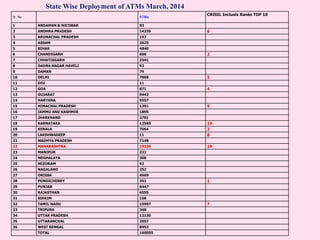
Sr. No ATMs
CRISIL Inclusix Ranks TOP 10
1 ANDAMAN & NICOBAR 93
2 ANDHRA PRADESH 14339 6
3 ARUNACHAL PRADESH 157
4 ASSAM 2625
5 BIHAR 4840
6 CHANDIGARH 606 2
7 CHHATISGARH 2541
8 DADRA NAGAR HAVELI 92
9 DAMAN 79
10 DELHI 7868 5
11 DIU 11
12 GOA 871 4
13 GUJARAT 9443
14 HARYANA 5557
15 HIMACHAL PRADESH 1391 9
16 JAMMU AND KASHMIR 1895
17 JHARKHAND 2781
18 KARNATAKA 12585 10
19 KERALA 7064 3
20 LAKSHWADEEP 11 8
21 MADHYA PRADESH 7148
22 MAHARASHTRA 19220 19
23 MANIPUR 221
24 MEGHALAYA 308
25 MIZORAM 92
26 NAGALAND 252
27 ORISSA 4669
28 PONDICHERRY 351 1
29 PUNJAB 6447
30 RAJASTHAN 6555
31 SIKKIM 158
32 TAMIL NADU 15997 7
33 TRIPURA 348
34 UTTAR PRADESH 12130
35 UTTARANCHAL 2057
36 WEST BENGAL 8953
TOTAL 160055
State Wise Deployment of ATMs March, 2014
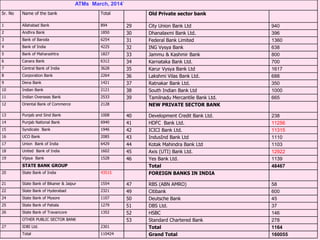
ATMs March, 2014`
Sr. No Name of the bank Total Old Private sector bank
1 Allahabad Bank 894 29 City Union Bank Ltd 940
2 Andhra Bank 1850 30 Dhanalaxmi Bank Ltd. 396
3 Bank of Baroda 6254 31 Federal Bank Limited 1360
4 Bank of India 4225 32 ING Vysya Bank 638
5 Bank of Maharashtra 1827 33 Jammu & Kashmir Bank 800
6 Canara Bank 6312 34 Karnataka Bank Ltd. 700
7 Central Bank of India 3628 35 Karur Vysya Bank Ltd 1617
8 Corporation Bank 2264 36 Lakshmi Vilas Bank Ltd. 688
9 Dena Bank 1421 37 Ratnakar Bank Ltd. 350
10 Indian Bank 2121 38 South Indian Bank Ltd 1000
11 Indian Overseas Bank 2533 39 Tamilnadu Mercantile Bank Ltd. 665
12 Oriental Bank of Commerce 2128 NEW PRIVATE SECTOR BANK
13 Punjab and Sind Bank 1008 40 Development Credit Bank Ltd. 238
14 Punjab National Bank 6940 41 HDFC Bank Ltd. 11256
15 Syndicate Bank 1946 42 ICICI Bank Ltd. 11315
16 UCO Bank 2085 43 IndusInd Bank Ltd 1110
17 Union Bank of India 6429 44 Kotak Mahindra Bank Ltd 1103
18 United Bank of India 1602 45 Axis (UTI) Bank Ltd. 12922
19 Vijaya Bank 1528 46 Yes Bank Ltd. 1139
STATE BANK GROUP Total 48467
20 State Bank of India 43515 FOREIGN BANKS IN INDIA
21 State Bank of Bikaner & Jaipur 1554 47 RBS (ABN AMRO) 58
22 State Bank of Hyderabad 2321 49 Citibank 600
24 State Bank of Mysore 1107 50 Deutsche Bank 45
25 State Bank of Patiala 1279 51 DBS Ltd. 37
26 State Bank of Travancore 1352 52 HSBC 146
OTHER PUBLIC SECTOR BANK 53 Standard Chartered Bank 278
27 IDBI Ltd. 2301 Total 1164
Total 110424 Grand Total 160055
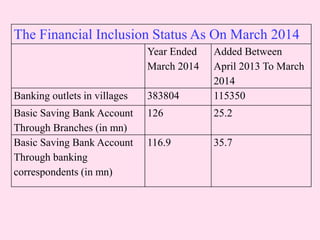
The Financial Inclusion Status As On March 2014
Year Ended
March 2014
Added Between
April 2013 To March
2014
Banking outlets in villages 383804 115350
Basic Saving Bank Account
Through Branches (in mn)
126 25.2
Basic Saving Bank Account
Through banking
correspondents (in mn)
116.9 35.7
NABARD-FINANCIAL INCLUSION
•NABARD focuses on technology up
gradation, capacity building and financial
literacy for greater financial inclusion.
•‘Financial Literacy through Audio Visual
medium— Doordarshan
•Farmers’ Club as – RRBs
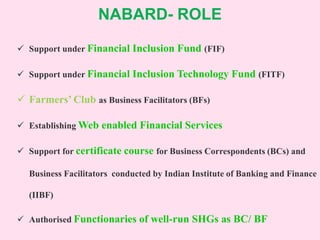
NABARD- ROLE
 Support under Financial Inclusion Fund (FIF)
 Support under Financial Inclusion Technology Fund (FITF)
 Farmers’ Club as Business Facilitators (BFs)
 Establishing Web enabled Financial Services
 Support for certificate course for Business Correspondents (BCs) and
Business Facilitators conducted by Indian Institute of Banking and Finance
(IIBF)
 Authorised Functionaries of well-run SHGs as BC/ BF
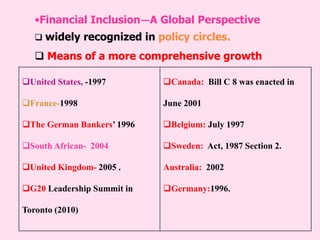
•Financial Inclusion—A Global Perspective
 widely recognized in policy circles.
 Means of a more comprehensive growth
United States, -1997
France-1998
The German Bankers’ 1996
South African- 2004
United Kingdom- 2005 .
G20 Leadership Summit in
Toronto (2010)
Canada: Bill C 8 was enacted in
June 2001
Belgium: July 1997
Sweden: Act, 1987 Section 2.
Australia: 2002
Germany:1996.
BENEFITS OF FINANCIAL INCLUSION
For The Common Man–
To The Economy As A Whole
For The Banker–
For The Govt.
For The RBI
For Technology Providers
For Benefits To Intermediaries
For the Common Man
Susceptibility to cash flow disruptions
Ability to face business cycles
Income and interest
long-term financial security and planning
Help during mergencies like hospitalization and medical bills
Safety and security of capital; and many more
Smoothing consumption
Safety of assets from major disruptions
Rational utilization of saving
Freedom from clutches of moneylenders
Increase in risk taking ability;
Use Of skill -Improved self esteem-Enlarges livelihood opportunities
 Benefits to the Economy as a whole
Financial inclusion is likely to result into number of benefits for
Indian economy as a whole.
Additional savings –
Boosting economic resources;
Lead to overall economic growth;
Possibility of tracking individuals financial history ;
better utilization of consumers protection mechanism ;
high level of financial literacy;
Chance to achieve faster growth in the country
For the banker–
Expansion of banking business
Expansion of bank branch network
Achieving access to a large untapped pool of customers
The low cost deposits will offer banks the opportunity
Huge opportunity for the banks to cross sell asset products, micro
insurance (both life & non-life),micro pension products, etc.
 For the Govt.
Higher and better productivity
Faster growth in economy
Reduction in income inequalities
Reduction in poverty
Increase in national income
Increase in employment and income opportunities
Help in more effective distribution of subsidies
Helpful in implementation of social security schemes,
Helpful in direct distribution of subsidies
Better distribution channels.
For the RBI
Spread of banking culture and extension
Implementation of state and central government schemes
and programmes
Consumer protection
Protect the interest of all other stakeholders
Purposeful direction to achieve larger societal goals.
 Limits Access To Financial Services
Low income & literacy levels
Nil or low savings -Lack of awareness
Unemployment/Under Employment
Use of inappropriate products
Financial illiteracy
Indigenous/ethnic issues
Geographical remoteness
Lack of time
Psychological / disability issues
Non-availability of a bank branch
Remote, hilly area
Higher transaction cost – unaffordable.
Perception of financial services as complicated
Banks do not prefer low income people
Other factors include gender,
Age,Legal entity,
Place of living,
Physical and cultural barriers,
Type of occupation etc.
KYC – documentary proof of identity/ address
Lack of awareness,
low income,
social exclusion
Distance from bank branch,
Branch timings
staff attitude are common reasons
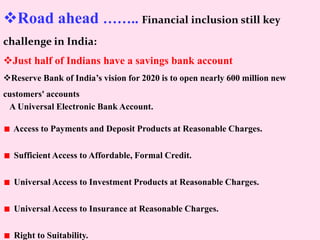
Road ahead …….. Financial inclusion still key
challenge in India:
Just half of Indians have a savings bank account
Reserve Bank of India’s vision for 2020 is to open nearly 600 million new
customers' accounts
A Universal Electronic Bank Account.
Access to Payments and Deposit Products at Reasonable Charges.
Sufficient Access to Affordable, Formal Credit.
Universal Access to Investment Products at Reasonable Charges.
Universal Access to Insurance at Reasonable Charges.
Right to Suitability.
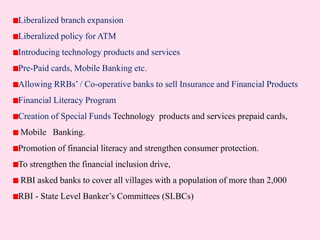
Liberalized branch expansion
Liberalized policy for ATM
Introducing technology products and services
Pre-Paid cards, Mobile Banking etc.
Allowing RRBs’ / Co-operative banks to sell Insurance and Financial Products
Financial Literacy Program
Creation of Special Funds Technology products and services prepaid cards,
Mobile Banking.
Promotion of financial literacy and strengthen consumer protection.
To strengthen the financial inclusion drive,
RBI asked banks to cover all villages with a population of more than 2,000
RBI - State Level Banker’s Committees (SLBCs)
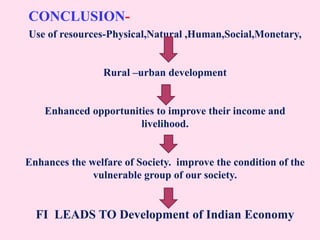
CONCLUSION-
Use of resources-Physical,Natural ,Human,Social,Monetary,
Rural –urban development
Enhanced opportunities to improve their income and
livelihood.
Enhances the welfare of Society. improve the condition of the
vulnerable group of our society.
FI LEADS TO Development of Indian Economy
Financial Inclusion is a powerful
accelerator of economic progress, and can
help to achieve the goals of eliminating
extreme poverty and financial
untouchability.
Financial inclusion drives out poverty
Thank You..,
One and All

Financial inclusion

  • 1.
    WELCOME PROMOTING FINANCIAL INCLUSION– Issues & Challenges Presentation BY Dr. S. V. Shinde Associate Professor D.A.V. Velankar College of Commerce, Solapur.
  • 2.
    Presentation Objective :- Toexplain the nature, scope, issues, dimensions and challenges of financial inclusion in India.
  • 3.
    Outline of ThePresentation Introduction-Social inclusion-Financial inclusion Promoting financial inclusion Need of financial inclusion Measurement of financial inclusion RBI approaches-History of financial inclusion Dimensions of financial inclusion NABARD and financial inclusion Progress Benefits Limitations and Road ahead conclusion
  • 4.
    INTRODUCTION- Social Incluision- Financial Inclusion- 11thFive Year Plan ( 2007-2012) • Towards Faster and More Inclusive Growth 12th Five Year Plan (2012-17) • Faster, Sustainable and More Inclusive Growth Social/Financial Inclusion of Bottom of Pyramid population
  • 5.
    Inadequate Access CapitalOr Resources Physical Natural Human Social Monetary Roads, Building, Plant And Machinery, Infrastructure Land, Water, Forests, Livestock weather Nutrition Health, Education, Skills, Competencies Kinship Groups, Association, Trust, Norms, Institutions) Socio-economic Conditions, Literacy, Income Level Urbanization Money, Income, Saving, Investments Consumption Production
  • 6.
    FINANCIAL INCLUSION "Financial inclusionis the process of ensuring access to financial services and timely and adequate credit needed by vulnerable groups such as weaker sections and low income groups at an affordable cost.” Dr. Rangarajan Committee on Financial Inclusion Door Step Delivery Of Credit/Banking Services/Products
  • 7.
  • 8.
    Promoting Financial Inclusion- •Theobjective of financial inclusion is to extend the scope of activities, Access to financial services of the organised financial system to include within its ambit people with low incomes. • Through graduated credit, attempts must be to lift the poor from one level to another so that they come out of poverty.
  • 9.
    Dr. Rangarajan Committeeon Financial Inclusion Dr.Usha Thorat Committee on Financial Inclusion Prof.Raghuram G.Rajan’s Governor, RBI Nachiket Mor committee Committee on Financial Inclusion CRISIL Report on Financial Inclusion Jan-Dhan 15-8-2014
  • 10.
    Kofi Annan Former UN Secretary-General Accordingto Former UN Secretary-General Kofi Annan, “The stark reality is that most poor people in the world still lack access to sustainable financial services, whether it is savings, credit or insurance. The great challenge before us is to address the constraints that exclude people from full participation in the financial sector. Together, we can and must build inclusive financial sectors that help people improve their lives.”
  • 11.
    Prime Minister NarendraModi's 'Jan-Dhan Yojana' to boost financial inclusion plan (date15-8-2014) "I believe when a person opens a bank account, he or she takes the first step to get connected with the economic system. End financial untouchability  for freedom from poverty "Vish-chakra se gareebon ki aazadi ka parv" – celebration of liberation of the poor from a poisonous cycle P.M. Narendra Modi
  • 12.
    Financial untouchability mustcome to an end To compalate bank-account-for-all program by jan 26 Rs.30 THOUSAND life cover over and above Rs.1 lakh accident insurance Accounts opened before Jan 26 to come with Rs.30 thousand life cover Bank account wiil give the poor ammunition to fight poverty Financial inclusion best way to alleviate poverty A day of records for insurance industry, with 1.5 cr new a/c Bank plan to give overdraft facility under Jan Dhan Yojana Govt plans to bring 7.5 cr people under banking services this year Around 10 cr people are not covered by the banking system
  • 13.
    DR. MANMOHAN SINGH “Forgrowth to be truly inclusive, banking must reach out to many more people than it reaches now.” RBI must remain committed to further expansion of banking services so that banks can touch the lives of more and more of our ordinary people….” – 'Dainik Bhaskar Financial Inclusion Conclave 2012’
  • 14.
    Financial inclusion denotes deliveryof credit and other financial services at an affordable cost to the vast sections of the disadvantaged and low- income groups. DR C RANGARAJAN
  • 15.
    Need of FinancialInclusion- NO Transaction account NO Time Deposits NO Financial Advice NO Appropriate small credit NO Insurance NO Mortgage Loans NO Superannuation NO Enterprise based loan
  • 16.
    ESSENTIALS OF FINANCIALINCLUSION Banks have to reach at – The bottom of the pyramid Last mile stone Remote corners Unreached villages Across untraveled roads Underprivileged segments
  • 17.
    5 A’S OFENSURING FINANCIAL INCLUSION Adequacy, Availability. Awareness of financial services Affordability Accessibility
  • 18.
    MEASUREMENT OF FINANCIAL INCLUSION- Banking penetration Availability of the banking services Usage of the banking system
  • 19.
    RBI- Two Approaches– 1.The minimalist approach – Basic Financial Products And Services. 2.The expanded approach Insurance Health Insurance, Micro Finance- pension, Housing Finance And Mutual Fund.
  • 20.
    The Financial Inclusion-Four Core Dimensions- [i] What is provided- [ii] How it is provided- [iii] Who receives it- [iv] Who provides it-
  • 21.
    [i] What IsProvided:- 1.The first step:- :Awareness 2.Opening of Account :Empowerment 3.Smart Card :Providing Identity
  • 22.
    Combination Of BankingProduct No Frill Savings Account Micro Credit Micro Insurance Remittance Overdraft Overdraft in Saving Bank Accounts KCC / GCC Guidelines Transfer of Funds Savings/ Thrift Loans/ Credit Micro Insurance Services (Life and Non- Life) Pension Products F I N A N C I A L I N C L U S I O N
  • 23.
    [II] How ItIs Provided:- With Quality Convenience Affordability, Safety and Dignity of Treatment Client Protection. Adequacy, Availability. Accessibility
  • 24.
    [iii] Who ReceivesIt:-Who are excluded ? Poor Women Farmers Disabled Uneducated Un-employed Ethnic Minorities Physically challenged people Old people as well as children Agricultural and Industrial Labourers People engaged in un-organised sectors Socially under-privileged in rural and urban areas
  • 25.
    Looking for abetter life Inclusion benefits everyone.
  • 26.
    Looking for abetter life "Growth will be irrelevant if it excludes the poor." P. Chidambaram,
  • 27.
    Looking for abetter life
  • 28.
    IV-Who Provides It- GOI& RBI- THE BANK FOR EVERYONE
  • 29.
    Cooperative ACT -1904 Nationalizationof Imperial Bank of India-1921 Nationalization of RBI-Banking Regulation Act -1949 Social control of commercial Banks Nationalization of commercial Banks-1969 and 1980 Specialized Agri. Finance Branches Branch Extension Introduction of Lead Bank Scheme- Regional Rural Banks-1976
  • 30.
    Priority Sector Credit FinancialInclusion- ACT-2005 Govt. Schemes Creation of NABARD-12 July 1982 SHG Bank Linkage  Introduction of KCC No Frill Accounts-2005 Overdraft GCC
  • 31.
    •History of strategiesfor Financial Inclusion in India. 1806 Bank of Calcutta & later Imperial Bank 1904 Setting up of Rural Cooperatives 1935 RBI 1949 Nationalization of RBI 1950-70 Banking Sector - Industry - Trade 1949 Banking Regulation Act, 1955 State Bank of India 1969 Nationalization of 14 major Banks
  • 32.
    1970-90 credit toneglected and weaker 1972 Priority sector lending 1969 Lead Bank scheme 1975 Regional Rural Banks 1980 6 more were nationalized . 90% banking under Govt. control 1990s Self Help Group 1990-2005: The focus was on strengthening the financial institutions as part of financial sector reforms 2005-2010: Financial Inclusion
  • 33.
    2005 RBI advisedopen no frill accounts 2006 RBI allowed BC/BF to act as agents 2011 National Payment Corporation of India 1900s Old Generation Private Sector banks 1990s new generation private sector banks were introduced
  • 34.
    2005 onwards Financial Inclusionas a “MISSION” mode National Financial Inclusion Plan 2010-2015 Reach the Unreached Communities that are particularly excluded from the financial system
  • 35.
    BANKS IN INDIA- Nationalised banks 27 Regional rural banks 80 Private-sector banks OLD 19 NEW 12 Foreign banks operating in India 32 Foreign banks with business in India 29 Foreign banks with representative offices in India SOURCE-RBI 18(42)
  • 36.
    Growth of Bankingin India of Scheduled Commercial Bank- Indicators 31 March of 2005 2006 2007 2008 2009 2010 2011 2012 2013 Number of Commercial Banks 284 218 178 169 166 163 163 169 151 Number of Branches 70,373 72,072 74,653 78,787 82,897 88,203 94,019 102,377 109,811 Population per Banks (in thousands) 16 16 15 15 15 14 13 13 12 Aggregate Deposits 17002 billion) 21090 billion 26119 billion 31969 billion 38341 billion 44928 billion 52078 billion 59091 billion 67504.54 billion Bank Credit 11004 billion 15071 billion 19312 billion 23619 billion 27755 billion 32448 billion 39421 billion 46119 billion 52605 billion Deposit as percentage to GNP (at factor cost) 62% 64% 69% 73% 77% 78% 78% 78% 79% Per Capita Deposit 16281 19130 23382 28610 33919 39107 45505 50183 56380 Per Capita Credit 10752 13869 17541 21218 24617 28431 34187 38874 44028 Credit Deposit Ratio 63% 70% 74% 75% 74% 74% 76% 79% 79%
  • 37.
    PROGRESS OF COMMERCIALBANKS IN INDIA - 2007 TO 2013 Bank Group As on March 31 2007 2008 2009 2010 2011 2012 2013 State Bank of India and its Associates 14691 15870 16940 18392 19341 20260 21315 Nationalised Banks 37437 39287 41027 43675 46461 50729 54528 Public Sector Banks 52128 55157 57967 62067 65802 70989 75843 Old Private Sector Banks 4840 4725 4955 5276 5093 5678 6290 New Private Sector Banks 2599 3638 4336 5243 7009 8298 9718 Private Sector Banks 7439 8363 9291 10519 12102 13976 16008 Foreign Banks 272 279 295 310 318 323 334 Regional Rural Banks 14810 15054 15484 15776 16267 17032 17564 Local Area Banks 48 48 48 49 54 57 62 All Commercial Banks 74697 78901 83085 88721 94543 102377 109811
  • 38.
    Sr. No ATMs CRISILInclusix Ranks TOP 10 1 ANDAMAN & NICOBAR 93 2 ANDHRA PRADESH 14339 6 3 ARUNACHAL PRADESH 157 4 ASSAM 2625 5 BIHAR 4840 6 CHANDIGARH 606 2 7 CHHATISGARH 2541 8 DADRA NAGAR HAVELI 92 9 DAMAN 79 10 DELHI 7868 5 11 DIU 11 12 GOA 871 4 13 GUJARAT 9443 14 HARYANA 5557 15 HIMACHAL PRADESH 1391 9 16 JAMMU AND KASHMIR 1895 17 JHARKHAND 2781 18 KARNATAKA 12585 10 19 KERALA 7064 3 20 LAKSHWADEEP 11 8 21 MADHYA PRADESH 7148 22 MAHARASHTRA 19220 19 23 MANIPUR 221 24 MEGHALAYA 308 25 MIZORAM 92 26 NAGALAND 252 27 ORISSA 4669 28 PONDICHERRY 351 1 29 PUNJAB 6447 30 RAJASTHAN 6555 31 SIKKIM 158 32 TAMIL NADU 15997 7 33 TRIPURA 348 34 UTTAR PRADESH 12130 35 UTTARANCHAL 2057 36 WEST BENGAL 8953 TOTAL 160055 State Wise Deployment of ATMs March, 2014
  • 39.
    ATMs March, 2014` Sr.No Name of the bank Total Old Private sector bank 1 Allahabad Bank 894 29 City Union Bank Ltd 940 2 Andhra Bank 1850 30 Dhanalaxmi Bank Ltd. 396 3 Bank of Baroda 6254 31 Federal Bank Limited 1360 4 Bank of India 4225 32 ING Vysya Bank 638 5 Bank of Maharashtra 1827 33 Jammu & Kashmir Bank 800 6 Canara Bank 6312 34 Karnataka Bank Ltd. 700 7 Central Bank of India 3628 35 Karur Vysya Bank Ltd 1617 8 Corporation Bank 2264 36 Lakshmi Vilas Bank Ltd. 688 9 Dena Bank 1421 37 Ratnakar Bank Ltd. 350 10 Indian Bank 2121 38 South Indian Bank Ltd 1000 11 Indian Overseas Bank 2533 39 Tamilnadu Mercantile Bank Ltd. 665 12 Oriental Bank of Commerce 2128 NEW PRIVATE SECTOR BANK 13 Punjab and Sind Bank 1008 40 Development Credit Bank Ltd. 238 14 Punjab National Bank 6940 41 HDFC Bank Ltd. 11256 15 Syndicate Bank 1946 42 ICICI Bank Ltd. 11315 16 UCO Bank 2085 43 IndusInd Bank Ltd 1110 17 Union Bank of India 6429 44 Kotak Mahindra Bank Ltd 1103 18 United Bank of India 1602 45 Axis (UTI) Bank Ltd. 12922 19 Vijaya Bank 1528 46 Yes Bank Ltd. 1139 STATE BANK GROUP Total 48467 20 State Bank of India 43515 FOREIGN BANKS IN INDIA 21 State Bank of Bikaner & Jaipur 1554 47 RBS (ABN AMRO) 58 22 State Bank of Hyderabad 2321 49 Citibank 600 24 State Bank of Mysore 1107 50 Deutsche Bank 45 25 State Bank of Patiala 1279 51 DBS Ltd. 37 26 State Bank of Travancore 1352 52 HSBC 146 OTHER PUBLIC SECTOR BANK 53 Standard Chartered Bank 278 27 IDBI Ltd. 2301 Total 1164 Total 110424 Grand Total 160055
  • 40.
    The Financial InclusionStatus As On March 2014 Year Ended March 2014 Added Between April 2013 To March 2014 Banking outlets in villages 383804 115350 Basic Saving Bank Account Through Branches (in mn) 126 25.2 Basic Saving Bank Account Through banking correspondents (in mn) 116.9 35.7
  • 41.
    NABARD-FINANCIAL INCLUSION •NABARD focuseson technology up gradation, capacity building and financial literacy for greater financial inclusion. •‘Financial Literacy through Audio Visual medium— Doordarshan •Farmers’ Club as – RRBs
  • 42.
    NABARD- ROLE  Supportunder Financial Inclusion Fund (FIF)  Support under Financial Inclusion Technology Fund (FITF)  Farmers’ Club as Business Facilitators (BFs)  Establishing Web enabled Financial Services  Support for certificate course for Business Correspondents (BCs) and Business Facilitators conducted by Indian Institute of Banking and Finance (IIBF)  Authorised Functionaries of well-run SHGs as BC/ BF
  • 43.
    •Financial Inclusion—A GlobalPerspective  widely recognized in policy circles.  Means of a more comprehensive growth United States, -1997 France-1998 The German Bankers’ 1996 South African- 2004 United Kingdom- 2005 . G20 Leadership Summit in Toronto (2010) Canada: Bill C 8 was enacted in June 2001 Belgium: July 1997 Sweden: Act, 1987 Section 2. Australia: 2002 Germany:1996.
  • 44.
    BENEFITS OF FINANCIALINCLUSION For The Common Man– To The Economy As A Whole For The Banker– For The Govt. For The RBI For Technology Providers For Benefits To Intermediaries
  • 45.
    For the CommonMan Susceptibility to cash flow disruptions Ability to face business cycles Income and interest long-term financial security and planning Help during mergencies like hospitalization and medical bills Safety and security of capital; and many more Smoothing consumption Safety of assets from major disruptions Rational utilization of saving Freedom from clutches of moneylenders Increase in risk taking ability; Use Of skill -Improved self esteem-Enlarges livelihood opportunities
  • 46.
     Benefits tothe Economy as a whole Financial inclusion is likely to result into number of benefits for Indian economy as a whole. Additional savings – Boosting economic resources; Lead to overall economic growth; Possibility of tracking individuals financial history ; better utilization of consumers protection mechanism ; high level of financial literacy; Chance to achieve faster growth in the country
  • 47.
    For the banker– Expansionof banking business Expansion of bank branch network Achieving access to a large untapped pool of customers The low cost deposits will offer banks the opportunity Huge opportunity for the banks to cross sell asset products, micro insurance (both life & non-life),micro pension products, etc.
  • 48.
     For theGovt. Higher and better productivity Faster growth in economy Reduction in income inequalities Reduction in poverty Increase in national income Increase in employment and income opportunities Help in more effective distribution of subsidies Helpful in implementation of social security schemes, Helpful in direct distribution of subsidies Better distribution channels.
  • 49.
    For the RBI Spreadof banking culture and extension Implementation of state and central government schemes and programmes Consumer protection Protect the interest of all other stakeholders Purposeful direction to achieve larger societal goals.
  • 50.
     Limits AccessTo Financial Services Low income & literacy levels Nil or low savings -Lack of awareness Unemployment/Under Employment Use of inappropriate products Financial illiteracy Indigenous/ethnic issues Geographical remoteness Lack of time Psychological / disability issues Non-availability of a bank branch Remote, hilly area Higher transaction cost – unaffordable.
  • 51.
    Perception of financialservices as complicated Banks do not prefer low income people Other factors include gender, Age,Legal entity, Place of living, Physical and cultural barriers, Type of occupation etc. KYC – documentary proof of identity/ address Lack of awareness, low income, social exclusion Distance from bank branch, Branch timings staff attitude are common reasons
  • 52.
    Road ahead ……..Financial inclusion still key challenge in India: Just half of Indians have a savings bank account Reserve Bank of India’s vision for 2020 is to open nearly 600 million new customers' accounts A Universal Electronic Bank Account. Access to Payments and Deposit Products at Reasonable Charges. Sufficient Access to Affordable, Formal Credit. Universal Access to Investment Products at Reasonable Charges. Universal Access to Insurance at Reasonable Charges. Right to Suitability.
  • 53.
    Liberalized branch expansion Liberalizedpolicy for ATM Introducing technology products and services Pre-Paid cards, Mobile Banking etc. Allowing RRBs’ / Co-operative banks to sell Insurance and Financial Products Financial Literacy Program Creation of Special Funds Technology products and services prepaid cards, Mobile Banking. Promotion of financial literacy and strengthen consumer protection. To strengthen the financial inclusion drive, RBI asked banks to cover all villages with a population of more than 2,000 RBI - State Level Banker’s Committees (SLBCs)
  • 54.
    CONCLUSION- Use of resources-Physical,Natural,Human,Social,Monetary, Rural –urban development Enhanced opportunities to improve their income and livelihood. Enhances the welfare of Society. improve the condition of the vulnerable group of our society. FI LEADS TO Development of Indian Economy
  • 55.
    Financial Inclusion isa powerful accelerator of economic progress, and can help to achieve the goals of eliminating extreme poverty and financial untouchability.
  • 56.
    Financial inclusion drivesout poverty Thank You.., One and All