ALLPPT.com _ Free PowerPoint Templates, Diagrams and Charts
REVISION
Economics
Thought of
the day
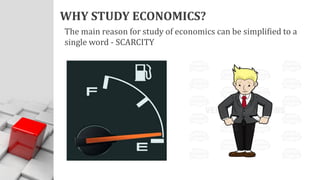
WHY STUDY ECONOMICS?
The main reason for study of economics can be simplified to a
single word - SCARCITY
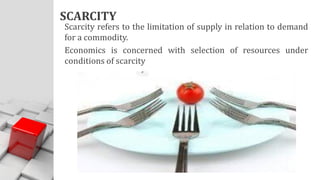
SCARCITY
Scarcity refers to the limitation of supply in relation to demand
for a commodity.
Economics is concerned with selection of resources under
conditions of scarcity
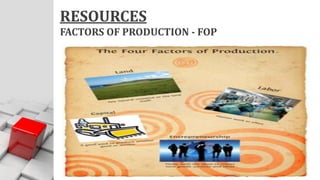
RESOURCES
FACTORS OF PRODUCTION - FOP
ECONOMIC PROBLEM
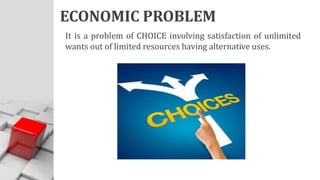
It is a problem of CHOICE involving satisfaction of unlimited
wants out of limited resources having alternative uses.
REASONS FOR ECONOMIC PROBLEM
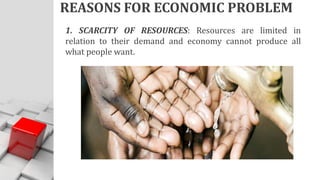
1. SCARCITY OF RESOURCES: Resources are limited in
relation to their demand and economy cannot produce all
what people want.
REASONS FOR ECONOMIC PROBLEM
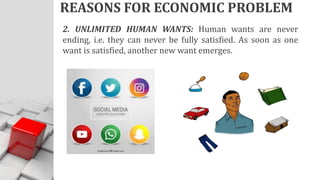
2. UNLIMITED HUMAN WANTS: Human wants are never
ending, i.e. they can never be fully satisfied. As soon as one
want is satisfied, another new want emerges.
REASONS FOR ECONOMIC PROBLEM
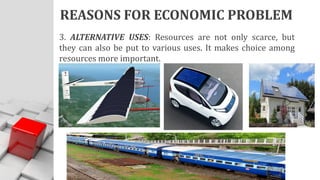
3. ALTERNATIVE USES: Resources are not only scarce, but
they can also be put to various uses. It makes choice among
resources more important.
ECONOMICS
Economics is a social science which studies the way a society
chooses to use its limited resources, which have alternative
uses, to produce goods and services and to distribute them
among different groups of people.
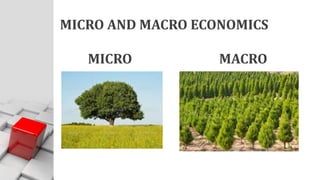
MICRO AND MACRO ECONOMICS
MICRO MACRO
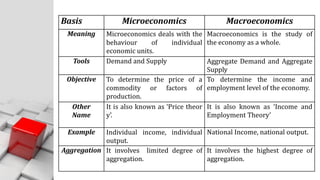
Basis Microeconomics Macroeconomics
Meaning Microeconomics deals with the
behaviour of individual
economic units.
Macroeconomics is the study of
the economy as a whole.
Tools Demand and Supply Aggregate Demand and Aggregate
Supply
Objective To determine the price of a
commodity or factors of
production.
To determine the income and
employment level of the economy.
Other
Name
It is also known as ‘Price theor
y’.
It is also known as ‘Income and
Employment Theory’
Example Individual income, individual
output.
National Income, national output.
Aggregation It involves limited degree of
aggregation.
It involves the highest degree of
aggregation.
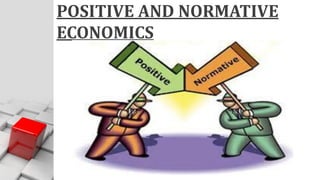
POSITIVE AND NORMATIVE
ECONOMICS
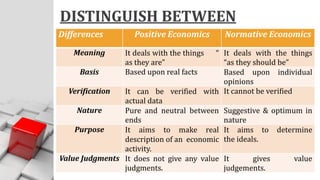
DISTINGUISH BETWEEN
Differences Positive Economics Normative Economics
Meaning It deals with the things “
as they are”
It deals with the things
“as they should be”
Basis Based upon real facts Based upon individual
opinions
Verification It can be verified with
actual data
It cannot be verified
Nature Pure and neutral between
ends
Suggestive & optimum in
nature
Purpose It aims to make real
description of an economic
activity.
It aims to determine
the ideals.
Value Judgments It does not give any value
judgments.
It gives value
judgements.
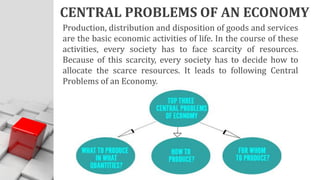
CENTRAL PROBLEMS OF AN ECONOMY
Production, distribution and disposition of goods and services
are the basic economic activities of life. In the course of these
activities, every society has to face scarcity of resources.
Because of this scarcity, every society has to decide how to
allocate the scarce resources. It leads to following Central
Problems of an Economy.
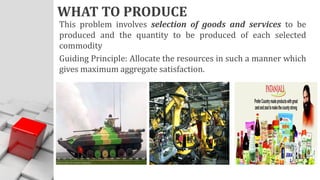
WHAT TO PRODUCE
This problem involves selection of goods and services to be
produced and the quantity to be produced of each selected
commodity
Guiding Principle: Allocate the resources in such a manner which
gives maximum aggregate satisfaction.
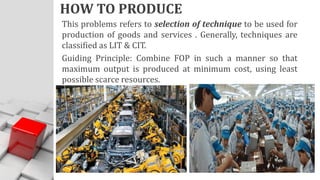
HOW TO PRODUCE
This problems refers to selection of technique to be used for
production of goods and services . Generally, techniques are
classified as LIT & CIT.
Guiding Principle: Combine FOP in such a manner so that
maximum output is produced at minimum cost, using least
possible scarce resources.
FOR WHOM TO PRODUCE
This problem refers to selection of category of people who will
ultimately consume the goods, i.e. Whether to produce goods for
more poor and less rich or more rich and less poor.
Guiding Principle: Ensure that urgent wants of each productive
factor are fulfilled to the maximum possible event.
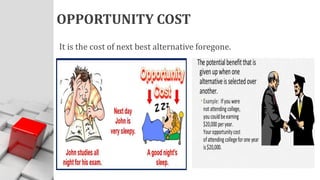
OPPORTUNITY COST
It is the cost of next best alternative foregone.
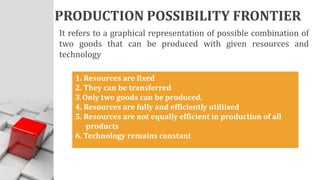
PRODUCTION POSSIBILITY FRONTIER
It refers to a graphical representation of possible combination of
two goods that can be produced with given resources and
technology
1. Resources are fixed
2. They can be transferred
3. Only two goods can be produced.
4. Resources are fully and efficiently utiliised
5. Resources are not equally efficient in production of all
products
6. Technology remains constant
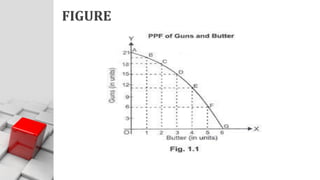
FIGURE
SCHEDULE
Production
Possibilities
[OR Combination]
Guns Butter MRT
A 21 0 -
B 20 1 1:1
C 18 2 2:1
D 15 3 3:1
E 11 4 4:1
F 6 5 5:1
G 0 6 6:1
Explanation
When points A, B, C, D, E, F, & G are joined we get a
curve AG, known as ‘Production Possibility Frontier.’
AG curve shows the maximum limit of production of
guns and butter.
Every point on PPC [like A, B, C, D, E, F& G] in figure
indicates full employment and efficient use of
resources.
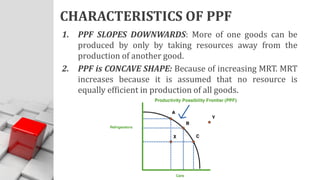
CHARACTERISTICS OF PPF
1. PPF SLOPES DOWNWARDS: More of one goods can be
produced by only by taking resources away from the
production of another good.
2. PPF is CONCAVE SHAPE: Because of increasing MRT. MRT
increases because it is assumed that no resource is
equally efficient in production of all goods.
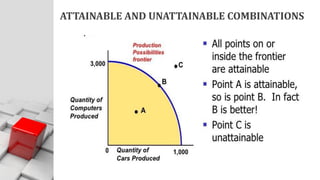
ATTAINABLE AND UNATTAINABLE COMBINATIONS
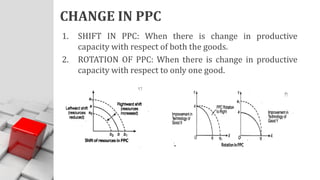
CHANGE IN PPC
1. SHIFT IN PPC: When there is change in productive
capacity with respect of both the goods.
2. ROTATION OF PPC: When there is change in productive
capacity with respect to only one good.

Eco Revision ch- Scarcity, economic problem

  • 1.
    ALLPPT.com _ FreePowerPoint Templates, Diagrams and Charts REVISION Economics
  • 2.
  • 4.
    WHY STUDY ECONOMICS? Themain reason for study of economics can be simplified to a single word - SCARCITY
  • 5.
    SCARCITY Scarcity refers tothe limitation of supply in relation to demand for a commodity. Economics is concerned with selection of resources under conditions of scarcity
  • 6.
  • 7.
    ECONOMIC PROBLEM It isa problem of CHOICE involving satisfaction of unlimited wants out of limited resources having alternative uses.
  • 8.
    REASONS FOR ECONOMICPROBLEM 1. SCARCITY OF RESOURCES: Resources are limited in relation to their demand and economy cannot produce all what people want.
  • 9.
    REASONS FOR ECONOMICPROBLEM 2. UNLIMITED HUMAN WANTS: Human wants are never ending, i.e. they can never be fully satisfied. As soon as one want is satisfied, another new want emerges.
  • 10.
    REASONS FOR ECONOMICPROBLEM 3. ALTERNATIVE USES: Resources are not only scarce, but they can also be put to various uses. It makes choice among resources more important.
  • 11.
    ECONOMICS Economics is asocial science which studies the way a society chooses to use its limited resources, which have alternative uses, to produce goods and services and to distribute them among different groups of people.
  • 12.
    MICRO AND MACROECONOMICS MICRO MACRO
  • 13.
    Basis Microeconomics Macroeconomics MeaningMicroeconomics deals with the behaviour of individual economic units. Macroeconomics is the study of the economy as a whole. Tools Demand and Supply Aggregate Demand and Aggregate Supply Objective To determine the price of a commodity or factors of production. To determine the income and employment level of the economy. Other Name It is also known as ‘Price theor y’. It is also known as ‘Income and Employment Theory’ Example Individual income, individual output. National Income, national output. Aggregation It involves limited degree of aggregation. It involves the highest degree of aggregation.
  • 14.
  • 15.
    DISTINGUISH BETWEEN Differences PositiveEconomics Normative Economics Meaning It deals with the things “ as they are” It deals with the things “as they should be” Basis Based upon real facts Based upon individual opinions Verification It can be verified with actual data It cannot be verified Nature Pure and neutral between ends Suggestive & optimum in nature Purpose It aims to make real description of an economic activity. It aims to determine the ideals. Value Judgments It does not give any value judgments. It gives value judgements.
  • 16.
    CENTRAL PROBLEMS OFAN ECONOMY Production, distribution and disposition of goods and services are the basic economic activities of life. In the course of these activities, every society has to face scarcity of resources. Because of this scarcity, every society has to decide how to allocate the scarce resources. It leads to following Central Problems of an Economy.
  • 17.
    WHAT TO PRODUCE Thisproblem involves selection of goods and services to be produced and the quantity to be produced of each selected commodity Guiding Principle: Allocate the resources in such a manner which gives maximum aggregate satisfaction.
  • 18.
    HOW TO PRODUCE Thisproblems refers to selection of technique to be used for production of goods and services . Generally, techniques are classified as LIT & CIT. Guiding Principle: Combine FOP in such a manner so that maximum output is produced at minimum cost, using least possible scarce resources.
  • 19.
    FOR WHOM TOPRODUCE This problem refers to selection of category of people who will ultimately consume the goods, i.e. Whether to produce goods for more poor and less rich or more rich and less poor. Guiding Principle: Ensure that urgent wants of each productive factor are fulfilled to the maximum possible event.
  • 20.
    OPPORTUNITY COST It isthe cost of next best alternative foregone.
  • 21.
    PRODUCTION POSSIBILITY FRONTIER Itrefers to a graphical representation of possible combination of two goods that can be produced with given resources and technology 1. Resources are fixed 2. They can be transferred 3. Only two goods can be produced. 4. Resources are fully and efficiently utiliised 5. Resources are not equally efficient in production of all products 6. Technology remains constant
  • 22.
  • 23.
    SCHEDULE Production Possibilities [OR Combination] Guns ButterMRT A 21 0 - B 20 1 1:1 C 18 2 2:1 D 15 3 3:1 E 11 4 4:1 F 6 5 5:1 G 0 6 6:1
  • 24.
    Explanation When points A,B, C, D, E, F, & G are joined we get a curve AG, known as ‘Production Possibility Frontier.’ AG curve shows the maximum limit of production of guns and butter. Every point on PPC [like A, B, C, D, E, F& G] in figure indicates full employment and efficient use of resources.
  • 25.
    CHARACTERISTICS OF PPF 1.PPF SLOPES DOWNWARDS: More of one goods can be produced by only by taking resources away from the production of another good. 2. PPF is CONCAVE SHAPE: Because of increasing MRT. MRT increases because it is assumed that no resource is equally efficient in production of all goods.
  • 26.
  • 27.
    CHANGE IN PPC 1.SHIFT IN PPC: When there is change in productive capacity with respect of both the goods. 2. ROTATION OF PPC: When there is change in productive capacity with respect to only one good.