AMIT KUMAR
PGT
ECONOMICS
JNV KULLU HP
Introductory
Concepts of
Micro Economics
Economics,
Economy and
Central Problems
of an Economy
Content to be Discussed
► Meaning of Economics
► Two Branches of Economics
► Positive and Normative
Economics
► Concept of Economy
► Types of Economy
► Central Problems and its
management
► Production Possibility Curve
► Concept of Opportunity Cost.
Meaning of Economics
► Economics Is a subject
matter deals with the
study of Economic
Activities And
Economic Issues Or
Economic Problems
related to Money Or
Wealth.
Economic Activities
All those human activities
are called Economic
Activities which Are
related to to Earning of
Money or Wealth.
For example:- Production,
Consumption, Investment,
Distribution etc.
Economic Problems
► It refers to the problem of choice or
allocation.
► As we humnas have unlimited
demands , desires and wants.
► And the Resources used to fulfill our
wants are limited or scarce in nature.
► Resources are not only Scarce but
have alternative uses as well.
► This leads to the problem of Rational
Management of Resources or
allocation of resources.
► This problem of Choice is called
Economic Problem.
Branches of Economics
► In 1933
► Oslo University , Norway
► Professor Ragner Frisch.
► Divided the subject matter of Economics
into two parts.
1. Micro economicss
2. Macroeconomicss
► These two are considered two branches of
Economics.
Micro Economics
What is
Microeconomics
► Micro Economics is a study of
behavior of Individual Units of
an economy
such as:-
► individual consumer behavior,
producer behavior, individual
Firm , Market etc.
Subject matter of
Micro Economics
What is Macro Economics
► Macr Eonomics refers to the study
of aggregates or of entire
economic system.
► It deals with the study of economic
issues economic problems at the
level of an economy as a whole.
Such as
► Aggregate demand and aggregate
supply
► National income
► Government budget
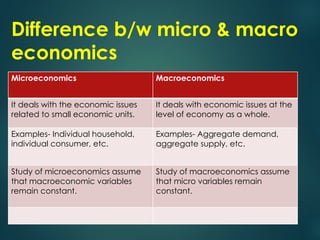
Difference b/w micro & macro
economics
Microeconomics Macroeconomics
It deals with the economic issues
related to small economic units.
It deals with economic issues at the
level of economy as a whole.
Examples- Individual household,
individual consumer, etc.
Examples- Aggregate demand,
aggregate supply, etc.
Study of microeconomics assume
that macroeconomic variables
remain constant.
Study of macroeconomics assume
that micro variables remain
constant.
Difference b/w positive &
normative economics
Positive economics Normative economics
It studies economic issues with facts
or truth related to present, past and
future.
It studies economic issues based on
opinions.
Statements of positive economics,
‘what was’, ‘what is’, and ‘what
would be’.
Statement of normative economics
relate to ‘what ought to be’.
Example- Government provided
health care increases public
expenditures.
Example- Government should
provide basic health care to all
citizens.
It does not involve value judgments. It involves value judgments.
Meaning of economy &
economic problem
► An economy is a system by which
people get their living.
► An economic problem is basically the
problem of choice which arise due to
scarcity of resources having
alternative uses.
3 types of economies
► Market economy.
► Centrally planned economy.
► Mixed economy.
Market
economy
► In this type of economy the factors of
production are owned and operated by
individuals or group of individuals.
► Main objective of production is profit
maximization.
► Central problems are solved by the free
forces of demand and supply.
Centrally planned
economy
► In this type of economy the factors of
production are owned and operated by
government.
► Main objective of production is social welfare
maximization.
► Central problems are solved by the central
planning authority.
Mixed economy
► In this type of economy the factors of production are
owned and operated both by private sector and
government.
► Main objective of production is profit maximization
(private sector) and social welfare (government
sector).
► Central problems are solved by the free forces of
demand and supply (private sector) and central
planning authority (public sector).
Causes of economic
problem
► Scarcity of resources
► Unlimited wants
► Limited resources having alternative
uses.
Central economic
problems-
► Allocation of resources-
► What to produce
► How to produce
► For whom to produce
► Efficient utilization of resources
► Growth of resources
Problem of allocation of resources
1. What to produce
► It is the problem of choosing which goods
and services should be produced in what
quantities.
► It is related to selection of goods, as all
goods cannot be produced due to
scarcity of resources.
Problem of allocation of
resources
2. How to produce
► It is the problem of choosing technique
of production of goods and services.
► There are two techniques of
production-
1) Labor intensive
2) Capital Intensive.
Problem of allocation of
resources
3. For whom to produce
► The problem of ‘for whom to produce’ refers to
the distribution of goods and services
produced in the economy.
► This is also called the problem of distribution of
national income among the factors of
production.
Production possibility
curve
► Definition-
PPC shows all possible
combinations of two goods that
can be produced in an economy
with given resources and
technology
Production possibility
curve
► Assumptions-
1. Resources and technology are given.
2. Resources are fully and efficiently
utilized.
3. Resources are not equally efficient in
production of all goods.
Properties of PPC
1. Downward sloping- PPC is a downward sloping curve
because the resources are scare and production of both
goods cannot be increased at the same time. Increase in
production of one good will lead to reduction in the
production of other good.
2. Concave to the origin- It is generally concave to the origin
due to increasing marginal opportunity cost. Resources are not
equally efficient in production of other goods.
3. PPC touch both X-axis and Y-axis- This is because the
economy can choose production of either of the two goods.
Schedule of PPC
Combinations/Po
ssibilities
Production of
wheat (units)
Production of
cloth (units)
MOC/MRT =
∆Y/∆X
(Loss/Gain)
A 0 10 -
B 1 9 1
C 2 7 2
D 3 4 3
E 4 0 4
Production possibility curve
Diagrammatic presentation
► PPC
Can it be convex or
straight line?
► PPC can be Convex when MOC decreases. It
means that in order to produce more units of
commodity X, less units of commodity are
sacrificed. This is due to application of law of
increasing returns.
► PPC can be a straight lime when MOC is
constant. It means that in order to produce
more units of commodity X, same units of
good Yare sacrificed. This is because of
application of law of constant returns.
Shift in PPC
► Rightward shift in PPC occurs due to-
1) When resources increase more of both
goods can be produced and PPC will
shift to the right.
2) With technological advancement
production of both goods can be
increased and PPC shifts to the right.
Rightward shift in PPC
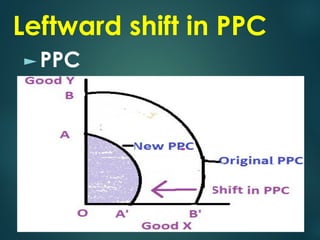
Leftward shift in PPC
► Leftward shift in PPC occurs due to-
1. Large scale outflow of foreign capital.
2. Migration of human resources to other
countries.
3. Natural calamities like earthquakes,
epidemics, floods etc.
Leftward shift in PPC
► PPC
Rotation of PPC
►When there is change in
resources/technology
for only one good, PPC
will rotate (not shift).
Causes of rotation of PPC- In case of
commodity on X axis
► When there is change in resources/technology
for only good X.
► It will rotate to the right when resources
increase or technology improves only for
increase in production of good X
► It will rotate to the left when resources
decrease or technology degrades only for
increase in production of good X
Rightward rotation of PPC
Leftward rotation of PPC
► PPC rotation to left
Causes of rotation of PPC- In
case of commodity on Y axis
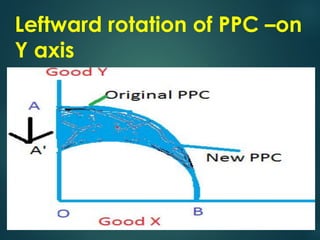
► When there is change in resources/technology
for only good Y.
► It will rotate to the right when resources
increase or technology improves only for
increase in production of good Y.
► It will rotate to the left when resources decrease
or technology degrades only for increase in
production of good Y.
Leftward rotation of PPC –on
Y axis
Rightward rotation of PPC –on Y
axis
► Technological degradation/ decrease
in resources
Effects of Economic changes on
PPC of an economy
Economic change Impact on PPC of Indian
economy
Reason
“Make in India” appeal
by Prime Minister of India
to find investors
Recent example,
Samsung company in
Noida, U.P
PPC will shift to its right. Increase in resources
implying increase in
production potential.
“Education for all”
campaign Example-
Sarva shiksha abhiyaan
PPC will shift to its right. Increased efficiency of
human resources.
Large scale inflow of
foreign capital
PPC will shift to its right. Increase in resources.
“Clean India Mission”
(Swachcha Bharat
Mission
PPC will shift to its right. Increased efficiency level
of human resources.
(Ensures better health)
Effects cont…
Economic change Impact on PPC of
Indian economy
Reason
Establishment of large
number of institutes of
science & technology
PPC will shift to its right. Skill development of
human resources will
improve.
Natural calamities like
earthquakes and
floods
PPC will shift to its left Reduction in resources
implying decrease in
production potential.
Large scale outflow of
foreign capital
PPC will shift to its left. Reduction in resources
implying decrease in
production potential.
Environmental
degradation
PPC will shift to its left. Reduction in resources
implying decrease in
production potential.
Effects cont…..
Economic change Impact on PPC of
Indian economy
Reason
Government efforts
towards reducing
unemployment
(generation of
employment schemes)
No effect on PPC (We
will move from
under-utilization to fuller
utilization of resources,
towards the PPC)
These efforts would
help in reaching the
production potential.
Economic slowdown in
foreign countries
causing fall in Indian
exports
No effect on PPC. (We
may move from a point
on the PPC to a point
inside the PPC)
This will lead the
economy from full
utilization to
under-utilization level.
Meaning of opportunity
cost
► The cost of next best alternative forgone.
► Example- A teacher has job offer from
two schools. School X offers her a salary
of Rs.40,000 and school Y offers her Rs.
55,000 . If a teacher at present draws a
salary of Rs.60,000 in school Z, what will
be her opportunity cost?
► Answer- Next best alternative at school Z
= Rs 55,000 by school Y.
Slope of PPC- Marginal
opportunity cost
► It is defined as the rate at which one
commodity is sacrificed to increase an
additional unit of another commodity.
► MOC/MRT= Loss of output of good 2/ Gain in
output of good 1
► Since MOC increases as we shift resources
from production of good Y to good X, PPC is
concave to the origin.
MOC
► Marginal opportunity cost is
the slope of PPC
That’s All in this
Chapter.................
Thank You

UNIT -1 Introductory concepts micro eco.pdf

  • 1.
    AMIT KUMAR PGT ECONOMICS JNV KULLUHP Introductory Concepts of Micro Economics
  • 2.
  • 3.
    Content to beDiscussed ► Meaning of Economics ► Two Branches of Economics ► Positive and Normative Economics ► Concept of Economy ► Types of Economy ► Central Problems and its management ► Production Possibility Curve ► Concept of Opportunity Cost.
  • 4.
    Meaning of Economics ►Economics Is a subject matter deals with the study of Economic Activities And Economic Issues Or Economic Problems related to Money Or Wealth.
  • 5.
    Economic Activities All thosehuman activities are called Economic Activities which Are related to to Earning of Money or Wealth. For example:- Production, Consumption, Investment, Distribution etc.
  • 6.
    Economic Problems ► Itrefers to the problem of choice or allocation. ► As we humnas have unlimited demands , desires and wants. ► And the Resources used to fulfill our wants are limited or scarce in nature. ► Resources are not only Scarce but have alternative uses as well. ► This leads to the problem of Rational Management of Resources or allocation of resources. ► This problem of Choice is called Economic Problem.
  • 7.
    Branches of Economics ►In 1933 ► Oslo University , Norway ► Professor Ragner Frisch. ► Divided the subject matter of Economics into two parts. 1. Micro economicss 2. Macroeconomicss ► These two are considered two branches of Economics.
  • 8.
  • 9.
    What is Microeconomics ► MicroEconomics is a study of behavior of Individual Units of an economy such as:- ► individual consumer behavior, producer behavior, individual Firm , Market etc.
  • 10.
  • 11.
    What is MacroEconomics ► Macr Eonomics refers to the study of aggregates or of entire economic system. ► It deals with the study of economic issues economic problems at the level of an economy as a whole. Such as ► Aggregate demand and aggregate supply ► National income ► Government budget
  • 12.
    Difference b/w micro& macro economics Microeconomics Macroeconomics It deals with the economic issues related to small economic units. It deals with economic issues at the level of economy as a whole. Examples- Individual household, individual consumer, etc. Examples- Aggregate demand, aggregate supply, etc. Study of microeconomics assume that macroeconomic variables remain constant. Study of macroeconomics assume that micro variables remain constant.
  • 13.
    Difference b/w positive& normative economics Positive economics Normative economics It studies economic issues with facts or truth related to present, past and future. It studies economic issues based on opinions. Statements of positive economics, ‘what was’, ‘what is’, and ‘what would be’. Statement of normative economics relate to ‘what ought to be’. Example- Government provided health care increases public expenditures. Example- Government should provide basic health care to all citizens. It does not involve value judgments. It involves value judgments.
  • 14.
    Meaning of economy& economic problem ► An economy is a system by which people get their living. ► An economic problem is basically the problem of choice which arise due to scarcity of resources having alternative uses.
  • 15.
    3 types ofeconomies ► Market economy. ► Centrally planned economy. ► Mixed economy.
  • 16.
    Market economy ► In thistype of economy the factors of production are owned and operated by individuals or group of individuals. ► Main objective of production is profit maximization. ► Central problems are solved by the free forces of demand and supply.
  • 17.
    Centrally planned economy ► Inthis type of economy the factors of production are owned and operated by government. ► Main objective of production is social welfare maximization. ► Central problems are solved by the central planning authority.
  • 18.
    Mixed economy ► Inthis type of economy the factors of production are owned and operated both by private sector and government. ► Main objective of production is profit maximization (private sector) and social welfare (government sector). ► Central problems are solved by the free forces of demand and supply (private sector) and central planning authority (public sector).
  • 19.
    Causes of economic problem ►Scarcity of resources ► Unlimited wants ► Limited resources having alternative uses.
  • 20.
    Central economic problems- ► Allocationof resources- ► What to produce ► How to produce ► For whom to produce ► Efficient utilization of resources ► Growth of resources
  • 21.
    Problem of allocationof resources 1. What to produce ► It is the problem of choosing which goods and services should be produced in what quantities. ► It is related to selection of goods, as all goods cannot be produced due to scarcity of resources.
  • 22.
    Problem of allocationof resources 2. How to produce ► It is the problem of choosing technique of production of goods and services. ► There are two techniques of production- 1) Labor intensive 2) Capital Intensive.
  • 23.
    Problem of allocationof resources 3. For whom to produce ► The problem of ‘for whom to produce’ refers to the distribution of goods and services produced in the economy. ► This is also called the problem of distribution of national income among the factors of production.
  • 24.
    Production possibility curve ► Definition- PPCshows all possible combinations of two goods that can be produced in an economy with given resources and technology
  • 25.
    Production possibility curve ► Assumptions- 1.Resources and technology are given. 2. Resources are fully and efficiently utilized. 3. Resources are not equally efficient in production of all goods.
  • 26.
    Properties of PPC 1.Downward sloping- PPC is a downward sloping curve because the resources are scare and production of both goods cannot be increased at the same time. Increase in production of one good will lead to reduction in the production of other good. 2. Concave to the origin- It is generally concave to the origin due to increasing marginal opportunity cost. Resources are not equally efficient in production of other goods. 3. PPC touch both X-axis and Y-axis- This is because the economy can choose production of either of the two goods.
  • 27.
    Schedule of PPC Combinations/Po ssibilities Productionof wheat (units) Production of cloth (units) MOC/MRT = ∆Y/∆X (Loss/Gain) A 0 10 - B 1 9 1 C 2 7 2 D 3 4 3 E 4 0 4
  • 28.
  • 29.
    Can it beconvex or straight line? ► PPC can be Convex when MOC decreases. It means that in order to produce more units of commodity X, less units of commodity are sacrificed. This is due to application of law of increasing returns. ► PPC can be a straight lime when MOC is constant. It means that in order to produce more units of commodity X, same units of good Yare sacrificed. This is because of application of law of constant returns.
  • 30.
    Shift in PPC ►Rightward shift in PPC occurs due to- 1) When resources increase more of both goods can be produced and PPC will shift to the right. 2) With technological advancement production of both goods can be increased and PPC shifts to the right.
  • 31.
  • 32.
    Leftward shift inPPC ► Leftward shift in PPC occurs due to- 1. Large scale outflow of foreign capital. 2. Migration of human resources to other countries. 3. Natural calamities like earthquakes, epidemics, floods etc.
  • 33.
    Leftward shift inPPC ► PPC
  • 34.
    Rotation of PPC ►Whenthere is change in resources/technology for only one good, PPC will rotate (not shift).
  • 35.
    Causes of rotationof PPC- In case of commodity on X axis ► When there is change in resources/technology for only good X. ► It will rotate to the right when resources increase or technology improves only for increase in production of good X ► It will rotate to the left when resources decrease or technology degrades only for increase in production of good X
  • 36.
  • 37.
    Leftward rotation ofPPC ► PPC rotation to left
  • 38.
    Causes of rotationof PPC- In case of commodity on Y axis ► When there is change in resources/technology for only good Y. ► It will rotate to the right when resources increase or technology improves only for increase in production of good Y. ► It will rotate to the left when resources decrease or technology degrades only for increase in production of good Y.
  • 39.
    Leftward rotation ofPPC –on Y axis
  • 40.
    Rightward rotation ofPPC –on Y axis ► Technological degradation/ decrease in resources
  • 41.
    Effects of Economicchanges on PPC of an economy Economic change Impact on PPC of Indian economy Reason “Make in India” appeal by Prime Minister of India to find investors Recent example, Samsung company in Noida, U.P PPC will shift to its right. Increase in resources implying increase in production potential. “Education for all” campaign Example- Sarva shiksha abhiyaan PPC will shift to its right. Increased efficiency of human resources. Large scale inflow of foreign capital PPC will shift to its right. Increase in resources. “Clean India Mission” (Swachcha Bharat Mission PPC will shift to its right. Increased efficiency level of human resources. (Ensures better health)
  • 42.
    Effects cont… Economic changeImpact on PPC of Indian economy Reason Establishment of large number of institutes of science & technology PPC will shift to its right. Skill development of human resources will improve. Natural calamities like earthquakes and floods PPC will shift to its left Reduction in resources implying decrease in production potential. Large scale outflow of foreign capital PPC will shift to its left. Reduction in resources implying decrease in production potential. Environmental degradation PPC will shift to its left. Reduction in resources implying decrease in production potential.
  • 43.
    Effects cont….. Economic changeImpact on PPC of Indian economy Reason Government efforts towards reducing unemployment (generation of employment schemes) No effect on PPC (We will move from under-utilization to fuller utilization of resources, towards the PPC) These efforts would help in reaching the production potential. Economic slowdown in foreign countries causing fall in Indian exports No effect on PPC. (We may move from a point on the PPC to a point inside the PPC) This will lead the economy from full utilization to under-utilization level.
  • 44.
    Meaning of opportunity cost ►The cost of next best alternative forgone. ► Example- A teacher has job offer from two schools. School X offers her a salary of Rs.40,000 and school Y offers her Rs. 55,000 . If a teacher at present draws a salary of Rs.60,000 in school Z, what will be her opportunity cost? ► Answer- Next best alternative at school Z = Rs 55,000 by school Y.
  • 45.
    Slope of PPC-Marginal opportunity cost ► It is defined as the rate at which one commodity is sacrificed to increase an additional unit of another commodity. ► MOC/MRT= Loss of output of good 2/ Gain in output of good 1 ► Since MOC increases as we shift resources from production of good Y to good X, PPC is concave to the origin.
  • 46.
    MOC ► Marginal opportunitycost is the slope of PPC
  • 47.
    That’s All inthis Chapter................. Thank You