Presented by :
Phrmacist: Ridha Hareka
Mohammad Balkhair
Introduction
• all hospital’s pharmacy still complaining of
medications errors problems which lead to
increasing number of patients die until now….
• So…we must know more information about
medications that consider as High Alert
Medications and how to deal with them?
Key points
• Definition.
• High alert medications.
• The top five high-alert medications.
• Reduce the risks of high-alert drugs..
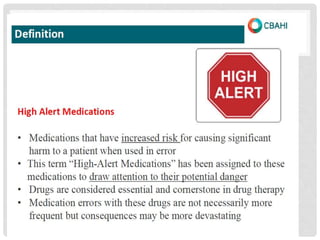
I. Definition
• High Alert Medications :
Drugs that bear a heightened risk of causing
significant patient harm when they are used in error.
Although mistakes may or may not be more common
with these drugs, the consequences of an error are
clearly more devastating to patients.
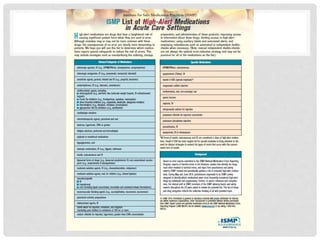
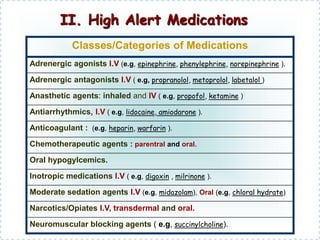
Classes/Categories of Medications
Adrenergic agonists I.V (e.g, epinephrine, phenylephrine, norepinephrine ).
Adrenergic antagonists I.V ( e.g, propranolol, metoprolol, labetalol )
Anasthetic agents: inhaled and IV ( e.g, propofol, ketamine )
Antiarrhythmics, I.V ( e.g, lidocaine, amiodarone ).
Anticoagulant : (e.g, heparin, warfarin ).
Chemotherapeutic agents : parentral and oral.
Oral hypogylcemics.
Inotropic medications I.V ( e.g, digoxin , milrinone ).
Moderate sedation agents I.V (e.g, midazolam), Oral (e.g, chloral hydrate)
Narcotics/Opiates I.V, transdermal and oral.
Neuromuscular blocking agents ( e.g, succinylcholine).
II. High Alert Medications
Specific medications
Colchicine injection .
Insulin : S.C and I.V.
Magnesium sulfate injection.
Methotrexate : oral ( non – oncologic use ) .
Oxytocin I.V.
Nitroprusside sodium for injection.
Potassium chloride for injection .
Promethazine I.V.
Sodium chloride for injection.
Cont..
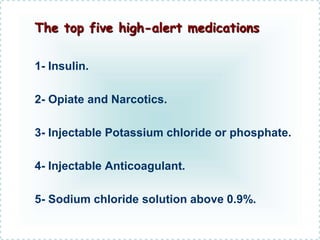
1- Insulin.
2- Opiate and Narcotics.
3- Injectable Potassium chloride or phosphate.
4- Injectable Anticoagulant.
5- Sodium chloride solution above 0.9%.
The top five high-alert medications
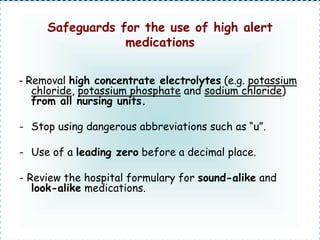
Safeguards for the use of high alert
medications
- Removal high concentrate electrolytes (e.g. potassium
chloride, potassium phosphate and sodium chloride)
from all nursing units.
- Stop using dangerous abbreviations such as “u”.
- Use of a leading zero before a decimal place.
- Review the hospital formulary for sound-alike and
look-alike medications.
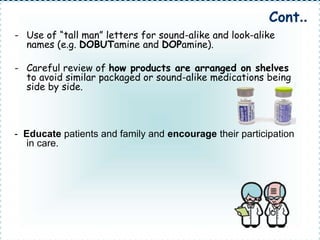
- Use of “tall man” letters for sound-alike and look-alike
names (e.g. DOBUTamine and DOPamine).
- Careful review of how products are arranged on shelves
to avoid similar packaged or sound-alike medications being
side by side.
- Educate patients and family and encourage their participation
in care.
Cont..
Rely on redundancies (repeating)
• Match high-alert drug orders to the patient’s diagnosis,
the drug’s indication, and vital patient information.
• If possible, avoid verbal orders. If they’re necessary,
write down the order in the chart and then read back:
must be your daily duty
– patient name and file number
– drug order and route of administration as
written.
– spelling of the drug name.
Cont..
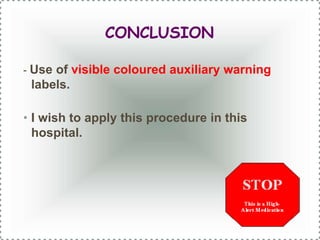
CONCLUSION
- Use of visible coloured auxiliary warning
labels.
• I wish to apply this procedure in this
hospital.
MEDICATIONS ERROR
• How to report

High alert medication

  • 1.
    Presented by : Phrmacist:Ridha Hareka Mohammad Balkhair
  • 2.
    Introduction • all hospital’spharmacy still complaining of medications errors problems which lead to increasing number of patients die until now…. • So…we must know more information about medications that consider as High Alert Medications and how to deal with them?
  • 3.
    Key points • Definition. •High alert medications. • The top five high-alert medications. • Reduce the risks of high-alert drugs..
  • 4.
    I. Definition • HighAlert Medications : Drugs that bear a heightened risk of causing significant patient harm when they are used in error. Although mistakes may or may not be more common with these drugs, the consequences of an error are clearly more devastating to patients.
  • 6.
    Classes/Categories of Medications Adrenergicagonists I.V (e.g, epinephrine, phenylephrine, norepinephrine ). Adrenergic antagonists I.V ( e.g, propranolol, metoprolol, labetalol ) Anasthetic agents: inhaled and IV ( e.g, propofol, ketamine ) Antiarrhythmics, I.V ( e.g, lidocaine, amiodarone ). Anticoagulant : (e.g, heparin, warfarin ). Chemotherapeutic agents : parentral and oral. Oral hypogylcemics. Inotropic medications I.V ( e.g, digoxin , milrinone ). Moderate sedation agents I.V (e.g, midazolam), Oral (e.g, chloral hydrate) Narcotics/Opiates I.V, transdermal and oral. Neuromuscular blocking agents ( e.g, succinylcholine). II. High Alert Medications
  • 7.
    Specific medications Colchicine injection. Insulin : S.C and I.V. Magnesium sulfate injection. Methotrexate : oral ( non – oncologic use ) . Oxytocin I.V. Nitroprusside sodium for injection. Potassium chloride for injection . Promethazine I.V. Sodium chloride for injection. Cont..
  • 8.
    1- Insulin. 2- Opiateand Narcotics. 3- Injectable Potassium chloride or phosphate. 4- Injectable Anticoagulant. 5- Sodium chloride solution above 0.9%. The top five high-alert medications
  • 9.
    Safeguards for theuse of high alert medications - Removal high concentrate electrolytes (e.g. potassium chloride, potassium phosphate and sodium chloride) from all nursing units. - Stop using dangerous abbreviations such as “u”. - Use of a leading zero before a decimal place. - Review the hospital formulary for sound-alike and look-alike medications.
  • 10.
    - Use of“tall man” letters for sound-alike and look-alike names (e.g. DOBUTamine and DOPamine). - Careful review of how products are arranged on shelves to avoid similar packaged or sound-alike medications being side by side. - Educate patients and family and encourage their participation in care. Cont..
  • 11.
    Rely on redundancies(repeating) • Match high-alert drug orders to the patient’s diagnosis, the drug’s indication, and vital patient information. • If possible, avoid verbal orders. If they’re necessary, write down the order in the chart and then read back: must be your daily duty – patient name and file number – drug order and route of administration as written. – spelling of the drug name. Cont..
  • 12.
    CONCLUSION - Use ofvisible coloured auxiliary warning labels. • I wish to apply this procedure in this hospital.
  • 14.