CLASSIFICATION OF
SEDIMENTARY ROCKS
PREPARED BY: V BINOY CHAKAMA
Msc. 1st Year
Department of Disaster Mangement
Pondhicerry University
Sedimentary Rocks
Sedimentary rocks are formed by the
accumulation of sediments. There are three
basic types of sedimentary rocks.
1.Clastic
2.Chemical
3.Organic
Clastic sedimentary rocks such as:-
 Breccia,
 Conglomerate
 Sandstone
 Siltstone
 Shale
These are formed from mechanical
weathering debris.
Clastic sedimentary rocks
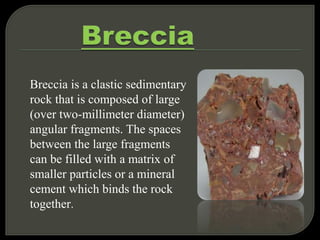
Breccia is a clastic sedimentary
rock that is composed of large
(over two-millimeter diameter)
angular fragments. The spaces
between the large fragments
can be filled with a matrix of
smaller particles or a mineral
cement which binds the rock
together.
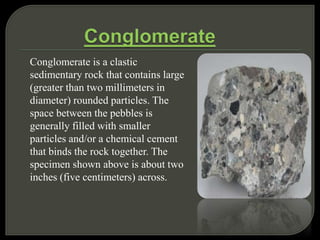
Conglomerate is a clastic
sedimentary rock that contains large
(greater than two millimeters in
diameter) rounded particles. The
space between the pebbles is
generally filled with smaller
particles and/or a chemical cement
that binds the rock together. The
specimen shown above is about two
inches (five centimeters) across.
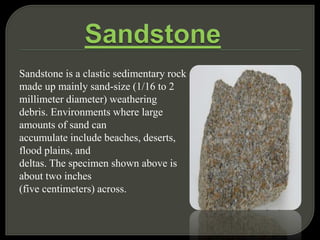
Sandstone is a clastic sedimentary rock
made up mainly sand-size (1/16 to 2
millimeter diameter) weathering
debris. Environments where large
amounts of sand can
accumulate include beaches, deserts,
flood plains, and
deltas. The specimen shown above is
about two inches
(five centimeters) across.
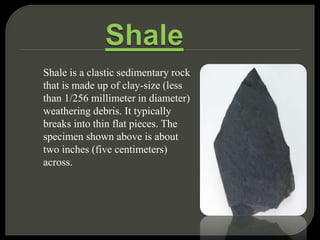
Shale is a clastic sedimentary rock
that is made up of clay-size (less
than 1/256 millimeter in diameter)
weathering debris. It typically
breaks into thin flat pieces. The
specimen shown above is about
two inches (five centimeters)
across.
Chemical sedimentary rocks, such as:-
 Rock salt
 Iron ore
 Chert
 Flint
 some Dolomites, and
 Some Limestones
These are form when dissolved materials
precipitate from solution.
Chemical sedimentary rocks
Rock salt
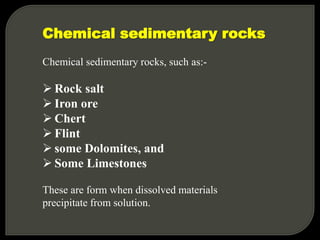
Rock Salt is a chemical sedimentary
rock that forms from the evaporation of
ocean or saline lake waters. It is also
known by the mineral name "halite." It
is rarely found at Earth's surface, except
in areas of very arid climate. It is often
mined for use in the chemical industry
or for use as a winter highway
treatment. Some halite is processed for
use as a seasoning for food. The
specimen shown above is about two
inches (five centimeters) across.
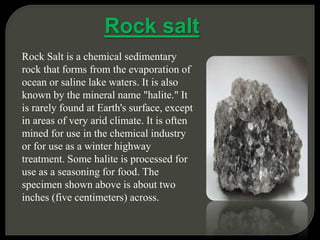
Chert is a microcrystalline or
cryptocrystalline sedimentary rock
material composed of silicon dioxide
(SiO2). It occurs as nodules and
concretionary masses, and less frequently
as a layered deposit. It breaks with a
conchoidal fracture, often producing very
sharp edges. Early people took advantage
of how chert breaks and used it to fashion
cutting tools and weapons. The specimen
shown above is about two inches (five
centimeters) across.
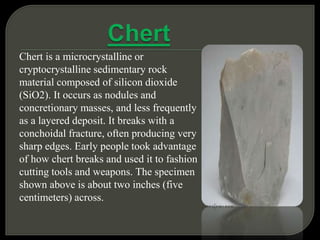
Flint is a hard, tough, chemical
or biochemical sedimentary rock
that breaks with a conchoidal
fracture. It is a form of
microcrystalline quartz that is
typically called “chert” by
geologists. It often forms as
nodules in sedimentary rocks
such as chalk and marine
limestones.
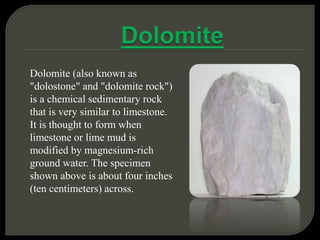
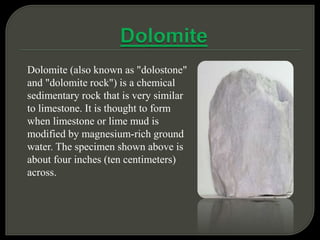
Dolomite (also known as
"dolostone" and "dolomite rock")
is a chemical sedimentary rock
that is very similar to limestone.
It is thought to form when
limestone or lime mud is
modified by magnesium-rich
ground water. The specimen
shown above is about four inches
(ten centimeters) across.
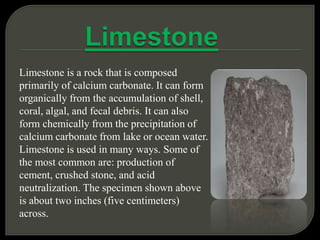
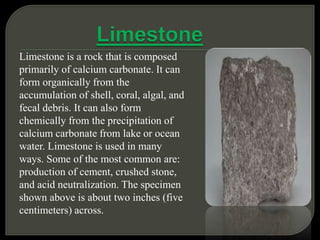
Limestone is a rock that is composed
primarily of calcium carbonate. It can form
organically from the accumulation of shell,
coral, algal, and fecal debris. It can also
form chemically from the precipitation of
calcium carbonate from lake or ocean water.
Limestone is used in many ways. Some of
the most common are: production of
cement, crushed stone, and acid
neutralization. The specimen shown above
is about two inches (five centimeters)
across.
Organic sedimentary rocks such as :-
Coal
Some Dolomites
Some Limestones
These are form from the
accumulation of plant or animal debris.
Organic sedimentary rocks
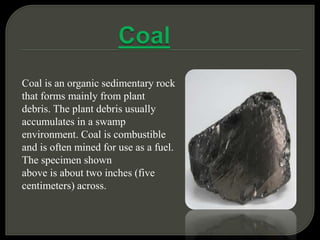
Coal is an organic sedimentary rock
that forms mainly from plant
debris. The plant debris usually
accumulates in a swamp
environment. Coal is combustible
and is often mined for use as a fuel.
The specimen shown
above is about two inches (five
centimeters) across.
Dolomite (also known as "dolostone"
and "dolomite rock") is a chemical
sedimentary rock that is very similar
to limestone. It is thought to form
when limestone or lime mud is
modified by magnesium-rich ground
water. The specimen shown above is
about four inches (ten centimeters)
across.
Limestone is a rock that is composed
primarily of calcium carbonate. It can
form organically from the
accumulation of shell, coral, algal, and
fecal debris. It can also form
chemically from the precipitation of
calcium carbonate from lake or ocean
water. Limestone is used in many
ways. Some of the most common are:
production of cement, crushed stone,
and acid neutralization. The specimen
shown above is about two inches (five
centimeters) across.
Binoy Jyoti Chakma
Msc.1st Year
Department Of Disaster Management
Pondicerry University
vinoychakma@gmail.com/8597086806

Classification of sedimentary

  • 1.
    CLASSIFICATION OF SEDIMENTARY ROCKS PREPAREDBY: V BINOY CHAKAMA Msc. 1st Year Department of Disaster Mangement Pondhicerry University
  • 2.
    Sedimentary Rocks Sedimentary rocksare formed by the accumulation of sediments. There are three basic types of sedimentary rocks. 1.Clastic 2.Chemical 3.Organic
  • 3.
    Clastic sedimentary rockssuch as:-  Breccia,  Conglomerate  Sandstone  Siltstone  Shale These are formed from mechanical weathering debris. Clastic sedimentary rocks
  • 4.
    Breccia is aclastic sedimentary rock that is composed of large (over two-millimeter diameter) angular fragments. The spaces between the large fragments can be filled with a matrix of smaller particles or a mineral cement which binds the rock together.
  • 5.
    Conglomerate is aclastic sedimentary rock that contains large (greater than two millimeters in diameter) rounded particles. The space between the pebbles is generally filled with smaller particles and/or a chemical cement that binds the rock together. The specimen shown above is about two inches (five centimeters) across.
  • 6.
    Sandstone is aclastic sedimentary rock made up mainly sand-size (1/16 to 2 millimeter diameter) weathering debris. Environments where large amounts of sand can accumulate include beaches, deserts, flood plains, and deltas. The specimen shown above is about two inches (five centimeters) across.
  • 7.
    Shale is aclastic sedimentary rock that is made up of clay-size (less than 1/256 millimeter in diameter) weathering debris. It typically breaks into thin flat pieces. The specimen shown above is about two inches (five centimeters) across.
  • 8.
    Chemical sedimentary rocks,such as:-  Rock salt  Iron ore  Chert  Flint  some Dolomites, and  Some Limestones These are form when dissolved materials precipitate from solution. Chemical sedimentary rocks
  • 9.
    Rock salt Rock Saltis a chemical sedimentary rock that forms from the evaporation of ocean or saline lake waters. It is also known by the mineral name "halite." It is rarely found at Earth's surface, except in areas of very arid climate. It is often mined for use in the chemical industry or for use as a winter highway treatment. Some halite is processed for use as a seasoning for food. The specimen shown above is about two inches (five centimeters) across.
  • 10.
    Chert is amicrocrystalline or cryptocrystalline sedimentary rock material composed of silicon dioxide (SiO2). It occurs as nodules and concretionary masses, and less frequently as a layered deposit. It breaks with a conchoidal fracture, often producing very sharp edges. Early people took advantage of how chert breaks and used it to fashion cutting tools and weapons. The specimen shown above is about two inches (five centimeters) across.
  • 11.
    Flint is ahard, tough, chemical or biochemical sedimentary rock that breaks with a conchoidal fracture. It is a form of microcrystalline quartz that is typically called “chert” by geologists. It often forms as nodules in sedimentary rocks such as chalk and marine limestones.
  • 12.
    Dolomite (also knownas "dolostone" and "dolomite rock") is a chemical sedimentary rock that is very similar to limestone. It is thought to form when limestone or lime mud is modified by magnesium-rich ground water. The specimen shown above is about four inches (ten centimeters) across.
  • 13.
    Limestone is arock that is composed primarily of calcium carbonate. It can form organically from the accumulation of shell, coral, algal, and fecal debris. It can also form chemically from the precipitation of calcium carbonate from lake or ocean water. Limestone is used in many ways. Some of the most common are: production of cement, crushed stone, and acid neutralization. The specimen shown above is about two inches (five centimeters) across.
  • 14.
    Organic sedimentary rockssuch as :- Coal Some Dolomites Some Limestones These are form from the accumulation of plant or animal debris. Organic sedimentary rocks
  • 15.
    Coal is anorganic sedimentary rock that forms mainly from plant debris. The plant debris usually accumulates in a swamp environment. Coal is combustible and is often mined for use as a fuel. The specimen shown above is about two inches (five centimeters) across.
  • 16.
    Dolomite (also knownas "dolostone" and "dolomite rock") is a chemical sedimentary rock that is very similar to limestone. It is thought to form when limestone or lime mud is modified by magnesium-rich ground water. The specimen shown above is about four inches (ten centimeters) across.
  • 17.
    Limestone is arock that is composed primarily of calcium carbonate. It can form organically from the accumulation of shell, coral, algal, and fecal debris. It can also form chemically from the precipitation of calcium carbonate from lake or ocean water. Limestone is used in many ways. Some of the most common are: production of cement, crushed stone, and acid neutralization. The specimen shown above is about two inches (five centimeters) across.
  • 18.
    Binoy Jyoti Chakma Msc.1stYear Department Of Disaster Management Pondicerry University vinoychakma@gmail.com/8597086806