ISBN 0-321-49362-1
Chapter 1
Preliminaries
Copyright © 2009 Addison-Wesley. All rights reserved. 1-2
Chapter 1 Topics
• Reasons for Studying Concepts of
Programming Languages
• Programming Domains
• Language Evaluation Criteria
• Influences on Language Design
• Language Categories
• Language Design Trade-Offs
• Implementation Methods
• Programming Environments
Copyright © 2009 Addison-Wesley. All rights reserved. 1-3
Reasons for Studying Concepts of
Programming Languages
• Increased ability to express ideas
• Improved background for choosing
appropriate languages
• Increased ability to learn new languages
• Better understanding of significance of
implementation
• Better use of languages that are already
known
• Overall advancement of computing
Copyright © 2009 Addison-Wesley. All rights reserved. 1-4
Programming Domains
• Scientific applications
– Large numbers of floating point computations; use of arrays
– Fortran
• Business applications
– Produce reports, use decimal numbers and characters
– COBOL
• Artificial intelligence
– Symbols rather than numbers manipulated; use of linked lists
– LISP
• Systems programming
– Need efficiency because of continuous use
– C
• Web Software
– Eclectic collection of languages: markup (e.g., XHTML), scripting
(e.g., PHP), general-purpose (e.g., Java)
Copyright © 2009 Addison-Wesley. All rights reserved. 1-5
Language Evaluation Criteria
• Readability: the ease with which programs
can be read and understood
• Writability: the ease with which a language
can be used to create programs
• Reliability: conformance to specifications
(i.e., performs to its specifications)
• Cost: the ultimate total cost
Copyright © 2009 Addison-Wesley. All rights reserved. 1-6
Evaluation Criteria: Readability
• Overall simplicity
– A manageable set of features and constructs
– Minimal feature multiplicity
– Minimal operator overloading
• Orthogonality
– A relatively small set of primitive constructs can be combined in a relatively
small number of ways
– Every possible combination is legal
• Data types
– Adequate predefined data types
• Syntax considerations
– Identifier forms: flexible composition
– Special words and methods of forming compound statements
– Form and meaning: self-descriptive constructs, meaningful keywords
Copyright © 2009 Addison-Wesley. All rights reserved. 1-7
Evaluation Criteria: Writability
• Simplicity and orthogonality
– Few constructs, a small number of primitives, a small set of rules
for combining them
• Support for abstraction
– The ability to define and use complex structures or operations in
ways that allow details to be ignored
• Expressivity
– A set of relatively convenient ways of specifying operations
– Strength and number of operators and predefined functions
Copyright © 2009 Addison-Wesley. All rights reserved. 1-8
Evaluation Criteria: Reliability
• Type checking
– Testing for type errors
• Exception handling
– Intercept run-time errors and take corrective measures
• Aliasing
– Presence of two or more distinct referencing methods for the same
memory location
• Readability and writability
– A language that does not support “natural” ways of expressing an
algorithm will require the use of “unnatural” approaches, and hence
reduced reliability
Copyright © 2009 Addison-Wesley. All rights reserved. 1-9
Evaluation Criteria: Cost
• Training programmers to use the language
• Writing programs (closeness to particular
applications)
• Compiling programs
• Executing programs
• Language implementation system: availability
of free compilers
• Reliability: poor reliability leads to high costs
• Maintaining programs
Copyright © 2009 Addison-Wesley. All rights reserved. 1-10
Evaluation Criteria: Others
• Portability
– The ease with which programs can be moved from
one implementation to another
• Generality
– The applicability to a wide range of applications
• Well-definedness
– The completeness and precision of the language’s
official definition
Copyright © 2009 Addison-Wesley. All rights reserved. 1-11
Influences on Language Design
• Computer Architecture
– Languages are developed around the prevalent
computer architecture, known as the von Neumann
architecture
• Programming Methodologies
– New software development methodologies (e.g.,
object-oriented software development) led to new
programming paradigms and by extension, new
programming languages
Copyright © 2009 Addison-Wesley. All rights reserved. 1-12
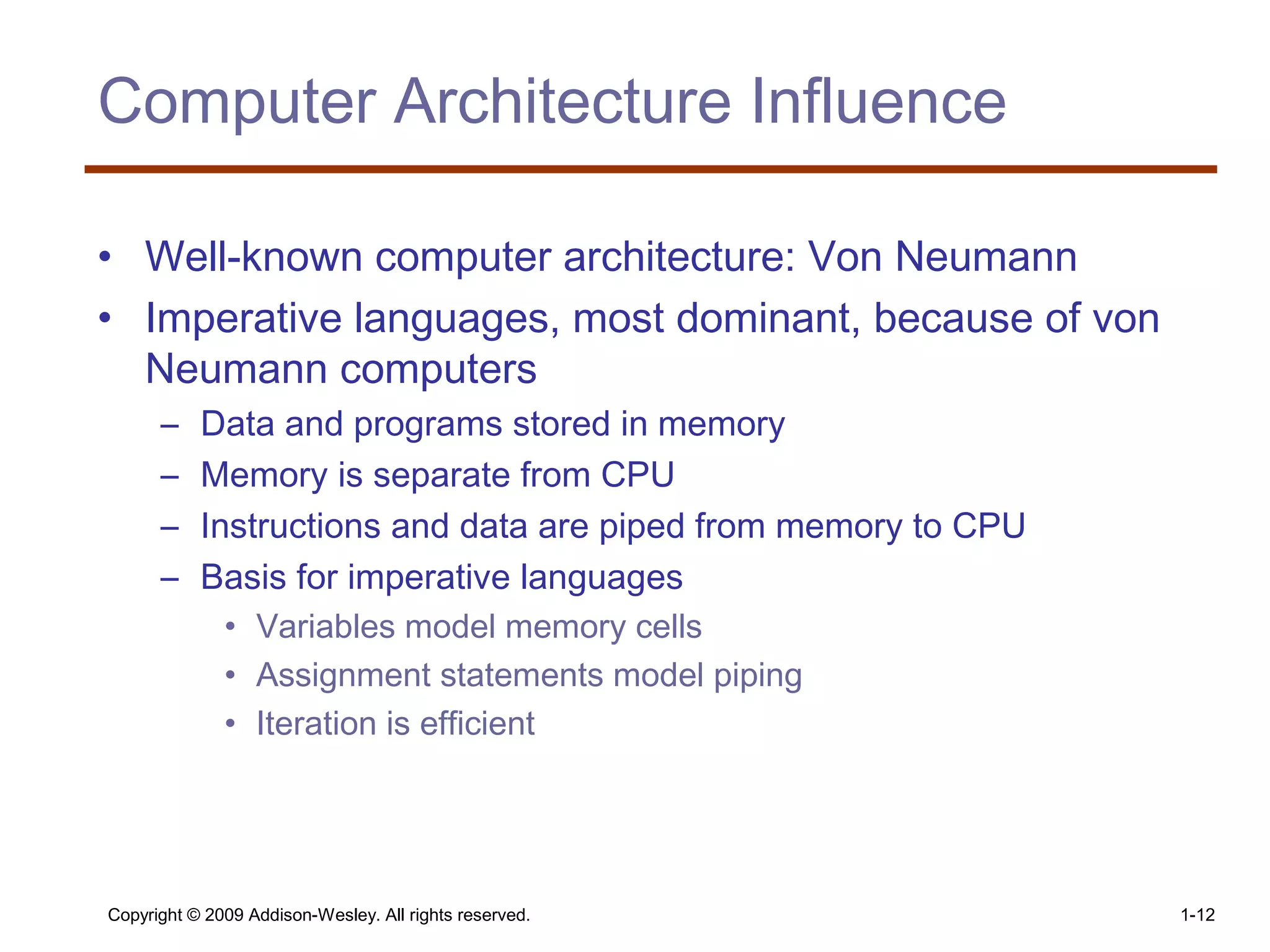
Computer Architecture Influence
• Well-known computer architecture: Von Neumann
• Imperative languages, most dominant, because of von
Neumann computers
– Data and programs stored in memory
– Memory is separate from CPU
– Instructions and data are piped from memory to CPU
– Basis for imperative languages
• Variables model memory cells
• Assignment statements model piping
• Iteration is efficient
Copyright © 2009 Addison-Wesley. All rights reserved. 1-13
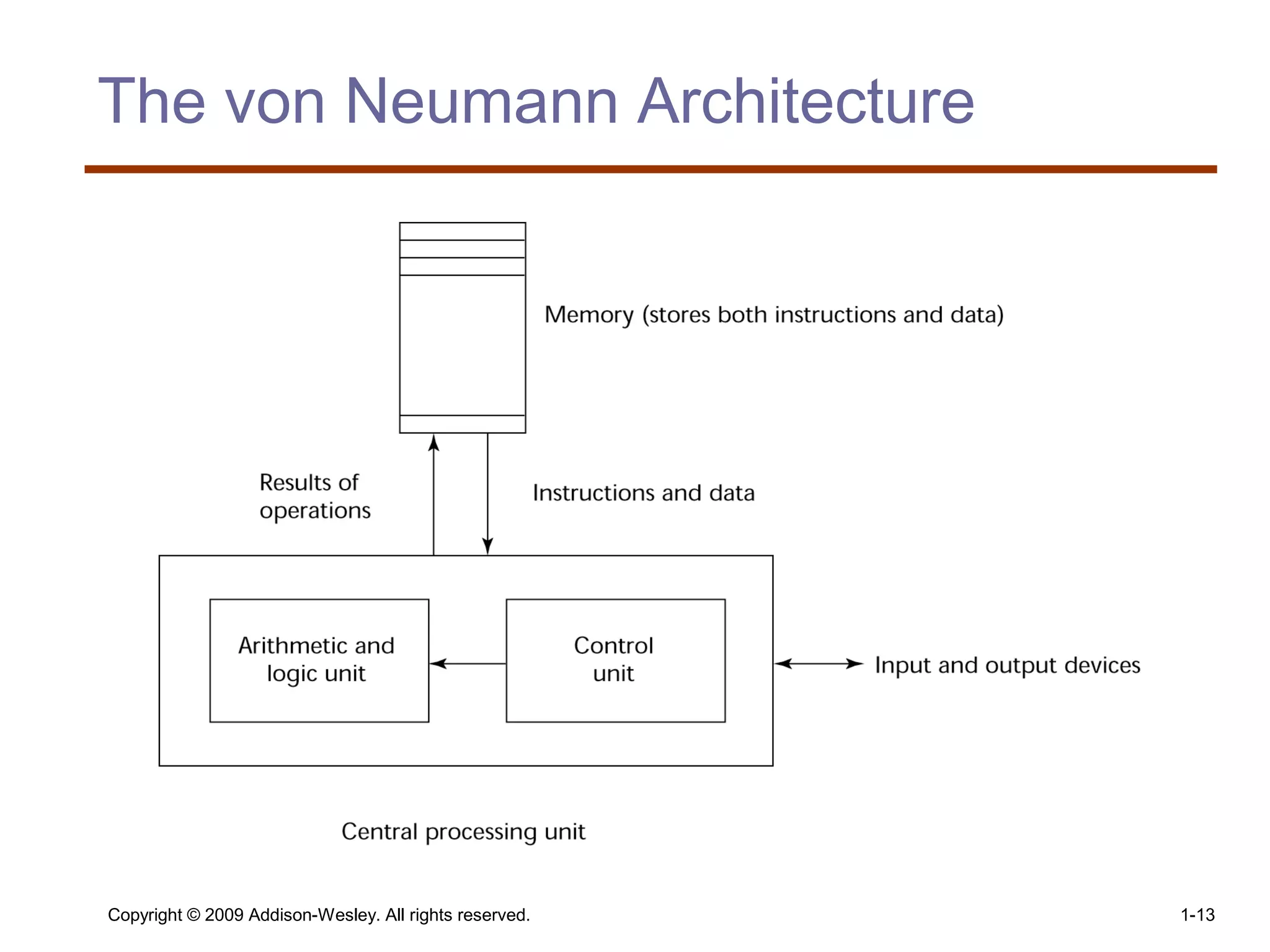
The von Neumann Architecture
Copyright © 2009 Addison-Wesley. All rights reserved. 1-14
The von Neumann Architecture
• Fetch-execute-cycle (on a von Neumann
architecture computer)
initialize the program counter
repeat forever
fetch the instruction pointed by the counter
increment the counter
decode the instruction
execute the instruction
end repeat
Copyright © 2009 Addison-Wesley. All rights reserved. 1-15
Programming Methodologies Influences
• 1950s and early 1960s: Simple applications; worry
about machine efficiency
• Late 1960s: People efficiency became important;
readability, better control structures
– structured programming
– top-down design and step-wise refinement
• Late 1970s: Process-oriented to data-oriented
– data abstraction
• Middle 1980s: Object-oriented programming
– Data abstraction + inheritance + polymorphism
Copyright © 2009 Addison-Wesley. All rights reserved. 1-16
Language Categories
• Imperative
– Central features are variables, assignment statements, and iteration
– Include languages that support object-oriented programming
– Include scripting languages
– Include the visual languages
– Examples: C, Java, Perl, JavaScript, Visual BASIC .NET, C++
• Functional
– Main means of making computations is by applying functions to given
parameters
– Examples: LISP, Scheme
• Logic
– Rule-based (rules are specified in no particular order)
– Example: Prolog
• Markup/programming hybrid
– Markup languages extended to support some programming
– Examples: JSTL, XSLT
Copyright © 2009 Addison-Wesley. All rights reserved. 1-17
Language Design Trade-Offs
• Reliability vs. cost of execution
– Example: Java demands all references to array elements be
checked for proper indexing, which leads to increased
execution costs
• Readability vs. writability
Example: APL provides many powerful operators (and a large
number of new symbols), allowing complex computations to be
written in a compact program but at the cost of poor readability
• Writability (flexibility) vs. reliability
– Example: C++ pointers are powerful and very flexible but are
unreliable
Copyright © 2009 Addison-Wesley. All rights reserved. 1-18
Implementation Methods
• Compilation
– Programs are translated into machine language
• Pure Interpretation
– Programs are interpreted by another program known as an
interpreter
• Hybrid Implementation Systems
– A compromise between compilers and pure interpreters
Copyright © 2009 Addison-Wesley. All rights reserved. 1-19
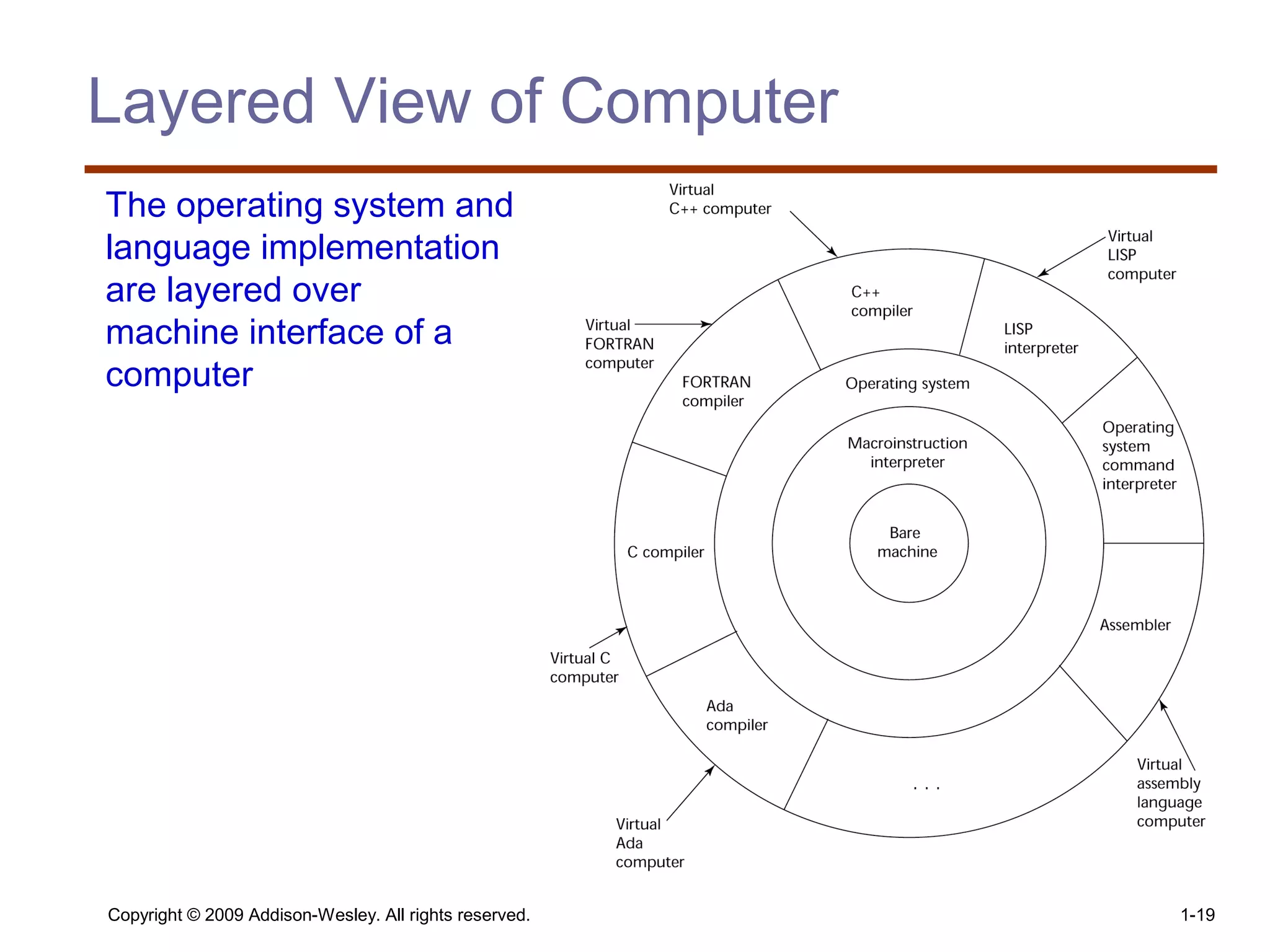
Layered View of Computer
The operating system and
language implementation
are layered over
machine interface of a
computer
Copyright © 2009 Addison-Wesley. All rights reserved. 1-20
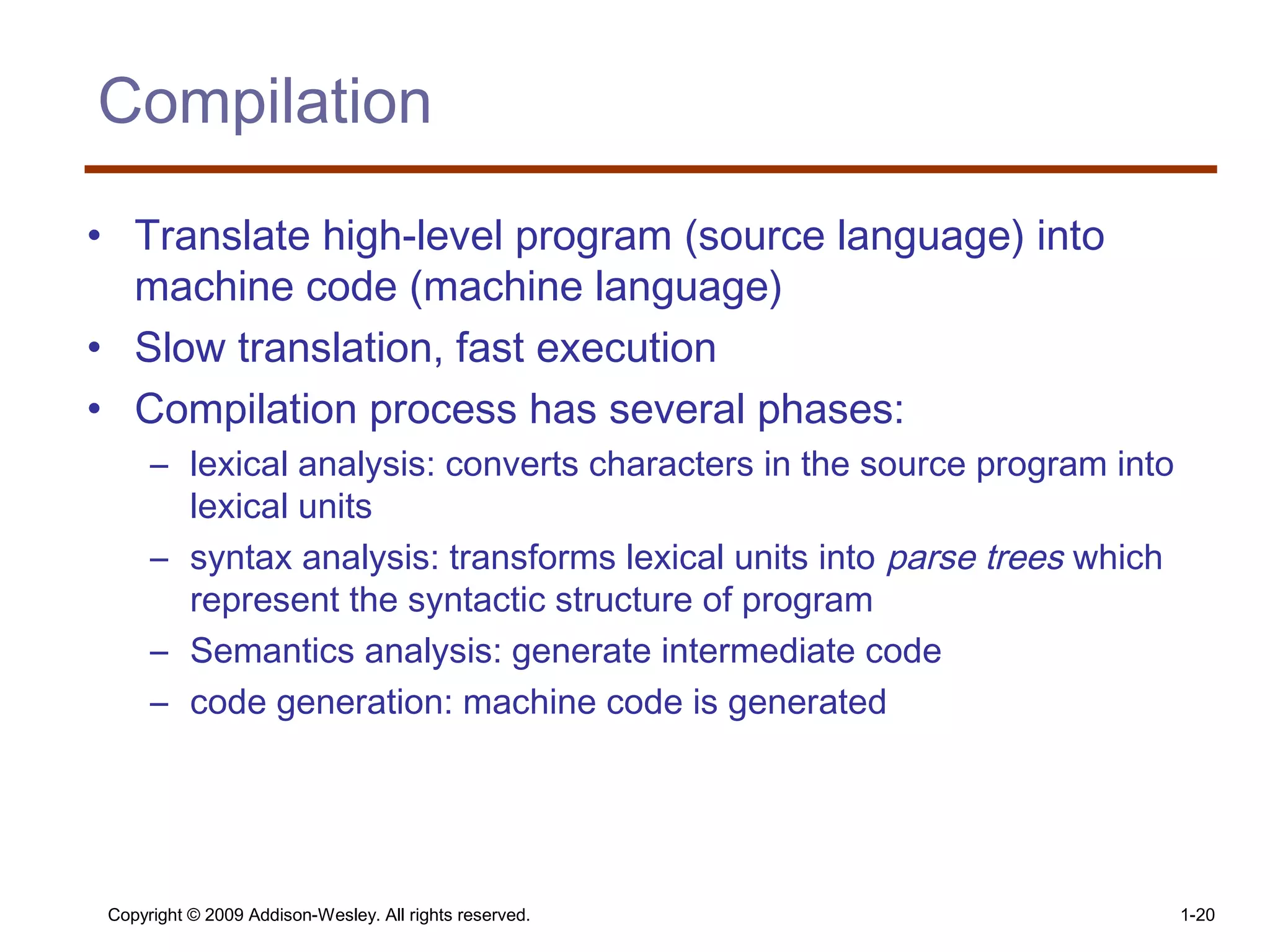
Compilation
• Translate high-level program (source language) into
machine code (machine language)
• Slow translation, fast execution
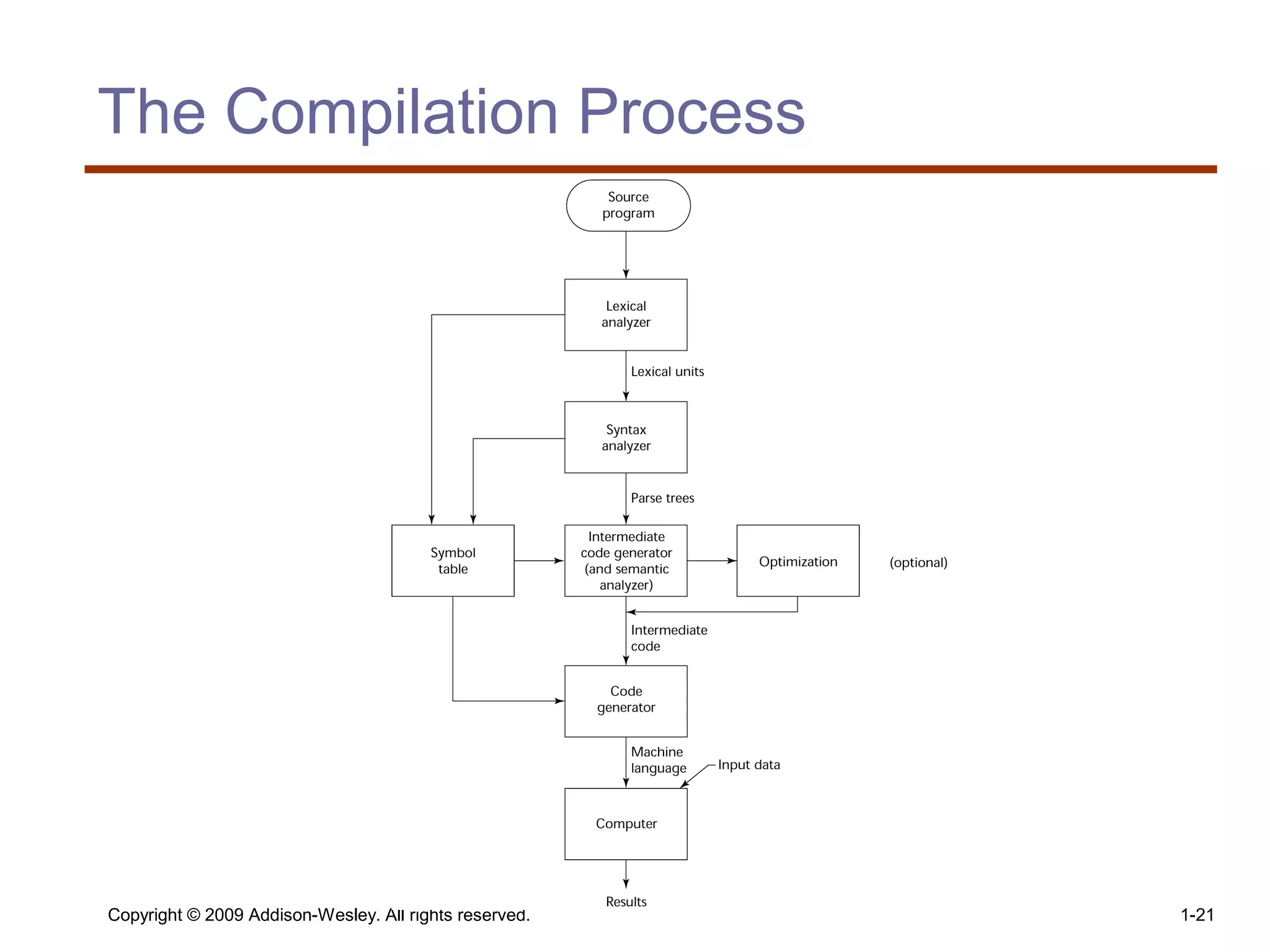
• Compilation process has several phases:
– lexical analysis: converts characters in the source program into
lexical units
– syntax analysis: transforms lexical units into parse trees which
represent the syntactic structure of program
– Semantics analysis: generate intermediate code
– code generation: machine code is generated
Copyright © 2009 Addison-Wesley. All rights reserved. 1-21
The Compilation Process
Copyright © 2009 Addison-Wesley. All rights reserved. 1-22
Additional Compilation Terminologies
• Load module (executable image): the user
and system code together
• Linking and loading: the process of
collecting system program units and linking
them to a user program
Copyright © 2009 Addison-Wesley. All rights reserved. 1-23
Von Neumann Bottleneck
• Connection speed between a computer’s
memory and its processor determines the speed
of a computer
• Program instructions often can be executed
much faster than the speed of the connection;
the connection speed thus results in a
bottleneck
• Known as the von Neumann bottleneck; it is the
primary limiting factor in the speed of computers
Copyright © 2009 Addison-Wesley. All rights reserved. 1-24
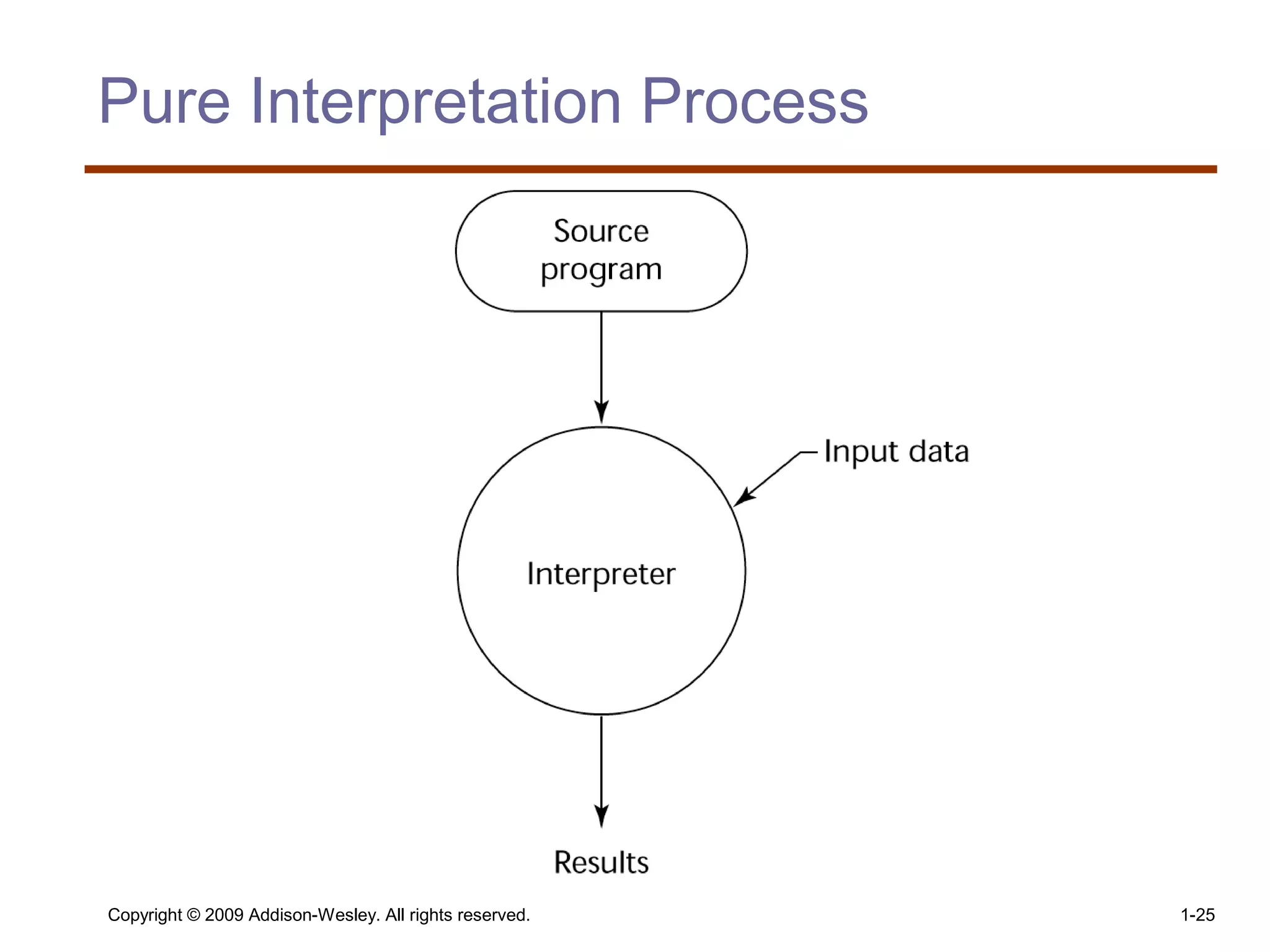
Pure Interpretation
• No translation
• Easier implementation of programs (run-time errors can
easily and immediately be displayed)
• Slower execution (10 to 100 times slower than compiled
programs)
• Often requires more space
• Now rare for traditional high-level languages
• Significant comeback with some Web scripting
languages (e.g., JavaScript, PHP)
Copyright © 2009 Addison-Wesley. All rights reserved. 1-25
Pure Interpretation Process
Copyright © 2009 Addison-Wesley. All rights reserved. 1-26
Hybrid Implementation Systems
• A compromise between compilers and pure
interpreters
• A high-level language program is translated to
an intermediate language that allows easy
interpretation
• Faster than pure interpretation
• Examples
– Perl programs are partially compiled to detect errors before
interpretation
– Initial implementations of Java were hybrid; the intermediate
form, byte code, provides portability to any machine that has a
byte code interpreter and a run-time system (together, these are
called Java Virtual Machine)
Copyright © 2009 Addison-Wesley. All rights reserved. 1-27
Hybrid Implementation Process
Copyright © 2009 Addison-Wesley. All rights reserved. 1-28
Just-in-Time Implementation Systems
• Initially translate programs to an intermediate language
• Then compile the intermediate language of the
subprograms into machine code when they are called
• Machine code version is kept for subsequent calls
• JIT systems are widely used for Java programs
• .NET languages are implemented with a JIT system
Copyright © 2009 Addison-Wesley. All rights reserved. 1-29
Preprocessors
• Preprocessor macros (instructions) are
commonly used to specify that code from
another file is to be included
• A preprocessor processes a program
immediately before the program is compiled to
expand embedded preprocessor macros
• A well-known example: C preprocessor
– expands #include, #define, and similar macros
Copyright © 2009 Addison-Wesley. All rights reserved. 1-30
Programming Environments
• A collection of tools used in software development
• UNIX
– An older operating system and tool collection
– Nowadays often used through a GUI (e.g., CDE, KDE, or
GNOME) that runs on top of UNIX
• Microsoft Visual Studio.NET
– A large, complex visual environment
• Used to build Web applications and non-Web applications in any
.NET language
• NetBeans
– Related to Visual Studio .NET, except for Web applications in
Java
Copyright © 2009 Addison-Wesley. All rights reserved. 1-31
Summary
• The study of programming languages is valuable for a
number of reasons:
– Increase our capacity to use different constructs
– Enable us to choose languages more intelligently
– Makes learning new languages easier
• Most important criteria for evaluating programming
languages include:
– Readability, writability, reliability, cost
• Major influences on language design have been machine
architecture and software development methodologies
• The major methods of implementing programming
languages are: compilation, pure interpretation, and
hybrid implementation

Pl9ch1

  • 1.
  • 2.
    Copyright © 2009Addison-Wesley. All rights reserved. 1-2 Chapter 1 Topics • Reasons for Studying Concepts of Programming Languages • Programming Domains • Language Evaluation Criteria • Influences on Language Design • Language Categories • Language Design Trade-Offs • Implementation Methods • Programming Environments
  • 3.
    Copyright © 2009Addison-Wesley. All rights reserved. 1-3 Reasons for Studying Concepts of Programming Languages • Increased ability to express ideas • Improved background for choosing appropriate languages • Increased ability to learn new languages • Better understanding of significance of implementation • Better use of languages that are already known • Overall advancement of computing
  • 4.
    Copyright © 2009Addison-Wesley. All rights reserved. 1-4 Programming Domains • Scientific applications – Large numbers of floating point computations; use of arrays – Fortran • Business applications – Produce reports, use decimal numbers and characters – COBOL • Artificial intelligence – Symbols rather than numbers manipulated; use of linked lists – LISP • Systems programming – Need efficiency because of continuous use – C • Web Software – Eclectic collection of languages: markup (e.g., XHTML), scripting (e.g., PHP), general-purpose (e.g., Java)
  • 5.
    Copyright © 2009Addison-Wesley. All rights reserved. 1-5 Language Evaluation Criteria • Readability: the ease with which programs can be read and understood • Writability: the ease with which a language can be used to create programs • Reliability: conformance to specifications (i.e., performs to its specifications) • Cost: the ultimate total cost
  • 6.
    Copyright © 2009Addison-Wesley. All rights reserved. 1-6 Evaluation Criteria: Readability • Overall simplicity – A manageable set of features and constructs – Minimal feature multiplicity – Minimal operator overloading • Orthogonality – A relatively small set of primitive constructs can be combined in a relatively small number of ways – Every possible combination is legal • Data types – Adequate predefined data types • Syntax considerations – Identifier forms: flexible composition – Special words and methods of forming compound statements – Form and meaning: self-descriptive constructs, meaningful keywords
  • 7.
    Copyright © 2009Addison-Wesley. All rights reserved. 1-7 Evaluation Criteria: Writability • Simplicity and orthogonality – Few constructs, a small number of primitives, a small set of rules for combining them • Support for abstraction – The ability to define and use complex structures or operations in ways that allow details to be ignored • Expressivity – A set of relatively convenient ways of specifying operations – Strength and number of operators and predefined functions
  • 8.
    Copyright © 2009Addison-Wesley. All rights reserved. 1-8 Evaluation Criteria: Reliability • Type checking – Testing for type errors • Exception handling – Intercept run-time errors and take corrective measures • Aliasing – Presence of two or more distinct referencing methods for the same memory location • Readability and writability – A language that does not support “natural” ways of expressing an algorithm will require the use of “unnatural” approaches, and hence reduced reliability
  • 9.
    Copyright © 2009Addison-Wesley. All rights reserved. 1-9 Evaluation Criteria: Cost • Training programmers to use the language • Writing programs (closeness to particular applications) • Compiling programs • Executing programs • Language implementation system: availability of free compilers • Reliability: poor reliability leads to high costs • Maintaining programs
  • 10.
    Copyright © 2009Addison-Wesley. All rights reserved. 1-10 Evaluation Criteria: Others • Portability – The ease with which programs can be moved from one implementation to another • Generality – The applicability to a wide range of applications • Well-definedness – The completeness and precision of the language’s official definition
  • 11.
    Copyright © 2009Addison-Wesley. All rights reserved. 1-11 Influences on Language Design • Computer Architecture – Languages are developed around the prevalent computer architecture, known as the von Neumann architecture • Programming Methodologies – New software development methodologies (e.g., object-oriented software development) led to new programming paradigms and by extension, new programming languages
  • 12.
    Copyright © 2009Addison-Wesley. All rights reserved. 1-12 Computer Architecture Influence • Well-known computer architecture: Von Neumann • Imperative languages, most dominant, because of von Neumann computers – Data and programs stored in memory – Memory is separate from CPU – Instructions and data are piped from memory to CPU – Basis for imperative languages • Variables model memory cells • Assignment statements model piping • Iteration is efficient
  • 13.
    Copyright © 2009Addison-Wesley. All rights reserved. 1-13 The von Neumann Architecture
  • 14.
    Copyright © 2009Addison-Wesley. All rights reserved. 1-14 The von Neumann Architecture • Fetch-execute-cycle (on a von Neumann architecture computer) initialize the program counter repeat forever fetch the instruction pointed by the counter increment the counter decode the instruction execute the instruction end repeat
  • 15.
    Copyright © 2009Addison-Wesley. All rights reserved. 1-15 Programming Methodologies Influences • 1950s and early 1960s: Simple applications; worry about machine efficiency • Late 1960s: People efficiency became important; readability, better control structures – structured programming – top-down design and step-wise refinement • Late 1970s: Process-oriented to data-oriented – data abstraction • Middle 1980s: Object-oriented programming – Data abstraction + inheritance + polymorphism
  • 16.
    Copyright © 2009Addison-Wesley. All rights reserved. 1-16 Language Categories • Imperative – Central features are variables, assignment statements, and iteration – Include languages that support object-oriented programming – Include scripting languages – Include the visual languages – Examples: C, Java, Perl, JavaScript, Visual BASIC .NET, C++ • Functional – Main means of making computations is by applying functions to given parameters – Examples: LISP, Scheme • Logic – Rule-based (rules are specified in no particular order) – Example: Prolog • Markup/programming hybrid – Markup languages extended to support some programming – Examples: JSTL, XSLT
  • 17.
    Copyright © 2009Addison-Wesley. All rights reserved. 1-17 Language Design Trade-Offs • Reliability vs. cost of execution – Example: Java demands all references to array elements be checked for proper indexing, which leads to increased execution costs • Readability vs. writability Example: APL provides many powerful operators (and a large number of new symbols), allowing complex computations to be written in a compact program but at the cost of poor readability • Writability (flexibility) vs. reliability – Example: C++ pointers are powerful and very flexible but are unreliable
  • 18.
    Copyright © 2009Addison-Wesley. All rights reserved. 1-18 Implementation Methods • Compilation – Programs are translated into machine language • Pure Interpretation – Programs are interpreted by another program known as an interpreter • Hybrid Implementation Systems – A compromise between compilers and pure interpreters
  • 19.
    Copyright © 2009Addison-Wesley. All rights reserved. 1-19 Layered View of Computer The operating system and language implementation are layered over machine interface of a computer
  • 20.
    Copyright © 2009Addison-Wesley. All rights reserved. 1-20 Compilation • Translate high-level program (source language) into machine code (machine language) • Slow translation, fast execution • Compilation process has several phases: – lexical analysis: converts characters in the source program into lexical units – syntax analysis: transforms lexical units into parse trees which represent the syntactic structure of program – Semantics analysis: generate intermediate code – code generation: machine code is generated
  • 21.
    Copyright © 2009Addison-Wesley. All rights reserved. 1-21 The Compilation Process
  • 22.
    Copyright © 2009Addison-Wesley. All rights reserved. 1-22 Additional Compilation Terminologies • Load module (executable image): the user and system code together • Linking and loading: the process of collecting system program units and linking them to a user program
  • 23.
    Copyright © 2009Addison-Wesley. All rights reserved. 1-23 Von Neumann Bottleneck • Connection speed between a computer’s memory and its processor determines the speed of a computer • Program instructions often can be executed much faster than the speed of the connection; the connection speed thus results in a bottleneck • Known as the von Neumann bottleneck; it is the primary limiting factor in the speed of computers
  • 24.
    Copyright © 2009Addison-Wesley. All rights reserved. 1-24 Pure Interpretation • No translation • Easier implementation of programs (run-time errors can easily and immediately be displayed) • Slower execution (10 to 100 times slower than compiled programs) • Often requires more space • Now rare for traditional high-level languages • Significant comeback with some Web scripting languages (e.g., JavaScript, PHP)
  • 25.
    Copyright © 2009Addison-Wesley. All rights reserved. 1-25 Pure Interpretation Process
  • 26.
    Copyright © 2009Addison-Wesley. All rights reserved. 1-26 Hybrid Implementation Systems • A compromise between compilers and pure interpreters • A high-level language program is translated to an intermediate language that allows easy interpretation • Faster than pure interpretation • Examples – Perl programs are partially compiled to detect errors before interpretation – Initial implementations of Java were hybrid; the intermediate form, byte code, provides portability to any machine that has a byte code interpreter and a run-time system (together, these are called Java Virtual Machine)
  • 27.
    Copyright © 2009Addison-Wesley. All rights reserved. 1-27 Hybrid Implementation Process
  • 28.
    Copyright © 2009Addison-Wesley. All rights reserved. 1-28 Just-in-Time Implementation Systems • Initially translate programs to an intermediate language • Then compile the intermediate language of the subprograms into machine code when they are called • Machine code version is kept for subsequent calls • JIT systems are widely used for Java programs • .NET languages are implemented with a JIT system
  • 29.
    Copyright © 2009Addison-Wesley. All rights reserved. 1-29 Preprocessors • Preprocessor macros (instructions) are commonly used to specify that code from another file is to be included • A preprocessor processes a program immediately before the program is compiled to expand embedded preprocessor macros • A well-known example: C preprocessor – expands #include, #define, and similar macros
  • 30.
    Copyright © 2009Addison-Wesley. All rights reserved. 1-30 Programming Environments • A collection of tools used in software development • UNIX – An older operating system and tool collection – Nowadays often used through a GUI (e.g., CDE, KDE, or GNOME) that runs on top of UNIX • Microsoft Visual Studio.NET – A large, complex visual environment • Used to build Web applications and non-Web applications in any .NET language • NetBeans – Related to Visual Studio .NET, except for Web applications in Java
  • 31.
    Copyright © 2009Addison-Wesley. All rights reserved. 1-31 Summary • The study of programming languages is valuable for a number of reasons: – Increase our capacity to use different constructs – Enable us to choose languages more intelligently – Makes learning new languages easier • Most important criteria for evaluating programming languages include: – Readability, writability, reliability, cost • Major influences on language design have been machine architecture and software development methodologies • The major methods of implementing programming languages are: compilation, pure interpretation, and hybrid implementation