Influences on Language Design
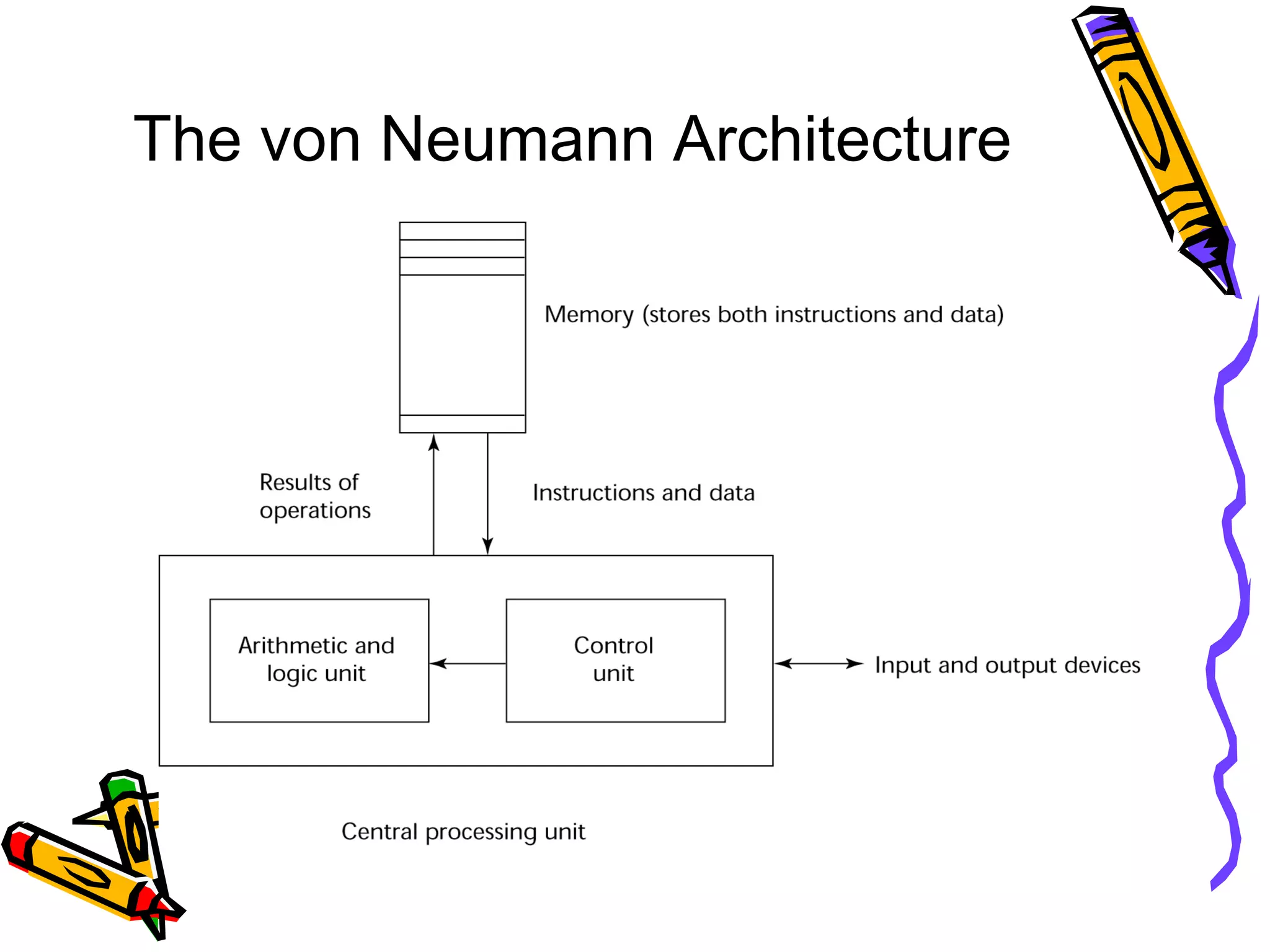
The von Neumann Architecture
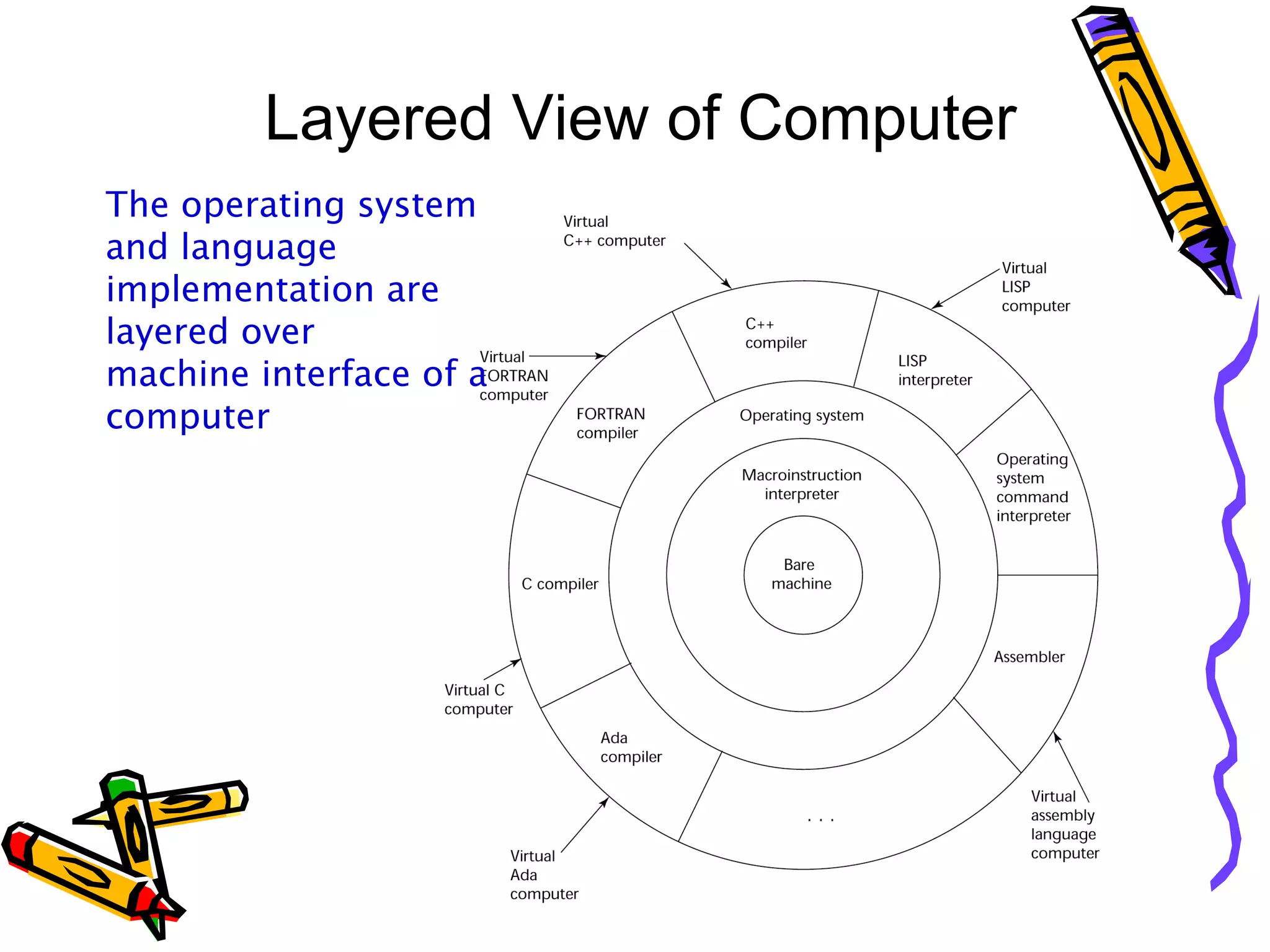
Layered View of Computer The operating system and language implementation are layered over  machine interface of a computer
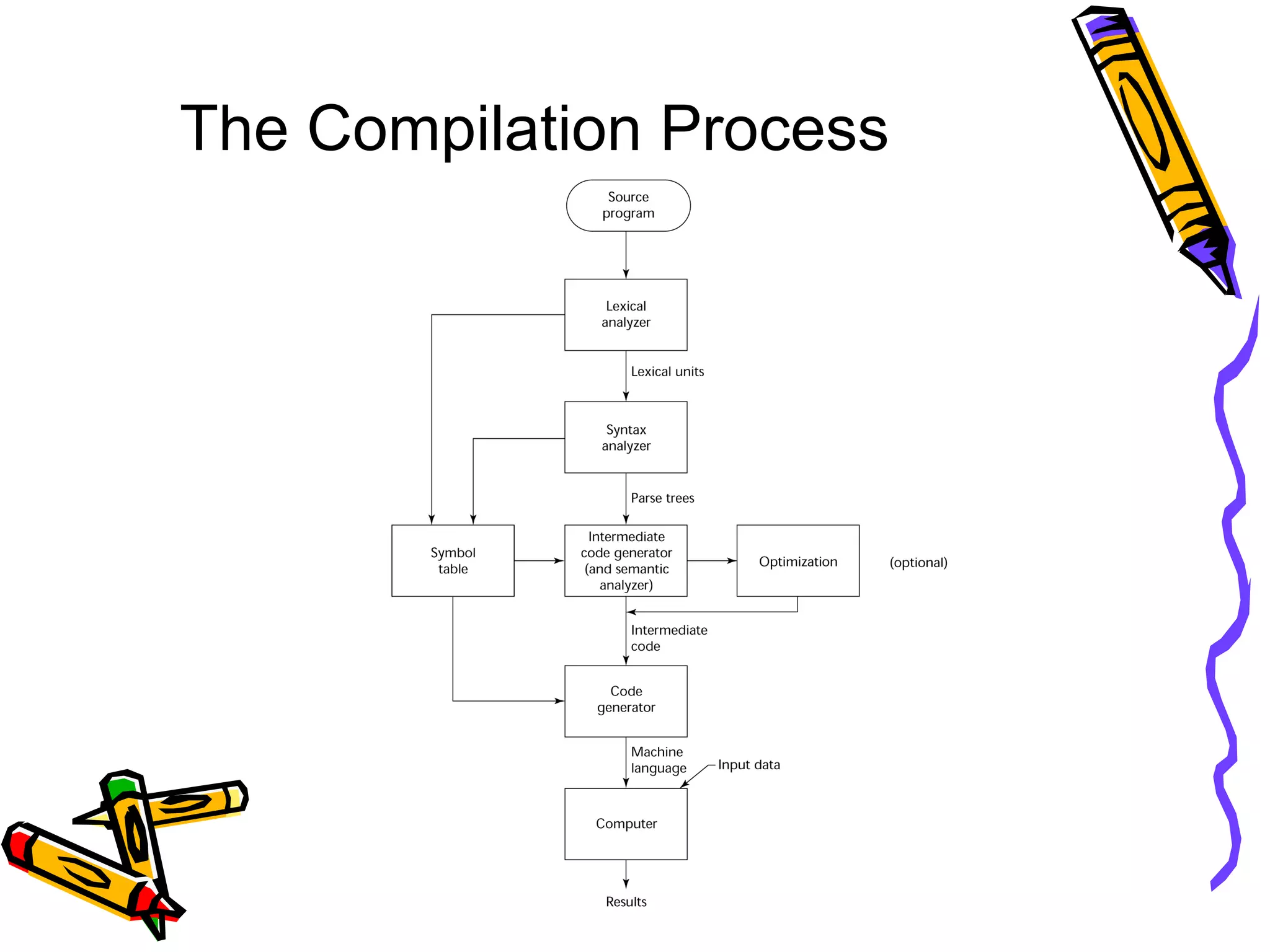
The Compilation Process
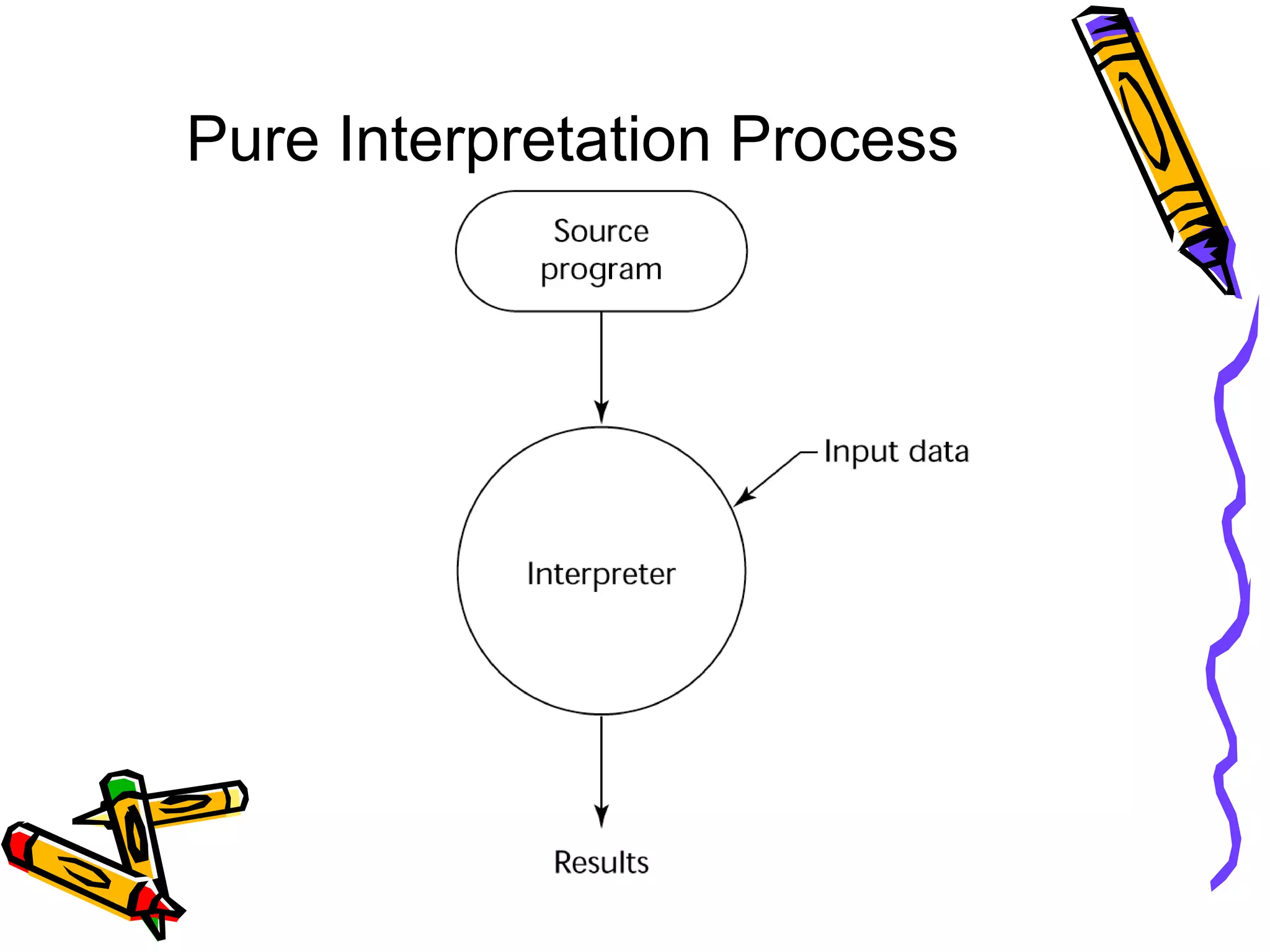
Pure Interpretation Process
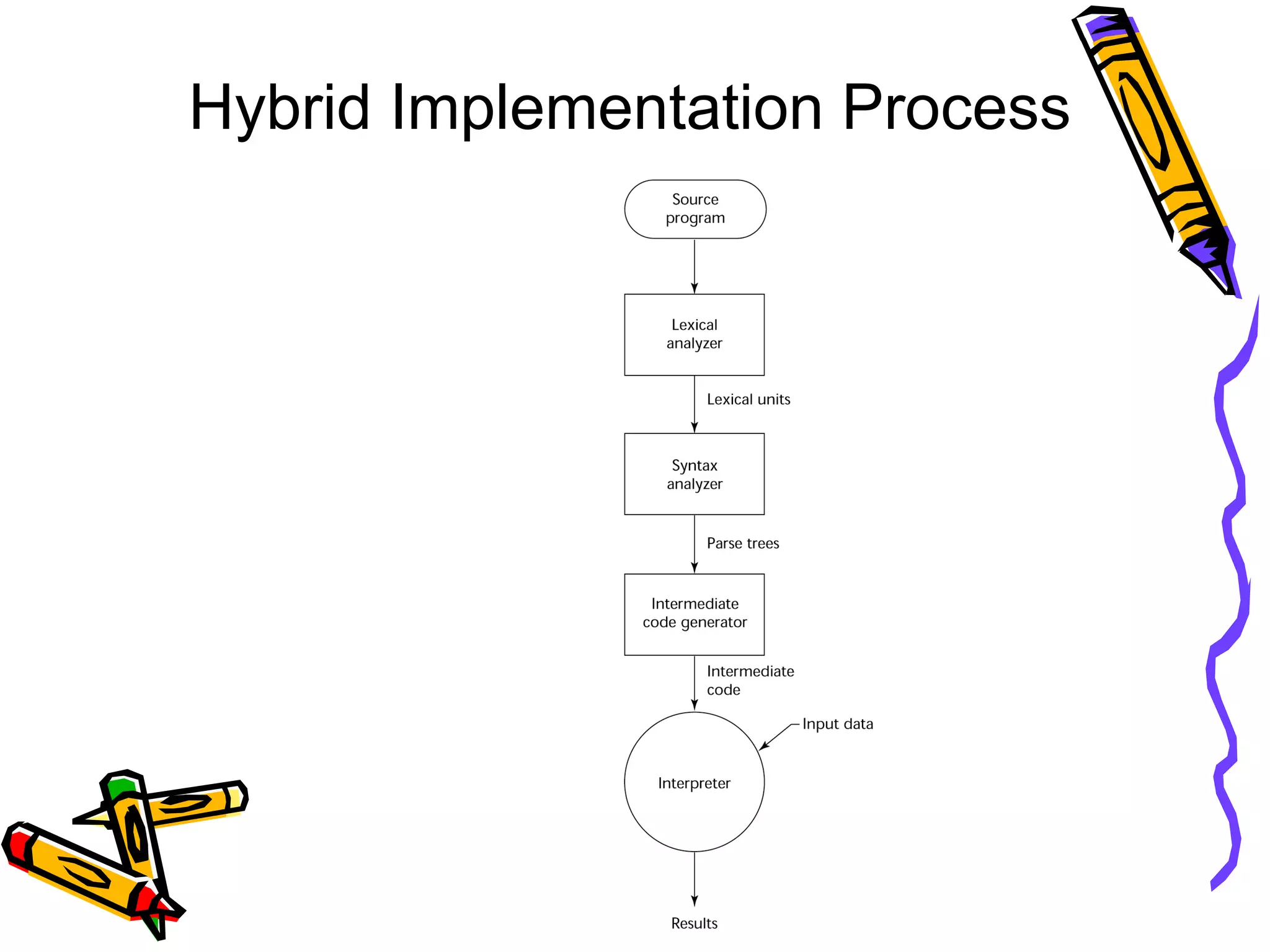
Hybrid Implementation Process
Awk vs Smallalk
Language Evaluation Criteria Readability : the ease with which programs can be read and understood Writability : the ease with which a language can be used to create programs Reliability : conformance to specifications (i.e., performs to its specifications)  Cost : the ultimate total cost
Evaluation Criteria: Readability Overall simplicity A manageable set of features and constructs Minimal feature multiplicity  Minimal operator overloading Orthogonality  A relatively small set of primitive constructs can be combined in a relatively small number of ways Every possible combination is legal Control statements The presence of well-known control structures  Data types and structures Adequate predefined data types and structures The presence of adequate facilities for defining data structures Syntax considerations Identifier forms: flexible composition  Special words and methods of forming compound statements Form and meaning: self-descriptive constructs, meaningful keywords
Evaluation Criteria: Writability Simplicity and orthogonality Few constructs, a small number of primitives, a small set of rules for combining them Support for abstraction The ability to define and use complex structures  or operations in ways that allow details to be ignored Expressivity A set of relatively convenient ways of specifying operations Strength and number of operators and predefined functions
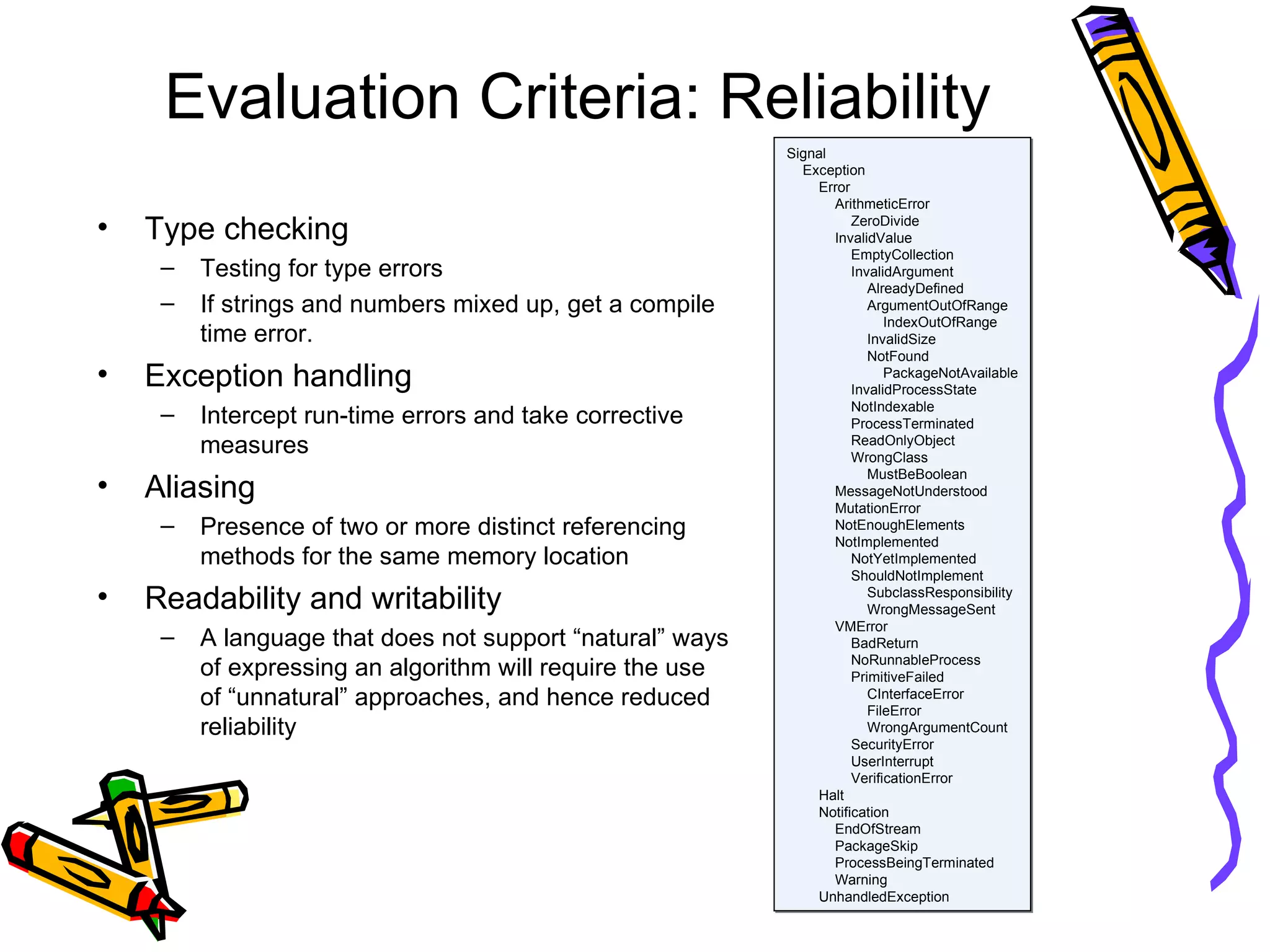
Evaluation Criteria: Reliability Type checking Testing for type errors If strings and numbers mixed up, get a compile time error. Exception handling Intercept run-time errors and take corrective measures Aliasing Presence of two or more distinct referencing methods for the same memory location Readability and writability A language that does not support “natural” ways of expressing an algorithm will require the use  of “unnatural” approaches, and hence reduced reliability Signal Exception Error ArithmeticError ZeroDivide InvalidValue EmptyCollection InvalidArgument AlreadyDefined ArgumentOutOfRange IndexOutOfRange InvalidSize NotFound PackageNotAvailable InvalidProcessState NotIndexable ProcessTerminated ReadOnlyObject WrongClass MustBeBoolean MessageNotUnderstood MutationError NotEnoughElements NotImplemented NotYetImplemented ShouldNotImplement SubclassResponsibility WrongMessageSent VMError BadReturn NoRunnableProcess PrimitiveFailed CInterfaceError FileError WrongArgumentCount SecurityError UserInterrupt VerificationError Halt Notification EndOfStream PackageSkip ProcessBeingTerminated Warning UnhandledException
Evaluation Criteria: Cost Training programmers to use the language Writing programs (closeness to particular applications) Compiling programs Executing programs Language implementation system: availability of free compilers Reliability: poor reliability leads to high costs Maintaining programs
Evaluation Criteria: Others Portability The ease with which programs can be moved from one implementation to another Generality The applicability to a wide range of applications Well-definedness The completeness and precision of the language’s official definition

Notes from Sebesta

  • 1.
  • 2.
    The von NeumannArchitecture
  • 3.
    Layered View ofComputer The operating system and language implementation are layered over machine interface of a computer
  • 4.
  • 5.
  • 6.
  • 7.
  • 8.
    Language Evaluation CriteriaReadability : the ease with which programs can be read and understood Writability : the ease with which a language can be used to create programs Reliability : conformance to specifications (i.e., performs to its specifications) Cost : the ultimate total cost
  • 9.
    Evaluation Criteria: ReadabilityOverall simplicity A manageable set of features and constructs Minimal feature multiplicity Minimal operator overloading Orthogonality A relatively small set of primitive constructs can be combined in a relatively small number of ways Every possible combination is legal Control statements The presence of well-known control structures Data types and structures Adequate predefined data types and structures The presence of adequate facilities for defining data structures Syntax considerations Identifier forms: flexible composition Special words and methods of forming compound statements Form and meaning: self-descriptive constructs, meaningful keywords
  • 10.
    Evaluation Criteria: WritabilitySimplicity and orthogonality Few constructs, a small number of primitives, a small set of rules for combining them Support for abstraction The ability to define and use complex structures or operations in ways that allow details to be ignored Expressivity A set of relatively convenient ways of specifying operations Strength and number of operators and predefined functions
  • 11.
    Evaluation Criteria: ReliabilityType checking Testing for type errors If strings and numbers mixed up, get a compile time error. Exception handling Intercept run-time errors and take corrective measures Aliasing Presence of two or more distinct referencing methods for the same memory location Readability and writability A language that does not support “natural” ways of expressing an algorithm will require the use of “unnatural” approaches, and hence reduced reliability Signal Exception Error ArithmeticError ZeroDivide InvalidValue EmptyCollection InvalidArgument AlreadyDefined ArgumentOutOfRange IndexOutOfRange InvalidSize NotFound PackageNotAvailable InvalidProcessState NotIndexable ProcessTerminated ReadOnlyObject WrongClass MustBeBoolean MessageNotUnderstood MutationError NotEnoughElements NotImplemented NotYetImplemented ShouldNotImplement SubclassResponsibility WrongMessageSent VMError BadReturn NoRunnableProcess PrimitiveFailed CInterfaceError FileError WrongArgumentCount SecurityError UserInterrupt VerificationError Halt Notification EndOfStream PackageSkip ProcessBeingTerminated Warning UnhandledException
  • 12.
    Evaluation Criteria: CostTraining programmers to use the language Writing programs (closeness to particular applications) Compiling programs Executing programs Language implementation system: availability of free compilers Reliability: poor reliability leads to high costs Maintaining programs
  • 13.
    Evaluation Criteria: OthersPortability The ease with which programs can be moved from one implementation to another Generality The applicability to a wide range of applications Well-definedness The completeness and precision of the language’s official definition