Introduction
Principles of Programming
Languages
Why Study Programming Languages?
• Increased capacity to express ideas
• Improved background for choosing appropriate language
• Increased ability to learn new languages
• Better understanding of the significance of implementation
• Better use of languages that are already known
• Overall advancement of computing
Programming Domains
• Scientific Applications (Fortran)
• Business Applications (COBOL)
• Artificial Intelligence (LISP, Prolog)
• Systems Programming (C)
• Web Software (HTML, PHP, Java)
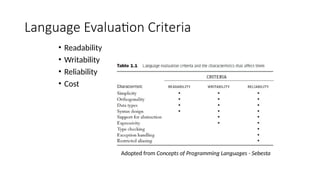
Language Evaluation Criteria
• Readability
• Writability
• Reliability
• Cost
Adopted from Concepts of Programming Languages - Sebesta
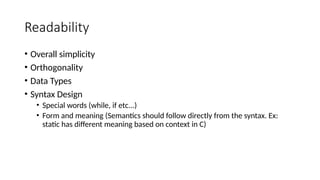
Readability
• Overall simplicity
• Orthogonality
• Data Types
• Syntax Design
• Special words (while, if etc...)
• Form and meaning (Semantics should follow directly from the syntax. Ex:
static has different meaning based on context in C)
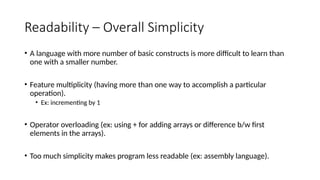
Readability – Overall Simplicity
• A language with more number of basic constructs is more difficult to learn than
one with a smaller number.
• Feature multiplicity (having more than one way to accomplish a particular
operation).
• Ex: incrementing by 1
• Operator overloading (ex: using + for adding arrays or difference b/w first
elements in the arrays).
• Too much simplicity makes program less readable (ex: assembly language).
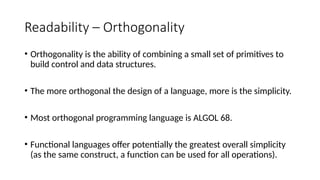
Readability – Orthogonality
• Orthogonality is the ability of combining a small set of primitives to
build control and data structures.
• The more orthogonal the design of a language, more is the simplicity.
• Most orthogonal programming language is ALGOL 68.
• Functional languages offer potentially the greatest overall simplicity
(as the same construct, a function can be used for all operations).
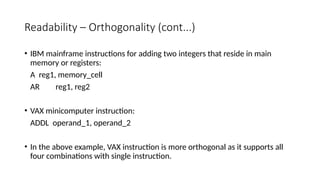
Readability – Orthogonality (cont...)
• IBM mainframe instructions for adding two integers that reside in main
memory or registers:
A reg1, memory_cell
AR reg1, reg2
• VAX minicomputer instruction:
ADDL operand_1, operand_2
• In the above example, VAX instruction is more orthogonal as it supports all
four combinations with single instruction.
Readability – Data Types
• The presence of meaningful data types aids readability.
• If a numeric type is used to indicate Boolean conditions, the
statement will be unclear.
Ex: timeOut = 1
Writability
• Simplicity and Orthogonality
• A language with small set of primitives is better than one with a large set of
primitives
• Too much orthogonality decreases writability
• Support for Abstraction
• Expressivity
Writability – Support for Abstraction
• Abstraction is the ability to define and use complicated structures or operations in
ways that allow many of the details to be ignored.
• Programming languages can support two types of abstraction: process and data.
• Example for process abstraction is to use a subprogram for sorting that is required
several times in a program.
• Example for data abstraction is a binary tree that stores integer data in its nodes. It
is better to implement a binary tree in C++ or Java using classes rather than in
Fortran77 using pointers and dynamic memory management.
Writability – Expressivity
• Ability of a language that allows a great deal of computation to be
accomplished with a very small program.
• In C, count++ is more convenient than writing count = count + 1.
• Inclusion of for statement in Java makes writing counting loops easier
than with the use of while.
Reliability
• A program is said to be reliable if it performs to its specifications
under all conditions.
• Type Checking
• Exception Handling
• Aliasing
• Readability and Writability
Reliability – Type Checking
• Type checking is simply testing for type errors either at compile time
or run-time.
• As run-time type checking is expensive, compile time checking is
desirable. (Ex: Java)
Reliability – Exception Handling
• Ability of a program to intercept run-time errors and take corrective
measures is known as exception handling.
• Ada, C++, Java and C# provides extensive capabilities for exception
handling.
Reliability- Aliasing
• Aliasing is having two or more distinct names that can be used to
access the same memory cell (Ex: Pointers in C and C++).
• Many languages greatly restrict aliasing to increase their reliability.
Cost
• Total cost of a programming language is a function of:
• Cost of training the programmers
• Cost of writing the programs
• Cost of compiling the programs in the language
• Cost of executing programs
• Cost of language implementation system (Ex: JVM)
• Cost of poor reliability
• Cost of maintenance
• Other criteria that can be used to evaluate a programming language are:
portability, generality and well-definedness.
Influences on Language Design
• Computer Architecture
• Programming Design Methodologies
Computer Architecture
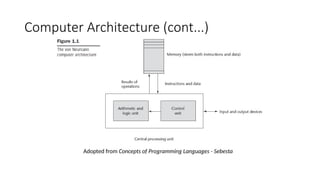
• Imperative languages have been designed around the computer
architecture called the von Neumann architecture.
• In this architecture, data and programs are stored in memory and they
are executed by the CPU.
• Central features of imperative languages are variables, which model
memory cells; assignment statements, which are based on the piping
operation; and iterative form of repetition, which is the most efficient
way to implement repetition on this architecture.
Computer Architecture (cont...)
Adopted from Concepts of Programming Languages - Sebesta
Programming Design Methodologies
• Intense analysis begun in large part by the structured programming
movement in the late 1960s.
• New software development methodologies that emerged as a result
of the research in 1970s were called top-down design or stepwise
refinement.
• In the late 1970s, a shift from procedure-oriented to data-oriented
program design methodologies began.
Programming Design Methodologies (cont...)
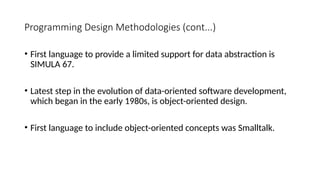
• First language to provide a limited support for data abstraction is
SIMULA 67.
• Latest step in the evolution of data-oriented software development,
which began in the early 1980s, is object-oriented design.
• First language to include object-oriented concepts was Smalltalk.
Programming Design Methodologies (cont...)
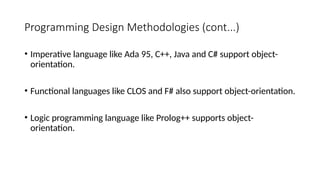
• Imperative language like Ada 95, C++, Java and C# support object-
orientation.
• Functional languages like CLOS and F# also support object-orientation.
• Logic programming language like Prolog++ supports object-
orientation.
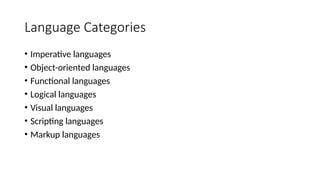
Language Categories
• Imperative languages
• Object-oriented languages
• Functional languages
• Logical languages
• Visual languages
• Scripting languages
• Markup languages
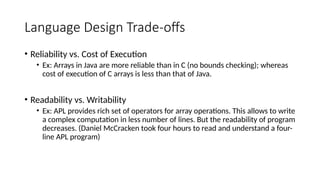
Language Design Trade-offs
• Reliability vs. Cost of Execution
• Ex: Arrays in Java are more reliable than in C (no bounds checking); whereas
cost of execution of C arrays is less than that of Java.
• Readability vs. Writability
• Ex: APL provides rich set of operators for array operations. This allows to write
a complex computation in less number of lines. But the readability of program
decreases. (Daniel McCracken took four hours to read and understand a four-
line APL program)
Implementation Methods
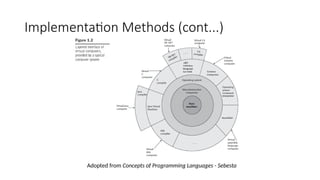
• A language implementation system cannot be the only software on a
computer. Requires an operating system also.
• The operating system and language implementations are layered over
the machine language interface of a computer.
Implementation Methods (cont...)
Adopted from Concepts of Programming Languages - Sebesta
Implementation Methods- Compilation
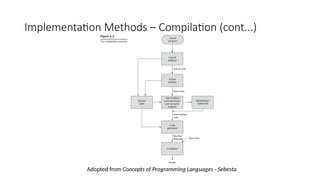
• Programs can be translated to machine language and be directly
executed on the computer. This is called compiler implementation.
• Very fast program execution.
• Ex: C, C++, COBOL, Ada
Implementation Methods – Compilation (cont...)
Adopted from Concepts of Programming Languages - Sebesta
Implementation Methods – Compilation (cont...)
• The user and system code together is called a load module or
executable image.
• Process of collecting system programs and linking them to user
programs is called linking and loading. This is done by a system program
called as linker.
• The speed of connection between a computer’s memory and its
processor is known as von Neumann bottleneck. This is the primary
motivation for research and development of parallel computers.
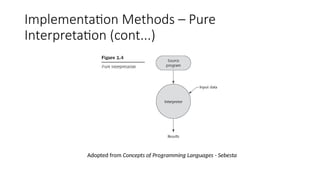
Implementation Methods – Pure Interpretation
• Programs are interpreted by another program called an interpreter, with no
translation.
• Advantage is easy implementation of many source-level debugging
operations.
• Disadvantage is this method is 10 to 100 times slower than compiled
systems.
• Statement decoding is the bottleneck of a pure interpreter.
Implementation Methods – Pure
Interpretation (cont...)
Adopted from Concepts of Programming Languages - Sebesta
Implementation Methods – Pure
Interpretation (cont...)
• Another disadvantage is, this method requires more space (for
including symbol table along with source code).
• Ex: Earlier versions of APL, SNOBOL and LISP
Implementation Methods – Hybrid Approach
Adopted from Concepts of Programming Languages - Sebesta
Implementation Methods – Hybrid Approach
(cont...)
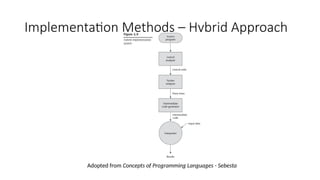
• High-level programs are translated to an intermediate language
designed to allow easy interpretation.
• This method is better than pure interpretation as the source language
statements are decoded only once.
• Ex: Perl, Java and .NET
Programming Environments
• A programming environment is a collection of tools used in the development of
software.
• UNIX is an older programming environment. GUI versions of UNIX or Solaris CDE,
GNOME and KDE.
• Borland’s JBuilder is an IDE.
• Microsoft’s Visual Studio .NET
• NetBeans

unit-1(ppl notes) programing for problem.pptx

  • 1.
  • 2.
  • 3.
    Why Study ProgrammingLanguages? • Increased capacity to express ideas • Improved background for choosing appropriate language • Increased ability to learn new languages • Better understanding of the significance of implementation • Better use of languages that are already known • Overall advancement of computing
  • 4.
    Programming Domains • ScientificApplications (Fortran) • Business Applications (COBOL) • Artificial Intelligence (LISP, Prolog) • Systems Programming (C) • Web Software (HTML, PHP, Java)
  • 5.
    Language Evaluation Criteria •Readability • Writability • Reliability • Cost Adopted from Concepts of Programming Languages - Sebesta
  • 6.
    Readability • Overall simplicity •Orthogonality • Data Types • Syntax Design • Special words (while, if etc...) • Form and meaning (Semantics should follow directly from the syntax. Ex: static has different meaning based on context in C)
  • 7.
    Readability – OverallSimplicity • A language with more number of basic constructs is more difficult to learn than one with a smaller number. • Feature multiplicity (having more than one way to accomplish a particular operation). • Ex: incrementing by 1 • Operator overloading (ex: using + for adding arrays or difference b/w first elements in the arrays). • Too much simplicity makes program less readable (ex: assembly language).
  • 8.
    Readability – Orthogonality •Orthogonality is the ability of combining a small set of primitives to build control and data structures. • The more orthogonal the design of a language, more is the simplicity. • Most orthogonal programming language is ALGOL 68. • Functional languages offer potentially the greatest overall simplicity (as the same construct, a function can be used for all operations).
  • 9.
    Readability – Orthogonality(cont...) • IBM mainframe instructions for adding two integers that reside in main memory or registers: A reg1, memory_cell AR reg1, reg2 • VAX minicomputer instruction: ADDL operand_1, operand_2 • In the above example, VAX instruction is more orthogonal as it supports all four combinations with single instruction.
  • 10.
    Readability – DataTypes • The presence of meaningful data types aids readability. • If a numeric type is used to indicate Boolean conditions, the statement will be unclear. Ex: timeOut = 1
  • 11.
    Writability • Simplicity andOrthogonality • A language with small set of primitives is better than one with a large set of primitives • Too much orthogonality decreases writability • Support for Abstraction • Expressivity
  • 12.
    Writability – Supportfor Abstraction • Abstraction is the ability to define and use complicated structures or operations in ways that allow many of the details to be ignored. • Programming languages can support two types of abstraction: process and data. • Example for process abstraction is to use a subprogram for sorting that is required several times in a program. • Example for data abstraction is a binary tree that stores integer data in its nodes. It is better to implement a binary tree in C++ or Java using classes rather than in Fortran77 using pointers and dynamic memory management.
  • 13.
    Writability – Expressivity •Ability of a language that allows a great deal of computation to be accomplished with a very small program. • In C, count++ is more convenient than writing count = count + 1. • Inclusion of for statement in Java makes writing counting loops easier than with the use of while.
  • 14.
    Reliability • A programis said to be reliable if it performs to its specifications under all conditions. • Type Checking • Exception Handling • Aliasing • Readability and Writability
  • 15.
    Reliability – TypeChecking • Type checking is simply testing for type errors either at compile time or run-time. • As run-time type checking is expensive, compile time checking is desirable. (Ex: Java)
  • 16.
    Reliability – ExceptionHandling • Ability of a program to intercept run-time errors and take corrective measures is known as exception handling. • Ada, C++, Java and C# provides extensive capabilities for exception handling.
  • 17.
    Reliability- Aliasing • Aliasingis having two or more distinct names that can be used to access the same memory cell (Ex: Pointers in C and C++). • Many languages greatly restrict aliasing to increase their reliability.
  • 18.
    Cost • Total costof a programming language is a function of: • Cost of training the programmers • Cost of writing the programs • Cost of compiling the programs in the language • Cost of executing programs • Cost of language implementation system (Ex: JVM) • Cost of poor reliability • Cost of maintenance • Other criteria that can be used to evaluate a programming language are: portability, generality and well-definedness.
  • 19.
    Influences on LanguageDesign • Computer Architecture • Programming Design Methodologies
  • 20.
    Computer Architecture • Imperativelanguages have been designed around the computer architecture called the von Neumann architecture. • In this architecture, data and programs are stored in memory and they are executed by the CPU. • Central features of imperative languages are variables, which model memory cells; assignment statements, which are based on the piping operation; and iterative form of repetition, which is the most efficient way to implement repetition on this architecture.
  • 21.
    Computer Architecture (cont...) Adoptedfrom Concepts of Programming Languages - Sebesta
  • 22.
    Programming Design Methodologies •Intense analysis begun in large part by the structured programming movement in the late 1960s. • New software development methodologies that emerged as a result of the research in 1970s were called top-down design or stepwise refinement. • In the late 1970s, a shift from procedure-oriented to data-oriented program design methodologies began.
  • 23.
    Programming Design Methodologies(cont...) • First language to provide a limited support for data abstraction is SIMULA 67. • Latest step in the evolution of data-oriented software development, which began in the early 1980s, is object-oriented design. • First language to include object-oriented concepts was Smalltalk.
  • 24.
    Programming Design Methodologies(cont...) • Imperative language like Ada 95, C++, Java and C# support object- orientation. • Functional languages like CLOS and F# also support object-orientation. • Logic programming language like Prolog++ supports object- orientation.
  • 25.
    Language Categories • Imperativelanguages • Object-oriented languages • Functional languages • Logical languages • Visual languages • Scripting languages • Markup languages
  • 26.
    Language Design Trade-offs •Reliability vs. Cost of Execution • Ex: Arrays in Java are more reliable than in C (no bounds checking); whereas cost of execution of C arrays is less than that of Java. • Readability vs. Writability • Ex: APL provides rich set of operators for array operations. This allows to write a complex computation in less number of lines. But the readability of program decreases. (Daniel McCracken took four hours to read and understand a four- line APL program)
  • 27.
    Implementation Methods • Alanguage implementation system cannot be the only software on a computer. Requires an operating system also. • The operating system and language implementations are layered over the machine language interface of a computer.
  • 28.
    Implementation Methods (cont...) Adoptedfrom Concepts of Programming Languages - Sebesta
  • 29.
    Implementation Methods- Compilation •Programs can be translated to machine language and be directly executed on the computer. This is called compiler implementation. • Very fast program execution. • Ex: C, C++, COBOL, Ada
  • 30.
    Implementation Methods –Compilation (cont...) Adopted from Concepts of Programming Languages - Sebesta
  • 31.
    Implementation Methods –Compilation (cont...) • The user and system code together is called a load module or executable image. • Process of collecting system programs and linking them to user programs is called linking and loading. This is done by a system program called as linker. • The speed of connection between a computer’s memory and its processor is known as von Neumann bottleneck. This is the primary motivation for research and development of parallel computers.
  • 32.
    Implementation Methods –Pure Interpretation • Programs are interpreted by another program called an interpreter, with no translation. • Advantage is easy implementation of many source-level debugging operations. • Disadvantage is this method is 10 to 100 times slower than compiled systems. • Statement decoding is the bottleneck of a pure interpreter.
  • 33.
    Implementation Methods –Pure Interpretation (cont...) Adopted from Concepts of Programming Languages - Sebesta
  • 34.
    Implementation Methods –Pure Interpretation (cont...) • Another disadvantage is, this method requires more space (for including symbol table along with source code). • Ex: Earlier versions of APL, SNOBOL and LISP
  • 35.
    Implementation Methods –Hybrid Approach Adopted from Concepts of Programming Languages - Sebesta
  • 36.
    Implementation Methods –Hybrid Approach (cont...) • High-level programs are translated to an intermediate language designed to allow easy interpretation. • This method is better than pure interpretation as the source language statements are decoded only once. • Ex: Perl, Java and .NET
  • 37.
    Programming Environments • Aprogramming environment is a collection of tools used in the development of software. • UNIX is an older programming environment. GUI versions of UNIX or Solaris CDE, GNOME and KDE. • Borland’s JBuilder is an IDE. • Microsoft’s Visual Studio .NET • NetBeans