Base64 Encoding

    Jonathan Francis Roscoe
               jjr6@aber.ac.uk
Topics of Discussion
●
    Encoding and encryption
●
    What is base64 used for?
●
    Usage of base64 encoding
●
    The algorithm
●
    Drawbacks
●
    Alternatives
Encoding and Encryption
●
    People often refer to base64 (and similar
    methods) as a form of encryption.
●
    Encoding is the process of transforming
    information from one format into another.
    –   Transfer
    –   Storage
    –   Formating (eg. LaTeX – semantics encoding)

●
    Encryption is a type of encoding that obscures
    information to make it unreadable without
    special knowledge.
What is base64?
●
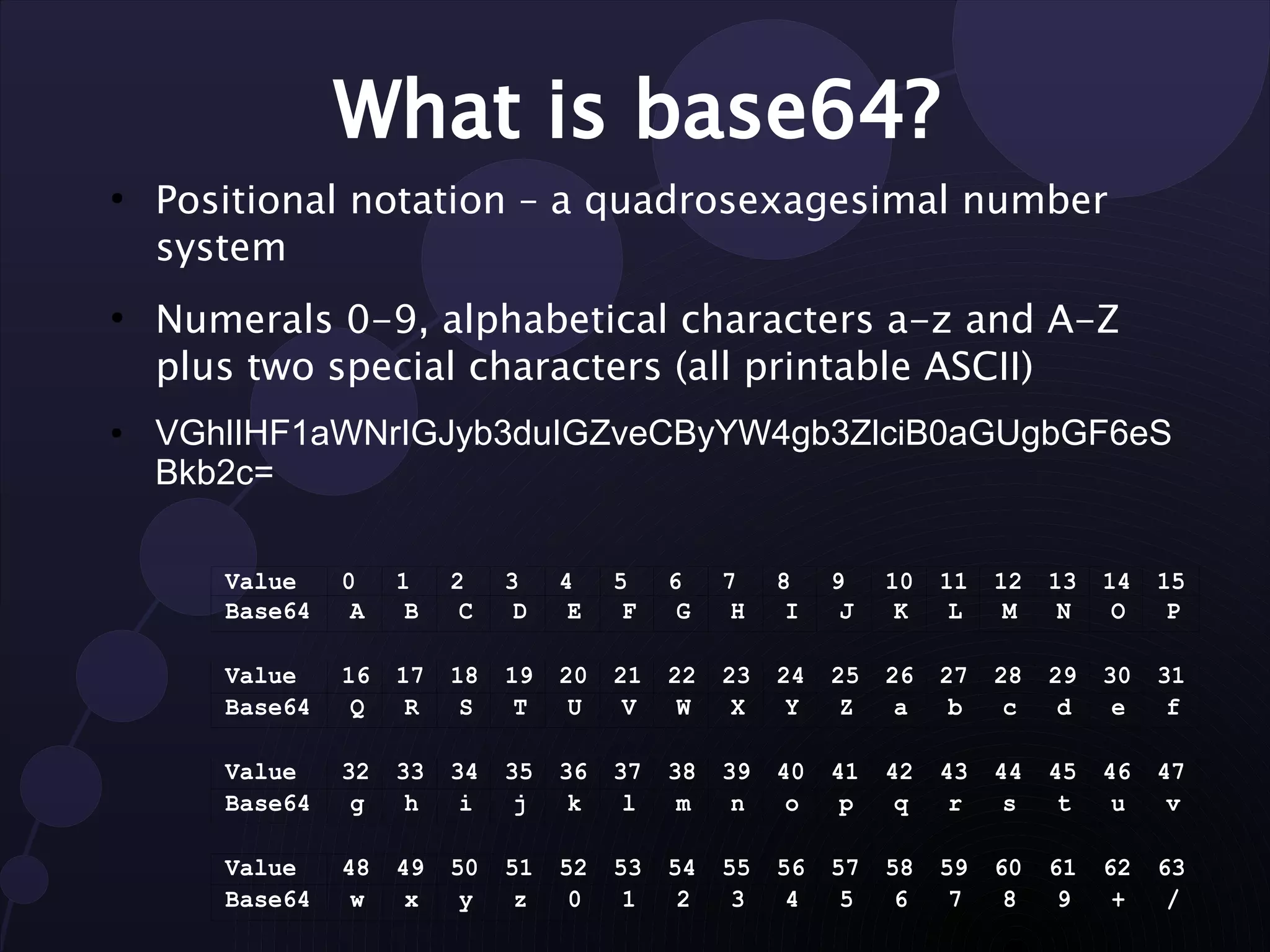
    Positional notation – a quadrosexagesimal number
    system
●
    Numerals 0-9, alphabetical characters a-z and A-Z
    plus two special characters (all printable ASCII)
●   VGhlIHF1aWNrIGJyb3duIGZveCByYW4gb3ZlciB0aGUgbGF6eS
    Bkb2c=

       Value    0    1    2    3    4    5    6    7    8    9    10   11   12   13   14   15
       Base64    A    B    C    D    E    F    G    H    I    J    K    L    M    N    O    P

       Value    16   17   18   19   20   21   22   23   24   25   26   27   28   29   30   31
       Base64    Q    R    S    T    U    V    W    X    Y    Z    a    b    c    d    e    f

       Value    32   33   34   35   36   37   38   39   40   41   42   43   44   45   46   47
       Base64    g    h    i    j    k    l    m    n    o    p    q    r    s    t    u    v

       Value    48   49   50   51   52   53   54   55   56   57   58   59   60   61   62   63
       Base64    w    x    y    z    0    1    2    3    4    5    6    7    8    9    +    /
What is base64 used for?
●
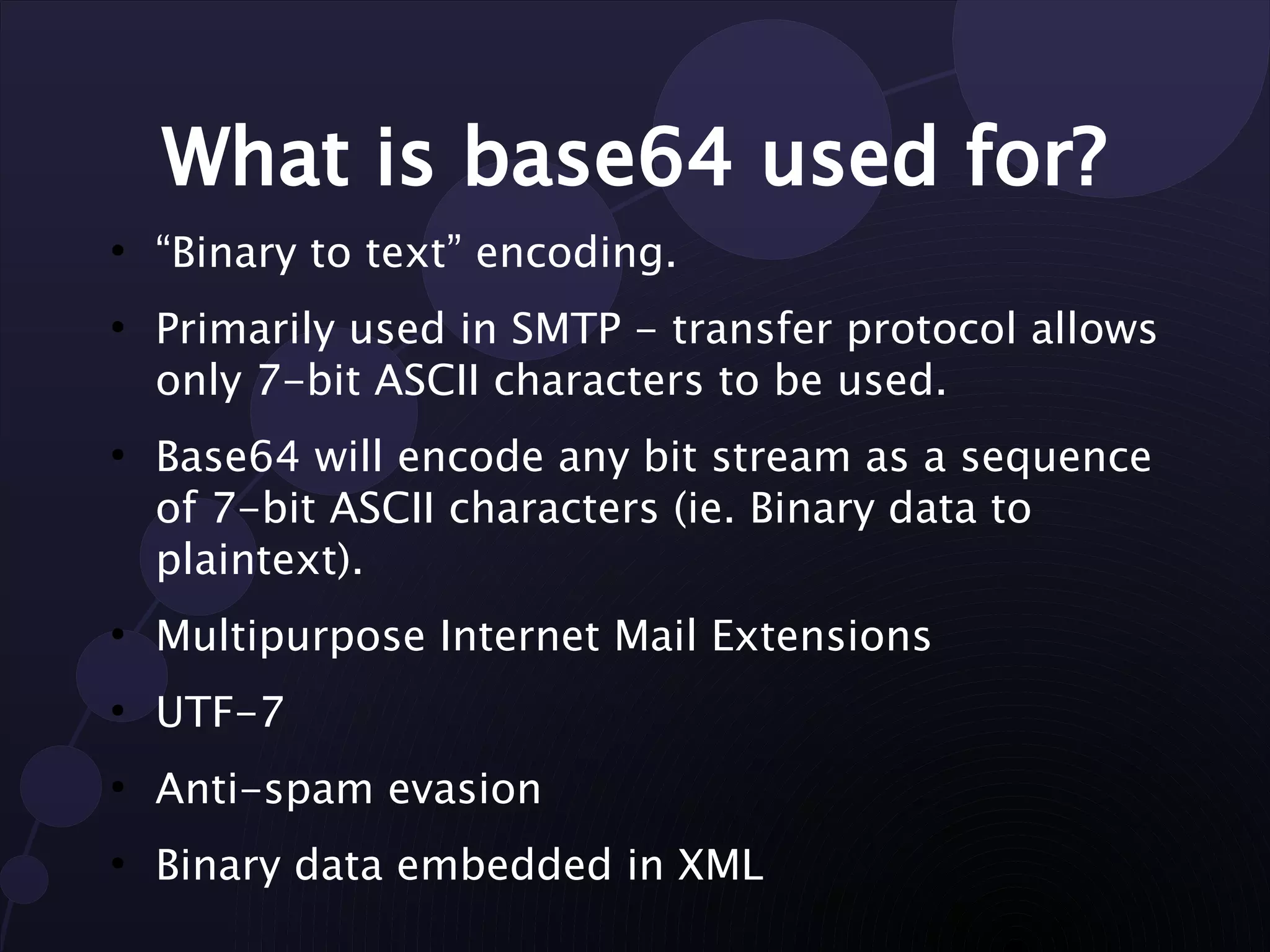
    “Binary to text” encoding.
●
    Primarily used in SMTP - transfer protocol allows
    only 7-bit ASCII characters to be used.
●
    Base64 will encode any bit stream as a sequence
    of 7-bit ASCII characters (ie. Binary data to
    plaintext).
●
    Multipurpose Internet Mail Extensions
●
    UTF-7
●
    Anti-spam evasion
●
    Binary data embedded in XML
The Encoding Algorithm
●
     Binary data is split into groups of 24 bits (3 bytes), then
     split into 6-bit chunks and converted to the corresponding
     ASCII characters.
    Original bit stream   011010110110101001101011


    6-bit chunks          011010 110110 101001 101011


    Decimal                       26 54 41 43


    Base64                            a2pr
The Encoding Algorithm
●
     What if we don't have a multiple of 3 bytes in our
     bit stream?
    Original bit stream   01100010011011000111010101100101


    Take first 24 bits,      011000 100110 110001 110101
    split into 6-bits


    Decimal                         24 38 49 53


    Base64                            Ymx1
The Encoding Algorithm
Take remaining bits          01100101


Take first 24 bits,    011001 01xxxx xxxxxx xxxxxx
split into 6-bits

Fill incomplete bits   011001 010000 xxxxxx xxxxxx
with zeros


Decimal                          25 26


Base64, replace                  ZQ==
blank bits with '='
Other Notes
●
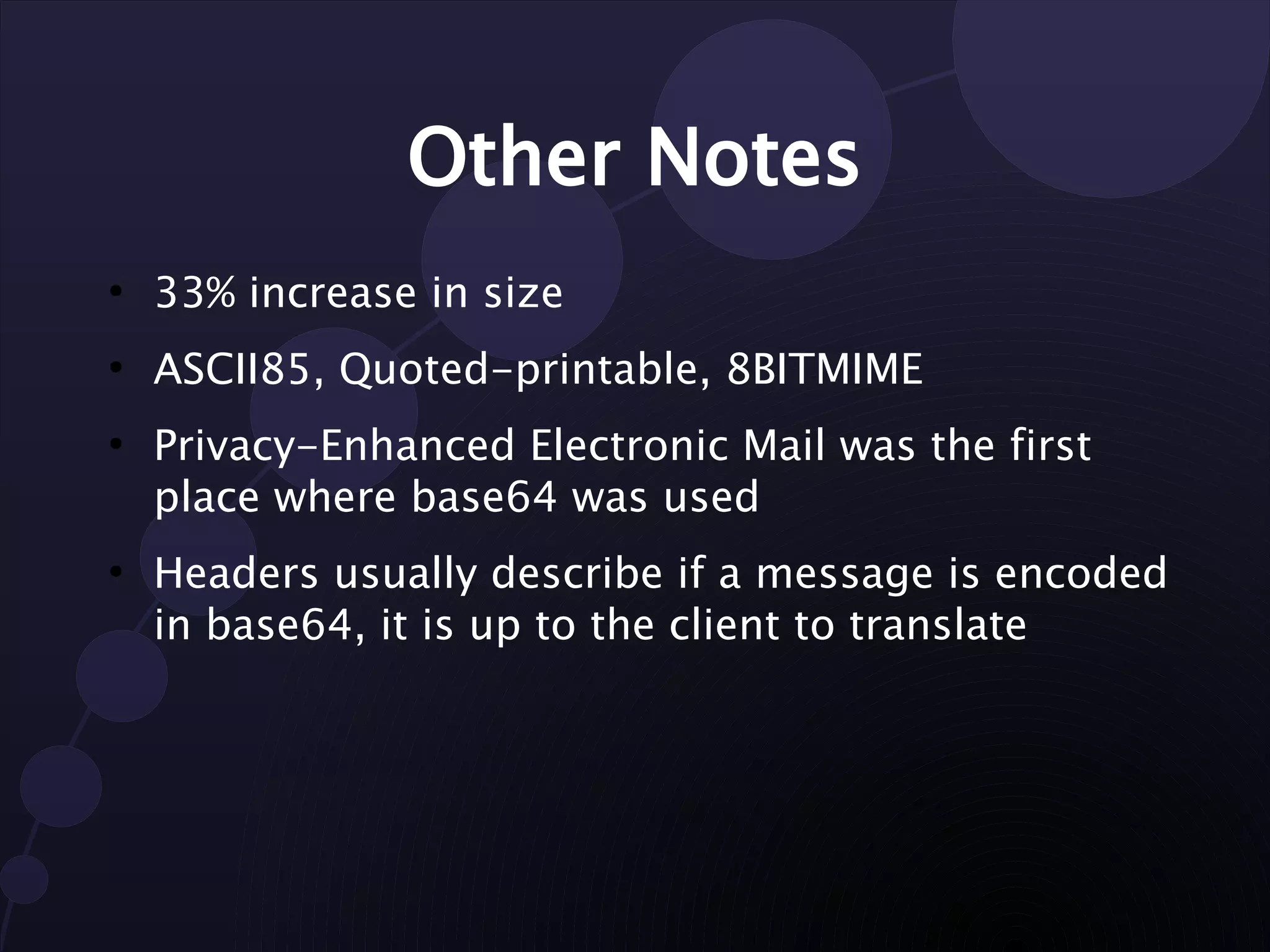
    33% increase in size
●
    ASCII85, Quoted-printable, 8BITMIME
●
    Privacy-Enhanced Electronic Mail was the first
    place where base64 was used
●
    Headers usually describe if a message is encoded
    in base64, it is up to the client to translate

Base64 Encoding

  • 1.
    Base64 Encoding Jonathan Francis Roscoe jjr6@aber.ac.uk
  • 2.
    Topics of Discussion ● Encoding and encryption ● What is base64 used for? ● Usage of base64 encoding ● The algorithm ● Drawbacks ● Alternatives
  • 3.
    Encoding and Encryption ● People often refer to base64 (and similar methods) as a form of encryption. ● Encoding is the process of transforming information from one format into another. – Transfer – Storage – Formating (eg. LaTeX – semantics encoding) ● Encryption is a type of encoding that obscures information to make it unreadable without special knowledge.
  • 4.
    What is base64? ● Positional notation – a quadrosexagesimal number system ● Numerals 0-9, alphabetical characters a-z and A-Z plus two special characters (all printable ASCII) ● VGhlIHF1aWNrIGJyb3duIGZveCByYW4gb3ZlciB0aGUgbGF6eS Bkb2c= Value 0 1 2 3 4 5 6 7 8 9 10 11 12 13 14 15 Base64 A B C D E F G H I J K L M N O P Value 16 17 18 19 20 21 22 23 24 25 26 27 28 29 30 31 Base64 Q R S T U V W X Y Z a b c d e f Value 32 33 34 35 36 37 38 39 40 41 42 43 44 45 46 47 Base64 g h i j k l m n o p q r s t u v Value 48 49 50 51 52 53 54 55 56 57 58 59 60 61 62 63 Base64 w x y z 0 1 2 3 4 5 6 7 8 9 + /
  • 5.
    What is base64used for? ● “Binary to text” encoding. ● Primarily used in SMTP - transfer protocol allows only 7-bit ASCII characters to be used. ● Base64 will encode any bit stream as a sequence of 7-bit ASCII characters (ie. Binary data to plaintext). ● Multipurpose Internet Mail Extensions ● UTF-7 ● Anti-spam evasion ● Binary data embedded in XML
  • 6.
    The Encoding Algorithm ● Binary data is split into groups of 24 bits (3 bytes), then split into 6-bit chunks and converted to the corresponding ASCII characters. Original bit stream 011010110110101001101011 6-bit chunks 011010 110110 101001 101011 Decimal 26 54 41 43 Base64 a2pr
  • 7.
    The Encoding Algorithm ● What if we don't have a multiple of 3 bytes in our bit stream? Original bit stream 01100010011011000111010101100101 Take first 24 bits, 011000 100110 110001 110101 split into 6-bits Decimal 24 38 49 53 Base64 Ymx1
  • 8.
    The Encoding Algorithm Takeremaining bits 01100101 Take first 24 bits, 011001 01xxxx xxxxxx xxxxxx split into 6-bits Fill incomplete bits 011001 010000 xxxxxx xxxxxx with zeros Decimal 25 26 Base64, replace ZQ== blank bits with '='
  • 9.
    Other Notes ● 33% increase in size ● ASCII85, Quoted-printable, 8BITMIME ● Privacy-Enhanced Electronic Mail was the first place where base64 was used ● Headers usually describe if a message is encoded in base64, it is up to the client to translate